Saturday, April 04, 2009

http://www.weeklystandard.com/weblogs/TWSFP/Obama%20brain.JPG
From The Guardian (UK):
The question that flummoxed the great orator
John Crace

Barack Obama, the World's Greatest Orator (™all news organisations), didn't exactly cover himself in glory when the BBC's political editor Nick Robinson asked him a question about who was to blame for the financial crisis. Normally word perfect, Obama ummed, ahed and waffled for the best part of two and a half minutes. Here, John Crace decodes what he was really thinking ...

Nick Robinson: "A question for you both, if I may. The prime minister has repeatedly blamed the United States of America for causing this crisis. France and Germany both blame Britain and America for causing this crisis. Who is right? And isn't the debate about that at the heart of the debate about what to do now?" Brown immediately swivels to leave Obama in pole position. There is a four-second delay before Obama starts speaking [THANKS FOR NOTHING, GORDY BABY. REMIND ME TO HANG YOU OUT TO DRY ONE DAY.] Barack Obama: "I, I, would say that, er ... pause [I HAVEN'T A CLUE] ... if you look at ... pause [WHO IS THIS NICK ROBINSON JERK?] ... the, the sources of this crisis ... pause [JUST KEEP GOING, BUDDY] ... the United States certainly has some accounting to do with respect to . . . pause [I'M IN WAY TOO DEEP HERE] ... a regulatory system that was inadequate to the massive changes that have taken place in the global financial system ... pause, close eyes [THIS IS GOING TO GO DOWN LIKE A CROCK OF SHIT BACK HOME. HELP]. I think what is also true is that ... pause [I WANT NICK ROBINSON TO DISAPPEAR] ... here in Great Britain ... pause [SHIT, GORDY'S THE HOST, DON'T LAND HIM IN IT] ... here in continental Europe ... pause [DAMN IT, BLAME EVERYONE.] ... around the world. We were seeing the same mismatch between the regulatory regimes that were in place and er ... pause [I'VE LOST MY TRAIN OF THOUGHT AGAIN] ... the highly integrated, er, global capital markets that have emerged ... pause [I'M REALLY WINGING IT NOW]. So at this point, I'm less interested in ... pause [YOU] ... identifying blame than fixing the problem. I think we've taken some very aggressive steps in the United States to do so, not just responding to the immediate crisis, ensuring banks are adequately capitalised, er, dealing with the enormous, er ... pause [WHY DIDN'T I QUIT WHILE I WAS AHEAD?] ... drop-off in demand and contraction that has taken place. More importantly, for the long term, making sure that we've got a set of, er, er, regulations that are up to the task, er, and that includes, er, a number that will be discussed at this summit. I think there's a lot of convergence between all the parties involved about the need, for example, to focus not on the legal form that a particular financial product takes or the institution it emerges from, but rather what's the risk involved, what's the function of this product and how do we regulate that adequately, much more effective coordination, er, between countries so we can, er, anticipate the risks that are involved there. Dealing with the, er, problem of derivatives markets, making sure we have set up systems, er, that can reduce some of the risks there. So, I actually think ... pause [FANTASTIC. I'VE LOST EVERYONE, INCLUDING MYSELF] ... there's enormous consensus that has emerged in terms of what we need to do now and, er ... pause [I'M OUTTA HERE. TIME FOR THE USUAL CLOSING BOLLOCKS] ... I'm a great believer in looking forwards than looking backwards.

Tuesday, March 31, 2009

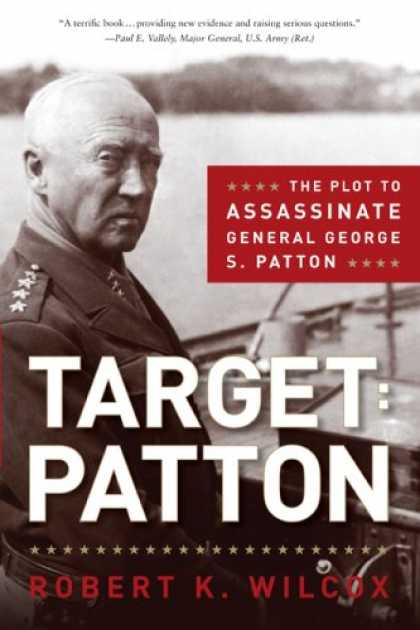
http://www.coverbrowser.com/image/bestsellers-2008/283-3.jpg
We've got a terrible situation with this great patriot, he's out of control
and we must save him from himself'. The OSS head General did not trust Patton.

From The Telegraph (UK): Good overview of an essential read.
General George S. Patton was assassinated to
silence his criticism of allied war leaders
claims new book

By Tim Shipman in Washington

George S. Patton, America's greatest combat general
of the Second World War, was assassinated after the conflict
with the connivance of US leaders, according to a new book.


Last Updated: 8:47PM GMT 07 Jan 2009

The newly unearthed diaries of a colourful assassin for the wartime Office of Strategic Services (OSS), the forerunner of the CIA, reveal that American spy chiefs wanted Patton dead because he was threatening to expose allied collusion with the Russians that cost American lives.

The death of General Patton in December 1945, is one of the enduring mysteries of the war era. Although he had suffered serious injuries in a car crash in Manheim, he was thought to be recovering and was on the verge of flying home.

But after a decade-long investigation, military historian Robert Wilcox claims that OSS head General "Wild Bill" Donovan ordered a highly decorated marksman called Douglas Bazata to silence Patton, who gloried in the nickname "Old Blood and Guts".

His book, "Target Patton", contains interviews with Mr Bazata, who died in 1999, and extracts from his diaries, detailing how he staged the car crash by getting a troop truck to plough into Patton's Cadillac and then shot the general with a low-velocity projectile, which broke his neck while his fellow passengers escaped without a scratch.

Mr Bazata also suggested that when Patton began to recover from his injuries, US officials turned a blind eye as agents of the NKVD, the forerunner of the KGB, poisoned the general.

Mr Wilcox told The Sunday Telegraph that when he spoke to Mr Bazata: "He was struggling with himself, all these killings he had done. He confessed to me that he had caused the accident, that he was ordered to do so by Wild Bill Donovan.

"Donovan told him: 'We've got a terrible situation with this great patriot, he's out of control and we must save him from himself and from ruining everything the allies have done.' I believe Douglas Bazata. He's a sterling guy."

Mr Bazata led an extraordinary life. He was a member of the Jedburghs, the elite unit who parachuted into France to help organise the Resistance in the run up to D-Day in 1944. He earned four purple hearts, a Distinguished Service Cross and the French Croix de Guerre three times over for his efforts.

After the war he became a celebrated artist who enjoyed the patronage of Princess Grace of Monaco and the Duke and Duchess of Windsor.

He was friends with Salvador Dali, who painted a portrait of Bazata as Don Quixote.

He ended his career as an aide to President Ronald Reagan's Navy Secretary John Lehman, a member of the 9/11 Commission and adviser to John McCain's presidential campaign.

Mr Wilcox also tracked down and interviewed Stephen Skubik, an officer in the Counter-Intelligence Corps of the US Army, who said he learnt that Patton was on Stalin's death list. Skubik repeatedly alerted Donovan, who simply had him sent back to the US.

"You have two strong witnesses here," Mr Wilcox said. "The evidence is that the Russians finished the job."

The scenario sounds far fetched but Mr Wilcox has assembled a compelling case that US officials had something to hide. At least five documents relating to the car accident have been removed from US archives.

The driver of the truck was whisked away to London before he could be questioned and no autopsy was performed on Patton's body.

With the help of a Cadillac expert from Detroit, Mr Wilcox has proved that the car on display in the Patton museum at Fort Knox is not the one Patton was driving.

"That is a cover-up," Mr Wilcox said.

George Patton, a dynamic controversialist who wore ivory-handled revolvers on each hip and was the subject of an Oscar winning film starring George C. Scott, commanded the US 3rd Army, which cut a swathe through France after D-Day.

But his ambition to get to Berlin before Soviet forces was thwarted by supreme allied commander Dwight D. Eisenhower, who gave Patton's petrol supplies to the more cautious British General Bernard Montgomery.

Patton, who distrusted the Russians, believed Eisenhower wrongly prevented him closing the so-called Falaise Gap in the autumn of 1944, allowing hundreds of thousands of German troops to escape to fight again,. This led to the deaths of thousands of Americans during their winter counter-offensive that became known as the Battle of the Bulge.

In order to placate Stalin, the 3rd Army was also ordered to a halt as it reached the German border and was prevented from seizing either Berlin or Prague, moves that could have prevented Soviet domination of Eastern Europe after the war.

Mr Wilcox told The Sunday Telegraph: "Patton was going to resign from the Army. He wanted to go to war with the Russians. The administration thought he was nuts.

"He also knew secrets of the war which would have ruined careers.

I don't think Dwight Eisenhower would ever have been elected president if Patton had lived to say the things he wanted to say." Mr Wilcox added: "I think there's enough evidence here that if I were to go to a grand jury I could probably get an indictment, but perhaps not a conviction."

Charles Province, President of the George S. Patton Historical Society, said he hopes the book will lead to definitive proof of the plot being uncovered. He said: "There were a lot of people who were pretty damn glad that Patton died. He was going to really open the door on a lot of things that they screwed up over there."

Monday, March 30, 2009

http://ebooks-imgs.connect.com/product/400/000/000/000/000/121/878/400000000000000121878_s4.jpg
BOOK REVIEW: From Asia Times
This almost-chosen, almost-pregnant land
American Babylon
by Richard John Neuhaus

Reviewed by Spengler

President Abraham Lincoln famously called Americans an "almost chosen people". That might qualify as America's national joke, for you can't be "almost chosen" any more than you can be almost pregnant.

Lincoln's oxymoron frames the tension between the religious impulses that made America and the reality that ultimately it is one imperfect polity among many others. America is "a country with the soul of a church", as G K Chesterton wrote, and by no accident, the only industrial nation (apart from Israel) in which religion plays a decisive role in public life. The central role of religion continues to polarize Americans and confuse foreign observers.

The working of faith in America's public square is more complex than Americans acknowledge, or foreigners understand, Richard John Neuhaus shows in this study of the heavenly city versus the earthly city of our exile.

Idolatry attracts both wings of American politics: the right tends to confound the United States of America with the City of God, while the left makes an object of worship out of its utopian imagination. Neuhaus was a pre-eminent social conservative and an advisor to former president George W Bush, but no less an even-handed critic for that. That quality that makes American Babylon: Notes of a Christian Exile one of the indispensable books of our time, of such importance that one wants to suspend debate of America's character until everyone has had time to read it.

Until his death on January 8, Father Neuhaus was America's pre-eminent Christian intellectual, and his posthumous book reminds us what a gap in public discourse is left by his absence. Starting in 1990, Neuhaus edited (and wrote a good deal of) the monthly journal First Things. It is hard for this writer to imagine intellectual life in America without First Things.

I have missed very few issues in the past 15 years, and could not have found my own journalistic vocation had Neuhaus not blazed such a broad trail. In 2007, I had the honor to contribute an essay on Franz Rosenzweig to his journal. Neuhaus was the rare sort of writer from whom one learned especially in disagreement, for his formulation of the issues was so lucid as to force those who did not share his views to rethink their own.

"There is in America," he wrote, "a strong current of Christian patriotism in which 'God and country' falls trippingly from the tongue. Indeed, God and country are sometimes conflated in a single allegiance that permits no tension, never mind conflict, between the two." Neuhaus added that "this book is animated by a deeply and lively patriotism", adding, "I have considerable sympathy for Abraham Lincoln's observation that, among the political orders of the earthly city, America is 'the last, best hope of mankind'."

On the left, utopian efforts to create a heaven on Earth expressed American idolatry, for example, in the Social Gospel movement of Walter Rauschenberg, "Christianizing America and Americanizing Christianity." The liberal philosopher John Dewey embodied the drift of mainline Protestantism into a social reform movement. The heir of this left-wing current is Rauschenberg's grandson, the late philosopher Richard Rorty, whose career was dedicated to proving the proposition that no proposition can be proven.

It is even sillier than it sounds, in Neuhaus' amusing account. As Neuhaus says,
Rorty writes that [John] Dewey and his soulmate Walt Whitman "wanted [their] utopian America to replace God as the unconditional object of desire. They wanted the struggle for social justice to be the country's animating principle, the nation's soul". He quotes favorably the lines of Whitman:

And I say to mankind, Be not curious about God,
For I who am curious about each am not curious about God.


"Whitman and Dewey," Rorty writes, "gave us all the romance, and all the spiritual uplift we Americans need to go about our public business."
That is the left-wing version of American self-worship. American nationalism harbors a civic religion as well. There is, Neuhaus explains,
a line of devotion that runs from the [Puritans'] "errand in the wilderness" to John F Kennedy's inaugural ... It is the American story, the American promise, that is invoked in Martin Luther King Jr's dream of the "beloved community" and in Ronald Reagan's vision of the "city on a hill".

Some readers will be surprised and others scandalized by the suggestion that George W Bush was in the tradition of Washington, Lincoln, Wilson, Kennedy, King and Reagan in sounding the characteristic notes of the American story, but so it is.
This is painfully clear, observes Neuhaus, in George W Bush's second inaugural address:
We are led [Bush said in his address] by events and common sense, to one conclusion: the survival of liberty in our land increasingly depends on the success of liberty in other lands. The best hope for peace in our world is the expansion of freedom in all the world. America's vital interest and our deepest beliefs are now one ... We go forward with complete confidence in the even triumph of freedom. Not because history runs on the wheels of inevitability; it is human choices that move events. Not because we consider ourselves a chosen nation; God moves and chooses as He wills.
"Both the power and the danger of the story is in the sincerity with which it is told," Neuhaus commented. "Good intentions go awry; we blind ourselves to our own capacity for self-deception when we cast ourselves in the role of God's agents in history's battle between The Children of Light and The Children of Darkness, to cite the title of [a] book by [Reinhold] Niebuhr."

Bush's second inaugural was an exercise in American self-worship, in its assumption that the free institutions of the United States were an earthly manifestation of the divine, such that the American government should become a Bureau of Missions for the cult of democracy. But it is manifestly false that America's security depends upon the success of freedom elsewhere. China's political system is not free by Western standards, yet China poses no strategic threat to the United States. Dictatorships that support terrorism well may constitute a strategic threat to the United States, especially if they are able to employ nuclear weapons. But the United States could just as well wipe all of them off the face of the Earth through pre-emptive nuclear bombardment, or let them fight each other to exhaustion, as try to foster democracy in their midst. America had no strategic imperative to promote democracy, only a narcissistic one.

Neuhaus concludes,
However high our appreciation of America's achievement and promise, and whether that appreciation is expressed from the left, as in the case of Richard Rorty's work, or from the right, as in George W Bush's speech, with its confidence in "a new order of the ages", the great danger is in forgetting that America, too, is Babylon.
From a Christian vantage point, Neuhaus means, every earthly city is an exile, like the Babylon whence the Jews of the 6th century were exiled after the fall of Jerusalem. Nonetheless, the Puritans who founded the Massachusetts Bay Colony, as Neuhaus retells the story, saw themselves as a new chosen people founding a new promised land. In some tellings of the story, they and the New World were Jerusalem, having escaped the captivity of the Babylon of the Old World ... And, in the more fantastical flights of theological imagination, America is something very close to the New Jerusalem. That, as Neuhaus reports, was the view of the great 18th-century theologian Jonathan Edwards, whose "Great Awakening" preceded and by most accounts prepared the ground for the American Revolution. Yet the fervent Calvinism of the Puritans and Jonathan Edwards turned into the mushy transcendentalism of Ralph Waldo Emerson by the 1830s. With good reason, American critic Harold Bloom characterized this peculiar variety of American religion as Gnostic. Nonetheless:
In the 1860s the church of the novus ordo seclorum was shattered by the bloodiest war in your history, and from that catastrophe emerged the most profound theologian of the civil religion. Lincoln's Second Inaugural Address, with its troubled reflection on the mysteries of providence, is in some ways worthy of St Augustine, except, of course, that it is without Augustine's Church, and therefore without the communal bearer of the story of the world by which all other stories, including the story of America, are truly told. American theology has suffered from an ecclesiological deficit, leading to an ecclesiological substitution of America for the Church through time.
There is no gainsaying Neuhaus' critique of the Puritans, who were in a sense play-acting at being Jews with their vision of a new chosen people and a new promised land. Gentiles do not emulate the Jews, or "Judaize", with success, perhaps because Jewish continuity depends not only upon faith but upon blood ties. By 1800, every formerly Puritan church in Boston but one had turned Unitarian, and the vapid Emerson became their intellectual heir.

Still, the tiny band of English separatists who departed Delft on the Mayflower in 1620 had better reasons to seek an "errand in the wilderness" than we easily can imagine today. Then in its second year, the Thirty Years War eventually would kill about two-fifths of the people of Central Europe, and destroy forever the Christian Empire of the Middle Ages, leaving the secular nation state in its place as Europe's principle of political organization.

A red line connects the Thirty Years War of 1618-1648 to the Second Thirty Years War of 1914-1945. Whether the Puritans were right to conclude that Europe already had been lost for Christianity is a matter for historians to debate. But it is hard to imagine how Europe might have avoided the victory of communism or fascism were it not for the United States, now the only major nation in which Christianity remains at the center of public life. If the Puritans had not sailed to America in emulation of Israel leaving Egypt, the Gates of Hell well might have prevailed over St Peter.

Lincoln appeared not only "as the most profound theologian of the civil religion", as Neuhaus argues, but arguably as the most profound American theologian of any religion. That is the view of the evangelical historian Mark Noll in his book America's God. "Views of providence," Noll writes, "provide the sharpest contrast between Lincoln and the professional theologians of his day."

Noll muses that "the American God may have been working too well for the Protestant theologians who, even as they exploited Scripture and pious experience so successfully, yet found it easy to equate America's moral government of God with Christianity itself. Their tragedy - and the greater the theologian, the greater the tragedy - was to rest content with a God defined by the American conventions God's own loyal servants had exploited so well."

Because America is not a chosen nation, Neuhaus warns, "we should be uneasy even with Lincoln's sharply modified claim that we are an 'almost chosen' people". But "almost chosen" is like "almost pregnant", and the absurdity of Lincoln's joke suggests the possibility of a more benign reading.

America brought into the world a new political form, the non-ethnic democracy, a necessary but not sufficient condition for a Christian nation. America really is different, from, say, Poland, the homeland of the greatest religious leader of our times. Pope John Paul II's last book, Memory and Identity, "is about Poland and being Polish, both of which John Paul explores and affirms in a way that many might think scandalously chauvinistic", Neuhaus observes.

In some respects, Poland deserves the special admiration of her pre-eminent son. As a breakaway Soviet buffer state on the central front, Poland occupied center stage in the Cold War, and the Polish people led by the Catholic Church rose heroically to the occasion.

The trouble is that Poland's story is coming to an end. The country's population will fall by almost 30% by mid-century, and the median age will rise from 36 years to 56 years. Benedict XVI, for that matter, ranks by my reckoning as the best mind on the planet, but it is questionable whether today's Germany is capable of educating another Joseph Ratzinger.

America's story will not end, at least not in the same way. What we might call America's "Special Providence" is founded on its capacity to absorb the talented and energetic immigrants vomited out by the wars and persecutions of the Old World.

Europe's residual paganism, the persistence of ethnic self-worship under a Christian veneer, became the downfall of Christendom. America's fresh start made it congenitally receptive to Christianity.
Only in its potential is America "almost chosen"; the extent to which it actually is Christian will depend not on its constitution but on its churches. Ultimately, the Puritan hope of forming a new chosen people in a new promised land only could fail, but it is hard to see how Christianity could have prevailed in the West without it.

Sometimes, perhaps, Christians may have to emulate the Jews in order to remain Christians.

American Babylon: Notes of a Christian Exile by Richard John Neuhaus. Basic Books, New York 2009. ISBN-10: 0465013678. Price US$26.95, 288 pages.

Sunday, March 29, 2009

Salvatore Abruzzese as a boy who gets caught up in the Neapolitan Mafia.

Salvatore Abruzzese as a boy who gets caught up in the Neapolitan Mafia.

From The New Yorker: Excellent review of a superb film.
G0morrah
by Anthony Lane


February 23, 2009

The first thing you should know about “Gomorrah” is that no fewer than three members of its cast have been arrested on suspicion of illegal activities. There could be no more unimpeachable testament, surely, to the integrity of Matteo Garrone’s film, which is about organized crime in Naples. Many of the actors were recruited from the area, presumably on the basis that they already knew the ropes, not to mention the Kalashnikovs.

You might say that the project smelled of trouble from the start. It began as a nonfiction book by the journalist Roberto Saviano, published in 2006, entitled “Gomorra”; one letter less gave more weight to the pun, yoking the Camorra, or Neapolitan Mafia, with a place of Biblical folly. The book, which opens with frozen Chinese corpses falling out of a shipping container on an Italian quayside—a small matter of human trafficking gone awry—was so detailed, and so incensed, in exposing the venalities of the Mob that Saviano now lives in hiding, under police protection. It was hard to picture his writhing tales of revenge being unpicked and sorted into cinematic sense, but somehow Garrone, working with a clan of screenwriters (including Saviano), has brought order to the sprawl. Even so, the result demands a patient viewing, and maybe more than one; only after a second dose did I get the measure of Garrone’s mastery, and realize how far he has surpassed, not merely honored, the author’s courageous toil.

There are five stories, layered and stuck together, raising the possibility that Garrone modelled the whole thing on a lasagna verde. We get them morsel by morsel, and the brisk dicing between them can catch the viewer unprepared. There is Totò (Salvatore Abruzzese), age thirteen, who spies a dropped gun in the street, returns it to local thugs, and, in reward, becomes a mini-mule in the drug trade. There is a pair of teen-agers, Marco (Marco Macor) and Ciro (Ciro Petrone), fools in love with a gangsterish ideal; “I’m No. 1! Tony Montana!” they cry, acting out their pantomime of “Scarface” in an empty tenement, where a sunken, unused bath echoes not just old Brian De Palma movies but much older tubs, in the balneae of Pompeii, across the bay. There is Don Ciro (Gianfelice Imparato), whose name hints at potency, but who is, in fact, a frightened hireling in a cheap blouson, distributing cash to those families who exist on the say-so of the Camorra. There is Franco (Toni Servillo), the most accomplished gentleman on view, and the one most at ease with evil; aided by a reluctant sidekick, Roberto (Carmine Paternoster), he arranges for the disposal of industrial waste. That sounds like a filmmaker’s convenient symbol, but, if you live in certain parts of southern Italy, the poisoning of the land is right in front of your nose, and under your skin.

Last, and best, of the central figures is Pasquale, played by Salvatore Canta-lupo. (Has any bunch of actors had better names?) Pasquale is a Thurberish drone, keeping his head down but unable to stop lifting up his eyes to resplendent things. He is a tailor, working his fingers off in the service of couture, or, rather, of its speedy, backroom simulacrum. In a bid to earn more, he accepts a secret offer to tutor Chinese immigrants in his delicate art, and what follows is a touching nocturnal farce. Bundled into the trunk of a car, he arrives not at some dripping sweatshop but at a spotless workplace, lined with eager apprentices who applaud his entrance as though he had come to conduct them: “They called me Maestro!” he whispers to his wife, creeping back at dawn. Moments like this achieve what so few American movies seem to be doing just now: they take on a big subject, unwieldy and unglamorous—in this case, the illegal economies that thrive under globalization, and on which we unwittingly feed—and dig out from it a cluster of private dramas that are highly specific (some Italian audiences required subtitles for “Gomorrah,” so parochial is the Neapolitan dialect), and yet which could, you feel, find an answering gleam almost anywhere on the planet. Toward the close, at a truck stop, Pasquale glances at a TV and sees a clip of a radiant Scarlett Johansson parading at a movie première, wearing a dress that he himself ran up at cut price, or perhaps its costlier identical twin; the expression on the tailor’s face is, you might say, his final master class, proving the beauty of ruefulness.

But then “Gomorrah” is a beautiful movie. That may sound perverse, given its welter of drive-by shootings and toxic dumps, but what is most impressive about Garrone is his refusal to let his style be bulldozed by the runaway violence of his subject. This is organized crime. Not for him the panicky, catch-me-if-you-can approach of a film like “City of God”—or, indeed, like “Slumdog Millionaire,” which next to “Gomorrah” seems like an adventure vacation. The mobsters may be trigger-frenzied, but the movie takes constant care, with a kind of appalled wonder, to survey the arenas of their mayhem. Don Ciro does the rounds of Scampia, a northern suburb of Naples, where people live and die in tower blocks that look like ruined ziggurats. Most of the camerawork is handheld, but now and then we pull back for a lofted view: a panorama as unruffled as an Andreas Gursky photograph. Meanwhile, Totò and other kids, in some murky shell of a building, take turns to strap on a makeshift bulletproof vest, get shot in the chest, struggle to their feet, and thereby prove themselves as men-in-waiting; as each vanishes into the gloom to receive his blow, we could be watching a parable of the ancient underworld. Few recent films have been as timely as “Gomorrah,” yet time itself seems to melt around the action; when an ambushed car crashes into an array of mock-classical statuary, you think, Is that the fate of the Roman past? To be cracked into plaster dust by the antics of modern hoodlums?

Garrone’s film is less furious than Saviano’s book, which has the tang of personal nausea, and for that reason, I suspect, it will prove more enduring. (It failed to make the nominations for Best Foreign Film at the Academy Awards: the usual travesty.) As I watched various Scampians being slain or spared on a whim, I felt borne along not so much by reportage, however well dramatized, as by a fierce meditation on the vagaries of fate—and thus, oddly enough, by the pull of comedy. When Franco, in a cathedral-size quarry, needs a new set of truck drivers to shift his drums of corrosive chemicals, whom does he call? Local children, who perch on cushions to see through the windshield; in a way, they make better mafiosi than the adults, yielding with less caution and complaint to their instinctual urges. There is a terrible numbness to the grownups, spun in the endless cycle of revenge; “We don’t know anything” is the conclusion of one group, which agrees to press ahead with murder, for want of another plan. I’m not sure that, after this movie, I will be able to take quite such unquestioning pleasure in the suave, all-knowing dons of the “Godfather” trilogy, let alone the stylized brutality of “Scarface”; the spoiled earth of “Gomorrah” is the ground zero of Mob cinema, burning away the sleekness and self-congratulation of the genre. The movie ends on a beach, every bit as haunting as those deserted strands unveiled by Antonioni in “The Girlfriends” and “Beyond the Clouds.” We could, in short, be watching the loveliest of art-house films, were it not for the dead bodies being scooped off the sand by a digger. When human beings become flotsam, all that art can do is stand and look.