Saturday, June 14, 2008

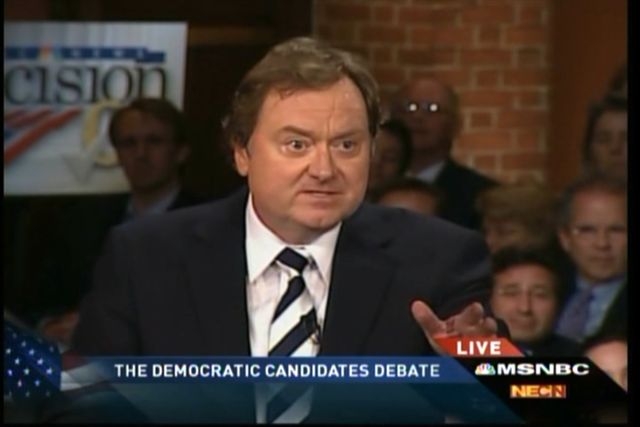
http://upload.wikimedia.org/wikipedia/commons/thumb/5/57/Tim_Russert.jpg/800px-Tim_Russert.jpg
From The New York Times:
National Politicians Sought Out
the Crucial ‘Russert Test’

By JIM RUTENBERG

Through Republican revolution and Republican collapse, the rise and fall of the Houses Clinton and Bush, one war in Afghanistan and two in Iraq, Tim Russert remained a center of gravity in the national discourse every Sunday on “Meet the Press.”

With an everyman’s style all his own, he captained the oldest political program on television to a steady place at the head of a pack that expanded by the year as cable news imitators sought his level of influence and Internet challengers sought to question it and the Washington political-media establishment he came to represent.

Mr. Russert put a definitive stamp on “Meet the Press,” overshadowing hosts who came before him, Martha Rountree, Ned Brooks and Lawrence Spivak, even though they had interviewed figures like the Rev. Dr. Martin Luther King Jr., John F. Kennedy and Eleanor Roosevelt.

If there was any doubt Mr. Russert’s place in the fabric of Washington was without parallel, the way his news was received inside and outside the Capitol should have put it to rest. White House staff members interrupted President Bush while he dined with President Nikolas Sarkozy of France at the Élysée Palace to tell him the news. Mr. Bush quickly issued a statement, along with scores of others, among them Senators Barack Obama and John McCain. In a tribute, NBC planned to devote an hour to Mr. Russert on Friday night, and it gave over its entire “Nightly News” to him. Mr. Russert had become more famous than many of his interviewees. The Web site of The New York Times received more than 2,000 comments about the death.

Underscoring how Mr. Russert had become more famous than many of his interviewees, Sally Quinn, the writer and socialite, equated his death with those of Kennedy, and Katharine Graham of The Washington Post, saying ,“He had such incredible influence.”

An interview with Mr. Russert could be a punishing gantlet or a victorious trial by fire for those who tried to sell a candidacy, defend against accusations or, even, market a war.

“He sort of set the model for interviewing politicians,” said Robert S. Bennett, the Washington lawyer who represented President Bill Clinton in the Monica Lewinsky scandal and, at times, was heavily involved in his communications strategy.

“Even though political people knew that they might come out of the show somewhat bloodier because of his incredible preparation and that of his staff, they went on anyway,” Mr. Bennett said. “If you could survive Russert, you scored a lot of points.”

But a “Meet the Press” appearance was one of necessity, not choice. It was a requisite rite of passage for any would-be president.

Dan Bartlett, counselor to Mr. Bush until last year, remembered in an interview how Mr. Bush’s campaign decided to put him on “Meet the Press” in 1999 for a full hour. The intent, Mr. Bartlett said, was to put to rest accusations that their man, then the Texas governor, was a lightweight.

“We felt like he performed well,” Mr. Bartlett recalled. “You might even say he passed the ‘Russert Test.’ It was a bellwether doing the Russert show.”

Mr. Bush’s White House eventually assigned a press aide, Adam Levine, to focus specifically on preparing its officials for interviews with Mr. Russert. Mr. Levine was an expert on Russert interviews, which included the now widely used presenting subjects with their words and asking them about apparent contradictions.

Mr. Levine had unusual insight because he and Mr. Russert had worked for Senator Daniel Patrick Moynihan, the New York Democrat who demanded that his staff be fully aware of all important articles that day by dawn and whom Mr. Russert occasionally imitated for friends.

Some liberal press critics said Mr. Russert was too soft on the administration and, at times, pointed to him as a symbol of the coziness between the mainstream news media personalities and their subjects in Washington.

In his off-camera life, Mr. Russert did treat some of those he covered like friends when he crossed paths with them at the Palm steakhouse or at dinner parties. Mary Matalin, a longtime adviser to the Bush family and the wife of James Carville, the Democratic operative, recalled in a tearful interview that in those social settings family life and life in Washington were the first topics of conversation. “Our collective best times were talking about our kids or somebody’s mother or garbagemen,” Ms. Matalin said, using the latter as a reference to Mr. Russert’s insistence that broken glass be wrapped in paper so as not to pierce a sanitation worker, his father’s onetime occupation. “He didn’t lose who he was, ever,” she said.

But Mr. Russert was ambitious, refusing to take no for an answer from presidents and senators and pushing NBC to extend the program to a full hour. His top-dog status this year, his 10th in first place in popularity ratings, made him something of a target. The Columbia Journalism Review featured an online “RussertWatch,” a critical eye on his coverage. The Clinton campaign sometimes viewed him as a longtime hostile presence on television.

Predictions that his status would eventually diminish were proved wrong on May 7, when Mr. Russert declared that Mrs. Clinton could not win, and “we now know who the Democratic nominee’s going to be, and no one’s going to dispute it.” This being Washington, a new game of speculation will soon begin over who will inherit Mr. Russert’s Sunday morning mantle. But not yet.

“I haven’t accepted it yet,” Ms. Quinn said. “I can’t imagine Sundays without ‘Meet the Press.’ If it’s Sunday, it’s ‘Meet the Press.’ If it’s Sunday, it’s Tim.”

Friday, June 13, 2008

http://images.huffingtonpost.com/2007-09-27-TimRussertDartmouth.JPG
From Human Events:
Remembering Tim Russert

My friend and former intern Roland Nobile, when writing a story for me about a congressional primary in New Hampshire, followed in my footsteps by identifying himself as the interviewer of the candidate.

“Brady spoke to Nobile,” he wrote, “whose manner of questioning could only be called ‘Russert-esque’. . . .”

It goes without saying I penciled that one out before it got to the managing editor. And Roland, a bright young man who developed into an outstanding writer, was joshing—sort of. Although he never expected the comparison of his interviewing with that of Tim Russert, host of NBC’s Meet the Press, I got the message: in striving to be the best in everything he did, Roland the young achiever set the goal of being the best as “Russet-esque.”

After six years, that came back to me upon getting the stunning news that Tim Russert had died June 13th of a heart attack at age 58. Like Bing Crosby having his last moment in 1977 on the golf course he loved doing what he most enjoyed, early reports stated the NBC interviewer (who had diabetes) died on the job--recording a production track at the NBC News Bureau in Washington.

And that said it all about Tim Russert: he loved his job and did it well. A lot of us who consider ourselves “newsmen” and bristle when people without a background in batting out stories under pressure are thrust in our midst laughed upon learning in 1991 that the new host of the long-running NBC’s four-decades-plus-old Sunday news show would be Tim Russert. Tim Russert?! Why, he had only worked at NBC for seven years, joining their Washington bureau in 1984 and was, the refrain went, a pol, not a newsman.

John Carroll University and Cleveland-Marshall College of Law graduate Russert had been chief of staff to New York’s Democratic Sen. Daniel Patrick Moynihan from 1977-82 and then counselor to New York’s Democratic Gov. Mario Cuomo from 1982-84; I thought of him as I have a lot of Hill staffers—as someone who would make a move for office himself when the right opportunity arose. Sure enough, when Rep. Jack Kemp decided to leave his Buffalo-area House district to seek the Republican nomination for President in 1988, I recall discussing a possible candidacy with then-state legislator and later GOP Congressman Bill Paxon, the talk of prospective Democratic hopefuls turned to—you guessed it!—Russert of Buffalo.

Russert never made the race and by 1988 had become Washington Bureau Chief for NBC. The thought of him sitting in the chair held for so long by the legendary Lawrence Spivak and later by the no-nonsense newsman Bill Munroe was far-fetched.

But Russet won over skeptics, including me. Meet the Press expanded to one hour and now included more than one guest. Senators and representatives with differing viewpoints squared off, and later candidates in major Senate races from around the country would have brief debates, with Russert serving as moderator. Gracious to a fault, he would introduce clips from the news and move the program on to another segment and then to the closing with the historic look-back, courtesy of MTP’s extensive archives. And then he would close on a friendly note, invoking his beloved Buffalo Bills during the football season.

As Tony Snow, Russert’s competitior for Sunday morning audiences on Fox News, and later White House press secretary, recalled: “Tim transformed the political interview from a staid and dull affair into an event. He combined the passion of a sports fan with the rigor of a trial attorney.”

Most significantly, Tim Russert was prepared—as guests found out and were often rendered speechless by his research. “He took Nation of Islam leader Louis Farrakhan on when Farrakhan dismissed charges he had engaged in virulent anti-semetic rhetoric. Russert gently referred him to quotes that showed the charges were true, shown in enlarged lettering for viewer and guest in studio to see.

Republican Rick Santorum and Democrat Bob Casey both got the “Russert treatment,” when they debated on MTP during their race for the Senate from Pennsylvania in 2006, and both were politely reminded by the moderator that, sure enough, they did say what he was saying they said. Earlier this year, GOP presidential hopeful Mike Huckabee learned that his tough illegal immigration manifesto that included deportation could deport some of the children of illegal aliens eligible for a scholarship under a measure he championed while governor of Arkansas. Again, rather than shouting “gotcha!” or interrupting Huckabee as other NBC hosts have done with guests, Russert pointed this out to the candidate gently and respectfully.

“Nothing more horrified a politician (or an aide) so much as the sight of Russert hauling out old quotes,” recalled Tony Snow, “and film clips, pieces of news and then closing the noose with a question: "Do you still believe that?" And yet, he was no inquisitor. Tim was kind to friends and loyal to causes. It was impossible not to like him.”

One could say that about all of this televised sessions, from presidential debates to election night coverage. Tim Russert was first and foremost a gentleman. He started out a “pol” and “staffer” and became a newsman. And we in the profession—and I include myself—began to work a little harder and be more “Russert-esque.” And, to a newsman, we will mourn and miss him.
http://www.dailygalaxy.com/photos/uncategorized/2007/11/05/tim_russert_3.jpg
From The Washington Post:
Journalist Revitalized Washington Talk Shows
By Howard Kurtz

Saturday, June 14, 2008

Tim Russert, the NBC commentator who revolutionized Sunday morning television and infused journalism with an unrelenting passion for politics, died of a heart attack yesterday.

Russert was recording a "Meet the Press" introduction in an NBC sound booth in Northwest Washington when he collapsed and was taken by ambulance, accompanied by his longtime producer Betsy Fischer, to Sibley Memorial Hospital, where he was pronounced dead soon afterward. He was 58.

The news swept the capital like a shock wave, with colleagues, rivals, President Bush and those vying to succeed him remembering Russert as a superb practitioner of political analysis and an irrepressible son of blue-collar Buffalo who, quite simply, loved the game. His influence was such that an appearance on the top-rated "Meet the Press" could boost or sink a candidate, and when he declared after midnight on May 6 that Barack Obama had wrapped up the Democratic nomination, that was treated as a news event in itself.

Russert wore many hats -- onetime Democratic operative, Washington insider, NBC bureau chief, MSNBC commentator, sports fanatic, committed Roman Catholic, biographer of his father, known as "Big Russ" -- but his greatest legacy was his sustained style of interrogation. Grounded in prodigious research, Russert would press his guests on past statements and contradictions, often for a full hour, spawning legions of imitators.

Friends were stunned by the news. "I just loved him," said Bob Schieffer, host of CBS's "Face the Nation." "When I scooped old Tim, I felt like I'd hit a home run off the best pitcher in the league."

"He was made for Washington because he lived and breathed politics," said Judy Woodruff, a former NBC correspondent now with PBS. But more than that, she said, he was remarkably empathetic. "When our son was sick about 10 years ago, he was right there, calling, coming over, bringing him back gifts from trips."

Russert's internist, Michael A. Newman, told MSNBC that an autopsy showed the journalist had an enlarged heart and that cholesterol plaque ruptured an artery, causing coronary thrombosis. He said Russert had been diagnosed earlier with coronary artery disease, but that it was controlled with medication and exercise and Russert had performed well on a stress test in late April.

The thread of Russert's career is laced through recent political history. His whiteboard from Election Night 2000 -- on which, early in the evening, he scribbled "Florida, Florida, Florida" -- became an iconic symbol of the disputed tally. Days after the Sept. 11, 2001, attacks, Vice President Cheney chose to appear on "Meet the Press." In late 2006, Sen. Barack Obama used the Russert program to say he was considering a White House run.

Russert moved his father, a former sanitation worker, to a nursing facility last week and had escaped for a brief vacation in Italy with his wife, Vanity Fair writer Maureen Orth, and their son, Luke, before returning to Washington Thursday. Luke Russert, who is a sports commentator on XM Satellite Radio, had just graduated from college.

Former anchor Tom Brokaw gave MSNBC viewers the news at 3:40 p.m. "He worked to the point of exhaustion so many weeks," Brokaw said, adding: "This news division will not be the same without his strong, clear voice."

Within minutes, all the cable networks were airing nonstop remembrances of Russert, as if a head of state had died, and the tributes came pouring in. Bush called him "an institution," a "tough and hardworking newsman" who "was as gregarious off the set as he was prepared on it."

Obama told reporters he considered Russert "not only a journalist but a friend. There wasn't a better interviewer on television, a more thoughtful analyst about politics. . . . I am grief-stricken with loss." Sen. John McCain, the presumed Republican nominee, called Russert "the preeminent political journalist of his generation."

"He was a junkie," said Washington Post writer Sally Quinn, a close friend. "He would say, 'People find stories about the budget boring -- that's crazy.' And then he would talk about the behind-the-scenes fights, the cast of characters, and it was interesting."

NBC News President Steve Capus called Russert's death "a loss for the entire nation. Everyone at NBC News is in shock and absolutely devastated," he said in a statement.

Praise also poured in as rival network anchors issued remarks. CBS's Katie Couric, calling Russert "a big teddy bear of a guy" but "a pit bull of an interviewer," said he gave her a big break when she was a local reporter for Washington's WRC-TV. Russert told her that "he admired my work, particularly my coverage of Marion Barry, who was then the mayor of D.C. He liked my 'scrappiness' and asked if I was interested in becoming the deputy Pentagon correspondent." She did.

"No one could see Tim in a room and not smile," said ABC's Diane Sawyer. "He brought so much joy and curiosity and sheer vitality to all our lives."

Jeff Gralnick, an NBC producer, recalled going head to head with Russert one election night when Gralnick was at ABC: "He was brutal to compete against because he was always one step ahead of you. We looked up at the monitor and said, 'The S.O.B. did it to us again.' " Russert delighted in asking a politician who decried the budget deficit which programs he would cut, or an opponent of foreign aid whether he would cut off aid to Israel.

In a 2004 interview, Russert said he would try to preempt a guest's talking points by incorporating them into his question, "and you take away at least the first time they say it. . . . You instinctively want to lean across the table and choke 'em and say, 'Stop! We've heard it!' "

Former Clinton White House aide Paul Begala recalled on CNN how Russert once "pounded" him during a 1998 interview, but days later sent a note saying, "Brother Paul, we both did our jobs."

Russert's position as a power player was confirmed by his role in the perjury and obstruction trial of Lewis "Scooter" Libby, Cheney's former top aide. Libby testified that he had learned the identity of CIA operative Valerie Plame from Russert, but the newsman, on the witness stand for two days, said they had never discussed it. The jury believed him and convicted Libby.

Russert, a graduate of John Carroll University, put himself through Ohio's Cleveland-Marshall College of Law by booking a Bruce Springsteen concert and winning big in a Buffalo pinochle game. He quickly gravitated to New York politics, becoming chief of staff for then-Sen. Daniel Patrick Moynihan at age 29. His penchant for exhaustive research paid off when he slipped to two reporters information that Moynihan's 1982 opponent, former congressman Bruce Caputo, had claimed a military record in Vietnam when he had been a civilian Pentagon employee, forcing Caputo to withdraw from the race.

By the time Russert was working for then-Gov. Mario Cuomo in 1984, the New Yorker carried a possibly apocryphal quote from presidential candidate Gary Hart -- "Get me a Russert!" -- that fueled the operative's legend.

The following year he changed careers, becoming an assistant to the NBC News president, and soon booked Pope John Paul II for an interview on "Today." Russert took over the Washington bureau in 1988, and became a "Today" commentator almost by accident, when NBC executives, amused by his political banter during daily conference calls, decided to put him on the air.

"Meet the Press" was languishing in the ratings when Russert took it over in 1991, and he first gained national attention by stumping David Duke, a Louisiana gubernatorial candidate, with a question about the state's three biggest employers. Russert later expanded the program to an hour, grabbed the ratings lead a decade ago and never relinquished it.

Russert won an Emmy in 2005 for his role in the coverage of Ronald Reagan's funeral, and this year Time magazine named him one of the world's 100 most influential people.

Russert became so valuable to NBC -- "Meet the Press" is said to have annual profits of $50 million -- that executives signed him to an extraordinary 11-year contract that was to expire in 2012. Industry insiders estimate he was earning more than $5 million a year.

Despite his eventual wealth, Russert never seemed to forget the summers he spent emptying pails of spoiled food into a garbage truck. His patter was filled with average-Joe references and constant references to his beloved the Buffalo Bills. Russert, a Washington Wizards season-ticket holder, viewed himself as a translator who made politics accessible to the average voter.

Russert wrote two best-selling books, "Big Russ & Me" and "Wisdom of Our Fathers," which brought fame to his working-class dad and enshrined Russert's reputation as a man of modest western New York roots.

At times he could be a lightning rod. Russert moderated a 2000 Senate debate between Hillary Clinton and Rick Lazio, and drew criticism for pressing the then-first lady about her trustworthiness after she had blamed charges about her husband's infidelity on their political opponents.

While leading officials and politicians in both parties praised Russert as a fair-minded inquisitor, some liberal critics complained that despite his political heritage, Russert reserved his toughest questions for Democrats.

Russert always gleaned the latest political intelligence for his role as a pundit, but he could be flat wrong on occasion. Asked about presidential candidate Howard Dean on "Today" on Jan. 6, 2004, Russert said: "Right now something would have to interfere with Howard Dean's movement towards the nomination. He clearly is on his way to it unless something untoward happens." Dean's White House campaign collapsed weeks later.

On Election Night 2006, NBC gave Russert an electronic version of the whiteboard he had made famous six years earlier, but he became frustrated at its complexity and decided to stick with pen and paper.

CNBC's John Harwood said yesterday that he and the Wall Street Journal's Gerald Seib taped an appearance yesterday morning on Russert's MSNBC talk show. As they left about 10:30, Harwood said, "Jerry observed that he didn't think Tim felt well."

As his shaken colleagues -- Brian Williams, David Gregory, Andrea Mitchell, Keith Olbermann -- remembered Russert during hours of continuous coverage on MSNBC yesterday, it was a reminder of how ubiquitous he had become during the primaries, appearing on camera from early morning until late at night. "Nobody enjoyed covering 2008 more than Tim," said Democratic pollster Peter Hart, who works with NBC. "How many times did I hear him say, 'It doesn't get any better than this.' "

Staff writers Lois Romano and Patricia Sullivan contributed to this report.

Thursday, June 12, 2008

http://www.greenberg-art.com/.Toons/.Toons,%20Environ/qqxsgANWR%20bomb.gif
From The Wall Street Journal:
$4 Gasbags


June 12, 2008

Anyone wondering why U.S. energy policy is so dysfunctional need only review Congress's recent antics. Members have debated ideas ranging from suing OPEC to the Senate's carbon tax-and-regulation monstrosity, to a windfall profits tax on oil companies, to new punishments for "price gouging" – everything except expanding domestic energy supplies.

Amid $135 oil, it ought to be an easy, bipartisan victory to lift the political restrictions on energy exploration and production. Record-high fuel costs are hitting consumers and business like a huge tax increase. Yet the U.S. remains one of the only countries in the world that chooses as a matter of policy to lock up its natural resources. The Chinese think we're insane and self-destructive, while the Saudis laugh all the way to the bank.

[$4 Gasbags]

There are two separate moratoria on offshore drilling: One is a ban that Congress has attached to every budget since 1982, and the other is a 1990 executive order that President Bush has waived in only a few cases. Republicans made failing attempts to overcome both when they ran Congress, but current Democratic leaders and their green masters remain adamantly opposed. The new political opportunity amid record prices is to convince enough rank-and-file Democrats that they'll suffer at the polls if they don't break with this antiexploration ideology.

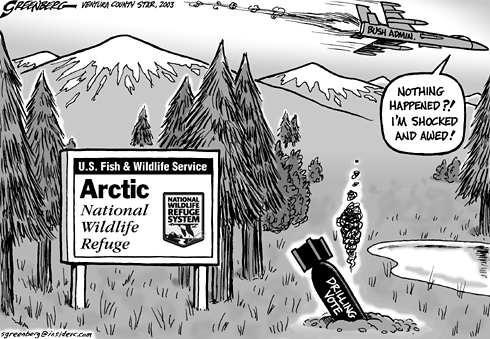
While energy "independence" is an impossible dream, there's no doubt the U.S. has vast undeveloped fossil-fuel deposits. A tiny corner of the Arctic National Wildlife Refuge contains an estimated 10.4 billion barrels of oil and would be the largest producing oil field in the Northern Hemisphere. Yet the Senate blocked that development as recently as last month. The Outer Continental Shelf is estimated to contain some 86 billion barrels of oil, plus 420 trillion cubic feet of natural gas. Yet of the shelf's 1.76 billion acres, 85% is off-limits and 97% is undeveloped.

Engineers recently perfected refining solid shale rock into diesel or gas, which may amount to the largest oil supply in the world – perhaps as much as 1.8 trillion barrels in the American West. That's enough to meet current U.S. oil demand for more than two centuries. Yet as late as 2007, Democrats attached a rider to the energy bill that prohibits leasing the federal interior lands that contain at least 80% of America's oil shale. The key vote was cast by liberal Senator Ken Salazar from Colorado, of all places.

These supply guesses are probably conservative, because the only way to know for sure is to drill exploratory wells. Yet most of Alaska and offshore are cut off even from modern seismic testing. Many areas haven't been examined since the 1960s, when exploration technology was far more primitive. This has led to the believe-it-or-not situation in which the Chinese are prepping to drill in Cuban waters less than 60 miles off the Florida coast. American companies are banned from drilling in American waters nearby.

Yes, we know, increased drilling is no energy cure-all; new projects take about a decade to come on line. Then again, more than a few experts say that new production could affect price as the market perceives a new U.S. seriousness to increase supplies. Part of today's futures speculation is based on the assumption that supplies will remain tight for years to come, even as Chinese and Indian demand surges.

Nor would merely repealing the exploration bans be enough. Between 2000 and 2007, the drilling of exploratory oil wells climbed 138%, but over the same period domestic crude oil production decreased 12.4% and fell to the lowest levels since 1947. Refineries for gasoline are stretched to the limit, but multiple regulatory barriers impede new construction or even expansions at existing facilities. Then there is the inevitable lawsuit downpour from the environmental lobby.

Democrats are going to have to grow up. The oil-rich areas they want to leave untouched are accessible with minimal environmental disturbance, thanks to modern technology. Hurricanes Katrina and Rita flattened terminals across the Gulf of Mexico but didn't cause a single oil spill. As for anticarbon theology, oil will be indispensable over the next half-century and probably longer, like it or not. Airplanes will never fly on woodchips, and you won't be able to charge your car with a windmill for some time, if ever.

Public anger over fuel prices could hardly come at a worse time for the GOP, since voters tend to blame a flagging economy on the party that occupies the White House. But the opportunity is to offer a reform alternative to Barack Obama and the high-price energy status quo he embraces. It looks like the public is increasingly ready for . . . change. In a May Gallup poll, 57% favored "allowing drilling in U.S. coastal and wilderness areas now off limits." Just 20% blamed the increase in gas prices on Big Oil, like Mr. Obama does.

Recent weeks have seen some GOP stirrings on Capitol Hill, but John McCain has so far refused to jettison his green posturings, such as his belief in carbon caps and his animus against offshore development. A good reason for a rethink would be $4 gas. At present, it is charitable to call Mr. McCain's energy ideas incoherent, and it may cost him the election.

http://cache.daylife.com/imageserve/03oIgh2bt81OA/610x.jpg

From The Corner: More final term shenanigans

from the Republican answer to Jimmy Carter.

Shalala
Yuval Levin

The Medal of Freedom for Donna Shalala — one of the Clinton administration’s foremost abortion advocates and welfare reform opponents — really is baffling. The Medal of Freedom is not just a pat on the back; it is a great and high honor, and should not be thrown around lightly or used to check boxes or bean-count. Some of the hardest working and most dedicated conservatives in this administration have been those at HHS striving these eight years to undo some of the damage Shalala did during her time there, and this is simply a slap in the face to all of them and their work. Reaching across party lines to recognize great public servants is certainly appropriate and valuable, but it also calls for some discretion in the choices made. As some of the other names on this year’s list of recipients show, there are some truly deserving and excellent human beings in this country. There are certainly many liberals and Democrats among them (Tom Lantos, another of this year’s honorees, was one for instance). Donna Shalala, for all her accomplishments, just isn’t. It’s bad enough when presidents give such awards to people who have served their administration even when they don’t deserve it (this White House has done that, unfortunately). But to give it to an undeserving person from a past administration, and one who worked against some important causes this president has championed, is really beyond belief.


Shalala, continued

Lisa Schiffren

As Yuval notes, awarding the Medal of Freedom to former HHS Secretary Donna Shalala, a close ally of Hillary Clinton's and an enemy of most social policies that Bush voters champion, is a slap in the face, first to his own administration, and second to his constituents. It is tempting to speculate just what constituency he was seeking to reach out to with this choice: Women? Americans of Lebanese descent? Liberal educators? I could go on about Ms. Shalala's PC particulars, but the point is that there are more appropriate choices in any of those categories.

It was said about the French House of Orleans, which provided many kings, but was not known for sagacity, that "they never forgot anything and the never learned anything." (Cannot find a citation for this, though I can hear the professor saying it...) This seems to be true of the House of Bush, which has yet to realize that all the honors for, and compromises with, the other party get him nothing, and does not make him look wise and generous, but rather like a sucker. Is it possible that, seven years on, President Bush still recalls the always-exaggerated, bi-partisan efforts of the Texas years too fondly, and has not learned what Democrats in Washington, likely including former Clinton official Donna Shalala, think of him?

Wednesday, June 11, 2008

Jim Webb
Webb, a descendent of Confederate officers,
also voiced sympathy for the notion of state sovereignty as it was understood in the early 1860s.

From Politico.com:
Webb's rebel roots:

An affinity for Confederacy

By: David Mark

June 11, 2008 07:29 AM EST

Barack Obama’s vice presidential vetting team will undoubtedly run across some quirky and potentially troublesome issues as it goes about the business of scouring the backgrounds of possible running mates. But it’s unlikely they’ll find one so curious as Virginia Democratic Sen. Jim Webb’s affinity for the cause of the Confederacy.

Webb is no mere student of the Civil War era. He’s an author, too, and he’s left a trail of writings and statements about one of the rawest and most sensitive topics in American history.

He has suggested many times that while the Confederacy is a symbol to many of the racist legacy of slavery and segregation, for others it simply reflects Southern pride. In a June 1990 speech in front of the Confederate Memorial at Arlington National Cemetery, posted on his personal website, he lauded the rebels’ “gallantry,” which he said “is still misunderstood by most Americans.”

Webb, a descendant of Confederate officers, also voiced sympathy for the notion of state sovereignty as it was understood in the early 1860s, and seemed to suggest that states were justified in trying to secede.

“Most Southern soldiers viewed the driving issue to be sovereignty rather than slavery,” he said. “Love of the Union was palpably stronger in the South than in the North before the war — just as overt patriotism is today — but it was tempered by a strong belief that state sovereignty existed prior to the Constitution and that it had never been surrendered.”

Webb expanded on his sentiments in his well-received 2004 book, “Born Fighting: How the Scots-Irish Shaped America,” which portrays the Southern cause as at least understandable, if not wholly laudable.

“The venerable Robert E. Lee has taken some vicious hits, as dishonest or misinformed advocates among political interest groups and in academia attempt to twist yesterday’s America into a fantasy that might better service the political issues of today,” he wrote. “The greatest disservice on this count has been the attempt by these revisionist politicians and academics to defame the entire Confederate Army in a move that can only be termed the Nazification of the Confederacy.” As in the Confederate Memorial speech, Webb suggests in his book that relatively few Southerners were slaveholders and that the war was fought over state sovereignty, which in the eyes of many at the time included the right to secede from the national government.

“The states that had joined the Union after the Revolution considered themselves independent political entities, much like the countries of Europe do today,” Webb wrote. “The 10th Amendment to the Constitution reserved to the states all rights not specially granted to the federal government, and in their view the states had thus retained their right to dissolve the federal relationship.”

There’s nothing scandalous in the paper trail, nothing that on its face would disqualify Webb from consideration for national office. Yet it veers into perilous waters since the slightest sign of support or statement of understanding of the Confederate cause has the potential to alienate African-Americans who are acutely sensitive to the topic.

Ron Walters, director of the African American Leadership Center at the University of Maryland and a professor of political science there, said Webb’s past writings and comments on the Confederacy could dampen enthusiasm for the Democratic ticket, should he appear on it.

“Unless he is able to explain it, it would raise some questions,” Walters said.

Edward H. Sebesta, co-author of the forthcoming “Neo-Confederacy: A Critical Introduction” (University of Texas Press), said Webb’s views express an unhealthy regard for a political system that propped up and defended slavery.

His book, in fact, will cite Webb as an example of the mainstreaming of neo-Confederacy ideas into politics, said Sebesta, a widely cited independent historical researcher and author of the Anti-Neo-Confederate blog.

“I don’t think people have thought through the implications of how his ideas have racial overtones, even if they are inadvertent,” Sebesta said.

Webb’s office declined to comment for this story.

Kristian Denny Todd, who served as communications director in Webb’s 2006 Senate campaign, said his remarks about the Confederacy should be viewed in the context of paying tribute to his Scots-Irish Southern forbears and his military sense of duty.

“He doesn’t defend the war at all or the practice of slavery. He does make arguments about why the South seceded,” said Denny Todd. “The individual Confederate soldier, for the most part, did not own slaves. They weren’t wealthy landowners. Webb simply talks about why these men — mostly poor and white — stepped up and answered the call to serve.”

The distinctions Webb makes, however, tend not to receive a full airing in the heat of political debate.
Former U.S. Attorney General John Ashcroft’s praise for Southern Partisan magazine, a journal sympathetic to the Confederate cause, helped delay his confirmation early in the Bush administration.

Other issues related to the Confederate legacy have proved equally thorny for politicians on both sides of the aisle. Questions surrounding the Confederate flag contributed to the defeat of Gov. David Beasley (R-S.C.) in 1998 and Gov. Roy Barnes (D-Ga.) in 2002.

In the 2004 Democratic presidential primary campaign, Democratic candidates awkwardly struggled with an NAACP-led economic boycott of South Carolina that was designed to force the removal of a Confederate flag from the Statehouse grounds. Later in the campaign, Democrat Howard Dean drew criticism for claiming that he wanted to be the “candidate for guys with Confederate flags in their pickup trucks.”

Four years earlier, in his first presidential run, Sen. John McCain wavered about the Confederate flag removal issue in South Carolina but later apologized for his equivocation. In advance of the South Carolina primary this year, he issued a full-throated call to take down the divisive symbol, joining the Democratic presidential candidates who took the same position.

Webb’s comments about the Confederacy already received some airing during his successful 2006 upset victory over then-Sen. George Allen (R-Va.), when a smattering of news outlets and blogs noted his past statements and writing about the Civil War era.

Most prominent was a May 2006 Richmond Times-Dispatch article revisiting Webb’s Confederate Memorial speech, which ran about a month before Webb’s Democratic primary victory and proved to be a one-day story.

In a different context, Webb’s record might very well have made a bigger splash. But it was largely overshadowed by other developments. At the time, it was widely perceived that Webb had more damaging exposure from his 1979 Washingtonian magazine article titled “Women Can’t Fight,” in which Webb, an ex-Marine, described one of the Naval Academy’s coed dorms as “a horny woman’s dream” and argued against allowing women to take combat roles.

Then the New Republic and other news organizations ran stories suggesting that Allen had his own racial insensitivity problems, featuring recollections by long-ago acquaintances of racial slurs, a noose that hung in his law office and a high school fascination with Confederate paraphernalia that continued into adulthood.

Webb generally remained silent during Allen’s Confederacy controversy, focusing instead on the Republican’s support for the Iraq war and other issues. Three months later, Allen’s caught-on-video reference to a Webb campaign volunteer as “macaca” took center stage and set in place a campaign narrative that dominated media coverage until his narrow defeat.

Webb won overwhelming support from black voters — 85 percent — who accounted for 16 percent of all voters, according to exit polls.

Tuesday, June 10, 2008

http://i108.photobucket.com/albums/n4/RobertOak/ObamaDir_562.jpg
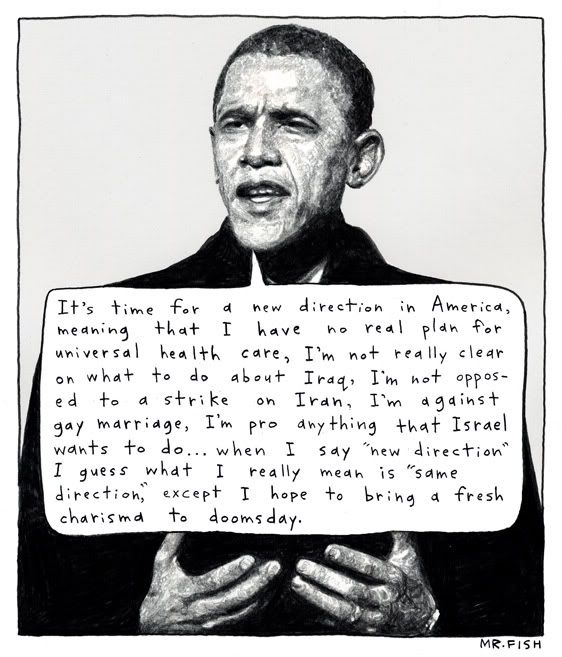
How Obama Won -- and May Win
by Patrick J. Buchanan

Posted 06/10/2008 ET

"I mean, you got the first mainstream African-American who is articulate and bright and clean and a nice-looking guy. ... I mean, that's a storybook, man."

Thus did Joe Biden famously describe his rival for the nomination, Barack Obama, to the The New York Observer, a year ago.

Biden, however, thought Obama might not be able to win the fall election, as he is "a one-term, a guy who has served for four years in the Senate. ... I don't recall hearing a word from Barack about a plan or a tactic."

Biden was forced to apologize, but was dead on in discerning Barack's strengths as a candidate in the primaries, which might prove weaknesses in the fall.

A new face in the game, Barack opened with three aces. He opposed the Iraq war, the defining issue in a party that had come to detest the war. He was an African-American. Thus, as the hopes of millions rose that he could be the first black president, there were surges of black voters whom he begin to sweep 90-10.

Lastly, Barack is a natural, a Mickey Mantle, a superb political athlete like JFK, who has looks, charm, youth and a speaking style that can move crowds to cheers or laughter.

Barack was thus able to unite the McGovern wing -- young, idealistic, liberal, anti-war -- with the Jesse Jackson quadrant of the party, black folks, and defeat Hillary's coalition of working-class Catholics, women, seniors and Hispanics.

As of today, by the traditional metrics of national politics, Democrats should roll up a victory this fall like FDR's first in 1932.

Bush's disapproval is near 70 percent, and 80 percent of the country believes the nation is on the wrong course. Unemployment is rising. Surging gas and food prices compete for the top story not only on business pages but front pages, with home foreclosures and the housing slump. Family incomes of Middle Americans have ceased to rise, as millions of their best jobs have been outsourced overseas.

Yet, national polls show McCain-Obama a close race, and the electoral map points to critical problems for Barack.

He seeks, for example, to target Colorado, Nevada and New Mexico. But in all three the Hispanic vote may be decisive. And Barack was beaten by Hillary two to one among Hispanics, and between these two largest of America's minorities, rivalry and tension are real and rising.

Barack must hold Michigan and Pennsylvania and pick up Ohio or Virginia. Yet, his weakness among Southern and working-class whites and women is remarkable. By two to one they rejected him.

After his string of primary and caucus victories in February, Barack proceeded to lose Texas, Ohio, Pennsylvania, Indiana, then West Virginia by 41, Kentucky by 35, Puerto Rico two to one and South Dakota by 10. That last one Barack was supposed to win.

The longer the campaign went on, the more reluctant Democrats seemed to be to embrace his nomination.

What is Barack's problem?

Middle America knows little about him, and much of what they know they do not like. When West Virginians were asked what they knew about Barack, a plurality said the Rev. Wright was his pastor. In Pennsylvania, a goodly slice of Democrats knew Barack had said they were "bitter" about being left behind and were clinging to their bigotries, Bibles and guns.

By June, resistance to Barack's nomination in the party that he now leads was extraordinary, stemming from a belief that he is too naive to be commander in chief in wartime and too far left, and does not like or understand Middle America or its values.

"He is not one of us."

And if Barack cannot erase this hardening perception in the American mind, he will not be president.

Democrats may talk of making the economy the issue this fall, but Republicans are going to make Barack the issue. Story line: We cannot entrust our beloved America, in a time of war, to this radical and exotic figure who has so many crazy and extremist associates.

Barack's problem is thus Reagan's problem.

As the country wished to be rid of Jimmy Carter in 1980, so the nation today wishes to be rid of Bush and his Republicans. But America is apprehensive over a roll of the dice, in Bill Clinton's metaphor.

How did Reagan ease the anxiety? In the debate with Carter, he came off as conservative, yes, but also traditional, mainstream, witty and the more likable man. The real Reagan came through.

With his persona, Barack may be able to do the same -- in the debates. The problem is that he had two dozen debates with Hillary and, by the end of the primary season, five months after it began, he was still losing ground.

Monday, June 09, 2008

From Newsweek:
As the Oceans Rise
Obama's words mesmerize a nation
accustomed to leaders who use words
with antic indifference to their accuracy.
By George F. Will

Updated: 1:20 PM ET Jun 7, 2008

Journalists consider themselves crusty, unsentimental creatures who, their battered fedoras shoved back on their heads, have slouched out of Ben Hecht's 1928 play "The Front Page," oozing skepticism from every pore. Actually, they are round-heeled romantics, such pushovers for a new swain that they did not laugh until their ribs squeaked when Barack Obama concluded his triumphal St. Paul, Minn., speech by proclaiming: "I am absolutely certain that generations from now, we will be able to look back and tell our children that this was the moment when we began to provide care for the sick …"

It is absolutely certain that generations from now someone will remember that even before that night in St. Paul, care was provided to the sick in America. Obama also asserted that future generations would say that "this was the moment when the rise of the oceans began to slow and our planet began to heal …" The man and the moment have met.

Obama's words mesmerize a nation accustomed to leaders who routinely use words with antic indifference to their accuracy. The No Child Left Behind law promises, indeed requires, that by 2014 all children will be "proficient" in reading and math. That will not happen. Obama vows to reduce carbon emissions 80 percent below 1990 levels by 2050. John McCain says 60 percent. Whether either goal should be reached, neither will be. Commentators, too, use words in peculiar ways, as when they speak of Obama and Hillary Clinton needing to bring together "the two wings of the party." There is the left wing, and the other left wing. As one precise commentator has said, Clinton and Obama differ about as much as the Everly Brothers.

As the primary season folds seamlessly into the general election campaign, there are few certainties, but this will be the first presidential election contested by two sitting senators, so this will be just the third time the country has elected a sitting senator (Harding in 1920, Kennedy in 1960). And there is an asymmetry between the senators' possible trajectories: McCain, although a very familiar figure, has a downside risk from becoming better-known concerning one issue; Obama has an upside potential from becoming better-known regarding an elemental fact.

McCain is fortunate. The eerie narcissism of Clinton's speech the night that Obama clinched the nomination distracted attention from McCain's badly delivered speech the same night, in New Orleans. If he really opposes torture, he will take pity on the public and master the use of a teleprompter.

He said, "The American people didn't get to know me yesterday, as they are just getting to know Senator Obama." McCain, who has been running for president for 10 years, has never entertained the thought that the country might sometimes have a surfeit of him. Does some statute require that he appear on at least one of the five Sunday morning talk shows every week (ABC, NBC, CBS, CNN, Fox News)? He has appeared on them 67 times since 2004. He has been such a ubiquitous figure, it will be difficult for him to seize the attention of a public that thinks it knows everything about him.

But it does not. Because of his cultivated persona as a "maverick" Republican, many—perhaps most—voters do not know he is pro-life. When the fact that he is becomes well publicized, and Democrats will make sure it is, Clinton's female supporters will stop sulking in their tents and will rally round Obama.

Something that millions of Americans think they know about Obama—that he is a Muslim—is injurious. When they are disabused of this idea, he will rise. McCain might think Obama cannot rise high enough to win because he, McCain, can get the support of white, blue-collar, culturally conservative Democrats who decisively preferred Clinton to Obama in the primaries.

But there are fewer of these "Reagan Democrats" than there were when that category was identified 28 years ago. That label might not yet be as antiquated as, say, "Wendell Willkie Republicans," but its significance diminishes as the economy and the educational and social profile of the electorate change. War-weary Americans are preoccupied with domestic discontents, but McCain sounds at best perfunctory when talking about things other than those that really interest him, things that fly or explode—the sinews of national security.

Neither candidate can know his current electoral strength because polling is in unexplored territory. No poll is any better than its template for predicting turnout—the size and composition of the Election Day electorate. So Republicans reading alarming polls might be insufficiently alarmed. Obama's candidacy might increase total turnout, and especially participation by African-Americans and young people. If so, some House and Senate races, and some states, may be more competitive than they currently seem.

In 2004, 12 states were won by 5 percentage points or less. Six were won by Bush (Florida, Ohio, Iowa, Colorado, Nevada, New Mexico) and six by Kerry (New Hampshire, Pennsylvania, Michigan, Wisconsin, Minnesota, Oregon). Bush's six have 73 electoral votes, Kerry's six have 69. But Florida, that geographic afterthought—some of it was tardy emerging from the sea, and its highest point is just 345 feet above sea level—might disappear, depending on "the rise of the oceans."

Sunday, June 08, 2008

http://home.comcast.net/~p-l-m.blogspot/BoDiddley.jpg
From Reuters:
The world of music pays tribute to Bo Diddley
Friends and heirs to Bo Diddley's throne pay
their respects to the deceased blues legend.

Tuesday, 3 June 2008

"Listening to Bo Diddley, you could convince yourself that the only thing you need to create great rock 'n' roll is a tremolo guitar, a killer beat and one and a half chords. Many tried and some have failed, but nobody did it like Diddley."

Elvis Costello in USA Today

"[Bo Diddley's] voice and relentless, glorious anthems echo down through my years. This royal shape shifter continues to influence four generations of musicians on a daily basis"

Led Zeppelin's Robert Plant on soundgenerator.com

"Bo's one of the guys who invented rock 'n' roll. He took two cultures that existed in separate forms -- country and western and the kind of blues that used to be known as 'race music' -- and put them together. His beat was a jungle beat. That's what he called it."

Eric Burdon, lead singer of the Animals, in the Los Angeles Times

"It's a good day because I've walked on the planet at the same time as Bo Diddley. The simplistic and humorous artistry that accompanied this creation we all know as the Bo Diddley beat is a resounding testament to someone who knew how to touch us in a rock 'n' roll way."

Billy Gibbons, ZZ Top's guitarist, in USA Today

"He was a wonderful, original musician who was an enormous force in music and was a big influence on the Rolling Stones. He was very generous to us in our early years and we learned a lot from him. We will never see his likes again."

Rolling Stones frontman Mick Jagger, in the Los Angeles Times

He's a huge hero of mine and the fact that he knew who I was was a huge compliment. Bo Diddley created a myth that was uniquely his own. An entire rhythm is owed to just one guy and that's pretty rare."

Guns N' Roses guitarist Slash on NME.com

"Bo Diddley was a music pioneer and a legend with a unique style. We always had a good time when we played together, but his legacy will live on forever."

B.B. King in the Los Angeles Times

"One of the founding fathers of rock 'n' roll has left the building he helped construct,"

Statement announcing his death, from his management agency, Talent Consultants International, on Reuters

"There was a gospel song that was sang and he said 'wow' with a thumbs up. The song was 'Walk Around Heaven' and in his last words he stated that he was going to heaven."

Garry Mitchell, a grandson of Diddley and one of more than 35 family members
at the musician's home when he died

(Josue Evilla/Globe Staff Illustration)
From The Boston Globe:
Hey, Bo Diddley

How a legend of rock defied the music's own myths
By Matthew Guerrieri

June 8, 2008

WHEN CHUCK BERRY wrote "Johnny B. Goode," he planted the seeds for America's reigning myth about a whole musical form. Johnny was a rural savant, illiterate and unsophisticated, with a natural flair for the guitar. "Oh my," Berry sang, "but that little country boy could play."

The story stuck. In the public mind, rock 'n' roll was a Southern amalgamation, a danceable reconciliation of black and white traditions, drawn from fields, churches, and backwoods dives, springing unconsciously from the very soul of America.

And then there was Bo Diddley. Along with Berry and Little Richard and Elvis Presley and a host of other claimants, Diddley, who died last week, invented rock 'n' roll, but he was no little country boy. ("I'm a man," he sang, "spelled M-A-N.") If the myth celebrated the fusion of black Southern blues and white country and western - making the former palatable and the latter cool - Diddley was its Northern, urban exception, streamlining where others combined, inventing where others consolidated. The myth looked to America's past; Diddley pushed forward, a singular, stubborn, sly innovator.

Diddley was celebrated more for his influence than his actual songs. (His highest-charting single was the entertaining but atypical novelty "Say Man," which reached No. 20.) Race was certainly a factor - 1950s white America wasn't quite ready for a black man with Diddley's unapologetic, cocky swagger and wit. But he was also too urban, too modern to be easily assimilated into American culture the way Southerners like Presley were. The romantic view of rock 'n' roll's history is that it helped bridge the racial divide, but Bo Diddley's career showed that other, subtler fault lines of American history - industrial vs. rural, North vs. South - proved more indelible.

He was born Ellas Bates in Mississippi, but he grew up in Chicago, the only Northerner among rock's pioneers. Arriving in the city at the tail end of the Great Migration, he absorbed its musical culture, a distinctive distillation of blues, gospel, and jazz: lean, electric, direct. Technologically savvy, he built and customized his own instruments and amplifiers. He applied the same inventive facility to the blues itself.

His Southern counterparts advertised their influences, drawing comforting parallels with familiar genres - Berry's "Maybelline" was a sped-up country-western song; Elvis leavened his blues with country crooning and the pure earnestness of white gospel. But Diddley seemed intent on eliminating any frame of reference except Bo Diddley himself. The elements were all in place on his first, eponymous single: the already austere blues progressions reduced to a single, repeated chord; the smooth, white-noise wash of cymbals replaced with brittle maracas and rumbling tom-toms; his guitar - its boxy body severing even a visual connection to its acoustic ancestor - fitted with a tremolo unit Diddley built out of automobile and alarm-clock parts, producing a radioactive shimmer.

This was a virtuosity not of decoration, but of engineering, an industrial factory producing a single product: the beat - one Bo Diddley claimed as his own. It had been around, in the Latin-American clave, in the jazz marches of New Orleans, in the imported West African dance that came to be known as juba or hambone. But Diddley drove it home with such power and efficiency that it was reborn as an innovation; in his hands, it was the sound of the future, a Sputnik transmitting a single, insistent rhythm, an uneasy signal to a country in desperate pursuit of good-old-days complacency.

The psychohistorian Robert Jay Lifton would diagnose a postwar "protean man," buffeted by dizzying changes, separated from the "nourishing symbols of [his] cultural traditions." The middle America of the time embraced heritage as a security blanket - many of the early rock 'n' rollers, consciously or unconsciously, augmented their appeal with at least token nods toward those traditions. But Bo Diddley was one of the millions of African-Americans who cut their Southern ties and went north, for opportunity and reinvention. He went to Chicago, where they razed the old landmarks to make room for skyscrapers.

His urban brashness hardly smoothed his career path. Elvis won over variety-show gatekeeper Ed Sullivan with Southern politeness and aw-shucks humility; Diddley nearly hit him after a repertoire mix-up caused Sullivan to derisively call Diddley "black boy." "I was ready to fight," Diddley recalled. "I was a dude from the streets of Chicago." He didn't appear on network television for another decade.

But a later generation of city kids recognized a kindred spirit. Just about everybody stole the beat, but it was the punk and post-punk bands that were eager to claim to have descended from the man himself; the Clash invited Diddley to open for them on their first American tour. (Their lead singer, Joe Strummer, was once asked about his source of inspiration. "Bo Diddley," he replied. Anybody else? "Bo Diddley," he replied.)

Diddley's strongest influence always seemed to be in Britain - the Beatles, the Rolling Stones, the punk rockers. Perhaps too much of America clung to a Jeffersonian, Arcadian ideal to ever fully embrace his forward-looking industry. But Diddley knew that ideal was disappearing. In "Hey, Bo Diddley," he mused about a farm with "women everywhere," only to complain that his baby "slipped on from me like a Cadillac-8." The old America was driving away just as fast, with Bo Diddley at the wheel. You were welcome to hitch a ride - but he wasn't about to slow down for you.

Composer and pianist Matthew Guerrieri writes about classical music for the Globe and also on his blog, Soho the Dog.

http://www.watchingamerica.com/images/JesusObama.jpg

Obama the humble savior
By Mark Steyn


The short version of the Democratic Party primary campaign is that the media fell in love with Barack Obama but the Democratic electorate declined to.

"I felt this thrill going up my leg," said MSNBC's Chris Matthews after one of the senator's speeches. "I mean, I don't have that too often." Au contraire, Chris and the rest of the gang seem to be getting the old tingle up the thigh hairs on a nightly basis. If Obama is political Viagra, the media are at that stage in the ad where the announcer warns that, if leg tingles persist for more than six months, see your doctor.

Out there in the voting booths, however, Democrat legs stayed admirably unthrilled. The more the media told Hillary she was toast, and she should get the hell out of it and let Obama romp to victory, the more Democrats insisted on voting for her. The more the media insisted Barack was inevitable, the less inclined the voters were to get with the program. On the strength of Chris Matthews' vibrating calves, Sen. Obama raised a ton of money – over $300 million – and massively outspent Sen. Clinton, but he didn't really get any bang for his buck. In the end, he crawled over the finish line. The Obama Express came a-hurtlin' down the track at 2 miles an hour.

But what does he care? Sen. Obama has learned an old trick of Bill Clinton's: If you behave like a star, you'll get treated as one. So, even as his numbers weakened, his rhetoric soared. By the time he wrapped up his "victory" speech last week, the great gaseous uplift had his final paragraphs floating in delirious hallucination along the Milky Way:

"I face this challenge with profound humility and knowledge of my own limitations. But I also face it with limitless faith in the capacity of the American people … . I am absolutely certain that generations from now, we will be able to look back and tell our children that this was the moment when we began to provide care for the sick and good jobs to the jobless; this was the moment when the rise of the oceans began to slow and our planet began to heal … . This was the moment – this was the time – when we came together to remake this great nation."

It's a good thing he's facing it with "profound humility," isn't it? Because otherwise who knows what he'd be saying. But mark it in your calendars: June 3, 2008 – the long-awaited day, after 232 years, that America began to provide care for the sick. Just a small test program: 47 attendees of the Obama speech were taken to hospital and treated for nausea. Everyone else came away thrilled that the Obamessiah was going to heal the planet and reverse the rise of the oceans: When Barack wants to walk on the water, he doesn't want to have to use a stepladder to get up on it.

There are generally two reactions to this kind of policy proposal. The first was exemplified by the Atlantic Monthly's Marc Ambinder:

"What a different emotional register from John McCain's; Obama seems on the verge of tears; the enormous crowd in the Xcel Center seems ready to lift Obama on its shoulders; the much smaller audience for McCain's speech interrupted his remarks with stilted cheers."

The second reaction boils down to: "'Heal the planet'? Is this guy nuts?" To be honest I prefer a republic whose citizenry can muster no greater enthusiasm for their candidate than "stilted cheers" to one in which the crowd wants to hoist the nominee onto their shoulders for promising to lower ocean levels within his first term. As for coming together "to remake this great nation," if it's so great, why do we have to remake it? A few months back, just after the New Hampshire primary, a Canadian reader of mine – John Gross of Quebec – sent me an all-purpose stump speech for the 2008 campaign:

"My friends, we live in the greatest nation in the history of the world. I hope you'll join with me as we try to change it."

I thought this was so cute, I posted it on the Web at National Review. Whereupon one of those Internetty-type things happened, and three links and a Google search later the line was being attributed not to my correspondent but to Sen. Obama, and a few weeks after that I started getting e-mails from reporters from Florida to Oregon, asking if I could recall at which campaign stop the senator, in fact, uttered these words. And I'd patiently write back and explain that they're John Gross' words, and that not even Barack would be dumb enough to say such a thing in public. Yet last week his demand in his victory speech that we "come together to remake this great nation" came awful close.

Speaking personally, I don't want to remake America. I'm an immigrant, and one reason I came here is because most of the rest of the Western world remade itself along the lines Sen. Obama has in mind. This is pretty much the end of the line for me. If he remakes America, there's nowhere for me to go – although presumably once he's lowered sea levels around the planet there should be a few new atolls popping up here and there.

Marc Ambinder is right. Obama's rhetoric is in a different "emotional register" from John McCain's. It's in a different "emotional register" from every U.S. president – not just the Coolidges but the Kennedys, too. Nothing in Obama's resume suggests he's the man to remake America and heal the planet. Only last week, another of his pals bit the dust, convicted by a Chicago jury of 16 counts of this and that. "This isn't the Tony Rezko I knew," said the senator, in what's becoming a standard formulation. Likewise, this wasn't the Jeremiah Wright he knew. And these are guys he's known for 20 years.

Yet at the same time as he's being stunned by the corruption and anti-Americanism of those closest to him, Obama's convinced that just by jetting into Tehran and Pyongyang he can get to know America's enemies and persuade them to hew to the straight and narrow. No doubt if it all goes belly-up, and Iran winds up nuking Tel Aviv, President Obama will put on his more-in-sorrow-than-in-anger face and announce solemnly that "this isn't the Mahmoud Ahmadinejad I knew."

Every time I hear an Obama speech, I start to giggle. But millions of voters don't. And, if Chris Matthews and the tingly-legged media get their way and drag Obama across the finish line this November, the laugh will be on those of us who think that serious times demand grown-up rhetoric.

©MARK STEYN