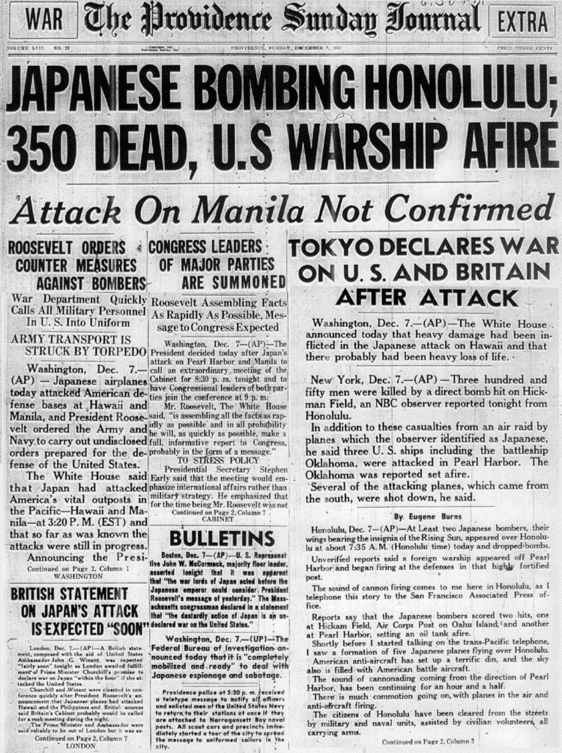
Friday, December 07, 2007

http://www.rivervet.com/images/PearlHarbor/PearlHarbor.jpgThe image “http://aswiftkick.mu.nu/Images/PearlHarbor-thumb.gif” cannot be displayed, because it contains errors.http://www.moonbattery.com/archives/AvengePearlHarbor.jpgThe image “http://z.about.com/d/politicalhumor/1/0/y/j/dems_pearl_harbor.jpg” cannot be displayed, because it contains errors.

Wednesday, December 05, 2007

The image “http://www.redpills.org/wp-content/img/AlGore2c.jpg” cannot be displayed, because it contains errors.
From Opinion Journal:
The Science of Gore's Nobel
What if everyone believes in global warmism
only because everyone believes in global warmism?


BY HOLMAN W. JENKINS JR.
Wednesday, December 5, 2007 12:01 a.m. EST

The Nobel Committee might as well have called it Al Gore's Inner Peace Prize, given the way it seems designed to help him disown his lifelong ambition to become president in favor of a higher calling, as savior of a planet.

The media will be tempted to blur the fact that his medal, which Mr. Gore will collect on Monday in Oslo, isn't for "science." In fact, a Nobel has never been awarded for the science of global warming. Even Svante Arrhenius, who first described the "greenhouse" effect, won his for something else in 1903. Yet now one has been awarded for promoting belief in manmade global warming as a crisis.

How this honor has befallen the former Veep could perhaps be explained by another Nobel, awarded in 2002 to Daniel Kahneman for work he and the late Amos Tversky did on "availability bias," roughly the human propensity to judge the validity of a proposition by how easily it comes to mind.

Their insight has been fruitful and multiplied: "Availability cascade" has been coined for the way a proposition can become irresistible simply by the media repeating it; "informational cascade" for the tendency to replace our beliefs with the crowd's beliefs; and "reputational cascade" for the rational incentive to do so.

Mr. Gore clearly understands the game he's playing, judging by his resort to such nondispositive arguments as: "The people who dispute the international consensus on global warming are in the same category now with the people who think the moon landing was staged in a movie lot in Arizona."

Here's exactly the problem that availability cascades pose: What if the heads being counted to certify an alleged "consensus" arrived at their positions by counting heads?

It may seem strange that scientists would participate in such a phenomenon. It shouldn't. Scientists are human; they do not wait for proof; many devote their professional lives to seeking evidence for hypotheses (especially well-funded hypotheses) they've chosen to believe.

Less surprising is the readiness of many prominent journalists to embrace the role of enforcer of an orthodoxy simply because it is the orthodoxy. For them, a consensus apparently suffices as proof of itself.

With politicians and lobbyists, of course, you are dealing with sophisticated people versed in the ways of public opinion whose very prosperity depends on positioning themselves via such cascades. Their reactions tend to be, for that reason, on a higher intellectual level.

Take John Dingell. He told an environmental publication last year that the "world . . . is great at having consensuses that are in great error." Yet he turned around a few months later and introduced a sweeping carbon tax bill, which would confront Congress more frontally than Congress cares to be confronted with a rational approach to climate change if Congress really believes human activity is responsible.

Mr. Dingell is no fool. Is he merely trying to embarrass those who offer fake cures for climate change at the expense of out-of-favor industries such as Mr. Dingell's beloved Detroit?

Take Vinod Khosla, a venture capitalist working with Kleiner Perkins, a firm Mr. Gore joined last month to promote alternative energy investments. Mr. Khosla told a recent Senate hearing: "One does not need to believe in climate change to support climate change legislation. . . . Many executives would prefer to deal with known legislation even if unwarranted."

Mr. Khosla is no fool either. His argument is that the cascade itself is a reason that politicians can gain comfort by getting aboard his agenda.

Now let's suppose a most improbable, rhapsodic lobbying success for Mr. Gore, Mr. Khosla and folks on their side of the table--say, a government mandate to replace half the gasoline consumed in the U.S. with a carbon-neutral alternative. This would represent a monumental, $400 billion-a-year business opportunity for the green energy lobby. The impact on global carbon emissions? Four percent--less than China's predicted emissions growth over the next three or four years.

Don't doubt that this is precisely the chasm that keeps Mr. Gore from running for president. He could neither win the office nor govern on the basis of imposing the kinds of costs supposedly necessary to deal with an impending "climate crisis." Yet his credibility would become laughable if he failed to insist on such costs. How much more practical, then, to cash in on the crowd-pleasing role of angry prophet, without having to take responsibility for policies that the public will eventually discover to be fraudulent.

Public opinion cascades are powerful but also fragile--liable to be overturned in an instant when new information comes along. The current age of global warming politics will certainly end with a whimper once a few consecutive years of cooling are recorded. Why should we expect such cooling? Because the forces that caused warming and cooling in the past, before the advent of industrial civilization, are still at work.

No, this wouldn't prove or disprove a human role in warming, only that climate is variable and subject to complicated influences. But it would also eliminate the large incentive for politicians to traffic in doom-laden predictions--because such predictions would no longer command media assent and would cease to function as levers to redistribute resources.

Mr. Gore would have to find a new job.

Mr. Jenkins is a member of The Wall Street Journal's editorial board. His column appears in the Journal on Wednesdays.

Tuesday, December 04, 2007

Librado Romero/The New York Times

From The New York Times: At least on the first day, only mildly obnoxious
(unless you count the normal sucking-up to whomever of his regular guests shows up).

Imus Is Back, Chastened but Still Proudly Obnoxious

By JACQUES STEINBERG

Nearly eight months after being fired for making a racially and sexually disparaging remark about the Rutgers women’s basketball team, Don Imus returned to the radio at 6 a.m. yesterday and vowed he would not say anything like it again.

He also introduced two new cast members, Karith Foster and Tony Powell — both black and both comedians — and said they would join him in conducting “an ongoing discussion about race relations in this country.”

“I will never say anything in my lifetime that will make any of these young women at Rutgers regret or feel foolish that they accepted my apology and forgave me,” Mr. Imus told a live audience at Town Hall in Midtown and those listening to WABC-AM, his new radio home. “And no one else will say anything on my program that will make anyone think I did not deserve a second chance.”

Still, in many ways it felt as if the clock had been turned back to before last April, when Mr. Imus made his remark and was fired by CBS Radio and MSNBC, which had simulcast his program on cable television.

“Dick Cheney is still a war criminal,” Mr. Imus, 67, told the audience, in an effort to reassure them that he did not intend to alter his style completely, or curb his tongue. “Hillary Clinton is still Satan. And I’m back on the radio.”

He was flanked on his right by Charles McCord, his longtime news reader and sidekick. To his left, with a microphone conspicuously in front of him, was Bernard McGuirk, the producer whose reference on April 4 to the Rutgers team as “some hard-core hos” had prompted Mr. Imus to take the bait and call them “nappy-headed hos.” Mr. McGuirk was largely mute yesterday — so much so that Mr. Imus implored him at one point to “turn your mike on.”

“Hi” was about all Mr. McGuirk could muster, but the Town Hall crowd, several hundred strong, roared its approval.

The roster of guests was familiar to any regular Imus listener. It included the presidential candidates John McCain and Christopher Dodd; the author Doris Kearns Goodwin; and the political strategists James Carville and Mary Matalin. Also stopping by to offer support were Gregg Hughes and Anthony Cumia, known on the radio as “Opie and Anthony.”

“We’ve had a couple of these ‘first shows back,’” Mr. Cumia said. He and Mr. Hughes lost their jobs in 2002 for apparently broadcasting a sex act from St. Patrick’s Cathedral on their FM show, and, last spring, were suspended by XM Satellite Radio for 30 days for allowing an extended discussion imagining sexual assaults on Laura Bush and Condoleezza Rice.

Some longtime advertisers came back, too, including the Hackensack University Medical Center in New Jersey; NetJets, the corporate aircraft leasing company; the Mohegan Sun casino in Connecticut; J. H. Cohn, an accounting firm; and Bigelow teas. The house band was led by Levon Helm, who played for Mr. Imus on April 12, which wound up being his last day. In addition to WABC, nearly two dozen affiliates carried the radio program yesterday, according to a show spokesman, including WTKK in Boston and WSKO in Providence.

Mr. Imus wore a tan cowboy hat, a gold vest under a tan barn jacket and worn boots. In his initial remarks he spoke to the audience from a lone microphone positioned at center stage. He acknowledged that he had not been as quick to forgive his detractors as the Rutgers team had been in forgiving him. At some points he sounded almost vindictive.

“We signed for five years,” he said of his contracts with Citadel Radio and RFD-TV. “That’s how long it’s going to take to get even with everybody.” (Citadel is the parent of WABC; RFD is simulcasting his program.)

Arguably the most uncomfortable moment happened within earshot of the audience, but during a commercial. “Al Roker says hi,” Bo Dietl, the private investigator who is a regular Imus guest, said to Mr. Imus, seated nearby. (Mr. Roker, the “Today” show weatherman, had criticized Mr. Imus, and MSNBC, for the Rutgers remark.) Mr. Imus, his face grim, fashioned his hand into a makeshift pistol, turned it toward Mr. Dietl and pretended to fire.

For all his bravado, Mr. Imus acknowledged that he had been chastened and, at times, humiliated these last few months, and that he deserved his punishment.

“I think things worked out the way they should have worked out,” he said. “We now have the opportunity to have a better program, to obviously diversify the cast.”

But, he added, “the program is not going to change.”

Adding Ms. Foster, who said she was in her 30s, and Mr. Powell, in his 40s, was intended to make an immediate statement about Mr. Imus’s commitment to keeping race high on his show’s agenda. On a day in which he had a lot of ground to cover in four hours, he did not give the comedians much to do, though each got a chance to take an early poke at the new boss.

Ms. Foster imagined how lonely Mr. Imus’s sex life would have been, after his Rutgers remark, had he been married to a black woman. Mr. Powell referred to another black performer in saying, “It is a thrill to be here on the ‘Tyler Perry’ version of ‘Imus in the Morning.’ ”

In an interview after the show Ms. Foster said she knew that as a black woman she was taking some risks by throwing in her lot with Mr. Imus, but was confident she could use the platform he had given her to help bridge some of the gaps between whites and blacks.

“There’s the term ‘sell out,’” she said. “A sellout is someone who does something that harms the community, for the greater good of themselves. I have more of an intention for this.”

“I’m not here to be his policeman,” she added. “But I’m not here to be his defender. I’m not a sycophant. I’m here to contribute to a historically entertaining show. And when I need to speak up, I will.”

Mr. Powell, whose responsibilities include giving the program’s sports news (he is the son of a scout for the Washington Wizards of the N.B.A.), said of Mr. Imus: “He’s actually the one pulling the train here. This is something he definitely wants to change.”

For now, at least, several of Mr. Imus’s most prominent critics appear to be willing to give him a chance. The National Organization for Women issued a statement yesterday that applauded the addition of Ms. Foster in particular, while reminding listeners it had opposed his hiring at WABC.

The Rev. Al Sharpton, whose protests last spring helped seal Mr. Imus’s fate, marshaled no forces outside Town Hall yesterday. Asked in a telephone interview about Ms. Foster and Mr. Powell, Mr. Sharpton said: “I don’t know if they’re for the good, or if they’re choreography for the radio station.”

“Whether he’s sincere or not, time will tell,” Mr. Sharpton added. “We will be monitoring.”
http://i.a.cnn.net/si/2007/writers/luke_winn/03/21/scouting.unc/t1_hansbrough_si.jpg
From Philadelphia Daily News:
CAROLINA BLUE COLLAR
Hansbrough's work ethic makes him a favorite
By MARCUS HAYES


CHAPEL HILL, N.C. - You love Tyler Hansbrough.

Even if he's likely to light up the home boys, as is the case tonight when he and No. 1 North Carolina visit Penn at the Palestra, you don't hold it against him.

You hated smooth Dukies J.J. Redick and Christian Laettner. You ignored UNC's lumbering Eric Montross and you yawned at Duke's Cherokee Parks.

But Hansbrough, a glaring, bruising junior forward who, somehow, scores and rebounds and hits free throws and doesn't foul out, has your attention - and, more intriguingly, your admiration. It is an unusual phenomenon.

It exists, says his coach, because people like overachievers.

"People identify with the work ethic. The fanaticism. The focus. That discipline," Roy Williams said. "They don't see a guy jumping over the moon and all that. Every play, he works so hard, people say, 'God, that guy - he's taking on three of our guys and he's still being successful.' "

Very successful: He averages 20.3 points and 9.6 rebounds for the 7-0 Heels this season; he is twice an All-America, twice a National Player of the Year finalist and this season's preseason favorite.

You love him probably because of your introduction to him: When, in the regular-season finale against Duke last season, Gerald Henderson broke Hansbrough's nose with a flying elbow or forearm after Hansbrough rebounded a shot and was going up for a layup. You love him because he wanted to fight Henderson with his face a bloody mess, and because he wanted to stay in the game, and because he scored 33 against Michigan State five games later . . . after removing the protective nose mask during the game.

You love him because, earlier in the Duke game, he got whacked in the tooth hard enough to require a postseason root canal - and played on, until the Henderson incident. You love him because he can't decide which hurt more: "The root canal. No, I'd go with the nose."

You love him because, when leaving for the ACC Tournament a few days later, he wore a Groucho Marx mask to hide the injury and to answer all the breathless mask questions: What kind of mask is Tyler going to wear?

You love him because he not only kept the two protective masks he was issued after the incident but, for Halloween this year, wore one of them as his costume.

You love him because he recently added pulling sport-utility vehicles to strengthen his legs as a part of his 6-hour offseason workout regimen, begun after his sophomore high school season. After arriving at Carolina he incorporated a stretching routine that he sometimes performs four times a day. His yelling and screaming during the workouts earned him the nickname "Psycho T"; his lack of flexibility as a freshman earned him the nickname, "Tin Man."

You love him because he likes Nelly Furtado and the video game, "Dance Dance Revolution."

You love him because he eats pounds of sushi for the protein and he gets pedicures. There's not a lot of sushi and the spa treatments in Poplar Bluff, Mo., population 17,000, self-proclaimed "The Gateway to the Ozarks," where tales of his newfound cosmopolitan habits make the hometown locals chuckle.

"They just laugh about it," he said. "Shoot, my bigger brother [Greg] goes with me sometimes to get pedicures. He's all about that now. If people saw my feet, they'd probably feel I'd need more pedicures."

You love him because, when he goes home he plays a game called "Texas-style pingpong with his buddies for hours. The rules: You win two straight points and the other guy lifts his shirt so you get a free spike shot at his gut. You can check it out at www.youtube.com/watch?v=_m8AzP-S-ls.

Yes, it hurts: "Last time I came back with, like, 15 welts. When you get on a roll, you can light some people up."

You love him because Henderson's foul was the fifth excessive foul he drew last year. Opponents know when they face Hansbrough - a chiseled 6-9 and 250 pounds - they're in for a long night of dirty dancing under the boards, and he has a target on his back.

"There's more physical involvement when there's two guys who know there's going to be a lot of physical contact," Hansbrough said. "Sometimes, I think some people before the game say the best way to stop him is to bang him up. I'm not sure that works but people say, 'Let's hammer him.' "

Actually, it often works. Hansbrough got clobbered against athletic and physical Ohio State and Kentucky and managed a combined 27 points on 8-for-27 shooting. Athletic and physical - you know, like the NBA players Hansbrough, a projected late first-round pick, has twice declined to join.

You love him because he shrugs his shoulders about his expected struggles at the next level. Williams notes that, over the past two seasons, Hansbrough improved his defensive techniques and shooting skills, but Hansbrough knows his limitations - and how to overcome them.

You love that, too.

"A lot of that stuff - I don't shoot threes, I'm not athletic - hey, I work as hard as anybody," Hansbrough said. "If a guy's going to be more athletic than me, I'm probably going to outwork him or do something to bust him. I'm confident in what I do."

You love him because Williams, who was an assistant at UNC when Michael Jordan played, says: "Michael Jordan - nobody ever worked harder than Michael. The smallest drill, he'd try to kill you. Well, Tyler wants to win every drill."

You love him because he does what he says. He vowed to be a vocal leader this season, and, after a series of botched assignments threatened to lengthen a practice 8 days ago, Hansbrough went nuts on his inattentive teammates after the first punitive sprint.

"He was yelling at everybody. There was no doubt: You'd better get in line or he was going to half-kill you himself," Williams said. "Sometimes, fear motivates you."

You love him because he seems sincere about staying at UNC until he wins an NCAA championship.

"I would [consider leaving], but that's after the title," he said. "Yeah, I think, I feel I want to win a championship before I leave here. The campus grows on me more and more each year. I keep liking the place better and better."

All around the country, the feeling is mutual.

Monday, December 03, 2007

The image “http://upload.wikimedia.org/wikipedia/en/thumb/2/2e/Prayer_Tower_on_the_campus_of_Oral_Roberts_University.jpg/350px-Prayer_Tower_on_the_campus_of_Oral_Roberts_University.jpg” cannot be displayed, because it contains errors.
From The Oklahoman:
How City of Faith led to fall

By John Estus and Tony Thornton


Oral Roberts was on top of the world in 1977.

His televangelism program was soaring high in the ratings. His ministry was raking in millions in donations from his many seed-faith followers — money Roberts used to build his namesake into a prosperous university.


Then, while mourning his daughter's plane crash death, Roberts said God came to him with a vision: An order to build a medical complex called the City of Faith.

He did, and the ministry and university haven't been the same since.

The hospital, research and medical clinic complex, adjacent to ORU's campus in south Tulsa, struggled from the day they opened in 1981. There were plenty of critics, but not enough patients or money.

City of Faith's inability to sustain itself meant donations that otherwise would have gone to the ministry and ORU were siphoned to the hospital to keep it open.

Roberts eventually resorted to using his television program to ask for money so City of Faith could stay open, going so far as claiming God told him he'd die if he didn't quickly raise money for the hospital.

He raised millions of dollars that way, but City of Faith closed in 1989. Most of the former hospital was converted to office space.

Thirty years after Roberts revealed God's mandate to build City of Faith, ORU and the Oral Roberts Evangelistic Association are being separated. The Roberts family no longer runs the university. The City of Faith buildings are now called CityPlex and were half empty in May, according to an occupancy report.

"The biggest thing (City of Faith) did was diverting from what could've been much more successful kinds of ministries,” said author David Edwin Harrell, an American religion historian who wrote a critically acclaimed Oral Roberts biography in 1985.

Others also point to the City of Faith debacle as the beginning of the Roberts empire's financial struggles. However, ORU's money woes could soon be cured by a local family who last week made an $8 million gift to ORU and offered $62 million more if it changes the way it operates.

Various news reports cited the cost of the City of Faith between $100 million and $150 million.

The $70 million pledged by the Green family, who founded the retail chains Hobby Lobby and Mardel, would pull ORU out of the $52 million debt it faces.

Hospital was controversial
From the beginning, many didn't think City of Faith made financial sense for Oral Roberts' empire.

"I thought it was a terrible mistake, as did most of the people around him,” Harrell said. "Oral always employed some pretty savvy people, and I think almost uniformly they thought it was not a good idea.”

Harrell spent six months in the early 1980s combing through Roberts' personal archives while researching for his book. He said apprehension about City of Faith was present even then, in the hospital's early years.

"You could offer a lot of rational objections, as some of the people who worked for him did, but every argument on that campus stopped with what God told Oral,” Harrell said. "I think he became obsessed with this idea and just had this strong, subjective feeling, which is largely what motivated him and what he was moved by.”

Harry McNevin, an ORU regent at the time, took part in the 1978 City of Faith groundbreaking and gave one of the dedicatory prayers.

But by the hospital's 1981 opening, McNevin also was convinced that the hospital was "a trick of the enemy” leading Oral Roberts astray.

"First he was going to build a school for prophets. Then it was going to be a college. Then it was a university. Then it was the City of Faith.

"I knew the spirit of the Lord was causing people to send their money in. But it seemed we were putting a terrible burden on everybody,” said McNevin, a retired trucking company owner now living in Colorado.

City of Faith's financial burden was evident in Roberts' numerous pleas for money after his 1977 visit with God.

In 1978, he urged his followers to help him win approval from the Oklahoma Health Planning Commission in order to build the hospital. The commission had not supported the hospital during its early planning stages.

In a letter, Roberts wrote: "The City of Faith that God told me to build is under attack by people who misunderstand the City of Faith. You may have heard that our privilege to build it for my partners has been voted down twice in hearings.

"I'm asking you to write a short letter to (and if the Lord leads you, pick up your phone and call) our Governor, the Honorable David Boren, and your state senator and your state representative. ... Just tell them how you feel about the City of Faith.”

In an undated fundraising letter, Roberts conveyed a conversation he'd had with God the previous night:

"I heard my own voice say, ‘God, if you don't let me build this, I can't live. Please take away my life or cause my partners to understand that I am anointed by You to pray for the sick and to build the City of Faith.'”

The letter asked followers to follow God's instructions and send donations in multiples of $7 — perhaps $77 or $777. "Then they will receive as they have never before received,” Roberts quoted God as saying.

The first televised plea came in 1979, during the hospital's construction. In March 1982, Roberts proclaimed his four-month-old hospital would close "unless we receive a miracle.”

Several similar pleas followed over the next decade — the most famous being Roberts' announcement in 1987 that "God could call Oral Roberts home” if he didn't come up with $4.5 million for City of Faith quickly. Donations exceeded that amount, but the financial problems continued.

God's word
A 1985 Tulsa Tribune editorial predicted the financial crisis caused by City of Faith could one day force Roberts to choose between the hospital and the university, which were both largely subsidized by his ministry. The editorial heralded the university's "useful” impact in Tulsa and noted the hospital's many shortcomings.

"If realistic accounting indicates that the Roberts ministry will support one but not both, the choice should be easy,” the editorial read.

In announcing the City of Faith's closing in September 1989, Oral Roberts cited a crippling drop in donations. That drop, Roberts said, was due in part to a "spirit of skepticism” following well-publicized scandals of televangelists Jimmy Swaggart and Jim Bakker, and led to a $25 million deficit in his ministry.

"Once it became clear that this was just going to suck up intolerable amounts of money, Oral accepted it and more or less said, ‘Well, God didn't say it would last forever,'” Harrell said.

Many who don't follow his religious beliefs had trouble believing Roberts' constant claims that God had spoken to him.

Just last week, Roberts' son, Richard, said God told him Thanksgiving morning to resign as president of ORU after allegations surfaced that he had used university and ministry money so his family could live an extravagant lifestyle.

"For outsiders, which I am one, understanding what a charismatic means when he says, ‘God told me to do such and such' is almost like speaking a different language,” Harrell said. "But what it means, to the best of my apprehension, is that you have this very strong subjective feeling that there is something you ought to do, and that is God telling you to do that.”

Oral Roberts' choice to commit significant financial resources to a hospital rather than the booming televangelism industry perplexed some.

"If we'd have continued the evangelism and the healing ministry when we started, the stream of finance would have been there to meet the need,” McNevin said.

But Roberts' mind was made up: he wanted to be an innovator in medical faith healing, just as he was in televangelism, Harrell said.

Oral Roberts recently came back to Tulsa from retirement in California so he can tend to ORU while officials search for a new president. For the time being, his family still lives in the gated, university-owned compound north of campus.

The mansion behind the fence overlooks the ORU campus, the ministry and the majestic buildings formerly known as City of Faith. It's from that mansion that the Robertses can look out on what their empire once was — and wait to see what it becomes.

Sunday, December 02, 2007

http://www.spcc-storrs.org/blog/archives/christmas.gif
From The Telegraph: Every time I see a story like this I feel like Tommy DeVito (Joe Pesci) in GoodFellas when Billy Batts tells him to go get his shine box.
Writer's speech 'too Christian' for carol service
By Jonathan Petre, Religion Correspondent

The Royal Commonwealth Society is at the centre of an embarrassing row after it barred a well-known Roman Catholic commentator from attacking intolerance towards Christians at its annual carol service.

Cristina Odone, the former deputy editor of the New Statesman, was to be one of the "celebrity readers" at the service in St Martin in the Fields church in central London next month, which is attended by diplomats and politicians.
advertisement

But she has pulled out of the event, accusing the society of demonstrating exactly the kind of intolerance she had planned to criticise.

"I am incandescent," she said. "I was told that the words I had written were not appropriate because the congregation would include people of little or no faith who presumably would be upset. Even more insultingly, I was asked instead to read a passage from Bertrand Russell, a militant atheist."

Ms Odone was invited three months ago to take part in the service alongside George Alagiah, the broadcaster, Gareth Thomas, the Government minister, and Don McKinnon, the Commonwealth Secretary General.

As an experienced writer and broadcaster on religion, she was asked to write a short piece on the theme of "opportunities for all" that could be "political and controversial".

She developed the theme of secular intolerance towards believers of all faiths, from the British Airways worker suspended for wearing a cross to the Muslim schoolgirl banned from wearing the veil.

"When it comes to expressing their faith, this country's believers have found that opportunities are blocked," Ms Odone wrote.

"Whether it is the boss at work or the head at school, the local authority or the chattering classes, people of faith know that their worldview is under siege, and their allegiances under suspicion.

"To parade this allegiance by wearing a cross, a cap or a veil is red rag to the secularist bull. What little opportunity believers have to bear witness to their faith is being quashed. If you are black or gay or female, your plea for equal opportunity is met with respect, and your campaign is applauded by supporters. But not if you are a believer. In a culture increasingly hostile to God and his followers, expressions of faith have become taboo. The only opportunity we have is for silence."

Stuart Mole, the director-general of the society, an educational charity that promotes the Commonwealth and whose patron is the Queen, told her the script was not acceptable.

He said it did not fit in with the overall theme of the readings, adding: "We also need to be mindful of the congregation, which will probably include quite a few drawn by the occasion and by the carols but who do not hold a deep (or even a shallow) faith."

Yesterday Ms Odone said: "I think there is a tremendous move to down play this country's Christian heritage, to silence, ridicule and marginalise religious belief.

"They have shown precisely the kind of intolerance and disapproval of Christianity that I am talking about."

Mr Mole said he was "deeply sorry" Ms Odone felt unable to participate in the service but the tone of her script was too polemical for a "multi-faith" carol service.
The image “http://www.the-two-malcontents.com/wp-content/uploads/muslime_beware.jpg” cannot be displayed, because it contains errors.
'No offense' is no defense
By MARK STEYN


The holiday season is here, and that means it's time to engage in the time-honored Christmas tradition of objecting to every time-honored Christmas tradition. Australia is a gazillion time zones ahead of the United States – it may even be Boxing Day there already – so they got in first this year with a truly fantastic headline:

"Santas Warned 'Ho Ho Ho' Offensive To Women."

Really. As the story continued: "Sydney's Santa Clauses have instead been instructed to say 'ha ha ha' instead, the Daily Telegraph reported. One disgruntled Santa told the newspaper a recruitment firm warned him not to use 'ho ho ho' because it could frighten children and was too close to 'ho', a U.S. slang term for prostitute."

If I were a female resident of Sydney, I think I'd be more offended by the assumption that Australian women and U.S. prostitutes are that easily confused. As the old gangsta-rap vaudeville routine used to go: "Who was that ho I saw you with last night?" "That was no ho, that was my bitch."

But the point is that the right not to be offended is now the most sacred right in the world. The right to freedom of speech, freedom of association, freedom of movement, all are as nothing compared with the universal right to freedom from offense. It's surely only a matter of time before "sensitivity training" is matched by equally rigorous "inoffensiveness training" courses. A musician friend of mine once took a gig at an elevator-music session, and, after an hour or two of playing insipid orchestral arrangements of "Moon River" and "Windmills of Your Mind," some of the lads' attention would start to wander, and they'd toot their horns a little too boisterously. The conductor would stop and admonish them to bland things down a bit. In a world in which everyone is ready to take offense, it's hard to keep the mood Muzak evenly modulated.

For example, when I said the right not to be offended is now the most "sacred" right in the world, I certainly didn't mean to offend persons of a nontheistic persuasion. In Hanover, N.H., home to Dartmouth College, an atheist and an agnostic known only as "Jan and Pat Doe" (which is which is hard to say) are suing because their three schoolchildren are forced to say the Pledge of Allegiance.

Well, OK, they're not forced to say it. The pledge is voluntary. You're allowed to sit down, or, more discreetly, stand silently, which is what the taciturn Yankee menfolk who think it's uncool to sing do during the hymns at my local church. But that's not enough for "the Does." Because the pledge mentions God, their children are forced, as it were, not to say it. And, as "Mr. and Mrs. Doe" put it in their complaint, having to opt out of participation in a voluntary act exposes their children to potential "peer pressure" from the other students. U.S. courts have not traditionally been sympathetic to this argument. The ACLU and other litigious types might more profitably explore the line that the Pledge of Allegiance is deeply offensive to millions of illegal aliens in the public school system forced to pledge allegiance to the flag of a country they're not citizens or even legally admitted tourists of.

Let us now cross from the New Hampshire school system to the Sudanese school system. Or as The Associated Press headline put it:

"Thousands In Sudan Call For British Teddy Bear Teacher's Execution."

Last week, Gillian Gibbons, a British schoolteacher working in Khartoum, one of the crumbiest basket-case dumps on the planet – whoops, I mean one of the most lively and vibrant strands in the rich tapestry of our multicultural world – anyway, Mrs. Gibbons was sentenced last week to 15 days in jail because she was guilty of, er, allowing a teddy bear to be named "Mohammed." She wasn't so foolish as to name the teddy Mohammed herself. But, in an ill-advised Sudanese foray into democracy, she'd let her grade-school students vote on what name they wanted to give the classroom teddy, and being good Muslims they voted for their favorite name: Mohammed.

Big mistake. There's apparently a whole section in the Quran about how, if you name cuddly toys after the Prophet you have to be decapitated. Well, actually there isn't. But why let theological pedantry deprive you of the opportunity to stick it to the infidel? Mrs. Gibbons is regarded as lucky to get 15 days in jail, when the court could have imposed six months and 40 lashes. But even that wouldn't have been good enough for the mob in Khartoum. The protesters shouted "No tolerance. Execution" and "Kill her. Kill her by firing squad" and "Shame, shame to the U.K." – which persists in sending out imperialist schoolmarms to impose idolatrous teddy bears on the youth of Sudan.

Whether or not the British are best placed to defend Mrs. Gibbons is itself questionable after a U.K. court decision last week: Following an altercation with another driver, Michael Forsythe was given a suspended sentence of 10 weeks in jail for "racially aggravated disorderly behavior" for calling Lorna Steele an "English bitch." "Racially aggravated"? Indeed. Ms. Steele is not English, but Welsh.

Still, at exactly the time Gillian Gibbons caught the eye of the Sudanese authorities, a 19-year-old Saudi woman was sentenced to 200 lashes and six months in jail. Her crime? She'd been abducted and gang-raped by seven men. Originally, she'd been sentenced to 90 lashes, but her lawyer had appealed and so the court increased it to 200 and jail time. Anybody on the streets in Sudan or anywhere else in the Muslim world who wants to protest that?

East is east, and west is west, and in both we take offense at anything: Santas saying "Ho ho ho," teddy bears called Mohammed. And yet the difference is very telling: The now-annual Santa lawsuits in the "war on Christmas" and the determination to abolish even such anodyne expressions of faith as the Pledge of Allegiance are assaults on the very possibility of a common culture. By contrast, the teddy bear rubbish is a crude demonstration of cultural muscle intended to cow and intimidate. When east meets west, when offended Muslims find themselves operating in Western nations, they discover that both techniques are useful: Some march in the streets, Khartoum-style, calling for the pope to be beheaded, others use the mechanisms of the West's litigious, perpetual grievance culture to harass opponents into silence.

Perhaps somewhere in Sydney there's a woman who's genuinely offended by hearing Santa say "ho ho ho" just as those New Hampshire atheists claim to be genuinely offended by the Pledge of Allegiance. But their complaints are frivolous and decadent, and more determined groups are using the patterns they've established to shut down debate on things we should be talking about. The ability to give and take offense is what separates free societies from Sudan.

MARK STEYN©
http://godscopybook.blogs.com/photos/uncategorized/john_howard.jpg
From The Australian:
A loss for civilisation
Mark Steyn


December 03, 2007

ACCORDING to my Oz-watching pals in Britain and the US, John Howard is not a failure but a victim of his own success. He made Australia safe for the Labor Party: or, at any rate, safe enough that a sufficient number of bored electors were willing to take a flier on a house-trained Labor on the short leash of a quasi-Blairite leader.

That, at any rate, is the spin. Even if it's correct, and accepting that in parliamentary democracies even the greatest generals go a bridge too far, I regret Howard's end. True, I object in principle to Australia's gun laws, and I regard much of the Aussie economy as embarrassingly overregulated after a decade of supposedly conservative rule. But, as the former prime minister put it in one of his most famous soundbites, this is no time to be an 80 per cent ally.

I am a 100 per cent ally of Howard.

From my perch several thousand kilometres away, I won't pretend to be an informed analyst of the internal dynamics of the Liberal Party. During my last visit, en route to yet another meeting, there'd usually be someone in the car explaining why the fellow I was on the way to see was on the outs with whichever prime-minister-in-waiting I'd met the day before. I felt a bit like Bob Hope in The Paleface, heading for the big shootout and getting his head stuffed full of contradictory advice: He leans to the Left, so draw to the Right; the wind's in the east, so shoot to the west.

What mattered to the world was the strategic clarity Howard's ministry demonstrated on the critical issues facing (if you'll forgive the expression) Western civilisation.

First, the prime minister grasped the particular challenge posed by Islam. "I've heard those very silly remarks made about immigrants to this country since I was a child," said the Democrats' Lyn Allison. "If it wasn't the Greeks, it was the Italians ... or it was the Vietnamese." But those are races and nationalities. Islam is a religion, and a political project, and a globalised ideology. Unlike the birthplace of your grandfather, it's not something you leave behind in the old country.

Indeed, the pan-Islamic identity embraced by many second and third-generation Muslims in the West has very little to do with where their mums and dads happen to hail from. "You can't find any equivalent in Italian or Greek or Lebanese or Chinese or Baltic immigration to Australia. There is no equivalent of raving on about jihad," said Howard, stating the obvious in a way most of his fellow Western leaders could never quite bring themselves to do.

"Raving on about jihad" is a splendid line which meets what English law used to regard as the reasonable-man test. If you're a reasonable bloke slumped in front of the telly watching jihadists threatening to behead the Pope or Muslim members of Britain's National Health Service ploughing a blazing automobile through the check-in desk at Glasgow airport, "raving on about jihad" fits in a way that President George W. Bush's religion-of-peace pabulum doesn't. Bush and Tony Blair can be accused of the very opposite of the traditional politician's failing: they walked the walk but they didn't talk the talk. That's to say neither leader found a rhetoric for the present struggle that resonated. Howard did.

Likewise, Peter Costello. Sympathising with Muslims who wish to live under sharia law, he mused: "There are countries that apply religious or sharia law: Saudi Arabia and Iran come to mind. If a person wants to live under sharia law these are countries where they might feel at ease. But not Australia." It's a glum reflection on the times that such an observation should be controversial.

Yet it stands in marked contrast to, say, the Dutch Justice Minister Piet Hein Donner, who remarked that if the electors voted to bring in sharia he'd be OK with that, or the Swedish politician who said that Swedes should be "nice to Muslims while we are in the majority so that when they are in the majority they will be nice to us".

Underpinning those words is the realisation that most of the Western world is very demographically weakened. Immigration adds to the gaiety of the nation, improves the choice of restaurants and makes pasty-faced white folks feel very virtuous about their multiculti bona fides, but a dependence on immigration is always a structural weakness, and should be addressed as such. At a time of unparalleled prosperity and peace, the majority of developed nations have chosen, in effect, to give up on the future. Howard's ministry was one of the first governments to get this and, in contrast to the dismal Euro-fatalism above, to try to do something to reverse it.

Costello's exhortation to Aussie couples - have one for mum, one for dad, and one for Australia - gets the stakes exactly right. The mid-20th century entitlement state was built on a careless model that requires a constantly growing population to sustain it.

When I made this point in a speech in Australia, Malcolm Turnbull passed me a note in which he'd scribbled down various population models based on certain fertility-rate calculations. I confess I've always had a certain antipathy to Turnbull because his republicanism seemed small-minded and unworthy, but in the years in which I've spoken on this subject to political figures on three continents, that's the only occasion in which a key government figure already knew the numbers and understood their implications.

And that brings us to the Coalition's next great strand of strategic clarity. At his 2006 education summit, Howard called for "a root and branch renewal of Australian history in our schools, with a restoration of narrative instead of what I labelled the 'fragmented stew of themes and issues"'.

As he explained at the Quadrant 50th anniversary celebration: "This is about ensuring children are actually taught their national inheritance." The absence of a "narrative" and an "inheritance" is a big part of the reason that British subjects born and bred blow up the London Tube, why young Canadian Muslims with no memory of living in any other society plot to behead their own prime minister.

You can't assimilate immigrants and minorities unless you give them something to assimilate to. It's one thing to teach children their history "warts and all", quite another to obsess on the warts at the expense of all else. The West's demographic weakness is merely the physical embodiment of a broader loss of civilisational confidence. Australia should never have had a "department of immigration and multicultural affairs", but, given that it did, Howard was right to rename it the Department of Immigration and Citizenship. Government should promote citizenship, not multiculturalism.

The Coalition was all but unique in understanding the three great challenges of the age - Islamism, demography, civilisational will - that in other parts of the West are combining to form the perfect storm. Just as importantly, unlike so many second-tier powers, Australia did not put its faith in the chimera of insipid obsolescent transnational talking shops in which attitudes substitute for policy. I liked to call Alexander Downer my favorite foreign minister, which, in hindsight, was damning with the faintest of praise.

After all, I'm not sure during his long tenure how many candidates there ever were for runner-up: Dominique de Villepin? Britain's Robin Cook and Margaret Beckett? Canada's Lloyd Axworthy and Bill Graham? Colin Powell I never expected much from, but few hitherto clear-headed types have shrunk in office as remorselessly as Condi Rice. I loved Downer for his gleeful mockery of transnationalism and its pointless committees stuffed with representatives of what he called "busted arse countries".

In more genteel mode, he put it like this: "Multilateralism is a synonym for an ineffective and unfocused policy involving internationalism of the lowest common denominator." See Darfur, the Iranian nukes, the UN's flop response to the tsunami. If it's right to intervene in the Sudan, it's not wrong because the Russian guy declines to stick his hand up at the relevant meeting. The Howard years saw the emergence of a regional power that, from East Timor to Solomon Islands, understood its responsibilities at a time when the Euro-Canadian poseurs shrunk from theirs.

As a distant observer of Australian affairs, I had some small personal contact with Howard and co. over the years. Merry, feisty, blunt and fair, they were exactly what we need at this moment: happy warriors. I'm saddened Australians feel differently. But if it's too late to get the US constitution amended in time for them to run for president next November, the savvier candidates ought to snap 'em up as speech writers.

Mark Steyn, a Canadian columnist and film and music critic, is author of America Alone: The End of the World as We Know It (2006). This is an extract from the December issue of the Institute of Public Affairs Review in Melbourne.
www.ipa.org.au
http://farm2.static.flickr.com/1283/532480441_093d4cfad7_o.jpg
From The Los Angeles Times:
CNN: Corrupt News Network
A self-serving agenda was set for the Republican presidential debates.
By Tim Rutten
Regarding Media


December 1, 2007

THE United States is at war in the Middle East and Central Asia, the economy is writhing like a snake with a broken back, oil prices are relentlessly climbing toward $100 a barrel and an increasing number of Americans just can't afford to be sick with anything that won't be treated with aspirin and bed rest.

So, when CNN brought the Republican presidential candidates together this week for what is loosely termed a "debate," what did the country get but a discussion of immigration, Biblical inerrancy and the propriety of flying the Confederate flag?

In fact, this most recent debacle masquerading as a presidential debate raises serious questions about whether CNN is ethically or professionally suitable to play the political role the Democratic and Republican parties recently have conceded it.

Selecting a president is, more than ever, a life and death business, and a news organization that consciously injects itself into the process, as CNN did by hosting Wednesday's debate, incurs a special responsibility to conduct itself in a dispassionate and, most of all, disinterested fashion. When one considers CNN's performance, however, the adjectives that leap to mind are corrupt and incompetent.

Corruption is a strong word. But consider these facts: The gimmick behind Wednesday's debate was that the questions would be selected from those that ordinary Americans submitted to the video sharing Internet website YouTube, which is owned by Google. According to CNN, its staff culled through 5,000 submissions to select the handful that were put to the candidates. That process essentially puts the lie to the vox populi aura the association with YouTube was meant to create. When producers exercise that level of selectivity, the questions -- whoever initially formulated and recorded them -- actually are theirs.

That's where things begin to get troubling, because CNN chose to devote the first 35 minutes of this critical debate to a single issue -- immigration. Now, if that leaves you scratching your head, it's probably because you're included in the 96% of Americans who do not think immigration is the most important issue confronting this country. We've got a pretty good fix concerning what's on the American mind right now, because the nonpartisan and highly reliable Pew Center has been regularly polling people since January on the issues that matter most to them. In fact, the center's most recent survey was conducted in the days leading up to Wednesday's debate.

HERE'S what Pew found: By an overwhelming margin, Americans think the war in Iraq is the most important issue facing the United States, followed by the economy, healthcare and energy prices. In fact, if you lump the war into a category with terrorism and other foreign policy issues, 40% of Americans say foreign affairs are their biggest concern in this election cycle. If you do something similar with all issues related to the economy, 31% list those questions as their most worrisome issue. As anybody who has looked at their 401(k) or visited a gas pump would expect, that aggregate figure has increased dramatically since Pew started polling in January. Back then, for example, concerns over the war outpaced economic anxieties by fully 8 to 1. By contrast, just 6% of the survey's national sample said that immigration was the most important electoral issue. Moreover, that number hasn't changed in a statistically meaningful way since the first of the year. In other words, more than nine out of 10 Americans think something matters more than immigration in this presidential election.

So, why did CNN make immigration the keystone of this debate? What standard dictated the decision to give that much time to an issue so remote from the majority of voters' concerns? The answer is that CNN's most popular news-oriented personality, Lou Dobbs, has made opposition to illegal immigration and free trade the centerpiece of his neonativist/neopopulist platform. In fact, Dobbs led into Wednesday's debate with a good solid dose of immigrant bashing. His network is in a desperate ratings battle with Fox News and, in a critical prime-time slot, with MSNBC's Keith Olbermann. So, what's good for Dobbs is good for CNN.

In other words, CNN intentionally directed the Republicans' debate to advance its own interests. Make immigration a bigger issue and you've made a bigger audience for Dobbs.

That's corruption, and it's why the Republican candidates had to spend more than half an hour "debating" an issue on which their differences are essentially marginal -- and, more important, why GOP voters had to sit and wait, mostly in vain, for the issues that really concern them to be discussed. That's particularly true because that same Pew poll reported findings of particular relevance to Republican voters, the vast majority of whom continue to support the war in Iraq.

According to this most recent poll, a substantial number of Americans believe the surge is working. As Pew summarized their findings, "While Iraq remains a deeply polarizing issue across party lines, there has been improvement in how both Democrats and Republicans view the war. At the lowest point in February, barely half of Republicans (51%) said things were going well. Today, 74% of Republicans say the same. And while Democrats remain far more skeptical than Republicans, the proportion of Democrats expressing a positive view of the Iraq effort has doubled since February (from 16% to 33%).

"Independents' assessments of how the military effort is going remain far closer to the views of Democrats than of Republicans. Currently, 41% of independents offer a positive assessment, while half say things are not going well. In February, 26% of independents expressed a positive view of the situation in Iraq."

Those are significant swings of opinion, yet the poll also found that more than half of Americans still favor withdrawing American troops. That disconnect is a real issue for the GOP candidates, all but one of whom support the war. Unless we're going to believe that the self-selecting YouTube questioners were utterly different from the rest of American voters, it seems pretty clear that CNN ignored these complex -- and highly relevant concerns -- for an issue that served its ratings interests -- immigration -- or ones that made for moments of conventional television conflict, like gun control, which doesn't even show up in surveys of voters' concerns.

THIS is intellectual venality, but it pales beside the wickedness of using some crackpot's query about the candidates' stand on Biblical inerrancy to do something that's anathema in our system -- to probe people's individual religious consciences. American journalists quite legitimately ask candidates about policy issues -- say, abortion -- that might be influenced by their religious or philosophical convictions. We do not and should not ask them about those convictions themselves. It's nobody's business whether a candidate believes in the virgin birth, whether God gave an oral Torah to Moses at Sinai, whether the Buddha escaped the round of birth and rebirth or whether an angel appeared to Joseph Smith.

The latter point is relevant because CNN's noxious laundering of this question through the goofy YouTube mechanism quite clearly was designed to embarrass Mitt Romney -- who happens to be a Mormon -- and, secondarily, to help Mike Huckabee -- who, as a Baptist minister, had a ready answer, and who happens to be television's campaign flavor of the month.

Beside considerations like these, CNN's incompetent failure to weed out Democratically connected questioners pales.

In any event, CNN has failed in its responsibilities to the political process and it's time for the leaders of both the Republican and Democratic parties to take the network out of our electoral affairs.

timothy.rutten@latimes.com