Saturday, August 25, 2007


Cash built bridges with his music
DVD of Man in Black's '60s-era TV show

is testament to his philosophy of peace and unity

By Robert Hilburn
Los Angeles Times

August 21, 2007

The first-ever DVD drawn from Johnny Cash's landmark 1969-71 TV series would be a pop treasure even if it only offered performances by such celebrated guests as Bob Dylan, Neil Young, Louis Armstrong and Merle Haggard. But "The Best of the Johnny Cash TV Show," a two-disc package that will be released Sept. 18 by CMV/Columbia/Legacy, delivers far more.

You realize the larger ambition of the collection when the first images on the disc aren't musicians but scenes from a Southeast Asian battlefield. "While a war in Vietnam divided America, a revolution on television brought us all back together," explains a narrator, who goes on to cite examples of the social and political upheaval of the late '60s. "Through it all, one man served as the ultimate ambassador."That man, of course, was Cash, who brought both an uncommon sense of musical integrity and social consciousness to the weekly ABC show. By showcasing gifted artists who cut across generational and racial lines, Cash sought to use the cleansing power of music to help unify and heal the greatly divided nation."

John approached the series with an absolute sense of mission," says Lou Robin, the late singer's longtime manager. Indeed, Cash made sure before agreeing to host the series that he would have the freedom to book musicians, regardless of musical genre -- not just familiar, mainstream figures that ratings-happy network executives might favor.

And Cash tested that power by inviting Dylan to appear on the opening telecast. While that move would seem a brilliant coup today, Dylan in 1969 was aligned with the youthful counterculture -- meaning he might alienate older, conservative country music fans who presumably were the TV show's target audience. Just six years earlier, CBS censors had prohibited Dylan from singing "Talkin' John Birch Society Blues" on Ed Sullivan's variety show.ABC-TV executives weren't apparently thrilled by Cash's choice, but they gave him the green light, and Dylan, quite fittingly, is the opening performer on the new DVD. He does an acoustic version of the country-ish "I Threw It All Away" and then teams with Cash on "Girl From the North Country."

While those and other clips have appeared on YouTube and in bootlegs, this is the first time the Cash show has been featured on an authorized home video, and it's a triumphant slice of American pop culture. More than two dozen of the 65 performances were also shown in a recent PBS special, but with little of the cultural context that makes the DVD so notable.

The back story: Kris Kristofferson, whose "Sunday Mornin' Comin' Down" was one of Cash's signature hits, has long cited Cash as a personal hero." John was an exciting and inspiring writer and performer who was committed to fighting for the underdog, the common guy. . . sort of like Woody Guthrie," Kristofferson said by phone. "The same was true of the TV show. There were people arguing with him about things like the songs he should do and the lyrics he should use."I was there when someone objected to the words 'wishing Lord that I was stoned' in 'Sunday Mornin' and he thought it might offend someone or something. I said I was against cutting the line because it was the heart of the song, and John just listened to us both."Kristofferson, who narrates part of the new package, was sitting in the balcony the night of the show, not knowing if Cash was going to sing his song."I would have understood if for the sake of the show John had to sacrifice the song," he said. "But he did sing it, and when he got to the line, he looked up at me where I was sitting in the balcony and sort of smiled. You can imagine how thrilled I was."

The series consisted of 58 episodes, so this four-hour set includes only highlights, but the lineup is extraordinary. It includes several musicians who would eventually join Cash in the Rock and Roll Hall of Fame, including Creedence Clearwater Revival (performing "Bad Moon Rising") and Neil Young ("The Needle and the Damage Done"), as well as others who would be honored with him in the Country Music Hall of Fame, including George Jones ("She Thinks I Still Care") and Tammy Wynette ("Stand By Your Man").

The music: The Dylan performance may be the most celebrated moment in the DVD, but two of the most moving may well be Louis Armstrong's teaming with Cash on a classic Jimmie Rodgers tune, "Blue Yodel No. 9," and Cash's rendition of "Man in Black." Rodgers, the father of modern country music and one of Cash's biggest influences, recorded "Blue Yodel" with Armstrong on trumpet in 1930 in Hollywood -- one of the first integrated recording sessions in country music. By celebrating that moment on the TV show, Cash wasn't just saluting one of his heroes but subtly underscoring his message of unity and tolerance. Later in the set, Cash chats with college students about the nation's values, and he ends up debuting on the show a song he wrote to explain some of his own feelings.

The lyrics, in part, from "Man in Black":

Well, there's things that never will be right I know,
And things need changin' everywhere you go.
But 'til we start to make a move to make a few things right,
You'll never see me wear a suit of white.

Nearly 40 years after Cash's boldness in bringing together young and old, country, rock and R&B performers, "The Best of the Johnny Cash TV Show" illuminates the liberating spirit of this invaluable American artist.

He was never just a "star."

Friday, August 24, 2007

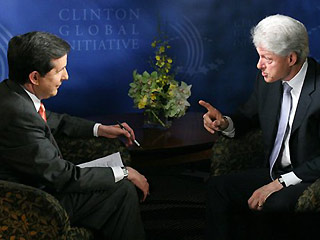
The image “http://leblacketlaplume.files.wordpress.com/2006/10/clinton-wallace.jpg” cannot be displayed, because it contains errors.
From Captain's Quarters: Yes he did. Surprise!
Did Clinton Lie About Targeting Bin Laden?


It appears that Bill Clinton may have exaggerated his record when it came to strategizing against Osama bin Laden. Newsweek's Michael Isikoff and Mark Hosenball take a look at the Inspector General's report of the pre-9/11 intelligence failures at the CIA and find an interesting nugget. Despite Clinton's angry assertion to Chris Wallace in last year's controversial Fox interview, he never gave the CIA an assassination order regarding bin Laden (h/t: CQ reader Mark):
The report also criticized intelligence problems when Bill Clinton was president, detailing political and legal “constraints” agency officials felt in the late 1990s. In September 2006, during a famous encounter with Fox News anchor Wallace, Clinton erupted in anger and waved his finger when asked about whether his administration had done enough to get bin Laden. “What did I do? What did I do?” Clinton said at one point. “I worked hard to try to kill him. I authorized a finding for the CIA to kill him. We contracted with people to kill him. I got closer to killing him than anybody has gotten since.”

Clinton appeared to have been referring to a December 1999 Memorandum of Notification (MON) he signed that authorized the CIA to use lethal force to capture, not kill, bin Laden. But the inspector general’s report made it clear that the agency never viewed the order as a license to “kill” bin Laden—one reason it never mounted more effective operations against him. “The restrictions in the authorities given the CIA with respect to bin Laden, while arguably, although ambiguously, relaxed for a period of time in late 1998 and early 1999, limited the range of permissible operations,” the report stated. (Scheuer agreed with the inspector general’s findings on this issue, but said if anything the report was overly diplomatic. “There was never any ambiguity,” he said. “None of those authorities ever allowed us to kill anyone. At least that’s what the CIA lawyers told us.” A spokesman for the former president had no immediate comment.)

I've written before that pursuing partisan blame for 9/11 is a waste of time. It gets in the way of determining where failures occurred and developing the proper approaches to avoid them in the future. The truth is that the issues that created these failures stretched back for years, probably decades in terms of interpretation of intelligence law.

However, it gets difficult to remember that when former presidents essentially lie about their roles on national television. Given Clinton's unique history, this prevarication and self-aggrandizement comes as no surprise, but it is still pretty disappointing. It leaves the historical record muddied, right up to the point when independent investigations reveal the truth. Worse, his shouted fabrications contribute to the partisan atmosphere.

One has to sympathize with CIA officials who had read the classified report in 2005, but were unable to respond to his exaggeration in 2006. He once gave the same kind of finger-waggling tirade to the nation, which turned out as false as his Wallace interview. It's a sad reflection on a man who somehow cannot bring himself to tell the truth, even when his nation needs it

Wednesday, August 22, 2007

The image “http://images.amazon.com/images/P/0867196041.01.LZZZZZZZ.jpg” cannot be displayed, because it contains errors.
The Color of Crime
by Patrick J. Buchanan


The execution-style murder of three African-American college students in Newark, N.J., forced to kneel and shot in the head -- allegedly by an illegal alien from Peru who was out on bail for the serial rape of a 5-year-old -- has the makings of a Willie Horton issue in 2008.

Newark, like New York, is a "sanctuary city," where cops are not to ask criminal suspects if they are in the country legally. Mitt Romney has been hammering Rudy Giuliani on the issue, trashing his tough-cop resume by painting the mayor as den mother of the Big Apple's playpen for illegal aliens.

The arrest of Jose Carranza in that Newark massacre, amid reports he had Hispanic accomplices and the murders may have been part of a gang initiation, has also elevated the issue of the black-brown war raging in U.S. big cities.

In the Aug. 10 Washington Post story that covered the Carranza arrest, the same page had two related articles. One was headlined, "Study: Almost Half of Murder Victims Black," the other, "Slaying of Popular Editor Stuns Blacks in Oakland."

The second headline reveals an ideological slant. One would assume that everyone in Oakland was stunned by the daylight execution of African-American editor Chauncey Bailey, allegedly by a teenage foot soldier at Your Black Muslim Bakery, which Bailey was investigating.

At Bailey's funeral, a mourner held up a sign reading, "Stop Black on Black Violence." That was the subject of the second Post story.

"Nearly half the people murdered in the United States are black," declared the opening paragraph, "part of a persistent pattern in which African Americans are disproportionately victimized by violent crime, according to a new Justice Department study."

Among other conclusions reported by the Post:

-- Blacks are more likely than whites or Hispanics to be victims of crime.

-- Blacks are more likely than any other group to be victims of "serious violent crime," such as rape, assault and robbery.

-- Blacks were more than twice as likely as whites to be confronted with a firearm during a crime.

"Overall, the new Justice findings jibe with previous studies," said the Post. "For example, a review of FBI data from 2004 by the Violence Policy Center, a liberal-leaning group that campaigns for stricter gun control laws, found that blacks accounted for about half of the nation's murder victims that year."

"Black victimization is a real problem, and it's often black on black," said David Harris, a law professor at the University of Toledo who studies crime statistics.

"Often"? Correction, Harris. As the Post reports and Justice concedes, in more than nine out of 10 cases, black victims are murdered by fellow blacks.

Utterly absent from the Post story and Justice Department stats is anything about white victims of crime. Not a word. Do white folks not count, though they are two-thirds of the population?

Yet, in "The Color of Crime: Race, Crime and Justice in America," produced by the "right-leaning" New Century Foundation in 2005, using the same FBI and Justice surveys, startling facts emerge:

-- "Blacks commit more violent crime against whites than against other blacks." Forty-five percent of the victims of violent crime by blacks are white folks, 43 percent are black, 10 percent are Hispanic.

-- Blacks are seven times as likely as people of other races to commit murder, eight times more likely to commit robbery and three times more likely to use a gun in a crime.

-- "Blacks are an estimated 39 times more likely to commit violent crime against a white person than vice versa, and 136 times more likely to commit robbery." (If decent black folks have trouble hailing a cab, and they do, these numbers may help explain it.)

-- Black-on-white rape is 115 times more common than the reverse.

Even the two most famous sexual assaults by white men on black women in the last two decades -- the Tawana Brawley and Duke rape cases -- turned out to be hoaxes.

What do these statistics tell us? A message the Post will not report. The real repository of racism in America -- manifest in violent interracial assault, rape and murder -- is to be found not in the white community, but the African-American community. In almost all interracial attacks, whites are the victims, not the victimizers.

Why does the Post not report such statistics? My guess: Because the stats would shatter the Post's cultivated image of America as a land where white racism is the great lurking malevolent monster. Stories that conform to the image get play. Stories that contradict it are buried.

But, if the Bush Justice Department is doing in-depth studies on black victims of crime and who is responsible, why not one on the victimization of Americans of all colors and who is responsible?

Or is that information we ought not know, and news not fit to print?

Mr. Buchanan is a nationally syndicated columnist and author of "The Death of the West," "The Great Betrayal," "A Republic, Not an Empire" and "Where the Right Went Wrong."
http://www.surgicare.com/images/Operating-Docs-Crop-400x328.jpg
Why the U.S. Ranks Low on WHO's Health-Care Study
By John Stossel


The New York Times recently declared "the disturbing truth ... that ... the United States is a laggard not a leader in providing good medical care."

As usual, the Times editors get it wrong.

They find evidence in a 2000 World Health Organization (WHO) rating of 191 nations and a Commonwealth Fund study of wealthy nations published last May.

In the WHO rankings, the United States finished 37th, behind nations like Morocco, Cyprus and Costa Rica. Finishing first and second were France and Italy. Michael Moore makes much of this in his movie "Sicko."

The Commonwealth Fund looked at Australia, Canada, Germany, New Zealand, the United Kingdom and the United States -- and ranked the U.S. last or next to last on all but one criterion.

So the verdict is in. The vaunted U.S. medical system is one of the worst.

But there's less to these studies than meets the eye. They measure something other than quality of medical care. So saying that the U.S. finished behind those other countries is misleading.

First let's acknowledge that the U.S. medical system has serious problems. But the problems stem from departures from free-market principles. The system is riddled with tax manipulation, costly insurance mandates and bureaucratic interference. Most important, six out of seven health-care dollars are spent by third parties, which means that most consumers exercise no cost-consciousness. As Milton Friedman always pointed out, no one spends other people's money as carefully as he spends his own.

Even with all that, it strains credulity to hear that the U.S. ranks far from the top. Sick people come to the United States for treatment. When was the last time you heard of someone leaving this country to get medical care? The last famous case I can remember is Rock Hudson, who went to France in the 1980s to seek treatment for AIDS.

So what's wrong with the WHO and Commonwealth Fund studies? Let me count the ways.

The WHO judged a country's quality of health on life expectancy. But that's a lousy measure of a health-care system. Many things that cause premature death have nothing do with medical care. We have far more fatal transportation accidents than other countries. That's not a health-care problem.

Similarly, our homicide rate is 10 times higher than in the U.K., eight times higher than in France, and five times greater than in Canada.

When you adjust for these "fatal injury" rates, U.S. life expectancy is actually higher than in nearly every other industrialized nation.

Diet and lack of exercise also bring down average life expectancy.

Another reason the U.S. didn't score high in the WHO rankings is that we are less socialistic than other nations. What has that got to do with the quality of health care? For the authors of the study, it's crucial. The WHO judged countries not on the absolute quality of health care, but on how "fairly" health care of any quality is "distributed." The problem here is obvious. By that criterion, a country with high-quality care overall but "unequal distribution" would rank below a country with lower quality care but equal distribution.

It's when this so-called "fairness," a highly subjective standard, is factored in that the U.S. scores go south.

The U.S. ranking is influenced heavily by the number of people -- 45 million -- without medical insurance. As I reported in previous columns, our government aggravates that problem by making insurance artificially expensive with, for example, mandates for coverage that many people would not choose and forbidding us to buy policies from companies in another state.

Even with these interventions, the 45 million figure is misleading. Thirty-seven percent of that group live in households making more than $50,000 a year, says the U.S. Census Bureau. Nineteen percent are in households making more than $75,000 a year; 20 percent are not citizens, and 33 percent are eligible for existing government programs but are not enrolled.

For all its problems, the U.S. ranks at the top for quality of care and innovation, including development of life-saving drugs. It "falters" only when the criterion is proximity to socialized medicine.

Next week: the truth about the Commonwealth Fund study.

http://blog.nj.com/ledgerupdates/__files/2007/08/large_Estreet.jpg

From BTX: A post by Bruce Brunch's Tom Cunningham. If you're a Bruce fan and this doesn't get you excited, I don't know what will.


Magic: A First Listen


I wanted to share a couple of thoughts about "Magic" while they are
still top of mind.

When the "hey come over and listen to the new album" phone call comes,
you go. That call came today. I'm glad I went.

I took some spotty notes, and when you can't read your own
handwriting--it's sad.

So, Magic.


Seated between a pair of outstanding speakers and handed a book with
the lyrics, the Magic began.

Quick observations: this album rocks...these songs will KILL in a
live concert setting...lots, LOTS of rocking guitars...I still don't
know why it's called Magic...nary a ballad...Clarence Clemons
rocks...I can't wait to find out how the actual recording of this
album played out...any crap that Brendan O'Brien took for The Rising
(undeserved in my book) will be long forgotten...these songs will
sound great on the radio...Bruce Springsteen "songwriter" is a
national treasure.

The production is big, without getting in the way. While The Rising
demanded a certain atmosphere and Devils & Dust surely came from its
own place, this album is an exclamation point in the Springsteen/
O'Brien studio pairing. This is a confident sounding record, made by
artists who trust each other and their art.


Radio Nowhere
Coming soon to a radio near you. Great lead off song. This could
easily be the guy in "Open All Night" 25 years burning down the road.
This song rocks, but the whole time, the guy in the song asks "is
anybody alive out there?" like his life depends on it. Classic E
Street with a monster solo from C.
And as the guy drives along he sings...
I just want to hear some rhythm
I just want to feel some rhythm
I just want to feel your rhythm
Awesome and terrifying at the same time.


You'll Be Comin' Down
Another song where C shines...spotlight on the Big Man. This is one
about someone getting their comeuppance--a whole "what goes around
comes around" thing. Karma!


Livin' In The Future
The most "pop" song on the album. Classic E Street--Big C again and a
song that would fit anywhere from Born To Run to Born In The U.S.A.


Your Own Worst Enemy
I liked this one a lot. Reminded me of the vibe of both Darkness and
The River, also not unlike None But The Brave. Great harmony vocals.


Gypsy Biker
A song about a gypsy biker who is coming home. Starts with a
beautiful harmonica and acoustic and ends up a flat out rocker. Very
powerful lyrics. Loved it and can't wait to hear it live.


Girls In Their Summer Clothes
Hmmmm...girls in their summer clothes don't like the hero in this
song. My notes for this one said "lyrics very specific, very
precise." While this was not one of my favorites, the lyrics are so
well written that you feel like you're on the street as "the girls in
their summer clothes pass me by."


I'll Work For Your Love
CatholicSchool...CatholicSchool...CatholicSchool. Bruce has used a
lot of Catholic imagery as of late, and this song certainly has that.
Beautiful piano intro, and another one that I really liked.


Magic
Interesting that this is the title cut. This one could have easily
been on Devils & Dust. The word "magic" does not appear in the song.
I need to hear it again, I guess. : )


Last To Die
Great songwriting here. Driving drums.


Long Walk Home
Probably the best song on the album. We know how great the lyrics
are, this is played with passion and tempo by Bruce and the band.
Wow. Max and Garry flat out kill this song, and there is an amazing
guitar solo. This song will destroy concert halls all over the
world. Amazing.


Devil's Arcade
The lyrics that are posted on the web are wrong. You'll be happy,
because this song is great--again with lyrics that are simply
amazing. Big guitars, big strings--I really liked this one a lot.


It's easy to toss around superlatives when discussing Bruce's work
(and yeah, I'm biased), but this is a great, great album. I keep
coming back to the preciseness and the specific ness of the lyrics.
These are streets that do have names. And the people who walk--drive--
run those streets have purpose. And when the band plays...

Do you believe in Magic? I do.

See you Sunday.

No surrender-

Tom Cunningham

Tuesday, August 21, 2007

http://www.11alive.com/assetpool/images/07726231526_vick726d.jpg
From KansasCity.com:
Vick lacked the courage to help
By JASON WHITLOCK


So let’s go ahead and redefine “keeping it real,” shall we?

We might as well, now that Michael Vick kept it real stupid and probably is headed to a federal penitentiary, the vacation destination of choice for men who believe criminal behavior and a lack of education are cultural benchmarks.

Trust me, I take no satisfaction in Vick’s decision to reach a plea agreement on dogfighting charges or his impending incarceration. The lack of parole and rehabilitation opportunities in federal penitentiaries and the mental disease caused by those shortcomings are as revolting to me as the crimes that land men there.

But this column won’t be a blast on our morally bankrupt penal institutions. This column will be about the lesson we all should take from Vick’s dramatic fall. Not long ago, the man did have the world by the tail. He owned a $130 million contract in a city, Atlanta, that adored him, and he was labeled a “franchise” quarterback.

He threw it all away because he bought into the self-destructive, immature, hip-hop model of “keeping it real.”

The Atlanta Falcons and owner Arthur Blank introduced and ushered Michael Vick into a brand-new world, a world that required Vick to carry himself in a more mainstream manner, a world of wealth, privilege, responsibility and the appearance of ethics and morality.

It’s a world all starting quarterbacks are asked to join. The position is the most prestigious in sports.

Vick wanted to do things his way. He wanted to customize the position in terms of style of play and off-field demeanor. He wanted to keep it real by keeping his feet in the seedy world he once knew and the new world that demanded a squeakier image.

The worlds don’t mix.

Michael Vick should not have abandoned his boyz from the hood, the gentlemen who predictably and quickly accepted plea agreements and squealed on Vick. He should’ve demonstrated the courage to demand that they join him on his new journey. He should’ve forced them to abandon him.

You follow?

It appears, according to federal investigators, that Vick financed his friends’ illegal dogfighting activity. Vick may have enjoyed dogfighting, but he certainly didn’t need the “sport.” He didn’t need a home dedicated to breeding and training pit bulls. He didn’t need to open and operate Bad Newz Kennels.

It’s my belief that if Vick stayed involved with dogfighting, he did so primarily because it was a way to stay involved in an activity in which his “boys” still participated. It was Vick’s way of keeping it real. He was fearful of being labeled a sellout, fearful of having his blackness questioned.

This is a burden we’ve created for ourselves. We fight our own evolution. This must end. We need to redefine keeping it real.

For athletes and other people who experience professional success, keeping it real should mean offering your lifelong friends and family members an opportunity to acquire the skills necessary to join the mainstream.

This may sound naïve and a bit comical, but it’s the truth: Rather than financing dogfighting, Vick should’ve paid for educational opportunities. He should’ve tried to help establish his cousins and friends in a legitimate business.

If they were uninterested in that, Vick should’ve informed them that he had nothing but love for ’em. No matter the problem, you can’t help people who are uninterested in helping themselves. You have to develop the courage to stop someone else’s weakness from drowning you. Vick, to me, is a coward. He wasn’t man enough to define for his friends what was in his best interest and what he would and would not tolerate.

Helping a friend or family member wallow in stupidity or self-destructive behavior is not keeping it real. It’s enabling a problem, a problem that could eventually engulf you. Ask Michael Vick.
From Spinner.com:
Bruce Springsteen Reveals 'Magic' Cover

Posted Aug 20th 2007 5:45PM
by Jessica Robertson

Behold the cover for Bruce Springsteen's forthcoming album, 'Magic.' The 11-song disc -- his first with the E Street Band since 2002's 'The Rising' -- hits shelves on Oct. 2.

Monday, August 20, 2007

http://www.avclub.com/content/files/images/danielson-family-movie.article.jpg
From Opuszine.com: This documentary is a wonderful exploration of the relationship of Christian faith to making art. A fascinating movie that should appeal to fans of indie rock, outsider art, and to thinking Christians.
Danielson: A Family Movie
Reviewed by Jason Morehead


Released: 2006
Country: United States
Genre(s): Documentary

http://forcefieldpr.com/site/wp-content/uploads/2006/11/danielson.jpg

One of the more amazing and intriguing concert experiences I’ve ever had took place at a sidestage during the 1998 Cornerstone Festival. It was late at night, and my friends and I had skipped out on M.C. Hammer(!)’s main stage performance to catch a couple of Cornerstone oddballs: Soul-Junk and the Danielson Famile.

The power kept cutting out from time to time, and so at one point, Soul-Junk started pulling people up from the crowd to breakdance onstage. When the power inevitably cut out during the Famile’s set, the band kept on playing, the passion and quirkiness of their music overcoming any technical difficulties and quickly becoming one of the most invigorating experiences of the fest that year.

In the following years, the Famile’s Cornerstone sets became must-see events for us. Sure, there was the off-kilter nature of it all—a band composed of brothers and sisters decked out in nurse uniforms and led by a guy singing in a most grating falsetto—that set it apart. But even more importantly was the amazing passion and even joy that they brought to their music, such that even the most hardened punk kids and metalheads could be found dancing, smiling, and praising during a Danielson Famile set.

All of these memories and impressions came rushing back while watching J.L. Aronson’s 2006 documentary, Danielson: A Family Movie.

The movie begins with the Danielson Famile—originally formed by Daniel Smith for his senior’s thesis project at Rutgers—preparing to play at England’s influential All Tomorrow’s Parties festival. It’s a watershed moment for a group that has spent years toiling in relative obscurity in both the Christian and secular music markets, thanks to their decidedly non-commercial and idiosyncratic music.

However, the festival also signifies a time of transition as well. As the band members go off to college, get married, and start families of their own, the band’s future becomes increasingly uncertain.

During this portion of the film, Daniel Smith seems largely on the periphery. Instead, the focus is on his siblings (both real and honorary) as they share their memories of the band’s past as well as thoughts on its future. An approach that, while somewhat unsatisfying on a purely informational level, also lends Danielson‘s first half a certain elegiac quality, as if we’re hearing the members’ fond farewells to long roadtrips and hours spent playing in both church basements and seedy bars.

The second half of the film picks up after All Tomorrow’s Parties, and finds Smith on his own, struggling to figure out where to go now that the Famile is on extended hiatus. He embarks on solo tours (with a then-unknown Sufjan Stevens as the opening act). He tries to come up with new artistic expressions, be it dressing up as a giant tree or turning his concerts into traveling salesman presentations. He builds a recording studio in his parents’ basement, and begins producing records for himself and friends.

It’s at this point where we begin to get a better glimpse of Daniel Smith, the man and artist. The film becomes something more than just a chronicle of yet another odd band and its quirky leader. Instead, it becomes an intriguing examination of an artist seeking the best and most creative ways to blend his art and spirituality, to brush aside any separation between the two.

The Christianity of Smith (and the rest of the Famile) is an obvious talking point of the film, largely because they do absolutely nothing to hide their faith and the role it plays in their music. Clips of Smith explaining his spirituality to interviewers and radio DJs make up much of the film, as do “hipster on the street” interviews.

During these latter segments, fans of the band—many of them not Christian—attempt to reconcile their love for Smith’s music with the fact that he is a born-again Christian whose faith is very evident in the music. These provide some of the most humorous moments in the film, as well as some of the most poignant.

In one particularly memorable scene, which thankfully fleshed out more in the DVD’s special features, a woman confesses that her critical attitude towards the band has nothing to do with their Christianity, but rather with her own anger towards the Church due to her childhood experiences.

But the scenes that prove most affecting for me are those where Smith, sans Famile, works to find his way during the band’s separation. He outlines for the camera his approach to songwriting—one where he claims the Holy Spirit plays as great a role in the creative process as himself, if not even greater. And yet, at the same time, we never see Smith just sitting back, waiting for divine inspiration to strike. Instead, he’s constantly busy in the studio, recording songs over and over again, going back and fixing mistakes, and working on new recording techniques.

It’s this dichotomy between the spiritual lens through which Smith sees his music, and the often-mundane activities that are involved in realizing the music (which, given the sparsity of Smith’s studio, have an almost monastic quality to them) that I find most fascinating.

We Christians tend to over-spiritualize our musicians, as if they’re not mere mortals but rather some manner of demigod capable of opening a direct line to the Almighty. Watching Smith muddle through the recording process, flubbing his lines and singing the wrong melodies, or watching him discuss his latest performance ideas with his wife, thoroughly blows that hyper-spiritual image out of the water.

And yet, as Smith outlines his creative process, and discusses his views on art with radio interviewers, fans, and even uber-producer Steve Albini, it’s obvious that Smith approaches his art in a completely holistic manner that is both refreshing and awe-inspiring. There is no divide between the secular and the sacred, the mundane and the spiritual, the natural and the supernatural.

It’s an inspiring vision of the way things could be, of the way things perhaps should be—especially amidst Christian circles. For many years, I resisted and railed against the Christian music industry, which I often found to be hopelessly cliched, stodgy, and dull. I was seeking after music with depth, passion, and creativity. The industry, or at least most of it, seemed more interested in churning out the same old “three cheers for Jesus” dreck album after album, year after year.

I’ve somewhat mellowed on that particular attitude, due in large part to artists such as Sufjan Stevens, David Eugene Edwards, Jason and Ronnie Martin, Rosie Thomas, Denison Witmer, Ester Drang, and of course, Smith and the rest of the Famile.

One of my favorite scenes in the movie takes place right before the band’s All Tomorrow’s Parties performance. Smith is talking with Steve Albini, who had picked the Famile to play at the festival, and the two are discussing music and faith. At one point, Smith lays out a vision of sorts for what a truly “Christian” music industry would look like. It sounds almost hopelessly naive, but at the same time, both incredibly alluring and incredibly convicting. It may be just a dream, but it’s not a bad dream to have. Not a bad dream at all.

More information on the movie can be found at its official website

Sunday, August 19, 2007

http://i.l.cnn.net/cnn/2007/US/08/11/schoolyard.killings/art2.carranza.court.ap.jpgThe image “http://media.modbee.com/smedia/2007/08/09/18/475-Schoolyard_Killings.sff.standalone.prod_affiliate.11.jpg” cannot be displayed, because it contains errors.
Speaking of sanctuary, where's ours?
By MARK STEYN


At the funeral of Iofemi Hightower, her classmate Mecca Ali wore a T-shirt with the slogan: "Tell Me Why They Had To Die."

"They" are Miss Hightower, Dashon Harvey and Terrance Aeriel, three young citizens of Newark, New Jersey, lined up against a schoolyard wall, forced to kneel and then shot in the head.

Miss Ali poses an interesting question. No one can say why they "had" to die, but it ought to be possible to advance theories as to what factors make violent death in Newark a more-likely proposition than it should be. That's usually what happens when lurid cases make national headlines: When Matthew Shepard was beaten and hung on a fence in Wyoming, Frank Rich wrote in the New York Times that it was merely the latest stage in a "war" against homosexuals loosed by the forces of intolerance. Mr. Shepard's murder was dramatized in plays and movies and innumerable songs by Melissa Etheridge, Elton John, Peter, Paul and Mary, etc. The fact that this vile crucifixion was a grisly one-off and that American gays have never been less at risk from getting bashed did not deter pundits and politicians and lobby groups galore from arguing that this freak case demonstrated the need for special legislation.

By contrast, there's been a succession of prominent stories with one common feature that the very same pundits, politicians and lobby groups have a curious reluctance to go anywhere near. In a New York Times report headlined "Sorrow And Anger As Newark Buries Slain Youth," the limpidly tasteful Times prose prioritized "sorrow" over "anger," and offered only the following reference to the perpetrators: "The authorities have said robbery appeared to be the motive. Three suspects – two 15-year-olds and a 28-year-old construction worker from Peru – have been arrested."

So, this Peruvian guy was here on a green card? Or did he apply for a temporary construction-work visa from the U.S. Embassy in Lima?

Not exactly. Jose Carranza is an "undocumented" immigrant. His criminal career did not begin with the triple murder he's alleged to have committed, nor with the barroom assault from earlier this year, nor with the 31 counts of aggravated sexual assault relating to the rape of a 5-year-old child, for which Mr. Carranza had been released on bail. (His $50,000 bail on the assault charge and $150,000 bail on the child-rape charges have now been revoked.) No, Mr. Carranza's criminal career in the United States began when he decided to live in this country unlawfully.

Jose Carranza isn't exactly a member of an exclusive club. Violent crime committed by fine upstanding members of the Undocumented-American community is now a routine feature of American life. But who cares? In 2002, as the "Washington Sniper" piled up his body count, "experts" lined up to tell the media that he was most likely an "angry white male," a "macho hunter" or an "icy loner." When the icy loner turned out to be a black Muslim named Muhammad accompanied by an illegal immigrant from Jamaica, the only angry white males around were the lads in America's newsrooms who were noticeably reluctant to abandon their thesis: Early editions of the New York Times speculated that Muhammad and John Lee Malvo were being sought for "possible ties to 'skinhead militia' groups," which seemed a somewhat improbable alliance given the size of Mr. Muhammad's hair in the only available mug shot. As for his illegal sidekick, Malvo was detained and released by the INS in breach of their own procedures.

America has a high murder rate: Murdering people is definitely one of the jobs Americans can do. But that's what ties young Malvo to Jose Carranza: He's just another killer let loose in this country to kill Americans by the bureaucracy's boundless sensitivity toward the "undocumented." Will the Newark murders change anything? Will there be an Ioefemi Hightower Act of Congress like the Matthew Shepard Act passed by the House of Representatives? No. Three thousand people died Sept. 11, 2001, in an act of murder facilitated by the illegal-immigration support structures in this country, and, if that didn't rouse Americans to action, another trio of victims seems unlikely to tip the scales. As Michelle Malkin documented in her book "Invasion," four of the killers boarded the plane with photo ID obtained through the "undocumented worker" network at the 7-Eleven in Falls Church, Va. That's to say, officialdom's tolerance of the illegal immigration shadow-state enabled 9/11. And what did we do? Not only did we not shut it down, we enshrined the shadow-state's charade as part of the new tough post-slaughter security procedures.

Go take a flight from Newark Airport. The TSA guy will ask for your driver's license, glance at the name and picture, and hand it back to you. Feel safer? The terrorists could pass that test, and the morning of 9/11 they did: 19 foreign "visitors" had, between them, 63 valid U.S. driver's licenses. Did government agencies then make it harder to obtain lawful photo ID? No. Since 9/11, the likes of Maryland and New Mexico have joined those states that issue legal driver's licenses to illegal immigrants.

Newark is the logical end point of these policies. It is a failed city: 60 percent of its children are being raised in households without fathers. Into that vacuum pour all kinds of alternative authority structures: Mr. Carranza is alleged to have committed his crime with various teenage members of MS-13, a gang with origins in El Salvador's civil war of the 1980s that now operates in some 30 U.S. states. In its toughest redoubts, immigrants don't assimilate with America, America assimilates to the immigrants, and a Fairfax, Va., teenager finds himself getting hacked at by machete wielders.

One could, I suppose, regard this as one of those unforeseen incremental consequences that happens in the darkest shadows of society. But that doesn't extend to Newark's official status as an illegal-immigrant "sanctuary city." Like Los Angeles, New York and untold others, Newark has formally erased the distinction between U.S. citizens and the armies of the undocumented. This is the active collusion by multiple cities and states in the subversion of U.S. sovereignty. In Newark, N.J., it means an illegal-immigrant child rapist is free to murder on a Saturday night. In Somerville, Mass., it means two deaf girls are raped by MS-13 members. And in Falls Church, Va., it means Saudi Wahhabists figuring out that, if the "sanctuary nation" (in Michelle Malkin's phrases) offers such rich pickings to imported killers and imported gangs, why not to jihadists?

"Tell Me Why They Had To Die"? Hard to answer. But tell me why, no matter how many Jose Carranzas it spawns, the nationwide undocumented-immigration protection program erected by this country's political class remains untouchable and ever-expanding.