Friday, November 16, 2007

The image “http://www.caglecartoons.com/images/preview/%7BF9106E76-B0FF-4969-A8B3-92F47BA01A93%7D.gif” cannot be displayed, because it contains errors.
From The New York Daily News:
Barry Bonds caught Hank Aaron,
now he's just caught

By Mike Lupica

Friday, November 16th 2007, 4:00 AM

This all really started with a dirty little drug company called BALCO, and then Barry Bonds sitting in front of a grand jury and saying, under oath, that he never knowingly used steroids from BALCO or anybody else. The government of the United States now says that was a lie, which is all anybody thought in the first place.

The government officially says that Bonds, who has hit more home runs than anybody in baseball history, lied about being a drug cheat. Bonds could go to jail for that. Pete Rose, who had more base hits than anybody in baseball history, once went to jail as a tax cheat.

Now it is 5:21 yesterday afternoon and a woman named Eve Burton, general counsel for the Hearst Corp., a woman who spent years trying to keep two San Francisco Chronicle reporters out of jail because of their reporting on Bonds and BALCO, looks at her computer screen in her office on the 42nd floor of the Hearst Tower at 57th and Eighth, and sees that she has an incoming e-mail.

It is a two-word message from Phil Bronstein, the editor of the Chronicle:

"Bonds indicted!"

For years Burton worked to keep two of Bronstein's best reporters, Mark Fainaru-Wada and Lance Williams, out of jail. So much of that was about Bonds, because BALCO was always about Bonds more than anybody else. The reporters were charged with contempt, and so Eve Burton kept filing in and out of the Federal Courthouse in San Francisco with motions and arguments, fighting for her reporters, fighting for the First Amendment.

While all this was going on, Barry Bonds kept chasing Henry Aaron's record of 755 home runs, and the only people who didn't know it was drugs who got him anywhere near Aaron over the last decade of his career didn't want to know, and shame on them, and the way they tried to blame everybody except Barry Bonds for who he is and what he did.

So many people, in and out of the media, desperately wanted Bonds to be a victim of something other than his own arrogance and his obsession with being the home run king of baseball. So they called this a witch hunt. One more lie. Not from Bonds this time. Just about him.

He kept chasing Aaron. The government stayed in its slow chase after him. Finally yesterday Barry Bonds was indicted for perjury and obstruction of justice. This really means the government produced finally came up with a positive drug test on Bonds. If you want to put down a bet, bet that somehow they got it out of BALCO, where this all began.

If it came from BALCO, that wouldn't just be justice, it would be poetic justice. That would make this poetic justice in addition to real justice.

Either that, or Greg Anderson got tired of sitting in a jail cell for Bonds and finally flipped on him.

In Eve Burton's office yesterday, after all the years of fighting for her reporters, she danced around her office on the 42nd floor like a schoolgirl and then the other people on that floor heard her yell, "YES!"

Halfway across the country in Milwaukee, the commissioner of baseball, Bud Selig, walked into his office after having been at the owners' meetings in Naples, Fla., and his phone rang and it was one of his PR men calling from an airport in Florida.

"Did you hear about Bonds?" Selig was asked.

All last season, Selig kept hearing that an indictment of Bonds was just around the corner, that it might even come before he passed Aaron. Only the indictment never came. Bonds passed Aaron. The night he did, there was this cockeyed notion that Selig should have done more to celebrate the moment, that somehow he was the bad guy.

Another lie.

"What about Bonds?" Selig said on the phone.

"They indicted him."

Selig didn't say anything right away. Finally he said, "Inevitable. Sad, but inevitable."

This indictment does not mean that Bonds is convicted, that the government will make its case in a courtroom, that what they have it has on him will meet the standards of either perjury, or obstruction of justice. But the government never believed him on in regard to steroids because reasonable people never did, the way reasonable people never believed that he grew the way he did and his home run numbers grew the way they did after the age of 35 because of all the gym work he did with Greg Anderson, personal trainer, ex-jailbird.

Nobody ever believed that the only way Bonds would ever use steroids is if he thought what he was using was flaxseed oil. If you believed that, you also believed pigs can fly.

The longer the government went without an indictment, the more you started to hear that it was more than a witch hunt, it was a vendetta now. You heard that if they it didn't have something on him by now they were it was never going to have anything on him. Only there turned out to be no clock on this the way there is no clock in baseball.

Of course this is a baseball story first and foremost because it is Bonds, and he is the one who hit all those home runs. But he did this. He is the one who could end up a bum the way Rose did, at least in the eyes of the law. Bonds knew exactly what he was doing, and what he was doing - unless you think Fainaru-Wada and Williams wrote a novel when they wrote "Game of Shadows" - was a laundry list of drugs that reads as if it were written in a pharmacy in hell.

Now the government says that he not only took all those drugs, but then he lied about it under oath and kept lying. And that isn't on baseball. It is on him. Baseball didn't do this to Barry Bonds, the media didn't do this, the feds didn't do this. He did this to himself. He takes a different kind of medicine now.
The image “http://i.cnn.net/si/si_online/covers/images/2006/0925_large.jpg” cannot be displayed, because it contains errors.
From The New York Daily News:
Steinbrenner sons rise to the occasion
By Mike Lupica


Already it starts to get around that Scott Boras orchestrated the whole thing, that he plays Karl Rove to the end with Alex Rodriguez, that he came up with the whole idea of sending his client back to the Yankees without him. Boras ought to watch himself, whether he's spinning things this way or not. He made a royal mess out of this thing once. If he does it again, if the Steinbrenners get the idea for one minute that Boras is trying to play them here, then the world's smartest agent - ask him - blows this up for good.

Then we're back to him looking more like A-Wad than A-Rod and he can figure out all over again why all polls everywhere have been running against him the way they have since he walked away from the last three years of his current contract during the World Series one night. Just because he's coming back doesn't mean he doesn't have a lot of work to do.

The last few weeks Yankee fans have been more worried about Jorge Posada and Mo Rivera leaving than they were about 54 home runs.

As one Yankee said yesterday, "It's not just about saying the right things from now on, it's about doing things the right way."

Maybe Boras will wait until the deal is done, then send all his various admirers in the media out to say that this was just another example of his genius, that he knew he was never getting $350 million, this was the best way to get as close as possible to $300 million with the Yankees. And to get them to negotiate after they said they wouldn't.

Why? Because Boras can't ever be shown up, not by his own star client, certainly not by Hank and Hal Steinbrenner, who have been in the game for only about 20 minutes. You would say that Boras thinks he invented everything including the iPod, but the "I" isn't big enough.

But if you are a Yankee fan who wanted Alex Rodriguez back despite everything, if you wanted him back no matter how much of a mess he and his agent had made of things, then you better talk about the Steinbrenner brothers today, because this doesn't happen without them.

They weren't afraid to change their minds about the way they do business. A-Rod wised up about the way he's been doing business. Jump ball. Now a lot of money is about to change hands. The Steinbrenners are ready to sign a player they said they wouldn't sign, especially after Boras didn't even give them a chance to make an offer that A-Rod is ready to take now. Boras was going to break all records again and now basically gets the same deal for his client he got seven years ago, the last time he was a free agent. It really will be interesting to see how he spins this when the contract is signed, because the bottom line on Alex Rodriguez's brand new bottom line with the Yankees is I could have gotten him this deal and so could you.

"I wanted the opportunity to share my thoughts with Yankee ownership," A-Rod said on his Web site yesterday.

If he'd done that three weeks ago, he wouldn't have lower poll numbers than Ron Paul.

Somebody sure did tell Rodriguez that he better tell the Yankees if he still wanted to play baseball for them. If it was, it was somebody smart, because when Rodriguez called Tampa over the weekend, he started the process of getting the best deal he was going to get. And the Steinbrenner boys talked to him because they never wanted him to leave in the first place.

They got murdered for the offer the Yankees finally made to Joe Torre, but they were always right about one thing: They weren't going to carry Torre around the room after three straight first-round losses and four in the last six years.

They had a perfect right to fire Torre. Did it look like a rookie mistake with those incentives attached? Sure. It gave Torre a chance to look like a martyr. But the idea that the manager of the Yankees, one who was making $7 million a year, shouldn't be held accountable for this amazing string of postseason failures was always ridiculous.

They get a good manager in Joe Girardi. They get A-Rod and all his numbers back, and weren't afraid to do that about-face, voting for him after they voted against him. Hey: They showed with Posada that they're still their father's sons and aren't afraid to overpay for somebody they want. The truth is, they wanted the catcher more than they wanted the outgoing manager, the way they want Mo Rivera back, even though they will end up wildly overpaying for a closer who will soon be in decline. And before this is all over, they may end up with Johan Santana.

Maybe there are other owners who would have done it the way they have with A-Rod. Name some. Hank and Hal Steinbrenner are still getting on-the-job training. Hank loves to talk, almost every day. The younger brother hangs back and seems happy to do more business than talking. They are both smart enough to listen to Brian Cashman on the big things. As much as they got banged around on Torre, they are getting the people they want, even if they had to go all the way around the mulberry bush to bring their third baseman back into the fold.

They didn't look great with Torre. But there's something in here, something pretty important, about not being afraid to look bad if you think it helps the Yankees. In that way, they may be more like the old man than we originally thought.
Wes Miller chronicled his senior season at North Carolina in the book,
Wes Miller chronicled his senior season at North Carolina
in the book, "The Road to Blue Heaven."
Photo courtesy of Pegasus Books

From SI On Campus:
Q&A: Wes Miller
The former UNC guard discusses his new book

By Nicki Jhabvala

Wes Miller didn't follow the usual route to becoming a Tar Heel. You know, the one where the 6-foot-8 high schooler who can leap out of the gym finally commits after years of recruiting by all the big-name schools. Yeah, that one. Definitely wasn't the 5-11 Miller. As a transfer from James Madison University, the shooting guard chose to follow his dream of landing a spot on North Carolina's roster. And not just to wear the Carolina blue jersey, mind you.

Try eventually earning a scholarship in that jersey when programs across the country simply shook their heads.

Try picking up an NCAA Championship trophy in that jersey.

Try earning a starting role in that jersey

Try making an impression in that jersey so strong that professional leagues overseas take notice.

The former "Roy's Boy" may have completed his college days, but the distinctive path he laid continues to guide his future. Now add a book to his list of accolades. With The Road to Blue Heaven, Miller opens the diary of his senior season in Chapel Hill to the public, telling of his journey from transfer to starter, walk-on to scholarship player, and Carolina admirer to disciple.

Sure, there have been many books about North Carolina basketball, but none have been by a player while that player is in the midst of his Tar Heel career. And no Carolina basketball author has given SI on Campus the full scoop on his literary feat.

SI: What inspired you to write this book?

WM: Well, I wish I could say it's an original thought, but my freshman year at UNC, I got coach (Jerod) Haase's book. He actually wrote a diary of his senior year at Kansas. I read that and really enjoyed it, and really never thought anything else about it at that point. But then going into my senior year, I remembered that book and what he had done, and wanted to do something similar to it. I kind of stole the idea from coach Haase.

SI: What surprised you about the process of writing a book?

WM: It was a new thing. I'm so used to just playing basketball and going to school. But it was a fun challenge. I met with Adam Lucas (editor) once a week and we went over everything and kind of stayed up to date on what had been going on to that point in the season. So, having Adam, who is such a talented writer and had written books before strictly on Carolina basketball, really helped me stay on track with the whole thing.

SI: How did the collaboration with Adam Lucas work exactly?

WM: We both did some writing for it. I would keep notes from here and there, and then I would talk to him. It's all in my words, but he helped me write it at the same time.

SI: What's your favorite part in the book?

WM: That's a tough question. I don't think there's like one chapter I enjoy more than others. But I what really like about the book is it gives you a different perspective that many people don't know about: life as a college basketball player -- life as a North Carolina college basketball player. It's kind of a behind-the-scenes look at the season. It'd be one thing to write a book and talk about how Tyler [Hansbrough] had 25 points and 12 rebounds and Tywon [Lawson] had eight assists that game. It's less of that and more talk of what it was like in the locker room, what it was like in practice -- things that the general public doesn't really get to see.

SI: What was the hardest part about writing the book?

WM: The hardest part was staying on track with it. You go through the ups and downs of the season and, especially when you're going through some tough times and you're losing some games, you don't feel like sitting down and writing notes down about what had just happened and keeping a diary and needing to talk about the book. You're so concerned about what's going on with the season. It wasn't extremely difficult, but it was time consuming. It was something I really enjoyed doing. It's been fun to go back to read and see -- even while we were in the season -- what had already been written and remember things that had happened just two months before that you kind of forget about as the season progresses.

SI: Did your teammates and coaches know you were planning to publish this during the season?

WM: I think a couple of them did, and a couple of them didn't. I think they figured it out towards the end of the season, but it wasn't something I really made public or talked about a lot. I talked about it with Coach [Roy] Williams before I did it to make sure it was OK with him. Once he gave me his blessing, I just went ahead with it and tried to keep it quiet throughout the year.

SI: Do you have any expectations or goals for the success of the book?

WM: I'm very unfamiliar with anything in the book world. It's new territory for me. But my expectation was to put something together that I could look back and read 20 years down the road and really be able to remember what my experience was like at UNC. And, at the same time, if people can get a look into Carolina and its fans, and if college basketball fans can get a look at what it's like to be a college basketball player, then that would be great, too. So that was really the motivation behind it.

SI: Can we expect another book from you in the future?

WM: There's no telling. At this point I don't have any plans to do another one. But I really enjoyed doing it and working with Adam Lucas. Who knows if I'll do anything in the future worthy of a book, but it was something I really enjoyed.

SI: How do you feel about playing in London?

WM: I just wanted to continue to play basketball. I wasn't ready to completely hang it up. The coach of my team, the London Capital, is Steve Bucknall, a former Carolina player. So, that's a good connection and it makes me feel a lot more comfortable. And I also get to do a little coaching at the youth level while I'm there too. I've always felt that I wanted to be a basketball coach whenever I'm done playing, and this is a way for me to actually get some coaching experience and play at the same time.

** Through the season's first eight games, Miller is averaging 23 points per game for the London Capital

Tuesday, November 13, 2007

Bruce Springsteen, center, with E Street Band mates Nils Lofgren, left, and Steven Van Zandt, got in their guitar licks in a sold-out show that mixed a potent 24-song set.
Bruce Springsteen, center, with E Street Band mates Nils Lofgren, left,
and Steven Van Zandt,
got in their guitar licks in a sold-out show
that mixed a potent 24-song set.

Bruce Springsteen, Working His Powerful Magic
By J. Freedom du Lac
Washington Post Staff Writer


Tuesday, November 13, 2007

ABruce Springsteen and the E Street Band concert circa 2007 comes with an implicit quality guarantee. While it might not say as much on your ticket, you know going in that the show will have a particularly high base line, given that the group is more or less incapable of proffering a poor live performance. Indifference and creative implosions simply aren't on the list of possibilities; even on their worst nights, the band is at least good.

Sunday night at Verizon Center was not one of those nights. Instead, Springsteen and his longtime band were simply great, performing a well-considered set with heightened intensity and a very clear sense of purpose.

The guiding principle of a Springsteen show is to deliver salvation and hope through song. Forging bonds is critical, as well -- no audience is more important to Springsteen than the one he's currently trying to win over -- and so he set out to do just that with the audience here immediately. "Is there anybody alive out there?" he wondered. " Is there anybody alive out there?" And away he and the E Street Band went with "Radio Nowhere," a chugging new single about searching for connections in a disconnected world.

Performing the first of two sold-out nights at the arena, Springsteen and his nine-piece band delivered a marvelous 24-song set that included some of his greatest hits ("Born to Run," "Dancing in the Dark," "Badlands") but was particularly heavy on songs from "Magic," a new album whose central figures are isolated, alienated and disillusioned. They've been betrayed and deceived, and so there's a riptide of angst tugging at those who occupy this wartime Americana.

Springsteen articulated that in both music and words: The song "Magic," he said, is about how "the truth gets twisted into lies, and lies get twisted into the truth." In introducing "Livin' in the Future," he talked about rendition and wiretapping and a Constitution under "attack." "The E Street Band is here tonight to do something about it!" he said. "We're going to sing about it. We're musicians. It's a start."

His moaning harmonica set the tone for "Gypsy Biker," a haunting tale about a soldier who comes home in a casket. "Last to Die" was a soaring, impassioned antiwar rant. "Devil's Arcade" -- dedicated to Veterans Day -- was a moving, meditative lament from a soldier's lover who lost her man to the military.

Their ideas were big, and the sound was bigger. Sometimes too big: With the audio mix muddy throughout the arena, instrumental parts stuck together and some vocals were swallowed whole. It was a shame, given just how tight the band's playing was, from Nils Lofgren's pealing guitar leads to Max Weinberg's tempo-pushing drumming, so furious yet so steady.

Still, the message rang clear: All is not well in the promised land of America. But all is not lost, either. "At the end of every hard-earned day, people find some reason to believe," Springsteen sang as the band turned "Reason to Believe," one of his stark "Nebraska" songs, into a bluesy stomp.

Springsteen remains one of the most potent live performers in popular music -- largely because he's among the most committed practitioners of the form, draining all of his creative energy every time he's onstage. (And there is much to drain, as his well runs exceptionally deep, even at the age of 58.) He also maintains an unwavering faith in the power of rock-and-roll; in turn, his own power is undeniable. Add the E Street Band to the calculus, and the result can be exhilarating and explosive, whether they're performing Springsteen's trenchant political poetry, his brittle working-class anthems or his rich, youthful narratives.

Sunday's 2-hour 15-minute set touched on all of Springsteen's thematic hallmarks, and even reached deep into his catalogue for a pair of songs from 1973, back before he'd established himself as one of the most gifted and important voices in rock. Among them was the shifty blues-jazz of "Kitty's Back," a most welcome and thrilling stylistic curveball thrown into a marvelous set that was heavy on muscular rockers with overdriven guitars.

There were songs about love and broken hearts, about refusing to grow old ("No Surrender") and the reality of growing even older ("Girls in Their Summer Clothes"), and, in "Night" -- an old warhorse that somehow still sounds fresh -- about restless, romantic young souls whose world is busting at its seams.

Arguing about whether the concert would have been better served if only they'd eschewed such-and-such (off "Magic" in this case) for so-and-so (from the "The River," no?) is something like an Olympic sport among Springsteen die-hards, and those debates have been raging since the last note of the old-time folk finale "American Land" faded inside the arena on Sunday. Which just goes to show you how hard Springsteen and the E Street Band have it: When you're always good, simply being great might not be good enough.

Monday, November 12, 2007

The image “http://www.themadpigeon.com/photos/uncategorized/1_53.jpg” cannot be displayed, because it contains errors.
From National Journal:
Academia's Pervasive PC Rot
By Stuart Taylor Jr.

Monday, Nov. 12, 2007

"A RACIST: A racist is one who is both privileged and socialized on the basis of race by a white supremacist (racist) system. 'The term applies to all white people (i.e., people of European descent) living in the United States, regardless of class, gender, religion, culture, or sexuality. By this definition, people of color cannot be racists.' " [emphasis added]

Such stuff has long been a staple of the totalitarian "diversity" obsessives who pollute -- and often dominate -- political discourse at almost all of our universities, from coast to coast. The University of Delaware recently got a step ahead of its peers by including the all-whites-are-racists dogma in training those who administered a systematic thought-reform program for incoming (and other) students.

The quoted language appears in an August 2007 "diversity facilitation training" program for resident assistants. The RAs were, in turn, assigned to use far-left propaganda such as this in what university documents called the mandatory "treatment" of freshmen and the rest of the 7,000 students in university residence halls.

University President Patrick Harker suspended this particular program two days after an October 30 expose spurred media reports and horrified parents and other citizens. But history suggests that it may well be back in some less obvious form before long. And it provides the latest glimpse into the political correctness rot that infects our universities and a great many secondary schools.

This and dozens of other cases suggest to me that the cancerous spread of ideologically eccentric, intellectually shoddy, phony-diversity-obsessed fanaticism among university faculties and administrators is far, far worse and more inexorable than most alumni, parents, and trustees suspect.

Another hyperbolic, conservative rant about liberals in academia? Perhaps I should confess my biases. I do dislike extremism of the Left and of the Right. But I have never been conservative enough to vote for a Republican presidential nominee. And the academics whose growing power and abuses of power concern me are far to the left of almost all congressional Democrats.

They are also ruthless in blocking appointment of professors whose views they don't like; are eager to censor such views; and in many cases are determined to push their own political views on students, who have few reality checks in their course material and are often too innocent of the world to understand when they are being fed fatuous tripe.

Delaware students have been not only inculcated with the lunatic view that all white Americans are racists (and that "REVERSE RACISM" is a "term ... created and used by white people to deny their white privilege") but also:

* Told to confess their "privilege" or lament their "oppression";

* Informed that "white culture is a melting pot of greed, guys, guns, and god";

* Required to "recognize that systemic oppression exists in our society" and "recognize the benefits of dismantling systems of oppression" (whatever that means);

* Instructed to purge male residents' "resistance to educational efforts" and "concepts of traditional male identity";

* Challenged to "change their daily habits and consumer mentality" for the sake of "sustainability";

* Pushed to display on their dorm doors politically approved decorations proclaiming support for (e.g.) "social equity" (whatever that means);

* Subjected to other "treatments" designed to alter their beliefs and behaviors and inculcate university-approved views on politics, sexuality, moral philosophy, and more;

* Ordered to attend residence-hall training sessions and submit to one-on-one sessions with RAs, who filed reports to their superiors about individual students' "level of change or acceptance" of the thought-reform program.

One such report, for example, classified a young woman as one of the "worst" students in the residence life education program for saying that she was tired of having "diversity shoved down her throat" and responding "none of your damn business" when asked "when did you discover your sexual identity?"

"It seemed like they were trying to convince us we were racist and sexist and were horrible people," Kelsey Lanan, a 19-year-old sophomore, told The Philadelphia Inquirer.

The expose of the Delaware program came not from the media, most of which have (unlike The Inquirer) displayed little interest in the ugly details of campus PC, but from the Foundation for Individual Rights in Education, a Philadelphia-based group that protects the liberties of students from their own universities. FIRE said in an October 29 letter to Harker that the university's approach "represents a distorted idea of 'education' that one would more easily associate with a Soviet prison camp." But although especially egregious, the Delaware program is hardly an isolated example.

"In a nation whose future depends upon an education in freedom, colleges and universities are teaching the values of censorship, self-censorship, and self-righteous abuse of power," FIRE founders Alan Charles Kors and Harvey A. Silverglate asserted, with copious documentation, in their 1998 book, "The Shadow University: The Betrayal of Liberty on America's Campuses."

They went on: "Our students are being educated in ... double standards to redress partisan definitions of historical wrongs.... [The norm is] intolerance of dissent from regnant political orthodoxy [and] the belief that universities not only may but should suspend the rights of some in order to transform students, the culture, and the nation according to their ideological vision and desire."

Despite a succession of court decisions striking down university speech codes, they re-emerged thinly disguised as rules to prevent and punish "harassment," defined to include any speech deemed offensive by minorities, women, gays, or other preferred groups.

The PC sickness goes far beyond intolerance of dissent. It also has a pervasive effect on course offerings. History departments, for example, offer fewer and fewer traditional courses such as political and diplomatic history, to make room for courses portraying history as a tale of unrelieved oppression of minorities, women, the poor, gays, and everyone else by privileged white males.

Academia's "diversity" obsession is founded on hostility to diversity of opinion. To most academics, "diversity" is a code word for systematic preference of minorities and women over white males in all walks of life. The preferred groups include many faculty members who are manifestly unqualified for their positions and whose websites read like a "Saturday Night Live" parody of wacky professors.

"At least in the humanities and social sciences," Emory University professor Mark Bauerlein wrote in a 2004 essay, "academics shun conservative values and traditions, so their curricula and hiring practices discourage non-leftists from pursuing academic careers.... The quasi-Marxist outlook of cultural studies rules out those who espouse capitalism. If you disapprove of affirmative action, forget pursuing a degree in African-American studies. If you think that the nuclear family proves the best unit of social well-being, stay away from women's studies."

Over the decades, academic extremists have taken over more and more departments, like cancers metastasizing from organ to organ. For example, the 88 Duke professors who signed a disgraceful April 2006 ad in the school paper spearheading the mob rush to judgment against falsely accused lacrosse players included 80 percent of the African-American studies faculty; 72 percent of the women's studies professors; 60 percent of the cultural anthropology department; and lots of professors in romance studies, literature, English, art, and history.

An organizer and representative member of the Duke 88, Wahneema Lubiano, has labeled herself a "post-structuralist teacher-critic-leftist." Her meager scholarly output includes railing against "Western rationality's hegemony" while making the inconsistent (and racist) claim that "many whites might not ever be persuaded by appeals to reason."

Another 88er, literature professor Grant Farred, has produced such "scholarship" as a monograph styling Houston Rockets center Yao Ming, a native of China, as "the most profound threat to American empire." In the fall of 2006, Farred accused hundreds of Duke students of "secret racism" against "black female bodies" because they had registered to vote! The students were trying to defeat rogue Durham District Attorney Mike Nifong, who was courting the black vote by pressing rape charges against three white lacrosse players in the face of overwhelming public evidence of innocence.

At no point during or since the rape hoax has Duke President Richard Brodhead or board Chairman Robert Steel even hinted at rebuking Lubiano, Farred, or the other unrepentant faculty persecutors of lacrosse players.

Only in American academia could still another elite university -- Cornell -- proudly hire away and tenure a character such as Farred after he had proved himself a malicious buffoon. "We are very enthusiastic about Professor Farred, whose work everyone in this department has long admired," remarked Cornell English Department Chairwoman Molly Hite.

In academia today, a professor who falsely smears his university's students as racists is a hot commodity. And hate means never having to say you're sorry.

-- Stuart Taylor Jr. is a senior writer and columnist for National Journal magazine, where "Opening Argument" appears. His e-mail address is staylor@nationaljournal.com.

http://www.boardwalkhall.com/images/press/Bruce_big.jpg

Excellent brief review from The Telegraph,
which I inexplicably failed to post earlier:

Bruce Springsteen

Magic


It starts the way it means to continue: with a glorious blast of drums, guitars, pianos, organs, saxophones – the E Street band in full flight. This is an album to stir the loins of Bruce Springsteen fans, resurrecting the desperate, fist-waving bravura of much-loved classics Born to Run and Born in the USA in a life-affirming surge of rock and roll, soul, blues and gospel, all merged together in a Spector-esque wall of sound.


The drums go boom-cha-boom on You'll Be Comin' Down, Clarence Clemons's sax punches a hole through Living in the Future, and a church bell can even be heard ringing out on Your Own Worst Enemy.


But, as on Springsteen's earlier masterpieces, the underlying sentiment is much darker and more subtle than the swaggering music implies. As everyone knows, your own worst enemy is yourself, and Springsteen turns a mordant eye on the changes in his own country since 9/11.


On the surface, these are personal vignettes of love and betrayal, but there is not a song here that does not lend itself to a more political interpretation. The darkness on the edge of town has spread through the whole nation, and where Springsteen protagonists once yearned to escape stultifying small towns, now he mourns the passing of a place where "you knew who you were… the people were at ease, baby slept in peace". Empty streets have become a symbol of a deeper malaise, like the diner "shuttered and boarded, with a sign that just said 'gone'?".


Amid all the sound and fury, the key is the quiet, folky title track, in which Springsteen's huckster magician lures his audience in, only to perform a sleight of hand that makes their very freedom disappear, leaving "bodies hanging in the trees / This is what will be".


Springsteen can be a downbeat writer, his voice mournful, his lyrics grappling with the contradictions of the human condition, but with the E Street band unleashed, the sheer joy of musical communion sugar-coats the bitterest pills. On Living in the Future, the bandleader roars: "Is that rolling thunder/ or just the sinking sound of something righteous going under?" It might just be the sound of the E Street Band, arriving like the cavalry.


Neil McCormick

http://www.enotes.com/images/contemporary-literary/clc_0001_0111_0_img0008.jpg
From The Guardian:
Farewell to a literary great, with chutzpah
A personal appreciation of Norman Mailer
Christopher Hitchens


Monday November 12, 2007

'Culture," said Norman Mailer pugnaciously in 1981, "is worth a little risk." Admittedly, he was uttering these words at a chaotic press conference, just after a convict, for whose release he had ardently campaigned, had stabbed a harmless waiter to death.

But I remember admiring Mailer's audacity even as I slightly whistled at his promiscuity. And I suppose that no appreciation of the man is possible without taking a comparative survey of both those capacities. I find I have to add that it's quite surprisingly difficult to picture the cultural scene without him.

"Have you read The Naked and the Dead?" wrote George Orwell to David Astor in 1949, a few months before his death. "It's awfully good, the best war book of the last war yet." For those of us who have to accept, bored as we must be with the idea, membership in the postwar "boomer" generation, it is impressive to reflect on how many subsequent milestones bore a Mailer imprint.

The Kennedy years (with a detour for Marilyn Monroe and a long excursus for the assassination), the Cuban revolution, the agony of Vietnam, the Apollo mission and the dark shadow of Richard Nixon: all of these were chronicled or encapsulated by Mailer episodes from The Deer Park, The Armies of the Night, Miami and the Siege of Chicago, Of a Fire on the Moon and many fine but lesser texts written either for glossy magazines or for the "alternative" papers (Dissent, The Village Voice) that he helped to found and energise.

Yes he did value risk-taking and not just for the rest of society (which was what was faintly "off" about his recommendation of the murderer Jack Henry Abbott, and about some of the exorbitant things he wrote in The White Negro) but also and proudly for himself.

Flung in the back of a paddy-wagon with Noam Chomsky and an American Nazi for company; mixing it up down in the Congo waiting for the Ali-Foreman brawl; running for mayor of New York with Jimmy Breslin as a campaign manager; duking it out with the Stalinist fellow-travellers in the company of his old friend Jean Malaquais, individualist Trotskyist, as intellectual mentor; getting the point of Gary Gilmore in The Executioner's Song, and appreciating that a stone-cold killer who really wanted to die was the negation of bleeding-heart liberalism and an intuitive curtain-raiser for the Reagan years.

Pint-size Jewish fireplug that he was, Mailer also continually ran a great risk very few are willing to run. I mean the danger of simply seeming ridiculous. He once nearly lost an eye in a bar-fight, because he thought someone had implied there was something homosexual, not about him, but about his dog! ("Nobody calls my dog a faggot.")

He got whimpering drunk and made an idiot of himself on the Dick Cavett show with Gore Vidal and Janet Flanner, and then reprinted the whole transcripted humiliation as part of an article. On that occasion, and on many others, beginning with An American Dream, he manifested an obsession with sodomy which was something a bit more (and perhaps even a bit less) than macho. I once made the mistake of asking him about this on a TV show with Germaine Greer: why was he so fixated on penetratio per anum and its occasions, male on male as well as male on female?

Seizing my copy of his terrible novel Tough Guys Don't Dance, he scrawled an inscription that vowed revenge, and later gave an interview in which he said that the book had been ill-received in London because of a coterie of queer reviewers organised by myself, Martin Amis and Ian Hamilton. (Amis and I contemplated writing a hurt response, saying that this was very unfair to Hamilton).

But all this bravado and bullshit and delinquency, including the near-fatal stabbing of one of his wives, only seemed to increase the number of people - including the stabbed wife herself - who found fresh ways of forgiving him. Even Gore Vidal, not a professional forgiver, was once gruffly affectionate about him in my hearing. A slightly schmaltzy way of phrasing this would be to say that Norman Mailer was always somehow life-affirming, and that his justly-famous cocky grin was something that even his enemies had to envy.

The life-affirming may be true even of his most embarrassing work. In The Time of Her Time, which appeared in Advertisements for Myself in 1959, he exhausted upwards of a dozen pages in a description of a heroic struggle to bring a stubborn woman to orgasm. (The method that his character finally employs is so underhand that I shall not quote it, thus forcing you to look it up.)

Quite unabashed years later, he reprinted the whole folly and claimed that its original publication had nerved a hesitant editor to publish Lolita, of which novel he straight-facedly claimed that The Time of Her Time was "the godfather".

Chutzpah could do no more. But without chutzpah, we would have had no Norman Mailer to appreciate in the first place. He would try everything at least once, from acting to directing to boxing to (worst of all, in my experience) cooking, and if it didn't work out, hey, it was worth taking the chance.

He used to tell me with perfect gravity that politically he was "a left conservative", and this quixotic description has a patina of truth to it. Probably more than anything, Mailer was a libertarian and a foe of any system or mindset that involved the censorious (feminism) or the overweening and the grandiose (imperialism/communism).

His masterpiece, at least in my opinion, is Harlot's Ghost (1991), a historic fictionalising of the national-security state that came very near to realising the Balzacian ambition that he had conceived for it. What a shame it was so dismally received by the critics, and that he never delivered the second volume of it that he had promised. Instead, he frittered away a good part of the last two decades in half-baked essays and fictions on liberation theology - of all sorry things - and callow stuff on George Bush as the macho man gone wrong. Where the hell, I always wanted to ask Mailer, was the cultural risk in that?

· Slate Magazine, © 2007 WPNI Slate (Distributed by The New York Times Syndicate)
The image “http://www.achievement.org/achievers/mai0/large/mai0-007.jpg” cannot be displayed, because it contains errors.
From Newsweek:
Norman Mailer, 1923-2007
America's literary lion was never derailed by his fame
By Malcolm Jones


Writing Norman Mailer's obituary is something like writing the obituaries of five or six very different people all at once. He began his long career with a bulky, partly autobiographical novel about World War II. That book, "The Naked and the Dead" made him famous in 1948—he was 25—and after that he was never not bathed in celebrity's spotlight. The novels kept coming ("Barbary Shore," "The Deer Park"). So did the essays, the plays, the movies, the nonfiction novels and the prizes that come to a writer who is—and there truly is no point debating this now, is there?—one of the very greatest authors of his time.

Of course, American writers do not claim the spotlight merely for being writers, at least not for long, and the contents of Mailer's fame was a dog's breakfast. He was famous for slugging Gore Vidal, famous for stabbing his second wife Adele Morales (one of his wives—he had six), famous for negotiating the release from prison of a man named Jack Henry Abbott who hardly breathed the air of freedom before he had killed another man. The salient point here is that while Mailer eventually became famous merely for being famous—the most damaging kind of fame—it never derailed him. He barreled on, writing on every conceivable subject (Gary Gilmore, Lee Harvey Oswald, Jesus Christ, Marilyn Monroe, Adolf Hitler) and in every conceivable genre, from noir potboiler to historical epic. The writing was sometimes beautiful, sometimes abysmal—often on the same page. But it was never predictable or tedious. And he never stopped trying. At his death—Friday, Nov. 9, acute renal failure, Mt. Sinai Hospital, New York City, at age 84—he was working on a sequel to his last novel, "The Castle in the Forest," a fictional account of the young Hitler, while his most recent work, "On God," a collection of dialogues on religion, had barely arrived in book stores.

Suffice it to say that no writer—hell, nobody—was ever more ambitious: he once ran for mayor of New York on a ticket whose slogan was: "Vote the Rascals In." Certainly no writer ever tested the limits of outsized ambition more often than Mailer did. To be ambitious in this way means that one must be willing to fall on one's face, and from a very great height, and Mailer's literary stumbles are a matter of record. He was no Flaubert, grinding away at the perfect book. He went at a subject, whether it was graffiti or the CIA, said what he could as best he knew how, and moved on. It was a mark of his mercurial intelligence that he could manage to be interesting even when he was spouting nonsense.

A reader, even an ardent fan, eventually chose one Mailer among the many to cherish. There are still people—all right, men—who will buttonhole you late at night when the bar is about to close and preach the glories of "The Naked and the Dead" as the greatest war novel ever written. "Ancient Evenings," his mammoth novel of ancient Egypt, likewise has its diehard fans. So does "Why Are We in Vietnam?," a novel that not once, past the title, mentions Vietnam. But finally-and the temptation to play the fair-minded, evenhanded critic is here almost overpowering, when really it's just preference talking—there is no getting around his two most magnificent works of nonfiction: "The Armies of the Night" and "The Executioner's Song," two works on which the Pulitzer committee got it dead right when it came time to hand out awards.
Willie Morris got fired, at least in part, because as editor of Harper's, he devoted one entire issue to "The Armies of the Night," Mailer's account of the 1967 march on the Pentagon. Time has proved that Morris knew exactly what he was doing. Writing in the third person, Mailer thrust himself into the story. We are constantly aware of him in the midst of everything that transpires. And yet, we are perfectly aware, because as self-involved as he was, he was also tuning-fork sensitive to everything going on around him. The book is an emotional and intellectual journey to the heart of the '60s, with everything that was good and bad about that time trapped like lucent amber right there before you on the page.

"Armies of the Night" was a baroque masterpiece, a word man's lush holiday. "The Executioner's Song," Mailer's massive account of the life and death of convicted murderer Gary Gilmore, is that early book's counterweight: quiet, almost sedate, magisterial. You have the feeling, on page after page, that the people in this story are doing the telling, that there is no narrator, no guiding intelligence that sees it all whole. For pages at a time, Mailer vanishes. Or so it seems while you're reading. Only in recollection does the sum of his achievement become clear, because nothing with this kind of inexorable velocity happens by chance.

Somehow, Mailer manages in this book to perfectly attune his writing to the thoughts and sensations of the characters he is writing about: he is their channeler, as in this passage right after Gary gets out of prison at the beginning of the book: "In the mountains, the snow was iron gray and purple in the hollows, and glowed like gold on every slope that faced the sun. The clouds over the mountains were lifting with the light. Brenda took a good look into his eyes and felt full of sadness again. His eyes had the expression of rabbits she had flushed, scared-rabbit was the common expression, but she had looked into those eyes of scared rabbits and they were calm and tender and kind of curious. They did not know what would happen next."

So there is no summing up Mailer. There is only contending with him, with what he wrote, the bad and the beautiful and everything in between. He would have had it no other way—you're paying attention to me, right? You can almost hear him laugh. He delighted in contradiction, but really he couldn't help it. It was his genius: to take chances, to change selves, to shuck one identity for another. Every time you thought you had him pegged, he popped out of another hole. There was just no telling. He was brave, he was bold … and he did the crossword puzzle every morning-in pencil. Go figure. But give him the last word on that, on everything, really, from the forward he wrote to an anthology of his own work: "There are only three words to cover this equation: nobody is perfect."

Sunday, November 11, 2007

From Backstreets.com:
I HAD A FRIEND, WAS A BIG BASEBALL MANAGER...
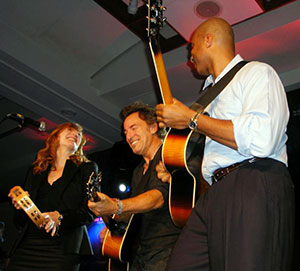
Last night's fifth annual Joe Torre Safe at Home Foundation benefit featured Bob Costas as Master of Ceremonies, a whole host of Yankees in the crowd, Billy Crystal cracking wise, and Bruce Springsteen batting clean-up with a rollicking half-hour acoustic set. Saying that he had been a Yankee fan since he was a kid, Bruce offered a riff on the Beverly Hillbillies theme about Torre heading for Beverly (Hills, that is...) which went right into a hard-strummed take on the Rivieras' "California Sun," with modified lyrics also in honor of Torre: "I'm goin' to where the palm trees are swayin'/Nobody gonna second-guess just who I'm playin'!" [Watch video here.] After "Working on the Highway" it was a new original, written for the occasion in the spirit of "I'm Turning Into Elvis" and "Freehold," call this one "Yankees Win." Bruce joked it would be the first cut on his next album, and the song got a little ribald as he described Patti in a Yankee hat and pinstripes... Everyone got a chuckle. Solo takes on "Thunder Road," "Bobby Jean" (with Bruce struggling to find the melody) and "Dancing in the Dark" followed. Finally, he asked Patti and Bernie Williams to join him. Patti grabbed a tambourine, Bernie a guitar (and he knows his way around it, for sure). Bruce made a joke about Bernie getting too old for baseball -- but he's just a baby if he goes into the music business at this point. They let it go with a great rendition of "Glory Days," the song about not crying over what you had and what you lost. Bernie did a wonderful jazz interlude during the middle of the song. Patti and Bruce sang together, Bernie and Bruce sang together, and everyone just had grins on their faces. Looking around the room, there were Bob Costas and Joe Torre were singing along, Bernie's kids excited that he's up on stage doing a song with Bruce Springsteen, and just a lot of people happy to get this close to Bruce in such an intimate environment and watch him enjoy himself. This was not a job tonight. This was a favor for a good friend, for a good cause, and it was all wrapped up in Yankee pinstripes. I doubt if next year's benefit will have this same flavor, but these last licks were good.
-Photograph and reporting by Pam Farquhar
http://www.kashmir-information.com/Pakistan/pakistan.jpg
From National Review Online:
Reality TV
You can't script Pakistan.

By Mark Steyn

F
rom CBS News:
In Toluca Lake, Calif., near Warner Bros. studio, writers converged on a house that serves as a location shoot for “Desperate Housewives.”

“We write the story-a, Eva Longoria,” about 30 strikers chanted, referring to one star of the hit ABC show.

Wouldn’t that rhyme be better as a taunt? “Who writes the story, huh? Eva Longoria?” Heigh-ho. Maybe the rewrite guys don’t show up to the protest until the first draft of chants has nosedived into the asphalt. Get a suite at the Waldorf Astoria, Eva Longoria: This one will run and run.

Until this here Hollywood writers’ strike came along, I had no idea so much of television was scripted. One charitably assumed it was the way it was because they were winging it. But across late-night the fastest wits in the West have fallen silent, apparently unable to produce a snide Dick Cheney crack without armies of accredited highly trained professionals. I haven’t checked the Weather Channel lately but it wouldn’t surprise me to find their photogenic meteorologists standing slack-jawed in front of maps of the midwest unable to decide whether to go for a high of 70 with a 25 percent chance of precipitation or vice versa.

Which brings me (said he, with the polished ease of a writerless talk-show host) to Pakistan. David Letterman may be reluctant to attempt 30 seconds of shtick without his backroom boys but in the political class they scoff at such pantywaisted fainthearts. Everyone’s an expert on Pakistan, a faraway country of which we know everything: General Musharraf should do this, he shouldn’t have done that, the State Department should lean on him to do the other. “It is time for him to go,” pronounced Congressman Dana Rohrbacher (R., Calif.). Every foreign-policy genius has his Hollywood pitch ready: “If we’re not careful , we’re going to see the same thing happen that happened in Iran,” warned Dan Burton (R., Ind.). Pakistan 2007 is a remake of Persia 1979 with the general as the shah. Etc.

Well, I dunno. It seems to me a certain humility is appropriate when offering advice to Islamabad. General Musharraf is — as George S Kaufman remarked when the Germans invaded Russia — shooting without a script. But that’s because he presides over a country that defies the neatness of scripted narratives. In the days after 9/11, George W Bush told the world that you’re either with us or against us. Musharraf said he was with us, which was jolly decent of him considering that 99.9999 percent of his people are against us. In the teeth of that glum reality, he’s rode a difficult tightrope with some skill. As John Negroponte, U.S. deputy secretary of state, put it, aside from America “no country has done more in terms of inflicting damage and punishment on the Taliban and al-Qaeda since 9/11” — which, given the proportion of the population that loathes America and actively supports the Taliban and al-Qaeda, is not unimpressive.

Nevertheless, in Washington and the media, the assumption is that the wheel has now come off Musharraf’s highwire act. Time for Pakistan to go back to democratically elected unicyclists, like the charming and glamorous Benazir Bhutto, who plays note-perfect in the salons of the west but degenerates into just another third-rate ward-heeler from one of the world’s most corrupt political classes once she’s back greasing the wheel in Pakistan itself.

Furthermore, confident believers in the usual dreary pendulum of Pakistani politics — corrupt democrats, followed by authoritarian generals, followed by corrupt democrats — overlook how profoundly the country’s changed. Its political dynamic has a new player: Islamism. Miss Bhutto says, oh, don’t worry about that, it’s a lot of hooey got up by Musharraf to persuade Washington to prop him up for another half-decade.

Really? Pakistan is both a nuclear power and a nation that cannot enforce sovereignty over significant chunks of its territory. Large tracts are run by the Taliban. The organization responsible for perpetrating the bloodiest assault ever on the U.S. mainland is holed up there and all but untouchable. The air routes between Karachi and Heathrow, Birmingham, Manchester, and Glasgow are the vital conduit between the jihad’s ideological redoubts and the wider world. What do the perpetrators of the Daniel Pearl beheading and the London Tube bombing and the thwarted martyrs of innumerable other plots all have in common? Pakistan. Fritz Gelowicz, arrested a few weeks ago in Europe, is an ethnic German who converted to Islam and graduated from a Pakistani terrorist camp. Unlike Britain and Canada, Germany has no longer-standing imperial ties with Pakistan, yet a ramshackle economically inconsequential basket-case of a state now has ideological converts in almost every corner of the world. Mohammed Umer Farooq is a conventional first-generation moderate immigrant to the West who serves happily as pharmacist at the Princess Patricia’s Canadian Light Infantry base in Alberta. By contrast, his daughter Nada Farooq says she “hates Canada” and was involved in a plot to behead the Prime Minister. In North America, Britain, Scandinavia, Australia and Pakistan itself, elderly grandparents who practice the Indian sub-continent’s traditional Sufi Islam have seen their grandchildren embrace hardline Deobandi Islam, essentially a local variant of Wahhabism …and then sell its virtues to pasty-faced white blokes with names like Fritz. The Bhuttos and their sometime rivals, sometime allies of convenience the Sharifs couldn’t run the country competently before it got hollowed out by the radicals. But the experts assure us they’re now the answer to the woes of a nuclear powder keg.

Pakistan is not Persia. For one thing, it’s a country only 60 years old whose slapdash creation was one of the worst disasters of British imperial policy. Yet even those who thought so at the time would be astonished to find that, a mere couple of generations on, a regional afterthought is not only a nuclear power that has dispersed its technology around the planet but also a driving force of the world’s first global insurgency. If General Musharraf is shooting without a script, what would you do stuck in a toxic soap opera where the incoherent plot twists pile up with every passing decade? It may well be that a Bhutto restoration will be the happy ending foreign-policy “realists” predict. But it’s more likely that a return to traditional levels of democratic corruption will cramp the economic interests of much of the military and lead key factions to make common cause with the Islamists — as Pakistan’s intelligence service did with the Taliban. I don’t know for sure, and nor does anyone else. But sometimes it helps to bet on form. And, given the last 60 years, the real question is how bad things will be after Musharraf. This thing can’t be scripted, in Washington or anywhere else.

© Mark Steyn 2007

http://img.timeinc.net/Life/space/covers/cv082969.jpg
From The New York Times:
At his best, no one wrote better than Mailer.

An Appraisal
A Novelist’s Nonfiction Captured the American Spirit

Norman Mailer was nothing if not ambitious. He once declared he wanted to write “a novel which Dostoyevsky and Marx; Joyce and Freud; Stendhal, Tolstoy, Proust and Spengler; Faulkner, and even old moldering Hemingway might come to read.” He wanted to “alter the nerves and marrow” of the nation with his work, to “change the consciousness” of his times. He wanted to write the Big Book, the Great American Novel. He wanted to hit the longest long ball of them all.

Though his first book, “The Naked and the Dead,” was an estimable war novel that won him enormous celebrity at the age of 25, and he would go on to write many more novels over the decades, it was nonfiction, not fiction, that would prove his most lasting contribution.

“The Armies of the Night,” his noisy, self-dramatizing account of his own experiences in the 1967 antiwar march on the Pentagon, became a founding document of what Tom Wolfe would call “the new journalism”: nonfiction that possessed all the ardor, attitude and body language of a novel but remained grounded in old-fashioned legwork and observation.

It was a genre particularly suited to covering the tumult and cacophonous change abroad in the ’60s, a decade so surreal, so stupefying, so confounding, in the view of some, that it surpassed anything a novelist might plausibly imagine.

And Mr. Mailer used his copious talents — a quick, skewering eye; a gift for the cameo portrait; bat-quality radar for atmosphere and mood; and blustering, bellicose prose — to capture the American spirit as the country lurched from the civil rights and antiwar demonstrations of the ’60s into the Watergate era of the ’70s.

In his best work Mr. Mailer made America his subject, and in tackling everything from politics to boxing to Hollywood, from astronauts to actresses to art, he depicted — or tried to depict — the country’s contradictions: its moralistic prudery and grasping fascination with celebrity and sex and power; the outsize, outlaw past of its frontier; and its current descent into “corporation land,” filled with cheap, consumer blandishments and the siren call of fame.

If hyperbole and pugilistic provocation became the tools of his trade, then they were also useful instruments for recording the growing pains of a protean nation, confused and conflicted at midcentury.

Reporting seemed to ground Mr. Mailer’s obsessive flights of fancy in something real, and its constrictions often forced him to do his best work: case in point, his 1979 masterpiece, “The Executioner’s Song,” an American epic that turned the real life story of Gary Gilmore into a potent ballad about love and violence and death.

Written in simple, stripped-down prose that captures the voices of people in Mr. Gilmore’s life, “The Executioner’s Song” signified a departure in style for Mr. Mailer, who had created in “The Armies of the Night” and other works a series of hectoring alter-egos: Aquarius, the “psychic outlaw,” the “criminally egomaniacal” writer, the “warrior, presumptive general, champion of obscenity, embattled aging enfant terrible of the literary world.”

These willfully provocative narrators would remind readers of the author’s public shenanigans — running for mayor of New York, stabbing his wife at a party with a penknife, and butting heads with or unleashing fusillades against literary rivals and critics (including this one).

They also provided Mr. Mailer with a means of filtering the chaotic events of the ’60s through the prism of his own combative, Whitmanesque ego. They enabled him to mythologize himself even as he used his own personality as an index to chart how the world had changed.

And they anticipated the narcissistic “advertisements for myself” that would become de rigueur, years later, in the “Me Generation” with its confessional talk shows and tell-all memoirs.

This deliberate focus on himself, Mr. Mailer once observed, was partly a response to the fame he achieved with “The Naked and the Dead”: Having gone from being an observer to one of the observed, he said, he learned to “live in the sarcophagus of his image.”

“For anyone who’s become an author early,” he said, “and has had a good deal of success, as Capote did and Vidal did and Styron did and I did, it’s not automatic or easy afterwards to look upon other people with a simple interest, because generally speaking they’re more interested in us than we are in them. This has nothing to do with character, but with the social situation — I am more interested in Marlon Brando than he is interested in me — and it has an immense impact when you’re young. You become a mirror and the only way you can perceive events is through the mirror of your self.”

No doubt this focus on himself played a role in the increasingly solipsistic nature of Mr. Mailer’s fiction. Instead of writing a great Tolstoyan novel about America that would “speak to one’s time” and capture the social and political pulse of the nation, he increasingly produced tendentious novels that were scaffolds for his eccentric, sometimes perverse ideas about violence and sex and power, what he once called “the mysteries of murder, suicide, incest, orgy, orgasm and Time.”

Plotting in these books often seemed beside the point, and the characters frequently emerged as walking, talking embodiments of Mr. Mailer’s own theories. Indeed the Mailer hero — Stephen Rojack in “An American Dream,” say — tended to be a carnivorous variation on “the hipster” identified by Mailer in his controversial 1957 essay “The White Negro”: an existential gunslinger who defines himself in opposition to the conformity he sees around him; a nihilistic individual, willing, even eager, to embrace violence as a liberating force; a “philosophical psychopath” who lives for himself alone.

In later works, historical personages were also reinvented, sometimes inappropriately, as oddly Maileresque heroes. Picasso, despite his repeated betrayals of family and friends, is celebrated as a heroic artist, who made life-risking dares in his work (“Portrait of Picasso as a Young Man”). Lee Harvey Oswald is depicted as a visionary malcontent (“Oswald’s Tale: An American Mystery”). Jesus is given the author’s own obsessions with odors and the dissipation of spiritual energy (“The Gospel According to the Son”). And Hitler, no less, is depicted by the narrator of “The Castle in the Forest” (a narrator who is a satanic emissary) as an abused child who develops “a will of iron” and embraces the Nietzschean knowledge of power that murder affords a murderer.

As early as the 1980s, Mr. Mailer observed that most of his ideas — about God and art and violence, as well as his view of America as a kind of spiritually impoverished Cancer Gulch — developed during the 1950s, when he found himself opposing the country’s repressive mores. Increasingly, he was engaged in “less of an exploration and more of an occupation of territories I reconnoitered years ago,” he said.

“What happens is you become the hat on your own head,” Mr. Mailer said. “You’re not having the pleasure of enjoying your own mind the way you used to when you were young, but you have the product of your mind to work with. You know, I ran into Henry Kissinger years ago, and I asked him if he enjoyed the intellectual stimulation of the work, and he said in effect: ‘I am working with the ideas that I formed at Harvard years ago. I haven’t had a real idea since I’ve been on this; I just work with the old ideas.’ I certainly know what he means now — I think there are just so many ideas you can have in your life, and once you have them, you have to develop them.”

http://media.hoover.org/images/digest20062_poster.jpg
From Chronicles.org:
Remember the Red October?

by Srdja Trifkovic

Had the Soviet Union not collapsed, today would have been a festive day in Moscow. The 90th anniversary of the October Revolution (“October” since in 1917 Russia was still using the Julian calendar) would be marked by a big military parade, with Western correspondents and military attaches on the lookout for new types of ICBMs and MBTs. There would be a speech by the Secretary General from atop Lenin’s tomb, with the rest of the gray-coated gerontocracy nodding in approval. But to anyone under the age of 30 such scenes are as distant as those from Nuremberg in 1936, and the date itself as irrelevant as that of the Armistice next Sunday.

In Russia itself, 13 years ago November 7 became the clumsily named Day of Reconciliation and Accord under Yeltsin; it was moved to November 4 an renamed “People’s Unity Day” under Putin. The holiday became linked with the date of the final expulsion of the Polish garrison from Moscow at the end of the “Times of Trouble” in 1612, and with the Day of the Icon of the Mother of God of Kazan, one of the greatest sacred symbols of Russian Orthodoxy, which the Vatican recently handed over to Russia.

A recent survey by the Public Opinion Fund has established that most Russians rightly perceive the “Revolution” as a political coup and conspiratorial takeover of power by the Bolseviks. The Communist Party of the Russian Federation (KPRF) is the sole political force that staunchly keeps its loyalty to the ideals of the Red October, but the communists no longer matter.

In a symbolic gesture, Moscow officially marked the 70th anniversary of the beginning of Stalin-era Great Terror last week. President Vladimir Putin visited the Butovo Range of NKVD secret police, where people were shot and dumped in their thousands in 1937 at the peak of terror. He laid flowers at a cross erected in memory of political repressions. “The year 1937 was prepared by the previous years of cruelty,” he said. “Such tragedies recurred in the history of mankind . . . always happened when ideals that were seemingly attractive” were held above the values of the human life, rights and liberties.”

There are a few capital cities around the world that are still marking the occasion in the spirit, and with the vocabulary, of Moscow cca. 1947. One of them is Hanoi, where the ruling Communist Party official daily Nhan Dan celebrated the “Spirit of October.” Judging by the paper’s account of the past nine decades, communism is still alive and well:

The October Revolution entered the history of humanity as the greatest event in the 20th century and ushered in a new era, the epoch of transition to socialism on the global scale . . . The victory of the October Revolution affirmed the thorough scientific and revolutionary nature of Marxism-Leninism, providing invaluable historical lessons to the revolutions for national independence and socialism . . . The Soviet Union’s socialism was a strong support and a vanguard force in pushing forward the struggle for peace, co-operation and development, helping nations prevent international reactionary forces from launching wars of aggression and creating the premise for nations to set up relations on the basis of equality, co-operation and development . . . Socialism, on the basis of successes and failures together with the aspirations and consciousness of nations, will surely record new developments. According to the objective rule of history, humanity will certainly advance to socialism.

Similar editorials were published, officially-sponsored commemorative gatherings held, and exhibitions staged, in Minsk, Peking, and Pyongyang. Their common theme is that the “ideals of October” are alive and well, a few current hiccups notwithstanding. In Cuba, for instance, the High-level Party School of Nico Lopez in Havana held a “scientific workshop” earlier this week entitled “Restoration of Socialist Ideologies.” Addressing the workshop, Raul Valdes Vivo, head of the School and a member of the Central Committee of the Communist Party of Cuba, reaffirmed the significance of the October Revolution to Cuba’s victories over its foreign enemies and social progress in central America.

Up to a quarter of the world’s six-and-a-half billion people live under regimes that claim to be inspired by what happened in St. Petersburg on this day nine decades ago, but there is no true zeal in their rulers’ rhetoric and no fire in their hearts. China is a “revisionist” power par excellence, as confirmed at the Communist Party Congress last week. That has enabled her to make a successful transformation from a poor agricultural economy into a global manufacturing base. The Communist Party has the monopoly of political power, but its rule fits in with the country’s authoritarian tradition from the First Emperor to Chiang Kai-Shek. The result is a reddish variety of authoritarian capitalism successfully tested decades ago in Taiwan, South Korea, and Singapore.

Vietnam would like to emulate China’s example, albeit with tighter Party controls on ownership and money flows—which cannot be done. North Korea is a bizarre, starving, paranoid hell on Earth, ruled by a malevolent eccentric. If Lenin were to find himself in Pyongyang today, he’d ask for a sealed train—not to foment another revolution, but just to get out. Cuba is an irrelevant basket case.

In the Western world Bolshevik variety of communism is dead and gone, but a new enemy without AND within is Islam, justifying Hilaire Belloc’s prescient question, in The Great Heresies (1938), “Will not perhaps the temporal power of Islam return and with it the menace of an armed Muhammadan world which will shake the dominion of Europeans—still nominally Christian—and reappear again as the prime enemy of our civilization?”

Seven decade after Belloc it is not Lenin’s, but Muhammad’s beliefs, ideas and intentions that pose the greatest threat to our civilization. The elite class rejects this diagnosis, of course, just as its intellectual fathers had rejected the truth about the Russian Revolution when it claimed 2-3 million lives (1917-1922), or about the famine caused by Stalin’s collectivization (5-7 million), or about the Great Purge and the Gulag (at lest ten million). Back then we had a legion of Moscow’s apologists, character witnesses, moles and fellow-travelers, assuring us that the Comrades want nothing but social justice at home and peaceful coexistence abroad.

The ideological focus of their heirs has shifted in form, but not in substance. They are cultural Marxists rather than Bolsheviks, Gramscians and not Leninists. Instead of inventing excuses for the Soviet butchers of 1917, they are battling “Islamophobia” and conjuring a mythical dichotomy between “Islam” and “Islamism.” This time, however, the outcome of the coming struggle is in grave doubt. The West is spiritually and morally weak; Europe is, demographically, on her last legs.

The 1917 Revolution was an immediate bitter fruit of the Great War that went on for another deadly year. Today’s decrepitude of the West, manifest in its apparent inability to defend itself against the new-old jihadist threat, is the long-term consequence of that war. We are living with the consequences of what had ended on another distant November morning at Compiegne.