Saturday, January 05, 2008

http://defendtheheartland.com/terrorclass.gif

From Pajamas Media: If no Supreme Court justices were to die, it's getting increasingly difficult to see how an Obama presidency could be worse than a George Bush presidency. He should be impeached for allowing this to happen while Commander-in-Chief. (Allegedly.)

Believe It or Not (Bureau of Islamist Extremism)

Roger Kimball

Remember Ripley’s Believe it or Not? (The odd, the unusual, the bizarre …) That amusing concession has been documenting strange phenomena for 90 years. Bill Gertz at the Washington Times has an item that qualifies for the Ripley treatment. Believe it or not,


Stephen Coughlin, the Pentagon specialist on Islamic law and Islamist extremism, has been fired from his position on the military’s Joint Staff. The action followed a report in this space last week revealing opposition to his work for the military by pro-Muslim officials within the office of Deputy Defense Secretary Gordon England.

And why was Mr. Coughlin’s contract with the Department of Defense not renewed? Believe it or not,

He had run afoul of a key aide to Mr. England, Hasham Islam, who confronted Mr. Coughlin during a meeting several weeks ago when Mr. Islam sought to have Mr. Coughlin soften his views on Islamist extremism.

It gets worse:

Mr. Coughlin wrote a memorandum several months ago based on documents made public in a federal trial in Dallas that revealed a covert plan by the Muslim Brotherhood, an Egyptian-origin Islamist extremist group, to subvert the United States using front groups. Members of one of the identified front groups, the Islamic Society of North America, has been hosted by Mr. England at the Pentagon.

Let’s see: Mr. Coughlin works for the US military, i.e., the chaps we pay to protect us from other chaps doing things like borrowing airliners and crashing them into skyscrapers, to say nothing of Mr. Coughlin’s own (soon-to-be-former) place of employment. Mr. Coughlin, an expert on said chaps, is fired because he runs afoul of “an aggressive ‘outreach’ program to U.S. Muslim groups.”

Hat tip to Andrew Bostom, who has more here. Andrew McCarthy weighs in here.

Jihad Watch reports this sobering assessment from LTC Joseph C. Myers, Army Advisor to the Air Command and Staff College, noted:


What Coughlin did was provide the epiphany in his over 300-page Joint Military Intelligence College thesis titled, “To Our Great Detriment: Ignoring What Extremists Say About Jihad” that is meticulously documented and powerfully argued.

In short, he argues we have in fact intellectually pre-empted our military decision making process and intelligence preparation of the battlefield process, the critical step 3-“evaluate the threat.” Strategically we have failed to do that by substituting policy for military analysis, for substituting cliché for competent decision processes.

We began on September 12, 2001 with “Islam is a religion of peace,” which soothed ideological sentiments of many but has failed us strategically, short-stopped the objective, sytstemic evaluation of the threat doctrine.

“Islam is a religion of peace” is fine for public policy statements, but is not and cannot be the point of departure for competent military or intelligence analysis…it is in fact a logical flaw under any professional research methodology…you have stated the conclusion before you have done the analysis.

If one has studied the implication of the Holy Land Foundation trial discovery documents as I have, as a former DIA senior military analyst, and understanding as even Bill Gertz has written in his book Enemies about the dismal record of our counter-intelligence one has to wonder and question the extent we are in fact penetrated in government and academia by foreign agents of influence, the Muslim Brotherhood, Islamists and those who truly in essence do not share our social compact.

The termination of Stephen Coughlin on the Joint Staff is an act of intellectual cowardice.

Believe it or not. I believe it.

http://www.clackamasreview.com/reuters_graphics/2007-12-19T175340Z_01_NOOTR_RTRIDSP_2_NEWS-USA-POLITICS-DC.jpg
It's the secular Left vs. the Christian Left
By MARK STEYN

Confronted by Preacher Huckabee standing astride the Iowa caucuses, smirking, "Are you feelin' Hucky, punk?", many of my conservative pals are inclined to respond, "Shoot me now."

But, if that seems a little dramatic, let's try and rustle up an alternative.

In response to the evangelical tide from the west, New Hampshire primary voters have figured, "Any old crusty, cranky, craggy coot in a storm," and re-embraced John McCain. After all, Granite State conservatism is not known for its religious fervor: it prefers small government, low taxes, minimal regulation, the freedom to be left alone by the state. So they're voting for a guy who opposed the Bush tax cuts, and imposed on the nation the most explicit restriction in political speech in years. Better yet, after a freezing first week of January and the snowiest December in a century, New Hampshire conservatives are goo-goo for a fellow who also believes the scariest of global-warming scenarios and all the big-government solutions necessary to avert them.

Well, OK, maybe we can rustle up an alternative to the alternative.

Rudy Giuliani's team is betting that, after a Huck/McCain seesaw through the early states, Florida voters by Jan. 29 will be ready to unite their party behind a less-divisive figure, if by "less divisive figure" you mean a pro-abortion gun-grabbing cross-dresser.

I can't see things playing out quite like that. The principal rationale for Rudy's candidacy is that he's the national-security toughie who can beat Hillary. But it's hard to conclude after Iowa that this is shaping up as a Code Orange election. And, as for Sen. Clinton, her Thursday night third-place was the nearest Bill and Hill have come to a Ceausescu balcony moment. In a world where even John Edwards can beat Hillary, who needs Rudy?

Way back a gazillion years ago, when Mrs. Clinton was first exploring the exploration of exploring the possibility of an exploratory committee, some wily Gompers were suggesting the Republicans trump her history-making first-woman-president card by drafting Condi Rice. It turns out we dead white males on the right wing were worrying unnecessarily: The Democrats trumped themselves. Liberal voters want desperately to cast a history-making vote and, if that's your priority, Barack Obama is a much more appealing way to cast it than Hillary. Don't worry about this "Change You Can Believe In" shtick. Obama doesn't believe in it, and neither should you. He's a fresh face on the same-old-same-old – which is the only change Democrats are looking for.

As for Huckabee, the thinking on the right is that the mainstream media are boosting him up because he's the Republican who'll be easiest to beat. It's undoubtedly true that they see him as the designated pushover, but in that they're wrong. If Iowa's choice becomes the nation's, and it's Huckabee vs. Obama this November, I'd bet on Huck.

As governor, as preacher and even as disc jockey, he's spent his life in professions that depend on connecting with an audience, and he's very good at it. His gag on "The Tonight Show" – "People are looking for a presidential candidate who reminds them more of the guy they work with rather than the guy that laid them off" – had a kind of brilliance: True, it is cornball at one level (imagine John Edwards doing it with all his smarmy sanctimoniousness) but it also devastatingly cuts to the core of the difference between him and Mitt Romney. It's a disc-jockey line: the morning man on the radio is a guy doing a tricky job – he's a celebrity trying to pass himself off as a regular joe – which is pretty much what the presidential candidate has to do, too. Huckabee's good at that.

I don't know whether the Jay Leno shtick was written for him by a professional, but, if so, by the time it came out of his mouth it sounded like him. When Huck's campaign honcho, Ed Rollins, revealed the other day that he wanted to punch Romney in the teeth, Mitt had a good comeback: "I have just one thing to say to Mr. Rollins," he began. "Please, don't touch the hair." Funny line – but it sounds like a line, like something written by a professional and then put in his mouth.

This is the Huckabee advantage. On stage, he's quick-witted and thinks on his feet. He's not paralyzed by consultants and trimmers and triangulators. Put him in a presidential debate, and he'll have sharper ripostes and funnier throwaways and more plausible self-deprecating quips than anyone on the other side. He'll be a great campaigner. The problems begin when he stops campaigning and starts governing.

In The Wall Street Journal, Peggy Noonan observed of Huck that "his great power, the thing really pushing his supporters, is that they believe that what ails America and threatens its continued existence is not economic collapse or jihad, it is our culture."

She's right. It's not the economy, stupid. The economy's fine. It's gangbusters. Indeed, despite John Edwards' dinner-theater Dickens routine about coatless girls shivering through the night because daddy's been laid off at the mill, the subtext of both Democrat and Republican messages is essentially that this country is so rich it can afford to be stupid – it can afford to pork up the federal budget; it can afford to put middle-class families on government health care; it can afford to surrender its borders.

There is a potentially huge segment of the population that thinks homo economicusis missing the point. They're tired of the artificial and, indeed, creepily coercive secular multiculti pseudo-religion imposed on American grade schools. I'm sympathetic to this pitch myself. Unlike Miss Noonan, I think it's actually connected to the jihad, in the sense that radical Islamism is an opportunist enemy that has arisen in the wake of the Western world's one-way multiculturalism.

In the long run, the relativist mush peddled in our grade schools is a national security threat. But, even in the short term, it's a form of child abuse that cuts off America's next generation from the glories of their inheritance.

Where I part company with Huck's supporters is in believing he's any kind of solution. He's friendlier to the teachers' unions than any other so-called "cultural conservative" – which is why in New Hampshire he's the first Republican to be endorsed by the NEA. His health care pitch is Attack Of The Fifty Foot Nanny, beginning with his nationwide smoking ban. This is, as Jonah Goldberg put it, compassionate conservatism on steroids – big paternalistic government that can only enervate even further "our culture."

So, Iowa chose to reward, on the Democrat side, a proponent of the conventional secular left, and, on the Republican side, a proponent of a new Christian left. If that's the choice, this is going to be a long election year.

©MARK STEYN
http://www.ericmcerlain.com/offwingopinion/archives/Images/lspt.jpg
From chicagotribune.com:
Tough to swallow Clemens' account
Rick Morrissey

January 6, 2008

I don't know a whole lot about law, but if I'm a member of Roger Clemens' legal team, I tell him the B-12 vitamin defense is not one I would personally mount if I were being hounded by accusations of steroid use and had been invited to testify before a congressional committee.

Rafael Palmeiro tried the same defense a few years back, and look what it got him: A heaping helping of disgrace. You might recall Palmeiro insisted in front of a committee in 2005 that he never took steroids. He also subsequently tested positive for 'roids and then blamed it on a tainted vial of B-12 that Orioles teammate Miguel Tejada supplied.

Since the laughter died down, Palmeiro hardly has been heard from.

The same can't be said of Clemens, who will appear on "60 Minutes" Sunday to make the case that he didn't boost his career in his 30s and 40s with a quiver of syringes filled with steroids and human growth hormone.

Some of the taped interview with CBS' Mike Wallace has been released, and the highlights include Clemens saying that, yes, his former trainer Brian McNamee did inject him, but with vitamin B-12 and lidocaine, not steroids and HGH. Lidocaine often is used by dentists and for minor surgeries.

McNamee's attorney countered his client has a master's degree in sports medicine, so he would know what he injected into Clemens' body.

If you're Roger Clemens and you appear on "60 Minutes" to plead your case, it's because you're trying to sway public opinion. There's no other point to going on national television.

So when he uses that huge forum to tell us he's a dedicated B-12 fan, it does not paint the picture of a man wronged. It paints the picture of a man who needs to come up with a better excuse.

(If you're a dedicated B-12 user, please do not e-mail me with accounts of the miraculous properties of the vitamin. I'm sure it does all sorts of wonders and that Clemens' shiny hair, nice smile and sunny disposition can be tied directly to B-12.)

Clemens might have his reasons for B-12 injections. Perhaps he has pernicious anemia. Or maybe he's a closet vegetarian. It's hard to find the vitamin in vegetables, after all.

But what would you prefer: An injection of B-12 or the vitamin in pill form?

Yeah, me too.

We used to laugh when Sammy Sosa jokingly attributed his power to Flintstones vitamins. Now, thanks to Clemens, we know he was telling the truth.

Clemens better get his story straight soon. He has been "invited" to testify before a congressional committee Jan. 16. Whether you have been invited or subpoenaed, it's always a good idea to show up with some honesty.

Asked in the "60 Minutes" interview if he would swear he never took steroids, Clemens said, "Swear." A bulldog reporter would have followed with, "On a stack of Bibles?"

What Clemens seems to be doing is mounting the always-popular I-never-knowingly-took-steroids defense—emphasis, of course, on "knowingly." This is the Barry Bonds defense, which hasn't done a whole lot for the indicted home run king. It's like a mobster saying he never knowingly left a dead body in the trunk of a car. He might have heaved a bulky bag into the trunk of the car, but, no, your honor, he never knowingly put a dead body in a car.

The legal defense of unwittingly doing something wrong isn't far removed from Bill Clinton's insistence that, although he did smoke marijuana, he never inhaled.

"I think that this is a lawyers' game, which allows him to try and attempt to say that McNamee didn't know what he was injecting or that at least Clemens didn't know what he was injecting," said Richard Emery, one of McNamee's attorneys.

If this keeps up, the syringe's legal representative will say the needle didn't know what it was shooting into Clemens.

This obviously is one of those he said-she said disagreements, and people will choose sides, in the same way they have chosen sides in the Bonds case. Many of us choose to believe Bonds is guilty as sin; others choose to believe in fairy tales. It will be the case with Clemens, though he surely will present a better image than the surly Bonds has. People will be convinced of his innocence.

But it's interesting that one of Clemens' best friends, Yankees teammate Andy Pettitte, admitted McNamee injected him with human growth hormone. That doesn't mean Clemens did use it, but it does make a guy wonder. Pettitte also is expected to testify before the congressional committee.

It has been enjoyable watching the different excuses roll in. There are the players named in the Mitchell report who said they used the drugs only once and "made a mistake." There are the guys who said they took HGH on the advice of their doctors.

And now the B-12 defense makes another appearance. Whatever happened to the dog-ate-my-prescription alibi?

rmorrissey@tribune.com
The image “http://i6.photobucket.com/albums/y241/chrisolds/NY_ND.jpg” cannot be displayed, because it contains errors.
From Newsday.com:
Snowing Wallace is one thing, Congress another
Wallace Matthews

January 5, 2008

It's one thing to swear before Mike Wallace, but would Roger Clemens tell the same story if put under oath before a congressional committee?

We soon may get the chance to find out how vehement Clemens' denial of steroid use really is, if he accepts the "invitation" sent to him, Andy Pettitte, Brian McNamee and Kirk Radomski Friday by the House Committee on Oversight and Government Reform to tell his story with his hand on a Bible on Jan. 16.

If there's any, er, juice to what Clemens told "60 Minutes" in the interview to be aired Sunday night, he will jump at the chance. If not, he will find a way to weasel out of it, the way he often has.

Remember when he was held out of the next Subway Series at Shea Stadium after the Piazza bat-flinging fiasco? That wasn't his fault. The Big, Bad Rocket wanted to pitch, but mean old Joe Torre wouldn't let him.

Same goes, presumably, for talking to George Mitchell. Roger would have loved to clear his name of these scurrilous charges, but Donald Fehr put a gag on him.

Instead, he opted to plead his case to Wallace, who had provided a friendly forum for Clemens to rehabilitate his image in 2001. If he thinks that is going to be enough, and that he can brush back Congress without fear of retaliation the way he has with American League hitters for all these years, he has a rude awakening coming.

For Clemens, the truth has always been a concept as difficult to grasp as a perfect bunt down the third-base line.

And for Wallace, and most TV journalists, truly getting to the truth is as important as finding a Metrocard on the street. He has no real use for either.

When they sat down together at Clemens' Texas ranch last weekend, interviewer and interviewee were seeking the same thing, and it wasn't the truth. It was the sound bite.

For Wallace, it was that little snippet of conversation that pulls in the audience. For Clemens, it was that moment of glibness that plays it for suckers.

So before you bother wasting 12 minutes watching Clemens' appearance on "60 Minutes," understand that Wallace and Clemens found what they were looking for. You and I, however, are still searching.

By now, we all know the sound bite. Lidocaine and B-12. Swear? Swear.

That charade may satisfy Wallace and Clemens. For the gullible, it may pass as an explanation for how a 34-year-old pitcher who had gone 40-39 in his previous four seasons could go 162-73 in the next 11.

But it shouldn't be enough to mollify a congressional committee, provided the congressmen get a chance to ask the questions Wallace will not.

Questions such as: If all you were taking was a topical painkiller and a vitamin generally prescribed to old people for fatigue, why all the secrecy?

Why didn't you mention it two weeks ago in your YouTube video, when you vehemently denied being injected with anything by Brian McNamee?

Now that you've admitted being injected, did you supply the lidocaine and B-12 to McNamee and instruct him to shoot you with it? Or did McNamee come to you and suggest the injections? Are you saying you may have been misinformed about what was really in the needles?

If everything was legit, why were the shots given by a personal trainer and not your personal physician, or the team doctor?

If nothing untoward was going on, why weren't the shots administered in the trainer's room at the ballpark rather than at your apartments in Toronto and New York?

Why did you twice refuse the opportunity to tell your story to Mitchell?

Those are the kinds of questions Clemens should be forced to answer, the kinds of questions that might bring us somewhere nearer the truth of how he turned around his career even more dramatically than did Barry Bonds, the poster boy for baseball's steroid problem.

You won't get them on "60 Minutes," which in its illustrious history has revealed the following sports blockbusters: Derek Jeter loves playing baseball. ("It's a blast!" he gushed to the late Ed Bradley.) Ricky Williams sometimes smokes marijuana. Some NFL players use steroids. Tiger Woods likes to win. Under tough questioning, Tom Brady admitted he hates to lose. And as a young man, Joe Namath enjoyed the company of booze and broads.

For some, Clemens has created the illusion of putting himself in great jeopardy by sitting across from an 89-year-old man who now spends more time in the owner's box at Yankee Stadium than in the newsroom. In truth, he would be in more trouble facing my 7-year-old daughter's tee-ball squad.

Presumably, the congressional committee that forced baseball - and its dishonest and disingenuous commissioner, Bud Selig - to finally acknowledge that its game is juiced to the gills, would not let Clemens off as easy as that.

And a man as adamantly innocent as Clemens says he is should welcome the opportunity. Now he has the chance. The invitation is in his mailbox. The ball is in his hands. Soon we'll know for sure if Roger Clemens is an honest man or is only playing one on television.

Copyright © 2008, Newsday Inc.

Friday, January 04, 2008

The image “http://blogues.cyberpresse.ca/hetu/wp-content/uploads/2007/06/jonah1.jpg” cannot be displayed, because it contains errors.
From www.nysun.com:
America's 'Fascist Moment'
BY RON RADOSH

January 4, 2008

For decades, the left has used the term "fascist" to attack just about anyone they disagree with. That behavior continues: The feminist author Naomi Wolf has recently come out with a book condemning what she calls the "fascist shift" in America, in which she describes the 10 steps she thinks America is taking that lead to fascism. (Of course, to Ms. Wolf the no. 1 fascist is President Bush.) Before her, the liberal journalist Joe Conason wrote a book titled "It Can Happen Here" — what could happen, of course, was American fascism emanating from the Bush administration. And the journalist Chris Hedges argued that the Christian right was composed of nothing but "American Fascists" — indeed the very title of his book on the subject.

Now, from the conservative side, Jonah Goldberg — who is rightfully fed up with the left's regularly and somewhat indiscriminately calling conservatives fascist — turns the tide by addressing the issue head on, in "Liberal Fascism: The Secret History of the American Left, from Mussolini to the Politics of Meaning" (Doubleday, 467 pages, $27.95). Not only is it a slander to yell fascist at the right; Mr. Goldberg presents a strong and compelling case that the very idea of fascism emanated from the ranks of liberalism. As he argues, contemporary liberalism descended from the ranks of 20th-century progressivism, and "shares intellectual roots with European fascism."

When Mr. Goldberg uses the term "liberal fascism," he is not offering a right-wing version of the left's smears. He knows it is a loaded term. What he is talking about is the historical idea of fascism: a corporatist and statist social structure that creates a deep reliance of its subjects on the government and engenders a sense of community and purpose. In American politics, this tendency toward statism has always been much more at home on the left than on the right.

It is impossible in a short review to do justice to the rich intellectual history of American liberalism that Mr. Goldberg offers to his readers. He has read widely and thoroughly, not only in the primary sources of fascism, but in the political and intellectual history written by the major historians of the subject.

Readers will learn that the very term "liberal fascism" came from the pen of H.G. Wells, the famed socialist author who delivered a speech at Oxford University in 1932 that included hosannas to both Stalin's Russia and Hitler's Germany. "I am asking," Wells told the students, "for a Liberal Fascisti, for enlightened Nazis." Democracy, he argued, had to be replaced with new forms of government that would save mankind, producing a "'Phoenix Rebirth' of liberalism" that would be called "Liberal Fascism." Like the activism, experimentation, and discipline that made the Soviet Union and Nazi Germany new dynamic societies, the West too could reach such a plateau by adopting the new soft fascism that suited it best.

Wells was not unique in offering this call to liberals. In giving us a true alternative history of modern liberalism, Mr. Goldberg shows how the ideological roots of fascism were liberal and left-wing, as were some of fascism's early proponents, especially in the Italy of Benito Mussolini. Most of us today forget that Mussolini, to his dying day, considered himself a man of the left and a socialist, who through nationalism and the corporatist reorganization of the polity sought to modernize a dying, 19th-century liberalism. Many will nevertheless be surprised to find that Mussolini's large band of admirers included the journalist Herbert Matthews, the comic Will Rogers, the psychoanalyst Sigmund Freud, the historian Charles Beard, and the muckraker Lincoln Steffens. It only strengthens his case to find that one person Mr. Goldberg leaves out, the founding father of American trade unionism, Samuel Gompers, praised Mussolini's creation of a new corporate state as a guide for American labor, and as a model for American society as a whole.

Indeed, America, as Mr. Goldberg writes, certainly had a "Fascist moment." It was not, however, during the current presidency, but one that extended from progressivism through the New Deal. Mr. Goldberg traces the American roots of liberal fascism to the presidency of Woodrow Wilson, who saw increased state power as an organic and natural development. His administration's War Industries Board laid the basis for future government-industry regulatory agencies that tied business to the new corporate state. Later on Mr. Goldberg reveals how Herbert Croly, who founded the New Republic as the preeminent journal of the new liberalism, presented classic fascist themes as the prescription for saving the country in his influential book, "The Promise of American Life."

A major New Deal program, General Hugh Johnson's National Recovery Administration, was an American version of Mussolini's corporate state. Entering Johnson's office, visitors found a portrait of Mussolini on the wall behind his desk. Industrial codes were to be enforced by the state and to be made popular by Nuremberg-type rallies and giant parades, as thousands marched under the symbol of the blue eagle. This marked the actual birth of liberal fascism, as President Roosevelt built upon the statist and collectivist roots of agencies created during World War I. As the vice president of the American Federation of Labor, Matthew Woll, put it at the time, "Labor might well assert that the seed of Fascism had been transplanted" to America. The cartelization of industry, he noted, was "a familiar story in the early history of Fascist Italy."

Turning to what he calls liberal racism, Mr. Goldberg offers readers his finest chapter. It is a devastating picture of how liberals adopted eugenics — a basic part of Nazi doctrine — which was not, as some liberal intellectuals have argued, an outgrowth of conservative thought. Fans of Margaret Sanger, perhaps the single most important feminist hero of the 20th century, will never be able to think of her in the same way. Mr. Goldberg dissects her hidden views of eugenics. A socialist and birth-control martyr, she favored banning reproduction of the "unfit" and regulation of everyone else's reproduction. She wrote, "More children from the fit, less from the unfit — that is the chief issue of birth control." She opposed the birth of "ill-bred, ill-trained swarms of inferior citizens." Her words reveal her motive in advocacy of birth control. She sought to remove "inferior" people from being born to poor people, whose mothers by definition were "unfit." Sanger's partisans in Planned Parenthood, the group that stemmed from her work, will be shocked to learn that her publication endorsed the Nazi eugenics program, and that Sanger herself "proudly gave a speech to a KKK rally." That was not surprising, since she clearly viewed blacks as inferior. Hence her "Negro Project," in which she sought to urge blacks to adopt birth control.

Some will rightfully take issue with Mr. Goldberg when he describes the administrations of Presidents Kennedy, Johnson, and Clinton as fascist. On this, he strains and pushes his evidence too far to convince the reader that these paragons of liberalism can be called fascist in any sense of the term. Mr. Goldberg makes a stronger case when he accuses the New Left of classic fascist behavior, when its cadre took to the streets and through action discarded its early idealism for what Mr. Goldberg correctly calls "fascist thuggery." Even if one does not consider the liberal administrations of the recent past fascist, Mr. Goldberg is correct to see the liberalism of today to be state worship, which built upon the original statist liberalism of the Wilson administration.

Mr. Goldberg has, unlike the leftists who yell the term, made the strongest possible case that Americans today live in a soft form of fascism, a statist liberal society whose citizens are unaware of the roots of ideas they hold. Echoing Susan Sontag, who pointed out that fascist ideas "are vivid and moving to many people," Mr. Goldberg ends with a humorous look at the cult of organic foods, vegetarianism, and animal rights, all programs and policies first instituted in Nazi Germany. "We are all fascists now," he concludes. Disagree if you must, but go out and read this brilliant, insightful, and important book.

Mr. Radosh, a contributing editor of The New York Sun, is an adjunct fellow at the Hudson Institute.
AP
Roger Clemens said that strength coach Brian McNamee only injected him with a painkiller and vitamin B-12 and swears that he never took steroids.

From www.northjersey.com:
Clemens' story a fairy tale

Ian O'Connor

Friday, January 4, 2008

Maybe Andy Pettitte is kicking himself for not coming up with the same sorry tale. Maybe ol' Rog figured he would show his eager student one last trick before calling it a career.

Admit the method of the injections, deny the substance of the juice. Just when Roger Clemens was promising to throw his legendary fastball, he stole a knuckleball out of Phil Niekro's bag.

"Ridiculous," Clemens called the Mitchell Report allegations in his "60 Minutes" interview with Mike Wallace.

Just not quite as ridiculous as Rocket's red glare.

He's angry at the injustice of it all, the very notion that someone could claim he's an all-American fraud. Brian McNamee, his former trainer and errand boy, told former Sen. George Mitchell that he pumped Clemens full of steroids, human growth hormone and testosterone, adding some late life to a Hall of Fame arm in apparent decline.

Clemens was smart enough to avoid calling McNamee a complete liar. He was smart enough to realize that Pettitte's confirmation of McNamee as a truth teller left him in a no-outs, bases-loaded jam.

So Clemens threw a pitch intended for the critics and cynics to take. He conceded that McNamee was a teller of half-truths, a man who indeed had a habit of sticking needles in his rump.

But then The Rocket swore those needles were loaded with Lidocaine and vitamin B-12, nothing more sinister than that. He was reading from the same absurd script Barry Bonds used when he addressed those foreign substances he applied to his comic-book body, the ones he described as flaxseed oil.

"Lidocaine and B-12. It's for my joints, and B-12 I still take today," Clemens told Wallace on the CBS interview to air Sunday. Asked by Wallace, something of a friend, to swear he didn't use any of the bad stuff, Clemens said, "Swear."

He doesn't sound any more believable now than he did that Subway Series night he fired a splintered bat at Mike Piazza.

"I thought it was the ball," Clemens said then.

Of course he did. All pitchers throw batted balls at the hitter as he heads to first base.

Hey, we all know plenty of people who have colleagues and friends inject Lidocaine and B-12 into their bodies. Who doesn't take time out at a backyard barbecue to ask a buddy to slip into the bathroom for a quick hit of both? It's as natural as asking to borrow your neighbor's snow blower.

"Brian has a master's degree in sports medicine," McNamee's attorney, Earl Ward, told ESPN The Magazine. "He knows the difference between Lidocaine, B-12, and testosterone. What he injected into Roger Clemens wasn't Lidocaine or B-12. It was testosterone."

Remember, as part of his deal with the feds, McNamee was facing felony charges if he was found to have lied to Mitchell. He had the most to lose by lying. He would lose his freedom by lying.

Clemens? He has the most to gain by lying. He has a legacy to protect, a lifetime performance that qualifies him for consideration as the greatest big league pitcher of all time.

If he acknowledges that he was just another Steroids Era hoax, he sets fire to 354 victories and seven Cy Young Awards. They all go up in smoke. Rocket Clemens, the John Wayne of baseball, gets reduced to Milli Vanilli.

Clemens has decided he isn't going out like that. He's going to fight for a reputation the Mitchell Report left in a million pieces.

If you're following this fight, here's the way to root: Pull for McNamee's defamation expert, Richard Emery, to watch the entire Wallace interview and decide he's heard enough to sue Clemens.

That puts The Rocket under oath. That raises the stakes to a level Clemens might not want to touch.

Or better yet, hope that Clemens decides on his own to march down to Capitol Hill and demand an audience with the same Congressmen who sat before the likes of Mark McGwire, Rafael Palmeiro and Sammy Sosa. Hope that Clemens voluntarily goes under oath and tells this same fairy tale.

Long before "60 Minutes" showed up, The Rocket rejected Mitchell's invitation to give his side of the story. So this is what the Mitchell Report says instead:

"Clemens asked McNamee to inject him with Winstrol, which Clemens supplied. McNamee knew the substance was Winstrol because the vials Clemens gave him were so labeled. McNamee injected Clemens approximately four times in the buttocks over a several-week period with needles that Clemens provided."

That would be Roger's steroids with Roger's needles in Roger's rump in Roger's apartment.

Later in the report, there was this: "McNamee injected Clemens in the buttocks four to six times with testosterone from a bottle labeled either Sustanon 250 or Deca-Durabolin. ... McNamee stated that during this same time period he also injected Clemens four to six times with human growth hormone..."

Nope, no mention of Lidocaine or vitamin B-12 there. That's the story Clemens is sticking to now, if only because he knows Pettitte's confession granted McNamee a credibility that can't be destroyed.

If this is The Rocket's last pitch, he should've retired a long time ago.

Thursday, January 03, 2008

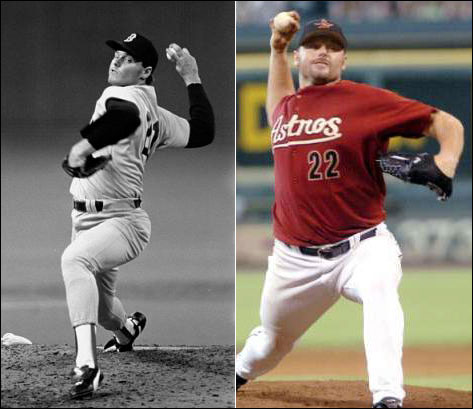
http://cache.boston.com/images/bostondirtdogs//Headline_Archives/RCbos_RChou.jpg
From FoxSports.com
Will Clemens face fastballs from Wallace?

By Mark Kriegel

Mark Kriegel is the national columnist for FOXSports.com.
He is the author of two New York Times best sellers, Namath: A Biography
and Pistol: The Life of Pete Maravich, which Sports Illustrated called "the best sports biography of the year."


Updated: January 3, 2008, 2:02 PM EST

Forget the first round of the NFL playoffs. The only must-see sports TV this weekend is Roger Clemens being interviewed by Mike Wallace on "60 Minutes."

It's your best chance of seeing that which networks often advertise but rarely deliver, a performance with historic implications. One only hopes that Wallace — now 89, and a self-proclaimed "friend" of the pitcher — hasn't lost his fastball.

At issue is the now-famous Mitchell Report, in which Clemens' former personal trainer, Brian McNamee, claims to have injected the pitcher with steroids and human growth hormone between 12 and 17 times from 1998 through 2001. It is safe to assume that Clemens will again deny McNamee's allegations. But by calling McNamee a liar, the man considered the best pitcher of his generation risks his own ruination.

"He's putting his head in a noose," said Richard Emery, an attorney now representing the former trainer. "He will be lying if he says McNamee did not inject him. And if he goes on '60 Minutes,' and lies about Brian, Brian has no choice but to go after him."

By go after him, Emery is referring to a defamation suit. That would allow McNamee's attorneys to depose Clemens. And while it's one thing to lie to reporters, it's another entirely to lie under oath.

"He's risking turning a civil action into a criminal action," said Emery. "I don't have any inside information, but I can't imagine that Robert Morgenthau" — the district attorney in Manhattan — "or Mike Garcia" — U.S. Attorney for the Southern District of New York — "wouldn't be interested in that."

Perhaps Clemens might want to consult with Barry Bonds, now under indictment for perjury, or Marion Jones, who cut a deal with Garcia's office and pleaded guilty to lying to federal agents. After the release of the Mitchell Report, Clemens took a familiar offensive, issuing a statement through his agent: "I want to state clearly and without qualification: I did not take steroids, human growth hormone or any other banned substances at any time in my baseball career or, in fact, my entire life."

It's an unmistakable position (the "I didn't know what I was being injected with" defense won't work here), and tantamount to calling McNamee a liar. But again, consider Marion Jones, one of whose many denials appeared in capital letters on page 173 of her autobiography: "I HAVE ALWAYS BEEN UNEQUIVOCAL IN MY OPINION: I AM AGAINST PERFORMANCE ENHANCING DRUGS. I HAVE NEVER TAKEN THEM AND I NEVER WILL TAKE THEM."

It's easy to lie, but not so easy when you're famous and under oath. Emery — I'm obliged to disclose he represented me as an agent in the early 1990s — is an excellent lawyer, best known for his civil rights work. One of his cases literally changed the way New York City is governed. By comparison, the prospect of a defamation case is kids' stuff.

"We feel very confident we can convince a New York jury that Brian McNamee is telling the truth," said Emery. "Actually, I feel confident we could convince a Texas jury, too."

On the other side, Clemens' attorney, Rusty Hardin, isn't exactly a slouch, either. Not only has Hardin won acquittals for Calvin Murphy, Warren Moon and Steve Francis, he earned more improbable accolades for his defense of a former Enron executive.

But those were criminal cases, where victory came by raising the specter of reasonable doubt. Hardin's defense of Clemens is a more complicated proposition, as Clemens' is playing for posterity, for admittance to the Hall of Fame. Raising reasonable doubt does no good here, Hardin is trying to alter the critical mass of public opinion, to expunge the perception that Clemens took performance-enhancing substances and protect a legacy that includes seven Cy Young awards and 354 victories.

"We're having to prove a negative," Hardin said Monday morning, "and that's a problem."

In other words, his only chance is to severely impugn McNamee's credibility.

Seems to me that the trainer in question — a self-confessed purveyor of steroids, and briefly a suspect in a 2001 date-rape case — is a bad guy. But even after the Yankees dumped him as their strength coach before the 2002 season, Clemens stood by him. Now it's a little late for the Rocket to be getting religion on the subject of Brian McNamee. Only 14 months ago, when McNamee's name surfaced in a partially inaccurate report in the Los Angeles Times, Clemens defended him vigorously.

"He's very good at what he does," Clemens told the Daily News, "I'll train with him any time."

"I'll continue to use Mac to train me,'' he told the New York Times. ''He's one of a kind.''

Now he's going to dirty him up?

"Roger thought he was a good trainer and didn't pass judgment on him," said Hardin, who has argued that Mitchell failed to interview potentially important witnesses. The most important among them, of course, would have been Clemens himself, who declined Mitchell's request to be interviewed.

The requests — there were at least two of them, it seems — were delivered through the Players' Association. Clemens, like most players, was advised by his own representatives not to talk. That's not to say the Mitchell people were reckless in deciding which names to include in the report. At least three names were deleted. Two of the players had retired. The third is believed to be the only active player who allowed himself to be interviewed. He presented "credible evidence" that he had never used the illicit substances he purchased.

So where was Clemens?

"If he had known McNamee was making these kinds of allegations he would have been down there in a New York minute," said Hardin, adding that Clemens figured he'd only be questioned about the Los Angeles Times report which named him erroneously.

Perhaps it's worth nothing that Clemens wasn't apprised of the particulars in his case. More striking, however, is the fact that McNamee only agreed to be interviewed by Mitchell as part of a deal with federal prosecutors. After years of denying, he told a different tale under penalty of perjury. Worse still, if you're Roger Clemens, is that your long-time workout partner and protege, Andy Pettitte — another long-time denier — has now admitted taking shots of human growth hormone administered by McNamee.

So you wait for Sunday night. Mike Wallace is a Yankees fan, pals with George Steinbrenner and a frequent guest in the principal owner's box. During a 2001 profile of the pitcher, Wallace said Clemens "became my friend."

No problem there. It's often good to have an affection for your subject. Still, the questions need to be asked, and answered. The interview has already been taped. And now you wonder of Clemens' fate.

Will an old reporter, five months shy of his 90th birthday, serve as the hangman, slipping the noose around his friend's heavily muscled neck?

Wednesday, January 02, 2008

http://neveryetmelted.com/wp-images/Kwanzaa.jpg
Kwanzaa: Holiday From the FBI
by Ann Coulter

Updated 01/02/2008 ET

Is it just me, or does Kwanzaa seem to come earlier and earlier each year? The same goes for the Iowa caucuses -- the early scheduling of which forced me to run an attack on a synthetic candidate, rather than a synthetic holiday, last week.

I've seen so few mentions of Kwanzaa this year, I was going to declare my campaign a success, but I see that President Bush issued another absurd Kwanzaa message this year, referring to millions of African-Americans gathering to celebrate Kwanzaa.

I believe more African-Americans spent this season reflecting on the birth of Christ than some phony non-Christian holiday invented a few decades ago by an FBI stooge. Kwanzaa is a holiday for white liberals, not blacks.

It is a fact that Kwanzaa was invented in 1966 by a black radical FBI stooge, Ron Karenga, aka Dr. Maulana Karenga. Karenga was a founder of United Slaves, a violent nationalist rival to the Black Panthers and a dupe of the FBI.

In what was probably ultimately a foolish gamble, during the madness of the '60s the FBI encouraged the most extreme black nationalist organizations in order to discredit and split the left. The more preposterous the organization, the better. Using that criterion, Karenga's United Slaves was perfect. In the annals of the American '60s, Karenga was the Father Gapon, stooge of the czarist police.

Despite modern perceptions that blend all the black activists of the '60s, the Black Panthers did not hate whites. They did not seek armed revolution. Those were the precepts of Karenga's United Slaves. United Slaves were proto-fascists, walking around in dashikis, gunning down Black Panthers and adopting invented "African" names. (That was a big help to the black community: How many boys named "Jamal" currently sit on death row?)

Whether Karenga was a willing dupe, or just a dupe, remains unclear. Curiously, in a 1995 interview with Ethnic NewsWatch, Karenga matter-of-factly explained that the forces out to get O.J. Simpson for the "framed" murder of two whites included: "the FBI, the CIA, the State Department, Interpol, the Chicago Police Department" and so on. Karenga should know about FBI infiltration. (He further noted that the evidence against O.J. "was not strong enough to prohibit or eliminate unreasonable doubt" -- an interesting standard of proof.)

In the category of the-gentleman-doth-protest-too-much, back in the '70s, Karenga was quick to criticize rumors that black radicals were government-supported. When Nigerian newspapers claimed that some American black radicals were CIA operatives, Karenga publicly denounced the idea, saying, "Africans must stop generalizing about the loyalties and motives of Afro-Americans, including the widespread suspicion of black Americans being CIA agents."

Now we know that the FBI fueled the bloody rivalry between the Panthers and United Slaves. In one barbarous outburst, Karenga's United Slaves shot to death Black Panthers Al "Bunchy" Carter and Deputy Minister John Huggins on the UCLA campus. Karenga himself served time, a useful stepping-stone for his current position as a black studies professor at California State University at Long Beach.

(Sing to "Jingle Bells")

Kwanzaa bells, dashikis sell

Whitey has to pay;

Burning, shooting, oh what fun

On this made-up holiday!

Kwanzaa itself is a lunatic blend of schmaltzy '60s rhetoric, black racism and Marxism. Indeed, the seven "principles" of Kwanzaa praise collectivism in every possible arena of life -- economics, work, personality, even litter removal. ("Kuumba: Everyone should strive to improve the community and make it more beautiful.") It takes a village to raise a police snitch.

When Karenga was asked to distinguish Kawaida, the philosophy underlying Kwanzaa, from "classical Marxism," he essentially explained that under Kawaida, we also hate whites. While taking the "best of early Chinese and Cuban socialism" -- which one assumes would exclude the forced abortions, imprisonment of homosexuals and forced labor -- Kawaida practitioners believe one's racial identity "determines life conditions, life chances and self-understanding." There's an inclusive philosophy for you.

Coincidentally, the seven principles of Kwanzaa are the very same seven principles of the Symbionese Liberation Army, another charming invention of the Worst Generation. In 1974, Patricia Hearst, kidnap victim-cum-SLA revolutionary, posed next to the banner of her alleged captors, a seven-headed cobra. Each snake head stood for one of the SLA's revolutionary principles: Umoja, Kujichagulia, Ujima, Ujamaa, Nia, Kuumba and Imani -- the exact same seven "principles" of Kwanzaa.

With his Kwanzaa greetings, President Bush is saluting the intellectual sibling of the Symbionese Liberation Army, killer of housewives and police. He is saluting the founder of United Slaves, who were such lunatics that they shot Panthers for not being sufficiently insane -- all with the FBI as their covert ally.

It's as if David Duke invented a holiday called "Anglika," and the president of the United States issued a presidential proclamation honoring the synthetic, racist holiday. People might well stand up and take notice if that happened.

Kwanzaa was the result of a '60s psychosis grafted onto the black community. Liberals have become so mesmerized by multicultural nonsense that they have forgotten the real history of Kwanzaa and Karenga's United Slaves -- the violence, the Marxism, the insanity. Most absurdly, for leftists anyway, is that they have forgotten the FBI's tacit encouragement of this murderous black nationalist cult founded by the father of Kwanzaa.

Now the "holiday" concocted by an FBI dupe is honored in a presidential proclamation and public schools across the nation. In Oregon public schools this year, Kwanzaa -- but not Christmas -- appeared on the official calendar.

Bush called Kwanzaa a holiday that promotes "unity" and "faith." Faith in what? Liberals' unbounded capacity to respect any faith but Christianity?

A movement that started approximately 2,000 years before Kwanzaa leaps well beyond mere "unity" and "faith" to proclaim that we are all equal before God. "There is neither Jew nor Greek, slave nor free, male nor female, for you are all one in Christ Jesus" (Galatians 3:28). It was practitioners of that faith who were at the forefront of the abolitionist and civil rights movements. But that's all been washed down the memory hole, along with the true origins of Kwanzaa.

Tuesday, January 01, 2008

http://i.realone.com/assets/rn/img/5/2/4/6/16296425-16296427-large.jpg

Here's the No Depression Yahoo Groups Top Albums listing for last year, with notes.

There were 33 ballots this year, down from 39 last year.

The difference between number 1 and 2 shrunk again this year. Bruce
Springsteen's "Magic" was the number one album, with the difference
between it and Fogerty's album only 13 points, vs. 16 between Dylan
and Neko Case last year, and the 27 points between Son Volt and New
Pornographers in 2005. This year 165 albums received votes.

Any inconsistency in formatting is, as always, due to my own laziness
after cutting and pasting. Ditto for any wrong album names, etc.

Any album given a higher numeric rating on this list than titles with
the same number of points is due to that title receiving more votes.
(Number of votes and point totals are given after album titles.)
Otherwise, titles receiving the same number of points are shown
alphabetically by artist.


No Depression Board Best Albums of 2007

1.Bruce Springsteen-Magic (10) 128
2.John Fogerty--Revival (12) 115
3.Grand Champeen: Dial T For This (7) 99
4.Wilco - Sky Blue Sky (11) 94
5.Amy Winehouse-Back To Black (7) 79
6.Shins-Wincing the Night Away (8) 76
7.Bettye Lavette--Scene of the Crime (6) 68
8.Joe Henry - Civilians (7) 65
9.Sharon Jones & The Dap Kings - 100 Days 100 Nights(6) 65
10.Ian Hunter-Shrunken Heads (5) 65

11.Broken West: I Can't Go On I'll Go On (7) 59
12.Robert Plant/ Alison Krauss-Raising Sand (5) 58
13.Chuck Prophet--Soap & Water (7) 57
14.Spoon: Ga, Ga, Ga, Ga, Ga (5) 52
15.John Doe: A Year In The Wilderness (6) 50
16.Steve Earle: Washington Square Serenade (5) 50
17.Jason Isbell Sirens of the Ditch (6) 49
18.Jeremy Fisher - Goodbye Blue Monday (4) 49
19.Nick Lowe--At My Age (4) 46
20.Ryan Adams - Easy Tiger (4) 45

21.Fratellis - Costello Music (4) 43
22.New Pornographers - Challengers (4) 42
23.Levon Helm - Dirt Farmer (4) 41
24.National: Boxer (3) 41
25.Tripwires -- Makes You Look Around (4) 40
26.Son Volt - The Search (3) 38
27.Avett Brothers: Emotionalism (3) 35
28.Scott Miller - "Reconstruction" (3) 34
29.Arcade Fire - Neon Bible (3) 30
Fountains of Wayne -Traffic & Weather (3) 30

31.Dinosaur Jr - Beyond (3) 29
32.Richmond Fontaine - Thirteen Cities (2) 26
33.Brandi Carlile – The Story (2) 25
34.Apples In Stereo -New Magnetic Wonder(2) 24
35.Ted Leo & the Pharmacists,Living With the Living (2) 23
36.Idlewild Make Another World (2) 22
37.Band of Horses - Cease to Begin (2) 21
38.Dolly Varden - Panic Bell (3) 20
39.Crowded House - Time On Earth (2) 20
Dan Wilson - Free Life (2) 20
ONCE Motion Picture Soundtrack (2) 20
Peter Case "Let us now praise Sleepy John" (2) 20
Tommy Womack: There, I Said It (2) 20
White Stripes - Icky Thump (2) 20

45.Panda Bear: Person Pitch 20
Radiohead: In Rainbows 20
47.Bill Kirchen Hammer of the Honky Tonk Gods (2) 19
Robert Pollard - Coast to Coast Carpet of Love (2) 19
49.Lyle Lovett - "It's Not Big, It's Large" 19
50.Josh Ritter– Historical Conquests of Josh Ritter (2) 17
Various Artists, The Song Of America (2) 17

52. Juanes – La Vida….Es Un Ratico 17
53.Okkervil River - The Stage Names (2) 16
54.Charlie Louvin Charlie Louvin 16
55.Two Cow Garage - Three (3) 15
56.Eagles-Long Road Out of Eden (2) 15
Glossary: The Better Angels of Our Nature (2) 15
Grinderman - Grinderman (2) 15
Kelly Willis: Translated From Love (2) 15
60.America-Here and Now 15
Arthur Dodge, The Perfect Face 15
Holmes Brothers--State of Grace 15
Pictures: The Fantastic Sounds Of The Pictures 15
Porter Wagoner Wagonmaster 15
Sloan-Never Hear The End Of It 15
Wildbirds - Golden Daze 15
67.Mendoza Line - "30 Year Low" (2) 14
68.John Davis - Arigato! 14
69.Doyle Lawson/Quicksilver More Behind the Picture... 13
Harding - Across The Road 13
Safes - Well, Well, Well 13
Stephen Kellogg & The Sixers – Glassjaw Boxer 13
73.Ryan Adams-Follow the Lights (2) 12
74.Bright Eyes, Cassadaga, 12
Dolorean - You Can't Win 12
Scotland Yard Gospel Choir - S/T 12
77.Patty Griffin - Children Running Through (2) 11
78.matt pond PA Last Light 11
Teddy Thompson Up Front and Low Down 11
They Might Be Giants, "The Else" 11
81.Andrew Bird - Armchair Apocrypha (2) 10
Roger Clyne/Peacemakers- No More Beautiful World (2) 10
83.Arctic Monkeys - Favourite Worst Nightmare 10
Battles: Mirrored 10
Besnard Lakes: The Besnard Lakes Are the Dark Horse 10
Big Al Anderson. Pawn Shop Guitars 10
Deadstring Brothers -- Silver Mountain 10
Dirty Projectors - Rise Above 10
Dwight Yoakam- Dwight Sings Buck 10
Eberhard Weber "Stages of a journey" 10
Editors-An End Has A Start 10
Eleni Mandell - Miracle of Five 10
Fall -Reformation Post TLC 10
Frames: The Cost 10
Gogol Bordello - Super Taranata 10
Gourds. Noble Creatures - 10
Graham Parker: Don't Tell Columbus 10
Grant-Lee Phillips, Strangelet 10
Great Lake Swimmers - Oniagara 10
Harlan T Bobo- I'm Your Man 10
John Mellencamp-Freedom's Road 10
Various Artists-Just One More;Tribute To Larry Brown 10
Justin Townes Earle-Yuma 10
Kim Richey - Chinese Boxes 10
Kinski - Down Below Is Chaos 10
LCD Soundsystem: Sounds of Silver 10
Len Price 3-Rentacrowd 10
Lucky Tomblin Band Red Hot from Blue Rock 10
Mofro--Country Ghetto 10
Of Arrowe Hill - Dulce Domum 10
Renee & Jeremy, It's a Big World 10
Richard Hawley: Lady's Bridge 10
Richard Thompson, "Sweet Warrior" 10
Sam Baker: Pretty World 10
Sarah Borges Diamonds In The Dark - 10
Subdudes "Street Symphony" 10
Terry Anderson-When The OAK Team Comes to Town 10
Tim Carroll The Devil Is A Busy Man 10
Valley -- Valley EP 10
Wussy-Left For Dead 10
121.A-Sides - Silver Storms 9
Breakup Society - Nobody Likes a Winner 9
Centro-Matic - Operation Motorcide 9
David Childers and Modern Don Juans -"Burning In Hell" 9
Interpol - Our Love to Admire 9
Shaky Hands - s/t 9
Spottiswoode & His Enemies - "Salvation" 9
Spottiswoode & His Enemies - "That's What I Like" 9
129.Ben Lee, Ripe 8
James Luther Dickinson--Killers From Space 8
Mother Hips - Kiss the Crystal Flake 8
Pipettes - We Are The Pipettes 8
Randy Kohrs Old Photograph 8
Rebecca Pronsky - Departures and Arrivals 8
Weakerthans - Reunion Tour 8
136.Black Francis, Bluefinger 7
Clientele - God Save The Clientele 7
Earlimart Mentor Tormentor Mentor Tormentor 7
Fionn Regan – The End of Histor 7
Haunt – As Blue as Your Dying Eyes 7
Raspberries-Live on the Sunset Strip 7
142.Dean and Britta, Back Numbers 6
Elliot Smith, New Moon 6
Roger Wallace It's About Time 6
1900s - Cold and Kind 5
146.Asleep At The Wheel Reinventing the Wheel 5
Black Moth Super Rainbow - Dandelion Gum 5
Deerhoof: Friend Opportunity 5
Dungen - Tio Bitar 5
Explosions in the Sky:All of a Sudden I Miss Everyone 5
Foo Fighters - Echoes, Silence, Patience & Grace 5
Graham Parker & The Figgs-- 103 Degrees in the Shade 5
Ike Reilly Assassination -We Belong... 5
Johnny Irion, Ex Tempore 5
Jon Rauhause - Steel Guitar Heart Attack 5
Lou Ford, Poor Man's Soul 5
Mark Olson - Salvation Blues 5
Mekons - Natural 5
Myth Takes 5
Nicole Atkins-Neptune City 5
Of Montreal - Hissing Fauna, Are You the Destroyer? 5
Paolo Nutini 5
Rock Plaza Central - Are We Not Horses 5
Suzanne Vega -Beauty & Crime 5
Waterboys-Book of Lightning 5

Monday, December 31, 2007


From nodepression.net:
"between the worlds of men and make-believe...."

by Peter Blackstock

December 21, 2007

News of Dan Fogelberg's death earlier this week hit me a little harder than I expected, given that it's been a long time since I really held the guy up on any sort of personal pedestal. But the thing is, he definitely did rank very high in my book at one point, and without question played a fairly significant role in the evolution of my musical taste and my appreciation for singer-songwriters.

For me, the graduation process went like this: Barry Manilow led to Dan Fogelberg led to Jackson Browne led to Bob Dylan. (Really nowhere higher to go once you get to Dylan.) That progression occurred when I was between the ages of 10 and 20.

"Mandy" hit when I was just about to turn 10, and immediately made me an unabashed fan of Mr. Manilow -- which I still am, despite the ridicule that inevitably accompanies such an admission (or the chuckles that invariably follow the acoustic-guitar arrangement of "Mandy" I've been known to deliver from the stage on occasion).

My older brother Si was a pretty good early guide to music that was a little bit beyond the Top-40 AM-radio staples of the mid-'70s, and one of the first artists he led me to was Fogelberg. He and his wife included "Longer" in their wedding ceremony in 1980; I'd heard that song and "Heart Hotels" on the local FM pop/rock station by then, but soon afterward I took the time to delve into Fogerty's earlier records, via dog-eared LPs at the used-vinyl store.

Souvenirs (his second, from 1974) was probably the best, with a minor hit in "Part Of The Plan" and a lot of country-rock accents/influences on songs such as "Illinois" and "Morning Sky". Captured Angel (1975) and Nether Lands (1977) had their moments, though the fact that the sixteen Fogelberg downloads I purchased this evening included just one song from the former and two from the later suggests those were overall somewhat lesser of the bunch, at least in my memory.

Phoenix (1980) was more or less his pop breakthrough, with not only "Longer" but also "Heart Hotels" making the singles charts. A more ambitious artistic statement was 1981's double-album The Innocent Age, which pretty much marked the peak of Fogelberg's career creatively. Its yuletide-chestnut-to-be ("Same Old Lang Syne"), while probably his best-known song, wasn't really representative of the full depth and breadth of the work. I was rather amused and heartened to discover a few years later that one of my late-'80s undeground-rock-obsessed musician roommates also had a real soft spot for The Innocent Age.

I went out and bought Fogelberg's subsequent album, 1984's Windows And Walls, upon its release, but I sensed a pretty clear dropoff in quality. Or maybe it was just my own perspective: I was headlong into Jackson Browne by then, and Dylan was waiting just around the corner. For whatever reason, none of Fogelberg's subsequent releases ever connected with me, though the bluegrassy High Country Snows from 1985 seems probably worth revisiting at some point.

The record I do still go back to on a regular basis, though -- seems like I pull the old vinyl copy off the shelves and put Side One on the turntable every couple of years or so -- is Fogelberg's very first album, 1972's Home Free. The songwriting's pretty green, really, but endearingly so, and quite good considering that Fogelberg was just 21 when the record came out. (He was 56 when he died this past Sunday of prostate cancer.) Musically there's real beauty in the arrangements, from the swinging country twang of "More Than Ever" to sweet swelling strings of "Hickory Grove" to the soft, simple piano touches of the opening track "To The Morning" -- one of the best first-songs-of-a-career that any artist ever had, from where I sit.

As it happens, today is my brother Si's 51st birthday, so I suppose this blog-entry can be considered an acknowledgment of thanks to him for helping to lead me down the musical path I wound up following all those years ago. And, also, an acknowledgment of thanks to Fogelberg, for making music that was such a significant step along that road.


Response to: "between the worlds of men and make-believe...."
Posted by: Ed Pettersen | December 22, 2007 5:52 AM

A few years ago a good friend of mine who is also a musician and I were watching a popular cable TV country music program called “Crossroads” which blended a country star with someone from the pop or rock world (Think Martina McBride and Pat Benetar). Anyways, My buddy asked me if I was the country guy who I’d pick to be the pop/rock person. I answered without hesitation, “Dan Fogelberg”, to which my friend screeched out “WHAAAAAAAAAT?????”. I wasn’t insulted however, buffered from years of this abuse amongst my friends. But I’m here to tell you that there would be no Ed Pettersen the recording artist and therefore no Song of America either if it wasn’t for Dan Fogelberg. Let me explain:

My first instrument was piano, not guitar. We had an old piano in our house growing up, with a lot of broken keys, but no money for a guitar. But it didn’t matter. I was a natural on the piano and I was almost able to play it from the first time I set hands on it. In fact, it came waaaaay easier than guitar for me. I soon took up Jazz, even taking some lessons from a Jazz legend before his untimely death, and started getting way up my own ass in prog rock (Now wouldn’t I have looked silly in THOSE outfits!!). But when I heard the music of Dan Fogelberg all that changed. Suddenly, I had a voice. Though I knew I could sing at that point I wasn’t moved by any particular one style. But Dan was different. I not only related to the smooth yet soulful sound of his voice but I could identify with his lyrics and youthful enthusiasm. He was speaking for me! And if that wasn’t enough he not only played guitar really well he played piano great too. Man, I had a lot of work to do!!! I really started working much harder of my guitar playing and soon starting concentrating more on some fledgling ideas for songs that I had. And it all started with Dan.

Sure, I got lost along the way in the 80’s, I guess we all did, and I lost touch with some of Dan’s recordings. I remember “High Country Snows” and I remember liking it and learning a few songs but nothing to this day will ever compare to the feeling I had that day I brought home my brand new copy of “Netherlands” in 1977 and ripped the plastic off with total disregard for the precious vinyl platter and put it on my crappy little desktop LP player as fast as I could. I had heard it at my high school’s radio station, WKWZ, “88.5 on your FM dial”, and ALL the seniors at the station had it (I was a lowly sophmore at the time). You just HAD to get it. It was the new Fogelberg! I remember running as fast as I could to my local record store after school that day the half-mile across the train tracks to the small store next to the pizzeria. I must have flew home ‘cause all I remember next is…..Crackle, crackle, crackle….then…piano…duhn, duhn, dum, dummmmm, etc. …then….ba da da, DUHN, DUHN, DUHN DUHN….the first few orchestral notes--BAM! Holy Christmas…..What’s THIS?!?!? It literally took my breath away and even though Dan has much, much bigger albums this one, from start to finish, is my special place. I love all the songs and the richness of the recordings even come through on my crappy little IPod. I love the first three albums too and like my friend Peter Blackstock Dan Fogelberg also led me to Jackson Browne and eventually Bob Dylan, another reason to be eternally grateful to Dan, but those woods in the Nederlands (intentional spelling; that’s the actual name of the place he was writing about in Colorado I’m told) occupy a mythical place in my heart. I still pull out that record when I’m feeling my lowest like this week with word of Dan’s passing. Rock on Dan, you’ll always be my first choice for a musical sidekick and I’m sorry I never got to meet ya’ but somehow I feel like I did.

Anyways, that’s why Dan’s important to me.

Sunday, December 30, 2007


From Goldmine:
Folk singer-songwriter Fogelberg
remembered as 'consummate artist'

Peter Lindblad

While walking with his wife one night on Lookout Mountain Avenue in California’s Laurel Canyon area, famed rock photographer Henry Diltz “heard the most beautiful piano music coming from a little house that was right across the street” from his.

“In that place, music just hangs in the air,” says Diltz.

He didn’t know it then, but he was about to meet folk singer-songwriter Dan Fogelberg. It was the mid-’70s, right around the time Fogelberg’s Souvenirs, one of 20 albums — many of them platinum or gold sellers — he released in his career, was due for release.

“He had come to town to do the album, and on his list of things to do, I guess, he wanted to get Henry Diltz to do his album cover,” says Diltz. “One day (actually, the day after Diltz’s walk with his wife), there was some girl watering flowers, and (Dan) came over and said, ‘Hi, I’m Dan Fogelberg.’ And she said, ‘I’m Elizabeth Diltz.’ And he said, ‘You’re not Henry’s wife, are you?’”

So began a long-lasting friendship between Diltz and Fogelberg, who died Dec. 16 in his home in Maine at the age of 56 after battling prostate cancer. Fogelberg’s music had an effect on Fridays Music owner and music-business veteran Joe Reagoso.

“Dan Fogelberg was the consummate artist: Beautiful melodies, heartfelt lyrics, first-rate musicianship, powerful vocals, plus songs that have truly stood the test of time,” says Reagoso, who worked for Fogelberg’s manager, Irving Azoff, when he was a promotions man for MCA in the ‘80s. “He will be sorely missed. Most of the world will continue to recognize his biggest hits, like ‘Leader Of The Band’ and ‘Longer,’ but the deeper fans remember his masterwork ‘Netherlands’ and his un-forgettable tunes like ‘Make Love Stay,’ ‘Same Old Lang Syne,’ ‘As The Raven Flies,’ ‘Sketches’ and ‘Dancing Shoes.’ God bless Dan.”

While the softly spun, acoustic-folk honey Fogelberg produced was winning the hearts and minds of ‘70s and ‘80s soft-rock listeners, Diltz and Fogelberg grew close. For years, Diltz would annually trek to Fogelberg’s ranch in the Colorado Rockies.

“It had stables and a chicken coop. It looked like a Russian church — I even think it had a minaret,” says Diltz.

Ultimately, Diltz says Fogelberg was a modern-day Renaissance man.

“Not many people know this, but he was an excellent painter and a very good photographer.”

And he was a gourmet cook, who also loved skiing and sailing.

Unlike most rock stars, Fogelberg avoided the limelight. Often, Diltz recalls, Fogelberg would play a concert, and then, instead of signing autographs or meeting with fans afterward, he would gather his friends and take them out to dinner. Fogelberg enjoyed his solitude.

“He enjoyed his fan base, but he didn’t want to stay around and lap up praise,” says Diltz. “He was not a recluse, but he did like to stay in his own environment.”

Born in Peoria, Ill., the son of a musician father, Fogelberg took to music early. In the early ‘60s, he was exposed to rock ‘n’ roll and performers like Buddy Holly, Carl Perkins and Little Richard, and later, The Beatles. In his teens, he fell in love with the folk-rock of The Byrds and the Buffalo Springfield, but music wasn’t his first calling. He attended the University of Illinois at Champaign as a drama major, intending to become an actor. He later changed course and studied painting — all while the Vietnam War was going on.

Fogelberg began his music career playing at a local club called The Red Herring. Word spread and Fogelberg caught the ear of Azoff, manager of REO Speedwagon. Thinking Fogelberg would hit it big, the two moved out west to California. A demo tape he made started attracting label interest from heavyweights like A&M Records and David Geffen’s Asylum Records. But, it was Clive Davis and Columbia Records who won out.

In 1972, Fogelberg released his debut, Home Free. A beautiful country-rock album, along the lines of that produced by David Crosby, Stephen Stills, Neil Young or Graham Nash, Home Free didn’t produce a hit single. Two years later, however, Fogelberg’s partnership with The Eagles’ Joe Walsh yielded Souvenirs, the album that catapulted him to stardom.

Through the ‘70s, Fogelberg would develop as an arranger, incorporating more classical influences and ornate touches into his music. Unexpectedly, a collaboration with jazz flutist Tim Weisberg called Twin Sons of Different Mothers in 1978 resulted in the hit “The Power Of Gold.”

It was all prelude to 1981’s The Innocent Age, a grandiose production that was bigger and more daring than anything he’d done previously. It was a smash, containing some of the most beloved songs in the Fogelberg catalog, including “The Same Old Lang Syne,” “Run For The Roses,” “Hard To Say” and “Leader Of The Band.”

Wandering in less-accessible directions, Fogelberg’s popularity began to wane. Bluegrass experiments and more introspective albums, like 1984’s Windows and Walls, failed to impress critics or generate massive sales. Fogelberg would drift away from music in the succeeding years, allowing him to pursue his many hobbies. It was his escape from the pressures of the music business. Still, Fogelberg would emerge on occasion with new material. His last album was 2003’s Full Circle.

“What a good guy he was,” says Diltz. “A lot of musicians want praise, they want applause. He wasn’t one of those guys.”