Saturday, April 12, 2008


Roy Williams was just another fan rooting for the Jayhawks to win the national championship.
Roy Williams was just another fan rooting
for the Jayhawks to win the national championship.

Bad move, Roy
You're not in Kansas anymore, so don't wear their logo
By Ted Keith, SI.com

Roy Williams is many things -- a wonderful father and husband, a pretty good golfer, a hard worker and most important, a man who wants to be loved by everyone.

He is also the head basketball coach at North Carolina, though you wouldn't have known it by his attire Monday night.

Maybe you heard, Williams was in the Alamodome rooting for the Kansas Jayhawks during the national title game. No surprise there. After all, Williams spent 15 years as the head coach at KU. Also, his son, Scott, who lives in London, was still in town, and Williams wanted to spend as much time as possible with him. Williams also had to stay in San Antonio to be with his star forward, Tyler Hansbrough, at the various National Player of the Year ceremonies held Sunday, the day after the Jayhawks ended North Carolina's season with a 84-66 win in the semifinals.

All of that was understandable. But when he put a Jayhawks sticker on his shirt, fresh wounds were ripped open; untold numbers of North Carolina fans felt as if they'd suddenly gut-punched (to be fair, there were many Tar Heel fans who had no problem with it), and understanding was replaced by anger, disappointment and hurt. That sticker was exactly what it was intended to be -- a visible sign that Roy was supporting Kansas. It also rubbed more than a few North Carolina fans the wrong way.

I'm one of them. As a UNC graduate and longtime Tar Heel fan, I found it curious at best, and disrespectful, unprofessional and inappropriate at worst to see the head coach of my alma mater visibly supporting another team without an equally visible sign that he's North Carolina's coach.

"My makeup is that I care what people think," he told Sports Illustrated in 2003, a line he repeated in various forms throughout the week leading up to UNC's Final Four tilt with Kansas. It's hard to believe Williams cared very much what Tar Heel fans would think of his wardrobe choice Monday night.

Root for Kansas? Fine. Support Kansas? Fine. But there is a way to do so without disrespecting yourself, your team, your employers and your own die-hard fan-base that cares about who you are and who you represent. Why not wear a UNC shirt with a KU sticker, or a KU hat, or a UNC shirt and a KU pompom? A small gesture to be sure, but had he balanced his KU fashion choice with one for North Carolina, this would never have become a story.

In the absence of further evidence, North Carolina fans were left to wonder where Roy's loyalty truly lies. Is it with the school he works for now, the one he, his wife and children graduated from and where he spent 10 years at as an assistant? Or is it with the school he works for now or the school that gave him a chance (on Dean Smith's recommendation) to be a college head coach?

While Williams' gesture has been interpreted as a classy move toward Kansas, it's fair to interpret it as an unclassy move toward North Carolina. Fans can reasonably expect to be heartbroken at the Final Four. They shouldn't expect to see their head coach visibly supporting their conqueror a scant two days later.

Roy doesn't owe Kansas fans anything. He spent 15 years giving them everything he had. Since leaving, he's spent five years, beginning with literally the first 15 minutes of his introductory press conference as North Carolina's head coach in 2003 (at which he wore a Jayhawk tie) praising Kansas -- the school, the state, the people.

Williams' lack of awareness as to how this might be perceived by North Carolina fans is disturbing because it means one of two things: either he didn't realize how it would be perceived by North Carolina fans or he doesn't care. If Williams has a character flaw, it's that he can come off as extremely self-righteous. He often responds to fans questions about his coaching or his team with dismissive comments that sound like a king being insulted that a subject would dare broach the subject in the first place.

For instance, when fans happen to mention how badly they want to win, he all-too-often responds by challenging the legitimacy of their devotion. What, he has been heard to say, do we have invested?

Well, let's see. Fans invest emotionally, which a coach should want because you want an advantage on the court, or in recruiting where many of the nation's top high school stars every year are long-time Tar Heel fans. They invest financially. They invest personally, supporting the team in ways big and small.

This is the same Roy Williams who has asked Tar Heel fans to show more passion since he returned to his alma mater. Show up at games early. Be at the team hotel when we're on the road. Cheer louder and more often. Be back at the Smith Center when we return from a road game, especially a big win, no matter what time of night it is. Oh, and don't forget to open those checkbooks to support the basketball program: with ticket sales, merchandise, travel, or donations to the school's booster club.

You can't ask fans to do all that and then be either surprised or offended when they act like, you know, fans.

As a Tar Heels fan I am grateful for all Roy Williams has done for Carolina, for the person and the coach he is and I hope he UNC's coach for many more years. But his first priority should be to UNC, not Kansas, and there was a way to show his divided loyalty that would have been appropriate. He chose to do it in and with inappropriate fashion.

After all, you can say you love your wife every day, but if you always mention how much you love your ex, eventually your wife will get tired of hearing about it. Roy Williams is married to North Carolina now. For better and for worse.

Chris Keane for The New York Times
New York Giants fullback Madison Hedgecock walks through a greenhouse
on his family farm in Kernersville, N.C.

From The New York Times:
Hard Hits and Hard Work Motivate Giants Fullback

By ANNA KATHERINE CLEMMONS

WALLBURG, N.C. — Hours after dumping a cooler on Coach Tom Coughlin in the closing moments of the GiantsSuper Bowl victory, Madison Hedgecock hit the road. Not to the beach, a Vegas casino or Disneyland. Rather, he took his celebration to the National Farm Machinery Show in Louisville, Ky.

After that postgame bacchanal, Hedgecock spent the off-season working on his family’s farm here, near Winston-Salem in north-central North Carolina, before returning to the Giants’ facility in New Jersey for the team’s conditioning program.

A 6-foot-3, 266-pound fullback, Hedgecock emerged early last season as a hard-hitting success story for the Giants. Having joined the team for the second game after being released by the Rams, he quickly displayed his knack for plowing over defenders and creating running lanes for Brandon Jacobs.

“I just love to hit,” he said. “Man, do I love it.”

He also loves to farm. Hedgecock estimated that members of his extended family owned 300 to 400 acres in this area, and he said his family’s roots on the farm where he works in the off-season could be traced back to the 1750s.

“Our house was built by my great-grandfather in 1913, but that’s just the house,” he said of the two-story home where his parents live. “We’ve got family here that dates back to selling liquor to the troops during the Revolutionary War.”

In the rolling green hills scattered around the Forsyth County line, Hedgecock’s immediate family works farms on both sides: the Hedgecock farm, which handles tobacco, strawberries and cattle; and the Smith farm, which has tobacco and cattle.

C

Hedgecock, 26, grew up working primarily on the Hedgecock farm, which is now run mostly by his cousin Scott. Hedgecock’s older brother, Allen, is the main operator of the Smith farm. But when Hedgecock is home, he helps on both, whether it is planting tobacco seeds in the greenhouse or handcrafting new machinery.

“I had my own tobacco plants starting when I was 13,” he said.

Walking through the old barns, he spoke of scorching summer days when tobacco leaves singed his arms as he tossed 50-pound leaf bags into trucks alongside migrant workers.

“People say football is hard work, but I just laugh sometimes,” he said. “Until they’ve worked on a tobacco farm, they don’t know what hard work is.”

His workman’s attitude is a major reason he has been so successful on the field. “He’s got this mentality that just breathes fullback because he’s so intense,” said Giants linebacker Zak DeOssie, a close friend of Hedgecock’s. “Let’s just say I’m glad he’s on my team and not the others.”

DeOssie recalled the time he and his roommate, safety Craig Dahl, were decorating a Christmas tree in their apartment. “We told Madison to get some ornaments,” DeOssie said. “He shows up with a John Deere ornament set. He sat on the couch, naming every year, make and model. It’s crazy how much he knows.”

Hedgecock returns to the farm for long weekends when time allows. His Australian cattle dog, Susie, follows him everywhere and rides in the back of his truck. The routine is much different when he is with the Giants. His only vehicle, a gray 2001 Chevrolet pickup, sits in the driveway of his rented apartment in Harrison, N.J. The owner of the two-family building, 32-year-old Arlyn Polanco, is both his landlord and friend, he said. Occasionally, she cooks Dominican specialties for Hedgecock or helps with his laundry. “His mother away from home,” Dahl said.

In return, Hedgecock sometimes gives Giants tickets to Polanco and her boyfriend. He has no plans to move out of Polanco’s house, even though he has signed a contract extension through 2012.

“He’s always thinking about back home, his family and the farm,” Polanco said.

While his teammates might have splurged after the Super Bowl, Hedgecock said he was still weighing his options for how to spend his money.

“My great-grandpa has a 1950 Ford F2 that they kept parked in a shed for 20 years, so I’ve thought about having it redone,” he said.

Hedgecock keeps his Super Bowl jersey and helmet in his childhood bedroom. His mother assembled a scrapbook of photographs, ticket stubs and news articles. It sits in the living room and is brought out for guests.

“This is probably the greatest football team I’ve ever played on,” Hedgecock said. “And this may be the best year of my life.”

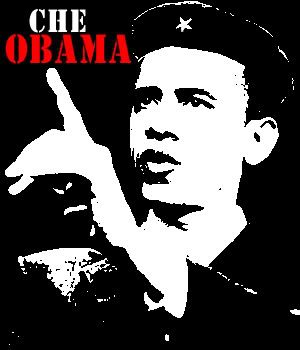
http://i22.photobucket.com/albums/b302/Minnesocold/Che_Obama_1.jpg
From National Review:
The Company He Keeps
Meet Obama’s circle: The same old America-hating Left.
By Andrew C. McCarthy

Why is Barack Obama so comfortable around people who so despise America and its allies? Maybe it’s because they’re so comfortable around him.

He presents as the transcendent agent of “change.” Sounds platitudinous, but it’s really quite strategically vaporous. Sen. Obama is loath to get into the details of how we should change, and, as the media’s Chosen One, he hasn’t had to.

But he’s not, as some hopefully dismiss him, a charismatic lightweight with a gift for sparkling the same old vapid cant. Judging from the company he chooses to keep, Obama’s change would radically alter this country. He eschews detail because most Americans don’t believe we’re a racist, heartless, imperialist cesspool of exploitation. The details would be disqualifying.

MICHELLE
So, instead, we get glimpses. The most profound influence in his life, his wife Michelle, is notoriously less circumspect than her careful husband about where she’s coming from. Her college thesis, which Princeton tried to keep under lock and key, testifies to a race-obsessed worldview. She may have refined it, but she’s never grown out of it.

After four years at one of America’s most esteemed academic institutions, Michelle recoiled at the thought of “further integration and/or assimilation into a white cultural and social structure that will only allow me to remain on the periphery of society; never becoming a full participant.” That the sky has been the limit for her, that she has managed to ride the “periphery” from Princeton to Harvard Law School, to one of the country’s top law firms, and to a plethora of prestigious institutional positions, has not much altered her perspective. Through the windows of her mansion on Chicago’s south side, American society still appears as a caste system.

The United States, says she, is “just downright mean.” Never, prior to her husband’s presidential run, had she had a reason to feel proud of it, she told a campaign throng. But by last November, with Barack’s pursuit of the brass ring catching momentum, she suddenly got plenty proud. And confident: so much so that she was moved to tell MSNBC, “Black America will wake up and get it” — unite and carry him over the finish line.

THE REV. WRIGHT
Years earlier, the Obamas had gravitated to the baleful Rev. Jeremiah Wright, an unapologetic racist and hard Left firebrand. They were comfortable with him — and he with them.

By the senator’s own account, Wright is the inspiration for his memoir, The Audacity of Hope — the title is cribbed from a Wright sermon (“The Audacity to Hope”). For Michelle, who had written that a racial “separationist” would have a better understanding of American blacks than “an integrationist who is ignorant to their plight,” Wright’s Trinity Church mission statement had to resonate, right from its opening declaration:

We are a congregation which is Unashamedly Black and Unapologetically Christian… Our roots in the Black religious experience and tradition are deep, lasting and permanent. We are an African people, and remain ‘true to our native land,’ the mother continent, the cradle of civilization.

Rev. Wright inspired his congregation — of which the Obamas were 20-year members — with “black liberation theology.” The doctrine is itself the inspiration of James Hal Cone, a professor of “Systematic Theology” at Union Theological Seminary in New York City. Cone is also the author of several books, which a tendentious Wright urged Sean Hannity to read during a recent interview.

It’s a useful suggestion. For example, there is Cone’s 1969 opus, Black Theology and Black Power, in which he helpfully explains:

Black theology refuses to accept a God who is not identified totally with the goals of the black community. If God is not for us and against white people, then he is a murderer, and we had better kill him. The task of black theology is to kill Gods who do not belong to the black community.... Black theology will accept only the love of God which participates in the destruction of the white enemy. What we need is the divine love as expressed in Black Power, which is the power of black people to destroy their oppressors here and now by any means at their disposal. Unless God is participating in this holy activity, we must reject his love.

Black liberation theology, as Wright has elaborated, is closely aligned with the “liberation theology” of Nicaragua during the seventies and eighties: i.e., the doctrine that catalyzed Marxist revolutionaries. It spurred an unabashedly Leftist movement that emphasized, you guessed it, the crying need for “change” — as George Russell aptly described it in a 2001 Time magazine analysis, “social change in the process of spiritual improvement.”

It is this same drive for upheaval, for supplanting a political order which purportedly treats blacks as “less than human,” that impelled Wright’s plea for God to “damn America.” In the oppression narrative, the murder of 3000 Americans on 9/11 isn’t terrorism but social justice. America, after all, had it coming. For Wright, it was “chickens coming home to roost.” Indeed, Wright sometimes prefers to call our country “the U.S. of KKK A” — a grotesque sentiment which, we shall see, is shared by others with whom the Obamas choose to associate themselves.

For their part, the Obamas couldn’t get enough of Wright. Barack and Michelle had him marry them. They chose him to baptize their children, who were routinely exposed to Wright’s race-baiting bombast.


Obama and his supporters brusquely dismiss the drawing of sensible inferences from these gestures of admiration as “guilt by association.” In point of fact, though, the Obamas didn’t just associate with Wright. They subsidized him to the tune of over $20,000 — not exactly chump change from a couple without great means or any history of philanthropy to speak of. And until recent public attention to the pastor’s noxious rants threatened to derail his White House bid, Sen. Obama kept Wright officially on board as part of his campaign’s “African American Religious Leadership Committee.”

BILL AYERS AND BERNADINE DOHRN
With this as background, is it really all that startling that Sen. Obama enjoys a friendly relationship with Bill Ayers and his wife, Bernadine Dohrn, a pair of terrorists?

I want to be clear here: Not terrorist sympathizers. Terrorists.

The mainstream media, in their zeal to elect a Democrat, are assiduously airbrushing Ayers: “an aging lefty with a foolish past,” as the Chicago Sun-Times has so delicately put it. In fact, it is the press that is rife with foolish, aging lefties. Ayers, by contrast, is an unapologetic terrorist with a savage past — one who beat the system he so reviles when, after his years of fugitivity, terrorism charges were dropped due to government surveillance violations. He’s “guilty as sin,” by his own concession, but “free as a bird.”

Ayers didn’t just carry a sign outside the Pentagon on May 19, 1972. He bombed it. As his memoir gleefully recalled, “Everything was absolutely ideal on the day I bombed the Pentagon. The sky was blue. The birds were singing. And the bastards were finally going to get what was coming to them.”

Whether Pentagon bombing day was more or less ideal than other days, when he, Dohrn and their Weathermen comrades bombed the U.S. Capitol, the State Department, and sundry banks, police stations and courthouses, Ayers does not say. But on each occasion, there was surely optimism that the bastards were finally going to get what was coming to them.

There were lots of bombs. There is no remorse. “I don’t regret setting bombs,” he told the New York Times in 2001, sorry only that he and the others “didn’t do enough.” Like what? We can’t be sure, though National Review Online’s Jonah Goldberg recounts Ayers’s sentiments back in the day: “Kill all the rich people. Break up their cars and apartments. Bring the revolution home, kill your parents, that’s where it’s really at.”

Ayers and Dohrn have done the actual dirty work of terror, while Jeremiah Wright draws the line at waving pom-poms. But the prism through which they assay the dirty work is precisely the same: America has it coming.

For them, that makes all the difference. It’s not terror, just chickens coming home to roost. “Terrorists destroy randomly,” Ayers rationalizes with nauseating arrogance, “while our actions bore ... the precise stamp of a cut diamond. Terrorists intimidate, while we aimed only to educate.” Right. As her companion Discover the Networks profile illustrates, Dohrn now goes even further: insisting their bombings weren’t terrorist acts at all: “We rejected terrorism. We were careful not to hurt anybody.”

Maybe she’s forgotten the “bastards getting what was coming to them” part. Or maybe she’s just lying. She was, we can be confident, something less than a model of compassion back then — like at the Weathermen “War Council” meeting in 1969, when she famously gushed over the barbaric Manson Family murders of the pregnant actress Sharon Tate, coffee heiress Abigail Folger, and three others: “Dig it! First they killed those pigs, then they ate dinner in the same room with them. They even shoved a fork into the victim’s stomach! Wild!”

Charming. The “War Council,” it should be noted, concluded by first condemning the United States for — what else? — its pervasive racism, then formally declaring war against what the Weathermen called “AmeriKKKa.” Rev. Wright would have understood.


It was at the Chicago home of Ayers and Dohrn that Obama, then an up-and-coming “community organizer,” had his political coming out party in 1995. Not content with this rite of passage in Lefty World — where unrepentant terrorists are regarded as progressive luminaries, still working “only to educate” — both Obamas tended to the relationship with the Ayers.

Barack Obama made a joint appearance with Bill Ayers in 1997 at a University of Chicago panel on the outrage of treating juvenile criminals as if they were, well, criminals. Obama apologists say, “So what? People appear with other people all the time.” Nice try. This panel was orchestrated by none other than Michelle Obama, then an Associate Dean of Student Services. Ayers didn’t happen to be there — he was invited by the Obamas to educate students on the question before the house: “Should a Child Ever Be Called a ‘Super Predator?’”

And here’s how the University’s press release chose to describe this would-be super predator:

William Ayers, author of A Kind and Just Parent: The Children of Juvenile Court (Beacon Press, 1997), says “We should call a child a child. A 13-year-old who picks up a gun isn’t suddenly an adult. We have to ask other questions: How did he get the gun? Where did it come from?”

Ayers, who spent a year observing the Cook County Temporary Juvenile Detention Center in Chicago, is one of four panelists who will speak on juvenile justice[.]
The other panelists included “Illinois State Sen. Barack Obama … who is working to block proposed legislation that would throw more juvenile offenders into the adult system.” The goal was to promote change, to actuate the vision of “Chicago reformer” Jane Addams, who’d sought “the establishment of a separate court system for children which would act like a ‘kind and just parent’ for children in crisis.” Never mind the crises they’d caused the victims of their wanton murders and mayhem — the fault for those, surely, was our downright mean society.

The Ayers and Obama, meantime, kept up. There was yet another panel in 2002, Obama and Ayers waxing on “Intellectuals in Times of Crisis.” Dohrn, too, was asked to weigh in, on a panel addressing the question, “Why Do Ideas Matter?” I’m sure it was, er, wild.

RASHID KHALIDI
In the interim, Ayers and Obama had teamed up for three years on the board of the Woods Fund, a Chicago charitable organization. Together, they voted to donate $75,000 of the largesse they controlled to the Arab American Action Network. The AAAN was co-founded by Rashid Khalidi, a longtime supporter of Palestinian “resistance” attacks against Israel, which he openly regards as a racist, apartheid state. Despite considerable evidence to the contrary, Khalidi peremptorily denies having been a PLO operative or having directed its official press agency for six years (from 1976 to 1982). There can be no gainsaying, though, that he was an influential apologist for Yasser Arafat, the terror master who spawned two Intifadas and ordered the murder of American diplomats.

In the mean, besotted United States, of course, being a terrorist, a terror apologist, or simply raging at the machine qualifies one for a cushy academic soapbox. Thus did Khalidi eventually land on his feet at the University of Chicago, where he ran in the same circles as Associate Dean Michelle Obama, Law Professor Barack Obama, University of Illinois-Chicago Education Professor Bill Ayers, and Northwestern Law Professor Bernadine Dohrn (who prepared for a career in instructing future officers of the court with a stint in federal prison for flouting a judge’s order that she testify in a grand jury investigation into the Weathermen’s infamous Brinks robbery-murders).

For Khalidi, though, greener pastures called: the opportunity to become a professor of Arab Studies at Columbia University. There, he now directs Edward Said’s legacy: Columbia’s notoriously Israel-bashing Middle East Institute — though, much to the University’s chagrin, he was scratched in 2005 from a program designed educate teachers on instructing their young students about the Middle East. New York City schools chancellor Joel Klein concluded Khalidi’s splenetic meanderings mightn’t be the best model.

They didn’t faze Barack Obama, though. He was front and center with Ayers and Dohrn at a farewell bash when Khalidi left Chicago for New York. It was only right. Khalidi, after all, had hosted a fundraiser for Obama in 2000, when the latter launched an unsuccessful campaign for a seat in the U.S. House of Representatives. And so it goes. A few weeks ago, Khalidi told worldnetdaily.com he supports Obama’s presidential run “because he is the only candidate who has expressed sympathy for the Palestinian cause,” and because Obama has promised negotiations with Iran.

Ayres, too, provided a minor ($200) contribution to Obama, in 2001. That was the year of September 11, just a few days before the Times published its excerpt of Ayres’s remembrances of bombings past. Read the short interview and ask yourself: Could anyone, let alone someone as sophisticated as Barack Obama, chat with Bill Ayers for about 30 seconds and not know exactly where is coming from?

Could they really have been friends? Well, Ayers is virtually channeling Michelle Obama and Jeremiah Wright when he wails that American “society is not a just and fair and decent place.”

“God, what a great country,” he scoffed to the Times. “It makes me want to puke.”

Hey, right back at you there, Professor. At least that’s how most of us are likely to feel. But not Sen. Obama. And that’s why Ayers — like Khalidi and Wright and Michelle Obama, and others who know the senator well while we’ve been told precious little — sees in Barack Obama the change he’s been waiting for.

No thanks.

— Andrew C. McCarthy is author of Willful Blindness: Memoir of the Jihad.

http://www.dallasnews.com/sharedcontent/dws/img/v3/03-29-2008.nn_29Obama2.G6M2CCB5U.1.jpg

From The Corner:
Hicks nix clique's shticks

Mark Steyn

I'm about done with Obama over this mill-closures-drive-small-town-losers-to-guns-and-God business. If you're running as a glamorous blank slate on which people project their own utopian fantasies, you've got to be very careful not to give the game away - especially when the game turns out to be the usual cliched elite disdain for the great unwashed. I mention in the current issue of NR how odd it is that Michelle Obama is in many ways more condescending on the stump than Teresa Heinz Kerry. Now her husband's at it, too. As Ed Driscoll says:

Leave it to Obama to make John Kerry's Brahmin hauteur seem earnestly goofy in retrospect.

Quite. I had a ton of fun covering Kerry's awkwardness with Americans but, in fairness, it was essentially a consumerist snobbery: he preferred the Newburgh Yacht Club for lunch over the local Wendy's, he'd rather be windsurfing off Nantucket than rednecking at Nascar, etc. Obama's snobbery seems more culturally profound, and unlike Kerry he can't plead the crippling disadvantage of a priviliged childhood. Rather, Barack's condescension reveals a man out of touch with the rhythms of American life to a degree that's hard to fathom. As Michelle says, they "chose" to "leave corporate America", and Barack became a "community organizer" and she wound up a 350-grand-a-year "diversity outreach coordinator". I've no idea what either of those careers involve, and most of us seem able to get along without them. But their remoteness from the American mainstream perhaps explains why the Obamas seem to have no clue how Americans live their lives.

And yes, I'm a foreigner. But it takes one to know one, and this guy seems weirdly disconnected from everything except neo-segregationist Afrocentric grievance politics and upscale white liberal condescension. Not much of a coalition.

Friday, April 11, 2008

http://www.writespirit.net/inspirational_talks/political/martin_luther_king_talks/martin-luther-king2.jpg
From Slate:
Obama Is No King

Today, the national civil rights pulpit
is largely occupied by second-rate shakedown artists.

By Christopher Hitchens


When Martin Luther King Jr. was murdered, I was 19 years old and fancifully considered myself to be far to the left of him. Notwithstanding that, he felt to me like one of my moral elders and tutors (as he still does). When I was first asked to sign a petition to make his birthday a national holiday, on a Manhattan side street in 1970, I was 21 and signed with pride. When, in 1983, President Ronald Reagan finally signed also, authorizing the bill for the King holiday, I was humbled to think of how far along I was in my 30s and how comparatively little I had to show for it. And last weekend, reading a beautiful reminiscence by King biographer Taylor Branch, I was arrested by the realization that King has now been dead for longer than he was alive, and that it's been 40 years.

On the very same weekend, as it happened, I was reading Nicholson Baker's much-discussed book Human Smoke, and I came across the following passage:

A union organizer and socialist, Philip Randolph, was in President Roosevelt's office to talk about jobs for Negroes in defense plants. It was June 18, 1941. Randolph had announced a huge march on Washington. "Our people are being turned away at factory gates because they are colored," he said to the president. "They can't live with this thing. Now, what are you going to do about it?"

FDR offered to intercede with the heads of the defense industries, but only if the march on Washington was called off: Randolph wanted an executive order prohibiting racism in hiring. In the end, the march was called off, but only in return for a strongly written executive order.

Whenever I leave my current hometown by train, I always make a little salute to the obscure and disfigured statue of Randolph that is erected in Washington's Union Station. It was 22 years before he had to try the same tactic on another vacillating Democratic incumbent. And this time, President John F. Kennedy didn't get the point until the marchers, organized by the United Automobile Workers as well as the civil rights leadership, actually flooded the city.

On the same weekend as I was reading Nicholson Baker, I also absorbed a news item about the Rev. Jeremiah Wright, the recently retired pastor of Barack Obama's church in Chicago. Here is the form that the reverend's "retirement" will take: a $1.6 million home, purchased in the name of his church and consisting of more than 10,000 square feet, in a gated community in Tinley Park, a prosperous white section of the city. There used to be a secularist line about fat shepherds and thin sheep, but the joke here is not just at the expense of a man who never pretended to be much more than a hustler. The joke is on those of the "flock" who tithed themselves to achieve this level of comfort for a man who must be pinching himself when he wakes up every day.

But, then, so must the Rev. Al Sharpton, routinely described by the New York Times as "the civil rights activist," be pinching himself each morning. By evening, after all, several limos will have arrived to transport him to several studios where he will be flattered and taken seriously. And this enviable existence is watched with avaricious jealousy by more junior practitioners, like the raving Rev. James Meeks of Chicago's Salem Baptist Church, who may not yet be quite ready for prime time, and by the members of Louis Farrakhan's racist and sectarian crew, who affect to think that Christianity is a slave religion and that white people are the products of a laboratory experiment gone wrong.

The thing that this gaggle of cranks and parasites has in common is the extreme deference with which it is treated by the junior senator from Illinois. In April 2004, Barack Obama told a reporter from the Chicago Sun-Times that he had three spiritual mentors or counselors: Jeremiah Wright, James Meeks, and Father Michael Pfleger—for a change of pace, a white Catholic preacher who has a close personal feeling for the man he calls (as does Obama) Minister Farrakhan. This crossover stuff is not as "inclusive" as it might be made to seem: Meeks' main political connections in the white community are with the hysterically anti-homosexual wing of the Christian right. If Obama were to be read a list of the positions that his clerical supporters take on everything from Judaism to sodomy, he would be in the smooth and silky business of "distancing" from now until November. And that is why he hopes that his Philadelphia speech, which dissociated him from everything and nothing, will be enough. He seems, indeed, to have a real gift for remaining adequately uninformed about the real beliefs of his "mentors."

This is a lot sadder, and a lot more serious, than has been admitted. Four decades after the murder in Memphis of a friend of the working man—a hero who was always being denounced by the FBI for his choice of secular and socialist friends and colleagues—the national civil rights pulpit is largely occupied by second-rate shakedown artists who hope to franchise "race talk" into a fat living for themselves. Far from preaching truth and brotherhood, they trade in cheap slander and paranoia and in venomous dislike of other minorities. Elijah Muhammad and the Black Muslims used to relish their meetings with Klansmen and Nazis to discuss the beauties of separatism. These riffraff, too, hang out with Farrakhan and make opportunist coalitions with the James Dobsons and Gary Bauers of the white right. This is the lovely clientele of the faith-based initiative. Who now cares to commemorate Philip Randolph or Bayard Rustin or the other giants of struggle and solidarity in whose debt we live? So amnesiac have we become, indeed, that we fall into paroxysms of adulation for a ward-heeling Chicago politician who does not complete, let alone "transcend," the work of Dr. King; who hasn't even caught up to where we were four decades ago; and who, by his chosen associations, negates and profanes the legacy that was left to all of us.

Christopher Hitchens is a columnist for Vanity Fair and the author of God Is Not Great: How Religion Poisons Everything.

Thursday, April 10, 2008

http://www.rushlimbaugh.com/home/daily/site_121406/content/truth_detector.Par.0002.ImageFile.gif
DREAMS FROM MY FATHER,
LAME EXCUSES FROM MY GRANDFATHER

by Ann Coulter
April 9, 2008

Since a Chinese graduate student at Columbia University, Minghui Yu, was killed last Friday when black youths violently set upon him, sending him running into traffic to escape, I think B. Hussein Obama ought to start referring to the mind-set of the "typical Asian person."

As of Wednesday, police had no motive for the attack, and witnesses said they heard no demand for money or anything else. The Associated Press reports that the assailant simply said to his friend, "Watch what I do to this guy" before punching Yu.

Meanwhile, let's revisit the story about Obama's grandmother being guilty of thinking like a "typical white person." As recounted in Obama's autobiography, the only evidence that his grandmother feared black men comes from Obama's good-for-nothing, chronically unemployed white grandfather, who accuses Grandma of racism as his third excuse not to get dressed and drive her to work.

His grandmother wanted a ride to work at 6:30 in the morning because, the day before, she had been aggressively solicited by a homeless man at the bus stop. On her account, the panhandler "was very aggressive, Barry. Very aggressive. I gave him a dollar and he kept asking. If the bus hadn't come, I think he might have hit me over the head."

Even Obama's shiftless grandfather didn't play the race card until pretty far into the argument over whether he would drive Grandma to work. First, the good-for-nothing grandfather told Obama that Grandma was just trying to guilt him into driving her, saying, "(S)he just wants me to feel bad."

Next, he complained about his non-work routine being disrupted, saying: "She's been catching the bus ever since she started at the bank. ... And now, just because she gets pestered a little, she wants to change everything!"

Only after Obama had offered to drive his grandmother to work himself and it was becoming increasingly clear what a selfish lout the grandfather was, did Grandpa produce his trump card. The reason he wouldn't get his lazy butt dressed and drive Grandma to work was ... she was a racist!

As Obama recounts it, on Grandpa's third try at an excuse, he told Obama: "You know why she's so scared this time? I'll tell you why. Before you came in, she told me the fella was black. That's the real reason she's bothered. And I just don't think that's right." So I guess I'll be heading back to the sack now!

That makes sense. It certainly never bothers me when crazy white people harass and threaten me.

This is Obama's own account of what happened, which -- as anyone can see -- consisted of his slacker grandfather making a series of excuses to avoid having to drive the sole bread-earner in the family to work.

But Obama says, "The words were like a fist in my stomach, and I wobbled to regain my composure." (It was as if he had been punched by an aggressive panhandler at a bus stop!) And not because his grandfather's sorry excuse reminded him that he came from a long line of callow, worthless men, both black and white.

No, Obama swallowed his grandfather's pathetic excuse hook, line and sinker, leading Obama to a reverie about his grandparents: "I knew that men who might easily have been my brothers could still inspire their rawest fears." That's true -- assuming his brothers and sisters were menacing people at bus stops.

How deranged would you have to be to cite this incident as evidence that your grandmother thought like a "typical white person" -- as opposed to your grandfather being worthless and lazy? For those keeping score, Obama is aghast at his grandmother's alleged racism, but had no problem with Jeremiah Wright's manifest racism.

If Obama is sent reeling by the mere words of an elderly white woman, how is he going to negotiate with a guy like Mahmoud Ahmadinejad? What if Ahmadinejad calls him "booger-face"? Will he run crying from the table?

Your grandmother wasn't a racist, Barack. Your grandpa was just a loser. Can we wrap up our national conversation about race now? I think we'd like to move onto questions about your stupid plan to hold talks with Iran.

Wednesday, April 09, 2008

The image “http://newsimg.bbc.co.uk/media/images/41345000/jpg/_41345666_multan_ap416.jpg” cannot be displayed, because it contains errors.
From The New York Daily News:
Arabs must take a long, self-critical look in the mirror

By Emilio Karim Dabul

Monday, April 7th 2008, 4:00 AM

There was a time centuries ago in Arab countries when intellectual introspection was common and the culture produced searching, self-critical scholarship in various arenas.

That time is gone. Today, brave and questioning souls like Irshad Manji, who calls for an Islamic Reformation, receive death threats. Without the ability to look inward, Arab blame for problems is projected outward - meaning, at Israel and the U.S. That is very dangerous for the world.

As an Arab-American, recent events have reminded me in very stark terms why introspection needs to return to the Arab world in a big way, as quickly as possible, as a prerequisite for anything resembling peace, in the Middle East or elsewhere, to be a real possibility.

First, look at what Fatah just attempted to do regarding American victims of Palestinian terrorism. Because of the 1990 Anti-Terrorism Act, numerous lawsuits have been brought against Fatah and other Palestinian terrorist groups that have injured or killed Americans while in Israel. Recently, the State Department decided it might intervene in some of these judgments, which had found in favor of the defendants and held Fatah and other Palestinian groups liable for millions of dollars in damages, because Fatah had complained that these judgments would bankrupt them and that this in turn would hurt the peace process.

Yes, you heard right. Fatah complained that they were being held financially liable for injuring and killing Americans in Israel, acts for which they had previously claimed responsibility!

And our own State Department wanted to support them in this complaint, supposedly in the interest of peace, by having these judgments nullified. Joseph Heller, the author of "Catch 22," couldn't have come up with a more surreal scenario.

Fortunately, advocates like the Endowment for Middle East Truth, made noise, and as a result of that pressure, the State Department has backed down for now.

But where is the proper sense of shame that might stop a group like Fatah from lodging such a complaint to begin with?

The only explanation is that by having such a pathological, externally focused sense of blame, aimed exclusively at Americans and Jews, no such sense of reasoning or decency applies.

The recent massacre of the Yeshiva students in Jerusalem by a Palestinian Muslim fits the same pattern. Gaza celebrated - yes, celebrated - the cold-blooded and ethnically motivated murders of these religious students, most of whom were teenagers.

Why are we, as Arabs and Arab-Americans, not lining the streets in Ramallah and all the way to New York to decry this sort of barbarism?

Let me say unequivocally that I am ashamed. And I am angry. Nothing, nothing in the world justifies these sorts of actions. Tell me, when have you ever heard of Israelis celebrating the killing of Palestinians?

Yes, there are a few glimmers of progress. Saudi Arabia's King Abdullah has issued a call for interfaith dialogue between Christians, Jews and Muslims. And The New York Times actually called Hamas out on its murderous, anti-Semitic rhetoric.

But these are drops in the bucket, not a rising tide.

The centuries-old downward spiral of tyranny, poverty, fanaticism and finger-pointing is the rule, not the exception in most Arab countries.

At this point in Arab history, we must finally renounce these fatally flawed tendencies to blame everyone but ourselves. As Arab-Americans, we must lead the way, away from groups like the Council on American-Islamic Relations - which consistently claims big, bad America is the oppressor and poor Arabs are almost always the hapless victims.

Let us begin anew the path toward our own glorious Renaissance abandoned long ago, and pursue the higher road that will be ours when we finally look more deeply and critically at ourselves.

Dabul is a novelist and commentator on Middle East issues.


JEFF SINER -- jsiner@charlotteobserver.com


From The Charlotte Observer:

Roy should let Kansas go already

TOM SORENSEN

The North Carolina basketball players walked out of the Alamodome Saturday night crushed. They believed they were the best team in college basketball and were going to win the national championship. They never came close. Kansas handled them.

Maybe those players watched Kansas upset Memphis two nights later. If so, they saw their coach, Roy Williams, wear a shirt with a KU sticker, KU being the team that ended their season.

For Williams, a Final Four that couldn't get worse did.

On Saturday, Williams stubbornly refused to adjust to the game in front of him. Somewhere in the Book of Dean is a passage that states: Save your timeouts. Williams must have more timeouts than I have Marriott points.

Perhaps there is also a passage in the Book of Dean that states: Although painting your face in your former school's colors should be discouraged once you attain adulthood, it's OK to wear a sticker.

Roy's intentions undoubtedly were honorable. Kansas gave him his first head coaching job, and he stayed 15 years. Based on his words, actions and sticker, he hasn't made peace with his departure.

Before he accepted the job with his alma mater, he told his players he was leaving them. That hurt him deeply, and that's good. Some coaches treat players as if they're disposable. You want a coach who cares. Roy cares.

Alas, he also cares about being liked. He wants Kansas to like him, thus Monday's show of Jayhawks solidarity. I wouldn't be surprised if before the game Williams approached every Kansas fan and said, "Hi, my name is Roy and I'm still sorry."

Have you ever committed an act that makes you sick no matter how long ago you did it? And you feel as if you can't go on until you're absolved? You so desperately want the aggrieved party to feel your pain that when you're around them you turn sad and apologetic. All you want is for them to say, "It's OK."

It's OK, at least with Kansas. The Jayhawks won a national title Monday with Bill Self, Roy's successor. They never won one with Roy.

North Carolina, however, is not OK. Here's why.

Roy wanted to beat Kansas, of course. But he also did not want to play Kansas. Was his reluctance a factor in North Carolina's slow start? Have you ever seen a team with the talent of the Tar Heels come out so uninspired for a game of such importance? What did he talk to the players about before they left the locker room -- Kansas' superior wheat?

In the first paragraph of this column I wrote that Kansas handled North Carolina. Kansas also handled Roy.

Trying to get people to like you is a waste. In Saturday's Observer was a story in which Roy said he was bothered by the Kansas barber who hung his picture in the bathroom of his establishment and called it Roy's Room.

Why would Williams even consider caring?

Unless the bathroom is in N.C., I mean.

Tuesday, April 08, 2008


roy_ku.jpg

From 850 The Blog:
Roy, Seriously?:
Published by JoeOvies April 7th, 2008 in ACC Hoops

Is Ol’ Roy telegraphing his interest in going back to Kansas should Bill Self take that insane $6 million signing bonus offer from Oklahoma State? Did he lose a bet? Is he that much of a weepy sentimental wet blanket? Or did he simply not notice the Jayhawks sticker on his chest, likely placed by a cheeky KU booster as a “kick me” sign after Saturday night’s beat down? The man spent 15 years at Kansas, built relationships with players who came through the program, etc etc. We get it already, you love Kansas, but this makes you look silly. North Carolina fans are gonna be pissed when they see this image plastered all over the eBays.

From The Wilmington Star-News :

Kansas And Roy Should Move On

San Antonio | Now that Kansas did something in year five of the Bill Self regime it couldn't do in 15 years of the Roy Williams regime, it's time both parties move on from each other.

We all know Williams loves Kansas and it gave him a chance. That's fine, but he's the North Carolina coach. He graduated from UNC and worked under Dean Smith for 10 years. Yet, he wore a shirt with a KU logo on it Monday night at the Alamodome. Move on, Roy.

He regularly professes his love of Kansas, but rarely do we hear about his love of UNC, a school that also gave him a chance.

If not for Smith, Kansas never would have called. And, if not for Smith, Williams wouldn't have come back home to North Carolina.

There's nothing wrong with having strong feelings for KU and feeling a bit emotional for the program's success because of how much it means to many close friends. But it's been old for a while now, and it's just time to move on.

Would Wal-Mart tolerate a former Target CEO always talking about how great that red dot is?

And for Kansas fans, many of whom have embarrassed themselves for their harsh feelings toward a man who gave them 418 victories in 15 years, let it go. Perhaps the shellacking Saturday night did that, as Williams received a nice ovation from the fans when he appeared on the jumbotron.

The man gave you a huge part of his life and decided to return home. Most people would have done the same thing.

So lets make a deal between Jayhawks fans and Williams: No more, please, no more. Move on.

Roy, you have possibly the best job in the game and KU fans, you have a national championship coach.

Monday, April 07, 2008

From The Sheila Variations:
Rest in peace, Charlton Heston
By Sheila O'Malley

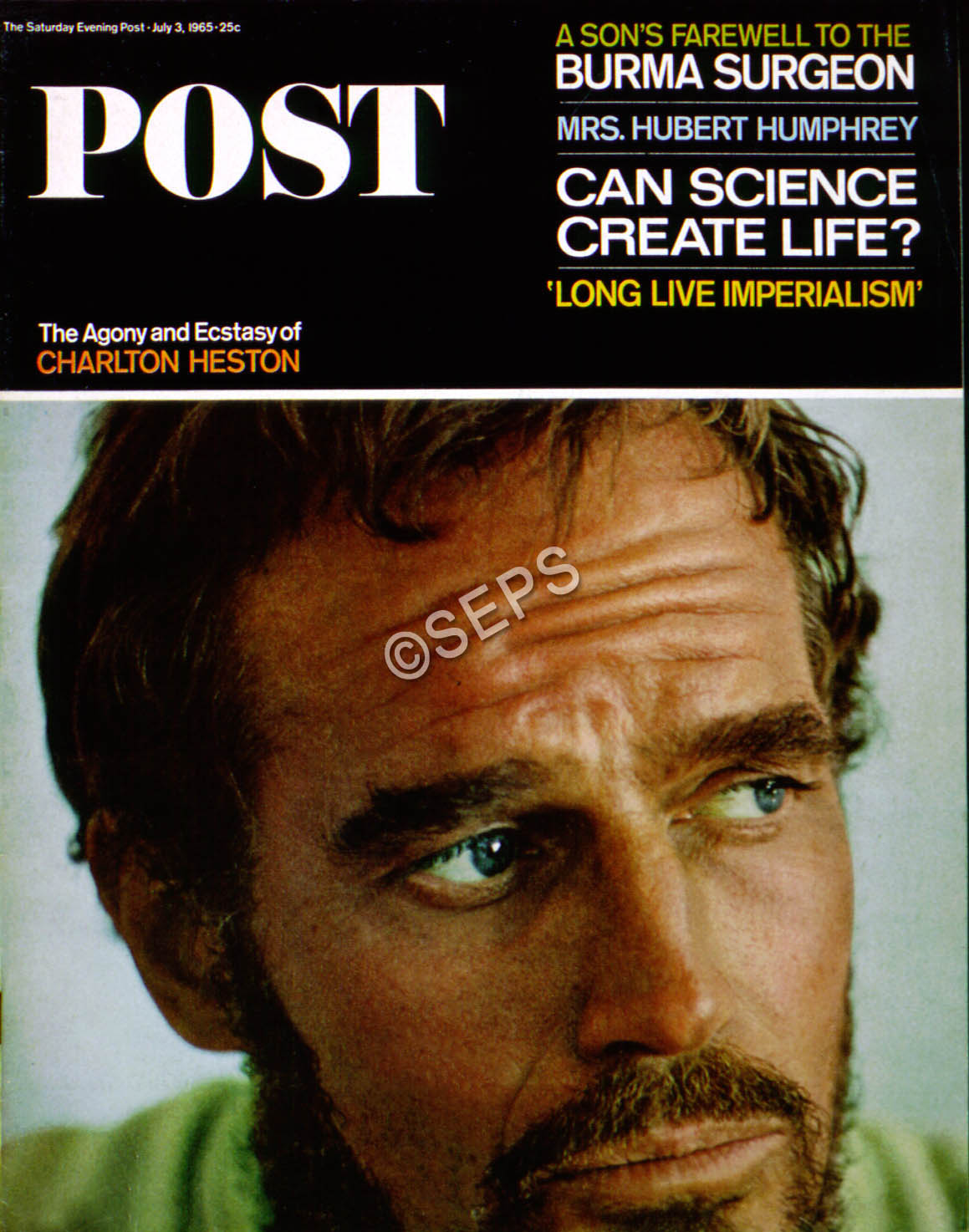
http://www.curtispublishing.com/images/NonRockwell/9650703.jpg

My brother Brendan and I watched The Ten Commandments on the night before Easter, and expressed amazement, for the 100th time, how incredible Heston is, how inevitable. I mean, how silly could that entire undertaking have been? Come to think of it, there is something supremely silly about Edward G. Robinson running around in a toga. It's awesome! But even today, lulled to sleep by CGI effects, there is something stunning and terrifying about the Red Sea parting, well done! - but none of it would matter a whit if it weren't for Heston's commanding (pun) performance. He had no fear. He embodied courage, and was able to portray it larger than life. This is something NO actors have today - NONE - it is no longer the "style" of acting, and no longer in vogue. And that's fine. Things don't have to stay the same forever. But at least we could look back at one of the greats and say, "Ah. There. That is how it was done. That is how it should have been done." His performances do not date themselves. I also liked him very much in the otherwise somewhat ridiculous Any Given Sunday. Seeing him show up in that plush skybox, with his cynical mutterings, and leering undeniable gravitas - was like suddenly seeing reality show up in that over-produced mess. And watching Cameron Diaz try to act with the man was like watching a flea try to compete with a gorilla. Nice shot, dear. Try again. She wasn't bad in that movie, she was perfectly cast, I thought ... but Heston walking in that room made everyone around him seem transparent, insubstantial.
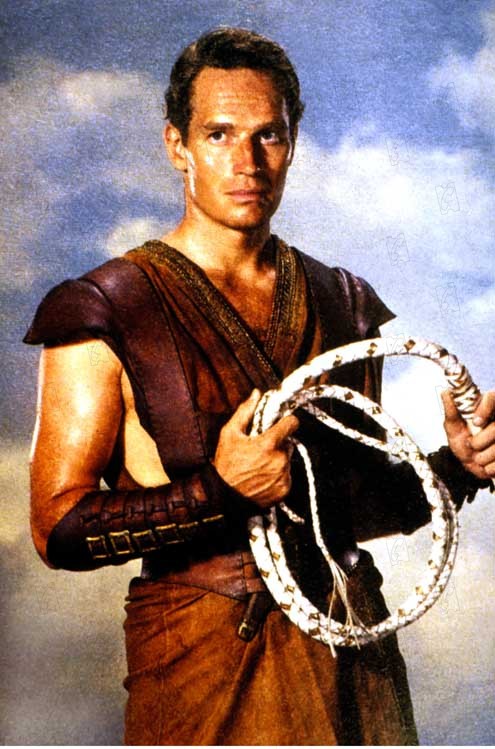
When Charlton Heston first announced that he had the onset of Alzheimer's, an outpouring of tributes emerged. A wonderful thing - I do hope he read them, and got a chance to understand, before the disease got his brain, how much he still meant to so many.

The most stunning tribute of all, it takes my breath away to this day, is Richard Dreyfuss' tribute. He wrote it for National Review - obviously a publication with political leanings that has nothing to do with who Richard Dreyfuss is, and how he votes. But, as I have said repeatedly on my blog, as I have chased people away from my site who seem constitutionally unable to play by my rules, as I have stated in my comment policy: when you are dealing with art, and the appreciation thereof, politics must take a backseat. At least if you want to have a worthwhile conversation. And then there are those who say, "I liked Charlton Heston's acting BECAUSE of his politics" and that is just as idiotic. His work transcends. He was an actor, first and foremost, a "great pretender". So talk about his work, please - there is plenty there to keep us chatting for 100 years at least! Nobody "owns" Charlton Heston. Nobody "owns" John Wayne. The most flaming liberal in the world could appreciate and love Red River, and those who put politics at the forefront are completely missing the point. What we are talking about here is love. And these actors who touch us, who get beneath our skins, who create something indelible ... transcend all of that. The editors at National Review knew that, and so did Richard Dreyfuss.

His tribute of Charlton Heston is what I first ran to, today, when I heard the news that Charlton Heston had passed away. Bless Dreyfuss for putting it so eloquently into print.

And rest in peace, great American icon. You will not be forgotten.

http://img5.allocine.fr/acmedia/medias/nmedia/18/36/25/04/18828915.jpg

He’s Not Moses, but He’s Something Else
My tribute to Charlton Heston.

By Richard Dreyfuss

I am shy around movie stars. True, if odd. My tongue sticks to the roof of my mouth and all I can think to say is I loved you in ... So it is with Charlton Heston.

In his presence I seem to nod idiotically like one of these doggies in the back of rear windows of cars. He always tries to make my agonies a bit smaller since he is such a gentleman. We've talked about children and gun control but usually it's hopeless and I just end up trying not to stare.

It's a serious and silly business, acting. Grown people running around pretending the clothes they're wearing are their own, pretending the words they're saying are their own, pretending that they're not pretending. That stuff can really make you feel silly if you're not careful. A thousand times more silly if you're wearing a toga or staring offstage at a burning bush that isn't there. But as silly as it might be at times, acting has awesome power to mirror our reality and give shape to our best and most noble pictures of ourselves.

When I was a kid and yearning to act, there were scads of actors whose work I admired and tried to emulate: (Spencer) Tracy and (Charles) Laughton, Paul Muni, Irene Dunne, and Jimmy Cagney. There were also Errol Flynn and John Wayne and Charlton Heston.

I thought, being cocky, that I could be something like Tracy, something like Cagney, something like Laughton (well maybe not Laughton). I watched them all. I knew I would never be as sexy as Flynn, never as heroic as Wayne, never as mythic as Heston. I never thought for a minute I could be like Heston.

There are some performances that could not possibly be acted by anyone other than who played them. Even though we hear stories about (Ronald) Reagan being cast in Casablanca, we know in our gut it just couldn't be right, couldn't happen. God gave Bogart the role. God gave John Wayne Red River. And God cast Charlton Heston as Moses. And Ben Hur. God I think cast Heston as God, because (if I'm not mistaken) his voice is the voice of God in the Ten Commandments, playing against himself. They say Cecil B. DeMille did the voice, but it sounds like Heston to me. I believe it anyway. Makes a better story.

Millions of Jewish kids grew up with the confusion that A) Charlton Heston was Moses B) Charlton Heston was not Jewish. I believe that films like Ben Hur were conceived because Heston was there to make them. He allowed these stories to be told because he was there to play the parts. Ben Hur starring Robert Montgomery. (Please.) Tyrone Power as Moses. (I don't think so.) With all due respect, and I have loads of that, Heston is inescapable. He was necessary. There would be no Chariot Race worth its salt without him. I would never watch Heston on TV because he was too big. It would be like watching the promos to the Incredible Hulk, with the giant bursting through his shirt. He was too big for television. TV is small, it's manageable, it's less. Heston was almost too big for the 20th century, let alone TV. But in the darkened mysterioso of the movie theatre, Charlton Heston was "just right."

When I saw Charlton Heston as a kid, he took me far, far away, to places few actors could go. The only other American actor so comfortable outside of this era was Wayne, and Heston could time travel farther. Both held the magical alchemy that made me forget the commonplace of here and now completely. John Wayne allowed us into our American past. Heston, because of his perfectly male face, the depth of his voice, the measured almost antique rhythm of his speech, the oddly innocent commitment that allowed him to dive without looking into the role, took me farther, before the common era, as they say.

Somehow he was able to cut the myriad strings that connect us to our current lives, so he could inhabit our imagined past and imagined future so perfectly. So well did he do this that his discomfort was obvious when he played in the Now (actually, make that my discomfort, because he more than likely had a ball in the rare instances when he played something current). If it wasn't the past it was the future. I could never have gotten to Ancient Rome without him, nor Ape City.

Is so and so a great actor? A good actor? A bad actor? Speaking as an expert it's a stupid question. The actor either gets you to where you have to go, or not. Heston did; priceless. He could portray greatness, which is no longer an artistic goal; he could portray a grandeur that was so satisfying. What he was able to personify so perfectly for us was a vision of ourselves called heroic. Is this out of favor? Out of step? Antique? Yes, antique as in gorgeous, incredibly valuable, and not produced anymore but this is a critique of the world, not him (hopefully we will one day come back to all that).

As someone who has seen Ben Hur two million times I am totally grateful.

Self-consciousness is the anticipation of being silly and often is the spoiler for many actors. Charlton Heston had no such problem. He would dive into the story with what I can only call measured abandon and make me believe. And it was fun watching him.

It has become fashionable to characterize his politics; almost as if his politics were a separate thing, like Diana's popularity. People are either defensive or patronizing (if not contemptuous). I can only say I wish all the liberals and all the conservatives I knew had the class and forbearance he has. Would I be as patient or serene when so many had showed me such contempt, or tried to make me feel stupid or small? I doubt it, truly I do. This is dignity, simply and completely. A much more important quality than political passion at the end of the day, and far more lacking, don't you think?

It is a terrible, terrible, terrible thing that Charlton Heston is going through this (earlier this month, Heston announced he had been diagnosed with symptoms consistent with Alzheimer's disease), but I confess that there is a part of my heart where I am grateful for the opportunity to let him know what he's meant to me.

It will make him smile that I'm writing this on National Review's website (among other publications). Come to think of it, it is kind of funny.


charlton_heston_civil_rights_march_1963.jpg


And here's a nice tribute from The Onion's AV Club. I particularly liked this part:

Above all, Heston was an actor. His performances never let viewers forget this. He had little use for subtlety but a great flair for operatic emotions. Few have equaled him for this. Heston was already a man out of time in an era that had begun to favor the nuance of Method performers but he had a gift for command that made the shift in fashion seem irrelevant, if not wrongheaded. Other actors could have cursed the skies and damned mankind for destroying itself at the end of Planet Of The Apes. But try to picture anyone else bringing Heston's ferocity and conviction to the moment and you'll probably draw a blank.

Amen. Rest in peace.

The image “http://www.lindenmanphoto.com/celebrites/images/Charlton%20Heston.jpg” cannot be displayed, because it contains errors.
Winning the Cultural War
Charlton Heston

delivered 16 February 1999, Austin Hall, Harvard Law School

I remember my son when he was five, explaining to his kindergarten class what his father did for a living. "My Daddy," he said, "pretends to be people." There have been quite a few of them. Prophets from the Old and New Testaments, a couple of Christian saints, generals of various nationalities and different centuries, several kings, three American presidents, a French cardinal and two geniuses, including Michelangelo. If you want the ceiling re-painted I'll do my best. There always seem to be a lot of different fellows up here. I'm never sure which one of them gets to talk. Right now, I guess I'm the guy.

As I pondered our visit tonight it struck me: if my Creator gave me the gift to connect you with the hearts and minds of those great men, then I want to use that same gift now to re-connect you with your own sense of liberty, your own freedom of thought, your own compass for what is right.

Dedicating the memorial at Gettysburg, Abraham Lincoln said of America, "We are now engaged in a great Civil War, testing whether that nation or any nation so conceived and so dedicated can long endure."

Those words are true again. I believe that we are again engaged in a great civil war, a cultural war that's about to hijack your birthright to think and say what lives in your heart. I'm sure you no longer trust the pulsing lifeblood of liberty inside you, the stuff that made this country rise from wilderness into the miracle that it is.

Let me back up a little. About a year or two ago, I became president of the National Rifle Association, which protects the right to keep and bear arms of American citizens. I ran for office. I was elected, and now I serve. I serve as a moving target for the media who've called me everything from "ridiculous" and "duped" to a "brain-injured, senile, crazy old man." I know, I'm pretty old, but I sure Lord ain't senile.

As I've stood in the crosshairs of those who target Second Amendment freedoms, I've realized that firearms are -- are not the only issue. No, it's much, much bigger than that. I've come to understand that a cultural war is raging across our land, in which, with Orwellian fervor, certain accepted thoughts and speech are mandated.

For example, I marched for civil rights with Dr. King in 1963 -- and long before Hollywood found it acceptable, I may say. But when I told an audience last year that white pride is just as valid as black pride or red pride or anyone else's pride, they called me a racist.

I've worked with brilliantly talented homosexuals all my life -- throughout my whole career. But when I told an audience that gay rights should extend no further than your rights or my rights, I was called a homophobe.

I served in World War II against the Axis powers. But during a speech, when I drew an analogy between singling out the innocent Jews and singling out innocent gun owners, I was called an anti-Semite.

Everyone I know knows I would never raise a closed fist against my country. But when I asked an audience to oppose this cultural persecution I'm talking about, I was compared to Timothy McVeigh.

From Time magazine to friends and colleagues, they're essentially saying, "Chuck, how dare you speak your mind like that. You are using language not authorized for public consumption."

But I am not afraid. If Americans believed in political correctness, we'd still be King George's boys -- subjects bound to the British crown.

In his book, "The End of Sanity," Martin Gross writes that

"blatantly irrational behavior is rapidly being established as the norm in almost every area of human endeavor. There seem to be new customs, new rules, new anti-intellectual theories regularly twisted on us -- foisted on us from every direction. Underneath, the nation is roiling. Americans know something without a name is undermining the country, turning the mind mushy when it comes to separating truth from falsehood and right from wrong. And they don't like it."

Let me read you a few examples. At Antioch College in Ohio, young men speaking and seeking intimacy with a coed must get verbal permission at each step of the process, from kissing to petting to final, at last, copulation -- all clearly spelled out in a printed college directive.

In New Jersey, despite the death of several patients nationwide who'd been infected by dentists who had concealed their own AIDS, the state commissioner announced that health providers who are HIV-positive need not -- need not! -- tell their patients that they are infected.

At William and Mary, students tried to change the name of the school team "The Tribe" because it was supposedly insulting to local Indians, only to learn that authentic Virginia chiefs really like the name, "The Tribe."

In San Francisco, city fathers passed an ordinance protecting the rights of transvestites to cross-dress on the job, and for transsexuals to have separate toilet facilities while undergoing sex change surgery.

In New York City, kids who didn't speak a word of Spanish had been placed in bilingual classes to learn their three R's in Spanish solely because their own names sound Hispanic.

At the University of Pennsylvania, in a state where thousands died at Gettysburg opposing slavery, the president of that college officially set up segregated dormitory space for black students.

Yeah, I know, that's out of bounds now. Dr. King said "Negroes." Jimmy Baldwin and most of us on the March said "black." But it's a no-no now.

For me, hyphenated identities are awkward, particularly "Native-American." I'm a Native American, for God's sake. I also happen to be a blood-initiated brother of the Miniconjou Sioux. On my wife's side, my grandson's a twelfth generation native-American, with a capital letter on "American."

Finally, just last month, David Howard, head of the Washington D.C. Office of Public Advocate, used the word "niggardly" while talking about budgetary matters with some colleagues. Of course, "niggardly" means stingy or scanty. But within days, Howard was forced to publicly apologize and then resign.

As columnist Tony Snow wrote: "David Howard got fired because some people in public employ were morons who (a) didn't know the meaning of 'niggardly,' (b) don't know how to use a dictionary to discover the meaning, and (c) actually demanded that he apologize for their ignorance."

Now, what does all of this mean? Among other things, it means that telling us what to think has evolved into telling us what to say, so telling us what to do can't be far behind. Before you claim to be a champion of free thought, tell me: Why did political correctness originate on America's campuses? And why do you continue to -- to tolerate it? Why do you, who're supposed to debate ideas, surrender to their suppression?

Let -- Let's be honest. Who here in this room thinks your professors can say what they really believe? (Uh-huh. There's a few....) Well, that scares me to death, and it should scare you too, that the superstition of political correctness rules the halls of reason.

You are the best and the brightest. You, here in this fertile cradle of American academia, here in the castle of learning on the Charles River. You are the cream. But I submit that you and your counterparts across the land are the most socially conformed and politically silenced generation since Concord Bridge. And as long as you validate that and abide it, you are, by your grandfathers' standards, cowards.

Here's another example. Right now at more than one major university, Second Amendment scholars and researchers are being told to shut up about their findings or they'll lose their jobs. But why? Because their research findings would undermine big-city mayors' pending lawsuits that seek to extort hundreds of millions of dollars from firearm manufacturers.

Now, I don't care what you think about guns. But if you are not shocked at that, I am shocked at you. Who will guard the raw material of unfettered ideas, if not you? Democracy is dialogue. Who will defend the core values of academia, if you, the supposed soldiers of free thought and expression lay down your arms and plead, "Don't shoot me."

If you talk about race, it does not make you a racist. If you see distinctions between the genders, it does not make you sexist. If you think critically about a denomination, it does -- does not make you anti-religion. If you accept but don't celebrate homosexuality, it does not make you a homophobe.

Don't let America's universities continue to serve as incubators for this rampant epidemic of new McCarthyism. That's what it is: New McCarthyism. But, what can you do? How can anyone prevail against such pervasive social subjugation?

Well, the answer's been here all along. I learned it 36 years ago, on the steps of the Lincoln Memorial in Washington D.C., standing with Dr. Martin Luther King and two hundred thousand people.

You simply disobey. Peaceably, yes. Respectfully, of course. Nonviolently, absolutely. But when told how to think or what to say or how to behave, we don't. We disobey the social protocol that stifles and stigmatizes personal freedom.

I learned the awesome power of disobedience from Dr. King who learned it from Gandhi, and Thoreau, and Jesus, and every other great man who led those in the right against those with the might.

Disobedience is in our DNA. We feel innate kinship with that disobedient spirit that tossed tea into Boston Harbor, that sent Thoreau to jail, that refused to sit in the back of the bus, that protested a war in Viet Nam.

In that same spirit, I' m asking you to disavow cultural correctness with massive disobedience of rogue authority, social directives, and onerous laws that weaken personal freedom.

But be careful. It hurts. Disobedience demands that you put yourself at risk. Dr. King stood on lots of balconies. You must be willing to be humiliated, to endure the modern-day equivalent of the police dogs at Montgomery and the water Cannons at Selma. You must be willing to experience discomfort. Now, I'm not complaining, but my own decades of social activism have left their mark on me. Let me tell you a story.

A few years ago, I heard about a -- a rapper named Ice-T who was selling a CD called "Cop Killer," celebrating the ambushing and of murdering police officers. It was being marketed by none other than Time/Warner, the biggest entertainment conglomerate in the country -- in the world. Police across the country were outraged. And rightfully so. At least one of them had been murdered. But Time/Warner was stonewalling because the -- the CD was a cash cow for them, and the media were tiptoeing around because the rapper was black. I heard Time/Warner had a stockholders meeting scheduled in Beverly Hills, and I owned some shares of Time/Warner at the time, so I decided to attend the meeting.

What I did was against the advice of my family and my colleagues. I asked for the floor. To a hushed room of a thousand average American stockholders, I simply read the full lyrics of "Cop Killer" -- every vicious, vulgar, instructional word:

I got my 12-Gauge sawed-off. I got my headlights turned off. I'm about to bust some shots off. I'm about to dust some cops off.

It got worse, a lot worse. Now, I won't read the rest of it to you. But trust me, the room was a sea of shocked, frozen, blanched faces. Time/Warner executives squirmed in their chairs and stared at their shoes. They hated me for that. Then I delivered another volley of sick lyrics brimming with racist filth, where Ice-T fantasizes about sodomizing the two 12-year-old nieces of Al and Tipper Gore:

She pushed her butt against my --

No. No, I won't do to you here what I did to them. Let's just say I left the room in stunned silence. When I read the lyrics to the waiting press corps outside, one of them said, "We can't print that, you know." "I know," I said, "but Time/Warner is still selling it."

Two months later, Time/Warner terminated Ice-T's contract. I'll never be offered another film by Warner Brothers, or get a good review from Time magazine. But disobedience means you have to be willing to act, not just talk.

When a mugger sues his elderly victim for defending herself, jam the switchboard of the district attorney's office. When your university is pressured -- your university -- is pressured to lower standards until 80% of the students graduate with honors, choke the halls of the Board of Regents. When an 8-year-old boy pecks a girl's cheek on the playground and then gets hauled into court for sexual harassment, march on that school and block its doorways. When someone you elected is seduced by political power and betrays you -- petition them, oust them, banish them. When Time magazine's cover portrays millennium nuts as deranged, crazy Christians holding a cross as it did last month, boycott their magazine and the products it advertises.

So that this nation may long endure, I urge you to follow in the hallowed footsteps of the great disobediences of history that freed exiles, founded religions, defeated tyrants, and yes, in the hands of an aroused rabble in arms and a few great men, by God's grace, built this country.

If Dr. King were here, I think he would agree.

I thank you.

Sunday, April 06, 2008

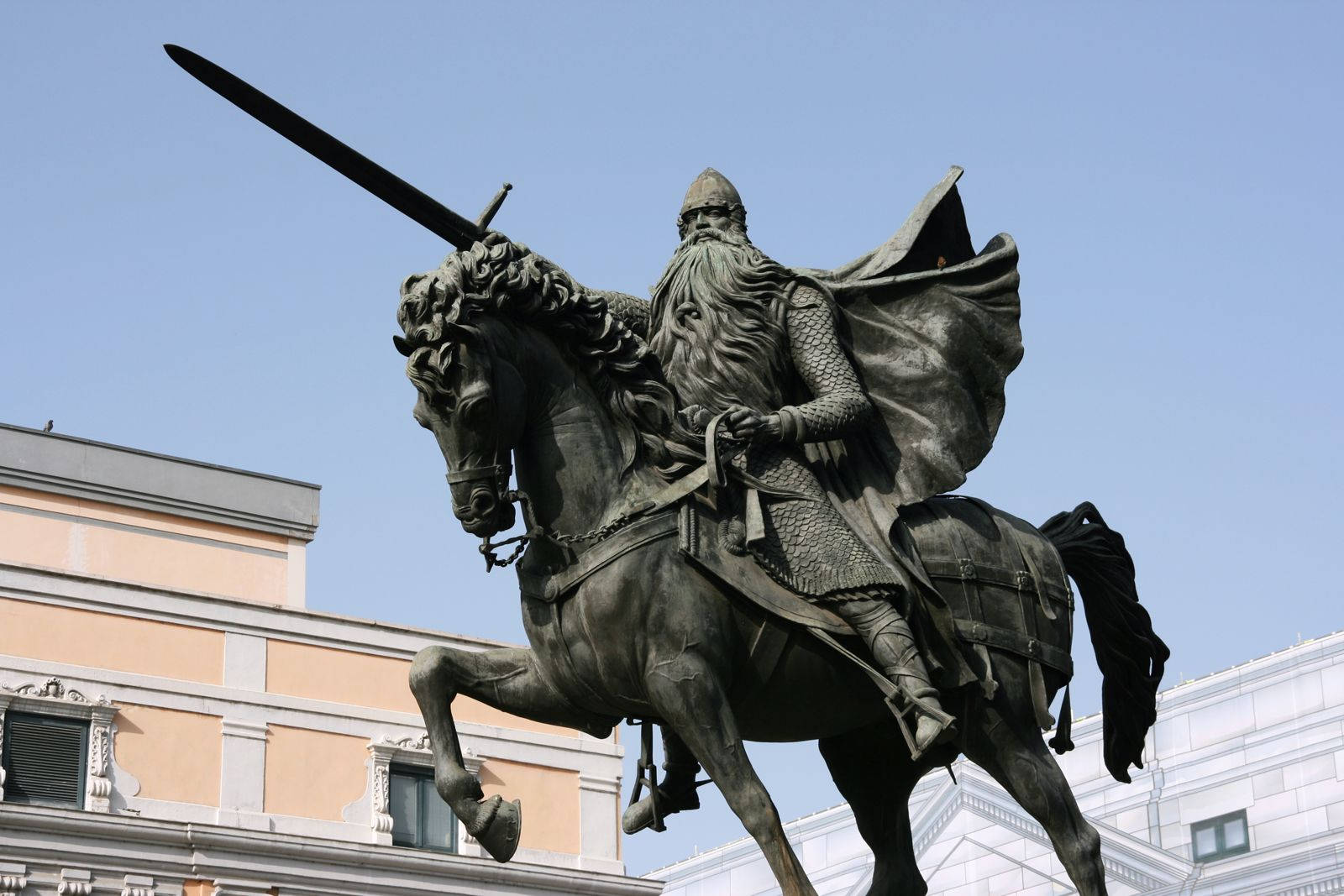
http://i2.iofferphoto.com/img/item/252/543/67/o_EL_CID_copy.JPG
From The New York Times:
Charlton Heston,
Epic Film Star and Voice of N.R.A., Dies at 83

By ROBERT BERKVIST

Charlton Heston, who appeared in some 100 films in his 60-year acting career but who is remembered chiefly for his monumental, jut-jawed portrayals of Moses, Ben-Hur and Michelangelo, died Saturday night at his home in Beverly Hills, Calif. He was 83.

His death was confirmed by a spokesman for the family, Bill Powers, who declined to discuss the cause. In August 2002, Mr. Heston announced that he had been diagnosed with neurological symptoms “consistent with Alzheimer’s disease.”

“I’m neither giving up nor giving in,” he said.

Every actor dreams of a breakthrough role, the part that stamps him in the public memory, and Mr. Heston’s life changed forever when he caught the eye of the director Cecil B. De Mille. De Mille, who was planning his next biblical spectacular, “The Ten Commandments,” looked at the young, physically imposing Mr. Heston and saw his Moses.

When the film was released in 1956, more than three and a half hours long and the most expensive that De Mille had ever made, Mr. Heston became a marquee name. Whether leading the Israelites through the wilderness, parting the Red Sea or coming down from Mount Sinai with the tablets from God in hand, he was a Moses to remember.

Writing in The New York Times nearly 30 years afterward, when the film was re-released for a brief run, Vincent Canby called it “a gaudy, grandiloquent Hollywood classic” and suggested there was more than a touch of “the rugged American frontiersman of myth” in Mr. Heston’s Moses.

The same quality made Mr. Heston an effective spokesman, off-screen, for the causes he believed in. Late in life he became a staunch opponent of gun control. Elected president of the National Rifle Association in 1998, he proved to be a powerful campaigner against what he saw as the government’s attempt to infringe on a Constitutional guarantee — the right to bear arms.

In Mr. Heston, the N.R.A. found its embodiment of pioneer values — pride, independence and valor. In a speech at the N.R.A.’s annual convention in 2000, he brought the audience to its feet with a ringing attack on gun-control advocates. Paraphrasing an N.R.A. bumper sticker (“I’ll give you my gun when you take it from my cold, dead hands”) he waved a replica of a colonial musket above his head and shouted defiantly, “From my cold, dead hands!”

Mr. Heston’s screen presence was so commanding that he was never dominated by mammoth sets, spectacular effects or throngs of spear-waving extras. In his films, whether playing Buffalo Bill, an airline pilot, a naval captain or the commander of a spaceship, he essentially projected the same image — muscular, steely-eyed, courageous. If critics regularly used terms like “marble-monumental” or “granitic” to describe his acting style, they just as often praised his forthright, no-nonsense characterizations.

After his success in “The Ten Commandments,” Mr. Heston tried a change of pace. Another legendary Hollywood director, Orson Welles, cast him as a Mexican narcotics investigator in the thriller “Touch of Evil,” in which Welles himself played a murderous sheriff in a border town. Also starring Janet Leigh and Marlene Dietrich, the film, a modest success when it opened in 1958, came to be accepted as a noir classic.

But the following year Mr. Heston stepped back into the world of the biblical epic, this time under the director William Wyler. The movie was “Ben-Hur.” Cast as a prince of ancient Judea who rebels against the rule of Rome, Mr. Heston again dominated the screen. In the film’s most spectacular sequence, he and his co-star, Stephen Boyd, as his Roman rival, fight a thrilling duel with whips as their horse-drawn chariots careen wheel-to-wheel around an arena filled with roaring spectators.

“Ben-Hur” won 11 Academy Awards — a record at the time — including those for best picture, best director and, for Mr. Heston, best actor.

He went on to star opposite Sophia Loren in the 1961 release “El Cid,” battling the Moors in 11th-century Spain. As a Marine officer stationed in the Forbidden City in 1900, he helped put down the Boxer Rebellion in Nicholas Ray’s 1963 epic “55 Days at Peking.” In “Khartoum” (1966), he played Gen. Charles (Chinese) Gordon, who was killed in a desert uprising led in the film by Laurence Olivier’s Mahdi. When George Stevens produced and directed “The Greatest Story Ever Told” in 1965, there was Mr. Heston, back in ancient Judea, playing John the Baptist to Max von Sydow’s Jesus.

He portrayed Andrew Jackson twice, in “The President’s Lady” (1954) and “The Buccaneer” (1958). There were westerns (“Major Dundee,” “Will Penny,” “The Mountain Men”), costume dramas (“The Three Musketeers” and its sequel, “The Four Musketeers,” with Mr. Heston cast as the crafty Cardinal Richelieu in both) and action films aplenty. Whether playing a hard-bitten landowner in an adaptation of James Michener’s novel “The Hawaiians” (1970), or a daring pilot in “Airport 1975,” he could be relied on to give moviegoers their money’s worth.

In 1965 he was cast as Michelangelo in the film version of Irving Stone’s novel “The Agony and the Ecstasy.” Directed by Carol Reed, the film pitted Mr. Heston’s temperamental artist against Rex Harrison’s testy Pope Julius II, who commissioned Michelangelo to create frescoes on the ceiling of the Sistine Chapel. Mr. Heston’s performance took a critical drubbing, but to audiences, the larger-than-life role seemed to be another perfect fit. Mr. Heston once joked: “I have played three presidents, three saints and two geniuses. If that doesn’t create an ego problem, nothing does.”

Mr. Heston was catapulted into the distant future in the 1968 science-fiction film “Planet of the Apes,” in which he played an astronaut marooned on a desolate planet and then enslaved by its rulers, a race of anthropomorphic apes. The film was a hit. He reprised the role two years later in the sequel, “Beneath the Planet of the Apes.”

Son of the Midwest

It was all a long way from Evanston, Ill., where Charlton Carter was born on Oct. 4, 1924, and from the small town of St. Helen, Mich., where his family moved when he was a small boy and where his father ran a lumber mill. He attended a one-room school and learned to fish and hunt and to savor the feeling of being self-reliant in the wild, where his shyness was no handicap.

When his parents divorced in the 1930s and his mother remarried — his stepfather’s surname was Heston — the family moved to the Chicago suburb of Winnetka. He joined the theater program at his new high school and went on to enroll at Northwestern University on a scholarship. By that time, he was convinced he had found his life’s work.

Mr. Heston also found a fellow drama student, Lydia Clarke, whom he married in 1944, just before enlisting in the Army Air Force. He became a radio-gunner and spent three years stationed in the Aleutian Islands. After his discharge, the Hestons moved to New York, failed to find work in the theater and, somewhat disenchanted but still determined, moved to North Carolina, where they spent several seasons working at the Thomas Wolfe Memorial Theater in Asheville.

When they returned to New York in 1947, Mr. Heston got his first big break, landing the role of Caesar’s lieutenant in a Broadway production of Shakespeare’s “Antony and Cleopatra” staged by Guthrie McClintick and starring Katharine Cornell. The production ran for seven months and proved to be the high point of Mr. Heston’s New York stage career. He appeared in a handful of other plays, most of them dismal failures, although his performance in the title role of a 1956 revival of “Mr. Roberts” won him praise.

If Broadway had little to offer him, television was another matter. He made frequent appearances in dramatic series like “Robert Montgomery Presents” and “Philco Playhouse.” The door to Hollywood opened when the film producer Hal B. Wallis saw Mr. Heston’s performance as Rochester in a “Studio One” production of “Jane Eyre.” Wallis offered him a contract.

Mr. Heston made his film debut in 1950 in Wallis’s “Dark City,” a low-grade thriller in which he played a small-time gambler. Two years later, he did his first work for De Mille as a hard-driving circus boss in “The Greatest Show on Earth.”

Throughout his career he studied long and hard for his roles. He prepared for the part of Moses by memorizing passages from the Old Testament. When filming began on the sun-baked slopes of Mount Sinai, he suggested to De Mille that he play the role barefoot — a decision that he felt lent an edge of truth to his performance.

Preparing for “The Agony and the Ecstasy,” he read hundreds of Michelangelo’s letters and practiced how to sculpt and paint convincingly. When filming “The Wreck of the Mary Deare” (1959), in which he played the pilot of a salvage boat, he learned deep-water diving. And he mostly rejected stunt doubles. In “Ben-Hur,” he said, he drove his own chariot for “about 80 percent of the race.”

“I worked six weeks learning how to manage the four white horses,” he said. “Nearly pulled my arms right out of their sockets.”

As the years wore on, the leading roles began to go to younger men, and by the 1980s, Mr. Heston’s appearances on screen were less frequent. He turned to stage work again, not on Broadway but in Los Angeles, at the Ahmanson Theater, where he played roles ranging from Macbeth to James Tyrone in “Long Day’s Journey into Night.” He also returned to television, appearing in 1983 as a paternalistic banker in the miniseries “Chiefs” and as an oil baron in the series “The Colbys.”

Rifles and a ‘Cultural War’

Mr. Heston was always able to channel some energies into the public arena. He was an active supporter of the Rev. Dr. Martin Luther King Jr., calling him “a 20th-century Moses for his people,” and participated in the historic march on Washington in 1963.

He served as president of the Screen Actors Guild from 1966 to 1971, following in the footsteps of his friend and role model Ronald Reagan. A registered Democrat for many years, he was nevertheless selective in the candidates he chose to support and often campaigned for conservatives.

In 1981, President Reagan appointed him co-chairman of the President’s Task Force on the Arts and Humanities, a group formed to devise ways to obtain financing for arts organizations. Although he had reservations about some projects supported by the National Endowment for the Arts, Mr. Heston wound up defending the agency against charges of elitism.

Again and again, he proved himself a cogent and effective speaker, but he rejected suggestions that he run for office, perhaps for a seat in the Senate. “I’d rather play a senator than be one,” he said.

He became a Republican after Democrats in the Senate blocked the confirmation of Judge Robert Bork, a conservative, to the Supreme Court in 1987. Mr. Heston had supported the nomination and was critical of the Reagan White House for misreading the depth of the liberal opposition.

Mr. Heston frequently spoke out against what he saw as evidence of the decline and debasement of American culture. In 1992, appalled by the lyrics on “Cop Killer,” a recording by the rap artist Ice T, he blasted the album at a Time Warner stockholders meeting and was a force in having it withdrawn from the marketplace.

In the 1996 elections, he campaigned on behalf of some 50 Republican candidates and began to speak out against gun control. In 1997, he was elected vice president of the N.R.A.

In December of that year, as the keynote speaker at the 20th anniversary gala of the Free Congress Foundation, Mr. Heston described “a cultural war” raging across America, “storming our values, assaulting our freedoms, killing our self-confidence in who we are and what we believe.”

A Relentless Drive

The next year, at 73, he was elected president of the N.R.A. In his speech at the association’s convention before his election, he trained his oratorical artillery on President Bill Clinton’s White House: “Mr. Clinton, sir, America didn’t trust you with our health care system. America didn’t trust you with gays in the military. America doesn’t trust you with our 21-year-old daughters, and we sure, Lord, don’t trust you with our guns.”

He was in the news again after the shootings at Columbine High School in Littleton, Colo., in April 1999, when he said that the N.R.A.’s annual membership meeting, scheduled to be held the following week in Denver, would be scaled back in light of the killings but not canceled.

In a memorable scene from “Bowling for Columbine,” his 2002 documentary about violence in America, the director, Michael Moore, visited Mr. Heston at his home and asked him how he could defend his pro-gun stance. Mr. Heston ended the interview without comment.

In May 2001, he was unanimously re-elected to an unprecedented fourth term by the association’s board of directors. The association had amended its bylaws in 2000 to allow Mr. Heston to serve a third one-year term as president. Two months after his celebrated speech at the 2000 convention, it was disclosed that Mr. Heston had checked himself into an alcohol rehabilitation program after the convention had ended.

Mr. Heston was proud of his collection of some 30 guns at his longtime home in the Coldwater Canyon area of Beverly Hills, where he and his wife raised their son, Fraser, and daughter, Holly Ann. They all survive him, along with three grandchildren.

Never much for socializing , he spent his days either working, exercising, reading (he was fond of biographies) or sketching. An active diarist, he published several accounts of his career, including “The Actor’s Life: Journals 1956-1976.”

In 2003, Mr. Heston was among the recipients of the Presidential Medal of Freedom awarded by President Bush. In 1997, he was also a recipient of the annual Kennedy Center honors.

Mr. Heston continued working through the 1990s, acting more frequently on television but also in occasional films. His most recent film appearance found him playing a cameo role, in simian makeup, in Tim Burton’s 2001 remake of “Planet of the Apes.”

He had announced in 1999 that he was receiving radiation treatments for prostate cancer.

He had always hated the thought of retirement and once explained his relentless drive as an actor. “You never get it right,” he said in a 1986 interview. “Never once was it the way I imagined it lying awake at 4 o’clock in the morning thinking about it the next day.” His goal remained, he said, “To get it right one time.”