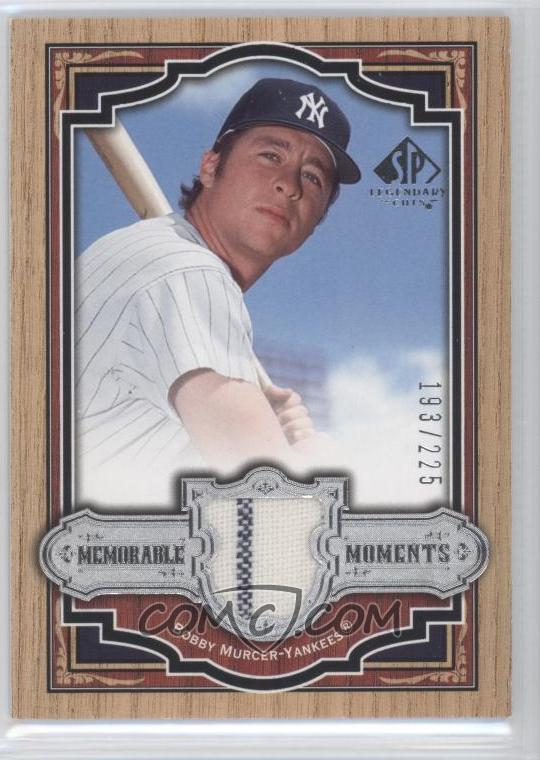
Saturday, July 12, 2008

http://keymancollectibles.com/cards/images/wpe32.jpg
From NewsOK.com:
Mick, Bobby together again

By John Rohde

Bobby Murcer was supposed to be the next Mickey Mantle.

Now Murcer is seated next to him.

Sadly for us, Murcer's courageous battle against cancer is one he could not win. So was his impossible quest to make people forget that Mantle once played center field in Yankee Stadium.

Murcer was not the next Mantle. There still hasn't been a next Mantle.

Murcer was saddled with a task no mortal could ever achieve.

Comparisons between Mantle and Murcer encompassed everything from whence they came, to where they played, to how they spoke.

The more they had in common, the heavier Murcer's burden.

Both hailed from Oklahoma.

Both started out as shortstops.

Both moved to center field because they were error-prone.

Both were signed by legendary scout Tom Greenwade.

Born in Spavinaw and raised in Commerce, Mantle arrived with the Yankees in 1951 at age 19.

Born and raised in Oklahoma City, Murcer arrived with the Yankees in 1965 at age 19.

Numerous times, Murcer said he never tried to be the next Mantle, because he knew he never could.

Murcer spoke of how he and Mantle often laughed at the comparisons.

"I didn't know what they were trying to do at the time, I was naïve,” Murcer said. "We laughed about it. I never worried about what people thought of the comparison. I only worried what he thought about the comparison. I never had any regrets because I never took it to heart. I never thought it was real. People thought it was a burden or hindrance. It never was because I never gave it a second thought.”

Murcer met Mantle in the spring of 1964.

"If you were his friend, you were his friend for life,” Murcer once said. "Back in those days they used to give rookies a hard time. When Mickey offered his acceptance to me — and I don't know why, I think maybe it was because Mickey was the last 19-year-old to make the Yankees — it caused everyone to lay off me.”

Mantle died from liver cancer on Aug. 13, 1995.

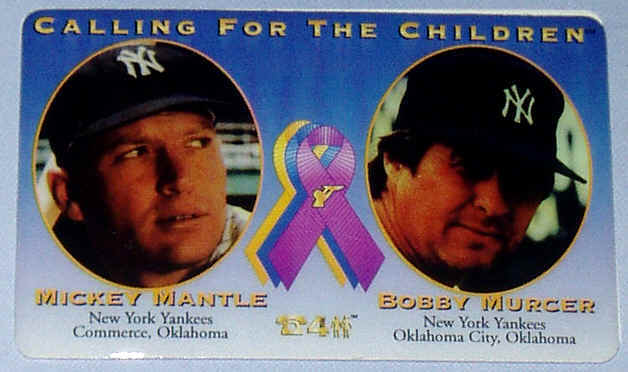
Just four months earlier, after the bombing of the Murrah Federal Building, Mantle had joined forces with Murcer to help raise funds for the victims.

When Mantle died, Murcer said it was "like losing a brother.”

Murcer called Mantle "the most honest man I ever knew.”

In 1996, at the first Old-Timers Day without Mantle, Murcer remembered a legend who had become a friend.

"There was always a certain electricity when Mickey walked into the building,” Murcer said that day. "It didn't matter what he did. He just was electric. And it's not the same way today. He's really missed. When I came up to the Yankees, Mickey took me under his wing. I guess because we were both from Oklahoma and he remembered how he felt when he first came here as a teenager. But we became good friends. I still can't believe he's not here.”

Now they're together again, not one behind the other, but side by side.

The longer Murcer's fight against cancer continued, the more people proclaimed him the most courageous New York Yankee since Lou Gehrig.

It's been nearly 13 years since Mantle died and 40 years since his last season in baseball, and people still haven't forgotten him.

Now it's time for no one to ever forget Bobby Murcer.


Keivom/News

Bobby Murcer, shown acknowledging Stadium crowd at 2007 Old-Timer's Day,
built legacy as beloved Yankee player and broadcaster.

From The NY Daily News:
Until the very end,
Bobby Murcer showed 'heart of a champion'

BY BILL MADDEN
DAILY NEWS SPORTS WRITER

Bobby Murcer lost his gallant and determined fight with brain cancer Saturday at Oklahoma City Hospital with his wife, Kay, his daughter, Tori, and his son, Todd, by his side, a little more than a year-and-half after first being diagnosed with the most aggressive form of tumors. He was 62, and while most of those last 19 months of a life-too-short were spent enduring exhaustive, often-agonizing after-effects of intense chemotherapy and radiation, Murcer, true to his upbeat nature, regarded them as a blessing rather than a curse.

"I feel especially blessed," he told me a few months ago, "to have been able to hear from and see all these wonderful people who have been my fans. Through this entire ordeal, their prayers and support have been so gratifying. You have no idea what a strength the fans have been for me."

According to his literary agent, Rob Wilson, Murcer was especially grateful to have been able to write his book, "Yankee For Life," in which he shared his life's experiences, from the trial of how he and his wife, Kay, dealt with the devastating news of his malignant brain tumor on Christmas Eve 2006, to the joy of his 44 years in the game as a player and broadcaster. During his last appearance in New York, May 27-29, Murcer, though frail and physically weakened, pushed himself to accommodate nearly 2,000 fans in three separate book signings.

"He displayed the heart of a champion throughout all those signings," said Wilson. "I don't know how he was able to get through them. No matter how weak he felt, he just kept signing. I told him at one point, 'We can cut this short, Bobby,' but he insisted on going the full nine innings. There was so much love on those lines, all those people who wanted to share their stories with him, and I think that was what motivated him to keep on going. He wanted them to know he loved them as much as they loved him."

He first came to us in 1966 out the same rolling hills of Oklahoma as his boyhood idol, Mickey Mantle, and with the same lofty expectations. But while that, too, might have been considered a curse for most any other ballplayer, Murcer - who like Mantle was signed by the legendary Yankee scout Tom Greenwade, and began his professional career as a shortstop before shifting to center field - felt honored to be compared with the great Yankee slugger.

"My answer to that was always the same: It never bothered me being compared to Mickey," Murcer said. "What bothered me was how Mickey felt about me being compared to him."

Such was Murcer's wry and self-effacing humor. But he was proud of all he accomplished as a player; especially proud of what he'd meant to a generation of Yankee fans in the mid-'60s and early '70s, who never knew the championship Yankee tradition. For a lot of those years, he was about all the Yankees had, a lonely pinstriped All-Star who came back from a two-year stint in military service to hit 129 homers in his first five full seasons. He would finish his career with a .277 average, 252 homers, 1,862 hits and a .445 slugging percentage - maybe not Mantle-esque, but more than enough to stamp him as a pretty fair country ballplayer. And, combined with his 22 years in the broadcasting booth, he earned Yankee icon status as one of the last to be introduced on Old-Timer's Day.

That's all he ever wanted to be - a respected Yankee. It was his fate, however, to never play on a Yankee world championship team. He arrived on the scene just after the 1949-64 Yankee dynasty had come to an end, and was traded - to the San Francisco Giants on Oct. 21, 1974, for Bobby Bonds - right before George Steinbrenner restored the team to a new championship era. Many years later, Murcer still called the trade to the Giants "the worst day of my life" but always blamed Yankee general manager Gabe Paul rather than Steinbrenner, who was serving his first suspension from baseball.

"Gabe and I always had a personality conflict," he once told me. "I was not a pro-Gabe Paul person. Gabe was only interested, in my opinion, in a team looking good and the budget being held down. He was satisfied with mediocrity."

Nevertheless, the Murcer-for-Bonds deal later became regarded as the pivotal transaction in the building of a new championship Yankee legacy when, a year later, Paul traded Bonds to the California Angels for pitcher Ed Figueroa and center fielder Mickey Rivers, both of whom were key components on the teams that won three straight American League pennants from 1976-78, and back-to-back World Series in '77 and '78. In the year prior to the trade, Murcer was dealt a double-barreled blow to his pride and his status as the premier Yankee: With Yankee Stadium undergoing its renovation, the team moved to Shea Stadium in 1974 and Murcer, who had the perfect lefthanded power stroke for Yankee Stadium, suffered accordingly, his home run output dropping to 10, with only two of them hit at home. At the same time, Yankee manager Bill Virdon determined that Elliott Maddox, whom the Yankees had purchased for $35,000 from the Texas Rangers in spring training '74, was a more adept center fielder, and Murcer was moved to right, never to return.

Murcer would go on to spend the next 41/2 years in Yankee exile, watching with envy from second-division outposts - Candlestick Park and Wrigley Field - as his old team, fortified with Hall-of-Fame-bound free agents Reggie Jackson, Catfish Hunter and Goose Gossage, along with his best friend, Thurman Munson, made regular trips to the World Series.

It wasn't until late June of 1979 that Steinbrenner reunited the 33-year-old Murcer with the Yankees, as the Cubs, who were just looking to dump his $320,000 contract, sent him back to the Bronx for a non-prospect minor league pitcher named Paul Semall. At the time of the deal, the Yankees, who had lost their closer, Gossage, to a thumb injury (the result of a shower room fight with teammate Cliff Johnson) were already falling out of the AL East pennant race. Then, on Aug. 2, an off-day, the Yankees and the rest of baseball were shocked by the news that Munson had been killed in the crash of his single engine private jet as he was practicing landings at the Canton, Ohio, airport.

No one in baseball was closer to Munson than Murcer, who, only the night before, had watched from his car at the end of the runway of a small Chicago airport as Munson took off on his solo flight home to Canton. Four days later, after delivering the eulogy at the Munson funeral in Canton, Murcer, despite having gotten no sleep, implored Yankee manager Billy Martin to let him play in the game that night at the Stadium against the Baltimore Orioles. It would be his finest hour as a Yankee as he honored Munson's memory by driving in all five runs, with a three-run homer and two-run single, in their emotional 5-4 win.

"He loved the game, his fans, his friends, and most of all his family," Murcer had said in the eulogy for Munson. "He is lost, but not gone. He will be missed, but not forgotten."

Now they are both lost.

Bobby Murcer was a pal and I will always choose to remember him, not so much for his exploits on the ballfield, but rather for his humor and humanity off it. A prime example of that latter quality was his service as president of the Baseball Assistance Team, the organization that raises money for indigent former players and baseball front office personnel. "Bobby lending his presence to our organization was so important in raising the awareness among the current players of what we do," said BAT executive director Jim Martin. "With him, it was never about Bobby and all about helping people in need."

One of my everlasting memories was a night in Boston in 1982. Bobby was at the tail-end of his career - on "scholarship" as I would tell him, in reference to the three-year "thanks for the memories" contract Steinbrenner bestowed upon him - and we were walking back to the hotel after having a few postgame cocktails at one of Boston's popular saloons. This was also when he was a spokesman for Skoal chewing tobacco and had actually recorded a goofy song, "Skoal Dippin' Man", for them. Regretfully, he also really chewed the stuff for a few years.

"I've always wanted to write my life story," Bobby said to me, "but I may need your help. Do you want to hear it?"

"Now?" I said.

"Well, yeah. When we get back to the room, I'll tell you everything."

Sure enough, when we got back to the hotel, Bobby doggedly followed me up to my room and as I stretched out on the bed, he pulled up a chair and a waste basket for which to deposit his "chew" spittle. I don't remember much of his monologue, other than feeling myself dozing off when, a half hour into his life story, he was only at Greensboro of the Carolina League.

The next day at the ballpark, he approached me in consternation.

"I can't believe you fell asleep in the middle of my life story!" he exclaimed.

"I can't believe you left that mess in my waste basket and that I'm probably gonna get charged for it!" I countered.

It turned out Bobby Murcer did have quite a life story. It was actually a love story that began and ended with the beautiful Kay, his high school sweetheart, and their two kids, Todd and Tori, who all survive him. And in between were all the rest of us, his friends, teammates and just plain fans, who will miss him and never forget him.
The image “http://www.nydailynews.com/img/2008/02/29/amd_murcersub.jpg” cannot be displayed, because it contains errors.
From The NY Daily News:
Against all odds,
Bobby Murcer taught us to keep believing

By Bob Raissman

Updated Saturday, July 12th 2008, 6:36 PM

Near the end of the 1995 season, the seismic shift in Yankees history did not escape Bobby Murcer.

On Aug. 13, Mickey Mantle died. Nine days later, Aug. 22, Phil Rizzuto packed up his microphone and retired. Now, it was late September and clear Don Mattingly was nearing the end of his career.

Murcer sat talking to a reporter. He smiled while reminiscing about Rizzuto, even hinting - with a wink and a nod - that Scooter, who spent 54 years as a player and broadcaster, could still make a comeback. Murcer's admiration for Mattingly, as a player and person, was evident. His tone of voice was reverential.

The Mantle part of this conversation was tough. Shortstops who were discovered by the same scout, Mantle and Murcer eventually set up shop in the outfield, outside those monuments in the Bronx. Two Okies who never lost their twang. Murcer didn't ever quite fill The Mick's shoes, but with heart and hustle he earned as much love.

Murcer had even more love for Mantle.

So, on this late September afternoon, the words did not come easy. Murcer choked back tears. He paused to compose himself as he recounted the day Mantle died. He woke up to hear the news on the radio. Then he and his wife, Kay, placed a call to Merlyn Mantle.

"She told us Mickey had gone peacefully," Murcer said. "We all know we are going to die someday and as much as we prepare for it we're never really ready when the actual event happens."

That's where we all are today.

In 2006, on Christmas Eve, the diagnosis the doctor gave Murcer was grave - a brain tumor. In the darkness of winter, faced with his own mortality, it was Murcer who comforted. It was Murcer who made you feel everything was going to be all right, no matter how long the odds were.

We all believed Murcer. We also believed in him. Murcer, who succumbed in that fight Saturday at the age of 62, was not just a player. For 22 years, in your living room talking baseball, he shared his summer nights. He was a friend. For Murcer, it wasn't only about pitch counts, swinging through the zone, or first-guessing every managerial decision.

Murcer was genuine. A baseball conversationalist. A storyteller with no pretense. A guy who liked to laugh, mostly at himself. Look into our baseball broadcast booths. With the exception of .Ralph Kiner, who has been relegated to cameo status by SNY, there is no one in the Bronx or Queens with the same one-on-one connection Murcer had with fans.

Rizzuto had it. So did Bob Murphy. Now they are all gone, replaced by technocrats big on strategy and ego, but so very small when it comes to sincerity and likability - qualities that cannot be taught.

Or readily recognized by various suits. Beginning in the early 1990s, February would roll around and Murcer still would not have been offered a Yankees broadcasting contract. That fact would find its way into the newspapers. Suddenly, George Steinbrenner would start "encouraging" someone to sign Murcer.

Even when the Yankees Entertainment & Sports Network was created, it seemed Murcer was never a priority to the people running it. That was reflected by the number of games he worked.

Other voices, including some who never played for the Yankees or were part-time Bombers, may have been blessed with more assignments, but not with the special bond Murcer had with Yankee fans.

Murcer never, ever, acknowledged any perceived slight. In a business full of insecurity, he was secure in himself. When he was forced to confront this crisis in his health, those very same fans who saw him as family uncapped a reservoir of love. They fueled Murcer for the fight of his life.

After six hours of surgery to have the tumor removed, and after a January 2007 pathology report revealed the tumor was malignant, Murcer kept on pushing. Kept on pushing all the way to the 2007 Yankee Stadium opener. Tampa Bay. Top of the third inning. There Murcer stood - bald, beautiful and smiling.

With his YES boothmates Michael Kay, Ken Singleton, and Joe Girardi at his side, Murcer surveyed the scene and waved to the fans. Rod Stewart's "Forever Young" sounded from the PA. The crowd of 56,035 stood and cheered. Yankee players did the same. Some even pointed up to the broadcast booth.

Murcer dried his eyes.

"If anyone can get well because of that," Murcer said, "I'm well already."

This was the last visible tribute to Murcer, but not the most important one. That tribute was delivered to others, some who never even saw him hit a home run or make a great catch, by Murcer himself. The way he kept on living, smiling, spreading optimism, gave so many others fighting cancer renewed faith and hope.

This was Bobby Murcer's last gift.

A reason to believe.


Moss Klein remembers Bobby Murcer
by Moss Klein/The Star-Ledger

From the time he joined the Yankees as a 19-year-old shortstop in 1965, everybody talked about Bobby Murcer being the next Mickey Mantle.

The similarities were obvious. Like Mantle, Murcer was from Oklahoma, a superb athlete and a power hitter. Like Mantle, Murcer was signed by legendary scout Tom Greenwade, came up as a shortstop and, just like Mantle, made enough wild throws to first base to be shifted to center field.

As it turned out, Murcer wasn't Mantle as a player. Murcer was very good, but not great; an All-Star, not a Hall of Famer. And to Murcer, and to those of us lucky enough to have crossed paths with him, being Bobby Murcer was more than enough.

Murcer, who passed away yesterday at the age of 62 after complications following his battle with brain cancer, was a fun-loving character, both as a player and in his next career as a Yankees broadcaster. When listening to him in his down-home way of speaking, he made you feel like you were sitting back, watching the game with a buddy.

I got the chance to spend time with Murcer beginning in 1979, when he was reacquired by the Yankees on the downside of his career. Those days of hanging out with Murcer and his closest friend, Lou Piniella, were a highlight of the years on the Yankees beat. Murcer was funny and smart, a great story-teller.

As a friend, just as he was as a player, Murcer always wanted to fit in, never looking to stand out. He was always one of the guys, willing to go along with the jokes -- like the time Sparky Lyle sawed off the legs of his beloved rocking chair in the locker room, put the legs back in place and alerted everyone to watch when Murcer sat down. Murcer, after his initial shock, laughed louder than anyone.

After getting to know him, I told him my "Murcer story" from the summer of 1969, when a few of us went to a twinight doubleheader on a Friday at Yankee Stadium.

One of the guys had lied to his boss to get out of work early at his job in Linden, telling him he had a doctor's appointment, but made the mistake of telling a few co-workers he was really going to the Yankees game. On Monday, the boss called him in.

"So how did it go with your doctor?" the boss asked.

"Fine, everything's fine," my friend said.

"Tell me," the boss said, "what's your doctor's name -- Dr. Bobby Murcer?"

That became a running gag for us, and in 1983, after Murcer had moved to the broadcast booth, my friend, now married and living in Maryland, attended a game in Baltimore and was coming up to the press box entrance to visit me after the third inning. I told Murcer, and he volunteered an idea. Shortly after my friend arrived, along came Murcer, going up to my friend and saying, "Pleased to meet you. This is Dr. Bobby Murcer, making a house call."

Murcer, a five-time All-Star, had so many proud moments as a Yankee before the move to Shea Stadium in 1974 hindered his Yankee Stadium left-handed power stroke, but none stood out more than Aug. 6, 1979, the night of Thurman Munson's funeral.

Murcer, who along with Piniella was exceptionally close to Munson, delivered an emotional eulogy at the funeral in Canton, Ohio, early that afternoon and returned with the Yankees for the game against the Baltimore Orioles at Yankee Stadium. After telling manager Billy Martin he really wanted to be in the lineup, Murcer put on a show: With Baltimore leading 4-0, he hit a three-run homer in the seventh and a two-run single in the bottom of the ninth for a 5-4 victory. A tearful Murcer fell into the arms of Piniella after the game and later gave his bat to Munson's wife.

Murcer's first go-round as a Yankee, when he was the team's star, ended abruptly with that trade to the Giants. Team president Gabe Paul used Murcer's struggles at Shea Stadium and the need for right-handed power in a lineup that had more than enough lefty hitters as the motivation.

"I don't think there was really any reason for the trade other than Gabe saw a window to trade me and he did," Murcer said years later. Murcer, however, remembered one bit of advice he gave to George Steinbrenner during the season -- the Yankees, he said, needed to get a right-handed power hitter to balance the lineup. "George asked me how I thought we could make the club a winner, and I told him," Murcer said. "And eventually it got me traded."

When Murcer returned to the Yankees in 1979, after four solid seasons with the Giants and the Cubs, he was used mostly as a platoon player, then abruptly changed careers one night in June, before a rainout in Baltimore. The Yankees needed to make room to call up Don Mattingly, and offered the struggling Murcer a spot in the broadcast booth.

"The timing was right," Murcer said, "And I always figured it would be good to be the guy who made room for Don Mattingly."

The guy who made room for Don Mattingly, and the guy who wasn't Mickey Mantle, had quite a career, and quite a lifetime, being Bobby Murcer.

Moss Klein covered the Yankees for The Star-Ledger from 1976-92. He may be reached at mklein@starledger.com

The image “http://www.jerzeyjen.com/components/com_virtuemart/shop_image/product/10de4b1b44f44f617b5c0f0ae6c15e67.jpg” cannot be displayed, because it contains errors.
From The New York Times:
Beloved Yankee Remembered as an Example

TORONTO — Bobby Murcer never played for a championship Yankees team. But like Don Mattingly, it made no difference to his legacy. Murcer was beloved by players for his good nature and revered as an embodiment of what the Yankees try to represent. He was competitive and classy, tough and tender, all at once.

“The way he handled himself,” Mariano Rivera said, “he was the best example we could have.”

The Yankees learned of Murcer’s death Saturday in the clubhouse at Rogers Centre, minutes after a victory. Suddenly the music stopped thumping through the speakers, and a celebration turned somber. One by one, players shared their memories of Murcer, who died of complications from brain cancer at age 62.

“Bobby always went out of his way to be nice,” Derek Jeter said. “He’s one of the most positive people you’d ever meet. Ever since I first came up, you always looked forward to seeing him.”

Jorge Posada would hang on Murcer’s stories about Mickey Mantle, a switch-hitter like Posada. He would ask Murcer about Thurman Munson, a predecessor as the team’s catcher. Murcer would talk — Oklahoma roots ever clear in his voice — and Posada understood his sincerity.

“A lot of stories from the heart,” Posada said. “He really meant everything he said. He was a big part of a great organization. He did a lot of good things for this team, and it’s a really sad day.”

Posada’s voice cracked, and he was not the only one who was emotional.

Jason Latimer, a Yankees’ media relations representative, learned the news from a cellphone call while Manager Joe Girardi was addressing reporters after the game. Girardi’s session ended, reporters left the manager’s office, and Latimer stayed behind to tell Girardi.

Girardi broadcast games with Murcer on YES last season and rooted for him in the 1970s, when Murcer played for the Chicago Cubs. When the door opened, Girardi sat hunched over at his desk chair, eyes red, nose sniffling. His voice broke as he called Murcer a great Yankee and a great friend.

“He was an inspiration to all of us,” Girardi said. “And I know he’s in heaven with the good Lord and he’s peaceful, but it’s hard when you lose somebody so special.”

Murcer, who was diagnosed as having cancer in 2006, was treated at the M. D. Anderson Cancer Center in Houston. Andy Pettitte, who lives in Houston, met him once for lunch. Like most of the players, Pettitte was aware of Murcer’s condition, but he was unprepared for Saturday’s news.

“Most of us are kind of blind-sided by it,” Pettitte said. “We didn’t know he was in such bad shape. He was just here — what, a month and a half ago? — and did a few games. I know he battled it for a long time. What a spirit he had.”

Pettitte and Jason Giambi remembered how Murcer would pat them on the back when they struggled. Murcer clowned with Giambi at Old-Timer’s Day, once showing up with a fake tattoo.

“He had that aura about him,” Giambi said. “He was always happy. You enjoyed being around him, because he was that type of guy that never seemed to have a bad day.”

Murcer also loved to talk about hitting, and as a fellow left-hander, he would tell Giambi about the adjustments needed to take advantage of the close right-field wall at Yankee Stadium.

Alex Rodriguez said Murcer often shared his simple philosophy — get a good pitch to hit — while making him feel at home.

“From the time I came over from Texas, he just treated me like I was a lifelong Yankee,” Rodriguez said.

In the clubhouse, the dean of the Yankees’ family is the trainer Gene Monahan. He started with the team as a spring-training intern in Fort Lauderdale, Fla., in the 1960s, when Murcer was also starting his career.

Monahan knew of the pressure on Murcer as an Oklahoma-born center fielder like Mantle. But Murcer carried himself with grace, Monahan said, learning how to act from the veterans and passing on the lessons.

“What stands out mostly is he was a gutty player with a lot of determination and strong will and a lot of love for his teammates,” Monahan said. “He was very kind and considerate, and he knew — because Mickey and all those guys took such great care of him in the ’60s when he came along and was highly touted — he knew that was the way to go with the young guys when they were coming up, even if you were the athletic trainer.

“He was always that way with the young kids, always took time out with them, always put his arm around them and explained things to them, even things as simple as how to dress, how to act on road trips, how to treat the clubhouse guys, how to be kind to the cab drivers and bus drivers, people who were out there to serve you, what it meant to be a big leaguer.”

Monahan was there for the ultimate example of Murcer as a teammate: his stirring eulogy at Munson’s funeral in Canton, Ohio, on Aug. 6, 1979. Murcer played for the Yankees that night in New York, driving in five runs, including the game-winner in an emotional ninth inning.

“There’s no words for that,” Monahan said, but the Yankee Stadium scoreboard operators found some. For years, whenever they showed highlights of that game, they played a song that seemed to fit Bobby Murcer: “Forever Young.”

http://morningchuhi.files.wordpress.com/2008/03/05f.jpg
From MLB.com:
Murcer remembered around MLB
The passing of Bobby Murcer, former Major League great and longtime Yankees announcer, brought forth an outpouring of reaction from around baseball. With the help of the Yankees, here are some of those comments about Murcer, who died at age 62 on Saturday:

BUD SELIG
Commissioner of Major League Baseball
"All of Major League Baseball is saddened today by the passing of Bobby Murcer, particularly on the eve of this historic All-Star Game at Yankee Stadium, a place he called home for so many years. Bobby was a gentleman, a great ambassador for baseball, and a true leader both on and off the field. He was a man of great heart and compassion and made many wonderful contributions to the Baseball Assistance Team and to the game. All of us in baseball will miss him. We pass on our sympathies and condolences to his family and to his many friends."

GEORGE STEINBRENNER
Chairperson, Yankees
"Bobby Murcer was a born Yankee, a great guy, very well-liked and a true friend of mine. I extend my deepest sympathies to his wife Kay, their children and grandchildren. I will really miss the guy."

JOE GIRARDI
Yankees player (1996-99) and current Yankees manager
"He was a great Yankee, but more importantly, he was a great friend to all of us. He always put others first, he cared about the game, and he cared whether we won or lost every day. He wore his emotions on his sleeve whether he was in the booth or as a player, and he played the game the right way. Bobby was the type of man that, I believe, got what life was about -- trying to make life better for people around him. As a kid, I used to watch Bobby Murcer, and he was one of my heroes."


JOE TORRE
Former Yankees manager, current Dodgers manager
"It's very sad. Obviously, I didn't get to know him until I got to the Yankees. You're talking about somebody loyal to George Steinbrenner. He was a good human being. He was a lot of fun to be around, he had a lot of class. He's going to be missed. He had the tag, supposed to follow Mantle. He wore the mantle with a lot of class. He understood the pressure that came with it. It's not easy. He never shied away from the responsibility of playing for the Yankees organization, with the high expectations.

"Having had cancer myself, it scares the [heck] out of you. Knowing where we are in research and finding a cure and the ability to live longer, you hope for the best. You always hold out hope you can live longer. He seemed to be doing well, then he had a setback."

LOU PINIELLA
Former Yankees teammate, current Cubs manager
"It's a sad day. Just a wonderful person, a great teammate and a heck of a baseball player. Kay and Bobby were good friends. I was informed about this about five minutes ago, and I knew that he was struggling. But, boy, you just don't think these sort of things happen, but they do. They happen frequently. My thoughts and Anita's thoughts are with Kay and his kids. We'll find out about the arrangements so that Anita and I can go be there. It's just a terrible, terrible day.

"I remember when we went to Thurman's funeral, and that night Bobby hit that home run into the upper deck to win a baseball game. I was so happy. A lot of good memories, a lot of good memories. You hate to see this happen to good people. I know that Kay is a strong girl, but this has really got to be tough on her and the kids. I've got his book here right behind me, I started to read it. I thought he was getting better and I know the past week or 10 days, he's been struggling. It's a shame, what can I say? We're thinking about him."

REGGIE JACKSON
Former Yankees teammate
"If there's a Hall of Fame for people, he's in it. He enjoyed life, his family and people. He was such a good person, and he was appreciative of the people who cared so much for him."

GOOSE GOSSAGE
Former Yankees teammate
"He was an awesome person. His values and the way he lived his life were tremendous. He was a gentleman, a class act and friendly to everyone. He was the model of how we should all be."

DON MATTINGLY
Former Yankees 1B and coach
"Bobby is so special to me. I feel like he and I are connected. He's the one that stepped down so graciously to give me my opportunity with the club. Anytime I think of the Yankees, and it's often, I think of Bobby. Over the years, I've had the opportunity to know Bobby, and he's a special person. He's been a great joy in my life."

TED LILLY
Former Yankees pitcher, now with the Cubs
"He was a good baseball man. He was respected and professional. Many people are going to miss him."

MEL STOTTLEMYRE
Former Yankees teammate and coach
"The loss of Bobby is a major blow to those of us who played alongside him and considered him a friend. He was a special person, and I'll always treasure the time I spent with him. He and Kay were classy people, and our families have bonded throughout the years."

BOB WATSON
Former Yankees teammate, executive
"For me, Bobby was the ultimate Yankee, a great player and a great friend. He was my locker neighbor for three years and we talked about anything and everything. The Yankees family is going to miss him."

DON ZIMMER
Former Yankees coach
"Bobby was a Yankee in every sense, a true Yankee. A class act. He was the type of person that was loved by everybody. He battled this thing and never gave up. My thoughts and prayers go out to his family."


http://www.nydailynews.com/img/2008/02/29/amd_murcer2.jpg
From MLB.com:
Murcer's death saddens current Yanks
By Gregor Chisholm


07/12/2008 9:25 PM ET

TORONTO -- The Yankees played a game on Saturday afternoon, but the result of the game was a distant second to the tragic news of Bobby Murcer's death.

The five-time All-Star and Yankees broadcaster lost his battle with brain cancer at the age of 62. He died in Oklahoma City, Okla., with family members by his side.

Following an afternoon game with the Blue Jays at Rogers Centre, Yankees players and staff members stuck around, not to talk about baseball, but to talk about the man whose smile and positive attitude had been a staple at Yankee Stadium for decades.

"He was a great Yankee, but more importantly, he was a great friend to all of us," said a visibly upset Yankees manager Joe Girardi. "He cared about the game -- he cared whether we won or lost every day. He wore his emotions on his sleeve -- in the booth and as a player.

"Bobby was just the type of man that I believe got what life was about, and that was making life better for the people around him."

Alex Rodriguez knew of Murcer long before his days in New York. During Rodriguez's tenure in Seattle, he played under Lou Piniella -- one of Murcer's old teammates with the Yankees -- and the veteran skipper had nothing but praise for one of his lifelong friends.

"It's just a reminder for all of us who are in the game, the media and a fan of baseball just how trivial the game can be, just for one day," Rodriguez said. "When you look at a guy like Bobby, it makes time stop a little.

"From Day 1, through all my struggles, he was always there with a smile. He stayed very positive, very uplifting. He's a symbol for what the Yankees stand for -- he's a real champion."

Murcer was a career .277 hitter with 252 home runs and 1,043 RBIs in 1,908 games with the Yankees, Giants and Cubs. He was the only Yankee to play with both Hall of Famer Mickey Mantle and first baseman Don Mattingly.

Mantle remains one of Jason Giambi's favorite players, and he said that Murcer's stories of the Yankees great and their glory days became the pair's strongest bonding point.

"He loved to talk hitting all the time," Giambi said. "He was a great hitter, made a lot of adjustments playing in Yankee Stadium with that short right-field wall, but the biggest thing was the spirit that he had. He was always happy, always had a positive spin on something, whether you were struggling or not. He always was that guy who would come down and root you on."

Those sentiments were echoed by Yankees captain Derek Jeter.

"Ever since I was a young player, any time I did something good, he would always come over and congratulate me," Jeter said. "He always stayed positive, even when you struggled. He was always someone you looked forward to seeing."

This story was not subject to the approval of Major League Baseball or its clubs.
http://www.paperbacknovel.com/images/murcer.jpg
From Newsday.com:
My Murcer memory
Murcer was a fan favorite,
former All-Star and announcer

John Valenti

7:37 PM EDT, July 12, 2008

I never collected autographs. Baseball cards, yes. But not autographs.

Don't get me wrong. I loved sports. I even grew up to spend almost 20 years as a sportswriter. But I was never star-struck like that, enough to seek out the autograph of a star.

Except for once.

That player was Bobby Murcer.

This was back in the 1970s. At Shea Stadium. Murcer was with the Chicago Cubs then, playing a game against the Mets. I was a teenager. I saw him down on the third-base lining, fans gathered around. I took a piece of paper. And a pen. And graciously, as he was with everything he did, Bobby Murcer signed his name.

I asked because Bobby Murcer was one of the heroes of my youth, flawed as he might have been -- never becoming the next Mickey Mantle, as everyone had said he would. I liked him because of how he played the game of baseball. Because of how much he cared. Because, often, he seemed to be the one bright shining light on a team that had become one saddest in sports.

A dynasty once, suddenly a dismal failure -- doomed to the second-tier of the American League as if there had never been a dynasty at all. These were the Yankees of my youth. Jake Gibbs. Horace Clarke. Bobby Murcer.

His presence, somehow, made the rest of it all palatable. Even the losing. Because of how he carried himself.

Of course, as fans we all have perceptions of how athletes perform in the real world. We equate their success on the field with their success as people. As human beings. As I would later find out in adulthood, the two are often mutually exclusive.

With Bobby Murcer, it wasn't. What you saw was what you got -- something most Yankees fans were later fortunate to learn when Murcer retired and became a Yankees announcer. Something, I was fortunate enough to find out first hand.

I was a 20-something-year-old kid, sent to Yankee Stadium for the first time ever on an assignment to cover the Yankees. This was in the 80s. I had no idea where I was going: From the press gate to the press room to the locker room to the press box. I found myself running for an elevator -- one with a door I could hear closing fast.

I was still 15 or 20 feet away, when suddenly a hand reached out -- and stopped the door. I continued to run. And in a few moments I found myself turning into the elevator, almost out of breath. I looked up to find one other person in the elevator. I was shocked to see it was Bobby Murcer. I thanked him profusely. He said your welcome -- and gave me that infamous Bobby Murcer smile. The rest of the ride was quiet.

But since that day I have often thought of how Bobby Murcer could have simply let the elevator door close -- and gone on his way. No one would have ever known any different.

I never told Bobby Murcer about the autograph, though I would always see him around the Yankees media dining room or press box during the times I was assigned to cover the team in the years to come. I guess I felt he might think it was stupid. Or dumb.

I thought about that autograph -- and the elevator story -- Saturday afternoon, hearing that Bobby Murcer had died. And somehow, amid the tears, all I could think of was how I wished I had told him. Told him that the moment when he held that elevator door made me realize that some folks are just the genuine article. Are just good people.

No matter how much is lauded on them. No matter if someone is watching them. Or they aren't.
Julie Jacobson/Associated Press
Bobby Murcer in the broadcast booth at Yankee Stadium before the Yankees played the Seattle Mariners on May 2
From The New York Times:
Bobby Murcer, 62, Yankee on Field and Air, Dies

By RICHARD GOLDSTEIN

Bobby Murcer, the Yankees’ All-Star outfielder and longtime broadcaster who never became another Mickey Mantle but endeared himself to Yankee fans in a baseball career of more than four decades, died Saturday in Oklahoma City. He was 62.

Murcer’s death, at Mercy Hospital, was announced by the Yankees, who said the cause was complications from brain cancer.

Murcer had surgery for a cancerous brain tumor at the M. D. Anderson Cancer Center in Houston in December 2006 and had received an experimental vaccine in a clinical trial there.

He returned as a Yankee broadcaster in May 2007 and broadcast some games this season. His memoir, “Yankee for Life: My 40-Year Journey in Pinstripes,” written with Glen Waggoner, was published in May, on his 62nd birthday.

When he made his Yankee debut in September 1965 as a teenage shortstop, Murcer evoked images in the press of a young Mantle. Murcer batted left-handed while Mantle was a switch-hitter, but both were Oklahomans, both had been signed by the Yankee scout Tom Greenwade, both possessed speed on the bases, and both had played at shortstop in the minor leagues.

But Murcer, at 5 feet 11 inches and 160 pounds, had a slighter build than Mantle. “Both of us were power hitters, the only difference being that Mickey’s power took the ball over the fence a lot more often than mine did,” Murcer said in his memoir.

Murcer eventually succeeded Mantle, his boyhood hero, in center field. He never approached a Hall of Fame career, but he proved an outstanding hitter and a fine fielder in his 17 major league seasons.

Playing mostly for the Yankees, Murcer hit 252 home runs and had 1,862 hits and a .277 career batting average. In 1971, he hit a career-high .331 and was the runner-up for the American League batting title, and he became adept at bunting. The next year, Murcer won a Gold Glove award.

He was named to five All-Star teams, from 1971 to 1974 while with the Yankees and in 1975 while with the San Francisco Giants. A memorable career moment came on June 24, 1970, when he hit four consecutive home runs in a doubleheader against the Cleveland Indians.

Murcer moved to the Yankee broadcast booth, as a commentator, the night of June 20, 1983, hours after George Steinbrenner, the Yankees’ principal owner, offered him the job during his second stint with the Yankees, when he was playing infrequently. He teamed at the outset with Phil Rizzuto, Frank Messer and Bill White and remained a Yankee broadcaster most of the time after that until his death.

Murcer recalled how he mangled syntax and offered a few baseball clichés as he learned his craft and how “one critic sniffed that my Oklahoma accent sounded a bit incongruous.” But, as he put it, “I’d spent almost four decades perfecting that accent, and I sure wasn’t going to change now.”

As for those early comparisons to Mantle, Murcer once told The New York Times that he did not feel overburdened. “I was too young and too dumb to realize what they were trying to do in the first place,” he said, “and by the time I realized it, I had already established myself.”

Bobby Ray Murcer was born May 20, 1946, in Oklahoma City. His father, Robert, owned several small jewelry stores. Murcer was signed out of high school, and spent two years in the minors before joining a Yankee team that had entered a long decline.

After playing briefly with the Yankees for two seasons, then marrying his high school sweetheart, Diana Kay Rhodes (known as Kay), Murcer spent two years in the Army. He became a regular in 1969, when Mantle retired.

In 1973, Murcer became the third Yankee, after Joe DiMaggio and Mantle, to receive a $100,000 salary. A year later he became the highest-paid player in Yankee history, with a $120,000 contract.

Murcer once recalled that after Steinbrenner gained control of the Yankees in 1973, “he told me that I was a big part of the Yankee tradition, and always would be.”

But after the 1974 season, the Yankees traded Murcer to the Giants for Bobby Bonds. Murcer spent two seasons in San Francisco and two and a half seasons with the Chicago Cubs.

“What hurt the most was that in the years I was with the Giants and the Cubs, the Yankees won three straight pennants and back-to-back world championships,” Murcer wrote in his memoir. “It just ripped my heart out not to have been part of that.”

Murcer was traded back to the Yankees in late June 1979 and emerged as a team spokesman six weeks later when the Yankees’ star catcher and captain, his longtime friend Thurman Munson, died in the crash of his small plane. Murcer and his wife stayed up all night with Munson’s widow, Diana, in the hours before Munson’s funeral — attended by the Yankees, who flew to Canton, Ohio, from New York — and Murcer delivered a eulogy.

“We all flew back to Yankee Stadium for a game against Baltimore,” Murcer recalled in a 1983 article for The Times. “None of us wanted to play, but we did, and I batted in all five runs and we won, 5-4. I never used that bat again. I sent it to Diana.”

Murcer finally made it to the postseason in 1980, and he played on a World Series team for the first time in 1981, when the Yankees were beaten by the Dodgers. But he had only a part-time role in his second Yankee stint.

In addition to his wife, Murcer is survived by a son, Todd; a daughter, Tori Witherspoon; his brother Randy and five grandchildren.

In August 1993, Mantle presented Murcer for induction into the Oklahoma Sports Hall of Fame at ceremonies in Oklahoma City.

Mantle, who died in 1995, struck an irreverent note at the ceremony. “The first time I ever heard of Bobby Murcer,” The Saturday Oklahoman quoted him as saying, “they said a kid from Oklahoma was gonna be the next Mickey Mantle. They were right. Sure enough, he couldn’t play shortstop either.”
The image “http://www.baseball-almanac.com/players/pics/bobby_murcer_autograph.jpg” cannot be displayed, because it contains errors.
From The New York Times:
Remembering Bobby Murcer

By Tyler Kepner

Every player who spoke about the late Bobby Murcer on Saturday – every one – mentioned how positive Murcer always was. That is no small thing to players in a sport built on failure, and they adored Murcer for it.

But there is nobody in the Yankees’ clubhouse who knew Murcer the way Gene Monahan did. Monahan, the head athletic trainer, has been with the team since 1962, two years before Murcer signed. They have been close ever since.

I thought the best way to remember Murcer here is to run the transcript of the beat writers’ interview with Monahan, who spoke from the heart about the kind and decent man the Yankees have lost:

“He was always nice to me. Guys like Hector Lopez, veteran guys like Johnny Blanchard, they were always good to me, and Bobby jumped right in with those guys. He had a lot of pressure on him as a young guy, trying to be the next Mickey Mantle and all that stuff. He carried himself with grace.

“I think of Bobby a lot – all the time. What stands out mostly is he was a gutty player with a lot of determination and strong will and a lot of love for his teammates. He was very kind and considerate, and he knew – because Mickey and all those guys took such great care of him in the ’60s when he came along and was highly touted – he knew that was the way to go with the young guys when they were coming up, even if you were the athletic trainer.

“He was always that way with the young kids, always took time out with them, always put his arm around them and explained things to them, even things as simple as how to dress, how to act on road trips, how to treat the clubhouse guys, how to be kind to the cab drivers and bus drivers, people who were out there to serve you, what it meant to be a big leaguer. He would virtually teach that stuff.

“His love for the Yankees and being a family member stands out, too. If I had to say one or two things that really stuck out about him from my growing up through this organization – this family, of which he’s right up there as a head family member – I’ve got to say he had love for his teammates, no matter where they were in the chain of command. He had love for them and compassion for them. That’s why he was such a great friend to associate with.

“Some of the veteran players – Lou and Thurman and all those guys – they had like a little Rat Pack and looked out for each other. They’d never go out by themselves on the road. They took care of one another, like brothers. That’s what stands out most about him, plus he was a very clutch player. You can say what you want – he didn’t have the body of Mickey Mantle, he didn’t look like he was a powerful player, his nickname was Lemon – but if he came to the plate when the game was on the line, he was 100 percent. That’s just how he played and how he lived.

“As he got older, his love showed in other ways, with the family and how he treated all the modern-day players here. Everybody really respected and cared for him back, because he cared for us. He brought you into the family, he taught you the Yankee way. He learned the way in the ’60s, when he was brought in to fill some huge shoes, and he did it all. Here’s a guy who loved his country, too. He enlisted in the service and had to go away for a couple of years. He was proud to serve his country, and he came back, told the guys about that, what it means to be an American. He was a full-circle guy.

“I kept up with him somewhat, on occasion. When someone is ill of that magnitude, I have a hard time bugging him. ‘How you doing? How you doing?’ – they don’t want to hear all that stuff. But on occasion I would call and check on him, see if he needed anything. He was always very grateful, and he always ended every conversation with, ‘I love you.’ And I’d say, ‘I love you, too.’ In the ’70s and the ’80s, you never thought he’d be saying that. But it was true.”

Monahan finished by talking about the way Murcer pulled the team together in 1979, after Thurman Munson died in a plane crash in Canton, Ohio. The team flew there for the funeral, four days after Munson died. Murcer delivered the eulogy, and when the team flew back for the game that night, Murcer drove in all five runs, including the game winner.

“Of all the things that we do that are hard or difficult in this business – late-night flights, getting in at 4 in the morning, playing 20 days in a row, all the moaning that you hear – that was probably the hardest, to lose a family member like this. That particular instance, when Thurman passed away, he, as his friend, came forward. Talk about being difficult – to this day, I don’t know he got through it, but he did. How he put that eulogy together in a day and a half, we all went out there as a team, he and Lou Piniella – I don’t know how he did that. And then to come back home and win a ballgame for us, there’s no words for that.”

From Bronx Banter:
Good Night, Old Pal
by Alex Belth
2008-07-12 18:26

The Yankees 9-4 win over the Blue Jays this afternoon, which featured Derek Jeter's 200th career home run as well as Alex Rodriguez's 537th career bomb (moving him past Mickey Mantle on the all-time list), was overshadowed by the news that Bobby Murcer has passed away.

Murcer was a solid star player for the Yankees during the late 60s and early 70s--good but never truly great--and later, a friendly voice in the broadcast booth. Murcer knocked a game-winning, pinch-hit homer over the right center field wall against the Orioles in September of 1981. I was at that game with my dad and my brother. I'll never forget watching two drunk guys sitting down the row from us in the upper deck, chanting "Bob-by, Bob-by!" and then all hell breaking loose when Murcer hit the dinger.

George Carlin, now Bobby Murcer. It certainly hits a lot closer to home when you grew up watching and then listening to a guy. Sixty-two is too young, man. At least he's not in pain anymore. Let's hope he's at peace. I know it's the natural order of things and all, but, good goosh, we've been talking an awful lot about death lately.

http://www.checkoutmycards.com/CardImages/Cards/021/077/06F.jpg
From WasWatching.com: Losing Tony Snow was bad enough for one day, now this.
Bobby Murcer’s Passing


I was attending a birthday party this afternoon - with my wife and kids. It was a kid’s party - for the daughter of my long-time friend, Mike.

At one point, Mike and I were chatting by the pool and his brother-in-law Chris (who is also a friend of mine) came over and shared “Bad news. Bobby Murcer passed away today.”

Within a few seconds, my wife came over and joined the conversation - and I updated her on what Chris had just shared. She looked at me, and then turned to my friend Mike, and said to him (motioning at me) “He’s probably already thinking about what he’s going to write when we get home.”

To be honest, I was still processing the whole thing when she said that; but, after hearing it, I thought, to myself, “Gosh, what can anyone possibly say about this at this point?”

After a minute or so, I came to this conclusion: “It’s sad. It shouldn’t be a shock. And, since Bobby’s in a better place now, let’s celebrate his life.” Here’s why I feel this way:

Having recently read Bobby’s book, I knew that his doctors told him on December 29, 2006, that the bell curve life expectancy for someone in his situation was 14 months. And, I knew (reading the book) that Bobby took part in a chemo and radiation “double whammy” trial in February 2007 - with the hope that it could, maybe, double his life expectancy.

Hey, I did the math on this long before today. Fourteen months from year-end 2006 was Feburary 2008. Add another fourteen months and that would be April of 2009. In fact, in his book, Murcer talked about making it to Opening Day 2009, at the new Yankee Stadium, as one of his big goals following his treatment (in the “double-whammy” trail).

So, when we heard recently that Bobby had slowed, I thought that it was time to start preparing myself for some sad news…between now and next Opening Day. And, therefore, I wasn’t totally shocked to hear the news on Bobby this afternoon.

Sure, I’m somewhat sad over this development. However, I know (again, reading Murcer’s book) that Bobby was prepared for, and at peace with, what was coming down the road. And, since he was recently suffering, it’s comforting to know, now, that he no longer has to deal with the physical battle of his condition.

At a time like this, I would recommend that we celebrate Bobby Murcer’s life - rather than mourn his passing.

As a player, Bobby Murcer was an icon in the New York sports scene in the 1970’s. During this time he was also one of the best batters in the game. For the decade of the ‘70’s, Bobby Murcer is among the top ten (of all major leaguers) in Games Played, At Bats, Hits, Runs Scored, Total Bases, Walks and Runs Batted In. During his career, Bobby was selected to the All-Star team five times.

Murcer, in his retirement from active play, became, to Yankees-baseball, what Tommy Lasorda is to the Dodgers and Ron Santo is to the Cubs. Bobby was a guy who loved the Yankees organization, was proud to be a part of its history, and who was not shy to promote that love and pride.

And, that’s what I want to think about now…when I think about Bobby Murcer. I’m going to focus on the fact that he was a great baseball player from the 1970’s and a long-time positive spokesperson for the Yankees organization. And, I’m thrilled that I had a chance to meet him, just six weeks ago, even if it was just for a few seconds and to tell him that it was a pleasure to meet him.

And, I’m going to think about one other thing.

It’s somewhat public knowledge that Bobby Murcer had a thing for rocking chairs. According to Murcer, there’s been a rocking chair in the Murcer household since 1966. He found them to be relaxing. He had one in the clubhouse both times when he was a Yankees player. And, he even brought his rocker with him when he played for the Giants and the Cubs.

So, today, I’m thinking that there’s now one less empty rocking chair in heaven. And, the guy sitting in it wearing Yankee pinstripes…and wearing them proudly. And, he’s at peace.

Rest in peace Bobby. You deserve it. And, thanks for everything.

http://www.swamppolitics.com/news/politics/blog/Snow.jpg
From Christianity Today:
A remarkable piece of writing by Tony Snow

Cancer's Unexpected Blessings
When you enter the Valley of the Shadow of Death,
things change.

Commentator and broadcaster Tony Snow announced that he had colon cancer in 2005. Following surgery and chemo-therapy, Snow joined the Bush administration in April 2006 as press secretary. Unfortunately, on March 23 Snow, 51, a husband and father of three, announced that the cancer had recurred, with tumors found in his abdomen—leading to surgery in April, followed by more chemotherapy. Snow went back to work in the White House Briefing Room on May 30, but resigned August 31. CT asked Snow what spiritual lessons he has been learning through the ordeal.

Blessings arrive in unexpected packages—in my case, cancer.

Those of us with potentially fatal diseases—and there are millions in America today—find ourselves in the odd position of coping with our mortality while trying to fathom God's will. Although it would be the height of presumption to declare with confidence What It All Means, Scripture provides powerful hints and consolations.

The first is that we shouldn't spend too much time trying to answer the why questions: Why me? Why must people suffer? Why can't someone else get sick? We can't answer such things, and the questions themselves often are designed more to express our anguish than to solicit an answer.

I don't know why I have cancer, and I don't much care. It is what it is—a plain and indisputable fact. Yet even while staring into a mirror darkly, great and stunning truths begin to take shape. Our maladies define a central feature of our existence: We are fallen. We are imperfect. Our bodies give out.

But despite this—because of it—God offers the possibility of salvation and grace. We don't know how the narrative of our lives will end, but we get to choose how to use the interval between now and the moment we meet our Creator face-to-face.

Second, we need to get past the anxiety. The mere thought of dying can send adrenaline flooding through your system. A dizzy, unfocused panic seizes you. Your heart thumps; your head swims. You think of nothingness and swoon. You fear partings; you worry about the impact on family and friends. You fidget and get nowhere.

To regain footing, remember that we were born not into death, but into life—and that the journey continues after we have finished our days on this earth. We accept this on faith, but that faith is nourished by a conviction that stirs even within many nonbelieving hearts—an intuition that the gift of life, once given, cannot be taken away. Those who have been stricken enjoy the special privilege of being able to fight with their might, main, and faith to live—fully, richly, exuberantly—no matter how their days may be numbered.

Third, we can open our eyes and hearts. God relishes surprise. We want lives of simple, predictable ease—smooth, even trails as far as the eye can see—but God likes to go off-road. He provokes us with twists and turns. He places us in predicaments that seem to defy our endurance and comprehension—and yet don't. By his love and grace, we persevere. The challenges that make our hearts leap and stomachs churn invariably strengthen our faith and grant measures of wisdom and joy we would not experience otherwise.

'You Have Been Called'

Picture yourself in a hospital bed. The fog of anesthesia has begun to wear away. A doctor stands at your feet; a loved one holds your hand at the side. "It's cancer," the healer announces.

The natural reaction is to turn to God and ask him to serve as a cosmic Santa. "Dear God, make it all go away. Make everything simpler." But another voice whispers: "You have been called." Your quandary has drawn you closer to God, closer to those you love, closer to the issues that matter—and has dragged into insignificance the banal concerns that occupy our "normal time."

There's another kind of response, although usually short-lived—an inexplicable shudder of excitement, as if a clarifying moment of calamity has swept away everything trivial and tinny, and placed before us the challenge of important questions.

The moment you enter the Valley of the Shadow of Death, things change. You discover that Christianity is not something doughy, passive, pious, and soft. Faith may be the substance of things hoped for, the evidence of things not seen. But it also draws you into a world shorn of fearful caution. The life of belief teems with thrills, boldness, danger, shocks, reversals, triumphs, and epiphanies. Think of Paul, traipsing though the known world and contemplating trips to what must have seemed the antipodes (Spain), shaking the dust from his sandals, worrying not about the morrow, but only about the moment.

There's nothing wilder than a life of humble virtue—for it is through selflessness and service that God wrings from our bodies and spirits the most we ever could give, the most we ever could offer, and the most we ever could do.

Finally, we can let love change everything. When Jesus was faced with the prospect of crucifixion, he grieved not for himself, but for us. He cried for Jerusalem before entering the holy city. From the Cross, he took on the cumulative burden of human sin and weakness, and begged for forgiveness on our behalf.

We get repeated chances to learn that life is not about us—that we acquire purpose and satisfaction by sharing in God's love for others. Sickness gets us partway there. It reminds us of our limitations and dependence. But it also gives us a chance to serve the healthy. A minister friend of mine observes that people suffering grave afflictions often acquire the faith of two people, while loved ones accept the burden of two people's worries and fears.

Learning How to Live

Most of us have watched friends as they drifted toward God's arms not with resignation, but with peace and hope. In so doing, they have taught us not how to die, but how to live. They have emulated Christ by transmitting the power and authority of love.

I sat by my best friend's bedside a few years ago as a wasting cancer took him away. He kept at his table a worn Bible and a 1928 edition of the Book of Common Prayer. A shattering grief disabled his family, many of his old friends, and at least one priest. Here was a humble and very good guy, someone who apologized when he winced with pain because he thought it made his guest uncomfortable. He retained his equanimity and good humor literally until his last conscious moment. "I'm going to try to beat [this cancer]," he told me several months before he died. "But if I don't, I'll see you on the other side."

His gift was to remind everyone around him that even though God doesn't promise us tomorrow, he does promise us eternity—filled with life and love we cannot comprehend—and that one can in the throes of sickness point the rest of us toward timeless truths that will help us weather future storms.

Through such trials, God bids us to choose: Do we believe, or do we not? Will we be bold enough to love, daring enough to serve, humble enough to submit, and strong enough to acknowledge our limitations? Can we surrender our concern in things that don't matter so that we might devote our remaining days to things that do?

When our faith flags, he throws reminders in our way. Think of the prayer warriors in our midst. They change things, and those of us who have been on the receiving end of their petitions and intercessions know it.

It is hard to describe, but there are times when suddenly the hairs on the back of your neck stand up, and you feel a surge of the Spirit. Somehow you just know: Others have chosen, when talking to the Author of all creation, to lift us up—to speak of us!

This is love of a very special order. But so is the ability to sit back and appreciate the wonder of every created thing. The mere thought of death somehow makes every blessing vivid, every happiness more luminous and intense. We may not know how our contest with sickness will end, but we have felt the ineluctable touch of God.

What is man that Thou art mindful of him? We don't know much, but we know this: No matter where we are, no matter what we do, no matter how bleak or frightening our prospects, each and every one of us, each and every day, lies in the same safe and impregnable place—in the hollow of God's hand.

http://hotair.cachefly.net/media.michellemalkin.com/archives/images/presssecsnow.jpg
From Catholic Online:
Tony Snow Dead at 53,
A Tribute to a Catholic Journalist

By Deacon Keith Fournier

7/12/2008

"It’s trendy to reject religious reflection as a grave offense against decency. That’s not only cowardly. That’s false. Faith and reason are knitted together in the human soul. So don’t leave home without either one."

CHESAPEAKE, VA (Catholic Online) – Tony Snow, whose Catholic faith, superb communication skills, and work ethic propelled him to prominence in the world of media, journalism and communications, has died after his courageous battle with colon cancer.

Honored by the Catholic University of America in May of 2007, Tony Snow gave the crowd which gathered for the 118th Annual Commencement Address: "Reason, Faith, and Vocation" much to ponder.

The title summed up his efforts to integrate his faith, his commitment to marriage and family, his political and policy convictions and a career of communications.

It was also characteristically blunt and practical while rising at times to the level of inspired insight. That was Tony Snow’s gift of communications. He used it throughout a career which was accompanied by earning the respect of his peers, even if they disagreed with his positions.

Robert Anthony “Tony” Snow was born on June 1, 1955. He earned a bachelors degree in philosophy and taught in Kenya before deciding on a career as a journalist. He married his beloved wife, Jill Ellen Walker in 1987 and they have three children, Robbie, Kendell and Christie.

Probably known most nationally for the last assignment of a memorable journalistic career, his brief stint as White House Press Secretary, Tony Snow has been a fixture in “conservative” politics and policy circles for many years.

He was a very popular syndicated columnist, an editor, one of the most popular personalities on the Fox television network, where he anchored “Fox News Sunday” and a radio host. His career spanned thirty years.

The President of the United States, George Bush, released a statement on Snow’s death in which he said: "Laura and I are deeply saddened by the death of our dear friend, Tony Snow. The Snow family has lost a beloved husband and father. And America has lost a devoted public servant and a man of character."

As tributes to this fine man pour in from all over the world, Catholic Online offers our prayers to his family and our deepest condolences on their loss. Tony Snow’s heroism in fighting cancer was another sign of the character which informed his stellar career as well as his commitment to family.

In his address to the graduates of Catholic University he spoke these words:

“Heed the counsel of your elders, including your parents. I guarantee you, they have made some howling mistakes if, like me, they were in college in the ’70s and ’80s. They probably haven’t owned up to them, but they might now, because they want to protect you. You see, they know that you are leaving the nest. And now that you’re leaving the nest, predators soon will begin to circle.

"Some are going to try to take your money, but the really clever ones are going to tempt you to throw your life away. They’ll appeal to your pride and vanity – or worse, to your moral ambition. After all, there’s nothing more subversive than the offer to become a saint. So think things through.

"Be patient. If somebody tries to give you a hard sell, you know they’re peddling snake oil; don’t buy it. If something’s not worth pondering, it is certainly not worth doing. And if your gut tells you something’s fishy, trust your gut.

"You know, hucksters perform an unintended service. Like everybody here, I’m sure you’ve all been conned. I am such a sucker that I get conned all the time. What happens is they make you look in the mirror and assess honestly the person on the other side.

"Now all of us love to delude ourselves, making excuses. But you know, the more we resist being honest and doing an honest evaluation, the sillier we behave. If you don’t believe it, think of any swinger you have ever seen in your life. Socrates was right: Know thyself.

But see, there’s more. Once you’ve gotten past the mirror phase, then things begin to get really interesting. You begin to confront the truly overwhelming question: Why am I here? And that begins to open up the whole universe, because it impels you to think like the child staring out at the starry night: “Who put the lights in the sky? Who put me here? Why?”

And pretty soon you are thinking about God. Don’t shrink from pondering God’s role in the universe or Christ’s. You see, it’s trendy to reject religious reflection as a grave offense against decency. That’s not only cowardly. That’s false. Faith and reason are knitted together in the human soul. So don’t leave home without either one.

... Think not only of what it means to love but what it means to be loved. I have a lot of experience with that. Since the news that I have cancer again, I have heard from thousands and thousands of people and I have been the subject of untold prayers. I’m telling you right now: You’re young [and you feel] bullet-proof and invincible.

[But] never underestimate the power of other people’s love and prayer. They have incredible power. It’s as if I’ve been carried on the shoulders of an entire army. And they had made me weightless. The soldiers in the army just wanted to do a nice thing for somebody. As I mentioned, a lot of people — everybody out here — wants to do that same thing.”

The manner and the message showed the mettle of the man.

In that address he also spoke of his sincere faith:

“When it comes to faith, I’ve taken my own journey. You will have to take your own. But here’s what I know. Faith is as natural as the air we breathe. Religion is not an opiate, just the opposite. It is the introduction to the ultimate extreme sport. There is nothing that you can imagine that God cannot trump.

As Paul said “Faith is the substance of things hoped for, the evidence of things not seen.” And once you realize that there is something greater than you out there, and then you have to decide, “Do I acknowledge it and do I act upon it?” You have to at some point surrender yourself. And there is nothing worthwhile in your life that will not at some point require an act of submission.”

We join our prayers to those of his family, friends and colleagues the world over:

“Eternal Rest grant unto him Oh Lord, and may his soul and the souls of the faithful departed rest in peace, Amen”
The image “http://cache.daylife.com/imageserve/08MmbPa3rw7yt/610x.jpg” cannot be displayed, because it contains errors.
From Real Clear Politics:
Tony Snow 1955-2008

Posted by MARK DAVIS

Looking ahead to the weekend, I was telling listeners Friday that Fox News Sunday and CBS' Face the Nation may experience a serious uptick in viewers as the election season plays out.

The reason: the decision to give Tom Brokaw the Meet the Press chair for the rest of the year, while heartwarming, is not going to work out well in actual practice.

This is not a job for an anchor or a reporter (sorry, Andrea Mitchell and David Gregory). It is a job for a host-- a creative and entertaining questioner respected along the political spectrum as fair and honest (sorry, Keith Olbermann and Chris Matthews).

So on Friday morning I asked rhetorically: "I wonder how Tony Snow is doing?" His was truly the only name of sufficient caliber that occurred to me.

Now I know the answer to that question, and another titan of modern American media has fallen. Like Tim Russert before him, Tony Snow brought an infectious passion and likability to his craft. He brought those skills not only to his media jobs in print, radio and television, but to the White House, where he was a speechwriter for the first President Bush and press secretary for the second. His 17 months at the White House press room podium made predecessor Scott McClellan look like the useless shlub history now reveals him to be.

When Tony Snow took over that post in Spring 2006, one of President Bush's key problems was the passionless ineptitude that poisoned the delivery of his message. Snow fixed that in one day, establishing a style of addressing the press with conviction and humor. There had been no one like him before, and I don't see anyone equaling him again.

But there have been a lot of good White House press secretaries, and a lot of good TV hosts and writers. It was his radio show that proved from 2003 to 2006 that he was an even rarer breed-- someone who could move from print and television into the completely different world of talk radio.

History is littered with failed talk show attempts by people who seemed interesting at something else. But there is little if anything in writing, acting or government service that equips one to offer opinions compellingly for three hours while taking extemporaneous calls from the public.

Tony did it, and he was great at it. Just like everything else he did.

And by that I mean more than his very public jobs. He was a man of varied interests, wide and deep friendships and a master of many musical instruments. He also managed to navigate through a government and media career while maintaining his most important job-- his devotion to his wife and kids.

I had spoken to Tony a few months earlier as he backed the White House on its woefully toothless immigration policies. While it was a rare occasion of disagreement, it was classic Tony-- civil, constructive and woven with his eternal pleasantness and good humor.

When I had finished telling him that his former boss really needed to toughen up on the borders, and he had told me that his former boss deserved a fairer shake, we spent the last couple of minutes on the cancer that had caused him to leave the press secretary post in September 2007.

He told me that things were going well and that more treatment options lay ahead if the current course did not do the trick. I wished him good luck and good health, and he wished me the same.

I had been around him about ten times over the years, first when he worked on the editorial pages of the Detroit News and Washington Times in the late 1980s. As his star rose, propelling him to the set of Fox News Sunday, where he took a show from non-existent to dominant in just a few short years, he never got the big head, never lost his winning personality and never let go of his passion for life, even as cancer slowly robbed him.

Now we are the ones who have been robbed. Tony Snow should have been able to see his kids grow older as he grew old with his bride, and we should have been able to enjoy his sunny demeanor during political clashes lasting well into the middle of this century.

It is his gifts, the kind he shared with Tim Russert, that are sorely needed, not just in government and on TV, but in our entire national discourse.

I am sad and angry and I miss him. My faith tells me I'm not supposed to grumble so much when God calls people home. Well, I'm sorry. While I know there's some great talent gathering in heaven, I simply was not done with them down here.

Snow and Russert leave behind loving families, grateful audiences and loving friends. They will have successors, but never replacements.
http://cache.daylife.com/imageserve/096H6fmfIVfQ4/610x.jpg
From Human Events:
Tony Snow: A Remembrance

by John Gizzi

Updated 07/12/2008 ET

As I returned to my hotel from a session at the National Governors Association in Philadelphia, the news hit me like with the force of a triphammer: Tony Snow had died.

From the White House press release which came on-line to calls from friends who knew I was in Philadelphia, I learned the final story of the veteran TV commentator turned White House press secretary who had long battled cancer--and who had been in the hospital for weeks before he passed away at age 53.

The last time I saw Tony was in March, when my fellow White House correspondents and I said farewell to our beloved colleague Ivan Scott, the veteran CBS radio reporter. The packed Mass at St. Stephen's Roman Catholic Church in Washington stopped and stared briefly when Tony, who had been battling cancer for more than a year, walked in. He embraced Ivan's widow Sarah, herself a White House correspondent for a Spanish language station, comforted her, and then talked to his colleagues after Mass.

That was Tony Snow in a nutshell: to reporters, a colleague more than a spokesman, and always a gentleman.

From Newsroom to White House Podium

For several years before he took a major cut in pay to be George W. Bush's third press secretary, I had known Tony. Having worked for local papers such as the Detroit News, he came to Washington to be editorial page editor for the Washington Times. Tony was top speechwriter to the elder President Bush, a Fox News commentator and frequent substitute for Rush Limbaugh on the radio show. When he spoke to a group of us at the Christian Science Monitor press breakfast on the day after he left the White House, Tony remarked that he had "been in every side of journalism--print, radio, TV--and even blogging for a short time, although I really wasn't great at that." (I still have friends who recall "Tony's Take" and would disagree with that!)

In '06, he became the first professional journalist to serve as press secretary at the White House since Ron Nessen left NBC News for the White House briefing room in 1974. Days before he started, Tony came into the briefing room to greet all of us--almost all of whom were colleagues and personal friends who had known him for years.

At his first "gaggle" (early morning briefing for reporters), Tony tried to revive the custom of greeting the correspondents in his office and serving coffee instead of taking their questions from the podium in the briefing room. It didn't work because the number of correspondents had swollen to a number that stretched out into the hall. Tony cheerfully admitted "my mistake" and went back to the twice-a-day briefings that television fans of the sessions know so well.

It was in that capacity that Tony Snow became the proverbial "rock star"--easily one of the best-liked faces of the Administration, after Laura Bush and Chief Justice John Roberts. His responses to our questions were like the soundbites in his commentaries--short, crisp, and chockful of facts and figures. Veteran business reporter Paula Cruickshank once asked a question chockful of complexities about the environment; Tony not only replied in detail, but whipped out a related document from his pocket, snapped it, and read from it. Paula was not only satisfied, but a bit in awe.

What Tony did from the podium in the James Brady Briefing Room is the kind of lore my colleagues and I will recall and share with others for years: how he dealt with press room grande dame Helen Thomas' editoralized questions about Iraq policy with gentility and humor; how he would roll his eyes when talk show host Les Kinsolving asked one of his long and detailed questions or the storied Goyal of New Dehli posed his inevitable query about India and Pakistan (but Tony always respectfully answered them--almost always); the time TASS correspondent Andrei Sitov asked a foreign policy question and Tony left jaws hanging by responding in Russian ("He said 'I don't know a thing about it and would appreciate it if you let me know when you're going to ask me something like that,'" Andrei later translated).

Always a Gentlman

But that didn't mean he wouldn't have his occasional flare-ups: when I asked why, as Tony was telling us, there was really nothing to e-mails by National Security Council staffer Elliot Abrams that seemed critical of U.S. policy toward North Korea, that these e-mails made Page One of the New York Times, he snapped at me: "Because somebody broke the law." Later, Kelly O'Donnell of NBC referred to his quote and asked whether Tony was accusing someone in the White House of breaking laws by leaking e-mails. Tony backed down and said, "Let me get back to you on that." When the transcript came out that day, it read at the bottom: "The press secretary misspoke" because it wasn't a violation of law to release those e-mails. Nobody made a federal case out of Tony's stumble.

Even those who clashed with Tony Snow at press briefings concede that he never took anything personally and treated all reporters with respect. When I brought both parents to the White House, he was unfailingly courteous and attentive to them. "Don't let those guys get you down," my father told him, and pointing to me said "Including him!" Tony laughed and promised he wouldn't.

Interns, colleagues,and friends from out of town considered sitting in on the briefing and meeting Tony Snow the equivalent of a private tour of the White House. He rarely failed to meet them, or pose for pictures--as he did for colleagues Ericka Anderson and Michelle Oddis at his final briefing. They loved it.

And, we his colleagues in the press, loved Tony Snow--and will miss him very much.
White House Press Secretary Tony Snow.

From Time Magazine:
Appreciation: Tony Snow
By Massimo Calabresi

The White House press corps is a temperamental group, and by the spring of 2006 its collective attitude towards the administration of George W. Bush was, at best, one of hostility. The problem wasn't the administration's policies — objectivity is still very much the goal — but the way those policies were expressed. Part of the problem had been Bush's two unsuccessful press secretaries: his first, Ari Fleischer, had proven capable but combative and condescending; his second, Scott McClellan, had been inadvertently caught up in misleading the press about the White House leak of the identity of a CIA officer.

It took a particular kind character to walk into that environment and attempt to turn it around. It's hard to imagine anyone could have done it better than Tony Snow, who died early Saturday after a second battle with colon cancer.

Snow was unabashed in his defense of the administration but managed to be respectful, even helpful, to the reporters on the beat. His experience as a Fox News broadcaster and radio personality was obvious; his quick wit and verbal dexterity made him fun to spar with, but his precision with language, and with the complicated details of policy, made him remarkable effective. But the clincher for a skeptical media was his disarming honesty. When he didn't know an answer, he said the rarest words in Washington — "I don't know." When he made a mistake he made a point of admitting it.

Snow made more than some of his predecessors, but he made up for them by knowing more, too. If his frankness contrasted with Fleischer's obstinacy, his access contrasted with McClellan's lack of it. Snow quickly became close to Bush and his chief of staff, Josh Bolten, and knew the administration's thinking on key issues, even if he didn't always share his knowledge in its entirety.

"It was a joy to watch Tony at the podium each day," said President Bush in a statement Saturday morning. "He brought wit grace, and a great love of country to his work. His colleagues will cherish memories of his energetic personality and relentless good humor." the President said.

Snow was first diagnosed with colon cancer in February 2005. His colon was removed, and after six months of treatment, doctors said the cancer was in remission. Eleven months after he accepted the White House job, he had a recurrence and was forced to undergo five weeks of treatment. When he returned to the podium — noticeably gaunter, but still game — he was greeted with applause.

"Not everybody will survive cancer," Snow told reporters then, "but on the other hand, you have got to realize you've got the gift of life, so make the most of it. That is my view, and I'm going to make the most of my time with you."