Saturday, March 03, 2007

http://www.defendamerica.mil/images/photos/aug2003/index/ii082603b.jpg

Fresh Troops-or Fresh Thinking?

By Patrick J. Buchanan

Six years after Donald Rumsfeld agreed to a second tour of duty as secretary of defense, to rebuild the military, Chief of Staff Peter Schoomaker told Congress his Army "will break" if not relieved of the present burdens. Colin Powell says the Army is "almost broken." This week, Gen. Peter Pace, chairman of the Joint Chiefs of Staff, said there is a significant risk that the United States today may be unable to respond quickly and fully to another crisis should it arise.

Howls erupted across the spectrum for more billions for more men for the Army and Marine Corps. What these revelations ought to trigger, however, are hard questions of our leaders and fresh thinking among our elites about the limits of American power and the extent of American commitments.

For, by any measure, Iraq and Afghanistan are not major wars. The United States had twice as many troops in Korea, resisting a million-man Chinese Army, and took 10 times the casualties we have taken in Iraq and Afghanistan, and America was not overstretched.

We put three times as many troops in Vietnam, fought longer and took nearly 20 times the casualties we have taken in these two insurgencies, while maintaining 300,000 troops in Europe and 40,000 in Korea. Yet, though we are spending today as much on defense as the next 10 nations combined, the U.S. Army is "about broken."

In a National Review essay, "The Crying Need for a Bigger U.S. Military," ex-Sen. James Talent details what happened to the armed forces that were Ronald Reagan's great legacy to the nation.

"The active-duty Army was cut from 18 divisions during Desert Storm to 10 by 1994—its size today. The Navy, which counted 569 ships in the late 1980s, struggles today to sustain a fleet of only 276. And the number of tactical air wings in the Air Force was reduced from 37 at the time of Desert Storm to 20 by the mid-1990s."

Inheriting Reagan's estate, Bill Clinton sold off much of it for the big party of the 1990s. But bemoaning what Clinton did yesterday does not address today's crisis.

What Desert Storm and the Iraq war should teach us is a simple lesson: The U.S. Army and Marines are capable of winning a small war in weeks against a middle-sized power. They are not large enough to wage a long war against a middle-sized power on the Asian continent. While they can defeat an enemy army and seize a capital, they cannot rebuild a nation. Nor are the marginal increases in the U.S. Army now being proposed going to create such a capacity.

Gen. Eric Shinseki said that to defeat and occupy Iraq would have required two to three times the force we sent in. Yet even that would not have prevented or defeated the insurgency we face.

Most Americans realize that our mistake was not just in how the occupation was botched by Paul Bremer—failure to stop the looting, disbanding the Iraqi Army. The blunder was in attacking a nation that did not attack or threaten us, or any U.S. ally.

Before Congress decides on the enhanced size and new weaponry of the U.S. Army, Navy, Air Force and Marine Corps, we need a bottom-up review of U.S. commitments and to begin shedding them rather than adding to them, as we have done, willy-nilly, since the end of the Cold War.

Why, for example, when Congress is demanding that Iraqis take responsibility for defending their own democracy, are we not also demanding that South Korea take responsibility for defending its own democracy? Cannot the South, with twice the North's population and an economy 40 times as large, defend it self?

And as we are not going to fight yet another land war in Asia, why not move all our forces offshore, as Gen. MacArthur urged in 1951?

And as Europe is richer and more populous than we, why not shift responsibility for Europe's defense to the Europeans, and bring the U.S. troops home? This is what Eisenhower urged Kennedy to do—in 1960.

In the War Party, many wish to confront Russia and extend NATO to Ukraine and Georgia. Are Americans really going to fight Russia in the Black Sea over the Crimea, or to prevent secession of Abkhazia or South Ossetia from Georgia? What concern is that of ours?

Americans welcomed as a godsend the liberation of Eastern Europe. Yet, no president—not Truman, Ike, JFK, LBJ, Reagan—ever broke relations with Moscow when Soviets blockaded Berlin, effected the 1948 coup in Prague, crushed the Hungarian Revolution, built the Berlin Wall, snuffed out the Prague Spring or crushed Solidarity.

Now, we are willing to go to war with a Russia with thousands of atomic weapons—over Estonia. Have we lost our minds?

Before we decide how many ships, planes, guns or troops we need, let us first decide what is so vital to us that we are willing to continue having the planes come in to Dover, and the ambulances rolling in from Andrews to Walter Reed, to defend it.

And there are not many things that can justify that.

Friday, March 02, 2007

Woodruff

Bob Woodruff speaks with Marine Cpl. Jeff Landay at Bethesda Naval Medical Center. (ABC News)

A Marine's Progress

Bob Woodruff Follows Progress of Young Soldier Who Suffered Devastating Brain Injury, Recovered With His Mother's Help

By BOB WOODRUFF

Feb. 28, 2007 — - One of the soldiers featured in the documentary "To Iraq and Back" is Cpl. Jeff Landay, who suffered a devastating brain injury during a roadside attack in Iraq.

Landay still has all the tenacity and grit befitting a U.S. Marine as he strives to recover, but his 160-pound frame displays the evidence of a turbulent tour of duty in Iraq.

Landay was 19 when his regiment shipped out to the war zone at the beginning of 2005.

He was injured in May when the explosion from a powerful improvised explosive device (IED) damaged his liver, kidney and spleen. It broke his jaw and crushed his skull, and the shattered bone penetrated the left side of his brain.

"We were going home, and when we went left, all I remember is something in the ground, and after that I don't remember anything," Landay said.

The blast killed Landay's gunner and seriously wounded three others. Landay was barely alive, but somehow summoned the strength to drive the vehicle out of harm's way.

"They all thought that was Jeff's last act … to get that truck to safety to get his comrades out," his mother, Michelle Landay, said.

Struggles With Health, and the VA

Military doctors were able to keep Landay alive by removing a large section of his skull to relieve the swelling in his brain. "To see it in person was devastating. It was very unsettling," his mother said.

Landay and his mother first met with me at Bethesda Naval Hospital last fall after surgeons repaired Landay's skull with an implant, and he could barely speak.

Since then, Landay has returned home to California with his family. With his mother's help, he is now working to rebuild his life. She left her job and became an advocate for her son's care, ensuring he got the medical attention he needed. Rehabilitation in the first year after brain injury is crucial.

But medical complications and disputes with the VA have left Landay without any therapy in the last six months. His mother is helping him study words with flash cards, but she said it's been frustrating to see him go without rehab. "He was supposed to be in therapy by December, but it didn't happen," she said. "I'm just trying to keep him going, but we've been very frustrated trying to get him into rehab."

They are beginning to see glimmers of hope, and supportive cards that local school kids have sent Landay are helping him recover some of his language skills.

"I am totally stunned that he is able to function like he is, considering the devastating brain injury that he had," Landay's mom said. "It is amazing."

Landay said he still doesn't remember a lot of things, but he's happy to be alive.

He dreams of once again donning his Marine Corps dress blues. Even if he doesn't wear them again, there is no denying that, in this Marine, there is plenty of fight left.

Thursday, March 01, 2007

http://www.achievement.org/achievers/giu0/large/giu0-009.jpg
Why Giuliani is the Top Candidate
By Robert Tracinski

Yes, I know it is very, very early to begin thinking about the 2008 election, but there are two good reasons why the campaign is already under way and why it's worth paying a little attention early on.

First, 2008 will be an unusual election year. Because President Bush can't run for office again, and because Dick Cheney won't run, this is a rare election in which there is no presumptive candidate for either party--which raises the stakes and means an earlier contest on both sides. The candidates are already trying to hone their message and image, and it is worth paying attention now--before some of these candidates have successfully re-written their history and re-packaged themselves for the voters.

The more important reason we should be paying attention to the candidates is that the next president may well have to be the one to confront and defeat Iran. I have held out some hope that President Bush will attempt to do so before he leaves office. That is still possible--but it is looking less and less likely, as the Bush administration seems to have settled into a policy of "containment" whose goal is to manage the problem of Iran until it can be handed over to a new administration.

Even if Bush wanted to act against Iran, he may not be able to do so given the constraints of a hostile Congress and his own personal unpopularity. I do not think that Bush's low approval ratings have discredited a vigorous war policy. I think the American people have simply concluded that this particular leader is not capable of fighting the war successfully. Bush could reverse this conclusion by taking serious action and showing success on the ground; I believe this is what he intends to do with the "surge" in Baghdad. But we may have to wait for a new pro-war leader to come forward and regain Americans' confidence that victory is possible.

So who are the candidates that have emerged so far, and what do they stand for?

I will gloss over the top Democratic candidates very quickly, because I regard all of them as obviously unacceptable. By now, they have all adopted an anti-war line in order to appease the hard left--even Hillary Clinton, who had shrewdly hedged her bets before last November's election. By anti-war, I mean that they are not just opposed to the Iraq War; they are also advocating negotiations with Iran and opposing the use of force against the mullah's regime.

And the candidates have negatives beyond their stance on the war. Hillary Clinton is the embodiment of the "it all depends on what the meaning of 'is' is" approach to politics. She represents the idea that there are no fixed facts that require leaders to take a definite stand and stick to unwavering principles. Instead, there are only words to be manipulated in order to appease various constituencies. James Taranto makes some perceptive observations about the cold calculation behind Clinton's shifting stance on the war and the complacency with which the left-leaning mainstream media takes her cynicism for granted.

The main alternative to Hillary Clinton is Barack Obama, whose main purpose is to use his clean-cut, wholesome, telegenic image to sell us on corrupt old leftist ideas. Thomas Sowell hit the nail on the head recently when he explained, "Senator Obama is being hailed as the newest and freshest face on the American political scene. But he is advocating some of the oldest fallacies, just as if it was the 1960s again, or as if he has learned nothing and forgotten nothing since then."

The only good news about the Democratic candidates is that they are already sniping at each other. If you haven't seen it already, don't miss this delightful story about their dust-up, particularly former supporter David Geffen's perfect summation of the Clintons: "Everybody in politics lies, but they do it with such ease, it's troubling." (See also a good Cox & Forum cartoon on this.)

The worst news about the Democratic candidates is that there is now a movement to draft Al Gore to run for president on a platform of shutting down industrial civilization.

Over on the Republican side, the big news is something I've been expecting for a while: the failure of the religious right to field a major candidate. They haven't done it so far, and I don't think they will manage to do so. If there were such a candidate, I think we would know by now who he is.

That story was recently covered in the New York Times, which inaccurately attributes the trend partly to the recent mid-term election loss. That's not true: the current roster of leading Republican candidates was already established before last November. The fact is that this is still a predominantly secular country, and secular issues (such as the war) carry more political weight than the cultural agenda of the religious right, which is still a small minority.

The top three Republican candidates--and I don't expect another strong Republican contender to challenge them--are former Massachusetts Governor Mitt Romney, Senator John McCain, and former New York Mayor Rudy Giuliani.

Mitt Romney is a man who truly deserves the description "empty suit." As far as I can tell, he has no firm convictions and a record of swinging with the swing voters. The best description of Romney is from a writer at The Politico: "Mitt Romney is Bill Clinton with his pants up." He wants to be all things to all people.

The worst example is his position on abortion. In the past, he has swung from being anti-abortion (to appeal to Mormons back in Utah), to being pro-abortion (to appeal to voters in Massachusetts), and back to being anti-abortion again now that he's seeking the Republican nomination. (Go here for more description of the flip-flops on abortion by Romney and John McCain.)

McCain is not an empty suit. He stands for something. Unfortunately, he stands for the worst kind of political altruism. He has repeatedly preached about the need for the individual to "sacrifice for something greater than yourself," and he's built up a pretty good list of what he thinks you should sacrifice. He think you should sacrifice the right to free speech; the campaign finance law he championed imposes limits on the ability of independent political groups to criticize politicians during an election. And he also thinks you should sacrifice your prosperity: he opposed President Bush's tax cuts, and more recently he has vigorously promoted the global warming hysteria.

Two of the most critical legislative attacks on liberty in recent decades may end up being named after him: McCain-Feingold, the campaign finance law that launched this nation's first direct assault on the freedom of political speech, and McCain-Lieberman, a proposed bill to choke off power production by capping America's carbon dioxide emissions.

Of course, McCain has been relatively good on the war, but my line on that (which you may have noticed) is that if John McCain saves us, who will save us from McCain?

That leaves Rudy Giuliani, who is emerging as far and away the best Republican candidate. Giuliani is, of course, most associated with the September 11 attacks on New York City; since then, he has been a strong supporter of the War on Terrorism. And while other candidates have attempted to alter their views on abortion, "gay marriage," and other parts of the agenda of the religious right, Giuliani has not done so--which has actually worked to endear him more to conservative voters. The article I linked to above, about Romney's and McCain's meanderings on abortion, ends with this observation: "Meanwhile, Giuliani soars [in the polls] despite offering social conservatives few concessions. Perhaps the moral of the story is this: If you can't respect life, at least try to respect pro-lifers' intelligence." Giuliani is earning points just for taking a stand and sticking to it.

Even more interesting is a speech he delivered this week outlining his domestic agenda. According to a report in the New York Sun, Giuliani "call[ed] on the Republican Party to redefine itself as 'the party of freedom,' focusing on lower taxes, school choice, and a health care system rooted in free market principles." In particular, Giuliani defined the difference between Democrats and Republicans in this way. "He said that while Republicans believe that the American economy is 'essentially a private economy,' Democrats 'really believe, honest, that it is essentially a government economy.'"

I do not want to exaggerate Giuliani's virtues. He first made his name as an over-zealous US attorney persecuting Wall Street figures like Michael Milkin, he has no real record as a defender of economic liberty, and even his strong stance on terrorism can be exaggerated. I remember back in the mid-1990s that he made headlines by refusing to admit Yasser Arafat into a New York City event--but at about the same time, he hosted a city event for Gerry Adams, the political front man for the IRA. I suggested at the time that one could explain these two contradictory actions by his need to appease two different constituencies: Jewish and Irish voters. Giuliani is, after all, a politician.

So far, however, Giuliani looks like he is the best candidate for advocates of the "secular right": that is, for those of us who favor free markets and a vigorous war against totalitarian Islam overseas--while opposing the intrusion of religion into politics here at home. And fortunately, he's now decisively in the lead.

These are my preliminary observations, but I want to stress that they are only preliminary. As the election contest continues, we will be inundated with a flood of new information about the ideology, platform, and personal character of all of the candidates--and I will have plenty of opportunities to comment on this new information in the more than 600 days still left before the election.

Robert Tracinski writes daily commentary at TIADaily.com. He is the editor of The Intellectual Activist and TIADaily.com.
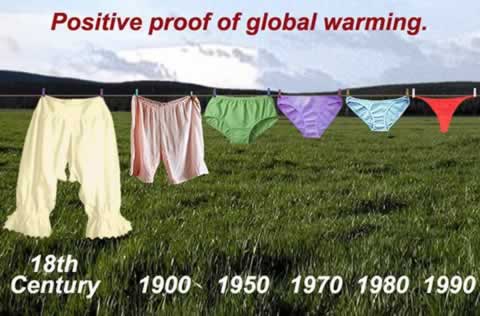
The image “http://www.neatorama.com/images/2006-05/positive-proof-global-warming-underwear.jpg” cannot be displayed, because it contains errors.
LET THEM EAT TOFU!
by Ann Coulter

February 28, 2007

Even right-wingers who know that "global warming" is a crock do not seem to grasp what the tree-huggers are demanding. Liberals want mass starvation and human devastation.

Forget the lunacy of people claiming to tell us the precise temperature of planet Earth in 1918 based on tree rings. Or the fact that in the '70s liberals were issuing similarly dire warnings about "global cooling."

Simply consider what noted climatologists Al Gore and Melissa Etheridge are demanding that we do to combat their nutty conjectures about "global warming." They want us to starve the productive sector of fossil fuel and allow the world's factories to grind to a halt. This means an end to material growth and a cataclysmic reduction in wealth.

There are more reputable scientists defending astrology than defending "global warming," but liberals simply announce that the debate has been resolved in their favor and demand that we shut down all production.

They think they can live in a world of only Malibu and East Hampton — with no Trentons or Detroits. It does not occur to them that someone has to manufacture the tiles and steel and glass and solar panels that go into those "eco-friendly" mansions, and someone has to truck it all to their beachfront properties, and someone else has to transport all the workers there to build it. (And then someone has to drive the fleets of trucks delivering the pachysandra and bottled water every day.)

Liberals are already comfortably ensconced in their beachfront estates, which they expect to be unaffected by their negative growth prescriptions for the rest of us.

There was more energy consumed in the manufacture, construction and maintenance of Leonardo DiCaprio's Malibu home than is needed to light the entire city of Albuquerque, where there are surely several men who can actually act. But he has solar panels to warm his house six degrees on chilly Malibu nights.

Liberals haven't the foggiest idea how the industrial world works. They act as if America could reduce its vast energy consumption by using fluorescent bulbs and driving hybrid cars rather than SUVs. They have no idea how light miraculously appears when they flick a switch or what allows them to go to the bathroom indoors in winter — luxuries Americans are not likely to abandon because Leo DiCaprio had solar panels trucked into his Malibu estate.

Our lives depend on fossil fuel. Steel plants, chemical plants, rubber plants, pharmaceutical plants, glass plants, paper plants –- those run on energy. There are no Mother Earth nursery designs in stylish organic cotton without gas-belching factories, ships and trucks, and temperature-controlled, well-lighted stores. Windmills can't even produce enough energy to manufacture a windmill.

Because of the industrialization of agriculture –- using massive amounts of fossil fuel — only 2 percent of Americans work in farming. And yet they produce enough food to feed all 300 million Americans, with plenty left over for export. When are liberals going to break the news to their friends in Darfur that they all have to starve to death to save the planet?

"Global warming" is the left's pagan rage against mankind. If we can't produce industrial waste, then we can't produce. Some of us — not the ones with mansions in Malibu and Nashville is my guess — are going to have to die. To say we need to reduce our energy consumption is like saying we need to reduce our oxygen consumption.

Liberals have always had a thing about eliminating humans. Stalin wanted to eliminate the kulaks and Ukranians, vegetarian atheist Adolf Hitler wanted to eliminate the Jews, Planned Parenthood founder Margaret Sanger wanted to eliminate poor blacks, DDT opponent Rachel Carson wanted to eliminate Africans (introduction to her book "Silent Spring" written by ... Al Gore!), and population-control guru Paul Ehrlich wants to eliminate all humans.

But global warming is the most insane, psychotic idea liberals have ever concocted to kill off "useless eaters." If we have to live in a pure "natural" environment like the Indians, then our entire transcontinental nation can only support about 1 million human beings. Sorry, fellas — 299 million of you are going to have to go.

Proving that the "global warming" campaign is nothing but hatred of humanity, these are the exact same people who destroyed the nuclear power industry in this country 30 years ago.

If we accept for purposes of argument their claim that the only way the human race can survive is with clean energy that doesn't emit carbon dioxide, environmentalists waited until they had safely destroyed the nuclear power industry to tell us that. This proves they never intended for us to survive.

"Global warming" is the liberal's stalking horse for their ultimate fantasy: The whole U.S. will look like Amagansett, with no one living in it except their even-tempered maids (for "diversity"), themselves and their coterie (all, presumably, living in solar-heated mansions, except the maids who will do without electricity altogether). The entire fuel-guzzling, tacky, beer-drinking, NASCAR-watching middle class with their over-large families will simply have to die.

It seems not to have occurred to the jet set that when California is as poor as Mexico, they might have trouble finding a maid. Without trucking, packaging, manufacturing, shipping and refrigeration in their Bel-Air fantasy world, they'll be chasing the rear-end of an animal every time their stomachs growl and killing small animals for pelts to keep their genitals warm.

COPYRIGHT 2007 ANN COULTER

Wednesday, February 28, 2007

http://image.guardian.co.uk/sys-images/Guardian/Pix/arts/2007/02/26/helenmirrenoscar460.jpg

Hollywood's Big Ho-Hum

By Cinnamon Stillwell

Having recently written about the politicization of various awards, I decided to sit in on Sunday night's Academy Awards just to verify that my criticism was justified. All I can say to those who wrote to me vociferously denying the politicization of awards such as the Oscars is that one would have to be deaf, dumb and blind not to recoil from the orgy of liberal self-congratulation on display.

As predicted, former Vice-President Al Gore's An Inconvenient Truth won the award for Best Documentary. All political messages aside, the documentary itself (which I forced myself to sit through for the purposes of an article) had no filmmaking merit whatsoever and this award was an insult to all those documentarians that actually try to produce quality work. But the Oscar was indeed all about politics, as Gore's not-so-hilarious jokes about running for president in 2008 indicated. It was patronage awarding at its best.

Religion of a sort also played a part. The belief in man-made catastrophic global warming, or what Gore kept dubbing the "climate crisis," (any bad weather will do, as in this year's extremely cold winter) is the new secular religion and Gore its preacher. And Hollywood has become the locus for its devotees. One could see it in the shiny upturned faces of audience members as they cheered on Gore and Melissa Etheridge for the numbingly dull and therefore aptly titled Inconvenient Truth theme song "I Need to Wake Up," which, of course, won the award for Best Song. They truly believe they are doing God's work (or rather Gaia's work) simply by mouthing slogans about low-flush toilets, recycling and compost, such as those appearing on the screen behind Etheridge during her performance. I'm sure audience members got right on saving the planet, after jumping into their hybrid limos at the end of the night and jaunting back home in their emissions-spewing private jets, that is. Hollywood, thy name is hypocrisy.

The Hersholt Humanitarian Award bestowed upon former chairman of Paramount Pictures Motion Picture Group Sherry Lansing was similarly nauseating. Lansing has had a brilliant career in Hollywood and has donated a fair amount of money to various charities and organizations (including the much-tainted Carter Center). But this hardly qualifies her, of all the world's people, as the "great humanitarian" claimed by presenter Tom Cruise. But Hollywood loves to award its own and Lansing's glowing references to embryonic stem cell research and the noble scientists toiling in their laboratories (no word about the advances in adult stem cell research for some strange reason) were likely the real reason for her award. Again, mouth the right mottos and give money to the right people and you're golden - literally.

Laughable moments in environmentalist silliness were aplenty. When Inconvenient Truth co-producer Lesley Chilcott prattled on to the surreal looking Joan Rivers about her "biodegradable" gown made of bamboo and recycled cotton (no human waste?), it could have been a Saturday Night Live skit. The slogans flashing on the screen behind Melissa Etheridge as she performed her mediocre song were astounding in both their banality and their nanny-statism. No doubt "mommy" (or rather the United Nations) will tell us all how to flush our toilets if the Democrats take over in 2008. At one point, Al Gore and his adoring co-presenter actor Leonardo DiCaprio announced that the Academy Awards had officially "gone green," whatever that means. From here on in, the Great Leader has decided that they will be dubbed the Green Academy Awards.

Beyond the constant preening about saving the environment, Hollywood couldn't get enough of its international and ethnic "diversity," which presenters trumpeted on every occasion. At one point, host Ellen Degeneres (whom I normally find funny, but this time seemed subdued) pointed to black (originally from Africa) actor Djimoun Hounsou and then referenced Hollywood's wonderful diversity. Sort of a "some of my best friends are black" moment. One can only hope that deserving black actors such as Jennifer Hudson and Forest Whitaker were awarded their Oscars based on merit and not white guilt.

Mexico won big with various awards for Pan's Labyrinth, Italian composer-conductor Ennio Morricone gave his Honorary Academy Award acceptance speech in Italian, and presenters French actress Catherine Deneuve and Japanese actor Ken Watanabe made sure to remind audience members that they were French and Japanese, respectively. Indeed, cast members from Clint Eastwood's Oscar nominated Letters from Iwo Jima injected a rare Asian presence into the occasion. Too bad it was on behalf of imperial Japan. Next up, a warm fuzzy film from the perspective of the Nazis - all in the name of diversity, of course.

In an uncommon moment of equanimity, the award for Best Foreign Film went to The Lives of Others, a German film about life in East Germany's former totalitarian state and the machinations of its secret police, the Stasi. Presenter, actress Cate Blanchett, sounded almost shocked upon announcing the winner. Normally, the commies get off scott free in Hollywood, as such leanings hit a little too close to home. Not that anyone in Hollywood is now or has ever been a member of the Communist Party, mind you.

There was another unusual instance, this time of patriotism, when actress Helen Mirren accepted the award for Best Actress for her portrayal of Queen Elizabeth II in The Queen. When Mirren spoke of the Queen's dignity and dedication (something that would be unheard of here in the United States in reference to the office of the president), she was met with an uncomfortable silence. Patriotism of any sort, in this case British, is not typically well-received in Hollywood. It's not as if making millions off one's own country is something to be thankful for or anything.

With a few exceptions, this year's Academy Awards again demonstrated that Hollywood is little more than a mutual admiration society. And if one's politics lean leftward, it sure doesn't hurt. Stay tuned next year for more of the same old, same old.

Cinnamon Stillwell is a columnist for SFGate.com, the online arm of the San Francisco Chronicle, and a contributing editor to FamilySecurityMatters.org. Contact Cinnamon and read her website and blog.

American Thinker

http://upload.wikimedia.org/wikipedia/en/0/04/Jason-scorchers-fervor.jpg
Jason and the Scorchers to play Exit In June 2, 2007

Press Release: Feb. 23, 2007


Jason and the Scorchers, Nashville's legendary rockers, will reform
for one concert only June 2, 2007 at the Exit In Nashville
Tennessee. This will be a benefit concert, with all profits
earmarked to help pay the medical expenses for Perry Baggs. Perry is
courageously fighting diabetes and kidney failure, and is on
dialysis 3 days a week. He is the original Scorcher's drummer,
harmony singer, and songwriter of some of the band's biggest songs.
His courage in the face of his illnesses is a great inspiration to
many in the Nashville music community, as well as other diabetes and
dialysis patients.

Health permitting, Perry does plan to play drums on some songs at the
show, and sing harmony. Warner E. Hodges will be on guitar, Jason
Ringenberg on vocals, Fenner Castner on drums filling in for Perry
as needed, and Kenny Ames on bass. Old Scorchers Ken Fox and Andy
York may make an appearance if their schedules permit.

The show will start promptly at 8.30. The band will do 2 sets.

Tickets are not for sale yet but will be soon. Keep checking the
Exit In website for info. Their will be no guest list, since all
money will go to help pay Perry's medical expenses. Tickets will be
20.00 in advance and 25.00 at the door.
The image “http://www.marxists.org/subject/china/mao_and_friends.jpg” cannot be displayed, because it contains errors.
China's Premier Calls Democracy A Distant Goal
Remarks an Answer to Reform Debate

By Edward Cody
Washington Post Foreign Service
Wednesday, February 28, 2007; A13

BEIJING, Feb. 27 -- The Communist Party cautioned China's increasingly impatient reformers and intellectuals Tuesday that political liberalization and democracy are still a long way off despite the rapid pace of economic change over the past two decades.

The warning, in an article attributed to Premier Wen Jiabao in the official People's Daily newspaper, constituted the party's first known response to a bubbling up of political debate as China prepares for an annual session of its legislature and an important Communist Party congress that is scheduled for this fall.

Most of the debate has remained behind closed doors, in keeping with the party's tradition of secrecy. But two recent articles by prominent establishment figures brought into the open suggestions to President Hu Jintao's government that moving faster on political reforms would help smooth the transformation to a market economy.

One, by Zhou Ruijun, a former People's Daily editor known for reformist views, said greater democratic openness is necessary to defuse tensions over a growing gap between rich and poor, which he warned could lead to instability. Another, by former Renmin University vice president Xie Tao, suggested that China should move speedily toward a Scandinavian-like social-welfare democracy.

Wen, who recently was reported to be in charge of preparing a leadership platform for the party congress, reached into familiar Marxist vocabulary to build an argument that China is not yet ready for such a democracy, even though it remains a distant goal for the "socialism with Chinese characteristics" that the party hopes to build.

"We are still far away from advancing out of the primary stages of socialism," he said. "We must stick with the basic development guideline of that stage for 100 years."

At the same time, Wen said that "the socialist system is not contradictory to democracy," adding: "A highly developed democracy and a complete legal system are inherent requirements of the socialist system and an important benchmark of a mature socialist system."

Wen's comments were seen as a foretaste of the platform Hu and his lieutenants will put forth at the key 17th party congress, essentially calling for the continuation of rapid economic development but without bold political departures. The remarks were also in keeping with Hu's reputation as a cautious, bet-hedging leader.

The congress is held every five years, and analysts have described this fall's assembly as a pivotal moment for Hu. Five years after taking power, he is expected to cement his leadership by making sure officials loyal to him are placed in key positions on the Politburo and its decision-making Standing Committee. That implies the retirement of some current party officials identified with the former president and party leader, Jiang Zemin, they noted, and so Hu is eager to avoid ideological disputes that could complicate the personnel changes.

Liu Xiaobo, a writer and political dissident, suggested Hu and Wen were working toward a trouble-free party congress by trying to walk a line between conservatives and liberals, who for different reasons are uncomfortable with China's political system. While conservative party stalwarts have become upset at the growing distance from Mao Zedong's founding ideology, eager reformers have become frustrated that the liberalization started by Deng Xiaoping in the 1980s still focuses mainly on economic reform.

"China has undertaken the opening and reform policy for 20 years, and many outsiders have applauded China's glamorous economic achievement," Liu added, "but those who really understand China know that many deep-rooted problems haven't been touched at all."

In another aspect of the debate, Chinese scholars posted a petition on the Internet recently calling on the legislature to slow down the privatization of state-owned companies and legal protection for their new owners.

Hundreds of large government-owned firms have been closed in recent years because they lost vast sums of money and survived only by ever-more-precarious loans. The closures have resulted in unemployment for hundreds of thousands of workers, the scholars complained, broadening the rich-poor gap and raising the threat of instability.

"With the relentless advance of privatization, our country already has a serious gap between rich and poor, which is polarizing into two extremes," said the petition, which was signed by, among others, Gong Xiantian, a Peking University law professor; Li Chengrui, former head of the National Statistics Bureau; and a dozen academics from the party's own Central Party School.

Similar opposition among party officials led Hu's government to pull back a law protecting private property, including privatized state enterprises, after it was submitted to last year's session of the legislature, the National People's Congress. The government has prepared a new law for this session. But the scholars warned that, practically speaking, the law would sanction the corruption that often accompanies such sell-offs and should be delayed again until new rules are drawn up.

Underlying the opposition is a reluctance among many tradition-minded party members to abandon the long-standing socialist principle that the state owns all land. Their fight against legal protection for private property ownership has become a kind of last stand against the wholesale jettisoning of communist doctrine that has occurred in China since Deng's reforms began.

Without directly addressing the petition, Wen acknowledged that China's market-oriented economic development must also include more social justice, calling these "two interrelated and mutually beneficial tasks." But he also expressed determination to keep at the reforms.

"Without sustained rapid growth of the productive forces, it is impossible to finally secure the fairness and social justice that lie at the heart of the socialist system," he wrot

TAMPA, Fla. -- On a recent afternoon at Legends Field, Don Mattingly was perched behind the Yankees' batting cage as four of the team's top hitters ripped drives around the ballpark.

To the untrained eye, the swings looked crisp, tight and absolutely right. But not to Mattingly, who assembled the group behind the plate and broke down each swing with unfettered accuracy.

Lesson learned, Mattingly clapped his hands together and stretched out his arms as if to say, "See?" And as Jason Giambi, Hideki Matsui, Doug Mientkiewicz and Alex Rodriguez nodded and scattered, another Mattingly mini-clinic was complete.

Mattingly may have been promoted to become Joe Torre's bench coach this season, ceding his duties as hitting coach to Kevin Long, but he can't resist the urge to chip in with a few pointers for his love of hitting.

"You've got to be ready to help these guys out," Mattingly said. "You've got to be here for them -- not for yourself. I'm here for their success, not my success."

It is that passion that leads at least one Yankee to believe that, when Torre's highly successful run as the team's manager comes to an end, Mattingly will be the one assuming the dugout reins.

"He'll be perfect. He'll definitely be, in the next couple of years, the manager of the Yankees," Giambi said.

"He's got a great name to play in New York, he knows how to handle the press and he knows a lot about the game. I think that's one of the main reasons he went to bench coach."

Taking the helm of a Major League club is a thought that prompts Mattingly to grin slightly, if not awkwardly.

As he spoke of the possibility of someday managing the Yankees, his mentor, Torre, sat about 15 feet away in the manager's office, kicking back in a reclining chair as he dutifully completed paperwork.

Mattingly is not looking to push Torre, who is in the final year under contract with the Yankees, out the door. But Mattingly also can not ignore those, like Giambi, who have touted him as Torre's likely successor.

"I don't worry about it, to be honest with you," Mattingly said. "I don't worry about the future. I'm 45 years old, and it's not like you're a player and the clock is running on your skills."No question, it's something I want to do, but I don't control that. I'm simply here this year to help Joe and these guys. I'm young and I've got a lot to learn. If the opportunity presents itself, I'll be ready for it."

For Torre, Mattingly's work ethic became evident during seven seasons as a guest instructor at Yankees Spring Training from 1997-2003, long before he ever tinkered as the team's official hitting coach.

One of the most popular players in the franchise's history, it would have been easy for Mattingly's spring excursion to have taken on little more meaning than showing up in Tampa, putting on a No. 23 jersey and waving to fans.

Mattingly wouldn't dream of it, annually exhibiting the same workmanlike nature that led him to stroke 2,153 hits in the Major Leagues.

"It wasn't just a vacation for him," Torre said. "He didn't just come down to hang out. He wanted to do some good. I told him to let me know if he was ever thinking about doing something full time, because he definitely had the capabilities."

Mattingly finally made that call for the 2004 season, with the blessing of his wife, Kim, and their three sons -- Jordon, Taylor and Preston.

After his retirement following the 1995 season, Mattingly said he spent most of his time back in Evansville, Ind., "chasing kids around Pony League fields," tending to horses and tweaking the designs of what would eventually become his budding Mattingly Baseball bat company.

"I didn't want to be in New York until I was 39, and the kids would be out of high school and not even know who their dad is," Mattingly said. "I was able to do that, and as the kids grew up, they were kind of like, 'Go ahead, Dad.' It made it easier for me to make the transition."

The Yankees have not even played their first exhibition of 2007 yet, and already Torre has acknowledged Mattingly's dedication and efficiency.

Each day at Legends Field, Mattingly arrives early and leaves late, digging through statistical data and scouting reports looking for something -- anything -- that could give the Yankees an edge during the regular season.

"I do look at a lot more stuff," Mattingly said. "When I was the hitting coach, all I did was study the opposing team's hitters. That was the sliver of the game I was responsible for.

"Now, I'm here to help any way I can and assist Joe. I can be another set of eyes for him. There's so many decisions to make in the course of a game, and I want to make it easier for him. The information will be at his fingertips. We'll be prepared."

The Yankees would expect nothing less.

http://suzyriceimage.com/LinkedOffsite/440wde_al_gore_loses_it_tokirk.jpg

From Economist.com:

Cutting carbon

THE Oscar win for Al Gore's documentary An Inconvenient Truth has touched off a minor firestorm over the Green Giant's own energy usage policies:

Last night, Al Gore’s global-warming documentary, An Inconvenient Truth, collected an Oscar for best documentary feature, but the Tennessee Center for Policy Research has found that Gore deserves a gold statue for hypocrisy.
Gore’s mansion, located in the posh Belle Meade area of Nashville, consumes more electricity every month than the average American household uses in an entire year, according to the Nashville Electric Service (NES).
In his documentary, the former Vice President calls on Americans to conserve energy by reducing electricity consumption at home.
The average household in America consumes 10,656 kilowatt-hours (kWh) per year, according to the Department of Energy. In 2006, Gore devoured nearly 221,000 kWh—more than 20 times the national average.
Last August alone, Gore burned through 22,619 kWh—guzzling more than twice the electricity in one month than an average American family uses in an entire year. As a result of his energy consumption, Gore’s average monthly electric bill topped $1,359.
Since the release of An Inconvenient Truth, Gore’s energy consumption has increased from an average of 16,200 kWh per month in 2005, to 18,400 kWh per month in 2006.
Gore’s extravagant energy use does not stop at his electric bill. Natural gas bills for Gore’s mansion and guest house averaged $1,080 per month last year.
“As the spokesman of choice for the global warming movement, Al Gore has to be willing to walk the walk, not just talk the talk, when it comes to home energy use,” said Tennessee Center for Policy Research President Drew Johnson.
In total, Gore paid nearly $30,000 in combined electricity and natural gas bills for his Nashville estate in 2006.
Al Gore's people have fired back:
Responding to Drudge’s attack, Vice President Gore’s office told ThinkProgress:

1) Gore’s family has taken numerous steps to reduce the carbon footprint of their private residence, including signing up for 100 percent green power through Green Power Switch, installing solar panels, and using compact fluorescent bulbs and other energy saving technology.

2) Gore has had a consistent position of purchasing carbon offsets to offset the family’s carbon footprint — a concept the right-wing fails to understand. Gore’s office explains:

What Mr. Gore has asked is that every family calculate their carbon footprint and try to reduce it as much as possible. Once they have done so, he then advocates that they purchase offsets, as the Gore’s do, to bring their footprint down to zero.

Some of this response seems flatly silly. The electricity usage is what Mr Gore consumes after things like solar panels and CFLs are taken into account; it's hardly comforting that he could be emitting even more carbon, since that is true of almost all of us, yet has not stopped Mr Gore from hectoring us to reduce our carbon output still further. Similarly, I find it hard to believe that Mr Gore has actually reduced his carbon output "as much as possible"—and if Mr Gore so believes, I invite him to take a train up to New York, where I will show him what a more carbon efficient lifestyle looks like.

The carbon offsets, on the other hand, sound like a very reasonable plan. That is, they did until I began thinking about them.

Most carbon offsets seem to work on one of a few principles: they plant trees, invest in renewable energy sources, or pay someone in a developing country to use some less-polluting technology, like a CFL.

It turns out that a lot of websites have already devoted quite a lot of space to discussing why these plans don't work particularly well. Calculating one's carbon output, and the carbon savings from various offsets, is very tricky and may be manipulated by unscrupulous offset firms. Trees take quite a long time to get to the stage where they are actually absorbing all that carbon—and tend to die shortly thereafter, releasing all that carbon back into the atmosphere, there to wreak havoc. By legitimating carbon usage, offset companies may actually be increasing it.

But surprisingly few make what, to me, seems like a more basic point: energy is a tradable market good. It is not as if there is some fixed demand for energy, so that by using less carbon-emitting energy, you actually decrease the amount of carbon emitted.

This is, of course, ridiculous. When you donate money to build a new windfarm, you don't take any of the old, polluting power offline; you increase the supply of power, reducing the price until others are encouraged to buy more carbon-emitting power. On the margin, it may make some difference, since demand for electricity is not perfectly elastic, but nowhere near the one-for-one equivalence that carbon offsets would seem to suggest. Especially since the worst offenders, big coal-fired plants, are not the ones that renewables will substitute for; solar and wind power are not good replacements for baseload power. Instead, renewables are likely to take relatively clean (and expensive) natural gas plants offline, since those are the ones that provide "extra" power to the system. Similarly, by giving villagers in Goa energy-saving CFL bulbs, you do not lessen the amount of electricity consumed; rather, you make it possible for other people to purchase the extra energy freed up by more efficient lightbulbs. This may be excellent poverty policy, but it does not lessen the carbon footprint of your international flight.

Obviously, the same is true of individual conservation efforst. Thats why any attempt to abate global warming has to be massive. Huge numbers of people in the rich world have to fly less, drive less, consume less, and live in smaller houses. If Mr Gore really wants to encourage this (as I do), then he should try leading by example.

http://www.stuff.co.nz/images/281984.jpg
From National Review Online:
Cameron Finds Christ!
What else in the ossuary?


By Dave Konig

Hollywood — Titanic director James Cameron unveiled today still more artifacts discovered in the tomb of Jesus. Cameron alleges these artifacts prove, once and for all, that the man Christians believe to be the Son of God actually got married, had a child, and moved to the suburbs:

An anniversary card “To My Wife” with a handwritten inscription by Jesus; “Mary, this year — I promise — we’ll get a babysitter and take a weekend at the Fontainebleau.”

Jesus Christ’s personal checkbook, from the Bank of Jerusalem, with a check stub for Jesus Jr.’s Tai Kwan Do lessons.

Several pairs of hardly worn women’s dress shoes that Cameron swears are “size 7 1/2 — Mary Magdalene’s shoe size!”

A baseball cap labeled “World’s Greatest Dad” with a handwritten note inscribed; “Pops — Happy Fathers Day (signed) Jesus Jr.”

On the side of the ossuary, a bumper sticker that, translated from the original Aramaic, reads: “Our Boy Is An Honor Student At Jerusalem High.”

Some refrigerator magnets shaped like oxen and goats.

A crayon drawing of a man who appears to be asleep. The drawing is labeled “Uncle Lazarus.”

A 2,000-year-old lottery ticket for the Jerusalem Powerball Mega Million Game. Scholars employed by Cameron’s production company maintain that the numbers on the ticket correspond exactly with the birthdays of Jesus, Mary Magdalene, and Jesus Jr.!

A discount pass for the Jerusalem Chuck E. Cheese “good until January 1st, 0033.”

Two ticket stubs to Cats.


— Dave Konig can be heard nationally on Speak Now...with Dave & Susan Konig, Mon - Fri, 10 AM - 12 Noon ET on The Catholic Channel, Sirius 159.

Tuesday, February 27, 2007

http://www.schnews.org.uk/images/524-2-large.jpg
Free Trade and Funny Math
By Patrick J. Buchanan

Tuesday, February 27, 2007

To the devout libertarian, free trade is not a policy option to be debated, but a dogma to be defended. Nowhere is this more true than at that lamasery of libertarianism, the Cato Institute.

But with America running the worst trade deficits in history, the monks are having a hellish time of it. Hence, like the neocons who cherry-picked the intel to stovepipe to Scooter to bamboozle us into believing national survival hung on invading Iraq, they feed us irrelevant truths and deny us the whole truth.

Case in point -- the Feb. 22 column in The Washington Times by one Daniel Ikenson, "associate director at the Cato Institute's Center for Trade Policy Studies." Bewailing the "barrage of hyperbole and misinformation about trade and its relationship to jobs and economic growth," Ikenson assured us, with impressive statistics, that globalism is working out wonderfully well for America.

"(T)he Census Bureau data show that U.S. export growth was phenomenal in 2006, increasing by 14.5 percent. ... Exports to Europe increased by 15.2 percent and to China by nearly 32 percent. The growth in exports to Japan was a slower 7.5 percent, but it grew. Since 2001, U.S. exports have increased by more than 42 percent."

Wow. Phenomenal indeed. And it does sound like we are cleaning those foreigners' clocks. But Ikenson ignored the other side of the ledger.

That the U.S. trade deficit in 2006 rose to an all-time record of $764 billion. That the deficit in goods hit $836 billion. That the deficit with China rose 15 percent, from $203 billion in 2005 to $233 billion in 2006, the largest trade deficit ever recorded between two nations. That the deficit with Japan rose to $88 billion, the largest ever between us.

Under Bush, the U.S. trade deficit has set five straight world records, as has the U.S. trade deficit in autos, parts and trucks. So reports Charles MacMillion of MBG Services, who has for years tracked the decline and fall of American manufacturing.

For manufactured goods, our trade deficit rose to $536 billion, from $504 billion. In Bush's six years, America has run a total trade deficit of $2.6 trillion in manufactured goods, as 3 million U.S. manufacturing jobs have disappeared and wages in that sector have fallen 3 percent in three years.

Query to Ikenson: If these numbers represent a successful trade policy, what would a failed trade policy look like?

Recall NAFTA. In 1993, we had a trade surplus with Mexico. Some of us warned it would be gone with the wind if NAFTA passed. And NAFTA did pass, through the collaboration of Clinton Democrats with Gingrich Republicans, over the opposition of the American people.

Since 1994, we have run a trade deficit with Mexico every year. In 2006, it hit a record $60 billion. Grand total: almost $500 billion in trade deficits with Mexico since NAFTA. Mexico now exports more than 900,000 vehicles to the United States every year, while the United States exports fewer than 600,000 cars and trucks to the entire world.

This is success?

Where did Mexico get an auto industry? Is it good that our auto industry is being exported? Has the price of a new car plunged because Mexicans get paid a fraction of what U.S. autoworkers earn?

"In 2006, the U.S. economy grew by an additional 3.4 percent," writes Ikenson. True, and China's economy grew by 10 percent -- and by 140 percent over the last 10 years, tripling the growth in the United States. Not only are we shipping factories, technology, equipment and jobs to China, we are exporting our future to China. Nor should this shock any student of history. For contrary to free-trade mythology, every nation that has risen to pre-eminence and power -- Britain before 1860, the United States from 1860-1914, Germany from 1870-1914, postwar Japan, China today -- has pursued a mercantilist or protectionist trade policy. Economic nationalism is the policy of rising powers, free trade the policy of declining powers. For great powers have ever regarded trade as an arena of struggle in the clash of nations. It is no accident all four presidents who made it to Mount Rushmore were protectionists. "Thank God I am not a free trader," wrote Theodore Roosevelt. "Pernicious indulgence in the doctrine of free trade seems inevitably to produce fatty degeneration of the moral fibre." Think Teddy might have had a point, Mr. Ikenson? Probably not. For libertarianism is an ideology, and evidence that contradicts the dogma of an ideology is to be disregarded or denied. For the dogma cannot be wrong. Indeed, should Ikenson awake from his dogmatic slumber and decide that free trade is failing America, he would not last long as associate director of the Cato Institute's Center for Trade Policy Studies. The folks who fund Cato are not paying to have dogma debated, but defended. For if the dogma be untrue, then the ideology, the whole system of beliefs, the faith itself, is called into question. And we can't have that.

Pat Buchanan is a founding editor of The American Conservative magazine, and the author of many books including State of Emergency: The Third World Invasion and Conquest of America .

Monday, February 26, 2007


From The New York Post:
NOT THAT SIMPLE

By ROY W. SPENCER


February 26, 2007 -- REPORTS on the global-warming debate have now become part of our daily diet of news. Actors, musicians, politicians, columnists and even the occasional climate scientist all weigh in on how soon planetary disaster will strike, who's to blame and what we should do about it. With claims that manmade warming is anywhere from an undeniable fact to a hoax, anyone can be excused for feeling a little bit confused.

The media is, almost by definition, most interested in extreme views on the issue, so reporting seldom reveals that broad scientific uncertainty still exists. In fact, a silent majority of scientists still think that global warming could end up falling anywhere between a real problem and a minor nuisance: They can see reasons for it going either way. Call them the global-warming moderates.

How can different scientists look at the same atmosphere and yet come to such a wide variety of conclusions? It all depends on their level of faith in our understanding of the atmosphere. We put equations into a computer that describe the basics of how we think the atmosphere works, and then we expect the computer to predict how much warming we will get when we turn up the greenhouse gas "knob."

The Earth's natural "greenhouse effect" traps infrared (heat) radiation because of water vapor, clouds, carbon dioxide and methane. You have probably heard that the greenhouse effect keeps the Earth "habitably warm." So if burning of fossil fuels keeps adding more of a greenhouse gas like carbon dioxide (CO2), the Earth should keep on warming up, right?

Well . . . it's not that simple.

CO2 concentrations - now running at 380 parts per million (ppm), up about 40 percent in the last century - are indeed one possible explanation for our current warmth. But we also know that our climate is a nonlinear, dynamic system - which can go through sizeable gyrations all by itself.

Contrary to popular accounts, very few scientists in the world - possibly none - have a sufficiently thorough, "big picture" understanding of the climate system to be relied upon for a prediction of the magnitude of global warming. To the public, we all might seem like experts, but the vast majority of us work on only a small portion of the problem.

Here, for example, is an insight that even many climate scientists are unaware of: The one atmospheric process that has the greatest control on the Earth's climate is the one we understand the least - precipitation.

Over most of the planet, water is continuously evaporating, humidifying the air to form the Earth's dominant greenhouse gas: water vapor. Climate scientists will tell you that the extra CO2 we are putting in the atmosphere causes a "warming tendency" at the surface, which will evaporate even more water, which will amplify the warming. This positive water vapor feedback, so the theory goes, ends up turning the relative benign direct warming effect of CO2 - only 1 degree of warming late in this century - into a much more serious problem.

But surface evaporation is not what determines how much water vapor, on average, resides in the atmosphere - precipitation systems do. These not only control the water-vapor portion of the greenhouse effect, they directly or indirectly control most of the next most important greenhouse ingredient: clouds.

These systems continuously recycle the Earth's air, and so exert strong controls over the entire climate system. For instance, the rising air in precipitation systems is what causes the sinking, cloudless air over desert areas. Vast oceanic areas of stratus clouds form below a temperature inversion that is also caused by air being forced to sink by precipitation systems, usually thousands of miles away.

So, what does all this have to do with global warming? Unless we know how the greenhouse-limiting properties of precipitation systems change with warming, we don't know how much of our current warmth is due to mankind, and we can't estimate how much future warming there will be, either. To solve the global-warming puzzle, we first need to learn much more about the precipitation-system puzzle.

What little evidence we now have suggests that precipitation systems act as a natural thermostat to reduce warming. For instance, warm, tropical systems are more efficient at converting water vapor to precipitation than their cool high-latitude cousins. Hurricanes are believed to be the most efficient of all.

I believe that negative feedbacks such as this are the only way to explain the relative stability of our climate. Computerized models of our climate have had a habit of "drifting" too warm or too cold. This because they still don't contain all of the temperature-stabilizing processes that exist in nature. In fact, for the amount of solar energy available to it, our climate seems to have a "preferred" average temperature, damping out swings beyond 1 degree or so.

I believe that, through various negative feedback mechanisms, the atmosphere "decides" how much of the available sunlight will be allowed in, how much greenhouse effect it will generate in response, and what the average temperature will be.

Finally, remember that phrase, "the Earth's greenhouse effect keeps the Earth habitably warm?" I'll bet you never heard the phrase that is, quantitatively, more accurate: "Weather processes keep the Earth habitably cool."

Were it not for weather, the natural greenhouse effect would cause the surface of the Earth to average 140 degrees. Wonder why we never hear that fact stated?

I believe that when the stabilizing effects of precipitation systems are better understood and included into the models, predictions of global warming will be scaled back.

Despite current inadequacies, climate models are still our best tools for forecasting global warming. Those tools just aren't sharp enough yet.

Roy W. Spencer is principal research scientist at the Global Hydrology and Climate Center of the National Space Science and Technology Center in Huntsville, Ala. He is also U.S. team leader for the AMSR-E instrument flying on NASA's Terra satellite.

From Debbie Schlussel.com:

Remember the First 9/11

By Debbie Schlussel

Fourteen years ago, today, Al-Qaeda terrorists tried to blow up the World Trade Center for the first time. The World Trade Center Memorial Foundation sent out this note:

On February 26, 1993, the World Trade Center was attacked by terrorists for the first time. At 12:18pm, 1,500 pounds of explosives were detonated in an underground parking garage below 1 WTC. Six people, including a pregnant woman, were killed in the attack and thousands were injured. On this day, the World Trade Center Memorial Foundation remembers each of the victims of the 1993 attacks and extends our condolences to the families of those who were killed and our thoughts to all who were affected.

I hope you will join us today in remembering the innocent lives lost at the World Trade Center fourteen years ago. In tribute, we invite you to read remembrances created by loved ones of the victims:

93wtcbombing.jpg93wtcbombing2.jpg
Click here to read the tributes.

You can also listen to Mike Hurley, former Director of Fire Safety for the World Trade Center, describe his experiences on February 26, 1993:

Click here to listen to Mike Hurley's podcast.

The World Trade Center Memorial and Museum will tell the stories of each of these victims and the experiences of those who were affected on that day. In doing so, we can honor and remember our history for generations to come.

To learn more, please visit http://www.buildthememorial.org/

Whenever President Bush falsely claims there hasn't been a terrorist attack on U.S. soil since 9/11 (there's been the Trolley Square Islamic terrorist attack, the LAX attack, the North Carolina Jeep attack, and so many others), remember that Bill Clinton could have said the same thing for his entire Presidency, after February 26, 1993.

It's not that we've stopped them. It's that they are waiting and planning for the next time. And laughing at how we try to appease their extremist fellow co-religionists as they grow their presence on U.S. soil.

From Debbie Schlussel.com:

Farrakhan's Final Call: Defends Iran; Celebs Help Louis Farrakhan

By Debbie Schlussel

Write off these celebs who were either in attendance at racist loon Louis Farrakhan's Detroit confab--or otherwise showed their support to him. From The Detroit Newsistan:

As he spoke, the huge screens in the stadium that projected live images during the speech filled with the face of U.S. Rep. John Conyers, D-Detroit, as he sat listening and smiling. Conyers once said he would work to impeach Bush, but has since drawn back from that position. He was not available after the speech. [DS: Well, we already knew Conyers was a racist nutjob, so no surprise there.] . . .
icecube2.jpglouisfarrakhan.jpganitabaker.jpg
Racist Farrakhan's Friends: Ice Cube, Anita Baker . . .
Anita Baker, the Detroit-native and Grammy Award-winning singer, performed the black national anthem before the speech, and speakers from various religious and ethnic groups welcomed Farrakhan. Also on the stage were hip-hop mogul Russell Simmons; Mayor Kwame Kilpatrick and his mother; U.S. Rep. Carolyn Cheeks Kilpatrick, D-Detroit; and Joe Shirley Jr., president of the Navajo Nation.

Before the speech, the Nation of Islam announced significant donations, including $100,000 from former professional basketball player Larry Johnson, $40,000 from Simmons, $20,000 from the recording artist Ice Cube and $10,000 from the recording artists Wu-Tang Clan.

"I have grown up loving and appreciating all of the work the Nation of Islam has done in our communities," Simmons said. "I think it very critical that when we leave here today we embrace the oneness of God. This is a great teacher -- the Honorable Minister Louis Farrakhan."

russellsimmons2.jpglarryjohnson2.jpg
. . . Russell Simmons, Larry Johnson

Well, Simmons is no surprise, either. A few years ago, I wrote about his Nation of Islam involvement, Farrakhan worship, and employment of anti-Semite Farrakhan ally, Benjamin Chavis Muhammad, in The Jerusalem Post. But Anita Baker--singing a separatist "Black national anthem"? Huh? What the heck is that?

Then, there are Farrakhan's absurd comments, not just the call for a Bush impeachment, but his defense of Iran attaining nuclear capability, and his absurd claim that Shi'ites and Sunnis lived peacefully together. Uh-huh:

Farrakhan contended that, before the U.S.-led invasion, "Shi'ite and Sunni lived together" peacefully in Iraq with "no bombings of holy places ... but it's happening now" because of U.S. intervention.

Living under Saddam and his dumping Shi'ites into wood-chippers wasn't exactly "peaceful." But when I saw him speak in Detroit in 1998, he told the audience that the Iraqi people "love" Saddam Hussein. Right.

Farrakhan, who has long associated with controversial Muslim heads of state, also defended Iran's nuclear energy program.

"Iran has the right" to develop nuclear energy, he said. "You cannot deny Iran access to knowledge."

The Final Call couldn't have come soon enough.

http://www.ibiblio.org/wm/paint/auth/greco/annunciation.jpg
The Annunciation by El Greco

From The London Times Online:
Religion isn't the sickness. It's the cure

Our correspondent on the moral failings of modernism
By William Rees-Mogg

From the earliest days Christianity has been opposed to slavery. In his Letter to the Galatians, St Paul wrote: “As many of you that have been baptised in Christ, have put on Christ. There is neither Jew nor Greek: there is neither bond nor free: there is neither male nor female. We were all one in Jesus Christ.” Undoubtedly Christians have compromised with slavery — as with other social evils — in the course of history, but the orthodox Christian doctrine is one of liberty and equality.

The Christian belief was the inspiration in William Wilberforce’s long campaign to end the slave trade. His Bill received the Royal Assent on March 25, 1807, 200 years ago. That was the most important of all the great reforms of the 19th century; essentially it was a Christian reform, inspired by the Protestant conversion of Wilberforce himself. March 25 was the old New Year’s Day; it is also the feast of the Annunciation of Mary, the Mother of Jesus.

We live in an age when modernists regard religion with something approaching panic. It is like the Devil’s attitude to Holy Water. There was a comic example of Christianophobia in The Sunday Times yesterday. Michael Portillo, who used himself to be seen in Brompton Oratory, was hyperventilating at the idea of David Cameron going to church. “I worry,” he wrote, “because men of power who take instruction from unseen forces are essentially fanatics . . . I would be more reassured to hear that the Tory leader goes to church because that is what it takes to get a child into the best of state schools, not because he is a believer.”

Perhaps this neurotic response to Mr Cameron’s habit of going to church reflects Mr Portillo’s recognition that religion is again becoming an important influence on society. Many of the current news stories show that religion is back in public consciousness; for those who feel uneasy about religion, that is unwelcome.


Islam is, of course, the alarming religious issue that will not go away. In the 20th century the world failed to adjust to two major belief systems, nationalism and Marxism. Now we face a similar global challenge from Islam, which opposes Judaism in Israel, Hinduism in India, Buddhism in South East Asia, Christianity in Europe and America and modernism in the whole advanced world. We certainly cannot say that all religious influences are benign; al-Qaeda is a religious cult, but a perverted one.

Religion turned William Wilberforce into a Protestant saint, but Wahhabism has turned Osama bin Laden into a devil.

The rise of militant Islam in the 21st century is, however, part of a much broader phenomenon. In the United States there has been the extraordinary resurgence of fundamentalist Protestantism, sufficiently strong to win two presidential elections for the Republican Party. In Britain, an inflow of Catholics from Eastern Europe, particularly Poland, has revitalised the Roman Catholic Church, which now has the largest Christian congregation in the country. The worldwide Church of England has been divided by a battle of moral convictions. All of these religious movements challenge modernism, that popular mix of materialism, scientism and political correctness that had seemed to be carrying all before it.

The modernist attack on religion was based on the victory of science, and particularly of neo-Darwinism. Yet science was open to the same challenge as religion; it could explain only half the world. The scientists, or some of them, sneered at religion for being unable to explain the developments of nature. Yet science itself was unable to produce a science-based morality for society. Marxism attempted to create a scientific social order that ended in monstrous and bloodthirsty tyranny. Social Darwinism either meant eugenics and the slaughter of babies who were not thought fit to survive, or it meant nothing. The Social Darwinism of George Bernard Shaw, or indeed that of Adolf Hitler, has been rejected by mankind.

The world needs religion to address the moral issues. In the advanced societies it is these moral issues that now mock us. Europe and North America are hugely wealthy regions, but they are morally impoverished. Broken families, drugs, booze, youth gangs, crime, neglect of children and the old, the sheer boredom of shopaholicism, terrorism, the inner-city slums, materialism itself, are all the marks of a global society in decline. Societies can be judged by their care for children. Social education must start in the family and must have a moral basis. Children need to be taught to distinguish between right and wrong. A recent report by Unicef showed Britain as 21st out of 21 advanced countries in the welfare of children; our national failure is a shame and a disgrace.

In 19th century England, the revival of Christianity provided the basis for a century of social reform. The religious revival spread across all the Christian churches; in the Church of England there was the Evangelical movement as well as the High Church movement. The Roman Catholic Church attracted thousands of new converts. The Methodists and other Nonconformists devoted themselves to the welfare of the poor and the working class. The Salvation Army took its trumpets into the pubs and slums and offered a new hope.

The 19th century was an age of social reform based on religious revival and the Christian faith. The 20th century was an age of religious decline and of accelerating decline in social cohesion as well as in faith. “Ill fares the land, to hastening ills a prey/ When wealth accumulates and men decay.”

These are lines from Oliver Goldsmith’s moving poem, The Deserted Village in the 18th century. If they seem to apply to our modern societies, religion is not the problem; it is the only possible remedy.

http://graphics.filecorner.com/thedailydose/lll/archives/ecgorefibs22-sm.jpg
From The Drudge Report: Shocking, shocking, the hypocrisy of the left...
POWER: GORE MANSION USES 20 TIMES THE AVERAGE HOUSEHOLD;
CONSUMPTION INCREASE AFTER 'TRUTH'


Mon Feb 26 2007 17:16:14 ET

The Tennessee Center for Policy Research, an independent, nonprofit and nonpartisan research organization committed to achieving a freer, more prosperous Tennessee through free market policy solutions, issued a press release late Monday:

Last night, Al Gore’s global-warming documentary, An Inconvenient Truth, collected an Oscar for best documentary feature, but the Tennessee Center for Policy Research has found that Gore deserves a gold statue for hypocrisy.

Gore’s mansion, [20-room, eight-bathroom] located in the posh Belle Meade area of Nashville, consumes more electricity every month than the average American household uses in an entire year, according to the Nashville Electric Service (NES).

In his documentary, the former Vice President calls on Americans to conserve energy by reducing electricity consumption at home.

The average household in America consumes 10,656 kilowatt-hours (kWh) per year, according to the Department of Energy. In 2006, Gore devoured nearly 221,000 kWh—more than 20 times the national average.

Last August alone, Gore burned through 22,619 kWh—guzzling more than twice the electricity in one month than an average American family uses in an entire year. As a result of his energy consumption, Gore’s average monthly electric bill topped $1,359.

Since the release of An Inconvenient Truth, Gore’s energy consumption has increased from an average of 16,200 kWh per month in 2005, to 18,400 kWh per month in 2006.

Gore’s extravagant energy use does not stop at his electric bill. Natural gas bills for Gore’s mansion and guest house averaged $1,080 per month last year.

“As the spokesman of choice for the global warming movement, Al Gore has to be willing to walk to walk, not just talk the talk, when it comes to home energy use,” said Tennessee Center for Policy Research President Drew Johnson.

In total, Gore paid nearly $30,000 in combined electricity and natural gas bills for his Nashville estate in 2006.

For Further Information, Contact:
Nicole Williams, (615) 383-6431
editor@tennesseepolicy.org