Friday, March 13, 2009

http://www.traditionalvalues.org/workfiles/01222009/obama-double-talk.jpg
From The Washington Post:
Morally Unserious in the Extreme
By Charles Krauthammer

WASHINGTON -- Last week, the White House invited me to a signing ceremony overturning the Bush (43) executive order on stem cell research. I assume this was because I have long argued in these columns and during my five years on the President's Council on Bioethics that, contrary to the Bush policy, federal funding should be extended to research on embryonic stem cell lines derived from discarded embryos in fertility clinics.

I declined to attend. Once you show your face at these things you become a tacit endorser of whatever they spring. My caution was vindicated.

Bush had restricted federal funding for embryonic stem cell research to cells derived from embryos that had already been destroyed (as of his speech of Aug. 9, 2001). While I favor moving that moral line to additionally permit the use of spare fertility clinic embryos, Obama replaced it with no line at all. He pointedly left open the creation of cloned -- and noncloned sperm-and-egg-derived -- human embryos solely for the purpose of dismemberment and use for parts.

I am not religious. I do not believe that personhood is conferred upon conception. But I also do not believe that a human embryo is the moral equivalent of a hangnail and deserves no more respect than an appendix. Moreover, given the protean power of embryonic manipulation, the temptation it presents to science, and the well-recorded human propensity for evil even in the pursuit of good, lines must be drawn. I suggested the bright line prohibiting the deliberate creation of human embryos solely for the instrumental purpose of research -- a clear violation of the categorical imperative not to make a human life (even if only a potential human life) a means rather than an end.

On this, Obama has nothing to say. He leaves it entirely to the scientists. This is more than moral abdication. It is acquiescence to the mystique of "science" and its inherent moral benevolence. How anyone as sophisticated as Obama can believe this within living memory of Mengele and Tuskegee and the fake (and coercive) South Korean stem cell research is hard to fathom.

That part of the ceremony, watched from the safe distance of my office, made me uneasy. The other part -- the ostentatious issuance of a memorandum on "restoring scientific integrity to government decision-making" -- would have made me walk out.

Restoring? The implication, of course, is that while Obama is guided solely by science, Bush was driven by dogma, ideology and politics.

What an outrage. George Bush's nationally televised stem cell speech was the most morally serious address on medical ethics ever given by an American president. It was so scrupulous in presenting the best case for both his view and the contrary view that until the last few minutes, the listener had no idea where Bush would come out.

Obama's address was morally unserious in the extreme. It was populated, as his didactic discourses always are, with a forest of straw men. Such as his admonition that we must resist the "false choice between sound science and moral values." Yet, exactly 2 minutes and 12 seconds later he went on to declare that he would never open the door to the "use of cloning for human reproduction."

Does he not think that a cloned human would be of extraordinary scientific interest? And yet he banned it.

Is he so obtuse not to see that he had just made a choice of ethics over science? Yet, unlike President Bush, who painstakingly explained the balance of ethical and scientific goods he was trying to achieve, Obama did not even pretend to make the case why some practices are morally permissible and others not.

This is not just intellectual laziness. It is the moral arrogance of a man who continuously dismisses his critics as ideological while he is guided exclusively by pragmatism (in economics, social policy, foreign policy) and science in medical ethics.

Science has everything to say about what is possible. Science has nothing to say about what is permissible. Obama's pretense that he will "restore science to its rightful place" and make science, not ideology, dispositive in moral debates is yet more rhetorical sleight of hand -- this time to abdicate decision-making and color his own ideological preferences as authentically "scientific."

Dr. James Thomson, the discoverer of embryonic stem cells, said "if human embryonic stem cell research does not make you at least a little bit uncomfortable, you have not thought about it enough." Obama clearly has not.

Thursday, March 12, 2009

Joe Escalante, Life After Indie 103.1 FM  by Caleb Bacon
The Vandal, Joe Escalante | Photo by: Tommy

From LAist: Fine tribute to a great morning show and host.
Joe Escalante, Life After Indie 103.1 FM
By Caleb Bacon

It seemed the writing was on the wall for Indie 103.1 FM when the plug was pulled on Joe Escalante’s “Last Of The Famous International Morning Shows.” Two months later Indie 103.1's plug was pulled.

Entravision Communications had decided Indie was too independent for its purse-strings and ended a five year experiment. Goodbye was said to a rare high-quality station which featured fresh talent-driven programming. Indie's audience wasn't mainstream, but it was sizable and fervent. In 2008 Rolling Stone dubbed Indie 103 the nation’s Best Radio Station.

The frequency is now home to “El Gato,” a Ranchero music station. No word on if “El Gato” is in the running for Rolling Stone’s Best Radio Station of 2009.

When Indie 103.1 tapped Joe Escalante to replace Dickie Barrett, the station brought in a man whose resume was full of feats -- though none in radio. Escalante played bass in The Vandals, and in 1996 he gave birth to independent label Kung Fu Records. He also received his bachelors at UCLA and earned a law degree from Loyola Law School.

“I considered it such a privilege to be a drive-time radio host in Los Angeles,” said Joe Escalante during a recent chat with LAist. “It’s something I never would’ve quit.” His breakfast-shift labor of love lasted only two-and-a-half years.

Early Days of Indie

“When I first got the job I was ready to follow orders, but there weren't any really,” Escalante recalled. “They kind of let me do what I wanted, because that was the idea.” Escalante’s bosses let the creative people do the programming and “didn’t worry about the ratings.” They believed they would come.

joeanddavidlynch.jpg
David Lynch and Joe Escalante

The hardest part of the job was the “shock to the system” of the 6 a.m. start time. Having spent the previous decade touring with world with The Vandals, Escalante said he “had gone ten or so years without needing an alarm clock.”

Great Contributions

“The best thing about doing the morning show was having David Lynch as my weather man, and Timothy Olyphant as my daily sports guy,” Escalante said of the contributions he received from the renowned film director, and the star of HBO’s David Milch-penned “Deadwood.” “I was really proud of those two.”

Both Lynch and Olyphant “remained somewhat of a secret bonus for those who managed to find the show," remembered Escalante. "It was a company policy that we were not allowed to send out press releases about our shows. I tried to make myself believe that it somehow made it even more cool that no none knew it was going on. I would have loved it if they [Indie] had marketed that.”

“When I would have an important guest on and they would find out the real David Lynch was doing weather, they would look at me with a changed level of respect, like they were doing the right morning show,” Escalante said.

The Axe Swings Through The Morning

“I didn’t protest. The people at Indie took a chance on me, I’m a little strange. I thanked them for the time,” Escalante said of the news his show wasn’t to go on. “I didn’t think they made the right decision but that wasn’t my job, to figure out the right decision.”

Many listeners wrote Escalante to tell him their morning commute would never be the same. “The fans don’t have a duty to the shareholders of Entravision, but it told me they got what I tried to do,” he said. “That was satisfying.”

Escalante likens the run of his show to cancelled TV series “Arrested Development.” Both were products “that people loved, absolutely loved" but there weren't enough of those people to create financial hits. “That’s the curse of being into weird stuff."

“I enjoyed doing the morning radio thing, ” Escalante said, “but I’m not running around going ‘I’ve got to get another morning radio job.’” He doesn’t take interest in the life of a journeyman radio host, though the right offer may be out there. “If someone says ‘hey, do you want to be Adam Carolla’s new sidekick?’ -- I’ll wake up at three in the morning to do something like that.”

Barely Legal Radio Lives

Though the morning show wasn’t to go on, Entravision agreed to continue to broadcast “Barely Legal Radio,” Escalante’s weekly legal advice show. 103.1’s format change then moved “Barely Legal Radio” to Indie's online radio station.

Airing live on Fridays, from 11 a.m. to noon, Barely Legal Radio moved from a 9 a.m. because 11 is “a better time for Internet radio,” Escalante said. “ Drive-time is no longer preferred. You want to be on the air when people are on their computers.”

"Barely Legal Radio" will become a nationally syndicated show if Escalante and sponsor LegalZoom get their wish. “We are on a quest to get on a regular station, and on as many stations as we can,” he said. Internet radio is going to be a great place for this show “in a couple of years. Right now, Barely Legal needs to be on an over-the air station because it’s call-in talk radio.”

While Escalante hasn’t practiced law in six or seven years, he is able to give good legal advice because he remains involved with the legal community. He takes MCLE (Minimum Continuing Legal Education) classes, and is “a Pro Tem judge in the LA County court system.” Judge Escalante hears cases ranging from small claims to landlord-tenant.

Don’t expect Escalante to take a turn for the life of the suit-and-tie attorney. “I’m not really the law firm type,” admitted the bass player.

joebass.jpg

Music is Business

Escalante finds the music industry stuck at a fork in the road. “The worst thing about the music business is that people actually do buy CDs,” he said. With half of the consumers purchasing CDs and the other half buying music via iTunes, “it’s neither one nor the other.” Escalante feels the music business will continue to have problems so long as the market is split. “I wish overnight the CDs would go away.”

And if it’s good punk rock you want, Escalante thinks you need to dig into the Internet. “There are kids playing a really un-commerical style of punk rock,” he said. “They’re doing it for the energy and to make a difference. They know there’s money in punk rock but they don’t want it.” He compared them to his early days in punk rock. “That’s what drove us, that we would never be commercially successful with this music.”

If it's good music for your morning commute you want, “you might want to figure out how to get Internet in your car,” Escalante said through a laugh. “Otherwise don’t look forward to radio getting any better.”

"Lynch and Escalante" Photo by Jose Galvan | "Joe Playing Bass" Photo by Austin Brown / both used with permission

Via http://smallestminority.blogspot.com:

Wednesday, March 11, 2009

http://media.collegepublisher.com/media/paper882/stills/i5sp4f77.jpg
From The Huffington Post:
The Worst Sports Columnist in America
By Matt Littman

Posted March 9, 2009 | 03:56 PM (EST)

All sports fans are nuts about their favorite teams, but not only are we zealous about our teams, we are fanatics about the people who write about our teams. If you grew up in Boston, you lived and died by Bob Ryan. In Philadelphia, it was Bill Conlin. In New York, we have had plenty of memorable sports writers, from Dick Young to Peter Vecsey. Then there a few bad writers, the people who are homers for their teams, or write in cliché.

And then there's William Rhoden, a sports columnist for the New York Times, and the worst of the worst.

The Times, the nation's paper of record, is held to a higher standard than other newspapers. This is the home of Red Smith, Harvey Araton, George Vescey. Yet, the Times hands its valuable space to William Rhoden, who is to the sports section what William Kristol was to the op-ed page.

Let me give you some Rhoden flavor, before I get to his column today: I recall, a few years ago, that Rhoden once wrote that Michael Vick was the Michael Jordan of the NFL. Now, of course, this was before Vick's dog-killing habits become public. This was when Vick was a quarterback of great potential. Michael Jordan may be the best ever to play a game. Vick, again, was a quarterback of great potential. Not according to Rhoden, though -- Vick was the Michael Jordan of the NFL. The highest praise that could be heaped upon a player. Vick had not won anything yet. We still didn't know what kind of player Vick would become. To Rhoden, he was Michael Jordan. Wow. What 11-year old came up with that column?

More Rhoden: In the NBA, it was long believed that you need three superstars to win a title. This thinking became outmoded in the salary cap era, when teams could afford two or maybe only one superstar. But Rhoden's thinking was based on the old Magic-Kareem-Worthy Lakers, or the Bird-McHale-Parish Celtics. While his concept for what it takes to succeed in the NBA was already outdated, let's give Rhoden the benefit of the doubt that three superstars were what it took to win a title. Let's also remember that there are very few superstars in the NBA (a superstar defined as players who transcend the sport and are household names). Sports fans often debate whether a player is or is not a superstar. As an example, Shaq is a superstar. Deron Williams is a star -- maybe one day he'll be a superstar. So Rhoden writes a column about the New Jersey Nets, who were about to tear up their roster. He writes that the Nets have three superstars -- Jason Kidd (correct), Richard Jefferson (a nice player, not even an All-Star) and Kenyon Martin (a nice player, once an All-Star). Here's what I'm telling you: no one who had watched basketball for 10 minutes would argue that Jefferson and Martin are superstars. No one. Not even Richard Jefferson's siblings would argue that he's a superstar. It's a dumb point to make -- the person reading your column then has to think you know nothing about basketball. Yet, to Rhoden, the Nets should keep their team together because they had three superstars (they had one).

Here's more: William Rhoden wrote a column stating that the NBA should give the Knicks a special dispensation to get rid of the bad contracts. This is a quote: "The N.B.A. should act like the World Bank and treat the Knicks like a developing nation. The league needs success in New York and there is only one way to achieve that: The N.B.A. has to forgive the Knicks' debt." Now, I'm a Knicks fan. I love the Knicks. But, two things: 1- the NBA does not need success in New York. The Knicks have had a few good years, and many bad ones, over the last 40 years. They stunk it up for much of the '80s. The league thrived. Two, could you imagine if the league awarded the Knicks special favors, favors that they did not give to other teams in the NBA, after the Knicks had made so many stupid moves?

As you can see from the previous statement, and as we all know, Isiah Thomas was to running the Knicks as George W. Bush was to running the country. His bad moves are what prompted Rhoden to write that the Knicks need a special dispensation from the league. Isiah was the absolute worst General Manager, an embarrassment, and it'll take years for the Knicks to recover. However, Rhoden wrote: "No coach in recent Knicks history was treated as harshly as Thomas. From the moment Thomas was named team president to the moment he was forced to coach the team he assembled, Thomas was the object of an intense dislike that, near the end, bordered on hatred." Does this sound familiar? Does this sound like William Kristol talking about W.?

Hold on, I'm not done. When the Knicks hired Donnie Walsh to run the team, and Mike D'Antoni to coach it, it was the New York hoops equal to when Obama became President. Yes, it'll take years to recover from the mess created by the predecessor, but now there's a plan, and the team is on the right track.

Knicks fans have been pleasantly surprised this season by how watchable the Knicks have become. They may not make the playoffs, but the team is fun, the players are young and improving, and there appears to be a bright future ahead.

The success started this year when Coach D'Antoni told Stephon Marbury, the Knicks cancer, that he basically would not play. This told the other Knicks players, young and impressionable for the most part, that good play and teamwork counted more than a zillion-dollar contract, and if you were a pain in the locker room, you were not playing. Message heard: the Knicks players, most of which seemed to dislike Marbury, instantly became more cohesive as a team. Finally, the coach asked Marbury to play in a game, Marbury said no, and the Knicks suspended him. Good for the Knicks.

What did Rhoden write after the Knicks suspended Marbury? "Didn't New York used to have a professional basketball team?... This is immensely entertaining but also amateurish: a tantalizing battle of wills, between whom I'm not sure. Marbury and James Dolan? Marbury and D'Antoni? Marbury and the franchise?

"I didn't call for this," Marbury said Friday. "I don't have any harsh feeling toward the Knicks at all. I just want to move forward. That's it."
We wish.

Relax. Watch the sideshow. And wonder: Didn't New York used to have a professional basketball team?"

Now, you may ask, was Rhoden paying attention the Knicks? What had happened when Rhoden was sleeping was that, as any Knicks fan will tell you, professionalism had returned to the Garden. Rhoden, paid to watch sports, was telling us the exact opposite of what was happening. It is as if I wrote a column today when I woke up this morning stating that, "It is night outside. The sky is dark all around me." Now, we know it's morning. But I'm saying it's night, and I write for the Times, so if I say it's night, it's night!

Now, here we go again with our Bizarro columnist. A little background: The New York Jets have hired a new coach, Rex Ryan, the former defensive coordinator of the Baltimore Ravens. The Jets go through coaches quickly, and just gambled and lost on Brett Favre's comeback. They are a team in need of an identity. The team is rebuilding with Ryan's specialty, defense, and has imported tough players from those Ravens. The rebuilding has gone well so far, in fact, a Sports Illustrated writer wrote that the Jets have just assembled a championship-caliber defense.

Of course, with a new coach, you want to give him every opportunity to put his stamp on the team, to make it his own, to make sure the players who work for this coach understand that he's in charge, and a good General Manager does all he can to make sure the coach is not undermined and has all the tools he needs to lead.

With that in mind, last week, Dallas became the third NFL team to wave goodbye to Terrell Owens. Owens is a Marbury, a clubhouse cancer. Dallas purged themselves of Owens despite his enormous talent and a salary cap hit because Owens is too divisive of a figure for the team to keep. He criticizes his quarterbacks and coaches, and this has caused him to be ousted from San Francisco, Dallas and Philadelphia. Now, as you may imagine, the NFL has quite its share of characters. You really have to do something wrong to get booted from your team when you're such a talent. But, even his talent may be fading. Owens is 35 years old, on the downside of his career. He led the league in drops last season.

When Owens was let go by Dallas, teams could not state fast enough that they would not sign him. Even the spending happy Washington Redskins said there's no way they would sign the guy at this point in his career.

Yet, Buffalo, a team with little to lose, took a chance on Owens by signing him to a one-year deal. It's a good deal for the Bills; if Owens messes up, they won't re-sign him.

The Jets do not have a quarterback on the roster that is assured of a starting job, and the current QBs they have are very young. They have a first-year head coach. They are rebuilding the team with a hard-nosed attitude defined by their coach. Of all the teams in the NFL, the last team that would sign T.O. would be the Jets.

And here we have our man William Kristol, I mean, Rhoden: "Opponents Fear Owens, But Why Did Jets?"

Writes Rhoden: "Jets fans should be seething... Owens was signed by one of the Jets' division rivals." Why they should seethe. He was going to sign somewhere, and it's not as if their division rivals New England (great management) or Miami (great management) were willing to sign T.O. No, the Bills, the team with the least to lose, signed him.

Writes Rhoden: "Your Jets. A team that has not won a Super Bowl in 40 years hires a new coach who promises fans that the team is going to have an edge. They added significant defensive pieces... then passed on T.O. out of fear. Some edge." So, in other words, if the Jets were going to have an edge (meaning, they were going to be very tough) they should take a risk on the NFL's most notoriously bad teammate? With a new coach and a new philosophy? Why -- to keep him away from Buffalo, not exactly a dynasty in the making?

Writes Rhoden: "On Friday, a Jets official... explained why Owens wouldn't be, couldn't be, shouldn't be a Jet. Owens would poison the team. Tear up the locker room. Be too big of a risk. And, what exactly is the risk to an organization that hasn't won a championship... in 40 years? Success?" Well, no. The risk is that Owens undermines a new coach and a new philosophy, as well as a new quarterback. Those seem like pretty big risks.

Writes Rhoden: "Last season, Owens's performance slipped, and he led the (NFC) in drops, yet he still had 69 receptions for 1,052 years and 10 touchdowns. No Jets receiver had more yards or more touchdowns than Owens." Owens also led Dallas in receiving yards and touchdowns, yet they waived him. Why would they waive a guy who led their receiving corps? Hmmm..."

Rhoden then says this: "...many of Owens's teammates speak highly of him." He quotes two players from the Cowboys who speak highly of T.O. But here's a report from the Star-Telegram in Dallas: The Cowboys players..."knew what a pain in the butt (T.O.) was, and knew he had to go." Owens claimed that the quarterback Tony Romo was forcing the ball to the tight end Jason Witten. Just FYI, this is not much different than other criticism T.O. had of his quarterbacks over the years. Witten, in turn, hit back at T.O. Writes the Star-Telegram: ""A bunch of us were talking and a guy was like, 'Wait, we're talking about Witten. We know him. This is a good guy, a good teammate,' a player said Friday, "And you could see the light bulb go on."

Finally, here's Rhoden synopsis on what happened with T.O. in Dallas: "Owens became a scapegoat and was jettisoned. A chapter ended in Dallas, one has begun in Buffalo; no chapter at all with the Jets. (Jets fans) should be seething." Memo to Bill: I think most Jets fans would have jumped off the roof of the Meadowlands stadium if Owens was on the team.

Sports columnist for the Times. The nation's paper of record, the newspaper with the most incredible journalists. Yet: when I see Rhoden on the sports page, I think to myself, this paper doesn't care about sports. This is why I have to buy the Post or read the Daily News on-line. The Times is willing to foist William Rhoden on us, and by doing so, they insult sports fans. Please, Times, for your own good: take away this man's column and have him cover games. Give this valuable space to someone else. You took William Kristol's op-ed column away from him; please find someone better than Rhoden to take up your valuable real estate.

http://www.thepeoplescube.com/images/Queen_Pelosi_400.jpg
From FOXNews.com:
Pelosi Made Repeated Requests
for Military Aircraft, Documents Show

Representatives for Judicial Watch, which obtained e-mails
and other documents showing the requests, say House Speaker
Nancy Pelosi has treated the Air Force as her "personal airline."


Tuesday, March 10, 2009

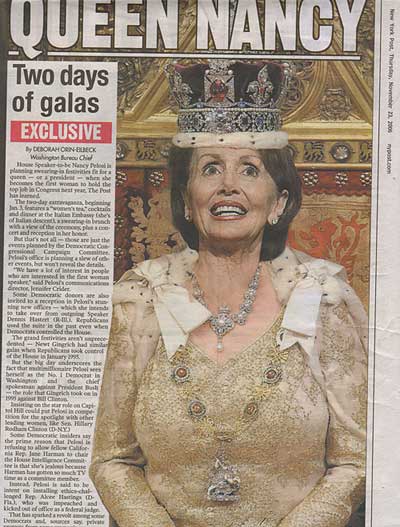
House Speaker Nancy Pelosi has repeatedly requested military aircraft to shuttle her and her colleagues and family around the country, according to a new report from a conservative watchdog group.

Representatives for Judicial Watch, which obtained e-mails and other documents from a Freedom of Information request, said the correspondence shows Pelosi has abused the system in place to accommodate congressional leaders and treated the Air Force as her "personal airline."

Pelosi's office disputed the claim, pointing to White House policy enacted after the Sept. 11 attacks allowing for the House speaker to travel to his or her congressional district via military aircraft whenever possible for security reasons. Her office said she typically uses the same kind of aircraft used by her predecessor, Dennis Hastert.

But Judicial Watch said that Pelosi was notorious for making special demands for high-end aircraft, lodging last-minute cancellations and racking up additional expenses for the military.

The e-mails showed repeated attempts by Pelosi aides to request aircraft, sometimes aggressively, and by Department of Defense officials to accommodate them.

"I think that's above and beyond what other members of Congress are doing and what is expected of our elected officials," said Jenny Small, a researcher with the group.

In one e-mail, aide Kay King complained to the military that they had not made available any aircraft the House speaker wanted for Memorial Day recess.

"It is my understanding there are NO G5s available for the House during the Memorial Day recess. This is totally unacceptable ... The Speaker will want to know where the planes are," King wrote.

In another, when told a certain type of aircraft would not be available, King wrote: "This is not good news, and we will have some very disappointed folks, as well as a very upset Speaker."

Pelosi spokesman Nadeam Elshami said the report seemed to be based on only "a few e-mails," and defended the requests for military aircraft for her colleagues as a "function of the speaker's office." Elshami said at least one of the requests in the above e-mails referenced requests made for other members.

Pelosi's office noted that the Department of Defense ultimately makes all decisions on use of military aircraft for travel, and that Pelosi is "extraordinarily appreciative" of the department's effort to accommodate Congress.

Tuesday, March 10, 2009

http://jeffreyhill.typepad.com/.a/6a00d8341d417153ef010536fa5ecf970b-pi
From The Wall Street Journal:
The President Politicizes Stem-Cell Research

Taxpayers have a right to be left out of it.
By ROBERT P. GEORGE and ERIC COHEN

Yesterday President Barack Obama issued an executive order that authorizes expanded federal funding for research using stem cells produced by destroying human embryos. The announcement was classic Obama: advancing radical policies while seeming calm and moderate, and preaching the gospel of civility while accusing those who disagree with the policies of being "divisive" and even "politicizing science."

Mr. Obama's executive order overturned an attempt by President George W. Bush in 2001 to do justice to both the promise of stem-cell science and the demands of ethics. The Bush policy was to allow the government to fund research on existing embryonic stem-cell lines, where the embryos in question had already been destroyed. But it would not fund, or in any way incentivize, the ongoing destruction of human embryos.

For years, this policy was attacked by advocates of embryo-destructive research. Mr. Bush and the "religious right" were depicted as antiscience villains and embryonic stem-cell scientists and their allies were seen as the beleaguered saviors of the sick. In reality, Mr. Bush's policy was one of moderation. It did not ban new embryo-destructive research (the president had no power to do that), and it did not fund new embryo-destructive research.

"Moderate" Mr. Obama's policy is not. It will promote a whole new industry of embryo creation and destruction, including the creation of human embryos by cloning for research in which they are destroyed. It forces American taxpayers, including those who see the deliberate taking of human life in the embryonic stage as profoundly unjust, to be complicit in this practice.

Mr. Obama made a big point in his speech of claiming to bring integrity back to science policy, and his desire to remove the previous administration's ideological agenda from scientific decision-making. This claim of taking science out of politics is false and misguided on two counts.

First, the Obama policy is itself blatantly political. It is red meat to his Bush-hating base, yet pays no more than lip service to recent scientific breakthroughs that make possible the production of cells that are biologically equivalent to embryonic stem cells without the need to create or kill human embryos. Inexplicably -- apart from political motivations -- Mr. Obama revoked not only the Bush restrictions on embryo destructive research funding, but also the 2007 executive order that encourages the National Institutes of Health to explore non-embryo-destructive sources of stem cells.

Second and more fundamentally, the claim about taking politics out of science is in the deepest sense antidemocratic. The question of whether to destroy human embryos for research purposes is not fundamentally a scientific question; it is a moral and civic question about the proper uses, ambitions and limits of science. It is a question about how we will treat members of the human family at the very dawn of life; about our willingness to seek alternative paths to medical progress that respect human dignity.

For those who believe in the highest ideals of deliberative democracy, and those who believe we mistreat the most vulnerable human lives at our own moral peril, Mr. Obama's claim of "taking politics out of science" should be lamented, not celebrated.

In the years ahead, the stem-cell debate will surely continue -- raising as it does big questions about the meaning of human equality at the edges of human life, about the relationship between science and politics, and about how we govern ourselves when it comes to morally charged issues of public policy on which reasonable people happen to disagree. We can only hope, in the years ahead, that scientific creativity will make embryo destruction unnecessary and that as a society we will not pave the way to the brave new world with the best medical intentions.

Mr. George is professor of Jurisprudence at Princeton and co-author of "Embryo: A Defense of Human Life" (Doubleday, 2008). Mr. Cohen is editor-at-large of The New Atlantis and author of "In the Shadow of Progress: Being Human in the Age of Technology" (Encounter, 2008).

https://304sophs.wikispaces.com/file/view/new_deal_kids.jpg
From UCLA News:
FDR's policies prolonged Depression by 7 years,

UCLA economists calculate

By Meg Sullivan

Two UCLA economists say they have figured out why the Great Depression dragged on for almost 15 years, and they blame a suspect previously thought to be beyond reproach: President Franklin D. Roosevelt.

After scrutinizing Roosevelt's record for four years, Harold L. Cole and Lee E. Ohanian conclude in a new study that New Deal policies signed into law 71 years ago thwarted economic recovery for seven long years.

"Why the Great Depression lasted so long has always been a great mystery, and because we never really knew the reason, we have always worried whether we would have another 10- to 15-year economic slump," said Ohanian, vice chair of UCLA's Department of Economics. "We found that a relapse isn't likely unless lawmakers gum up a recovery with ill-conceived stimulus policies."

In an article in the August issue of the Journal of Political Economy, Ohanian and Cole blame specific anti-competition and pro-labor measures that Roosevelt promoted and signed into law June 16, 1933.

"President Roosevelt believed that excessive competition was responsible for the Depression by reducing prices and wages, and by extension reducing employment and demand for goods and services," said Cole, also a UCLA professor of economics. "So he came up with a recovery package that would be unimaginable today, allowing businesses in every industry to collude without the threat of antitrust prosecution and workers to demand salaries about 25 percent above where they ought to have been, given market forces. The economy was poised for a beautiful recovery, but that recovery was stalled by these misguided policies."

Using data collected in 1929 by the Conference Board and the Bureau of Labor Statistics, Cole and Ohanian were able to establish average wages and prices across a range of industries just prior to the Depression. By adjusting for annual increases in productivity, they were able to use the 1929 benchmark to figure out what prices and wages would have been during every year of the Depression had Roosevelt's policies not gone into effect. They then compared those figures with actual prices and wages as reflected in the Conference Board data.

In the three years following the implementation of Roosevelt's policies, wages in 11 key industries averaged 25 percent higher than they otherwise would have done, the economists calculate. But unemployment was also 25 percent higher than it should have been, given gains in productivity.

Meanwhile, prices across 19 industries averaged 23 percent above where they should have been, given the state of the economy. With goods and services that much harder for consumers to afford, demand stalled and the gross national product floundered at 27 percent below where it otherwise might have been.

"High wages and high prices in an economic slump run contrary to everything we know about market forces in economic downturns," Ohanian said. "As we've seen in the past several years, salaries and prices fall when unemployment is high. By artificially inflating both, the New Deal policies short-circuited the market's self-correcting forces."

The policies were contained in the National Industrial Recovery Act (NIRA), which exempted industries from antitrust prosecution if they agreed to enter into collective bargaining agreements that significantly raised wages. Because protection from antitrust prosecution all but ensured higher prices for goods and services, a wide range of industries took the bait, Cole and Ohanian found. By 1934 more than 500 industries, which accounted for nearly 80 percent of private, non-agricultural employment, had entered into the collective bargaining agreements called for under NIRA.

Cole and Ohanian calculate that NIRA and its aftermath account for 60 percent of the weak recovery. Without the policies, they contend that the Depression would have ended in 1936 instead of the year when they believe the slump actually ended: 1943.

Roosevelt's role in lifting the nation out of the Great Depression has been so revered that Time magazine readers cited it in 1999 when naming him the 20th century's second-most influential figure.

"This is exciting and valuable research," said Robert E. Lucas Jr., the 1995 Nobel Laureate in economics, and the John Dewey Distinguished Service Professor of Economics at the University of Chicago. "The prevention and cure of depressions is a central mission of macroeconomics, and if we can't understand what happened in the 1930s, how can we be sure it won't happen again?"

NIRA's role in prolonging the Depression has not been more closely scrutinized because the Supreme Court declared the act unconstitutional within two years of its passage.

"Historians have assumed that the policies didn't have an impact because they were too short-lived, but the proof is in the pudding," Ohanian said. "We show that they really did artificially inflate wages and prices."

Even after being deemed unconstitutional, Roosevelt's anti-competition policies persisted — albeit under a different guise, the scholars found. Ohanian and Cole painstakingly documented the extent to which the Roosevelt administration looked the other way as industries once protected by NIRA continued to engage in price-fixing practices for four more years.

The number of antitrust cases brought by the Department of Justice fell from an average of 12.5 cases per year during the 1920s to an average of 6.5 cases per year from 1935 to 1938, the scholars found. Collusion had become so widespread that one Department of Interior official complained of receiving identical bids from a protected industry (steel) on 257 different occasions between mid-1935 and mid-1936. The bids were not only identical but also 50 percent higher than foreign steel prices. Without competition, wholesale prices remained inflated, averaging 14 percent higher than they would have been without the troublesome practices, the UCLA economists calculate.

NIRA's labor provisions, meanwhile, were strengthened in the National Relations Act, signed into law in 1935. As union membership doubled, so did labor's bargaining power, rising from 14 million strike days in 1936 to about 28 million in 1937. By 1939 wages in protected industries remained 24 percent to 33 percent above where they should have been, based on 1929 figures, Cole and Ohanian calculate. Unemployment persisted. By 1939 the U.S. unemployment rate was 17.2 percent, down somewhat from its 1933 peak of 24.9 percent but still remarkably high. By comparison, in May 2003, the unemployment rate of 6.1 percent was the highest in nine years.

Recovery came only after the Department of Justice dramatically stepped enforcement of antitrust cases nearly four-fold and organized labor suffered a string of setbacks, the economists found.

"The fact that the Depression dragged on for years convinced generations of economists and policy-makers that capitalism could not be trusted to recover from depressions and that significant government intervention was required to achieve good outcomes," Cole said. "Ironically, our work shows that the recovery would have been very rapid had the government not intervened."

-UCLA-

http://blog.mlive.com/grpress/news_impact/2008/11/lbj-and-obama.jpg
From Real Clear Politics:
Lyndon Baines Obama

By Patrick Buchanan

It was the winter of conservative discontent.

Barry Goldwater had gotten only 38 percent of the vote, and his party had suffered its worst thrashing since Alf Landon fell to FDR in 1936.

Democrats held 295 House seats, Republicans 140. They held 68 Senate seats to Republicans' 32, and 33 governors to the GOP's 17.

Democratic registration was twice that of the GOP. The liberal press was gleefully writing the obituary of "The Party That Lost Its Head."

Decades might pass, it was said, before the GOP recovered from its fatal embrace of right-wing radicalism and foolish rejection of the leadership of Govs. Nelson Rockefeller and William Scranton.

Wrote Robert Donovan in the opening lines of his book, "The Future of the Republican Party":

"The devastating defeat of Barry Goldwater at the hands of voters in all sections of the country but the Deep South has damaged, weakened and tarnished the party. For years to come ... the two-party system will be crippled."

Donovan and all the rest were wrong. The GOP came roaring back in 1966 to capture 47 House seats and eight new governorships. In 1968, Nixon led the party out of the wilderness and into a White House it would hold for 20 of the next 24 years.

Full of hubris in 1965, Lyndon Johnson had seized his moment. He had launched a Great Society that would outdo his beloved patron FDR. He would dispatch 500,000 troops to Vietnam to "bring the coonskin home on the wall" and create a "Great Society on the Mekong." Those were heady days of "guns-and-butter."

By 1968, LBJ's coalition was shredded. Gov. George Wallace had torn away the populist right. Sens. Gene McCarthy, George McGovern and Robert Kennedy had rallied the antiwar left against him. LBJ and Hubert Humphrey were left to preside over a shrinking center.

Why did LBJ fail? He overloaded the circuits. He tried to do it all. He misread a national desire for continuity after Kennedy's death as a mandate for a lunge to the left and a great leap forward with the largest expansion of government since the New Deal.

By 1968, racial riots had torn apart almost every great city.
The most prestigious campuses had been rocked by student violence. Thousands of antiwar demonstrators had taken to the streets. And 100 to 200 body bags were coming home from Vietnam every week.

By the winter of 1968, Lyndon Johnson was a broken president.

History never repeats itself exactly. But Barack Obama is making the same mistakes today that LBJ made in 1965.

He has ordered 17,000 more U.S. troops into Afghanistan, as the situation deteriorates and the NATO allies pull out. He has no exit strategy. He has read a repudiation of George Bush as a mandate for a government seizure of wealth and power that exceeds anything attempted in the Great Society.

Fully half of the $3.55 trillion in spending Obama will preside over this year will not be covered by tax revenue but by red ink. The money will have to be borrowed from abroad or printed by the Fed.

Not only is Barack running a deficit four times as large as Bush's largest, he has called for $1 trillion in new taxes on America's most successful, who have already seen their savings and pensions ravaged.

He wants a cap-and-trade system to deal with a global-warming or climate-change crisis many scientists believe is a hoax. He is going to provide health care for all, including immigrants, millions of whom arrive uninsured every year. He is going to plunge scores of billions more into education, though education has eaten up the wealth of an empire, as SAT scores sink further and further below the apogee of 1964, before LBJ and the feds barged in. He is going to ask Congress for authority to spend another $750 billion rescuing the banks.

He is going to find the cure for cancer. He is going to ensure every kid gets a college education. He is going to drop half of all wage-earners off the tax rolls, while the top 2 percent, who already pay 40 percent of all income taxes, are forced to cough up more.

Obama is misreading the election returns. When America voted to cancel the White House lease of Mr. Bush, it did not vote Barack Obama a blank check.

By misinterpreting his mandate, Obama has accomplished something John McCain could not -- unite the Republican Party and instill in it a new esprit de corps. For the Obama budget is an insult to the core belief of the party -- that free people, not coercive government, should shape the character of society.

By daring Republicans to fight on the issue of a $1.75 trillion deficit, Obama has liberated the GOP from any obligation to him. He has come out of the closet as a radical liberal spoiling for a fight over an agenda of radical change.

Sooner than any might have thought, we have clarity.
http://libertyboy.files.wordpress.com/2008/10/obama-marxist.jpg
From the Los Angeles Times
Obama's fear-mongering
The president and his aides say they don't want to waste a crisis.
That's a cynical way to exploit a national emergency.
Jonah Goldberg

March 10, 2009

Imagine a child falls down a well. Now imagine I offer to lend the parents my ladder to save her, but only if they promise to paint my house. Would you applaud me for not letting a crisis go to waste? Or would you think I'm a jerk?

I ask because I'm trying to come to terms with Rule No. 1 of the Obama administration.

"Rule 1: Never allow a crisis to go to waste," White House Chief of Staff Rahm Emanuel told the New York Times right after the election. "They are opportunities to do big things." Over the weekend, Secretary of State Hillary Rodham Clinton told members of the European Parliament, "Never waste a good crisis." Then President Obama explained in his Saturday radio and Internet address that there is "great opportunity in the midst of" the "great crisis" befalling America.

Numerous commentators, including me, have pointed to this never-waste-a-crisis mantra as ideological evidence that Obama's budget priorities are a great bait-and-switch. He says he wants to fix the financial crisis, but he's focusing on selling his long-standing liberal agenda on healthcare, energy and education as the way to do it, even though his proposals have absolutely nothing to do with addressing the housing and toxic-debt problems that are the direct causes of our predicament. Indeed, some -- particularly on Wall Street -- would argue that his policies are making the crisis worse.

But the real scandal isn't those policies, even though they're bad enough. The real scandal is that this administration thinks crises are opportunities for governmental power-grabs (It seems writer Randolph Bourne was wrong. It is not war, but crisis, that is the health of the state).

Michael Kinsley famously said that a gaffe in Washington is when a politician accidentally tells the truth. As they say, it's funny because it's true.

But the White House tactic isn't funny at all. It's scary. Its amorality is outweighed only by the grotesque and astoundingly naked cynicism of it all.

Recall that not long ago, the first item on the bill of indictment against the Bush administration was that it was "exploiting" 9/11 to enact its agenda. Al Gore shrieked that President Bush "played on our fears" to get his way. In response to nearly every Bush policy proposal, from the Patriot Act to the toppling of Saddam Hussein, critics would caterwaul that Bush was taking advantage of the country's fear of terrorism.

The Bush administration always denied this, and rightly so. If the president admitted that he was using a national calamity for narrow partisan or ideological advantage, it would be outrageous. Indeed, every time Karl Rove or some other administration official said anything that could be even remotely interpreted as using the war or 9/11 for partisan or ideological gain, the editorial pages and Democratic news-release factories churned into overdrive with righteous indignation.

Well, now we have the president, along with his chief aides, admitting -- boasting! -- that they want to exploit a national emergency for their preexisting agenda, and there's no scandal. No one even calls it a gaffe. No, they call it leadership.

It's not leadership. It's fear-mongering.

Franklin Roosevelt said that all we have to fear is fear itself. Now Barack Obama all but admits that all he has to fear is the loss of fear itself.

In other realms of life, exploiting a crisis for your own purposes is an outrage. If a business uses a hurricane warning, for example, to price-gouge on vital supplies, it is a crime. When a liberal administration does it, it's taking advantage of a historic opportunity.

Obama's defenders respond to this argument that Obama's motives are decent, noble and pure. He wants to help the uninsured and the poorly educated. He wants to make good on his vow to halt those rising oceans.

But this is just a rationalization. Every president thinks his agenda is what's best for the country; every politician believes his motives are noble. The point is that scaring people about X in order to achieve Y is fundamentally undemocratic.

This was transparently obvious to Bush's harshest critics, who alleged that 9/11 was merely a convenient crisis for devious neocons who wanted to topple Hussein all along. But it's now clear that many of these critics simply objected to the agenda, not the alleged tactics. Now that it's their turn, they see nothing wrong with doing what they so recently condemned.

They even admit it, over and over again.

Monday, March 09, 2009

https://blogger.googleusercontent.com/img/b/R29vZ2xl/AVvXsEijBcfFuXO4YjIIB88_HJ7P7ueNbfC8GA5h8FVh0ul6gxLVl_Y9-Pfws06C0i5Ud-VoW8iP4WpigIlnwyPAeZ36VKRWRkUX-hJ9r2X4RqrBspBZYTOzIEQkKfEDJBiVXdyDbn1R/s400/Obama+Manchurian+Candidate.jpg
From Bloomberg.org:
‘Manchurian Candidate’ Starts War on Business

Kevin Hassett

March 9 (Bloomberg) -- Back in the 1960s, Lyndon Johnson gave us the War on Poverty. In the 1970s, Richard Nixon launched the War on Drugs. Now that we have seen President Barack Obama’s first-year legislative agenda, we know what kind of a war he intends to wage.

It is no wonder that markets are imploding around us. Obama is giving us the War on Business.

Imagine that some hypothetical enemy state spent years preparing a “Manchurian Candidate” to destroy the U.S. economy once elected. What policies might that leader pursue?

He might discourage private capital from entering the financial sector by instructing his Treasury secretary to repeatedly promise a brilliant rescue plan, but never actually have one. Private firms, spooked by the thought of what government might do, would shy away from transactions altogether. If the secretary were smooth and played rope-a-dope long enough, the whole financial sector would be gone before voters could demand action.

Another diabolical idea would be to significantly increase taxes on whatever firms are still standing. That would require subterfuge, since increasing tax rates would be too obvious. Our Manchurian Candidate would have plenty of sophisticated ideas on changing the rules to get more revenue without increasing rates, such as auctioning off “permits.”

These steps would create near-term distress. If our Manchurian Candidate leader really wanted to knock the country down for good, he would have to provide insurance against any long-run recovery.

There are two steps to accomplish that.

Discourage Innovation

First, one way the economy might finally take off is for some entrepreneur to invent an amazing new product that launches something on the scale of the dot-com boom. If you want to destroy an economy, you have to persuade those innovators not even to try.

Second, you need to initiate entitlement programs that are difficult to change once enacted. These programs should transfer assets away from productive areas of the economy as efficiently as possible. Ideally, the government will have no choice but to increase taxes sharply in the future to pay for new entitlements.

A leader who pulled off all that might be able to finish off the country.

Let’s see how Obama’s plan compares with our nightmare scenario.

Treasury Secretary Timothy Geithner has been so slow to act that even liberal economist and commentator Paul Krugman is criticizing the administration for “dithering.” It has gotten so bad that the Intrade prediction market now has a future on whether Geithner is gone by year’s end. It currently puts the chance of that at about 20 percent.

No More Deferral

On the tax hike, Obama’s proposed 2010 budget quite ominously signaled that he intends to end or significantly amend the U.S. practice of allowing U.S. multinationals to defer U.S. taxes on income that they earn abroad.

Currently, the U.S. has the second-highest corporate tax on Earth. U.S. firms can compete in Europe by opening a subsidiary in a low-tax country and locating the profits there. Since the high U.S. tax applies only when the money is mailed home, and firms can let the money sit abroad for as long as they want, the big disadvantage of the high rate is muted significantly.

End that deferral opportunity and U.S. firms will no longer be able to compete, given their huge tax disadvantage. With foreign tax rates so low now, it is even possible that the end of deferral could lead to the extinction of the U.S. corporation.

If any firms are to remain, they will be festooned with massive carbon-permit expenses because of Obama’s new cap-and- trade program.

Importing Drugs

Obama’s attack on intellectual property is evident in his aggressive stance against U.S. pharmaceutical companies in the budget. He would force drug companies to pay higher “rebate” fees to Medicaid, and he included wording that suggests Americans will soon be able to import drugs from foreign countries. The stock prices of drug companies, predictably, tanked when his budget plan was released.

Obama will allow cheap and potentially counterfeit substitutes into the country and will set the U.S. price for drugs equal to the lowest price that any foreign government is able to coerce from our drugmakers.

Given this, why would anyone invest money in a risky new cancer trial, or bother inventing some other new thing that the government could expropriate as soon as it decides to?

Finally, Obama has set aside $634 billion to establish a health-reform reserve fund, a major first step in creating a universal health-care system. If you want to have health care for everyone, you have to give it to many people for free. Once we start doing that, we will never stop, at least until the government runs out of money.

It’s clear that President Obama wants the best for our country. That makes it all the more puzzling that he would legislate like a Manchurian Candidate.

(Kevin Hassett, director of economic-policy studies at the American Enterprise Institute, is a Bloomberg News columnist. He was an adviser to Republican Senator John McCain of Arizona in the 2008 presidential election. The opinions expressed are his own.)

http://tothewire.files.wordpress.com/2008/12/baracksocialismeyes1.jpg
From The Washington Post:
Obama's Double Talk
By Robert J. Samuelson

Monday, March 9, 2009

To those who believe that Barack Obama is a different kind of politician -- more honest, more courageous -- please don't examine his administration's budget. If you do, you may sadly conclude that he resembles presidents stretching back to John Kennedy in one crucial respect. He won't tax voters for all the government services they want. That's the main reason we've run budget deficits in 43 of the past 48 years.

Obama is a great pretender. He repeatedly says he is doing things that he isn't, trusting his powerful rhetoric to obscure the difference. He has made "responsibility" a personal theme; the budget's cover line is "A New Era of Responsibility." He says the budget begins "making the tough choices necessary to restore fiscal discipline." It doesn't.

With today's depressed economy, big deficits are unavoidable for some years. But let's assume that Obama wins reelection. By his last year, 2016, the economy presumably will have long recovered. What does his final budget look like? Well, it runs a $637 billion deficit, equal to 3.2 percent of the economy (gross domestic product), projects Obama's Office of Management and Budget. That would match Ronald Reagan's last deficit, 3.1 percent of GDP in 1988, so fiercely criticized by Democrats.

As a society, we should pay in taxes what it costs government to provide desired services. If benefits don't seem equal to burdens, then the spending isn't worth it. (Exceptions: deficits in wartime and economic slumps.)

If Obama were "responsible," he would conduct a candid conversation about the role of government. Who deserves support and why? How big can government grow before higher taxes and deficits harm economic growth? Although Obama claims to be doing this, he hasn't confronted entitlement psychology -- the belief that government benefits once conferred should never be revoked.

Is it in the public interest for the well-off elderly (say, a couple with $125,000 of income) to be subsidized, through Social Security and Medicare, by poorer young and middle-aged workers? Are any farm subsidies justified when they aren't essential for food production? We wouldn't starve without them.

Given an aging America, government faces huge conflicts between spending on the elderly and spending on everything else. But even before most baby boomers retire (in 2016, only a quarter will have reached 65), Obama's government would have grown. In 2016, federal spending is projected to be 22.4 percent of GDP, up from 21 percent in 2008; federal taxes, 19.2 percent of GDP, up from 17.7 percent.

It would also be "responsible" for Obama to acknowledge the big gamble in his budget. National security has long been government's first job. In his budget, defense spending drops from 20 percent of the total in 2008 to 14 percent in 2016, the smallest share since the 1930s. The decline presumes a much safer world. If the world doesn't cooperate, deficits will grow.

The gap between Obama rhetoric and Obama reality transcends the budget, as do the consequences. In 2009, the stock market has declined 23.68 percent (through March 6), says Wilshire Associates. The Wall Street Journal's editorial page blames Obama's policies for all of the fall. That's unfair; the economy's deterioration was a big cause. Still, Obama isn't blameless.

Confidence (too little) and uncertainty (too much) define this crisis. Obama's double talk reduces the first and raises the second. He says he's focused on reviving the economy, but he's also using the crisis to advance an ambitious long-term agenda. The two sometimes collide. The $787 billion "stimulus" is weaker than necessary, because almost $200 billion for extended projects (high-speed rail, computerized medical records) take effect after 2010. When Congress debates Obama's sweeping health-care and energy proposals, industries, regions and governmental philosophies will clash. Will this improve confidence? Reduce uncertainty?

A prudent president would have made a "tough choice" -- concentrated on the economy; deferred his more contentious agenda. Similarly, Obama claims to seek bipartisanship but, in reality, doesn't. His bipartisanship consists of including a few Republicans in his Cabinet and inviting some Republican congressmen to the White House for the Super Bowl. It does not consist of fashioning proposals that would attract bipartisan support on their merits. Instead, he clings to dubious, partisan policies (mortgage cramdown, union card check) that arouse fierce opposition.

Obama thinks he can ignore these blatant inconsistencies. Like many smart people, he believes he can talk his way around problems. Maybe. He's helped by much of the media, which seem so enthralled with him that they don't see glaring contradictions. During the campaign, Obama said he would change Washington's petty partisanship; he also advocated a highly partisan agenda. Both claims could not be true. The media barely noticed; the same obliviousness persists. But Obama still runs a risk: that his overworked rhetoric loses its power and boomerangs on him.

From TarHeelBlue.com:
Waking Up With Chills

By Adam Lucas

March 8, 2009

Inside sources will reveal that Mike Copeland has sometimes been accused of being the most proficient snorer on the Carolina basketball team. But Saturday night, he didn't snore at all.

"I couldn't sleep last night," Copeland said Sunday evening. "I finally fell asleep for a few minutes, and when I woke up this morning, I had chills. I knew it was the last time I would play here. It's senior night. It's Duke. I knew today was all of those things, and it gave me chills."

On June 16, when Danny Green announced he was returning to school along with Wayne Ellington and Ty Lawson, Sunday's Carolina-Duke game instantly became the toughest senior day ticket since Phil Ford said goodbye in 1978. Way back in October, Roy Williams said, "I expect that to be the toughest ticket of any game ever at the Smith Center." Sunday, it finally arrived.

On the occasion of their final appearance in Chapel Hill--really, Green, Copeland, Bobby Frasor and Tyler Hansbrough are never going to play again in the Smith Center, and as of 9 p.m. on Sunday night that still doesn't seem quite right--it's worth taking a second to remember where we were when they arrived.

Expectations were low. I'm not talking about, "Might not be able to win the conference," low. I'm talking about, "Might not be able to walk and chew gum at the same time," low. Remember, we were still in the shadow of 8-20. Now, a bad year means not making it to the Final Four. Then, a bad year could've meant not winning four games.


We weren't too far removed from something very few people remember--in the 2002 ACC Tournament quarterfinals, the only way Carolina had a chance to even stay in the same building with Duke was holding the ball. It wasn't quite the famous 47-40 game of 1979 (the Blue Devils led 7-0 at halftime), but it was as close as you could get with a shot clock. And still, the Blue Devils won.

Sure, there had been a national championship since the 2002 game. But all the good players left, didn't they? Rashad and Raymond and Sean and Marvin? We were left with David Noel, Wes Miller, and some guy I saw at the concession stand at the 2005 Final Four.

Let's be honest. That kid who stood on the concourse in St. Louis didn't look like he was about to be the centerpiece of one of Carolina's all-time great classes.

"I thought it was going to take awhile," says Hansbrough, who was in St. Louis as a fan in 2005 and will leave with his jersey in the rafters. "No one expected much from our class."

But we found out, beginning with a heart-pounding loss to Illinois early in their freshman season, that we could expect plenty. There's always been something about this group that's been fun to watch, and it's gone beyond putting a basketball into a hoop. There's something about them that makes people respond.

Take Green. On a fast break with Hansbrough with 8 minutes left in Sunday's game, he decided to take a pull-up 19-foot jumper. And as he released it, 21,750 people instantly screamed, "Danny, no!" And as it dropped through the rim, those same people--and maybe even Roy Williams--yelled, "Great shot, Danny!"

Take Frasor. Early in the second half, with Duke having closed their deficit to four points, he stared down a 4-on-1 Blue Devil fast break and drew a charge on Kyle Singler.

"You could see the whole thing unfolding in front of you," Frasor said. "They threw it to Singler and he had a head of steam and I stepped in and took a charge. I thought that was key for us, because they were making a little run."

He's always had a knack for making those kinds of key plays. And so, after he had tied up Gerald Henderson and forced a game-clinching jump ball with 55 seconds left, the crowd began to serenade him: "Bobby, Bobby, Bobby..."

When is the last time the crowd chanted the name of someone who had scored a grand total of three points? Here, we do. Because we connect with them. It's never just been about basketball with this class. We see them at Boshamer Stadium taking in a baseball game or on Franklin Street or, yes, jumping off a frat house and we think that these five guys--because you must include Marcus Ginyard--have done it exactly like we would've done it.

Stop any incoming Carolina freshman student on orientation weekend and ask them how they want to live their four (or more) years in Chapel Hill, and they'd probably respond something like this: jump off a few frat houses, dunk a few Dukies, have a little fun, and see some winning basketball. That's what this group has done.

"We've just been normal kids having fun," Copeland said.

And people respond to it. After Hansbrough went to the line to shoot his final Smith Center free throws with 29.4 seconds left, Frasor flashed that same grin he'd first shown during the upset win against Duke in Durham in 2006. He clapped his hands and smiled wide, and he looked down the court and there was Hansbrough with his arms high above his head, a rare display of on-court emotion. And if you were there, and if you are the type who would have, like Copeland, woken up with chills, you might have discovered that you had them again.

On this day, Jordan was just another intense Tar Heel fan.


At that moment, a man behind the scorer's table in an untucked white dress shirt and blue jeans felt the same thing we all felt. He bounced out of his seat, he held his hands over his head, and he clapped and cheered like a 10-year-old with the rest of us. Even 25 years after he last walked the campus as a student, you see, Michael Jordan still knows Carolina. And there we had perhaps the most surreal moment of Frasor's life, as the man he grew up watching at the United Center in a Chicago Bulls uniform got out of his seat and stood and cheered for Bobby Frasor, and Tyler Hansbrough, and Danny Green, and Mike Copeland.

At Carolina, we take for granted that these things happen. Of course Michael Jordan and Larry Brown and Sean May and Raymond Felton and Jerry Stackhouse would show up for the game. Why wouldn't they? They're Tar Heels.

These are the things that happen at Carolina.

"I've learned that being a Carolina Basketball player puts a lot on your shoulders," Frasor said. "People put you on a pedestal. But you get to play in the greatest facilities in the world, with the best coaches in the world, and the greatest teammates in the world.

"And hey, we might be playing for another month. Maybe we'll get to hang another banner."

Adam Lucas is the publisher of Tar Heel Monthly. He is also the author or co-author of four books on Carolina basketball.