Saturday, February 03, 2007

http://jcrue.wordpress.com/files/2006/05/mram_illegal_immigration.gif
$23 billion sent to Mexico in '06
Record total attributed to more migration, cheaper sending costs


By DIANNE SOLÍS and LAURENCE ILIFF / The Dallas Morning News

dsolis@dallasnews.com and liliff@dallasnews.com

Wednesday, January 31, 2007

The amount of money that Mexican immigrants sent back to their homeland hit a record $23 billion in 2006 – suggesting a greater number of workers are sending more money home.

Immigration experts attributed last year's 15 percent rise to multiple factors, including increased migration, more generosity by immigrants and cheaper sending costs.

It was the fifth straight year that remittances have risen between 15 and 25 percent.

Some experts even cited deportation fears as a reason for the spikes.

"They used to spend more money here, but now they are saving every penny here and sending it down there," said Socorro Perales, a naturalized citizen who lives in Dallas and works among immigrants from the central Mexican state of Guanajuato.

Ms. Perales regularly sends money to her grandmother in Zacatecas.

Mexico's Central Bank said in its quarterly report released Wednesday that reduced costs to send money – due to greater competition by banks and other businesses – are one reason for the increase.

For example, in 1999, the cost to send $300 from Dallas to Mexico was $27. Last year, that same transaction cost $11.50, the Central Bank said in its report.

The Central Bank said it has also done a better job counting the dollars sent home over the last several years.

Previously, there were more informal channels for sending money. Today, 98.5 percent of transfers are reported to the bank under stricter legal requirements, the bank said. It recorded six times more transactions in 2006 than it did in 1995.

Increasingly, the flow of money out of the country has been a source of rancor in the U.S.

State legislatures in Arizona and Texas have proposed taxing the money to pay for such social services as health care and education.

"The rapid rise in remittances during recent years is the result of both better registration of these transactions, as well as a genuine increase in these resources," the bank said in its report Wednesday.

Roberto Suro, director of the nonpartisan Pew Hispanic Center, cautioned that increased migration alone can't explain the rise in money transfers.

He noted that Central Bank figures show a doubling of money transfers from $10 billion five years ago, and illegal immigration hasn't doubled in that time.

"I think it is more people sending more money," Mr. Suro said, "and it has gotten cheaper and easier to send money."

A survey by the Inter-American Development Bank to be released today estimates that Mexicans received $25 billion in 2006, $2 billion more than Mexico's Central Bank said in its report.

The poll showed that of 2,415 people surveyed throughout Mexico by the Inter-American Development Bank, 17 percent said they received money from family north of the Rio Grande. The poll had a margin of error of plus or minus 2 percentage points.

Some of the increase is due to Mexican workers whose prosperity has swelled, said Sergio Bendixen, whose Miami-based firm did the poll for the Washington-based Inter-American Development Bank. Those Mexicans came over a period of a decade, he said. "These immigrants are making some good money in the United States, and, therefore, they are able to send more," Mr. Bendixen said.

He noted that the money is also being invested into more productive ventures, such as advanced education for children and small businesses.
Stronger first half

Mexico's Central Bank noted, however, that money transfers in the second half of 2006 were not as vigorous as in the first half.

The bank attributed that, in part, to "greater problems faced by Mexican workers emigrating to the United States as a result of more border enforcement in that country."

It also cited "increasing difficulties finding work faced by undocumented Mexican immigrants in the United States as a result of stricter official controls."

In Austin, legislators introduced bills to tax money electronically transmitted from the U.S. to foreign countries. One of the bills, submitted by Sen. Royce West, D-Dallas, proposes a sliding fee scale.

Some have challenged the bills as Mexico-bashing. Others note that they raise Constitutional questions and that the money sent home represents only about 10 to 15 percent of what is earned.

"It would of course be double taxation," said Mr. Bendixen, the pollster. "The money they send is after they pay taxes."

Such efforts bring praise from some quarters.

At the Federation for American Immigration Reform, spokesman Ira Mehlman said: "This is money going directly out of our economy. You have many people who are here illegally, who earn money here and don't even spend it here but send it out of the country."

As for arguments that the money is already taxed, Mr. Mehlman noted that some illegal immigrants work "off the books," and, thus, pay no taxes at all.
'Indicator of success'

Rodolfo Tuirán Gutiérrez, a Mexico City newspaper columnist on immigration trends, has argued that the Central Bank's estimate of remittances could include other types of money transfers, such as payment for purchases of goods, resulting in an overestimate.

Still, he believes the dollar amount is clearly rising as a result of greater immigration to the U.S. and cheaper costs for money transfers.

Mr. Tuirán estimates that the number of Mexican immigrants in the U.S. is increasing by about half a million per year, and that is reflected in the increasing amount of money sent home.

"I think the subject of remittances has been so well publicized that it has become an indicator of success" by some Mexican immigrants, he said. And that may encourage others to try their luck, he said.

In the same report, the Central Bank announced that the economy added 880,000 jobs last year thanks to a brisk 4.8 percent growth rate, but that was still not enough to satisfy demand.

Mr. Tuirán characterized Mexico's young, energetic labor force as "a resource that Mexico cannot take advantage of and so it must find another outlet."

In Fort Worth, immigrant Sebastian Martínez said the rise in money sent back to Mexico reflects the U.S. appetite for the labor.

Mr. Martínez, who lives legally in the U.S., regularly sends money back to family in his home state of Zacatecas. Migration's roots are so deep there that the governor makes frequent trips to the U.S. to visit Zacatecan communities here.

"It is certainly the economic power of the migrants, but, also, the migrants keep coming," said Mr. Martínez, who owns a business selling music instruments.

Indeed, labor participation rates in 2006 were nearly 85 percent for Hispanic males, compared with about 76 percent for white males, according to the U.S. Bureau of Labor Statistics.

The image “http://www.netribution.co.uk/cc/main.php?g2_view=core.DownloadItem&g2_itemId=2832&g2_serialNumber=1” cannot be displayed, because it contains errors.

From The New York Times:

Pretending to like the little people

By Genia Bellafonte


That species of star known as the celebrity altruist is a creature in whom the British comic Ricky Gervais seems to have absolutely no faith. The actors, directors and rock singers who give money to Holocaust foundations and adopt babies from impoverished places and expound before the United Nations General Assembly on the crisis of African debt — these people simply do not figure in his consciousness, one consumed by a brilliantly uncharitable view of fame.

“Extras,” midway through its second queasy, funny season on HBO, is Mr. Gervais’s deft essay on the vainglory of the well known. And it leaves you wondering, in the end, whether Mr. Gervais down deep imagines no real difference between what motivates Clint Eastwood and what drives Vanna White.

Each week Mr. Gervais — who writes, directs and stars in the comedy with his creative partner Stephen Merchant, with whom he also worked on “The Office” for the BBC — gets celebrities to appear on the show as themselves. Kate Winslet and Patrick Stewart showed up last season; Coldplay’s Chris Martin appears this Sunday in the taping of a public-service announcement, which he tries to exploit to promote his new album.

The celebrities are not meant to be playing themselves; not really. They are there to enact Mr. Gervais’s caricature, largely reprising the same dim, self-aggrandizing megalomaniac over and over. Every time they do, they seem to be inadvertently making Mr. Gervais’s point for him, because by getting in his game, they are betraying the kind of self-regard that leaves us assuming that they consider themselves exempt from his critique. Anyone who subjects himself to Mr. Gervais’s camera must believe that he does not belong to the class of arrogant jerks that Mr. Gervais is making so much fun of.

“How do I act so well?” Ian McKellen earnestly asks Mr. Gervais’s character in a forthcoming episode. “What I do is I pretend to be the person I’m portraying in the film or play,” he whispers. “You’re confused. Case in point, ‘Lord of the Rings,’ Peter Jackson comes to New Zealand and says to me, ‘Sir Ian, I want you to be Gandalf the Wizard,’ and I say to him, ‘You are aware that I’m not really a wizard.’ ”

Mr. Gervais’s character, Andy Millman, is an actor who had been making his living as an extra and has seen his fortunes change this season. An even greater misanthropy has accompanied the shift. Andy has managed to sell a workplace comedy to the BBC. He stars in it, and though the network suits have insisted it be stupider than he had ever hoped, he suddenly finds himself among the quasi-famous.

So when he complains to a boy’s mother in a restaurant that the boy is way too loud, without noticing first that the boy has Down syndrome, his tactlessness becomes front-page tabloid news. He is ultimately forced to have his picture taken with the child as he gives him an Xbox.

Andy has more money now, but he gives it away only meagerly, and merely for the purpose of small-scale image enhancement. When a homeless man recognizes him on the street, Andy gives him £20. When Andy asks the man what, hypothetically, he might ever say about the exchange to the press, the man responds, “I’d say, don’t ask Andy Millman for money because he’ll only give it to you begrudgingly.”

The new conceit — Andy as a real television actor — gives the show a sharper focus than it had last season and puts Mr. Gervais’s talents in the foreground more easily, giving him greater claim to Andy’s selfishness and diminishing his abjection.

Abjection, one of the show’s favorite themes, is now almost entirely Maggie’s to bear, and she bears more than a viewer’s comfort level can sustain. Played by Ashley Jensen, Maggie is Andy’s closest friend in the world of disrespected extras, a Bridget Jones without the wit, verbal range or ability to attract good-looking bad men.

She is a foil for all the big egos around her, pathetic, but in a different way, because she possesses ambition for nothing. And yet her apathy toward the actors she lets humiliate her leave them courting her approval: celebrities crave recognition even from those they denigrate or barely notice.

In one exceptionally funny episode a few weeks ago, in which Maggie is an extra in a period courtroom drama starring Orlando Bloom, she points out to him that women approach him only because he is famous. There’s really little else special about him at all. He disagrees: “They’re not doing it just because I’m famous. It’s my looks as well.”

He goes on to explain that other actors don’t get nearly as much attention: “I’ll tell you who gets ignored: Johnny Depp,” Mr. Bloom says. “On the set of the ‘Pirates of the Caribbean,’ the birds just walked straight past him: ‘Get out of our bloody way, whoever you are, we just want to get to Orlando.’ ”

Mr. Gervais wants to get to the world’s Orlandos, and also, subversively, at them.

EXTRAS

HBO, Sunday night at 10, Eastern and Pacific times; 9, Central time.

Written and directed by Ricky Gervais and Stephen Merchant; Charlie Hanson, producer; Jon Plowman, executive producer.

WITH: Ricky Gervais (Andy Millman), Stephen Merchant (Darren Lamb), Ashley Jensen (Maggie Jacobs), Shaun Williamson (Barry).

http://www.claybennett.com/images/archivetoons/chicken_little.jpg
UN Climate Summary Designed to Dupe, Critics Say
By Kevin Mooney
CNSNews.com Staff Writer
February 02, 2007

(CNSNews.com) - Scientific evidence for human-induced global warming will receive a significant boost Friday when the U.N.'s Intergovernmental Panel on Climate Change (IPCC) releases the summary of a key report, according to environmental activists and top Democrats in Congress.

But wait.

Some climate researchers and environmental scientists previously associated with the IPCC claim the public relations summary of the panel's fourth assessment report distorts the actual scientific findings and that the discrepancies are driven by a political agenda.

The IPCC Summary for Policymakers, roughly 20 pages long, is primarily the work of political appointees, not of scientists, according to Richard Lindzen, professor of atmospheric science at MIT.

The full text will not be available for another three months, as two further documents making up the fourth assessment report are scheduled to be released in April and May.

Lindzen specialized in the study of clouds and water vapor for IPCC's third assessment report, which was released in 2001.

He told Cybercast News Service the rules for the fourth assessment report specifically require changes to be made to the body that will bring it into line with the summary statement.

"If you were doing that with a business report, the federal trade commission would be down your throat," Lindzen said.

"These people are openly declaring that they are going to commit scientific misconduct that will be paid for by the United Nations," Harvard University physicist Lubos Motl wrote on his website last week.

"If they find an error in the summary, they won't fix it," Motl said. "Instead, they will 'adjust' the technical report so that it looks consistent."

The relevant provision, which appears in an appendix of the IPCC's principles, also attracted the attention of Sen. James Inhofe (R-Okla.), a global warming skeptic and long-time critic of the IPCC process.

In a statement Inhofe slammed what he termed the "systematic and documented abuse" of the scientific process by the IPCC and called for changes that would mitigate against relevant scientific evidence from being excluded from its reports.

While Inhofe has previously questioned the "alarmist" findings contained in some climate change studies, Democratic colleagues, such as Sen. Barbara Boxer of California, the new chairwoman of the Senate Environment and Public Works Committee, have generally taken a different line.

"If we fail to take action on global warming now, we can expect future catastrophic impacts like rising sea levels, more extreme weather events of all kinds, damage to coral reefs and fisheries, and negative impacts on food production and water supplies," Boxer said Tuesday.

"We need to act soon, before we reach a tipping point when irreversible changes to the world we know may occur."

In the U.S. House, meanwhile, Rep. Henry A. Waxman (D-Calif.), who chairs the Oversight and Government Reform Hearing, said he believes the science on global warming has "grown more compelling" over the past 15 years.

A memorandum prepared by the committee's Democratic majority staff invokes the IPCC report as proof that a strong scientific consensus has emerged on global warming.

This sentiment is shared by public advocacy groups such as the Union of Concerned Scientists (USC), which described the last IPCC report as a "landmark review" presenting evidence for an "overwhelming scientific consensus" on global warming.

In recent congressional testimony, Francesca Grifo, a USC senior scientist, claimed the reality of human influence upon climate change has been "repeatedly affirmed by scientific experts."

'Misrepresented'

Nonetheless, at least one scientific expert saw fit to resign from participation in the latest IPCC report, because he says "media sessions" associated with his research on hurricanes and tropical cyclones were being misrepresented.

Christopher Landsea, who is now science and operations officer at the National Hurricane Center in Miami, resigned from the IPCC's fourth assessment team two years ago.

In his resignation letter, Landsea expressed concern over statements by the IPCC to the media, which he said were "far outside current scientific understandings."

Landsea told Cybercast News Service his primary concern was with how lead authors representing the IPCC were interacting with the public and the media.

The hurricane activity Landsea has observed over the past 12 years is not, in his estimation, out of proportion with what was experienced in the mid-20th century during the last active hurricane cycle.

While he believes a "good portion" of the warming that has been detected most recently is manmade, the "sensitivity" to those changes in the areas where hurricanes form has been "very tiny."

Landsea also said the most relevant, up-to-date work done in this area comes from the The International Workshop on Tropical Cyclone, rather than from the IPCC.

According to Sterling Burnett, senior fellow with the National Center for Policy Analysis, the IPCC draws from experts in fields that don't necessarily have the best perspective to properly assess the factors behind warming and cooling periods.

Bonner Cohen, author of "The Green Wave: Environmentalism and Its Consequences," said in an interview he had similar concerns with what he views as an overly narrow perspective on the science of global warming.

He described geology as the "dog that is barking but being crowded out."

Cohen also said the political summary available on Friday, which precedes the release of the actual scientific data by three months, will overshadow the most important findings in the full report.

"It is safe to assume the summary will have the usual buzzwords, it is going to talk about 'dire consequences' and this is going to be for the media," he said.

But the actual report -- when it comes out later this year -- will be read by less than one percent of the world's journalists and will be treated accordingly in the media, Cohen predicted.

Friday, February 02, 2007

http://www.registeredmedia.com/gallery/files/5/reaganmemorial3.jpg

PEGGY NOONAN

Happy Birthday, Mr. Reagan
He was a man of determination and good cheer--one of America's greats.

Friday, February 2, 2007 12:01 a.m. EST

Next Tuesday would have been Ronald Reagan's 96th birthday, which is amazing when you consider he is, in a way, more with us than ever: his memory and meaning summoned in political conversation, his name evoked by candidates. I remember 10 years ago when there was controversy over the movement to name things for him--buildings and airports. I was away from home at the time, and I realized that to talk to people in Washington about it, I'd have to land at JFK, take the FDR Drive and go through the Lincoln tunnel.

This is America; we remember our greats. You tell yourself who you are by what you raise a statue to.

The other day a friend asked: What do you think made him so likable to many who disagreed with him and who look back with nostalgia on his White House?

It's funny that people like to talk about this even though they know the answers. There was the courage to swim against the tide, to show not a burst of bravery but guts in the long haul. The good cheer and good nature that amounted to a kind of faith. The air of pleasure Reagan emanated on meeting others, and his egalitarianism. He thought everyone, from Nobel Prize winners to doormen, equal. Not that he wasn't aware of status. When he stood behind Errol Flynn for a still photo to promote "Santa Fe Trail," he knew of Flynn's towering reputation. Between shots, Reagan kept quietly pushing little piles of dirt together. When he had a mound, he stood on it so that he was, literally, of equal stature. He told the story on himself for years because it was funny, and he believed in laughter. He was a little like Art Buchwald in this; he thought laughter was a value of its own. I think he thought that people who shared a laugh had in fact just voted for something together: something funny and human just got said or done.

Lesley Stahl of "60 Minutes" was CBS's White House correspondent during the Reagan administration, and I asked her what she remembered most. She said, "We reporters would stake out 'the driveway' to see who was going in to see the president. In the first few years there was a stream of people who came to argue against his budget-cutting proposals. They would march up that driveway in a huff, smoke coming out of their nostrils as they rehearsed their angry arguments about why he was destroying the lives of poor people, or schoolkids.

"I remember specifically a group of mayors from big cities, livid about cuts to their welfare programs, school-lunch programs, etc. They were there to give the president a scolding; they were going to tell him. And in they'd march. Two hours later, out they came. We were all ready with the cameras and the mikes to get their version of the telling off. But they were all little lambs, subdued. . . . He had charmed them. . . . The mayors told us Reagan agreed with them. That they had persuaded him. . . .

"Thirty minutes later Larry Speakes was in the press room telling us the numbers would not in fact change. The mayors had 'misunderstood' the president. Still, I'll bet anything if you talked to those mayors today, they would tell you Reagan was a great guy."

She mentioned "his personal touch, his gallantry." You knew he was a good man and you knew he meant it. So you understood how he could be the biggest supporter of FDR and the New Deal in 1944, and the most persuasive voice for Barry Goldwater in 1964. He'd thought it through and changed, not overnight but in time and with effort. He could change his mind on abortion in the same way, and not because he feared the base. Reagan was the base.
Last week I was at a gathering of old Reagan hands and I asked aloud if something that I'd heard might be true. It was that Mikhail Gorbachev now lives in California and has a pool. The minute I said it, a longtime Reagan friend laughed. He knew where I was going. Reagan always said what he really wanted to do with a Russian premier was get him in a helicopter, ride over Southern California, point down at the million little houses and million little pools, and say "Mr. Gorbachev, that's how the proletariat lives in America."

But it wasn't true. Mr. Gorbachev lives in Moscow, where he has a think tank, a former cabinet secretary told me. Mr. Gorbachev had given the secretary a tour, and proudly noted that he paid for the building by renting out two floors. "Gorbachev has discovered the free market," the secretary said.

It was almost as good.

This led the Reagan intimate to remember being on a private plane with him one day. They had a steak and fine wine. "Reagan said to me, 'You know, I believe everyone in America can have these things.' I said, 'You really believe that?' Reagan said, 'Yes, I do.' " The intimate said to me, "See, I don't believe that, that anyone here can do it." Then he paused. "But it's good to have a president who does."

Lately we are hearing of President Reagan's famous 11th commandment: "Speak no ill of a fellow Republican." It's a good rule for both parties, but it's good also to remember how he approached it in practice. Ronald Reagan turned his own party upside down, enraged its establishment, and threatened its immediate future when, in 1976, he mounted a fierce challenge to an incumbent Republican president. He ran full and hard against Jerry Ford and it was bitter--the stakes were high, the issue freedom at home and abroad. Reagan lost, his challenge doomed Ford in the general election, and four years later Reagan roared back. And when he won the nomination he turned around and seriously considered as his running mate . . . Jerry Ford.

When he ran against Ford, it wasn't personal. And when he almost picked Ford as his vice president, that wasn't personal either. It was more like this: This is America. We have been arguing about everything for 200 years. It's what we do. It's our glory.

Our politics then were grimmer yet had a lighter touch. The Soviets could nuke us tomorrow; let's have a hellacious brawl. It was a serious time, but I don't think we were in general so somber, so locked in. The 11th commandment meant the fight should never be mean, low or unnecessarily injurious to the person, or the party. But a fight could be waged--should be waged--over big, big things.

That he knew that is part of why we remember him as great. It's part of why when you next fly to Washington, you'll land at Reagan National Airport.

Ms. Noonan is a contributing editor of The Wall Street Journal and author of "John Paul the Great: Remembering a Spiritual Father" (Penguin, 2005), which you can order from the OpinionJournal bookstore. Her column appears Fridays on OpinionJournal.com.

Thursday, February 01, 2007

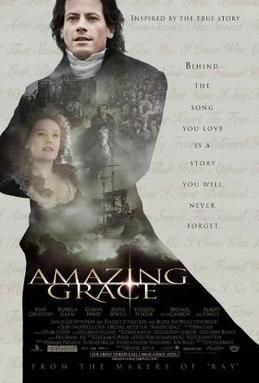
http://upload.wikimedia.org/wikipedia/en/8/87/Amazinggraceposter.jpg

Posted at The Corner:

This Really Is Amazing Grace!
By Michael Novak

Mark February 23 in your “must do” calendar. That is the opening in many theaters of Amazing Grace, which has an amazing script and amazing actors and actresses. The film is visually beautiful, moves very quickly (one of the most skillfully cut I have ever seen, jumping between years back and forth, in order to aid our understanding of the issues). The central battle at the spine of the movie takes place in the British Parliament over the hotly contentious issue of the abolition of slavery.


After decades of defeat and discouragement, William Wilberforce by a marvelous but uncharacteristic ruse, outfoxes the opposition, and gains his lifetime goal. In the process he falls in love – a bit obtusely – gets married, finds added inspiration and drive, has children, continues to fight, decade after decade.

He gathers evidence of the slave trade, witnesses, tales of the horror inside slave ships packed densely with as many as 600 young slaves from Africa chained to tiny cots, on voyages from which perhaps only 200 would emerge alive. Some were brutalized on the journey. All lived in their own cumulatively awful stench, chained away from latrines or places to wash, with no way to escape even for air. No way but death, after which they were thrown over the side – by the dozens.

Worse than animals was their treatment – at least animals would have been carefully treated, to keep them alive and in health.

Slowly, the people in England were awakened. Slowly the human conscience bit in, and courage grew to face the truth, and to do something definitive about it. The character of Sir William Pitt is especially brilliantly drawn, in a script as witty, playful, and humorous as it is full of suspense. The intelligence and character of William Wilberforce are rendered indirectly through the wit of his exchanges in the House of Commons, through his interactions with friends, through his daring and his discouragements. If you do not leave the theater feeling tears well up in your eyes, you have no heart. If you do not leave intellectually and visually far better informed, you have lost a part of your brain.

A truly exceptional film, I would love to take my grandchildren to it, and get every member of our far-flung family to put it on their lists for immediate viewing. This is a film that liberals as well as conservatives will love – it dramatizes something deep in each of their dreams of how brave men and women should behave, in respect to something they believe in as just and true and right.

http://home.earthlink.net/~jberthoud/Reagan%20&%20John%20Paul%20II.jpghttp://www.medaloffreedom.com/MargaretThatcher_RonaldReagan.jpg

From Macleans.ca:

When leaders showed courage

In this defeatist climate, it's a shock
to remember three who changed the world

MARK STEYN

"It feels like August," wrote the National Review's editor, Rich Lowry, about eight months after 9/11. August 2001, that is: he meant America's war on terror seemed to have lost its urgency and the "sleeping giant" appeared to be resuming his slumbers. Five years on, it's worse than that: it feels like the seventies.

Now as then, America seems less a sleeping giant than a helpless one, ensnared by Lilliputians and longing for release. Some Republicans distance themselves from the President's "surge" in Iraq, others dutifully string along with it, but without any great confidence it will make a difference. Democrats, meanwhile, are all but urging on defeat. Explicitly threatening to cut off funds for "Bush's war," Senator Ted Kennedy trotted out the old Vietnam "quagmire" analogies but added a new charge, bizarrely formulated: "In Vietnam," he recalled, "the White House grew increasingly obsessed with victory, and increasingly divorced from the will of the people and any rational policy."

"Obsessed with victory"? In the history of warfare, most parties have been "obsessed with victory" to one degree or another, ever since Caveman Ug first clubbed Caveman Glug. If you're not "obsessed with victory," you probably shouldn't have got into the war in the first place. It would be more accurate to say that Kennedy and his multiplying ilk are obsessed with defeat, and they're prepared to do what's necessary to help inflict it. The famous photographs of the departing choppers lifting off from the U.S. Embassy in Saigon with pleading locals clinging to the undercarriage are images not just of defeat but also of the betrayals necessary to accomplish it. "In reality," writes John O'Sullivan in his splendid new book The President, the Pope and the Prime Minister, "the betrayal was truer than the defeat. America had not been defeated on the battlefield and South Vietnamese ground forces had themselves defeated a full-scale North Vietnamese invasion in 1972 when they still enjoyed U.S. air support. Not only did the United States withhold such support in 1975, but Congress also refused to supply even the ammunition and military supplies that it had promised when the American forces left. For some perverse psychological motive, the American establishment acted as if the United States would not be genuinely free of involvement in Vietnam until its allies were conquered and occupied."

To be sure, not everyone was abandoned. The U.S. ambassador sportingly offered asylum to a former Cambodian prime minister, Sirik Matak. "I cannot, alas, leave in such a cowardly fashion," he replied. "I never believed for a moment that you would have this sentiment of abandoning a people which has chosen liberty." As O'Sullivan adds: "It was worse than that. In the final hours, America switched sides." Sirik Matak stayed in Phnom Penh and was murdered by the Khmer Rouge, but so were another 1.7 million people, and in a pile of skulls that high it's hard to remember this or that individual. Still, it's startling, given the appalling slaughter that arose in the wake of "peace," to find vulgar braggarts like John Kerry and Pinch Sulzberger (the New York Times publisher) still preening and congratulating themselves for their stance three decades later.

O'Sullivan's book is not about the seventies but about their antidote: Reagan, Thatcher and John Paul II. I ought to declare a slight interest: he and I have the same publisher. On the other hand, my book is concerned with the vast impersonal tide of humanity -- the demographic decline in Europe, Russia, China and Japan (and Canada), and the great surge of Islam, the millions of nonentities who cumulatively make up the numbers in the vital statistics databases. O'Sullivan comes at the big picture from the opposite end: a trio of decisive individuals who weren't swept along by the currents but instead, through sheer force of personality, stopped historical inevitability cold in its tracks.

He subtitles the book "Three Who Changed the World," and that's undeniable. What's more open to question by the end is whether the three "saved the world." Mrs. Thatcher's reign in particular is looking more and more like a magnificent interruption in Britain's bizarre remorseless self-dissolution: whether or not the British people were worthy of her efforts, her own wretched party certainly wasn't. The Conservatives' current leader, whose name escapes me, is a philosophically unmoored squish of almost parodic modishness who demonstrates political "courage" by boasting about how much of Thatcherism's core values he's willing to toss overboard. O'Sullivan thinks this a mere phase the Tory party is going through: "Once it recovers from its continuing nervous breakdown, it will surely set her next to Churchill in its pantheon." But it's not clear it ever will recover from its breakdown, which makes admission to its pantheon somewhat moot. As for the Pope, whatever his achievements in eastern Europe and beyond, in the Catholic heartland he was unable to halt the Church's long decline and the literally morbid self-absorption of post-Christian Europe.

And what of America? Of all three figures, Ronald Reagan, buoyant and optimistic, would seem to be the one most obviously in tune with his people. When I first read an advance copy of this book a week or two before America's mid-term elections, it was heroic and inspiring. Rereading it again a couple of months later, the early section on the seventies -- "The Nightmare Years," in O'Sullivan's admirably blunt designation -- now seems unnervingly topical. He puts a question mark after "The Decline Of The West?" but it was pretty much a given in those days. "The Carter administration," he declares, "was a post-American administration before the concept of post-Americanism had been invented . . . They assumed that the 'American century' had come to a premature end." It wasn't just that Carter was woefully inadequate to the challenge of the times but that his inadequacy was presented as a kind of moral virtue. His promise of a government "as good as the American people" is characteristic of the man both in its vanity and its casual slur of his predecessors. One line, from a commencement address at Notre Dame, captures the style: "We are now free of that inordinate fear of Communism which once led us to embrace any dictator who joined us in our fear." As O'Sullivan notes, that single sentence performs multiple tasks: it "exonerated the Soviets," "indicted the United States," and advertised a new hostility toward "unrespectable allies" who shared traditional views of the apparently non-existent Communist threat. The Carter administration was not homogenous: it was a freak-show coalition of sanctimonious narcissists committed to specious concepts of "global justice," sixties radicals reflexively attracted to whichever option conflicted most with America's interests, and foreign-policy "realists" who'd concluded that Soviet Communism was a permanent but stable feature of the global scene.

The realists were unreal on both counts: the Commies proved in the eighties not to be permanent, but in the seventies they were certainly profoundly destabilizing, gobbling up previously Anglo-American real estate across the planet from Vietnam to Aden to Grenada, and, through dupes like Trudeau, neutering much of the West under the euphemism of "détente." Reagan, Thatcher and the Pope refused to accept these "new realities." They were fighting not just foreign adversaries but the domestic conventional wisdom, too: when John Paul interrupted the Sandinistas' attempts to hijack a papal Mass in Managua by crying "Silencio!" and striding downstage to wave his crozier, it was surely more discomforting to Harold Pinter, John Kerry and Ortega's other Western groupies than to audiences in Latin America.

The single episode that symbolizes the repudiation of Carterian "malaise" is the Falklands War. To Moscow and the world, Carter had embodied the West as a smiling eunuch, a ditherer who belatedly dispatched the helicopters to Iran only to have them crash in the desert and sit by as cocky mullahs poked the corpses of U.S. servicemen on TV. Why would the toothless arthritic British lion prove any more formidable? But O'Sullivan reminds us not just of Mrs. Thatcher's determination to win the war, but of the demented pressure she faced in the wake of liberation to reward Argentina for its aggression -- to, in effect, give away her victory. "We were prepared to negotiate before," she said, "but not now. We have lost a lot of blood, and it's the best blood." Or as a British sergeant put it: "If they're worth fighting for, then they must be worth keeping."

He's right. Yet the unreal realpolitik cynics know the tactical price of everything but the strategic value of nothing. The Falklands were an itsy-bitsy colonial footnote, costly to win and hold. But, says O'Sullivan, "Thatcher saw that a much larger prize was at stake. To make a diplomatic retreat the climax of what had become a great national cause would have confirmed and perpetuated the dismal myth of postwar British decline." Instead, "victory produced what became known as the 'Falklands effect' -- a revival of British self-confidence across the board and of Britain's reputation internationally."

The Falklands wasn't just about the Falklands, any more than Iraq is about Iraq. In Congress today they're re-subscribing to the defeatist myths -- the invincibility of the insurgent, then Marxist, now Islamist, but plus ça change. This invaluable book reminds us that while threats come and go, the pathologies of free societies remain distressingly constant. It feels like the seventies, and it shouldn't.

http://www.hiandlomodern.com/IMAGES/BOOKS/faithofgraffiti.jpg
From The Claremont Review:

The Literary Tenor of the Times
By Mark Helprin

Posted January 26, 2007

Unable as usual to resist the absurd, the New York Times recently attempted to find and certify the best work of American fiction that appeared in the last quarter-century, and perhaps to dilute their unconscious embarrassment published a list of the runners-up. Asked to serve on the enormous panel of solons they had assembled for the purpose, I declined on the grounds that neither I nor just about anyone else has a sufficiently wide or deep knowledge of all that has been written in the period, and that even if we had, such a determination is impossible, especially at the hands of literary people who have intellectual debtors and creditors, protégés, and favorites (including, not least, themselves).

But suppose for a moment that reality is suspended and the perfectly disinterested judges, after considering various worthies, were left to decide which of Homer, Dante, and Shakespeare would fill the last slot in their list. Though they might make the choice, it would be meaningless. A meaningless decision, however, would be easy in the literary tenor of these times, which makes itself known not so much in works of fiction but in the vast apparatus that contains and to an alarming extent directs them.

One would have to have spent the last 40 years in a bathyscaphe to be unaware of the conventions, requirements, strictures, and demands that aggressively have (almost) monopolized the field. To anyone who reads, writes, or publishes, they are inescapable, the senseless, destructive, and cruel companions to a suicidal slide of culture, remarkable for the degree to which they are taken as palliatives and correctives rather than the acid that eats away the bone. After all, the addict views narcotics, the criminal his next score, and the lemming the open air beyond the cliff edge—as salvation.

And thus the literary tenor of the times is saturated above all with nihilism and its outrider, contempt; followed by politicization and its outrider, conformity. The first pair of abominations serves to dissolve the supple, living flesh of civilization—whether in blunt Leninist political combat hidden in the folds of academic relativism, or in the unbridled Satanic ravings of popular culture that society has lost the courage to dismiss outright. And the second pair of abominations serves to cast what remains after the dissolution into a slipshod orthodoxy as gray, hard, and dead as concrete.

Strangely enough, the enforcers and beneficiaries of this orthodoxy, which in spirit goes far beyond even the standard obeisances to race, sex, class, economics, and selected dogma in international relations and meteorology, think they are beleaguered revolutionaries. For example, in affirming his courage, Norman Mailer—everything he has done has been to affirm his courage, which perhaps one should not condemn in a man who bears such a strong physical resemblance to Mamie Eisenhower—pronounces that he has been a leftist all his life, something that in Manhattan and Brooklyn Heights may not be quite as dangerous as he hallucinates.

And yet politics themselves, of whatever coloration, are less damaging an intrusion upon the literary enterprise than the now deeply engraved notion that literature cannot escape them. Political discourse can be literature, as Pericles, Lincoln, and Churchill prove, but literature that is political discourse destroys itself, as history proves (pace the febrile tracts of tenured lunatics: Disguised Vaginal Narratives of the French & Indian War: The Hidden Meanings of Bernard de Con's Account of the Assault on Fort Ticonderoga—A Novel). Whereas great political writing, always primarily literary, is equipped to transcend the causes and contentions of the day, a literary work that rests upon a political cause will follow it into oblivion. Lincoln and Churchill infused politics with the higher truths to which literature is the handmaiden, but the modern convention excludes these truths by subordinating literature to politics.

One seldom encounters pure nihilism, for just as anarchists are usually very well-organized, most of what passes for nihilism is a compromise with advocacy. Present literary forms may spurn the individual, emotion, beauty, sacrifice, love, and truth, but they energetically embrace the collective, coldness of feeling, ugliness, self-assertion, contempt, and disbelief. And why? Simply because the acolytes of modernism are terribly and justly afraid. They fear that if they do not display their cynicism they will be taken for fools. They fear that if they commit to and uphold something outside the puppet channels of orthodoxy they will be mocked, that if they are open they will be attacked, that if they appreciate that which is simple and good they will foolishly have overlooked its occult corruptions, that if they stand they will be struck down, that if they love they will lose, and that if they live they will die.

As surely they will. And others of their fears are legitimate as well, so they withdraw from engagement and risk into what they believe is the safety of cynicism and mockery. The sum of their engagement is to show that they are disengaged, and they have built an elaborate edifice, which now casts a shadow over every facet of civilization, for the purpose of representing their cowardice as wisdom. Mainly to protect themselves, they write coldly, cruelly, and as if nothing matters.

But life is short, and things do matter, often more than the human heart can bear. This is an elemental truth that neither temporarily victorious nihilism, nor fashion, nor cowardice can long suppress, which is why the literary tenor of the times cannot and will not last. And which is one reason among many why one must not accept its dictates or write according to its conventions. These must and will fall, for they are subject to constant pressure as generation after generation rises in unprompted affirmation of human nature. And though perhaps none living may see the change, it is an honor to predict and await it.

Mark Helprin, whose novels include Winter's Tale, A Soldier of the Great War and Freddy and Fredericka, is a senior fellow of the Claremont Institute.
Wheaties Honors UNC Basketball
By J.B. Cissell
Inside Carolina

CHAPEL HILL, N.C.--Wheaties, the cereal also known as "The Breakfast of Champions" has chosen to honor the tradition of one of college basketball's greatest programs.


Wheaties wishes to honor the five-time national basketball champions with an interlocking "NC" logo over the backdrop of the home court in the Dean E. Smith Center. Additionally, the Tar Heels have won 15 ACC Tournament Championships in producing some of most gifted players and incredible moments in sports history.

The back of the box displays an image of the team cutting the net from the rim after a victory along with the school mascot.

"It is a treamendous honor and compliment for the Carolina Basketball program to become a part of history with Wheaties," said Director of Athletics Dick Baddour. "The front of the Wheaties Box is an American Icon. We are proud to be displayed on the cover and appreciate the Wheaties recognition of Carolina Basketball's success."

The 18-ounce Wheaties package is now available regionally, mostly concentrated in North Carolina, with no predetermined number of units or time frame of distribution.

"It's an honor and a privilege to feature the men's basketball program on this special-edition Breakfast of Champions package," said Dan Stangler, Wheaties brand manager. "Bringing two championship traditions like those of Wheaties and UNC together in this unique manner is undoubtedly a proud moment for us."

Wednesday, January 31, 2007


Bush Priorities

This clown of a President makes time to get to the Stock Exchange,
but not to attend the dedication of a rehab facility for the soldiers
he is responsible for sending on his fool's errand to be mutilated .

U.S. President George W. Bush visits traders on the floor of the New York Stock Exchange (NYSE) January 31, 2007 in New York City. Bush visited the city to give a speech on the economy.

U.S. President George W. Bush visits traders
on the floor of the New York Stock Exchange (NYSE)
January 31, 2007 in New York City.

U.S. Marine Chief Warrant Officer Brian Dix salutes soldiers wounded during the Iraq war as they arrive at the Center for the Intrepid in San Antonio. (Eric Gay, Associated Press)
Eric Gay, Associated Press

U.S. Marine Chief Warrant
Officer Brian Dix salutes soldiers wounded during the Iraq war as they arrive at the Center for the Intrepid in San Antonio.


From Cox and Forkum:


Foul Weather

07.01.25.FoulWeather-X.gif

From FOX News:

Storm Hits Weather Community Over Climate Expert's Global Warming Claims.

The Weather Channel is standing by a climatologist who is taking some heat after blogging that TV weather forecasters skeptical about man-made global warming theories should lose their professional certification.

Climate expert Heidi Cullen defended herself last week in The Weather Channel's One Degree Climate Change blog after questioning the fitness of meteorologists who disagree with her conclusions. ...

Cullen raised Cain last month when she suggested that the American Meteorological Society decertify meteorologists who don't warn about climate change.

"If a meteorologist has an AMS Seal of Approval, which is used to confer legitimacy to TV meteorologists, then meteorologists have a responsibility to truly educate themselves on the science of global warming," Cullen wrote in the blog. "If a meteorologist can't speak to the fundamental science of climate change, then maybe the AMS shouldn't give them a seal of approval." ...

According to a statement by the AMS, the society agrees with Cullen on the science of global warming, if not the certification of its approved meteorologists. ...

But James Spann, chief meteorologist for ABC 33/40 in Alabama, who has been in operational meteorology since 1978, said Cullen is wading into dangerous waters when it comes to judging her colleagues.

"I do not know of a single TV meteorologist who buys into the man-made global warming hype. I know there must be a few out there, but I can’t find them," Spann said on his blog. "I have nothing against 'The Weather Channel,' but they have crossed the line into a political and cultural region where I simply won’t go."

From Reuters: Global warming dissenters few at U.S. weather meeting.

Joe D'Aleo was a rare voice of dissent this week at the American Meteorological Society's annual meeting in San Antonio.

D'Aleo, executive director of the International Climate and Environmental Change Assessment Project, a group of scientists, doesn't think greenhouse gas emissions are the major cause of global warming and climate change.

Researchers who hold such contrary views do not appreciate being lumped together with flat-Earthers. They are legitimate scientists who question the mainstream, but they are a distinct minority.

"Greenhouse warming is real, but I think it is a relatively minor player," D'Aleo said.

He claims other factors like solar activity and other natural causes are probably playing a greater role in rising temperatures -- a position that gets a mostly chilly reception from this crowd. ...

"I think there's virtually no doubt that humans are a major player in warming the globe," said Robert Henson, author of the recently published "The Rough Guide to Climate Change."

"There are still people out there who will contradict that, but they are not part of the scientific mainstream," he said.

The dissenters would say that is the point: portraying them as the wild-eyed fringe or lackeys of oil companies makes even legitimate questioning seem less credible.

From CNN: 'Smoking gun' report to say global warming here.

Human-caused global warming is here -- visible in the air, water and melting ice -- and is destined to get much worse in the future, an authoritative global scientific report will warn next week. ...

Andrew Weaver, a Canadian climate scientist and study co-author, went even further: "This isn't a smoking gun; climate is a batallion of intergalactic smoking missiles." ...

That report will feature an "explosion of new data" on observations of current global warming, [said Susan] Solomon [a senior scientist for the U.S. National Oceanic and Atmospheric Administration].

Even the global warming data is exploding! Some believers in man-made global warming are finally becoming concerned about the hype. From Houston Chronicle: Climate scientists feeling the heat.

Scientists long have issued the warnings: The modern world's appetite for cars, air conditioning and cheap, fossil-fuel energy spews billions of tons of carbon dioxide into the atmosphere, unnaturally warming the world.

Yet, it took the dramatic images of a hurricane overtaking New Orleans and searing heat last summer to finally trigger widespread public concern on the issue of global warming.

Climate scientists might be expected to bask in the spotlight after their decades of toil. The general public now cares about greenhouse gases, and with a new Democratic-led Congress, federal action on climate change may be at hand.

Problem is, global warming may not have caused Hurricane Katrina, and last summer's heat waves were equaled and, in many cases, surpassed by heat in the 1930s.

In their efforts to capture the public's attention, then, have climate scientists oversold global warming? It's probably not a majority view, but a few climate scientists are beginning to question whether some dire predictions push the science too far.

"Some of us are wondering if we have created a monster," says Kevin Vranes, a climate scientist at the University of Colorado.

It's appears Al Gore is feeling some heat, too. He recently dodged an interview with journalist Flemming Rose and Bjorn Lomborg. From The Wall Street Journal: Will Al Gore Melt?.

[I]f we are to follow Mr. Gore's suggestions of radically changing our way of life, the costs are not trivial. If we slowly change our greenhouse gas emissions over the coming century, the U.N. actually estimates that we will live in a warmer but immensely richer world. However, the U.N. Climate Panel suggests that if we follow Al Gore's path down toward an environmentally obsessed society, it will have big consequences for the world, not least its poor. In the year 2100, Mr. Gore will have left the average person 30% poorer, and thus less able to handle many of the problems we will face, climate change or no climate change.

Clearly we need to ask hard questions. Is Mr. Gore's world a worthwhile sacrifice? But it seems that critical questions are out of the question.

Speaking of environmentalists leaving the poor poorer, a documentary about the European mining industry was recently released, and it looks excellent. It's called Mine Your Own Business, and you can view the trailer here. If you happen to live in the Los Angeles area, the UCLA Club LOGIC will be screening the film on January 31 with the filmmakers present for a Q&A session (click here for details). Here's a review of the film.

UPDATE -- Jan. 26: "Dissenters Blown Off" turns out to be mild compared to what some are calling for: NUREMBERG-STYLE TRIALS PROPOSED FOR GLOBAL WARMING SKEPTICS. (hat tip Chris Davis)

[David] Roberts wrote in the online publication [Grist] on September 19, 2006, "When we've finally gotten serious about global warming, when the impacts are really hitting us and we're in a full worldwide scramble to minimize the damage, we should have war crimes trials for these bastards -- some sort of climate Nuremberg. ...

The use of Holocaust terminology has drawn the ire of Roger Pielke, Jr. of the University of Colorado's Center for Science and Technology Policy Research. “The phrase ‘climate change denier’ is meant to be evocative of the phrase ‘holocaust denier,’” Pielke, Jr. wrote on October 9, 2006.

“Let's be blunt. This allusion is an affront to those who suffered and died in the Holocaust. This allusion has no place in the discourse on climate change. I say this as someone fully convinced of a significant human role in the behavior of the climate system,” Pielke, Jr. explained.

Posted by Forkum at 05:34 PM / Permalink


Tuesday, January 30, 2007

The image “http://www.baseball-almanac.com/players/pics/roger_maris_autograph.jpg” cannot be displayed, because it contains errors.

Roger Maris and Me

I grew up in the shadow of Yankee Stadium and just fell in love with baseball.

When Roger Maris came to the New York Yankees from the Kansas City Athletics in 1960, I was eleven. I had been burned in a fire in August, so I was laid up for a while and followed baseball even more closely. I remember a headline that said Roger Maris "rejuvenates" the Yankees. I had never heard the word before, but it made me think this Roger Maris was someone special.

For me, there was something about the way he swung the bat, the way he played right field and the way he looked. I had an idol. In 1961 the entire country was wrapped up in the home-run race between Maris and Mickey Mantle and Babe Ruth's ghost. I cut out every single article on Roger and told myself that when I got older and could afford it, I would have my scrapbooks professionally bound. (Eight years ago I had all of them bound into eleven volumes.)

I usually sat in Section 31, Row 162-A, Seat 1 in Yankee Stadium. Right field. I would buy a general admission ticket, but I knew the policeman, so I would switch over to the reserved seats, and that one was frequently empty.

I'd get to the stadium about two hours before it opened. I would see Roger park his car, and I would say hello and tell him what a big fan I was. After a while, he started to notice me. One day he threw me a baseball during batting practice, and I was so stunned I couldn't lift my arms. Somebody else got the ball. So Roger spoke to Phil Linz, a utility infielder, and Linz came over, took a ball out of his pocket and said, "Put out your hand. This is from Roger Maris."

After that, my friends kept pushing me: "Why don't you ask him for one of his home-run bats?" Finally, when Roger was standing by the fence, I made the request. He said, "Sure. Next time I break one."

This was in 1965. The Yankees had a West Coast trip, and I was listening to their game against the Los Angeles Angels on the radio late one night, in bed, with the lights out. And Roger cracked a bat. Next morning my high school friend called me, "Did you hear Roger cracked his bat? That's your bat."

I said, "We'll see."

When the club came back to town, my friend and I went to the stadium, and during batting practice Rog walked straight over to me and said, "I've got that bat for you."

I said, "Oh, my God, I can't thank you enough."

Before the game, I went to the dugout. I stepped up to the great big policeman stationed there and poured my heart out: "You have to understand, please understand, Roger Maris told me to come here, I was supposed to pick up a bat, it's the most important thing, I wouldn't fool you, I'm not trying to pull the wool over your eyes, you gotta let me...."

" No problem. Stand over here." He knew I was telling the truth. I waited in the box-seat area to the left of the dugout, pacing and fidgeting. Then, just before game time, I couldn't stand it anymore. I hung over the rail and looked down the dimly lit ramp to the locker room, waiting for Rog to appear. When I saw him walking up the runway with a bat in his hand, I was so excited I almost fell. I don't know what he thought, seeing a kid hanging upside down, but when he handed me the bat, it was one of the most incredible moments in my young life.

I brought the bat home, and my friends said, "Now why don't you ask him for one of his home-run baseballs?"

So I asked Roger, and he said, "You're gonna have to catch one, 'cause I don't have any."

Maris was traded to the St. Louis Cardinals on December 8, 1966-a dark day for me. That year, I went off to college at the University of Akron, in Ohio. My roommate had a picture of Raquel Welch on his wall, and I had a picture of Roger Maris.

Everyone knew I was a big Maris fan. My friends said, "You say you know Roger Maris. Let's just go see." So six of us drove two and one-half hours to Pittsburgh to see the Cardinals play the Pirates. It was May 9, 1967. We got to Forbes Field two hours before the game, and there was No. 9. It was the first time I had ever seen Roger Maris outside of Yankee Stadium, and I figured he wouldn't know me in this setting. I was very nervous. Extremely nervous, because I had five guys with me. I went down to the fence, and my voice quavered: "Ah,... Roger."

He turned and said, "Andy Strasberg, what the hell are you doing in Pittsburgh?"

That was the first time I knew he knew my name. "Well, Rog, these guys from my college wanted to meet you, and I just wanted to say hello." The five of them paraded by and shook hands, and they couldn't believe it. I wished Rog good luck and he said, "Wait a minute. I want to give you an autograph on a National League ball." And he went into the dugout and got a ball and signed it. I put it in my pocket and felt like a million dollars.

In 1968, I flew to St. Louis to see Roger's last regular-season game. I got very emotional watching the proceedings at the end of the game. I was sitting behind the dugout, and Rog must have seen me because he later popped his head out and winked. It touched my heart. I was interviewed by the Sporting News, who found out I had made that trip from New York City expressly to see Roger retire. The reporter later asked Maris about me, and Roger said, "Andy Strasberg was probably my most faithful fan."

We started exchanging Christmas cards, and the relationship grew. I graduated from college and traveled the country looking for a job in baseball. When the San Diego Padres hired me, Roger wrote me a nice note of congratulations.

I got married in 1976 at home plate at Jack Murphy Stadium in San Diego. Rog and his wife, Pat, sent us a wedding gift, and we talked on the phone once or twice a year. In 1980, Roger and Pat were in Los Angeles for the All-Star Game, and that night we went out for dinner-my wife Patti, me, my dad, Roger and Pat.

When Roger died of lymphatic cancer in December 1985, I attended the funeral in Fargo, North Dakota. After the ceremony, I went to Pat and told her how sorry I felt. She hugged me, and then turned to her six children. "I want to introduce someone really special. Kids, this is Andy Strasberg." And Roger Maris Jr. said, "You're Dad's number-one fan."

There is a special relationship between fans-especially kids-and their heroes that can be almost mystical. Like that time my five college buddies and I traveled to Pittsburgh to see Roger. It's so real to me even today, yet back then it seemed like a dream.

I'm superstitious when it comes to baseball. That day I sat in Row 9, Seat 9, out in right field. In the sixth inning Roger came up to the plate and, moments later, connected solidly.

We all-my friends and I-reacted instantly to the crack of the bat. You could tell it was a homer from the solid, clean sound, and then we saw the ball flying in a rising arc like a shot fired from a cannon. Suddenly everyone realized it was heading in our direction. We all leaped to our feet, screaming, jostling for position. But I saw everything as if in slow motion; the ball came towards me like a bird about to light on a branch. I reached for it and it landed right in my hands.

It's the most amazing thing that will ever happen in my life. This was Roger's first National League home run, and I caught the ball. Tears rolled down my face. Roger came running out at the end of the inning and said, "I can't believe it." I said, "You can't? I can't!"

The chances of No. 9 hitting a home-run ball to Row 9, Seat 9 in right field on May 9, the only day I ever visited the ballpark, are almost infinitely remote. I can only explain it by saying it's magic-something that happens every so often between a fan and his hero. Something wonderful.

[AUTHOR'S NOTE: On August 3, 1990, I received a phone call from Roger's son Randy and his wife Fran. They were calling from a hospital in Gainesville, Florida. Fran had just given birth to their first son. Fran and Randy wanted me to know that they named their son Andrew and asked i f I would be his godfather. To this day I still can't believe that the grandson o f my childhood hero Roger Maris is my namesake and my godson.]

Andy Strasberg

Roger Maris and Me. Reprinted by permission of Andy Strasberg. © 2000 Andy Strasberg
Tony Dungy and Lovey Smith
Pillars of Gentle Strength


By Michelle Kaufman
Miami Herald
FINALLY: Tony Dungy holds the Lamar Hunt Trophy after the Colts reached the Super Bowl.
MICHAEL CONROY/AP
FINALLY: Tony Dungy holds the Lamar Hunt Trophy after the Colts reached the Super Bowl.

Much will be made of the skin color of the two Super Bowl XLI coaches, and certainly, it is historically significant that Chicago's Lovie Smith and Indianapolis' Tony Dungy are the first black coaches to reach the grandest NFL stage. Their names forever will be linked because of the barrier they broke together.

But the more you learn about these two men, the more it becomes apparent their close friendship stems from something far deeper than race -- their convictions. Both are devout Christians who don't drink or curse.

Rather than belittle players with profanity-laced tirades on the sidelines, they shoot a stare that delivers the message loud and clear.

The worst you'll get out of Smith is ''Jiminy Christmas!'' and that's only when he's really mad. Dungy's former NFL teammates lost a lot of money on bets trying to make him swear, and he has considered leaving coaching for a career in prison ministry.

Both men insist on making room for family and faith in the violent and narcissistic world of pro football. They suffered through tragedies with their sons, and were reminded to embrace life beyond the sideline. Dungy's son James committed suicide at age 18 in December 2005. In his eulogy at the jam-packed Idlewild Baptist Church outside Tampa, Dungy said: ``I urge you not to take your relations for granted. Parents, hug your kids each chance you get. Tell them you love them each chance you get. You don't know when it's going to be the last time.''

Smith's scary moments with his two sons were more private. In 1988, while he was an assistant at Arizona State, his then-toddler son, Matthew, fell into a pool and nearly drowned. Smith jumped in and dragged his son out, and Smith's wife MaryAnne performed CPR until the paramedics arrived. In 2000, his son Mikal, now 30, was diagnosed with a slow-growing brain tumor doctors continue to monitor.

`PILLARS OF STRENGTH'

''The thing about my dad and Coach Dungy that I'm most proud of is that they showed you can get to the Super Bowl by being soft-spoken and treating people with respect,'' said Mikal Smith, who just completed his first year as an assistant coach at Trinity College in Illinois. ``It doesn't mean they're soft people. They're both pillars of strength. They proved good things happen to good people in due time.''

Dungy, who gave Smith his first NFL job with the Tampa Bay Buccaneers in 1996, said: ``I'm so happy that Lovie got [to the Super Bowl] because he does things the right way. He's going to get there with a lot of class, no profanity, no intimidation, but just helping his guys play the best that they can. That's the way I try to do it, and I think it's great that we're able to show the world not only that African-American coaches can do it, but Christian coaches can do it in a way that, you know, we can still win.''

DIFFERENT PATHS

They took wildly different paths but wound up in the same place -- the pinnacle of their profession.

Smith, 48, was raised in Big Sandy, a two-stoplight East Texas town best known as the needlepoint mecca of the South. His mother Mae worked at a lawn furniture factory, and his father Thurman battled alcoholism much of his life but spent his final years sober and was close to Lovie, who was named after his Aunt Lavana. Mae is still alive, but diabetes stole her eyesight. She listens to Bears games on the radio and will be at Dolphin Stadium next Sunday to soak in the sounds of her son's historic game.

Smith played defensive end and linebacker in high school, earning pocket change by baling hay for three cents per 40-pound bale.

Dungy, 51, was born in Jackson, Mich., to a pair of educators -- his father Wilbur a physiology professor, his mother Cleomae a high school English teacher. Academics were priority No. 1 in the Dungy household, and it apparently paid off. Dungy's brother is a dentist, one sister is a nurse and another is an obstetrician.

Dungy, a high school quarterback, went on to set all sorts of passing records at the University of Minnesota from 1973-76. He was known as a cerebral player who loved to dissect film with coaches. He wasn't big and didn't have a particularly good arm, so he was passed over in the NFL draft. But he signed as a free agent with Pittsburgh, was converted to defensive back, and became part of the famed ''Steel Curtain'' unit of the late 1970s. He retired in 1980.

It was right about that time Smith completed his career at the University of Tulsa, where he was a two-time All-American linebacker. He went back to Big Sandy to coach his high school team. In 1983, became a coach at Tulsa, then made several other college stops before 1996, when he was introduced to Dungy.

Dungy's coaching career began at 25, as an assistant at the University of Minnesota. Before long, he had been hired by the Steelers, and in 1984 he became the first black defensive coordinator in NFL history.

He was one of the most respected assistants in the league for more than a decade, and finally, in 1996, he was given the top job by the struggling Buccaneers.

EMPHASIS ON TEACHING

In assembling his staff, he made it clear he wanted ''teachers,'' and several Bucs scouts recommended Smith, a first-year assistant at Ohio State. Dungy interviewed Smith at the NFL combine in Indianapolis and knew almost instantly that he had found his man.

''After about 15 minutes with Lovie, he showed he had a command of the game . . . but not in a know-it-all, come across the wrong way,'' Dungy said. ``I knew he'd be sharp and a guy players would gravitate to. It didn't take us long to know he was going to be really, really good.''

FAST FRIENDSHIP

Bears general manager Jerry Angelo, who made Smith his head coach in 2004, was the Bucs' director of player personnel when Dungy was hired in 1996, and he is not surprised Dungy and Smith became fast friends.

''Tony and Lovie are very similar in terms of character, and . . . you'd have to really know both men well to realize that they do have some different personality traits,'' Angelo said. ``Lovie shows his emotion a little bit more than Tony, but otherwise, they are very much alike.''

Dungy wound up putting together an all-star coaching staff: Herman Edwards went on to become head coach of the New York Jets and now Kansas City; Rod Marinelli is head man at Detroit; Mike Tomlin was just named coach at Pittsburgh.

Jack Oliver, a pastor at Idlewild Baptist Church, got to know Dungy well during his Tampa Bay days.

``If I had to pick one word to describe Tony Dungy, I'd use Christ-like, and by that I mean he always thinks of others first and he lives what he believes. He is such a humble man, despite his success and fame. He'd come and sit in Bible class Wednesday nights just like anyone else. He is proof that nice guys do finish first.''

CELEBRATING SUCCESS

Two weeks ago, Smith and his wife made the three-hour trip from Chicago to Indianapolis to watch Dungy's Colts face Edwards' Chiefs in a playoff game. The coaches and their wives had dinner at a Chinese restaurant, reminisced about old times in Tampa, and celebrated their successes.

''My dream was for Tony Dungy to get to the Super Bowl, and that dream was fulfilled,'' Smith said. ``I owe a lot to him, and I know that. He gave me a chance.''

Dungy and Smith have also paved the way for minority coaches, like the Washington Redskins' Doug Williams did when he became the first black quarterback to play in the Super Bowl, back in 1988.

LEADING THE WAY

''I think about my generation of kids, who watched Super Bowls, never really saw African-American coaches and didn't necessarily think about the fact that you could be the coach,'' Dungy said. ``You could be a player. You couldn't necessarily be the quarterback. Then we saw Doug Williams play and win, and guys a little bit younger than me all of a sudden felt they could be a quarterback. Now you see Donovan McNabb and Michael Vick, guys like that, because of what Doug did.

'And hopefully, young kids now will say, `Hey, I might be the coach one day.' So that's special.''