Friday, September 12, 2008

http://www.israpundit.com/2007/wp-content/uploads/2007/10/obama.bmp
From The Times:
Barack Obama the speechmaker is being rumbled
There is a yawning gulf between what the
Democratic candidate says and how he has acted.
That's why the race is so close
Gerard Baker

September 12, 2008

It's funny how the harder you look at something, the harder it can be to understand it. I can't recall a US presidential election that has attracted more attention. But neither can there have been a time when the world has watched what goes on in America with the nonplussed, horrified incomprehension it has now.

Travelling in Britain this week, I've been asked repeatedly by close followers of US politics if it can really be true that Barack Obama might not win. Thoughtful people cannot get their head around the idea that Mr Obama, exciting new pilot of change, supported by Joseph Biden, experienced navigator of the swamplands of Washington politics, could possibly be defeated.

They look upon John McCain and Sarah Palin and see something out of hag-ridden history: the wizened old warrior, obsessed with finding enemies in every corner of the globe, marching in lockstep with the crackpot, mooseburger-chomping mother from the wilds of Alaska, rifle in one hand, Bible in the other, smiting caribou and conventional science as she goes.

Two patronising explanations are adduced to explain why Americans are going wrong. The first is racism. I've dealt with this before and it has acquired no more merit. White supremacists haven't been big on Democratic candidates, whatever their colour, for a long time, and Mr Obama's race is as likely to generate enthusiasm among blacks and young voters as it is hostility among racists.

In a similarly condescending account, those foolish saps are being conned into voting for Mr McCain because they like his running-mate. Her hockey-mom charm and storybook career appeals to their worst instincts. The race is boiling down to a beauty contest in which a former beauty queen is stealing the show. Believe this if it helps you come to terms with the possibility of a Democratic defeat. But there really are better explanations.

One is a simple political-cultural one. This election is a struggle between the followers of American exceptionalism and the supporters of global universalism. Democrats are more eager than ever to align the US with the rest of the Western world, especially Europe. This is true not just in terms of a commitment to multilateral diplomacy that would restore the United Nations to its rightful place as arbiter of international justice. It is also reflected in the type of place they'd like America to be - a country with higher taxes, more business regulation, a much larger welfare safety net and universal health insurance. The Republicans, who still believe America should follow the beat of its own drum, are pretty much against all of that.

You can argue the merits of each case. But let me try to explain to my fellow non-Americans why Mr Obama's problems go well beyond that. Even if you think that Americans should want to turn their country into a European-style system, there is a perfectly good reason that you might have grave doubts about Mr Obama.

The essential problem coming to light is a profound disconnect between the Barack Obama of the candidate's speeches, and the Barack Obama who has actually been in politics for the past decade or so.

Speechmaker Obama has built his campaign on the promise of reform, the need to change the culture of American political life, to take on the special interests that undermine government's effectiveness and erode trust in the system itself,

Politician Obama rose through a Chicago machine that is notoriously the most corrupt in the country. As David Freddoso writes in a brilliantly cogent and measured book, The Case Against Barack Obama, the angel of deliverance from the old politics functioned like an old-time Democratic pol in Illinois. He refused repeatedly to side with those lonely voices that sought to challenge the old corrupt ways of the ruling party.

Speechmaker Obama talks about an era of bipartisanship, He speaks powerfully about the destructive politics of red and blue states.

Politician Obama has toed his party's line more reliably than almost any other Democrat in US politics. He has a near-perfect record of voting with his side. He has the most solidly left-wing voting history in the Senate. His one act of bipartisanship, a transparency bill co-sponsored with a Republican senator, was backed by everybody on both sides of the aisle. He has never challenged his party's line on any issue of substance.

Speechmaker Obama talks a lot about finding ways to move beyond the bloody battlegrounds of the “culture wars” in America; the urgent need to establish consensus on the emotive issue of abortion.

Politician Obama's support for abortion rights is the most extreme of any Democratic senator. In the Illinois legislature he refused to join Democrats and Republicans in supporting a Bill that would require doctors to provide medical care for babies who survived abortions. No one in the Senate - not the arch feminist Hillary Clinton nor the superliberal Edward Kennedy - opposed this same humane measure.

Here's the real problem with Mr Obama: the jarring gap between his promises of change and his status quo performance. There are just too many contradictions between the eloquent poetry of the man's stirring rhetoric and the dull, familiar prose of his political record.

It's been remarked that the biggest difference between Americans and Europeans is religion: ignorant Americans cling to faith; enlightened Europeans long ago embraced the liberating power of reason. Yet here's an odd thing about this election. Europeans are asking Americans to take a leap of faith, to break the chains of empiricism and embrace the possibility of the imagination.

The fact is that a vote for Mr Obama demands uncritical subservience to the irrational, anti-empirical proposition that the past holds no clues about the future, that promise is wholly detached from experience. The second-greatest story ever told, perhaps.

Thursday, September 11, 2008

McCain believes America was an innocent victim of Islamic terrorism.

From The New York Post:
THE LESSONS OF 9/11

By AMIR TAHERI

September 11, 2008 --

TODAY's joint visit to Ground Zero may give the impression that John McCain and Barack Obama share a common analysis of the causes of 9/11 and how to deal with its legacy. They don't.

The divide starts with the question: Why was America attacked?

McCain's answer is simple (or, as Obama might suggest, simplistic): The United States was attacked because a resurgent Islam has produced a radicalism that dreams of world conquest and sees America as the enemy.

In different shapes and sizes and under a range of labels, that radical streak of Islam has waged war on America since 1979, when Khomeinists seized the US embassy in Tehran and held its diplomats hostage for 444 days.

The killing of 241 Marines in Beirut in 1983, the first World Trade Center attack in 1993 and a host of other operations that claimed more American lives were episodes in a war - the reality of which the United States faced only after 9/11.

McCain doesn't hesitate to acknowledge that his country is engaged in a Global War on Terror. He doesn't believe that 9/11 might've been prompted by some wrong America did to others. To him, the nation was an innocent victim of "Islamic terrorism."

McCain asserts, "America faces a dedicated, focused and intelligent foe in the War on Terrorism. This enemy will probe to find America's weaknesses and strike against them. The United States cannot afford to be complacent about the threat, naive about terrorist intentions, unrealistic about their capabilities, or ignorant to our national vulnerabilities."

He'd pursue and fight these "enemies" wherever they are - including, especially, in Iraq. "If we run away," he says, "they are going to follow us home."

OBAMA, by contrast, doesn't use terms such as "the Global War on Terror" or "Islamic terrorism." Nor does he claim that America was simply an innocent victim.

In one speech, he used the image of a US helicopter flying over the poor countries in Africa and Asia, where it's seen as a symbol of oppression. He says his objective is to turn that helicopter into a symbol of American aid to the downtrodden.

For Obama, the threat comes not from terrorists but from "extremists" and their "program of hate." He never uses such terms as "jihadist," judging them hurtful to Muslims. He speaks of "violent extremists who are a small minority of the world's 1.3 billion Muslims."

In one speech, he claimed that the Islamists aim only at "creating a repressive caliphate." He seemingly hasn't heard of jihadist movements whose declared aim is to destroy the United States in the name of Islam.

For McCain, the War on Terror is a "just war" in which Americans fight for their security and their allies'. Obama rejects the concept of "just war." He dismisses the Iraq war as both "unnecessary and unjust" - though the struggle in Afghanistan is "a necessary war."

ONE constant Obama theme is the claim that poverty and economic factors breed terrorism; this echoes the analysis of Jimmy Carter back in the '70s. Strengthening that impression is Obama's pick of Sen. Joseph Biden as running mate.

Biden denies there's a War on Terror in the first place or that the United States even knows whom it's fighting. He has declared that "terrorism is a means, not an end, and very different groups and countries are using it toward very different goals. If we can't even identify the enemy or describe the war we're fighting, it's difficult to see how we will win."

While McCain puts the emphasis on hard power - that is, on meeting and defeating the enemy on the battlefield - Obama, echoing Carter and Bill Clinton, promises a greater use of soft power.

He plans to double US foreign aid to $50 billion a year, allocate a further $20 billion to offering "alternatives to madrassa education" in Muslim countries, provide Afghanistan with another $1 billion a year in support and spend $5 billion on a "Shared Security Partnership Program" with foreign governments.

And he promises to "bolster our ability to speak different languages and understand different cultures" - as if America's unique cultural spectrum didn't already include large numbers of speakers of every living language, with millions of immigrants each year. Sorry: The nation was not attacked because Americans don't speak Arabic or don't understand Saudi or Egyptian cultures.

Obama also says he'll open "America Houses" in Muslim capitals. These would be community centers with libraries, Internet cafes and English-language classes. Has he considered the possibility that these might become prime targets for terrorists?

Plus, he'd set up an "America's Voice Corps," which would recruit and train thousands of young Americans to go to Muslim countries to explain "American values" and, in return, "listen to Islamic voices."

More important, perhaps, Obama promises to attend "a significant Islamic forum" (presumably, the summit of the Organization of the Islamic Conference) within his first 100 days in the White House. He believes that the magic of his eloquence might do what America's hard power has failed to achieve. In an early version of this idea, Obama wanted to invite all Muslim heads of state to a Washington summit. He doesn't realize that this would endorse the claim that Islam merits a special treatment even in international relations.

ONE might expect Obama to be more convincing on Afghanistan, his pet war. Yet all we get is a promise to increase aid - despite the fact that the Afghan economy hasn't been able to absorb the $20 billion pledged since 2002. He would also send in two more combat brigades - precisely the number that other NATO allies were supposed to supply by next January. (President Bush just announced that, from now until January, he'll be sending an even larger reinforcement to Afghanistan.)

The Democratic platform's section on foreign policy contains several references to "restoring American leadership." When it comes to tough issues, however, we're told that "the world must do" this or that.

An example: "The world must prevent Iran from acquiring nuclear weapons." What if that abstract entity, "the world," of which Obama once claimed to be a citizen, fails to do so? Obama's answer is "tougher sanctions and aggressive, principled and direct high-level diplomacy without preconditions."

He promises to talk to all the "bad guys," including the Khomeinist leaders in Tehran. He ignores the fact that successive US administrations, from Carter to George W. Bush, have talked to the mullahs - so far to no avail. He also forgets that then-Secretary of State Colin Powell traveled to Syria and was rewarded with a series of political murders of US friends in Lebanon.

The platform's Middle East section promises to "stand with allies and pursue diplomacy." Apart from Israel, however, we're never told who those "allies" are.

While Bush fixed the creation of two states, a Palestinian one besides Israel, as the aim of his strategy, Obama takes a step back by claiming merely that the US should "lead the efforts to build the road to a secure and lasting peace."

HE also abandons Bush's mes sage of democratization in the Middle East as the long-term weapon against terrorism and strengthens the fiction that the Palestinian issue is the region's main, if not the sole, problem.

In fact, despotism may be the more important issue. Yet Obama sneers at the elections held in Iraq, Afghanistan and several other Muslim nations thanks to US encouragement and pressure. He would leave America without a core message in the Middle East.

McCain believes that America is at war; Obama doesn't. McCain believes the United States can win on the battlefield; Obama doesn't.

For Obama, the problem is one of effective law enforcement. His model is the way Clinton handled the first attack on World Trade Center in 1993. Obama says: "We are able to arrest those responsible, put them on trial." This means the United States reacting after being attacked.

McCain, however, doesn't fear the politically incorrect term "pre-emption" - hitting the enemy before he hits you.

WHEN all is said and done, this election may well have only one big issue: the existential threat that Islamist terrorism poses to America's safety. Since McCain and Obama offer radically different policies for facing that threat, American voters do have a real choice.

Wednesday, September 10, 2008

The image “http://abcnews.go.com/images/Politics/comic_strip_4.jpg” cannot be displayed, because it contains errors.
From ABCNews.com:
In a Not-Remotely-Comic Strip,

Bill Ayers Weighs In on What He Meant By
'We Didn't Do Enough' to End Vietnam War
By Jake Tapper

September 09, 2008 11:06 AM

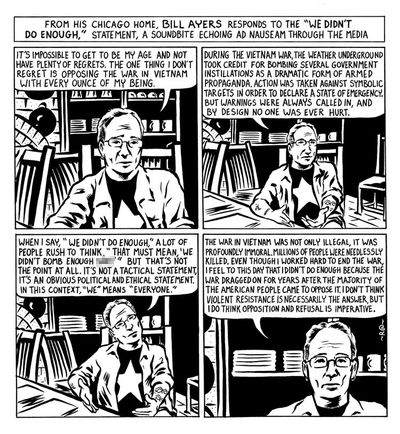
In a four-panel not-even-remotely-comic strip, William Ayers, the former member of the Weather Underground and associate of Sen. Barack Obama, D-Ill., weighs in on his blog on some of the controversy he's been causing:

It reads:

"From his Chicago home, Bill Ayers responds to the 'We didn't do enough,' statement, a soundbite echoing ad nauseam through the media."

Says the Ayers cartoon: "It's impossible to get to be my age and not have plenty of regrets. The one thing I don't regret is opposing the war in Vietnam with every ounce of my being.

"During the Vietnam war, the Weather Underground took credit for bombing several government installations as a dramatic form of armed propaganda. Action was taken against symbolic targets in order to declare a state of emergency. But warnings were always called in, and by design no one was ever hurt.

"When I say, 'We didn't do enough,' a lot of people rush to think, 'That must mean, "We didn't bomb enough s---."' But that's not the point at all. It's not a tactical statement, it's an obvious political and ethical statement. In this context, 'we' means 'everyone.'

"The war in Vietnam was not only illegal, it was profoundly immoral, millions of people were needlessly killed. Even though I worked hard to end the war, I feel to this day that I didn't do enough because the war dragged on for years after the majority of the American people came to oppose it. I don't think violent resistance is necessarily the answer, but I do think opposition and refusal is imperative."

I don't think violent resistance is NECESSARILY the answer?

- jpt

Tuesday, September 09, 2008

http://cache.daylife.com/imageserve/0gwwdzLdgx7G7/340x.jpg

From The Corner:

Trig
[Rich Lowry]

A couple of e-mails responding to this column:

—As a father of a beautiful 8-year old boy, Christian, who has Down Syndrome I can honestly say that if I had to do it all over again, I wouldn’t change a thing. We knew that there was a possibility for a birth defect but did not find out until the moment he was born. I will never forget the pain and confusion I felt at that time. I was present with my wife during the C-section and when Christian came into this world I was overjoyed with the birth of our first child, my son. Then the doctor and nurses hung their heads and announced to me that our beautiful baby had Down Syndrome. I was confused and hurt by their announcement. Here is the most joyous day of our lives with the birth of our son and the doctors and nurses acted like it was a funeral. I left the room and walked down the hallway and met my mother-in-law. I was crying. Alarmed, my mother-in-law asked me “what was wrong?” Her first instinct was that something terrible happened to Genine, my wife. When I told her our baby had Down Syndrome, my mother-in-law, in probably her finest moment, said to me “Oh, is that all. Lets go look at the baby”. From that point forward, the birth of my son has never been looked at as a tragedy but as a gift to us. Most Down Syndrome children are born with heart defects. Christian had a small hole at the top of his heart. We took him to a cardiologist twice. The first visit to examine the hole at the top of his heart. On the second visit, a miracle happened. The hole at the top of Christian’s heart had closed on its own. A “one in a million” occurrence the cardiologist said. Christian would not have to have heart surgery nor have to go back to the cardiologist again.

Since then, my life with our son Christian has been nothing but a joy. He has taught me a lot about his world and myself. Sure, Christian’s development is much slower than other children’s development including our non-Down syndrome child Corinne. Christian has taught me patience and to notice and enjoy the little things in life that normally I take for granted or never really noticed. He has touched everyone’s lives that he has come into contact with and continues to receive the support of his family and community. Occasionally we get the strange looks from adults and children noticing that Christian is different. But those looks quickly turn to looks of acceptance and tolerance once people get to know him. There is nothing wrong with children with Down Syndrome. I am not a religious person but I truly believe God has a purpose for people with Down Syndrome and entrusted us with this precious gift to raise our child in a loving and supportive environment so that he can be self-sufficient later in life.


I truly believe that it is peoples’ attitudes towards Down Syndrome that needs to change. Once they realize that children born with Down Syndrome do have value in our society, people will see a side of life that is not only innocent but beautiful. When Sarah Palin announced to the world her son Trig, my heart soared. Here is an intelligent hard working woman who “gets it” and sees Down Syndrome children not as a burden on society but as a gift. Welcome to the club, Sarah. 1 in 800 births in this country is a Down Syndrome child. Do the math, that’s a lot of families who now have VP candidate who is one of them and will advocate for these families.

—Rich,

I appreciate and agree with your article about how Trig’s life could have an enormous impact on changing how many pockets of our society look unfavorably upon children with special needs. I am happy to say that in Northwest Arkansas, we are not one of those pockets. We have a 9-year old, Caleb, who was born with mental and physical disabilities due to Hydrocephalus. He is an inspiration to his family, his therapists and everyone else that spends two seconds with him. He was our first child, and we have had four more children since, each two years apart. The reaction we get from people, wherever we go, is not one of disapproval, but admiration. I cannot remember a single time anyone has ever approached my wife or me to question whether we made the right decision.

As an example, after Caleb was born, my work associates at Tyson Foods, Inc. threw us a baby shower. There were so many people that showed up to show their support, folks were spilling out of the large conference room and were lining the halls. As soon as my wife and I stepped into the hall with Caleb in her arms, everyone began to cheer. I have seen the same reaction with others that have brought special children into the world.

I believe God has a special plan for each of us, and can use children with disabilities to give perspective and inspiration to others like no one else can. Perhaps God blessed the Palin family with Trig for the very purpose of bringing perspective and inspiration to a Nation in desperate need of both.

From The Corner:
Meeting Chloe Nolan
[Kathryn Jean Lopez]

This exchange is from today's Rush Limbaugh Show:

CALLER: And I wanted to share a story with you. A week ago last Saturday we went to the Palin-McCain rally in Washington, Pennsylvania, was the day after he announced her, and we have a five-year-old daughter with Down syndrome, and we made a sign that said: "We Love Kids with Down Syndrome." So when they pulled in their bus the sign did catch their, McCain and Palin and the rest of their family, it caught their eye, we could tell, they gave us a thumbs-up from the bus, so we were all excited just by that -
...

So then we moved around as the bus was getting ready to pull out, we kind of positioned ourselves so we could just wave them on and a Secret Service agent came up to us and said, "Hey, can you come with us?" I was like, "Do we have a choice?"

RUSH: (laughing) You shouldn't have worried. It's not the Clinton administration.

CALLER: Right. So we accompanied them up the hill, we went right to the bus, where it was, and Governor Palin, Senator McCain, Cindy, Todd Palin, they're all standing there. We're in this inner circle with just us and them, and the Secret Service agent, and they came right up to us and thanked us for coming out, said they loved our sign, and Governor Palin immediately said, "May I hold your daughter?" and our daughter Chloe, who's five, went right to her, and I have some pictures I'd love to send you maybe when I'm done here, but Governor Palin was hugging Chloe, and then her little daughter brought their baby Trig who has Down syndrome from the bus, he was napping, and Chloe went right over and kissed him on the cheek, and my son Nolan who's nine, he thanked her.

More from Chloe's dad — and more pictures — here.
The image “http://community.adn.com/sites/community.adn.com/files/images/585924cb95cb4482b3b050b92a0a9d6a.preview.jpg” cannot be displayed, because it contains errors.
Is Trig at the Heart of Media's Reaction to Palin?
By Mona Charen

There were basically two things known about Sarah Palin when her name was announced on Aug. 29 and the mediasphere began to shudder and pulsate: She was a recently elected governor and the mother of five children including a handicapped infant. The scorn from the mainstream press and the left-leaning blog world was both intense and instantaneous. Andrew Sullivan of The Atlantic immediately began circulating rumors that Trig was not the governor's baby -- that she had engaged in a huge charade to cover up her teen daughter's illegitimate child. The New York Times reported on the front page that Palin had been a member of the Alaska Independence Party. Eleanor Clift of Newsweek described the reaction of most newsrooms to Palin's elevation as "literally laughter." US Weekly rushed out a cover story picturing Palin holding her baby son with the headline "Babies, Lies, & Scandal."

And that was just the throat-clearing phase. NBC's Brian Williams wondered whether she could discharge her responsibilities with all those kids. Sally Quinn of the Washington Post asked, "Will she put her country first, or will she put her family first?" Mort Kondracke called her a "wacko right-winger."

Now it hardly needs mentioning that Brian Williams and company would sew their own lips closed before ever uttering such heresy about a liberal woman candidate. Nor would it even occur to them to question any male candidate's fitness because of the number of children he had.

How do the media poobahs explain it? They say (and to her credit, Sally Quinn has apologized for her comments) that it was Palin's inexperience that prompted their contempt. But aren't these the same people who had just the week before been defending Barack Obama's thin resume?

Something about Sarah Palin set them off before their own politically correct impulses ("Must Avoid Sexism") could inhibit them. By the ferocity of the response, you might have thought Palin was a secret member of a polygamous cult or had forced her daughter to give birth after a rape. But no, she was just the mother of five, hunting, fishing, NRA member, and governor.

I wonder if it was that baby.

Sarah Palin is no ordinary pro-lifer. She is an attractive, intelligent, ambitious, successful woman who has actually lived her convictions. Told that the baby she was carrying would be handicapped with Down syndrome, she and her husband made the only decision their consciences would permit -- to welcome this child with the same love they would give to any other. That decision is comparatively rare in America. Fully 80 percent of parents who receive a diagnosis of Down syndrome in their unborn children elect to abort. But it's not unusual at all among committed pro-lifers. I have met many in the course of speaking to pro-life audiences. And for every couple that has chosen life for a handicapped child, there are thousands and perhaps millions more who have abjured prenatal testing because under no circumstances would they abort their children. I cannot count the times I've amazed pro-choice people with the news that there are even waiting lists of couples who stand ready to adopt Down syndrome babies.

The example of people living their principles by embarking on the undeniably difficult path of raising a handicapped child is a hard one to dismiss. In fact, it's hard not to admire. Don't most of us, deep down, really think that the most humane and honorable thing is to treat all life as sacred? Even if you are not religious or have no belief in God -- doesn't it appeal to an enlightened humanism to give support and love to the handicapped? In fact, most pro-choice people probably treat the handicapped with terrific compassion and care. They doubtless support civil rights legislation like the Americans with Disabilities Act, additional school spending, and generous Social Security benefits. They'd be the first to hold the door for someone in a wheelchair, and they'd be friendly toward anyone with obvious mental retardation.

But for themselves, they would abort. And there stands Sarah, Trig Palin in her arms, a beautiful ambassador for the path of humility, duty, honor, and grace. It's no wonder she was in their crosshairs from the get go.

Copyright 2008, Creators Syndicate Inc.
The image “http://www.telegraph.co.uk/telegraph/multimedia/archive/00801/palin-mccain_801840c.jpg” cannot be displayed, because it contains errors.
One of Them, and One of Us
By Patrick Buchanan

One wonders: What did Sarah Palin ever do to inspire the rage and bile that exploded on her selection by John McCain? What is there either in this woman's record or resume to elicit such feline ferocity?

What did we know of her when she was introduced?

That she was a mother of five who had brought into this world a baby boy with Down syndrome, thus living her Christian beliefs. That she was a small-town conservative who had risen from mayor of Wasilla (Pop. 9,700) to be governor of a state twice the size of Texas.

That she was a reformer who had dethroned an Old Boys' Network by dumping a sitting Republican governor. That she had taken on Big Oil, taxed the companies and returned the money in $1,200 checks to every citizen of Alaska. And that she had cut a deal with Canada to build a pipeline to bring natural gas to her fellow Americans.

And, oh, yes. She was "Sarah Barracuda" -- a fierce high school athlete, a runner-up in the Miss Alaska pageant, a Feminist for Life and lifetime member of the NRA. Introduced by McCain, she praised Hillary Clinton and pledged to finish her work by smashing through the glass ceiling in which Hillary had made 18 million cracks.

What, in any or all of this, is there to justify the feral attacks within minutes of her introduction? What had she done to cause this outburst? Answer: absolutely nothing.

No. Sarah Palin is not resented for what she has done, but for who she is: a Christian conservative who believes unborn children are gifts of God, even those with birth defects, and have a God-given right to life.

Normally, the press is reluctant to rummage into the private lives of public servants, unless their conduct affects their duties or they preach virtues they hypocritically do not practice.

Yet, no sooner was Palin introduced, than the media went berserk over the news that her 17-year-old daughter is pregnant. As one in three births in America is out-of-wedlock and Hollywood celebrates this lifestyle, why did The New York Times and The Washington Post splash this "news" on page one above the fold?

How does Bristol Palin's pregnancy disqualify Sarah Palin to be vice president? Why is it even relevant?

They did it because they thought it would damage Sarah Palin in the eyes of a Christian community they do not comprehend.

So out of bounds was the media that Obama, in an act of decency, declared Palin's family off limits and reminded the media that he was himself born to a teenage single mom.

If one would wish to see the famous liberal double standard on naked display, consider.

Palin's daughter was fair game for a media that refused to look into reports that John Edwards, a Democratic candidate for president, was conducting an illicit affair with a woman said to be carrying his child and cheating on his faithful wife Elizabeth, who has incurable cancer. That was not a legitimate story, but Bristol Palin's pregnancy is?

Why did the selection of Sarah Palin cause a suspension of all standards and a near riot among a media that has been so in the tank for Barack even "Saturday Night Live" has satirized the infatuation?

Because she is one of us -- and he is one of them.

Barack and Michelle are affirmative action, Princeton, Columbia, Harvard Law. She is public schools and Idaho State. Barack was a Saul Alinsky social worker who rustled up food stamps. Sarah Palin kills her own food.

Michelle has a $300,000-a-year sinecure doing PR for a Chicago hospital. Todd Palin is a union steelworker who augments his income working vacations on the North Slope. Sarah has always been proud to be an American. Michelle was never proud of America -- until Barack started winning.

Barack has zero experience as an executive. Sarah ran her own fishing fleet, was mayor for six years and runs the largest state in the union. She belongs to a mainstream Christian church. Barack was, for 15 years, a parishioner at Trinity United and had his daughters baptized by Pastor Jeremiah Wright, whose sermons are saturated in black-power, anti-white racism and anti-Americanism.

Sarah is a rebel. Obama has been a go-along, get-along cog in the Daley Machine. She is Middle America. Barack, behind closed doors in San Francisco, mocked Middle Americans as folks left behind by the global economy who cling bitterly to their Bibles, bigotries and guns.

Barack has zero foreign policy experience. Palin runs a state that is home to anti-missile, missile and air defense bases facing the Far East, commands the Alaska National Guard and has a soldier-son heading for Iraq.

Barack, says the National Journal, has the most left-wing voting record in the Senate, besting Socialist Bernie Sanders. Palin's stances read as though they were lifted from Reagan's 1980 "no pale pastels" platform. And this is what this media firestorm is all about.

Copyright 2008, Creators Syndicate Inc.

Monday, September 08, 2008

http://www.newsoftheworld.co.uk/multimedia/archive/00006/palin_280x450_6667a.jpg
From The Weekly Standard: Basketball...yet another thing
at which Sarah Palin is superior to Obama.
Game Changer

Will the battle of 2008 turn out to have been won
on the playing fields of Alaska?
by Jessica Gavora

09/15/2008

"Al I ever really needed to know I learned on the basketball court."

That's Sarah Palin, circa 2004, when she was merely, as the Obama campaign would say, "the former mayor of a town of 9,000 with zero foreign policy experience."

More than once on her way to becoming a national political phenom as John McCain's running mate, Palin has said she owes it all to playing hoops. But she's not just talking about basketball.

She's talking about girls' basketball.

In Alaska.

In the seventies.

It was a time and a place before identity politics. Before feminists made young female athletes the bright, shiny faces of their graying crusade; before Nike cut treacly, black and white commercials featuring sweaty and empowered young women; and before the law mandated that all six-year-old girls, regardless of race, color, creed, or total lack of interest, strap on shin guards and spend each and every Saturday kicking around a #3 soccer ball.

I know because I was there. While Sarah Palin was calling plays as point guard for the Wasilla Warriors, I was posting low as center for the West Valley Wolfpack, just a few hundred miles north in Fairbanks.

It was a different world. We didn't play basketball to pad our college applications or fulfill some bureaucrat's notion of "gender equity." We played because the winters were long and cold and dark. There was nothing else to do. Maybe as a result, basketball was deadly serious business. Away games were played at the end of eight-hour bus rides or harrowing plane landings in frozen, remote villages. Our opponents were tough, and the fans were unforgiving. And even though the law that feminists like to credit with all female athletic success, Title IX, was then unenforced in high school sports, we girls wouldn't have dreamed of taking second place to the boys--nor did we.

Palin earned her now-famous nickname on the hardcourt--"Sarah Barracuda." Her enemies have tried to belittle her by pointing to her stint as a beauty queen, but it is clear that Palin's background in sports, more than any other experience, is what has made her the existential threat to liberal feminism (and possibly the Democratic ticket) that she is today.

In a basketball-crazed state, Wasilla was and is a basketball-crazed town. Palin, the Anchorage Daily News wrote when she was running for governor, was "practically canonized" for her role on the 1982 state championship team. It is a story she repeated often to the Alaska media as she made her name in politics: The Wasilla Warrior girls were the underdogs coming into the state tournament that year. Nobody thought they could win. But they beat squads from much larger Anchorage schools to capture the big prize.

As a candidate in Alaska, Palin sold herself unselfconsciously as a chick jock. In one op-ed, she went out of her way to set herself apart, as chick jocks like to do, from the supporting actors who are nonetheless the highest link in the high-school-girl food chain: the cheerleaders. She has never, she wrote, "been coordinated, peppy or dramatic enough to have ever been on a pom-pom squad."

"I know this sounds hokey," she told an interviewer in 2006, "but basketball was a life-changing experience for me." The problem for today's feminists is that the life lessons Palin learned from basketball have made her their biggest nightmare.

Instead of turning her into a gender-obsessed, hair-trigger enemy of the patriarchy, basketball taught Palin a different set of virtues: To insist on equal opportunity, not equal results. To know herself and what she is capable of. And to never, ever see herself as a victim.

Like a good politician, Palin pays lip service to Title IX, but the law that she supports is Title IX as it was originally written--a grant of equal opportunity for girls and women--not the quota law it has become.

Instead of teaching her to view the world through the prism of gender, as feminists would have it, sports taught Palin the opposite lesson. "Sports taught me that gender isn't an issue," she said shortly after becoming governor. "In fact, when people talk about me being the first female governor, I'm a little absent from that discussion, because I've never thought of gender as an issue."

The modern feminist theory of girls and women in athletics is that we are all lingering victims--even in 2008--of the patriarchy. The theory explains away girls' and women's lower interest in athletics with the assertion that years of being shut out of athletics (never mind that the years in question were four decades ago) have conditioned females not to like sports as much as men. It's not that we don't like to play sports as much as the guys, it's just that we don't yet know that we like to play sports as much as the guys. We need to be educated about our interests, and it is the government's responsibility to ensure that schools create women's teams--and/or eliminate men's teams--until we come to our senses and behave just like the boys.

Palin takes this theory of the victimized female, prisoner of false-consciousness, and drives a stake through its heart. She didn't need anyone to teach her that she was an athlete back in the seventies, and she won't allow anyone to call her a token female today.

For all their talk of the sameness of the sexes, what feminists want for female athletes today is preferences, quotas mandated by the federal government and handed out by schools. But what Sarah Palin has achieved no one has given her; she has manifestly earned it.

It's difficult to overstate how entrenched--and how male--was the political culture that Palin upended in Alaska. The state's governing Republican troika of Senator Ted Stevens, Congressman Don Young, and Governor Frank Murkowski (known simply as Ted, Don, and Frank) together had more than a century on the public payroll--in a state less than 50 years old--when Palin challenged Murkowski in the Republican primary in 2006. For decades, they had relied on the not-unpersuasive argument that failing to return them to Washington would be fatal to a small state like Alaska with only three snouts in the federal trough.

But it turns out that playing basketball taught Sarah Palin the importance of a quality more valuable than seniority: competitiveness. Instead of shrinking before the political machine that was responsible for delivering billions of federal dollars to the residents whose votes she sought, Palin challenged it head on. Not content with exposing her own Republican party chairman for ethics violations, she defeated a sitting governor of her own party and called the FBI investigation of Stevens and others for official corruption an "embarrassment" to Alaska.

"Competition defines and refines a person," she wrote in 2004. "Character is revealed. It's really nothing to be afraid of."

But liberal feminists are, in fact, afraid of Sarah Palin. For the first time, they face real competition in their claim to speak for women. For decades, feminist groups have insisted they are the voice of American women, when in fact they are the voice of a narrow, liberal fringe. It's an argument that has convinced the media and has cowed politicians of both parties. And it's an argument that Sarah Palin is busy blowing clean out of the water.

If she wins, that hissing sound you will hear will be the air wheezing out of modern feminism. And even if she doesn't win, she will have given America--and, more important, American politicians--the example of a female former athlete who knows who she is and what she wants and doesn't need Big Brother to protect her from the old boys network.

And to think it all began in a gym in Wasilla.

Jessica Gavora, a native Alaskan, is a writer and speechwriter.
The image “http://celebritybabies.typepad.com/photos/uncategorized/2008/04/18/13webpalin_t575.jpg” cannot be displayed, because it contains errors.
A Feminist's Argument for McCain's VP
By Tammy Bruce

In the shadow of the blatant and truly stunning sexism launched against the Hillary Rodham Clinton presidential campaign, and as a pro-choice feminist, I wasn't the only one thrilled to hear Republican John McCain announce Gov. Sarah Palin as his running mate. For the GOP, she bridges for conservatives and independents what I term "the enthusiasm gap" for the ticket. For Democrats, she offers something even more compelling - a chance to vote for a someone who is her own woman, and who represents a party that, while we don't agree on all the issues, at least respects women enough to take them seriously.

Whether we have a D, R or an "i for independent" after our names, women share a different life experience from men, and we bring that difference to the choices we make and the decisions we come to. Having a woman in the White House, and not as The Spouse, is a change whose time has come, despite the fact that some Democratic Party leaders have decided otherwise. But with the Palin nomination, maybe they'll realize it's not up to them any longer.

Clinton voters, in particular, have received a political wake-up call they never expected. Having watched their candidate and their principles betrayed by the very people who are supposed to be the flame-holders for equal rights and fairness, they now look across the aisle and see a woman who represents everything the feminist movement claimed it stood for. Women can have a family and a career. We can be whatever we choose, on our own terms. For some, that might mean shooting a moose. For others, perhaps it's about shooting a movie or shooting for a career as a teacher. However diverse our passions, we will vote for a system that allows us to make the choices that best suit us. It's that simple.

The rank bullying of the Clinton candidacy during the primary season has the distinction of simply being the first revelation of how misogynistic the party has become. The media led the assault, then the Obama campaign continued it. Trailblazer Geraldine Ferraro, who was the first Democratic vice presidential candidate, was so taken aback by the attacks that she publicly decried nominee Barack Obama as "terribly sexist" and openly criticized party chairman Howard Dean for his remarkable silence on the obvious sexism.

Concerned feminists noted, among other thinly veiled sexist remarks during the campaign, Obama quipping, "I understand that Sen. Clinton, periodically when she's feeling down, launches attacks as a way of trying to boost her appeal," and Democratic Rep. Steve Cohen in a television interview comparing Clinton to a spurned lover-turned-stalker in the film, "Fatal Attraction," noting, "Glenn Close should have stayed in that tub, and Sen. Clinton has had a remarkable career...". These attitudes, and more, define the tenor of the party leadership, and sent a message to the grassroots and media that it was "Bros Before Hoes," to quote a popular Obama-supporter T-shirt.

The campaign's chauvinistic attitude was reflected in the even more condescending Democratic National Convention. There, the Obama camp made it clear it thought a Super Special Women's Night would be enough to quell the fervent support of the woman who had virtually tied him with votes and was on his heels with pledged delegates.

There was a lot of pandering and lip service to women's rights, and evenings filled with anecdotes of how so many have been kept from achieving their dreams, or failed to be promoted, simply because they were women. Clinton's "18 million cracks in the glass ceiling" were mentioned a heck of a lot. More people began to wonder, though, how many cracks does it take to break the thing?

Ironically, all this at an event that was negotiated and twisted at every turn in an astounding effort not to promote a woman.

Virtually moments after the GOP announcement of Palin for vice president, pundits on both sides of the aisle began to wonder if Clinton supporters - pro-choice women and gays to be specific - would be attracted to the McCain-Palin ticket. The answer is, of course. There is a point where all of our issues, including abortion rights, are made safer not only if the people we vote for agree with us - but when those people and our society embrace a respect for women and promote policies that increase our personal wealth, power and political influence.

Make no mistake - the Democratic Party and its nominee have created the powerhouse that is Sarah Palin, and the party's increased attacks on her (and even on her daughter) reflect that panic.

The party has moved from taking the female vote for granted to outright contempt for women. That's why Palin represents the most serious conservative threat ever to the modern liberal claim on issues of cultural and social superiority. Why? Because men and women who never before would have considered voting for a Republican have either decided, or are seriously considering, doing so.

They are deciding women's rights must be more than a slogan and actually belong to every woman, not just the sort approved of by left-wing special interest groups.

Palin's candidacy brings both figurative and literal feminist change. The simple act of thinking outside the liberal box, which has insisted for generations that only liberals and Democrats can be trusted on issues of import to women, is the political equivalent of a nuclear explosion.

The idea of feminists willing to look to the right changes not only electoral politics, but will put more women in power at lightning speed as we move from being taken for granted to being pursued, nominated and appointed and ultimately, sworn in.

It should be no surprise that the Democratic response to the McCain-Palin ticket was to immediately attack by playing the liberal trump card that keeps Democrats in line - the abortion card - where the party daily tells restless feminists the other side is going to police their wombs.

The power of that accusation is interesting, coming from the Democrats - a group that just told the world that if you have ovaries, then you don't count.

Yes, both McCain and Palin identify as anti-abortion, but neither has led a political life with that belief, or their other religious principles, as their signature issue. Politicians act on their passions - the passion of McCain and Palin is reform. In her time in office, Palin's focus has not been to kick the gays and make abortion illegal; it has been to kick the corrupt and make wasteful spending illegal. The Republicans are now making direct appeals to Clinton supporters, knowingly crafting a political base that would include pro-choice voters.

On the day McCain announced her selection as his running mate, Palin thanked Clinton and Ferraro for blazing her trail. A day later, Ferraro noted her shock at Palin's comment. You see, none of her peers, no one, had ever publicly thanked her in the 24 years since her historic run for the White House. Ferraro has since refused to divulge for whom she's voting. Many more now are realizing that it does indeed take a woman - who happens to be a Republican named Sarah Palin.

Tammy Bruce is the author of "The New American Revolution" (HarperCollins, 2005) and a Fox News political contributor. She is a former president of the Los Angeles chapter of the National Organization for Women. A registered Democrat her entire adult life until February, she now is registered as a decline-to-state voter.

Sunday, September 07, 2008

http://media.hoover.org/images/sarah_palin.jpg
Sarah Barracuda
Palin should strike fear in the hearts of Democrats
By Jack Kelly, Pittsburgh Post-Gazette

Sunday, September 07, 2008

"You arrogant ass! You've killed us!" So said the executive officer of a Soviet submarine to his captain in Tom Clancy's novel "The Hunt for Red October" after the captain had recklessly fired a torpedo that homed in on his own sub.

NBC's David Gregory must have had similar thoughts as he noted, ruefully, that the news media's assault on Alaska Gov. Sarah Palin boosted substantially the television audience for her acceptance speech Wednesday night.

No friend of Barack Obama -- and the last week has demonstrated he has no better, nor more unscrupulous, friends than those in the news media -- can be happy about that.

Journalists last week cast aside the mask of objectivity to reveal they are so deeply in the tank for Mr. Obama most have grown gills. For six days, Sarah Palin and her family were subjected to a relentless barrage of innuendo. Journalists were trying to "define" her before she had an opportunity to introduce herself to the people in the lower 48. She was portrayed as an ignorant redneck from a hick town who should be home caring for her children instead of running for high public office.

Then Sarah Palin got her opportunity to speak, and her enemies learned firsthand why her nickname is "Sarah Barracuda."

Dismiss if you will the rapturous response to Ms. Palin's speech by the delegates in the convention hall and the posters on conservative blogs. The best testament to its power was the lame response of the Obama campaign. They noted she had the help of a speechwriter (the very talented Matt Scully) in preparing her remarks. Well, duh. Every major political figure has speechwriters. Sarah Palin works fine without a script. It's Barack Obama who ums and ahs without a teleprompter.

In my lifetime, I've only heard three or four speeches (all by Ronald Reagan) that I thought were as good or better than Sarah Palin's. She's as much a natural in politics as Michael Jordan was in basketball.

"Several moderate Democrat friends of mine have been e-mailing -- few if any would ever vote for McCain -- but all agree Palin was very strong," Michael Crowley wrote on The New Republic's blog. "The more liberal among them are a little panicked."

With good reason. With a smile on her face, Ms. Palin sliced and diced Barack Obama with the skill she dresses a moose she just shot. There were a host of good lines which I'm sure we'll see in McCain commercials in the near future. But ultimately the most effective may be this one: "In small towns, we don't know quite what to make of a candidate who lavishes praise on working people when they are listening, and then talks about how bitterly they cling to their religion and guns when those people aren't listening."

What gives this line its power is that Sarah Palin is definitely part of the "we" -- the small town, blue-collar Americans who will decide this election.

Only once in modern times has a vice presidential candidate swung an election. Lyndon Johnson brought Texas and Alabama to John F. Kennedy in 1960, states that otherwise would have been suspicious of a Catholic liberal from New England. I think Sarah Palin will be the second. She has changed the nature of this race in ways ominous for Mr. Obama.

First, this race is no longer between a candidate who advocates change and the status quo, as Democrats would like to frame it. It's between two different visions of change, and between a ticket that's actually delivered reform, and a ticket that just talks about it. The argument that John McCain represents a third term for George W. Bush was strained to start with. It's ludicrous now.

Second, the Republican base is more fired up, and the party more united than it's been since Ronald Reagan ran for his second term. Conservatives see in Sarah Palin Ronald Reagan in a dress, the brains and backbone of Margaret Thatcher in a younger, prettier package. The Grand Old Party has a bright new face.

Mr. Obama owes much of his new troubles to his friends in the news media. Republicans -- and independent and Democratic women appalled by their sexism -- were enraged by the vicious assaults on Sarah Palin and her family.

After he learned his fleet had attacked Pearl Harbor before a formal declaration of war, Japanese Adm. Isoroku Yamamoto is reputed to have said: "I fear all we have done is awaken a sleeping giant and fill him with a terrible resolve."

The vice presidential debate is Oct. 2. If I were Joe Biden, I would be very, very afraid.
The image “http://www.trashotron.com/agony/images/2008/08-news/05-12-08/peacock-cure_for_night.jpg” cannot be displayed, because it contains errors.
From The Washington Post: Great review of an excellent
new crime novel/legal thriller.
Addictive Prose
By Patrick Anderson

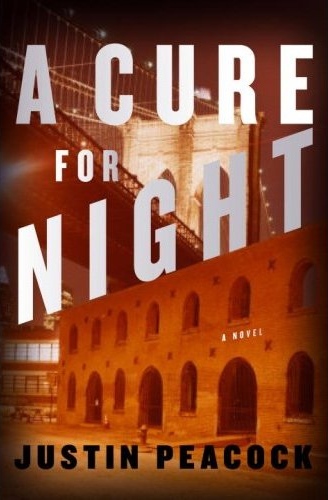
A CURE FOR NIGHT
By Justin Peacock
Doubleday. 341 pp. $24.95

Monday, September 1, 2008

At the start of Justin Peacock's terrific first novel, "A Cure for Night" (to be published tomorrow), Joel Deveraux, a lawyer with a top-drawer Manhattan firm, unwisely hooks up with a co-worker, a sexy paralegal named Beth. She proves to be a junkie, and soon he's snorting heroin with her on weekends. Even worse, one day she ODs in the firm's ladies' room. In the aftermath of this disaster, Joel is ousted by the law firm and becomes a public defender in Brooklyn because no one else will hire him. That's when his education begins.

Joel, who narrates the story, is assigned to help a more experienced PD, Myra Goldstein, defend drug dealer Lorenzo Tate, who's accused of shooting two men, one fatally, in the dangerous and depressing Glenwood Gardens housing project. Tate is black, the man he allegedly killed was white, and the prosecutors are out for blood, or at least for headlines. As it happens, Tate convinces the two public defenders that he's innocent -- which few of their clients are -- and they, too, are ready for a fight.

The case becomes increasingly complicated, and by the time it reaches trial we have no idea if Tate is innocent or guilty or, in either event, whether his defenders can win his freedom. It's a good, gritty case, but it's only the start of what Peacock -- himself a lawyer in New York City -- wants to tell us. He takes us inside the public-defender culture, whose harried lawyers spend a lot of time worrying about the morality of getting guilty clients off, and agonizing when they can't keep innocent ones out of prison. The lawyers are mostly idealists moving fast toward cynicism, as when one remarks, "A criminal trial is a search for the truth, but the defense lawyer isn't a member of the search party."

The novel has a lot to say about the drug culture. In the projects, it's "the life," one that holds out the promise of money and prestige but also prison and death. Seeking witnesses in the project, Joel and Myra meet law-abiding people, along with drug dealers who'd as soon kill you as look at you. Here, for example, is what one man says about Devin, the young drug lord who was wounded in the shooting: "He got the rock, the powder, the chronic, that D called Bin Laden all them junkies be craving. He owns that courtyard out there in the Gardens. I beef with him, win or lose, I lose. Devin's soldiers take me out for sure." (Chronic, be it noted, is high-grade marijuana, and D is a name for heroin.)

But Peacock's portrait of the drug culture extends well beyond the housing project. Devin and his crew have built a thriving business selling to white students at nearby Brooklyn College. The novel also includes a vivid flashback to the snowbound weekend when Beth, the paralegal, introduced Joel to heroin: "The pleasure was almost sexual, yet lacking sex's strain, its battle with self-consciousness, its animal need. . . . It was a glorious physical glow, a slow burn. The room acquired a stillness. Movement had become unnecessary, extraneous. We were both still, our eyes closed as if in sleep, some deeper species of rest." If that seems to romanticize the heroin experience, be assured that moments later Joel is vomiting, and soon the drug, having led to sex, replaces it.

"A Cure for Night" has a routine plot -- young lawyer, difficult client -- but rises above it because Peacock writes so well. Few first-time novelists share his ability to maintain a fast pace even as he introduces well-drawn characters and explores interesting ideas. And his use of dialogue, particularly among the dealers, is first-rate. Among the lawyers, Myra, Joel's tough-as-nails partner, is a nice creation. She's an angular woman with unruly hair who smells of cigarettes but is not without an edgy appeal. At first, she bristles at having Joel assigned to her murder case. But, unsurprisingly, friction leads to flirtation. Underlying the entire story is the question of whether Joel is happier as an underpaid, overworked public defender than he was as a highly paid associate in a fancy Manhattan firm where all that mattered was money. Increasingly, he embraces the underdog values of the public defender's office. I'm going to give this book to a law student I know, because it's an honest look at the choices and frustrations young lawyers face.

The novel climaxes not only with a verdict in the trial of Lorenzo Tate, but with a final scene that made me late for a lunch date because I couldn't stop reading. If the chilling events therein don't cure Joel and Myra of their idealism, nothing will. When the prizes are awarded for this year's best first novel, "A Cure for Night" will be competing for the gold.