Friday, September 14, 2007

Cover Image
An Historic Birth
Jay Winik's new bestseller.

An NRO Q&A

Two weeks after 9/11, President Bush was spotted carrying a copy of April 1865, Jay Winik’s account of the most fateful month in American history, aboard Marine One. This week, Winik is back with The Great Upheaval: America and the Birth of the Modern World, 1788-1800. The pre-publication reviews have been exceptionally good — Winik may have written the blockbuster history book of the fall. He recently took questions from NRO’s John J. Miller on the Founding Fathers, what John Adams thought of the Russians, and learning French.

JOHN J. MILLER: You’ve written a history of the American Founding period that’s global in its scope. Why?

JAY WINIK: The more I researched this book, the more I came to realize that it was vital to bring alive the world that the Founders themselves actually saw. Conventional scholarship has long isolated the story of America’s founding decade from the rest of the globe. But this misses a crucial part of the picture: The world of the 1790s was stitched together in ways that we can scarcely grasp, from Philadelphia to Paris to St. Petersburg and Constantinople. Our Founding Fathers were all consumed, and rightly so, by events in Europe and on the global stage — from the increasing anarchy and bloodshed of the French Revolution that swept the continent, to Russia’s dismemberment of the ancient Kingdom of Poland. What emerges is ultimately an unprecedented, new picture of America’s founding years.


MILLER:
Can you give a couple of examples?

WINIK:
For example, you can’t appreciate America’s fears of foreign invasion in its formative years in the 1790s or of being swallowed by a predatory European power without seeing them in relation to Napoleon’s armies that were devouring Europe “leaf by leaf” — not to mention reaching deep into the heart of the Middle East — or against the backdrop of Marshall Suvorov’s “tidal wave” of Russian armies laying siege to Islam, and literally wiping Poland off the face of the map. These grim examples powerfully underscored to the young republic the perils of weakness in the face of imperialistic European empires. Similarly, the crisis of the Whiskey Rebellion that George Washington faced — at a time when the Terror was deepening in France — takes on an entirely different coloration when one realizes that the American rebels in Western Pennsylvania were singing French insurrectionary songs and carrying mock guillotines.


MILLER: What’s the “great upheaval” of your title?

WINIK:
Arguably, the period of the 1790s is the most significant era in all of human history, but it’s also arguably the most tumultuous. These years saw a young America literally struggling for its life, at home and abroad. It saw a savage revolution that upended the French dynasty, then the most significant in the world, and with it, a cataclysmic global war. It witnessed the first modern holy war between Christianity and Islam, the consequences of which the world is still grappling with. And for good or for ill, it saw an unremitting struggle between leaders of their nations all fighting desperately for the ideals they believed in, whether divinely inspired autocracy or man-made democracy, whether constitutional republicanism or Allah’s law.


MILLER: What was the greatest accomplishment of the era?

WINIK: Unquestionably it would have to be the survival of America with its ideas and ideals intact. Revolutionary France started out with the noblest intentions, but then descended into unspeakable bloodshed and barbarism. For its part, the Russian Empire and the rest of the world’s monarchies became reactionary. While it was touch and go, only America, a small, minor country on the periphery of the world, managed to weather the cruel upheavals of the age. The result was what would become the first fully functioning democracy. It was an extraordinary achievement that changed the course of civilization, one accomplished against all the odds.


MILLER:
What’s the single most surprising fact or thesis that readers will encounter in your book?

WINIK: I think it would have to be how precarious America’s existence was in the first decade. Throughout history, all republics had stumbled and failed, or fallen prey to predatory powers. We almost did, too. In a related vein, it’s an eye-opener just how different America’s Founders look when viewed on the world stage. We get a completely new take on George Washington, for example, by seeing him not merely in comparison to his fellow Americans, Adams, Hamilton and Jefferson, but also to his reigning European peers like a dispirited Louis XVI, or such giants as a charismatic but aggressive Catherine the Great, or an increasingly dictatorial Napoleon, let alone an often bloodthirsty monster like Robespierre. Seen in this light, the entire founding period looks different.


MILLER: How would America and the modern world be different today if the French had just listened to Edmund Burke and ended their revolution before it really got going?

WINIK: Such scenarios are speculative, but where does one begin? Ironically, a number of the more moderate French revolutionaries hoped to import an American-style form of Republicanism to France, but soon found themselves unable to control the very forces that they had helped to unleash — and many were ruthlessly guillotined. Yet, if somehow the French had managed to put a brake on their excesses, the world might have been spared 21 ghastly years of war that consumed all of Europe and left millions of dead. France’s political system could have been more like America’s, and there would have been no Napoleon. And the modern face of despotism might have looked very different: The worst aspects of the revolution paved the way for the ghastly excesses of totalitarianism in the 20th century, whether Stalin’s Russia, Hitler’s Nazi Germany, or Pol Pot’s Cambodia. At the height of the Terror, to speed up France’s death machine, priests were systematically drowned. Elderly people were forced to dig their own graves before they were mowed down with machine guns — not unlike what the SS did in World War II. Foreshadowing Auschwitz, one distinguished French chemist even proposed the use of poison gas.


MILLER:
Is it true that you learned French in order to research this book?

WINIK: I did. I spent 18 intensive months developing a working knowledge of French, which gave me a greater feel for reading French documents and sources. I’ve long believed it’s important for an historian to immerse himself as much as possible into the world he’s writing about. So even though most of my sources were freely available in translation, I developed a far richer appreciation of the world of France, in all its splendor and excess, than if I had not taken French. It also immeasurably helped me in understanding Imperial Russia and Catherine the Great’s Court, where French was the spoken tongue.


MILLER:
John Adams thought that Americans and Russians were natural allies. What happened?

WINIK: Adams was not alone in thinking this. One of the hidden but fascinating chapters of America’s beginnings is the role Empress Catherine played in helping midwife the young American republic to independence. King George III actually approached Catherine to see if she would lend him her hardened Cossacks, as well as her navy, to put down George Washington and the upstart rebels. Catherine not only turned him down, but then formed the League of Armed Neutrality, which helped isolate Britain diplomatically, for the first time in a century. It was almost natural then that Adams and others thought the two nations were destined to live in harmony. Catherine had actually corresponded with Jefferson and George Washington (who called her “the great potentate of the North”). But as it happened, Catherine soon turned on these young republicans. Though she carefully followed events in the U.S., she never received the fledgling American envoy, and once the French Revolution intensified, she hotly denounced both Washington and an American Revolution that once she professed to admire. The Russian component is a critical part of the story of this epic period.


MILLER: Who was your favorite character to write about?

WINIK: Since I was dealing with probably the greatest galaxy of actors in world history, there was no shortage to choose from. Catherine the Great was probably the most charismatic — you want to be seated next to her at a dinner party. For some 30 years she dominated the global arena, befriended the mortal French philosophes like Voltaire, waged war on Islam, and after decades of enlightenment, unleashed modern authoritarianism. She was also incredibly charming, brilliant, and complex. She’s one of my favorites. Napoleon, of course, is one of a kind, and quite important historically. I found the story of King Louis XVI and Queen Marie Antoinette and their downfall to be quite powerful and poignant. Getting into the head of Robespierre, who prefigured Stalin and Hitler, was quite challenging. But in the end, however, it was George Washington who proved to be the master spirit of the age, even if his peers didn’t quite see that way. Though he was at times stilted, and often unapproachable, he had the vision and wisdom to securely guide the young America through a tumultuous era, and the world has never been the same since.
http://www.awrinkleintime.net/img/jacket_wrinkle.jpg
'A Wrinkle' Ages Gracefully
Reading Madeleine L'Engle as a child and as an adult.

BY MEGHAN COX GURDON
Friday, September 14, 2007 12:01 a.m. EDT

Was I the only sixth-grader who didn't love "A Wrinkle in Time"? The recent death of Madeleine L'Engle, who wrote the 1963 Newbery Medal winner, has evinced so many adulatory remembrances from other ex-sixth-graders that it's brought back memories of having felt like an oddball for not warming to the book's oddball protagonist, Meg Murry. We even shared a first name, yet I somehow couldn't work up much affection for Ms. L'Engle's awkward, glasses-wearing heroine, despite how brave and clever she turned out to be. Heroines, it seemed to me, ought to be dashing and pretty and, if possible, drive roadsters.

"A Wrinkle in Time," you may recall, tells the story of how Meg, her brilliant little brother Charles Wallace, and a high-school boy named Calvin are helped by three magical beings--Mrs. Whatsit, Mrs. Which and Mrs. Who--to rescue Meg's scientist father from IT, a pulsing disembodied brain on a distant planet that is in league with a sinister black cloud seeking to devour the universe. There are no boarding schools, no plucky orphans, no princesses, certainly no roadsters--none of the comforting tropes of children's fiction. Yet once you'd read it, you couldn't rid yourself of it. "A Wrinkle in Time" was like a bit of grit in the oyster; a narrative irritant that you kept trying to digest.

Of course I wasn't the only reader to find Ms. L'Engle's work of science fantasy initially disconcerting. Famously, 26 publishers rebuffed the manuscript before the author found a benefactor in Farrar, Straus & Giroux in 1962. Winning the Newbery a year later secured the book's place in the pantheon of children's literature, and since then innumerable schoolchildren have experienced the dazzling weirdness of a story that starts with quantum physics and ends with a child's love overcoming vast powers of evil.

"It was simply a book I had to write. I had no choice," Ms. L'Engle said in her Newbery acceptance speech. "And it was only after it was written that I realized what some of it meant."

Coming back to the book 30 years later, it's striking how true the same process is for the reader. A child is inclined to take away very different lessons from a novel than is an adult. For one thing, "A Wrinkle in Time" is infused with Christian faith to such a degree that, were it newly published today, it would probably be relegated to the religious section of the bookstore.

As a heathen child, I missed entirely the biblical references, the significant mention of Jesus and the way a loving God's sovereignty over the universe is understood even as the characters battle an expanding force of pure evil. Meg's father, at one point, urges her to be courageous in confronting IT. "We were sent here for something," he tells her, echoing Romans 8:28. "And we know that all things work together for good to them that love God, to them who are the called according to his purpose."

Clearly, American society wasn't as twitchy about Judeo-Christian content 40-odd years ago. In fact, over the decades "A Wrinkle in Time" has been criticized as insufficiently Christian, a claim that pained its Episcopalian author. The novel is ranked 22nd on the American Library Association's list of the 100 "most frequently challenged" books that agitators seek to ban.

The complaints will sound familiar to anyone who has overheard the controversy about the Harry Potter series (itself No. 7 on the ALA's list). In Ms. L'Engle's most famous work, some have objected to an apparent witch, a clairvoyant and the manner in which Jesus is referred to as merely one of earth's great fighters against darkness, not the Light. In strict religious families, these elements may well interfere with children's religious formation.

But subversion works both ways. For children raised in nonreligious households, as I was, Ms. L'Engle's narrative grit could, it seems, produce years later a kind of pearl. Rereading the book recently, I was amazed at the familiar resonance of the passages whose religious import I had thought eluded me as a child. It will be interesting to see whether Harry Potter leaves a similar spiritual comet-trail in the millions of children who've read his story, now that, with the final book in the series, J.K. Rowling has revealed the wizarding world to be unquestionably Christian--though maybe it's not possible to test the long-term effects of literature the way you can, say, fluoride.

Every book is a product of its time, and so is the way it's read. Ms. L'Engle wrote "A Wrinkle in Time" in the depths of the Cold War, and the horror of totalitarianism is there in her depiction of IT's planet, where Meg's father is imprisoned. In the story, the three children arrive on Camazotz to see endless rows of identical houses, before each of which a small boy stands and bounces a ball in exactly the same rhythm as every other boy. But one child keeps getting it wrong, and when his ball bounces off into the street he's rushed into the house by his terrified mother. Some of my friends were convinced that L'Engle's target was conformist suburbia (there was a lot of scornful talk of that in 1976). But to me, Meg's eventual triumph over IT meant that free people would surely someday be able to push back the creeping menace of communism. A sixth-grader picking up the book today will presumably take away another message altogether.

Like Madeleine L'Engle, who was as surprised as anyone at the content of her own novel, C.S. Lewis didn't start out to write a Christian fable when he began "The Lion, the Witch, and the Wardrobe." But as he proceeded, he explained to a friend, he "saw how stories of this kind could steal past a certain inhibition which had paralysed much of my own religion in childhood."

Not long ago, my two eldest children were obliged to read "A Wrinkle in Time" for school. Neither liked it much. "Meg was such a nerd," said my daughter. "I didn't get all the tesseract and time-travel stuff," complained my son. It doesn't matter. Madeleine L'Engle may have departed this world, but in the children who continue to read her best-known novel, she keeps depositing those little bits of grit.

Mrs. Gurdon reviews children's books for The Wall Street Journal

Wednesday, September 12, 2007

The image “http://www.coxandforkum.com/archives/05.07.14.DressCode-X.gif” cannot be displayed, because it contains errors.
From Opinion Journal:
Trashing Petraeus
MoveOn.org, and the new standards of Democratic debate.


Tuesday, September 11, 2007 12:01 a.m.

Important as was yesterday's appearance before Congress by General David Petraeus, the events leading up to his testimony may have been more significant. Members of the Democratic leadership and their supporters have now normalized the practice of accusing their opponents of lying. If other members of the Democratic Party don't move quickly to repudiate this turn, the ability of the U.S. political system to function will be impaired in a way no one would wish for.

Well, with one exception. MoveOn.org, the Democratic activist group, bought space in the New York Times yesterday to accuse General Petraeus of "cooking the books for the White House." The ad transmutes the general's name into "General Betray Us."

"Betrayal," as every military officer knows, is a word that through the history of their profession bears the stain of acts that are both dishonorable and unforgivable. That is to say, MoveOn.org didn't stumble upon this word; it was chosen with specific intent, to convey the most serious accusation possible against General Petraeus, that his word is false, that he is a liar and that he is willing to betray his country. The next and obvious word to which this equation with betrayal leads is treason. That it is merely insinuated makes it worse.

MoveOn.org calls itself a "progressive" political group, but it is in fact drawn from the hard left of American politics and a pedigree that sees politics as not so much an ongoing struggle but a final competition. Their Web-based group is new to the political scene, but its politics are not so new. More surprising and troubling are the formerly liberal institutions and politicians who now share this political ethos.

In an editorial on Sunday, the New York Times, after saying that President Bush "isn't looking for the truth, only for ways to confound the public," asserted that "General Petraeus has his own credibility problems." We read this as an elision from George Bush, the oft-accused liar on WMD and all the rest, to David Petraeus, also a liar merely for serving in the chain of command. With this editorial, the Times establishes that the party line is no longer just "Bush lied," but anyone who says anything good about Iraq or our effort there is also lying. As such, the Times enables and ratifies MoveOn.org's rhetoric as common usage for Democrats.

Late last week, for instance, we heard it said of General Petraeus that, "He's made a number of statements over the years that have not proven to be factual." This was from Harry Reid, the Majority Leader of the U.S. Senate.

The Chairman of the House Foreign Affairs Committee, Tom Lantos, said Thursday that General Petraeus would not be the author of his report; it would be written "by Administration political operatives." He opened yesterday's hearing, moments before General Petraeus was to speak, by saying, "We cannot take anything this Administration says on Iraq at face value."

So far, only two Democrats that we are aware of have repudiated this political turn. Joe Lieberman, already ostracized from the party for dissent, called the MoveOn ad an "act of slander that every member of the Congress--Democrat and Republican--has a solemn responsibility to condemn." And Joe Biden, after the MoveOn ad was read to him on "Meet the Press" Sunday, replied: "I don't buy into that. This is an honorable guy. He's telling the truth."

These are the exceptions. Another of the party's activist groups, Democracy for America, released a statement about the time General Petraeus began to speak: "It is offensive that our commander-in-chief has ordered a four-star general to mislead Congress."

As General Petraeus finished his statement yesterday, Senator Chris Dodd's Presidential campaign spammed an email about "the accuracy" of the report: "The fact that there are questions about General Petraeus's report is not surprising given that it was brought to you by this White House." Thus in Mr. Dodd's view, General Petraeus, returned from the Iraq battlefield, is a complicit ventriloquist's dummy.

Can this really be the new standard of political rhetoric across the Democratic Party? There was a time when the party's institutional elites, such as the Times, would have pulled it back from reducing politics to all or nothing. They would have blown the whistle on such accusations. Now they are leading the charge.

Under these new terms, public policy is no longer subject to debate, discussion and disagreement over competing views and interpretations. Instead, the opposition is reduced to the status of liar. Now the opposition is not merely wrong, but lacks legitimacy and political standing. The goal here is not to debate, but to destroy.

Today General Petraeus testifies before the Senate Foreign Relations Committee. Its Democratic Members include Joe Biden, Chris Dodd, Barack Obama, John Kerry, Barbara Boxer and Jim Webb. This would be the appropriate setting to apologize to General Petraeus for the MoveOn.org ad. Or let it stand.
http://imgsrv.1010wins.com/image/DbGraphic/200708/687517.jpg
From telegraph.co.uk:
The Boss is back in charge

Bruce Springsteen's latest album and tour will see him
roaring with renewed energy and anger
Neil McCormick


There are thundering drums, a towering wall of chugging, chiming, riffing guitars through which a raw, wailing sax is trying to punch a hole, while a gruff, desperate voice calls: "Is there anybody alive out there?" It is the return of Bruce Springsteen and the E Street Band, laying their marker down with roaring rocker Radio Nowhere.

The anthemic single, which has already been widely heard, heralds a new album from New Jersey's finest. To be called Magic, it will be released on Oct 1. This is the kind of news capable of inducing paroxysms of excitement in music fans of a certain age, for whom the 57-year-old veteran represents the very pinnacle of rock culture.

Those less enamoured may just shrug their shoulders. After all, Springsteen can hardly be considered the most groundbreaking artist, his rootsy style drawing on rock and roll, doo wop, soul, gospel and country.

There is nothing in this track to suggest any new sonic developments, and even the lyrics cover well-worn themes, with the narrator "driving through the misty rain" on "the last lone American night", his fingers "spinnin' round a dead dial" while all he can hear is "a drone bouncing off a satellite". "I just want to hear some rhythm," he pleads.
advertisement

It might seem a lot of fuss about not being able to find a decent station on the car radio.

Ah, but things are rarely quite that simple in the world of Springsteen. For all the fist-waving associated with his live performances, he is a subtle master of the miniature narrative in which big themes are refracted.

In his best songs, the personal becomes universal and, as often as not, political. And there is an undercurrent of disquiet in the single, a sense that all is not well in Springsteen's very particular vision of America.

Perhaps it is the fact that music - and in particular rock-and-roll radio - forms an essential part of his mythos, something that connects Americans to the true values of their nation. But, in Radio Nowhere, his driver's loneliness is accompanied only by static. Something has been lost, and he seems uncertain where to find it.

The one-word album title, Magic, is very un-Springsteen. There is no beat poetry here, just a seemingly generic, innocuous and much over-used word, much associated with glitzy entertainment.

But there is a deep irony in the way Springsteen employs it, for there is a particular kind of black magic at the heart of his most recent songs. It is visible between the lines of 2005's sombre Devils & Dust, where idealistic visions of the land of the free disappear in the shimmering heat haze of the Iraqi desert.

Although Springsteen's manager, Jon Landau, has been insisting "politics is not the primary intention of this album", there are plenty of indications that this could be misleading.

An artist deeply tuned into the American psyche, Springsteen has almost acted as the musical conscience of his country, and his output over this decade has chronicled a nation's increasing unease with itself.

His extraordinary 2002 double album, The Rising (marking a reunion of the E Street Band for the first album since the 1984 classic Born in the USA), was an attempt to articulate his countrymen's bewildered response to the events of 9/11.

The sombre, solo, stripped-back Devils & Dust suggested disillusion with the warmongering direction his country was taking, pondering "what if what you do to survive/kills the things you love?" The characters in Devils & Dust are bewildered and bereft, honourable ordinary men and women clinging to fading ideals.

Last year's joyously raucous We Shall Overcome: The Seeger Sessions, recorded with a large, improvising ensemble, might have seemed a complete departure except that, by reclaiming old protest songs, Springsteen was reasserting the innate political liberalism of that mythical America, built on principles of freedom and equality.

There was a sense that Springsteen initially disbanded the E Street Band because the scale of their sound was somehow limiting. When he calls them together, it is because that scale suits the songs, suggesting he has something vital and significant to say. "We've been together since 1974, and I don't think I've ever seen him more excited than he is right now about this record," says Landau.

With a tour kicking off in North America in October, reaching Europe in November (and London's O2 on Dec 19), it would appear Springsteen is ready to do some grandstanding, and somehow turn his complex thoughts and feelings about the country he loves into big, radio-friendly pop music.

I will let you into a secret: I have heard the new album. But all I can say for now is that it excited me as much as anything Springsteen has produced, bitter pills sugar-coated by the immense rock and roll of a great band.

Some of the titles alone convey a sense of Springsteen's ambivalence, verging on disappointment, with his emotionally divided nation: Your Own Worst Enemy, Last to Die, Devil's Arcade and Long Walk Home. The latter was performed during his last tour, and a version has been previously available as an official live recording on the internet. Landau called it the "summational song on the album, one of Bruce's great masterpieces".

It is a truly great song, as anyone who heard it live can attest, and a key to his subtle marriage of the personal and political.

The narrator recalls his father's words about a time when "the flag flying over the courthouse/Means certain things are set in stone/Who we are, what we'll do and what we won't." Springsteen concludes, "It's gonna be a long walk home", yet makes the idea of the journey uplifting, with that knack he has of discovering redemption in the most desperate situations.

There was a time when Springsteen's protagonists yearned to escape small-town America, rebelling against its stultifying insularity on Born to Run and Darkness on the Edge of Town. Now, it appears, he longs for a return to simple values, kindness to neighbours, the familiarity of what we know - basic decency.

That he can distil all of this in ultimately life-affirming pop music is a gift. They don't call him The Boss for nothing. There was a time when Springsteen's protagonists yearned to escape small town America, rebelling against its stultifying insularity on 'Born To Run' and 'Darkness on the Edge of Town'.

Now, it appears, older and wiser, he longs for a return to simple values, kindness to neighbours, the familiarity of what we know, basic decency. That he can distil all of this in what is ultimately life affirming pop music is a special gift.

"I want a thousand guitars / I want pounding drums / I want a million voices speaking in tongues," Springsteen demands on 'Radio Nowhere', while his band do their best to provide just that. They don't call him The Boss for nothing.
http://www.theage.com.au/ffximage/2007/01/11/knBAGHDAD_wideweb__470x300,0.jpg
By Bush's Own Standard, Surge Has Failed
By George Will


Before Gen. David Petraeus' report, and to give it a context of optimism, the president visited Iraq's Anbar province to underscore the success of the surge in making some hitherto anarchic areas less so. More significant, however, was the fact that the president did not visit Baghdad. This underscored the fact that the surge has failed, as measured by the president's and Petraeus' standards of success.

Those who today stridently insist that the surge has succeeded also say they are especially supportive of the president, Petraeus and the military generally. But at the beginning of the surge, both Petraeus and the president defined success in a way that took the achievement of success out of America's hands.

The purpose of the surge, they said, is to buy time -- "breathing space," the president says -- for Iraqi political reconciliation. Because progress toward that has been negligible, there is no satisfactory answer to this question: What is the U.S. military mission in Iraq?

Many of those who insist that the surge is a harbinger of U.S. victory in Iraq are making the same mistake they made in 1991 when they urged an advance on Baghdad, and in 2003 when they underestimated the challenge of building democracy there. The mistake is exaggerating the relevance of U.S. military power to achieve political progress in a society riven by ethnic and sectarian hatreds. America's military leaders, who are professional realists, do not make this mistake.

The progress that Petraeus reports in improving security in portions of Iraq is real. It might, however, have two sinister aspects.

First, measuring sectarian violence is problematic: The Washington Post reports that a body with a bullet hole in the front of the skull is considered a victim of criminality; a hole in the back of the skull is evidence of sectarian violence. But even if violence is declining, that might be partly because violent sectarian cleansing has separated Sunni and Shiite communities. This homogenization of hostile factions -- trained and armed by U.S. forces -- may bear poisonous fruit in a full-blown civil war.

Second, brutalities by al-Qaeda in Iraq have indeed provoked some Sunni leaders to collaborate with U.S. forces. But these alliances of convenience might be inconvenient when Shiites again become the Sunnis' principal enemy.

Congressional Democrats should accept Petraeus' report as a reason to declare a victory, one that might make this fact somewhat palatable: Substantial numbers of U.S. forces will be in Iraq when the next president is inaugurated. The Democrats' "victory" -- a chimera but a useful one -- is that Petraeus indicates there soon can be a small reduction of U.S. forces.

To declare this a substantial victory won by them requires Democrats to do two things. They must make a mountain out of a molehill (Petraeus suggests withdrawal of only a few thousand troops). And they must spuriously claim credit for the mountain. Actually, senior military officers have been saying that a large drawdown is inevitable, given the toll taken on the forces by the tempo of operations for more than four years.

But Democrats cannot advertise a small withdrawal as a victory without further infuriating their party's base, the source of energy and money. The base is incandescent because there are more troops in Iraq today than there were on Election Day 2006, when Democratic activists and donors thought, not without reason, that congressional Democrats acquired the power to end U.S. involvement in Iraq.

A democracy, wrote the diplomat and scholar George Kennan, "fights for the very reason that it was forced to go to war. It fights to punish the power that was rash enough and hostile enough to provoke it -- to teach that power a lesson it will not forget, to prevent the thing from happening again. Such a war must be carried to the bitter end." Which is why "unconditional surrender" was a natural U.S. goal in World War II, and why Americans were so uncomfortable with three "wars of choice" since then -- in Korea, Vietnam and Iraq.

What "forced" America to go to war in 2003 -- the "gathering danger" of weapons of mass destruction -- was fictitious. That is one reason why this war will not be fought, at least not by Americans, to the bitter end. The end of the war will, however, be bitter for Americans, partly because the president's decision to visit Iraq without visiting its capital confirmed the flimsiness of the fallback rationale for the war -- the creation of a unified, pluralist Iraq.

After more than four years of war, two questions persist: Is there an Iraq? Are there Iraqis?

Tuesday, September 11, 2007

From Libertas: With examples like the Clintons and the academy's
behavior in the Duke lacrosse case, it looks like Stalinism is the latest
form of nostalgia on the left just when old Pete Seeger finally gets
around to condemning Uncle Joe.
Cyrus Nowrasteh on Disney/ABC’s
Censorship of the Path to 9/11 DVD

There was a point last year when a lot of us were concerned about what Disney/ABC was editing out of Path to 9/11 in order to protect the reputations of the Clintons. We wondered if Disney/ABC would bow to censorship pressures from the Democratic Party, in a kind of cinematic equivalent of Sandy Berger stuffing a few inconvenient documents down his pants to protect the Clintons.

How quaint that concern now seems.

Cyrus Nowrasteh, writer-producer of ABC’s The Path to 9/11, discusses today the complete suppression of his film (see the Wall Street Journal, subscriber side) - today being, of course, the sixth anniversary of the attack itself. Essentially, Disney/ABC no longer wants you to see any of that film - even though it was watched by 28 million viewers and was just nominated for seven Emmies. [Special note to those of you out there who still believe that in Hollywood ‘it’s all about the money’: feel free to explain in the comments section how that would apply here.]

Six years after the attack, it’s become apparent that the full story behind those attacks still can’t be told because of what that story reveals about the Clintons - who still crave power - and about the Democratic Party that enables them. Here’s Cyrus’ article:

A year ago today, ABC ran the docudrama I wrote, “The Path to 9/11,” at the peak of a firestorm of political protest designed to discredit and shut down the miniseries before it aired. Left-leaning pundits, politicos and bloggers waxed hysterical about its supposed inaccuracies and anti-Clinton bias, though the vast majority of them had not seen it.

They were determined that no one else should see it, either. But they failed, and the miniseries garnered nearly 28 million viewers and seven Emmy nominations. One year later, however, there is another attempt to shut down “The Path to 9/11″ — this time the DVD version.

Despite what these would-be censors and the conspiracy theorists of the blogosphere fervently believed a year ago, the miniseries was never about Bill Clinton, the political left or right, but about our common enemy then and now: Islamist terrorism. It dramatizes a clearly linked chain of historical events, beginning with the World Trade Center bombing in 1993, continuing through the multiple attacks on American embassies and interests abroad, and culminating in the horrific attacks on American soil six years ago.

The miniseries depicts not only the institutionalized lapses and errors along the way, noted in the 9/11 Commission Report and other sources, but also the efforts of ordinary American heroes who did their best to defend this country from its enemies. Both the failures and the successes are historical facts, and neither the Clinton nor Bush administration is spared its failures or denied its successes in the miniseries, as its many millions of viewers can attest.

After the broadcast the controversy went away. The threatened lawsuits never materialized, and the attacks on the miniseries’ credibility dissipated. Indeed, experts such as Michael Scheuer, former chief of the CIA’s bin Laden unit, and Gary Schroen, the first American field agent into Afghanistan after 9/11, both came forward to confirm the accuracy of the docudrama.

The current battle against the DVD version is not taking place in a frenzy of unfounded accusations, but in silence. The normal time frame from broadcast to DVD for miniseries and movies is approximately four months. Originally I was told by ABC that the DVD release date would be in January. January came and went, and I was told June was the new release date. Then July. Now ABC’s official statement is, “We have not decided on a release date at this time.” No further explanation.

Privately, I was told by an ABC executive that “If Hillary weren’t running for president, this wouldn’t be a problem.” The clear message is that ABC/Disney isn’t eager to reopen the wound, or feel the pressure again from politicians anxious to whitewash their legacy. Executive Producer Marc Platt, a well-known Hollywood liberal, even had to finance the limited Emmy campaign himself because Disney/ABC refused to do so (unheard of for such a high-profile production). This passive self-censorship is just as effective as anything Joseph Stalin or Big Brother could impose. The result is the same: the curbing of free speech and creative expression, and the suppression of a viewpoint that may be an inconvenient truth for some politicians.

This was a $40 million project that, because of the overblown controversy, attracted no sponsors and thus made not a penny of profit from its broadcast. It is a quality production, both entertaining and educational, that has the potential to recoup a significant part of its cost, if not actually turn a profit, through the sales of an eagerly anticipated DVD. Does ABC/Disney not owe it to its shareholders to make this basic effort to reclaim some of their $40 million?

But profit, while not an insignificant consideration, is not at the heart of the matter here (certainly not for me personally, as I would make literally a fraction of a penny for each DVD sold). The issue is that corporate timidity is preventing millions of Americans from finding “The Path to 9/11″ on DVD — though other politically controversial movies are readily available, such as “Loose Change,” which argues that the Bush administration targeted American citizens for death in an elaborate and sinister plot, or Michael Moore’s unabashedly biased “Fahrenheit 9/11.” These highly charged movies, which don’t offer even a pretense of balance, and others can be found online or in retail outlets and DVD rental stores across the country — and so they should be, just as “The Path to 9/11″ should be.

Whatever one may think of the miniseries or of me as the writer, the American way is not to let the docudrama languish in a cowardly purgatory but to release it for the general public to judge. If there is controversy, all the more reason it should be made available for every American to decide for himself. In fact, I suggested to Disney executives that members of the Clinton administration be allowed to speak their piece in the DVD’s special features, a suggestion which was met with — that’s right — utter silence.

A year ago, the amped-up outcry preceding the airing of “The Path to 9/11″ nearly drowned out the truth. This Sept. 11, it is the corporate silence regarding the DVD that is deafening.

I’m reminded of the old leftist adage about ’speaking truth to power.’ In Hollywood the Left is the power, and no one is allowed to speak truth to them.

Pic5

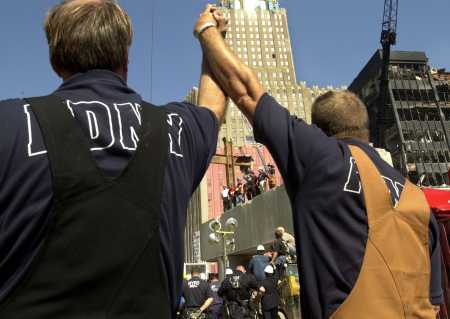
Yankees recall tragedy of 9/11
By Bryan Hoch / MLB.com


09/11/2007 9:27 PM ET

TORONTO -- Derek Jeter remembers shaking hands with various New York City emergency workers six years ago, blocks from the still-smoking blazes of Ground Zero, and hearing how excited they were to meet him. It didn't make a whole lot of sense.

But then again, not much seemed right in the immediate aftermath of Sept. 11, 2001. Now, as the nation mourns its losses once more and remembers the events of that tragic Tuesday morning, Jeter thinks back to how baseball was considered part of New York's healing process.

"I hear the stories now," Jeter said. "When people talk about September 11, they talk about how -- at least for those few hours -- we gave them something they could cheer for. That makes you feel good. At that point, some people who weren't necessarily baseball fans sort of rallied around us as a symbol for the city. I just think it gave people those three hours a day, something that they could cheer for."

The Mets may have played the first game back within New York's city limits after Sept. 11, a memorable Shea Stadium contest against the Braves in which Mike Piazza hit a crucial home run off future Yankee Steve Karsay. But it was the Yankees who kept the Bronx lit and played deepest into October, providing a welcome distraction for a city that desperately needed reasons to cheer.

The stories of rescue workers near the fallen World Trade Center towers, hovering around a portable television set or a radio to keep up with the Yankees' World Series vs. Arizona, have become deeply entrenched in sports folklore. Indeed, they are now part of American history.

Yankees manager Joe Torre said he relives Sept. 11 so often. Six years seems like a minute ago, Torre said, and yet the pain is never going to go away.

"It's not supposed to happen here," Torre said. "That's the whole mindset. Even though you have different things happen, especially at the World Trade Center [bombing] seven years earlier, it's something of this magnitude that scared ... all of us. It's so sad."

For the players, it was understood that their role was to help provide an outlet for raw emotions in a time when such releases were crucial. The Yankees, along with other notable figures in sports, entertainment and politics, were eagerly received downtown, where they consoled the grieving and lifted the spirits of the wounded.

"It was a time when people didn't have much to smile about," Jeter said. "I remember hearing the stories and how people were so excited to meet us. That didn't make much sense at the time, because we were with the real heroes -- the Fire Department, the NYPD, the EMS workers.

"For us, it was an opportunity to meet them and hear their stories. In return, they told us how excited they were to meet us. It was kind of a weird situation."

The Yankees remain the only Major League club to play "God Bless America" at the seventh inning of every home game. It was a common statement after Sept. 11 that the United States had been forever changed, that nothing could or should be the same. Torre would agree with that sentiment.

"There's just things you pay a whole lot more attention to," Torre said. "We're so much more vigilant than we used to be."
http://www.september11news.com/AAACross2.jpg
The Rising

Can't see nothin' in front of me
Can't see nothin' coming up behind
I make my way through this darkness
I can't feel nothing but this chain that binds me
Lost track of how far I've gone
How far I've gone, how high I've climbed
On my back's a sixty pound stone
On my shoulder a half mile line

Come on up for the rising
Com on up, lay your hands in mine
Come on up for the rising
Come on up for the rising tonight

Left the house this morning
Bells ringing filled the air
Wearin' the cross of my calling
On wheels of fire I come rollin' down here

Come on up for the rising
Come on up, lay your hands in mine
Come on up for the rising
Come on up for the rising tonight

Li,li, li,li,li,li, li,li,li

Spirits above and behind me
Faces gone, black eyes burnin' bright
May their precious blood forever bind me
Lord as I stand before your fiery light

Li,li, li,li,li,li, li,li,li

I see you Mary in the garden
In the garden of a thousand sighs
There's holy pictures of our children
Dancin' in a sky filled with light
May I feel your arms around me
May I feel your blood mix with mine
A dream of life comes to me
Like a catfish dancin' on the end of the line

Sky of blackness and sorrow ( a dream of life)
Sky of love, sky of tears (a dream of life)
Sky of glory and sadness ( a dream of life)
Sky of mercy, sky of fear ( a dream of life)
Sky of memory and shadow ( a dream of life)
Your burnin' wind fills my arms tonight
Sky of longing and emptiness (a dream of life)
Sky of fullness, sky of blessed life ( a dream of life)

Come on up for the rising
Come on up, lay your hands in mine
Come on up for the rising
Come on up for the rising tonight

Li,li, li,li,li,li, li,li,li


Copyright © Bruce Springsteen (ASCAP)
http://www.september11news.com/BBX11NewsandObserverX.jpghttp://www.september11news.com/BBNewsandObserverW.jpg
Where Were You
(When The World Stopped Turning)

By Alan Jackson


Where were you when the world stopped turning that September day
Out in the yard with your wife and children
Working on some stage in LA
Did you stand there in shock at the site of
That black smoke rising against that blue sky
Did you shout out in anger
In fear for your neighbor
Or did you just sit down and cry

Did you weep for the children
Who lost their dear loved ones
And pray for the ones who don't know
Did you rejoice for the people who walked from the rubble
And sob for the ones left below

Did you burst out in pride
For the red white and blue
The heroes who died just doing what they do
Did you look up to heaven for some kind of answer
And look at yourself to what really matters

I'm just a singer of simple songs
I'm not a real political man
I watch CNN but I'm not sure I can tell you
The difference in Iraq and Iran
But I know Jesus and I talk to God
And I remember this from when I was young
Faith hope and love are some good things he gave us
And the greatest is love

Where were you when the world stopped turning that September day
Teaching a class full of innocent children
Driving down some cold interstate
Did you feel guilty cause you're a survivor
In a crowded room did you feel alone
Did you call up your mother and tell her you love her
Did you dust off that bible at home
Did you open your eyes and hope it never happened
Close your eyes and not go to sleep
Did you notice the sunset the first time in ages
Speak with some stranger on the street
Did you lay down at night and think of tomorrow
Go out and buy you a gun
Did you turn off that violent old movie you're watching
And turn on "I Love Lucy" reruns
Did you go to a church and hold hands with some stranger
Stand in line and give your own blood
Did you just stay home and cling tight to your family
Thank God you had somebody to love

I'm just a singer of simple songs
I'm not a real political man
I watch CNN but I'm not sure I can tell you
The difference in Iraq and Iran
But I know Jesus and I talk to God
And I remember this from when I was young
Faith hope and love are some good things he gave us
And the greatest is love

I'm just a singer of simple songs
I'm not a real political man
I watch CNN but I'm not sure I can tell you
The difference in Iraq and Iran
But I know Jesus and I talk to God
And I remember this from when I was young
Faith hope and love are some good things he gave us
And the greatest is love

The greatest is love

Where were you when the world stopped turning that September day
The image “http://www.infowars.net/pictures/Oct06/231006spet11.jpg” cannot be displayed, because it contains errors.
'America the Ugly'
Six years after 9/11, it's notable how little
the politics of the left have changed.

BY NORMAN PODHORETZ


Tuesday, September 11, 2007 12:01 a.m. EDT

In the immediate aftermath of the attacks on us that took place on this very day six years ago, several younger commentators proclaimed the birth of an entirely new era in American history. What Dec. 7, 1941, had done to the old isolationism, they announced, Sept. 11, 2001, had done to the Vietnam syndrome. It was politically dead, and the cultural fallout of that war--all the damaging changes wrought by the 1960s and '70s--would now follow it into the grave.

I could easily understand why they thought so. After all, never in their lives had they witnessed so powerful an explosion of patriotic sentiment--and not only in the expected precincts of the right. In fact, on the left, where not so long ago the American flag had been thought fit only for burning, the sight of it--and it was now on display everywhere--had been driving a few prominent personalities to wrench their unaccustomed arms into something vaguely resembling a salute. One of these personalities, Todd Gitlin, a leading figure in the New Left of the '60s and now a professor at Columbia, even went so far as to question the inveterately "negative faith in America the ugly" that he and his comrades had tenaciously held onto for the past 40 years and more.

Having broken ranks with the left in the late '60s precisely because I was repelled by the "negative faith in America the ugly" that had come to pervade it, I naturally welcomed this new patriotic mood with open arms. It seemed to me a sign of greater intellectual sanity and moral health, and I fervently hoped that it would last.

But I could not fully share the heady confidence of my younger political friends that the change was permanent, and that nothing in American politics and American culture would ever be the same again. As a veteran of the political and cultural wars of the '60s, I knew from my own scars that no matter how small and insignificant a group the anti-Americans of the left might for the moment look to the naked eye, they had it in them to rise and grow again.

In this connection, I was haunted by one memory in particular. It was of an evening in the year 1960, when I went to address a meeting of left-wing radicals on a subject that had then barely begun to show the whites of its eyes: the possibility of American military involvement in a faraway place called Vietnam and the need to begin mobilizing opposition to it. Accompanying me that evening was the late Marion Magid, a member of my staff at Commentary, of which I had recently become the editor. As we entered the drafty old hall on Union Square in Manhattan, Marion surveyed the 50 or so people in the audience and whispered to me: "Do you realize that every young person in this room is a tragedy to some family or other?"

The memory of this quip brought back to life some sense of how unpromising the future had then appeared to be for that bedraggled-looking assemblage. No one would have dreamed that these young people, and the generation about to descend from them politically and culturally, would within the blink of a historical eye come to be hailed by many members of the very "Establishment" they were trying to topple as (in the representative words of Prof. Archibald Cox of Harvard Law School) "the best informed, the most intelligent, and the most idealistic this country has ever known."

More incredible yet, in a mere decade the ideas and attitudes of the new movement, cleaned up but essentially unchanged, would turn one of our two major parties upside down and inside out. By 1972, only 11 years after President John F. Kennedy had promised that we would "pay any price, bear any burden . . . to assure the survival and the success of liberty," George McGovern, nominated for president by Kennedy's own party, was campaigning on the antiwar slogan, "Come home, America." It was a slogan that to an uncanny degree reflected the ethos of the embryonic movement I had addressed in Union Square only about a decade before.

In sharp contrast to my younger friends, I could not help fearing that something like this might happen again. On the one hand, those who thought that we had brought 9/11 down on ourselves and had it coming were in a very tiny minority--even tinier than the antiwar movement of the early '60s. On the other hand, they were much stronger at a comparably early stage of the game than their counterparts of the '60s (who in some cases were their own younger selves). The reason was that, as the Vietnam War ground inconclusively on, the institutions that shape our culture were one by one and bit by bit converting to the "faith in America the ugly." By now, indeed, in the world of the arts, in the universities, in the major media of news and entertainment, and even in some of the mainstream churches, that faith had become the regnant orthodoxy.

But it would be a great mistake to suppose that the influence of these sectors of the culture was limited to their inhabitants. John Maynard Keynes once said that "practical men who believe themselves to be quite exempt from any intellectual influences, are usually the slaves of some defunct economist." Keynes was referring specifically to businessmen. But bureaucrats and administrators are subject to the same rule, though they tend to be the slaves not of economists, but of historians and sociologists and philosophers and novelists who may be very much alive even when their ideas have, or should have, become defunct.

Nor is it necessary for the "practical men" to have studied the works in question, or even ever to have heard of their authors. All they need do is read the New York Times, or switch on their television sets, or go to the movies--and, drip by drip, a more easily assimilable form of the original material is absorbed into their heads and into their nervous systems.

The few people I knew who shared my apprehensions believed that if things went well on the military front of what we were calling World War IV (the Cold War having in our scheme of things been World War III), all would be well on the home front too. And that was how it appeared from the effect wrought by the Afghanistan campaign, the first front to be opened in World War IV. For a short spell, the spectacular success of that campaign dampened the nascent antiwar activity on at least a number of campuses. But I felt certain that, as other fronts were opened--with Iraq most likely being the next--opposition not only would grow but would become more and more extreme.

I turned out to be right about this, and yet even I never imagined that the new antiwar movement would so rapidly arrive at the stage of virulence it had taken years for its ancestors of the Vietnam era to reach. Nor did I anticipate how closely the antiwar playbook of that era would be followed and how successfully it would be applied to Iraq, even though the two wars had nothing whatever in common.

To be sure, this time, mainly because there was no draft, there would be no student protesters and no massive street demonstrations. Instead, virtual demonstrations would be mounted in cyberspace by the so-called netroots and these, more suited to the nature of the new technological age, would prove an all-too-effective substitute. And so on the sixth anniversary of the attacks on the World Trade Center and the Pentagon, the main issues agitating this country are how quickly we can extricate ourselves from Iraq and whether to fix a timetable and a deadline for abandoning the field.

Here too the antiwar playbook of the Vietnam era is being very closely followed. In 1972, Richard Nixon was elected by landslide to a second term as president, but in campaigning against George McGovern's call for us to withdraw from Vietnam, Nixon did not sound an opposing call to fight on to victory. On the contrary: He too promised to get us out of Vietnam. The difference was that he also promised to accomplish this with our honor intact.

Today, like the McGovernites with respect to Vietnam in 1972, the overwhelming majority of the Democrats in Congress, and all the Democrats hoping to become their party's candidate for president, want America out of Iraq, and the sooner and the more completely the better. And like Nixon in 1972, many Republican members of Congress, along with a few of the Republicans running in the presidential primaries, also want out, but with our honor intact.

Well, Nixon did get us out of Vietnam. By 1975, when the North Vietnamese communists conquered the South, not a single American soldier was left in the country. But never in American history had our honor been so besmirched as it was by the manner of our withdrawal. Having left with the promise that we would continue to help save the South Vietnamese from communism by supplying them with arms, Congress nevertheless refused to send them so much as a bullet when the communists of the North were already storming the gates. As President Bush recently reminded us, to the sputtering rage of those who did not wish to be reminded, the price "was paid by millions of innocent citizens whose agonies would add to our vocabulary new terms like 'boat people,' 're-education camps,' and 'killing fields.' "

It is impossible at this point to predict how and when the battle of Iraq will end. But from the vitriolic debates it has unleashed we can already say for certain that the attacks of Sept. 11, 2001, did not do to the Vietnam syndrome what Pearl Harbor did to the old isolationism. The Vietnam syndrome is back and it means to have its way. But is it strong enough in its present incarnation to do what it did to the honor of this country in 1975? Well acquainted though I am with its malignant power, I still believe that it will ultimately be overcome by the forces opposed to it in the war at home. Even so, I cannot deny that this question still hangs ominously in the air and will not be answered before more damage is done to the long struggle against Islamofascism into which we were blasted six years ago and that I persist in calling World War IV.

Mr. Podhoretz is editor at large of Commentary. This essay is adapted from his new book, "World War IV: The Long Struggle Against Islamofascism," out today from Doubleday, which you can buy from the OpinionJournal bookstore.

Monday, September 10, 2007

The image “http://dappledthings.files.wordpress.com/2007/03/300px-new_york_times_9-11.jpg” cannot be displayed, because it contains errors.
No terrorism, just war?
Mark Steyn

Oh, it's a long, long while from September to September. This year, the anniversary falls, for the first time, on a Tuesday morning, and perhaps some or other cable network will re-present the events in real time – the first vague breaking news in an otherwise routine morning show, the follow-up item on the second plane, and the realization that something bigger was under way. If you make it vivid enough, the JFK/Princess Di factor will kick in: you'll remember "where you were" when you "heard the news." But it's harder to recreate the peculiar mood at the end of the day, when the citizens of the superpower went to bed not knowing what they'd wake up to the following morning.

Six years on, most Americans are now pretty certain what they'll wake up to in the morning: There'll be a thwarted terrorist plot somewhere or other – last week, it was Germany. Occasionally, one will succeed somewhere or other, on the far horizon – in Bali, Istanbul, Madrid, London. But not many folks expect to switch on the TV this Tuesday morning, as they did that Tuesday morning, and see smoke billowing from Atlanta or Phoenix or Seattle. During the IRA's 30-year campaign, the British grew accustomed (perhaps too easily accustomed) to waking up to the news either of some prominent person's assassination or that a couple of grandmas and some schoolkids had been blown apart in a shopping center. It was a terrorist war in which terrorism was almost routine. But, in the six years since President Bush declared that America was in a "war on terror," there has been in America no terrorism.

In theory, the administration ought to derive a political benefit from this: The president has "kept America safe." But, in practice, the placidity of the domestic front diminishes the chosen rationale of the conflict: if a "war on terror" has no terror, who says there's a war at all? That's the argument of the left – that it's all a racket cooked up by the Bushitlerburton fascists to impose on America a permanent national-security state in which, for dark sinister reasons of his own, Dick Cheney is free to monitor your out-of-state phone calls all day long.

Judging from the blithe expressions of commuters doing the shoeless shuffle through the security line at LAX and O'Hare, most Americans seem relatively content with a permanent national-security state. It's a curious paradox: airports on permanent Orange Alert, and a citizenry on permanent … well, I'm not sure there's a Homeland Security color code for "Gaily Insouciant," but, if there is, it's probably a bland limpid pastel of some kind. Of course, if tomorrow there's a big smoking hole where the Empire State Building used to be, we'll be back to: "The president should have known! This proves the failure of his policies over the last six years! We need another all-star commission filled with retired grandees!"

And that would be the relatively sane reaction. Have you seen that bumper sticker "9/11 WAS AN INSIDE JOB"? If you haven't, go to a college town and cruise Main Street for a couple of minutes. It seems odd that a fascist regime that thinks nothing of killing thousands of people in a big landmark building in the center of the city hasn't quietly offed some of these dissident professors – or at least the guy with the sticker-printing contract. Fearlessly, Robert Fisk of Britain's Independent, the alleged dean of Middle East correspondents, has now crossed over to the truther side and written a piece headlined, "Even I Question The 'Truth' About 9/11." According to a poll in May, 35 percent of Democrats believe that Bush knew about 9/11 in advance. Did Rumsfeld also know? Almost certainly. That's why he went to his office as normal that today, because he knew in advance that the plane would slice through the Pentagon but come to a halt on the far side of the photocopier. That's how well-planned it was, unlike Iraq.

Apparently, 39 percent of Democrats still believe Bush didn'tknow in advance – or, at any rate, so they said in May. But I'm confident half of them will have joined Rosie O'Donnell on the melted steely knoll before the Iowa caucuses. If Iraq is another Vietnam, 9/11 is another Kennedy assassination. Were Bali, Madrid and London also inside jobs by the Bush Gang? It's no wonder federal spending's out of control.

And what of those for whom the events of six years ago were more than just conspiracy fodder? Last week the New York Times carried a story about the current state of the 9/11 lawsuits. Relatives of 42 of the dead are suing various parties for compensation, on the grounds that what happened that Tuesday morning should have been anticipated. The law firm Motley Rice, diversifying from its traditional lucrative class-action hunting grounds of tobacco, asbestos and lead paint, is promising to put on the witness stand everybody who "allowed the events of 9/11 to happen." And they mean everybody – American Airlines, United, Boeing, the airport authorities, the security firms – everybody, that is, except the guys who did it.

According to the Times, many of the bereaved are angry and determined that their loved one's death should have meaning. Yet the meaning they're after surely strikes our enemies not just as extremely odd but as one more reason why they'll win. You launch an act of war, and the victims respond with a lawsuit against their own countrymen.

But that's the American way: Almost every news story boils down to somebody standing in front of a microphone and announcing that he's retained counsel. Last week, it was Larry Craig. Next week, it'll be the survivors of Ahmadinejad's nuclear test in Westchester County. As Andrew McCarthy pointed out, a legalistic culture invariably misses the forest for the trees. Sen. Craig should know that what matters is not whether an artful lawyer can get him off on a technicality but whether the public thinks he trawls for anonymous sex in public bathrooms. Likewise, those 9/11 families should know that, if you want your child's death that morning to have meaning, what matters is not whether you hound Boeing into admitting liability but whether you insist that the movement that murdered your daughter is hunted down and the sustaining ideological virus that led thousands of others to dance up and down in the streets cheering her death is expunged from the earth.

In his pugnacious new book, Norman Podhoretz calls for redesignating this conflict as World War IV. Certainly, it would have been easier politically to frame the Iraq campaign as being a front in a fourth world war than as a necessary measure in an anti-terrorist campaign. Yet who knows? Perhaps we would still have mired ourselves in legalists and conspiracies and the dismal curdled relativism of the Flight 93 memorial's "crescent of embrace." In the end, as Podhoretz says, if the war is to be fought at all, it will "have to be fought by the kind of people Americans now are." On this sixth anniversary, as 9/11 retreats into history, many Americans see no war at all.

Sunday, September 09, 2007

http://msnbcmedia2.msn.com/j/msnbc/Components/Photos/070817/070817_chamberlain_hmed_4p.hmedium.jpg
Seeing Joba live a 'blessing' to father
By Conor Nicholl / MLB.com


09/08/2007

KANSAS CITY -- Harlan Chamberlain started crying.

He had watched his son, Joba, "hundreds of times" in person. He played catch with him every day when Joba was growing up, watched him in high school and junior college. He saw him become the ace at the University of Nebraska and help the Cornhuskers reach the 2005 College World Series.

But he had never seen him like this -- watching him pitch in a Major League game, live, from the stands. Harlan, who has polio, is confined to a wheelchair.

He doesn't travel often and has watched his son pitch for the Yankees only on Major League Baseball's Extra Innings television package. But when Joba and the Yankees came to Kansas City, Harlan had to make the trip from his Nebraska home.

And when Joba entered the seventh inning of Friday's game against the Royals at Kauffman Stadium, Harlan became emotional.

"I will never forget this night," Harlan said. "September 7, 2007. To actually be here was pretty neat. It was a real blessing."

Joba continued his incredible scoreless streak, tossing two shutout innings. He allowed just two singles and still hasn't allowed a run in the Major Leagues. Through 11 appearances, Chamberlain has tossed 14 1/3 scoreless innings. These two, though, were actually a little bit easier for Chamberlain.

"We had a tight game going on and it is a situation where I want to be in," he said. "Doesn't matter what is going on. It is a big game for us no matter who we are playing."

About six hours before his son appeared in the game, Harlan pulled into Kauffman Stadium. Along with family members and friends, Harlan made the three-hour trip from Nebraska to Kansas City.

He reached Kauffman about four hours before first pitch and spent time with a Sports Illustrated photo crew, met Yankees manager Joe Torre and talked with lefty Andy Pettitte's father.

Joba was certainly happy to see his father -- as well as most of the state. Joba and Royals third baseman Alex Gordon are longtime friends, teammates and Cornhuskers legends.

In 2005, Chamberlain went 10-2 with a 2.81 ERA and Gordon won the Golden Spikes Award as collegiate baseball's player of the year.

Neither player knew how many tickets he asked for. Chamberlain couldn't even estimate the number -- "I haven't even counted; I just put my name and number next to a list" -- and Gordon received a barrage of phone calls and text messages asking for tickets.

Because the Cornhuskers football team is traveling this weekend, this Yankees-Royals series is the must-see event for many Nebraskans. Harlan put the number of Cornhuskers fans in attendance on Friday night at 10,000.

However, no fan was likely happier than Harlan.

"I think that if you stand, like, 35 feet away, you can probably see his smile," Joba said with a smile and laugh.

Harlan has always helped Joba. He taught him all he could about pitching.

"What I know about pitching will fit in a thimble; what I don't know will fit in the Smithsonian," Harlan said.

But Harlan did teach his son one piece of advice -- advice that helped Joba hone a dominating fastball.

"'If you throw a curveball, I will take you right out,' and he never did," Harlan said. "A kid growing up, a curveball is not something that he needs to be throwing.

Harlan saw Joba take his talent to Nebraska, win 16 games in two seasons and be picked as a supplemental first-rounder in the 2006 First-Year Player Draft.

When -- on Aug. 15, 2006 -- his appendix failed, it appeared that Harlan may not be able to see his son pitch again.

"When your appendix blows up at 54 years of age, there is a lot of other stuff that happens," Joba said. "When a 21-year-old man's appendix blows up, you are in and out of the hospital, but when you are a 54-year-old man who has polio ..."

Harlan's body didn't react well to painkillers. But he kept fighting, didn't give up. He wanted to continue living -- and continue watching his son play.

"A year later, he is finally back to where he was, and he is finally 100 percent," Joba said.

Harlan could watch his son skyrocket through the Minors. First, there was the 4-0 record and 2.03 ERA in seven starts at Class A Tampa. Then, 66 strikeouts in 40 innings at Double-A Trenton. Finally, 18 strikeouts and one walk in eight shutout innings for Triple-A Scranton/Wilkes-Barre.

And then the Majors. Harlan watched his son pitch 10 games and throw 12 1/3 shutout innings.

"I knew he would always make it," Harlan said. "I felt in [my heart] that he would always make it, but to move this fast, it is always surprising. He has jumped right in and become a part of it, and the rest is history. Now we just make new history."

Harlan saw on TV the incredible ovations and "Joba, Joba" chants his son received at Yankee Stadium. He wanted to see his son play in person, and this weekend offered an opportunity.

When he arrived at Kauffman Stadium, Harlan was greeted by Torre and his son's teammates. Torre approached Harlan, who extended his hand. Torre asked Harlan to call him "Joe."

"When each of the players came up and introduced themselves to me, it meant a great deal to me," Harlan said. "It was indeed an honor to meet [Torre]."

Harlan enjoyed another incredible experience when his son came in to protect a 3-2 seventh-inning lead. Joba threw 98-100 mph consistently and pitched a scoreless seventh.

"I understand somebody told me that he hit 100 six times and 101 once," Harlan said. "That is bringing [it] up. It amazes me, whether it is Joba, or [Carlos] Zambrano or [Joel] Zumaya."

In the eighth, Chamberlain faced his former teammate, Gordon, with one out. A few days ago, Gordon told him to throw him a first-pitch fastball. That is exactly what happened.

It was 100 mph. Gordon swung and missed.

"I got my first pitch to hit, and I was swinging," Gordon said. "You can't let those go by against a guy with this kind of talent."

Gordon eventually singled, but Chamberlain finished the inning with no damage. After Mariano Rivera closed out the ninth, Chamberlain met his dad and family, capping a night his father would never forget.