Saturday, December 13, 2008

From reason.tv:
Killer Chic
Hollywood's Sick Love Affair
with Che Guevara


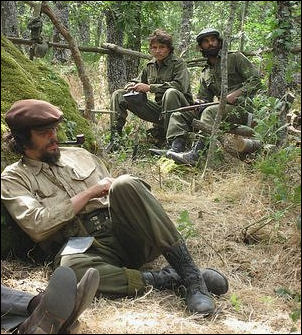
Gisele Bundchen wears him on the runway, Johnny Depp wears him around his neck, and Benicio Del Toro becomes him in the new, highly acclaimed, two-part epic film from Steven Soderbergh, Che. Ernesto "Che" Guevara, the revolutionary who helped found communist Cuba, is the celebrity that celebrities adore. And be it Madonna, Rage Against the Machine, or Jay-Z, musicians really dig Che.

It’s something that baffles Cuban jazz legend Paquito D’Rivera. “Che hated artists, so how is it possible that artists still today support the image of Che Guevara?” Turns out the rebellious icon that emblazons countless T-shirts actually enforced aesthetic and political conformity. D’Rivera explains that Che and other Cuban authorities sought to ban rock and roll and jazz.

“Che was an inspiration for me,” D’Rivera tells reason.tv. “I thought I have to get out of this island as soon as I can, because I am in the wrong place at the wrong time!” D’Rivera did escape Cuba, and so far he’s won nine Grammy awards playing the kind of music Che tried to silence. But D’Rivera says Che’s crimes didn’t end with censorship. “He ordered the execution of many people with no trial.” Che served as Castro’s chief executioner, presiding over the infamous La Cabana prison. D’Rivera says Che’s policy of killing innocents earned him the nickname—the Butcher of La Cabana.

“We’re rightly horrified by fascist murderers like Adolph Hitler,” says reason.tv’s Nick Gillespie. “Why aren’t we also horrified by communist killers?” Certainly, Che’s body count isn’t anywhere near Hitler’s. But what about someone Che idolized, someone whom he might have liked to wear on his chest?

“Che, Castro, all the communist regimes idolized only one thing that Mao personifies—violence.” Kai Chen grew up in China under the reign of Mao Zedong. Although he won gold medals for China’s national basketball team, Chen’s was far from the celebrity life of an NBA star. Says Chen, “You have no right to talk, and you have no right to think.”

The punishment for questioning Mao’s authority was often death. The Black Book of Communism estimates that Mao is responsible for the deaths of 65 million people—a figure that dwarfs even Hitler’s body count. “Mao is a murderer,” says Chen. “The biggest mass murderer in human history.”

And yet, like Che, Mao’s image is becoming an increasingly popular way to move merchandise. You can buy Mao t-shirts, mugs, caps—you name it. Near Chen’s Los Angeles home there’s even a restaurant called Mao’s Kitchen. “Can you imagine a restaurant called Hitler’s Kitchen?” asks Gillespie.

Neither D’Rivera nor Chen understands why communist killers are considered Chic, but each finds his own way to have the last laugh on these anti-capitalist icons.

"Killer Chic" is written and produced by Ted Balaker. Director of Photography is Alex Manning.

Closing music, "Che Guevara T-Shirt Wearer," courtesy of The Clap. Listen to the whole song here.

http://www.hollywood-elsewhere.com/images/column/101507/chejungle.jpg
From The New York Post:
'CHE' IT AIN'T SO

By KYLE SMITH

December 12, 2008 --

MEET Che Guevara. Just think of him as Jesus plus Abraham Lincoln with a touch of Moses and Dr. Doug Ross. After 4½ hours of watching Dr. Ernesto "Che" Guevara heal the sick, teach the illiterate, daze the women, execute the lawless, defeat the corrupt, uplift the peasantry and spew the sound bite, I was convinced there would be a scene in which he turned water to Bacardi.

You can't spell cliché without "Che." And as I endured this mad dream directed - or perhaps committed - by Steven Soderbergh, I wondered where I'd seen it all before. The booted stomping through the greensward, the jungly target shooting? It's a remake of Woody Allen's "Bananas," right? Minus punch lines - or perhaps with them. "We are in a difficult situation," Che observes, at a point when his army is surrounded and forced to eat its horses.

The story of the Argentine doctor Ernesto "Che" Guevara is played with much broody self-importance by Benicio Del Toro. It will be shown in two parts after its one-week opening run. That way, on consecutive evenings, it can bore everyone but activist grad students.

There are banana boats of chitchat about Bolivian mining strikes and agrarian land reform amid messages about how "a true revolutionary is guided by great feelings of love" (that, and Molotov cocktails) and "you have to live as if you've already died." If ever a movie needed Kim Cattrall to slink into the frame, it's this one. "Honey, love the beret, but if anything's to die for, it's the quilted Chanel tote, not toothless Bolivian farmers."

Part I, set almost entirely in Cuba as Castro and Guevara creep through the jungle, builds to an exciting hand-to-hand fight in the streets, then ends abruptly before our heroes even parade into La Habana, though not before Che can deliver one last lecture on how "I'd rather walk to Havana than drive in a stolen car." (The movie is based on two books - written by Guevara, so we know they're accurate.)

Part II skips the Che/Castro follies in Cuba and Che's adventures in Africa to settle in 1966 Bolivia. Che will spend the next two hours trudging around the mountains changing his name (first he's "Ramon," then "Fernando"), accepting worship ("Could I shake his hand again?" asks a guerrilla junior grade), telling his men he'd rather die than slow them down, taking a break during a bizarre cameo by Matt Damon, and jumping the gun on Del Toro's next gig by gradually proceeding from "unshaven" to "Wolf Man."

This isn't a movie so much as a siege. When the screen flashed "Day 302," I thought it was updating me on how long I had spent in the theater without food, water or access to the Red Cross.

Che, although armed, allows himself to be taken alive, which means an amusing execution in the dust instead of righteous death in battle. Soderbergh (who went native and showed up at the Toronto Film Festival in chunky glasses and arrested-for-vagrancy grooming) takes Che's point of view as the moment of expiration arrives, sharing with us a vision of a blinding white light as the furry comandante slips into Commie heaven. Say hi to the Rosenbergs for me! Fidel says, "See ya soon."

kyle.smith@nypost.com

CHE Rebarbative. In Spanish and English with subtitles. Running time: 287 minutes, including 30-minute intermission. Rated R (violence).

Wednesday, December 10, 2008

INSPIRATION FOR NEW SPRINGSTEEN COVER?
(HT: RMAS Usenet group)
http://ecx.images-amazon.com/images/I/61T23ZQ0V8L._SS500_.jpg

Tuesday, December 09, 2008

http://entertainmentnow.files.wordpress.com/2008/05/che1-512.jpg
"So easy, even a bloodthirsty Communist mass-murderer can do it..."
http://www.prostockbike.com/images/logo_geico.jpg
From FrontPageMagazine.com:
Che’s Useful Idiot
By Humberto Fontova

Tuesday, December 09, 2008

“I’d like to dedicate this to the man himself, Che Guevara!” announced Benicio del Toro this May, as he received a “best actor” award for his starring role in Che, a reverent new film about the communist revolutionary. As the crowd at the Cannes Film Festival erupted in thunderous ovation, the Puerto Rico-born actor gushed that “I wouldn't be here without Che Guevara, and through all the awards the movie gets you'll have to pay your respects to the man!"

But some stubbornly refuse to pay their respects. Thus, the actor received a much cooler reception when Che, directed by Oscar-winner Steven Soderbergh, had a private screening in Miami Beach this past Thursday. Cuban-Americans, including the mayor of Miami Beach, protested the 4-and-a-half hour glorification of the man they consider a Stalinist mass-murderer.

Miami's media proved equally unwelcoming. At a press conference after the screening in Miami Beach's Byron Carlyle Theater, Marlene Gonzalez of the Spanish language America TeVe network asked del Toro about some glaring omissions in the movie. What of Che’s role in ordering the executions of ordinary Cubans? And why no mention of the forced-labor camps established on the guerilla fighter’s orders? A suddenly hurried Del Toro denied that Che bore any culpability for these horrors. He refused even to admit Che’s bitter falling out with Fidel Castro, claiming that, to the contrary, the two always got along splendidly and that Castro was genuinely heartbroken when Che was captured and killed after fighting to his last bullet.

The contrast made for a moving scene. As protestors outside the Carlyle Theater brandished pictures of relatives murdered by Che Guevara, del Toro paid tribute to their murderer. Questions about Che’s brutalities – meticulously recorded in books like Exposing the Real Che Guevara – he brushed aside as the embittered fabrications of Cuban exiles.

The following day, del Toro flew to Havana to present his film at the Havana Film Festival and hob-knob with Castro regime officials. Che was billed as the highlight of the festival and the Stalinist regime rolled out the carpet for their honored guest. “It's a privilege to be here!” effused del Toro. “I'm grateful that the Cuban people can see this movie!”

And why shouldn't Castro's subjects be allowed to view his movie? Weren't Stalin's subjects allowed to watch The Battleship Potemkin? Weren't Hitler's subjects allowed to watch Leni Riefenstahl’s Triumph of Will? Both were produced at the direction of the propaganda ministries of totalitarian regimes, to be sure, but then the same might well be said of Che. The screenplay was based on Che Guevara's diaries, which were published by Cuba's propaganda ministry; the diaries’ forward was written by Fidel Castro himself. The film includes several Communist Cuban actors, while other Latin American actors spent months in Cuba being prepped for their roles by members of Cuba's “Che Guevara Institute.”

The Cuban Film Institute is an arm of Stalinist Cuba's propaganda ministry. On December 7, Castro’s own press ministry announced that “Actor Benicio del Toro presented the film (at Havana’s Karl Marx Theater) as he thanked the Cuban Film Institute (ICAIC) for its assistance during the shooting of the film, which was the result of a seven-year research work in Cuba.

That del Toro considers the Cuban regime a reliable source for the film is telling. Consider that the Castro government has jailed more political prisoners as a percentage of population than Stalin's and executed more people (out of a population of 6.4 million) in its first three years in power than Hitler's executed (out of a population of 70 million) in it's first six. These figures come from the human rights group Freedom House and from the Black Book of Communism, authored by French scholars and translated into English by Harvard University Press, not exactly headquarters for the vast-right wing conspiracy.

The irony is that del Toro himself is a noted advocate of artistic freedom and an outspoken opponent of the “armed struggle” that Che Guevara led, to such disastrous effect, in Cuba. But not only has he starred in a film glorifying the communist killer, but he has just deigned to be feted as guest of honor at Havana's Film Festival by a totalitarian regime that, for half a century, has jailed and tortured any Cuban movie director who strayed from Stalinist dictator's party line. Del Toro needn’t look to Cuban exiles to undermine his convictions. He has done well enough on his own.


Humberto Fontova is the author of Exposing the Real Che Guevara and the Useful Idiots Who Idolize Him. Visit www.hfontova.com
http://www.sentieriselvaggi.it/file/5/26202/image/rourke_thewrestler.jpg
From The New Yorker: The best film critic working pens the best assessment of Mickey Rourke I've ever read.
'The Wrestler'

By Anthony Lane

For some years, Mickey Rourke was just about my favorite movie star. This was not an easy stance to take. The body of the man’s work was dismayingly thin, and the body of good work, from “Rumble Fish” onward, could be counted on the knuckles of one fist. As for the body of the man, it swelled from taut and slender to something so bulbous and spongiform that those of us who had thrilled to Boogie, his cocky romancer in “Diner,” could only wince and look away. Yet I insist: there was a time when Rourke demanded to be looked at, catching and holding your eye no less grippingly than the young De Niro. Sweetness and menace were folded up in him—in the way that he angled himself at the world, as if both sure of his place within it and, deeper down, afraid that it might still spit him out. Hence the voice: never a bellow or a screech, nor yet a Brando-haunted mumble, but the soft croon of a conspirator; remember him as the arsonist for hire in “Body Heat,” forcing his employers to lean in close lest they miss his wicked meaning. That whisper of secrecy remained in Stanley White, with his stiff gray hair, his long coat, and his vows of judicial vengeance. Stanley was the cop whom Rourke played in “Year of the Dragon,” and everything about the project shouted overkill: script by Oliver Stone, direction by Michael Cimino, and a racial attitude that was designed to rile. But there was Rourke, holding steady at the core of the storm.

And now the voice is back. In “The Wrestler,” directed by Darren Aronofsky, Rourke is Robin Ramzinski, known to his admirers as Randy (the Ram) Robinson. The body is now a glistening mound of bruised and damaged goods, and the quiff of Stanley White has been replaced by a mop of ropy blond extensions that you could wipe the floor with. Twenty years ago, as the opening credits show, Randy was a star on the wrestling circuit, but the film follows him as he burns away. He lives in a trailer in New Jersey, except that, right now, he doesn’t; the landlord has locked him out for not paying the rent. Randy joshes with the local kids, and plays Nintendo with one of them—“a really old game,” according to the boy, who is used to Call of Duty. Such is modern senescence: to age as quickly as a video game. Randy still wrestles, but the cash is petty, and he boosts his income by heaving boxes at a supermarket. He has a friend, a stripper named Cassidy (Marisa Tomei), but she has no plans to be his girlfriend. Then, there is Stephanie (Evan Rachel Wood), his daughter, although they haven’t met in years. When they do hook up, things improve—too fast, it turns out, as if reconciliation were more of a dream than a practical goal. They book a dinner, but Randy gets drunk, misses the date, and loses her once more. “An old, broken-down piece of meat,” he calls himself. “I’m alone, and I deserve to be alone.”

To some extent, as that speech suggests, “The Wrestler” is as simple as its title. The pathos of personal ruin is an established trope, and the trick, as demonstrated by John Huston in “Fat City” and by Martin Scorsese in “Raging Bull,” is to stop it from sliding into the sentimental. Aronofsky doesn’t always succeed in this, and there are lines in Robert D. Siegel’s script that wave their symbolic purpose in the audience’s face: “It’s your heart—you need to start taking better care of it.” So says a hospital medic, when Randy is admitted, and undergoes bypass surgery, after collapsing in the wake of a bout. It’s O.K., Doc, we get the point. But the movie, like its hero, manages to yank itself back into shape, and that, it strikes me, is mostly due to Rourke. When Randy goes home after the operation, and peels off his bandage, the camera zooms in to inspect the scar on his chest, whereas what really pinches our attention is his harmless habits: the mild, uncomplaining manner in which he pops in a hearing aid or adjusts his reading spectacles. He may be one of the last people in movies to use a pay phone. This fellow is mutton dressed as Ram, and he knows it, and, if he earns the caress of our pity, that is precisely because he never stoops to beg for it.

There is no denying the brutality of “The Wrestler,” and some of the scenes in the ring, especially those which provoke the cardiac arrest, are hard to watch. The movie comes off as inoffensive, however, since, unusually for these times, it trades in violence cleansed of ill will. The wrestlers are a club, greeting one another as brothers in arms, or in headlocks; one of them cheerfully sells Randy almost a thousand dollars’ worth of steroids and other drugs, and, in place of the hypocritical masking that bedevils major sports, there is a peculiar honesty, almost a decorum, running beneath the overcooked beefcake and the staged aggression of the fights. “What do you want to do tonight?” one opponent asks Randy, as if inviting him to the theatre, before proposing that he enliven that evening’s bout by puncturing his rival with a staple gun. You could call them cardboard characters, pierced and flattened for the delight of the crowd, but Aronofsky cast the minor roles with real wrestlers, and you believe in every scourging of the flesh.

For all that, the best sequence in the film, even more likely to lodge in your mind than the soaring sadness of the climax, takes place not on the wrestlers’ canvas, with its carpet of blood and broken glass, but at the deli counter of the supermarket. Here Randy, needing the money, dons a protective hairnet and doles out pasta salad. He even pins on a name tag that says “Robin,” randiness being too rich for this clientele. The dent to his pride is profound, more wounding than any professional blow to the head, and the scene closes in agony, as he takes out his frustration on a meat slicer. But here’s the thing: while the job lasts, he’s pretty good at it, bringing a brief shaft of pleasure to the customers, and suffering any taunts that come his way. What Rourke offers us, in short, is not just a comeback performance but something much rarer: a rounded, raddled portrait of a good man. Suddenly, there it is again—the charm, the anxious modesty, the never-distant hint of wrath, the teen-age smiles, and all the other virtues of a winner. No wonder people warmed to Randy Robinson twenty years ago. I felt the same about Mickey Rourke, and I still do.

Monday, December 08, 2008

http://www.ccel.org/pix/books.jpeg
From Pajamas Media:
Some things you can’t say
By Roger Kimball

On December 8, 2008

Most readers will be familiar with George Orwell’s concept of Newspeak, that diabolical instrument of totalitarian control that focuses on the primary instrument humans use to understand and communicate about the world they share: language. Newspeak, Orwell explains in 1984, operates “partly by the invention of new words, but chiefly by eliminating undesirable words and by stripping such words as remained or unorthodox meanings.”

When I first read 1984 in high school, the gruesome scenes in which Winston is tortured and broken made the the most vivid impression on me. But as time has passed, I have come to think that Orwell’s dissection of Newspeak is even more terrible. The examples Orwell used–”War is Peace,” “Freedom is Slavery,” etc.–were the sort of bald contradictions that most adolescents cheerfully accommodate because they haven’t the foggiest idea of what they really mean or what a world in which people seriously believed that war is peace, or freedom is slavery, would be like. Heck, growing up in a small coastal town in Maine in the 1960s, most adolescents didn’t really have any clear idea what “war” or “peace” or “freedom” or “slavery” was. I know I didn’t. They were abstractions you could define, if someone asked, but you were happy to accept the contradiction of their conjunction because, deep down, you were innocent of their awful implications.

In any event, that bit of Orwell’s book now strikes me as singularly grim because I now see the process he anatomizes at work all around me. Let me give three examples.

One: Last winter, Department of Homeland Security issued a [1] document called “Terminology to Define the Terrorists: Recommendations from American Muslims.” While you ponder why the Department of Homeland Security is gathering recommendations about how to combat radical Islam from American Muslims, let me mention a few things this document recommends.

Because we are supposed to be “communicating with, not confronting,” Muslims, the document advises us not to “insult or confuse them with pejorative terms such as ‘Islamo-fascism.’ which are considered offensive by many Muslims.” The word “progress” is OK, but–George Orwell, where are you?–”the experts consulted” rejected the word “liberty” “because because many around the world would discount the tern as a buzzword for American hegemony.”

Breathtaking isn’t it? Those leading the fight against terrorism assure us that “The fact is that Islam and secular democracy are fully compatible–in fact, they can make each other stronger.” But where is the evidence of that? In the immediate aftermath of 9/11, President Bush went to a mosque and told his audience that “Islam” meant “peace.” Perhaps that was an emollient thing to do. Unfortunately, it is not true. [2] Islam means “total submission to the will of Allah,” and absent that submission what Muslims give us is not peace but jihad.

While emissaries from the State Department and the Department of Homeland Security are making Herculean efforts not to do or say anything of “offend Muslims,” radical Muslims are busy extending the list of things they are offended by while also seeking new ways to insinuate elements of Sharia law into the West–a mode of theocratic imposition that, far from being “fully compatible” with secular democracy, is something closer to its antithesis.

My second example is a seasonal one. In a recent column, Mark Steyn [3] pointed out that the mighty Amazon.com is advertising a special music sale called “[4] The Twelve Days Of Holiday“. (Hat tip for this to [5] Instapundit.) This is what happens when you bend over backwards to mollify multicultural sensitivities. The linguistic absurdity (”On the first day of holiday, my true love gave to me . . .”) is not fortuitous: it is the presenting symptom of that moral illness that underlies the whole enterprise. In a [6] later column, Mark reports that a reader who complained to Amazon about the excision of the word “Christmas” received this canned response from Amazon:

Please accept our sincere apologies if you were offended by the use of the word “Christmas” on our website. Our intention in referring to Christmas is to give specific ordering guidance for a specific holiday, not to exclude other faiths.

Pass the air-sickness bag, what? In the nineteenth century, the Danish philosopher Soren Kierkegaard expended a lot of ink criticizing his countrymen for pretending that they were Christians when in fact they lived as thoughtless hedonists. I wonder what Kierkegaard would have to say could he make a brief tour through the remains of Christendom today? At least his fellow Copenhageans gave lip service to Christianity. (I’ve always thought there was a lot to be said for lip service: for one thing, it makes the practice of genuine devotion much more practicable.)

My third example was brought to my attention by my friend [7] Dawn Eden. A new English children’s dictionary published by Oxford University Press, the London Telegraph [8] reported yesterday, has dropped many many words “associated with Christianity, the monarchy and British history.” Banished are such words as “aisle” (those things running between lines of pews), “bishop”, “chapel”, “empire,” and “monarch.” But the Junior Dictionary is happy to welcome such new comers as “blog”, “broadband,” and “celebrity.”

The Telegraph quotes Professor Alan Smithers from Buckingham University: “We have a certain Christian narrative which has given meaning to us over the last 2,000 years. To say it is all relative and replaceable is questionable. The word selections are a very interesting reflection of the way childhood is going, moving away from our spiritual background and the natural world and towards the world that information technology creates for us.”

“Interesting” is one word for it. “Dismaying” might be more to the point, or even “horrified” the word applied by one mother who has tallied differences among Junior Dictionaries going back to 1978. It’s not only words that carry and help preserve Britain’s religious heritage and identity as a Christian nation: also gone missing are words that describe the natural environment. “Moss” and “fern” and “sycamore” are out in favor of words from the realm of virutal relaity: MP3 player, e.g., and voicemail, and chatroom.

The Telegraph supplies this tally:

Words taken out:

Carol, cracker, holly, ivy, mistletoe

Dwarf, elf, goblin

Abbey, aisle, altar, bishop, chapel, christen, disciple, minister, monastery, monk, nun, nunnery, parish, pew, psalm, pulpit, saint, sin, devil, vicar

Coronation, duchess, duke, emperor, empire, monarch, decade

adder, ass, beaver, boar, budgerigar, bullock, cheetah, colt, corgi, cygnet, doe, drake, ferret, gerbil, goldfish, guinea pig, hamster, heron, herring, kingfisher, lark, leopard, lobster, magpie, minnow, mussel, newt, otter, ox, oyster, panther, pelican, piglet, plaice, poodle, porcupine, porpoise, raven, spaniel, starling, stoat, stork, terrapin, thrush, weasel, wren.

Acorn, allotment, almond, apricot, ash, bacon, beech, beetroot, blackberry, blacksmith, bloom, bluebell, bramble, bran, bray, bridle, brook, buttercup, canary, canter, carnation, catkin, cauliflower, chestnut, clover, conker, county, cowslip, crocus, dandelion, diesel, fern, fungus, gooseberry, gorse, hazel, hazelnut, heather, holly, horse chestnut, ivy, lavender, leek, liquorice, manger, marzipan, melon, minnow, mint, nectar, nectarine, oats, pansy, parsnip, pasture, poppy, porridge, poultry, primrose, prune, radish, rhubarb, sheaf, spinach, sycamore, tulip, turnip, vine, violet, walnut, willow

Words put in:

Blog, broadband, MP3 player, voicemail, attachment, database, export, chatroom, bullet point, cut and paste, analogue

Celebrity, tolerant, vandalism, negotiate, interdependent, creep, citizenship, childhood, conflict, common sense, debate, EU, drought, brainy, boisterous, cautionary tale, bilingual, bungee jumping, committee, compulsory, cope, democratic, allergic, biodegradable, emotion, dyslexic, donate, endangered, Euro

Apparatus, food chain, incisor, square number, trapezium, alliteration, colloquial, idiom, curriculum, classify, chronological, block graph

It may seem like a small thing that Amazon.com advertizes a “Twelve Days of Holiday” music sale. And haven’t dictionaries been moving in the direction of being “descriptive” rather “prescriptive” for decades? Sure troglodytes like me always complain, but if young ‘uns no longer encounter such things as moss and ferns and sycamores, if they never set foot in an abbey or encounter a bishop, if they never dream about elves or goblins, or eat cauliflower or play with conkers, what’s the big deal? Since they’re strapped to their MP3 players while checking their voicemail and dropping in on their favorite internet chatrooms, shouldn’t a junior dictionary reflect those changes?

Do you believe that? Then you will also believe the US State Department when it tells you that Islam and secular democracy are “fully compatible” and that “liberty” should be avoided because its a synonym for “American hegemony.” Yesterday, I [9] made mention of something called “[10] The Voluntary Human Extinction Movement.” I, too, thought it little more than a (bad) joke when I first heard about it. More and more, though, I wonder whether it is making far greater, if largely covert, inroads into civilization than we had ever thought possible. Not, alas, into those civilizations where the [11] Religion of Peace reigns or is making rapid inroads. But many–maybe most–places that had traditionally identified themselves as Christian seem to have surrendered. Is “suicide” still in that junior dictionary? It should be. Twelve days of holiday to spend in the virtual world of a chatroom while emissaries from the religion of peace busy themselves making the laws of your neighborhood fully compatible with the tenets of Sharia law.

Merry Christmas.

7:17 am In Uncategorized | 5 Comments

http://bztv.typepad.com/instanthistory/images/december_22_1980_1.jpg
From the blog A Deeper Shade of Soul:
John Lennon, December 8, 1980 and Me
By Ben Lazar

December 8, 1980 is, in retrospect, one of the most important days in my life.

It was a Monday, and I was in the 5th grade at Solomon Schecter Day School in Cranford, NJ, and we had the day off. My Dad and I were living alone in Plainfield, New Jersey, but I was spending the long weekend at my Godfather’s tiny studio in Manhattan on W. 72nd Street between Amsterdam and Columbus Avenue, one avenue away from the Dakota, where John Lennon and Yoko Ono lived.

My Godfather, Vincent Cavallaro, was a painter, and it was he who introduced me to fine art and what it is to be an artist. He was a wonderful painter and sculptor – one of very few artists commissioned by NASA to depict the space program in the 60’s. He was never financially successful; his best work came in the 50’s and 60’s, and it didn’t quite follow the fashion of Abstract Expressionism in the 50's and especially not the Pop Art that Warhol and Rauschenberg ushered in during the early 60’s. By 1980, he was almost seventy, and his fire was going.

But Jimmy (his nickname, which was the only name I ever called him) was the grandfather I never had – and he spoiled me rotten. Pretty much anything I wanted, he’d get it for me. One day in the spring of 1980, Jimmy had bought me a new pair of roller skates and we went to Central Park to try them out. On our way back to his place, I saw a couple walk out the very scary looking (to my eyes) Dakota building on the corner of 72nd and Central Park West, into a waiting car. The man was signing autographs before he got into the car. “Who is that,” I asked Jimmy. “John Lennon,” he replied. Even at the age of nine going on ten, I knew that John Lennon was someone important, and that he had been in the Beatles, and they were important, even though I didn’t really know anything about them yet.

My Dad picked me up early in the evening on December 8th, and I was home by around seven. I was asleep by ten. The following morning, I awoke and got the paper for my Dad, opened it up, and saw the headline in the upper left section: John Lennon Dead. I read the article, fascinated, my adrenaline beginning to pump, thinking that this murder had happened someplace I had walked by countless times – that I had just been there the day before - I had seen this man before.

And then I turned on the radio (I listened to WPLJ in those days), and then I started to get the depth of what had happened, what John Lennon had meant to people, and who the Beatles really were. The radio seemed to play the saddest Beatles and John Lennon songs. (I recall hearing “Strawberry Fields Forever,” “A Day In The Life,” “Let It Be,” and “Imagine” more than almost anything else.) And in hearing listeners call in anguished and crying, something about their grief touched me.

I was transfixed by the story and the footage I saw on TV. I related to Sean losing his father violently, as I had lost my mom violently in a car accident a few years previously. I heard about John Lennon losing his mom twice; once as a young boy when his parents split, and then as a teenager when she was hit by a car. Of course, it resonated with me completely.

And then I made a discovery. Underneath the stereo, there was a cabinet full of (vinyl) albums. I thought they were all opera albums belonging to my Dad, but as I went through the collection, I saw them – Rubber Soul, Revolver, Sergeant Pepper, the White Album and Let It Be. They had been left behind by my older brother and sister, and now they were mine.

I put on Revolver first, because I thought the cover looked cool. And from the first note of "Good Day Sunshine," (I put side two on first and yes, I know it's a Paul song) I was gone. I didn’t just listen to the music; I swallowed it whole, like air or water. By that Sunday, when there was a worldwide vigil for John, I had made tape recordings of all of those albums, and was playing them on my little Panasonic mono tape recorder, even when I went to bed. Yes, I felt the sadness of the moment – I related to that sadness all too well. But I heard the joy, pleasure and possibility in the Beatles, and I, thank God, related to that more. Like millions before me, I was now discovering the power of their music - and of rock and soul.

Within three months, I had every Beatles album and was fully obsessed with them. When I would see Jimmy, I would have him buy me books on the Beatles and rock n’ roll. And reading those books (Shout! by Philip Norman, The Rolling Stone Illustrated History Of Rock And Roll, The Beatles by Hunter Davies, Lennon Remembers) led to names that I had might have heard before, but that I certainly hadn’t yet reckoned with: Elvis Presley, Little Richard, the Everly Brothers, Chuck Berry, Buddy Holly, the Rolling Stones, the Who, Smokey Robinson, Billy Preston, Motown, Stax and more, all of whom in the months and years to come would be more treasure for me discover. In the Time Magazine with Lennon on the cover following his death, it covered Bruce Springsteen and Miami Steve Van Zandt’s reaction to Lennon’s death the following night in Philadelphia, and that Lennon had been warmly admiring of “Hungry Heart,” which had just been released. That led to me buying The River in February, 1981. I was gone, again.

Who I am, who I’ve been and who I will ever be as a music lover, executive, participant, producer, writer, critic, A&R man, and advocate was, in part, birthed in the aftermath of that horrible event on December 8, 1980. My relationship with John Lennon’s music – from the sublime way he sang “You’ve Really Got A Hold On Me,” to the anguished soul of Plastic Ono Band is at the core of who I am. The soul of his music - romantic, cynical, hilarious, mocking, loving, fun, questioning- is there with me always, as something to treasure, and a benchmark to aspire to. I’ve never stopped missing him and wishing I had had the opportunity to appreciate him while he was alive.

And I'm still pissed off he's gone.
http://farm3.static.flickr.com/2221/2082757434_066ac37c25.jpg?v=0
From Chronicles Magazine:
How to Win the War Against Christmas
by Tom Piatak

In the seven years since my first essay on the War Against Christmas appeared in Chronicles, I have had no trouble writing at least one such essay per year, because each year brings new and outrageous attempts to suppress the public celebration of Christmas. My favorite example was the 2002 winner of VDare.com’s invaluable War Against Christmas Competition that I analyzed in The American Conservative in Christmas 2003. The Columbus, Ohio, schools banned a performance of Handel’s Messiah, which for the previous nine years had been the highlight of the year at a specialized school for the arts. The performance would have violated the district’s religious-music policy, which came into being as the result of an ACLU lawsuit.

According to the Columbus Dispatch, the policy stipulated that the proportion of religious music performed in concert be no more than 30 percent and that the performance of religious music be “based on sound curricular reasons” and not “manifest a preference for religion or particular religious beliefs.” The educational bureaucrats who devised the policy, trying to be helpful, suggested the students perform “Frosty the Snowman” or “Jingle Bells” instead of Handel. Their ignorance and philistinism are appalling, though characteristic of those waging the War Against Christmas. After hearing Messiah performed in London, Haydn was moved to exclaim that “Handel is the master of us all!” and to write his own great oratorio, The Creation. But, in today’s climate of “sensitivity” and “tolerance,” beauty and artistic merit are scarcely a sufficient warrant for exposing delicate ears to the name of Christ.

This example, precisely because it is so appalling, gives us a clear idea of what is at stake in the War Against Christmas. As I wrote in The American Conservative, “The result of sanitizing Christmas is now within sight: an undistinguished, uninspiring public celebration, devoid of religious or cultural significance or indeed of beauty, with nothing left but multiculturalist pap and tawdry commercialism.” The War Against Christmas is a part of the larger war against the heritage of the West. It goes by such names as “multiculturalism,” “political correctness,” and “cultural Marxism” and seeks to destroy the traditional culture of the West and, ultimately, the West itself. Although embittered atheists are often shock troops in the War Against Christmas, the hostility to religion is noticeably selective: The public celebration in America of Hanukkah, Ramadan, and Diwali as faux-Christmases (even though the Islamic lunar calendar is taking Ramadan further and further away from December) has never been more pronounced. This is not happening by accident, nor is it restricted to America. As the Daily Mail reported on November 1, 2007, a Labour think tank had urged that Christmas be “downgraded” as part of an “urgent and upfront campaign” to promote a “multicultural understanding of Britishness,” and part of this campaign is the elevation of non-Christian holidays with temporal proximity to Christmas.

However, none of this is irreversible. As I wrote on VDare.com during Christmas in 2003, there are several mundane steps that would help in the effort to make Christmas again a time for joyous and beautiful public celebration. We need to let movie studios, retailers, school boards, and politicians know that those of us who love Christmas vastly outnumber the malcontents, and that we do not appreciate what has happened to the public celebration of our holiday. We need, in essence, a new Legion of Decency, an organization that helped ensure both that Hollywood did not make movies assaulting Christmas and that it made movies that celebrated Christmas, including such classics from Hollywood’s Golden Age as It’s a Wonderful Life, Miracle on 34th Street, The Bishop’s Wife, and The Bells of St. Mary’s, the movie being shown in Bedford Falls as George Bailey runs down its snowy streets on Christmas Eve. Boycotting bad movies works. Last year Hollywood celebrated Christmas by releasing The Golden Compass, a movie based on Philip Pullman’s atheist children’s trilogy. Once word got out about who Pullman was and what he believed, the movie tanked at the U.S. box office, and it is now unlikely that the two planned sequels will ever be made.

Numbers are surely on our side. Polls show that up to 96 percent of Americans celebrate Christmas. This effort need not be entirely negative—even though some polite, forceful complaining will be necessary. We can start wishing others “Merry Christmas” again. We can buy only cards that mention Christmas and let both the retailer and the card maker know why we are doing that. On our Christmas cards that actually mention Christmas we can make a point of using only the USPS’s Christmas stamp, and we can tell them why we prefer that stamp to the generic “Season’s Greetings” alternative. (Indeed, only a popular outcry saved the Christmas stamp from the p.c. chopping block in the mid-1990’s.) We can patronize retailers who actually mention the holiday that is the source of their good fortune and tell them why we prefer to shop there. We can also share essays on the War Against Christmas with our friends and relatives: People are much more likely to act when they realize they are not alone, and others have expressed sentiments they share but have been reluctant to voice.

At a deeper level, we need to cultivate the traditions that make Christmas special in our own homes, churches, and communities. From an early age, I learned from what I saw and experienced that the gifts brought by Santa were only a tiny part of the reason why Christmas was special. It was when our home looked special, when we brought out ornaments we had cherished for years, and some my dad had kept from his childhood, to put on our tree; when we ate the same dinner on Christmas Eve that our family had eaten for centuries; and when we listened to some of the exquisite music inspired by Christmas, including the beautiful Polish carols I have loved my whole life and the music my uncle and my cousin’s wife played for us on the cello and violin at our Christmas Eve dinner. Such things did not happen anytime else during the year, and they helped instill in me a lasting love for Christmas and a desire to learn about and experience more facets of the celebration of Christmas.

In cultivating the traditions of Christmas, we are also being nourished by some of the deepest wellsprings of Western civilization. Over the course of centuries, the celebration of Christmas became splendid and multifaceted, a testament to the genius of our civilization and a holiday that, because of its cultural significance, can be and is enjoyed even by those who do not believe in Christ. As Paula Simons, a non-Christian, wrote in the Edmonton Journal five years ago,

Traditional Christmas carols are beautiful songs. They combine rich, lyric poetry with melodies of timeless power. A child who grows up hearing and singing the likes of God Rest Ye, Merry Gentlemen or Silent Night . . . or the other great world classics gets a profound musical education. The intricate harmonies and modalities of real carols don’t just move our hearts. They train our ears to appreciate more sophisticated musical forms and our voices to sing in concert with others.

She is exactly right. No other festival has inspired even a tiny fraction of such great music. For those seeking a bright-line test on how to treat competing winter holidays, I have suggested equal emphasis on all winter holidays which have had music written for them by Johann Sebastian Bach. And Simons’ comments point to yet another way the War Against Christmas can be won.

Christmas is, of course, a celebration of the birth of Christ and the mystery of the Incarnation. But it is also the celebration that most helped shape the West. As Thomas Cahill explains in his Mysteries of the Middle Ages,

Roman Christians found their attention drawn to the most down-to-earth aspect of the Trinitarian doctrine: the Infleshing, the Incarnation, the Making of the God-Man. What, they asked themselves, are the practical consequences—to human beings—of the Word becoming Flesh? From this question will flow, with some notable divagations, the main course of what was to become Western Christianity.

Although Roman Christians “agreed in principle” with their Greek coreligionists that Easter was the “supreme Christian feast,” “in practice they came to prefer Christmas.” And this preference for Christmas had profound consequences.

Cahill tells the charming story of how Saint Francis of Assisi created the first crèche at Midnight Mass in Greccio. In the words of Saint Bonaventure, Francis “made ready a manger, and bade hay, together with an ox and an ass, be brought unto the place.” Cahill particularly focuses on why the saint did this: “I wish to make a memorial of that child who was born in Bethlehem and, as far as possible, behold with bodily eyes the hardships of his infant state, lying on hay in a manger with the ox and the ass standing by.” By trying to recreate “as far as possible” what had happened in Bethlehem, Francis had, according to Cahill, asked a “wholly new question,” a question that was “historical, emotional, particular, and human: what would it have been like to be there?” This emphasis on realism, so different from the Christian iconography that characterized Eastern religious art, meant that “In the town of Greccio on Christmas night in 1223 were born the arts as we still know them.”

A generation later, Giotto, “throughout his adult life a Franciscan tertiary,” painted that scene in Greccio in fresco in the magnificent basilica built to commemorate Francis in Assisi, and the first Christmas is part of his equally famous frescoes in the Scrovegni Chapel in Padua. Giotto’s

eucharistic Catholicism, informed by a Franciscan spirit, pushed him toward a nearly scientific quest to reproduce more exactingly in art the very things his eyes could see, his hands could touch, his heart could love—and preeminently among these lovable things was the human body itself.

And this realism, grounded in the incarnational theology of the Western Church, had a profound impact:

[Giotto’s] work is done. His influence on generations to come, whether direct or indirect, on sculptors as well as painters, on Renaissance and modern artists as well as late-medieval ones—on Pisano, Ghiberti, Donatello, the Della Robbias, Fra Angelico, Masaccio, Piero della Francesca, and Mantegna, on the inevitable trio of Leonardo, Michelangelo, and Raphael, and perhaps especially on that most inspired supernaturalist Caravaggio—will be immeasurable. . . . And that is how life became art.

Thus, it is no exaggeration to state that the Western artistic tradition is inextricably linked to the celebration of Christmas.

We should never tire of emphasizing this, and of reminding those who wish to “downgrade” Christmas of all they are denigrating. The indisputable cultural significance of Christmas should sweep aside any fair-minded objections to its public celebration and reveal those who still object to be motivated by a hatred of Christmas or of Christianity or of the West, as indeed many of those waging the War Against Christmas are. If the War Against Christmas is to be won, it will be by remembering who we are and how we got here, and by summoning the courage to defend the great legacy bequeathed us by those who went before.

Contributing editor Tom Piatak writes from Cleveland, Ohio.

This article first appeared in the December 2008 issue of Chronicles: A Magazine of American Culture

Sunday, December 07, 2008

http://aggreen.net/pro-life/baby.jpg
From The New York Times:
Abortion Politics Didn’t Doom the G.O.P.

By ROSS DOUTHAT

Washington

AN iron law of recent American politics dictates that any Republican setback at the polls will be quickly pinned on the pro-life movement. You might think that the Republican Party’s 2008 debacle would be an exception to this rule. John McCain probably mentioned earmarks about a thousand times more often than he let the word “abortion” slip his lips. The Republican ticket’s weak attempts to play the culture-war card — a Bill Ayers here, a Joe the Plumber there — had nothing whatsoever to do with Roe v. Wade. And why should abortion opponents, of all conservative factions, take the blame for the financial meltdown, or the bungled occupation of Iraq, or the handling of Hurricane Katrina?

But never mind. Pro-choice Republicans, in particular, know exactly whom to blame for their party’s showing. As Christie Whitman, the former New Jersey governor and Bush administration E.P.A. chief, explained after the election, it lost because “the party was taken hostage by ‘social fundamentalists,’ the people who base their votes on such social issues as abortion.”

The conservative columnist Kathleen Parker made the same point more vividly: “The evangelical, right-wing, oogedy-boogedy branch of the G.O.P. is what ails the erstwhile conservative party.” The neoconservative writer Max Boot was diffident about the matter (“I don’t think Republicans need to panic,” he wrote, but “one area where I do see some room for adjustment is on the issue of abortion”) and the right-wing humorist P. J. O’Rourke was blunt (pro-lifers should “give the issue a rest”). The message is clear: If the Republican Party would only jettison its position on abortion, it would be back on its feet in no time.

For pro-lifers, these refrains are as frustrating as they are familiar. But more frustrating than the blame game is the equally familiar advice that has accompanied it. Most abortion opponents can recite the litany by heart. Their movement should focus on changing hearts and minds, rather than the law. It should be more consistently pro-life, by helping human beings outside the womb as well as those within it. It should cease trying to roll back the sexual revolution and standing athwart science yelling “stop!” And above all, it should be less absolutist, and more amenable to compromise.

Obviously there’s wisdom in some of these suggestions. But pro-lifers have already taken much of it to heart. Compromise, rather than absolutism, has been the watchword of anti-abortion efforts for some time now. Since the early 1990s, advocates have focused on pushing largely modest state-level restrictions, from parental notification laws to waiting periods to bans on what we see as the grisliest forms of abortion.

The culture of (sometimes violent) protest that once defined the movement is largely a thing of the past: Pay a visit to any locus of anti-abortion sentiment — an evangelical megachurch, say, or a conservative Catholic parish — and you’ll find that the bulk of pro-life energy is being channeled into grassroots efforts, from crisis pregnancy centers to post-abortion counseling, that seek to reduce the abortion rate one woman and one child at a time.

Over the same period, pro-lifers — especially in the evangelical community — have broadened their movement’s ambit, emphasizing poverty, the environment and other non-abortion “life issues” more consistently than an earlier generation did. Leading pro-life figures like Rick Warren are more likely to be photographed touring poor nations alongside Bono than protesting outside abortion clinics. Apart from its Supreme Court appointments, the Bush administration policy most influenced by pro-life sentiment was probably its AIDS-in-Africa initiative.

As for the movement’s supposed antipathy to science and social change — well, no doubt you’ll find more believers in young-earth creationism or divinely ordained patriarchy at a pro-life rally than you would at the Harvard Faculty Club. But here, too, the easy stereotypes are increasingly detached from reality.

For example, we’re coming off a decade in which pro-lifers responded to the embryonic stem-cell controversy by becoming better versed in the relevant science than their miracle-cure-promising opponents. They insisted, presciently, that scientific advances with non-fetal stem cells, rather than legal restrictions, would eventually offer a way forward. And we’re coming off an election in which pro-lifers rallied eagerly around Sarah Palin, a working mother whose family structure — from her Mr. Mom husband to her pregnant, unwed daughter — reflected post-feminist realities rather than an Ozzie-and-Harriet nostalgia trip.

So the question isn’t whether the anti-abortion movement can change, adapt and compromise. It’s already done that. The question is whether it can afford to compromise on the national issue that keeps serious pro-lifers in the Republican fold, and requires an abortion litmus test for Republican presidential nominees — namely, the composition of the courts. And here the pro-life movement is essentially trapped — not by itsown inflexibility, but by the inflexibility of the Supreme Court’s abortion jurisprudence.

In theory, there are many middle grounds imaginable in America’s abortion wars, from bans that make exceptions for rape and fetal deformities to legal systems modeled on the French system, in which abortion is available but discouraged in the first 10 weeks and sharply restricted thereafter.

The public is amenable to compromise: majorities support keeping abortion legal in some cases, but polling by CBS News and The Times during the presidential campaign showed that more Americans supported new restrictions on abortion than said it should be available on demand. And while some pro-lifers would reject any bargain, many more would be delighted to strike a deal that extends legal protection to more of the unborn, even if it stopped short of achieving the movement’s ultimate goals.

But no such compromise is possible so long as Roe v. Wade and Planned Parenthood v. Casey remain on the books. These decisions are monuments to pro-choice absolutism, and for pro-lifers to accept them means accepting that no serious legal restrictions on abortion will ever be possible — no matter what the polls say, and no matter how many hearts and minds pro-lifers change.

Overturning Roe and Casey has never been an easy task, and the election of Barack Obama will make it that much more difficult. Facing a hostile governing majority, pro-lifers can and should talk more about the possibility of compromise: They should explain, more often and more cogently, that if Americans want laws that better reflect their muddled sentiments on abortion, it is pro-choice maximalism, not the pro-life movement, that’s really standing in the way.

But so long as the Supreme Court remains closely divided, and a post-Roe world remains in reach, the movement’s basic political task must remain the same. Not because pro-lifers are absolutists who reject compromise, but because any real compromise will always depend on overturning Roe. Giving up on this goal would mean giving up the movement’s very purpose, while gaining nothing in return.

Ross Douthat, a senior editor at The Atlantic, is a co-author of “Grand New Party: How Republicans Can Win the Working Class and Save the American Dream.”

http://perfunction.typepad.com/perfunction/images/2008/08/26/ayers_mug_full.jpg
From The Volokh Conspiracy blog:
Was Bill Ayers a Terrorist?

Eric Posner
December 6, 2008 at 11:24am

He says no:

I never killed or injured anyone.... In 1970, I co-founded the Weather Underground, an organization that was created after an accidental explosion that claimed the lives of three of our comrades in Greenwich Village. The Weather Underground went on to take responsibility for placing several small bombs in empty offices — the ones at the Pentagon and the United States Capitol were the most notorious — as an illegal and unpopular war consumed the nation.

The Weather Underground crossed lines of legality, of propriety and perhaps even of common sense. Our effectiveness can be — and still is being — debated. We did carry out symbolic acts of extreme vandalism directed at monuments to war and racism, and the attacks on property, never on people, were meant to respect human life and convey outrage and determination to end the Vietnam war.

Peaceful protests had failed to stop the war. So we issued a screaming response. But it was not terrorism; we were not engaged in a campaign to kill and injure people indiscriminately, spreading fear and suffering for political ends.

There is no doubt, however, that at least under current law, he would be considered a terrorist. Here is a definition of terrorism in U.S. law (22 USC 2656f(d)f(2)) (there are others as well but similar):

the term “terrorism” means premeditated, politically motivated violence perpetrated against non-combatant targets by subnational groups or clandestine agents

The Weather Underground was a subnational group; exploding bombs is an act of violence; government offices are non-combatant targets (the Weather Underground also bombed banks); and the use of violence had the political goal of ending the Vietnam War. "Screaming response" or no, this was terrorism.

Under current law, Ayers was a terrorist. This definition is not idiosyncratic; similar definitions can be found in the laws of foreign countries and in international treaties. Ayers seems to think he ought to be excused for violence because his motives were good, but that is the excuse that terrorists always offer—that their political goals justify their use of violence—and naturally the legal definition could not permit such a defense without subverting itself, or turning every terrorism trial into a debate about whether the political ends of the defendants are "good" or "bad" from a moral or political perspective.

Though Ayers is right that the he was a sideshow to the campaign, the term “unrepentant terrorist” seems accurate. Worse terms would be even more accurate.

The op-ed is written carefully; one detects the touch of a lawyer or perhaps an author with lawyerly instincts. Ayers says that he never killed or injured anyone and that he co-founded the Weather Underground in 1970, which “went on to take responsibility for placing several small bombs in empty offices.” The natural question that arises is whether the Weather Underground actually did more than what it took responsibility for, and whether Ayers, as its co-founder, is responsible for those unnamed acts, or other acts that occurred prior to the founding of the Weather Underground in 1970. Anyone with even casual knowledge of the days of rage and the other antics of the Weathermen (the term used prior to the founding of the Weather Underground in 1970), and the various disputes involving what the Weather Underground did and did not actually do (as opposed to what it “took responsibility for”), might wonder what Ayers is not telling us, and whether Ayers considers himself responsible for the many injuries and deaths (of his own “comrades” who accidently blew themselves up in a Greenwich Village townhouse prior to the founding of the Weather Underground) even if he did not inflict them with his own hands. Ayres did not first enter the scene when he co-founded the Weather Underground in 1970, as uncareful readers might surmise.

The op-ed is a stupid piece of work; what it says about Ayers I leave to the reader.

http://s001.blogmatrix.net/users/tuatara/podcasts//2007/10.01/0000/London_Bus_1.jpg
From The Corner at NRO:
Sunset in the west
Mark Steyn

Your Demographic Deathwatch story of the day:

Karen Dunnell, the [United Kingdom's] National Statistician, will bring together a wide range of evidence on the growing number of older people, and examine the changes this will bring to society and the economy... Three months ago the ONS revealed that Britain is home to more pensioners than children for the first time in the country's history. There are 11.58 million pensioners - classed as men over 65 and women over 60 - compared with 11.52 million under-16s.

Where's the harm in that? We can all live longer healthier lives than our grandparents did, can't we? Well, up to a point:

The NHS already restricts access to expensive new drugs that could benefit older age groups — such as sufferers of Alzheimer's and macular degeneration, the leading cause of blindness — amid fears that the costs could cripple the health service...

Britain's population profile is ageing despite record immigration and the rise in the number of immigrant women having children.

Which would tend to support the view that a dependence on mass immigration is evidence of a structural defect in society that immigration alone can never resolve. The conventional solution of homo economicus to the lack of homegrown young people is to import them. The remorseless aging of Britain suggests that no society in demographic decline can have an immigration rate high enough to compensate for it. That's before you consider the broader implications of such a strategy:

The Office for National Statistics (ONS) will publish figures showing that the UK's birth rate surged last year to a 30-year high, driven by a baby boom among immigrant families. Among all babies born in the UK, 23 per cent had mothers who were born abroad. Whereas British-born women have only 1.7 children each on average, the figure is 3.9 for Bangladeshi-born women in Britain, and almost five for Pakistani-born women.

By the way, that British-born 1.7 is only kept that high by the significantly higher birth rates of British-born women of Pakistani and Bangladeshi descent who now account for the main demographic energy in most English cities. Britain's future will be more Muslim. The only question is how much more. But, at some point, those fertility rates put a question mark over the social compact. In 20 or 30 years' time, will a young, demographically healthy Muslim working population with vast extended families be willing to pay confiscatory tax rates for the shuffleboard years of an aged, childless, fast shriveling Anglo-Celtic population? All welfare societies presuppose a commonality of interest that in the Britain of 2025 will no longer be there.

http://www.truthandgrace.com/Images/muslimhate59.jpg
From Human Events:
Islamo-Fascists Won't Negotiate
What do Mohammed Sadique Khan, Ajmal Amir Kasab and Omar al-Bashir have in common?

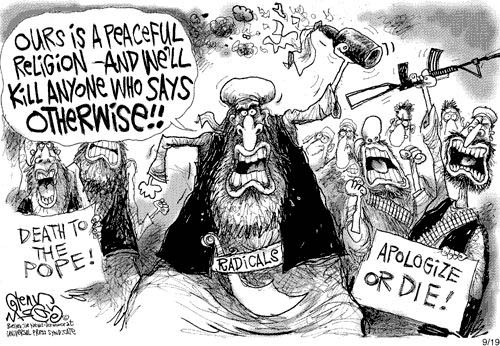
It’s not race, socio-economic status, geography or politics. Khan was a middle class British primary school teacher. Kasab is an impoverished Punjabi day laborer, and Bashir is Sudan’s president. What they have in common is that they’ve all committed horrendous acts of terrorism and justified their actions by claiming that their Muslim faith required them to act in the manner they did.

Now, what do the mainstream television and print media have in common in reporting these and other terrorist acts around the world? It’s not lack of coverage: the media routinely devote hours of coverage and pages of column space to terrorist acts. But they share an unwillingness to mention that these individuals are operating on the belief that they are praising Allah.

It is a glaring fact that radical Islam is the common denominator in many of the most violent places in the world. It is a sad fact that in India, as in almost every other place where radical Islam has revealed itself, few in the media or in politics are willing to identify what the real problem is.

The media’s reluctance to identify the Mumbai attackers as “Muslim” has been scandalous. As the terrible events unfolded last week, CNN commentators repeatedly referred to the attackers simply as “terrorists” or “extremists.” In one three-hour period, the word “Islamic” was used only once. Statements by many world leaders were no better. The typical statement merely pledged to defeat terrorism without ever specifying who the terrorists were or what their motives might be.

Even the Bush Administration has cooperated in this suffocating political correctness, which prevents us from naming the enemy that wants us all dead. At the State Department and the Department of Homeland Security, decisions were made last year to ban the phrase “Islamic terrorists” and to replace it with terms such as “militant.”

Many commentators tried to place the Mumbai attacks in the framework of the Pakistani-India dispute, which is an implausible assertion given that relations between the two countries have become increasingly cordial as the dispute over the Kashmir region has diminished. While Lashkar-e-Taiba, the group responsible for the attacks, was created to fight the Indian army in Kashmir, as the Wall Street Journal has reported, “[o]ver the years it has expanded its cause into the rest of India and aims to establish Islamic rule.”

The Mumbai massacre was yet another reminder of an evil ideology whose adherents are willing to violate every rule of war and all societal norms in their quest for power. We have seen their work time and time again – here on 9/11; in the London subway attacks; in Spain; in Indonesia; in Beslan, Russia, where helpless school children were shot in the back; and in scores of other attacks too numerous to list.

These are not random acts of violence and hatred. The perpetrators always fit the same profile – young Muslim extremists raised on a steady diet of hatred and death lust.

Although the media dare not name the terrorists’ religion, the terrorists themselves are not so reticent to identify what compels them to carry out their ghastly deeds. In Mumbai, they referred to themselves as “mujahideen”—Islamic warriors. Lashkar-e-Taiba is a known Islamic terror group that intelligence agencies believe has trained in camps with the Taliban.

Clearly, there are millions of Muslims who disagree that Islam justifies terrorism. We should do everything we can to encourage these moderate Muslims to speak out against terror. Those who do often put themselves and their families at great risk. The prospects for peace in the world for all people will depend in large part on whether moderate Muslims or Islamo-fascists win the theological battle over who is being true to their faith. But we aren’t helping anyone when media and government elites increasingly will not acknowledge the Islamo-fascist component to a great deal of the violence taking place around the world.

The jihadists who are attacking civilization are educated in madrasses – Islamic religious schools. They cite the Koran as their authority, and they follow the teachings of Muslim imams, who issue fatwas, religious decrees justifying the murder of infidels and moderate Muslims. They praise “Allah” as they kill and die. These clues make it fairly clear that they aren’t merely militants, and that their motives stem from their faith.

It is disgraceful that while our enemy screams who he is, we are more concerned mainly with not appearing intolerant. President-elect Obama’s foreign policy vision is built on the need for diplomacy and negotiations. I hope he will quickly learn that the Islamo-fascists couldn’t care less about words and diplomats.

Osama bin Laden has no desire to negotiate. His followers are working tirelessly right now to bring to the U.S. and to our allies sorrows much greater than the sorrows we have already experienced. Iran’s Ahmadinejad doesn’t tell Israel that he wants to talk. He regularly promises that Israel will soon cease to exist while he continues moving toward obtaining nuclear weapons.

A few years ago, Hezbollah leader Hassan Nasrallah, when asked about the possibility of negotiations with Israel, responded that Hezbollah had no desire to talk, and that it wanted only to kill its enemies.

All of this recalls the famous scene in the James Bond film Goldfinger in which the villain Auric Goldfinger prepares to cut Bond in half with an industrial laser, leading Bond to ask “Do you expect me to talk?” The irritated Goldfinger replies: “No, Mr. Bond. I expect you to die.”

In the same way, the Islamo-fascists don’t want to negotiate (unless, perhaps, it is to discuss our unconditional surrender). They expect us to die. For our enemies, it is that simple: They will impose their version of Islam on the entire world or die trying. And for us it’s just as simple: We need to be willing to defend western civilization or die trying.

Former presidential candidate Mr. Gary Bauer is president of American Values and chairman of the Campaign for Working Families.