Saturday, August 04, 2007

The image “http://www.danielpipes.org/pics/new/large/183.jpg” cannot be displayed, because it contains errors.
Unbelievable. Every time you think you can't be surprised any more
by the stupidity of governing elites, something like this happens.

BRAVE NEW SCHOOLS

Islamic education for all
Great Britain plan would move toward 'religion of state'

Posted: August 2, 2007
1:00 a.m. Eastern


© 2007 WorldNetDaily.com

A new government study is being condemned by the Christian ministry the Barnabas Fund because its proposals would move closer to imposing Islam in the United Kingdom as "a religion of state."

Among the proposals from the study being considered for implementation is the provision by universities for Islamic studies for all students.

The report was initiated by Bill Rammell, the minister of state for higher education and lifelong learning, officials said. He appointed Ataullah Siddiqui, senior research fellow at the Islamic Foundation, to write it.

The Barnabas Fund, in an analysis, said the report "signals another step toward the Islamisation of Britain and its education system"

"Should this report be implemented, education will be handed over more and more to Muslims who will train and shape the next generation," the analysis said.

The Barnabas Fund, which works primarily with Christians in Muslim-majority environments by channeling money from Christians, through Christians to Christians for projects developed by local bodies of believers, said the appointment of Siddiqui, at the outset, signaled a problem.

"It is well known that the Islamic Foundation is an Islamist institute founded by high ranking members of the Pakistani Islamist party, Jama'at-I Islami," the group said. "However, in answer to questions in the House of Commons about possible links between Ataullah Siddiqui and Jama'at-i-Islami, Rammell stated that 'Dr Siddiqui has assured me categorically that he has no links to the Jamaat-e-Islami Party.' … This reveals that Rammell does not understand how Islamists use dissimulation (taqiyya) to hide their real goals while claiming to be moderate and liberal," the analysis said.

Among the other recommendations are that universities should employ Muslim scholars to teach Islamic theology, all universities must employ Muslim chaplains and provide Muslim prayer rooms, Islamic Student Societies should be better recognized and encouraged, and universities should cooperate with Islamic schools and colleges to break down the divisions between British society and the Muslim community.

The study also recommended Islamic studies should be linked to job opportunities such as teaching, chaplaincy and Islamic banking, and guidance should be given to all universities on Friday prayers, Ramadan and halal food.

The Barnabas Fund said it's simply a demand for a "privileged position for Islam in the universities."

"It would seem to aim at transforming Islamic studies in Britain into a Muslim monopoly, a Muslim enclave in which the vast majority of staff and students are Muslim. It is implied that non-Muslim scholars cannot teach Islam because they do not unquestioningly accept its basic premises regarding the revelatory nature and divine authority of Quran and Hadith."

If that happens, the teaching faculty soon would be limited to Muslim and Islamist lecturers, the group said.

"It is most likely that censorship would develop, affecting choice of staff, teaching methods and acceptable subjects for research and publication," the group said.

It's a part of the larger goal, the Barnabas Fund said. "The aim is to expand Islamic domination into all spheres. The whole system of Western academic education must, say the Islamists, be recast and remolded on Islamic lines as it is tainted by Christian and pagan influences."

"Implementing these recommendations, as the British government has promised to do, would be likely to narrow the scope of university Islamic studies and make them more intolerant and radical," the critique said.

The organization said one of its goals is to inform and enable Christians in the West to respond to the growing challenge of Islam to the church, society and mission.

Reports said the government already has pledged several million dollars to universities in order to boost Islamic studies.

The Left Before The Fall

From a distance of nearly 50 years, the liberalism of 1960 is hardly recognizable. It was comfortable with the use of American power abroad, unabashedly patriotic, and forward-looking. But that was before The Fall.

In his eye-opening new book Camelot and the Cultural Revolution, Jim Piereson argues The Fall was the assassination of President Kennedy. It represented more than the tragic death of a young president, but the descent of liberalism from an optimistic creed focused on pragmatic improvements in the American condition to a darker philosophy obsessed with America's sins. Echoes of the assassination -- and the meaning attributed to it by JFK's admirers -- can still be heard in the querulous tones of contemporary liberalism.

The real John F. Kennedy wasn't the paladin of liberal purity of myth. He was friends with Joseph McCarthy. In his 1952 campaign for Senate and his 1960 presidential campaign, he got to the right of his Republican opponents on key issues. "Kennedy did not want anyone to tag him as a liberal, which he regarded as the kiss of death in electoral politics," Piereson writes. As president, he was vigorously anti-communist, a tax-cutter and a cautious supporter of civil rights.

His kind of liberalism -- "tough and realistic," as Piereson puts it, in the tradition of FDR and Truman -- was carried away in the riptide of his death. In a crucial and counterintuitive interpretive act, the nation's opinion elite made JFK a martyr to civil rights instead of the Cold War. Kennedy had been killed by a communist, Lee Harvey Oswald, who a few years before had tried to defect to the Soviet Union. Liberals nonetheless blamed the assassination on, in the characteristic words of Supreme Court Chief Justice Earl Warren, "the hatred and bitterness that has been injected into the life of our nation by bigots."

Thus, the assassination curdled into an indictment of American society: "Kennedy Victim of Violent Streak He Sought to Curb in Nation," read a New York Times headline. Until this point, 20th-century liberalism had tended to see history as a steady march of progress. Now, the march had been interrupted by the country's own pathologies. "Kennedy was mourned in a spirit of frustrated possibility and dashed hopes," Piereson argues, and that sense of loss came to define the new liberalism.

American history no longer appeared to be a benign process, but a twisted story of rapine and oppression. "With such a bill of indictment," Piereson writes, "the new liberals now held that Americans had no good reason to feel pride in their country's past or optimism about its future."
Their agenda took on a punitive edge, focused on compensating victim groups and expiating the country's guilt.

The left developed ambivalence about national power, in which the old liberal reformers had placed such faith. In the paranoid theories that sprang up in the wake of Kennedy's assassination -- many of them to avoid the simple, uncongenial fact that a lone communist had killed the president -- the seat of American government had been the locus of a secret plot to kill JFK. The conspiracy theories and anti-Americanism that had so appalled liberals about the far right in the 1950s had now gravitated to the left. Bizarrely, after a liberal hero was slain by a Marxist, communist icons and ideas became more fashionable on the Left than ever before.

Other things were going on obviously, most importantly the Vietnam War. But the war was seen through the prism of American malignancy established by the Kennedy assassination. This downbeat and adversarial disposition is -- more than any specific policy weaknesses on, say, national security -- a drag on contemporary liberalism's long-term appeal. One day a Democratic politician will emerge who is compelling enough to vanquish the foul spirit of JFK's assassination from the left.

Until that happens, JFK has to be remembered, in Piereson's words, as "the last articulate spokesman for the now lost world of American liberalism."

© 2007 by King Features Syndicate

Friday, August 03, 2007

Another on the money review, though I'm not sure I'd rate the first half hour as highly as this reviewer:

LIBERTAS Review: The Bourne Ultimatum

— Dirty Harry @ 3:38 pm

blcvns_d018_12863.jpg

My biggest problem with the Bourne franchise has always been Bourne himself. Stoic would be a stretch for this character and it’s hard to feel for someone who’s so self-serious and also suffering the added baggage of being played by an unlikable actor who’s even more self-serious in real life. Looking back, the series died for me with Franka Potente. She played Bourne’s love interest in Identity and was killed at the beginning of Supremacy. A beguiling actress, she added a much needed humor and warmth to a franchise that became incomprehensible halfway through the previous chapter and lapses into plodding and episodic in this latest and hopefully final chapter.

A newspaper story quickly gets things rolling. After seeing his name in an expose’ about the secret CIA Treadstone program, Bourne seeks out the reporter hoping the source of the story might lead him to his real identity. Unfortunately, all it leads to is the CIA who’s also after the source of the story and trailing the reporter. And so, begins a two hour cat-and-mouse game between Bourne and shoot-first-ask-questions-later CIA bigwig Noah Vosen (David Straithairn).

blcvns_d017_12135.jpg

The first half hour is exhilerating and smart. Bourne outmaneuvers the CIA at every turn, always a step ahead of their tactics and ready for anything. A cynic may wonder why Bourne’s memory loss conveniently doesn’t effect his ability to remember his training or how the CIA operates, but the movie soon has bigger problems than the logic gaps that have plaqued it since Identity. The movie’s about to get boring.

Ultimatum is nothing more than a glorified B-chase film. You have a protagonist determined to get from A to Z and an antagonist equally determined to stop him. And that’s fine. B-movie’s can be great movies. But for a chase film to avoid becoming tedious with one episodic set-piece after another they require strong subplots. The best subplots in these kind of films involve character and relationship development. And if you can tie those subplots into the main story, that’s what you call thickening the plot. Well, the plot’s mighty thin here and remains so. Bourne’s character never develops emotionally (that might require Matt Damon to act), and so all we’re left with is two shallow poorly contructed sub-plots that do more harm than good.

blcvns_d015_11190r.jpg

The lovely and always interesting Joan Allen returns as Pamela Landy, and she’s pitted against Straithairn’s Vosen; but this contrived conflict has been used too many times (including in Supremacy) to remain effective. And without these two stellar actors in these nothing roles, the film would’ve sunk into oblivion within an hour. Worse, is the absurd expansion of the Julia Stiles’ character. Stiles has been way over her head since this series began and still looks like she’s playing grown up here. However, in her defense, no actor could rise above the completely unbelievable plot-twist we’re forced to endure just so Bourne can give yet another self-confessional and angsty “I can see the faces of everyone I’ve killed.” speech.

The redeeming virtue of the film should be the A-budget action, but you can’t see anything. Director Paul Greengrass (United 93) remains addicted to his signature shaky-cam and all the action is incomprehensible. The camera’s so spastic that it’s hard enough to follow the happenings when it’s just two talking heads, but once the action gets going it’s a blur of jitter and quick cuts. I think there was a really good fight scene and motorcycle chase, but I can’t say for sure, because I couldn’t tell what the hell was going on.

blcvns_d012_09410.jpg

A number of action scenes also go on way too long. And after a while watching Straithairn bark the same kind of orders — I want my asset there now! – from the same small dark command center gets repetitive. There’s also a serious structural flaw in the film. Movies, most especially action movies, require an end-of-second-act all is lost moment. We have to feel at a certain point that our hero has no chance of succeeding. But that moment never happens here. Bourne is indestructible. He’s unflappable. He’s always in control. About halfway through you stop worrying about his safety because he no longer seems at all vulnerable. We don’t have much emotional investment in this dull character to begin with, so once the suspense is removed the last forty minutes leave us with an indifferent jitter-cam numbness.

The politics of the film haven’t changed since the first one. As usual, the people who protect our national security are either portrayed as brutal zealots eager to ignore the law, or women. Scott Glenn makes a brief appearance as a CIA director, and we all know where his ethics lie as soon as we see the lapel flag. It would be nice to think that our CIA was as organized as portrayed here: able to use a text message to summon ruthless assassins anywhere within minutes, or mass men, machines, and cameras at a moments notice. I think the filmmakers are trying to scare us with the idea that the same CIA who missed the collapse of the Soviet Union and 9/11 has that kind of power, but I just sat there thinking, “Yeah. I wish.”

blcvns_d030_14945.jpg

One of my favorite moments in any action film happened in Identity. It’s when Damon sends Franka Potente into a hotel with detailed instructions on how to stealthly steal some information: You take thirteen steps to the desk, the quickest exit is eight paces east, etc… As he stands in a phone booth worried it’s all gone wrong, she knocks on the booth holding the all important information. ”How did you get it?” he asks. “I asked the desk clerk for it,” she replies. “You just asked him for it?” That’s what you call a nice bit of business. It humanizes the characters and lightens things up a bit. The sequels could’ve used more of that. Especially this one.

The film does wrap up nicely and answer any lingering questions. The final scene intercutting between the fates of all parties involved is extremely well done, especially in its evocation of the how the series began.

blcvns_d022_00512r.jpg

Just a few days ago, Matt Damon had some harsh words for the Bond series. Besides showing a tremendous lack of class in attacking another franchise to gain publicity for his own, Damon also seems to have missed the major appeal of a franchise that has consistently out grossed his by hundreds of millions. Bond believes in something. Something other than working out his own angsty Oprah-ish issues. And Bond has a personality. The Bourne franchise was entertaining but unexceptional, and made zero impact (unlike Bond) on the popular culture. The Bourne films won’t be missed because, like their leading man, they’ve never much registered.

stars_2.gif

The image “http://eur.i1.yimg.com/eur.yimg.com/xp/yahoo_manual/20070328/10/4067747690.jpg” cannot be displayed, because it contains errors.
Matt Damon exhibits the full range of emotions on display in The Bourne Ultimatum.

From The Washington Post: An accurate review of this pedestrian movie. The only reason possible for the hosannas from so many film critics is the film's palpable distaste for any American clandestine operations that go beyond hiding in a closet. The movie is suffused with camera work that seems like the cameraman is in the throes of an epileptic seizure. It lacks any semblance of good writing or characterization and features a soundtrack resembling a truckload of garbage cans spilling onto an interstate while the vehicle remains at full speed.
I should have been warned when I saw a favorable review of the film by Craig Lindsey.

The Bourne Ultimatum
Reviewed by Stephen Hunter

(August 3, 2007)

No medium as thin as language can capture the snare-drum riffs that propel "The Bourne Ultimatum" along faster than the speed of sound, light and thought. It's not a movie, it's a trip through a gun barrel at the head of a cloud of exploding gas, and you end up splattered against a wall, then sliding into the dust with the sound of the drums ringing in your head for hours.

Good? Who could tell? It's like watching french fries crackle amid a spew of hot bubbles in the back of a McDonald's. Do the actors act? Again, you got me. Does it make sense? Ask the scriptwriters, they'd probably know. Does it give you a headache? Hmm, about the size of beautiful downtown Rockville.

The third in the series of films derived from novels by the late Robert Ludlum starring Matt Damon, it is the second to be directed by Paul Greengrass, the brilliant Brit who, like everybody affiliated with the project, is much too good for it. Other luminaries whose careers will be tarnished by this express train without destination include Damon himself, grown grave and tragic in his mid-30s, Julia Stiles, Joan Allen, David Strathairn and Scott Glenn.

Greengrass, God help us, has a style, brilliantly deployed in "Bloody Sunday" and "United 93," but it's sorely overused here. He doesn't want us to catch our breath, which is why his Steadimount camera guy (now there's someone who earned his paycheck!) dances around his subjects as if he's the third member of a two-man conspiracy, always close enough to hear the muttering.

The plot seems to be: Jason Bourne, who two movies ago awoke with no memory but a great number of alarming, unexplained skills, is closing in on the CIA puppetmasters who turned him into an assassin automaton. He is headed to England to connect with a reporter with knowledge of how Bourne got programmed, while the CIA tries to either kill him (the conservative position) or bring him in (the liberal). For a while the movie plays its games in various European locales but eventually moves to New York, figuring if it can make it there, it can make it anywhere.

It's frenetic to the point of crazy while achieving a mark that barely exceeds mediocre.

Thursday, August 02, 2007

http://www.beatlesportraits.com/ringo1lg.jpg
From What Goes On:
Photograph: Very Best of Ringo Starr
CD and Digital on August 28

Hollywood, California -- June 18, 2007 -- Since he first began his career in the 1960s with The Beatles, Ringo Starr has been one of the world's brightest musical luminaries. On August 28, Starr's four EMI Music catalog albums, Sentimental Journey (1970), Beaucoups Of Blues (1970), the platinum-certified Ringo (1973) and gold-certified Goodnight Vienna (1974) will make their global digital release debuts across all of the world's major digital sales providers. On the same date, six Ringo Starr ringtones will also debut, and Capitol/EMI Music Catalog Marketing will release the first-ever career and label-spanning collection of Starr's best solo recordings, PHOTOGRAPH: The Very Best Of Ringo Starr.

Click here to see bigger image

Starr's EMI catalog will be available in digital form for the first time on a global basis. Fans will be able to purchase Starr's EMI catalog works from all of EMI's digital distribution partners, and the titles will also be part of EMI's premium download offering (free of digital rights management and in a higher-quality bit rate) from participating retailers.

To be released physically in CD and Collector's Edition CD/DVD packages and digitally, PHOTOGRAPH: The Very Best Of Ringo Starr presents 20 standout Starr tracks, including seven Top 10 Pop hits, released between 1970 and 2005 with Capitol, Atlantic, Mercury, Boardwalk, Private Music and Koch. The Collector's Edition adds seven never before released film and video clips on DVD, including original promotional films for "It Don't Come Easy," "Sentimental Journey," "Back Off Boogaloo," among others, and the music video for "Act Naturally" (with Buck Owens).

The world has known and loved Ringo Starr since he was a Beatle, and it is his unique talent and his love of creating and playing music that continues to captivate fans around the world, and which shines through in every one of his songs. "Ultimately, what's most impressive about Ringo Starr isn't what he's been, but rather who he is," said Rolling Stone magazine Contributing Editor David Wild. "The man's great heart and soul, his wit and wisdom." A liner notes essay by Wild is complemented by a selection of classic Starr photos in PHOTOGRAPH: The Very Best Of Ringo Starr's 12-page booklets. The CD will be released in a jewelcase, while the Collector's Edition will be presented in a deluxe fold-out digipak package.

PHOTOGRAPH: The Very Best Of Ringo Starr celebrates the legacy of this iconic and universally loved artist. Covering the full scope of Starr's solo career, the new collection's seven Top 10 Pop hits include "It Don't Come Easy," "Photograph," "Oh My My," "Snookeroo," "Back Off Boogaloo," "Only You (And You Alone)," and his playful and now tongue-in-cheek "No-No Song." Also included are "Act Naturally" (with Buck Owens), "You're Sixteen (You're Beautiful and You're Mine)," and the critically acclaimed "Weight of the World" and "Fading In and Fading Out."

PHOTOGRAPH: THE VERY BEST OF RINGO STARR (CD & Digital Album)

  1. Photograph (1973) [LISTEN]
  2. It Don't Come Easy (1971) [LISTEN]
  3. You're Sixteen (You're Beautiful And You're Mine) (1973)
  4. Back Off Boogaloo (1972) [LISTEN]
  5. I'm The Greatest (1973)
  6. Oh My My (1973)
  7. Only You (And You Alone) (1974)
  8. Beaucoups Of Blues (1970)
  9. Early 1970 (1971)
  10. Snookeroo (1974)
  11. The No-No Song (1974)
  12. (It's All Down To) Goodnight Vienna (1974)
  13. Hey Baby (1976)
  14. Weight Of The World (1993)
  15. A Dose Of Rock 'N' Roll (1976)
  16. King Of Broken Hearts (1998)
  17. Never Without You (2003)
  18. Act Naturally (with Buck Owens) (1989)
  19. Wrack My Brain (1981)
  20. Fading In and Fading Out (2005)

PHOTOGRAPH: THE VERY BEST OF RINGO STARR (Collector's Edition) CD/DVD

  1. Sentimental Journey (1970 promotional film)
  2. It Don't Come Easy (1971promotional film) [VIEW LO] [VIEW HI]
  3. Back Off Boogaloo (1972 promotional film) [VIEW LO] [VIEW HI]
  4. You're Sixteen (You're Beautiful And You're Mine) (1973 promotional film)
  5. Only You (And You Alone) (1974 promotional film)
  6. Act Naturally (with Buck Owens) (1989 -- music video)
  7. Goodnight Vienna (1974 -- promotional film for album)

Wednesday, August 01, 2007

The image “http://www.kittysback.com/images/brucespringsteenkzoo3smallerstill.jpg” cannot be displayed, because it contains errors.
Bruce Springsteen with aide Terry Magovern
Terry Magovern, 67, key Springsteen aide
BY JAY LUSTIG


Star-Ledger Staff

Over the last two decades, Bruce Springsteen has changed musical styles several times, and worked with countless different musicians. But Terry Magovern was there through it all.

Mr. Magovern, a Rumson resident who worked as an assistant to Springsteen, died in his sleep Monday, at the age of 67. The cause of death was not immediately known.

"He was a gentle giant with a heart of gold," said his longtime friend, Bob Benjamin, who manages rock artists and founded the charitable Light of Day foundation. "He came off with a lot of bluster, but behind that was a lot of tenderness."

"He was a complicated man to sum up in one quote," said his son, Sean, of Avon. "But he was always there for those around him. He was the guy you would want in the trench with you."

Raised in Belmar, Mr. Magovern worked in bars like D'Jais in Bel mar and the Captain's Garter in Neptune, after a stint in the Navy. In 1981, he began running Big Man's West, a nightclub Springsteen's saxophonist, Clarence Clemons, owned in Red Bank. After the club closed a few years later, Mr. Magovern continued working for Clemons, and in 1987, joined Springsteen and the E Street Band on their "Tunnel Of Love Express Tour."

The shows had a carnival theme and each musician, walking onto the stage, handed a ticket to a man sitting in a booth. That man was Mr. Magovern.

That wasn't all he did on the tour, of course; he also assumed a number of offstage duties. At various times, Mr. Magovern has been described as Springsteen's personal assistant, bodyguard or road manager. He was credited with "research" on Springsteen's 1995 album, "The Ghost of Tom Joad," and was identified as Springsteen's "dedicated sidekick" on 2002's "The Rising."

In an entry on Mr. Magovern in the Springsteen encyclopedia, "The Ties That Bind: Bruce Springsteen A To E To Z," veteran rock journalist Robert Santelli wrote that through the years, his job description was always vague.

"Once," Santelli wrote, "when Springsteen was asked exactly what role Magovern played in his camp, Springsteen replied, 'Terry Magovern is Terry Magovern.'"

Hardcore Springsteen fans may not have been able to say exactly what he did, either. But many knew what he looked like. That's because if there were rumors that Springsteen might make a surprise appearance at a club or theater, they would keep an eye out for him. If he were spotted, checking out the stage or the crowd, there was a good chance Springsteen would show up later.

Mr. Magovern was usually content to stay behind the scenes. But after his fiancée, Joan Dancy, died in 2005 from amyotrophic lateral sclerosis, he became something of a public figure, founding the charitable organization, the Joan Dancy & PALS (People with ALS) Support Group.

"As difficult as it is for me to ask for your contributions, I know how important each dollar will be to our ALS families," he wrote in a fundraising letter for the organization.

Springsteen, Jon Bon Jovi, Southside Johnny and other Shore rock-scene stalwarts performed at a PALS fundraiser held at the Count Basie Theatre in Red Bank in December 2006. Mr. Magovern made a brief speech, and Springsteen dedicated the song "Waitin' on a Sunny Day" to him and the late Dancy.

In June, Red Bank's Two River Theater presented a Jackson Browne concert as a benefit for the organization. Springsteen joined Browne for two songs.

"It was pretty cathartic for (Mr. Magovern), putting together the PALS organization," says Benja min. "He was keeping a promise to Joan. When she was diagnosed, there was nowhere for her to turn."

The organization will continue its work, said Sean Magovern, adding that "there is a dedicated group of people who supported the organization since its inception."

In addition to Sean Magovern, Mr. Magovern is survived by a daughter, Laurie Guinan of Eaton town; eight brothers and sisters, and five grandchildren.

A memorial service is scheduled for tomorrow. In lieu of flowers, contributions may be made to the Joan Dancy and PALS Support Group at Riverview Hospital, 1 Riverview Plaza, Red Bank, N.J. 07701.

Staff Photos by Jason Arthurs

Players mourn at Holy Family Catholic Church in Clemmons during a funeral Mass for Wake Forest basketball coach Skip Prosser.

From Raleigh News & Observer:
'His integrity was unwavering'
Tears flow freely as family, friends and colleagues
share memories of Prosser at funeral Mass
Lorenzo Perez, Staff Writer


CLEMMONS - Wistful smiles and chuckles accompanied the recollections of Skip Prosser's eagerness to inch along the sideline of a Wake Forest football game to encourage Demon Deacons coaching colleague Jim Grobe, "When in doubt, throw deep."

There was full- throated laughter at the tales of the boredom his assistant coaches' feigned every time he went on about his son Mark's early successes as a young assistant basketball coach at Bucknell, or his other adult son Scott's unofficial "GM" role with Wake Forest basketball, always seated within screaming distance two rows behind his father.

Yet the shared memories could not halt the tears that flowed freely among Prosser's family, friends and coaching colleagues Tuesday night. Five days after dying of an apparent heart attack, the Wake Forest basketball coach was memorialized as a wry teacher who cast an even broader impact off the court for the players he touched during a 35-year coaching career that began at the high school level in West Virginia.

He was 56.

At least 1,000 people attended the funeral Mass at Holy Family Catholic Church, while a couple thousand more gathered at Wake's Wait Chapel on campus to view the service via a live telecast. The mourners included past and present players from Prosser's tenures at Xavier and Wake Forest, and the collection of rival coaches from the ACC and across the country filled pew after pew after pew.

Bill Cowher, the former Super Bowl- winning coach of Prosser's beloved Pittsburgh Steelers, attended the funeral Mass. ACC commissioner John Swofford, Prosser's college mentor, former Virginia coach Pete Gillen, Michigan State's Tom Izzo and St. Joseph's Phil Martelli joined Duke's Mike Krzyzewski, North Carolina's Roy Williams, Maryland's Gary Williams and the rest of the ACC basketball coaching fraternity to help fill the large, suburban Catholic church.

Noting that all the coaches who had dropped their plans to pay their respects to Prosser's family on the final official recruiting contact day of the summer, Wake associate head coach Dino Gaudio said Prosser would have wanted it that way.

"Because if he couldn't be on the road recruiting, you guys couldn't be on the road recruiting either," said Gaudio, who struggled to get through his eulogy without crying.

As mourners filed past Prosser's family on their way to receive Communion, many glanced at Prosser's casket and turned away in tears. Few could resist pausing to hug Prosser's wife, Nancy, or his mother, seated in the front pew.

"His integrity was unwavering," Gaudio said. "Those of us that were blessed to be under his charge will carry that with us for the rest of our lives."

Prosser's career record of 291-146 includes the six seasons he coached at Wake, guiding the Deacs to four consecutive NCAA Tournaments. Before arriving in Winston-Salem, he coached seven seasons at Xavier -- and another nine as an assistant there -- and one at Loyola of Maryland. In 2003, he won the ACC's Coach of the Year award after claiming the league's regular-season title with a team led by ACC Player of the Year Josh Howard. Two seasons later, Wake claimed the first No. 1 national ranking in school history.

Part of a long procession of current and former Wake players, Howard walked into the church with his arms around former Demon Deacon point guard Chris Paul. The two NBA stars struggled to contain their tears.

During a brief, emotional eulogy, Paul remembered how he intentionally bumped into Prosser at an AAU tournament in Orlando, Fla., back when he was a high school player hoping to catch the eye of his hometown school's new coach.

"At the time, I never knew the man would change my life forever," Paul said, dabbing his eyes. "He cared about us, and he helped us not only grow as basketball players, but also as men."

Tuesday, July 31, 2007

Photo
From San Jose Mercury News:
Former players recall Bill Walsh's far-reaching influence
By Mark Emmons and Dennis Georgatos


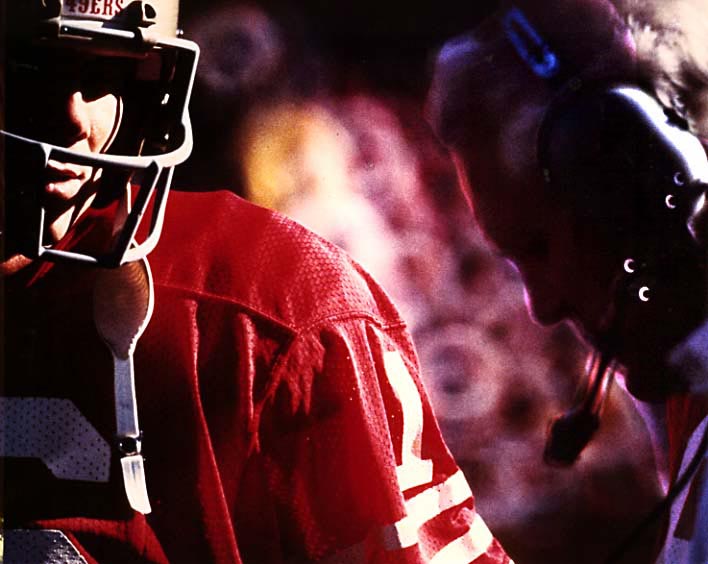
His former players and coaches understood that everyone already knows about Bill Walsh, the football genius. So they spent the hours after his death Monday from leukemia at age 75 talking about Walsh, the human being.

They described him as a beloved mentor and a man who always believed in them - sometimes before they even believed in themselves.

"I came to San Francisco and I found another father," legendary 49ers wide receiver Jerry Rice said at a news conference at Stanford. "I never wanted to let him down."

Sitting next to Rice, Hall of Fame quarterback Steve Young nodded in agreement.

"He knew me before I even knew myself," Young said. "He had such confidence in what I could become."

It was a measure of the depth of feeling for Walsh that some of his former coaches and players, such as Joe Montana, choked back emotions Monday as they reminisced about a man whom Young called the most influential figure in football over the past 25 years.

Montana - the player most closely associated with Walsh - still marvels at how the coach gambled on him when the prevailing view was he lacked the arm strength and athleticism to succeed in the NFL.

"But he had a vision and a foresight that was beyond most people," said Montana, who became arguably the best quarterback in NFL history.

Former 49ers kicker Ray Wersching, echoing a sentiment expressed over and over, added that Walsh always treated his teams like they were a large family. That approach contributed to his talent for getting people to perform at their highest level.

"He brought out the best in us," Wersching said. "He just instilled us with confidence. He'd say with such assurance, `Hey, relax, all you've got to do is perform. We've got the scheme and we'll succeed.' And by gosh, we did. "

Tributes to Walsh poured in Monday from around the country. But his death hit the Bay Area especially hard. He was so much more than a 49ers icon. He also had a profound impact at both Stanford and his alma mater, San Jose State. His influence even touched the Raiders and Cal, where he had been an assistant coach.

He simply was a local institution; a cerebral man who was the epitome of class, perfection and success. And Walsh, who had boxed at San Jose State, also was a battler. He fought his illness to the end.

"Bill would hold up his hands up like he was boxing and say, `I'm fighting,' and he did," Young said.

Walsh's death was not unexpected. He had been diagnosed with leukemia in 2004 and publicly disclosed the illness last November. In recent weeks, word had circulated that he wasn't doing well.

"I knew we were in trouble with him the last few months, because he would always end our conversations with, `I love you,' " said Bill McPherson, a former 49ers assistant who had known Walsh since the 1950s when they were high school coaches. "I wanted to tell him, `Why the hell didn't you say that when I coached with you?' "

During the last week, a who's who of football elite made their way to Walsh's Woodside home to say their goodbyes - including Montana, Al Davis, John Madden, Ronnie Lott and Ty Willingham. Former 49ers owner Eddie DeBartolo Jr. visited him about 10 days ago.

As good a coach as Walsh was, DeBartolo said, he was an even better man.

"One of his powers was the ability to give everybody the confidence to go one step beyond," DeBartolo said.

But Young, Rice and Keena Turner also were quick to say there were times when their old coach could be infuriating. Young remembered feeling a bit conned when he was traded to the 49ers in 1987 because Walsh had inaccurately led him to believe Montana's back injury might end his career.

It was a reminder that Walsh, the master motivator, could be manipulative. And he could be brutally cold, cutting any player in a heartbeat if he thought it would improve the team's chances of winning.

No player wants to hear his career is over, and feelings would be hurt. But with the passage of time, players invariably would gravitate back to Walsh. Montana said their relationship became much closer as soon as Walsh no longer was his coach.

"There was nothing he wouldn't do to help when his men, as he called them, would reach out to him," added Turner, the retired linebacker. "I never saw him turn down a guy for support when he was in retirement. And there were lines and lines of his men who were there for him. It's a testament to his influence."

Players often realized later that Walsh had taught them more about life than he did about football.

"Not too many days go by where I don't think about something I learned from him," added former 49ers safety and Cal Coach Tom Holmoe.

New Stanford Coach Jim Harbaugh, who said he still has the voicemail message from Walsh asking if he was interested in the Cardinal job, learned to shut up and just listen whenever they went out to lunch.

"Everything that came out of his mind and heart, I hung on every single word," Harbaugh said.

It's something Walsh's players long ago learned to do.

Offensive lineman Steve Wallace never forgot Walsh's pregame speech before the 1989 Super Bowl. Walsh calmly reminded the players of the importance of executing their assignments. Wallace couldn't believe there was no "rah-rah" stuff to fire up the team. Later in the game, which the 49ers famously won 20-16 on Montana's pass to John Taylor with 34 seconds remaining, Wallace understood.

"When it came down to it, that's what helped us win the championship," Wallace said. "We couldn't be jumping up and down, and out of control late in the game when we had to move the ball 92 yards. We had to put it together, one play at a time, 11 guys doing their job, just like we were drawing it up in practice.

"And in the back of my mind as we moved the ball down the field, I was thinking Bill was right all along."
The image “http://www.poster.net/beatles-the/beatles-the-photo-the-beatles-6206406.jpg” cannot be displayed, because it contains errors.
From CBS Sunday Morning:
It's 2007 And The Beatles Still Matter

NEW YORK, July 29, 2007(CBS) Sunday Morning contributor Bill Flanagan of MTV takes a look at the Beatles' legacy 40 years after their revolutionary album "Sgt. Pepper's Lonely Hearts Club Band."

This summer Paul McCartney turned 65 and "Sgt. Pepper's Lonely Hearts Club Band" turned 40. Both events got a lot of media attention. The Beatles broke up in 1970 and two of the Fab Four have passed away — and yet Beatlemania never completely subsides.

Cirque du Soleil's big hit "The Beatles Love" just celebrated its first anniversary in Las Vegas. Paul and Ringo attended, paying tribute to George and John, and the fans went wild.

The acclaimed director Julie Taymor has a new film coming in September called "Across The Universe," which uses Beatles songs to tell the story of the '60s through the eyes of an English boy named — guess — Jude.

The Beatles' music in invulnerable to changes in pop styles or fashions. It gets stronger as time goes by.

Which created a special challenge for John, Paul, George and Ringo. No matter what they did as solo performers, it would always be held up to the impossible standard of The Beatles. They were the only four musicians in the world whose records were considered disappointments if they were not as good as Beatles records. As John Lennon sang on the last Beatles album, "Boy, you're gonna carry that weight a long time." It's a testament to their strength of character and resolve as artists that all four of them kept moving ahead and making music in spite of the impossible expectations.

It's interesting how well a lot of their solo work ages — as time passes and we get away from the Beatles comparisons.

Ringo has a new "Greatest Hits" album coming out later this summer, on August 28. It's a surprise to be reminded of how many solo hits Ringo had: "It Don't Come Easy," "Photograph," "Back Off Boogaloo," "You're Sixteen," and a lot more. John Lennon always said that Ringo was a star in Liverpool before he joined the Beatles and everybody there knew he was going to be successful in show business in some fashion. Go back to the Beatles movies for proof of that; they are all built around Ringo. He was a natural Starr.

For George fans, there is the long-awaited CD re-release of the complete Traveling Wilburys recordings. Back in 1988 George put together a super-group with his pals Bob Dylan, Tom Petty, Jeff Lynne and Roy Orbison and had a huge hit. The Wilburys made two albums and several other recordings, all of which are collected here along with a new DVD documentary that reminds us how remarkable this nearly accidental group really was. At the time I think most of us just got a kick out of seeing those five famous faces singing together. Now you listen and you realize that these songs were really well-constructed and beautifully recorded. Obviously George Harrison knew how to balance giant egos and giant talents. The Traveling Wilburys is a great tribute to the good humor and subtle power of "the quiet Beatle."

Nobody ever called John Lennon the quiet Beatle. John was one of the great big mouths. A worthy tribute to his memory is a new double CD called "Instant Karma" in which U2, REM, Green Day, Christina Aguilera and a couple of dozen other current stars perform Lennon's songs. It is all in support of the Amnesty International campaign to save Darfur, and although a skeptic could say that when it comes to stopping that genocide it might be time to give guns a chance, this is a noble cause and a wonderful tribute record. However, it has to be said: no one else can sing these songs like John Lennon. His voice remains irreplaceable.

Which should remind us to be grateful that Paul McCartney is still with us. Paul is the most successful popular songwriter in history but he always has the burden of anything he does being compared to what he did in The Beatles. Paul's response has been to simply keep working. Through gigantic success, unprecedented fame, public feuds and private tragedy, McCartney has never stopped making music.

His new album has a great title — "Memory Almost Full." It's a concept record about scanning through a lifetime of images and memories. It's about being amazed at how quickly time passes, and how memories from 40 or 50 years ago can seem as vivid as what we did yesterday. He calls it "my ever present past."

McCartney's real subject has always been perseverance — "Take a sad song and make it better," "Take these broken wings and learn to fly," "Let it be." No matter what he's gone through, McCartney always acts like it's cool, it's fine, it's no big deal. On "Memory Almost Full," Sir Paul looks back on a long and event-filled life and hints that maybe it was a pretty big deal after all.

A few years ago I was seated with Paul at a wedding and of course, every guest in the place, from the bride's cousin to the priest, came up to have a photo taken with him. After about an hour of this I said to him, "Boy, that must get to a real drag." He said, "Well, anytime I start to feel that way I remember how nervous John and I were when we were kids and we met our heroes, the Everly Brothers. I know what it's like to be the fan."

He said that it amazed him sometimes to think that he met Elvis Presley. In fact, he said, it amazed him sometimes to think that he was in The Beatles. On his new album, Paul expresses that amazement that we all in some ways share. Get a load of how fast life goes by, all the things we've done, all the people we¹ve known, all the adventures, all these friends and lovers.

It's a remarkable thing to look back at a life and say, "Wow, that was me!"


© MMVII, CBS Interactive, Inc. All Rights Reserved.
The image “http://www.sfinternational.se/Upload/ED9C4F3F-DF3A-4D6E-823B-90D9FB6C9F03/The_seventh_Seal.jpg” cannot be displayed, because it contains errors.
From The New York Post:
DEATH & THE DIRECTOR
By JOHN PODHORETZ


July 31, 2007 -- NOT so long ago, Ingmar Bergman was one of the most celebrated and famous men in the world - the recipient of universal praise for having transformed the corrupt young medium of the movies into a vehicle for difficult, punishing, sobering, existentialist high art.

He was so renowned that some trifling income-tax troubles in his native Sweden made headlines across the globe - on the grounds that it was an outrage for Sweden to be treating its greatest artist so shoddily.

And yet, when word came yesterday of Ingmar Bergman's death at the age of 89, it seemed like a bulletin from the past - as though the man who had once been the foremost writer-director in all of cinema had been gone from this earth not just a day but for an entire era.

Bergman had been the key figure in a painstaking effort, by him and by critics worldwide, to elevate the cinema into an art form equivalent to novels, poetry or classical music.

These were not the kinds of critics who wanted people to believe that westerns or gangster movies or musicals could be great art on the order of Tolstoy and Dickens. These critics wanted the movies instead to mimic the forbidding demands and even more forbidding themes of high modern art - from the difficult poetry of T.S. Eliot and Ezra Pound to the assaultive aesthetic of Pablo Picasso and Marcel Duchamp.

Bergman was their man. In a relentless series of films - one or two a year - made between 1950 and 1982, he punished his audiences with a view of life so dark and foreboding that he made his fellow existentialist artist, Samuel Beckett, seem as upbeat as Oprah.

The darkness of Bergman's vision of the world and his uncompromisingly bleak expression of that vision resonated with those who viewed art not as a form of the most sublime entertainment - entertainment that transcends the merely pleasurable to offer a transformative experience - but rather as the secular version of a stern sermon.

Art, in this view, wasn't supposed to be easy to take or pleasurable to take in. It was supposed to punish you, assault you, scrub you clean of impurities.

Bergman used motion pictures to explore grand and grandiloquent themes - the fear of death, the horrors of old age, the mysteries of womanhood, the disasters of marriage, the trauma of living without God. Happiness, contentment, even momentary good feeling are all but absent from a Bergman movie, which is a portrait of a traumatized species.

He stopped making motion pictures in 1982, though he wrote and directed several small films for television. And the truth is, he quit just in time. His day had passed. After decades of declaring modern life worthless and offering only suicide as a way out of the nightmarish tangle of human existence, Bergman had nothing more to say.

Worse still, the earnestness of his vision was beginning to wear pretty heavily. It is impossible these days to watch his most famous film, "The Seventh Seal," without laughing - because its famous scene of Death playing chess has been so frequently and devastatingly parodied over the years that it has become one of the great images of cinematic pretentiousness.

As for the society of people who needed Ingmar Bergman to stand as the greatest example of what the cinema should do, they too had had their day by 1982. For the basic truth is that the critics who described Bergman as the greatest of film artists were people embarrassed by the movies.

They didn't admire the medium. They were offended by its unseriousness, by its capacity to entertain without offering anything elevating at the same time. They believed the movies were a low and disreputable art form and that its only salvation lay in offering moral and aesthetic instruction to its audiences about the worthlessness of existence.

Such views held sway over the opinions of an educated elite in this country and in Europe for a long time. But you can only tell people to sit down and eat their spinach for so long.

jpodhoretz@gmail.com
brucearrivinginkzoo
From the Asbury Park Press:
Jersey Shore music veteran Terry Magovern dies
KELLY-JANE COTTER
MUSIC WRITER

Frank "Terry" Magovern, an influential presence on the Jersey Shore music scene for some 40 years, died Monday .

Magovern, of Rumson, was an early fan and supporter of Bruce Springsteen and many other musicians in Asbury Park's seminal music scene. In the 1960s and '70s, Magovern managed bars and booked bands in nearby beach towns, including D'Jai's in Belmar, the Riptide in Point Pleasant Beach and the Captain's Garter (later the Headliner) in Neptune. In the early '80s, Magovern managed Big Man's West in Red Bank, a club owned by E Street Band saxophonist Clarence Clemons.

Magovern worked with Springsteen in myriad capacities, on tours and in the studio, but was most often described as a personal assistant to Springsteen. On the liner notes to Springsteen's 1995 album, "The Ghost of Tom Joad," Magovern is credited for "research."

Magovern also worked with Clarence Clemons during the saxophonist's time with the Red Bank Rockers.

Any musician, reporter or fan who spent time on the Springsteen circuit eventually ran into Magovern, whose imposing physical presence — he was a Navy veteran — and deep voice belied his kind personality.

"He was a gentle giant," recalled Jimmy Vivino, guitarist for the Max Weinberg Seven and for the Fab Faux, among many other projects. "He always had the time to help me out and be a friend. He was a confidant. He always had a twinkle in his eye, like he had inside information, but he couldn't tell you."

After the death of his fiancee, Joan Dancy, in 2005, Magovern became an advocate for people suffering from Amyotrophic Lateral Sclerosis, commonly known as Lou Gehrig's disease. Dancy died of ALS, and she had asked Magovern to create a support group that would help others in her situation. Magovern founded Joan Dancy and PALS, based at Riverview Medical Center in Red Bank.

Magovern's work with PALS continued until his death. On July 1, he was featured in a story in the Asbury Park Press about $183,000 raised for PALS by Shop-Rite and its customers.

It is not yet known who will serve as Magovern's successor in PALS.

Magovern also was involved with other local charities, including Holiday Express, which brings live music and gifts to needy or isolated people every December, and Light of Day, which supports research into Parkinson's Disease.

Magovern also was involved with Apple Jack Canine Kennels in Maryland, which trained bomb-sniffing dogs for the military. He also developed a program to train dogs for use as companions and protectors of women who have been victims of domestic violence.

Magovern grew up in Belmar, where he attended St. Rose High School.

He was a four-year veteran of the U.S. Navy, completing Special Warfare Training. He specialized in underwater demolition work before being assigned to work with the Mercury space program and the original seven Mercury astronauts.

He is survived by his daughter, Laurie Guinan, and son-in-law, Michael Guinan, both of Eatontown; his son, Sean Magovern, and daughter-in-law, Andrea Magovern, both of Avon; five grandchildren, Michael and Matthew Guinan and Michael, Kyle and Maggie Magovern; and eight siblings, Dennis, Richard, Robert, James, Brian, Mary and Patrick Magovern, and Lee Boydman.

He was predeceased by his parents, Frank and Rosalie Magovern.

A memorial service is scheduled for 2 p.m. Thursday at United Methodist Church of Red Bank, 247 Broad St. Arrangements are by Thompson Memorial Home, 310 Broad St., Red Bank.

Memorial donations can be made to the Joan Dancy & PALS Support Group, Riverview Medical Center, 1 Riverview Plaza, Red Bank, NJ, 07701.

Monday, July 30, 2007

http://www.altmanphoto.com/Joe.Montanna.Coach.Walsh.jpeg
Walsh's vision reshaped, redefined the NFL
By Vic Carucci
National Editor, NFL.com


(July 30, 2007) -- You could judge this book by its cover. You could trust that what you saw was what you would get.

The silver head of hair, which was rarely out of place. The immaculate sweaters. The folded arms, with the right hand tucked under the left elbow and left index finger resting against the left cheek.

NFL Network video
Bill Walsh

A look back at the Hall of Fame career of Bill Walsh.
Video: 56k | 300k

NFL Network's Adam Schefter remembers Walsh.
Video: 56k | 300k

NFL Films president Steve Sabol remembers Walsh.
Video: 56k | 300k

Steve Mariucci with mentor Bill Walsh.
Video: 56k | 300k

The Bill Walsh coaching tree.
Video: 56k | 300k

Even before Bill Walsh uttered a single word, you knew something intelligent would flow from his mouth.

And flow is the appropriate way to put it. Walsh didn't bark. He didn't bellow. He didn't do a lot of the things one commonly expects from someone who makes his living in the hard-bitten world of football coaching, yet he had uncommon results. Walsh's San Francisco 49ers became an NFL dynasty in 1980s, setting a championship standard that most other teams could only dream of achieving. Walsh moved the 49ers past the Steelers dynasty of the 1970s by building a consistent winner that would last for many more years past his tenure.

Through it all, he handled himself with the utmost grace, class and dignity. There was something regal about the way he moved and the way he spoke -- especially when the subject was football.

Walsh had a way of making the game sound like an art form, if not the curriculum from an advanced science course.

"I always said that he was an artist and all the rest of us were blacksmiths pounding the anvil while he was painting the picture," said Seattle Seahawks coach Mike Holmgren, who was Walsh's offensive coordinator with the 49ers. "There is always more than one way to win games but that was how he chose to do it."

Whatever you thought you knew about football quickly vanished once Professor Walsh began his lecture. His unique perspective and vision reshaped and redefined the game.

We thought coaches had to be barrel-chested and craggy faced, loud and intimidating. Then we met Walsh, who got his point across with every bit as much authority but with a whole lot less bluster than so many of his predecessors and contemporaries.

We thought passes had to be thrown to wide receivers on long-developing deep routes. Then we met Walsh and his version of the "West Coast Offense," which emphasized horizontal passing and plenty of short throws to the running backs.

We thought practice had to be relentless and filled with punishing hits, a constant test of survival so that players would be well prepared to handle the violence on Game Day. Then we met Walsh, who kept players out of pads for long stretches of training camp and between games in order to enhance their ability to stay fresh and healthy through the latter stages of the season -- and into the postseason.

Many of those principles could be found in numerous branches on the Walsh coaching tree -- Holmgren, Sam Wyche, Jon Gruden and Andy Reid, just to name a few.

My most lasting image of Walsh comes from a story that former NFL quarterback Phil Simms shared with me from one of Simms' pre-draft workouts at Morehead State before the 1979 draft. Walsh, beginning his first year as the 49ers' coach, was in search of a quarterback he hoped would lead the franchise from the mire of a 2-14 finish in 1978. He thought Simms would be a good prospect.

Before Walsh's visit to Morehead, Simms had auditioned for about nine teams. Simms' forte was an exceptionally powerful arm, and each of the nine previous NFL visitors wanted to see how hard he could throw.

Not Walsh.

"I started working out, throwing hard as usual, and Bill said, 'Oh, that's waaay too hard. Throw a little softer. Throw with a little more rhythm,' " Simms recalled. "So I took a little off of my passes, but Bill again said, 'Oh, it's way too hard. Softer.' Now I was thinking, 'Okayyy.' "

Walsh instructed Simms to "drop back really gracefully," to be "really light" on his feet, to make his passes "really pretty," to deliver "nice spirals," to throw with "beautiful rhythm." Simms had never received such coaching. He didn't even knew such a passing style existed.

"After about 10 minutes I finally got it," Simms said. "I finally got to a speed that he liked. For the next 30 minutes, I threw just the way he wanted me to. My passes were at a nice pace, the perfect pace. They were easy for the receivers to catch. They were on time. I was throwing nothing but perfect spirals. As I was getting into it I was thinking, 'Hey, this is really cool. Man, this is great. This guy has been here 15 minutes and I am like a machine.'

Bill Walsh couldn't get highly touted Phil Simms, but struck gold with Joe Montana.
"I had always been taught to throw it hard; just drop back and rip it. But when you throw the ball hard it gets away from you every now and then or at times the receivers drop the ball. In about 15 minutes to a half-hour, I learned about the rhythm of throwing and being a little better technically. The results were awesome. That was one of the more enjoyable days I've ever had in my life."

During a second visit to Morehead, Walsh promised Simms that if the 49ers drafted him, he would lead the NFL in passing every year. When Simms responded with an incredulous look, Walsh proceeded to mention the names of quarterbacks he had helped win passing titles -- Greg Cook and Ken Anderson while Walsh was an assistant in Cincinnati (where he also helped Virgil Carter lead the NFL in completion percentage); Guy Benjamin and Steve Dills at Stanford, before they went onto NFL careers as well.

"We're not taking about history's greatest throwers," Simms said. "But nothing was getting in the way of his quarterback having success."

The Niners didn't have a first-round pick in '79. The New York Giants did, and used it on Simms. The 49ers used a third-round choice on a quarterback named Joe Montana.

Simms had an impressive career with the Giants. Montana, whose lack of arm strength was viewed as a handicap, established himself as one of the greatest quarterbacks in NFL history.

He had Walsh to thank.

So do many other quarterbacks and coaches. Walsh made a lot of people in and around football better and smarter.

His legacy ranks among the greatest in the history of the game.

The image “http://www.wisconsinhistory.org/museum/exhibits/toys/images/snydertom.jpg” cannot be displayed, because it contains errors.
From The Los Angeles Times:
TV newsman Tom Snyder dies at 71

His ‘Tomorrow’ show opened the door for late-night programming.
By Dennis McLellan, Times Staff Writer

July 31, 2007

Tom Snyder, the brash, irreverent and provocative late-night TV talk-show host whose bellowing laugh and ever-present cigarette made him a pop-culture icon ripe for parody in the 1970s, has died. He was 71.

Snyder died Sunday in San Francisco of complications associated with leukemia, Mike Horowicz, his longtime producer and friend, told the Associated Press today.

"Tom was the very thing that all broadcasters long to be -- compelling," David Letterman, whose production company produced the show that marked Snyder's return to late-night TV in the 1990s, said in a statement today.

"Whether he was interviewing politicians, authors, actors or musicians, Tom was always the real reason to watch," Letterman said. "I'm honored to have known him as a colleague and as a friend."

CNN talk-show host Larry King said in a statement to The Times: "Tom Snyder was one of a kind; he had a unique personality. He changed anchoring in television news; his approach was like no one else."

A top-rated evening news anchor at KNBC-TV in Los Angeles in the early `70s, Snyder made the transition to late-night TV in 1973 as the host of "The Tomorrow Show," which ran in the time slot after "The Tonight Show Starring Johnny Carson" until 1982.

As NBC's late-late-night answer to old movies for insomniacs -- it originally aired from 1 to 2 a.m. and later from 12:30 to 2 a.m. -- "The Tomorrow Show" featured discussion topics such as group marriages, suicide, male prostitution, rock-music groupies and film censorship.

Snyder also talked with newsmakers such as Teamsters union president Jimmy Hoffa, former Vice President Spiro Agnew, Watergate special prosecutor Leon Jaworski, and -- from prison in California -- Charles Manson. Celebrities such as John Lennon, Marlon Brando and Orson Welles also sat for chats with Snyder.

"Fire up a colortini,Ă– sit back, relax, and watch the pictures, now, as they fly through the air," Snyder would tell his viewers.

"I told them [network executives] in the beginning, 'Don't put me in a monkey suit. Don't put me in front of a band. I'm a newsman. I don't tell jokes. I just talk about issues,' " Snyder recalled in a 1979 interview with Newsweek magazine.

"It's sort of a little hip shoot," Snyder said of his show. "Something's got to happen or they'll turn off the box at this hour. What will make the program will be when people begin to say, 'Did you hear what that s.o.b.Ă– said at 1:20 this morning?'"

Of Snyder, Tim Brooks and Earle Marsh, authors of "The Complete Directory to Prime Time Network and Cable TV Shows," wrote of Snyder: "Tom could be sweet and ingenuous one moment, relentlessly probing the next."

As for criticism of his sometimes arrogant, intimidating and belligerent on-camera demeanor, Snyder told the New York Times in 1977:

"I'm not just there as a piece of wood, for people to talk to. I'm a human being. I have opinions and biases and beliefs and standards, and I have to inject them into that program. Otherwise we might as well have an empty chair and give the guests a list of written questions and let them answer them."

Despite the late hour, several million Americans regularly tuned into Snyder's show. Letterman, whose original late-night show replaced Snyder's on NBC in 1982, was one of them.

"I'd come home, turn on the TV, and suddenly NBC has this wonderful new show," Letterman remarked when Snyder appeared on the Letterman show in 1994. "It was you, sitting low in your chair, darkly lit,Ă– smoke rolling out of your nose. The image and feeling of intimacy was overwhelming."

Snyder quickly became fodder for parody, most memorably by Dan Aykroyd on "Saturday Night Live," complete with a cloud of cigarette smoke, dramatic delivery and the big laugh that former Times television critic Howard Rosenberg once described as exploding from Snyder's "6-foot-4 body like a howitzer."

"I was flattered," Snyder said of Aykroyd's impersonation in a 1994 interview with the New York Times. "It wasn't a spiteful parody at all. And it was hilarious."

What's important about Snyder and "The Tomorrow Show," said Robert J. Thompson, a professor of television and popular culture at Syracuse University, is that "he really helped settle real estate that had not been settled before: the suburbs of prime time had never stretched much past Johnny Carson.

"Most people thought at 1 o'clock at night, they'd watch the Star-Spangled Banner and the station sign-off," Thompson told The Times today. "Snyder really took that real estate after 'The Tonight Show' and turned it into something really worth watching."

Looking back on his long broadcasting career, Snyder once said: "It may sound corny, but I think I was born to do this."

Born in Milwaukee on May 12, 1936, Snyder dreamed of becoming a radio disc jockey and often visited local radio stations. Although he enrolled as a pre-med student at Marquette University after graduating from a local Jesuit high school, he soon switched to journalism.

While still a student, he landed a part-time news and disc-jockey job at a Milwaukee radio station.

He dropped out of Marquette a semester before graduation to take a radio-TV job in Savannah, Georgia. A string of other jobs followed, including a mid-1960s stint as an anchorman at KTLA-TV in Los Angeles.

Snyder had been a popular evening news anchorman at KYW-TV in Philadelphia and co-host of a weekly hourlong talk show in 1970 when he returned to Los Angeles in 1970. He anchored the 6 o'clock weeknight news on KNBC-TV and hosted "Sunday," a live, 90-minute interview show.

"I had never seen a person read the news with such excitement and clarity," Robert E. Mulholland, who was then KNBC's news producer and later president of the NBC television network, told Esquire magazine in 1978. "He read as if he were talking to you. I knew that it would only be a matter of time before everyone at the network was after him."

Snyder became host of "The Tomorrow Show" in October, 1973. A year after its debut, "The Tomorrow Show" moved from Los Angeles to New York City, where Snyder also became an anchor at WNBC. Snyder later anchored the 1979-80 NBC newsmagazine "Prime Time Sunday."

After "The Tomorrow Show" was canceled in 1982, Snyder became a news anchor at WABC-TV in New York for a time and later hosted his own show on the ABC radio network. He was hosting a talk show on the CNBC cable channel when he was tapped to host "The Late Late Ă– Show with Tom Snyder" on CBS.

The show, which ran from 1995 to 1999 and followed in the time slot after "The Late Show with David Letterman," was produced by Letterman's Worldwide Pants Inc.

"They just said, 'Tom, be Tom. We know who you are. We know what you do. … Just do you. Don't try to do anything else but you,' " Snyder told the Associated Press in 1995. "And if I did anything else, I would surely fail."

Snyder, who announced on his Web site in 2005 that he had chronic lymphocytic leukemia, is survived by a daughter, Anne Mari Snyder; and two grandchildren.

dennis.mclellan@latimes.com
http://www.avclub.com/content/files/images/W-five.article.jpg
From The New York Times:
'Five Families': Made Men in America
By BRYAN BURROUGH


FIVE FAMILIES
The Rise, Decline, and Resurgence of America's Most Powerful Mafia Empires.
By Selwyn Raab.
Illustrated. 765 pp. Thomas Dunne Books/St. Martin's Press. $29.95.

Published: September 11, 2005

EARLIER this year The Times published a front-page article describing an F.B.I. drive to rid the New York waterfronts of Mafia influence. At first glance the story appeared so anachronistic it was jarring. The Mafia? You mean those guys still exist? Given the fact that New York hasn't hosted a decent godfather since Sammy the Bull ratted out John Gotti 14 years ago, one might be forgiven for believing that the world of Italian-American organized crime had gone the way of other crumbling pillars of midcentury American culture, like heavyweight boxing, thoroughbred horse racing and the Democratic Party.

But no. Despite a 25-year onslaught by prosecutors armed with high-tech listening devices and racketeering statutes, despite the fact that so many mobsters have been sent away that not one of New York's infamous ''five families'' even has an identifiable godfather at the moment, rumors of the Mafia's death appear premature. Still, the mob's influence in the opening years of the 21st century remains a far cry from its glory days, as Selwyn Raab reminds us in his excellent history of the New York Mafia, ''Five Families: The Rise, Decline, and Resurgence of America's Most Powerful Mafia Empires.''

For Raab, a veteran reporter who has spent decades chronicling the city's not-so-wiseguys, this book amounts to a kind of lifetime achievement award, granted for long years shouting questions at handcuffed men named Momo and Quack-Quack, studying wiretapped chats at ''social clubs'' like the Ravenite in Little Italy and trailing the drooling, bathrobe-clad Vincent ''Chin'' Gigante as he staged his long-running charade of mental incapacitation in the alleys of SoHo.

Mafia nonfiction is not a genre given to rigorous documentation and sound sourcing. What makes Raab so wonderful is that he eschews legend and suspect anecdotage in favor of a Joe Friday-style just-the-facts-ma'am approach. In a 765-page book, not one gangster is ''linked'' to anything more profound than a keychain. Readers raised on stories of mob ties to this president or that Hollywood chieftain will be disappointed. Frank Sinatra gets two paragraphs tops, Jack Kennedy's Mafia connections barely a clause. But just about everyone who should receive his due does, from Meyer Lansky and Joe Valachi to ''Donnie Brasco'' and John Gotti.

Therein lies Raab's challenge: organizing the mounds of material he has gathered over the years. This is a book that tells the story of 200 men named Vincent. Everyone else seems to be Tony. By and large, Raab makes things easy to follow with the help of a priceless naming strategy. Rather than repeatedly referring to a mobster as Anthony ''Fat Tony'' Salerno or simply Salerno -- there must 15 Salernos in this book -- Raab removes the quotation marks on second reference. George Herbert Walker Bush, meet Philip Benny Squint Lombardo.

Raab divides his mass of reportage into three sections: one on Mafia history to 1970; a second on the F.B.I.'s awakening and the use of new RICO laws that culminated in the so-called Commission trial of 1985; and a final section that charts the subsequent fates of each of the five families, or borgatas, as Raab properly terms them. His brisk history reminds us that the Italian-American Mafia's creation was Benito Mussolini's doing; it was Il Duce's crackdown on Sicilian Mafiosi that sent so many of them scrambling for American shores. In quick, deft strokes, Raab explains how the mob was created in 1931 -- by Charles Lucky Luciano -- as a treaty settling the street battles of two Italian outfits.

From there the boldfaced names fly by. Tom Dewey, Frank Costello, Albert Anastasia, Dutch Schultz, Abe Reles -- the gang's all here. ''Five Families'' sags a bit as Raab introduces the generation of youngish prosecutors and F.B.I. agents who finally rouse law enforcement from decades of slumber to confront the mob in the late 1970's. But he hits his stride when he reaches the gangsters he knows best, those who presided over the Mafia's decline in the 1980's and 90's. Paul Castellano, John Gotti and Sammy Gravano spring to life for the first time in years, and Raab tells their story with precision and gusto.

The book's finest moments are reserved for Gotti's lesser-known peers, scary third-rate mooks like Anthony Gaspipe Casso of the Luccheses, Carmine the Snake Persico of the Colombos and Joe the Ear Massino of the wheezing Bonannos. Their Shakespearean outer-borough downfalls, heretofore banished to inside pages of The New York Post, bring Macbeth to Maspeth. New York's mob families, it seems, could weather Rudy Guiliani and Donnie Brasco, but they were helpless against their own. When Sammy the Bull trashed omerta by cutting a deal with prosecutors, the floodgates of betrayal swung open, never to be closed. Dozens of Mafiosi squealed before heading off to ranch-house retirements in the Witness Protection Program. When a godfather, Gaspipe Casso, joined the rat parade, the Mafia's fate was sealed.

One's quibbles with ''Five Families'' lie chiefly with the inelegant writing; Raab may gather facts like Joe Friday, but he's no threat to Proust. The only thing he loves more than a bloody Mafia hit is the passive voice. And he suffers from an irritating case of explanitis, a malady in which every conceivable reference, from Little Lord Fauntleroy to Crazy Horse, is defined. (Even my 9-year-old knows what ''wearing a wire'' means.)

In an apparent attempt to buoy its relevance, the book's subtitle refers to the Mafia's ''resurgence.'' This is a stretch. Raab takes 688 pages detailing the New York mob's operatic rise and fall; its supposed resurgence makes up the last 20. One can easily forgive this off-key final aria, however. ''Five Families'' is the finest Mafia history we're likely to see for a good long while.

Bryan Burrough, a special correspondent at Vanity Fair, is the author of ''Public Enemies: America's Greatest Crime Wave and the Birth of the FBI, 1933-34.''
http://www.pastemagazine.com/images/articles/2724_image_1.jpg
From chicagotribune.com:
Snyder left indelible mark on television
By Phil Rosenthal


Tribune media columnist

2:40 PM CDT, July 30, 2007

Tom Snyder always reminded me of the TV sets from a bygone era. It didn't matter if he was on TV, on radio or across the dinner table. Flip his switch and he would crackle and pop, heating up as he filled the room with sound and light.

And like so many of those old sets, Mother Snyder's son has flickered and faded to a warm glow for the last time, dead at 71, a victim of the leukemia he tried to cheerfully shrug off when it was diagnosed a couple years ago.

Snyder never took over "The NBC Nightly News" or succeeded Johnny Carson on "The Tonight Show," as some forecast and some feared. He nonetheless left an indelible mark on the business.

He established a template for the modern-day TV anchor at New York's WNBC and Los Angeles' KNBC. He also was plucked from a KNBC lineup that included Tom Brokaw and Bryant Gumbel to host a post-"Tonight Show" NBC experiment called "Tomorrow." The show pushed the edge of the broadcast day deeper into the night (or early morning) and exploited the freedom of an ignored time slot to expand the list of acceptable TV topics.

"I was basically a fellow from the newsroom that reported on the city council and the mayor, and all of a sudden I'm out at a nudist camp where people are spanking other people on mattresses," Snyder said, when I asked him about some of the more sordid stuff. "I'm thinking, 'What the hell is going on here?'"

All along the way, he reminded everyone, so much of broadcasting is just storytelling.

"It's that he's talking to us, and it's no more than that," David Letterman, a longtime Snyder fan who replaced him on NBC and years later hired him on CBS, once told me. "And you don't need satellites. And you don't need special effects. And you don't need a band. [Television] is used for other things. . . . But right there, that's the core of it. That's the essence."

A natural-born broadcaster, part newsman, part star, larger than life, he could weave an affecting anecdote out of anything from his trip to the dry cleaners that day or remembrance of flying in PanAm's luxurious old Clipper Class.

He was a tough, fearless interviewer, sometimes funny, sometimes touching, sometimes combative. But for writers, especially those of us who agonized over stringing quotes together into something readable, perhaps his most remarkable skill was the ease with which he could do a live interview in a way that, in real time, told a story.

In the years when I came to know him while he was following Letterman and doing a radio show for CBS, Snyder would use his staff as a test-audience each night during a pre-show dinner, trading jokes, riffing on the day's events and in effect rehearsing his no-frills show open.

Snyder established a bond in the intimate hours with the viewers he would urge to "sit back, relax, and watch the pictures, now, as they fly through the air," perhaps while enjoying an adult beverage of some sort.

They would come to know his whole life story after a while, how he grew up in Milwaukee and got his start in radio there. They often heard of Savannah, Ga., Philadelphia, ABC Radio, CNBC and how his hitch in Kalamazoo, Mich., ended when he inadvertently burped on the air and blamed it on the food at a nearby Howard Johnson's, which just happened to be owned by the TV station's owner.

The Chicago Sun-Times' Ron Powers, the first TV critic to ever win a Pulitzer Prize, called Snyder in the late 1970s "the greatest local newscaster of them all ... a TV journalist of unquestioned credentials, the definitive electronic newsman ... a nationally known interviewer ... a skilled reporter ... and a personality of almost mythical proportions. "

Snyder, Powers observed, "was doing what every other local TV newsman was doing, only he was doing it better. He was doing journalism as show biz. ... What propelled Snyder past fascinated colleagues--and mesmerized viewers--was his style."

But that's part of it, isn't it? It's television, for goodness sake. That's why they wear makeup. Anyone who doesn't realize there's at least some performance aspect to it belongs in another medium.

Furrowed brow, hunched over, nervous laugh, cigarette smoke wafting into the picture in the years before he quit, Snyder put the tense in present tense.

Everyone talks about his "Tomorrow" interviews with Charles Manson, Johnny Rotten, James Earl Ray and John Lennon. Unforgettable, to be sure. But how about his trip to Saigon to talk to South Vietnamese military officials?

Jimmy Hoffa, Marlon Brando, Alfred Hitchcock, George H.W. Bush and a very young and earnest Bono all sat across from him, and he also chatted up group sex enthusiasts and experts on extraterrestrials long before that sort of thing became commonplace on TV.

No one knew it at the time, but Snyder's "Tomorrow" was probably doomed after April 17, 1976. President Ford's press secretary, Ron Nessen, hosted "Saturday Night Live," heralding all the ways "SNL" was changing late-night TV, channeling youth culture with music and comedy rather than mere conversation.

It was also the night Dan Aykroyd introduced his withering impression of Snyder, the caricature that supplanted reality for many.

In the years to come, NBC would saddle Snyder with a co-host, gossip monger Rona Barrett, who brayed from Los Angeles while Snyder fumed in New York, and pushed him to book noisy bands. It was a relief when the plug was pulled.

"People have asked me, 'Do you fear cancellation?' I say, 'Hell, no,'" Snyder said. "I've been canceled, and it's not the end of the world."

Letterman, who used to prank call Snyder's TV and radio programs, was excited to return Snyder to network TV in 1995, an idea first suggested on Garry Shandling's HBO "The Larry Sanders Show" as a joke.

"On any given night, there's a great story that you want to hear Tom talk to the principals of," Letterman said. "That's what I would like. But will 14-year-old boys like that? I don't know."

It turns out they didn't. Not enough, anyway. Snyder passed the baton to Craig Kilborn after three years, and something significant was lost in the night air.

philrosenthal@tribune.com

Walsh (L) and Edwards in 2000. (Getty Images)
Cut from a different cloth
By Jason Cole, Yahoo! Sports


July 30, 2007

An admiral, a politician, a clothes designer and a militant black activist/professor.

This isn't the opening line to some elaborate joke. It's the collection of people football coach Bill Walsh assembled for a late-night discussion before he led the San Francisco 49ers in a road game against the New York Giants in October 1987.

The coach was ready to bend his mind, professor Harry Edwards recalled of the night with Walsh, his friend of more than 25 years. Yet none of the talk was about football.

For Walsh, an atypical coach in a single-minded profession who passed away Monday after a lengthy battle with leukemia, the discussion was common. The group, which included Adm. James Stockdale, talked about the Vietnam War and its lasting effect.


"By the end of the two hours, Bill has orchestrated the conversation to where we're now talking about the impact of the end of the draft and what had been a second chance to inner-city kids to pick up skills and get discipline," said Edwards, who was asked by Walsh to give his eulogy. "How (the end of the draft) created and contributed to the deterioration of life in the urban center because now there are no second opportunities … and how ultimately the military might still be a way of getting kids who are hopeless and lost and have no other options some kind of second chance and whether that was ethical in terms of the poor and dispossessed becoming the military of the United States.

"So by the time this thing ends, he has this admiral who was in Vietnam and was a prisoner of war; he has me, an anti-war member of the Black Panther Party, fighting against the war, against racism; this clothes designer, who's taking full advantage of all the ideas coming out of the inner city in terms of clothes design; and a moderate politician, who the draft is poison to in terms of getting elected, talking about this."

To Edwards, an imposing man whose life experiences include inspiring John Carlos' and Tommie Smith's black-glove protest at the 1968 Summer Olympics, it was part of a deep relationship. It was the essence of Walsh, an incredibly profound man who didn't fit the mode of the "tough guy, winning is everything" football coach.

Walsh's construction of the West Coast offense and his extensive coaching tree would be enough to rank him with football innovators such as legendary Chicago Bears owner and coach George Halas, Clark Shaughnessy (the inventor of the T-formation) and Sid Gillman (the father of the modern passing game). In reality, they only speak to part of a man who Edwards befriended after they exchanged so many notes about subjects having little or nothing to do with football.

Ultimately, Walsh understood not just how to coach and manage players, but how to run an entire organization … even if the foundation was built on unconventional methods. He was just as apt to draw up plays as he was to exchange books with scholars at Stanford University, where he twice served as head coach and worked as an administrator.

"That was maybe one of his obstacles to getting a head coaching job faster. Bill was a very cerebral, articulate coach who didn't look or sound like (one)," said Baltimore Ravens coach Brian Billick, who was the assistant director of public relations with the 49ers in 1979-80 and co-authored Bill Walsh: Finding the Winning Edge. "Owners and fans weren't used to this type of intellect from a head coach."

While men such as Halas and Vince Lombardi were intimidating teachers and leaders, Walsh, with his combination of V-neck sweater and wispy white hair, looked more like a man ready to ponder the meaning of a Henry James novel.

"I've said this before, but his approach to the game was quite different," said Seattle Seahawks coach Mike Holmgren, another Walsh disciple. "He was a football coach, and football is a physical, sometimes violent sport. But it was like most of us were a blacksmith pounding an anvil and he was an artist painting a picture."

During his years with Walsh, Holmgren rubbed elbows with men like Stockdale and author James Michener.

"One day … we sat down for the cheeseburger snack, and there's the playwright (Neil) Simon in there with us. You just never knew who you'd run into with Bill in the course of getting ready for a game," Holmgren said.

Like any football coach though, Walsh had an element of toughness to him. As a boss, he could be brutal.

"He fired me twice in one game," Holmgren said. "It was something that wasn't going right with the quarterbacks and he was angry. As a head coach, you get that way sometimes and you fly off the handle a bit in the heat of the moment. I've learned that since I became a coach.

"But … the next day I was in my office cleaning out my things. Bill came in and said, 'What are you doing?' I said, 'You fired me yesterday.' He told me I wasn't really fired. He even gave me a little raise. Then he got in front of the staff and apologized for what he said. He didn't need to do that. That meant a lot to me."

Walsh was tough on his coaches in other ways. He never yelled directly at his players. Instead, he yelled at assistant coaches as a way of motivating players.

"He'd say something to (offensive line coach) Bobb McKittrick like, 'Bobb, can you possibly teach your guys how to punch when we're blocking this way?' " Billick said. "Bill knew that the relationship between the assistant coach and the players was much tighter most of the time. He'd seize upon that as a way to inspire the players to protect their coach."

From a personal standpoint, Walsh's toughness developed in his youth, when he was a boxer. He never lost an appreciation for the sport, studying fighters such as Muhammad Ali and Evander Holyfield. But where most coaches and athletes might stop with an appreciation of someone's skill, Walsh was looking at a bigger picture. Where did the skill come from? Where was the genesis of their love for the sport? What created and sustained their passion? And, ultimately, how does one apply those answers?

Essentially, Walsh was a sociologist with a whistle.

Walsh built the 49ers into a dynasty that won five Super Bowls over a 15-year period, including two under George Seifert after Walsh retired. Walsh had a great system, had great players (wide receiver Jerry Rice, safety Ronnie Lott and quarterbacks Joe Montana and Steve Young, among many) and great coaching staffs.

Talent was the foundation, but Walsh took it further. He not only taped practices, he taped coaching sessions so that the team could maintain a consistent approach. He instituted and/or upgraded programs for players that went beyond playing.

Edwards, for instance, was brought in to build finance, education and counseling programs for players, dealing with everything from paying taxes to getting family guidance.

"All of those to this day have been adopted by the league, and the teams follow them," Edwards said. "What Bill believed is that if we can create a better man off the field in dealing with the pressures and circumstances of life, we will have a better player on the field."

Said Billick: "Bill was different and he was treated with some scorn because he was one of the first people to question authority, to question traditional thought. He said: 'Why can't we run an offense this way? Why do we have to run our players so hard in practice?' He was probing for answers and looking for other ways to do things if those ways made sense."

Such as lightening the moment at the right time. One day, Walsh assigned Billick to go find the prettiest pregnant woman he could find. Billick roamed Santa Clara, Calif., for several hours before he found the right candidate. He brought her back to the 49ers facility for the beginning of the team's practice.

Walsh then lined up the entire team, including coaches, and began talking with the woman, as if he was assuring her that he would confront the man responsible for making her pregnant.

As the woman walked down the line of players and coaches – their anxiety growing as they started to believe what was going on – Walsh and the woman eventually stopped at McKittrick, the team's resident drill sergeant, disciplinarian and about the last guy who'd qualify as a lady's man.

"The entire team just broke up in laughter," Billick said. "It was just a great way to break all the tension they were dealing with at that point, and then they went out and had a great practice."

However, most of Walsh's overall approach has been blotted out by the popularity of the West Coast offense, a catchy term for the system Walsh began to devise starting in 1969 when he was an assistant coach with the Cincinnati Bengals.

As a franchise, the 49ers were moribund. They posted back-to-back 2-14 seasons in 1978 and 1979, part of a run of seven losing seasons in eight years. Far worse was the social atmosphere of the Bay Area at the time. In November 1978, the area was hit by two staggering tragedies: hundreds of residents were victims of the Jonestown massacre in Guyana, and Mayor George Moscone and Supervisor Harvey Milk were slain.

Beyond that, the outbreak of AIDS was just beginning, and it caused a rush of fear, particularly in the area's gay community.

"Bill Walsh and the San Francisco 49ers stepped into that vacuum, into that situation of degradation, depression and self-doubt … and not only could they come from an abysmal past and win, but they could triumph," Edwards said. "When you saw that first parade and people were lined up screaming and throwing confetti, it was then that it dawned on me what Bill Walsh and the 49ers had done."

Set against the backdrop of the Bay Area's erudite fan base, Walsh and the 49ers made for a perfect match.

"This is a man of substance. I always thought that having him as a football coach, with the exception of that one thing – that God gave us the 49ers to show us what we could accomplish and the mountains we could scale together – he should have been a governor. He should have been someone who ran for president," Edwards said.

Perhaps, but maybe it's telling that Walsh did something just as impressive on a personal level: He touched the soul of a hard-edged black man like Edwards, who had been dismissed and degraded even by supposed intellectuals at the University of California.

"My greatest single experience and relationship other than my family has been my experiences with Bill Walsh," Edwards said. "I learned more about sports in the 21 years I was with him than I did in all the years of playing, organizing athletes, writing books, starting the field of sociology of sport, all of it. The greatest teacher and mentor I have been around is Bill Walsh."

Jason Cole is a national NFL writer for Yahoo! Sports. Send Jason a question or comment for potential use in a future column or webcast.