Friday, April 06, 2007

From Backstreets.com:

Tribute to the Music of Bruce Springsteen

April 5 / New York, NY / Carnegie Hall
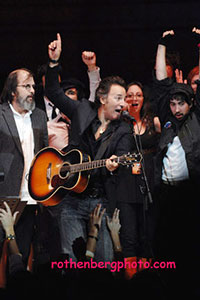
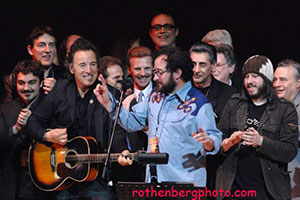
Notes: As a hard-rocking, frenetic version of "Atlantic City" performed by The Hold Steady wrapped up the "Tribute to the Music of Bruce Springsteen," a sold-out Carnegie Hall audience was pleasantly surprised as the man to whom 20 artists had previously paid tribute appeared on stage. Benefiting the Music for Youth Initiative of the UJA-Federation of New York, the already-excellent performance was capped as Bruce walked up to the microphone, telling the crowd, "I'm still alive!"

Springsteen's performance started with an acoustic guitar and harmonica version of "The Promised Land," pairing the familiar melody with the emotive vocal style used on versions on the Tom Joad and Devils & Dust tours.

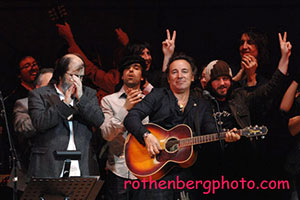
Bruce remained on stage to perform a surprise version of "Rosalita," first solo acoustic, with an improvised story in the middle ("it's been a long night, and I'm running out of lyric sheets!"), and then again with all of the evening's performers on stage, in all its full-band glory (house band Elysian Fields clearly knew their Bruce). Lead vocals the second time around were shared by Craig Finn of The Hold Steady, Badly Drawn Boy, and Jesse Malin.

Earlier in the evening, Springsteen collaborators old and new were present to perform: Patti Smith sang "Because the Night," Jesse Malin was joined by Ronnie Spector on "Hungry Heart," and Marah got the crowd into the show early with an energetic performance of "The Rising."

Other highlights (and there were many) included Joseph Arthur's version of "Born in the U.S.A."; Juliana Hatfield's solo electric reading of "Cover Me"; Badly Drawn Boy backed by Elysian Fields on a full-band "Thunder Road"; jazz pianist Uri Caine's "New York City Serenade" piano instrumental; Odetta performing what Bruce described as "the best version of '57 Channels' ever," and the Holmes Brothers' "My City of Ruins" with the Young People's Chorus of New York City, one of the musical groups receiving grants form the proceeds of the performance.
- Debra L. Rothenberg photos

Setlist:
Nebraska
- Steve Earle
Streets of Philadelphia
- The Bacon Brothers
Streets of Fire
- Elysian Fields
The River
- Josh Ritter
Because the Night
- Patti Smith
The Rising
- Marah
My City of Ruins
- Holmes Brothers with the Young People’s Chorus of New York City
Brilliant Disguise
- Robin Holcomb
Jersey Girl - Jersey Guys with Bobby Valli
Spirit in the Night - North Mississippi All-Stars
New York City Serenade - Uri Caine
Cover Me - Juliana Hatfield
One Step Up - Low Stars
Thunder Road - Badly Drawn Boy
Born in the U.S.A. - Joseph Arthur
Dancing in the Dark - Pete Yorn
Hungry Heart - Jesse Malin with Ronnie Spector
I’m Goin’ Down - M. Ward
57 Channels - Odetta
Atlantic City - The Hold Steady
The Promised Land -
Bruce
Rosalita -
Bruce
Rosalita -
Bruce with all performers

Tony Cenicola/The New York Times
The lineup of books about Mickey Mantle
has grown to more than 20 titles over the past 54 years

From The New York Times: An interesting article on Mantle lit, and not just a review of Golenbock's drivel.

Fascination With Mantle Now Blends Fiction With Fact
By RICHARD SANDOMIR


April 5, 2007

Fifty-four years ago, the sports book genre that should be named MickLit was begun with the publication of “The Mickey Mantle Story,” an autobiography of the very young Mantle as told to Ben Epstein.

More than 20 books about Mantle, by Mantle (with the aid of hired writers), or by his widow, Merlyn, and their surviving sons, have been published since. One, “Mickey Mantle of the Yankees,” by the prolific Gene Schoor inspired Marty Appel, a former Yankees public-relations chief, to hand in the same book report in the fourth, fifth and sixth grades.

“Mickey’s kind of like Abe Lincoln; he keeps catching people,” said Robert W. Creamer, who wrote and researched the 1964 book “The Quality of Courage” for Mantle. It was a collection of inspiring stories, including that of Mutt, Mantle’s father, which gave a sports spin to “Profiles in Courage,” John F. Kennedy’s 1957 Pulitzer Prize winning book.

The newest and possibly strangest addition to the MickLit canon arrived this week: “7: The Mickey Mantle Novel,” a fictional, ribald, rollicking, sad, some-of-it-based-on-fact rendering by Peter Golenbock of the late Yankee’s life, as told by Mantle in heaven to the late sportswriter Leonard Shecter.

The book has upset the Mantle family, teammates like Whitey Ford and some fans who wonder why Golenbock would write a salacious book that features a one-night stand between Marilyn Monroe and Mantle.

Golenbock is certain that some people will love “7” but that many will despise it because the lewd scenes and crude jokes build a detour from the familiar yarn fans love, of the imperfect, dramatic hero who fell short of his promise.

So far, Golenbock said by telephone, “Nobody’s threatened to shoot me yet.”

Golenbock’s publisher, Lyons Press, which acquired “7” after it was dropped by HarperCollins, said the book went out with a giant first printing of 250,000 copies. Its release was backed by full-page ads in The New York Times and The New York Post, and by mobile billboards in Manhattan.

Mary Ellen Keating, a spokeswoman for Barnes & Noble, said that early reviews and press were negative, so the influential chain does not expect significant sales. The reviewer for Publishers Weekly wrote, “This book would make Henry Miller blush,” while The St. Petersburg Times called the book “ultimately endearing” because the repentant Mantle of his final year was the narrator “and — despite it all — you can’t help but love the guy.”

Golenbock, the author of numerous sports books, said he didn’t start “7” as a fictional account, but as a straight biography.

“But it wasn’t Mickey,” he said. “He was one of the funniest people I’ve ever met. Mickey would tell jokes in a group, like the ones in the book, and I’d be on the floor. He was as funny as Chris Rock. To write a book about Mickey that wasn’t hilarious, or didn’t show how troubled he was — I couldn’t figure it out in a straight biography.”

He added, “Maybe Maraniss or Jane Leavy could do it.”

David Maraniss has written acclaimed biographies of Vince Lombardi and Roberto Clemente, and Leavy, the author of a well-reviewed biography of Sandy Koufax, is in the midst of researching a Mantle biography.

“Jane’s job is challenging because we know so much about Mickey,” said Appel, a connoisseur and collector of MickLit. “But he will always fascinate us, because he wasn’t what we believed him to be in the first place, but when we found out more about him, we loved him all over again.”

What is it about Mantle that makes him fascinating enough to have become something of a literary muse? He brought his great talent from the country to the New York spotlight; he hit massive home runs but had a body that was breaking down even before he put on a Yankees uniform; he was a blond, blue-eyed Adonis loved by men and women who played in 12 World Series in his first 14 seasons And in his final acts, which would lead him to that Golenbockian heaven, came alcoholism treatment, public atonement, a liver transplant and death by cancer.

“He was, in a way, a kind of perfect American,” said David Falkner, the author of “The Last Hero: The Life of Mickey Mantle,” which came out soon after his subject’s death. “So vulnerable, so innocent, and he could not hide who he was, which was both beautiful and horrible.”

Mantle could have been the chairman of a department of MickLit Studies, having been an eager participant in his own publishing movement. After collaborating with Epstein and Creamer, he worked with Bob Smith on a 1967 book of memories and lessons called “The Education of a Baseball Player;” Herb Gluck on a 1985 biography, “The Mick;” Phil Pepe on the 1991 memoir of his Triple Crown season, “My Favorite Summer: 1956;” and Mickey Herskowitz on a 1994 World Series reminiscence, “All My Octobers.”

No one, except for Mantle, has been more immersed in MickLit than Herskowitz, a former sports columnist for The Houston Chronicle . He wrote an appreciation of Mantle after his death then worked with the Mantle’s widow and their surviving sons, Danny, David and Mickey Jr., in 1996 on an extraordinarily candid memoir, “A Hero All His Life,” which expressed their love for him but painted scenes of lives damaged by his absences and womanizing and their drinking.

Last year, Herskowitz, along with Merlyn, Danny and David, published “Mickey Mantle: Stories & Memorabilia from a Lifetime with the Mick” (Stewart, Tabori & Chang) that was distinguished by reproductions of artifacts like a love letter written from Mickey to Merlyn on Hotel Cleveland stationery; his 1949 minor league contract, and a letter from Richard M. Nixon written after Mantle’s selection to the Baseball Hall of Fame.

“He hasn’t played in almost 40 years, he’s been dead for nearly 12, yet the interest in him is endless,” Herskowitz said from his office at Sam Houston State University, where he is a journalism professor.

Herskowitz said writers cannot fully escape the accepted hagiography of Mantle’s life, which has proved so enduring to baby boomers; nor does the broadcaster Bob Costas, whose readings about Mantle started when he was 7 or 8 with the Schoor biography (a subject that Schoor, still enamored with MickLit, returned to in 2002 with an illustrated biography).

“Look, something about Mantle and the circumstances of his career and life moved people,” he said from St. Louis. “It went beyond his specific accomplishments and beyond rooting interest. These are undeniable, emotional truths and the darker aspects of his life don’t invalidate them any more than what Richard Ben Cramer wrote about Joe DiMaggio invalidates the DiMaggio that Hemingway and Paul Simon were touched by.”

Former Patriot Darryl Stingley. (File)

Through faith, Stingley never stopped giving

By Joe Fitzgerald
Boston Herald Columnist

Friday, April 6, 2007 - Updated: 02:26 AM EST

Darryl Stingley’s death yesterday at age 55 triggered deeply moving memories here of a man whose faith transcended any form of stardom known to sports.
He was, of course, a magnificent athlete, proficient enough for the Pats to have made him a first-round draft pick in 1973 and passionate enough to have set the stage for the devastation that came upon him in an exhibition game at Oakland on Aug. 12, 1978.
“I went for a ball that was four feet higher than I could have jumped,” he recalled years later. “I just felt like I could catch it, you know? And when I came down, my life was changed forever.”
Indeed, two lethal, absolutely unnecessary hits delivered solely for intimidation by a self-described “assassin” named Jack Tatum, left him motionless on the field, a quadriplegic at 26.
As a player, it was the end of Stingley’s story.
But as a man, it was only the beginning.
Darryl’s devout faith was common knowledge as his star ascended.
“I always felt that whatever I accomplished was a gift from God,” he explained during his rookie season. “So whenever I have a good day, I attribute it to him. I’m sure some writers find that boring. They want me to be arrogant - ‘I’m the greatest!’ - but this is the only way I know to account for what I’ve been able to do. I tell them, ‘If you can’t put it that way, then I guess you can’t write about me.’ ”
But it would be in his apparent weakness, tethered to a chair, that he would give new meaning to those beliefs.
“When this happened, I asked myself, ‘Why, why, why?’ ” he admitted. “Why would God, being such a good God, allow something like this to happen? I refused all interviews for a long time because I didn’t know what direction my life was going in. It wasn’t until I stopped asking ‘why’ that I began to live again.
“I don’t want people thinking I have a halo over my head. But I’ve been touched by God in a special way, allowing him to work through me to inspire people. They look at me in a pitiful way, only to be shocked when they discover how much my spirit has triumphed.
“People expected me to be bitter, but I’m not. Bitterness acts as a poison, a toxin, in your body, in your psyche, in your mind. So you’ve got to let it go, allowing it to flow out of your system and be happy with yourself, happy to be alive. When I started thanking God that I was still alive, that’s when I really started living again.
“Cynics say, ‘Hey, God, give me tomorrow’s lottery number,’ and then if they don’t win, they don’t believe. But the very fact I’m alive is a testimony to the fact God doesn’t make mistakes. I still see, taste, smell and hear, which means I’m still experiencing life, only now it’s on a different level. In some ways I’m living more abundantly than ever; I’ll tell you, I never thought the simple things could mean so much.”
In 1983, Stingley’s book, “Happy To Be Alive,” was published. And he became a much-in-demand motivational speaker, touching young lives through the power of his example.
“I came pretty close to death,” he said. “It makes you think about what’s really important in life. It helps you to rearrange your priorities, I guess. It’s a miracle I’m alive today. There was no way in the world I was supposed to have left that hospital in California. But here I am, and I believe I’m here for a reason, that there’s a purpose to be gained.
“I was given the gift of athletic ability and used it to the utmost. At least I tried to. But I can’t go out and catch touchdown passes anymore. I can no longer give people thrills that way. All I really have left to give them is myself.”
As the years rolled on, Stingley continued giving all he had, reaching deep within himself for answers to questions he knew were sure to be asked.
“I never write speeches,” he confided. “I just say a little prayer before I begin, asking God to give me the right words to use. And I find that it gives me a boldness, like King David must have felt in facing Goliath.
“I’ve learned we have to take whatever we’ve been given and make the most of it. That’s what I tried to do on the football field and what I’m trying to do from this chair.”
Oh, did Darryl Stingley ever do it and do it well, becoming a blessing to all who were privileged to know him, this writer among them.
Goodbye, good friend, and God bless.

Thursday, April 05, 2007

Former Patriots wide receiver Darryl Stingley, shown here being wheeled off the field in a 1978 exhibition game after a hit that would leave him paralyzed, died this morning.
Former Patriots wide receiver Darryl Stingley, shown here being wheeled off the field
in a 1978 exhibition game after a hit that would leave him paralyzed, died this morning.
(Globe File Photo)

Former Pats WR Darryl Stingley dies
By Dave Goldberg, AP Football Writer


April 5, 2007

CHICAGO --Darryl Stingley spent more than half his life in a wheelchair, a symbol of the violence of the NFL, where large bodies collide at high speeds on every play. He was only 26 when he clashed head-on with the Raiders' Jack Tatum during an exhibition at the Oakland Coliseum as they leaped for a pass.

That play has haunted the NFL for nearly three decades.

On Thursday, the aftereffects of Stingley's grievous injury finally took his life at age 55.

He was pronounced dead at Northwestern Memorial Hospital after he was found unresponsive in his Chicago home, according to Tony Brucci, an investigator with the Cook County medical examiner's office.

An autopsy revealed contributing factors were bronchial pneumonia, quadriplegia, spinal cord injury and coronary atherosclerosis, the medical examiner's office said.

"I am deeply saddened by the death of Darryl Stingley," Tatum said in a statement released by the Raiders. "Darryl will be forever remembered for his strength and courage. My thoughts and prayers go out to his family."

Stingley was a star receiver with the New England Patriots when he collided with Tatum on Aug. 12, 1978. With one jolt, his life was forever changed. His neck was broken; he was left a quadriplegic. In time, he regained limited movement in his right arm and was able to operate his electric wheelchair on his own.

"I have relived that moment over and over again," he said in a 1988 interview with The Associated Press. "I was 26 years old at the time and I remember thinking, 'What's going to happen to me? If I live, what am I going to be like?' And then there were all those whys, whys, whys?

"It was only after I stopped asking why, that I was able to regroup and go on with my life," he said.

His death instantly rekindled the debate over the circumstances of the accident.

"I've thought about that throw over and over the years. Could I have changed anything or done anything differently?" Steve Grogan, the Patriots quarterback who threw the pass, said Thursday. "That hit probably was not necessary in a game with no meaning."

But Chuck Fairbanks, the Patriots' coach at the time, said he couldn't find anything illegal or dirty about it. Nor did the officials; no flag was thrown on Tatum.

"I saw replays many, many times, and many times Jack Tatum was criticized," Fairbanks said. "But there wasn't anything at the time that was illegal about that play. I do think probably that play was a forerunner for some of the changes in rules that exist today that are more protective of receivers, especially if there is head-to-head-type contact. I think that probably pre-empted some of the things that happened today."

Gene Upshaw, who played for the Raiders in that game, got to know Stingley well after the injury. Now executive director of the NFL Players Association, he helped push owners to provide benefits for disabled players: $48,000 in Stingley's time; $225,000 now.

"It was one of those things that happens that everyone regrets," Upshaw said. "I know a lot of people in New England think differently, but Jack had no intention of hurting him. I saw him hit people like that a lot of times. That was the way he played."

That style made Tatum a symbol of a violent game and he never was able to shed that reputation. He eventually wrote a book titled: "Final Confessions of NFL Assassin Jack Tatum."

Stingley, who worked as a consultant for the Patriots, often visited paralyzed patients in hospitals and lived a full life despite his disability. He wrote a book about his experiences entitled "Happy to Be Alive," in 1983, and 10 years later started a nonprofit foundation to help inner-city youth in Chicago, where he grew up and attended Marshall High School.

Tatum and Stingley never reconciled. In 1996, they were supposed to meet for a TV appearance, but Stingley called it off after being told it was to publicize Tatum's book.

But when he learned that Tatum needed to have part of a leg amputated because of diabetes, he empathized.

"You can't, as a human being, feel happy about something like that happening to another human being," Stingley told the Boston Globe in 2003. "Maybe the natural reaction is to think he got what was coming to him, but I don't accept human nature as our real nature. Human nature teaches us to hate. God teaches us to love."

Broadcaster John Madden, the Raiders' coach at the time, remained close to Stingley, visiting him in the hospital daily after the injury.

"After the game, when we found out that Darryl was paralyzed, John told him that from now on he was a Raider and we should treat him as one," Upshaw said.

During his induction last summer to the Pro Football Hall of Fame, Madden's thoughts weren't far from Stingley when he said, "We all like to see hard, aggressive play, but you always want the guy to get up."

Ten years ago, there was another scare for Stingley and his family when his son, Derek, was hit in the chest during an Arena Football game in Albany, N.Y. He sustained a concussion, but was not seriously hurt.

Stingley was raised in Chicago and went to Purdue after starring at John Marshall High School. In 1973, the Patriots made him a first-round draft pick.

Just when he got hurt, he seemed ready to become one of the NFL's top receivers.

In 1977, he had 39 catches with a 16.8 average and five touchdowns. Those were very good figures in an era when defensive backs were allowed to hit receivers all over the field and linemen couldn't use their hands to block.

In 1978, when he was injured, the NFL changed rules to open up the game and enacted new ones that are still in effect -- making a chuck illegal 5 yards past the line of scrimmage and giving linemen more leeway in their blocks.

Stingley is survived by his wife, Martine, and three sons, Hank, John and Derek. Funeral services are pending.

Wednesday, April 04, 2007

http://www.1minutemanager.nl/wp-content/uploads/2006/07/springsteen-seeger2.jpg
From RMAS via Postal68: So funny, because it rings so true:

Bruce Springsteen and The Seeger Sessions Band :
Session Outtakes
To Be Released On November 6.

Bruce Springsteen and The Seeger Sessions Band Session Outtakes will be
available on-line and in stores on November 6. The release will consist of:
a CD, and a behind the scenes DVD, also available in Blu-ray disc, that will
include the band at a home style backyard barbeque and hootenanny. Special
collectors editions will come with a full color booklet. This will include a
full narrative history of each song, and as a bonus, either a commemorative
autographed washboard and thimbles or an autographed moonshine jug.

According to Springsteen's longtime manager Jon Landau, "These songs are the
root of American music and Bruce Springsteen is continuing his crusade until
he makes every person understand the importance of these songs,
I admire his persistence. With this release, fans will finally be able to
see Bruce at work, meticulously crafting these songs like a father with his
children, and maybe, they will finally understand the importance of these
songs."

Songs include fan favorites from highly successful 'The Seeger Sessions,'
important incomplete takes, alternate versions, previously unreleased songs
and 2 bonus tracks.

Track listing :

Old Dan Tucker - take 1
Old Dan Tucker - take 2
Old Dan Tucker - complete, no fiddles
Stagolee - previously unreleased
Oh, Mary, Don't You Weep - solo acoustic
John Henry - extended version
Erie Canal - take 1
Erie Canal - zydeco version
Froggie Went A-Courtin' - with full horn section
Mrs. McGrath - take 1
Mrs. McGrath - take 2
Mrs. McGrath - take 3
Mrs. McGrath - slow version
Pretty Polly - previously unreleased
Pay Me My Money Down - alternate version
Jim Crack Corn - previously unreleased
Eency Weency Spider - newly recorded for this release

Bonus Tracks
* Buffalo Gals - dance remix
* Jacob's Ladder - dance remix

Pre-order details coming soon.
http://www.allthingsbeautiful.com/all_things_beautiful/images/jihad_barbie.jpg
Whitewashing Jihad in the Schools
Throwing the book at denial.

By Michelle Malkin

T
hree years ago, I wrote about a mock terrorism drill at a public-school district in Muskegon County, Michigan. Instead of Islamic terrorists, educators substituted Christian homeschoolers. Yes, Christian homeschoolers. Here was the description of the school drill plan:

The exercise will simulate an attack by a fictitious radical group called Wackos Against Schools and Education who believe everyone should be homeschooled. Under the scenario, a bomb is placed on the bus and is detonated while the bus is traveling on Durham, causing the bus to land on its side and fill with smoke.

Flabbergasting, but true. In the wake of 9/11 and the jihadists’ carnage against schoolchildren in Beslan, Russia, the school chose to prepare their students for an attack by Christian homeschooling “wackos,” not Muslim suicide bombers.

Unfortunately, little has changed. Last month, New Jersey’s Burlington Township High School held its own mock terrorism drill. “You perform as you practice,” Superintendent Chris Manno told the Burlington County Times. “We need to practice under conditions as real as possible in order to evaluate our procedures and plans so that they’re as effective as possible.”

But the “real as possible” conditions included no bomb-vest-donning jihadists shouting “Allahu Akbar.” No red bandana-wearing martyrs with visions of 72 virgins dancing in their evil heads. No America-hating plotters enraged by the existence of Israel or driven to establish a worldwide caliphate. Nope. According to the paper, two local police detectives took on the role of hostage-taking Christian gunmen.

“Investigators described them as members of a right-wing fundamentalist group called the ‘New Crusaders’ who don’t believe in separation of church and state. The mock gunmen went to the school seeking justice because the daughter of one had been expelled for praying before class.” Upset Christian students reported on the drill to their parents.

How many other jihad-whitewashing mock terrorism drills have been conducted using tax dollars? How long before we mimic the British schools, where the Holocaust is being dropped from history lessons to avoid offending Muslim pupils?

American educators have been bending to the will of the grievance-mongers ever since the 9/11 attacks. Remember the jihad-sympathizing admonition included in the NEA’s touchy-feely, post-9/11 curriculum: “Do not suggest that any group is responsible” for the terrorist attacks, parents and teachers were advised.

But feel free to conjure up homeschooling “wackos” and Christian “New Crusaders” to avoid offending the Muslim lobby.

Here is a “real as possible” scenario. Last month, you’ll recall, counterterrorism officials sent cautionary bulletins to police departments nationwide warning that suspected members of extremist groups have signed up as school bus drivers in the United States. The “extremists” being investigated by the FBI and other agencies are foreigners who have been able to “purchase buses and acquire licenses.”

Who are these “extremists”? Hint: They are not Presbyterian or Lutheran or Catholic homeschooling wackos.

In Indonesia last month, a theological school was reportedly attacked by religious terrorists in Jakarta. The school was evangelical Christian. The terrorists were Muslim. In southern Thailand, attackers hurled explosives and opened fire on an Islamic school, killing three students. According to reports, police believe that Muslim insurgents staged the attack in an attempt to convince villagers that authorities were responsible — a ploy to win villagers over to the insurgents’ cause.

And in the name of winning Iraqis over to their blood-stained cause this week, a suicide truck bomber carrying food supplies killed eight Iraqi schoolgirls and a baby in the northern oil city of Kirkuk. The truck bomber was a crusader, all right. But not the kind American students are being taught to drill against in their make-believe bubbles.

In our government institutions of perpetual ignorance maintenance, “D” is for dhimmitude. They are teaching our children all too well.

© 2007 CREATORS SYNDICATE, INC.

Tuesday, April 03, 2007

The image “http://www.coxandforkum.com/archives/06.07.27.GlobalJihad-X.gif” cannot be displayed, because it contains errors.
The Goal of the Jihad
By Robert Spencer

FrontPageMagazine.com | April 3, 2007

[The following talk, with some modifications, was delivered as part of a panel on “The Next Moves of Radical Islam” at the David Horowitz Freedom Center’s Santa Barbara Retreat, March 31, 2007 -- The Editors].

I am not much for predicting the future, so when it comes to detailing the next moves of the jihadists I can’t tell you what they’re going to do – but I can tell you about the ultimate goal they’re working toward.

President Bush has said that they are hoping to establish an Islamic state from Spain to Indonesia. He could have added in the Americas, too, for their goal is global. This goal is important for many reasons, although a lot of analysts have dismissed it on the grounds that the goal is unattainable. Not too long ago Reuters ran a story about the jihadist plan to establish a caliphate. To show you how important they thought it was, they ran it as part of their “Oddly Enough” feature series, which usually contains stories about man-eating chickens and Jell-O wrestling.

The story quoted a Saudi analyst Faris bin Houzam, and an anthropologist in London, Madawi ar-Rasheed, who both dismissed the caliphate as a serious threat. Ar-Rasheed said: “This is just part of (al Qaeda’s) war of slogans.”

Of course, it should go without saying that however unlikely the prospect of success, the jihadists will soldier on, attempting to advance their cause by both violent and non-violent means.

Also, to dismiss the caliphate as “just part of (al Qaeda’s) war of slogans” fails to recognize how potent slogans can be in formulating public opinion -- witness the success of the Palestinian cause in winning global support through canny use of terms like “occupation” and “apartheid” (and “Palestinian” itself). However unlikely its realization, the quest for the caliphate is increasingly popular -- at least by the evidence of election results in the Palestinian Authority, Egypt, Algeria, and elsewhere, and that fact could have extraordinarily serious consequences.

The idea of the caliphate itself also needs to be thoroughly understood by those of us who don’t wish to live under one. Why do they want to establish a caliphate at all? It isn’t just so that they can establish the rule of Islamic law: Saudi Arabia itself today is governed by Islamic law, but not by a caliph. The caliph was for Sunni Muslims, who make up 85 to 90 percent of the Islamic world today, the successor of the prophet Muhammad as the spiritual, political and military leader of the Islamic community. The great Islamic empires of the Middle Ages were ruled by caliphs.

But in 1924, the new secular government of Turkey abolished the caliphate. This is identified by jihadists today as the source of all their troubles. Western influence, disunity, laxity in Islamic observance – all this has been traced by jihadists to the loss of the caliphate.

For example, this is from the Turkish branch of Hizb-ut-Tahrir, an international political party whose stated goal is reviving the caliphate – or khilafah:

It was a day like this 79 years ago, and more specifically on the 3rd of March 1924 that...the criminal English agent, Mustafa Kemal (so-called Ataturk, the “Father of the Turks”!) announced that the Grand National Assembly had agreed to destroy the Khilafah; and...the establish...a secular, irreligious, Turkish republic....

Since that day the Islamic ummah [nation, community] has lived a life full of calamities; she was broken up into small mini states controlled by the enemies of Islam in every aspect. The Muslims were oppressed and became the object of the kuffar’s [that is, unbelievers’] derision in Kashmir, Philippines, Thailand, Chechnya, Iraq, Bosnia-Herzegovina, Afghanistan, Palestine and other lands belonging to the Muslims [...]

So the crime took place and the kuffar tightened their grip over the Islamic lands and tore it up into pieces....In place of a single Khilafah state they established cartoon states and installed rulers as agents to carry out the orders of their kuffar masters. They abolished the Islamic Sharee’ah [religious law] from the sphere of ruling, economy, international relations, domestic transactions and judiciary.[...]

“Without the Khilafah, the Islamic lands will remain torn up and the Islamic peoples will remain divided. Without the Khilafah the kafir, crusader and colonial states will continue to control us, plunder our resources and create divisions amongst us. Without the Khilafah, the Jews will continue to occupy our sacred places and kill and humiliate our brothers in Palestine. Without the Khilafah, the Islamic peoples in Bosnia, Chechnya, Afghanistan, Iraq, Kashmir, Uzbekistan and so on will continue to be killed....Without the Khilafah, those Muslims who do not work seriously for its implementation will be sinful and incur the anger of Allâh, even if they fast, pray, make Hajj [pilgrimage] and pay Zakah [alms]. This is because the work to establish the Khilafah Rashidah is a fard [obligation] on every Muslim, and it should be conducted with the most extreme effort and utmost speed.[...]

And there is something else also. In Islamic law, jihad warfare may be defensive or offensive. Jihad is ordinarily fard kifaya – an obligation on the Muslim community as a whole, from which some are freed if others take it up. Jihad becomes fard ayn, or obligatory on every individual Muslim to aid in any way he can, if a Muslim land is attacked. That is what jihadists argue today – that the American presence in Iraq and Afghanistan makes jihad fard ayn, or obligatory on every individual Muslims.

But still, that is just jihad for the defense of Muslim lands. There is also offensive jihad, in line with Muhammad’s command that Muslims offer non-Muslims conversion to Islam, subjugation as inferiors under Islamic rule, or war. But in Islamic law, only the caliph is authorized to wage offensive jihad.

That’s a primary reason why jihadists want to restore the caliphate. Some would even say that they’ve already done so. In 1996 the Taliban’s Mullah Omar went to the shrine of the Respectable Cloak of Muhammad in Kandahar and stood on the roof of the shrine wrapped in the cloak. His followers proclaimed him Emir al Momineen, or leader of the believers – a title of the caliph. So far, however, only a jihadist group in Algeria has joined the Taliban in accepting Mullah Omar as caliph.

In any case, the desire to restore the caliphate ultimately highlights the expansionist, imperialist, totalitarian, globalist aims of the jihad movement, even as today it presents itself as a defensive action against Western evils. This is, I believe, a crucial point for our understanding the enemy properly, so that we can formulate the proper defensive responses. If we don’t understand what we’re up against correctly, we will not defend ourselves properly against it. And that is, unfortunately, in many ways the fix we’re in today.

Thank you.

http://www.oslospektrum.no/getfile.php/272604.297.ufdpscaupt/BruceSpringsteenWeb.jpg
In too late for April Fool's, we get a third reheating of a year-old casserole. Also, what's with the "Sessions" Band moniker (omitting Seeger)? Does he think leaving Pete's name off will make the album seem less folksy? Maybe confusing buyers into expecting electric guitar and bass instead of banjo and fiddle? Did he think political junkies would expect a collaboration with former FBI director William Sessions? If he's so enamored with this material and wants to win over all his fan base with it, then he should go perform it in some places in the US he missed the first time around. This is underwhelming news. I feel about as excited as Patti looks above.

From Bruce Springsteen.net:

COLUMBIA RECORDS TO RELEASE 'BRUCE SPRINGSTEEN WITH THE SESSIONS BAND LIVE IN DUBLIN' JUNE 5 ON DVD AND IN 2-CD SET
Concert Features 23 Songs From November, 2006


Columbia Records will release 'Bruce Springsteen With The Sessions Band Live in Dublin' June 5, a concert DVD, and separate two-CD set release. The two-CD set and DVD both feature 23 songs drawn from the band's performances in Dublin, Ireland at The Point on November 17, 18 and 19, 2006. Songs include fan favorites from 'The Seeger Sessions,' radical interpretations from the Springsteen songbook and rare songs appearing for the first time on any Springsteen release.

Springsteen's longtime manager Jon Landau said, "'Live in Dublin' charts the development of a band from an informal gathering in Bruce's living room to an onstage powerhouse. It also documents the growth in Bruce's vision of American music; it includes folk music, blues, Dixieland, country, swing, gospel, rock, down to and including his own writing. It's all performed with Bruce's classic energy and focus. I think it's some of the finest music he's ever made."

The DVD and CD captures the band during the finale of its multi-leg 2006 tour. The Word Magazine (UK) said of a concert on this tour, "I have never, make that NEVER, seen a show better than the one mounted by Bruce Springsteen and his band at Wembley Arena on Saturday, November 11, 2006." The Sunday Business Post Agenda (UK), in a 5 star review, said, "During the concert's numerous high points, the crowd was ecstatic and Springsteen was the preacher, spreading a welcome message: We're open all night."

Bruce Springsteen with The Sessions Band's tour last year prompted other incredible reviews. "Sometime, somewhere, a more dramatic and exhilarating confluence of music with moment may have existed... But in nearly 40 years of concert-going, I haven't witnessed one," said LA Times. The Washington Post declared, "It was the best live show I've seen in at least five years. (And I've seen a few.)" Meanwhile, The Independent (UK), said, "It's been an astonishingly rich evening." The Observer (UK) proclaimed, "Springsteen and the Seeger Session band were an inspiring triumph."

'Bruce Springsteen With The Sessions Band Live in Dublin' was produced by George Travis and produced and edited by Emmy Award winner Thom Zimny, who recently took home a Grammy Award for directing "Wings For Wheels: The Making Of Born To Run," a DVD in the acclaimed 'Born To Run' box set. Legendary mixer Bob Clearmountain mixed the DVD in both stereo and 5.1 surround sound. Bob Ludwig mastered the DVD and CD at Gateway Studios. Documented with nine cameras, the concert was filmed in High Definition (HD).

Bruce Springsteen With The Sessions Band Live In Dublin' Tracklisting

1. Atlantic City
2. Old Dan Tucker
3. Eyes on the Prize
4. Jesse James
5. Further on Up the Road
6. O Mary Don't You Weep
7. Erie Canal
8. If I Should Fall Behind
9. My Oklahoma Home
10. Highway Patrolman
11. Mrs. McGrath
12. How Can A Poor Man Stand Such Times And Live
13. Jacob's Ladder
14. Long Time Comin'
15. Open All Night
16. Pay Me My Money Down
17. Growin' Up
18. When the Saints Go Marching In
19. This Little Light of Mine
20. American Land
21. Blinded By the Light (Credits)

Bonus Songs:
Love of the Common People
We Shall Overcome

The Sessions Band From November 17. 18 and 19, 2006:

Bruce Springsteen - Vocals, Guitar, Harmonica
Sam Bardfeld - Violin, Vocals
Art Baron - Sousaphone, Trombone, Mandolin, Penny Whistle, Euphonium
Frank Bruno - Acoustic Guitar, Vocals, Field Drum
Jeremy Chatzky - Bass
Larry Eagle - Drums, Percussion
Clark Gayton - Trombone, Vocals, Percussion
Charlie Giordano - Accordian, Piano, Organ, Vocals
Curtis King Jr. - Vocals, Percussion
Greg Liszt - Banjo, Vocals
Lisa Lowell - Vocals, Percussion
Ed Manion - Saxophone, Vocals, Percussion
Cindy Mizelle - Vocals, Percussion
Curt Ramm - Trumpet, Vocals, Percussion
Marty Rifkin - Steel Guitar, Dobro, Mandolin
Patti Scialfa - Acoustic Guitar, Vocals
Marc Anthony Thompson - Acoustic Guitar, Vocals
Soozie Tyrell - Violin, Vocals


Roy Williams will be enshrined in Springfield on Sept. 7.
HOF Latest Step In Charmed Life

April 2, 2007

By Adam Lucas

ATLANTA--Margey Frederick's family depended on the hire her husband was about to make, and she was concerned.

Bob Frederick was about to hire a basketball coach at the University of Kansas to replace Larry Brown. Understand, this was Kansas, one of the top jobs in America and fresh off the 1988 national championship. Rabid fans, tradition, Rock Chalk, all that.

And Margey Frederick's husband, Kansas's popular--up to this point, when he was about to commit career suicide--athletic director, was proposing to hire a relative unknown from the University of North Carolina, a coach named Roy Williams who wasn't even the first assistant in Chapel Hill.

Imagine that. Imagine Carolina needed to fill a basketball vacancy and the school decided to go for a second assistant who had never been a head coach at the college level and had zero ties to the school.

Now walk back in off the ledge.

So the remark has been immortalized in history, but Margey had good reason to say exactly what she said, which was:

"You're not going to hire that guy from North Carolina, are you?"

That guy won 418 games at Kansas and has already amassed 106 wins back at Carolina. And Monday, those 524 career wins and .800 career winning percentage earned him a spot in the Naismith Basketball Hall of Fame.

We love him because he's approachable, because even 20 years and a lot of money after that first introductory press conference he still checks his tab at dinner to make sure he's been charged correctly. Because he travels with a printout of the top golf courses in the world, checking them off as he plays them and comparing notes with Larry Brown and Dean Smith.

He might be your golfing buddy. It doesn't seem out of the realm of possibility, not the way it would to play with a divine presence like Smith. To us, he's ol' Roy, a guy you feel like you can slap on the back in the aisle of the grocery store and tell him about the time you used one of his defenses while coaching your son's rec league team. And that's why he can't go many places at all without a handful of people stopping him. "Coach, you probably don't remember me, but..." And five minutes later, he's still standing there smiling and nodding. We love all that. The Hall of Fame does not care. The Hall of Fame cares about wins and championships. Sometimes we forget that. Behind the twang and the community involvement and the subtle gestures like visiting a first-year head coach in the hospital after midnight, Roy Williams is one of the best coaches in college basketball. And by the time he's done--Monday he hedged about the possibility of coaching 15 more years, but he didn't slam the door on that possibility, either--he might be in the conversation of the best college basketball coaches ever.

He will not want to hear that, of course. Monday, he said all the things you would expect him to say.

"I already had my talk ready for what I was going to say when I didn't make it," he said of the phone call all the finalists received last Wednesday notifying them of the selection committee's decision.

How did he celebrate? He skipped his noon workout and went home to tell his wife, Wanda. In the Williams household, this qualifies as wild partying. Some coaches show up on the internet in wacky pictures in compromising locations. About as compromising as Williams ever gets is sitting on the couch watching golf with a bag of potato chips.

Hall selections were a closely guarded secret, with only Phil Jackson's name leaking into the public before Monday's presentation. Williams had to tell a few close athletic department staffers in order to coordinate his appearance at the function. This is how he told them about the greatest honor anyone in his profession can receive:

"Well, I got a call. And I guess I've made the Hall of Fame."

This, by the way, was the last item he mentioned in the meeting, almost in an apologetic, passing way. It was the way someone would ask you to pick up something at the grocery store on the way home, an "Oh, by the way..." kind of remark.

Don't be fooled--he is honored. "It's one of the only times I've ever been speechless," he said. But he freely admitted that in Atlanta, a city consumed by Monday's Florida-Ohio State title tilt, he'd happily swap the honor for a chance for his team to participate in the season's last game.

His team knows it, too. Earlier this year, word arrived during a Carolina practice that Williams was a HOF finalist. Williams, of course, was oblivious. The staff passed the news to the seniors, and Wes Miller gathered the entire team at center court at the conclusion of practice--never during practice, of course.

"Coach, we just wanted to be the first ones to congratulate you on being a Hall of Fame finalist," Miller said. And that's how Williams found out he'd made the first round of cuts, which is exactly how he'd want it.

"I've lived a charmed life, I really have," he said.

It's a life that would make Disney skeptical. And "charmed" doesn't really do it justice, because that somehow implies there wasn't a substantial amount of work involved. You know the stories: the Coca-Colas, the calendars, the driving 504 miles roundtrip on Sundays to deliver UNC television shows just to make a few extra dollars during his early Tar Heel assistant coaching days.

And yet somehow he's still--someone tell Margey Frederick--that same guy from North Carolina.

Roy Williams has just been announced as a Basketball Hall of Famer. What does he do next? Does he buy the finest bottle of champagne in Atlanta and toast to his greatness? Does he post on his own personal website proclaiming he's reached the pinnacle of his profession?

Nope. He walks a few blocks down the street to The Varsity and orders a cheeseburger. He splits an order of fries with his daughter, Kimberly.

"Want to flip for who's buying?" he asks his guests, pulling a quarter out of his pocket and flipping it into the air before snatching it and placing it on the back of his hand.

Do you even need to wonder what happens next?

Of course not.

He wins.

Adam Lucas's third book on Carolina basketball, The Best Game Ever, chronicles the 1957 national championship season and is available now. His previous books include Going Home Again, focusing on Roy Williams's return to Carolina, and Led By Their Dreams, a collaboration with Steve Kirschner and Matt Bowers on the 2005 championship team

http://www.howardbloom.net/reinventing_capitalism/index_files/image056.jpg
The Trouble With Islam
Sadly, mainstream Muslim teaching accepts and promotes violence.

BY TAWFIK HAMID
Tuesday, April 3, 2007 12:01 a.m. EDT

Not many years ago the brilliant Orientalist, Bernard Lewis, published a short history of the Islamic world's decline, entitled "What Went Wrong?" Astonishingly, there was, among many Western "progressives," a vocal dislike for the title. It is a false premise, these critics protested. They ignored Mr. Lewis's implicit statement that things have been, or could be, right.

But indeed, there is much that is clearly wrong with the Islamic world. Women are stoned to death and undergo clitorectomies. Gays hang from the gallows under the approving eyes of the proponents of Shariah, the legal code of Islam. Sunni and Shia massacre each other daily in Iraq. Palestinian mothers teach 3-year-old boys and girls the ideal of martyrdom. One would expect the orthodox Islamic establishment to evade or dismiss these complaints, but less happily, the non-Muslim priests of enlightenment in the West have come, actively and passively, to the Islamists' defense.

These "progressives" frequently cite the need to examine "root causes." In this they are correct: Terrorism is only the manifestation of a disease and not the disease itself. But the root-causes are quite different from what they think. As a former member of Jemaah Islamiya, a group led by al Qaeda's second in command, Ayman al-Zawahiri, I know firsthand that the inhumane teaching in Islamist ideology can transform a young, benevolent mind into that of a terrorist. Without confronting the ideological roots of radical Islam it will be impossible to combat it. While there are many ideological "rootlets" of Islamism, the main tap root has a name--Salafism, or Salafi Islam, a violent, ultra-conservative version of the religion.

It is vital to grasp that traditional and even mainstream Islamic teaching accepts and promotes violence. Shariah, for example, allows apostates to be killed, permits beating women to discipline them, seeks to subjugate non-Muslims to Islam as dhimmis and justifies declaring war to do so. It exhorts good Muslims to exterminate the Jews before the "end of days." The near deafening silence of the Muslim majority against these barbaric practices is evidence enough that there is something fundamentally wrong.

The grave predicament we face in the Islamic world is the virtual lack of approved, theologically rigorous interpretations of Islam that clearly challenge the abusive aspects of Shariah. Unlike Salafism, more liberal branches of Islam, such as Sufism, typically do not provide the essential theological base to nullify the cruel proclamations of their Salafist counterparts. And so, for more than 20 years I have been developing and working to establish a theologically-rigorous Islam that teaches peace.

Yet it is ironic and discouraging that many non-Muslim, Western intellectuals--who unceasingly claim to support human rights--have become obstacles to reforming Islam. Political correctness among Westerners obstructs unambiguous criticism of Shariah's inhumanity. They find socioeconomic or political excuses for Islamist terrorism such as poverty, colonialism, discrimination or the existence of Israel. What incentive is there for Muslims to demand reform when Western "progressives" pave the way for Islamist barbarity? Indeed, if the problem is not one of religious beliefs, it leaves one to wonder why Christians who live among Muslims under identical circumstances refrain from contributing to wide-scale, systematic campaigns of terror.

Politicians and scholars in the West have taken up the chant that Islamic extremism is caused by the Arab-Israeli conflict. This analysis cannot convince any rational person that the Islamist murder of over 150,000 innocent people in Algeria--which happened in the last few decades--or their slaying of hundreds of Buddhists in Thailand, or the brutal violence between Sunni and Shia in Iraq could have anything to do with the Arab-Israeli conflict.

Western feminists duly fight in their home countries for equal pay and opportunity, but seemingly ignore, under a façade of cultural relativism, that large numbers of women in the Islamic world live under threat of beating, execution and genital mutilation, or cannot vote, drive cars and dress as they please.

The tendency of many Westerners to restrict themselves to self-criticism further obstructs reformation in Islam. Americans demonstrate against the war in Iraq, yet decline to demonstrate against the terrorists who kidnap innocent people and behead them. Similarly, after the Madrid train bombings, millions of Spanish citizens demonstrated against their separatist organization, ETA. But once the demonstrators realized that Muslims were behind the terror attacks they suspended the demonstrations. This example sent a message to radical Islamists to continue their violent methods.

Western appeasement of their Muslim communities has exacerbated the problem. During the four-month period after the publication of the Muhammad cartoons in a Danish magazine, there were comparatively few violent demonstrations by Muslims. Within a few days of the Danish magazine's formal apology, riots erupted throughout the world. The apology had been perceived by Islamists as weakness and concession.

Worst of all, perhaps, is the anti-Americanism among many Westerners. It is a resentment so strong, so deep-seated, so rooted in personal identity, that it has led many, consciously or unconsciously, to morally support America's enemies.

Progressives need to realize that radical Islam is based on an antiliberal system. They need to awaken to the inhumane policies and practices of Islamists around the world. They need to realize that Islamism spells the death of liberal values. And they must not take for granted the respect for human rights and dignity that we experience in America, and indeed, the West, today.

Well-meaning interfaith dialogues with Muslims have largely been fruitless. Participants must demand--but so far haven't--that Muslim organizations and scholars specifically and unambiguously denounce violent Salafi components in their mosques and in the media. Muslims who do not vocally oppose brutal Shariah decrees should not be considered "moderates."

All of this makes the efforts of Muslim reformers more difficult. When Westerners make politically-correct excuses for Islamism, it actually endangers the lives of reformers and in many cases has the effect of suppressing their voices.

Tolerance does not mean toleration of atrocities under the umbrella of relativism. It is time for all of us in the free world to face the reality of Salafi Islam or the reality of radical Islam will continue to face us.

Dr. Hamid, a onetime member of Jemaah Islamiya, an Islamist terrorist group, is a medical doctor and Muslim reformer living in the West.

http://nobodysbusiness.typepad.com/photos/uncategorized/front042605.gif
Two-Faced Saudis

INVESTOR'S BUSINESS DAILY

Posted 4/2/2007

War On Terror: We get the sense the Saudis grin and kiss us on both cheeks when we walk into their palaces, then spit on the ground the moment we leave. The latest affront is over Iraq.

It turns out our "close ally" King Abdullah, in a speech before fellow Arabs, has condemned our presence there as "illegitimate." The harsh tone shocked U.S. officials who were under the impression the king was cooperating with our efforts.

"In beloved Iraq, blood is shed among brothers in the shadow of an illegitimate foreign occupation," Abdullah carped at the annual Arab summit in Riyadh.

Such a statement could have come from the lips of Saddam Hussein, who threatened Abdullah's regime. But removing that threat next door apparently wasn't good enough for Abdullah. He wants us infidels to remove ourselves, before the job is finished.

The slight proves again our ally's duplicity, and our own naivete in continuing to trust him. It's not merely an issue of semantics.

We actually thought the Saudis might have our backs in Iraq. But the reality may be that they're working against us there — and may even be sponsoring the insurgents killing our troops. Abdullah's remarks add weight to reports that Saudi is funding the insurgency next door.

As we've noted, the Iraq Study Group, in a throwaway line deep in its report, stated that "funding for the Sunni insurgency comes from private individuals within Saudi Arabia." Separately, the Associated Press has reported that the Saudis are "giving millions to Sunni insurgents in Iraq and much of the money is used to buy weapons, including shoulder-fired anti-aircraft missiles."

Sunni fighters say they've bought stockpiles of Strela missiles with the Saudi cash. Strelas have been blamed in a series of attacks on U.S. helicopters in Iraq, including a CH46 Sea Knight shot down over Anbar province, which borders Saudi Arabia.

The Saudis also are manning the insurgency, something we've been pointing out for the past two years. Pentagon figures show the vast majority of suicide attackers and foreign terrorists inside Iraq are Saudi citizens.

If King Abdullah shares the jihadists' view that we are infidel occupiers, it should come as no surprise that he would give the nod to their attacks on our troops. No less than the chief justice of Saudi Arabia's Supreme Judicial Council has been taped exhorting young Muslims to go to Iraq to wage jihad against U.S. forces.

Americans know precious little about the man we're depending on to help fight al-Qaida and other Muslim terrorists in Saudi Arabia. Who is King Abdullah? For starters, he's much more devout than his late brother, King Fahd. Last year he ordered Saudi newspapers to stop publishing pictures of women. He's also a Jew-hating hothead, seeing "Zionist hands" behind everything bad.

Not surprisingly, he supports Hamas and has let the terror group set up offices in Saudi Arabia. He also has OK'd fundraisers for families of Palestinian suicide bombers.

Last week, the king called for an end to the international boycott of the new Palestinian government. The U.S. and Israel want the boycott continued. Abdullah also abruptly canceled an appearance at a White House dinner set this month in his honor.

It's worth remembering that Abdullah also turned down an invitation to the White House less than four months before the 9/11 attacks. Then, as now, he was angry President Bush was siding too closely with Israel over the Palestinian issue.

Within a few weeks of 9/11, Abdullah cut off ties to Washington, shocking the Bush administration. "From now on, we will protect our national interests," he told the White House through his ambassador, "regardless of where America's interests lie in the region."

In essence, he was warning that from that day forward Saudis would go their way, and Americans could go to hell.

The major unanswered question of 9/11 is just what was the full extent of Saudi Arabia's role. What did Abdullah know, and when did he know it?

After 9/11, the Saudis expressed shock over the attacks, and vowed to help us fight the terror network they funded from its infancy. But since then, all signs indicate the Saudi government still sponsors terror.

Sadly, the White House has continued to reward it. Abdullah asked for entry into the WTO and got it. He asked for visas to deploy 20,000 more young Saudi men here, and he got them, too.

State-sponsored terror substantially increases the likelihood of successful and more lethal attacks within the U.S. How many times must we be double-crossed by the Saudis before we wise up and play hardball?

Monday, April 02, 2007


Just because this looks cool. and because the show is only two months away.
http://anti-cair-net.org/CoxForkim.jpg
From The New York Post:
LIBS: LAWSUITS 1ST, SAFETY 2ND
By DEBRA BURLINGAME


April 2, 2007 -- WHY must Democrats constantly defend against charges that they can't be trusted on issues of national security? Well, consider what went on in the House of Representatives last Wednesday night.

Various members of the House majority had just spent 30 minutes in self-praise over the $7.3 billion transportation-security bill, calling it long-overdue relief for millions of Americans. Then Rep. Peter King (R-L.I.) rose to propose an amendment directed at a dangerous new threat to national security.

His motion was a response to the "John Doe" lawsuit filed by six "Flying Imams." Last November, the six were ejected from a US Airways flight after their fellow passengers reported what they saw as strange and disturbing behavior. The imams claim that they were victims of "intentional" and "malicious" discrimination and are seeking compensation, including punitive damages - from the airlines, and also from the passengers and crew, who are identified in the suit as "John Does" to be served with legal papers once a court order reveals their actual identities.

That lawsuit is a dangerous threat aimed at a vital component of public-transit security - the public itself.

King explained as much, speaking on behalf of his amendment, which would protect anyone who makes a reasonable, good-faith report of suspicious activity from being the target of a lawsuit. "We have an enemy which is constantly adapting," King said Wednesday. "We have to think outside the box."

That enemy, of course is al Qaeda - which is obsessed with slaughtering innocents using public transportation. There was Madrid's "3/11" - 10 bombs detonated on four trains at the height of the morning rush hour, killing 191 and injuring 2,050. And London's "7/7" - four suicide bombers in the Underground and on a double-decker bus, resulting in 52 dead and 700 injured.

In New York City alone, 7 million people use mass transit every day. With 400 subway stations with 1,500 entrances, the trains are a "soft" target - one the NYPD can't adequately protect without help from the public.

Every New York City rail and transit rider has seen the signs: "If you see something, say something." The principle is obvious - in an age of terror, we should all have our eyes open. If the imams' lawsuit prospers, how many people won't say something - for fear of being sued?

Rep. Steve Pearce (R-N.M.), who'd offered an earlier bill to protect good Samaritans who alert officials, rose to speak after King. "If we allow these suits to go forward," he warned the House, "it will have a chilling effect on the future of American security . . . If we are serious about fighting terrorism, if we are serious about protecting Americans and asking them to help protect each other, then we must pass this motion."

This is the kind of no-brainer legislation that every member of Congress should vigorously support. Yet House Democrats reacted to King's proposal as if he'd thrown a bomb into the House chamber itself.

According to witnesses in the gallery and on the floor, Speaker Nancy Pelosi displayed a classic deer-in-the headlights look as the Democratic leadership went into a huddle - plainly eager, not to embrace this common-sense measure, but to sidetrack it.

Meanwhile, Rep. Bennie Thompson (D-Miss.), the chairman of the Homeland Security Committee, took the floor to oppose King's motion - and to defend the lawsuit against John Does. "We should be tolerant," he argued; people shouldn't be singled out because they "look different."

In fact, the flying imams triggered concerns by a variety of unusual actions, as well as words that roused the concern of another Arabic-speaking passenger. Witnesses say that House members started booing Thompson.

Finally, a member of the leadership realized how this would look to Americans watching on C-SPAN: Rep. Rahm Emanuel (D-Ill.) was seen staring at Thompson and repeatedly drawing his hand across his throat - an urgent signal to get off the floor.

With Democrats realizing they couldn't argue against King's measure, it went to a vote, and passed, 304 to 121

Every one of those 121 votes aimed at defeating protection for "John Does" was a Democrat - indeed, more than half of all Democrats present voted "nay."

And, with the exception of Rep. Anthony Weiner (Brooklyn), Democrats from the New York-New Jersey metro area led the way in voting against it.

Rep. Jerrold Nadler, whose district includes Ground Zero, voted no. So did Rep. Carolyn Maloney, whose district includes Midtown, and Rep. Nita Lowey, who lost dozens of Westchester neighbors on 9/11.

Rep. Bill Pascrelle hails from New Jersey, the home of 700 9/11 victims. Earlier that night, he had praised the bill's provision protecting government whistleblowers from retaliation. But he voted against such protection for John Does who don't have government jobs.

The story isn't over yet. To become law, this measure must also pass the Senate - and survive House-Senate conference, where the leadership might try to quietly excise King's reform.

The Council on American-Islamic Relations (CAIR) will certainly push for that. After all, the radical "civil rights" group - which supports the terrorists of Hamas and has received millions in funding from Saudi Arabia - is paying the lawyers in the "Flying Imams" lawsuit.

Nihad Awad, CAIR's executive director, defends the suit's targeting of ordinary citizens. The clerics, he explains, will only sue passengers who made false reports or acted in bad faith. But the suit cites an "elderly couple" who watched the imams in the gate area and then made a cellphone call. How will CAIR determine who the couple called and whether anything they did was intended to discriminate against the imams, without first finding out their names and forcing them to defend against the charge? What about their civil rights?

In the future, who will be willing to risk their savings in the face a potential lawsuit underwritten by wealthy Middle Eastern donors?

If King's measure becomes law, that worry will vanish. But the bill will have to survive the instinct of Congress' Democratic leadership to pander to political correctness and CAIR's special-interest pressure.

Democrats who don't want to be branded as soft on national security should remember the image of Rahm Emanuel on the House floor, drawing his hand across his neck.

Debra Burlingame is sister of Charles F. "Chic" Burlingame, pilot of American Airlines flight 77, which was hijacked and crashed at the Pentagon on 9/11.
Barton Silverman/The New York Times

On Monday, Carl Pavano, left, will make his first start since June 27, 2005.

From The New York Times:
New Season Brings a Fresh Start for Yankees
By DAVID PICKER


The 57,478 seats at Yankee Stadium were empty yesterday on a chilly and gray afternoon. But shortly after 1 p.m., the ballpark began to hum with anticipation.

First, Thin Lizzy’s “The Boys Are Back in Town” played over the loudspeakers. Then the Yankees filed onto the field for their final workout before the 2007 season.

The players looked excited to be back at Yankee Stadium after spending so much time preparing at spring training. Derek Jeter and Alex Rodriguez were smiling as they emerged from the clubhouse, and they playfully climbed the dugout steps together.

The Yankees begin their season this afternoon at the Stadium against the Tampa Bay Devil Rays with some new faces and some old ones who have not played with the team in a while.

“Opening day, you’d like to say it’s another game,” Manager Joe Torre said. “But you know it’s more than that.”

Carl Pavano will make the first opening day start of his career, going against the Devil Rays left-hander Scott Kazmir. And the Yankees will have the same lineup they used in Saturday’s 3-3 tie with the Detroit Tigers in Tampa, Fla.

Johnny Damon (center field) will lead off, followed by Jeter (shortstop), Bobby Abreu (right field), Rodriguez (third base), Jason Giambi (designated hitter), Hideki Matsui (left field), Jorge Posada (catcher), Robinson Canó (second base) and Josh Phelps (first base).

The right-handed-hitting Phelps beat out Doug Mientkiewicz, who bats left-handed, for a spot in the lineup. Phelps said yesterday that Torre did not plan on a strict platoon, meaning that the first basemen, each new to the Yankees, would see action against left-handers and right-handers.

“I think it’s a privilege and an honor,” Phelps said about starting the opener.

Being back at Yankee Stadium meant different things to different players. For Pavano it represented a rebirth of sorts. He has not pitched in more than a year and a half because of a string of injuries that led to his competitiveness being questioned in the clubhouse.

“I’m ready to put all that behind me and move forward,” Pavano said. “And it starts tomorrow, as far as I’m concerned.”

Pavano was surprised when he walked into the clubhouse and discovered that his locker had been moved from one side to the other, and next to Andy Pettitte’s. Torre said the two had been paired for no particular reason that he knew, but he added that having Pettitte’s advice at his disposal would only benefit Pavano.

Pettitte has not started at Yankee Stadium since the 2003 World Series. Being back at the ballpark represented a homecoming. He said he was surprised by how little things had changed.

When Pettitte pitched for the Yankees from 1995 to 2003, he would arrive at the ballpark and head straight into the clubhouse.

Yesterday Pettittte walked directly onto the field and peered at the sea of empty seats.

“Now that I’m back and I’m here, it doesn’t seem like it was that long ago,” Pettitte said. “Where when I was gone, it seemed like it never really existed.

“It’s just strange how time can separate you from something but yet how comfortable you can get once you come back.”

There was another noteworthy clubhouse switch. Mariano Rivera occupied the corner locker that for the past 10 seasons had belonged to Bernie Williams, who passed on an invitation to spring training and was not offered a major league contract. Before Williams, the locker belonged to Don Mattingly until he retired after the 1995 season. The locker was then left vacant for one season.

“This locker, when I came here, was Mattingly’s,” said Rivera, who was given the spacious locker because of his seniority. “So I think I can say it’s a good thing being in this corner, a lot of pressure. You have to do the job now.”

The locker that belonged to Cory Lidle will remain vacant for the season. Jason Zillo, the Yankees’ director of media relations and publicity, said it was a way to pay tribute to Lidle, the pitcher who died when his small plane crashed into a Manhattan high rise in October after his only season with the team.

Lidle’s wife and son will take the mound for the ceremonial first pitch today.

INSIDE PITCH


Chien-Ming Wang, who will start the season on the disabled list with a pulled right hamstring, threw 40 pitches in a bullpen session yesterday in Tampa but has not been cleared to pitch from the top of a mound. He is expected to join the Yankees in late April.

Tyler Kepner contributed reporting.
http://www.c-span.org/questions/images/weekly27.jpg
Fred Thompson Is for Real
By Robert Novak

WASHINGTON -- In just three weeks, Fred Thompson has improbably transformed the contest for the Republican presidential nomination. It is not merely that he has come from nowhere to double digits in national polls. He is the talk of GOP political circles, because he is filling the conservative void in the Republican field of candidates.

Republican activists have complained for months that none of the big-three contenders -- Rudy Giuliani, John McCain and Mitt Romney -- fits the model of a conservative leader for a conservative party. The party faithful have been waiting for another Ronald Reagan. But in conversations with them the past year, nobody mentioned Thompson as the messiah until he appeared March 11 on "Fox News Sunday with Chris Wallace."

His statement to Wallace that he was "giving some thought" to a presidential run generated a reaction that surprised Thompson. In the first Gallup poll that listed Thompson (March 23-25), he scored 12 percent -- amazing for someone out of public life for more than four years who has not campaigned. More important than the polling data is his backing within the political community. Buyer's remorse is expressed by several House members who had endorsed former Massachusetts Gov. Romney.

Thompson's popularity reflects weakness among announced Republican candidates, as reflected in the Gallup survey. Sen. McCain, no longer an insurgent but still not accepted by conservatives, is stuck in the 20-25 percent range. Former New York City Mayor Giuliani has dropped precipitously from 44 percent to 31 percent, amid attacks on his ideology and personal life. Most startling, despite a well-financed, well-organized campaign, Romney has fallen to 3 percent.

Sophisticated social conservative activists tell me they cannot vote for Giuliani under any conditions and have no rapport with McCain or Romney. They do not view Sen. Sam Brownback, representing the social right, as a viable candidate. They are coming to see Thompson as the only conservative who can be nominated. Their appreciation of him stems not from his eight years as a U.S. senator from Tennessee but his actor's role as district attorney of Manhattan on "Law and Order." That part was molded to Thompson's specifications as a tough prosecutor, lending him political star power.

Thompson's political origin as a protege of Sen. Howard Baker, leader of the Tennessee GOP's more liberal wing, prompted hard-line Senate conservatives to consider him a little too liberal. Actually, his lifetime Senate voting record as measured by the American Conservative Union was 86 percent. It would have been close to 100 percent except for his repeated votes supporting McCain's campaign finance reform. None of the big-three Republicans has been so consistently conservative as Thompson on tax policy, national security and abortion.

The principal complaint about Thompson concerns not his ideology but his work ethic. The rap is that he does not burn the midnight oil -- the identical criticism of Reagan, before and during his presidency. That carping may betray resentment that Thompson has emerged as a full-blown candidate without backbreaking campaign travel and tedious fund-raising.

Thompson's critics assert that, bored with his lucrative career as an actor, he has enjoyed his 15 minutes of fame created by a chance TV interview and will not really run. But he privately assures friends that this is for real. His performance on "Fox News Sunday" was no accident. He went on the program for the purpose of unveiling his possible candidacy.

Thompson did not leave public policy when he left the Senate. He has served on the U.S.-China Economic and Security Review Commission. He hardly knew Scooter Libby but felt he was getting a raw deal, appeared in his courtroom and helped raise money for his defense fund.

Friends bet Thompson will run. He clearly wants to try, and his wife, Jeri, is all for it. Seeking the best timing, he wants to avoid the pitfalls encountered by Democrat Barack Obama, who may have damaged himself by starting his campaign too quickly.

I met Fred Thompson in 1974 as Howard Baker's 31-year-old minority counsel on the Watergate investigation. I considered him cool, careful and conservative. He still is, and that is how he would run for president, which appears in the offing.

Copyright 2007 Creators Syndicate Inc.

Sunday, April 01, 2007

Twenty-seven years ago, Mahmoud Ahmadinejad was a student in Tehran and is said (by a former Iranian president, for one) to be among those in the U.S. embassy who seized and held American citizens hostage for more than a year.

Today, Mahmoud Ahmadinejad is president of Iran and bears less ambiguous responsibility for Western hostages. This time round, they're British subjects: 15 sailors and Royal Marines. There are a few differences between this kidnapping and the last: Back in 1979, the Iranians seized their hostages by invading a diplomatic mission -- the sovereign territory of the United States. In 2007, they seized them in international waters. In 1979, two weeks after the embassy crisis began, 13 American hostages who happened to be black were released; the remainder were held for another 14 months. In 2007, the one woman among the hostages is being offered by the regime for early release, invitingly dangled in front of the TV cameras, though with her Royal Navy uniform replaced by Islamic dress; it remains to be seen what will become of the others. On Thursday, a new generation of "student demonstrators" called for the "British aggressors" to be executed.

On this 25th anniversary of the Falklands War, Tony Blair is looking less like Margaret Thatcher and alarmingly like Jimmy Carter, the embodiment of the soi-disant "superpower" as a smiling eunuch.

But this is a season of anniversaries. A few days ago, the European Union was celebrating its 50th birthday with the usual lame-o Euro-boosterism. I said up above that the 15 hostages are "British subjects." But, as a point of law, they are also "citizens of the European Union." Even Oxford and Hoover's Timothy Garton Ash, one of the most indefatigable of those Euro-boosters, seemed to recognize the Iranian action was a challenge to Europe's pretensions. "Fifteen Europeans were kidnapped from Iraqi territorial waters by Iranian Revolutionary Guards," he wrote. "Those 14 European men and one European woman have been held at an undisclosed location for nearly a week, interrogated, denied consular access, but shown on Iranian television, with one of them making a staged 'confession,' clearly under duress. So if Europe is as it claims to be, what's it going to do about it?''

Short answer: Nothing.

Slightly longer answer: The 15 "European" hostages aren't making that much news in "Europe." And, insofar as they have, other "Europeans" -- i.e., Belgians, Germans and whatnot -- don't look on the 15 hostages as "Europeans" but as Brits. Europe has more economic leverage on Iran than America has. The European Union is the Islamic Republic's biggest trading partner, accounting for 40 percent of Iranian exports. They are in a position to inflict serious pain on Tehran. But not for 15 British servicemen. There may be "European citizens," but there is no European polity.

OK, well, how about the United Nations? Those student demonstrators want the execution of "British aggressors." In fact, they're U.N. aggressors. HMS Cornwall is the base for multinational marine security patrols in the Gulf: a mission authorized by the United Nations. So what's the U.N. doing about this affront to its authority and (in the public humiliation of the captives) of the Geneva Conventions?

Short answer: Nothing.

Slightly longer answer: The British ambassador to the U.N. had wanted the Security Council to pass a resolution ''deploring'' Iran's conduct. But the Russians objected to all this hotheaded inflammatory lingo about ''deploring,'' and so the Security Council instead expressed its ''grave concern'' about the situation. That and $4.95 will get you a decaf latte. Ask the folks in Darfur what they've got to show for years of the U.N.'s "grave concerns" -- heavy on the graves, less so on the concern.

Yet, like the Americans, the British persist in trying to resolve real crises through pseudo-institutions. A bunch of unelected multinational technocrats can designate an entire continent as "citizens of Europe" but, as Pat Buchanan wrote the other day, "dry documents, no matter how eloquent, abstract ideas, no matter how beautiful, do not a nation make." Similarly, the West's transnational romantics can fantasize about "one-world government," but, given the constituent parts, it's likely to be a lot more like Syria writ large than Sweden. In fact, it already is.

And, at one level, the obstructionists have a point. Russia's interests in Iran are not the same as the United Kingdom's: Why should it subordinate its national policy for a few British sailors? Conversely, why should we subordinate ours to transnational process? If saving Darfur is the right thing to do, it doesn't become the wrong thing to do because the Chinese guy refuses to raise his hand. And Darfur is an internal region of a sovereign state. If the Security Council cannot even "deplore" an act of piracy on the high seas, then what is it for?

The U.N. will do nothing for men seized on a U.N.-sanctioned mission. The European Union will do nothing for its "European citizens." But if liberal transnationalism is a post-modern joke, it's not the only school of transnationalism out there. Iran's Islamic Revolution has been explicitly extraterritorial since the beginning: It has created and funded murderous proxies in Hezbollah, Hamas and both Shia and Sunni factions of the Iraq "insurgency." It has spent a fortune in the stans of Central Asia radicalizing previously somnolent Muslim populations. When Ayatollah Khomeini announced the fatwa against Salman Rushdie, it was not Iranians but British, Indian, Turkish, European, Asian and American Muslims who called for his death, firebombed bookstores, shot his publisher, fatally stabbed his translator and murdered anybody who got in their way.

So we live today in a world of one-way sovereignty: American, British and Iraqi forces in Iraq respect the Syrian and Iranian borders; the Syrians and Iranians do not respect the Iraqi border. Patrolling the Shatt al-Arab at a time of war, the Royal Navy operates under rules of engagement designed by distant fainthearts with an eye to the polite fictions of "international law": If you're in a ''warship,'' you can't wage war. If you're in a ''destroyer,'' don't destroy anything. If you're in a "frigate," you're frigging done for.

On Sept. 11, a New York skyscraper was brought down by the Egyptian leader of a German cell of an Afghan terror group led by a Saudi. Islamism is only the first of many globalized ideological viruses that will seep undetected across national frontiers in the years ahead. Meanwhile, we put our faith in meetings of foreign ministers.

"It is better to be making the news than taking it," wrote Winston Churchill in 1898. But his successors have gotten used to taking it, and the men who make the news well understand that.

© Mark Steyn 2007