Saturday, April 14, 2007

The image “http://blogs.newsobserver.com/media/butch.JPG” cannot be displayed, because it contains errors.
From The News & Observer:
Upgrading Tar Heels

Tweaking facilities, open-door policy some of Davis' changes

Robbi Pickeral, Staff Writer

CHAPEL HILL - At least once a week, North Carolina coach Butch Davis walks the halls of the Kenan Football Center, pointing out wall hangings to replace, equipment to upgrade, doors to tear down. To him, building a champion isn't just about implementing a new offense or figuring out who will start at linebacker, things that will be on his mind during today's spring game.

It's also about making over the image and attitude of the program with subtle alterations to everything from the uniforms (larger lettering this season, a major overhaul in 2008) to stationery (helmet-shaped cards for autographs, high-grade note cards).

"You don't change for the sake of change," said Davis, who was hired in November to revive a program with only one winning season in the past six years.

"You're really truly changing because you think it's going to make a difference in winning or losing -- whether it's a change in the carpet, whether it's a change in the locker room. ...

"And every change we'll make, this year and for the next two or three years, will dramatically make an impact on this program."

Subtly, it already has.

Morale is on an upward swing this spring, players say, as the new coaching staff's open-door policy has taken a literal turn. Many doors throughout the four-floor facility have been taken off the hinges, and those that haven't are usually left open.

"I like that policy a lot," said kicker Connor Barth. "It really makes for a family atmosphere ... and really makes us feel like we're wanted everywhere."

Davis said some of his top former players at Miami were notorious for coming into the office, grabbing a cup of coffee and the remote control, plopping down on a couch and watching game film -- all before the coaches even arrived. They simply wanted to be there, in the football facility. Learning. Bonding. Winning.

To that end at Carolina, the most tangible upgrades this offseason will come in the weight room and locker room, where the school is replacing workout equipment, some of it 10 years old, and tearing down walls that created natural cubbies, which Davis believes contributed to the formation of cliques.

New flat-panel TVs will replace some of the ones in the cafeteria and players' lounge. Flat-monitor message boards will be posted throughout the facility, making announcements and meeting times easier to circulate.

The purchases might seem like luxuries, considering the Kenan Center was opened in 1997 as part of a $50 million expansion. But Davis says they are necessary improvements when you're competing for top recruits and trying to get current players to spend more time in the football facilities.

"This was probably the Taj Mahal of college football the day that it opened," said Davis, who made similar upgrades when he coached the Miami Hurricanes and Cleveland Browns.

"But over the course of the last 10 years, it became the benchmark. Everyone in college football looked at this facility and said, 'OK, ours has to be better than theirs.' And ... probably over 50 schools have built new football complexes just in the last five or six years. ... And so what we want to do now is, we've got to go back and get back into the so-called 'arms race.' "

Carolina is planning to eventually add luxury boxes and an expansion in the east end zone that would make Kenan Stadium a complete oval.

While continuing to push for the multimillion dollar upgrades, Davis is also busy making quicker, less expensive changes:

* This week, players were photographed for two sets of individual media guide pictures: The usual ones in their jerseys (with the addition of white mock turtlenecks underneath), plus snapshots in coats and ties. Players liked the formality so much, Davis said, that several have suggested adding it to the pregame Old Well Walk -- a tradition started by former coach John Bunting that will remain intact.

"He wants us to have the attitude of champions -- to walk like champions, to play like champions, to dress like champions," quarterback Cameron Sexton said.

* Daily schedules will change so players will be finished with practice, meetings, study halls and anything else football-related by 6 p.m. each day in the fall.

"Go watch TV, read, maybe do some supplemental studying and stuff like that, as opposed to monopolizing their time where they're getting out of here at 9 o'clock at night and they're just dead tired," Davis said.

* He plans to have more outside resources available to the team. For example, Dr. Kevin Elko, a sports psychologist who has previously worked with Davis as well as various NFL and Olympic teams, will be in Chapel Hill eight to 25 times a year to meet with players and coaches.

Davis also wants to start a seminar for rising seniors that will teach the players about financial planning, relationships with agents, the draft, life after the NFL -- and life without the NFL for those who don't make it.

* Assistant coaches will meet weekly, or bi-weekly, with players individually to discuss their grades, their classes, their lives.

"Players, they want to know that you care about them more than just how many touchdowns they can score and how many tackles they can make," Davis said.

* Davis wouldn't give details, but said game uniforms will be modified slightly for next season, with a "major change" coming in 2008. At the very least, names on the back of the jerseys will be larger.

"There are some things on this uniform that I absolutely love," he said. "You couldn't design a better helmet than the one that we've got."

Players are enthused about the changes -- big and small.

"It's makes it feel like you're a part of something big coming up," Barth said.

Meanwhile, Davis plans to keep marching the halls every week, looking for any tweak that might make his players feel like winners so that they can become winners.

"There are a lot of things that don't need to change," he said. "... But any time there's the restoration of a program, I think [change] is refreshing, it's exciting. I think it builds enthusiasm.

Friday, April 13, 2007

http://www.booksamillion.com/bam/covers/0/74/326/473/0743264738.jpg
Einstein and Faith

By John Rose

Wednesday, April 11, 2007, 9:19 AM

Walter Isaacson’s biography Einstein: His Life and Universe hit bookstands yesterday and promises to be a bestseller. Time magazine has made an excerpt available online called “Einstein & Faith” that is very much worth reading.

Although Einstein abandoned his faith in a personal God at a young age, Isaacson notes that he had little patience or respect for simple materialist atheism. “The fanatical atheists,” Einstein wrote, “are like slaves who are still feeling the weight of their chains which they have thrown off after hard struggle. They are creatures who—in their grudge against traditional religion as the ‘opium of the masses’—cannot hear the music of the spheres.” The cosmos was symphonic for Einstein, and his God was revealed in the harmony of its laws. Simultaneously a determinist and a theist, Einstein saw proof of a divine Author in the intricate, beautiful ways in which everything seemed to be determined.

How, then, did Einstein balance beliefs in both physical materialism and human ethics? Isaacson writes:

Einstein’s answer was to look upon free will as something that was useful, indeed necessary, for a civilized society, because it caused people to take responsibility for their own actions. “I am compelled to act as if free will existed,” he explained, “because if I wish to live in a civilized society I must act responsibly.” He could even hold people responsible for their good or evil, since that was both a pragmatic and sensible approach to life, while still believing intellectually that everyone’s actions were predetermined. “I know that philosophically a murderer is not responsible for his crime,” he said, “but I prefer not to take tea with him.”

Evidently, even a genius can’t resolve this contradiction. But perhaps it was never necessary for Einstein to put himself in this position.

Since Einstein’s death, quantum theory’s verification has cast serious doubts on determinism and helped recover human free will in science. As Stephen Barr writes in “Faith and Quantum Theory” (subscription required, First Things, March), Einstein “detested the idea that a fundamental theory should yield only probabilities. ‘God does not play dice!’ he insisted. In Einstein’s view, the need for probabilities simply showed that the theory was incomplete.”

Well, he was wrong. And in being wrong about quantum theory, Einstein was also wrong about the impossibility of free will. The steps in logic taken to get from quantum probabilities to the freedom of the human mind are surprising, yet convincing. Barr concludes: “As long as only physical structures and mechanisms are involved, however complex, their behavior is described by equations that yield only probabilities—and once a mind is involved that can make a rational judgment of fact, and thus come to knowledge, there is certainty. Therefore, such a mind cannot be just a physical structure or mechanism completely describable by the equations of physics.” This leaves room for the mind to be free.

Others will disagree with Barr, siding with Einstein or proposing still other ways of interpreting quantum theory. Their objections will be heard, as well as Barr’s responses to them, in the correspondence section of the June/July double issue of First Things.

As for myself, I wonder what Einstein would think had he lived to see the evidence for quantum theory. His reaction would help tell us whether his belief in determinism was scientific (as he always claimed) or itself a sort of prescientific faith. And, assuming for the moment he came to accept quantum theory and its implications for free will as given by Barr, would Einstein have viewed the universe as no longer harmonious—and might he have reconsidered religion?

John Rose is an assistant editor at First Things.

Thursday, April 12, 2007

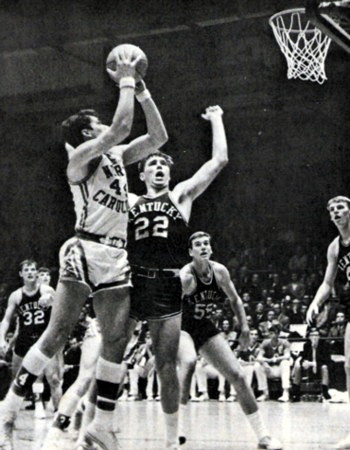
http://www.bigbluehistory.net/bb/Graphics/GameAction/19671212NorthCarolina.jpg
From The Morning Call

Miller's tale is one of glory at UNC
Former Catasaqua star helped bring Tar Heels back to Final Four.

By Jeff Schuler Of The Morning Call

April 2, 2007

On the night of Friday, March 17, 1972, after helping the Carolina Cougars beat the New York Nets 147-127 on Long Island, Larry Miller spent some time with a couple of friends from Catasauqua. Basically, the whole night.

"I think between the three of us we drank a couple of cases of beer, and then Larry went to his room to watch a (Mister MotoMoto) movie," said Buff Schwenk, who traveled to New York with Rich Petro for the American Basketball Association game.

"I was with those guys until at least 5 a.m.," Miller said.

At 7 a.m. the next day, Miller and the Cougars flew back to Greensboro, where Carolina had another game Saturday against Memphis, on a night the franchise was honoring the king of stock-car racing, Richard Petty.

"We got in after the flight, and I went home and slept a little before getting up to go to the game," Miller recalls. "During warm-ups I felt queasy a little bit, and I even said to someone that I wasn't feeling that good and maybe I shouldn't play. But I did."

It turned out that night, just over 45 years ago, was one to remember. The former North Carolina All-American stole the thunder from King Richard, breaking the league's single-game scoring record with 67 points in a 139-125 victory.

Miller, who had 38 points at halftime, was 25-of-40 from the field, scoring mostly on 15-foot jumpers and drives through the porous Memphis defense. He missed his only 3-point attempt but converted 17 of 23 free throws, adding eight rebounds and four assists while breaking the previous league mark of 63, set the previous month by Utah's Zelmo Beaty.

At the time, only two professional basketball players, Wilt Chamberlain and Elgin Baylor, had scored more points in a game, and no guards. Some 45 years later, Miller is still one of just five pro guards (David Thompson, Pete Maravich, Michael Jordan, Kobe Bryant) to reach that mark in a game.

"It was just one of those nights," said Miller, whose previous career-high had been 47 against Oakland when he was playing for the Los Angeles Stars as a rookie in 1968-69. "And everyone kept passing me the ball."

As a senior at North Carolina Miller was a first-team AP All-American, along with Houston's Elvin Hayes, UCLA's Lew Alcindor (now Kareem Abdul-Jabbar), LSU's Pete Maravich and Louisville's Wes Unseld. All four went on to Hall of Fame careers in the established NBA. So how did he wind up playing in the upstart ABA, about to begin its second season?

Call it a combination of circumstance, pride, and Lehigh Valley stubbornness.

In an attempt to head off its new rival, the NBA had moved the first round of its draft up four weeks to right after the collegiate season. Hayes went first, to the San Diego (now Houston) Rockets. The Baltimore Bullets, now playing in Washington, took Unseld second.

In all, 14 players were selected. Miller wasn't one of them.

"They took Gary Gregor (Phoenix) and Skip Harlicka (Atlanta), from South Carolina, who I played against in the ABA, and Bill Hoskett (New York) from Ohio State, who I played against in the Final Four," Miller said. "I knew I was better than any of them."

That perceived snub gave the ABA an opening, and the Stars, who had just hired Bill Sharman -- whose son was a Parade All-American with Miller in 1964 -- as coach away from the NBA's San Francisco Warriors, jumped right in.

In late April general manager Jim Hardy traveled to Chapel Hill and met with Miller in the home of Tar Heel coach Dean Smith, offering a three-year package that totaled almost $150,000.

Although Smith attempted to persuade Miller to be patient, Miller took it.

"I tried to tell him there was no rush, to let things play out a little, but Larry was just so anxious to graduate and go play pro ball," Smith said. "He was so determined. They were offering so much money for that time, and the more we talked I just knew he was going to play in the ABA."

A week later, when the NBA completed its draft, the 76ers took him in the fifth round. By then it was too late. "When [the NBA] made their decision that they didn't think I could play as well as those other guys, I just said I'm going to play for someone who wants me," Miller said.

The popular notion at the time was that Miller was a "tweener" – too small to play forward, too slow to play guard. But Larry Brown, an assistant under Smith during Miller's sophomore and junior years before going on to his own Hall of Fame coaching career, disputes that notion.

"There's no doubt in my mind he would have been successful [in the NBA]," Brown said. "Larry was a great athlete, an unbelievable jumper at 6-4 with great strength. He could guard big guys; he could guard small guys.

"When I look at the way the game is played today, on the perimeter, he's a guy who would really fit in now. If you go small he's strong enough to guard a big guy, go big and he was quick enough to play small forward or big guard. If he was coming out of college today everyone in the NBA would want him."

Miller had a solid if not spectacular six-year career in the ABA. In his first season he averaged 17.0 points, 7.7 rebounds and 2.3 assists a game and was a first-team all-rookie selection. He averaged double-figures in five of his six seasons, with a high of 18.4 in 1971-72 with the Cougars.

In all, he averaged 13.6 points and 5.0 rebounds over his career, retiring after playing just five games in what would have been his seventh season.. However, Miller was never able to find stability. He played for five teams – Los Angeles, Carolina, San Diego, Virginia and Utah – and nine different coaches, including K.C. Jones and Wilt Chamberlain in San Diego.

He was traded twice and left unprotected after his best season, 1971-72, for the expansion draft, which is how he wound up in San Diego.

"(The Cougars) were paying Billy Cunningham $400,000 a year to leave the Sixers and come back to Carolina to play," Miller said of his former UNC teammate. "I was the team MVP, the best defender, the leading scorer the year before, and probably should have been an all-star. I was getting $45,000 (in the last year of his rookie contract) and wanted $60,000. They said I was holding them up and let me go."

Although Miller never regretted his decision to go with the ABA, the instability eventually got to him.

"We thought we were as good as they were in the NBA; hell, we were as good," Miller said. "I knew a lot of those guys and I knew I could play with them, and I knew a lot of us could play with them. And I saw history. I saw George Gervin's first game, and Julius (Erving's) first game.

"But it just got so bizarre. George Lehmann played with me in Carolina, and he was good. We could have dominated for 10 years if we could have played together because I could read his eyes and he could read mine. He told the coaches, 'Start me and Mills together and we'll win,' and we started together for three games and won each one on the road. But they traded him a couple of days later because he was eating popcorn on the bench. At San Diego, Wilt never showed up (for practice). He'd just said send his manservant down from Los Angeles to run things.

"It all just added up," Miller continued. "It just wasn't any fun any more. I played for one coach at Catasauqua (Bob Mushrush(, one coach at North Carolina. Jerry West and I talked about it one night. It's all about situations. He said he was lucky; he played for one team and six coaches (two in his first season) in 13 years with the Lakers. I was with different teams, different coaches, different philosophies. I don't care what anybody says, I could have scored 30 points a game if I wanted to and played with anybody. But it was about selling yourself every year, and I got tired of it."

Wednesday, April 11, 2007

http://www.voccoquan.com/SteveR/don%20imus.JPG

From The Kansas City Star: Brilliant piece.
Imus isn’t the real bad guy

Instead of wasting time on irrelevant shock jock,
black leaders need to be fighting
a growing gangster culture.

By JASON WHITLOCK


Thank you, Don Imus. You’ve given us (black people) an excuse to avoid our real problem.

You’ve given Al Sharpton and Jesse Jackson another opportunity to pretend that the old fight, which is now the safe and lucrative fight, is still the most important fight in our push for true economic and social equality.

You’ve given Vivian Stringer and Rutgers the chance to hold a nationally televised recruiting celebration expertly disguised as a news conference to respond to your poor attempt at humor.

Thank you, Don Imus. You extended Black History Month to April, and we can once again wallow in victimhood, protest like it’s 1965 and delude ourselves into believing that fixing your hatred is more necessary than eradicating our self-hatred.

The bigots win again.

While we’re fixated on a bad joke cracked by an irrelevant, bad shock jock, I’m sure at least one of the marvelous young women on the Rutgers basketball team is somewhere snapping her fingers to the beat of 50 Cent’s or Snoop Dogg’s or Young Jeezy’s latest ode glorifying nappy-headed pimps and hos.

I ain’t saying Jesse, Al and Vivian are gold-diggas, but they don’t have the heart to mount a legitimate campaign against the real black-folk killas.

It is us. At this time, we are our own worst enemies. We have allowed our youths to buy into a culture (hip hop) that has been perverted, corrupted and overtaken by prison culture. The music, attitude and behavior expressed in this culture is anti-black, anti-education, demeaning, self-destructive, pro-drug dealing and violent.

Rather than confront this heinous enemy from within, we sit back and wait for someone like Imus to have a slip of the tongue and make the mistake of repeating the things we say about ourselves.

It’s embarrassing. Dave Chappelle was offered $50 million to make racially insensitive jokes about black and white people on TV. He was hailed as a genius. Black comedians routinely crack jokes about white and black people, and we all laugh out loud.

I’m no Don Imus apologist. He and his tiny companion Mike Lupica blasted me after I fell out with ESPN. Imus is a hack.

But, in my view, he didn’t do anything outside the norm for shock jocks and comedians. He also offered an apology. That should’ve been the end of this whole affair. Instead, it’s only the beginning. It’s an opportunity for Stringer, Jackson and Sharpton to step on victim platforms and elevate themselves and their agenda$.

I watched the Rutgers news conference and was ashamed.

Martin Luther King Jr. spoke for eight minutes in 1963 at the March on Washington. At the time, black people could be lynched and denied fundamental rights with little thought. With the comments of a talk-show host most of her players had never heard of before last week serving as her excuse, Vivian Stringer rambled on for 30 minutes about the amazing season her team had.

Somehow, we’re supposed to believe that the comments of a man with virtually no connection to the sports world ruined Rutgers’ wonderful season. Had a broadcaster with credibility and a platform in the sports world uttered the words Imus did, I could understand a level of outrage.

But an hourlong press conference over a man who has already apologized, already been suspended and is already insignificant is just plain intellectually dishonest. This is opportunism. This is a distraction.

In the grand scheme, Don Imus is no threat to us in general and no threat to black women in particular. If his words are so powerful and so destructive and must be rebuked so forcefully, then what should we do about the idiot rappers on BET, MTV and every black-owned radio station in the country who use words much more powerful and much more destructive?

I don’t listen or watch Imus’ show regularly. Has he at any point glorified selling crack cocaine to black women? Has he celebrated black men shooting each other randomly? Has he suggested in any way that it’s cool to be a baby-daddy rather than a husband and a parent? Does he tell his listeners that they’re suckers for pursuing education and that they’re selling out their race if they do?

When Imus does any of that, call me and I’ll get upset. Until then, he is what he is — a washed-up shock jock who is very easy to ignore when you’re not looking to be made a victim.

No. We all know where the real battleground is. We know that the gangsta rappers and their followers in the athletic world have far bigger platforms to negatively define us than some old white man with a bad radio show. There’s no money and lots of danger in that battle, so Jesse and Al are going to sit it out.

To reach Jason Whitlock, call (816) 234-4869 or send e-mail to jwhitlock@kcstar.com.
The image “http://faculty-staff.ou.edu/A/Rufus.J.Alexander-1/017_PP0296~R-Kelly-Posters.jpg” cannot be displayed, because it contains errors.
Top-40 Depravity
Where's the outrage?

By Michelle Malkin

Let’s stipulate: I have no love for Don Imus, Al Sharpton, or Jesse Jackson. A pox on all their race-baiting houses.

Let’s also stipulate: The Rutgers women’s basketball team didn’t deserve to be disrespected as “nappy-headed hos.” No woman deserves that. I agree with the athletes that Imus’s misogynist mockery was “deplorable, despicable and unconscionable.” And, as I noted on Fox News’s O’Reilly Factor this week, I believe top public officials and journalists who have appeared on Imus’s show should take responsibility for enabling Imus—and should disavow his longstanding invective.

But let’s take a breath now and look around. Is the Sharpton & Jackson Circus truly committed to cleaning up cultural pollution that demeans women and perpetuates racial epithets? Have you seen the Billboard Hot Rap Tracks chart this week?

The No. 1 rap track is by a new sensation who goes by the name of “Mims.” The “song” is “This Is Why I’m Hot.” It has topped the charts for the last 15 weeks. Here’s a taste of the lyrics that young men and women are cranking up in their cars:

This is why I’m hot

Catch me on the block

Every other day

Another bitch another drop

16 bars, 24 pop

44 songs, nigga gimme what you got . . .

. . . We into big spinners

See my pimping never dragged

Find me wit’ different women that you niggas never had

For those who say they know me know I’m focused on ma cream

Player you come between you’d better focus on the beam

I keep it so mean the way you see me lean

And when I say I’m hot my nigga dis is what I mean

Let’s move down the Billboard list, shall we? The No. 2 rap track in the nation this week is by rappers Bow Wow and R. Kelly (yes, the same R. Kelly who was indicted five years ago on a raft of child-porn charges and is still awaiting trial). The “song” is called “I’m a Flirt,” and it’s been on the charts for 12 weeks:

Ima b pimpin

I don’t be slippin

When it come down to these hos

I don’t love em

We don’t cuff em

Man that’s just the way it goes

I pull up in the Phantom

All the ladies think handsome

Jewelry shining, I stay stuntin’

That’s why these niggas can’t stand em

Ima chick mag-a-net

And anything fine I’m bag-gin it

And if she got a man, I don’t care

10 toes and I wanna be, cause I gotta have it

The final line:

Now the moral of the story is cuff yo chick, ‘cause hey, I’m black, fresh, and I rap, plus I’m rich, and I’m a flirt.

Al Sharpton, I am sure, is ready to call a press conference with the National Organization for Women to jointly protest this garbage and the radio stations and big pimpin’ music companies behind it.

Or perhaps the New Civility Squad is not convinced yet that the Billboard chart toppers I’ve highlighted are representative? Let’s proceed to No. 3 on the Billboard rap charts this week (and on the charts for the past 13 weeks): “Go Getta” by a rapper named “Young Jeezy” with a special appearance by R. Kelly (again!). Here’s the “chorus”:

You know we trap all day

Play all night

Dis Is Da Life Of A Go Getta (Ey) Go Getta (Ey) Go Getta (Yea)

U In Da Club

U C A Bad Bitch

Point Her Out (Oh)

Yea U Damn Right Ima (Ey)

You Damn Right Ima Go Getta (Ey) Go Getta (Ey) Go Getta (Yea)

The No. 4 song on the Billboard Rap Tracks charts is “Throw Some D’s” by “Rich Boy featuring Polow Da Don.” (It’s been on the charts for 18 weeks.) Here’s the chorus:

Rich Boy sellin’ crack

F—k niggas wanna jack

Sh-t tight no slack

Just bought a Cadillac (Throw some D’s on that bitch!)

Just bought a Cadillac (Throw some D’s on that bitch!)

Just bought a Cadillac

The lyrical rap poet known as “Unk” has the No. 5 spot with “2 Step.” On the charts for nine weeks, here’s a taste of his dope rhyme:

I See You Got It Right

Beat My Wrist Ice

Colder Than A Bud Light

Now I’m a Take My Time

Where The Gangsters At

And You Can Still Post The Wall Nigga Holla Back

Grey Goose And Yak

Blunt Filled With Kush

I’m Getting Jiggy With It

Smoking On That George Bush

Step

And at No. 6 is “Rock Your Hips” by “Crime Mob.” Here’s the non-obscene part:

She rock her hips

She rock her hips

I like that way

She rock her hips

She rock her hips

I like the way

She rock her hips

But you can’t have a hit without the n-word, of course:

Now I got 32 flavors of that bootylicious bubblegum

Raspberry, grape, cherry,

Come and get this honey bun

Yummy-yum baby, not your ordinary lady

Known to drive the niggas crazy

One dumb radio/television shock jock’s insult is a drop in the ocean of barbaric filth and anti-female hatred on the radio.

Imus gets a two-week suspension. What kind of relief do we get from this deadening, coarsening, dehumanizing barrage from young, black rappers and their music-industry enablers who have helped turn America into Tourette’s Nation?

© 2007 CREATORS SYNDICATE, IN

From Libertas:

If I Knew The Rules…

— Dirty Harry @ 7:21 am

imus.jpgal_sharpton.jpg

“Nappy Headed.” I had no idea that was a slur. No idea whatsoever. Do you know how many times I’ve heard that term used affectionately or comedically between black people in movies or on television? Thankfully, I’ve never called anyone “nappy headed,” because I didn’t know what it meant. But how am I supposed to know it’s yet another “N” word when no one tells me? How am I supposed to know it’s offensive when black people use it all the time as a punch line?

“Ho.” “Ho,” is bad now? When did ‘Ho” become bad? I hear “ho” on the radio everyday and everytime I flip past MTV or a reality show. What’s next on the bad list? “Bitch?” ”Nigga?” Because I just sat through Quentin Tarantino’s critically slobbered over Death Proof and heard those words a few hundred times. Words written by a white guy. Directed to be used by a white guy.

tarantino.jpg

“You People.” We can’t say “You People” anymore? That’s a racial thing now? I always knew it was condescending, but now it’s a black thing? Am I allowed to say, “You People” to white people I want to condescend to? Or, will they get confused and look behind them for black people?

I’m used to the double standard that allows black people to call each other what they want. I’m even used to the double standard that allows black people to say anything they want about whitey even as whitey fears a slip of the ”You People…” Okay… I’m not used to to it, but at least the hypocritical rules are clear. I know where I stand. But what’s scary is that now nothing’s clear. For some strange reason we now live in a world where Tarantino can (over)use those words (even from his own mouth in some films) and be hailed as a genius, while others find themselves on the radio kissing the ugly butt of the biggest racist and race baiter since Bull Connor.

bang407.jpg

Welcome to political correctness gone insane. Talk about Orwellian: The rules are gone. It’s no longer what you say, but who says it. It’s no longer even the skin color of who says it, but some strange unseen arbiter that condems the white Imus for trying to entertain using the exact same language the white Tarantino’s entertained with for a decade.

And what could be harder to stomach than the MSM treating Al Sharpton as some sort of Wise Man when it comes to racial issues? Watching Anderson Cooper fawn over Sharpton like a Martin Luther King last night was stomach-churning. The Reverend is a race-baiting, street thug, petty hustler; a disgrace who’s created as much racial unrest in New York as the Klan in Alabama. He’s a fast talking pig and not once did Cooper have the journalistic decency to bring up Sharpton’s racial misdeeds.

1988a.jpg

We’re way beyond a double standard today. There simply is no standard. Not even a “double” one. Today it’s all arbitrary and scary. Having no idea it was a slur, the only thing that saved me from using the term “nappy head” is that I’m not one of those lame white guys who tries to talk like a black guy. Or, is it African American guy? Or Afro-American guy? Or People of Color?

Uh-oh.

Could someone send me a guide? And be real sure to include phrases black people use affectionately towards each other that would offend coming from me but not from Tarantino or not from me in a Tarantino movie if Tarantino directed but it had black people where he was acting and not only directing and I said the line to a black person but there was more than three white people in the room and Sam jackson said it was okay and not on the radio.

Anyway, I’m no Imus fan. I listened to him for a year but found his constant nastiness exhausting. But I do think we should live in a country where a man can say something terrible, apologize, and not have his life ruined. Unlike me, Imus obviously knew ”nappy head” was a slur, but he’s apologized and humiliated himself by kissing Sharpton’s ring, and now it should be over.

The image “http://www.atcfkid.com/images/don_imus.jpg” cannot be displayed, because it contains errors.
Don Imus's Via Dolorosa
By Kathleen Parker

WASHINGTON -- I'm an Imus fan and often tune in for headlines, a shot of guyness and a pinch of politics. He's sometimes funny, sometimes smart, and every now and then, dumber'n a box o' rocks.

As recently, when he referred to the Rutgers University women's basketball team as "nappy-headed hos.'' It was ridiculously unacceptable, mean and insensitive.

But was it unforgivable?

Piling on is awfully fashionable at the moment, and while tempting, it's also awfully easy. Let's try something hard. Like thinking.

The offensive remark was meant to be funny on a show that is a mix of serious and humorous commentary, both irreverent and sometimes adolescent. We all can agree it wasn't funny. As Imus has acknowledged during his stations of the cross, it was "repugnant, repulsive and horrible.''

It was also racist.

But the public scourging of Don Imus -- and his "I'm a good person who said a bad thing'' mea culpa -- borders on the ridiculous. Most absurd was his lashing by Al Sharpton on the latter's radio show.

Sharpton, Jesse Jackson and others have called for the I-Man's' firing. A two-week suspension isn't enough, according to these self-appointed arbiters of acceptable speech, who seem to have made peace with their own racist remarks of the past.

In 1995, Sharpton organized a protest and called a Jewish landlord a "white interloper'' after the man terminated the lease on a black-owned music store. Later, the landlord's own store was burned to the ground, and eight people were killed.

Jackson called New York City "Hymietown" and Jews "hymies" in a 1984 interview with The Washington Post. When accused of anti-Semitism, he said, "Charge it to my head ... not to my heart.''

Fair enough for Jackson, but not for Imus?

What Imus said was not hateful, but it was thoughtlessly unkind to young women who are not, in fact, "hos.''

Anyone who caught the student-athletes' Tuesday news conference couldn't help being impressed by the players' maturity, integrity and poise -- and feel a little bit sorry for the less-mature Imus. His chastening has been severe and his humiliation must be painful.

The strength of the country's reaction may suggest that our tolerance for gratuitous insult has reached a tipping point -- and that is a welcome development. What would be even more welcome is if that news were to reach the places where the word "ho," short for "can't-be-printed-here,'' is frequently used.

Black hip-hop artists have been denigrating the women of their families and neighborhoods for years with terminology that reduces all women to receptacles for men's pleasure. Sharpton and Jackson would do well to direct some of their outrage to that neck of the woods.

Meanwhile, the broader savaging of Imus seems disproportionate to the crime. There is in the air the unmistakable scent of schadenfreude -- pleasure in someone else's misery -- as some in the media have turned on the radio jock like pack wolves on a wounded puppy.

Otherwise, his takedown feels like hecklers gone wild. When the star is down, the heckler gets to be the star. Celebrity comes to the one with the loudest voice, the meanest jibe or, in this case, the pithiest piety.

In such an environment, punishment doesn't have to be equal to the sin; it has to be equal to the sinner. Because Imus is rich and powerful, the only appropriate punishment is death by a million apologies.

Followed by forced retirement.

Context has been ignored, meanwhile, by all but Imus' oldest friends. Imus has said a few dumb things in a decades-long career -- as have we all -- but he also has raised many millions for charities.

Otherwise, his show is entertaining and informative, thanks to the many national politicians who show up. Yes, it's a little clubby at times, mutually admiring and self-absorbed, but those characteristics also create a sense of relaxed intimacy that is part of the show's attraction.

Whatever his flaws -- and however careless his recent blurt -- Imus deserves a shot at resurrection.

He has promised to make a better show and to become an even better person. If that means no more racist jokes, the world will be better. It would be a waste, however, to banish a reformed Imus from the airwaves -- especially if an example of redemption and rehabilitation is what we seek.

But sainthood -- please -- is not required. In fact, a St. Imus would be a suicide bomb for sure.

Tuesday, April 10, 2007

http://msnbcmedia2.msn.com/j/msnbc/Components/Video/061101/n_imus_kerry_061101.300w.jpg

A dangerous detour

Cycles of outrage and apology distract blacks
from confronting many big, chronic problems


BY JOHN McWHORTER

You can count on about one a month. Last August it was Sen. George Allen's (R-Va.) "macaca" comment that led to the usual editorials about the "persistence of racism in America" and the duty of good-thinking people to police the country for "offensive language." Allen apologized.

We were barely past that episode when Michael Richards tossed off the N-word in a meltdown during a standup routine when some black men heckled him. More policing, more talk shows exploring the issue. Richards apologized, with the Rev. Jesse Jackson in tow.

Upon which Sen. Joseph Biden (D-Del.) was dragged through the mud for calling Sen. Barack Obama (D-Ill.) "articulate and bright and clean." Never mind that if you look at the actual transcript, he meant something different from what was reported. This was still water-cooler talk for a couple of weeks, complete with the Op-Eds and the requisite apology.

Not long ago, a radio host in Texas, making fun of Biden, called Obama a "clean darky." The local NAACP was up in arms.

Writing about this kind of thing a little while ago, I predicted that there would be a new episode the following week. I was off by seven days. Now it's Don Imus on the coals for saying that the women on Rutgers' basketball team are "nappy-headed ho's."

We know the drill. The Rev. Al Sharpton wants Imus to resign. Reflective sorts are tsk-tsking over Imus. Condemning him. Imus will be trotted out as one more example that on racism in America we've come a long way, but we have a ...(need I even finish?).

And what will the point be? What, really, is the goal of these monthly performances over something someone says in passing and usually in jest? If the goal is to stop people from ever uttering anything that can be construed as belittling to people of color, it doesn't appear to be working.

We have already succeeded in making the outright abusive wielding of racial slurs unacceptable in American society. Nicholas (Fat Nick) Minucci, the Howard Beach, Queens, twentysomething who assaulted a black man with a bat while shouting the N-word, deserved to go to prison.

However, the quest for an America where no one ever makes passing observations that are less than respectful of minority groups is futile. And why are so many of us so obsessed with chasing that rainbow anyway? The truth is that black people who go to pieces whenever anyone says a little something are revealing that they are not too sure about themselves.

Imus hosts a radio show and a lot of people listen to it. During a few seconds last week he said something tacky. The show went on, as did life. Black people continued to constitute most new AIDS cases, black men continued to come out of prison unsupervised. And we're supposed to be most interested in Imus saying "nappy-headed ho's"?

What creates that hypersensitivity is a poor racial self-image. Where, after all, did Imus pick up the very terminology he used? Rap music and the language young black people use themselves on the street to refer to one another.

What Imus said is lowdown indeed, but so is the way blacks refer to each other. And life goes on.

Street theater is not strength. It saps energy better put to other uses. The focus we'll be dedicating to the next gaffe sometime in (this time I'll give myself a little more wiggle room) May will mean that much less commitment to addressing black people's real problems.

McWhorter, a senior fellow at the Manhattan Institute, is author of the book "Winning the Race."

Monday, April 09, 2007

http://search-engines-web.com/pete-best-beatles.jpg

Let's talk again, Pete Best urges Sir Paul

Apr 9 2007


by Matt Hurst, Liverpool Daily Post


HE missed out on Beatlemania but is estimated to have banked £1m from re-released recordings, and now Pete Best wants to break the 45 years of silence with Sir Paul McCartney.

The 65-year-old drummer has not had a conversation with Sir Paul since he was sacked as the Beatles stood on the verge of stardom.

But Best says he feels no bitterness towards the Fab Four, even though they were stacking platinum albums as he stacked loaves in a bread factory delivery van.

He said: “We’re not getting any younger.

“We know what we’ve done and we’re not going to think any worse of each other if we had a chat now.

“God bless us all: it was all 40-odd years ago.”

The drummer left his group, the Blackjacks, to join the Beatles in August 1960 to help them fulfil a series of dates in Hamburg.

They spent these early appearances on stage, at the likes of the Indra Club and Kaiserkeller, honing their skills and it was this period of their career that later featured in the film Backbeat.

But two years down a road that included their first Parlaphone audition recordings of “Love Me Do” and “Besame Mucho”, Best was dropped and replaced by Ringo Starr.

He has never been given a proper explanation about why he was sacked, although many theories abound. Some have suggested that his musicianship was not up to scratch, that his hairstyle didn’t fit, that he was too popular with the fans for Lennon to bear, that he turned down Brian Epstein’s advances, or that he was unreliable – all dismissed by Best over the years.

He told a national newspaper that he bore no grudges.

He said: “Some people expect me to be bitter and twisted, but I’m not.

“I feel very fortunate in my life.

“God knows what strains and stresses the Beatles must have been under.

“When I got kicked out of the Beatles, none of us knew what was going to happen.

“I know we went about saying we were going to be ‘bigger than Elvis’, but I didn’t believe it and I don’t think the others did either.”

And after all these years, Best now finds himself making money from the band as the thirst for fresh or rare recordings remains unquenched.

A number of tracks laid down during his two years made it on to Anthology 1, and are said to have netted him around £1m.

He also continues to play with the Pete Best Band, performing early Beatles tracks like “Love Me Do” and “My Bonnie”, which the group released with singer Tony Sheridan.


Watching Tottenham Hotspur fans taking on the Spanish constabulary at a European soccer match the other night, I found myself idly speculating on what might have happened had those Iranian kidnappers made the mistake of seizing 15 hard-boiled football yobs who hadn't got the Blair memo about not escalating the situation.

Instead, as we know, the mullahs were fortunate enough to take hostage 15 Royal Navy sailors and Royal Marines. Which were which was hard to say upon their release. The Queen's Navee had been demobbed. The token gal was dressed up as an Islamic woman and the 14 men had been kitted out in Ahmadinejad leisurewear. Which is not just a ghastly fashion faux pas but a breach of the increasingly one-way Geneva Conventions. But they smiled and they waved. Wave, Britannia! Britannia, waive the rules!

The Associated Press reported the story as follows: ''Analysis: Hope For More Iran Compromises.''

Well, if by ''compromise'' you mean Tehran didn't put them up for a show trial and behead them, you might have a point. With this encouraging development, we might persuade them to wipe only half of Israel off the map, or even nuke some sparsely occupied corner of the Yukon instead. With the momentum of this "compromise" driving events, all manner of diplomatic triumphs are possible.

Tony Blair was at pains to point out that the hostages were released ''without any deal, without any negotiation, without any side agreement of any nature.'' But he's missing (or artfully sidestepping) the point: Tehran didn't want a deal. It wanted the humbling of the Great Satan's principal ally. And it got it. Very easily. And it paid no price for it. And it has tested in useful ways the empty pretensions of the U.N., the EU and also NATO, whose second largest fleet is now a laughingstock in a part of the world where it helps to be taken seriously.

I'm always bemused by the correspondence I get from readers arguing that there's more going on than meets the eye -- that the British and Americans wanted to keep things cool this last week because it's a massive head fake to distract attention from all kinds of covert activities already under way to overthrow Ahmadinejad, and Assad, and a bunch of other fellows. Even if it were true (which it's not) that Valerie Plame's crack commando units are rappelling down the walls of every presidential palace from Sudan to North Korea, in a media age what matters is not only what's going on behind the scenes but the scenes themselves. And scenes of British servicemen fawning on Ahmadinejad along with scenes of a headscarved Nancy Pelosi doing the same to Bashir Assad project a consistent message.

Even if there is more going on than meets the eye, what meets the eye is so profoundly damaging to the credibility of great nations that no amount of lethal special ops could compensate for it. Power is only as great as the perception of power. The Iranians understand that they can't beat America or Britain in tank battles or air strikes so they choose other battlefields on which to hit them. That's why the behavior of the captives gives great cause for concern: There's no point training guys to be tough fighting men of the Royal Marines when you're in a bloody little scrap in Sierra Leone (as they were a couple of years ago) if you allow them to crumple on TV in front of the entire world.

So in 2007 the men of the Royal Navy can be kidnapped and "the strong arm of England" (in Lord Palmerston's phrase) goes all limp-wristed and threatens to go to the U.N. and talk about drafting a Security Council resolution. Backstage, meanwhile, deals are done: An Iranian "diplomat" (a k a Mister Terror Kingpin) suddenly resurfaces in Tehran after having been reported in American detention, his release purely coincidental, we're told. But it's the kind of coincidence that ensures more of your men will be kidnapped and ransomed in the years ahead. And, just to remind the world who makes the rules, six more British subjects were killed in southern Iraq even at the moment of the hostages' release. The Iranians have exposed America's strongest ally as the soft underbelly of the Great Satan.

The most noticeable feature of the last two weeks has been the massive shrug by the British public. Some observers attributed this to the unpopularity of the Iraq war: Those nice mullahs wouldn't be pulling this stuff if Blair hadn't got mixed up with that crazy Texas moron. But it seems to me a more profound malaise has gripped them -- the enervating fatalism of too many people in what is still a semi-serious nation with one of the world's biggest militaries up against an insignificant basket-case. The traditional British position was deftly summed up in the chorus of an old music-hall song:

"We don't want to fight but, by jingo, if we do

We've got the ships, we've got the men, we've got the money too . . ."

Or, to modify Elvis, they weren't looking for trouble but, if you looked right in their face, they'd give you some. In theory, they still have the ships, the men and the money, but something intangible has been lost. "Jingoism" is not merely a mindless swagger but a kind of assumed national confidence of which the fleet and the sailors and the cash are merely the tangible embodiment. Take away the confidence, and the ships and men and money avail you nought. You want a diplomatic solution? Fine. But, if you believe (as Europe and half America does) in ''soft power,'' it's important to remember it depends on the world's belief that you're willing to use that power. Looking at the reaction to this incident by the United States, European Union, United Nations et al., Iran will conclude that the transnational consensus will never muster the will to constrain its nuclear ambitions.

Europeans and more and more Americans believe they can live in a world with all the benefits of global prosperity and none of the messy obligations necessary to maintain it. And so they cruise around war zones like floating NGOs. Iran called their bluff, and televised it to the world. In the end, every great power is as great as its credibility, and the only consolation after these last two weeks is that Britain doesn't have much more left to lose.

© Mark Steyn, 2007

http://cdn.channel.aol.com/channels/0f/06/44887863-00323-06e31-400cb8e1

From The Boston Globe: An especially significant article given the recent feigned outrage by Sharpton and other professional race-baiters over Don Imus' comments about the Rutgers women's basketball team. It's unfortunate Sharpton and his ilk don't spend a tenth of the time criticizing the degenerate hip-hop culture that the Rutgers players seem anxious to emulate that they spend on exploiting an Imus joke.

The Lessons of Fat Albert


Hey, hey, hey! A TV cartoon is going to save black America.
That was the message of Bill Cosby's doctoral thesis 30 years ago at UMass,
a paper that lies at the root of Cosby's rants today.


By John Ridley

April 8, 2007

I remember it vividly from when I was a kid. At the time, and even today, it is the most absurdly nerve-racking image I believe I’ve ever seen. “It” is a photograph. So horrifically brilliant it seems as if the devil himself had done the shutterbugging. The picture, monochromatic. Black and white in every sense. White rage. Black resilience. Mob violence and mindless hate and all the blind racist crap that blacks had been dealing with since the first of us got loaded off the boat from the motherland.

And it is the artifact that most definitively captures the middle years of the 1970s: a black guy sporting a three-piece suit – Ted Landsmark – getting manhandled in broad daylight outside Boston City Hall by a couple of white guys. One guy, Joseph Rakes – white, same as the other aggressors – has got Old Glory on a standard. Seems to be in the act of rearing back to spear Landsmark. To kill him – if he can – with the most sacred symbol of our nation.

This is America. 1976.

For blacks, was there another time that held as much promise and as much peril in equal portions; a second middle passage, from Jim Crow to the larger successes of which we were always capable?

The run-up to ’76 was impressive.

In 1972, Shirley Chisholm made her historic bid for the White House.

In 1973, Maynard Jackson became the first black elected mayor of a major Southern US city, Atlanta.

In 1975, Lee Elder was the first brother to play in the Masters Tournament. Arthur Ashe became the first black man to win at Wimbledon (Althea Gibson took the women’s at Wimbledon back in 1957).

In 1976, Alex Haley’s Roots hit the bookstores, immediately popularizing the African-American struggle.

1976 also saw the inaugural edition of the National Urban League’s “The State of Black America,” which was to become an annual assessment of where we were as a people.

Where we were wasn’t good.

Never mind all the accomplishments black Americans were racking up in the public arena, the Urban League wasn’t having any flowery clack from politicos who were determined to spend America’s bicentennial year singing hymns about the land of the free. League executive director Vernon Jordan held back none as he held forth at a press conference in January of ’76. “Last week the president declared that the State of the Union is ‘better, in many ways a lot better,’ ” Jordan said. “I’m here today to say that the state of black Americans is worse.”

According to the league’s report, citing 1974 stats, the proportion of middle-income black families had dipped in a year from one-fourth to one-fifth of the population. The median income for blacks was 58 percent that of whites. The black jobless rate was at 26 percent.

But the league’s real concern was the quality of education available to blacks and the “substantial issue of whether our schools are providing adequate educations to minorities and the poor.” With declining test scores and increasing dropout rates, the conclusion was obvious to the league: “By any test, the answer is no.”

Education as a means of ascension has been held as a precious ideal by enlightened blacks throughout our history in America. In Narrative of the Life of Frederick Douglass by the famed escaped slave, Douglass quotes his onetime owner, Master Auld, laying out real plainly the perils of having educated blacks runnin’ around: “Learning would spoil the best nigger in the world.” And one could just about imagine old Auld chewing his cud as he dispensed this gem of a yokelism: “It would forever unfit him to be a slave.”

No truer words.

And this prevailing notion of enslavement through ignorance – enforced in subsequent years by acts of law when possible, violence when “necessary” – separated blacks from education right up to the time Landsmark was being attacked by Rakes and his re-purposed American flag.

So, while a bunch of the country was busy trying to will their mood rings to shine bicentennial red, white, and blue, there were some in our community who saw the crisis. They focused on maintaining the educational ascension of black America.

In May 1977, an unlikely doctoral candidate at the University of Massachusetts at Amherst – the man who would a few years later become America’s Black Dad – walked across a stage with his familiar smile, shook the hand of chancellor Randolph Bromery, and collected his diploma. And with that, Bill Cosby walked out into the world with a 267-page dissertation that posited an interesting, bold, and ultimately (slightly) controversial way forward for urban education.

Of late, the Cos has been a lightning rod for controversy as much as a source of levity. His views on the failures of some blacks are deemed so extreme that a few in our community have all but excommunicated him from the race. What happened, some wonder, to that rubbery-faced comedian who frequented The Tonight Show? What became of the characters that he transmogrified into the “angry black man” who rarely viewed the world except from behind smoked glasses? What transpired between Cosby then and Cosby now?

Or did anything?

If human nature is a constant, did Bill Cosby simply become more of what he always was?

If there is a source code to the man, it’s likely to be found in words, ideas, and ideals he himself had written 30 years ago in that dissertation. And beyond the illumination it offers to those who believe they know Cosby, the operative question going in is: Does the plan he expressed for black America then hold up to scrutiny now?

By the mid-seventies, Bill Cosby already owned a lot of entertainment real estate. Live stand-up and comedy albums. I Spy on NBC. A grip of Emmys. Costarring in a string of movies with Sidney Poitier.

It may seem kinda odd that a guy who pretty much had the world by a string would even bother going after a doctorate, especially one that was earned and not merely awarded. But the Cos has always been passionate about learned minds. A passion he made public in the (very) controversial May 2004 speech/lecture/rant he gave at Constitution Hall in Washington, D.C., at an NAACP commemoration of the 50th anniversary of the Brown v. Board of Education Supreme Court decision. In the speech, Cosby excoriated “lower economic and lower middle economic” blacks for not “holding their end in this deal.” “The deal” having been forced on the white majority at the end of the civil rights era: a swap of basic rights for the good citizenry and hard work for which blacks had always displayed the capacity.

Instead, Cosby saw a segment of our race that, despite the gains of the civil rights movement, cherished Ebonics over English. The sporting life over raising the babies they made. Anything and everything over education. This address came to be known as the “Poundcake” speech, derived from the following lines delivered by Cosby:

“Looking at the incarcerated [blacks], these are not political criminals. These are people going around stealing Coca-Cola. People getting shot in the back of the head over a piece of poundcake! And then we all run out and are outraged, ‘The cops shouldn’t have shot him.’ What the hell was he doing with the poundcake in his hand?”

Though this was met with wild applause from the assembled, in the following weeks the media – always oddly curious when a black man proves himself to be independent of the throwback groupthink – made much hay of how the speech supposedly outraged black America. I have yet to see any actual statistical evidence that a larger portion of black America disagreed with Cosby than agreed with him.

But the media gave disproportionate attention to the whining of the Old Schoolers and Victim Mongers – those who make a good living shilling to other blacks the snake oil of eternal scapegoating and low expectations – rather than giving full examination to the facts of which Cosby spoke: the need for blacks to refocus themselves on the fundamentals of learning.

Cosby himself had come to education in a roundabout way. Born in Philly in 1937, he favored athletics over academics. Repeated the 10th grade. Quit school altogether to hook up with the Navy. He eventually got a GED by correspondence. Entered Temple University on an athletic scholarship, his aspirations set on being a phys-ed teacher.

But, you know, there was stand-up comedy and TV and fame and fortune and all that.

Still, education remained a strong thread in Cosby’s life. Enough so that when he could have elected to spend his free time kicking it in Beverly Hills, he instead headed to UMass in 1970 in pursuit of his EdD. He built a house and moved to Massachusetts so he could attend classes, but it became clear early on that Cosby couldn’t maintain a regular course schedule because of the mob scene his presence created. An alternative access program was devised where Cosby could study with professors off campus.

“His path was not ordinary,” recalls Dwight Allen, dean of UMass’s School of Education at the time of Cosby’s studies. He is also the coauthor of a book written in 2000 with Cosby, American Schools: The $100 Billion Challenge. “It was highly individualized but intensive.” Allen says Cosby was recruited to UMass through a mutual attraction. “I was trying very hard to increase the range of diversity of doctoral students. There were few people of color from any field. And we were trying to find ways to combat institutional racism at all levels.”

That clearly appealed to Cosby – working on ways to break down a busted system not up to the task of attending to what he considered the unique needs of black children. It is a solution to this issue to which Cosby dedicated his doctoral studies. The culmination of which he believed to be a groundbreaking method of incorporating a new educational tool into the curriculum that would speak to black children with words and images specifically tailored to their unique upbringing. Cosby offered this system in a dissertation that carried the incredible but true title: “An Integration of the Visual Media Via ‘Fat Albert and the Cosby Kids’ into the Elementary School Curriculum as a Teaching Aid and Vehicle to Achieve Increased Learning.”

Fat Albert was going to save black America.

If the household I grew up inoutside of Milwaukee is used as prime exemplar, I can tell you that for black kids in the ’70s, Fat Albert was “must see” viewing. Not so much for its entertainment value. A cartoon built around “be”-attitudes couldn’t much hold a candle to the Super Friends kicking interstellar ass. But for my parents and millions of other black parents, when their children could watch space aliens and teenage witches and kung fu dogs but pass a Saturday peeping nary a person of color, that alone was reason enough for Fat Albert to exist.

Truth being so much stranger than fiction, Fat Albert and his gang were actually based on real kids Cosby grew up with in Philadelphia. According to his official bio, “Cosby attended Wister Elementary School along with his pals Fat Albert, Old Weird Harold, Dumb Donald, Rudy, Nolan, and Weasel.” Years on, as part of an overall deal to keep the hot Cosby at NBC following the conclusion of I Spy in 1968, the network sprang for an animated special based on Cosby’s schoolboy chums: Hey, Hey, Hey – It’s Fat Albert. The special was moderately successful; it got two more airings after its premiere in 1969. But a planned Saturday morning series never materialized. Cosby tried to interest ABC, but it, too, passed. “Both ABC and NBC were not interested in producing an educationally oriented animated series,” Cosby says in his thesis.

He then took Fat Albert to CBS, which, as Cosby writes, saw “something that was worthwhile in this area.” Whether that something was producing an educational Saturday morning show for black kids or merely getting into the Cosby business is dealer’s choice.

Retitled Fat Albert and the Cosby Kids and with live-action “wraparounds” featuring Cosby, the show debuted on September 9, 1972. It would run for eight years, and then run another five retitled as The New Fat Albert Show.

But for Cosby, the success of Fat Albert wasn’t to be measured by its longevity but by the unique way the series was created.

“From the beginning, Bill and Lou [Scheimer, one of the founders and principal producers at Filmation, Fat Albert’s production company] said: ‘We have these characters, and we really want to do something good with these characters,’ ” says Gordon Berry. Now professor emeritus at the UCLA Graduate School of Education and Information Studies, Berry helped establish the advisory panel that guided the development of each Fat Albert script from an educational standpoint. “The way we framed the series was to say that this was a series that helped children to learn about and explore pro-social messages, values, and later life lessons.” Those lessons include dealing with race relations, gender relations, drug abuse, smoking, bullying, honesty, and even loss. “It was one of the early shows for children to deal with death and dying,” says Berry. In an episode titled “The Shuttered Window,” one of the Cosby kids loses a favorite uncle.

“Look at the subjects we covered,” Cosby tells me through his publicist, David Brokaw. “The conscientiousness was that I was always working in an educational and entertainment mode.”

This is what Cosby put forward in his dissertation as a foundation for helping young black kids with emotional and educational development. Using an entertainment medium – television – and images to which black kids relate – another black child, Fat Albert – to transmit “knowledges, skills and attitudes to children so they may grow to their fullest potential.” The idea being that educational systems are most effective when they do not take the guise of traditional curriculum and when the delivery method most reflects the intended audience.

This approach is hardly radical. By the time Cosby finished his dissertation, the granddaddy of edu-tainment, Sesame Street, had already been on the air for eight years.

But there is an additional element Cosby brings to his dissertation that is both revelatory of the man and powerful in its directive. It is nothing less than using the countervailing image of Fat Albert to displace latent racism from the public school system. And the Bill Cosby of 1977 was not afraid to claim racism was rampant and to invoke the legacy of discrimination as being the reason for lingering black failures in education. In the first 13 pages of his dissertation, Cosby makes direct references to racism 11 times. Among his choicest cuts: Blacks must learn to “combat the insidious nature of institutional racism which our schools perpetuate.” Teachers are “instilled with their own racist attitudes”; there is “inherent racism in American schools”; and blacks have gotta keep an eye out for the “depth and pervasiveness of racism within the white community.” His militant side in full effect, Cosby quotes from two of the most radicalized black men of their day, Charles Hamilton and Stokely Carmichael. Pulling from their book, Black Power: The Politics of Liberation in America: “It [racism] takes two closely related forms: individual whites against individual blacks, and acts by the total white community against the black community . . . individual racism and institutional racism.”

Oh, what would the suburban whites who happily snapped up the Jell-O and Coca-Cola hawked by Cosby think today if they knew their beloved product pitchman had, at least back then, resented the “depth and pervasiveness” of their racism?

The 1977 Cosby ideology of failure due to systemic racism provides an interesting insight into his psychology in light of his current detractors. There are the Old Schoolers who themselves blame our travails on all but ourselves. The Victim Mongers among us who often accuse the pro-self-reliance Cosby of being “accidentally black” – that is, having stumbled into race awareness late in life. The incendiary language of his 30-year-old thesis alone proves that is not the case. And such narrow accusations re the authenticity of Cosby’s blackness (or the blackness of any middle-class African-American) collapse under the weight of their own racism: that to be stamped “officially black,” a person of color must conceive and respond only in a prescribed manner or risk excommunication from the entire race. And beyond Cosby’s words, such attacks against him are belied by his deeds. In the 1980s, Cosby and his wife, Camille, donated millions to various historically black universities, including one $20 million gift to Atlanta’s Spelman College.

Cosby would endure a lifetime of hatas claiming he wasn’t doing enough – not at their predetermined level of contribution. His comedy and TV and film roles were too devoid of ethnic awareness. But Cosby, displaying the most precious attribute of ascended blacks, clearly did not care what others expected of him. Intuitively, he understood that success is gained through an appreciation of one’s own personal value.

For Cosby, it’s in this Randian manner that Fat Albert would assist in black educational achievement. “He is a sympathetic hero,” Cosby writes in his dissertation, “that children, especially black children, can empathize with as he struggles with value conflicts and the peer group problems that confront children today.”

Adds Berry: “The interesting thing was, with Fat Albert, we were able to get these messages over because we started with clear educational objectives and wrote toward them.”

Though its goals are laudable, its language emotional, it is in the depth of scholarly research that Cosby’s dissertation falls somewhat short. Discussion of the show in direct relation to school curriculum – a section titled “Fat Albert and the Cosby Kids: A Vehicle to Transmit Development of Affective Skills in Children” – is limited to nine pages. By comparison, a section on the production aspects of the show runs seven pages, including a detailed examination on “Xeroxing.” The research into how Fat Albert would jump-start fundamentals for school kids consists of a fairly rudimentary questionnaire sent to 225 teachers and administrators, though the results are discussed in a lengthy Chapter Five. But I was reminded by Allen that the expected level of research in a dissertation circa 2007 is far heavier than it would have been 30 years ago. “If this dissertation were done today, the methodology would be much more sophisticated,” he says. “By the same token, Bill’s dissertation was much more methodologically sophisticated than my own, almost 20 years before that.”

Cosby submitted his dissertation, backed with charts and graphs. He advocated for it in a requisite oral defense that by all accounts proceeded without incident. And on May 1, 1977, in the commencement ceremony held in the university’s football stadium, the newly minted Dr. Cosby in gown and mortarboard got paparazzi-snapped accepting his EdD. The Boston Globe ran a headline with the picture – “Cosby Wins His Doctor’s Degree” – and predicted that he would teach at Amherst. Not out of the realm of possibility. Cosby himself once swore he would kick Hollywood to the curb by the time he was 34 and become a full-time educator.

But, you know, there was stand-up comedy and TV and fame and fortune and all that.

Cosby’s doctorate was hardly set aside. In the intervening years, Cosby has whipped around his degree with the ferocity of a ninja throwing star. At an exponential rate of increase, one has been more likely to see the man credit himself as William H. Cosby Jr., EdD, than as Bill Cosby or Cosby or the Cos. No doubt that is a combo of justified pride and a bit of plain hubris. But Cosby earned his doctorate, so why not lay claim to it?

Then came “Poundcake.”

In the tornado-alleylike aftermath of that verbal twister, the Victim Mongers, no doubt feeling exposed as perpetrators of black indolence, looked for any stick to seize upon and give Cosby a flogging. Cosby was hit up with the usual invective reserved for blacks who espouse a way forward that runs counter to the Old Schoolers: Race traitor, he was called. And sellout and Uncle Tom.

And, too, his doctorate was scrutinized. If Cosby was going to question blacks and education, didn’t it make a certain eye-for-an-eye sense that some blacks would question his credentials? The tool most often used to chip away at them was Reginald Damerell.

A former associate professor of education at UMass and the author of the book Education’s Smoking Gun: How Teachers Colleges Have Destroyed Education in America, Damerell was a member of Cosby’s dissertation committee. Having literally signed off on Cosby’s thesis, Damerell was in a unique position to assess Cosby’s finished effort.

The assessment he gives is not real good.

Damerell believes Cosby to be nothing more than a trophy student for the UMass school of education, brought in to enhance the image of the then scandal-tainted university. Damerell sees UMass as nothing but a “diploma mill.” Cosby’s assertions of systemic racism were “standard rhetoric of the school’s administration and faculty, as well as much of the national black community,” writes Damerell, who is white. Cosby merely “regurgitated that rhetoric without thorough examination.”

The bottom line of Damerell’s book is that Cosby’s EdD does not attest to “genuine academic achievement.” That Cosby’s doings are “empty credentials.” Those lines quoted ad nauseam. Repeated by the enablers of our race – whom I will not give credence to by name – same as an urban legend that survives for its entertainment value rather than its basis in fact. Repeated without reference to the fact Damerell’s actually speaking of several individuals and not just Cosby when he makes that statement. Also missing is reference to Damerell’s own credentials. Or lack thereof. A former advertising copywriter who moved to teaching partly because he was fed up with being a hidden persuader, Damerell confesses to me that he doesn’t have a doctorate. Merely a BA in English. Has only taken a single college-level course in education. Prior to Cosby’s, he’d never read a doctoral dissertation. Damerell, to me, sheepishly, defensively: “But I have a good idea what was substance and what’s not.”

Also questionable are Damerell’s own views on race. If there were truly racism in America, “it is difficult to imagine how he [Cosby] and other black entertainers and professional athletes have come to be as popular as they are,” Damerell writes in his book, as if he has no idea where a black person in the mid-’70s woulda come up with the notion of discrimination.

I guess Damerell missed that photo of Rakes attacking Landsmark.

The entire preceding civil rights era.

And a little thing called slavery.

How queer it is that anyone, and blacks in particular, would use the words of an underqualified, umm, bigot to assail a black man whose only crime is to chide the rest of us to do our best. And clearly having done so without reading Cosby’s work. It speaks more to the desperation of some to obfuscate the real issues that face black America than it does of Cosby’s dedication to the advancement of his race.

And that is perhaps the greatest insight to be gained from Cosby’s thesis; what changed with Cosby the comedian in the last three decades? Not much. And not much change should have been expected. Human nature is a constant. Over time people do not alter. They simply become more of what they truly are.

When examined from the perspective of potency of message, the “quality” of Cosby’s dissertation is to a degree inconsequential. So, too, is the issue of whether or not Fat Albert in the classroom would have really been of benefit to “at-risk” kids or amounted to little more than a Band-Aid on a bullet wound. What matters most are the ideals expressed. For all the questioning of Cosby’s blackness – the ugly echoes of which we hear now with Barack Obama – in 30 years’ time, the consistency of Cosby’s message has remained the same: self-reliance, self-determination, education as a means to ascension. The very ideals that gave us passage from slavery to a failed Reconstruction on through Jim Crow past the civil rights era. That’s 200-plus years of black singularity.

Allen sees Cosby’s dissertation as one of the most influential of that last 50 years. “Whereas most dissertations count their impact by the number of times a few of its copies are checked out or cited,” he says, “Bill Cosby’s dissertation lives even today in the minds and hearts of the many adults who, as children, enthusiastically volunteered each Saturday morning to receive, live, and applaud its messages of unity, responsibility, and good will.”

So, the question going into this was: Do these concepts retain their worth?

Though not all of any race aspire to them, I do not believe that, in the 30 years since Cosby wrote his dissertation, those values have become passe.

It is worth reading. As an artifact of an era. As a documentation of principles.

Cosby’s work on stage and screen is meant to be enjoyed. His opinions on the direction of black America are meant to be endured, as well as endure. “At the age of 70, UMass and the awareness of teaching and aiding and entertaining continues to be my purpose,” he tells me in another part of his statement.

That others dismiss Cosby’s stands on education, particularly given his dissertation, and would rather remain antagonistic than open to discourse on the ideals of advancement that are the very real legacy of the civil rights movement. . . Man, for me, that some in our race choose to remain intellectually timid carries a frightful sadness.

Very much similar to one I felt years ago, as a kid, when I first saw Rakes having at Landsmark with that American flag.

Sunday, April 08, 2007

http://www.buythebeatles.com/Magnets%20SgtPepper.jpg
From Mirror.co.uk:
SERGEANT PEPPER 2
OASIS NOEL TO REDO BEATLES CLASSIC


By Mark Jefferies 07/04/2007

OASIS are re-recording the Beatles' album Sgt Pepper's Lonely Hearts Club Band with a little help from their friends.

The Kaiser Chiefs, The Killers, Razorlight and Travis are among others contributing to the project to mark the LP's 40th anniversary on a Radio 2 special.

And organisers, led by Bob Geldof, are hoping the songs can be released for charity.

The Beatles' original engineer Geoff Emerick will help the groups record the hits with the same analogue equipment used in 1967. He said: "We have borrowed the original mixing desk from Mark Knopfler's studio and will complete the recordings at Abbey Road."

Oasis brothers Noel and Liam Gallagher are the Beatles' most famous fans in music.

Radio 2 controller Lesley Douglas said: "This will be a unique radio event, and a very special musical moment."

http://extremecatholic.blogspot.com/images/resurrection.jpg

From Armavirumque, The New Criterion weblog:

Tempus fugit

[Posted 8:22 AM by Roger Kimball]

"So long as no one asks me," St. Augustine says, reflecting on the mystery of time in Confessions, "I know what it is. But as soon as I try to say what time is I am baffled"

Well, St. Augustine has many interesting things to say about time in Book XI of Confessions, and he is perhaps most interesting (if also least helpful) when he wonders whether time is somehow "an extension of the mind itself"--most interesting because it is clear that our experience of time is deeply implicated with the movements of our mind, that it differs radically from one moment, and one phase of life to the next. But St. Augustine's suggestion is also not particularly helpful when it comes to one of life's most awful facts: that time passes, sweeping all that is "contains" (right word?) before it.

In a used book shop somewhere a couple of years ago I picked up a book enticingly called Why Life Speeds Up as You Get Older. Published by Cambridge University Press, it's by a Dutch psychologist called Douwe Draasisma, and it is full of interesting facts and speculations about (as the book's subtitle puts it") "how memory shapes our past." (How indeed: "Memory," Draasima quotes the Dutch aphorist Cees Nooteboom as saying, "is like a dog that lies down where it pleases.")

Easter, whatever else it is, is a festival about time's passing--taking that phrase in all the rich multiplicity implied in "passing." (When time has passed, what is left?) Draasisma's book presents lots of fascinating psychological case studies. Much briefer, yet unaccountably more poignant, is this little poem I discovered in on of John Julius Norwich's Christmas Crackers. It is, he tells us, inscribed on the pendulum of a clock in a church in Kent.

When as a child I laughed and wept
Time crept.
When as a youth I dreamed and talked
Time walked.
When I became a full-grown man
Time ran.
And later as I older grew
Time flew.
Soon shall I find when traveling on
Time gone.
Will Christ have saved my soul by then?
Amen.
An apposite question for this Easter morn.