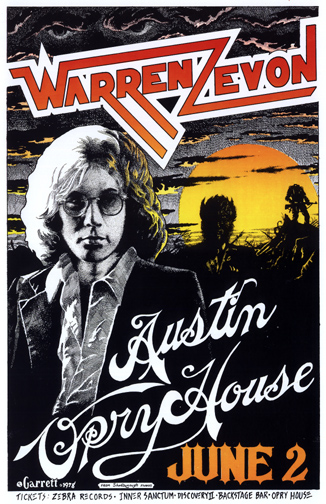
Friday, May 04, 2007

http://www.dannygarrett.com/MusicArt/OtherAustinMusicVenues/images/AUSWarrenZevon2June1978WC.jpg
From Los Angeles Times: www.calendarlive.com

Excitable boy's narcissism, addiction with no regrets

I'll Sleep When I'm Dead
The Dirty Life and Times of Warren Zevon
Crystal Zevon
Ecco: 454 pp., $26.95


By Erik Himmelsbach
Special to The Times

May 4, 2007

IT was the perfect subject for a Warren Zevon song: A down-on-his-luck songwriter gets a terminal cancer diagnosis and turns his death march into a victory trot. But Zevon never got to write it; he ran out of time.

Zevon died in September 2003, from mesothelioma, a form of lung cancer. Diagnosed the year before, he was given just a few months to live but was determined to record a final album and see the birth of his grandchildren (his daughter, Ariel, gave birth to twins in June 2003.) He managed to do both, and in the process lived long enough to enjoy the kind of career validation usually reserved for posthumous box sets. During the final year of his life, Zevon was Dead Man Walking — and the manner in which he turned his impending death into the ultimate marketing opportunity was a diabolical final turn in a truly twisted life.

The son of a Jewish gangster known as "Stumpy," Zevon bounced around the fringes of the L.A. music scene in the '60s and '70s — penning jingles, playing piano in the Everly Brothers' touring band. He had less success with his compositions, but he became a sort of bad-boy id to Laurel Canyon's cowboys and girls — Jackson Browne, Bonnie Raitt, Linda Ronstadt. He countered their touchy-feely introspection with a lyrical sledgehammer.

Touted as "the Dorothy Parker of rock" after his self-titled release for David Geffen's Asylum Records in 1976, Zevon reached a commercial peak two years later with the album "Excitable Boy," which landed in Billboard's top 10 on the strength of the hit single "Werewolves of London." Although his commercial appeal plummeted over the next two decades, Zevon's rock 'n' roll appetite never abated. His life was a blur of booze and broads, of endless club tours to pay the bills, a "comeback" every five years or so hyped by sympathetic writers and an occasional glory bask with David Letterman, who remained a loyal champion to the end.

By the late 1990s Zevon was just a guy whose résumé included a singular moment or two, which granted him infinite access to periphery of the business. Then came the diagnosis: Suddenly, 55-year-old Warren Zevon was hot, sexy, and had just months to live.

At last, Zevon had his angle. He spoke to the press, allowed a VH1 camera crew to film his last months and began a final album. "The Wind," released in August 2003, became his biggest seller in two decades and featured famous friends like Bruce Springsteen and Browne paying their final respects. His son, Jordan, remembers his father saying: " 'Okay, I'm going to die but I'm not going to go out John Prine-style with the record that sells ten thousand copies.' He knew what he was doing."

Zevon probably would've appreciated the sometimes disconcerting candor with which friends, family, lovers, acquaintances and, most damningly, Zevon's own diaries, unpeel the complicated layers of the songwriter's life in "I'll Sleep When I'm Dead." Crystal Zevon penned the no-holds-barred oral history at the request of her ex-husband during one of their final conversations. The book reveals a smartass satirist whose inner core was as bankrupt as the characters he documented in his songs. That Zevon was a songwriter held in the highest esteem by peers cannot mask his inability to connect with others on a basic emotional level. "Nobody with a decent circle of friends could have gotten away with what my dad got away with," his son said. "But he did get away with it because he was him."

He was a difficult guy to root for. According to the testimonials of the scores who knew him, he was a gifted artist who destroyed everything in its wake, leaving miles of scorched earth and emotional debris in the rearview mirror. He had the requisite demons — alcoholism, sex addiction, obsessive-compulsive disorder. He could be brutally abusive, both physically and emotionally. In the 1980s when he and Crystal divorced and when he got off booze, his addiction to sex became that much more pronounced. Though he had trysts with the likes of Eleanor Mondale and songwriter Karla Bonoff, he preferred strings-free sexual romps.

Zevon's diaries serve to painfully reinforce others' points of view. So it comes as no surprise when, on his deathbed, he asks his son to safekeep his collection of homemade porn tapes he'd shot with various partners.

Zevon was a strict adherent to the rock star rulebook: He was a classic narcissist of the no apologies, no regrets school. And the story gets ugly, but Crystal Zevon embellishes the darkness with enough Zevonian gonzoness as a reminder why so many were so fond of him: getting married in Vegas while on LSD; shooting cockroaches in his home with a .45; palling with Hunter Thompson, Ross Macdonald and Thomas McGuane.

Even Zevon may have believed he was larger than life. But in spite of the in-character bravado he exhibited when faced with death, he was as scared as any of us would be. He broke 17 years of sobriety, sometimes concocting cocktails of liquid morphine and scotch.

In spite of his last-gasp of self-destruction, he was stubborn enough to hold his grandkids and finish his final sonic statement. Zevon was an excitable boy to the very end — summing it up nicely to his friend, author Carl Hiaasen: "I got to be Jim Morrison a lot longer than he did." This book chronicles a debauched rock 'n' roll life, simultaneously puncturing through Zevon's self-created mythology while enhancing his legend in the process.

Erik Himmelsbach, a writer and TV producer, is at work on a book about the radio station KROQ-FM (106.7) and the alternative-culture revolution.
http://static.rateyourmusic.com/album_images/s27005.jpg
From Los Angeles Times: www.calendarlive.com:
Crystal Zevon's story: Warren from A to Z

Through interviews and diaries, the musician's ex-wife
chronicles the hedonistic life of one of the genre's bad boys.

By Fred Schruers
Special to The Times


May 4, 2007

In August 1980, Warren Zevon, onstage at the Roxy on Sunset Boulevard, sat down at the piano and introduced his song, "Hasten Down the Wind," which had been covered by Linda Ronstadt on a platinum-selling 1976 album.

"This is the song that intervened between me and starvation," he told the crowd.

This night found Zevon fairly fresh out of a rehab stint and grateful in a larger sense: "As someone who abused the privilege for a long time, I'd like to say, it's good to be alive."

Zevon, who had strained a nerve in rehearsal, was on painkillers and steroids, and the rebirth he cited that night would soon give way to half a decade of heavy boozing and drug abuse that finally yielded in 1986 to a rededication to sobriety. That resolve would last 17 years — until, in a small tragedy engulfed by the larger tragedy of his slow decline from lung cancer, he temporarily succumbed to drugging and boozing again.

"It was very painful," recalled former wife Crystal Zevon of that spell leading to his death on Sept. 7, 2003. "Because we lost that time with him."

One thing that can definitively be said of Crystal Zevon, whose new memoir "I'll Sleep When I'm Dead: The Dirty Life and Times of Warren Zevon" is that she's forgiving. Now living near her (and Warren's) daughter, Ariel, in central Vermont, two decades after the breakup that helped send her and Ariel spiraling through years of addictive behavior, she's touring the country to promote the book, which came out this week. It's a compulsively readable oral history composed of brief narrative blocks, a wealth of personal anecdotes from her husband's friends, lovers (including his first wife, Marilyn "Tule" Livingston), and collaborators, and most importantly, Zevon's journals.

Going through his microscopic daily notations, she noted in a recent interview, "There were many times where I said, 'I can't do this, I don't want to read another word, let alone put us all out for public consumption.' Then I'd run across some great line or the moment when a song trigger came to him, and I'd say, 'The story has got to be told.'

"As I say in the acknowledgements, I fell in and out of love a lot of times."

A life on tape

Released simultaneously with the book is a two-CD set (from the small-label Ammal, headed by Zevon's late-career benefactor Danny Goldberg), which has been compiled from carelessly stashed recordings by Zevon's son with Tule, musician Jordan Zevon, 38. It's clear from these 16 tracks, mostly demos of well-known songs, that the performer's classical music grounding made him a deft arranger of his compositions — and also clear, as he growls his way through, that his producers must have worked hard to get some more tuneful barking and crooning out of him for the finished records. (Three of those LPs, never available on CD, were recently released by Rhino in expanded, remastered editions.)

Goldberg believed in the worth of exhuming Jordan's pick of about 150 tracks that Zevon left behind and compares him to John Lennon and Bob Dylan: "I think you could count on the fingers of one hand those songwriters that created an original, distinctive, long lasting and important body of work as Warren," Goldberg said.

Jordan Zevon, who's become an activist against his father's form of lung cancer (mesothelioma, blamed on asbestos), was careful to wear a mask when he delved into the storage areas. Amid old boxes of .45-caliber ammo and T-shirts and cassettes ("Dad would shed a skin every few years, and it was all in there"), he found the real trove in the form of "a floppy, green vinyl suitcase, very 'Death of Salesman,' full of reel-to-reel tapes."

Perhaps most intriguing is the demo of the mournful East L.A. ballad "Carmelita," an emotional rendition in which we hear the original line, "Well I pawned my Smith & Wesson, and I went to meet my man," which was later to be replaced by the much more writerly — in the most literal sense — "… pawned my Smith-Corona."

The accompanying 36-minute interview disk, done circa 2000, displays Zevon's eloquence in answering even pro forma questions. As Goldberg says in the album notes, Zevon "combined sensitivity, intellectual acuity, macho sarcasm, wit, crudeness and aggression. He was the tough guy who wore his heart on his sleeve."

From that same nest of contradictions came Zevon's valedictory body of work, both in his final album, "The Wind," and in earlier work, like the 2000 "Life'll Kill Ya" album, which seems eerily predictive of his fate.

Troubled childhood


But to read Crystal Zevon's unstinting compilation is to swing between admiring and abominating the man. He could be "cruel for cruelty's sake" (as confessed in "The Sin") and during blackout drunks was physically abusive toward Crystal. His itinerant parents' early divorce made Zevon's childhood troubled. When his dad, a Russian-immigrant gangster from Brooklyn, asked him to help with a letter, he "wept with joy." Yet when Jordan, then 8, was ushered into his presence for a rare get-together before a major gig at the Hollywood Bowl, Zevon had little to say.

Jordan finds that forgivable: "Yeah, he's not playing catch with me in the park, but I knew his position in the world — sitting among so many thousands of people as the center point. I never harbored the bitterness, and he ended up being one of my best friends."

"You know, he had a pretty rough beginning," Crystal said. "I think he always suffered. He would angrily reference that, but he took responsibility. I don't think he believed it was a justification."

Ultimately, the dying Zevon pulled out of his binge. His determination to leave a recorded legacy was greatly aided by pals like Billy Bob Thornton, Dwight Yoakam, Bruce Springsteen and his two most indispensable, career-long collaborators, bassist and co-writer Jorge Calderon and singer-songwriter Jackson Browne. Calderon took recording gear to the failing singer's home to get the affecting "Keep Me in Your Heart." Goldberg bankrolled the sessions and was rewarded with a gold record, which Zevon lived to see enter the charts. He also lived to see Ariel's grandsons born.

"He made this decision that the best spiritual connection to this life was to make that album and leave whatever legacy he could in music," Crystal said. "But then when it was all over he kind of let that go, and he really sobered up and he looked at the relationships in his life. He turned to his family and was really there and present."

It was just days before he breathed his last that Zevon reaffirmed to Crystal, "You gotta tell the whole truth, even the awful ugly parts," whereupon "I said, 'Warren, I don't know what the whole truth is.' And he laughed and said, 'You'll find out.' "


From NoMaas.org:
05.03.2007

Seriously, please fire Joe Torre

The longer Joe Torre is kept around, the more damage he is doing to this pitching staff. He is a truly horrible manager. He needs to be removed immediately as he is jeopardizing the health and effectiveness of the bullpen.

Who in their right mind removes Mike Mussina after allowing 1 run through 5 innings on 64 pitches?!?!? 64 pitches!

And then, Four RingsTM uses 5 relievers to finish off the game. From the 6th inning on, Torre brings in Bruney, Henn, Proctor, Farnsworth, and Rivera.

Are you kidding? Six total pitchers in a game in which the Yankees allow 2 runs?!?

How can anyone defend this guy? This insanity needs to be stopped. He's killing the bullpen.

Thursday, May 03, 2007

From Libertas:

Reagan’s Hollywood Ending

— Fedora @ 3:50 pm

According to the late Secretary of Defense Clark Clifford, Ronald Reagan was an “amiable dunce.”

When Clifford, one of the Democratic Party’s “wise men,” made that remark early in Reagan’s presidency, it was taken seriously in certain circles because Clifford was, according to powerbroker Robert Strauss, “the wisest man in the room by two to one.” After all, Clifford had advised every Democratic president since Harry S Truman. And Clifford’s genius was supposedly versatile. He was deemed so astute that he reportedly “even redesigned the presidential seal.”

History, however, has a curious way of revealing the truth. A little more than a decade after his comment on Reagan, Clifford’s reputation was in tatters. There was the stench from Lyndon Baines Johnson, plus a banking scandal in which Clifford was indicted on fraud and bribery charges. (Because Clifford had become so frail, those charges were later dropped.) “I have a choice of either seeming stupid or venal,” is how he is quoted in one of his final interviews. The invitations for Clifford to hold court in Georgetown salons stopped coming.

And, today, here is what is being said about the man Clifford quipped was stupid: “It’s not historical hyperbole to note that the most profound achievements of the Reagan administration changed the world. When Reagan took office, the Soviet Union expected war imminently. By the time he left the White House, the threat of nuclear war was reduced to a memory, as the Cold War was fast coming to a close.” Those aren’t the words of a press release from the Heritage Foundation or conservative commentator Dinesh D’Souza. Instead, they come from historian Douglas Brinkley, editor of The Reagan Diaries, to be published later this month by HarperCollins.

According to Brinkley, “Reagan’s diaries—five 8-by-11 hardback books bound in maroon leather and embossed on the front with the presidential seal—resemble a handsome half-set of an encyclopedia.” Excerpts from them are here on the Vanity Fair website.

This is the entry Reagan wrote after John Hinckley tried to kill him in 1981:

Mon. March 30 [written Sat. April 11] • My day to address the Bldg. & Const. Trades Nat. Conf. A.F.L.-C.I.O. at the Hilton Ballroom—2 p.m. Was all dressed to go & for some reason at the last min. took off my really good wrist watch & wore an older one.

Speech not riotously received—still it was successful.

Left the hotel at the usual side entrance and headed for the car—suddenly there was a burst of gun fire from the left. S.S. Agent pushed me onto the floor of the car & jumped on top. I felt a blow in my upper back that was unbelievably painful. I was sure he’d broken my rib. The car took off. I sat up on the edge of the seat almost paralyzed by pain. Then I began coughing up blood which made both of us think—yes I had a broken rib & it had punctured a lung. He switched orders from W.H. to Geo. Wash. U. Hosp.

By the time we arrived I was having great trouble getting enough air. We did not know that Tim McCarthy (S.S.) had been shot in the chest, Jim Brady in the head & a policeman Tom Delahanty in the neck.

I walked into the emergency room and was hoisted onto a cart where I was stripped of my clothes. It was then we learned I’d been shot & had a bullet in my lung.

Getting shot hurts.

Warner Brothers star and Screen Actors Guild president — they were important roles that prepared Reagan for Washington, and he drew on them throughout his presidency. “Although the diaries cover only eight years,” writes Brinkley, “they leave a sense of the full scope of Reagan’s life. For example, there is no sense that he ‘left Hollywood behind.’ Some of the people he respected most were friends from his acting days, and so the likes of James Stewart, Frank Sinatra, Claudette Colbert, Irene Dunne, and George Murphy make regular appearances.”

Last year, several of Reagan’s best films were released on DVD. They showed a forgotten side to the man most remember as the grandfatherly president. And with the publication of the diaries, the scrutiny of Reagan will continue — as the public’s memory of Clark Clifford continues to dim.

Wednesday, May 02, 2007

http://www.coxandforkum.com/archives/04.09.07.NomsdeGuerre-X.gif
Mum Over Stifled Documentary

By Frank J Gaffney Jr.

The Washington Times | May 2, 2007

Since September 11, 2001, many of us have wondered: Where are the moderate Muslims? If they are out there, why are we not hearing more, and getting more help, from them in the fight against our common foe -- the totalitarian Islamists?

In recent weeks in this space, I have chronicled the saga of an effort to answer that question. It took the form of a 52-minute documentary I helped produce for the Corporation for Public Broadcasting's "America at a Crossroads" series. The film, entitled "Islam vs. Islamists: Voices from the Muslim Center," features compelling stories of anti-Islamist Muslims who have had the courage to stand up to co-religionists who are using faith to accomplish political ends.

The documentary makes clear why the moderates are not more in evidence. Observant Muslims who dare to challenge the Islamists over ideological agendas pursued in the name of religion are shown being subjected to ostracism, intense coercion to conform and, in some cases, death threats. As long as these anti-Islamist Muslims are rightly seen as isolated, vulnerable and powerless, it would be foolish to believe that many of their co-religionists will want to emulate them.

Such a conclusion is especially likely to the extent that fence-sitting moderate Muslims perceive those repressing the anti-Islamists to be what Osama bin Laden calls "the strong horse." The success of organizations supportive of the Islamists and of their efforts to exploit real or perceived Muslim grievances and civil liberties to create "parallel societies" in Western democracies will, inevitably, attract more adherents to the former's ranks.

Unfortunately, what has happened to "Islam vs. Islamists" can only compound this perception. The Public Broadcasting Service (PBS) and its Washington flagship station, WETA, refused to air this film. While a number of explanations have been given for that decision -- including demonstrably false claims that the documentary was not submitted on time, was too long, was unfinished, the officially stated reason is that it was: "flawed by incomplete storytelling, a limited focus that does not adequately corroborate the film's conclusions, and a general lack of attention to the obligation of fairness, which requires that viewers have access to additional context and relevant information about a complex subject."

In other words, PBS/WETA judged our film to be "unfair" to the "conservative imams" and fellow Islamists shown denouncing, threatening and, in one case, proposing to murder the moderate Muslims we profile. Unless our production team, which included a number of world-class journalists, agreed to change not the "storytelling" but the story, "Islam vs. Islamists" was going to be suppressed.

Interestingly, PBS and WETA were untroubled by the manifest lack of fairness in a film on much the same subject entitled "The Muslim Americans," produced by Crossroads series host Robert MacNeil. This documentary amounted to a love letter to the Islamists and like-minded organizations in America. It helped legitimate a number of their most prominent spokesmen and agendas, in the process virtually ignoring easily ascertained records of troubling statements, behavior and/or affiliations.

It is bad enough that the public airwaves were used to disseminate only one rendering of the state of Islam in the West -- and a highly misleading one, at that. The process whereby the voices of anti-Islamist Muslims were silenced by PBS and WETA was also characterized by egregious behavior, some of which would typically evoke howls of outrage from American liberals.

These included: attempts to blacklist producers on political grounds; outlandish conflicts of interest (notably, Mr. MacNeil's self-dealing and his film's featuring of two Islamist-sympathizing Muslim "advisers" recruited by WETA to help determine which documentaries were aired); and one of those advisers' unauthorized preview of a "rough-cut" version for representatives the Nation of Islam, a subject of the film -- in clear violation of the most basic tenets of journalistic ethics.

The question occurs: Where are the liberal non-Muslims in the controversy over "Islam vs. Islamists"? They have at least as much on the line as the rest of us in the outcome of this struggle for the soul and future character of Islam.

After all, the anti-Islamist Muslims and conservatives are not the only ones in the Islamofascists' cross hairs. Homosexuals, women and Jews are among those whose lives will be made miserable, or simply be prematurely terminated, in the new world order the Islamists have in mind. Blacks are still being sold into slavery in Islamist nations. And, to date, the Islamists have been responsible for killing more of their fellow Muslims than any other population, not just in Darfur but around the world.

Yet, as of this writing, Sen. Joe Lieberman, Connecticut Democrat, and Rep. Brad Sherman, California Democrat, have been the only examples of individuals with strong liberal credentials who have publicly urged that the American people be allowed to view "Islam vs. Islamists." They understand the stakes if the voices of the anti-Islamists are suppressed and, worse yet, if those of their repressors continue to be amplified.

The struggle over a documentary designed to do the former is a microcosm of the larger struggle for the future of Islam and the war for the free world. None of us can afford to be AWOL in these fights.

Click Here to support Frontpagemag.com.


Frank J. Gaffney, Jr. is the founder, president, and CEO of The Center for Security Policy. During the Reagan administration, Gaffney was the Assistant Secretary of Defense for International Security, the Deputy Assistant Secretary of Defense for Nuclear Forces and Arms Control Policy, and a Professional Staff Member on the Senate Armed Services Committee, chaired by Senator John Tower (R-Texas). He is a columnist for The Washington Times, Jewish World Review, and Townhall.com and has also contributed to The Wall Street Journal, USA Today, The New Republic, The Washington Post, The New York Times, The Christian Science Monitor, The Los Angeles Times, and Newsday.
From Town Hall.com via Hugh Hewitt:
Why Do I Mock John Edwards?
Posted by Dean Barnett | 3:53 PM

Every time I write a piece mocking John Edwards, I get a few letters from my liberal readers saying, “Such things are beneath you.” They try to butter me up by saying I’m such a high quality thinker I shouldn’t stoop to such depths. But I’m on to their game. I know they’re just trying to play on my well-known massive ego.

Besides, I’m not above such things. Regrettably, I’ve always been cursed by a fondness for the puerile. On Friday, a dear old friend from childhood and I spoke for the first time in years and the conversation quickly turned to our junior high school antics. We both agreed that our crank calls of the time were seminal comic masterpieces.

As regards Edwards, how can a political commentator, be he a serious one or not, refrain from mocking this man? He’s a walking, talking, hair-combing parody. His whole shtick is that he’s the humble son of a mill-worker, when in fact he’s neither humble nor the son of a mill-worker. He desperately tries to play like he’s one of us, “us” being the American oppressed who just can’t buy a break. He then goes and builds himself a 28,000 square foot house, gets himself $400 haircuts, and does yoga with hip-hop mogul Russell Simmons. Doing yoga alone would estrange him from the people that he’s trying to con into believing he’s a Joe Six-Pack who just got lucky. But doing yoga with a hip-hop mogul? Words fail me.

Now, let’s be clear – I don’t begrudge him these indulgences, although I do consider a $400 haircut to be a tad on the foppish side and I prefer men who retain their physiques by pumping iron rather than twisting themselves into pretzels in the company of hip-hop moguls. But who am I to point fingers? If I had Edwards funds, I would lavish extraordinary fortunes on my golf game, red wine and prime beef. While I wouldn’t build a 28,000 square foot home, I would construct a home entertainment center that, I promise you, would be nothing short of bitchin’.

Besides, in my defense, with Edwards there’s just so much to mock, he’s an irresistible target. He’s a man who got into politics in 1996 with the specific aim of becoming president. He decided that the time honored Huey Long class warfare path was the best route to take. Now, a man whose mind was flexible enough to do a sort of mental yoga would conclude that running a “war on poverty” in a country with an unemployment rate knocking on the door of 4% was a lousy idea and shift gears. But Edwards keeps plodding ahead.

And then there’s the fact that his notion of modern poverty is so antiquated and outdated. For four years now, he’s been spotting shivering, starving children. But in America, we are fortunately not beset with a plague of hunger. A much bigger problem in our underclass is juvenile obesity. But it would be tough to reconcile that fact with Edwards’ ludicrous narrative of Dickensian poverty gripping the land.

JOHN EDWARDS MAY BE IN MANY WAYS A FINE MAN. He certainly seems like a good husband, and I deeply admire the way he hasn’t tried to make political hay out of his teenage son’s death. If you compare Edwards’ behavior in that regard to the way Al Gore dealt with his sister’s death, there alone is reason to believe that Edwards is the far better of the two men.

One of my thoughtful liberal readers (you may know him as commenter JohnCar), suggested I link to this YouTube where Edwards addresses the far more famous YouTube where he fusses with his hair for two minutes while “I Feel Pretty” plays in the background. Some might find the rebutting YouTube to be sympathetic. I wouldn’t say it hit me that way, but I will say that it was an undeniable tour de force by a talented politician at the top of his game.

So, to return to our original question, why do I make fun of John Edwards? First, because he is a gifted politician who could offer our system a lot more than divisiveness and demagoguery if he so chose. And second, because Candidate John Edwards is an utter and embarrassingly transparent phony. Even Edwards doesn’t believe his own message. If he really thought income disparity was an all-important issue, he would tamp down his own excesses. If he really cared about modern American poverty, he would get to know it and familiarize himself with it, rather than insistently peddle his idiotic Dickensian narrative of starving chimney sweeps and limping Tiny Tims.

So the short answer to why I make fun of John Edwards? Because he can do better. But chooses not to.

Tuesday, May 01, 2007

http://www.republicanvoices.org/tsunami.JPG
"The Alien In Hokie Nation"
Buchanan On The Dark Side of Diversity

(Hat Tip To VDARE.COM!)

By Patrick J. Buchanan

Since the massacre of 32 students and teachers at Virginia Tech, the mainstream media have obsessed over the fact the crazed gunman was able to buy a Glock in the state of Virginia.

Little attention has been paid to the Richmond legislators who voted to make "Hokie Nation," a Middle American campus of 26,000 kids, a gun-free zone where only the madman had a semi-automatic.

Almost no attention has been paid to the fact that Cho Seung-Hui was not an American at all, but an immigrant, an alien. Had this deranged young man who secretly hated us never come here, 32 people would heading home from Blacksburg for summer vacation.

What was Cho doing here? How did he get in?

Cho was among the 864,000 Koreans here as a result of the Immigration Act of 1965, which threw the nation's doors open to the greatest invasion in history, an invasion opposed by a majority of our people. Thirty-six million, almost all from countries whose peoples have never fully assimilated in any Western country, now live in our midst.

Cho was one of them.

In stories about him, we learn he had no friends, rarely spoke, and was a loner, isolated from classmates and roommates. Cho was the alien in Hokie Nation. And to vent his rage at those with whom he could not communicate, he decided to kill in cold blood dozens of us.

What happened in Blacksburg cannot be divorced from what's been happening to America since the immigration act brought tens of millions of strangers to these shores, even as the old bonds of national community began to disintegrate and dissolve in the social revolutions of the 1960s.

To intellectuals, what makes America a nation is ideas—ideas in the Declaration of Independence, Bill of Rights, Gettysburg Address and Dr. King's "I Have a Dream" speech.

But documents no matter how eloquent and words no matter how lovely do not a nation make. Before 1970, we were a people, a community, a country. Students would have said aloud of Cho: "Who is this guy? What's the matter with him?"

Teachers would have taken action to get him help—or get him out.

Since the 1960s, we have become alienated from one another even as millions of strangers arrive every year. And as Americans no longer share the old ties of history, heritage, faith, language, tradition, culture, music, myth or morality, how can immigrants share those ties?

Many immigrants do not assimilate. Many do not wish to. They seek community in their separate subdivisions of our multicultural, multiracial, multiethnic, multilingual mammoth mall of a nation. And in numbers higher than our native born, some are going berserk here.

The 1993 bombers of the World Trade Center and the killers of 9-11 were all immigrants or illegals. Colin Ferguson, the Jamaican who massacred six and wounded 19 in an anti-white shooting spree on the Long Island Railroad, was an illegal. John Lee Malvo, the Beltway Sniper, was flotsam from the Caribbean.

Angel Resendez, the border-jumping rapist who killed at least nine women, was an illegal alien. Julio Gonzalez, who burned down the Happy Land social club in New York, killing 87, arrived in the Mariel boatlift.

Ali Hassan Abu Kamal, who wounded seven, killing one, in a rampage on the observation deck of the Empire State Building, was a Palestinian. As was Sirhan Sirhan, the assassin of Robert Kennedy.

The rifleman who murdered two CIA employees at the McLean, Va., headquarters was a Pakistani. When Chai Vang, a Hmong, was told by a party of Wisconsin hunters to vacate their deer stand, he shot six to death. Peter Odighizuwa, the gunman who killed the dean, a teacher and a student at the Appalachian School of Law, was a Nigerian.

Hesham Hadayet, who shot up the El Al counter at LAX, killing two and wounding four, was an Egyptian immigrant. Gamil al-Batouti, the copilot who yelled, "I put my faith in Allah's hands," as he crashed his plane into the Atlantic after departing JFK Airport, killing 217, was an Egyptian.

Mohammed Reza Taheri-azar, the UNC graduate who ran his SUV over nine people on Chapel Hill campus and said he was "thankful for the opportunity to spread the will of Allah," was an Iranian.

Juan Corona, who murdered 25 people in California to be ranked with the likes of Ted Bundy and John Wayne Gacy, was a Mexican.

Where does one find such facts? On VDARE.com, a Website that covers the dark side of diversity covered up by a politically correct media, which seem to believe it is socially unhealthy for us Americans to see any correlation at all between mass migrations and mass murder.

"In our diversity is our strength!" So we are endlessly lectured.

But are we really a better, safer, freer, happier, more united and caring country than we were before, against our will, we became what Theodore Roosevelt called "a polyglot boarding house for the world."

Patrick J. Buchanan needs no introduction to VDARE.COM readers; his book State of Emergency: The Third World Invasion and Conquest of America, can be ordered from Amazon.com.


Monday, April 30, 2007

http://static.firedoglake.com/2006/12/sadunclesam.jpg
From National Review:
The Waning of the GOP
By William F. Buckley Jr.


The political problem of the Bush administration is grave, possibly beyond the point of rescue. The opinion polls are savagely decisive on the Iraq question. About 60 percent of Americans wish the war ended — wish at least a timetable for orderly withdrawal. What is going on in Congress is in the nature of accompaniment. The vote in Congress is simply another salient in the war against war in Iraq. Republican forces, with a couple of exceptions, held fast against the Democrats’ attempt to force Bush out of Iraq even if it required fiddling with the Constitution. President Bush will of course veto the bill, but its impact is critically important in the consolidation of public opinion. It can now accurately be said that the legislature, which writes the people’s laws, opposes the war.

Meanwhile, George Tenet, former head of the CIA, has just published a book which seems to demonstrate that there was one part ignorance, one part bullheadedness, in the high-level discussions before war became policy. Mr. Tenet at least appears to demonstrate that there was nothing in the nature of a genuine debate on the question. What he succeeded in doing was aborting a speech by Vice President Cheney which alleged a Saddam/al Qaeda relationship which had not in fact been established.

It isn’t that Tenet now doubts the lethality of the terrorists. What he disputed was an organizational connection which argued for war against Iraq as if Iraq were a vassal state of al Qaeda. A measure of George Tenet’s respect for the reach and malevolence of the enemy is his statement that he is puzzled that Al Qaeda has not, since 2001, sent out “suicide bombers to cause chaos in a half dozen American shopping malls on any given day.” By way of prophecy, he writes that there is one thing he feels in his gut, which is that “Al Qaeda is here and waiting.”

But beyond affirming executive supremacy in matters of war, what is George Bush going to do? It is simply untrue that we are making decisive progress in Iraq. The indicators rise and fall from day to day, week to week, month to month. In South Vietnam there was an organized enemy. There is clearly organization in the strikes by the terrorists against our forces and against the civil government in Iraq, but whereas in Vietnam we had Hanoi as the operative headquarters of the enemy, we have no equivalent of that in Iraq, and that is a matter of paralyzing importance. All those bombings, explosions, assassinations: we are driven to believe that they are, so to speak, spontaneous.

When the Romans were challenged by Christianity, Rome fell. The generation of Christians moved by their faith overwhelmed the regimented reserves of the Roman state. It was four years ago that Mr. Cheney first observed that there was a real fear that each fallen terrorist leads to the materialization of another terrorist. What can a “surge,” of the kind we are now relying upon, do to cope with endemic disease? The parallel even comes to mind of the eventual collapse of Prohibition, because there wasn’t any way the government could neutralize the appetite for alcohol, or the resourcefulness of the freeman in acquiring it.

General Petraeus is a wonderfully commanding figure. But if the enemy is in the nature of a disease, he cannot win against it. Students of politics ask then the derivative question: How can the Republican party, headed by a president determined on a war he can’t see an end to, attract the support of a majority of the voters? General Petraeus, in his Pentagon briefing on April 26, reported persuasively that there has been progress, but cautioned, “I want to be very clear that there is vastly more work to be done across the board and in many areas, and again I note that we are really just getting started with the new effort.”

The general makes it a point to steer away from the political implications of the struggle, but this cannot be done in the wider arena. There are grounds for wondering whether the Republican party will survive this dilemma.

© 2007 Universal Press Syndicate

From The London Times Online:
Watergate reporter demolishes Hillary’s career story
Sarah Baxter, Washington


Drawing on a trove of private papers from Hillary Clinton’s best friend, the legendary Watergate journalist Carl Bernstein is to publish a hard-hitting and intimate portrait of the 2008 presidential candidate, which will reveal a number of “discrepancies” in her official story.

Bernstein, who was played by Dustin Hoffman in the film All the President’s Men, has spent eight years researching the unauthorised 640-page biography, A Woman in Charge: The Life of Hillary Rodham Clinton.

“Bernstein reaches conclusions that stand in opposition to what Senator Clinton has said in the past and has written in the past,” said Paul Bogaards, a spokesman for Knopf, which publishes the book on June 19.

With the thoroughness for which he is famous, Bernstein spoke to more than 200 of Clinton’s friends, colleagues and adversaries. He stops short of accusing the New York senator of blatantly lying about her past, but has unearthed examples of where she has played fast and loose with the facts about her “personal and political life”, according to Knopf.

The book could revive the explosive charge, made earlier this year by David Geffen, a former Clinton donor and Hollywood mogul, that “the Clintons lie with such ease, it’s troubling”.

Clinton remains the frontrun-ner for the Democratic presidential nomination, but Barack Obama, who is keeping pace with her fundraising juggernaut, is closing the gap in the polls.

The Sunday Times has learnt that Bernstein has been given unprecedented access to the private papers of Diane Blair, Clinton’s closest friend and confidante, who died of lung cancer aged 61 in 2000. The collection is still being sorted at the University of Arkansas library and is not yet available to the public.

Bernstein has been delving through Blair’s copious records of the 1992 presidential election campaign, which could offer tantalising insight into Bill Clinton’s war machine and Hillary’s reaction to news of her husband’s dalliance with the nightclub singer Gennifer Flowers in Arkansas.

Hillary denied all knowledge of the affair, but one writer who has followed her career closely said: “She always knew about her.” He added: “Anyone who has approached the subject of Hillary Clinton with a clear eye will run across many examples of stories that are not true.”

Blair, a professor of political science, crisscrossed the country with the Clintons in 1992, serving as a senior adviser and semiofficial historian of the campaign. She became friends with Hillary in the political backwater of Little Rock, Arkansas, in the 1970s, when the two East Coast-educated power women sought each other out as soulmates.

Hillary went on to serve as “best person” at her friend’s marriage to Jim Blair, who had a walk-on part in the scandals of the Clinton White House when it emerged he had helped the former first lady make $100,000 in cattle futures.

Joe Klein, the bestselling author of Primary Colors, recounted how Blair once witnessed a blazing row between Bill and Hillary Clinton. “They were really, really angry with each other,” she told him. “And then suddenly, the president took her in his arms and began kissing her all over her face and he said, ‘God, what would I do without you?’ I felt kind of embarrassed being there.”

When Blair was diagnosed with lung cancer, Clinton was running for the Senate in New York. In her memoir, Living History, she writes about seeing her friend for the last time in an Arkansas hospice. “She pressed my hand tightly and whispered to me, ‘Don’t ever give up on yourself and what you believe in. Take care of Bill and Chelsea. They need you. And win this election for me’.”

Bernstein is known as a liberal Democrat who fiercely opposes the war in Iraq and is likely to be critical of Clinton’s Senate vote to authorise the war. His marriage to Nora Ephron, the screen-writer, broke up when he had an affair with Baroness Jay, the daughter of former prime minister James Callaghan.

For years Bernstein suffered from writer’s block, but Knopf is promoting his biography as a triumphant return to form. Publisher Sonny Mehta said his portrait would “show us, for the first time, the true trajectory of Hillary Clinton’s life and career”. It will be published simultaneously in Britain by Hutchinson.

According to the publishers, it will cover everything from Clinton’s “complex relationship with her disciplinarian father” to “her courtship with Bill Clinton and the amazing dynamic of their marriage, during the most trying of circumstances”.

Clinton’s relationship with the truth has frequently come under scrutiny. William Safire, a conservative columnist in The New York Times, provoked a storm in the 1990s when he accused the first lady of being a “congenital liar”. Bill Clinton let it be known that if he were not president, he would punch Safire on the nose.

While the senator continues to lead Barack Obama, her nearest rival, in the polls - most recently by 36% to 31% in an NBC/Wall St Journal survey - she continues to be dogged by high ratings for “unfavourability”.

She is the most assured Democratic candidate on the campaign trail, as she proved in a televised debate with her rivals for president in South Carolina last week. But while Washington commentators declared her the obvious victor, television viewers in the state put Obama on top, suggesting there remains considerable voter-resistance to her charms.

In an effort to boost her campaign, Clinton said last week that she would appoint her husband ambassador to the world if elected to the White House. “I can’t think of a better cheer-leader for America than Bill Clinton, can you?” she said.

Bernstein’s biography is likely to touch some raw nerves. One writer who has crossed swords with Clinton advises Bernstein to watch his back. “She has the most powerful war machine that has ever been developed and it is led by people who have been to hell and back.”
http://www.whitehouse.gov/news/releases/2003/03/images/20030320_ovalofficemeeting32-1-515h.jpg
From The Washington Post:
Tenet Tries to Shift the Blame. Don't Buy It.
By Michael F. Scheuer


Sunday, April 29, 2007

George Tenet has a story to tell. With his appearance tonight on "60 Minutes" and the publication of his new memoir, "At the Center of the Storm," the former director of central intelligence is out to absolve himself of the failings of 9/11 and Iraq. He'll sell a lot of books, of course, but we shouldn't buy his attempts to let himself off the hook.

My experience with Tenet dates to the late 1980s, when he was the sharp, garrulous, cigar-chomping staff director of the Senate intelligence committee and I was a junior CIA officer who briefed him on covert action programs in Afghanistan. Later, I worked directly for Tenet after he took over the CIA and I became the first chief of the agency's Osama bin Laden unit. We met regularly, often daily. It's impossible to dislike Tenet, who is smart, polite, hard-working, convivial and detail-oriented. But he's also a man who never went from cheerleader to leader.

At a time when clear direction and moral courage were needed, Tenet shifted course to follow the prevailing winds, under President Bill Clinton and then President Bush -- and he provided distraught officers at Langley a shoulder to cry on when his politically expedient tacking sailed the United States into disaster.

At the CIA, Tenet will be remembered for some badly needed morale-building. But he will also be recalled for fudging the central role he played in the decline of America's clandestine service -- the brave field officers who run covert missions that make us all safer. The decline began in the late 1980s, when the impending end of the Cold War meant smaller budgets and fewer hires, and it continued through Sept. 11, 2001. When Tenet and his bungling operations chief, James Pavitt, described this slow-motion disaster in testimony after the terrorist attacks, they tried to blame the clandestine service's weaknesses on congressional cuts. But Tenet had helped preside over every step of the service's decline during three consecutive administrations -- Bush, Clinton, Bush -- in a series of key intelligence jobs for the Senate, the National Security Council and the CIA. Only 9/11, it seems, convinced Tenet of the importance of a large, aggressive clandestine service to U.S. security.

Like self-serving earlier leaks seemingly from Tenet's circle to such reporters as Ron Suskind and Bob Woodward, "At the Center of the Storm" is similarly disingenuous about Tenet's record on al-Qaeda. In "State of Denial," Woodward paints a heroic portrait of the CIA chief warning national security adviser Condoleezza Rice of pending al-Qaeda strikes during the summer of 2001, only to have his warnings ignored. Tenet was indeed worried during the so-called summer of threat, but one wonders why he did not summon the political courage earlier to accuse Rice of negligence, most notably during his testimony under oath before the 9/11 commission.

"I was talking to the national security adviser and the president and the vice president every day," Tenet told the commission during a nationally televised hearing on March 24, 2004. "I certainly didn't get a sense that anybody was not paying attention to what I was doing and what I was briefing and what my concerns were and what we were trying to do." Now a "frustrated" Tenet writes that he held an urgent meeting with Rice on July 10, 2001, to try to get "the full attention of the administration" and "finally get us on track." He can't have it both ways.

But what troubles me most is Tenet's handling of the opportunities that CIA officers gave the Clinton administration to capture or kill bin Laden between May 1998 and May 1999. Each time we had intelligence about bin Laden's whereabouts, Tenet was briefed by senior CIA officers at Langley and by operatives in the field. He would nod and assure his anxious subordinates that he would stress to Clinton and his national security team that the chances of capturing bin Laden were solid and that the intelligence was not going to get better. Later, he would insist that he had kept up his end of the bargain, but that the NSC had decided not to strike.

Since 2001, however, several key Clinton counterterrorism insiders (including NSC staffers Richard A. Clarke, Daniel Benjamin and Steven Simon) have reported that Tenet consistently denigrated the targeting data on bin Laden, causing the president and his team to lose confidence in the hard-won intelligence. "We could never get over the critical hurdle of being able to corroborate Bin Ladin's whereabouts," Tenet now writes. That of course is untrue, but it spared him from ever having to explain the awkward fallout if an attempt to get bin Laden failed. None of this excuses Clinton's disinterest in protecting Americans, but it does show Tenet's easy willingness to play for patsies the CIA officers who risked their lives to garner intelligence and then to undercut their work to avoid censure if an attack went wrong.

To be fair, Tenet and I had differences about how best to act against bin Laden. (In the book, he plays down my recommendations as those of "an analyst not trained in conducting paramilitary operations.") The hard fact remains that each time we acquired actionable intelligence about bin Laden's whereabouts, I argued for preemptive action. By May 1998, after all, al-Qaeda had hit or helped to hit five U.S. targets, and bin Laden had twice declared war on America. I did not -- and do not -- care about collateral casualties in such situations, as most of the nearby civilians would be the families that bin Laden's men had brought to a war zone. But Tenet did care. "You can't kill everyone," he would say. That's an admirable humanitarian concern in the abstract, but it does nothing to protect the United States. Indeed, thousands of American families would not be mourning today had there been more ferocity and less sentimentality among the Clinton team.

Then there's the Iraq war. Tenet is now protesting the use that Rice, Vice President Cheney and other administration officials have made of his notorious pre-war comment that the evidence of Iraq's supposed weapons of mass destruction programs amounted to a "slam dunk" case. But the only real, knowable pre-war slam dunk was that Iraq was going to turn out to be a nightmare.

Tenet now paints himself as a scapegoat for an administration in which there never was "a serious consideration of the implications of a U.S. invasion," insisting that he warned Bush, Cheney and their Cabinet about the risks of occupying Iraq. Well, fine; the CIA repeatedly warned Tenet of the inevitable disaster an Iraq war would cause -- spreading bin Ladenism, spurring a bloody Sunni-Shiite war and lethally destabilizing the region.

But as with Rice and the warnings in the summer of 2001: Now he tells us. At this late date, the Bush-bashing that Tenet's book will inevitably stir up seems designed to rehabilitate Tenet in his first home, the Democratic Party. He seems to blame the war on everyone but Bush (who gave Tenet the Medal of Freedom) and former secretary of state Colin L. Powell (who remains the Democrats' ideal Republican). Tenet's attacks focus instead on the walking dead, politically speaking: the glowering and unpopular Cheney; the hapless Rice; the band of irretrievably discredited bumblers who used to run the Pentagon, Donald H. Rumsfeld, Paul D. Wolfowitz and Douglas J. Feith; their neoconservative acolytes such as Richard Perle; and the die-hard geopolitical fantasists at the Weekly Standard and National Review.

They're all culpable, of course. But Tenet's attempts to shift the blame won't wash. At day's end, his exercise in finger-pointing is designed to disguise the central, tragic fact of his book. Tenet in effect is saying that he knew all too well why the United States should not invade Iraq, that he told his political masters and that he was ignored. But above all, he's saying that he lacked the moral courage to resign and speak out publicly to try to stop our country from striding into what he knew would be an abyss.

Powell has also been blasted for being a good soldier during the march to war rather than quitting in protest. The Bush administration would have been hurt by Powell's resignation, but it might not have stopped the war. But Tenet's resignation would have destroyed the neocons' Iraq house of cards by discrediting the only glue holding it together: the intelligence that "proved" Saddam Hussein guilty of pursuing nuclear weapons and working with al-Qaeda. After all, the compelling briefing that Powell, with Tenet sitting just behind his shoulder, gave the U.N. Security Council in February 2003 could never have been delivered if Tenet had blown the whistle.

Of course, it's good to finally have Tenet's side of the Iraq and 9/11 stories. But whatever his book says, he was not much of a CIA chief. Still, he may have been the ideal CIA leader for Clinton and Bush -- denigrating good intelligence to sate the former's cowardly pacifism and accepting bad intelligence to please the latter's Wilsonian militarism. Sadly but fittingly, "At the Center of the Storm" is likely to remind us that sometimes what lies at the center of a storm is a deafening silence.

Michael F. Scheuer, the founding head
of the CIA's bin Laden unit, is the author
of "Imperial Hubris" and "Through Our Enemies' Eyes."

Sunday, April 29, 2007


From Memphis Commercial Appeal:
New Warren Zevon biography offers
unblinking look at the tortured talent


By Bob Mehr


April 28, 2007

"All good stories," Warren Zevon once observed, "end in death."

As a writer, Zevon knew the value of a big finish. When he passed away in 2003, at 56 from a rare form of cancer, he'd managed to create a finale worthy of one of his best songs -- closing his life and career with a Grammy-winning, gold-selling album, The Wind, and a long, memorable goodbye.

This week, Zevon returns -- in a way. Tuesday will see the publication of an authorized biography penned by his former wife, and a new CD of early material and demos, produced by his son. The two projects, at last, offer a fully rounded picture of a brilliant but troubled man and musician.

First emerging from the mid-'70s Los Angeles rock scene, Zevon was hailed for his finely etched literary style and unique worldview. "He's the first and foremost proponent of song noir," remarked his friend and great champion, Jackson Browne.

"A moralist in cynic's clothing, Zevon nails a part of the American character rarely captured in pop music," offered admirer Bruce Springsteen.

At their best, Zevon's songs combined a macabre, surreal, comic sense with a penchant for tender sentimentality, his lurid intelligence often bulldozing the distinctions between the two.

A classically trained pianist with a rock-and-roll heart, a voracious reader whose tastes ran from Graham Greene to Mickey Spillane, Zevon's music was an utterly unique mix of brains and brawn, high art and low culture.

The popular perception of Zevon during the last decade of his life was that of a faded '70s rock star. It was a view that wasn't quite accurate. He often liked to describe himself as "a folk singer who accidentally had one big hit" and saw the success of 1978's "Werewolves of London" as an aberration in a career that was as commercially frustrating as his work was brilliant.

"He was an artist's artist, a critic's artist, and a cult artist," says Danny Goldberg, president of Zevon's last record label, Artemis. "He was alternative before 'alternative' was a marketing word. It wasn't his destiny to be a pop star. His destiny was to do what he did."

In his heyday, he was, in the words of his friend, the crime novelist Carl Hiaasen, "the infamously dangerous Zevon. The pistol-waving, vodka-soaked, Darvon-addled maniac who locked himself in manacles for the cover of Rolling Stone." It was something of an act, but one fueled by demons that were all too real.

The product of a bizarre childhood and family life, Zevon's nimble mind and fragile psyche were embroiled in a lifelong battle against alcoholism, self-destructiveness and compulsive behavior.

"He truly was a tortured soul," says his ex-wife and biographer, Crystal Zevon. In his final months, Zevon expressed a wish that Crystal, a journalist and media activist, write his life story. "When I agreed to do it, he was dying," she says. "And it's difficult to refuse a dying man's request."

Zevon had implored her not to shy away from exposing the most unflattering aspects of his life, telling her to include "all the ugly awful parts, because that is the guy who wrote all them excitable songs."

Her nearly four-year effort -- during which she conducted close to 90 interviews and pored over dozens of private journals -- has resulted in a remarkable oral history called "I'll Sleep When I'm Dead: The Dirty Life and Times of Warren Zevon." It is, as the title suggests, an unflinching look at an always complex, frequently unpleasant, but ultimately singular figure.

As Crystal writes, Zevon's upbringing had a profound impact on his life and work. His parents were an oddly matched pair: his mother the closely guarded daughter of a strict Mormon family; his father a Ukrainian-born Jew from New York City, nearly twice her age.

His birth had not been an easy proposition. Zevon's mother had a congenital heart condition; she was not supposed to have children because of her health.

"Her family urged her to abort the baby, and she wouldn't do it and she nearly died in childbirth," says Crystal. "As a kid, whenever he would misbehave his grandmother would say, 'You're killing you're mother. She almost died having you.' It was a guilt trip that was laid on him throughout his whole life."

Although his father maintained a number of businesses over the years, his real occupation was as a gambler and gangster; he was close to Chicago Mafiosi Sam Giancana and L.A. mob boss Mickey Cohen, serving as best man at the latter's wedding.

Raised in Illinois, Arizona, and mostly, California, his parents were constantly splitting up and getting back together. Bright and sensitive, Zevon was eager to escape his unpleasant childhood. From an early age he longed for some kind of stardom.

"He was a kid with bad acne, big spaces between his teeth, and thick glasses. He was the kid that other kids laughed at growing up," says Crystal. "But it only made him more determined."

After a decade of scuffling in the L.A. music scene -- as a songwriter, sessioneer and band leader -- Zevon finally found success in the mid-'70s.

But fame only exacerbated Zevon's inner turmoil. His Herculean consumption of vodka, among other substances, was particularly alarming given his fondness for handguns and a tendency toward wild behavior.

But Zevon's alcoholism had a darker impact on Crystal and their newborn daughter, Ariel. Zevon would black out and physically abuse his wife, shoot up the house and not remember any of it the next day.

"Scientifically, when an alcoholic is in a blackout, there is literally no memory," says Crystal, herself a recovering alcoholic. "I didn't know that at the time. So I spent years in resentment, not understanding why he never owned up to the things he did.

"What I lived with Warren still astounds me," she says. "But he gave you moments of such brilliance that they somehow made up for the many more hours of agony that you would go through with him."

Though he eventually got, and stayed, sober for most of the last 16 years of his life, Zevon's behavior grew increasingly odd in later years.

Although he'd always been superstitious, he would become consumed by a serious case of obsessive compulsive disorder and a kind of sexual compulsion, keeping a rotating cast of girlfriends and groupies on hand. "The way his mind worked he was in a kind of perpetual agony," says Crystal, who remained close to him even after their early-'80s divorce. "When he got sober he refused to take any kind of medication that could've cured his OCD or compulsive behavior. He'd get terrible migraine headaches, but he was loath to even take an aspirin."

Throughout the writing of the book Crystal had reservations about painting such an unvarnished portrait of Zevon -- detailing his addictions, infidelities and most intimate moments. "But I felt if I can do something to tell his story, to interest younger generations in his music, then it's worth it."

Meanwhile, Zevon's son, Jordan, has spent the years since his father's death working to ensure his musical legacy.

In 2005, he co-produced a tribute album, Enjoy Every Sandwich, featuring covers of Zevon songs by Bob Dylan, Bruce Springsteen and the Pixies, among others. This past spring, he facilitated the release of three of Zevon's Asylum albums -- Excitable Boy (1978), Stand in the Fire (1980), and The Envoy (1982) -- in expanded remastered editions on Rhino Records.

Jordan has also compiled a selection of unreleased tracks for a disc titled Preludes, due from Danny Goldberg's new Ammal imprint this week.

An insightful collection of odds and sods, it offers a multi-faceted portrait of Zevon, shedding light on his little-heard pop numbers and tracing his evolution as a writer, showcasing early versions of some of his best-known songs. (Jordan will release his own debut album on Ammal later this summer).

Jordan also has been active in the fight against mesothelioma, the asbestos-related cancer that claimed his father. He serves as spokesman for the Asbestos Disease Awareness Organization.

It's not clear how Zevon contracted the disease -- he may have been exposed as a child in his father's carpet store, in his parents' attic, or even through the soundproofing material used in old recording studios.

"That's the scary thing about mesothelioma," says Jordan. "It only takes the briefest exposure, and it can linger in your body for decades. The number of cases is going up each year."

Though Zevon's life was cut short, his friends and family are optimistic that his music can live on. "He believed that whether it's Stravinsky or the Beatles, that most things fade away," says Crystal. "And yet there is something about music, a part of it that is forever. He wanted his songs to last in that way."

--Bob Mehr

LetsPretend.gif


Light bulbs that don't signify ideas
BY MARK STEYN


April 29, 2007

Everything's difficult, isn't it? In the Democratic presidential candidates' debate, Sen. Barack Obama was asked what he personally was doing to save the environment, and replied that his family was "working on" changing their light bulbs.

Is this the new version of the old joke? How many senators does it take to "work on" changing a light bulb? One to propose a bipartisan commission. One to threaten to de-fund the light bulbs. One to demand the impeachment of Bush and Cheney for keeping us all in the dark. One to vote to pull out the first of the light bulbs by fall of this year with a view to getting them all pulled out by the end of 2008.

In 1914, on the eve of the Great War, British Foreign Secretary Sir Edward Grey observed, "The lamps are going out all over Europe. We shall not see them lit again in our lifetime." Whether he was proposing a solution to global warming is unclear. But he would be impressed to hear that nine decades later the lights are going out all over Washington.

This week, both the House and the Senate voted for defeat in Iraq. That's to say, Congress got tired of waiting for deadbeat insurgents to get their act together and inflict devastating military humiliation on U.S. forces. So America's legislators have voted to mandate the certainty of defeat. They want the withdrawal of American forces to begin this October, which is a faintly surreal concept: Watching CNN International around the world, many viewers unversed in America's constitutional arrangements will have been puzzled by the spectacle of a nation giving six months' notice of surrender. But the cannier types in the presidential palaces will have drawn their own conclusions.

For example, as Congress was voting, Vladimir Putin announced that Russia would withdraw from the post-Cold War arrangements of the Conventional Forces in Europe Treaty in protest at American plans to install missile defense systems on the Continent. In the first months of the Bush administration -- pre-9/11 -- this issue was mostly theoretical. European leaders couldn't quite figure out why anyone would need a system to take out incoming nukes but Bush seemed hot for it and, that being so, you might as well be inside the system rather than out.

Six years on, Iran is going nuclear and nobody seems minded to stop them. So a missile defense shield in Eastern Europe is a more practical benefit than it once seemed. In fact, the mullahs are precisely the kind of fellows the system's intended for: small nuclear powers less susceptible to conventional deterrence theory. There might be quite a few of these a decade down the line. Reluctant to find themselves living under a Shia Persian nuclear umbrella, the Sunni Arab dictatorships are said to be pondering whether they might benefit from going the nuke route. The Saudis and Egyptians could certainly afford it very easily.

So what's Putin's game? Well, he leads a country with severe structural defects (a collapsed birth rate for everyone except Russia's Muslims, a depopulating east, disease-ridden menfolk face down in the vodka) but a relatively buoyant economy -- or, to be more precise, kleptocracy. In particular, Western Europe is increasingly dependent on Russia as an energy supplier. Putin calculates that even a weak Kremlin can make mischief for America. The missile-defense interceptors might have been expressly designed for fin-du-civilization Europe: You don't have to do anything, you don't have to attack anyone, you don't have to be beastly and aggressive like the swaggering Texan cowboy. You just have to go about your business and, if anything's heading your way, the Yanks will press a button and blow it to smithereens and send you a confirmatory e-mail afterward. But Putin is putting Continental leaders in the position of having to choose between even this benign defensive technology and relations with Russia. And, given European dispositions, he must surely feel he's got a sporting chance of winning this one. And, if he does, he will in effect be making the world safe for Iranian nuclear blackmail.

Why would he do this? Well, why wouldn't he? As I always say, if you live in Tikrit and Ramadi, the Iraq issue is about Iraq. But, if you live anywhere else on the planet, Iraq is about America. In Tehran, Pyongyang, Khartoum, Caracas, Beijing, Moscow and the South Sandwich Islands, they watch Harry Reid & Co. on the 24/7 cable channels and draw their own conclusions about American will.

The Defeaticrats are being opportunist: They think they can calibrate the precise degree of U.S. defeat in Mesopotamia that will bring victory for them in Ohio and Florida. Contemptible as this is, it wouldn't be possible had the administration not lost the support of many of the American people over this war. The losses are devastating for the individuals' families but they are historically among the lowest in any conflict this nation or any other has fought. So I don't believe the nightly plume of smoke over Baghdad on the evening news explains the national disenchantment. Rather, the mission as framed by the president -- help the Iraqi people build a free and stable Iraq -- is simply not accepted by the American people. On the right, between the unrealpolitik "realists" and the "rubble doesn't cause trouble" isolationists and the hit-'em-harder-faster crowd, the president has fewer and fewer takers for a hunkered-down, defensive, thankless semi-colonial policing operation. Regardless of how it works on the ground, it has limited appeal at home. Meanwhile, the leftists don't accept it because, while they're fond of "causes," they dislike those that require meaningful action: Ask Tibetans about how effective half a century of America's "Free Tibet" campaign has been; or ask Darfuris, assuming you can find one still breathing, how the left's latest fetishization is going from their perspective:

"On Sunday, April 29, Salt Lake Saves Darfur invites the greater Salt Lake community of compassion to join with us as we honor the fallen and suffering Darfuris in a day of films, discussion and dance with a Sudanese dance troupe."

Marvelous. I hope as the "Salt Lake Saves Darfur" campaign intensifies in the decades ahead there'll be enough Darfuris to man the dance troupe. It would be truer to say that the greater Salt Lake community of compassion, like Sen. Obama with his light bulbs, is "working on" saving Darfur.

In Khartoum, Tehran, Moscow and elsewhere, the world's mischief-makers have reached their own conclusions about how much serious "work" America is prepared to do.

©Mark Steyn, 2007