Saturday, May 10, 2008

http://www.bestsportsphotos.com/images/baseball/maddux-greg-atb-2.jpg
From The Washington Post:
A Three-Way Argument For Game's Integrity
By Thomas Boswell

Saturday, May 10, 2008

Eventually, your wins, like your sins, will find you out.

In San Diego tonight, Greg Maddux will try to win his 350th game. Later this year, he may pass Roger Clemens's total of 354. But whether Maddux hits either number, the verdict is in. It arrived in the Mitchell report. The greatest right-handed pitcher since Walter Johnson is no longer the tainted Clemens but the mesmerizing Maddux.

Just as Barry Bonds's 762 homers will always be a smaller number -- arithmetic be damned -- than Hank Aaron's 755, so Maddux already has forever outdistanced Clemens.

Searching for silver linings in a steroid age is hard work. But there are some. Perhaps none is brighter than the realization that Maddux, and two of his former teammates, Tom Glavine and John Smoltz, all of them presumptive Hall of Famers, will now be among those who move up most dramatically as we reevaluate the stars of the past 20 years.

Last summer, Glavine won his 300th game; last month Smoltz got his 3,000th strikeout. Yet, Maddux and Glavine, both 42, and Smoltz, 41 next week, are all staggering to the finish. Glavine just ended his first trip ever to the disabled list and Smoltz is currently on the DL. This will be Maddux's fifth try for No. 350.

"It's coming to an end soon," the Braves' Chipper Jones said. So enjoy and value it.

"We all deserve what we've gotten," Glavine said. "Maybe people will finally pay attention to us. You don't want to be elevated on somebody else's mistakes. That's hard to deal with. I don't know Roger well. But this era is what it is and now you've got the greatest pitcher of our time caught up in it.

"But we have done it right. Hopefully, that will be appreciated more and the three of us will be a better example to kids. Maybe we will be the inspiration that you can run your miles and work in the weight room and still be successful."

"Nothing bad will come out about them," Manager Bobby Cox said of the trio that pitched for him for 11 years. "They won their games on hamburgers."

Presumably. But let's add the disclaimer that now defaces baseball: No player of this generation can be proven innocent. Thanks to Clemens and Bonds, nobody can be declared clean. What we can do is refuse to use their impossible achievements as baseball's proper benchmarks. Their seven Cy Young and most valuable player awards should never again dwarf their peers.

Now, when we look at numbers, the stats can tell us an entirely different story. We discover that, for players such as Maddux, there is circumstantial evidence of honesty.

The season when Clemens was 36, his ERA was 4.60; Maddux's was 2.62. After that, Clemens somehow pitched younger, going 18-4 at 41, then posting a preposterous 1.87 ERA at 42. Now, from baseball's own report, we assume we know part of the reason. Maddux, on the other hand, got old just as players had for the previous century. In his last five full seasons, his ERA has ranged from 3.96 to 4.24, yet he's still averaged 15 wins a year (14-11 in '07). His diminishing fastball has, at times, barely broken 80 mph.

Yet even with the anchor of age, Maddux's career ERA is now 3.12, the same as Clemens's.

"When it comes to the art of pitching, you can't out-think Maddux," Jones said. "He's the best chess player ever. He takes being smart about baseball to a different level."

In Clemens's final seasons, as he changed teams, celebrated multiple retirements, played in the World Series for both the Yanks and his hometown Astros and signed enormous contracts to play fractions of seasons, the man with the Texas-size ego did everything imaginable to attract attention. Like Bonds, he was a glutton for glory. Now, with his shadow greatly diminished, others can step into the light.

"There's never been a better one-two-three on a staff -- ever. The numbers are staggering," Jones says of the trio's 862 wins, plus 154 saves by Smoltz. "When I look back, playing with them will be the good old days."

The three seem to exist for counterpoint. Glavine was homegrown, Smoltz came in trade and Maddux was a free agent. The three even adapted to age differently. Glavine learned a cut fastball to get inside on right-handed hitters, especially after baseball eliminated the "Maddux-Glavine strike" just off the outside corner. Maddux learned to change speeds at even lower speeds, and accepted that he'd never be dominant again. After arm problems, Smoltz went to the bullpen to reduce his innings by 140 a year, then suddenly became the game's best closer, a career cherry-on-top that will presumably put him into Cooperstown. Then, his arm feeling stronger, he went back to starting.

"Smoltz might be a closer again before he's finished," said Cox, whose bullpen has been demolished this season. "You never know."

Though friends and addicted golfers, the three have few personality traits in common. "Smoltz is the most competitive, the best in the playoffs," Jones said. "Glavine is the smart guy, represented the union" in '94.

"The union didn't pick Tommy Glavine out of a hat," Cox said. "He was the chosen one. They got the right one, too. . . . He could take the heat."

As for Maddux, no major star is more camouflaged or enjoys the sly sardonic mischief of anonymity more. Out of uniform, in glasses and a ballcap, Maddux could take tickets and not be recognized. "He's just really, really crazy," Jones said. "No Mad Dog stories for print," Glavine said. "He's so goofy you can't believe it's the same guy who's so studious, a perfectionist, when he pitches. . . . He's Clark Kent and Superman."

Only in the last year, as landmarks have fallen, has it become difficult to imagine that any of the three will be left out of Cooperstown.

"There's more satisfaction now," Glavine said. "It makes some of the tougher days easier to take, because we know where we are going.

"Everything hasn't always gone swimmingly for us. That's the beauty of what we've done. More than once we've all been counted down and out, had to prove people wrong. It's a testament to our pride."

Apparently, a testament to their integrity, as well.

Wednesday, May 07, 2008

http://www.reagan.utexas.edu/archives/photographs/large/c33301-23.jpg
Don't know how I missed this earlier...
A GREAT SPIRIT GONE

by Joe Sobran

September 11 has long been a special date for me,
well before it became 9/11. On September 11, 1972, I
began 21 years of writing for NATIONAL REVIEW in New York
City, my boss being my hero, Bill Buckley, who died the
other day at age 82. (My employment ended unhappily, much
to my regret now, but I rejoice to say we patched things
up a year or so ago.)

I was struck by one thing in the tributes to Bill:
the people who really knew him didn't want to talk about
his achievements as a public figure, great and rare as
these were: they wanted to talk about him, his goodness,
his warmth, the quality his and my friend Hugh Kenner, an
eminent literary critic who measured his words carefully,
once called "saintly."

A few nights before Bill died, I happened to mislay
my rosary, so I counted my prayers on my fingers. I'd
learned to do this from Bill in a casual conversation
many years earlier; he'd learned it as a boy from a
family servant, and it stuck with him the rest of his
life. That was Bill, devout in detail. If you didn't know
this side of him, you didn't really know him.

And if he was your friend, you really had a friend.
One of his old Yale fraternity brothers recalled to me
that when his little girl was dying of brain cancer, Bill
was the only friend who sat with him and shared his
suffering when there was no longer any hope of her
recovery. Such tender, self-wounding charity was typical
of him, and it accounts for much of the deep affection he
inspired.

Of course you can love the man without accepting his
politics, and over the years I decided that Bill's
conservatism conceded too much to the liberal statism he
opposed. I wish, for example, that he had retained his
father's "isolationism," as opposing military
interventionism is still disparagingly called.

Still, in 1965, when he ran for mayor of New York
City, he made what must be the most sublime campaign
promise in modern American history: he pledged to give
every citizen "the internal composure that comes of
knowing there are rational limits to politics." Well,
that would have won him Aristotle's vote.

What delightful company he was! I don't remember a
boring moment in his company in all the years I knew him.
He had a Falstaffian gift for finding fun in every
situation. Once, when a Wisconsin newspaper announced it
was dropping his column and picking up my new one
instead, he sent me the clipping with a note, in his
tiny, barely legible red handwriting, "Joe: Morituri te
salutamus." He was both hilarious and endearing. And
always so encouraging. He made you feel like a genius.

And there was Bill the raconteur, savoring delicious
anecdotes in that rich, resonant cello of a voice. He
took pride in having tricked the peerless Vladimir
Horowitz into giving him a free performance at his home
one evening. How? He had simply disparaged Scriabin,
knowing what this would provoke. And sure enough, the
pianist leaped to the keyboard to refute the slur by
playing a Scriabin piece.

But above all, first and last, Bill was a Catholic,
whose ultimate love was Jesus. His secret benefactions --
they were countless (except for the ones he did me, I had
to learn of them gradually) -- were in keeping with our
Lord's injunction not to let the left hand know what the
right hand is doing. His faith was put to the test in his
last year, when his wife of 57 years died in agony and
his own body was tortured by disease. He displayed what I
didn't expect even of him: the courage of a martyr. But
I'm not really surprised.

The image “http://a.abcnews.com/images/Politics/nm_obama_church_070604_ms.jpg” cannot be displayed, because it contains errors.

From The Corner:

Obama's National Conversation on Religion
Mark Hemingway

Asked about the Rev. Wright on Meet the Press Sunday, Obama again tried to distance himself:

I think that the American people understand that when I joined Trinity United Church of Christ, I was committing not to Pastor Wright, I was committing to a church and I was committing to Christ. And it is a wonderful church. It's a member of the United Church of Christ, a denomination that dates back to the battles around abolition.

The problem here is that trying to separate Wright from the UCC — a church body with a long history of radical politics — is near impossible. As I wrote last week:

While American conservatives have focused resources and talent on highlighting the alleged takeover of academic and political institutions by liberal activists since the 1960s, comparably little attention has been paid to the same development in churches.

[snip]

Jim Naughton, the director of communications for the Washington D.C., Episcopal diocese, claims “[politically liberal church bodies are] dealing with an attack funded by the same donors who have funded the establishment of the Heritage Foundation, the American Enterprise Institute, who fund The American Spectator magazine — the whole sort of intellectual infrastructure of the far right wing in this country has decided to target our mainline churches because it doesn’t like where they stand on social issues, on economic issues and to some extent on theological issues.”

Apparently, Naughton doesn’t pay much attention to the Episcopal Church’s own membership rolls: It’s not just the vast right wing conspiracy that has a problem with the politicization of these churches. It’s the laity that objects, and they’ve been voting with their feet. Nearly every one of these church bodies has been hemorrhaging members for decades now.

Case in point: the United Church of Christ, which has been grabbing headlines as the denomination of Barack Obama and the Rev. Jeremiah Wright, has lost some 40 percent of its membership over the last 40 years. When the Wright scandal broke, the church leadership vigorously defended Wright and his comments on the church's website and elsewhere. Is it any wonder that a church body that would embrace him is unpopular? The scandal with Wright isn't just that his views may represent a particular politician; it’s also that his identity politics and arrogance may reflect those of many denominational leaders.

Indeed, if Obama's trying to pledge his allegiance to the UCC over Wright, from a political standpoint that's not really preferable. Over at the UCC website you can find out why God wants you to protest the FCC over media consolidation, campaign against legislation that mandates employers verify the legal citizenship of employees, prevent social security privatization, participate in an “Economic Justice Young Adult Team Immersion Experience,” decry Wal-Mart's lack of “corporate social responsibility”, and understand that "safe and legal abortion is consistent with a woman’s right to follow the dictates of her own faith" and so on. Oh and let's not forget the time Rabbi Abraham Cooper, associate dean for the Simon Wiesenthal Center, called the UCC “functionally anti-Semitic.”

Now that he's disowned his pastor, I'm looking forward to Obama initiating a national conversation on religion to explain his church.

http://progressivepodcastnetwork.org/PPNBlog/wp-content/uploads/2006/08/bushshiitew.jpg
From The News & Observer:
President without a plan
Rick Martinez

Now that North Carolina has had its say on who will be the next president, it's time for my take on the one currently occupying the Oval Office. No matter what future historians write, I'll always remember George W. Bush as the president who refused to win a war.

When Bush launched the Iraq War in 2003, in no way did I think it would still be a major national concern for his predecessor. Had I known that U.S. forces would be fighting more than five years after the unleashing of "Shock and Awe," letters urging U.S. Sens. Elizabeth Dole and John Edwards to oppose the invasion would have gone out over my signature.

Make no mistake; invading Iraq, ousting and eventually killing Saddam Hussein were the right things to do, and the world owes Bush a debt of gratitude for having the guts to do it. Saddam willfully violated United Nations resolutions. His forces fired on U.S. aircraft practically every day, aircraft that were legally patrolling the Iraqi No-Fly Zone. And let's not forget that the restricted airspace was established to protect Iraqi Kurds and Shiites from Saddam's gunships.

I wasn't dismayed when no active weapons of mass destruction programs were discovered after Saddam's fall. I was relieved. And the invasion did crush the most effective WMD Iraq had in its possession -- Saddam himself. He was responsible for killing at least 800,000 of his own people and more than double that number when you include the ill-fated wars he launched against Iran and later Kuwait.

Getting rid of Saddam was the best thing Bush ever did. However, regime change was not the finish line. Transforming Iraq into a strong, independent Muslim democracy was and, unfortunately, that finish line is nowhere in sight. Had Bush learned lessons from his predecessors, particularly Harry Truman, the world would be celebrating a free Iraq instead of lamenting one more troubled hot spot.

Bush's biggest mistake -- the one that will keep his presidency from greatness -- was appointing and eventually placing his trust in former Defense Secretary Don Rumsfeld. The former Navy pilot believed that wars of the 21st century could be won on the cheap, with more reliance on technology and less on good old-fashioned quantities of soldiers, sailors and Marines. The fallacy of that thinking was exposed when, shortly after being liberated, Iraqis looted with impunity as American soldiers looked on. Rumsfeld's said looting was an expression of newfound freedom.

Baloney. It was a symptom of not having enough troops in Iraq, not having a solid plan for the post-Saddam Iraq and, most importantly, not listening to the generals and foreign policy experts both in and outside the government who accurately predicted the fallout of overthrowing Saddam, including the strengthening of Iran.

The consequences of Rumsfeld's obstinacy nearly cost the United States the war. Many respected military analysts concluded that Iraq was on the precipice of anarchy in December 2006. In truth, the surge, which began in January 2007, didn't provide the Iraqi government "breathing space" as the president told us. It provided survival.

Now nearly 18 months later, Iraq is more stable but remains a rudderless ship. The security provided by the much-heralded local Sunni militias is evidence of progress, but only a fool would ignore the likelihood that they have responded more to sectarianism than to dreams of a unified Iraq. And who can blame them, given the incompetent leadership and Shia favoritism displayed by Prime Minister Nouri al-Maliki.

Iraq is more secure today thanks to the surge, but it's far from being politically stable -- the only measure that matters when it comes to bringing our troops home.

Unfortunately, bringing home our men and women for good from Iraq will be a job left to the one of the candidates North Carolina voters cast their ballots for yesterday.

I'm sure that most of them cast their votes with an eye to the future. Mine was cast with an eye to the past. I voted for the person least likely to repeat the mistakes of George W. Bush.

Regardless of who becomes our next president, I hope he or she has learned from Bush that before committing U.S. troops to war, the president must first commit the country and him- or herself to winning it.

Contributing columnist Rick Martinez (rickjmartinez2@verizon.net) is director of news and programming at WPTF-AM.

Tuesday, May 06, 2008

http://g-ecx.images-amazon.com/images/G/01/ciu/51/53/f69c228348a06efd13b0e010._AA240_.L.jpg
From The Sunday Times:
The day feminist icon Alice Walker
resigned as my mother

The Color Purple brought Alice Walker global fame,
but her strident views led to an irreconcilable rift, her daughter tells
Margarette Driscoll


May 4, 2008

In the mid-1980s, The New York Times ran a profile of the American writer and activist Alice Walker. Her novel, The Color Purple, had won the Pulitzer prize and was being turned into a film by Steven Spielberg.

The article was illustrated by a photograph of Walker sitting on her teenaged daughter’s knee. It was meant to be a “fun” picture; but, in retrospect, according to Rebecca Walker, the photographer unwittingly portrayed the true nature of her relationship with her mother.

Alice Walker was, and remains, an icon of the American civil rights movement. “People adore her. I can’t tell you how many people have said to me, ‘Your mother saved my life’ and ‘I have an altar to your mother in my bedroom’. They feel a connection to her and revere her greatly,” says Rebecca.

Walker’s success as a campaigner was to her detriment as a mother. Like Dickens’s Mrs Jellyby, who neglects her home and her children as she directs her energy towards the poor of Africa, so America’s icon often went to feminist meetings and rallies and left Rebecca to fend for herself. Her daughter experimented with drugs and became pregnant at 14.

“My mother\did a lot of leaving to go to her writing retreat, which was over 100 miles away — so she’d go there and leave me a little bit of money, leave me in the care of a neighbour,” recalls Rebecca, now 38.

“When I was pregnant at 14, I think it was because I was so lonely that I was reaching out through my sexuality. My mother’s a crusader for daughters around the world, but couldn’t see that her own daughter was having a difficult time. It was me having to psycho-emotionally tiptoe around her, rather than her taking care of me.”

Walker is furious with Rebecca for making such sentiments public, and mother and daughter are estranged with little hope of reconciliation. Rebecca has a three-year-old son, Tenzin, whom her mother has never seen. Their last meaningful exchange, during Rebecca’s pregnancy, ended in Walker sending a terse e-mail in which she resigned from “the job” of being her mother, and told her that in any case their relationship had been “inconsequential” for years.

The depth of her anger was such that she refused to budge even when Rebecca had a difficult birth and Tenzin’s life hung in the balance in a special-care baby unit. “My father called her to tell her what was happening. He couldn’t imagine that she wouldn’t run right over . . . In some ways, I wanted her to — but in other ways, I didn’t. I knew she wouldn’t be able to be there for me in the way I wanted. It would be problematic.”

Walker, the eighth child of poor sharecroppers, grew up in Georgia during segregation. Her extraordinary intellect and determination won her a scholarship to study in New York; and after university she returned to the South and became involved in voter-registration drives and setting up children’s education programmes in Mississippi.

There she met Mel Leventhal, a Jewish civil rights lawyer. In the midst of the feverish, sometimes murderous, racial politics of the time, they became the first legally married inter-racial couple in Mississippi, defying both their families’ disapproval and death threats from the Ku Klux Klan.

The marriage did not last but it produced Rebecca: a living, breathing, mixed-race embodiment of the new America that they were trying to forge. The problem was that, during her childhood, Rebecca felt precisely that — a political symbol rather than a cherished daughter.

Being progressives, Walker and Leventhal decided on shared parenting but came up with the agreement that Rebecca would alternately live two years with each of them. From the age of eight, she lived in utterly different worlds: with her father and stepmother in New York’s conventional, rich, Jewish, Upper East Side; and with her mother among bohemian, black, mostly poverty stricken activists and feminists in California.

She felt she did not fit into either world. In New York, she was the only black face in the neighbourhood. Yet she felt she was far too steeped in “white privilege” for her mother’s friends’ taste. And, if she tried to talk to her parents about any of this, she was ignored.

“My father had come out of world war two and the Holocaust, my mother from the segregated South. Their attitude was, ‘The Gestapo isn’t after you, you’re not getting beaten up by mobs just for sitting at the lunch counter — what’s your problem?’ ” she says.

Walker had also joined the early feminist movement — Gloria Steinem is Rebecca’s godmother — and it was her politics, more than anything, that shaped mother-daughter relations. The so-called “first wave” feminists believed that housework was another form of slavery and that women did not have an innate need to nurture but had been conditioned into their subordinate role as wives and mothers through centuries of patriarchy.

“My mother is very ideologically based, and her ideology is much more important in many ways than her personal relationships,” says Rebecca.

When Rebecca became pregnant at 14, Walker wasn’t shocked: she calmly picked up the phone and arranged an abortion. “Her feminist thing was about empowering me to have an active sexuality and to be in control of my body, and that trumped any sense of boundaries,” Rebecca says.

Certainly, Walker believed that what she was doing was right. Leaving her teenaged daughter to “do her own thing” was a way of fostering Rebecca’s independence and avoiding inadvertently passing down patriarchal values.

“Her circle were questioning power relationships and whether a mother had any more knowledge than a child. Some friends of hers were living on communes. I know those kids and they’re totally screwed up.

“Some were sexually abused, all kinds of bad stuff happened, but even those who survived intact don’t want to create communes for their children. They didn’t want to be raised by 10 different parents — again, it was this ideological thing trumping the maternal instinct.”

Towards the end of senior school, an ecstatic Rebecca showed Walker her offer letter from Yale. Instead of celebrating her daughter’s success in landing a place at one of the world’s top universities, Walker asked her coolly why she wanted to go to a bastion of male privilege.

Rebecca went to Yale anyway, and started thinking about feminism for herself. Her first book examined what feminism meant to young women and what role it played in the modern world. “When I began to challenge status quo feminism, my mother started to feel very injured,” she says. “To have a daughter who was questioning feminism — it was seen as a threat. Imagine Margaret Thatcher having a hippie child who wanted to live in India and become a Hare Krishna. It was that kind of schism.

“I keep telling people feminism is an experiment. And just like in science, you have to assess the outcome of the experiment and adjust according to your results, but my mother and her friends, they see it as truth; they don’t see it as an experiment.

“So that creates quite a problem. You’ve got young women saying, ‘That didn’t really work for me’ and the older ones saying, ‘Tough, because that’s how it should be’.”

The debate goes on: Rebecca, who lives in Hawaii with Tenzin and Glen, his Buddhist-teacher father, recently wrote about why she was supporting Barack Obama rather than Hillary Clinton — and immediately came under fire.

“The response from older feminists was that I, and other young women, were naive in thinking Obama could ever truly represent us, and we should be supporting the female candidate. The belief is that women become more radical as they get older, that we’re naive and we’ll ‘get it’ later on.”

Predictably, Walker was upset at Rebecca’s next publication, Black, White and Jewish — a memoir about growing up in her fractured family. “My father was quite shocked at first, but he got behind me 100%. However, my mother felt very injured,” says Rebecca. “I’m not blameless. I can be very direct and strong in my opinions and I wasn’t as sensitive to other people’s feelings as I could have been.

“My mother is a celebrity, and celebrities need to constantly police their reputation. If you put a chink in their public persona, it can be very dangerous and threatening to them.”

The final showdown happened while Rebecca was pregnant, and is chronicled in her new book, Baby Love — a diary of her pregnancy in which she explores modern women’s dilemmas about relationships and motherhood.

Having been raised to believe that “it’s not nature, it’s nurture”, she was not prepared for the strength of her feelings for her baby. “I adore him,” she says. “He’s really into running and jumping and he’s very attached to me. It’s all, ‘Mommy, Mommy, Mommy’, and it’s very difficult to leave him.”

People she meets constantly express surprise at what’s happened — surely having a child should have brought her closer to her mother, rather than splitting them asunder? She agrees.

“People don’t really understand how strong ideology can be,” she says. “I think sometimes of that group and that feminism as being close to a cult. I feel I had to de-programme myself in order to have independent thought. It’s been an ongoing struggle. When you have a cult, you have a cult leader who demands a certain conformity . . . And when you have a celebrity who has cultural-icon status, economic power beyond what you can imagine, you can’t resist that person — if you want to stay in their realm. Because once you start challenging them, they kick you out.”

Baby Love by Rebecca Walker is published by Souvenir Press at £15. Copies can be ordered for £13.50, including postage, from The Sunday Times BooksFirst on 0870 165 8585

From Rebecca’s diary


June 29, 2004

Two days ago, I checked my e-mail to find a note from my mother threatening to send an attached statement [to a website.] In a nutshell, she took offence to a section of my 2001 memoir, reprinted in a publication two weeks ago, in which I wrote that my parents didn’t protect or look out for me . . . In the statement, she calls me a liar, a thief (because when I was eight, I took quarters from her purse during my parents’ divorce) and a few other discrediting unmentionables . . .

I went over to her house to find out what the hell was going on. Never have I been so frightened by my mother. She sat me down and called me “someone who thinks she is a good person but really isn’t”. She said that because I wasn’t from the South and didn’t have the full memory of slavery (read: I am half white), that I don’t know what it feels like to be sold down the river.

I asked whether she thought it was a little strange that I wrote about my struggle in an attempt to get her to take care of me, but here we were, talking about how I should be taking care of her.

She grew quite vicious. After two hours of trying to convince her of the merits of my existence, I left the house shaking. [My partner] Glen was extremely upset: This is how she treats you when you’re pregnant?

November 24

E-mails have been flying back and forth. I ask her to apologise for the statement she threatened to send [to a website]. She tells me that she and all of her friends think that I have lost my mind. When I write that if she can’t apologise, I don’t want contact because I feel she is too emotionally dangerous for me and my unborn son, she writes that she won’t miss what we don’t have. She [adds] that she has been my mother for 30 years and is no longer interested in the job. Instead of signing “your mother” at the end, she signs her first name.

Getty Images

Has the Rocket's final legacy already been written?
From espn.com:
The Rocket fades from the night sky. What now?

by Tim Keown

Stupidity or hubris—which is most at fault for the wholesale destruction of Roger Clemens' reputation? You can't go wrong with either, but it is the two choices in concert that have produced a spectacle truly startling in its completeness.

Through this ongoing yard sale of Clemens' legacy, personal and professional, one truth shines through: If it was not for his otherworldly ability to throw a baseball, this guy would be standing behind a convenience-store counter, rubbing his gut and betting his co-workers five bucks he could eat a dozen Slim Jims. The façade fell for good as soon as we were offered the image of a 28-year-old man taking a 15-year-old girl back to his hotel room. Didn't help to hear Clemens had also cavorted with one of John Daly's former wives. All this from a guy who preached the gospel of the family man?

Every bit of his reputation, shredded. Every member of his family, shamed. Every hope of redemption, shattered. And why? Because Clemens believed in the sanctity of the star-loving culture that created him. He could ignore George Mitchell's investigators (like the rest of his colleagues), seemingly lie to a congressional committee and file a lawsuit against his accuser—and nothing would happen.

He was insulated by his superhuman identity, unburdened by the mundane boundaries of accountability. He is The Rocket; the rules don't apply. He's a ballplayer, one of the best, and there are privileges attached. Did you see how members of Congress, the ones who were supposed to get him to come clean, acted like adolescent fans when he graced the Hill? Small wonder that Clemens figured the sanctity of the baseball institution extended beyond the institution itself. He believed in the code of honor in clubhouses that long ago decreed the discussion of infidelity off-limits. He didn't understand that filing a defamation lawsuit was stepping away from the protection of the institution, into the big, bad world of real people and real consequences, where character goes beyond an abscess on your ass to who you really are.

Oh, but he is a man of power and privilege, and in his world Brian McNamee is merely an invited guest. Of course The Rocket would be believed and the trainer's allegations discarded. Increasingly, no one cares about getting to the truth. Our culture has created a who-screams-loudest pecking order that discounts fact in favor of status. This line-blurring is why some people don't believe the weather they plainly see out their windows until it is confirmed on Fox News. What matters are our opinions and how well we can defend them. Farhad Manjoo, author of True Enough: Learning to Live in a Post-Fact Society, says, "It's been proven people have a tendency to believe something is true if it's repeated often enough."

The Rocket's relationship with the truth has always been rocky. To put it in terms that even he might understand, he was never so intimate with it that he could fly it around in his private jet. Remember when he threw half a bat at Mike Piazza in the 2000 World Series and tried to convince us he thought it was the ball? And remember how nobody made him tell us why, if he thought it was the ball, he threw it at Piazza instead of to first base? Everyone just shrugged and said, "That's Roger," in the same way they shrug when the dog chews the furniture.

Athletes love to call themselves entertainers and Clemens seems to have enjoyed all the trappings of the entertainer lifestyle (money, women, planes) while still living within the baseball culture. That culture called for obedience and silence—especially from the hired help, the trainers and clubbies—and so obedience and silence were received.

Now, though, with the lawsuit being his first big leap into the deep end, the truth is there for all to scour. He has made it okay to sift through his garbage, and he was too ignorant or insulated to see it coming. He thought he could compartmentalize the pieces of his life—steroid denials here, defamation lawsuit there—to separate The Rocket from his philandering self.

It could get worse. His wife, his sons, his teammates, his alleged mistresses—all could be deposed. Before it's over, more legal problems could ensue. Unless Rusty Hardin talks his client into dropping his lawsuit, McNamee's lawyers will go at Clemens the same way he went at Piazza. Stupidity and hubris. Combine the two and you get a guy walking face-first into a blast furnace—and still coming away surprised he got burned.

Monday, May 05, 2008

The image “http://img.gactv.com/GAC/2006/05/01/glencambell_CMA_e.jpg” cannot be displayed, because it contains errors.
GLEN CAMPBELL RETURNS TO CAPITOL RECORDS
FOR HIS DYNAMIC NEW STUDIO ALBUM,
MEET GLEN CAMPBELL

New Album to be Released August 19;
Campbell to Premiere Select Songs
at Stagecoach Festival on Friday, May 2

Hollywood, California – April 29, 2008 – In a legendary music career that spans more than five decades, Glen Campbell has achieved chart-topping, platinum-selling pop and country success singing everyday tales of life, love, work and heartache. For Meet Glen Campbell, his inspired, dynamic new studio album, the music icon has returned to his longtime label home, Capitol Records. Meet Glen Campbell will be released on August 19 on CD, limited edition vinyl and digitally.

The songs on the album all strike a personal and musical chord with Campbell. He has reinterpreted and re-imagined both older and contemporary songs with his own signature vocal and guitar arrangements. A true musician's musician, Campbell's distinct guitar playing, along with the clarity and emotion of his powerful vocal performance, come together to give new life to the songs he selected for Meet Glen Campbell.

The influential singer, guitarist and stylist, who has long made others' songs his own, is doing it again, recording high-spirited, emotionally charged versions of tracks that have personally moved and inspired him. Campbell's intimate performances convey an autobiographical and deeply personal connection to the album's songs, which include Travis' "Sing," Tom Petty's "Angel Dream" and "Walls," The Replacements' "Sadly Beautiful," U2's "All I Want Is You," The Velvet Underground's "Jesus," and Jackson Browne's "These Days," among others.

"I really like all of the songs and I had a great time recording them. While I didn't write these songs, this sounds like a Glen Campbell album, which is important to me," says Glen Campbell.

A musician at heart, Campbell has maintained a sense of truth, respect and authenticity throughout his career. The songs on his new album were written by others, but become undeniably Campbell's own as he has personally styled them for the new album. Titled evocatively by design, the album is certain to surprise and delight longtime fans and turn many new ears to the music icon's legendary career. Meet Glen Campbell welcomes discovery and re-discovery of the legend and his music.

Recorded in March and April at The Recording Studio and Jim Henson Studios in Los Angeles, Meet Glen Campbell is produced by Julian Raymond (Rosanne Cash, Fastball, Shawn Mullins, Wallflowers) with engineer/co-producer Howard Willing. The album features musical contributions by Campbell contemporaries as well as younger rock and alt-country artists who joined him in the studio, including Cheap Trick's Robin Zander, Roger Joseph Manning, Jr. and Jason Faulkner from Jellyfish, and Chris Chaney from Jane's Addiction. Campbell's sons and daughters, who regularly perform with their father, recorded backing vocals for the tracks, providing the album's warm family tone.

Conceived by Julian Raymond to honor Campbell's musical legacy while showcasing his creative versatility and vitality, Meet Glen Campbell has been long in the making since its creative inception to the recent studio sessions. Says Raymond of the new album, "I've been listening to Glen since I was nine years old, so making this record is an honor and a dream come true. I am incredibly proud of this project."

Meet Glen Campbell begins an exciting new chapter in the 50-year career of one of America's most beloved musical icons. This Friday, May 2, during his set at the Stagecoach Music Festival in Indio, California, Campbell will be joined onstage by special guests to premiere select songs from his new album.

To watch a video trailer for Meet Glen Campbell, please visit
Campbell's official Website, www.glencampbellshow.com.

Meet Glen Campbell (CD, limited edition vinyl, digital album)
(NOT FINAL SEQUENCE)
1. Jesus (Velvet Underground)
2. All I Want Is You (U2)
3. Times Like These (Foo Fighters)
4. Grow Old With Me (John Lennon)
5. Angel Dream (Tom Petty & The Heartbreakers)
6. Sadly Beautiful (The Replacements)
7. Sing (Travis)
8. These Days (Jackson Browne)
9. Walls (Circus) (Tom Petty & The Heartbreakers)
10. Good Riddance (Time Of Your Life) (Green Day)

The image “http://www.whudat.com/news/images/barack-obama-somali-elder-clothing.jpg” cannot be displayed, because it contains errors.

Barack Obama's Muslim Childhood
By Daniel Pipes
FrontPageMagazine.com

4/29/2008

As Barack Obama's candidacy comes under increasing scrutiny, his account of his religious upbringing deserves careful attention for what it tells us about the candidate's integrity.

Obama asserted in December, "I've always been a Christian," and he has adamantly denied ever having been a Muslim. "The only connection I've had to Islam is that my grandfather on my father's side came from that country [Kenya]. But I've never practiced Islam." In February, he claimed: "I have never been a Muslim. … other than my name and the fact that I lived in a populous Muslim country for 4 years when I was a child [Indonesia, 1967-71] I have very little connection to the Islamic religion."

"Always" and "never" leave little room for equivocation. But many biographical facts, culled mainly from the American press, suggest that, when growing up, the Democratic candidate for president both saw himself and was seen as a Muslim.

Obama's Kenyan birth father: In Islam, religion passes from the father to the child. Barack Hussein Obama, Sr. (1936–1982) was a Muslim who named his boy Barack Hussein Obama, Jr. Only Muslim children are named "Hussein".

Obama's Indonesian family: His stepfather, Lolo Soetoro, was also a Muslim. In fact, as Obama's half-sister, Maya Soetoro-Ng explained to Jodi Kantor of the New York Times: "My whole family was Muslim, and most of the people I knew were Muslim." An Indonesian publication, the Banjarmasin Post reports a former classmate, Rony Amir, recalling that "All the relatives of Barry's father were very devout Muslims."

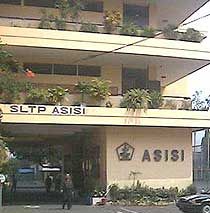
Barack Obama's Catholic school in Jakarta.

The Catholic school: Nedra Pickler of the Associated Press reports that "documents showed he enrolled as a Muslim" while at a Catholic school during first through third grades. Kim Barker of the Chicago Tribune confirms that Obama was "listed as a Muslim on the registration form for the Catholic school." A blogger who goes by "An American Expat in Southeast Asia" found that "Barack Hussein Obama was registered under the name ‘Barry Soetoro' serial number 203 and entered the Franciscan Asisi Primary School on 1 January 1968 and sat in class 1B. … Barry's religion was listed as Islam."

The public school: Paul Watson of the Los Angeles Times learned from Indonesians familiar with Obama when he lived in Jakarta that he "was registered by his family as a Muslim at both schools he attended." Haroon Siddiqui of the Toronto Star visited the Jakarta public school Obama attended and found that "Three of his teachers have said he was enrolled as a Muslim." Although Siddiqui cautions that "With the school records missing, eaten by bugs, one has to rely on people's shifting memories," he cites only one retired teacher, Tine Hahiyari, retracting her earlier certainty about Obama's being registered as a Muslim.

Barack Obama's public school in Jakarta.

Koran class: In his autobiography, Dreams of My Father, Obama relates how he got into trouble for making faces during Koranic studies, thereby revealing he was a Muslim, for Indonesian students in his day attended religious classes according to their faith. Indeed, Obama still retains knowledge from that class: Nicholas D. Kristof of the New York Times, reports that Obama "recalled the opening lines of the Arabic call to prayer, reciting them [to Kristof] with a first-rate accent."

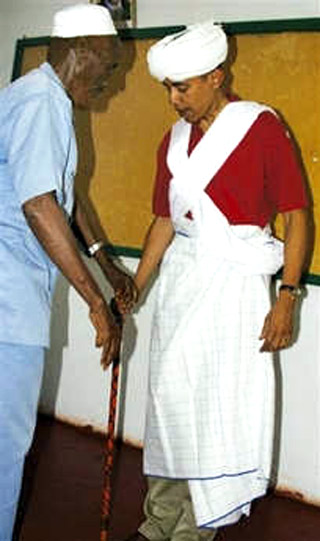
Mosque attendance: Obama's half-sister recalled that the family attended the mosque "for big communal events." Watson learned from childhood friends that "Obama sometimes went to Friday prayers at the local mosque." Barker found that "Obama occasionally followed his stepfather to the mosque for Friday prayers." One Indonesia friend, Zulfin Adi, states that Obama "was Muslim. He went to the mosque. I remember him wearing a sarong" (a garment associated with Muslims).

Piety: Obama himself says that while living in Indonesia, a Muslim country, he "didn't practice [Islam]," implicitly acknowledging a Muslim identity. Indonesians differ in their memories of him. One, Rony Amir, describes Obama as "previously quite religious in Islam."

Obama's having been born and raised a Muslim and having left the faith to become a Christian make him neither more nor less qualified to become president of the United States. But if he was born and raised a Muslim and is now hiding that fact, this points to a major deceit, a fundamental misrepresentation about himself that has profound implications about his character and his suitability as president.

Mr. Pipes (www.DanielPipes.org), director of the Middle East Forum, is the Taube/Diller distinguished visiting fellow at the Hoover Institution of Stanford University.

© All rights reserved by Daniel Pipes.

http://nymag.com/daily/intel/20070215ebony.jpg
Are We Getting Two for One?
Is Michelle Obama responsible
for the Jeremiah Wright fiasco?

By Christopher Hitchens

So numbed have I become by the endless replay of the fatuous clerical rantings of the Rev. Jeremiah Wright that it has taken me this long to remember the significant antecedent. In 1995, there appeared a documentary titled Brother Minister about the assassination of Malcolm X. It contained a secretly filmed segment showing Louis Farrakhan shouting at the top of his lungs in the Nation of Islam's temple in Chicago on "Savior's Day" in 1993. Farrakhan, verging on hysteria, demanded to know of the murdered Malcolm X: "If we dealt with him like a nation deals with a traitor, what the hell business is it of yours?" His apparent admission of what had long been suspected—that it was the Black Muslim leadership that ordered Malcolm's slaying—is not understood or remembered (or viewed) as often as it might be.

I invite you to look at the film of Farrakhan's sweating, yelling, paranoid face and to bear in mind that this depraved thug, who boasts of "dealing with" one of black America's moral heroes, is the man praised by Jeremiah Wright and referred to with respect as "Minister Farrakhan" by the senator who hopes to be the next president of the United States.

Liberal comment on Wright, and on the incredible damage that this conceited old fanatic has done to the Obama campaign, tends to dwell on the negative effect that black chauvinist rhetoric has on white working-class voters. Fair enough, I suppose. But why should a thinking black member of the working class want any truck with a Farrakhan fan or with a moral idiot who thinks that the drugs and disease in the black community are imposed by an outside conspiracy? I don't need any condescending liberal to explain to me why black Americans are inclined to be touchy about the way their forebears were treated any more than I require a patronizing former Harvard law student to guide me through the anxieties of the gun-owning and hunting community. I can quite easily understand these points without pedagogic assistance. What I won't be told is that Tawana Brawley was right, or that AIDS is the fault of the government, or that Jews were behind the slave trade, or that there is a secret Masonic code in the dollar bill. And the apologist for murder "Minister Farrakhan" and his big-mouth Christian friends flirt with this kind of half-baked garbage every day.

Nettled at last by the way in which this has upset his campaign, Sen. Obama last week cut the ties that bound him to his crackpot mentor. Well, high time. But those who profess relief at this should perhaps revisit what they thought (and wrote) about the earlier Philadelphia speech in which Obama was held to have achieved the same result with less trouble. If he was right last week, then the Philly speech was a failure on every level, and if it was a failure on every level, and thus left Obama hideously vulnerable to the very next speech made by his foaming pastor, then that must raise questions of eligibility for the highest office.

What can it be that has kept Obama in Wright's pews, and at Wright's mercy, for so long and at such a heavy cost to his aspirations? Even if he pulls off a mathematical nomination victory, he has completely lost the first, fine, careless rapture of a post-racial and post-resentment political movement and mired us again in all the old rubbish that predates Dr. King. What a sad thing to behold. And how come? I think we can exclude any covert sympathy on Obama's part for Wright's views or style—he has proved time and again that he is not like that, and even his own little nods to "Minister" Farrakhan can probably be excused as a silly form of Chicago South Side political etiquette. All right, then, how is it that the loathsome Wright married him, baptized his children, and received donations from him? Could it possibly have anything, I wonder, to do with Mrs. Obama?

This obvious question is now becoming inescapable, and there is an inexcusable unwillingness among reporters to be the one to ask it. (One can picture Obama looking pained and sensitive and saying, "Keep my wife out of it," or words to that effect, as Clinton tried to do in 1992 when Jerry Brown and Ralph Nader quite correctly inquired about his spouse's influence.) If there is a reason why the potential nominee has been keeping what he himself now admits to be very bad company—and if the rest of his character seems to make this improbable—then either he is hiding something and/or it is legitimate to ask him about his partner.

I direct your attention to Mrs. Obama's 1985 thesis at Princeton University. Its title (rather limited in scope, given the author and the campus) is "Princeton-Educated Blacks and the Black Community." To describe it as hard to read would be a mistake; the thesis cannot be "read" at all, in the strict sense of the verb. This is because it wasn't written in any known language. Anyway, at quite an early stage in the text, Michelle Obama announces that she's much influenced by the definition of black "separationism" offered by Stokely Carmichael and Charles Hamilton in their 1967 screed Black Power: The Politics of Liberation in America. I remember poor Stokely Carmichael quite well. After a hideous series of political and personal fiascos, he fled to Africa, renamed himself Kwame Toure after two of West Africa's most repellently failed dictators, and then came briefly back to the United States before electing to die in exile. I last saw him as the warm-up speaker for Louis Farrakhan in Madison Square Garden in 1985, on the evening when Farrakhan made himself famous by warning Jews, "You can't say 'Never Again' to God, because when he puts you in the ovens, you're there forever." I have the distinct feeling that the Obama campaign can't go on much longer without an answer to the question: "Are we getting two for one?" And don't be giving me any grief about asking this. Black Americans used to think that the Clinton twosome was their best friend, too. This time we should find out before it's too late to ask.

Christopher Hitchens is a columnist for Vanity Fair.

Sunday, May 04, 2008

http://www.chinadaily.com.cn/world/2007-04/03/xin_1504040312596943183562.jpg
Mark Steyn:
To Obama, 'we' means 'me'

Four score and seven years ago … No, wait, my mistake. Two score and seven or eight days ago, Barack Obama gave the greatest speech since the Gettysburg Address, or FDR's First Inaugural, or JFK's religion speech, or (if, like Garry Wills in The New York Review of Books, you find those comparisons drearily obvious) Lincoln's Cooper Union speech of 1860.

And, of course, the senator's speech does share one quality with Cooper Union, Gettysburg, the FDR Inaugural, Henry V at Agincourt, Socrates' Apology, etc.: It's history. He said, apropos the Rev. Jeremiah Wright, that "I could no more disown him than I can disown my white grandmother." But last week Obama did disown him. So, great-speech-wise, it's a bit like Churchill promising to fight them on the beaches and never surrender, and then surrendering a month and a half later, and on a beach he decided not to fight on.

It was never a great speech. It was a simulacrum of a great speech written to flatter gullible pundits into hailing it as the real deal. It should be "required reading in classrooms," said Bob Herbert in the New York Times; it was "extraordinary" and "rhetorical magic," said Joe Klein in Time – which gets closer to the truth: As with most "magic," it was merely a trick of redirection.

Obama appeared to have made Jeremiah Wright vanish into thin air, but it turned out he was just under the heavily draped table waiting to pop up again. The speech was designed to take a very specific problem – the fact that Barack Obama, the Great Uniter, had sat in the pews of a neo-segregationist huckster for 20 years – and generalize it into some grand meditation on race in America. Sen. Obama looked America in the face and said: Who ya gonna believe? My "rhetorical magic" or your lyin' eyes?

That's an easy choice for the swooning bobbysoxers of the media. With less impressionable types, such as voters, Sen. Obama is having a tougher time. The Philly speech is emblematic of his most pressing problem: the gap – indeed, full-sized canyon – that's opening up between the rhetorical magic and the reality. That's the difference between a simulacrum and a genuinely great speech. The gaseous platitudes of hope and change and unity no longer seem to fit the choices of Obama's adult life. Oddly enough, the shrewdest appraisal of the senator's speechifying "magic" came from Jeremiah Wright himself. "He's a politician," said the reverend. "He says what he has to say as a politician. … He does what politicians do."

The notion that the Amazing Obama might be just another politician doing what politicians do seems to have affronted the senator more than any of the stuff about America being no different from al-Qaida and the government inventing AIDS to kill black people. In his belated "disowning" of Wright, Obama said, "What I think particularly angered me was his suggestion somehow that my previous denunciation of his remarks were somehow political posturing. Anybody who knows me and anybody who knows what I'm about knows that – that I am about trying to bridge gaps and that I see the – the commonality in all people."

Funny how tinny and generic the sonorous uplift rings when it's suddenly juxtaposed against something real and messy and human. As he chugged on, the senator couldn't find his groove and couldn't prevent himself from returning to pick at the same old bone: "If what somebody says contradicts what you believe so fundamentally, and then he questions whether or not you believe it in front of the National Press Club, then that's enough. That's – that's a show of disrespect to me."

And we can't have that, can we?

In a shrewd analysis of Obama's peculiarly petty objections to the Rev. Wright, Scott Johnson of the Powerline Web site remarked on the senator's "adolescent grandiosity." There's always been a whiff of that. When he tells his doting fans, "We are the change we've been waiting for," he means, of course, he is the change we've been waiting for.

"Do you personally feel that the reverend betrayed your husband?" asked Meredith Vieira on "The Today Show."

"You know what I think, Meredith?" replied Michelle Obama. "We've got to move forward. You know, this conversation doesn't help my kids."

Hang on. "My" kids? You're supposed to say "It's about the future of all our children," not "It's about the future of my children" – whose parents happen to have a base salary of half a million bucks a year. But even this bungled cliché nicely captures the campaign's self-absorption: Talking about Obama's pastor is a distraction from talking about Obama's kids.

By the way, the best response to Michelle's "this conversation doesn't help my kids" would be: "But entrusting their religious upbringing to Jeremiah Wright does?" Ah, but, happily, Meredith Vieira isn't that kind of interviewer.

Mrs. O is becoming a challenge for satirists. My radio pal Hugh Hewitt played a clip on his show of the putative first lady identifying the real problem facing America:

"Like many young people coming out of college, with their MA's and BA's and PhD's and MPh's coming out so mired in debt that they have to forego the careers of their dreams, see, because when you're mired in debt, you can't afford to be a teacher or a nurse or social worker, or a pastor of a church, or to run a small nonprofit organization, or to do research for a small community group, or to be a community organizer because the salaries that you'll earn in those jobs won't cover the cost of the degree that it took to get the job."

I'm not sure why Michelle would stick "pastor of a church" in that list of downscale occupations: Her pastor drives a Mercedes and lives in a gated community. But, insofar as I understand Mrs. O, she feels that many Harvard and Princeton graduates have to give up their life's dream of being a minimum-wage "community organizer" (whatever that is) and are forced to become corporate lawyers, investment bankers and multinational CEOs just to pay off their college loans. I'm sure the waitresses and checkout clerks nodded sympathetically.

Michelle Obama is a bizarre mix of condescension and grievance – like Teresa Heinz Kerry with a chip on her shoulder. But the common thread to her rhetoric is its antipathy to what she calls "corporate America." Perhaps for his next Gettysburg Address the senator will be saying, "I could no more disown my wife than I could disown my own pastor. Oh, wait … ."

Whatever one thinks of Sens. Clinton and McCain, they're as familiar as any public figures can be. Obama, on the other hand, is running explicitly on a transcendent "magic." It doesn't help when the cute girl in spangled tights keeps whining about how awful everything is, and the guy you sawed in half sticks himself together and starts rampaging around the stage. The magician has lost control of the show.

©MARK STEYN