Friday, March 06, 2009

Rod Aydelotte/Associated Press

Horton Foote on the set of "The Traveling Lady" at the Mabee Theatre at Baylor University in February 2004

From The New York Times:
Horton Foote,
Chronicler of America in Plays and Film,

Dies at 92

By WILBORN HAMPTON
Published: March 4, 2009

Horton Foote, who chronicled a wistful American odyssey through the 20th century in plays and films mostly set in a small town in Texas and who left a literary legacy as one of the country’s foremost storytellers, died on Wednesday in Hartford. He was 92 and lived in Pacific Palisades, Calif., and Wharton, Tex.

Mr. Foote died after a brief illness, his daughter Hallie Foote said. He had recently been living in Hartford while adapting his nine-play “Orphans’ Home Cycle” into a three-part production that will be staged next fall at the Hartford Stage Company and the Signature Theater in New York.

In a body of work for which he won the Pulitzer Prize and two Academy Awards, Mr. Foote was known as a writer’s writer, an author who never abandoned his vision even when Broadway and Hollywood temporarily turned their backs on him.

In screenplays for movies like “Tender Mercies,” “To Kill a Mockingbird” and “The Trip to Bountiful,” and in plays like “The Young Man From Atlanta” and “The Carpetbagger’s Children,” Mr. Foote depicted the way ordinary people shoulder the ordinary burdens of life, finding drama in the resilience by which they carry on in the face of change, economic hardship, disappointment, loss and death.

Robert Duvall, an actor who was one of Mr. Foote’s most frequent interpreters, making his screen debut in “To Kill a Mockingbird” (1962) and winning an Oscar for best actor in “Tender Mercies” (1983), said on Wednesday that “Horton was the great American voice.” He added, “His work was native to his own region, but it was also universal.”

Frank Rich, who as chief theater critic of The New York Times in the 1980s was one of Mr. Foote’s champions, once called him “one of America’s living literary wonders.” On Wednesday Mr. Rich described Mr. Foote as “a major American dramatist whose epic body of work recalls Chekhov in its quotidian comedy and heartbreak, and Faulkner in its ability to make his own corner of America stand for the whole.”

In 1986, in an interview with The New York Times Magazine, Mr. Foote expounded on the themes that run through his work, saying, “I believe very deeply in the human spirit and I have a sense of awe about it because I don’t know how people carry on.” He added: “I’ve known people that the world has thrown everything at to discourage them, to kill them, to break their spirit. And yet something about them retains a dignity. They face life and they don’t ask quarters.”

Mr. Foote spent most of his life writing about such people. In more than 60 plays and films, most set in the fictive town of Harrison, Tex., he charted their struggle through the century by recording their familial conflicts.

He often seemed to resemble a character from one of his plays. Always courteous and courtly, he spoke with a Texas drawl. He enjoyed good food and wine, but he usually opted for barbecue and iced tea or fried chicken with a Coca-Cola when he was home in Texas. He was jovial with a wry humor, and his white hair and robust frame gave him the appearance of a Southern senator or the favorite uncle who always had a story. Harper Lee, a lifelong friend since Mr. Foote adapted her novel “To Kill a Mockingbird,” once said that Mr. Foote “looked like God, only cleanshaven.”

Albert Horton Foote Jr., one of three sons of Albert Horton Foote and the former Hallie Brooks, was born March 14, 1916, in Wharton, Tex., a town about 40 miles southwest of Houston. His father was a haberdasher and his mother taught piano.

Although he boarded a train for Dallas at 16 to pursue acting, Mr. Foote never really left home. From his first efforts as a playwright, he returned again and again to set his plays and films amid the pecan groves and Victorian houses with large front porches on the tree-lined streets of Wharton. His inspiration came from the people he knew and the stories he heard growing up there.

Mr. Foote spent two years studying acting at the Pasadena Playhouse in California, then went to New York to become a Broadway star. He continued his studies there with Tamara Daykarhanova, a Russian émigré, and joined Mary Hunter’s American Actors Company. While rehearsing a production of one-acts, Ms. Hunter had her cast perform improvisations based on life in the actors’ hometowns. After Mr. Foote performed his, Agnes De Mille, who was doing choreography for another show, asked Mr. Foote if he had ever considered writing.

“No,” he replied. “What on earth would I write about?”

Ms. DeMille, who became a lifelong friend, gave Mr. Foote the age-old advice to every beginning playwright. “Write what you know about,” she said.

Mr. Foote went home that night and wrote a one-act called “Wharton Dance,” about the Friday-night dances in his hometown. He wrote the lead part for himself. The company performed the play in an evening of one-acts.

Mr. Foote continued to pursue acting and appeared in a few other plays. Then, during a trip home, he decided to write another play. This time he spread a large canvas, writing a three-act, multilayered drama set in a small-town drugstore. He called it “Texas Town,” and the American Actors Company staged it in 1941, with Mr. Foote in the lead.

To Mr. Foote’s and the company’s surprise, Brooks Atkinson, the critic for The Times, came to see it. Atkinson called it an “engrossing portrait of small-town life.” He praised it for being “simply written” and for giving “a real and languid impression of a town changing in its relation to the world.” He added, “Mr. Foote’s play is “an able evocation of a part of life in America.”

To support himself, Mr. Foote took various jobs, including night elevator operator and bookstore clerk. While working in the bookstore a Vassar student came in looking for a summer job. Her name was Lillian Vallish. Mr. Foote asked her on a date, and the two were married the next year, on June 4, 1945. They had four children and remained together until Ms. Foote’s death in 1992.

Besides his daughter Hallie, an actress who became a main interpreter of her father’s plays, Mr. Foote is survived by his three other children — Horton Jr., who also acted and directed and is a restaurant owner in New York; Walter, a lawyer; and Daisy, also a playwright — and two grandchildren.

After World War II, Mr. Foote and Lillian moved to Washington to run the King Smith School along with Vincent Donehue. (Mr. Foote had been barred from serving in the military during the war because of a hernia.) The new theater fashion in those years was to blend words, music and dance into one theatrical experience, and Mr. Foote tried to write in the new form. One achievement during the Washington years was that Mr. Foote opened the King Smith theater to all races, the first integrated audiences in the nation’s capital.

Mr. Foote returned to New York in 1950, just as television was beginning to command America’s attention and producers like Fred Coe were recruiting writers to work for it. Mr. Donehue was hired by Mr. Coe to produce a weekly TV show for children that starred Gabby Hayes, the cowboy movie star and Roy Rogers sidekick.

Mr. Foote went to work for Mr. Coe at NBC, and his first assignment was to help write weekly half-hour episodes of “The Gabby Hayes Show.” In his spare time he continued to write plays. One, “The Chase,” in 1952, introduced Kim Stanley to Broadway, although it did not have great critical success.

Mr. Coe shortly signed Mr. Foote to a contract to write nine one-hour dramas for television. Mr. Coe liked to have one-page plot synopses from his writers, but for his third TV drama, Mr. Foote recalled, he didn’t know how to put it on paper. So, by his account, he just told Mr. Coe the plot.

“It’s about an old lady who wants to go home,” Mr. Foote said.

“That’s it?” Mr. Coe asked

“That’s it,” Mr. Foote replied.

“Go ahead,” Mr. Coe said. “I trust you.”

“The Trip to Bountiful” starred Lillian Gish as the gentle and long-suffering widow Carrie Watts. The play would have several incarnations over Mr. Foote’s life, including a version on Broadway, a revival Off Broadway, a London production and, three decades later, a 1985 movie for which Geraldine Page would receive an Academy Award for best actress and Mr. Foote was nominated for the screenplay.

Mr. Foote went on to write 10 plays for television, mostly for Television Playhouse and mostly directed by Mr. Donehue. When Mr. Coe moved from NBC to CBS, Mr. Foote wrote several teleplays for “Playhouse 90,” including adaptations of the Faulkner stories “Old Man” and “Tomorrow.” Faulkner was so impressed with the latter that he offered to split the publication royalties with him.

Television had moved to the West Coast by this time, and Mr. Foote’s work in TV there led to his first film projects. One of them was to adapt a screenplay of Ms. Lee’s “To Kill a Mockingbird,” about a white Southern lawyer defending a black man on rape charges. For his screenplay Mr. Foote received his first Academy Award. Gregory Peck won best actor for his performance as the lawyer, Atticus Finch, and the film introduced to the screen a young actor named Robert Duvall as the eccentric Boo Radley.

Mr. Foote had another film success with “Baby, the Rain Must Fall” (1965), a reworking of his play “The Traveling Lady.” The film starred Steve McQueen.

But Mr. Foote’s Hollywood honeymoon began to sour. His next Hollywood venture was to adapt his play “The Chase” into a screenplay. But studio executives were unhappy with the script, and the producer Sam Spiegel hired Lillian Hellman to rewrite it. When the final film version was released, almost none of Mr. Foote’s original material remained. Mr. Foote was then hired by Otto Preminger to work on a screenplay for “Hurry Sundown” (1967), but the producer never used a word of his dialogue, although Mr. Foote appeared in the credits as a co-writer.

The experiences so depressed Mr. Foote that he moved to New Hampshire to live on a farm, and even contemplated giving up writing. It was after the death of his parents that Mr. Foote began the nine-play cycle called “The Orphans’ Home,” inspired by his father’s family and spanning 1902 to 1928. The first of these plays were staged in New York by Herbert Berghof, who with his wife, Uta Hagen, ran the H-B Theater workshop. It marked the start of the Foote revival.

If Brooks Atkinson helped launch Mr. Foote’s first career as a writer, it was Mr. Rich, of The Times, who helped start his revival with enthusiastic reviews of the cycle’s plays. Producers started paying attention to Mr. Foote’s work again, and a new generation of audiences was introduced to his work.

One of those who applauded Mr. Foote’s return was the director and producer Alan J. Pakula, who had hired him to write the screenplay for “Mockingbird.” “In a seemingly undramatic way,” Mr. Pakula said, Mr. Foote “has a specific voice, a specific style, and he has never abandoned it, even though it has cost him.”

http://farm1.static.flickr.com/159/412158036_de37de592c.jpg?v=0

While Mr. Foote worked on “The Orphans’ Home” cycle, his agent, Lucy Kroll, suggested he write an original screenplay. He began working on a story about a group of young singers trying to break into country and western music. When his daughter Hallie reminded him that Mr. Duvall could sing, Mr. Foote started molding a character for him.

The movie, “Tender Mercies,” was written specifically with Mr. Duvall in mind for the role of Mac Sledge, a washed-up, alcoholic singer who finds redemption in the love of a young Vietnam War widow and her small son. The film was shot in Waxahachie, Tex., for only $4.5 million, and at first no studio wanted to distribute it. But, Mr. Duvall went on to win the best-actor Academy Award and Mr. Foote received his second Oscar for the screenplay.

With his new success, Mr. Foote again turned toward writing movies, but this time he pursued an independent route. With his wife, Lillian, as producer and the rest of his family acting or working behind the scenes, he made movies of two plays in the “The Orphans’ Home” cycle, “1918” and “On Valentine’s Day.” Both were shot in Waxahachie, cost under $2 million each and starred Hallie Foote.

The second act of Mr. Foote’s career was given an extended run by the Signature Theater, an Off Off Broadway company that devoted its 1994-95 season to his work. One of the Foote plays that season had been written some years earlier, but had never been performed. It was “The Young Man From Atlanta” and was about a couple nearing retirement in Houston in the 1950s and trying to come to terms with their grown son’s suicide and suspected homosexuality. It won the Pulitzer Prize in 1995.

As the 21st-century dawned, Mr. Foote wrote “The Carpetbagger’s Children,” a play in which three grown daughters of a carpetbagger look back over their lives and the 20th century in alternating monologues. It was staged at Lincoln Center and drew sold-out audiences in an extended run. Another revival of “The Trip to Bountiful,” with Lois Smith, was a hit for Signature Theater, and Mr. Foote scored a Broadway success with the revival of “Dividing the Estate,” under Michael Wilson’s direction.

Mr. Wilson, director of the Hartford Stage, and James Houghton of the Signature, put together the production of “The Orphans’ Home Cycle” that will be staged in the fall and was Mr. Foote’s lifelong dream.

Mr. Foote had all but completed work on adapting those plays at his death. Only a week ago, he had seen a preview performance of the stage version of “To Kill a Mockingbird” at the Hartford Stage Company and had been anticipating the staging of “Dividing the Estate” there in April.

“I don’t think I’ll ever stop writing,” he said in a 1999 interview. “I write almost every day. I’d write plays even if they were never done again. You’re at the mercy of whatever talent you have.”

http://img71.imageshack.us/img71/3783/obama1yg4.jpg
From The Wall Street Journal:
Obama's Radicalism is Killing the Dow
A financial crisis is the worst time
to change the foundations of American capitalism.
By Michael Boskin

It's hard not to see the continued sell-off on Wall Street and the growing fear on Main Street as a product, at least in part, of the realization that our new president's policies are designed to radically re-engineer the market-based U.S. economy, not just mitigate the recession and financial crisis.

[Commentary]
Martin Kozlowski

The illusion that Barack Obama will lead from the economic center has quickly come to an end. Instead of combining the best policies of past Democratic presidents -- John Kennedy on taxes, Bill Clinton on welfare reform and a balanced budget, for instance -- President Obama is returning to Jimmy Carter's higher taxes and Mr. Clinton's draconian defense drawdown.

Mr. Obama's $3.6 trillion budget blueprint, by his own admission, redefines the role of government in our economy and society. The budget more than doubles the national debt held by the public, adding more to the debt than all previous presidents -- from George Washington to George W. Bush -- combined. It reduces defense spending to a level not sustained since the dangerous days before World War II, while increasing nondefense spending (relative to GDP) to the highest level in U.S. history. And it would raise taxes to historically high levels (again, relative to GDP). And all of this before addressing the impending explosion in Social Security and Medicare costs.

To be fair, specific parts of the president's budget are admirable and deserve support: increased means-testing in agriculture and medical payments; permanent indexing of the alternative minimum tax and other tax reductions; recognizing the need for further financial rescue and likely losses thereon; and bringing spending into the budget that was previously in supplemental appropriations, such as funding for the wars in Iraq and Afghanistan.

The specific problems, however, far outweigh the positives. First are the quite optimistic forecasts, despite the higher taxes and government micromanagement that will harm the economy. The budget projects a much shallower recession and stronger recovery than private forecasters or the nonpartisan Congressional Budget Office are projecting. It implies a vast amount of additional spending and higher taxes, above and beyond even these record levels. For example, it calls for a down payment on universal health care, with the additional "resources" needed "TBD" (to be determined).

Mr. Obama has bravely said he will deal with the projected deficits in Medicare and Social Security. While reform of these programs is vital, the president has shown little interest in reining in the growth of real spending per beneficiary, and he has rejected increasing the retirement age. Instead, he's proposed additional taxes on earnings above the current payroll tax cap of $106,800 -- a bad policy that would raise marginal tax rates still further and barely dent the long-run deficit.

Increasing the top tax rates on earnings to 39.6% and on capital gains and dividends to 20% will reduce incentives for our most productive citizens and small businesses to work, save and invest -- with effective rates higher still because of restrictions on itemized deductions and raising the Social Security cap. As every economics student learns, high marginal rates distort economic decisions, the damage from which rises with the square of the rates (doubling the rates quadruples the harm). The president claims he is only hitting 2% of the population, but many more will at some point be in these brackets.

As for energy policy, the president's cap-and-trade plan for CO2 would ensnare a vast network of covered sources, opening up countless opportunities for political manipulation, bureaucracy, or worse. It would likely exacerbate volatility in energy prices, as permit prices soar in booms and collapse in busts. The European emissions trading system has been a dismal failure. A direct, transparent carbon tax would be far better.

Moreover, the president's energy proposals radically underestimate the time frame for bringing alternatives plausibly to scale. His own Energy Department estimates we will need a lot more oil and gas in the meantime, necessitating $11 trillion in capital investment to avoid permanently higher prices.

The president proposes a large defense drawdown to pay for exploding nondefense outlays -- similar to those of Presidents Carter and Clinton -- which were widely perceived by both Republicans and Democrats as having gone too far, leaving large holes in our military. We paid a high price for those mistakes and should not repeat them.

The president's proposed limitations on the value of itemized deductions for those in the top tax brackets would clobber itemized charitable contributions, half of which are by those at the top. This change effectively increases the cost to the donor by roughly 20% (to just over 72 cents from 60 cents per dollar donated). Estimates of the responsiveness of giving to after-tax prices range from a bit above to a little below proportionate, so reductions in giving will be large and permanent, even after the recession ends and the financial markets rebound.

A similar effect will exacerbate tax flight from states like California and New York, which rely on steeply progressive income taxes collecting a large fraction of revenue from a small fraction of their residents. This attack on decentralization permeates the budget -- e.g., killing the private fee-for-service Medicare option -- and will curtail the experimentation, innovation and competition that provide a road map to greater effectiveness.

The pervasive government subsidies and mandates -- in health, pharmaceuticals, energy and the like -- will do a poor job of picking winners and losers (ask the Japanese or Europeans) and will be difficult to unwind as recipients lobby for continuation and expansion. Expanding the scale and scope of government largess means that more and more of our best entrepreneurs, managers and workers will spend their time and talent chasing handouts subject to bureaucratic diktats, not the marketplace needs and wants of consumers.

Our competitors have lower corporate tax rates and tax only domestic earnings, yet the budget seeks to restrict deferral of taxes on overseas earnings, arguing it drives jobs overseas. But the academic research (most notably by Mihir Desai, C. Fritz Foley and James Hines Jr.) reveals the opposite: American firms' overseas investments strengthen their domestic operations and employee compensation.

New and expanded refundable tax credits would raise the fraction of taxpayers paying no income taxes to almost 50% from 38%. This is potentially the most pernicious feature of the president's budget, because it would cement a permanent voting majority with no stake in controlling the cost of general government.

From the poorly designed stimulus bill and vague new financial rescue plan, to the enormous expansion of government spending, taxes and debt somehow permanently strengthening economic growth, the assumptions underlying the president's economic program seem bereft of rigorous analysis and a careful reading of history.

Unfortunately, our history suggests new government programs, however noble the intent, more often wind up delivering less, more slowly, at far higher cost than projected, with potentially damaging unintended consequences. The most recent case, of course, was the government's meddling in the housing market to bring home ownership to low-income families, which became a prime cause of the current economic and financial disaster.

On the growth effects of a large expansion of government, the European social welfare states present a window on our potential future: standards of living permanently 30% lower than ours. Rounding off perceived rough edges of our economic system may well be called for, but a major, perhaps irreversible, step toward a European-style social welfare state with its concomitant long-run economic stagnation is not.

Mr. Boskin is a professor of economics at Stanford University and a senior fellow at the Hoover Institution. He chaired the Council of Economic Advisers under President George H.W. Bush.

http://www.danzfamily.com/archives/blogphotos/06/348-cox-forkum-islam-pr.jpg
From Asia Times Online:
Who are the 'extraordinary' Muslims?

By Spengler


February 3, 2009

"My job is to communicate to the American people that the Muslim world is filled with extraordinary people who simply want to live their lives and see their children live better lives," United States President Barack Obama told an Arabic television channel on January 26. Really? What are their names? Word has come to the West of no extraordinary Muslim thinker since the 12th century. There is one first-rank Arab writer working today who tries to explain why there are no extraordinary Muslims - but on that more below.

By "extraordinary", to be sure, Obama means no more than Garrison Keillor meant in saying that the children of Lake Wobegon all are above average. There is no "there" in Obama's "patchwork", as he characterized America in his inaugural address. America is all patches and no quilt, arranged in no particular order, as in his remark in the same interview that America is "a country of Muslims, Jews, Christians, non-believers". Everyone is ordinary, or maybe extraordinary - whatever. If Obama had said that "the Muslim world is filled with ordinary people, etc", his meaning would have been clearer.

It's worth holding Obama to his words, though. In the real world, the ordinary depends on the extraordinary, for it is the extraordinary citizens of a nation who set a mark for the aspirations of ordinary people. Cultures that can't produce extraordinary individuals can't survive. That bears on the other half of the president's assertion. It is true that most Muslims simply want a better life, and the two or three million American Muslims mostly are well-educated economic immigrants who value prosperity over tradition.

But it also is true that among the 1.4 billion Muslims in the world there are tens of millions who would rather kill and die than endure what they perceive as an intolerable humiliation. The majority of Muslims will be content to eat crumbs from the table of the West and conform to the misery of their circumstances. It is the substantial minority that will not be content that should worry Obama.

The failsafe definition of an "extraordinary person" is what an ambitious mother will tell her feckless children, "Work hard and you might grow up to be like him (or her)." Successful cultures produce people whose contributions resonate through the world - scientists, poets, musicians, entrepreneurs, or philosophers. Just one great individual can transform a nation, by setting an example for ambitious youth. Thanks to the composer Jan Sibelius, Finland with just 5 million people became a force in the world of classical music. But woe unto cultures whence comes no contribution to the rest of humanity. Where are the Muslim scientists, novelists, entrepreneurs, athletes and musicians?

Apart from political leaders, a reasonably diligent reader of a quality newspaper in the West will not be able to name a single Muslim distinguished in any field of human endeavor. Excluding the politically awarded Peace Prize, Muslims have won only three Nobel prizes since their inception more than a century ago, or one for every 450 million Muslims alive today. By contrast, there have been 169 Jewish Nobel Laureates (excluding the Peace Prize), or about one for every 89,000 Jews alive today. During the past century, a Jew was 5,000 times more likely to win the Nobel than a Muslim.

The last native of a Muslim country to receive the Nobel was the Turkish novelist Orhan Pamuk, a secular critic of his native country now living in New York City in virtual exile, unable to return to Istanbul in safety. I favorably reviewed his last novel Snow. Only one Muslim writer today is mentioned as a frontrunner for the literature prize today: the Syrian poet Adonis (the pen-name of Ali Ahmad Sa'id), whom I profiled (Are the Arabs already extinct? Asia Times Online, May 8, 2007).

Adonis is a man whom the world should know better. Almost singlehanded, he created a modernist poetic style in Arabic that vividly conveys the terror of the Muslim encounter with the modern world.

Adonis calls his work an obituary for the Arabs. "We have become extinct," he told Dubai television on March 11, 2007. "We have the masses of people, but a people becomes extinct when it no longer has a creative capacity, and the capacity to change its world ... The great Sumerians became extinct, the great Greeks became extinct, and the Pharaohs became extinct."

Islam itself destroys the creative of Muslims, Adonis argues: "Because Islam - the last message sent by God to mankind - has placed the final seal on the Divine Word, successive words are incapable of bringing humankind anything new. A new message would imply that the Islamic message did not say everything, that it is imperfect." The most melancholy Slav sounds like Jerry Seinfeld next to this poet of despair.

The blame for Islamic backwardness, Adonis claims, lies in the concept of "oneness," or tawhid, of Allah. "Oneness" conveys not just monotheism, but exclusionary comprehensiveness; it refers more to totality than to unity. As the leading European Islamist Tariq Ramadan explains tawhid, for a right-thinking Muslim, it is literally inconceivable to raise doubts about God. A Muslim, Ramadan explains, might forget, but he cannot doubt.

The trouble with a religion that permits no doubt - unlike Christianity, of which Pope Benedict XVI said that "doubt is the handmaiden of faith" - is that it becomes an all-or-nothing proposition. Either Islam regulates the totality of life and thought, such that questioning may intrude within its magic circle, or it becomes nothing. Islam is inseparable from the traditional life of subject peoples; it cannot find roots in the thin soil of modernity.

Measuring modernity is difficult, especially because its onset in the Muslim world is sudden, but there is one unerring gauge of social transformation that shows how quickly Muslim societies are changing. That is population.

Thrust into the modern world, Muslims are overtaking the West only in one dimension: they are aging, and aging faster than any other part of the world. Iran is the fastest-aging country on the globe. The developed world today has a median age of almost 40, the sad result of two generations of demographic decline, while the largest Muslim countries have a median age of 25. But by the middle of the century, according to United Nations projections, the average age of the largest Muslim countries will be 47, converging on the aging industrial world.


Only with extreme difficulty will the developed countries manage the burden of a rapidly aging population. It is hard to envisage how the much-poorer Muslim world will manage it at all. The potential for civil as well as regional instability will continue to rise. Increasingly, the Muslims find themselves with the worst of both worlds, that is, with the same dependency profile as the populations of the West, but without the wealth or the capacity to generate wealth that gives the West some wiggle room.

Japan may have a declining population, but it is a wealthy land with enormous inventiveness and the capacity to substitute capital for labor. Excepting Turkey, no Muslim country has a single industrial company that can compete on world markets. The Muslim world thus far has failed to produce the sort of extraordinary men and women who can innovate and adapt.

Shrinking resources and growing need are a formula for social and regional instability. Iran's insistence on acquiring nuclear weapons stems from more than a paranoid antipathy to the state of Israel. Iran looks wistfully towards the far shore of the Persian Gulf where Saudi Shi'ites dominate the monarchy's main oil-producing regions. Fifty million aging Persians, for that matter, might be more concerned about 175 million young Pakistanis to their east than about Israel.

Most Muslims want to better their lives, as Obama said, but their lives are getting worse rather than better, and nothing they know can make things better. In theory, there might be a future state of the world in which the Islamic world could live in peace and prosperity, but today's Muslims cannot get there from here.

In dozens of essays during the past five years, I excoriated former president George W Bush for imaging that he could fix the problems of the Muslim world by promoting American-style democracy. If Obama spends more time reassuring, and less time trying to fix the Muslim world, he will do better, by default. America's policy towards the incurables should be to live and let die.
http://www.segundoasegundo.com/images/uploads/COMANDO_ARMADO_CIUDAD_JUAREZ.jpg
From Human Events:
Afghanistan South
Heeding the advice of Gen. David Petraeus, Barack Obama has committed 17,000 more troops to Afghanistan and will keep 50,000 in Iraq after U.S. combat operations end in August 2010.

But are U.S. vital interests more threatened by what happens in Anbar or Helmand than in the war raging along our southern border?

Prediction: After all U.S. troops in Iraq, Afghanistan and Korea have come home, there will be a U.S. army on the Mexican border. For this is where the fate of our republic will be decided, as the fate of Europe will be decided by the millions streaming north from the Maghreb and Middle East, sub-Sahara and South Asia.

Last year, 6,000 Mexicans died in drug-related killings in a war where the tactics are massacre, murder, kidnapping and beheading.

President Felipe Calderon has ordered another 5,000 troops and 1,000 police to the border. Primary target: Ciudad Juarez, across the Rio Grande from El Paso.

Some 2,500 federal troops are already in Juarez, where in 2008 there were 1,600 drug-related murders. Gun battles occur every day. Nationally, 45,000 army troops and police are committed to this war that Mexico is not winning. For, according to the March 3 Washington Times, the Pentagon now estimates the cartels field more than 100,000 foot soldiers.

The chief of police of Juarez just resigned after a cartel threatened to kill an officer every 48 hours if he did not. To prove its seriousness, the cartel murdered four cops, including the chief's deputy. Last year, 50 police officers in Juarez were murdered.

"The decision I am taking is one of life over death," said Chief Roberto Oduna. The chief would seem to have a point. In January, his predecessor's head was found in an ice cooler outside a police station. The mayor keeps his family in El Paso, as they have been threatened with decapitation.

Friday, the State Department declared, "Corruption throughout Mexico's public institutions remains a key impediment to curtailing the power of the drug cartels." Calderon retorts that, while the murders may be committed in Mexico, the cash and guns come from the United States.

With oil revenue down since the price dropped $100 a barrel, and remittances down from Mexican workers in the United States as the U.S. economy tanks, tourism, too, has begun to die. Beheadings in and around Acapulco have not helped. Warnings have been issued to U.S. college kids to avoid Mexico on spring break, as kidnappings for ransom are rampant. Restaurants and bars in Juarez that catered to folks from El Paso and soldiers from Fort Bliss are shutting down.

In February, in the resort town of Cancun, a retired army general sent to create an elite anti-crime unit was kidnapped, tortured and shot. Mexican troops raided Cancun's police headquarters and arrested the chief and dozens of his officers in connection with the murder.

Add a collapsing global economy to a losing war with drug cartels, and Mexico is at grave risk of becoming a failed state, a narco-state, with a 2,000-mile border with the United States.

How does one win a drug war when millions of Americans who use recreational drugs are financing the cartels bribing, murdering and beheading to win the war and keep self-indulgent Americans supplied with drugs?

There are two sure ways to end this war swiftly: Milton's way and Mao's way. Mao Zedong's communists killed users and suppliers alike, as social parasites. Milton Friedman's way is to decriminalize drugs and call off the war.

When Richard Nixon declared the War on Drugs in 1972, Milton, writing in Newsweek, objected on ethical grounds:

"On ethical grounds, do we have the right to use the machinery of government to prevent an individual from becoming an alcoholic or a drug addict? For children, almost everyone would answer at least a qualified yes. But for responsible adults, I, for one, would answer no. Reason with the potential addict, yes. Tell him the consequences, yes. Pray for and with him, yes. But I believe that we have no right to use force, directly or indirectly, to prevent a fellow man from committing suicide, let alone from drinking alcohol or taking drugs."

"Am I my brother's keeper?'" asked Milton, answering, "No."

Americans are never going to adopt the Maoist solution. For the users of drugs are all too often classmates, colleagues, friends, even family. Indeed, our last three presidents did not deny using drugs.

Once, a Christian America outlawed and punished homosexuality, abortion, alcohol, loan-sharking and gambling, all as criminal vice. Now, homosexuality and abortion are constitutional rights. Gambling and booze are a rich source of government revenue. And loan-sharking is done by credit-card companies, and not just the Corleones.

Will we raise the white flag in the drug war, as well?

Which is the greater evil? Legalized narcotics for America's young or a failed state of 110,000 million on our southern border?

Some choice. Some country we've become.

Thursday, March 05, 2009

http://www.reagan.utexas.edu/archives/photographs/large/c4237-6.jpg
From The Wall Street Journal:
Has Obama Buried Reagan?

The GOP is faltering in its defense of Republican ideals.
By DANIEL HENNINGER

The Democratic idea bank of Robert & Robert says it's safe to unload on Ronald Reagan.

Robert Reich: "It is the boldest budget we have seen since the Reagan administration, and drives a nail in the coffin of Reaganomics. We can basically say goodbye to the philosophy espoused by Ronald Reagan and Margaret Thatcher."
[Wonder Land] Corbis

President Ronald Reagan compares Republican and Democratic economic policies on taxes and spending at the White House.

Robert Shrum: "Obama is not only unwinding Reagan's policies, he is offering a Rooseveltian paradigm that justifies government pragmatically."

Hmmm. Let us consider an alternative universe.

The stock market has been in a free-fall (with a bounce off a ledge yesterday), dismantling the saved wealth of millions of individual Americans who must feel they are living through the exploding rubble of some Hollywood disaster movie.

In reaction, Republicans, true to form, set sail for a deserted island to ponder a dispute between Rush Limbaugh and Republican National Committee Chairman Michael Steele. At issue: Who's captain of the GOP Titanic.

Americans are ready for a message of economic growth, but who will deliver it?

Someone said, "A crisis is a terrible thing to waste." Why are the Republicans wasting it?

If the Democrats are willing to bet the entire U.S. economy on a 1931 theory known as the Keynesian multiplier, surely Republicans can excavate and relearn the core idea handed down to them by Ronald Reagan. That idea was known as economic growth.

Freed to choose between these two competing ideas, I'm guessing many voters would go for growth. All that's needed is just one Republican who can explain this idea halfway as well as Ronald Reagan.

Arguably at no time in their lives have more Americans been this sharply focused on the economy. They think and talk about nothing else. The Republicans have been handed on a tarnished silver platter the chance to offer the American people an alternative vision of how their economy works -- and grows.

They should take political ownership of the 75% of the U.S. economy that the Democrats have abandoned -- the private economy.
Podcast

Listen to Daniel Henninger's Wonder Land column, now available in audio format.

Over the past four decades and the decline of private-sector industrial unions, professional Democrats -- politicians, intellectuals like Robert & Robert, campaign professionals, unions and satellite groups -- have severed their emotional and intellectual connection with private production.

Today, frontline Democrats see the private sector as doing two things: It produces tax revenue for $3.9 trillion federal budgets, and it shafts workers. The private sector in the Democratic worldview is necessary but nasty. Their leadership gives the impression of not having the simplest understanding of how an employer's life unfolds day to day.

This week's NBC News/Wall Street Journal poll finds President Obama with a 60% approval. That's high alright, as in high anxiety: 44% say the nation is "off on the wrong track," 41% see it headed in the right direction, and 15% of respondents are in a gray fog.

I have a poll question: Has anyone in America had a single upbeat conversation about anything the past three weeks?

Beyond the stock market, there is a reason why, despite much goodwill toward his presidency, the Obama response to the faltering economy has left many feeling undone. There isn't much in his plan to stir the national soul. It's about "sacrifice" now so that we can live for a future of small electric cars and windmills. This may move the Democratic Party's faith communities, but it cannot revive a great nation. If the Democrats want to embrace market failure as a basis for their ideology, let them have it. As politics, it's a downer.

What Ronald Reagan knew and they don't is that what moves a nation is the vital, teeming life of the private economy -- work, ideas, innovation, the excitement of production, getting bigger. Growth. In the past this world was depicted as blast furnaces and factory chimneys. Today the economy's sinews are harder to see, but they exist in tens of thousands of small-cap, mid-cap and fat-cap companies.

The Republicans -- Romney, Huckabee, Jindal, Pawlenty, Sanford, Newt, Sarah and several hundred 2010 congressional candidates -- must rediscover a way to talk about the living world of the real economy. Their vocabulary now consists mainly of policy-wonk spinach -- "fiscal responsibility," "reduce the debt," and even "tax cuts." True but insufficient.

What Rush Limbaugh was trying to tell that conservative audience in so many words was, Don't be embarrassed. Don't be embarrassed about embracing the world of free markets, competition, entrepreneurship and profit. If you don't know how to talk about it, reread the apostles and evangelists of private economic growth -- Ronald Reagan's "A Life in Letters," Milton Friedman's "Free to Choose," Henry Hazlitt's "Economics in One Lesson."

Politics, it has been recently demonstrated, is about ideas and language. The conservative movement is not at a loss for proven ideas, and in the U.S. the most powerful of these -- running in an upward line since the Industrial Revolution -- is the idea of private economic growth. The Democrats don't want the private economy anymore and conservatives have forgotten how to talk about it. Democrats are betting their opponents will forget even where Ronald Reagan is buried. They should be so lucky.

Write to henninger@wsj.com

Wednesday, March 04, 2009

http://pal2pal.com/BLOGEE/images/uploads/barrygump_thumb.jpg
From National Review:
Intelligence Failure
Obama recruits from China Inc.
to fill a critical national-security post.

By the Editors

Charles Freeman is a career diplomat, a Saudi apologist, and a savage critic of Israel. He also argues that Beijing did not strike down the Tiananmen Square protesters with sufficient swiftness. Barack Obama proposes to make him head of the National Intelligence Council. It’s an abominable appointment.

The National Intelligence Council is, as its website says, “a center of strategic thinking within the U.S. Government, reporting to the Director of National Intelligence . . . and providing the President and senior policymakers with analyses of foreign policy issues that have been reviewed and coordinated throughout the Intelligence Community.” The NIC plays a crucial role in determining what specific intelligence the president consumes from the torrents of information gathered by 16 different agencies. As chairman, Freeman will decide how that intelligence is framed. So how does he view the world?

Freeman is a career foreign-policy savant, with several stints in the State Department and one in the Clinton Defense Department. He has distinguished himself as a rabid Israel-hater who regards the Jewish state’s defensive measures as the primary cause of jihadist terror. He is a shameless apologist for Saudi Arabia (where he once served as U.S. ambassador) despite its well-documented record of exporting terrorists and jihadist ideology. And he is a long-time sycophant of Beijing, where he served as Richard Nixon’s interpreter during the 1971 summit and later ran the U.S. diplomatic mission.

His Chinese associations are alarming. Since 2004, Freeman has sat on the international advisory board of the China National Offshore Oil Corporation, which is owned by the Communist government. Its 2005 attempt to purchase Unocal, the American oil giant, was thwarted by Congress for national-security reasons.

Brutal as his benefactors in Beijing have been, Freeman wished them more brutal still: The Weekly Standard has unearthed a 2006 e-mail in which Freeman faults Chinese authorities for not moving swiftly enough in 1989 to crush democracy demonstrators. “The truly unforgivable mistake of the Chinese authorities,” wrote Freeman, “was the failure to intervene on a timely basis to nip the demonstrations in the bud, rather than — as would have been both wise and efficacious — to intervene with force when all other measures had failed to restore domestic tranquility to Beijing and other major urban centers in China.”

With that in mind, it is unsettling that Freeman will play a key role in determining what intelligence the president sees — and what he doesn’t. As NIC chairman, he will have a strong hand in the production of National Intelligence Estimates, reports that are pivotal in determining the direction of U.S. policy. An errant NIE can be a dangerous thing. Recall the disastrous 2007 NIE that concluded, against the evidence, that Iran had abandoned its nuclear weapons program in 2003. Though quickly abandoned, that NIE helped soften our national resolve to prevent Iran’s development of nuclear weapons, even as the mullahs ramped up production.

Three of the major foreign-policy challenges the United States faces today involve the survival of Israel, the Saudis’ promotion of radical Islam, and the ambitions of China. To navigate them, Obama has chosen a fierce critic of Israel — our only reliable ally in the region where threats to the United States are most immediate — whose track record is one of kowtowing to our enemies in the Mideast and our rivals in Beijing.

Freeman has an irrepressible instinct for the appalling. In a public forum in 2002, Freeman decried “America’s lack of introspection about September 11.” What commanded Freeman’s attention was not the jihadist ideology that brought about the murder of nearly 3,000 of our fellow citizens, but what he described as “an ugly mood of chauvinism” in the United States. Americans, he maintained, “should examine ourselves” as we consider “what might have caused the attack.”

The post of NIC chairman is an executive-staff appointment, meaning that Freeman, though an intimate Obama adviser, is not subject to vetting through Senate confirmation hearings. But what we already know is reason enough for alarm.
http://www.strangepolitics.com/images/content/117719.jpg
From Human Events: This is fantastic...
Olbermann's Plastic Ivy

Fortunately, we have Keith Olbermann to point out that Rush Limbaugh did not accurately quote the preamble to the Constitution in his CPAC speech last weekend. I'm not sure what scam Olbermann imagined Rush was trying to put over on the American people by saying conservatives believed in the "preamble to the Constitution" and then quoting words from the Declaration of Independence -- but Olbermann put an end to that cruel deception!

These small-time opportunities to show off by correcting someone else's teeny-tiny mistakes are the lifeblood of Olbermann's MSNBC show, "Countdown." Olbermann is no more capable of not correcting Rep. Charlie Rangel when he said "inferred," but meant "implied," than an obsessive compulsive could pass a sink without washing his hands.

There is utterly no purpose to these lame "gotchas," except that Olbermann is so desperately insecure that he is willing to waste valuable airtime in order to convince other status-conscious idiots that he is, like, scary-smart.

Olbermann relentlessly attacked low-level Bush administration employee Monica Goodling for not going to a name-dropping college, saying -- approximately 1 million times -- that she got her law degree "by sending 100 box tops to Religious Lunatic University."

I would venture to say that the students at Goodling's law school at Regent University are far more impressive than those at the Cornell agriculture school -- the land-grant, non-Ivy League school Keith attended.

I wouldn't mention it, except that Olbermann savages anyone who didn't go to an impressive college. As it happens, he didn't go to an impressive college, either.

If you've ever watched any three nights of his show, you know that Olbermann went to Cornell. But he always forgets to mention that he went to the school that offers classes in milking and bovine management.

Indeed, Keith is constantly lying about his nonexistent "Ivy League" education, boasting to Playboy magazine, for example: "My Ivy League education taught me how to cut corners, skim books and take an idea and write 15 pages on it, and also how to work all day at the Cornell radio station and never actually go to class."

Except Keith didn't go to the Ivy League Cornell; he went to the Old MacDonald Cornell.

The real Cornell, the School of Arts and Sciences (average SAT: 1,325; acceptance rate: 1 in 6 applicants), is the only Ivy League school at Cornell and the only one that grants a Bachelor of Arts degree.

Keith went to an affiliated state college at Cornell, the College of Agriculture and Life Sciences (average SAT: about that of pulling guards at the University of South Carolina; acceptance rate: 1 of every 1.01 applicants).

Olbermann's incessant lying about having an "Ivy League education" when he went to the non-Ivy League ag school at Cornell would be like a graduate of the Yale locksmithing school boasting about being a "Yale man."

Among the graduates of the Ivy League Cornell are Ruth Bader Ginsburg, Thomas Pynchon, Paul Wolfowitz, E.B. White, Sanford I. Weill, Floyd Abrams, Kurt Vonnegut, Douglas Ginsburg, Janet Reno, Henry Heimlich and Harold Bloom.

Graduates of the ag school include David LeNeveu of the Anaheim Ducks, Mitch Carefoot of the Phoenix RoadRunners, Darren Eliot, former professional hockey player, and Joe Nieuwendyk, multiple Stanley Cup winner.

One begins to understand why Harvard students threw a chicken on the ice during Cornell's famous rout of Harvard at a 1973 hockey game.

If you actually want to pursue a career related to agriculture, there is no better school than the Cornell ag school. I have nothing but admiration for the farmers and aspiring veterinarians at the ag school. They didn't go there just to have "Cornell" on their resumes.

In addition to the farmers, there are some smart kids who go to the ag school -- as there are at all state universities. But most people who majored in "communications" at an ag school don't act like Marshall Scholars or go around mocking graduates of Regent University Law School.

The sort of insecurity that would force you to always say "trebled" instead of "tripled" could only come from a communications major with massive status anxiety, like Keith. Without even looking it up, I am confident that Harvard, Yale and Princeton do not offer degrees in "communications." I know there is no "communications" major at the Ivy League Cornell.

"Communications" is a major, along with "recreation science," most commonly associated with linemen at USC. But at least the linemen can throw a football, which Keith cannot because his mother decided he was not physically robust enough to play outdoors as a child.

It may seem cruel to reveal the true college of someone who already wakes up in the middle of the night in a cold sweat worried that he's a fraud. But I believe that by pointing out that Olbermann actually is a fraud, I am liberating him.

You may not realize it now, Keith, but you will look back on this day and say, "That was the best thing that ever happened to me!"

Finally, you can stop pretending that you went to the hard-to-get-into Cornell.

Now you won't have to quickly change the subject whenever people idly remark that they didn't know it was possible to major in "communications" at an Ivy League school.

No longer will you have to aggressively bring up Cornell when it has nothing to do with the conversation.

Relax, Keith. Now you can let people like you for you.

Ann Coulter is Legal Affairs Correspondent for HUMAN EVENTS and author of "High Crimes and Misdemeanors," "Slander," ""How to Talk to a Liberal (If You Must)," "Godless," "If Democrats Had Any Brains, They'd Be Republicans" and most recently, Guilty: Liberal "Victims" and their Assault on America.
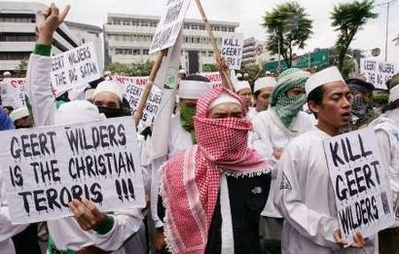
http://steynian.files.wordpress.com/2008/03/kill_geert_wilders_muslims_indonesia.jpg
The religion of peace and the measured response to Wilders

From Jihad Watch at Human Events:

Geert Wilders Welcomed in Washington,
Shows 'Fitna' at the Capitol

Geert Wilders, Dutch parliamentarian -- producer of the film expose Fitna -- and international champion of free speech, electrified a standing-room-only crowd in Washington Friday, declaring: “We will never apologize for being free men. We will never give in. We will never surrender. There is no stronger power than the force of free men fighting for the great cause of liberty.”

Wilders spoke these words at the Omni Shoreham Hotel, site of the Conservative Political Action Conference, at an independent event organized by Pamela Geller, publisher of the popular website AtlasShrugs.com, and co-sponsored by the David Horowitz Freedom Center, Dr. Andrew Bostom (editor of The Legacy of Jihad and The Legacy of Islamic Antisemitism), and my own Jihad Watch.

Geller’s determined efforts to get Wilders a platform in Washington show what one tireless citizen can do to make a difference -- a lesson that conservatives should increasingly heed in the Age of Obama, when so many organizations on the Right seem to have lost their focus and will.

In a jab at British authorities who barred him from entering the country in February, Wilders thanked immigration authorities for “letting me into this great country,” quipping: “It is always a pleasure to cross a border without being sent back on the first plane.” The Brits seemed afraid that if Wilders went ahead with plans to screen in the House of Lords his short film Fitna, which shows how jihadists use the Qur’an to incite Muslims to commit acts of violence, Muslims might…commit acts of violence. Instead of admonishing Muslims that public order would be preserved and free speech upheld, British authorities sent Wilders back to the Netherlands. But in America, not only was Wilders allowed in, but he even screened Fitna in the Capitol at the invitation of Senator Jon Kyl (R-Ariz).

And at the Omni Shoreham event, he eloquently explained the need to defend free speech. “The real question,” he stated, “is, will free speech be put behind bars? And the larger question for the West is: will we leave Europe’s children the values of Rome, Athens and Jerusalem, or the values of Mecca, Teheran and Gaza?” The 57-government Organization of the Islamic Conference (OIC), the largest voting bloc at the United Nations, has undertaken a concerted initiative to compel Western governments to adopt Islamic restrictions on free speech. If successful, this would prevent us from understanding our enemy by outlawing even law enforcement and government explorations of how jihadists use Islam to justify violence and make recruits. Such investigations would be outlawed as offensive to Islam under the guise of “hate speech.”

“Hate speech” doesn’t refer to obnoxious behavior that everyone will recognize -- calls to violence, racial slurs, etc. Rather, “hate speech” laws such as those advocated by the OIC -- with a willing audience in the Obama administration -- are tools to silence dissent and outlaw unwanted political opinions. Global jihadists are wielding those tools. “‘Hate speech,’” said Wilders, “will always be used against the people defending the West -- in order to please and appease Muslims.”

As an antidote, Wilders called on the West to follow the example of Ronald Reagan. “In 1982,” he reminded the enthusiastic audience at the Omni, “President Reagan gave a speech there very few people liked. Reagan called upon the West to reject communism and defend freedom. He introduced a phrase: ‘evil empire.’ Reagan’s speech stands out as a clarion call to preserve our liberties. I quote: If history teaches anything, it teaches self-delusion in the face of unpleasant facts is folly. What Reagan meant is that you cannot run away from history, you cannot escape the dangers of ideologies that are out to destroy you. Denial is no option.”

“Self-delusion in the face of unpleasant facts is folly.” In the face of the global jihad threat, which still so few Western authorities understand in all its dimensions, truer words were never spoken. At the Omni event spoke a true statesmen; if the West is to be saved, the U.S. and Europe will have to find it within themselves to produce many more politicians like Geert Wilders.

Mr. Spencer is director of Jihad Watch and author of "The Politically Incorrect Guide to Islam (and the Crusades)", "The Truth About Muhammad," and "Stealth Jihad" (all from Regnery -- a HUMAN EVENTS sister company).
http://savejoefromtaxes.com/images/obama_socialism.gif
From Human Events:
Pitchfork Time

In his campaign and inaugural address, Barack Obama cast himself as a moderate man seeking common ground with conservatives.

Yet, his budget calls for the radical restructuring of the U.S. economy, a sweeping redistribution of power and wealth to government and Democratic constituencies. It is a declaration of war on the Right.

The real Obama has stood up, and lived up to his ranking as the most left-wing member of the United States Senate.

Barack has no mandate for this. He was even behind McCain when the decisive event that gave him the presidency occurred -- the September collapse of Lehman Brothers and the market crash.

Republicans are under no obligation to render bipartisan support to this statist coup d'etat. For what is going down is a leftist power grab that is anathema to their principles and philosophy.

Where the U.S. government usually consumes 21 percent of gross domestic product, this Obama budget spends 28 percent in 2009 and runs a deficit of $1.75 trillion, or 12.7 percent of GDP. That is four times the largest deficit of George W. Bush and twice as large a share of the economy as any deficit run since World War II.

Add that 28 percent of GDP spent by the U.S. government to the 12 percent spent by states, counties and cities, and government will consume 40 percent of the economy in 2009.

We are not "headed down the road to socialism." We are there.

Since the budget was released, word has come that the U.S. economy did not shrink by 3.8 percent in the fourth quarter, but 6.2 percent. All the assumptions in Obama's budget about growth in 2009 and 2010 need to be revised downward, and the deficits revised upward.

Look for the deficit for 2009 to cross $2 trillion.

Who abroad is going to lend us the trillions to finance our deficits without demanding higher interest rates on the U.S. bonds they are being asked to hold? And if we must revert to the printing press to create the money, what happens to the dollar?

As Americans save only a pittance and have lost -- in the value of homes, stocks, bonds and other assets -- $15 trillion to $20 trillion since 2007, how can the people provide the feds with the needed money?

In his speech to Congress, Obama promised new investments in energy, education and health care. Every kid is going to get a college degree. We're going to find a cure for cancer.

Who is going to pay for all this?

The top 2 percent, the filthy rich who got all those Bush tax breaks, say Democrats. But the top 5 percent of income earners already pay 60 percent of U.S. income taxes, while the bottom 40 percent pays nothing.

Those paying a federal tax rate of 35 percent will see it rise to near 40 percent and will lose a fifth of the value of their deductions for taxes, mortgage interest and charitable contributions.

Yet, two-thirds of small businesses are taxed at the same rate as individuals. Consider what this means to the owner of a restaurant and bar in Los Angeles open from noon to midnight, where a husband and wife each put in 80 hours a week.

At year's end, the couple finds they have actually made a profit of $500,000 that they can take home in salary.

What is the Obama-Schwarzenegger tax take on that salary?

Their U.S. tax rate will have hit 39.6 percent.

Their California income tax will have hit 9.55 percent.

Medicare payroll taxes on the proprietor as both employer and salaried employee will be $14,500. Social Security payroll taxes for the proprietor as both employer and employee will be $13,243.

In short, U.S. and state income and payroll taxes will consume half of all the pair earned for some 8,000 hours of work.

From that ravaged salary they must pay a state sales tax of 8.25 percent, gas taxes for the 50-mile commute, and tens of thousands in property taxes on both their restaurant and home. And, after being pilloried by politicians for having feasted in the Bush era, they are now told the tax deduction they get for contributing to the church is to be cut 20 percent, while millions of Obama voters, who paid no U.S. income tax at all, will be getting a tax cut -- i.e., a fat little check -- in April.

Any wonder native-born Californians are fleeing the Golden Land?

Markets are not infallible. But the stock market has long been a "lead indicator" of where the economy will be six months from now. What are the markets, the collective decisions of millions of investors, saying?

Having fallen every month since Obama's election, with January and February the worst two months in history, they are telling us the stimulus package will not work, that Tim Geithner is clueless about how to save the banks, that the Obama budget portends disaster for the republic.

The president says he is gearing up for a fight on his budget.

Good. Let's give him one.

Tuesday, March 03, 2009

From The Corner at NRO:
Never glad confident
Reinhold Niebuhr-reading morning again

Mark Steyn

Reading Rich and Jonah re the "raging moderates" alongside Derb and Kathryn on Rush & Co is instructive. Six weeks in, the Obamacon dominoes - David Brooks, Christopher Buckley - are stunned to discover that, in the words of Mr Brooks, "Barack Obama is not who we thought he was".

You don't say. Instead, he seems to be pretty much what the firebreathing knuckledragging morons thought he was: a Big Government leftie with the most liberal voting record in the Senate.

So the smart guys got suckered, and the bozos were more or less on the money.

Which may be worth keeping in mind during the apparently endless "reinventions" of American conservatism now underway.

I wonder if President Obama is fretting, "If I've lost Brooks, I've lost the country." Or is he laughing his rear end off?


Elvis Presley memorabilia at the Beatles Story
Elvis Presley memorabilia at the Beatles Story 460

From The Liverpool Echo: That's a good looking shirt...
Rare Elvis Presley shirt

on display at the Beatles Story


Mar 2 2009

A STRIPED polo shirt worn by Elvis Presley throughout the late 1950s is on display at the Beatles Story.

The blue and grey sweater, which bears the King of Rock ’n’ Roll’s embroidered initials, was lent to the Albert Dock museum by the caretakers of his Memphis estate.

Estimated to be worth around £10,000, it was made by the Corsicar label in California and is a typical example of Elvis’ personal brand.

His initials began appearing on his clothes in the late 1950s and continued to adorn shirts, jackets, jewellery and even sunglasses well into the 1970s.

Jerry Goldman, Beatles Story managing director, said: “Elvis and The Beatles are the greatest artists in popular music history so it is apt we bring the two great music cities of Liverpool and Memphis together.”

The shirt, on loan from Elvis Presley Enterprises, will used in the exhibition to symbolise the huge influence the star had on The Beatles and their music.

John Lennon once famously said “before Elvis, there was nothing”, while Elvis recorded several Beatles songs.

Elvis Sings Beatles Songs Promo CD

Elvis Sings Beatles Songs - Elvis Presley Promo CD

(Australia)

Something, Hey Jude, Little Sister/Get Back, Lady Madonna, Yesterday/Hey Jude

From The New York Post:
WAGING WAR ON PROSPERITY
By DICK MORRIS & EILEEN MCGANN


March 3, 2009
--

PRESIDENT Lyndon Johnson's administration was known for his War on Poverty. President Obama's will become notable for his War on Prosperity.

We're speaking, of course, of Obama's plans to hike income taxes on the most wealthy 2 or 3 percent of the nation. He's not just raising the top rate to 39.6 percent; he's also disallowing about one-third of top earner's deductions, whether for state and local taxes, charitable contributions or mortgage interest. This is an effective hike in their taxes by an average of about 20 percent.

And soon the next shoe will drop - he'll announce that he's keeping yet another of his campaign promises: to apply the full payroll tax to all income over $250,000 a year. (Right now, the 15.3 percent Social Security tax only applies to the first $106,800 of income - you neither pay the tax on income above that, nor accumulate added benefit.) For many taxpayers in this bracket, this hike will raise their total taxes by about half.

Finally, he's declaring war on investors by raising the capital-gains-tax rate to 20 percent.

These increases are politically insignificant: The top 2 percent of the nation casts only about 4 percent of the votes, barely enough to attract the notice of even the most meticulous pollsters.

But they have enormous economic significance. Those who earn more than $200,000 pay almost 60 percent of America's income taxes and account for a third of its total disposable income. If these spenders and investors are hunkering down, waiting for the revenuers to beat down their doors, their confidence will be anything but robust. Their spending will drop; they'll be unlikely to invest (except in new tax shelters).

Franklin Roosevelt's presidency was marked by an emphasis on recovery in his first term and class warfare (which he called "reform") in his second. Campaigning for re-election in 1936, FDR famously declared, "I should like to have it said of my first administration that in it the forces of selfishness and of lust for power met their match. I would like to have it said of my second administration that in it these forces met their master."

Obama seems to have skipped the first-term FDR program and jumped right into the class divisions and warfare of the second.

But the president would do well to remember that Roosevelt's assault on the rich led directly to the recession of 1937-39 - when unemployment soared back up to 19 percent. (It was brought down only by World War II.)

Obama must realize that his tax hikes will dampen investment and consumer spending and prolong and deepen the economy's woes - this is presumably why he's postponing most tax hikes until 2011. But taxpayers, particularly wealthy taxpayers, are not dumb: They'll know what's coming, and look to secure the hatches in advance by sitting on their money.

But then, Obama must also realize that his stimulus package, with its massive growth of government, is going to kindle huge inflation in coming years. And he surely realizes that he can't expand government health insurance as massively as he intends introducing rationing of medical services.

He must know, but not care.

Here is a president who would rather redistribute income than create wealth. He thinks it more important to grow government than to fight inflation. He believes that it is crucial to expand health care to the young and middle aged, even if it means cutting it back for the elderly. He's more committed to effecting "broad change" in his first term than he is to winning a second one.

We have a president, in short, who will stand on his principles. Unfortunately, they're bad ones.

http://patdollard.com/wp-content/uploads/obama-the-snake-oil-salesman.png
From The Wall Street Journal:
The Obama Economy

As the Dow keeps dropping,
the President is running out of people to blame.

As 2009 opened, three weeks before Barack Obama took office, the Dow Jones Industrial Average closed at 9034 on January 2, its highest level since the autumn panic. Yesterday the Dow fell another 4.24% to 6763, for an overall decline of 25% in two months and to its lowest level since 1997. The dismaying message here is that President Obama's policies have become part of the economy's problem.

Americans have welcomed the Obama era in the same spirit of hope the President campaigned on. But after five weeks in office, it's become clear that Mr. Obama's policies are slowing, if not stopping, what would otherwise be the normal process of economic recovery. From punishing business to squandering scarce national public resources, Team Obama is creating more uncertainty and less confidence -- and thus a longer period of recession or subpar growth.

[Review & Outlook]

The Democrats who now run Washington don't want to hear this, because they benefit from blaming all bad economic news on President Bush. And Mr. Obama has inherited an unusual recession deepened by credit problems, both of which will take time to climb out of. But it's also true that the economy has fallen far enough, and long enough, that much of the excess that led to recession is being worked off. Already 15 months old, the current recession will soon match the average length -- and average job loss -- of the last three postwar downturns. What goes down will come up -- unless destructive policies interfere with the sources of potential recovery.

And those sources have been forming for some time. The price of oil and other commodities have fallen by two-thirds since their 2008 summer peak, which has the effect of a major tax cut. The world is awash in liquidity, thanks to monetary ease by the Federal Reserve and other central banks. Monetary policy operates with a lag, but last year's easing will eventually stir economic activity.

Housing prices have fallen 27% from their Case-Shiller peak, or some two-thirds of the way back to their historical trend. While still high, credit spreads are far from their peaks during the panic, and corporate borrowers are again able to tap the credit markets. As equities were signaling with their late 2008 rally and January top, growth should under normal circumstances begin to appear in the second half of this year.

So what has happened in the last two months? The economy has received no great new outside shock. Exchange rates and other prices have been stable, and there are no security crises of note. The reality of a sharp recession has been known and built into stock prices since last year's fourth quarter.

What is new is the unveiling of Mr. Obama's agenda and his approach to governance. Every new President has a finite stock of capital -- financial and political -- to deploy, and amid recession Mr. Obama has more than most. But one negative revelation has been the way he has chosen to spend his scarce resources on income transfers rather than growth promotion. Most of his "stimulus" spending was devoted to social programs, rather than public works, and nearly all of the tax cuts were devoted to income maintenance rather than to improving incentives to work or invest.

His Treasury has been making a similar mistake with its financial bailout plans. The banking system needs to work through its losses, and one necessary use of public capital is to assist in burning down those bad assets as fast as possible. Yet most of Team Obama's ministrations so far have gone toward triage and life support, rather than repair and recovery.

AIG yesterday received its fourth "rescue," including $70 billion in Troubled Asset Relief Program cash, without any clear business direction. (See here.) Citigroup's restructuring last week added not a dollar of new capital, and also no clear direction. Perhaps the imminent Treasury "stress tests" will clear the decks, but until they do the banks are all living in fear of becoming the next AIG. All of this squanders public money that could better go toward burning down bank debt.

The market has notably plunged since Mr. Obama introduced his budget last week, and that should be no surprise. The document was a declaration of hostility toward capitalists across the economy. Health-care stocks have dived on fears of new government mandates and price controls. Private lenders to students have been told they're no longer wanted. Anyone who uses carbon energy has been warned to expect a huge tax increase from cap and trade. And every risk-taker and investor now knows that another tax increase will slam the economy in 2011, unless Mr. Obama lets Speaker Nancy Pelosi impose one even earlier.

Meanwhile, Congress demands more bank lending even as it assails lenders and threatens to let judges rewrite mortgage contracts. The powers in Congress -- unrebuked by Mr. Obama -- are ridiculing and punishing the very capitalists who are essential to a sustainable recovery. The result has been a capital strike, and the return of the fear from last year that we could face a far deeper downturn. This is no way to nurture a wounded economy back to health.

Listening to Mr. Obama and his chief of staff, Rahm Emanuel, on the weekend, we couldn't help but wonder if they appreciate any of this. They seem preoccupied with going to the barricades against Republicans who wield little power, or picking a fight with Rush Limbaugh, as if this is the kind of economic leadership Americans want.

Perhaps they're reading the polls and figure they have two or three years before voters stop blaming Republicans and Mr. Bush for the economy. Even if that's right in the long run, in the meantime their assault on business and investors is delaying a recovery and ensuring that the expansion will be weaker than it should be when it finally does arrive.

Monday, March 02, 2009

The Beatles - Twist and Shout / There's a Place
TODAY IN BEATLES HISTORY
1964
US single release: 'Twist And Shout'/'There's A Place'.
This is a strong candidate for the best rock and roll single ever.
http://cdn.harpercollins.com/harperimages/isbn/large/6/9780061430206.jpg
Books of The Times
Fighting Demons From Left and Right
By MICHIKO KAKUTANI

THE BELIEVERS
By Zoë Heller
335 pages. Harper. $25.99.

Nearly all the characters in Zoë Heller’s ambitious new novel, “The Believers,” are true believers. Though each chooses a different vehicle of worship — socialism, liberal humanism, orthodox Judaism or the New Age gospel of self-improvement — they are all in thrall to their own certainty, self-righteous about their own beliefs and contemptuous of anyone dimwitted enough to disagree. They are also believers in their own mythologies: the roles in which they have been cast by their parents or children or followers, the personas they have had thrust upon them and have, over the years, internalized as their own. Zeal is their default setting; sanctimony, their favorite defense.

Whereas Ms. Heller’s two previous novels — “Everything You Know” and “What Was She Thinking? Notes on a Scandal” — were slender tour de forces that used distasteful narrators to explore the related theme of self-delusion and the gap between private feelings and public perceptions, “The Believers” is a considerably larger and messier undertaking. It attempts to give us a group portrait of a wildly dysfunctional family, even as it tackles the big theme of certainty and its discontents.

Ms. Heller, who has worked as a journalist for publications like Vanity Fair and The New Yorker, is an extraordinarily entertaining writer, and this novel showcases her copious gifts, including a scathing, Waugh-like wit; an unerring ear for the absurdities of contemporary speech; and a native-born Brit’s radar for class and status distinctions. But “The Believers” is also a somewhat scattershot production: brilliant at times; at others, oddly unfocused.

The novel lacks the coiled suspense and narrative drive of “Notes on a Scandal” (which was made into a critically acclaimed film starring Judi Dench and Cate Blanchett), and its nasty central character — the family matriarch Audrey Litvinoff — lacks the emotional development and moral chiaroscuro that made the equally nasty hero of “Everything You Know” such a compelling creation. In fact, “The Believers” tends to feel like a transitional work — an experiment in multiple points of view and thematic variations — devised to stretch the author’s literary muscles, and leading, in the future perhaps, to a big-boned novel that is more fully realized.

The largely off-screen presence who sets the plot of “The Believers” in motion is Audrey’s husband, Joel Litvinoff, a William Kunstleresque lawyer, famous for defending radicals and accused terrorists. He is regarded by members of his lefty New York circle as a genius and hero who has stayed true to his principles despite society’s drift into yuppie materialism, and he revels in being described by The New York Post as “a rent-a-radical with a long history of un-Americanism.”

When Joel is abruptly felled by a stroke that leaves him in a coma, Audrey is confronted by some secrets from his past — including the revelation that he has fathered a child with one of his many lovers — and she is forced to reassess her four-decade-long marriage. Joel’s collapse also forces his children to reassess their own goals and desires, and their tempestuous relationship with their mother.

Like many earlier Heller characters, Audrey is a deeply unpleasant creature: selfish, judgmental, intolerant, hard-hearted, foul-mouthed and lame-brained. She acts jaded and dismissive with Joel as a means of exerting her spousal status and puts down her two daughters, Karla and Rosa, as disappointing fools.

“How had she ended up like this, imprisoned in the role of harridan?” Ms. Heller writes of Audrey. “Once upon a time, her brash manner had been a mere posture — a convenient and amusing way for an insecure teenage bride, newly arrived in America, to disguise her crippling shyness. People had actually enjoyed her vituperation back then, encouraged it and celebrated it. She had carved out a minor distinction for herself as a ‘character’: the cute little English girl with the chutzpah and the longshoreman’s mouth.”

Somewhere along the line, this defensive pose hardened into an identity: “it had begun to express authentic resentments: boredom with motherhood, fury at her husband’s philandering, despair at the pettiness of her domestic fate.” By the time Audrey realized that “she was no longer a sexy young woman with a charmingly short fuse but a middle-aged termagant,” it was too late: “her anger had become a part of her. It was a knotted thicket in her gut, too dense to be cut down and too deeply entrenched in the loamy soil of her disappointments to be uprooted.”

Although such passages are meant to explain Audrey’s awfulness, they more often feel like half-hearted excuses for her obnoxious behavior and shrewish outbursts. A short prologue showing her as the awkward young woman whom Joel first met in London back in 1962, and a surprise ending revealing her softer side are similarly forced: in contrast to Willy Muller, the narrator of “Everything You Know,” who genuinely evolves in the course of that novel and achieves a kind of self-knowledge, Audrey never emerges as a character with a genuine inner life — or someone who learns or changes or grows.

As for Audrey’s two daughters, whom she admits she’s never developed much affection for, they, too, find themselves trapped in assigned roles in their family’s mythology. Karla, a social worker, is the doormat — the fat, unattractive, self-loathing one, who’s stuck in a loveless marriage to Mike, a union activist who looks up to her father with sycophantic ardor. Karla feels lucky that someone as attractive as Mike married her in the first place and silently suffers his patronizing snits, the same way she puts up with her mother’s mean wisecracks about her weight.

Her sister, Rosa, the pretty, ascetic one, is a believer in search of a cause: having become disillusioned with socialism after living in Cuba, she is now flirting with the idea of becoming an Orthodox Jew, a notion that elicits the contempt of her parents, who are as famous for their atheism as they are for their radical politics.

This novel’s blackly comic accounts of Rosa and Karla’s efforts to free themselves from their father’s ideological shadow and their mother’s emotional clutches remind the reader of Ms. Heller’s ability, first glimpsed in “Everything You Know,” to navigate artfully between the poles of satire and sympathy, sarcasm and sincerity. Combined with her hilarious evocation of the radical-chic world the Litvinoffs inhabit, her understanding of the Darwinian mathematics of familial politics helps override this book’s evident flaws and makes the reader look forward to her next foray into fiction.