Saturday, January 26, 2008


From The News & Observer:
It's a Heel of a museum
Robbi Pickeral, Staff Writer

CHAPEL HILL - When Dean Smith found out the NCAA did not supply enough watches to his team from the 1982 Final Four, the former North Carolina coach gave his own timepiece to student manager Dave Hart.

Now, it is one of the more than 450 artifacts on display at the 8,000-foot, $3.4 million Carolina basketball museum, which will open to the public Monday.

"I donated it because I wanted people to know how I got it," said Hart, now a financial analyst in Asheville, "... and to understand that there's a lot more to Coach Smith, and the program, that a lot of fans don't get to see.''

The collection, which is located on the first floor of the new Ernie Williamson Athletics Center on Skipper Bowles Drive, is the first basketball-only museum for a university in the country, said Terry Healy, a partner at Maryland-based Gallagher and Associates, which designed it.

It showcases memorabilia from every era of UNC basketball, including: 1950s legend Lennie Rosenbluth's shorts (which featured a red stripe around the waistband), the floor from the 2005 championship game, Mitch Kupchak's No. 21 socks, current coach Roy Williams' collegiate textbooks, Bobby Jones' 1972 Olympics jersey, and the protective facemask All-America forward Tyler Hansbrough wore last season after suffering a broken nose against Duke.

It also displays the evolution of the Tar Heels' uniforms, Smith's basketball innovations, a six-minute game day theater presentation, interactive videos of the 30 greatest plays in Carolina basketball history; and a database that will feature biographies, photos and statistics of every Tar Heels player. Eventually, every former coach and player still living will autograph a giant interlocking NC on one wall.

"It's all designed to bring out emotion; not just to see the history, but to re-live the history," said Steve Kirschner, UNC's Associate Athletic Director for Communications and a member of the museum committee.

The idea for a new museum was forged about five years ago, when Smith decided to donate his extensive collection of memorabilia to the school. With 12 ACC trophies and 12 Final Four trophies divided between Carmichael Auditorium (where the team used to play) and the Smith Center, it seemed like a good idea to put it all in once place.

UNC's Educational Foundation raised the $15.1 million needed for the four-floor building, which also will include offices for senior athletics department administrators (such at athletic director Dick Baddour) and the Rams Club. It is, by far, the most massive single basketball showcase in the Triangle. Duke displays its hoops memorabilia on the concourse of Cameron Indoor Stadium and its all-sports Hall of Fame in the adjacent Schwartz-Butters building; N.C. State's trophies and pictures are at the RBC Center and its practice court.

Dozens of former Tar Heels donated items, and offers for additional memorabilia keep coming in. And just in case, enough space in the "Championships" room was left for four more title trophies.

"Our challenge is to keep it updated," Kirschner said. "We don't want people to come here a year from now and say, 'I've seen it before.' ''

Admission is free, and the museum will be open from 10 a.m. to 4 p.m. Monday through Friday (except on game days, when it will close 60 minutes before tipoff on weekdays, and open 3 1/2 hours before weekend games).

And while Hart's watch, Vince Carter's warmup jacket and Eric Montross' massive hightop shoes will all appeal to UNC fans, there is even a reason for the Duke faithful to sneak a peek.

Showcased among Michael Jordan's letters of intent, Dream Team jersey and game-improvement tips from Smith is a type-written letter signed by Blue Devils coach Mike Krzyzewski. Dated Oct. 29, 1980, it begins: "I am sorry to hear that you no longer have an interest in learning about Duke University ..."

Friday, January 25, 2008

http://redstatepatriot.com/ramirez.gif
From MichelleMalkin.com:
Another reason to oppose McCain:

John McCain’s open-borders outreach director:

The next DHS secretary?;
Update: A “non-paid volunteer”


By Michelle Malkin • January 25, 2008 10:03 AM

Update: Hernandez is a “non-paid volunteer,” says the McCain campaign. Was he “non-paid” at the Reform Institute, too? And does McCain share his “Mexico First/” “Just A Region”/”Free Flow of People” views or not? Ask.

Update: Meet La Familia McCain.

***
1juanhernandez.jpg
Dr. Juan Hernandez, McCain Hispanic outreach director: “We must not only have a free flow of goods and services, but also start working for a free flow of people.”

Last month, I received an e-mail from a concerned reader. She wrote:

“Hispanic Republicans here in Nevada had a chance to speak by conference to Sen. John McCain and many of us were appalled to learn that his National Director of Hispanic Outreach is none other that Dr. Juan Hernandez, notorious for his open borders stance. How can McCain reconcile the fact that he says he “learnt his lesson w/the American people” with choosing as his Hispanic Ntl. Dir. someone whose views and interests are so clearly anti-security and not in the interest of the American people or for that matter us legal Hispanic immigrants. Can someone question him directly on this?”

Bryan at Hot Air confirmed it. Here’s a photo he found on McCain’s daughter’s campaign website. The ethnocentrist, border obliteration activist is in tight with the top echelons of the McCain camp. McCain campaign guru Mark MacKinnon is in the foreground. Maybe sending e-mails about their future shamnesty plans with Teddy Kennedy and Lindsay Graham.

1juan.jpg
Photo credit: Copyright Heather Brand

Hernandez and I go way back. He had a bad habit of calling you “My friend” during TV debates while smoothly peddling open-borders propaganda. I cured that bad habit several years ago during a Fox News segment by pointing out that he was not, in fact, “my friend.”

He is not your friend, either.

Hernandez was a close advisor to Vicente “Welcome to North America” Fox and headed up a Mexican bureaucracy called the “Presidential Office for Mexicans Abroad.” It was designed to allow Hernandez to travel across the country, meddling with local, state, and federal immigration enforcement on behalf of millions of illegal aliens in America. He lobbied for illegal alien driver’s licenses and Mexico first, defended Mexican bus operators carrying illegal aliens to the USA, and promoted extending banking privileges to illegal aliens.

In an interview on ABC News’s Nightline, Hernandez stated bluntly that he was betting that the Mexican American population in the United States –all generations– “will think Mexico first…”I want ‘em all to think Mexico first.”

And here’s Tom Tancredo recounting how Hernandez told him that Mexico and the U.S. are not two separate countries, but “just a region:”

TANCREDO: I had a great argument one time with a gentleman by the name of Juan Hernandez who was at that time the minister of that ministry that I just mentioned, the Ministry for Mexicans Living in the United States.

And I asked him that very question. What he told me the purpose of his ministry was to push people into the United States, it was to—by the way, it was also AFC work with them so that they did—he was with the community, he said. He was three days a week in the United States, four in Mexico.

By the way, he himself is a dual citizen born in Texas, university—teaching at the University of Texas and on the Vicente Fox cabinet. And he said, “I work with the community in the United States, the Mexican community because I don‘t want them essentially going native on us. We want them continually tied emotionally, linguistically, politically to Mexico, because then they‘ll continue to send money home.”

And I said to him, that does not sound like—you know, you‘re doing something that‘s actually the act of an unfriendly government.

CARLSON: Well, of course, it doesn‘t in any way serve American interests. It undermines our country in a pretty direct and direct and obvious way.

TANCREDO: Tucker, his response. Let me tell you his response.

CARLSON: Yes.

TANCREDO: At the end he goes, “Congressman,” in an incredibly condescending way. He goes, “Congressman, it‘s not two countries; it‘s just a region.”

CARLSON: That is not my view, to put it mildly.

TANCREDO: Not mine either.

Now, incredibly, Juan Hernandez is GOP presidential candidate John McCain’s Hispanic Outreach Director. He is, as my Nevada reader wrote, a sovereignty-undermining extremist who “whose views and interests are so clearly anti-security and not in the interest of the American people or for that matter us legal Hispanic immigrants.”

I repeat: Geraldo Rivera Republican John McCain has learned nothing from the shamnesty debacle.

Next stop for his friend Juan Hernandez: DHS Secretary?

***

More reax:

Mark Krikorian…”Does McCain agree with this? Has he offered Hernandez, a former high-level foreign government official who presumably swore an oath to uphold the Mexican constitution, a place in a future McCain Administration? That’s not a rhetorical question.”

Gateway Pundit: “When Senator McCain insisted that he had not changed his position on immigration in an interview after the South Carolina Republican Primary, he wasn’t kidding!”

Jake Jacobsen: “You have got to be freaking kidding me.”

Sundries Shack: “Let’s ask his Hispanic Outreach Director whether he’d work for a politician who intended on securing the borders before offering amnesty. What do you think his answer would be?”

Oh, I know too well what it would be. Hernandez would smile, lie through his teeth, and tell you he supports securing the border, just like his good friend John McCain does…

The image “http://i.a.cnn.net/si/2007/writers/don_banks/10/30/pats.running.up/p1_belichick_brady.jpg” cannot be displayed, because it contains errors.
'72 Dolphins don't want to face the truth
by Mark Kriegel

Mark Kriegel is the national columnist for FOXSports.com.
He is the author of two New York Times best sellers,
Namath: A Biography and Pistol: The Life of Pete Maravich,
which Sports Illustrated called "the best sports biography of the year."


A champagne toast is in order. Raise a glass for the 1972 Miami Dolphins, a team that has finally succeeded in diminishing its own perfect season.

The latest silly salvo directed at the undefeated New England Patriots comes from Mercury Morris, now 61, who went on the radio the other day and spoke his apparently deteriorating mind.

"They win on February 3, and they're the second-best team in the history of the NFL," said Morris. "We're the first team. ... If they win, they're going to be the second team."

So there.

Of course, every team deserves to be judged in the context of its time. That said, a 19-0 season — New England's record should it win the Super Bowl — would be more impressive than Miami's mark, 17-0. Anyone not named Mercury Morris can do the math on that one.

What's more, Dolphins alums like Morris were not well-advised to call attention to themselves, or else someone like me would remind you of their dirty little secret. The '72 team benefited from one of the easiest schedules in NFL history. Bash the Patriots and their coach all you want. I do. Just understand that with a game left to play, they are nothing if not tested, as their regular season included victories over six playoff teams — the Colts, Cowboys, Chargers, Steelers, Giants and Redskins.

Now, go back and check the '72 Dolphins. Their regular season included only two games against teams that finished better than .500 — the Vikings and the Giants, who were both 8-6 that year. The combined won-loss record of their opponents was 43-86-3. Let me rephrase. Their average opponent had a winning percentage of .333.

There are some notably sane Dolphin alums. Jim Mandich, a tight end on that '72 team, comes to mind. When recently asked how that team would do against these Patriots, he responded: "They would kick our (butts) from one side of the field to the other."

There's no shame in that, just common sense. As a rule, ballplayers get bigger, stronger and faster every year. The Patriots have 35 years of athletic evolution (not to mention a little HGH, in the case of Rodney Harrison) on their side. The Dolphins offensive line averaged 253 pounds. The front three starters on New England's defense range from 300 to 325 pounds.

Still, Mandich's teammates seem incapable of acknowledging the obvious.

"The weight issue is overstated," the Dolphins' old center, Jim Langer, told The Miami Herald. "Another 50 pounds doesn't mean a damn thing. It's all about leverage."

Said Bob Kuechenberg, once a guard: "If we play under the old rules" — basically enabling the defense to beat up receivers all over the field — "we win going away."

Fifty pounds doesn't mean a thing. We win going away. Lines like these — so contemptuous of an obvious truth — could be dismissed as a mere goof if they weren't also a little sad. No one wants to hear old men sound like little boys. But then again, maybe that's what this is about. It says right here that these ex-Dolphins don't resent the Patriots nearly as much for cheating as for making them feel old.

The undefeated season seemed to confer an eternal standing. But faced with the prospect of an even better undefeated team, the aging Dolphins are being forced to confront their own mortality.

As Charlie Babb, the former Miami safety, told my colleague Alex Marvez, "The older I get, the more it means. More than anything else, that's all that we have left."

They've spent months trying to rationalize their everlasting superiority, building hypothetical constructs that might favor their cause. They neglect their soft schedule, of course. Instead, they dwell on the old rules, as if that could possibly help them. They talk of having to play with their second-string quarterback, Earl Morrall, for 10 games. And, of course, there was the suggestion — first advanced by Don Shula — that an undefeated Patriots season should be designated with an asterisk.

New England was caught illicitly stealing defensive signals in the first week against the Jets. That alone is reason enough to root against them and to dislike the coach. Spygate might cast suspicion on Bill Belichick's career -- what of a coach who made cheating part of the game plan? -- but not this season. Again, the Pats were busted in Week 1 against the Jets, a team they beat by 24. It's not as if Belichick got caught in, say, Week 10. He never got a chance to study and make use of the stolen signs.

So there goes Shula's asterisk. It bears mention, by the way, that Shula wasn't always comfortable with hypothetical scenarios. Back in 1989, Steve Sabol of NFL Films came up with an elaborately modeled computer program featuring 20 of the greatest NFL teams in an elimination tournament. According to Dave Hyde's Still Perfect: The Untold Story of the 1972 Miami Dolphins, Shula detested the idea, and kept calling Sabol to see how the computer was treating his legacy.

"That team never got the credit it deserved," he would say.

Still, the computer Dolphins won every "game" until the very last, when they lost to the '78 Steelers. Not long after that Dream Bowl, as it was called, Sabol made the mistake of picking up his phone. It was Shula, hollering in what Hyde would describe as "a voice of rage."

"What kind of computer is that?" he asked.

Shula and his former players have made it a habit to pop of bottle of champagne following the first defeat of each season's last undefeated team. They might find themselves toasting the Patriots' loss on Feb. 3. The Giants have a legitimate shot. More likely, though, the 1972 Dolphins will learn of their fate the hard way. This is no Super Bowl for old men.
http://www.neoconnews.com/wp-content/uploads/2007/08/edwards.jpg
From The Washington Post:
John Edwards: Losing Ugly

By Charles Krauthammer

WASHINGTON -- There's losing. There's losing honorably. And then there's John Edwards.

Mike Huckabee is not going to be president. The loss in South Carolina, one of the most highly evangelical states in the union, made that plain. With a ceiling of 14 percent among nonevangelical Republicans, Huckabee's base is simply too narrow. But his was not a rise and then a fall. He came from nowhere to establish himself as the voice of an important national constituency. Huckabee will continue to matter, and might even carry enough remaining Southern states to wield considerable influence at a fractured Republican convention.

Fred Thompson will also not be president. His campaign failed, but quite honorably. He never tacked. He never dissimulated. He refused to reinvent himself. He presented himself plainly and honestly. Too plainly. What he lacked was the ferocious near-deranged ambition (aka, fire in the belly) required to navigate the bizarre ordeal that is today's nominating process. Political decency is not a common commodity. Thompson had it. He'd make a fine attorney general, and not just on TV.

Then there is John Edwards. He's not going to be president either. He stays in the race because, with the Democrats' proportional representation system, Barack Obama and Hillary Clinton might end up in a very close delegate race -- perhaps allowing an also-ran with, say, 10 percent of the delegates to act as kingmaker at the convention.

It's a prize of sorts, it might even be tradeable for a Cabinet position. But at considerable cost. His campaign has been a spectacle.

Edwards has made much of his renunciation of his Iraq War vote. But he has not stopped there. His entire campaign has been an orgy of regret and renunciation.

-- As senator, he voted in 2001 for a bankruptcy bill that he now denounces.

-- As senator, he voted for storing nuclear waste in Nevada's Yucca Mountain. Twice. He is now fiercely opposed.

-- As senator, he voted for the Bush-Kennedy No Child Left Behind education reform. He now campaigns against it, promising to have it "radically overhauled."

-- As senator, he voted for the Patriot Act, calling it "a good bill ... and I am pleased to support it." He now attacks it.

-- As senator, he voted to give China normalized trade relations. Need I say? He now campaigns against liberalized trade with China as a sellout of the middle class to the great multinational agents of greed, etc.

Breathtaking. People can change their minds about something. But everything? The man served one term in the Senate. He left not a single substantial piece of legislation to his name, only an astonishing string of votes on trade, education, civil liberties, energy, bankruptcy and, of course, war that now he not only renounces but inveighs against.

Today he plays the avenging angel, engaged in an "epic struggle" against the great economic malefactors that "have literally," he assures us, "taken over the government." He is angry, embodying the familiar zeal of the convert, ready to immolate anyone who benightedly holds to any revelation other than the zealot's very latest.

Nothing new about a convert. Nothing new about a zealous convert. What is different about Edwards is his endlessly repeated claim that the raging populist of today is what he has always been. That this has been the "cause of my life," the very core of his being, ingrained in him on his father's knee or at the mill or wherever, depending on the anecdote he's telling. You must understand: This is not politics for him. "This fight is deeply personal to me. I've been engaged in it my whole life."

Except for his years as senator, the only public office he's ever held. The audacity of the all-my-life trope is staggering. By his own endlessly self-confessed record, his current pose is a coat of paint newly acquired. His claim that it is an expression of his inner soul is a farce.

A cynical farce that is particularly galling to left-liberals of real authenticity. "The one (presidential candidate) that is the most problematic is Edwards," Sen. Russ Feingold told The Post-Crescent in Appleton, Wis., "who voted for the Patriot Act, campaigns against it. Voted for No Child Left Behind, campaigns against it. Voted for the China trade deal, campaigns against it. Voted for the Iraq War. ... He uses my voting record exactly as his platform, even though he had the opposite voting record."

It profits a man nothing to sell his soul for the whole world. But for 4 percent of the Nevada caucuses?

letters@charleskrauthammer.com
The image “http://777denny.files.wordpress.com/2007/08/romneygiulianimccain2.jpg” cannot be displayed, because it contains errors.
Breaking Up Is Hard to Do
By PEGGY NOONAN

January 25, 2008

We begin, as one always must now, again, with Bill Clinton. The past week he has traveled South Carolina, leaving discord in his wake. Barack Obama, that "fairytale," is low, sneaky. "He put out a hit job on me." The press is cruelly carrying Mr. Obama's counter-jabs. "You live for it."

In Dillon, S.C., according to the Associated Press, on Thursday Mr. Clinton "predicted that many voters will be guided mainly by gender and race loyalties" and suggested his wife may lose Saturday's primary because black voters will side with Mr. Obama. Who is raising race as an issue? Bill Clinton knows. It's the press, and Mr. Obama. "Shame on you," Mr. Clinton said to a CNN reporter. The same day the Web site believed to be the backdoor of the Clinton war room unveiled a new name for the senator from Illinois: "Sticky Fingers Obama."

Bill Clinton, with his trembly, red-faced rage, makes John McCain look young. His divisive and destructive daily comportment—this is a former president of the United States—is a civic embarrassment. It is also an education, and there is something heartening in this.

There are many serious and thoughtful liberals and Democrats who support Mr. Obama and John Edwards, and who are seeing Mr. Clinton in a new way and saying so. Here is William Greider in The Nation, the venerable left-liberal magazine. The Clintons are "high minded" on the surface but "smarmily duplicitous underneath, meanwhile jabbing hard at the groin area. They are a slippery pair and come as a package. The nation is at fair risk of getting them back in the White House for four years."

That, again, is from one of the premier liberal journals in the United States. It is exactly what conservatives have been saying for a decade. This may mark a certain coming together of the thoughtful on both sides. The Clintons, uniters at last.

Mr. Obama takes the pummeling and preaches the high road. It's all windup with him, like a great pitcher more comfortable preparing to throw than throwing. Something in him resists aggression. He tends to be indirect in his language, feinting, only suggestive. I used to think he was being careful not to tear the party apart, and endanger his own future.

But the Clintons are tearing the party apart. It will not be the same after this. It will not be the same after its most famous leader, and probable ultimate victor, treated a proud and accomplished black man who is a U.S. senator as if he were nothing, a mere impediment to their plans. And to do it in a way that signals, to his supporters, How dare you have the temerity, the ingratitude, after all we've done for you?

Watch for the GOP to attempt swoop in after the November elections and make profit of the wreckage.

* * *

As for the Republicans, their slow civil war continues. The primary race itself is winnowing down and clarifying: It is John McCain versus Mitt Romney, period. At the same time the conservative journalistic world is convulsed by recrimination and attack. They're throwing each other out of the party. Republicans have become very good at that. David Brooks damns Rush Limbaugh who knocks Bill Kristol who anathematizes whoever is to be anathematized this week. This Web site opposes that magazine.

[elephant]

The rage is due to many things. A world is ending, the old world of conservative meaning, and ascendancy. Loss leads to resentment. (See Clinton, Bill.) Different pundits back different candidates. Some opportunistically discover new virtues in candidates who appear at the moment to be winning. Some feel they cannot be fully frank about causes and effects.

More on that in a moment.

I saw Mr. McCain this Tuesday in New York, at a fund-raiser at which a breathless aide shared, "We just made a million dollars." What a difference a few wins makes. There were a hundred people outside chanting, "Mac is back!" and perhaps a thousand people inside, crammed into a three-chandelier ballroom at the St. Regis. When I attended a fund-raiser in October there was none of this; perhaps 200 came, and people were directed to crowd around the candidate as if to show he had support. Now you had to fight your way through a three-ring cluster. (When I attended a Giuliani fund-raiser this summer I saw something I wish I'd noted: The audience was big but wasn't listening. They were all on their BlackBerrys. That should have told me something about his support.)

Mr. McCain is in the middle of a shift. Previous strategy: I'm John McCain and you know me, we've traveled through history together. New strategy: I'm the old vet who fought on the front lines of the Reagan-era front, and I am about to take on the mantle of the essentials of conservatism—lower spending, smaller government, strong in the world. He is going to strike the great Reagan gong, not in a way that is new but in a way that is new for him.

In this he is repositioning himself back to where he started 30 years ago: as a Southwestern American conservative veteran of the armed forces. That is, inherently if not showily, anti-establishment. That is, I am the best of the past.

Mr. Romney, on the other hand, is running as I Am Today. I am new and fresh, in fact I'm tomorrow, I know all about the international flow of money and the flatness of the world, I know what China is, I can see you through the turbulence just as I saw Bain to success.

It will all come down to: Whom do Republicans believe? Mr. Romney in spite of his past and now-disavowed liberal positions? Or Mr. McCain in spite of his forays, the past 10 years, into a kind of establishment mindset that has suggested that The Establishment Knows Best?

Do conservatives take inspiration from Mr. Romney's newness? Or do they take comfort and security from Mr. McCain's rugged ability to endure, and to remind?

It is along those lines the big decision will be made.

* * *

On the pundit civil wars, Rush Limbaugh declared on the radio this week, "I'm here to tell you, if either of these two guys [Mr. McCain or Mike Huckabee] get the nomination, it's going to destroy the Republican Party. It's going to change it forever, be the end of it!"

This is absurd. George W. Bush destroyed the Republican Party, by which I mean he sundered it, broke its constituent pieces apart and set them against each other. He did this on spending, the size of government, war, the ability to prosecute war, immigration and other issues.

Were there other causes? Yes, of course. But there was an immediate and essential cause.

And this needs saying, because if you don't know what broke the elephant you can't put it together again. The party cannot re-find itself if it can't trace back the moment at which it became lost. It cannot heal an illness whose origin is kept obscure.

I believe that some of the ferocity of the pundit wars is due to a certain amount of self-censorship. It's not in human nature to enjoy self-censorship. The truth will out, like steam from a kettle. It hurts to say something you supported didn't work. I would know. But I would say of these men (why, in the continuing age of Bill Clinton, does the emoting come from the men?) who are fighting one another as they resist naming the cause for the fight: Sack up, get serious, define. That's the way to help.

Wednesday, January 23, 2008

http://www.thelivinglegacy.net/Library/Best6Brn.jpg
From Dr. K's Software Ruminations
(www.charlesknudson.net): Though the list isn't close to one
I would compile of his 10 best songs, another fine Fogelberg tribute.

Dan Fogelberg: 1951-2007

The current crop of college students probably have only a passing idea of who Dan Fogelberg was. Younger than that and they pretty much haven’t heard of him at all (unless they’ve been surfing their parents’ CD collections).

From the late 70’s through the mid 80’s, Fogelberg was one of the most influential singer-songwriters on the musical scene in any genre. I saw Dan in concert a couple times (once in Iowa City and once in Provo). I was frankly never blown away by the live experience. But the songs! Different story. And in both concert experiences I loved it when he dismissed the band and just sat at the piano or on a stool with his guitar.

Bottom line for me is that I sort of moved through young adulthood into marriage and young parenthood with Dan doing the background music. I fell in love at least a couple times with Dan on vocals. I’ve walked out into the falling snow in the middle of a scene of unrequited young adult angst and heard his signature piano play in my mind. It’s tough to survive unrequited young adult angst without proper mood music, and Dan always obliged.

Fogelberg died last month after a long battle with cancer. I don’t normally emote like this when someone I’ve seen but never met passes away, but this one is different. Fogelberg’s music really had a positive impact on my life, and I’m grateful for that.

So here’s my personal tribute. In honor of Dan’s passing, I’m serving up my personal top 10 Fogelberg songs of all-time:

10) “Forefathers” - The Wild Places (1990)

“Forefathers” is a somewhat obscure piece in the Fogelberg collection, and probably makes it onto very few personal top ten lists. Musically it’s fairly simple, and lyrically almost clumsily autobiographical. But it just nails the entire genre of family history and genealogy in a way that I’ve never seen attempted (let alone pulled off) in popular music.

And the sons become the fathers
And their daughters will be wives
As the torch is passed from hand to hand
And we struggle through our lives
Though the generations wander
The lineage survives
And all of us from dust to dust
We all become forefathers by and by

9) “Sweet Magnolia And The Traveling Salesman” - Windows and Walls (1984)

Another obscure Fogelberg classic. “Sweet Magnolia and the Traveling Salesman” is a classic angst-ridden lost love piece. (Hello! He’s a traveling salesman! You think he’s sticking around?!) Relatively simple piano backing and soulful vocals. Dan’s not just singing here, he’s really suffering! Maybe it was just that time in my life, but this song always gets me.

Then one day I flew
Far away from you
I never knew how I’d regret it
My sweet magnolia belle
You know I loved you well
Even if I never said it

8 ) “Looking for a Lady” - Home Free (1972)

“Looking for a Lady” is one of a pair of absolute classics from Dan’s first album (Home Free) in 1972. The guitar work is relatively simple (I can play it well — this should be an indication). The vocals are twangy in a patently classic country sort of way. And yet the angst is golden. More lost love (or love as yet unfound, almost the same thing).

Well I have a few in mind but none in particular
I have had ‘em before but nothing that was for sure
And my feelings have grown rigid like a wooden post
And my love is like a curtain that has been drawn closed
And my life just isn’t going the way I thought it was supposed to
And I’m crying and I find myself
Looking for a lady to change my night to day

7) “The Power of Gold” - Twin Sons of Different Mothers (1978)

“The Power of Gold” was the only hit from the Tim Weisberg collaboration Twin Sons of Different Mothers. (17 years later Dan and Tim tried it again, this time as clean-shaven aging guys with haircuts, calling the album “No Resemblance Whatsoever.” Excellent self-referential humor.) “The Power of Gold” features Weisberg’s distinctive flute and classic Fogelberg rock and roll (a’ la “Part of the Plan”). But Dan being Dan, the song ends with a haunting bass and flute backdrop for mysterious repeating lyrics:

The women are lovely, the wine is superb
But there’s something about the song that disturbs you.

6) “Times Like These” - The Innocent Age (1981)

I love this song, and it has absolutely nothing to do with the fact that it appeared in the 1980 film Urban Cowboy (which I never saw anyway). For me this is the ultimate Fogelberg rock tune. Put down the acoustic guitar, walk away from the piano, strap on an electric guitar and hammer it. (Not Guns N’ Roses hammering it, you understand. This is still Dan.) This is the song that “Part of the Plan” wishes it had been. It never made the charts as a single, and I don’t care. It’s one of the best Fogelberg songs of all time.

Nothing before you, nothing behind
Thoughtlessly chasing the thunder.
Traveling lightly, traveling blind
Never detouring to wonder why

5) “The Reach” - The Innocent Age (1981)

“The Reach” is probably the most tender and inspiring song on the amazing double album “The Innocent Age” from 1981. It tells the tale of lobstermen taking their sons and their boats out into the water in search of the “catch of the day.” Sounds a bit pedestrian, or seafaring, or working class, and it is. But it’s so much more than that. The music is elaborate, orchestrated, and moving. The tone and the vocals are tender and moving. And of course, it wouldn’t be Dan if there wasn’t some rain.

I will take from the reach
All that she has to teach
To the depths of my soul

4) “To The Morning” - Home Free (1972)

“To the Morning” might be the most brilliant early and mostly undiscovered song in the entire Fogelberg portfolio. No single. No charts. Dan and his piano and his silky voice. It’s not just good music, and a great composition, but the fundamental message of the song is about hope and perseverance in the face of whatever.

And it’s going to be a day
There is really no way to say “No” to the morning.

3) “Rhythm of the Rain” - The Wild Places (1990)

“Rhythm of the Rain” might be the only cover that Fogelberg recorded.* The song was written by John Gummoe and recorded in 1963 by the Thundernotes (formerly the Cascades), whose original version hit #2 in the states and #1 in many places internationally. It was later recorded by artists including Lawrence Welk, Jan and Dean, Johnny Rivers, Jerry Jeff Walker, and Neil Sedaka. But Dan’s version kicks them all. The soulful vocals are classic, the sax solo about two-thirds through is classic Dan, and the slightly strange but smooth transition at the end to Lennon and McCartney’s “Rain” is, um, classic… for Dan. In 1990 when this song was released, Dan’s commercial appeal had already faded. But this song still moves me.

Rain please tell me now does that seem fair
For her to steal my heart away when she don’t care?
I can’t love another when my heart’s somewhere far away

2) “Hard to Say” - The Innocent Age (1981)

Back to 1981 for the finale. The Innocent Age was possibly the most amazing singer-songwriter accomplishment in musical history in terms of densely packed instant classics. Think MJ’s “Thriller” or Boston’s first album, except Dan with a guitar and a piano. My all-time #2 Fogelberg hit is “Hard to Say.” It’s got everything: cool guitar work (including a harmonic note transition created using the tuner, rather than distorting the string through fingering), classic Dan vocals (naturally), Glenn Frey of the Eagles on backup vocals (not making that up), angst-ridden lost love (of course), and both snow and rain. Why do you cry each time the sky begins to snow?! Not sure, but this song should help ease the pain anyway.

Lucky at love, well maybe so
There’s still a lot of things you’ll never know
Like why each time the sky begins to snow you cry

1) “Same Old Lang Syne” - The Innocent Age (1981)

Drumroll please… This is my number one Dan song of all time. I understand that your mileage may vary, but this is my list. I struggled a bit with this choice, but decided ultimately that it belonged here. The song starts with the opening notes of the “William Tell Overture” (10 notes, followed in Gioachino Rossini’s composition by cannons exploding) developed into a very cool but simple theme on the piano. Then starts the simple and beautiful autobiographical story, “Met my old lover in the grocery store. The snow was falling Christmas Eve.” To be quite frank, as in other biographical songs by Dan, the lyrics are sometimes a bit clumsy (”She went to hug me and she spilled her purse, and we laughed until we cried.”) But there’s just this honesty about the story telling, the honesty of vocal expression that was uniquely Dan (and ironically often not as well achieved in concert as in the studio). But the ending seals the deal. You’ve got Dan, his piano, an angst-filled encounter with a former girlfriend, a holiday, snow, rain, loneliness, and a saxophone. Say no more. In the Fogelberg portfolio this song brings almost every conceivable element of the Dan musical persona to bear.

Just for a moment I was back in school
And felt that old familiar pain
And as I turned to make my way back home
The snow turned into rain

That’s my list. My apologies to those of you going, “Where’s Longer?! Run for the Roses?! Leader of the Band?!” Sorry. My faves. My tribute.

But most of all, thank you Dan for the music that was such a huge part of my young adult years. It wouldn’t have been the same — breaking up, walking out into the snow, and that sax playing in my head while the snow turned into rain. Somehow the Fogelberg soundtrack in my head made it all a bit more tolerable.

Thanks Dan!

*{Nope. There was at least one other. "It Doesn't Matter" by Stephen Stills was on Exiles. }

http://thesportsidiot.files.wordpress.com/2007/01/rivers1.jpg
From Real Clear Sports: With all the talk about what it took for Rivers to play on Sunday, I have yet to have read or hear a sportswriter or reporter ask exactly what prescription of drugs Rivers had to use to be able to perform with the minimum of pain. If drugs to artificially enhance strength are viewed with opprobrium, drugs to mask pain from serious injury should be treated the same way.
Chargers Jeopardized Franchise's Future
As Well As Rivers'

By Robbie Gillies

There has been a lot of talk about Philip Rivers recently. Some have talked about his incessant trash-talking on the field, others have focused on his poor performances this season, but most recently people have been mentioning his toughness for playing on a completely torn ACL in the AFC Championship game. I'm not going to talk about Philip Rivers, but instead about the San Diego Chargers completely reckless decision allowing Rivers to play.

Philip Rivers is a football player. All football players want to play no matter how injured they are. The media and often their coaches, have put it in their head that playing injured is heroic. But, there's a difference between playing banged up and playing on a knee that will need surgery in order to continue a career in the NFL.

The Chargers reported the injury as a sprained medial collateral ligament, an injury much less severe than a torn ACL. But, they knew better. They knew he had what all athletes fear, a torn ACL. An injury that, after surgery, takes at the very minimum four months to heal, and usually takes up to a full year before feeling fairly comfortable competing on it. Many have praised the coaching job Norv Turner has done for the Chargers, but the decision to play Rivers should negate all that praise. In response to playing Rivers, Turner had this to say:

My advice to Philip was, 'This is a heck of a football team. We're going to be in this position many times in the future. Don't put yourself in that position. Just do what you need to do.

He wanted to play. I've never been around that mental toughness. I've never been around an attitude like that. Then to go out and play the way he did – it's one for me that's for the books.

This is exactly why players act the way Rivers did. Every player wants to hear praise like this. Every player wants their coach to think they're mentally tough, especially quarterbacks. But, coaches need to be smarter. The call to play rests with the coach not the players. Turner should have never left this decision up to Rivers.

This past off-season the NFL took a lot of heat about players playing with concussions and Commissioner Goodell stepped up and established an independent panel that established rules in regards to concussions. The number one rule that was established was that medical decisions must always override competitive considerations. During last year's Super Bowl press week Goodell said, "I don't think competitive issues should ever override medical issues. So if there's a medical determination that someone should not participate, they should not participate." Now, I don't think the same heat will be on Goodell this year, but it should. How do the doctors, the Chargers organization, and Norv Turner allow Rivers to play with a torn ACL? The Chargers contest they did nothing wrong and abided by the rules for listing injuries. The NFL only requires for teams to list the body part that is injured, so a torn knee ligament simply becomes "knee". Teams often fudge the medical report because as Rivers said, "It would change the way the Patriots played against us." But, obviously, competitive issues did overrule medical issues in this situation and the Chargers should have to pay a price for this negligent decision.

Commissioner Goodell came down hard on the Patriots for taping opponents' coaches when he explicitly outlined that this was against NFL rules. Just like the Chargers, the Patriots contended they did nothing wrong. Belichick said he had misinterpreted the rules and didn't know he was doing anything wrong and the Chargers also feel they were within the confines of the rules about injuries. But, The Patriots have been punished and there is no talk of the Chargers receiving any disciplinary actions. Bill Belichick was fined $500,000 and the Patriots lost a first round draft pick for what many thought didn't even give them a competitive advantage, and definitely did not endanger a young man's career. Shouldn't the Chargers and Norv Turner receive similar punishment for disobeying a direct order from Goodell?

Players will always protest that they are ready to play, no matter how badly they are injured. The NFL has a responsibility to protect these players and punish any organization that puts them in danger. This will probably not be as big of an issue as concussions were last off-season, but it definitely deserves attention, so no more players are put in harms way as Rivers was on Sunday.

Robbie Gillies is an Editor for RealClearSports.
The image “http://www.wilsonsalmanac.com/images1/clinton_cigar.jpg” cannot be displayed, because it contains errors.
From The Nation blog: Nice to see some libs catching on to Bill Clinton,
now that their particular ox is being gored.

Slick Willie Rides Again

By William Greider

The Clintons play dirty when they feel threatened. But we knew that, didn't we?

The recent roughing-up of Barack Obama was in the trademark style of the Clinton years in the White House. High-minded and self-important on the surface, smarmily duplicitous underneath, meanwhile jabbing hard to the groin area. They are a slippery pair and come as a package. The nation is at fair risk of getting them back in the White House for four more years. The thought makes me queasy.

The problem is not Hillary Clinton per se or the sharp exchanges and personal accusations that squeamish political reporters deplore. That's what politics is always about. Tough, even nasty conflict is educational, also entertaining. Politics ain't beanbag, as Mark Shields likes to say.

The one-two style of Clintons, however, is as informative as low-life street fighters. Mr. Bill punches Obama in the kidney and from the rear. When Obama whirls around to strike back, there stands Mrs. Clinton, looking like a prim Sunday School teacher and citing goody-goody lessons she learned from her 135 years in government.

I thought Obama did quite well in response, looked strong and stayed in character. But we shall see. He was compelled to play defense and to hope the audience recognized foul play. It's possible the Clintons won on points, simply by making Obama look like a confused young man who had to keep repeating what he had actually said.

The style is very familiar to official Washington, not just among the Clintons' partisan adversaries, but among their supporters. The man lied to his friends. All the time. They got used to it. They came expect it. I observe a good many old hands among the Senate Democrats are getting behind Obama. It would be good to know more about why they declined to make the more obvious choice of endorsing the power couple.

We are sure to see more of Mr. Bill's intrusions because the former president is pathological about preserving his own place in the spotlight. He can't stand it when he is not the story and, one way or another, he will make himself the story. I used to be sympathetic toward Mrs. Clinton on this point. No longer.

She is using her egocentric husband to do the low-road hits for her campaign. He is good at it--a real charmer if you've never seen his act before. Or is Mrs. Clinton's husband using her? People can ask that question without disturbing the principles of feminism.

Evidently, many of the mainstream party faithful want the Clinton team as their presidential nominee. It's their choice, of course. But does the rest of the country really deserve this?
http://www.johnmccain.com/images/pictures/nh01.jpg
From TownHall.com: A contrary view to the McCain related post of yesterday.
Six Big Lies About John McCain

By Michael Medved

Wednesday, January 23, 2008

LIE #1: John McCain isn’t a loyal Republican.

TRUTH: McCain has been a stalwart Reagan Republican since he first entered politics in 1981.

He has never backed Democratic candidates for president or lesser posts – other than supporting his friend Joe Lieberman in his Independent campaign for US Senate in 2006. Over the years, he has campaigned tirelessly for Republican office-holders in every corner of the country – including vigorous campaigning that helped win elections for his former rival George W. Bush in both 2000 and 2004. McCain has earned a lifetime rating of 83 for his Senate voting record from the American Conservative Union; his friend, Fred Thompson, won a very similar lifetime rating of 86 and appropriately dubbed himself “a consistent conservative.” While some of McCain’s harshest critics regularly talk of abandoning the GOP for some third party option (and some did so to back Pat Buchanan’s embarrassing run in 2000), McCain has never abandoned his party. On three crucial items in the Bush agenda – taking the offensive against terrorists, cutting wasteful government spending, and comprehensive immigration reform – no member of Congress has provided more loyal or significant support for the President of the United States and the leader of the Republican Party.

----------------------------------------------------------

LIE #2: McCain represents a betrayal and rejection of the Reagan coalition.

TRUTH: McCain is a consistent, passionate Reagan Republican who, like the greatest president of recent years, is unabashedly pro-life, pro-second amendment rights, pro-military, pro-peace through strength, pro-small government, pro-spending cuts, and pro-tax cuts.

Many leaders of the Reagan Revolution – Jack Kemp, Senator Phil Gramm, Senator Dan Coats, General Alexander Haig, George Shultz and many more – proudly back Senator McCain. The conservative Senators who know McCain best – John Kyl, Tom Coburn, Sam Brownback, Lindsey Graham, Trent Lott – support his presidential campaign after working with him in the Senate for years and seeing his commitment to Reaganism. During the six years he served in Congress under President Reagan, McCain supported the administration as one of its most effective “foot soldiers.” Unlike many of his critics, McCain echoes the Reagan approach – not the Buchanan approach – to free trade and immigration reform.

--------------------------------------------------------------

LIE #3: John McCain organized “The Gang of Fourteen” to Block the Confirmation of Conservative Judges.

TRUTH: John McCain organized “The Gang of Fourteen” to win- not to block -the Confirmation of Conservative Judges, and his efforts succeeded in the Senate.

This group of seven Republicans and Seven Democrats (representing a full 14% of the US Senate, obviously) ultimately broke the logjam that had delayed confirmation of some of the most conservative nominees of President Bush. Because of McCain’s leadership, Chief Justice John Roberts and Associate Justice Samuel Alito won Supreme Court confirmation without filibuster from the Democrats. He also secured the previously blocked confirmations of Appellate Judges William Pryor, Janice Rogers Brown, Priscilla Owen, and Brett Kavanaugh, previously filibustered by Democrats. At the same time, McCain and his “gang” managed to protect the right to filibuster – an important tool with obvious value now that Republicans find themselves in the minority. McCain has never opposed a Republican nominee for the Supreme Court; unlike some of his prominent fellow Republicans, he actively supported the nomination of Judge Robert Bork. His disagreement with Senate Republican leader Bill Frist on the “Gang of Fourteen” issues involved questions of tactics, not the goal of securing a judiciary that honors the principles of strict construction.

-------------------------------------------------

LIE #4: John McCain supports higher taxes.

TRUTH: John McCain has never voted for an increase in tax rates in 25 years in Congress—never – and clearly and consistently supports cutting and simplifying taxes.

Grover Norquist of Americans for Tax Reform has acknowledged that even though McCain refuses to take the “no new taxes” pledge he has kept that pledge with his voting record, throughout his service in the Senate and the House. Yes, he did vote against Bush tax cuts – but did so because no cuts in spending accompanied the cuts in taxes. Unlike some of his colleagues, he insists that tax cuts and increased revenues won’t be enough to close the deficit – there must be spending cuts as well. It’s increasingly obvious that he’s right: tax cuts without spending cuts won’t shrink the national debt or trim the size of government. He currently supports making all the Bush tax cuts permanent before their schedule expiration in 2010 to allow individuals and businesses to plan their futures without uncertainty. He also backs an immediate cut in the corporate tax rate from 35% (second highest rate in the world) to 20% (one of the lowest in the world) as a means of stimulating the economy and creating jobs. He also backs instituting new rules requiring a super majority – a three-fifths vote of both houses of Congress-- rather than simple majorities, to approve any tax increases. This would make it vastly more difficult for future Congresses (even under Democratic control) to take more money from hard-working Americans.

-----------------------------------------------------------

LIE #5: McCain is an advocate of “amnesty” and “open borders.”

TRUTH: As Senior Senator from Arizona, McCain has fought for years to tighten border security, stop illegal immigration, increase workplace enforcement and to resist “amnesty” for those who entered the country without authorization.

McCain’s rival for the nomination, Mitt Romney, unequivocally and rightly acknowledged that his opponent’s position in no way amounts to “amnesty” or “open borders.” In the Fox News debate in South Carolina on January 10, Governor Romney declared: “All of us on this stage agree… that we secure the border, we have the fence, and we have enough Border Patrol agents to secure the border; and that we have an employment verification system of some kind….We all agree that anybody who’s committed a crime should be sent home.”

As Romney pointed then out: “The place of difference between us is what we do with the 12 million people who are here illegally.” Romney’s answer? “Those who are here illegally today would be looked at person by person, given a specific time period by which they arrange their affairs, they stay here during that time period. When that time period is over, they go home…”

Alone among Presidential candidates, McCain has shown the courage to stand up against such simplistic sloganeering. No President will ever succeed in driving out all 12 million illegals – the greatest forced migration in all human history. Illegals represent more than 5% of America’s work force and the cost of firing and, ultimately, deporting for forcing out every one of those people would cripple the economy far worse than any recession. The immigration bills McCain supported (along with President Bush and the Senate Republican leadership of Mitch McConnell, Trent Lott and John Kyl) never granted “amnesty” or automatic citizenship for undocumented aliens. Instead, McCain’s idea of immigration reform always emphasized “earned legalization” and assimilation– not automatic privileges – in an effort to separate the immigrants who wanted to begin playing by the rules and to enter the American mainstream, from those who continued to defy those rules and have no long-term stake in the country. It’s not amnesty to charge $6,000 in fines and payment of back taxes, to require background checks and mastery of English, and to demand registry with the government and acknowledgment of wrong-doing before an immigrant received legal status. Before an illegal could become a citizen, the process required at least nine years (and in most cases fourteen) of cooperation, commitment and patience. Moreover, two crucial elements of last year’s immigration bill received almost no attention: under the bill any immigrant who attempted to enter America illegally after the passage of immigration reform would be apprehended, identified, finger-printed and biometrically recorded, and forever banned from receiving legal status to work or live in the United States. Second, the unfinished (and ultimately unsuccessful) compromise bill included a “trigger provision”: no illegal immigrant would receive legal status until after Congress certified that the border had been effectively secured. McCain emphasizes this provision in his current proposals: insisting we secure the border first, before we make arrangements for future guest workers and give a chance to some (but by no means all) current illegal residents to earn legal status in the U.S.

-----------------------------------------------------------------------------

LIE #6: McCain-Feingold Campaign Finance Reform represents a devastating assault on free speech.

TRUTH: McCain-Feingold was a piece of useless, misguided legislation but it’s done no serious damage to the country, the constitution or the conservative pro-life cause. After nearly seven years on the books, robust and impassioned discussion of political issues and candidates is more vibrant and free-wheeling than ever. The pro-life movement (with McCain’s enthusiastic support) has made substantial progress in the last seven years, changing minds and hearts and driving abortion rates to their lowest point in 29 years—unimpeded by McCain-Feingold. More people are involved in donating to candidates and causes than before the legislation, and there’s been an increase in the broadcast of campaign ads and distribution of political materials, not a reduction. Does any American – particularly those in key primary states – honestly believe we now have a shortage of political ads on TV? Those who say that McCain-Feingold took away free speech make no more sense than leftists who claim that the Patriot Act destroyed civil liberties or crushed dissent: their arguments remain utterly disconnected from the real world experience of every American. Hard-hitting, free wheeling debate is alive and well in the land of the free. McCain favored counterweights to lobbyist influence and the corrupting impact of money in politics because he saw that commercial involvement as a powerful force toward corporate welfare and government expansion—betraying the small government ideals he has always embraced.

Of course, this discussion only begins to scratch the surface when it comes to the smears and distortions against Senator McCain from some of his long-standing foes in the Republican establishment. Fortunately, the Senator himself is getting more opportunity to speak directly to the American people, above the heads of the talk radio hosts who are leading the hysterical charge against him.

On the night of his primary victory in South Carolina, for instance, McCain gave a concise, eloquent summary of his conservative philosophy:

“I seek the nomination of our Party,” he said, “because I am as confident today as I was when I first entered public life as a foot soldier in the Reagan Revolution that the principles of the Republican Party – our confidence in the good sense and resourcefulness of free people – are always in America’s best interests. In war and peace, in good times and challenging ones, we have always known that the first responsibility of government is to keep this country safe from its enemies, and the American people free of a heavy-handed government that spends too much of their money, and tries to do for them what they are better able to do for themselves. We want government to do its job, not your job;; to do it better and to do it with less of your money; to defend our nation’s security wisely and effectively, because the cost of our defense is so dear to us; to respect our values because they are the true source of our strength; to enforce the rule of law that is the first defense of freedom; to keep the promises it makes ot us and not make promises it will not keep. We believe government should do only those things we cannot do individually, and then get out of the way so that the most industrious, ingenious, and enterprising people in the world can do what they have always done: build an even greater country than the one they inherited.”

McCain’s critics have every right to prefer other candidates, or to reject his increasingly powerful bid to unite the party and defeat the Democrats in November.

They are wrong, however, to lie about his policies, his principals, his record and his character. Instead of the endless concentration on distorted reasons to dislike McCain, the complainers should concentrate on the basis for admiring the candidates they do support. The Republican Party would benefit from an open, honest debate about the virtues of the various candidates that make them worthy of support, rather than incessant and self-destructive focus on alleged vices of the front-running candidate that make him worthy of contempt.

Again and again in his 25 years in politics, John McCain has risked his career to provide straight talk to the American people. Those who claim to cherish the integrity of the conservative movement owe it to their party and their country to talk straight about all four of the excellent candidates remaining in this race.

Michael Medved, nationally syndicated talk radio host, is author of 10 non-fiction books, including The Shadow Presidents and Right Turns.

Tuesday, January 22, 2008

http://www.sportscardworld.com/wp-content/uploads/2007/08/philiphughes.jpghttp://www.sportscardworld.com/wp-content/uploads/2007/08/jobachamberlain.jpg

From WasWatching.com:

Media Bloggers Share Opinion On Yanks Hurlers

Two days ago, in an entry entitled "Yanks Taking Big Gamble With Pitching This Year?," I wrote:

Basically, this report tells us that the Yankees are fine offensively this season. The big areas of concern for New York are Mussina and the kids in the rotation - and the bullpen in front of Mariano Rivera.

Last time I checked, 60% of your starting rotation and 85% of your bullpen are not areas where you want to have a lot of uncertainty if you want to be a contending team.

Being curious as to how some others felt about this, I reached out to seven members of the baseball media, who also have blogs, and asked them the following question:

In your opinion, at this moment, how would you classify and/or describe the state of the Yankees pitching staff for the 2008 season?

To date, here's what those who got back to me had to say:

Tyler Kepner, from the Times, and the blog "Bats" -

I think the Yankees have serious pitching questions for 2008. The upside of Hughes, Chamberlain and Kennedy is huge, but they have such limited experience at the major league level that it's asking a lot for them all to succeed immediately. The bullpen looks shaky to me, especially if Chamberlain starts, because Farnsworth is your eighth-inning guy and Mo will usually pitch only the ninth. Wang and Pettitte are dependable, and Mussina will find a way to at least give them a .500 record at worst. The best thing they have going for them is the depth of their young pitching -- the number of high-ceiling, live arms is staggering. If they can find 2 or 3 gems among Ohlendorf, Veras, Sanchez, Horne, McCutchen, Melancon, etc., they'll be fine. But it's hard to count on that, just like it's hard to count on Hughes, Chamberlain and Kennedy all hitting it big right away. Also, I do not think they should trade for Santana, because Hughes is too valuable and Melky's defense cannot be replaced internally. Their best bet -- for the long-term, which should be most important -- is to go with what they have and nurture those young pitchers as best they can.

Kat O'Brien, from Newsday, and the blog "On The Yankees Beat" -

I would describe the Yankees' starting rotation as solid at the front, but not spectacular; and talented at the back end, but a question mark due to inexperience. I would say the bullpen is a bigger question mark than the rotation, particularly if Joba Chamberlain does spend the season in the rotation. Aside from Mariano Rivera, I think the entire bullpen is very iffy, though I believe the LaTroy Hawkins addition is a good one. Most of the relievers are unproven. Should the Yankees acquire Johan Santana, I think they would have much more reason to be confident that their pitching staff is good enough to carry them deep into the playoffs.

Lisa Kennelly, from the Star-Ledger, and the blog "Ledger on Yankees" -

In my opinion, the Yankees pitching staff has both plenty of promise and plenty of question marks. About the only reliable guy is Chien-Ming Wang (19.06 ERA in last season's playoffs notwithstanding). Ok, and probably Andy Pettitte (though he's going to be 36 this year and who knows if the Mitchell Report fallout will have an effect on him?).

But the biggest question is with the three young guys, Chamberlain, Kennedy, and Hughes. The ceiling is so high for all of them, but it's easy to forget how young they are. The biggest question, for me, is how they'll hold up over a long season. Inning limits will be an issue. Facing major league hitters regularly will be another.

I do think Hughes will be successful, judging from how he looked at the end of the season once he got his strength back after his injuries. Kennedy and Chamberlain (if he is not in the bullpen) are harder to say.

And Mussina, after what we all saw last season, doesn't look like he's going to add much to the pitching staff.

Sweeny Murti, from WFAN, and the blog "Sweeny Blog" -

The Yankees are hoping their young studs mature quickly, and while that's entirely possible it is much more likely that there will be some growing pains along the way, talking specifically here about Hughes, Chamberlain, and Kennedy. Getting double-digit wins from all 3 would be a great step forward, but unfortunately too many fans believe they can all win 15-20 apiece this year...that's asking too much right now. They haven't even started 20 games in the big leagues between them, so you can't ramp up the maturation process too much. It doesn't mean these kids won't be good, but it makes it hard to think they can lead a staff to the World Series. Especially when none of the 3 will be allowed to approach 200 innings.

That said, Wang and Pettitte will be counted on heavily again, and each is entirely capable of winning 15-20 games each. Mussina pitched better than most people think last year...a few good starts with nothing to show for it in June to even out the 3 horrible starts in a row late in the year.

The bullpen has some questions. Kyle Farnsworth is still being counted on to pitch the 8th inning and has been unreliable for the last two years. Joe Girardi is a strong believer and may be able to bring something out of him, but Farnsworth has been a physical question mark because of the sporadic back troubles. LaTroy Hawkins has a decent track record, we'll see how he adjusts to New York and the AL East. There a number of good arms that will come to spring training to try and win some other spots. For that reason, spring training will be a lot more interesting than it has been in recent years when the available open jobs were few. Let's see how it shakes out. At this stage, because of the youth in the rotation they are not as good as the Red Sox.

Notice, in everyone's feedback, the words "question" or "questions" or "question mark" come up - when referring to the state of the Yankees pitching staff for the 2008 season.

Sure sounds like a consensus here, huh?

This is why I suspect we could be seeing an end to that run of 1st or 2nd place finishes for the Yankees (since 1993).

Thirty-one years ago, Earl Weaver, perhaps one of baseball's best managers ever, was quoted as saying: "Nobody likes to hear it, because it's dull. But, the reason you win or lose is darn near the same thing......pitching."

Earl was right. And, nothing has changed since that time. If the answers to all those "questions" on the 2008 Yankees pitching staff turn out to be unfavorable for New York, it's going to be a long "last" season in the "current" Yankee Stadium.

My thanks to Tyler, Kat, Lisa and Sweeny for their feedback on this survey. If I hear back from any other Yankees media bloggers (that I reached out to), I'll add their comments to this once their feedback comes in.

Update: This just in from Mark Feinsand of the Daily News and the blog "Blogging The Bombers" -

I think the Yankees pitching staff is in better shape than most people believe. With Wang and Pettitte at the top of the rotation, they can compete with any other 1-2 in the league during the course of the 162-game season. The only question would be in October, and I think Wang's terrible postseason was the exception, not the rule. If Hughes, Kennedy and Chamberlain are as good as advertised. If they are, I'd move Joba back to the bullpen and go with Wang-Pettitte-Hughes-Mussina-Kennedy in the rotation. Aside from Rivera, you've got a hodge-podge in the bullpen of Hawkins, Farnsworth, Ohlendorf, Veras, etc, which is the biggest question mark. As we've learned over the years, the staff we see in February won't be the one we see down the stretch.

http://www.cbc.ca/gfx/topstory/sports/webster_mike0924.jpg
From Rocky Mountain News:
Paying heavy price for glory on Sundays
By Dave Krieger

Tuesday, January 22, 2008

In the wake of the Patriots' victory Sunday, the world of sports commentary is full of phrases like "on the precipice of football history." They are followed by portentous Roman numerals in connection with the impending Super Bowl. It's as if Caesar himself will officiate. Apparently, we are all very lucky to be alive to see it.

The overwrought prose of my trade got me to thinking about just where football history ranks in the pantheon of histories - say, American or African or Asian, modern or ancient, ideas or events.

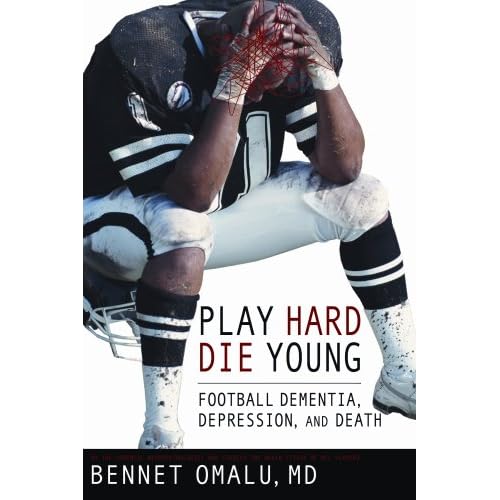
The initial instinct, admittedly, is to say that the history of a single modern sport might pale in significance to other human histories and suggest our fascination with it a tad overblown. But I happen to be reading the galleys of a book to be published next month by the pathologist who wrote the first paper in a peer-reviewed scientific journal linking repeated concussions in football to a horrible decline and death.

In Play Hard, Die Young, Dr. Bennet Omalu writes a sort of mystery story, particularly suited to this era of CSI mania. He has brain tissue from three former football players who suffered bizarre descents and deaths at relatively young ages. He must figure out why.

On some level, most football fans processed the sad story of Mike Webster's decline after a Hall of Fame career as a center for the Steelers. By the time of his induction speech in Canton, he was already having mental problems.

Omalu tells the heartrending story of Webster arising from the dinner table one night, in front of friends and family, opening the oven door and urinating in the oven, believing it to be a commode. Of his 17-year-old son putting a flag on the porch so his dad might recognize their home. Of his marriage dissolving. Of eventual paranoia and homelessness. Of loved ones having no idea why any of it was happening.

The most heavily publicized part of Webster's story was the NFL's refusal to grant him disability benefits for most of his life, perhaps the most shocking example of a heartless system that is only now being embarrassed into reform.

Less well-publicized were the deaths of Terry Long, an offensive lineman who played beside Webster in Pittsburgh, and Andre Waters, a fearsome defensive back for the Eagles. Long and Waters experienced declines similar to Webster's - a loss of cognitive ability and mood stability along with a growing paranoia.

Long was 45 when he killed himself by drinking antifreeze. Waters was 44 when he shot himself in the mouth.

Omalu is a Nigerian-born forensic pathologist who landed in Pittsburgh and was doing about 130 brain autopsies a year in the normal course of his practice. Webster and Long arrived in his lab requiring autopsies. He sought out brain samples from Waters.

Although all three brains appeared normal, Omalu reported that detailed tissue analysis revealed the presence of a form of dementia caused by repeated concussions. Omalu dubbed it "gridiron dementia," similar to dementia pugilistica, or punch-drunk syndrome, which affects boxers. The brain tissue, Omalu reports, resembled that of an 80-year-old dementia patient.

"The brains of boxers who suffer from dementia pugilistica, the brains of three retired NFL players, and the lives of other retired football players who have suffered from dementia are telling us that the way we look at concussions may not be correct," he writes.

"These brains and lives are telling us that certain types of individuals may not recover completely from concussions. Obvious clinical signs and symptoms may not be grossly present, but the brain cells may not recover bio-chemically at the sub-cellular level."

You may not be surprised to learn that the NFL has fought him every step of the way. In fact, NFL doctors tried to get his first paper, on the Webster case, retracted from the medical journal Neurosurgery, which declined their appeal.

"Some of my colleagues and I have wondered if the NFL was adopting a strategy that may be similar to the denial or coverup of the harmful effects of cigarette smoking by the tobacco industry," Omalu writes. "We honestly do not know."

A year ago, the NFL and players association established the "88 plan" in honor of Hall of Fame tight end John Mackey, who was diagnosed with dementia at age 59. It provided up to $88,000 a year for nursing or day care for former players suffering from dementia. Within three months, 54 retired players had applied for aid from the plan.

In the general population ages 60-69, dementia occurs in 66 out of 100,000 people, Omalu reports. With fewer than 10,000 living retired NFL players, the rate of application for the 88 plan suggests a rate at least 10 times greater.

Omalu's disturbing manuscript gives me a new appreciation for the "precipice of football history." Invocation of the Roman gladiators may not be so far off.

kriegerd@RockyMountainNews.com


http://www.rightwingnews.com/graphics/mccainforprez.jpg
From Real Clear Politics:
Why McCain Needs to Be Stopped

By Robert Tracinski

Will John McCain save Republicans?

McCain's South Carolina victory raises the possibility that he could save Republicans from a drawn-out primary battle by giving them a clear front-runner to rally behind, unifying the party well in advance of this summer's convention. And although it's still a bit early for these polls to mean very much, McCain does well in match-ups against Hillary Clinton and Barack Obama, so he offers Republicans the possibility that he could save them from defeat in November by attracting independents and winning against the Democratic nominee.

Many voters seem to be attracted to McCain because of his strong stance on the War on Terrorism, reinforced by his war-hero biography. This is part of the reason, for example, that Rudy Giuliani's poll numbers have declined precisely as McCain's have risen: both candidates are competing for the support of pro-war voters.

But that raises another, far more important question: if John McCain saves Republicans, who will save Republicans from John McCain?

The voters who support McCain over Giuliani are making a dangerously short-sighted trade. McCain is a suicidal choice for Republicans, because on every issue other than the war, he stands for capitulation to the left.

There are three big domestic issues that will be decided by the 2008 election: socialized medicine, higher taxes, and global warming regulations. The Democrats are in favor of all three--and John McCain won't stop them.

On health care, McCain has attacked pharmaceutical companies as "bad guys" who are using corrupt political influence to profit at the expense of the little guy--campaign rhetoric borrowed straight from one of John Edwards's "two Americas" tirades. McCain uses this rhetoric to support the re-importation of prescription drugs from Canada. The drugs are cheaper in Canada, but that's because Canada has a system of socialized medicine that imposes price controls. So importing drugs from Canada is just an indirect way of importing socialist price controls.

But every student of economics knows that price controls tend to choke off the supply of new drugs. Why should pharmaceutical companies invest billions of dollars in research and testing over a period of decades, if the government is going to steal their profits by dictating arbitrary prices?

Apparently, John McCain doesn't understand free-market economics and won't stand up for the principle of economic freedom. So how is he supposed to stand up to the Democrats on any part of their socialized medicine agenda?

In addition to fighting the Democrats on socialized medicine, a Republican president would also have to fight in Congress for the extension of President Bush's tax cuts, which are set to begin expiring in 2009 and 2010. A failure to extend these tax cuts (or to make them permanent) would mean a massive de facto tax increase. Yet McCain was opposed to the Bush tax cuts when they were first passed.

But the biggest problem for Republicans with McCain's candidacy is his stance on global warming. McCain has been an active promoter of the global warming hysteria--for which he has been lauded by radical environmentalists--and he is a co-sponsor of a leftist scheme for energy rationing. The McCain-Lieberman Climate Stewardship Act would impose an arbitrary cap on America's main sources of energy production, to be enforced by a huge network of federal taxes and regulations.

The irony is that McCain won in South Carolina among voters whose top concern is the economy. Don't these voters realize what a whole new regime of energy taxes and regulations would do to the economy?

No matter what happens, there is likely to be a huge debate in the coming years over global warming--whether it's really happening, whether it's actually caused by human beings, and what to do about it. But if the Republicans nominate McCain, that political debate will be over, and Al Gore and the left will have won it--thanks to John McCain.

And speaking of political debate, McCain is against it. The most notorious piece of legislation McCain has co-sponsored with the left is McCain-Feingold, which has the evil distinction of being the nation's first direct attack on the freedom of political speech during an election campaign, precisely when such speech is most important.

For Republicans, there is one form of suicide worse than losing the 2008 presidential election--and that is winning it with a candidate who will put the pro-welfare-state, pro-regulation left in the driver's seat of American politics. Yet that is precisely what Republican primary voters are unwittingly supporting when they vote for McCain.

So who will save Republicans from John McCain? In the early primaries, he has already shown he can beat Fred Thompson, Mike Huckabee, and--at least some of the time--Mitt Romney. And there's good reason why none of these candidates has been successful against McCain. None of them can match his appeal on foreign policy, and most of them offer their own major examples of capitulation to the left.

No, the best hope to save Republicans from McCain is the one candidate who hasn't yet fully entered the race--but who will finally have his chance against McCain in Florida: Rudy Giuliani.

As the one Republican running on both a strong foreign policy and a staunch pro-free-market platform, Giuliani may be the last hope to prevent a Republican suicide in 2008.

Robert Tracinski writes daily commentary at TIADaily.com. He is the editor of The Intellectual Activist and TIADaily.com

Monday, January 21, 2008

18 down, 1 to go for Patriots as they reach Super Bowl
From Fox Sports.com:
Patriots proved they could win ugly

by Mark Kriegel
Mark Kriegel is the national columnist for FOXSports.com. He is the author of two New York Times best sellers,
Namath: A Biography and Pistol: The Life of Pete Maravich, which Sports Illustrated called "the best sports biography of the year.


FOXBOROUGH, Mass. - Last week, Tom Brady threw but two incompletions.

On Sunday, with an historic season in the balance, the best big-game quarterback in football threw three interceptions.

This might seem like cause for optimism for the Giants. New York might also take comfort in the fact that Randy Moss, who set a record for touchdown receptions this season, was held to a single catch — and that didn't come until midway through the third quarter.

Yes, with this conference championship game now in evidence, there are a number of ways to argue against the Pats. San Diego was playing without the best runner in the game, who sat on the bench with his helmet on, as if hoping that his dark face mask could keep his true identity a secret. The Chargers quarterback, though game, was also gimpy with a bad knee. Finally, the star tight end (two catches, 17 yards) was rendered ineffective with a sprained toe. It stands to reason that a healthy Phillip Rivers, a healthy LaDainian Tomlinson and a healthy Antonio Gates might well have changed the outcome of this less-than-epic contest.

For much of the afternoon, the Patriots' record-breaking offense was considerably less than sharp. The signature play of their season has been Brady to Moss, who tends to catch the ball without any break in his long, loping strides. And as it began on Sunday, Brady threw to Moss on the Patriots' third play from scrimmage. But this time, the ball traveled a path not unlike a knuckle-change that got away. It wasn't the wind, either. It was Brady.

"We didn't execute as well as we're capable," he said. "... It just felt like everything was a struggle today."

This was the Patriots' game to lose. For whatever reason — give the San Diego defense, especially cornerback Quentin Jammer, a load of credit — their offense was sloppy and mistake-prone. Jammer leaped high to snare the first interception. The second came off a bad pass that Donte Stallworth could only get a hand on. The third was all Brady, as he lost track of cornerback Antonio Cromartie in the end zone.

So there you have it: the Patriots suddenly seem vulnerable. They can be beat.

Or can they?

There's another way to consider this contest. Even on their bad night — with their best player at his worst — the Patriots won. Again. The Chargers, on the road in the cold, had no pressure. With all the injuries, and the oddsmakers predicting a two-touchdown defeat, San Diego was playing with house money. On the other hand, the Patriots were looking at potentially the worst choke job in football history. But even as the game got tight, the Patriots did not.

And that — that ability to maintain their composure — is what should scare the hell out of the Giants.

"I've been with Tom for eight years," said Kevin Faulk. "He's thrown three interceptions before. He's the type of quarterback who just shakes it off. "

Lest you think Faulk was just talking, Brady was seven-for-seven in the fourth quarter. They were all short passes, the longest and last of them going for 14 yards to Faulk over the middle. But more than that, Brady's crew demonstrated spectacular adaptability.

As that fourth quarter began, the Patriots were clinging to a two-point lead and looking quite beatable. But then, without much warning, late in their 18th game of the season, they became a smash-mouth team.

Faulk, who is 31, caught the short passes, and Laurence Maroney, who is 22, started doing his Earl Campbell impression. Maroney finished with 122 yards, 106 of them in the second half. Recalled Faulk, "I told Laurence, 'Be patient, your time is going to come.' ... All year long we heard the question: 'Why don't you guys have a running game?' "

Well, Sunday they did — the sight of which would have warmed the hearts of smash-mouth advocates from Vince Lombardi to Bill Parcells. The Patriots didn't score on their last drive. But it was a triumph nonetheless, as they held the ball for the final nine minutes and 13 seconds.

The highest-scoring offense in football history has now shown it can win ugly.

The Giants should take note. It's not cause for much encouragement.
http://www.smidirect.net/images/belichick.jpg
From The Boston Globe:
18 down, 1 to go
Patriots win return trip to Super Bowl
to confront Giants and history

By Dan Shaughnessy, Globe Staff


FOXBOROUGH - Their relentless quest for perfection is almost complete. The undefeated New England Patriots need just one more victory to establish themselves as the 1927 Yankees of football: Greatest team ever.

The journey started one year ago today when the Patriots were humbled by the Indianapolis Colts in the AFC Championship game. The Patriots returned to the conference title game yesterday and beat the San Diego Chargers, 21-12, at frosty Gillette Stadium to advance to Super Bowl XLII.

The Patriots belong to the world now. There'll be no more games this season in the icy Foxborough football palace where the end zones are paved with gold. Already owning the best record in league history (18-0), walking where no NFL cleats have trod, the 2007-08 Patriots will play the New York Giants in the uber game in Glendale, Ariz., one week from Sunday.

Only one team in pro football history ever finished undefeated and the Patriots already have won more games than the 1972 Miami Dolphins (17-0).

"I'm happy we could win this at home, with all of you," Patriots owner Bob Kraft told the sellout crowd as he hoisted the Lamar Hunt Trophy after the final whistle sounded early last night. "We did what has never been done before."

Ever-stoic Patriots coach Bill Belichick told the fans, "All the credit goes to the players. The players played great all year and they did today. I'm really lucky to coach this team. Now we can look ahead."

Looking ahead is what the Patriots studiously avoided since early September. As they piled win upon win, they were asked about their place in history and always they stopped the music and recited the mantra: "We're just thinking about the next game."

Finally, the next game is the big game, the game that can seal their place in history.

Veteran linebacker Tedy Bruschi, who has been around since Bill Parcells took the Patriots to Super Bowl XXI against the Packers after the 1996-97 season, said, "If there was a time I felt any pressure this year it was before the final game against the Giants. We realized [a 16-0 regular season record] was possible to be achieved. There was history on the line all year."

History walks hand-in-hand with these Patriots. They have won three Super Bowls since 2001-02, but no NFL team has finished 19-0.

Since closing the regular season with a 38-35 win over the Giants at the Meadowlands, the Patriots have faced the prospect of an ignominious ending. Losing any playoff game, particularly one before the Super Bowl, would have made them targets of ridicule. The September Spygate episode and a succession of games in which they ran up the score made the Patriots the target of jealous fans around the nation.

Playing at home against the Eagles after Thanksgiving, the Patriots demonstrated new vulnerability and have been repeatedly tested in close games since beating Philadelphia, 31-28. Yesterday was no exception. The wounded Chargers intercepted Tom Brady three times and trailed by only 2 points (14-12) after three quarters. It was a pretty good showing for a team playing without the NFL's leading rusher (LaDainian Tomlinson carried the ball twice in the first quarter, then went to the sideline for the rest of the day because of a knee injury).

Last weekend the Chargers advanced to the AFC title game with a gutty upset of the defending Super Bowl champion Colts in Indianapolis. But the victory came at an enormous price. Tomlinson and quarterback Philip Rivers were wounded at the RCA Dome and all-world tight end Antonio Gates aggravated a toe injury. Gates was able to make only two catches yesterday and Rivers hobbled through the full four quarters, looking like the Knicks' Willis Reed limping at Madison Square Garden in the 1970 NBA Finals.

All of the above hindered the visitors at Gillette, but it was New England's ageless defense that kept the Chargers out of the end zone. Three times San Diego advanced inside New England's 10-yard line and failed to come away with a touchdown. It was the difference.

Brady, meanwhile, completed 22 of 33 passes, including two touchdown strikes, but was bothered by the three interceptions. New England's offense repeatedly was rescued by Laurence Maroney (122 yards on 25 carries) and Kevin Faulk (eight catches, 82 yards).

The Patriots led, 14-9, at halftime but the Chargers looked ready to take a third quarter lead when they moved the ball to the New England 4-yard line. That's when 39-year-old Junior Seau stuffed Michael Turner for a 2-yard loss on third down, forcing yet another Nate Kaeding field goal.

New England made it a two-score game with an eight-play, 67-yard drive to take a 21-12 lead early in the fourth quarter. The Chargers took over, moved the ball to the Patriot 36, then inexplicably punted on fourth and 10 with 9:21 left. A bold move, it was not. In the fine tradition of former coach Marty Schottenheimer, Norv Turner had clinched defeat for San Diego. The Chargers never got the ball again.

"Every time I've played in the Super Bowl, I've cherished that," said Brady. "It never gets old. Standing up there and accepting the Lamar Hunt Trophy for the fourth time is pretty outstanding."

The next trophy is the Lombardi Trophy. That's the one you get when you win the Super Bowl.

Dan Shaughnessy can be reached at dshaughnessy@globe.com.