Tuesday, January 20, 2009

http://cache.daylife.com/imageserve/03pq43a7X74Kg/610x.jpg
From The Wall Street Journal:
The NFL's Most Exciting Receiver
By REED ALBERGOTTI

While they're not over yet, this year's National Football League playoffs have already produced one spectacle for the ages: the remarkable ability of Arizona Cardinals' wide receiver Larry Fitzgerald to pluck passes out of the sky.

As the Cardinals prepare to face Philadelphia in Sunday's NFC championship game, Mr. Fitzgerald's acrobatics are the talk of the NFL. They have also stirred up a mystery: in photographs, Mr. Fitzgerald can often be seen doing something almost unfathomable: making catches with his eyes closed. "I don't understand it myself," he says.

On paper, Mr. Fitzgerald is not an extraordinary athlete. He's not the tallest receiver in the NFL or the best leaper. His 40-yard-dash time of 4.63 seconds at the 2004 NFL scouting combine is mediocre for the position. To explain his 1,431 yards receiving this season and his ability to haul in footballs with one hand or hold on to them while being pounded by defenders, most analysts say he must have soft hands, great timing or excellent body positioning.

But after 20 years of studying the eyes of elite athletes, and after taking into account two unusual opportunities Mr. Fitzgerald had as a child, one prominent researcher believes his catching talent has less to do with his hands and feet than his eyes and brain. The two catalysts for Mr. Fitzgerald's success may, in fact, be his stint as a teenage ballboy for the Minnesota Vikings and the summer days he spent at his grandfather's optometry clinic.

Joan Vickers, a cognitive psychologist at the University of Calgary, studies the eye movements of elite hockey goaltenders, baseball hitters, and tennis and volleyball players by having them play while wearing special goggles equipped with cameras that film their eyes. After watching Mr. Fitzgerald's 166-yard performance against the Carolina Panthers last week on television, she believes his talent reflects a mastery of two cognitive skills she has observed -- one called "the quiet eye" and another known as "predictive control."

While running downfield at a full sprint, Dr. Vickers says, no receiver has an easy time focusing intently on the football. To track its flight pattern, Dr. Vickers says, receivers like Mr. Fitzgerald have to glean whatever information they can about its speed, direction and rotation long before the ball gets close enough to catch. In some cases, she says, a receiver's only chance to predict where the football will end up may come at the moment the quarterback lets go of the ball. To make a correct call, the receiver has to operate his eyes like a camera: opening the shutter, holding the lens steady and taking a snapshot with the longest possible exposure.

The ability to maintain a level and strong gaze on a distant object for an unusually long period of time, even while moving, is something Dr. Vickers calls "the quiet eye." Her research suggests the difference between great athletes and good ones -- at least when it comes to sports that involve flying balls or pucks -- is the ability to lock down on these objects longer.

Mr. Fitzgerald may have a clear advantage in this area. When he was young, his grandfather, Robert Johnson, the founder of a optometry clinic in Chicago, set out to make sure his grandson had "visual dominance" -- at first because he was having trouble in school. From the time Mr. Fitzgerald was in first grade, during summer visits, Mr. Johnson would take him to the clinic and have him stand on balance beams and wobbly boards while doing complicated hand-eye drills. By the time his grandson was 12 and emerging as an athlete, Dr. Johnson tailored many of these exercises to athletics. To improve the boy's precision, control, spatial judgment and rhythm, for instance, Dr. Johnson would hang a painted ball from the ceiling and have him try to hit the colored dots on the ball with the matching colored stripes on a rolling pin.

Mr. Fitzgerald says he believes the training helped him on the football field. "When you're at that age, anything that helps strengthen your eyes and eye-hand coordination is going to definitely help with catching the ball," he says.

The second skill Dr. Vickers sees in Mr. Fitzgerald is predictive control -- the brain's ability to gather information from the eyes and use it to predict what will happen next.

Dr. Vickers says the best goalies and tennis players she's studied have two skills. First, they use the quiet-eye technique to take a clear snapshot of an approaching object and then, while it approaches them, will instantly compare it to a vast library of memories drawn from years of practice and observation. By matching that object with others, they can make a perfect calculation of where it will go and how to put themselves in position to make the play -- even if they aren't looking at the ball. The best athletes, then, can succeed without having to open their eyes. "It's a very, very amazing cognitive skill," she says.

For Mr. Fitzgerald, this means that after scanning a newly thrown ball with his quiet eye, he turns on the microprocessor in his head and downloads every similar pass he's seen until he's made a calculation about where this ball is likely to land. "People don't realize it," says Mr. Johnson, Mr. Fitzgerald's grandfather, "but we actually see with our brains."

Mr. Fitzgerald may have a better mental computer than most NFL receivers. Growing up in Minnesota his sportswriter father, Larry Fitzgerald Sr., helped his son get a job as a ballboy for the hometown Vikings for six seasons during his teenage years. This enabled the young Mr. Fitzgerald to see thousands of passes thrown and caught from the sidelines, to absorb these images up close in three dimensions and to study superstar receivers like Cris Carter and Randy Moss. Dr. Vickers says these experiences probably left Mr. Fitzgerald with a catalog of millions of impressions that would take most athletes years to build.

For Arizona quarterback Kurt Warner and the rest of the Cardinals offense, Mr. Fitzgerald's performance this season has made him a viable target even when he's smothered by defenders. He's also sparkled in the playoffs. In the first round against the Atlanta Falcons, he caught a touchdown in double coverage. Last week, with the team trailing the Carolina Panthers, he tipped the ball to himself while being violently sandwiched by two defenders, coming down with an implausible 41-yard play that "kick-started" the offense, according to Mr. Warner.

On Thanksgiving, when the Cardinals and Eagles last met, Mr. Fitzgerald found himself wide open on a pass play in the fourth quarter. As Eagles defensive backs converged on him, he leapt into the air and came down with a pass that most receivers might have missed. A still photograph (see above) later revealed that Mr. Fitzgerald's eyes were closed as he grabbed the ball.

When asked about the photo, Mr. Fitzgerald says he thinks his eyes were shut because he was bracing for the hit and that his instinct for catching passes is "second nature." Dr. Vickers believes it could be a textbook case of an athlete using predictive control to know exactly where to place his hands.

"I don't know how he makes those catches," says Cardinals head coach Ken Whisenhunt, "but there's no doubt Larry has an ability to catch a ball that is special."

Write to Reed Albergotti at reed.albergotti@wsj.com
  President Barack Obama puts his hand on the back of former President George W. Bush as they walk alongside first lady Michelle Obama and former first lady Laura Bush as they prepare to depart the U.S. Capitol after Obama was sworn in as the 44th president in Washington Tuesday, Jan. 20, 2009. (AP Photo/Saul Loeb, Pool)
President Barack Obama puts his hand on the back of former President George W. Bush as they walk alongside first lady Michelle Obama and former first lady Laura Bush as they prepare to depart the U.S. Capitol after Obama was sworn in as the 44th president in Washington Tuesday, Jan. 20, 2009. (AP Photo/Saul Loeb, Pool)
Saul Loeb / AP
From The American Thinker:
Bush and the Bush-Haters

By J. R. Dunn

There is one thing certain to go through Barack Obama's mind during the inauguration: at one point or another, while glancing at George W. Bush, he will consider the treatment that Bush got as president and hope to God he suffers nothing even vaguely similar.

It can be stated without fear of serious argument that no previous president has been treated as brutally, viciously, and unfairly as George W. Bush.

Bush 43 endured a deliberate and planned assault on everything he stood for, everything he was involved in, everything he tried to accomplish. Those who worked with him suffered nearly as much (and some even more -- at least one, Scooter Libby, was convicted on utterly specious charges in what amounts to a show trial).

His detractors were willing to risk the country's safety, its economic health, and the very balance of the democratic system of government in order to get at him. They were out to bring him down at all costs, or at the very least destroy his personal and presidential reputation. At this they have been half successful, at a high price for the country and its government.

Although everyone insists on doing so, it is impossible to judge Bush, his achievements, or his failings, without taking these attacks into account. Before any serious analysis of the Bush presidency can be made, some attempt to encompass the campaign against him must be carried out. I hope no one is holding his breath.

It's quite true that other presidents have suffered baseless attacks. Lincoln was generally dismissed as an imbecile, an unwashed backwoodsman, and an orang-outang (as they spelled it then). There exists an infamous Confederate cartoon portraying him with devil's horns and one foot on the Constitution. Next to no one at the time could have foreseen the towering stature Lincoln would at last attain.

Richard M. Nixon probably stands as the most hated president prior to Bush. But that was largely thanks to a relatively small coterie of east-coast leftists and their hangers-on, angered by Nixon's early anti-communism (which had become more "nuanced" by the time he took office, as the 1970 opening to China clearly reveals.). Nixon had the support of most of the country, the famed "silent majority", during his first term, and if not for his own personal failings, he would unquestionably have prevailed over his enemies. Difficult though it may be to believe, Nixon was only one paranoid slip away from being considered a great or near-great president

With Reagan, the coterie was even smaller and more isolated. His enemies continually underestimated him as a "B-movie actor" (which, by the way, showed a serious misunderstanding as to how the old studio system actually worked), and were just as continually flummoxed by his humor, his intelligence, and his unexcelled skill at communication. As the outpouring of public emotion surrounding his state funeral made clear, Reagan today stands as one of the beloved of all modern presidents.

Bush is alone at being attacked and denied support from all quarters -- even from many members of his own party. No single media source, excepting talk radio, was ever in his corner. Struggling actors and comics revived their careers though attacks on Bush. A disturbed woman perhaps a half step above the status of a bag lady parked outside his Crawford home to throw curses at him and was not only not sent on her way but joined by hundreds of others with plenty of spare time on their hands, an event covered in minute-by-minute detail by major media.

At least two films, one produced play, and a novel (by the odious Nicholson Baker, a writer with the distinction of dropping further down the ladder of decency with each work -- from sophisticated porn in Vox to degrading the war against Hitler in last year's Human Smoke) appeared calling for his assassination -- a new wrinkle in presidential criticism, and one that the left will regret. And let's not forget that tribune of the voiceless masses, Michael Moore, whose Fahrenheit 911 once marked the end-all and be-all of political satire but today is utterly forgotten.

While FDR was accused of having engineered Pearl Harbor (as if even an attempted attack on the US would not have been enough to get the country into WW II in real style), no president before Bush was ever subjected to the machinations of an entire conspiracy industry. The 9/11 Truthers, a mix of seriously disturbed individuals and hustlers out to pull a profitable con, accused Bush and his administration of crimes that put the allegations against Roosevelt in the shade, and with far less rational basis. These hallucinations were picked up the mass media, playing the role of transmission belt, and various fringe political figures along the lines of Cynthia McKinney.

But even this pales in light of the actions of the New York Times, which on its downhill road to becoming a weekly shopper giveaway for the Upper West Side, seriously jeopardized national security in the process of satisfying its anti-Bush compulsion. Telecommunications intercepts, interrogation techniques, transport of terrorist captives, tracking of terrorist finances... scarcely a single security program aimed at Jihadi activity went unrevealed by the Times and -- not to limit the blame -- was then broadcast worldwide by the legacy media. At one point, Times reporters published a detailed analysis of government methods of searching out rogue atomic weapons, a story that was no doubt read with interest at points north of Lahore, and one that we may all end up paying for years down the line. The fact that Bush was able to curtail any further attacks while the media as a whole was working to undermine his efforts is little less than miraculous.

As for his own party, no small number of Republicans (not all of them of the RINO fraternity) made a practice of ducking out on their party leader. Many refused to be photographed with him, several took steps to be out of town when he was scheduled to appear in their districts, and as for the few who actually spoke out in his favor... well, the names don't trip easily into mind. This naked pusillanimity played a large role in the GOP's 2006 and 2008 electoral debacles. Until the party grasps this, don't look for any major comeback.

And last but not least (I think we can safely overlook the flying shoes, which have been covered down to the last aglet), Bush is the sole American chief executive -- perhaps the sole leader in world history -- to have had a personality disorder named after him, the immortal Bush Derangement Syndrome. Few at this point recall that this was an actual psychological effort at diagnosing the president's effect on the tender psyches of this country's leftists. Was there a Hitler syndrome? A Stalin syndrome? The very existence of BDS says more about the left in general than it does about Bush.

What were the reasons for this hatred and the campaign that grew out of it? We can ask that question as often as we like, but we'll get no rational answer. All that we can be sure of is that Bush's actual policies and personality had little to do with it. Al Gore's egomaniacal attempt to defy this country's constitutional rules of succession merely acted as a trigger, giving the left a pretext to open up the attack. The same can be said about lingering bitterness over Bill Clinton's impeachment. While certainly a factor, it by no means accounts for a complete explanation. After all, did the GOP of the 70s go overboard in avenging Richard Nixon's forced resignation by working over Jimmy Carter? The best course was actually that which they followed, to allow Mr. Peanut to destroy himself.

As in all such cases, Bush hatred involves a number of factors that will be debated by historians for decades to come. But one component that cannot be overlooked is ideology, specifically the ideologization of American politics. It is no accident that the three most hated recent presidents are all Republican. These campaigns are yet another symptom of the American left's collapse into an ideological stupor characterized by pseudo-religious impulses, division of the world into black and white entities, and the unleashing of emotions beyond any means of rational control. The demonization of Bush -- and Reagan, and Nixon -- is the flip-side of the messianic response to Barack Obama.

There's nothing new about any of this. It's present in Orwell's 1984 in the "Five-Minute Hate" against the imaginary Emmanuel Goldstein, himself based on Leon Trotsky. The sole novel factor is its adaptation as a conscious tactic in democratic politics. That is unprecedented, and a serious cause for concern.

Being a Democrat, Obama has little to worry about, even with the far-left elements of his coalition beginning to sour on him. The ideological machinery is too unwieldy to swing around in order to target a single figure. Even if circumstances force him to violate the deeper tenets of his following, personal factors -- not limited to skin color -- will serve to protect him.

For the country as a whole, the prospects are bleaker. The left is convinced that hatred works, that it's a perfect tactic, one that will work every time out. They have already started the process with Sarah Palin, their next target in their long row of hate figures. They're wrong, of course. In a democracy, hatred is not a keeper, as the Know-Nothings, Radical Republicans, segregationists, Birchers, and many others have learned to their eventual dismay. But the process can take a long time to work itself out -- nearly a century, in the case of racial segregation -- and no end of damage can occur in the meantime. One of the byproducts of the campaign against Bush was to encourage Jihadis and Ba'athists in Iraq with the assurance of a repetition of Saigon 1975 as soon as the mad and bad Bush 43 was gotten out of the way. This time, the price was paid by the Iraqi people. But in the future, the bill may be presented somewhat closer to home.

And as for the "worst president in history" himself, George W. Bush has exhibited nothing but his accustomed serenity. Despite the worst his enemies could throw at him, his rehabilitation has already begun (as can be seen here, here, here, and here). He will be viewed at last as a man who picked up the worst hand of cards dealt to any president since Roosevelt and who played it out better than anyone had a right to expect. As Barack Obama seems to have realized, there is much to be learned from Bush, a man who appears to personify the golden mean, never too despondent, never too overjoyed, and never at any time overwhelmed.

Other presidents may encounter the same level of motiveless, mindless hatred, others may suffer comparable abuse -- but we can sure that no one will ever meet it with more equanimity than George W. Bush.

http://www.saboo.net/images/pittsburgh_teams.jpg
From The Wall Street Journal:
Sports Mania Is a Poor Substitute
for Economic Success

There's a reason so many Steeler fans
have left Pittsburgh.

By JERRY BOWYER

JANUARY 17, 2009, 9:09 A.M. ET

Pittsburgh

Tomorrow the Pittsburgh Steelers square off against the Baltimore Ravens, and the Philadelphia Eagles square off against the Arizona Cardinals. The winners will go head to head on Feb. 1 in Super Bowl XLIII.

If there ever was a time to crow about the wonders of rebuilding a city around a professional sports team, this would be it. Three of the four teams remaining in the play-offs hail from cities -- Baltimore, Philadelphia and Pittsburgh -- that in recent years spent billions rebuilding their downtowns around pro sports facilities and other community "anchors."

Except that there's a problem. The teams might be competitive, but the cities definitely are not. All three continue to shrink in population, and have stagnant job markets and crumbling public schools.

Baltimore, Philadelphia and Pittsburgh were prototypes of the economic development fad of the 1990s: government-financed "investments" in economic development. They all practiced what was called "tin cup urbanism" -- the belief that the rest of society owed large taxpayer transfers to the urban cores from which most of us have fled. They all supped from the same cup: center city stadia, aquaria and subsidized retailia.

Philadelphia practiced "the core, the core, the core" as a development strategy while perfecting the art of the tin cup under the guidance of then Mayor (now Gov.) Ed Rendell in the late 1990s. The feeling in Philadelphia was that the city was being crushed by economic forces outside of its control, and that the country owes cities, owes them big, and should pay up.

We did pay up, although Philadelphia's population declined 4.3% in the 1990s. And we will likely pay much more under Barack Obama's "stimulus" plan to spend hundreds of billions on new infrastructure. But based on experience, we won't see much renewal.

Baltimore's Inner Harbor development was the leader. Huge sums of government money poured into a very small patch of territory. Especially notable was a pricey public aquarium. Development officials claimed that by reviving the urban "core," economic health would return to the region. It didn't. The dawning of the Age of Aquarium has yet to appear.

On my last trip to Baltimore, it didn't take more than a three minute drive from the Inner Harbor before I could see burned-out neighborhoods. When I stopped for gas, I was aggressively panhandled by a man with a gold tooth in which a black ace was etched. Didn't see that guy in the development prospectus.

Pittsburgh followed the pattern, explicitly basing its development model partly on Baltimore and partly on Cleveland (from which Baltimore's football team had fled). The promises -- of "Renaissance III," "turning Pittsburgh back into a major league town again," and "creating a world class city" -- were grandiose. When city officials put the plan -- to spend taxpayer money on rebuilding downtown and subsidizing a stadium -- on the ballot, it got sacked. The referendum was rejected in all 11 counties in the metro area. It was a complete shut-out. Pittsburgh might be a drinking town with a football problem, as they say, but voters said no anyway on that one.

It didn't matter. Despite the referendum results, the city built it all anyway with public money. Then Mayor Tom Murphy and other city officials, as well as state legislators, went ahead. By 2003, two years after the project's completion, Pittsburgh faced bankruptcy.

A U.S. Census report just out shows that Pittsburgh's population has just been surpassed by Toledo, Ohio. Mayor Luke Ravenstahl, 28, the Burg's wunderkind without the wunder, responded this week to the news. He isn't interested in repealing the special tax breaks for favored businesses the city uses to tamp down calls for pro-growth tax cuts, or in demanding more accountability from a school system that spends $18,000 per-child every year. And he isn't talking about repealing a steep parking tax that socks commuters. He wants a recount from the Census Bureau.

But Pittsburgh has lost half of its population since the 1950s, the decade in which the city imposed its first individual income tax. That was the peak. Since then, each new tax designed to fund public works to "keep our young people here" spurs more and more people to call for a moving van.

Maybe America should take a look at Baltimore, Philadelphia and Pittsburgh before getting behind Mr. Obama's plan to use public-works projects to lead us out of economic morass.

In some ways, the sports mania in these towns is a substitute for genuine economic achievement. Sure the middle class is disappearing. But, hey, how 'bout them Steelers? Football triumphalism is a kind of civic cocaine, creating a sense of accomplishment where the reality is otherwise. (Maybe that's what's behind Western Europe's soccer fanaticism.)

When the Steelers were in the Super Bowl in 2006 I was the host of a radio show in Pittsburgh. I argued that the franchise was an exercise in leadership excellence in a city whose politicians were anything but. Numerous callers hammered me. They said there are a lot of "Steelers" bars across the country, and that proved the city still had some national respect. Indeed, there are hundreds of watering holes dispersed across America loaded with fanatical devotees of the Pittsburgh Steelers. "Where are the Seahawks bars?" the callers asked.

In Seattle, of course. That city has gained population while Pittsburgh lost it. Steelers bars are the visible cultural artifact of a kind of economic diaspora. People in those bars are the refugees who looked at high taxes, union dominance and lousy schools and voted with their feet. They can still root for their favorite team -- from Raleigh, North Carolina. You go South or West to get your bread. The circuses can be watched on cable.

Mr. Bowyer is the chairman of Bowyer Media, a Pennsylvania-based radio and television production company.

For conservatives, there are parts to disagree with, as might be expected. Overall, an excellent speech containing much also with which to agree as well as moving references to great moments in US History...
President Obama's Inaugural Address

Barack Obama

My fellow citizens:

I stand here today humbled by the task before us, grateful for the trust you have bestowed, mindful of the sacrifices borne by our ancestors. I thank President Bush for his service to our nation, as well as the generosity and cooperation he has shown throughout this transition.

Forty-four Americans have now taken the presidential oath. The words have been spoken during rising tides of prosperity and the still waters of peace. Yet, every so often the oath is taken amidst gathering clouds and raging storms. At these moments, America has carried on not simply because of the skill or vision of those in high office, but because We the People have remained faithful to the ideals of our forbearers, and true to our founding documents.

So it has been. So it must be with this generation of Americans.

That we are in the midst of crisis is now well understood. Our nation is at war, against a far-reaching network of violence and hatred. Our economy is badly weakened, a consequence of greed and irresponsibility on the part of some, but also our collective failure to make hard choices and prepare the nation for a new age. Homes have been lost; jobs shed; businesses shuttered. Our health care is too costly; our schools fail too many; and each day brings further evidence that the ways we use energy strengthen our adversaries and threaten our planet.

These are the indicators of crisis, subject to data and statistics. Less measurable but no less profound is a sapping of confidence across our land - a nagging fear that America's decline is inevitable, and that the next generation must lower its sights.

Today I say to you that the challenges we face are real. They are serious and they are many. They will not be met easily or in a short span of time. But know this, America - they will be met.

On this day, we gather because we have chosen hope over fear, unity of purpose over conflict and discord.

On this day, we come to proclaim an end to the petty grievances and false promises, the recriminations and worn out dogmas, that for far too long have strangled our politics.

We remain a young nation, but in the words of Scripture, the time has come to set aside childish things. The time has come to reaffirm our enduring spirit; to choose our better history; to carry forward that precious gift, that noble idea, passed on from generation to generation: the God-given promise that all are equal, all are free, and all deserve a chance to pursue their full measure of happiness.

In reaffirming the greatness of our nation, we understand that greatness is never a given. It must be earned. Our journey has never been one of short-cuts or settling for less. It has not been the path for the faint-hearted - for those who prefer leisure over work, or seek only the pleasures of riches and fame. Rather, it has been the risk-takers, the doers, the makers of things - some celebrated but more often men and women obscure in their labor, who have carried us up the long, rugged path towards prosperity and freedom.

For us, they packed up their few worldly possessions and traveled across oceans in search of a new life.

For us, they toiled in sweatshops and settled the West; endured the lash of the whip and plowed the hard earth.

For us, they fought and died, in places like Concord and Gettysburg; Normandy and Khe Sahn.

Time and again these men and women struggled and sacrificed and worked till their hands were raw so that we might live a better life. They saw America as bigger than the sum of our individual ambitions; greater than all the differences of birth or wealth or faction.

This is the journey we continue today. We remain the most prosperous, powerful nation on Earth. Our workers are no less productive than when this crisis began. Our minds are no less inventive, our goods and services no less needed than they were last week or last month or last year. Our capacity remains undiminished. But our time of standing pat, of protecting narrow interests and putting off unpleasant decisions - that time has surely passed. Starting today, we must pick ourselves up, dust ourselves off, and begin again the work of remaking America.

For everywhere we look, there is work to be done. The state of the economy calls for action, bold and swift, and we will act - not only to create new jobs, but to lay a new foundation for growth. We will build the roads and bridges, the electric grids and digital lines that feed our commerce and bind us together. We will restore science to its rightful place, and wield technology's wonders to raise health care's quality and lower its cost. We will harness the sun and the winds and the soil to fuel our cars and run our factories. And we will transform our schools and colleges and universities to meet the demands of a new age. All this we can do. And all this we will do.

Now, there are some who question the scale of our ambitions - who suggest that our system cannot tolerate too many big plans. Their memories are short. For they have forgotten what this country has already done; what free men and women can achieve when imagination is joined to common purpose, and necessity to courage.

What the cynics fail to understand is that the ground has shifted beneath them - that the stale political arguments that have consumed us for so long no longer apply. The question we ask today is not whether our government is too big or too small, but whether it works - whether it helps families find jobs at a decent wage, care they can afford, a retirement that is dignified. Where the answer is yes, we intend to move forward. Where the answer is no, programs will end. And those of us who manage the public's dollars will be held to account - to spend wisely, reform bad habits, and do our business in the light of day - because only then can we restore the vital trust between a people and their government.

Nor is the question before us whether the market is a force for good or ill. Its power to generate wealth and expand freedom is unmatched, but this crisis has reminded us that without a watchful eye, the market can spin out of control - and that a nation cannot prosper long when it favors only the prosperous. The success of our economy has always depended not just on the size of our Gross Domestic Product, but on the reach of our prosperity; on our ability to extend opportunity to every willing heart - not out of charity, but because it is the surest route to our common good.

As for our common defense, we reject as false the choice between our safety and our ideals. Our Founding Fathers, faced with perils we can scarcely imagine, drafted a charter to assure the rule of law and the rights of man, a charter expanded by the blood of generations. Those ideals still light the world, and we will not give them up for expedience's sake. And so to all other peoples and governments who are watching today, from the grandest capitals to the small village where my father was born: know that America is a friend of each nation and every man, woman, and child who seeks a future of peace and dignity, and that we are ready to lead once more.

Recall that earlier generations faced down fascism and communism not just with missiles and tanks, but with sturdy alliances and enduring convictions. They understood that our power alone cannot protect us, nor does it entitle us to do as we please. Instead, they knew that our power grows through its prudent use; our security emanates from the justness of our cause, the force of our example, the tempering qualities of humility and restraint.

We are the keepers of this legacy. Guided by these principles once more, we can meet those new threats that demand even greater effort - even greater cooperation and understanding between nations. We will begin to responsibly leave Iraq to its people, and forge a hard-earned peace in Afghanistan. With old friends and former foes, we will work tirelessly to lessen the nuclear threat, and roll back the specter of a warming planet. We will not apologize for our way of life, nor will we waver in its defense, and for those who seek to advance their aims by inducing terror and slaughtering innocents, we say to you now that our spirit is stronger and cannot be broken; you cannot outlast us, and we will defeat you.

For we know that our patchwork heritage is a strength, not a weakness. We are a nation of Christians and Muslims, Jews and Hindus - and non-believers. We are shaped by every language and culture, drawn from every end of this Earth; and because we have tasted the bitter swill of civil war and segregation, and emerged from that dark chapter stronger and more united, we cannot help but believe that the old hatreds shall someday pass; that the lines of tribe shall soon dissolve; that as the world grows smaller, our common humanity shall reveal itself; and that America must play its role in ushering in a new era of peace.

To the Muslim world, we seek a new way forward, based on mutual interest and mutual respect. To those leaders around the globe who seek to sow conflict, or blame their society's ills on the West - know that your people will judge you on what you can build, not what you destroy. To those who cling to power through corruption and deceit and the silencing of dissent, know that you are on the wrong side of history; but that we will extend a hand if you are willing to unclench your fist.

To the people of poor nations, we pledge to work alongside you to make your farms flourish and let clean waters flow; to nourish starved bodies and feed hungry minds. And to those nations like ours that enjoy relative plenty, we say we can no longer afford indifference to suffering outside our borders; nor can we consume the world's resources without regard to effect. For the world has changed, and we must change with it.

As we consider the road that unfolds before us, we remember with humble gratitude those brave Americans who, at this very hour, patrol far-off deserts and distant mountains. They have something to tell us today, just as the fallen heroes who lie in Arlington whisper through the ages. We honor them not only because they are guardians of our liberty, but because they embody the spirit of service; a willingness to find meaning in something greater than themselves. And yet, at this moment - a moment that will define a generation - it is precisely this spirit that must inhabit us all.

For as much as government can do and must do, it is ultimately the faith and determination of the American people upon which this nation relies. It is the kindness to take in a stranger when the levees break, the selflessness of workers who would rather cut their hours than see a friend lose their job which sees us through our darkest hours. It is the firefighter's courage to storm a stairway filled with smoke, but also a parent's willingness to nurture a child, that finally decides our fate.

Our challenges may be new. The instruments with which we meet them may be new. But those values upon which our success depends - hard work and honesty, courage and fair play, tolerance and curiosity, loyalty and patriotism - these things are old. These things are true. They have been the quiet force of progress throughout our history. What is demanded then is a return to these truths. What is required of us now is a new era of responsibility - a recognition, on the part of every American, that we have duties to ourselves, our nation, and the world, duties that we do not grudgingly accept but rather seize gladly, firm in the knowledge that there is nothing so satisfying to the spirit, so defining of our character, than giving our all to a difficult task.

This is the price and the promise of citizenship.

This is the source of our confidence - the knowledge that God calls on us to shape an uncertain destiny.

This is the meaning of our liberty and our creed - why men and women and children of every race and every faith can join in celebration across this magnificent mall, and why a man whose father less than sixty years ago might not have been served at a local restaurant can now stand before you to take a most sacred oath.

So let us mark this day with remembrance, of who we are and how far we have traveled. In the year of America's birth, in the coldest of months, a small band of patriots huddled by dying campfires on the shores of an icy river. The capital was abandoned. The enemy was advancing. The snow was stained with blood. At a moment when the outcome of our revolution was most in doubt, the father of our nation ordered these words be read to the people:

"Let it be told to the future world...that in the depth of winter, when nothing but hope and virtue could survive...that the city and the country, alarmed at one common danger, came forth to meet [it]."

America. In the face of our common dangers, in this winter of our hardship, let us remember these timeless words. With hope and virtue, let us brave once more the icy currents, and endure what storms may come. Let it be said by our children's children that when we were tested we refused to let this journey end, that we did not turn back nor did we falter; and with eyes fixed on the horizon and God's grace upon us, we carried forth that great gift of freedom and delivered it safely to future generations.

Thank you.

God bless you. And God bless the United States of America.

Barack Obama is the President of the United States of America.

Monday, January 19, 2009

http://upload.wikimedia.org/wikipedia/commons/thumb/9/93/Bruce_springsteen_front.jpg/460px-Bruce_springsteen_front.jpg
From The Telegraph (UK):
Bruce Springsteen,
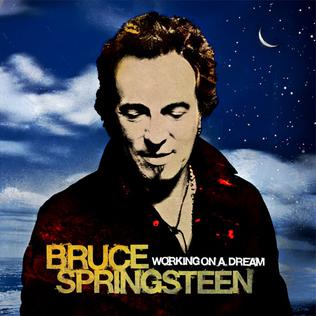
Working on a Dream – review

Springsteen has swapped anger
for romance on his 24th album.
By Neil McCormick

Bruce Springsteen
Working On A Dream
(Columbia)

Springsteen 24th studio album follows 2007's Magic, a record underscored by fear, disgust and shame at the direction of his country under Bush. But now, as he plays to inaugurate a new president, the weight seems to have been lifted. The most political thing about Working On A Dream is that it is not political at all.

The Boss is in love, and doesn't care who knows it.

On Queen of the Supermarket, Bruce Springsteen drives a shopping cart rather than a Cadillac, swooning over a check out girl with the wry tenderness of a Midwestern Morrissey. The E Street Band fill the supermarket aisles with a lush update of Roy Orbison-style operatic rock 'n roll.

At times the sentiments come close to Tin Pan Alley cheesiness. In Kingdom of Days he rhymes "I love you", "I do", and "blue", while also drawing attention to the moon and sun. Yet Springsteen is too substantial a songwriter to fall into cliché. The dark heart of love is glimpsed in the desperate epic Life Itself, while even the simplest songs contain hard won wisdom.

On rare occasions when he strays from amour it is to celebrate hearty male friendship. The album's opener, Outlaw Pete is a sprawling folk saga, comic and touching, with a wild arrangement that hearkens back to the kind of music Springsteen made in the early 70s, before he really started to define himself.

The epic qualities of the E Street Band's sound is easily pastiched (indeed, others have built entire careers on it, from Bon Jovi to the Hold Steady) but Springsteen is moving forward by looking backwards. He has clearly been listening to '5th Dimension' era Byrds, The Beach Boys, West Coast Psychedelia and even pre-rock big band ballads. The arrangements are as likely to include swoonsome strings and choral singing as Clarence Clemons' trademark ripe sax.

This, I suspect, is Springsteen's idea of a pop album. But don't accuse the Boss of going soft. If anyone can make romance sound like manly business, Bruce can.

Download this: Life Itself
http://upload.wikimedia.org/wikipedia/en/1/1c/Working_on_a_Dream.jpg
From Newark Star-Ledger:
Blues, power-pop and love songs
meld on 'Working On a Dream'

by Jay Lustig

Monday January 19, 2009, 5:00 AM

"Working On a Dream" is Bruce Springsteen's "White Album."

Like The Beatles' 1968 double album (officially titled "The Beatles"), it's full of surprises, covers an exceptionally broad range of musical styles, and is both deeply serious and, occasionally, whimsical.

Springsteen, 59, doesn't go as far out on a limb as The Beatles did: There is no equivalent to the "White Album" sound collage, "Revolution 9." But "Working On a Dream" does have a spooky, snarling blues tune ("Good Eye"), a lavish Beach Boys homage ("This Life"), a buoyant power-pop song ("Surprise Surprise") and the strange-but-wonderful "Queen of the Supermarket" -- a rapturous, almost Roy Orbisonesque love song, addressed to a checkout clerk.

"I'm in love with the queen of the supermarket/As the evening sky turns blue, a dream awaits in aisle No. 2," sings Springsteen, the music swelling majestically behind him. "With my shopping cart I move through the heart/Of a sea of fools so blissfully unaware/That they're in the presence of something wonderful and rare."

"Working On a Dream" comes out Jan. 27, which is about 16 months after the release of Springsteen's last album, "Magic." Given that he toured behind "Magic" until August 2008, this is an exceptionally speedy turnaround.

In a November press statement announcing the album's release, Springsteen said the songs were written quickly and recorded with members of his E Street Band during breaks in the "Magic" tour. "We usually used one of the first takes," he said.

Occasionally, a lyric does seem in need of a little refining.

"I love you, I love you, I love you, I love you, I do/You whispered 'Then prove it, then prove it, then prove it to me, baby blue,' " Springsteen croons in "Kingdom of Days," another lushly romantic, Orbisoneque track.

"At 25, a mustang pony he did steal, and they rode around and 'round on heaven's wheel," he sings in "Outlaw Pete," an eight-minute, quasi-mythic Western tale about Outlaw Pete and his nemesis, "bounty hunter Dan."

The title track itself seems misconceived, too, with an easy-going vibe that contradicts the idea of working to make a dream come true, and a whistling interlude. There is just no way to keep a whistling interlude from sounding corny.

A few missteps is a small price to pay, though, for an album as consistently lively as this one. With its swirling organ riffs, plus howled backing vocals by Steven Van Zandt and a Clarence Clemons sax solo, "My Lucky Day" echoes the garage-rock urgency of "Two Hearts," from Springsteen's 1980 album "The River" (his only prior release to approach the stylistic breadth of this one). Springsteen achieves an even greater sense of abandon in the blues of "Good Eye" and the pop uplift of "Surprise Surprise."

With its chiming guitars, "Surprise Surprise" is one of several tracks that suggest Springsteen has been listening to lots of Byrds CDs lately. The gently rolling, countryish sound of "Tomorrow Never Knows" is evocative of that band's "Ballad of Easy Rider," and the psychedelic guitar solo on "Life Itself" could have been lifted from "Eight Miles High."

"The Last Carnival" is a sweet, somber tribute to the late E Street Band keyboardist Danny Federici, featuring Federici's son Jason on accordion. "We won't be dancing together on the high wire/Facing the lions with you at my side, anymore," sings Springsteen, early on. Later, the song dissolves into a chorus of wails.

The behind-the-scenes documentary that's on the DVD of deluxe editions of the album is far from essential. But images, there, of Federici, Springsteen and various E Streeters during "The Last Carnival" do make this song even more of a heart-tugger.

While the album-opening "Outlaw Pete" is half-baked -- Pete isn't enough of a character, and there isn't enough of a story, to justify the eight-minute length -- album-closer "The Wrestler" is flawless. This dry, dusty song, written for the new Mickey Rourke movie of the same name, is as real as "Outlaw Pete" is phony. Instead of just telling a story, Springsteen gets inside the character, who calmly, sadly sings of his own shortcomings, with minimal musical accompaniment: "Have you ever seen a one-armed man punching at nothing but the breeze?/If you've ever seen a one-armed man then you've seen me."

Like much of "Working On a Dream," it's like nothing else on the album, but the setting seems perfect.

Jay Lustig may be reached at jlustig@starledger.com or (973) 392-5850.

Sunday, January 18, 2009

http://www.pf-militarygallery.com/images/strain/Battlefield%20Prayer.jpg
From VDare.com:
Praise For Lee And Jackson
By Chuck Baldwin

January 16, 2009

January is often referred to as "Generals Month" since no less than four famous Confederate Generals claimed January as their birth month: James Longstreet (Jan. 8, 1821), Robert E. Lee (Jan. 19, 1807), Thomas Jonathan "Stonewall" Jackson (Jan. 21, 1824), and George Pickett (Jan. 28, 1825). Two of these men, Lee and Jackson, are particularly noteworthy.

Without question, Robert E. Lee and "Stonewall" Jackson were two of the greatest military leaders of all time. Even more, many military historians regard the Lee and Jackson tandem as perhaps the greatest battlefield duo in the history of warfare. If Jackson had survived the battle of Chancellorsville, it is very possible that the South would have prevailed at Gettysburg and perhaps would even have won the War Between the States.

In fact, it was Lord Roberts, commander-in-chief of the British armies in the early twentieth century, who said, "In my opinion, Stonewall Jackson was one of the greatest natural military geniuses the world ever saw. I will go even further than that--as a campaigner in the field, he never had a superior. In some respects, I doubt whether he ever had an equal."

While the strategies and circumstances of the War of Northern Aggression can (and will) be debated by professionals and laymen alike, one fact is undeniable: Robert E. Lee and Thomas J. Jackson were two of the finest Christian gentlemen this country has ever produced. Both their character and their conduct were beyond reproach.

Unlike his northern counterpart, Ulysses S. Grant, General Lee never sanctioned or condoned slavery. Upon inheriting slaves from his deceased father-in-law, Lee immediately freed them. And according to historians, Jackson enjoyed a familial relationship with those few slaves that were in his home. In addition, unlike Abraham Lincoln and U.S. Grant, there is no record of either Lee or Jackson ever speaking disparagingly of the black race.

As those who are familiar with history know, General Grant and his wife held personal slaves before and during the War Between the States, and, contrary to popular opinion, even Lincoln's Emancipation Proclamation did not free the slaves of the North. They were not freed until the Thirteenth Amendment was passed after the conclusion of the war. Grant's excuse for not freeing his slaves was that "good help is so hard to come by these days."

Furthermore, it is well established that Jackson regularly conducted a Sunday School class for black children. This was a ministry he took very seriously. As a result, he was dearly loved and appreciated by the children and their parents.

In addition, both Jackson and Lee emphatically supported the abolition of slavery. In fact, Lee called slavery "a moral and political evil." He also said "the best men in the South" opposed it and welcomed its demise. Jackson said he wished to see "the shackles struck from every slave."

To think that Lee and Jackson (and the vast majority of Confederate soldiers) would fight and die to preserve an institution they considered evil and abhorrent--and that they were already working to dismantle--is the height of absurdity. It is equally repugnant to impugn and denigrate the memory of these remarkable Christian gentlemen.

In fact, after refusing Abraham Lincoln's offer to command the Union Army in 1861, Robert E. Lee wrote to his sister on April 20 of that year to explain his decision. In the letter he wrote, "With all my devotion to the Union and the feeling of loyalty and duty of an American citizen, I have not been able to make up my mind to raise my hand against my relatives, my children, my home. I have therefore resigned my commission in the army and save in defense of my native state, with the sincere hope that my poor services may never be needed . . ."

Lee's decision to resign his commission with the Union Army must have been the most difficult decision of his life. Remember that Lee's direct ancestors had fought in America's War For Independence. His father, "Light Horse Harry" Henry Lee, was a Revolutionary War hero, Governor of Virginia, and member of Congress. In addition, members of his family were signatories to the Declaration of Independence.

Remember, too, that not only did Robert E. Lee graduate from West Point "at the head of his class" (according to Benjamin Hallowell), he is yet today one of only six cadets to graduate from that prestigious academy without a single demerit.

However, Lee knew that Lincoln's decision to invade the South in order to prevent its secession was both immoral and unconstitutional. As a man of honor and integrity, the only thing Lee could do was that which his father had done: fight for freedom and independence. And that is exactly what he did.

Instead of allowing a politically correct culture to sully the memory of Robert E. Lee and Thomas J. Jackson, all Americans should hold them in a place of highest honor and respect. Anything less is a disservice to history and a disgrace to the principles of truth and integrity.

Accordingly, it was more than appropriate that the late President Gerald Ford, on August 5, 1975, signed Senate Joint Resolution 23, "restoring posthumously the long overdue, full rights of citizenship to General Robert E. Lee."

According to President Ford, "This legislation corrects a 110-year oversight of American history." He further said, "General Lee's character has been an example to succeeding generations . . ."

The significance of the lives of Generals Lee and Jackson cannot be overvalued. While the character and influence of most of us will barely be remembered two hundred days after our departure, the sterling character of these men has endured for two hundred years.

What a shame that so many of America's youth are being robbed of knowing and studying the virtue and integrity of the great General Robert E. Lee and General Thomas J. "Stonewall" Jackson.

Dr. Chuck Baldwin is the pastor of Crossroad Baptist Church in Pensacola, Florida. He hosts a weekly radio show. His website is here.

http://blog.spout.com/wp-content/uploads/barack-obama-2.jpg
From chicagotribune.com:
Even Barack Obama will be judged
by what he does as president

By Patrick T. Reardon

January 17, 2009

This is not another installment in the media's—and the nation's—fascination with President-elect Barack Obama. And the school his girls attend. And the dress Michelle will wear for the inauguration. And who will pray what prayer at the ceremony. And who will be the White House chef.

This is a reality check. No, even better, think of it as a reality reminder.

This guy is going to be inaugurated, and then he's going to become—drumroll, please!—routine. And not just routine.

People—basically all of us at some point—aren't going to like him. Remember, nearly half the country voted for the other guy. You, even if you've been a dyed-in-the-wool Obama-ite from the word "go," are almost certain to be upset by or turned off by something he'll do over the next four years.

Sure, he's the first African-American president, and there will always be something special about that. But he's just a guy, and this is a job that involves dozens, if not hundreds, of decisions every day. Every decision involves winners and losers, and the losers don't like not winning.

I'm not saying Obama will be a bad president. He could be good, even great. But greatness is not protection against criticism.

Lyndon Johnson did more for the civil rights movement than any other president in history. Yet he was reviled for policies that got us deeper and deeper into the Vietnam War.

Franklin Delano Roosevelt led the nation through the Great Depression and World War II. Yet, for a certain segment of the nation's population, he was always "that man in the White House," a traitor to his class, a socialist, an upsetter of apple carts, a warmonger. Even those who loved him for his jauntiness in the face of crisis could find fault with his attempt to pack the Supreme Court.

Obama, a transplanted son of Illinois, has done much as a candidate and president-elect to draw parallels with that other Illinois transplant, Abraham Lincoln.

Widely considered the greatest president, Lincoln led the nation through its darkest danger and direst tragedy, the Civil War. Through his eloquence, clear-headedness, intellectual and moral strength, political savvy and, let's face it, luck, he kept the North united and found the means to bring the South, against its wishes, back into the fold.

Then, at the height of his success, an assassin's bullet took his life, and he became a national martyr.

Yet, had Lincoln lived, almost certainly his legacy would have been a lot more mixed.

Most of us don't realize that Lincoln was a controversial president, criticized for acting unilaterally to limit civil liberties, suspend the writ of habeas corpus and imprison without trial thousands of border-state residents suspected of sympathizing with the rebels.

He was blamed by many in the North for the long, bloody conflict, and, a few months before the 1864 election, he wrote that it seemed "exceedingly probable that this Administration will not be re-elected." A month later, though, Gen. William Sherman captured Atlanta, giving Lincoln the boost he needed to win a second term.

His running mate was Andrew Johnson, who became president at Lincoln's death and ran afoul of Congress by urging a gentler Reconstruction than Northern firebrands wanted. He was impeached and came within a vote of being removed from office.

Lincoln's attitude toward the reincorporation of the South into the Union was very similar to Johnson's. Had he survived, would he have faced impeachment as Johnson did?

There's no way to know, of course, but the reality is that, with the war finished, it would have been politics as usual. Lincoln would have been just another president trying to work with the Congress. He certainly wouldn't have been the secular saint that he became.

Like Lincoln, come Tuesday, Obama will be just another president trying to work with Congress. Our focus won't be on what sort of dog he'll get for his daughters, but on the sort of health-care program he'll try to implement. And on his plans for Iran. And the Gaza Strip. And the Iraq War. And the nation's economy. And on and on.

The novelty of this guy with the interesting life story will wear off. He'll be just another president—like the 43 who preceded him.

We'll judge him on what he does. Over and over and over again.
http://www.allamericanpatriots.com/files/images/george-w-bush-2.jpg
From NEWSWEEK:
43, For a Final Time

He takes his leave neither angry nor forlorn
but rather with the serenity of someone sustained
by a providential sense of history.
By George F. Will

Jan 26, 2009

As the nation arrives, for the first time since 1825, at the end of consecutive eight-year presidencies, a summing up of the second of them must begin with this fact: Not since Abraham Lincoln's has an administration been so defined by a single subject as George W. Bush's has been by the Iraq War, which the country now thinks was improvidently begun and incompetently conducted. Historical judgments are, however, subject to history's contingencies, and if, a decade hence, Iraq has a nonsectarian regime controlled by a multiparty, recognizably democratic process, and if this exerts an improving tug on the region, Americans might then consider the war at least partially redeemed.

If history's judgment is that the war was positively related to the fact that there was no attack on America after 9/11, then history's judgment of the commander in chief will be much less severe than today's unhinged critics of him can imagine. Furthermore, some, and perhaps many, Americans probably are alive today because persons conspiring to commit mass murder were thwarted by the president's ferocious focus after 9/11.

He believes that America has "a calling from beyond the stars to stand for freedom." But "standing for" does not entail "exporting." To stroll in Arlington cemetery among headstones recording deaths during the appallingly named "Operation Iraqi Freedom" is infuriating: No American should have died for freedom in Iraq, and none did. All who sacrificed there did so for the security of America's freedom. The "nation building" there has been a learning experience, teaching Americans to recoil from suggested repetitions.

The administration's failures in responding to Hurricane Katrina were real but secondary to, and less shocking than, the manifold derelictions of duties by the governments of Louisiana and New Orleans. A failed nomination to the Supreme Court, that of Harriet Miers, was, however, indicative of the obduracy, arrogance and frivolity that at times characterized this administration. On the other hand, among Bush's excellent legacies, gifts that might keep on giving for decades, are two justices—John Roberts and Sam Alito.

Within the lifetimes of most Americans now living, today's media-manufactured alarm about man-made global warming might be an embarrassing memory. The nation will then be better off because Bush—during whose administration the embarrassing planet warmed not at all—refused to be stampeded toward costly "solutions" to a supposed crisis that might be chimerical, and that, if real, could be adapted for considerably less cost than will be sunk in efforts at prevention.

Just as Bill Clinton's presidency was costly for the Democratic Party, which had fewer senators, representatives, governors and state legislators when he left the White House than when he entered it, Bush's presidency has taken a terrific toll on the Republican Party's sense of itself. Consider:

By grafting a prescription-drug entitlement on to Medicare, just as the demographic deluge of the baby boomers' retirements was beginning, the president expanded the welfare state more than any president since Lyndon Johnson created Medicare in 1965. By signing every grotesque spending measure that arrived on his desk with the support of a majority of congressional Republicans—e.g., the 2002 farm bill that increased corporate welfare for agriculture at a time of record farm profits —the president committed his party to a situational ethic of governance that amounts to no ethic at all. By signing the McCain-Feingold speech-rationing (a.k.a. "campaign reform") legislation, the president violated his oath to defend the Constitution. By federalizing the family tragedy of Terri Schiavo, the president and some congressional allies made risible their stock of rhetoric in praise of limited government. By enacting the No Child Left Behind law, which is the thin end of a potentially enormous wedge, the administration licensed potentially unlimited federal supervision of the quintessentially local responsibility of education in grades K through 12, thereby further weakening federalism. And by presiding, in its last four months, over more and more flamboyant government intervention in the economy than at any time in 75 years, the administration completed the GOP's intellectual disarmament.

Actually, however, the contraction and self-marginalization of the Republican Party began before Bush entered office. In 2000, he became the first Republican to win the presidency while losing the North. In 2004, when he won re-election by winning Ohio, that was the only large state he carried outside the South. That year Bush became the first president since his father in 1988 to win more than 50 percent of the vote. This was a costly achievement, attained by embracing a sterile template of politics: Get your base riled up—it does not much matter about what—and hope that your base is a bit larger and angrier than the other party's, and that swing voters are a small slice of the turnout.

The president does not depart an angry man. He takes his leave with the serenity of someone sustained by a providential sense of history, as well as by wide reading of presidential histories, which contain many accounts of miseries. He leaves in eager anticipation of resuming life where he has been happiest, deep in the heart of Texas.

Pete Carroll and Mark Sanchez walk past each
other after Sanchez announced he was going
pro. Carroll made clear he didn't agree with the
decision. (AP Photo/Damien Dovarganes)
From CBSSports.com:
Not everybody heard Carroll being a selfish jerk
By Gregg Doyel

Jan. 18, 2009

Pete Carroll spoke, and everyone heard the same thing. Everyone was listening, too, because this was a major press conference -- USC quarterback Mark Sanchez was announcing his decision to turn pro after his junior season.

Carroll spoke Thursday, questioning Sanchez's decision, and the Los Angeles Times heard Carroll "publicly scorn" Sanchez and treat him "like a traitor (or) ... a jilted lover." Sports Illustrated heard Carroll "rain on Sanchez's parade." Mike Wilbon of ESPN heard such disrespect that he said, "If I was Mark Sanchez's father I would have taken a swing at Pete Carroll."

Like I said, Pete Carroll spoke -- and everyone heard the same thing.

Everyone but me.

And listen to me. I am wired, by nature, to not like Pete Carroll or the Southern California football team. They're too hip, too cool. Too good. I'm wired to hear the same thing everyone else heard, and everyone else heard Carroll being a selfish jerk.

Me, I heard something different. I heard Carroll being fed up with Sanchez, and with the people around Sanchez.

Understand something. Yes, for the 2008 season, Sanchez was a superstar. I get that. But for the three previous years, he was a major pain in the ass. You have to take that into consideration, or you can't fairly judge how Carroll acted, and what he said, at that press conference. What he said was startling. He said, "We don't see this decision the same. Mark's going against the grain, and he knows that." And he said, "I am disappointed the information we have wasn't compelling enough to make it clear to him (to stay)."

How Carroll acted was an even bigger shock. He basically declined to sit next to his player at the podium. He gave Sanchez a half-hearted handshake goodbye. He then left the press conference while Sanchez was still speaking.

That's the headline, and everyone wrote it: Pete Carroll's a jerk!

But here's the back story.

In April of his freshman season, Sanchez was arrested after a female USC student accused him of sexual assault. I'm not accusing Sanchez of anything. Guilty, innocent, I don't know. The charges were eventually dropped, but Sanchez's arrest was one in a long line of negative off-field stories Carroll and the USC program had to endure.

Carroll stood by Sanchez during that whole ordeal, and stood by him over the next two seasons as Sanchez battled a broken thumb in 2007 and a dislocated kneecap in '08. Sanchez spent just one season as the Trojans' starter, this season. Along the way his father has been there in the background, even the foreground, attending not just games but practices, micromanaging his son's college career.

Now this.

Now, Sanchez is turning pro, and he is doing it against the advice of his coach. This is a coach with a history of blessing his players' decision to leave early for the NFL. In 2006 five non-seniors from USC entered the draft, including Heisman winner Reggie Bush. Carroll seemed fine with that.

He's not fine with this, and for a time after the Rose Bowl, Sanchez himself wasn't fine with it. After the Rose Bowl he said he was leaning toward staying, saying of turning pro early, "I don't think I can do it."

And then he did it, even after Carroll advised him not to. So Carroll spoke about that at the press conference, and everyone heard one thing. They heard Carroll making an ass of himself.

Me, I heard something else. I heard Carroll being fed up. Carroll knew Sanchez had initially been leaning toward staying. Carroll knew that he then told Sanchez, based on conversations with NFL people -- and Carroll knows NFL people; he once was head coach of the Jets and Patriots -- that Sanchez's pro career would be better served with one more year of college. And still Sanchez turned pro early.

So who got to Sanchez? Between the lines of that awkward press conference, that's the question I heard. I heard Carroll wondering who it was that got to his player. Carroll has seen it before, with scumbags getting close to Reggie Bush and even O.J. Mayo on the basketball side of campus. Carroll knows the scumbags are still out there. So was it a scumbag this time? Or was it a family member? An agent? A girl? It was someone, and Carroll's mad as hell at that person, as well as being mad as hell at Sanchez for listening.

So Carroll went into the press conference and delivered a message.

Here's the thing. Carroll is one of the smoothest coaches in college sports. He knows how to act, and he knows what to say. He knows that everything he says and does will be dissected. And still he walked into that press conference, with plenty of time to prepare, and did what he did, and said what he said.

You think that was an accident? You think he lost control? You think his entire performance wasn't planned?

I think it was intentional. I think it was premeditated. So I didn't hear Pete Carroll being a shortsighted jerk. I heard Pete Carroll being fed up with the real shortsighted jerk in this scenario. I just wish I knew who that shortsighted jerk is.

Mark Sanchez knows who it is. Maybe someday, if his NFL career isn't everything it could have been, he'll get mad at that shortsighted jerk himself. Even if that shortsighted jerk is someone in his own family, maybe even himself.