Saturday, July 28, 2007

http://img.search.com/f/f8/Tony_Gwynn_3000.jpg
From The New York Sun:
Gwynn Revolutionized The Hitter's Approach
BY TIM MARCHMAN

July 27, 2007

Tony Gwynn, when he played, wore custom cleats with "5.5" embossed on them. This wasn't superstition; it was a tribute to how he made his name and his living. Gwynn called the space between the third baseman, no. 5 on a scorecard, and the shortstop, no. 6, the 5.5 hole. It was where he placed an untold number of the 3,141 career hits that will earn the universally beloved San Diego Padre induction into the Hall of Fame this weekend.

This is charming, and also perfectly reflects what kind of player Gwynn was. If you think about his strategy, it doesn't make all that much sense. For a left-handed hitter to consciously go to the plate trying to put the ball on the ground through the left side of the infield, he has to be perfectly confident in his ability not only to go with the outside pitch, but to place it exactly where he wants it. The problem is that you can't wait for the outside pitch. Think of a left-handed power hitter pulling an inside pitch down the right field line. If you imagine it vividly, you'll see that the batter is waiting with his hands back, waiting to turn on the ball with a quick, short stroke. To go with the outside pitch, he'll have to not only reach out for the ball, but do so without waiting for it. This is one of the most difficult things to do in baseball.

Aside from its inherent difficulty, Gwynn's approach presented other problems. For instance, when a defense knows that a player is going to try and hit the ball a certain way, they can shade in that direction, set into motion, or even stack the infield that way with a straight shift. Gwynn always had to be alert to this possibility, and so had to have total confidence in his ability to pull the ball from either side of the plate against certain defensive alignments. There's also the fact that when your approach is so consistent that you emblazon it on your shoes, pitchers are going to be aware of it and not give you the sort of pitch you like to hit.

None of this mattered, and Gwynn hit .338 over 19 years in the major leagues, winning eight batting titles along the way and standing to this day as the last man to make a serious run at hitting .400. He even hit .429 against the great Greg Maddux, the only man you'd suspect could outthink him.

How was Gwynn able to do this? Part of it was that he was a phenomenal athlete; as a collegian, he was able to dunk a basketball flat-footed, and when he was young he was an excellent center fielder who stole 56 bases in his best year. A knee injury robbed him of much of his speed and led to massive weight gain later in his career, but he retained his most important gifts — hand-eye coordination, quickness in the wrists, and eyesight. When he was 41 and outright fat, he was still a .320 hitter.

A lot of it, though, was that he was an innovator. These days, when hitters watch game film that is shot with special cameras on their customized iPods, the fact that Gwynn was the first hitter to set up a real video room and a library to aid him in studying pitchers doesn't seem very startling, and of course that studying was nothing that hadn't been done in the past. From scouting, which is as old as baseball, to managers like Earl Weaver keeping preposterously detailed charts on hitter and pitcher tendencies, to next generation managers like Tony LaRussa and Davey Johnson raising that art to a science, everyone has always sought an edge.

Gywnn did, though, revolutionize what you might call intelligence collection in the sport. By keeping his own tapes so he could study patterns, tells, and tendencies, he showed every hitter how to be his own scout. This naturally inspired counterintelligence. Pitchers couldn't rely so much on odd patterns or angles, and those without the raw stuff to dominate found that life became a bit harder. Keeping certain pitches or sequences in reserve and studying hitters became more important, and the speed with which adjustments had to be made increased. The confrontation between hitter and pitcher became far more scientific than it had been in the past, to the point that when you watch the dugout from the stands today, you'll usually see a coach or manager calling many or most of the pitches. The various studies and counter-studies and adjustments and counter-adjustments have become so refined that no one can trust them to the players. Perversely, this probably makes life easier for players who, unlike Gwynn, rely on physical skill — but such are the unpredictable consequences of technology.

That, though, isn't what Gwynn will be remembered for. He'll be remembered as simply one of the most extraordinary hitters we've ever seen. Today, when everyone is a disciple of Bill James, batting average is rightly seen for what it is, a relatively meaningless statistic that tracks just one of the many things a batter can do to put runs on the board. Does that make any one of Gwynn's eight batting titles mean a jot less? Of course not. Everything else aside, the game comes down to trying to hit the ball and reach first base. Gwynn did that about as well as anyone ever, and in as unlikely a fashion as you'll ever see. I'm pretty sure he could still hit .320 just on brains. It will be a glorious weekend in Cooperstown.

tmarchman@nysun.com
The image “http://home.swipnet.se/~w-56566/ripken2129.jpg” cannot be displayed, because it contains errors.
From The New York Sun:
Remember Ripken, Not the Myth of Ripken
BY TIM MARCHMAN

July 26, 2007

Shut yourself away! Cal Ripken Jr. is going to save baseball. Again.

This weekend, Ripken, a magnificent baseball player who's never done or said anything that would make one think he's anything other than a truly decent and righteous man, will be inducted into the National Baseball Hall of Fame, an honor that's almost unworthy of him. Unfortunately, along with the man who redefined and mastered shortstop, the player who took the field in 2,632 consecutive games, and in several seasons was better than Alex Rodriguez has ever been, the mythic Cal Ripken will be inducted as well. Baseball can live without this scarecrow.

Ripken's role in baseball's mythology, as we all know, is that he is the man who supposedly saved the game after the terrible strikes of 1994 and 1995, which led to a canceled World Series, the use of scab labor, and a real fear that baseball's time had passed. On September 6, 1995, Ripken broke Lou Gehrig's famous record, and the president stood to applaud him. Banners unfurled in the Baltimore harbor; fireworks exploded, schmaltzy music played. We were told that baseball had been saved as Ripken took his victory lap around the field, that a simple man and his dedication to merely showing up to work had reminded us not only of the best traditions of the sport, but of the finest aspects of our national character.

This whole cloying spectacle is what hangs over the game as Barry Bonds nears Hank Aaron's career home run record, and the quirk of timing that contrasts Ripken's honor with Bonds's ongoing shame will surely be seized up on this weekend as an opportunity for Significant Thoughts from all and sundry about what baseball Really Means. That's fair enough, but let's not forget the totality of Ripken's legacy, which dates back well past 1995 and into the days of barely remembered scandals far worse than those of today.

In 1981, the year Ripken played his first major league game, baseball endured a strike, the fifth work stoppage the sport had seen in nine years. Those were the early days of free agency, as well, and the years of the cocaine scandals. In 1985 the Pittsburgh drug trials, an astonishing exercise, called several of baseball's biggest stars (among them Aaron and Willie Mays) to account for their personal drug use, resulting in the yearlong suspensions of seven players, among them Keith Hernandez and Dave Parker, both former MVPs.

This was the game into which Ripken's career was born, and it was the game I was raised watching. There was a terrible sense of cynicism and tension in the game. Drugs, free agency, the labor wars, and a now-forgotten plague of drunken rowdyism at the ballparks all alienated fans from players, and looming over it all was race. Many of the brightest young stars of the game were from the first generation of black men to grow up in the era of civil rights and racial radicalism, and they were incomprehensible to the middle-Americans to whom the game has always been most important. From the boastful and flamboyant Rickey Henderson to Tim Raines, who confessed to snorting cocaine during games, baseball was a new and different game, awash in money, in which words such as loyalty and humility seemed to mean nothing.

Loyalty and humility were, of course, always simply codes of control and part of the artificial product baseball was selling, words management used to mask the fact that it paid its players less than they deserved by maintaining illegal control over their careers. Loyalty and humility are, though, powerful values, and dispossessed fans felt that these values were under attack — and that, by extension, so were they personally.

It was during this time that Ripken became a secular saint. Here was a man who stood for old-fashioned American values. Born and raised in Maryland, the son of a humble baseball journeyman, he played for his hometown team and made his name not with the obscene physical talent of a Henderson, but because of his hard work and dedication, best symbolized, of course, by his signature trait — his overwhelming need to just show up for work. No pampered, spoiled athlete he; this was someone with whom any factory worker or policeman or smalltown mortgage broker could identify, someone who just punched the clock every day and tried his hardest, quietly and with pride.

This was, of course, the most ridiculous nonsense it's possible to imagine. Cal Ripken was 6 feet 4 inches, 225 pounds., built like a god, and blessed with enough athleticism that he probably would have been a truly great basketball player. He wasn't the best possible version of David Eckstein or Joe McEwing, but the most physically gifted player in the sport. What made him unique was the overwhelming effect of his personal dedication and discipline on his unparalleled natural gifts; by all accounts, no one worked harder. But the myth of Ripken located his greatness in his will, as if will were sufficient to command the greatest heights of achievement. It isn't.

I greatly admire Cal Ripken, but despise this myth. It grounded his appeal in resentment of supposedly lazy and greedy (and often black) modern players who didn't appreciate the gifts with which they were born and the rewards to which those gifts entitled them. That all the boogeymen and preening villains to whom Ripken was contrasted throughout his career, from the joyous Henderson to the odious Bonds, all worked just as hard as he did, and enjoyed the rightful fruits of their labor no more than he did, never really seemed to register. This weekend, we can honor him without pandering to this myth and thus implicitly denigrating players who were never held out as representative of values that existed in a mythic, hazily remembered past. The man was an incredible baseball player with an iron will, and he remains an icon of simple decency. That's more than enough, and more than worth honoring in its own right.

tmarchman@nysun.com

Friday, July 27, 2007

http://media.gatewaync.com/wsj/photos/2004/wake/07bb/wssu/prosser.jpg
Coaching fraternity reeling from Prosser's death
By Andy Katz

ESPN.com

LAKE BUENA VISTA, Fla. -- My 23-month-old son was being his normal, vocal self behind me. I was on the phone with Wake Forest coach Skip Prosser Wednesday morning, and Prosser asked me about my family, my wife, my nearly 5-year-old daughter and my son. And before I could answer, Prosser told me how much better being a parent is as your children get older.

"What's great is now I see my son on the road recruiting, and we can go out and have lunch and hang out," Prosser said of his son Mark, an assistant at Bucknell. "We just did [this week]. I love it."

Prosser died Thursday after going out for a jog in Winston-Salem, N.C. I can't stop thinking about our conversation 24 hours earlier. He was so upbeat, so full of life, so Skip, easily one of the most likable and respected college basketball coaches.

Prosser told me he had just been recruiting in Las Vegas, was in Orlando for another day and had to go back to campus Thursday. Supposedly, the plan was to possibly head back to Orlando for more recruiting evaluation. We talked about the good news Wake Forest was receiving on commitments for some of the top big men in the Class of 2008. He was as excited about Wake Forest basketball as he was when the Demon Deacons were No. 1 in the country two seasons ago with Chris Paul at the point. After a disappointing 2005-06 season, Prosser was mentioned as a candidate to head back to Cincinnati to replace Bob Huggins. He was adamant that he was staying at Wake Forest, determined to turn the Demon Deacons back into an ACC contender. He echoed that sentiment in our conversation Wednesday.

It all seems so trivial right now.

It's way too early to speculate on what Prosser was living with, what time bomb lurked inside him. But like most college coaches, he was in the midst of the usual July grind -- taking red-eyes from Vegas to Orlando, sneaking back for a camp day and then quickly back on the road.

And as the news of Prosser's death quickly spread Thursday at the Milk House on Disney's Wide World of Sports complex, where I was taping a series of ESPNU college basketball roundtable discussions, the reaction among college coaches was one of utter shock.

We had just finished a session with Saint Joseph's coach Phil Martelli, George Mason coach Jim Larranaga, VCU's Anthony Grant and Clemson's Oliver Purnell when Ohio coach Tim O'Shea and Pitt coach Jamie Dixon delivered the news. Martelli's son, Jimmy, an assistant at Robert Morris, ran up to find his father.

George "Skip" Prosser
Wake Forest, 2001-07
Xavier, 1994-2001
Loyola (Md.), 1993-94
Xavier, 1984-93, assistant coach
Central Catholic HS, 1979-84
Linsly Institute, 1971-79
Notables:
2003 ACC coach of the year
1995 MCC coach of the year
9 NCAA Tournament berths
4 regular-season conference titles
2 conference tournament titles
1 Sweet 16 appearance (2004)
Dixon had just seen Mark Prosser get the phone call while sitting courtside watching an AAU game. He got up and left in tears.

The ashen looks on the coaches in the gym were everywhere. Around the court, Dixon, Kansas' Bill Self, Louisville's Rick Pitino, Baylor's Scott Drew and Virginia Tech's Seth Greenberg stared blankly out at the court. Their eyes were focused on the action, but there's no telling where their minds had drifted.

Everyone was in a state of disbelief. Prosser had just been in Orlando the previous night. Stanford coach Trent Johnson called to tell me he was with Prosser late into the night after a game. Johnson was in shock after hearing the news, but still wanted to be sure he heard it correctly.

Illinois coach Bruce Weber wanted to be certain he heard the same thing. So, too, did Gonzaga's Mark Few and many others. West Virginia called on behalf of Bob Huggins, a good friend of Prosser's from their Cincinnati-Xavier rivalry days. UCLA's Ben Howland was just as stunned. No one could come to grips with the news that one of their own, who never seemed to be the subject of negative talk, was gone so suddenly.

A number of these coaches have dealt with grief recently. Pitino lost his brother-in-law on 9/11. Dixon's sister, former Army coach Maggie Dixon, and his cousin both died unexpectedly last year of heart ailments. Greenberg didn't lose any loved ones in the Virginia Tech massacre, but he was there, sharing the fear, and in the aftermath, the schoolwide grief.

Greenberg had a hard time dealing with the rather trivial task at hand of watching high school players run and up down a court Thursday. He cited the health of Western Michigan coach Steve Hawkins, who told me earlier this week that he was told his exhaustion contributed to his seizure last month, as yet another warning sign to the demands of the profession. Greenberg wondered aloud what kind of lifestyle these coaches are living with their rush to watch games, going from Orlando to Las Vegas to Los Angeles, to text one more recruit, to make one more phone call, to rush back for this camp and that speaking engagement.

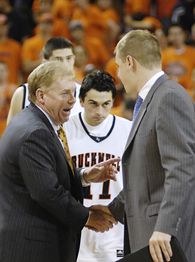
Skip Prosser and Mark Prosser
Bucknell Athletics

Skip Prosser's son Mark (right) is an assistant coach at Bucknell.

There was a collective pause among the coaches here Thursday, wondering if they shouldn't all just take a step back. Martelli was so distraught, he said he was heading back home to Philadelphia. He didn't see the purpose of staying on the road anymore. I got the sense no one wanted to be here. Martelli said Thursday night that he thought the event should be shut down since no coaches clearly wanted to be recruiting.

"Maybe we should all go home and take a breath and a break," Martelli said.

He also said Prosser had recently encouraged him to read the book about the Duke lacrosse case while they sat at the Peach Jam in North Augusta, S.C., earlier this month. Martelli said he just finished the book and said he was looking forward to talking to him about it.

The reason Prosser was so beloved by his peers was because he was genuine. He was honest. He was real. On a number of occasions, he could be found taking his developmentally challenged son Scott with him on the road. I can't recall seeing Prosser by himself over the years. He was always with Scott, his son Mark, his assistant Dino Gaudio or his wife Nancy. While at Wake Forest, he was close to sports information director Dean Buchan, who recently took a job at Georgia Tech in the same capacity.

Prosser talked to me Wednesday about Buchan's departure. He joked about how Buchan kept text messaging Prosser to make sure he wasn't mad at Buchan. They continued their friendly barbs as late as Thursday morning, Buchan said later in the day.

Prosser said he was eager to get to know Buchan's replacement. He was one of those people interested in just about everyone he came into contact with on a daily basis. He was a diligent reader, interested in history and politics. He was more than just a coach. Much more.

The fair-haired, freckled Prosser was a wonderful man and appeared to be a devoted father, husband, friend to many, foe to apparently no one and a mentor for many in the profession.

Wake Forest, Winston-Salem, the ACC, college basketball, and those of us who knew him lost a gentlemen Thursday. His death makes us all ponder purpose and the need to slow down at times, too.

Excuse me while I head home to hug my loved ones.

Andy Katz is a senior writer at ESPN.com.

http://media.gatewaync.com/wsj/photos/2004/wake/07bb/ecu/prosser.jpg
From The Winston-Salem Journal:
Friend, Teacher, Coach:
His heart-attack death hits university, city hard
By Dan Collins

JOURNAL REPORTER
Friday, July 27, 2007

Skip Prosser came to coach basketball at Wake Forest because it was in a conference, and an area of the country, with a deep passion for the game.

“As a coach, you want to be someplace where they care,” Prosser said in 2001.

In his six years at Wake Forest, people from the school and the area also came to care about Prosser.

That was painfully obvious yesterday when Prosser collapsed and died of what Dr. William Applegate, the dean of the Wake Forest University School of Medicine, said was probably a massive heart attack. Prosser was 56.

News of his death rocked the community, the ACC and all of college basketball.

Prosser completed his regular jog yesterday at Kentner Stadium and then returned to his office next door in the Manchester Athletic Center about 12:40 p.m. Mike Muse, the Deacons’ director of basketball operations, found Prosser unconscious in his office about 12:45 and tried to revive him with CPR.

The attempts of Muse and Dr. Cecil Price from the Student Health Services - which included the use of a defibrillator - were unsuccessful. Prosser was taken to Wake Forest University Baptist Medical Center, arriving about 1:30. He was pronounced dead at 1:41.

Wake Forest did not confirm Prosser’s death for more than seven hours because school officials were trying to reach his wife, Nancy, who was driving to Louisville, Ky., to visit a family member.

Prosser’s record at Wake Forest was 126-68. The Deacons finished first in the ACC regular season in 2003 and played in the NCAA Tournament in four of his six seasons.

Although the Deacons were coming off their first losing season since 1990, Prosser had just landed commitments from three highly rated high-school seniors.

“I met with the team earlier, and I told them how blessed we are to have known him,” Athletics Director Ron Wellman said.

“I told our players I don’t know if I’ve known a stronger man, a man who believed in what he believed and lived what he believed. There were so many times after a devastating loss I’d talk to him, and every time I left that conversation thinking ‘We are going to be OK.’”

Prosser loved coaching college basketball. He loved the game, the interaction with players, coaches, media and fans. He even loved the recruiting. His favorite hours were spent in a gym, coaching his team.

“Beats being at the mall,” Prosser would quip.

But coaching wasn’t Prosser’s first love.

George Edward Prosser III grew up in Pittsburgh, the son of a signalman for the Pennsylvania Railroad. His father was made of stern stuff, and he expected his son to be as well. Once, playing in a Little League game for his father, the coach, Prosser hurt his arm and left the field crying.

His father asked: “What’s the matter? You have another one, don’t you?”

Prosser completed the game, after which he was taken to the hospital and treated for a broken arm.

Prosser attended the U.S. Merchant Marine Academy and majored in nautical science. He joked that he majored in driving ships.

His early days at the academy, in Kings Point, N.Y., were trying, so much so that Prosser called home to say that he was returning to Pittsburgh.

His father told him that was all right, but he didn’t know where his son would sleep because he was getting ready to go to Prosser’s room and knock the bed apart. Prosser stayed and graduated in 1972. He received a master’s degree in secondary education from West Virginia University in 1980.

Prosser played basketball at the Merchant Marine Academy but spent most of his time on the bench. “Even when I could play, I couldn’t play,” Prosser recalled.

He became a coach because that was a stipulation attached to his first job as a teacher at Linsly Institute in Wheeling, W. Va.

He considered himself as much a teacher as a coach, if not more. “I love teaching,” Prosser said. “I love lectures and all that.

“My opinion is, there’s a lot of lessons you can learn in the gym that you can’t learn in the classroom - just like there’s a lot of lessons you can learn in the classroom that you can’t learn in the gym.

“But I know that some of the best lessons I ever taught were taught to me by my coaches. And I remember some of my coaches more than I remember some of my teachers.”

Dick Vitale, the television commentator, who knew Prosser well, wrote yesterday that Prosser was proud of the fact that he came from nowhere in the coaching profession, without the pedigree of most major-college coaches.

Prosser, in fact, was 34 when he broke into the college ranks. He had been coaching high-school basketball in West Virginia and coaching it well enough to win the 1982 Class AA championship at Central Catholic High School in Wheeling.

He began networking with college coaches at camps and learned that Pete Gillen, the head coach at Xavier, needed an assistant. Prosser said he remembers standing in a phone booth by a busy interstate, while on a scouting trip for the Central Catholic football coach, when Gillen offered him the job.

According to Prosser, at least three other candidates had turned down Gillen. “I might have been his 33rd choice,” he said.

He remained loyal friends with Gillen, whom he insisted on calling “Coach,” even when the two competed against each other in the ACC when Gillen was at Virginia.

Prosser’s first head-coaching job was at Loyola of Maryland, and he made enough of a splash to coach the Greyhounds to their first appearance in the NCAA Tournament.

The next season, Gillen left Xavier for Providence, and Prosser replaced him.

Prosser succeeded at Xavier, with his teams winning 148 games and losing 65 over seven seasons. The Musketeers played in the NCAA Tournament four times and in the NIT twice.

Because Prosser had turned down several high-profile coaching jobs to remain at Xavier, there was a question of whether he would accept the position at Wake Forest. Wellman wondered as well before he hired Prosser to succeed Dave Odom in April 2001.

“I called the people in the country who I felt knew the best basketball coaches,” Wellman said in 2001. “And when I asked them about a short list of names that I had, when I got to Skip Prosser the response was always the same. And that is, ‘If you can hire him, you’d better get him. He is a great basketball coach, and beyond that he is a great person.’”

When asked then about his new challenge, Prosser responded in typical fashion.

“I may not know a lot about the ACC right now, but thanks to Ron (Wellman), I did stay at a Holiday Inn Express last night,” Prosser said. “I mean I know how difficult it is. In all honesty, that’s certainly one of the challenges that excited me, and we’re looking forward to it.”

Most modern college-basketball coaches hold the media at arm’s distance. Prosser embraced them, and because of that and his quick mind, he was a post-game favorite.

Michael Perry covered the Xavier beat for the Cincinnati Enquirer during Prosser’s years as the Musketeers’ head coach.

“If all the coaches I dealt with were like Skip, then I’d be happy,” Perry said. “He was cooperative, accessible, and he respected the job I had to do.”

If anything, Prosser became even more accessible during his time at Wake Forest, regularly opening his practices to the media and actually ribbing reporters whom he hadn’t seen drop by for a day or two.

One reason that the media gravitated toward Prosser was that he was not just an interesting basketball coach but a very interesting man who coached basketball. He was well-read, listing his favorite authors as Ralph Waldo Emerson, Tom Clancy, Nelson DeMille and Pat Conroy.

Contrary to what most people believed, Prosser, despite his red hair, ruddy complexion and love of almost all things Irish, was not of Irish descent. He did make several summer trips to Ireland. “That’s all a myth,” Prosser said. “I think it’s just because I’ve got red hair. I like their music and I like going over there. But that’s not true.

“I’m English, Scottish and Welsh.”

Prosser had two sons from his first marriage, Scott, 28, and Mark, 27. Mark Prosser played basketball at Marist and has been an assistant coach at Bucknell the last three seasons.

Prosser’s one fault, if it could be called that, was his intense aversity to losing. He said he recognized the character flaw, and at one period of his life attempted to accept losing more graciously. He admitted that the attempt failed.

But he did retain a healthy perspective, particularly for a man engaged in a high-profile occupation. His wife, Nancy, was a trauma nurse while they lived in Cincinnati.

“She deals with life and death every day,” Prosser said. “She literally has saved people’s lives that I know. We would go out to dinner, and people in Cincinnati would walk up to me - and she may have actually saved somebody’s life that day - and they would want to know how recruiting’s going.

“What she (did) is infinitely more important than what I do.”

Players remember him as the ultimate player’s coach.

“He’s more than just a coach to us,” said Steve Lepore, a former player at Wake Forest. “He told us that he’ll always have our backs, no matter how long we’ve been gone or graduated. He said he’s going to be a good friend of ours, and he’s going to back us up.”

■ Dan Collins can be reached at 727-7323 or at dcollins@ws.journal.com.

Skip Prosser wasn't one to beat around the bush. He was by turn eloquent, verbose, even a little caustic. But rarely misunderstood:

"How I define hard play, and how they define hard play is oftentimes not the same. But as I tell them, they have their definition and I have my definition, but their definition is meaningless to me. The only real definition that counts is mine."

"I don't think anyone wants to go to practice and yell for two or three hours. Nobody wants to be Attila the Hun for two or three hours. But all of us, including adults, need it probably once in awhile. Our human nature is not to push ourselves to the limit. It's to do, at times, as little as you can to get by. So that's my role to make sure we don't lapse into that level of self-satisfaction."

"Oftentimes in this day and age, people think that every time you try to correct them and teach them, you're being critical of them. That's not the case. You're just trying to teach them and coach them. The real good players understand that earlier than others."

Monday, July 23, 2007


From Opinion Journal:
The Impoverishment of American Culture
And the need for better art education.

BY DANA GIOIA
Thursday, July 19, 2007 12:01 a.m.

There is an experiment I'd love to conduct. I'd like to survey a cross-section of Americans and ask them how many active NBA players, Major League Baseball players, and "American Idol" finalists they can name. Then I'd ask them how many living American poets, playwrights, painters, sculptors, architects, classical musicians, conductors and composers they can name. I'd even like to ask how many living American scientists or social thinkers they can name.

Fifty years ago, I suspect that along with Mickey Mantle, Willie Mays and Sandy Koufax, most Americans could have named, at the very least, Robert Frost, Carl Sandburg, Arthur Miller, Thornton Wilder, Georgia O'Keeffe, Leonard Bernstein, Leontyne Price and Frank Lloyd Wright. Not to mention scientists and thinkers like Linus Pauling, Jonas Salk, Rachel Carson, Margaret Mead and especially Dr. Alfred Kinsey.

I don't think that Americans were smarter then, but American culture was. Even the mass media placed a greater emphasis on presenting a broad range of human achievement. I grew up mostly among immigrants, many of whom never learned to speak English. But at night watching TV variety programs like the Ed Sullivan Show, I saw--along with comedians, popular singers and movie stars--classical musicians like Jascha Heifetz and Arthur Rubinstein, opera singers like Robert Merrill and Anna Moffo, and jazz greats like Duke Ellington and Louis Armstrong captivate an audience of millions with their art.

The same was true of literature. I first encountered Robert Frost, John Steinbeck, Lillian Hellman and James Baldwin on general-interest TV shows. All of these people were famous to the average American--because the culture considered them important. Today no working-class kid would encounter that range of arts and ideas in the popular culture. Almost everything in our national culture, even the news, has been reduced to entertainment, or altogether eliminated.

The loss of recognition for artists, thinkers and scientists has impoverished our culture in innumerable ways, but let me mention one. When virtually all of a culture's celebrated figures are in sports or entertainment, how few possible role models we offer the young. There are so many other ways to lead a successful and meaningful life that are not denominated by money or fame. Adult life begins in a child's imagination, and we've relinquished that imagination to the marketplace.

I have a reccurring nightmare. I am in Rome visiting the Sistine Chapel. I look up at Michelangelo's incomparable fresco of the "Creation of Man." I see God stretching out his arm to touch the reclining Adam's finger. And then I notice in the other hand Adam is holding a Diet Pepsi.

When was the last time you have seen a featured guest on David Letterman or Jay Leno who isn't trying to sell you something? A new movie, a new TV show, a new book or a new vote? Don't get me wrong. I have a Stanford MBA and spent 15 years in the food industry. I adore my big-screen TV. The productivity and efficiency of the free market is beyond dispute. It has created a society of unprecedented prosperity.

But we must remember that the marketplace does only one thing--it puts a price on everything. The role of culture, however, must go beyond economics. It is not focused on the price of things, but on their value. And, above all, culture should tell us what is beyond price, including what does not belong in the marketplace. A culture should also provide some cogent view of the good life beyond mass accumulation. In this respect, our culture is failing us.

There is only one social force in America potentially large and strong enough to counterbalance this commercialization of cultural values, our educational system. Traditionally, education has been one thing that our nation has agreed cannot be left entirely to the marketplace--but made mandatory and freely available to everyone.

At 56, I am just old enough to remember a time when every public high school in this country had a music program with choir and band, usually a jazz band, too, sometimes even an orchestra. And every high school offered a drama program, sometimes with dance instruction. And there were writing opportunities in the school paper and literary magazine, as well as studio art training.

I am sorry to say that these programs are no longer widely available. This once visionary and democratic system has been almost entirely dismantled by well-meaning but myopic school boards, county commissioners and state officials, with the federal government largely indifferent to the issue. Art became an expendable luxury, and 50 million students have paid the price. Today a child's access to arts education is largely a function of his or her parents' income.

In a time of social progress and economic prosperity, why have we experienced this colossal cultural decline? There are several reasons, but I must risk offending many friends and colleagues by saying that surely artists and intellectuals are partly to blame. Most American artists, intellectuals and academics have lost their ability to converse with the rest of society. We have become wonderfully expert in talking to one another, but we have become almost invisible and inaudible in the general culture.

This mutual estrangement has had enormous cultural, social and political consequences. America needs its artists and intellectuals, and they need to re-establish their rightful place in the general culture. If we could reopen the conversation between our best minds and the broader public, the results would not only transform society but also artistic and intellectual life.

There is no better place to start this rapprochement than in arts education. How do we explain to the larger society the benefits of this civic investment when they have been convinced that the purpose of arts education is to produce more artists, which is hardly a compelling argument to the average taxpayer?

We need to create a new national consensus. The purpose of arts education is not to produce more artists, though that is a byproduct. The real purpose of arts education is to create complete human beings capable of leading successful and productive lives in a free society.

This is not happening now in American schools. What are we to make of a public education system whose highest goal seems to be producing minimally competent entry-level workers? The situation is a cultural and educational disaster, but it also has huge and alarming economic consequences. If the U.S. is to compete effectively with the rest of the world in the new global marketplace, it is not going to succeed through cheap labor or cheap raw materials, nor even the free flow of capital or a streamlined industrial base. To compete successfully, this country needs creativity, ingenuity and innovation.

It is hard to see those qualities thriving in a nation whose educational system ranks at the bottom of the developed world and has mostly eliminated the arts from the curriculum. Marcus Aurelius believed that the course of wisdom consisted of learning to trade easy pleasures for more complex and challenging ones. I worry about a culture that trades off the challenging pleasures of art for the easy comforts of entertainment. And that is exactly what is happening--not just in the media, but in our schools and civic life.

Entertainment promises us a predictable pleasure--humor, thrills, emotional titillation or even the odd delight of being vicariously terrified. It exploits and manipulates who we are rather than challenging us with a vision of who we might become. A child who spends a month mastering Halo or NBA Live on Xbox has not been awakened and transformed the way that child would be spending the time rehearsing a play or learning to draw.

If you don't believe me, you should read the studies that are now coming out about American civic participation. Our country is dividing into two distinct behavioral groups. One group spends most of its free time sitting at home as passive consumers of electronic entertainment. Even family communication is breaking down as members increasingly spend their time alone, staring at their individual screens.

The other group also uses and enjoys the new technology, but these individuals balance it with a broader range of activities. They go out--to exercise, play sports, volunteer and do charity work at about three times the level of the first group. By every measure they are vastly more active and socially engaged than the first group.

What is the defining difference between passive and active citizens? Curiously, it isn't income, geography or even education. It depends on whether or not they read for pleasure and participate in the arts. These cultural activities seem to awaken a heightened sense of individual awareness and social responsibility.

Art is an irreplaceable way of understanding and expressing the world--equal to but distinct from scientific and conceptual methods. Art addresses us in the fullness of our being--simultaneously speaking to our intellect, emotions, intuition, imagination, memory and physical senses. There are some truths about life that can be expressed only as stories or songs or images.

Art delights, instructs, consoles. It educates our emotions. And it remembers. As Robert Frost once said about poetry, "It is a way of remembering that which it would impoverish us to forget." Art awakens, enlarges, refines and restores our humanity.

Mr. Gioia is the chairman of the National Endowment for the Arts. This article is a condensed version of his June 17 commencement address at Stanford University.

http://www.the-spine.com/wp-content/uploads/2006/12/potter.jpg
From Human Events:
Harry Potter and the End of the Road
A Decade Later, the Veil is Dropped on the Epic Series of Our Time
by Jeff Emanuel

Posted 07/23/2007 ET

A journey that began over a decade ago, with lines of a story written on napkins at a coffee shop by a woman who was too poor to buy proper paper, finally reached its end this week, with the release of Harry Potter and the Deathly Hallows (which had a record 12 million copy first-run printing), the seventh and final installment in the series about a young orphaned wizard that took the world by storm, reawakening children to the joys of reading and making the author, J.K. Rowling, one of the richest women in the world.

For the public, the voyage began in September of 1998, with the 309-page Harry Potter and the Sorcerer’s Stone, which introduced the world to a magical realm of witches and wizards, of goblins, giants, and trolls, of good and evil, and of little Harry Potter himself, a young, unloved boy of eleven, parentless and forced to live in the cupboard under his aunt and uncle’s stairs, ignorant (by design) of the magical world. Young Harry is equally ignorant of his celebrity status within the magical community as “The Boy Who Lived” -- the hero who, at the age of one, ended a Dark Lord’s (whose name people are still afraid to speak) reign of terror upon both the magical and “Muggle,” or non-magical, worlds, by causing the evil wizard’s killing curse -- which had already killed Harry’s parents -- to rebound upon him, vanquishing Lord Voldemort, as he is known, and leaving Harry with a lightning-shaped scar on his forehead.

As Harry journeyed through his new-found life, attending Hogwarts School of witchcraft and Wizardry, learning the truth about a great many things, the reading audience -- which grew and grew with each installment of this literary phenomenon -- travelled with him, learning about his life and his world, and also learning a little something about themselves.

Fans of Harry Potter struggled along with him to comprehend the new challenges and hardships he faced as he grew up, feeling anger, pain, joy, and love along with him, and valuing the loyalty of his friends as much as he himself did. They befriended the half-giant Rubeus Hagrid, Hogwarts School’s loyal-to-a-fault gamekeeper; they loathed the slick, greasy Severus Snape, who hated Harry as much as Harry hated him; they learned from the wise and seemingly invincible headmaster, Albus Dumbledore (and fell with him from the Astronomy Tower when Snape killed him at the end of the sixth book); they searched, along with the protagonist, for clues and answers to many questions, including why Voldemort sought specifically to kill him in the first place, why Snape loathed him so much (and whether the oily head of Slytherin House was really on the side of good or of evil), what really happened on the night his parents were murdered, and what it was that Harry himself had to do to vanquish the Dark Lord once and for all.

Such was the gift of Jo Rowling, once a single mother who was “on the dole” in Britain, and whose incredible ability to spin a multi-layered, multi-volumed tapestry of a story pulled her out of the unemployment line and placed her on a pedestal as one of the great authors in recent history. For these are no mere children’s tales; any single volume of Harry Potter contains more references, allusions, derivatives, and subplot lines from classical mythology, Greek, Latin, the Renaissance, eastern mysticism, Tolkien’s Lord of the Rings, Shakespeare, Norse mythology, Christianity, and many, many others than could ever be absorbed on first reading. Beyond this cultured basis, each story is brimming with clues and hints (along with a double-helping of red herring) as to the larger mystery of the entire series -- a mystery which many readers only gradually realized existed in the first place.

The Harry Potter stories are not independent tales; the complex tapestry of information, riddles, and clues which Rowling weaves in each volume not only requires multiple readings to fully grasp, but is more necessary for comprehension of the series’s overall plot than most ever knew. Simply calling it a mystery, though, does no justice to the series itself, or to Rowling’s skill. The book is a morality play writ large, with good facing evil at every turn, with shades of gray in between; as Harry’s godfather, the short-lived Sirius Black, says in book five, Harry Potter and the Order of the Phoenix, “the world is not simply made up into good people and Death Eaters” (followers of Voldemort). As with most stories in this genre, Harry is provided a mentor (Dumbledore) whose words and wisdom he takes as absolute, incontrovertible truth -- and through trials he must learn of that mentor’s fallibility and, in essence, mortality.

Which brings us -- seven volumes, nine years, and four thousand, one-hundred and seventy pages later -- to the end. Voldemort has returned, Dumbledore is dead, and Harry has been growing older -- and his life more dangerous – with each increasingly-dark installment. The trend of darkness continues in this final book; with Hogwarts and the Ministry of Magic both being taken over by Voldemort and his Death Eaters, injury, torture, and death are commonplace, both for children at school and for adults in the outside world. Already thrust into de facto adulthood by the loss of any father figures he might once have had -- as well as by the fact that the Dark Lord Voldemort has long since sworn that he will stop at nothing to finish Harry off once and for all -- the protagonist, and the reader along with him, must cope with the fact that his continued existence seems to bring death and danger to those he most loves, and who most love him.

Several key characters, whom readers have gotten to know over the course of the multi-volume series, perish in this story, giving their lives to a cause, though it means that they leave behind loved ones of their own.

The seventh volume consists of Harry, Ron Weasley, and Hermione Granger’s quest to fulfill the last mission assigned them by Dumbledore before his death. They must seek out four remaining Horcruxes (objects in which Voldemort has stored bits of his shredded soul, thereby preventing him from dying) and destroy them, before going up against the Dark Lord himself. However, like in the other stories, a crossroads is reached, and a decision must be made -- in this case, whether to continue in the seemingly futile pursuit of the Horcruxes, or to change course and go after three magical objects called Hallows, which are said to make the holder the master of Death itself.

In Deathly Hallows, Harry travels back in space and time to Godric’s Hollow, where he learns more about his parents’ death and about Dumbledore’s mysterious life and family; he learns even more about the value of friendship and of fate; and the greatest theme of the first six books is reinforced -- that who and what we are is nowhere near as important as the choices that we make.

The choices made by central (and controversial) characters from the series are revealed in Hallows, with more information being given, and the complexity of some individuals -- from Severus Snape to Harry’s aunt, Petunia Dursley -- being revealed.

Choice is central not only to the development and revealing of ancillary characters, but to the fate of Harry himself (and, by extension, of the wizarding world). After thousands of pages of learning, growing, and fighting, the end of the saga comes down to a final choice to be made by the protagonist, involving the decision not only whether (and how) to use the tools he has acquired on his quest, but, in the mold of Aslan and of Christ, whether to make the ultimate sacrifice in hopes of saving those he loves.

Chief among Rowling’s many achievements in this series is her success in making Harry a real teenage boy, with very real concerns, fears, and emotions. He is no more a cardboard construct than the reader is, and as a result, an entire generation of readers has been drawn to him and to his story.

In Hallows, the elegant, intricate tapestry which Rowling spent the past decade weaving becomes much more clear, as seemingly insignificant (or long-forgotten) characters, incidents, and objects -- from a rusty object in a hidden room, to a pair of wandmakers, to an old dark wizard mentioned on the back of a Chocolate Frog card -- come back, and show their importance to the overall narrative. The story flows, the characters struggle, and, in the words of one major individual, “magic many of us have never encountered or imagined” comes to life, with the odds seemingly reaching impossible heights by the time that Harry is forced to make his final choice.

The ending of the Harry Potter saga should satisfy all who have followed the boy wizard since he was introduced to the world, wearing broken glasses and hand-me-down clothes, a decade ago, if for no other reason than the simple fact that it provides closure. The pieces fit together and, though answering every question would take Tolkien-esque appendices, the mystery and the narrative are satisfyingly sewn up into a nice, tight ending, leaving the reader -- whether die-hard Harry Potter fan or simply casual reader -- with a bittersweet certainty of people’s final fates. Regardless how well Rowling told the final story, a lack of closure would have left readers eternally unhappy and unsatisfied. However, she achieved that final task masterfully, and as the reader turns to page 759 of Harry Potter and the Deathly Hallows, they really will be able to say -- through the tears of joy and of loss -- that they “have stuck with Harry to the very end.”

And that is a reward in itself.

Mr. Emanuel, a special operations military veteran, is a columnist and director of conservative weblog RedState.com.

Sunday, July 22, 2007

The image “http://blog.pennlive.com/poprocks/medium_pottercover3.jpg” cannot be displayed, because it contains errors.
From The Washington Post:
Harry's Final Fantasy: Last Time's the Charm
By Elizabeth Hand,

the author of numerous fantasy novels,
most recently "Generation Loss"


HARRY POTTER AND THE DEATHLY HALLOWS

By J.K. Rowling

Scholastic, $34.99, 759 pp.

All great writers are wizards. Considering the mass Harrysteria of the last few days, who would have been surprised if they had logged on to YouTube at 12.01 a.m. Saturday and seen J.K. Rowling pronounce a curse -- "Mutatio libri!" -- that would magically change the final pages of her book and foil the overeager reviewers and Web spoilsports who revealed its surprise ending?

Yet Rowling's spell remains unshattered, despite the broken embargo: It's hard to imagine a better ending than the one she's written for her saga after 10 years, more than 4,000 pages and close to 400 million copies in print. "Harry Potter and the Deathly Hallows" may be a miracle of marketing, but it's also a miraculous book that earns out, emotionally and artistically.

Was it worth the wait? You bet.

I was a somewhat reluctant Potter convert. Rowling's debt to the great 20th-century English fantasists -- J.R.R. Tolkien, C.S. Lewis, E. Nesbit, Alan Garner -- made her work seem less homage than unabashedly derivative. Still, I read the first five books aloud to my two children, and also listened to Stephen Fry's delectable audiobooks (more than once). I found Rowling's prose style clunky (though Fry made her words sing like Shakespeare) and her storytelling workmanlike in the early books.

But Rowling's darker, more resolute vision in "Prisoner of Azkaban" won me over. By Book 6, my kids were teenagers, and I no longer had reading aloud as an excuse. I was hooked. So Friday night I lined up at midnight at my local bookstore, along with a hundred other readers, and scored my copy of "Deathly Hallows." Sleepless, over-caffeinated and teary-eyed, I finally finished it on Saturday morning.

Tolkien continues to cast a long shadow over Harry Potter's world, along with C.S. Lewis, but the writer most evoked by "Deathly Hallows" is Charles Dickens. Rowling's enchantments have always lived easily in a secular world, rooted in mundane details of Muggle life and wry, careful accounts of wizards who work side-by-side, if unobserved, by their non-magical neighbors. Like Dickens, she has a gift for marvelous names -- Severus Snape is as brilliant a moniker as Magwitch or Ebenezer Scrooge -- as well as that of making the everyday seem at once familiar and extraordinary. Her magical world is grounded in small, meticulous observations -- that liminal train platform at King's Cross; the disgusting flavors of Bertie Bott's Every Flavor Beans; the wearying bureaucracy of the Ministry of Magic -- that can make her invented world seem as real as ours.

In "Deathly Hallows," the thin protective veil between the Muggle and Wizarding worlds is torn away. Voldemort no longer lurks in the shadows: His forces have infiltrated the Ministry of Magic and Hogwarts School of Witchcraft and Wizardry itself, intent upon practicing their form of wizardly genocide. Half-blood wizards and Muggles are designated Undesirables, and Harry Potter is "Undesirable Number One." Muggle families like the Dursleys and the Grangers resort to a kind of Wizard Protection Program to escape being tormented by Dementors, and a mass escape from Azkaban Prison is hushed up by a corrupt Ministry of Magic, which has embraced the Orwellian slogan "Magic is Might."

Against this grim backdrop, Harry and his closest friends, Hermione and Ron, become fugitives. All three refuse to return to a Hogwarts where the murderous Severus Snape is now Headmaster, after having killed the beloved Albus Dumbledore at the end of Book 6. The aftermath of Dumbledore's death is not easily resolved. In his will, he left three enigmatic objects to Harry, Ron and Hermione, artifacts that they hope will aid them in locating the hidden Horcruxes, which contain Voldemort's divided soul, and so defeat him.

But their quest for the Horcruxes leads them into the stranger and darker territory of Dumbledore's past, and a dizzying labyrinth of betrayals and counterplots that both reverses and deepens a reader's understanding of everything that has happened in the previous volumes.

"Deathly Hallows" is exhilarating but also exhausting: Rowling's prose suddenly shifts into high gear, and the spectacularly complex interplay of narrative and character often reads as though an entire trilogy's worth of summing-up has been crammed into one volume. The novel's breakneck speed is reminiscent of John Buchan's fervid "The 39 Steps." "Harry Potter and the Deathly Hallows" is a far bleaker, unapologetically adult novel than its predecessors, which now have the feel of a long, picturesque prologue, rather as "The Hobbit" is a prelude to "The Lord of the Rings," with subplots involving goblins and warring factions who behave like orcs quarreling over the injured Frodo. But the echoes of Tolkien and Lewis are sometimes too obvious. The locket that is one of Voldemort's Horcruxes exerts a malignant power over its owners, inevitably evoking the One Ring, and the story owes too much to "The Lion, the Witch and the Wardrobe."

Yet Rowling trumps even Tolkien in the sheer humanity of her characters. She nimbly and unsparingly dissects the master-slave relationship of the wizards to their elf and goblin helpmeets, and the arrogance of the sorcerers -- even ostensibly good ones -- toward their ordinary, human counterparts. And the maturation of Harry and his friends is as moving as it is realistic: Their romantic and emotional bonds are frayed and sometimes appear to be severed, but Harry and Ron and Hermione stumble on, dogged and damp and quarrelsome as real adolescents.

"The rain was pounding the tent, tears were pouring down Hermione's face, and the excitement of a few minutes before had vanished as if it had never been, a short-lived firework that had flared and died, leaving everything dark, wet and cold. The sword of Gryffindor was hidden they knew not where, and they were three teenagers in a tent whose only achievement was not, yet, to be dead."

Beloved figures die in this book. But it's part of Rowling's greatness that she permits her surviving characters to grieve, and they -- and the reader -- are the better for it. Rowling understands that grief is part of what makes us wholly human, along with the ability to love and forgive and show remorse.

And while magic is ultimately seen to have limits -- Death has its dominion, even at Hogwarts -- love does not. Rowling's major theme throughout the Harry Potter books is not the power of magic to maintain the wizards' social order, but that of love to create and sustain a community, to establish a sometimes fragile but remarkably resilient network of families, good, bad and indifferent. Parental love triumphs over even death; the love not just of biological mothers and fathers but of godparent and grandparents. There may be no broken families of divorce in the Harry Potter books, but there are blended families made up of orphaned children, Muggle and magic alike -- another trope Rowling shares with Dickens, who also understood the anguish and longing of the awkward, unlovable child shunted aside by his better-off, better-looking peers. The much-maligned loner Snape does not come onstage until the latter part of "Deathly Hallows," but when he does the book becomes his: Snape's fate, more than Voldemort's, perhaps more even than Harry's, is the most heartbreaking, surprising and satisfying of all of Rowling's achievements.

I cried at the end of "Harry Potter and the Deathly Hallows." It's that rare thing, an instant classic that earns its catharsis honestly, not through hype or sentiment but through the author's vision and hard work. One gets the feeling that J.K. Rowling is as relieved and joyous as we are to reach this point at last; that she's grown and suffered and struggled through the last 10 years, just like Harry. Just like us.
http://www.dispenser.rai.it/imgservizi/2004-05-17-1.jpg
Tammy Faye dies at age 65
Charlotte Observer Staff Reports


Tammy Faye Messner, whose can-do Christian cheer helped her survive the PTL scandal and forge a second career as a pop-culture queen, died Friday after battling cancer for more than a decade.

She was 65. News of her death at her home near Kansas City, Mo., was posted on her Web site Saturday night.

A family service was held Saturday in a private ceremony, where her ashes were interred, said Joe Spotts, Messner's booking agent. Spotts said that the family is considering a public memorial service for the coming weeks.

For Tammy Faye, like Elvis, no last name was necessary.

She came to fame in the late 1970s as half of the televangelism team -- Jim and Tammy Bakker -- that founded the PTL empire in Fort Mill, S.C., which grew to include a hotel, campground and Christian theme park. On the "Jim and Tammy" TV show, she sang about Jesus and shed mascara-tinged tears, bringing ever greater support and donations from the faithful -- and mounting ridicule from skeptics.

By the late 1980s, the first couple of Christian TV were in disgrace amid a flurry of damaging headlines: that Jim Bakker had a sexual encounter with church secretary Jessica Hahn, that he and associates had paid hush money to keep her quiet and that PTL had defrauded thousands of followers by overselling "lifetime partnerships" at its Heritage Grand hotel.

The PTL (for Praise the Lord) story faded. But the public's fascination with Tammy Faye -- and her own determination to re-invent herself -- never dimmed.

She divorced Jim Bakker in 1992, while he was in prison.

Bakker, now remarried and a televangelist in Branson, Mo., said in a statement Saturday that his ex-wife "lived her life like the song she sang, `If Life Hands You a Lemon, Make Lemonade.'

"She is now in heaven with her mother and grandmother and Jesus Christ, the one who she loves and has served from childbirth," he said. "That is the comfort I can give to all who loved her."

In her post-PTL life, much of it spent living in Matthews, Messner grabbed the occasional spotlight by playing herself on TV sitcoms and reality shows, selling "Tammy Faye Celebrity Wigs" (16 different colors), and publishing a 1996 autobiography that mostly blamed the downfall of PTL on others.

The 4-foot-11 singer, whose first fans were conservative Christians, also developed a late-in-life cult following among gays, many of whom admired her spunk and her unapologetic -- and over-the-top -- style.

In May, she had this message for her fans posted on www.tammyfaye.com: "The doctors have stopped trying to treat the cancer and so now it's up to God and my faith. And that's enough!"

Messner, weighing just 65 pounds, appeared Thursday night on CNN's "Larry King Live" show, telling fans she loved them and would see them again in heaven someday.

Before that final appearance, when she managed to be upbeat despite a sunken face and breathless voice, Messner was often made fun of.

But Randall Balmer, a professor of American religious history at Columbia University, called Messner "an enormously important figure in the whole business of Christian broadcasting."

Yes, Balmer said, her style was often "camp and over-the-top. But there was a guilelessness about her that was winsome. First lady of Christian television? I wouldn't dispute that."

Messner is survived by her husband, Roe Messner, and her two children with Bakker. Both followed their parents into the evangelism business: Tammy Sue Chapman is a Christian singer, and son Jamie Charles -- known as Jay -- branded his body with Jesus tattoos, created the Revolution Church and starred in a documentary series on the Sundance Channel called "One Punk Under God."

Through the years, Messner called on her sunny Christianity to get through one crisis after another: Bakker's imprisonment and the breakup of their 30-year marriage in 1992; her own addiction to tranquilizers; the 1996 conviction and jailing of her husband for federal bankruptcy fraud; his battle with prostate cancer; and her own health problems, which began with colon cancer surgery in 1996.

Messner even learned how to laugh with those who mocked her. Stand-up comics made fun of her mascara; drag queens imitated her at gay nightclubs.

"I've had a lot of realities of life hit me right in the face," Messner told the Observer in 1996. "But I've always believed the words, `You can make it.' It's not just something I sang at PTL. I never give up."

Love changed everything

The former Tamara Faye LaValley was born on March 7, 1942, the oldest of eight children in International Falls, Minn., along the Canadian border. The family was so poor, they didn't have an indoor bathroom.But little Tammy had talent: Urged on by her music-loving mother, she was singing before church audiences by age 3.

In 1960, she met Jim Bakker. Both were students at North Central Bible College in Minneapolis. He was a smooth-talking young evangelist whose first date with Tammy offered a whisper of the faith and romance to come. They went to church, then he kissed the petite 17-year-old.

"I had never given a boy a kiss on a first date," she said. "But that wasn't going to stop me now. I reached over and kissed him, and `Wow!' I, too, was in love."

They married on April 1, 1961, then set out together to preach -- and, sing -- about the joy of Jesus.

The rise of PTL

A pastor's invitation brought them to North Carolina.

Traveling from church to church led them to a big idea.

Premiering their PTL Club show from an old Charlotte furniture store in 1974, they got their first chance to blend Christianity and talk show-style entertainment -- something that hadn't been done quite that way.

Using their TV show as the magnet, they opened Heritage USA in Fort Mill in 1978, dreaming of a Christian complex that could entertain and inspire. It also brought a plush lifestyle and the attention of presidents. Before long, they transformed the 2,300-acre site into a Christian version of Walt Disney World.

At its height in 1986, about 6 million people visited Heritage USA for its hotel, shopping mall, rides, Christmas lights and more.

For all the attractions, the centerpiece remained the Jim and Tammy TV show, broadcast over satellite to millions each day.

The fall of the empire

It all came crashing down.Bakker resigned as PTL president in 1987, amid a series of Pulitzer Prize-winning articles in the Observer detailing scandals. In 1989, he was convicted of bilking followers of $158 million.

Messner steered clear of legal troubles herself. She remained unrepentant, acknowledging mistakes in judgment but denying crimes by Bakker. Instead, she pointed the finger at others -- competing evangelists, disloyal members of the PTL team and government prosecutors.

She defended the Bakkers' opulent lifestyle, saying they needed a houseboat on Lake Wylie to get away from fans and that amassing wealth was no sin.

"If you have a diamond ring," she wrote in 1996, "that diamond ring isn't going to keep you from loving the Lord."

The day Jim Bakker was convicted in 1989, she stood outside the federal courthouse in uptown Charlotte, looked into a sea of reporters and sang the first verse of "On Christ the Solid Rock I Stand."

Life after PTL, Bakker

A year after divorcing Bakker, she married Bakker friend and associate Roe Messner (a contractor whose company built Heritage USA) and moved on. Eventually, that meant a spot in a pop culture landscape that had become increasingly obsessed with celebrity.

She starred in a TV talk show with a gay sidekick and a reality show in which she shared a Hollywood mansion with a former porn star and others.

"I thought my day was over (when PTL fell)," she said in a 1996 interview. "The only thing that made me think it might not be was that people still recognized me."

She liked the limelight -- and all the perks. "After PTL, I thought I'd never ride in another limousine again," she said.

Messner also promoted causes -- in her own way: In 1995, she taped "You Can Make It," a motivational infomercial at Spirit Square in Charlotte. Sporting spiked pink heels and hot pink stirrup pants, she brought her beloved Yorkshire terrier, Tuppins, to the stage as part of the act.

A critically praised 2000 documentary, "The Eyes of Tammy Faye," chronicled her eccentric life and premiered at New York's Museum of Modern Art.

And her popularity with many gays inspired a one-woman show in 2002 at the Jackie Gleason Theater in the South Beach section of Miami Beach. She even was guest of honor at a gay bingo fundraiser in Charlotte, put on by a ministry to HIV/AIDS patients.

"I think they (gays) see me as a survivor," Messner said, articulating the theme that ran like a thread through her life. "...We in America appreciate someone who can survive. There's no one I won't hug."

Her final moment on stage

Then the cancer returned, and spread to her lungs and spine.But even then, she enjoyed a few more moments in the spotlight. For her, cancer was another plot twist to play out on her Web site or on TV talk shows such as CNN's "Larry King Live," which first broke the news of her death.

As she shared the most personal details of her treatment, she stayed upbeat -- even perky.

"I know I'm going to heaven to be with Jesus," she said at one point. "I just don't want to be on the next bus."

Then, facing the possibility of hair loss, she said, "Honey, I was born with wigs ready."

She also kept shopping, often at the T.J. Maxx store on Independence Boulevard, before moving to Kansas City.

Looking back on her life a decade ago, Tammy Faye summed it all up this way:

"When I was a little girl, I used to pray: `Dear God, please don't let my life be boring.'

"I found that you have to be careful what you pray for."

Tammy Faye Through the Years

1942 Born in International Falls, Minn.

1961 Marries Jim Bakker.

1978 Bakkers open Heritage USA in Fort Mill, S.C.

1987 Jim Bakker resigns as PTL head, signaling the beginning of the end of their religious empire.

1989 Belts out "On Christ the Solid Rock I Stand" in front of the federal courthouse in Charlotte after Jim Bakker is convicted of fraud.

1992 Bakkers divorce.

1993 Roe and Tammy Faye Messner marry.

1996 Publishes her memoir, "Tammy: Telling It My Way."

1999 Messners move from Rancho Mirage, Calif., to Matthews.

2000 "The Eyes of Tammy Faye" documentary debuts to strong reviews.

2004 Goes on national TV talk show to talk about fighting cancer.

May 2007 Stops receiving cancer treatment.

Friday Tammy Faye Messner succumbs to cancer.

The Bible Verse That Gave Her Solace: Romans 8:28.

"And we know that all things work together for good to them that love God, to them who are called according to his purpose."

The image “http://farm1.static.flickr.com/173/458052832_6576c6b049_o.jpg” cannot be displayed, because it contains errors.
From The OC Register:
Look who's holding hostages again
MARK STEYN


How do you feel about the American hostages in Iran?

No, not the guys back in the Seventies, the ones being held right now.

What? You haven't heard about them?

Odd that, isn't it? But they're there. For example, for two months now, Haleh Esfandiari has been detained in Evin prison in Tehran. Esfandiari is a U.S. citizen and had traveled to Iran to visit her sick mother. She is the director of the Middle East program at the Woodrow Wilson Center for International Scholars, which is the kind of gig that would impress your fellow guests at a Washington dinner party. Unfortunately, the mullahs say it's an obvious cover for a Bush spy.

Among the other Zionist-neocon agents currently held in Iranian jails are an American journalist, an American sociologist for a George Soros-funded leftie group, and an American peace activist from Irvine, Ali Shakeri, whose capture became known shortly after the United States and Iran held their first direct talks since the original hostage crisis.

Two months in an Iranian jail is no fun. Four years ago, a Montreal photo-journalist, Zahra Kazemi, was arrested by police in Tehran, taken to Evin prison, and wound up getting questioned to death. Upon her capture, the Canadian government had done as the State Department is apparently doing – kept things discreet, low-key, cards close to the chest, quiet word in the right ears. By the time Zahra Kazemi's son, frustrated by his government's ineffable equanimity, got the story out, it was too late for his mother.

Still, upon hearing of her death, then-Canadian Foreign Minister Bill Graham expressed his "sadness" and "regret," which are pretty strong words. But then, as Reuters put it, this sad regrettable incident had "marred previously harmonious relations between Iran and Canada." In his public pronouncements, Graham tended to give the impression that what he chiefly regretted and was sad about was that one of his compatriots had had the poor taste to get tortured and murdered onto the front pages of the newspapers.

With an apparently straight face, Graham passed on to reporters the official Iranian line that her death in jail was merely an "accident." The following year, Shahram Azam, a physician who'd examined Kazemi's body, fled Iran and said that she had broken fingers, a broken nose, a crushed toe, a skull fracture, severe abdominal bruising, and internal damage consistent with various forms of rape. Quite an accident.

The longer American prisoners are held in Evin, the more likely it is they'll meet with a similar accident. It would be nice to think the press has ignored these hostages out of concerns that they might inflame the situation. (To date, only National Review, Bill Bennett on his radio show and various doughty Internet wallahs have made any fuss.) Or maybe the media figure that showing American prisoners on TV will only drive Bush's ratings back up from the grave to the rude health of intensive care. Or maybe they just don't care about U.S. hostages, not compared to real news like Senate sleepovers to block unblocking a motion to vote for voting against a cloture motion on the best way to surrender in Iraq.

But I'll bet the mullahs wouldn't really care if everyone put Haleh Esfandiari on the front pages 24/7. It's only a few months since they seized a bunch of Royal Navy sailors and Royal Marines in international waters (an illegal act) and paraded them all over Iranian TV (in breach of the Geneva Conventions) and dressed up the female sailor in Islamic garb (another breach).

And the U.N. and the EU and all the other transnational arbiters of global order sent a strong message: "Whoa, you guys really need to tamp things down, de-escalate, defuse the confrontation." But, for some reason, they sent the strong message to the British government, not the Iranians. And, with the sailors' humiliation all over the media, the British public was inclined to agree. Almost to a man, they rose up and told Tony Blair: "This is all your fault for getting us into Iraq."

But outrage at Iran? There was none.

The ayatollahs figure that's how it usually goes with a plump, complacent Western world that just wants to be left alone and wishes these crazies would stop trying to catch its eye. Officially, Iran is "negotiating" with the European Union over its nuclear program. If this were a real negotiation, instead of a transnational pseudo-negotiation, the Iranians would be concerned to stop any complicating factors coming into play. Instead, every week they gaily toss new provocations into their EU chums' laps: In recent days, they've stoned to death various fellows for adultery and homosexuality, two activities to which Europeans are generally very partial.

But why let a few stonings throw your negotiations off track? And, if the Americans are so eager to get a seat at the negotiating table, why not remind them of the rules of the game? Last week, the Iranians paraded their U.S. hostages all over TV as they confessed to engaging in espionage, along the way fingering the Woodrow Wilson Center and George Soros as key elements in the plot to overthrow the ayatollahs. If only.

The week before, Iran captured 14 spies near the Iraqi border who it claimed were agents of American and British intelligence equipped with surveillance devices. The "spies" in question were squirrels – as in small furry animals very protective of their nuts (much like the Democratic Party regarding Mr. Soros). I'm prepared to believe that a crack team of rodents from NUTS (the Ninja Undercover Team of Squirrels) abseiled into key installations in Iran and garroted the Revolutionary Guards, but not that the U.S. and British governments had anything to do with it. If they have any CIA or MI6 training at all, they must be rogue squirrels from the Cold War days who've been laid off and gone feral.

In America, public opinion is in no mood for war with Iran. In Washington, Congress is focused on finding the most politically advantageous way to lose in Iraq. In Europe, they've already psychologically accepted the Iranian nuclear umbrella. In the Western world, where talks are not the means to the end but an end in themselves, we find it hard despite the evidence of 30 years to accept that Iran talks the talk and walks the walk. Once it goes nuclear, do you think there will be fewer fatwas on writers, stonings of homosexuals, kidnappings in international waters, forced confessions of American hostages and bankrolling of terror groups worldwide? These latest hostages are part of a decades-old pattern of behavior. The longer it goes without being stopped, the worse it will be.

©MARK STEYN