Saturday, March 15, 2008

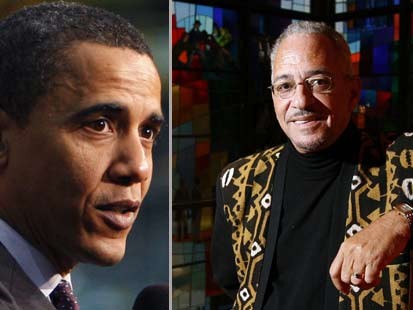
http://a.abcnews.com/images/Blotter/Obama_wright_080312_ms.jpg
From The Corner:
Pew research center: Obama/Wright
Mark Steyn

Kate's right about Obama's who-ya-gonna-believe-me-or-your-lyin'-eyes routine. The Senator has said he missed JeremiahWright's post-9/11 sermon. How many other Sundays did he decide to sleep in? Did he also miss the one where the Reverend Wright referred to "the US of KKKA"? How about the one where the pastor said "the government lied about Pearl Harbor. They knew the Japanese were about to attack"?

Out of town that morning? Well, what about the one where he said "the government lied about inventing HIV as a means of genocide against people of color"? Alarm clock out of batteries that Sunday, too?

It seems hard to believe you could spend 20 minutes in this pastor's company, never mind 20 years (as the Obamas have), without figuring he's a race-baiting loon. So at the very minimum Senator Obama's extremely belated distancing is lame. This is the candidate who wants to negotiate with the Iranians. The US deserves better than a president who, asked his reaction to the moment in the meeting when Ahmadinejad promised to wipe Israel off the face of the earth, says, "Oh, gee, I guess I must have stepped out to the men's room for that bit."

Obama listened to Wright's bilge week in, week out his entire adult life and by the end was giving this huckster over 20 grand a year to keep him in business. It seems reasonable to assume, given some of her observations on the hustings, that Mrs Obama agrees with the broad thrust of Jeremiah Wright's "theology". Does her husband?

Derb wondered the other day whether the Obama campaign was a massive "con job". But it's worse than that. If he were a con artist, he'd be like every other opportunist pol contemplating a run for the presidency: he'd be slick enough to know from the get-go that the Reverend Wright was a guy he needed to keep at way beyond arm's length; instead, he named his big pre-campaign hey-world-here-I-am book after one of his sermons. That suggests Obama didn't even appreciate the pastor was a potential problem. Which, in turn, suggests a candidate as weirdly disconnected from reality as Jeremiah Wright.

From The New York Daily News:
'Flock' to Bell X1's new album

By Jim Farber

Sunday, February 17th 2008, 4:00 AM

Bell X1

BELL X1. "Flock" (Yep Rock)

Good writing is ruthless. By that measure, Bell X1's Paul Noonan is a mean God.

When eying the pores on his skin, he compares them to the exploding volcano at Pompeii. When viewing a woman who has her arm draped around a man, he compares it to a noose. When a lover calls him out for being a mean drunk at night, he shoots back, "at least I'm okay in the morning."

You gotta love the guy.

Especially since Noonan's group sounds like Radiohead had they never gone off the arty deep end. Think: "Pablo Honey" at the peak of "Creep."

So honed a point of view, and clear a sound, didn't arrive overnight. Though Bell X1 is just releasing its American debut this week, the group's been coming on in its native Ireland for nearly a decade.

Back in '99 its main members comprised the band Juniper, a group fronted by the later solo star Damien Rice. Juniper released a full CD before Rice left for his inevitable, and glorious, career. Before that, Noonan had been trapped behind the drum kit. After the fracture (in 1999) he stepped up to become lead singer, making him a kind of Phil Collins to Rice's Peter Gabriel - only 1,000 times smarter.

Bell X1 (who took their name from the first plane to break the sound barrier) put out two CDs before the new one, each of which continued the connection to Rice by featuring some of his songs. The new CD, which came out in Ireland over a year ago and hit No. 1 in that country, represents Bell X1's first album to feature all its own material.

Noonan's wan and pale voice may always remind people of either Radiohead's Thom Yorke or Coldplay's Chris Martin, but he has his own twist on their timbre. In some of the more animated songs he can come closer to the yammer of David Byrne, circa early Talking Heads. New wave hooks give his songs some bounce, but the most appealing cut, "My First Born for a Song," pivots on a questioning piano riff.

The song's lyrics increase the intrigue significantly. They're about the teeth-gnashing, chest-beating search for inspiration, which makes Noonan swear he'd happily give up his child for a bit more of it. Elsewhere, Noonan describes politicians as people only out to seduce and then screw you ("Reacharound"), social networking sites as time-wasters that ruin your concentration and leave you more needy in the end ("He Said She Said"), and love as a duel to the death ("Natalie").

It's not just Noonan's sharp eye in these songs that proves winning. It's also his flair for dialogue and his keen way with a metaphor. His cruel writing will make you swoon.

jfarber@nydailynews.com

From The New York Daily News:
Bell X1 is coming to town

By Gene Santoro

Friday, March 14th 2008, 4:00 AM

Bell X1's 'Flock' CD, a No. 1 record in Ireland, recently debuted in the U.S.

The first jet plane to break the sound barrier inspired the name of a band that now stands at the cutting edge of Irish rock.

The music of Bell X1 doesn't sound at all like fellow Dubliners U2 or the Pogues. Instead, the quartet owes more to Radiohead, Coldplay, Talking Heads and even Bruce Springsteen, blending disco, funk and arena rock with lyrics that can be lovingly sentimental, artily angsty or cleverly ironic.

Powered by such sonic lures, Bell X1's tunes have surfaced on "Grey's Anatomy" and "The O.C." Their recent U.S. debut, "Flock," has been climbing the charts. And, now, for St. Patrick's Day weekend, they're performing shows Friday and Saturday at the Bowery Ballroom. (Monday. they'll appear on David Letterman.)

In 2005, the band's debut CD, "Flock," opened at No. 1 in Ireland. According to lead singer Paul Noonan, Bell X1 had wanted to tour the States for years. "We got caught in the major-label meltdown," he explained this week at McSorley's, where he and guitarist David Geraghty stopped by for a pint.

The label demanded they make an album of sound-alike hits. So the more free-wheeling Bell X1 struggled to fly. Though their CD was an instant smash in Ireland, "Flock" didn't get a British release until 2006. The CD didn't make it over here until last month.

In January, Bell X1 made a quick U.S. strike that included a date on "Late Night With Conan O'Brien." At last, the band seemed ready to soar.

It's been a long time in coming. In the mid-1990s, Bell X1 was a popular quintet called Juniper that included singer Damien Rice. When Rice abruptly left for a stellar solo career, the remaining bandmates had to change their identity - or pack it in. The new name came via Noonan, who was reading a book about famed test pilot Chuck Yeager.

The band's first two albums mingled leftover Rice tunes with new songs by Noonan and Geraghty. But for the new "Flock," they agreed to make it pure Bell X1. The guys themselves admit that this style can land "all over the place."

That reflects their new approach to songwriting. "We wrote this material as a group," Geraghty explained. "Instead of Paul or me bringing in finished songs, we'd sketch them."

"It sounds a bit academic," Noonan added, "but it made the songs stronger, and more varied."

The band's energetic live show should only accelerate their U.S. ascent. "American audiences seem open-minded. They like bands that don't have a single style," Noonan opined.

"Not like England," grinned Geraghty, "where every song has to sound the same."

The image “http://www.replayphotos.com/images/D/sm/Duke-University-Mens-Sports-Basketball-Basketball-Legends-Coach-K--Dean-Smith-D-M-B-00109sm.jpg” cannot be displayed, because it contains errors.
From The Charlotte Observer:
Krzyzewski has a love for former rival Smith

RON GREEN JR
.

Dean Smith and Mike Krzyzewski stood on opposite sides of college basketball's ultimate holy war for all those years, raging in that beautiful never-ending drama that has defined the Duke-North Carolina rivalry.

They have gone jaw to jaw, program to program, national championship to national championship.

They are of different generations but bound by a rare brilliance that intersected not just in Cameron Indoor Stadium and the Smith Center but across the basketball universe.

"I love Dean Smith," Krzyzewski, 61, said recently, sitting in a meeting room inside Duke's Cameron Indoor Stadium.

Smith, who is 77, has been retired from North Carolina for 11 years and will make a rare public appearance today when he's introduced at the ACC tournament with 11 other memorable figures from the league's basketball heritage.

The others might need the introduction.

Smith doesn't.

He'll probably walk gingerly on the knee he had replaced in December.

There were complications after the surgery that kept him hospitalized for a time and it's been a difficult recovery. Smith, who regularly visits the office in the building named for him, insists he'll be on the golf course again soon.

Fans will see Smith and be reminded of all he meant, not just to the ACC but to the game. Some will still see the coach who invented the Four Corners offense and was as disliked in some corners as he was loved in others. Some grudges never die.

Perhaps no one, however, will see him quite the way Krzyzewski does. He admits he didn't always feel about Smith the way he now does.

"I'm not saying that (love) was there all the time," Krzyzewski said. "I probably understand him better than anyone in the history of the conference.

"There have been a lot of great coaches and (Smith) is one of them. For him to be there that long and go through that cycle, the changes of only one team making (the NCAA tournament), the integration of our league, he kinda touched the whole thing.

"He was successful with Michael Jordan and he was successful with teams that didn't have (James) Worthy and (Sam) Perkins. His standard of excellence matches anyone that ever coached the game. I admire that."

Krzyzewski said he has tried to emulate what Smith did at North Carolina. There are differences, obviously, but the goal was the same -- sustained excellence.

And to both it means more than winning games. It means shaping hearts and minds and lives.

They both coached a game but they made it an education about more than Xs and Os.

Like great professors, they inspired not just their players but those who were within range, to be a part of something bigger than themselves.

If you've seen them at the end of seasons, you've seen both of them with tears in their eyes, and not just because they've won or lost.

"He was always players first," Krzyzewski said.

It's too bad, Krzyzewski said, that Smith essentially left the game when he retired. Smith has stayed connected to the North Carolina program, offering advice when asked and making the occasional appearance.

He remains one of the game's great living resources.

"We should have tapped into him somehow. There isn't another resource like him," Krzyzewski says. "He's seen everything. He's felt it. He's competed against it. For the state of basketball, not just the ACC.

"He and (Bobby) Knight remember everything. Put a tape recorder down and just talk to them. Just listen to them. As much as he loves Carolina basketball, he loves basketball. He loves the game."

Krzyzewski and Smith had their wars. Krzyzewski said the league had a double standard when it came to Smith and how his team's games were officiated. They got into a shouting match during the 1989 ACC tournament final in Atlanta, salting an already vicious game.

Eventually, though, they became friends. As his career has unfolded, bringing national championships and all that comes with them, Krzyzewski came to appreciate Smith, not just for what he accomplished but how he accomplished it.

"You learn a lot from competing against him," Krzyzewski says.

"Once you get over ... wanting to beat him, you say, `This guy is pretty damn good.' "

Friday, March 14, 2008

From NoMaas.org:
There's a new sheriff in town

03.12.2008

For far too long, Joe Torre made it clear that there would be no repercussions for going after a Yankee player. Over the last 3 years, no American League team has had more hit batsmen than the Bombers (223). Times have changed and no longer will a Yankees manager allow his players to be targets.

Whether if you believe the wrist-breaking collision at home plate was right or wrong, it's clear that the fiery Italian will defend his players. It's so refreshing to see. Who knows? Maybe if a pitcher is playing on one ankle, we may actually see a player lay down a bunt.


Bobby Meacham, Shelly Duncan, Joe Girardi,
and Kevin Long showed that the law has changed.


http://www.foxnews.com/images/266470/0_61_wright320.jpg

From The Corner:

The Pastor Problems of B. Hussein Obama
Victor Davis Hanson

Betrayed?

The problems with Rev. Wright and Sen. Obama are fivefold. They won’t go away, but they will raise dilemmas for him that have no analogy, no parallel with other religious leaders of dubious past declamations who have supported the other candidates:

1) The Obamas were not merely endorsed by, or attended the church of, Rev. Wright, but subsidized his hatred with generous donations, were married by him, and had their children baptized by this venomous preacher; there is nothing quite comparable in the case of Sens. Clinton and McCain.

2) Rev. Wright’s invective is not insensitive or hyperbolic alone, but in the end disgusting. And when listened to rather than read, the level of emotion and fury only compound the racism and hatred, whether in its attack on the Clintons, or profanity-laced slander of the United States and its history, or in gratuitous references to other races. Its reactionary Afrocentrism, conspiracy-theory, and illiberal racial separatism take us back to the 1970s, and compare with the worst of the fossilized Farrakhan—and have no remote parallel in the present campaign.

3) Sen. Obama has proclaimed a new politics of hope and change that were supposedly to transcend such venom and character assassination of the past. Thus besides being politically dense, he suffers—unless he preempts and explains in detail his Byzantine relationship with the Reverend—the additional charge of hypocrisy in courting such a merchant of hate. And then he compounds the disaster by the old-fashion politics of contortion and excuse by suggesting the Rev. Wright is not that controversial, or is analogous to the occasional embarrassing outburst of an uncle—some uncle.

4) There is a growing sense of betrayal among some of his supporters. Sen. Obama promised to transcend race; millions of sincere people of both parties took him at his word and invested psychologically and materially in his candidacy. Part of his message was that collectively America had made great progress, and their Ivy League and subsequent careers, in addition to his rhetoric of inclusiveness and tolerance, bore witness to that progress in racial equality. Now we learn, that for much of his career, he was not only attending hate-filled sermons against “rich white people” and the “g-d d——d America” (in hopes of solidifying his racial fides in regional Chicago politics?), but subsidized that ministry of intolerance. So while he promised an evolution beyond the race-identity politics of Jesse Jackson or the Rev. Sharpton, his own minister trumped anything that either one of those preachers might have sermonized. All in all—a betrayal.

5) The timing is especially troubling. In delegate mathematics, Obama seems to have the nomination; but this scandal—and it is a scandal despite the best efforts of sympathetic journalists to downplay it—will only cause worry for the super delegates, who now must either nominate a candidate (no doubt the vast right-wing conspiracy is examining the multivolume DVDs of Rev. Wright’s collective corpus of hatred) who will bleed all spring and summer, or “steal” the nomination from the “people” and “hand it over” to Hillary.

So now in place of a critical discussion of issues from taxes to the war, welcome to the Politics of Change.
http://graphics8.nytimes.com/images/2007/03/06/us/06obama_lg.jpg
From The Wall Street Journal:
Obama and the Minister
By RONALD KESSLER

March 14, 2008

In a sermon delivered at Howard University, Barack Obama's longtime minister, friend and adviser blamed America for starting the AIDS virus, training professional killers, importing drugs and creating a racist society that would never elect a black candidate president.

The Rev. Jeremiah A. Wright Jr., pastor of Mr. Obama's Trinity United Church of Christ in Chicago, gave the sermon at the school's Andrew Rankin Memorial Chapel in Washington on Jan. 15, 2006.

"We've got more black men in prison than there are in college," he began. "Racism is alive and well. Racism is how this country was founded and how this country is still run. No black man will ever be considered for president, no matter how hard you run Jesse [Jackson] and no black woman can ever be considered for anything outside what she can give with her body."

Mr. Wright thundered on: "America is still the No. 1 killer in the world. . . . We are deeply involved in the importing of drugs, the exporting of guns, and the training of professional killers . . . We bombed Cambodia, Iraq and Nicaragua, killing women and children while trying to get public opinion turned against Castro and Ghadhafi . . . We put [Nelson] Mandela in prison and supported apartheid the whole 27 years he was there. We believe in white supremacy and black inferiority and believe it more than we believe in God."

His voice rising, Mr. Wright said, "We supported Zionism shamelessly while ignoring the Palestinians and branding anybody who spoke out against it as being anti-Semitic. . . . We care nothing about human life if the end justifies the means. . . ."

Concluding, Mr. Wright said: "We started the AIDS virus . . . We are only able to maintain our level of living by making sure that Third World people live in grinding poverty. . . ."

Considering this view of America, it's not surprising that in December Mr. Wright's church gave an award to Louis Farrakhan for lifetime achievement. In the church magazine, Trumpet, Mr. Wright spoke glowingly of the Nation of Islam leader. "His depth on analysis [sic] when it comes to the racial ills of this nation is astounding and eye-opening," Mr. Wright said of Mr. Farrakhan. "He brings a perspective that is helpful and honest."

After Newsmax broke the story of the award to Farrakhan on Jan. 14, Mr. Obama issued a statement. However, Mr. Obama ignored the main point: that his minister and friend had spoken adoringly of Mr. Farrakhan, and that Mr. Wright's church was behind the award to the Nation of Islam leader.

Instead, Mr. Obama said, "I decry racism and anti-Semitism in every form and strongly condemn the anti-Semitic statements made by Minister Farrakhan. I assume that Trumpet magazine made its own decision to honor Farrakhan based on his efforts to rehabilitate ex-offenders, but it is not a decision with which I agree." Trumpet is owned and produced by Mr. Wright's church out of the church's offices, and Mr. Wright's daughters serve as publisher and executive editor.

Meeting with Jewish leaders in Cleveland on Feb. 24, Mr. Obama described Mr. Wright as being like "an old uncle who sometimes will say things that I don't agree with." He rarely mentions the points of disagreement.

Mr. Obama went on to explain Mr. Wright's anti-Zionist statements as being rooted in his anger over the Jewish state's support for South Africa under its previous policy of apartheid. As with his previous claim that his church gave the award to Mr. Farrakhan because of his work with ex-offenders, Mr. Obama appears to have made that up.

Neither the presentation of the award nor the Trumpet article about the award mentions ex-offenders, and Mr. Wright's statements denouncing Israel have not been qualified in any way. Mr. Obama nonetheless told the Jewish leaders that the award to Mr. Farrakhan "showed a lack of sensitivity to the Jewish community." That is an understatement.

As for Mr. Wright's repeated comments blaming America for the 9/11 attacks because of what Mr. Wright calls its racist and violent policies, Mr. Obama has said it sounds as if the minister was trying to be "provocative."

Hearing Mr. Wright's venomous and paranoid denunciations of this country, the vast majority of Americans would walk out. Instead, Mr. Obama and his wife Michelle have presumably sat through numerous similar sermons by Mr. Wright.

Indeed, Mr. Obama has described Mr. Wright as his "sounding board" during the two decades he has known him. Mr. Obama has said he found religion through the minister in the 1980s. He joined the church in 1991 and walked down the aisle in a formal commitment of faith.

The title of Mr. Obama's bestseller "The Audacity of Hope" comes from one of Wright's sermons. Mr. Wright is one of the first people Mr. Obama thanked after his election to the Senate in 2004. Mr. Obama consulted Mr. Wright before deciding to run for president. He prayed privately with Mr. Wright before announcing his candidacy last year.

Mr. Obama obviously would not choose to belong to Mr. Wright's church and seek his advice unless he agreed with at least some of his views. In light of Mr. Wright's perspective, Michelle Obama's comment that she feels proud of America for the first time in her adult life makes perfect sense.

Much as most of us would appreciate the symbolism of a black man ascending to the presidency, what we have in Barack Obama is a politician whose closeness to Mr. Wright underscores his radical record.

The media have largely ignored Mr. Obama's close association with Mr. Wright. This raises legitimate questions about Mr. Obama's fundamental beliefs about his country. Those questions deserve a clearer answer than Mr. Obama has provided so far.

Mr. Kessler, a former Wall Street Journal and Washington Post reporter, is chief Washington correspondent of Newsmax.com and the author of "The Terrorist Watch: Inside the Desperate Race to Stop the Next Attack" (Crown Forum, 2007).
http://cagle.com/news/ObamaObama/images/keefe.gif
Playing by Obama's Rules
By Patrick Buchanan

To observe Democrats this week, savaging one of their heroines, is to understand why the party is unready to rule.

Consider: At the 1984 Democratic convention in San Francisco, an unknown member of Congress was vaulted into history by being chosen the first woman ever to run on a national party ticket.

Geraldine Ferraro became a household name. And though the Mondale-Ferraro ticket went down to a 49-state defeat, "Gerry" became an icon to Democratic women.

This week, however, after being subjected for 48 hours to accusations of divisiveness by Barack Obama, and racism by his agents and auxiliaries in the media, Ferraro resigned from Clinton's campaign. What had she said to send the Obamaites into paroxysms of rage?

She stated an obvious truth: Had Barack not been a black male, he probably would not be the front-runner for the nomination.

Here are the words that sent her to the scaffold.

"If Obama was a white man he would not be in this position. And if he was a woman (of any color) he would not be in this position. He happens to be very lucky to be who he is. And the country is caught up with the concept."

Note that Ferraro did not say race was the only reason Barack was succeeding. She simply said that being an African-American has been as indispensable to his success as her being a woman was to her success in 1984. Had my name been "Gerald" rather than Geraldine, I would not have been on the '84 ticket, Ferraro conceded.

In calling her comments racist, Barack's retinue is asserting that his race has nothing to do with his success, even implying that it is racist to suggest it. This is preposterous.

What Geraldine Ferraro said is palpably true, and everyone knows it.

Was the fact that Barack is black irrelevant to the party's decision to give a state senator the keynote address at the 2004 convention? Did Barack's being African-American have nothing to do with his running up 91 percent of the black vote in Mississippi on Tuesday?

Did Barack's being black have nothing to do with the decision of civil rights legend John Lewis to dump Hillary and endorse him, though Lewis talks of how his constituents do not want to lose this first great opportunity to have an African-American president?

Can political analysts explain why Barack will sweep Philly in the Pennsylvania primary, though Hillary has the backing of the African-American mayor and Gov. Ed Rendell, without referring to Barack's ethnic appeal to black voters?

What else explains why the mainstream media are going so ga-ga over Obama they are being satirized on "Saturday Night Live"?

Barack Obama has a chance of being the first black president. And holding out that special hope has been crucial to his candidacy. To deny this is self-delusion -- or deceit.

Nor is this unusual. John F. Kennedy would not have gotten 78 percent of the Catholic vote had he not been Catholic. Hillary would not have rolled up those margins among white women in New Hampshire had she not been a sister in trouble. Mitt Romney would not have swept Utah and flamed out in Dixie were he not a Mormon. Mike Huckabee would not have marched triumphantly through the Bible Belt were he not a Baptist preacher and evangelical Christian. All politics is tribal.

The first campaign this writer ever covered was the New York mayoral race of 1961. Republicans stitched together the legendary ticket of Lefkowitz, Fino and Gilhooley, to touch three ethnic bases. Folks laughed. No one would have professed moral outrage had anyone suggested they were appealing to, or even pandering to, the Jewish, Italian and Irish voters of New York. People were more honest then.

Obama's agents suggest that Ferraro deliberately injected race into the campaign. But this, too, is ridiculous. Her quote came in an interview with the Daily Breeze of Torrance, Calif., not "Meet the Press."

The attack on Ferraro comes out of a conscious strategy of the Obama campaign -- to seek immunity from attack by smearing any and all attackers as having racist motives. When Bill Clinton dismissed Obama's claim to have been consistently antiwar as a "fairy tale," and twinned Obama's victory in South Carolina with Jesse Jackson's, his statements were described as tinged with racism.

Early this week, Harvard Professor Orlando Patterson's sensitive nostrils sniffed out racism in Hillary's Red Phone ad, as there were no blacks in it. Patterson said it reminded him of D.W. Griffith's pro-KKK "Birth of a Nation," a 1915 film.

What Barack's allies seem to be demanding is immunity, a special exemption from political attack, because he is African-American. And those who go after him are to be brought up on charges of racism, as has Bill Clinton, Ed Rendell and now Geraldine Ferraro.

Hillary, hoping to appease Barack's constituency, is ceding the point. Will the Republican Party and the right do the same? Play by Obama rules, and you lose to Obam

Thursday, March 13, 2008

null

From philly.com
The Elephant in the Room:
McCain must change views on social issues
I attended the Council for National Policy meeting last week in New Orleans and listened to John McCain address the who's who of Hillary Rodham Clinton's vast right-wing conspiracy. It was another chance for McCain to, in his words, "not just unite, but reignite the base."

How did the crowd think he did? Let's just say it's hard to ignite anything with cold water and no fire.

He talked about two legs of the Republican stool - spending/taxes and national security. But the third leg - social issues - went unmentioned. When questioned, he failed to connect with the people who care as much about why you vote the way you do as about how you vote.

The vast majority of the people at the meeting and in the conservative movement will vote for McCain. I will. But will the people who make up the backbone of the get-out-the vote effort go to work for him?

Only if he demonstrates that his vaunted pragmatism and open-mindedness will lead him to different positions on some issues.

Consider immigration and the extension of the Bush tax cuts. McCain says he "got the message." He's accepted the political reality of the need to secure our borders first and not increase people's taxes in a slow economy. That's great, but these conservatives are less interested in conversions based on politics than in decisions based on sound policy.

On other issues, more than better explanations will be needed.

McCain has opposed the Federal Marriage Amendment in the past because he said states could handle the assault on marriage. Have they? No. Although some state courts have sided with the voters' wishes in their states, courts in other states have forced same-sex marriage and civil-union laws on the public. A hodgepodge of laws is forcing other state courts to rule on the divorces of Massachusetts marriages and the breakups of civil unions from the nine states that permit them. It's an alternative route to forcing same-sex marriages and civil unions by making other state courts recognize these unions.

We also have gained a better understanding of the consequences of court ordered same-sex marriages. In Massachusetts, some public schools have introduced a fairy tale in which a prince marries another prince as part of a lesson on marriage - for second-graders. One superintendent said the district was "committed to teaching children about the world they live in." Interesting.

McCain, who recently supported a state constitutional amendment favoring traditional marriage in Arizona, needs to take these changes into account and outline a strategy that pushes some form of Federal Marriage Amendment or sets forth the conditions that would prompt his call for the amendment.

McCain also has been a proponent of capping carbon emissions to stop global warming. Yet last year's Intergovernmental Panel on Climate Change, the environmentalists' gold standard, dramatically scaled back its doom-and-gloom predictions. At the same time, hundreds of respected scientists went public to question the validity of man-made global warming.

If the science is changing, so are temperatures. Yes, 1998 was the warmest year since 1938, but every year since has been cooler, and we just learned that 2007 was the coldest year since 1966.

Let's put these inconvenient truths aside and assume man-made global warming exists. The fact is, McCain's legislation would cost hundreds of billions and have almost no effect on global temperature.

In his New Orleans speech, McCain asked what was wrong with investing in green technologies, reducing fossil-fuels consumption, boosting Earth-friendly energy alternatives and creating a cleaner environment. Nothing. Count me in. But his global-warming legislation does much more than that and would hurt the U.S. economy. At the very least, McCain should require full global participation - China and India - before the United States implements these climate-change initiatives.

New science also has upended the debate over federal funding of embryonic stem-cell research. It is now clear that the pursuit of federal funds for embryonic stem-cell research is not only unnecessary, but with the advent of embryonic-like adult stem cells, it is now counterproductive, since it would displace money for more promising research. One of the scientists responsible for recent adult stem-cell advances predicted an end to our stem-cell wars. As James Thompson told the New York Times: "A decade from now, this will be just a funny historical footnote."

When McCain voted to support federal research that destroys human embryos, things were different. The science - and the moral components of the debate - have changed. Can he?

Social conservatives see all three issues as moral issues. Yes, even global warming. Why? Because too many global-warming zealots appear to worship the creation instead of the Creator and view man and his actions as only suspect disrupters of nature.

I've known John McCain for almost two decades. Honor and integrity underlie everything he does. I can testify it's hard to persuade him that there is another way when he believes he has taken the honorable position. He is stubborn in the best sense of the word.

Conservatives are not asking him to execute a series of 180s. We're looking for policy adjustments that show he has the independent spirit and pragmatic sense to change prior stands not simply because of new political realities, but new facts. Facts - which, as Ronald Reagan used to say, are also stubborn things.

Tuesday, March 11, 2008

The image “http://politicalpartypoop.com/wp-content/uploads/2007/05/nafta2a.JPG” cannot be displayed, because it contains errors.
To Die for NAFTA
by Patrick J. Buchanan

Posted 03/11/2008 ET
Updated 03/11/2008 ET

"The commonest error in politics," said Lord Salisbury, "is sticking to the carcass of dead policies."

Lord Salisbury's rule comes to mind on reading of John McCain's delight at the $40 billion contract awarded the French-led parent of Airbus -- to build the next generation of U.S. Air Force tankers.

The contract could run to $100 billion and is a body blow to Boeing in its duel to the death with Airbus. Two-thirds of all air-to-air refueling tankers are used by the United States.
The contract gives a 30-year lease on life to the expiring Airbus A330 and means early death for Boeing's 767, the U.S. model for the tanker.

Congratulating himself for having exposed corruption in the Boeing bid, McCain purred, "I have always insisted that the Air Force buy major weapons through fair and open competition."

If McCain thinks Airbus has prospered through "fair and open competition," he is beyond recall. In its first 25 years, Airbus sold 770 planes but did not make a dime in profit. It was started as a socialist cartel, subsidized by the governments of Spain, France, Britain and Germany, to invade and capture a market owned by Americans who built the planes that won World War II.

Airbus drove Lockheed and McDonnell-Douglas out of the business of commercial aircraft and almost took down Boeing. And like indolent buffalo munching grass as they are shot one by one, we let it happen.

Lost U.S. jobs should not be our primary concern, said McCain, "I've always felt the best thing to do is to create the best weapons system we can at minimum cost to taxpayers."

But if McCain thinks cost trumps all in building weapons of war, why not outsource the building of U.S. carriers, cruisers, destroyers, frigates and submarines to the foreign shipyards that constuct America's merchant ships? Why not hire and train foreign sailors as crews?

Why not outsource the scores of thousands of U.S. government jobs handling Social Security checks and tax returns to Bangladesh and India? After all, the neocons want to hire foreign mercenaries to fight America's wars and reward them with U.S. citizenship, as the Romans did in the last days of the empire.

What does it mean to be an American anymore?

It took 20 years to wake up blockheaded Republicans to the social insanity of open borders. Only the collapse of his candidacy last summer jolted McCain into realizing that the 80 percent of Americans who reject amnesty and want a border fence are not all "bigots," as his Tonto, Lindsay Graham, said they were.

Is it going to take 20 more years for Republicans to awaken to the economic disaster they have created and the political ruin they are inviting with this fanatic faith in "free trade," while the rest of the world loots our country through mercantilism?

When Europe imposes a 15 percent value-added tax on U.S. imports and rebates the VAT on exports to the United States, that is not free trade. When China devalues its currency 45 percent, as it did in 1994, and bolts it down to suck jobs and factories out of the United States, that is not free trade. When Japan manipulates its currency, preaches economic nationalism to its people, and shelters its market for TVs, autos and steel, while dumping into and capturing ours, that is not free trade.

McCain admits to knowing almost nothing about economics and is now being advised by my old friend Jack Kemp. In a Wall Street Journal essay bemoaning my views, Kemp concedes, "I'm on the advisory board of Toyota North America and now drive a hybrid Lexus."

Nor is Jack the only pol who has found happiness in a foreign employ. Ex-secretaries of state and Cabinet officers, ex-senators and congressmen, and ex-White House aides are getting rich working for foreigners who are carting off American jobs, American technology, American markets, American factories -- and America's future.

Yet retribution may be at hand for our multinational GOP. In Ohio, NAFTA is a five-letter word with a four-letter meaning, as Ohio lost a huge slice of the 3.5 million manufacturing jobs that vanished under the McCain-Kemp-Bush policy of unilateral disarmament in the trade wars being waged against America.

Look at the Bush-McCain record: $4 trillion in trade deficits, $2.5 trillion in manufactures alone. One in every six manufacturing jobs, 3 million, gone. With America borrowing $2 billion a day to pay for foreign goods, we have seen a collapse of the dollar, the price of gold quadruple to $1,000 an ounce, oil soar to $107 a barrel and gas heading toward $4 a gallon.

Where Bush has created an average of 46,000 new private-sector jobs a month, Bill Clinton did five times as well, creating 220,000 a month.

Hillary won Ohio denouncing the NAFTA deal Bill Clinton cut. The lady gets it. McCain remains a loyal NAFTA man. Good luck in Ohio and Michigan. As the Great Peer said, "The commonest error in politics is sticking to the carcass of dead policies."
http://media.monstersandcritics.com/articles/1322191/article_images/unit.jpg
From The Village Voice (of all places):
David Mamet:
Why I Am No Longer a 'Brain-Dead Liberal'

An election-season essay
by David Mamet


March 11th, 2008 12:00 AM

John Maynard Keynes was twitted with changing his mind. He replied, "When the facts change, I change my opinion. What do you do, sir?"

My favorite example of a change of mind was Norman Mailer at The Village Voice.

Norman took on the role of drama critic, weighing in on the New York premiere of Waiting for Godot.

Twentieth century's greatest play. Without bothering to go, Mailer called it a piece of garbage.

When he did get around to seeing it, he realized his mistake. He was no longer a Voice columnist, however, so he bought a page in the paper and wrote a retraction, praising the play as the masterpiece it is.

Every playwright's dream.

I once won one of Mary Ann Madden's "Competitions" in New York magazine. The task was to name or create a "10" of anything, and mine was the World's Perfect Theatrical Review. It went like this: "I never understood the theater until last night. Please forgive everything I've ever written. When you read this I'll be dead." That, of course, is the only review anybody in the theater ever wants to get.

My prize, in a stunning example of irony, was a year's subscription to New York, which rag (apart from Mary Ann's "Competition") I considered an open running sore on the body of world literacy—this due to the presence in its pages of John Simon, whose stunning amalgam of superciliousness and savagery, over the years, was appreciated by that readership searching for an endorsement of proactive mediocrity.

But I digress.

I wrote a play about politics (November, Barrymore Theater, Broadway, some seats still available). And as part of the "writing process," as I believe it's called, I started thinking about politics. This comment is not actually as jejune as it might seem. Porgy and Bess is a buncha good songs but has nothing to do with race relations, which is the flag of convenience under which it sailed.

But my play, it turned out, was actually about politics, which is to say, about the polemic between persons of two opposing views. The argument in my play is between a president who is self-interested, corrupt, suborned, and realistic, and his leftish, lesbian, utopian-socialist speechwriter.

The play, while being a laugh a minute, is, when it's at home, a disputation between reason and faith, or perhaps between the conservative (or tragic) view and the liberal (or perfectionist) view. The conservative president in the piece holds that people are each out to make a living, and the best way for government to facilitate that is to stay out of the way, as the inevitable abuses and failures of this system (free-market economics) are less than those of government intervention.

I took the liberal view for many decades, but I believe I have changed my mind.

As a child of the '60s, I accepted as an article of faith that government is corrupt, that business is exploitative, and that people are generally good at heart.

These cherished precepts had, over the years, become ingrained as increasingly impracticable prejudices. Why do I say impracticable? Because although I still held these beliefs, I no longer applied them in my life. How do I know? My wife informed me. We were riding along and listening to NPR. I felt my facial muscles tightening, and the words beginning to form in my mind: Shut the fuck up. "?" she prompted. And her terse, elegant summation, as always, awakened me to a deeper truth: I had been listening to NPR and reading various organs of national opinion for years, wonder and rage contending for pride of place. Further: I found I had been—rather charmingly, I thought—referring to myself for years as "a brain-dead liberal," and to NPR as "National Palestinian Radio."

This is, to me, the synthesis of this worldview with which I now found myself disenchanted: that everything is always wrong.

But in my life, a brief review revealed, everything was not always wrong, and neither was nor is always wrong in the community in which I live, or in my country. Further, it was not always wrong in previous communities in which I lived, and among the various and mobile classes of which I was at various times a part.

And, I wondered, how could I have spent decades thinking that I thought everything was always wrong at the same time that I thought I thought that people were basically good at heart? Which was it? I began to question what I actually thought and found that I do not think that people are basically good at heart; indeed, that view of human nature has both prompted and informed my writing for the last 40 years. I think that people, in circumstances of stress, can behave like swine, and that this, indeed, is not only a fit subject, but the only subject, of drama.

I'd observed that lust, greed, envy, sloth, and their pals are giving the world a good run for its money, but that nonetheless, people in general seem to get from day to day; and that we in the United States get from day to day under rather wonderful and privileged circumstances—that we are not and never have been the villains that some of the world and some of our citizens make us out to be, but that we are a confection of normal (greedy, lustful, duplicitous, corrupt, inspired—in short, human) individuals living under a spectacularly effective compact called the Constitution, and lucky to get it.

For the Constitution, rather than suggesting that all behave in a godlike manner, recognizes that, to the contrary, people are swine and will take any opportunity to subvert any agreement in order to pursue what they consider to be their proper interests.

To that end, the Constitution separates the power of the state into those three branches which are for most of us (I include myself) the only thing we remember from 12 years of schooling.

The Constitution, written by men with some experience of actual government, assumes that the chief executive will work to be king, the Parliament will scheme to sell off the silverware, and the judiciary will consider itself Olympian and do everything it can to much improve (destroy) the work of the other two branches. So the Constitution pits them against each other, in the attempt not to achieve stasis, but rather to allow for the constant corrections necessary to prevent one branch from getting too much power for too long.

Rather brilliant. For, in the abstract, we may envision an Olympian perfection of perfect beings in Washington doing the business of their employers, the people, but any of us who has ever been at a zoning meeting with our property at stake is aware of the urge to cut through all the pernicious bullshit and go straight to firearms.

I found not only that I didn't trust the current government (that, to me, was no surprise), but that an impartial review revealed that the faults of this president—whom I, a good liberal, considered a monster—were little different from those of a president whom I revered.

Bush got us into Iraq, JFK into Vietnam. Bush stole the election in Florida; Kennedy stole his in Chicago. Bush outed a CIA agent; Kennedy left hundreds of them to die in the surf at the Bay of Pigs. Bush lied about his military service; Kennedy accepted a Pulitzer Prize for a book written by Ted Sorenson. Bush was in bed with the Saudis, Kennedy with the Mafia. Oh.

And I began to question my hatred for "the Corporations"—the hatred of which, I found, was but the flip side of my hunger for those goods and services they provide and without which we could not live.

And I began to question my distrust of the "Bad, Bad Military" of my youth, which, I saw, was then and is now made up of those men and women who actually risk their lives to protect the rest of us from a very hostile world. Is the military always right? No. Neither is government, nor are the corporations—they are just different signposts for the particular amalgamation of our country into separate working groups, if you will. Are these groups infallible, free from the possibility of mismanagement, corruption, or crime? No, and neither are you or I. So, taking the tragic view, the question was not "Is everything perfect?" but "How could it be better, at what cost, and according to whose definition?" Put into which form, things appeared to me to be unfolding pretty well.

Do I speak as a member of the "privileged class"? If you will—but classes in the United States are mobile, not static, which is the Marxist view. That is: Immigrants came and continue to come here penniless and can (and do) become rich; the nerd makes a trillion dollars; the single mother, penniless and ignorant of English, sends her two sons to college (my grandmother). On the other hand, the rich and the children of the rich can go belly-up; the hegemony of the railroads is appropriated by the airlines, that of the networks by the Internet; and the individual may and probably will change status more than once within his lifetime.

What about the role of government? Well, in the abstract, coming from my time and background, I thought it was a rather good thing, but tallying up the ledger in those things which affect me and in those things I observe, I am hard-pressed to see an instance where the intervention of the government led to much beyond sorrow.

But if the government is not to intervene, how will we, mere human beings, work it all out?

I wondered and read, and it occurred to me that I knew the answer, and here it is: We just seem to. How do I know? From experience. I referred to my own—take away the director from the staged play and what do you get? Usually a diminution of strife, a shorter rehearsal period, and a better production.

The director, generally, does not cause strife, but his or her presence impels the actors to direct (and manufacture) claims designed to appeal to Authority—that is, to set aside the original goal (staging a play for the audience) and indulge in politics, the purpose of which may be to gain status and influence outside the ostensible goal of the endeavor.

Strand unacquainted bus travelers in the middle of the night, and what do you get? A lot of bad drama, and a shake-and-bake Mayflower Compact. Each, instantly, adds what he or she can to the solution. Why? Each wants, and in fact needs, to contribute—to throw into the pot what gifts each has in order to achieve the overall goal, as well as status in the new-formed community. And so they work it out.

See also that most magnificent of schools, the jury system, where, again, each brings nothing into the room save his or her own prejudices, and, through the course of deliberation, comes not to a perfect solution, but a solution acceptable to the community—a solution the community can live with.

Prior to the midterm elections, my rabbi was taking a lot of flack. The congregation is exclusively liberal, he is a self-described independent (read "conservative"), and he was driving the flock wild. Why? Because a) he never discussed politics; and b) he taught that the quality of political discourse must be addressed first—that Jewish law teaches that it is incumbent upon each person to hear the other fellow out.

And so I, like many of the liberal congregation, began, teeth grinding, to attempt to do so. And in doing so, I recognized that I held those two views of America (politics, government, corporations, the military). One was of a state where everything was magically wrong and must be immediately corrected at any cost; and the other—the world in which I actually functioned day to day—was made up of people, most of whom were reasonably trying to maximize their comfort by getting along with each other (in the workplace, the marketplace, the jury room, on the freeway, even at the school-board meeting).

And I realized that the time had come for me to avow my participation in that America in which I chose to live, and that that country was not a schoolroom teaching values, but a marketplace.

"Aha," you will say, and you are right. I began reading not only the economics of Thomas Sowell (our greatest contemporary philosopher) but Milton Friedman, Paul Johnson, and Shelby Steele, and a host of conservative writers, and found that I agreed with them: a free-market understanding of the world meshes more perfectly with my experience than that idealistic vision I called liberalism.

At the same time, I was writing my play about a president, corrupt, venal, cunning, and vengeful (as I assume all of them are), and two turkeys. And I gave this fictional president a speechwriter who, in his view, is a "brain-dead liberal," much like my earlier self; and in the course of the play, they have to work it out. And they eventually do come to a human understanding of the political process. As I believe I am trying to do, and in which I believe I may be succeeding, and I will try to summarize it in the words of William Allen White.

White was for 40 years the editor of the Emporia Gazette in rural Kansas, and a prominent and powerful political commentator. He was a great friend of Theodore Roosevelt and wrote the best book I've ever read about the presidency. It's called Masks in a Pageant, and it profiles presidents from McKinley to Wilson, and I recommend it unreservedly.

White was a pretty clear-headed man, and he'd seen human nature as few can. (As Twain wrote, you want to understand men, run a country paper.) White knew that people need both to get ahead and to get along, and that they're always working at one or the other, and that government should most probably stay out of the way and let them get on with it. But, he added, there is such a thing as liberalism, and it may be reduced to these saddest of words: " . . . and yet . . . "

The right is mooing about faith, the left is mooing about change, and many are incensed about the fools on the other side—but, at the end of the day, they are the same folks we meet at the water cooler. Happy election season.
Monday, March 10, 2008

From Deadspin.com:
Your Definitive Duke/UNC Photo


No matter who wins in any particular North Carolina-Duke game, all one can really ask for is a perfect photo that encapsulates all the boasting the winning team has earned. We'd say this one covers it pretty well.

From Manolo's Shoe Blog:
Ukrainian Army Women
and Their Shoes

Manolo says, many people in the blogosphere have been linking to this photo of the Ukrainian Army hotties. As one may see, for feetwear, anything goes, from the slingbacks to the wedge heels, although the preponderance are the sexy, stiletto heeled pumps.

By the comparison, the standard female dress shoes for the U.S. Army are supposed to be…”Black oxford shoes, or black service pumps…The pumps will be plain, with closed toe and heel. The heel will be between 1/2 and 3 inches high.” In the other words, functional, serious, and appropriate, but not hot.

Sunday, March 09, 2008


From WRAL.com:A user-submitted picture of slain UNC student body president
Eve Marie Carson and UNC basketball star Tyler Hansborough.
From TarHeelBlue.com:
The Best Days Of Your Life

March 9, 2008

By Adam Lucas

DURHAM--To be a truly memorable Carolina Basketball victory, to be one of those nights you remember forever, you have to be surrounded by the right people.

I promise you this: long after you've forgotten Ty Lawson's key steal, long after you've forgotten Wayne Ellington's clutch bank shot, long after you've forgotten Danny Green's one-hand slam over a helpless Greg Paulus (OK, maybe you won't have forgotten that one), you'll remember who was there and how you celebrated Carolina's 76-68 victory in the season finale. Nights like this are about the people.

Inside Cameron, there were images that you will never forget. Around 11:45, the media was trying to shoehorn into the tiny visitor's locker room to get comments from the players. Up the stairs and around the corner, there sat a very tired-looking man with his head in his hands. He held a stat sheet and he looked exhausted.

It was Roy Williams. While students were screaming on Franklin Street and you were high-fiving in your living room, he was just sitting, surrounded by a few close friends.

What was on his mind?

"Who's the starting pitcher tomorrow?"

He was talking about tomorrow's third game of the Carolina-Duke baseball series. Less than an hour after coaching in front of millions on national television, he wasn't cutting down the nets or popping his collar. He was thinking about baseball.

"I love Roy all the time," was Eve Carson's quote earlier this week on the front page of the Daily Tar Heel. Her friends couldn't explain why she'd put it exactly that way.

"Who doesn't love Roy?" said Carson's close friend, Tristan Heinrich. "Everything that Carolina does is done with so much respect and class and integrity, and Eve appreciated that that's the way he has represented Carolina at every opportunity."


I think maybe Eve loved Roy all the time because Roy loves Carolina all the time, which is something that would have appealed to her--and something to which she could have related.

It's the people, see. You can talk about switching screens or offensive rebounds. But what I'm more likely to remember is watching Eric Montross stand up in the crow's nest radio booth at Cameron Indoor Stadium, contorting himself so his head wouldn't scrape metal, to wave goodbye to George Lynch. Lynch had spent most of his evening feverishly waving a Carolina blue-and-white pompom, oblivious to the fact that Duke students behind him were having a hard time seeing over 6-foot-8 plus a pompom.

Lynch was Jackie Manuel before there was Jackie Manuel. If it's possible, after watching him wave that pompom, I think I like the 1993 national champion even more right now.

Late in the second half, former Blue Devil Brian Davis--inexplicably clad in a Carolina blue jacket--stood up in his seat near the baseline during a timeout. He pointed at the Carolina bench and loudly informed them that they were not a good basketball team.

The response from Lynch and the rest of the Carolina fans behind the bench: they pointed at the scoreboard.

It wasn't just senior night, see. It was also alumni night. Davis was there, of course. Jason Williams and Chris Duhon were there, too. You're smiling a little, knowing they went home unhappy, aren't you? Wait a minute. Know who else was there, sitting on the opposite baseline?

Christian Laettner.

Yep, Laettner himself got to view the loss. He was one row behind Eli and Peyton Manning, because apparently two Super Bowl trophies outweigh a retired jersey.

It's the people. Inside the Tar Heel locker room, after a raucous celebration that included a brave-yet-foolish chest bump of immovable Jonas Sahratian by slightly more movable Eric Hoots--"Put me on the injury report as, `Bruised sternum,'" Hoots said--Mike Copeland removed his jersey and started to toss it in his locker. Then he grabbed it and pointed to the black patch with the blue letters that read, "Eve."

"That's why we did it, right there," he said. "That's why we did it."

Last year around this time, Bobby Frasor was walking across The Pit when a stranger grabbed him.

"Will you take a picture with me?" Eve Carson asked.

Frasor obliged, and a friendship was born. The Tar Heel guard turned into Carson's underground campaign manager, asking all his teammates if they'd voted for her on election day.

"Normally, I hate politics," Frasor said. "But anything to help a friend."

The friend just happened to be a rabid basketball fan. She spent most of the season in her regular seats in section 118, row Y. In those seats, she was not the student body president or the Morehead Scholar. She was just a college senior who really, really wanted to get on the video board. So for the Duke game, she and her friend Anna showed up in Carolina blue prom dresses. Presto, video board magic.

She wasn't always in the stands. Sometimes, she was on the field. She was the captain of her intramural flag football team, which was named--you're not going to believe this--Team Friendship. Last year, they won the school and regional championship. Mostly, she played receiver, but she also had a favorite postgame activity.

When the game was over and players--friends--would start to scatter, Eve would start yelling.

"Wait a minute, come back here!" she'd say. She'd gather everyone in a circle and then she'd say something they all remember, every single one of them.

"Think about this moment," she'd say. "This day and this moment, this is the best day of our lives right now."

You know who would love that quote? Roy Williams. He would love the idea that a college student recognized that the best days of her life--the best days of all of our lives--were not a few months away at graduation or back in high school or that time you threw the winning pass in the playoffs. He would love the idea of relishing this exact moment right now.

There is more to come, an ACC Tournament and NCAA Tournament and you hesitate to even imagine what might be ahead. I understand that some people judge a season by what happens in the next month. But right now, she's right.


The photos above show a man that police say used Eve Carson's ATM card and may have been driving the slain UNC student's Toyota Highlander.

Chapel Hill Police Department Photos

"I'm shocked, shocked to find
that gambling is going on in here!"
-Captain Renault, Casablanca

"Each year, some 1.2 million violent crimes involving blacks and whites occur nationwide. In fully 90 percent of those cases, according to U.S. Justice Department figures, the perpetrators are black and the victims are white.

Violent white felons choose black victims for fewer than 3 percent of their attacks, whereas violent black felons choose white victims about 56 percent of the time. Statistically, the "average" African American is an astonishing 56 times more likely to attack a white than vice versa."-John Perazzo

Chip Litherland for The New York Times
Yankees closer Mariano Rivera, right, has taken several young teammates
like pitcher Edwar Ramírez, left, under his wing.

From The New York Times:

Rivera’s a Closer With an Open Heart
By TYLER KEPNER

TAMPA, Fla. — The dollars were staggering, the richest deal for a closer, the reward for a decade of sterling service and the lightning still left in his right arm.

But the money was the least important part of Mariano Rivera’s November. While the Yankees and his agent sketched out the details of his three-year, $45 million contract, Rivera spread his message and mourned his mentor, the man who fostered in him a sense of duty that has made Rivera the sage of the Yankees’ clubhouse.

In mid-November, Rivera traveled to the Dominican Republic for an annual Christian-themed baseball clinic. In late November, on his 38th birthday, Rivera was in Panama to bury Chico Heron, who brought him into professional baseball.

There were two clinics in the Dominican Republic, one on either side of the country, and they ran at the same time each day for four days. Rivera had lent his name to the event, and with that came responsibility. He would speak to one group at the start of the camp, then hustle some 90 minutes across the country to address the other group.

“He was adamant that he make both camps at the same time,” said the Cincinnati Reds’ Andy Phillips, a former Yankee who attended the clinic. “He was running himself into the ground, driving across the country to make it, because he wanted all these kids to get an opportunity to spend time with him and work with him.”

It is no different with the Yankees, especially in training camp, where teammates flock to Rivera for guidance. Much of the lessons he imparts are from Heron, the Yankees scout who found Rivera in Panama in 1990.

Heron was like his second father, and he saw something special in Rivera, a gangly 20-year-old who threw only 85 miles an hour. It was Heron who recommended that Herb Raybourn sign Rivera for $3,000, and Heron who nurtured Rivera for the next 17 years.

“He was twice older than me, but I loved that man,” Rivera said. “He used to tell me to work hard, be committed, be respectful, trust what you have and trust the Lord, be able to do it in tough situations. And he was always, constantly encouraging me to just do it, don’t give up — even before he passed away.”

Heron was in his 70s, Rivera said, and he had been sick for a while. Rivera lives in Westchester County year-round now, but he visited Heron in Panama shortly before he died, to see him one last time.

“He was one of those men that if I call him any time, anytime that I need something from him, he would have done it on the spot,” Rivera said. “That’s how close he was to me. I respect that man till the day he died. I buried him with honor.”

When Rivera speaks of Heron, he mentions his willingness to give advice to anybody who asked. It is trait that has made Rivera as important a leader on the Yankees as Derek Jeter, the team’s designated captain.

“He cares about helping people, period,” General Manager Brian Cashman said. “It’s as simple as that.”

When reliever Ross Ohlendorf was called to the majors in September, he was startled when Rivera peppered him with questions about the Yankees’ Class AAA team. It was important to Rivera, Ohlendorf noticed, to know how the minor league affiliates were doing.

Joba Chamberlain, who had never been a reliever before the Yankees made him the setup man in August, was nervous at first around Rivera. All he knew were Rivera’s accomplishments.

Chamberlain tried to learn Rivera’s cutter, but quickly discovered that the pitch was impossible to duplicate. But the more he talked with Rivera, the more he learned how to approach his new job. Pay attention in the early innings, Rivera told him. Watch for the strengths and weaknesses of the hitters. Be alert.

And when Rivera struggled, Chamberlain learned from that, too.

“To watch his demeanor and watch the way he handled it, every day he put ice on his shoulder and said: ‘I’m only human. Tomorrow, if the game’s close, I’m going to get the ball and do everything I can,’ ” Chamberlain said. “He’s won and lost some of the biggest games in the history of baseball, and he’s no worse for the wear when he gives up a home run. Some people think the world’s going to end.”

Perspective is one of Rivera’s great gifts. His first experience as a postseason closer was failure, in the 1997 playoffs against Cleveland. He celebrated on the mound at the end of the next three World Series, but failed again in Arizona in 2001. A savior against Boston in 2003, he was a goat the next fall.

Win or lose, Rivera’s demeanor does not change. Conquering the mental side of baseball, he said, is harder than his physical feats.

“When you start thinking, a lot of things will happen,” Rivera said. “Emotions take place, and you have to know how to control your emotions. If you don’t control your emotions, your emotions will control your acts, and that’s not good.”

Rivera’s extraordinary athleticism lets him repeat his delivery, the most important factor in a pitcher’s success. He also knows his craft well enough to notice flaws in others, the way he did last season with Luis Vizcaíno.

“Mo’s the reason Vizcaíno turned his game around last year — Mo’s efforts,” Cashman said. “He wasn’t going to let a teammate struggle.”

Now, the young reliever Edwar Ramírez often sits in Rivera’s locker before practice, chatting softly while Rivera gently blows the ink dry on the baseball cards he has carefully signed. A clubhouse attendant waits nearby, sealing the cards in envelopes, returning the prizes to fans.

When Ramírez was called to the majors last July, Dave Eiland, then the Class AAA pitching coach, told him, “If you need something, ask Mo.” Ramírez became Rivera’s pregame catch partner, and he eagerly sought Rivera’s counsel.

“He told me if you want to stay in the big leagues with the Yankees, you have to stay straight,” Ramírez said. “You don’t have to go to the clubs, you don’t have to drink. That’s what he showed me, because he doesn’t drink and he doesn’t go to the clubs.”

Rivera coordinates Bible study, and Ramírez and another reliever, José Veras, are among those who participate. Like Ramírez, Veras is a native of the Dominican Republic. Growing up, he said, his family knew to suspend all activity when Rivera was pitching on television.

Over and over, Veras used the word dream to describe how it felt to be teammates and friends with his idol. They talk shop, about Veras’s staying tall in his delivery, or gripping his pitches, or attacking certain lineups. They also talk about life, and the responsibilities of being in the majors.

Even now, in his third season with the Yankees, Veras seems amazed that Rivera cares so much.

“It’s hard to find people like that,” he said. “That’s why we appreciate everything he does, because if you’re 20-something and he’s 30-something, he doesn’t want to be my baby sitter. But he can say, ‘Don’t do this; that’s bad.’ It just takes a couple of seconds, but some guys think it’s hard to say. So when you find people like that that can teach you the right way, it’s awesome. It’s unbelievable to find people like that.”

It would be unbelievable, except that Chico Heron made it real. For the best $3,000 the Yankees ever spent, Heron found an extraordinary talent in Rivera, who learned from him the value of community.