Tuesday, December 30, 2008

http://i62.photobucket.com/albums/h110/majorcombs/bureaucracy2b.gif
From Opinion Journal:
Obama Will Ration Your Health Care
Think of his health plan as a federal HMO.
By SALLY C. PIPES

People are policy. And now that President-elect Barack Obama has fielded his team of Tom Daschle as secretary of Health and Human Services and Melody Barnes as director of the White House Domestic Policy Council, we can predict both the strategy and substance of the new administration's health-care reform.

The prognosis is not good for patients, physicians or taxpayers. If Mr. Daschle meant what he wrote in his book "Critical: What We Can Do About the Health-Care Crisis," Americans can expect a quick, hard push to build more federal bureaucracy, impose price controls, restrict medicines and technology, boost taxes, mandate the purchase of health insurance, and expand government health care.

In his book, Mr. Daschle proposes a National Health Board to regulate the way health care is provided. This board would have vast powers in regulating the massive federal health-care system -- a system that includes Medicare, Medicaid, and other programs. Under Mr. Obama, it is likely that that system will be expanded and that new government insurance for the nonelderly, nonpoor will be created.

Given the opportunity, Mr. Daschle would likely charge the board with determining which treatments and drugs are cost effective and therefore permissible to use for patients covered by the government. And because the government is such a big player in the health-care market (46% of health-care spending comes from the government), the board would effectively set parameters for private insurers.

It is nearly certain that the process of determining which drugs and which treatments would be approved for use would be quickly politicized. The details of health-care policy may not be kitchen table conversation, but the fact that a Washington committee can deny grandma a hip replacement due to her age, or your sister a new and expensive drug, is. Health care is personal and voters will pressure lawmakers on access to care.

Liberal experts, Mr. Daschle included, believe that America needs to ration new technology and drugs. In his book, Mr. Daschle complains about overuse of new technology and praises the United Kingdom's National Institute for Health and Clinical Excellence (NICE), a rationing system that controls government costs. NICE's denial of care is legendary -- from the arthritis drug Abatacept to the lung cancer drug Tarceva. These drugs are effective. It's just that the bureaucrats don't consider them cost effective.
The Opinion Journal Widget

Download Opinion Journal's widget and link to the most important editorials and op-eds of the day from your blog or Web page.

Americans will not put up with such limits, nor will our elected representatives. Mr. Daschle himself proves this. He punts the hard decisions about rationing to an unelected board. Yet his main proposals are not only about expanding subsidized programs to cover more people but about adding the massively expensive benefit categories of mental health, which has a strong lobby behind it, and long-term care, which is important to the broad middle class.

One of the great myths in health care is that the uninsured are responsible for driving up private premiums by shifting costs. Uncompensated care certainly shifts some costs to private payers. Yet these costs are actually quite manageable in the aggregate, akin to what retailers lose due to shoplifting. The major cost shift is from government programs -- Medicare and Medicaid -- to private plans. The government pays doctors to treat Medicare and Medicaid patients. But the rates it pays, on average, are less than the cost for providing care to these patients. This is why Medicaid patients, and increasingly Medicare patients, struggle to find doctors. Putting more people on these programs will destabilize the remaining private system and create a coalition for price and wage controls.

Americans will never tolerate this. Remember our managed-care experiment in the 1990s. It succeeded in its main goal of controlling costs without an aggregate reduction in health quality. But in asking Americans to limit their choices, it prompted a bipartisan act of Congress to provide patients with a Bill of Rights. Now Mr. Daschle proposes nothing less than a giant HMO with a federal bureaucracy setting the benefit plan.

Mr. Daschle's model is Massachusetts. But Massachusetts's plan is an unfolding disaster and demonstrates how Mr. Daschle's private/public model is merely a stalking horse for government-dominated health care.

The headline claim is that the program has signed up 442,000 more people for health insurance. The reality is that 80,000 of these were simply put on Medicaid and 176,000 more on the taxpayer-subsidized plans. Costs have exploded, requiring additional tax hikes and the entire system is only possible due to sizable transfers from the federal government. The plans are so unaffordable that in 2007, 62,000 people were exempted from the individual mandate. So much for universal coverage.

The only way the Massachusetts plan will survive is with continued and increasing federal subsidies -- that is, tax revenue from the residents of other states. The only way Mr. Daschle's proposed plan would survive is with massive deficit spending -- that is, with taxpayer money from future Americans, many of whom are not yet born.

Mr. Daschle and the Democrats have spent years developing both the policy and political strategy to make the final push for taxpayer-financed universal health insurance. They have the players on the field, a crisis providing a sense of urgency, and a playbook filled with lessons learned from years of health policy reform disasters -- most recently that of HillaryCare in 1994.

The big questions for believers in private medicine are at this point political and strategic. With employers and most insurers reportedly on board with the new administration's desire for radical overhaul, who will step in to ask the tough questions? Will these issues get raised in time to provoke a meaningful, fact-based debate? Americans could easily find that Mr. Obama's 100-day honeymoon ends with a whole new health-care regime they hadn't quite bargained for.

Ms. Pipes, president and CEO of the Pacific Research Institute, is the author of "The Top Ten Myths of American Health Care: A Citizen's Guide" (Pacific Research Institute, 2008).

Monday, December 29, 2008

http://www.weeklystandard.com/weblogs/TWSFP/Bush-and-Obama.jpg
From VDARE.COM:
Tale of Two Presidential Workout Fanatics—
A Study In Media Bias

By Michelle Malkin

December 26, 2008

Ah, the perks of media affection. On Christmas Day, the Washington Post delivered a front-page paean to Barack Obama's workout habits. The 1,233-word ode to O's physical fitness read more like a Harlequin romance novel than an A-1 news article.

Sighed smitten reporter Eli Zaslow, "The sun glinted off chiseled pectorals sculpted during four weightlifting sessions each week, and a body toned by regular treadmill runs and basketball games." [As Duties Weigh Obama Down, His Faith in Fitness Only Increases]Drool cup to the newsroom, stat.

Zaslow imparted us with vital information about buff Bam's regimen: "Obama has gone to the gym for about 90 minutes a day, for at least 48 days in a row." The Washington Post enlightened us with more gushing commentary from Obama friends and associates, who explain how, as the subtitle of Zaslow's opus put it, "Gym Workouts Help Obama Carry the Weight of His Position."

For adoring journalists, you see, Obama's workout fanaticism demonstrates the discipline and balance in his life. Apparently, what's good for Obama's glistening pecs is good for the country. Zaslow quoted Obama Chicago crony Marty Nesbitt, who offered this diagnosis: "He doesn't think of it as something he has to do—it's his time for himself, a chance for him to reflect. It's his break. He feels better and more revved up after he gets in his workout."

And when Obama feels better, the skies will part, the sun will shine (in moderate, environmentally correct, non-global warming-inducing amounts, of course), and peace will reign worldwide!

Too bad the doughy, McDonald's-chomping, coffee-guzzling members of the White House press corps couldn't see the merits of White House exercise over the past eight years. After giggling about his out-of-shape colleagues in the media, Zaslow mentioned in passing that President George W. Bush shares Obama's commitment to health. What he failed to acknowledge is that the same reporters who so greatly admire Obama's lithe figure derided Bush for his training schedule.

Former Washington Post writer Jonathan Chait famously attacked Bush three years ago in an opinion piece for the Los Angeles Times headlined "The (over)exercise of power." Recounting how President Bush ran 3.5 miles a day and preached more cross-training to a federal judge, Chait fumed, "Am I the only person who finds this disturbing? ... What I mean is the fact that Bush has an obsession with exercise that borders on the creepy."

Chait argued that Bush's passionate devotion to exercise was a dereliction of duty. "Does the leader of the free world need to attain that level of physical achievement?" he jeered. "It's nice for Bush that he can take an hour or two out of every day to run, bike or pump iron. Unfortunately, most of us have more demanding jobs than he does."

Can you imagine any member of the Obamedia mocking the incoming gym rat-in-chief this way?

Chait was not alone. Reuters journalist Caron Bohan weaved the same unhinged themes into a piece on Bush's two-hour, 17-mile bike ride with cycling champ Lance Armstrong in Crawford, Texas, in 2005. After noting his six-day-a-week workout schedule, Bohan steered the piece into an anti-war screed:

"Bush says exercise helps sharpen his thinking. But some of his critics view his exercise obsession as an indulgence that takes time away from other priorities. Among them is Cindy Sheehan, the Vacaville, Calif., mother of a soldier killed in Iraq, who until late last week was camped out down the road from Bush's ranch seeking a meeting with him to discuss her opposition to the war. Sheehan, who left her vigil on Thursday to tend to her sick mother, has said she believes Bush should take fewer bike rides to have more time to focus on the 'the nation's work.'"[Bush tests his mettle in bike ride with Armstrong, August 20, 2005]

Fit Republican president = Selfish, indulgent, creepy fascist.

Fit Democratic president = Disciplined, health-conscious Adonis role model.

The good news: In just a few short weeks, W. will be able to exercise in peace, free from the disapproving glares of journalists now rushing to mop the sweat—er, the glisten—from Barack Obama's hallowed brow.

COPYRIGHT CREATORS SYNDICATE, INC.

Michelle Malkin [email her] is author of Invasion: How America Still Welcomes Terrorists, Criminals, and Other Foreign Menaces to Our Shores. Click here for Peter Brimelow’s review. Click here for Michelle Malkin's website. Michelle Malkin's latest book is "Unhinged: Exposing Liberals Gone Wild."

http://media.monstersandcritics.com/galleries/1345337/0145130750085.jpg
From Real Clear Politics:
The New Culture War
By Rich Lowry

Barack Obama's election was supposed to signal the end, or at least the diminishment, of the cultural issues that the GOP had feasted on electorally for 30 years. The "wedge issues" of old had been a Republican contrivance anyway, and once freed of them, American politics would be more praiseworthy (and, not coincidentally, more liberal).

This storyline lasted all of a few weeks, as Obama's inaugural ceremony has become embroiled in a nasty cultural spat. In a nice (and shrewd) gesture, Obama invited the evangelical Pastor Rick Warren to deliver the invocation Jan. 20. The ensuing firestorm sheds light on two questions: Is there a real culture war in this country, deeper and more abiding than any one political party's electoral strategy? And who is the aggressor in it? The answers, respectively, are "yes" and "the cultural left."

Warren is comfortably in the American mainstream. The pastor of the Saddleback evangelical mega-church in Lake Forest, Calif., he's the author of "The Purpose Driven Life," which sold more than 20 million copies. He's worked to broaden evangelicals' public concerns, widening them out from abortion to alleviating world poverty and fighting global warming. Passionate about fostering a civil discourse, he's twice welcomed Obama to forums at his church.

Warren, in short, is an unlikely hate figure, more Billy Graham than Pat Robertson. But he has a black mark against him for those yelping in rage about his participation in the inauguration. He believes what a majority of Americans do, what the vast majority of the planet does, and what all major religions maintain about marriage: namely, it should be defined as between a man and a woman.

Warren supports partnership benefits for gay couples, but not marriage. According to a recent Newsweek poll, he's among two-thirds of Americans against gay marriage: About a third of Americans favor gay marriage, a third favor civil unions but not marriage, and a third favor no legal recognition. Even Barack Obama - the liberal paladin whose inauguration allegedly will be besmirched by Warren's presence - says he opposes gay marriage, although apparently few of his supporters believe him (for good reason).

Warren is a particular provocation to the left after the passage of Proposition 8 in California. The ballot initiative - supported by Warren - amended the California Constitution to define marriage as a union between man and woman.

The vote was necessary only because the California Supreme Court had imposed gay marriage on the state earlier this year. As in so many other culture-war battles, the traditionalists were the ones in a fundamentally defensive posture. They defended an age-old definition of marriage, while the left sought - using its favorite tool, the courts - to run roughshod over majority sentiment.

Now, traditionalists will have to beat back an attempt to define their view of marriage as out of bounds, as the moral equivalent of racism. Mormons who contributed financially to Prop. 8 have been vilified and intimidated, and California Attorney General Jerry Brown has deemed Prop. 8 so illegitimate he won't defend it in court even though it's his duty to do so.

The attacks on Warren are part of this strategy: If Pastor Rick can be defined as a hatemonger undeserving of a prominent public stage, surely the same can be done to any opponent of gay marriage.

In a story about Hollywood's outrage at Obama's choice of Warren, Democratic political consultant Chad Griffin told the Los Angeles Times: "Rick Warren needs to realize that he is further dividing us at a time when the country needs to come together. I think he needs to gracefully step aside."

Ah, yes, "gracefully step aside." That's essentially what the cultural left has been asking traditionalists to do for 30 years now, to politely shut up while it goes about redefining the country's mores. The answer must now be, as it has always been, "No way, no how."

Sunday, December 28, 2008

http://www.expressmilwaukee.com/imgs/hed/art2880widea.jpg
From The Times Literary Supplement: Another good review of an essential book:
Americans in the gulag
The little-known story of US citizens trying to escape the Depression
Adam Hochschild

December 23, 2008

Mountainous Kolyma, only a few hundred miles west of the Bering Strait, is the coldest inhabited area on earth. During Stalin’s rule, some 2 million prisoners were sent there to mine the rich deposits of gold that lie beneath the rocky, frozen soil. In 1991, when researching a book about how Russians were coming to terms with the Stalin era, I travelled to the region to see some of the old camps of Kolyma, legendary as the most deadly part of the gulag, some of whose survivors I had interviewed. In a country beset by shortages of building materials, all of the hundreds of former prison camps accessible by truck had long since been stripped bare. The only ones still standing were those no longer reached by usable roads, and to see them you had to rent a helicopter.

I spent a full day being flown across this desolate territory, its gravelly mountainsides streaked with snow even in June. We descended into three of the old camps, finding rickety wooden guard towers, high fences of rusted barbed wire, and, in one camp, an internal prison of punishment cells. Its roof was gone, but thick stone walls still stood; within them were small windows crossed both vertically and horizontally by heavy bars, the intersections further cinched with thick iron bands. At the end of the day in Kolyma, as shadows filled the hollows like spreading ink,we flew back to the town where I was staying. I sat in the helicopter cockpit between the two pilots. Beyond every jagged ridge, it seemed, in every valley, were the ruins of another camp, the wood blackened by decades of exposure, as if an angry giant’s hand had scattered them across the harsh, bleak moonscape.

No one knows exactly how many Soviet citizens met unnatural deaths during the quarter-century that Stalin wielded absolute power, but adding together those who were sentenced to death and shot, died in manmade famines, or were worked to death in gulag camps like these, authoritative estimates put the total at approximately 20 million. Like the other great horror show unfolding in German-occupied Europe in the same period, the Soviet story was one of mass deaths on an almost unimaginable scale. But, unlike the Nazis, the Soviets, in their first two decades in power, were partly sustained by great idealism on the part of people all over the world who were fervently hoping for a more just society. The Forsaken by Tim Tzouliadis is a poignant reminder of this. For his account of the Stalin years and their aftermath is seen through an unusual prism: the experience of tens of thousands of Americans who emigrated to the Soviet Union in the 1930s. Many of them, like the Russians they lived among, fell victim. Bits and pieces of this story have been told before, mainly in survivors’ memoirs. But to my knowledge this is the first comprehensive history, and a sad and fascinating one it is.

Like the thousands of Western Europeans who arrived in the same period, these immigrants were driven by the Great Depression at home and the belief that a better, fairer way of life existed in the USSR. A quarter of the US labour force was unemployed, and millions of Americans were standing in line at soup kitchens or living in “Hooverville” shantytowns when they had lost their homes or farms. Was it not possible to construct a more humane society than this? Of course it was – and in Russia, apparently, they were doing it. Factories were hiring – particularly skilled workers and engineers, who were being offered what seemed to be lucrative contracts. And these factories were said to have nursery schools, clinics, libraries. Although many of the American immigrants had been socialists or Communists in the US, you didn’t have to be one to believe that somewhere in the world someone had been able to build a more sensible economy than the Depression-ridden American one. One of many intriguing facts Tzouliadis has unearthed is that an English translation of something originally written for Soviet schoolchildren, New Russia’s Primer: The story of the Five-Year Plan, spent seven months on the US bestseller list in 1931.

When the Soviet foreign trade agency advertised jobs for skilled American workers in Russia that year, 100,000 Americans applied. 10,000 Ten thousand of them were hired; untold thousands more headed for the country on tourist visas, hoping to find work when they got there. By early 1932, the New York Times was reporting that up to 1,000a thousand new Americans were arriving in Moscow each week – and that the number was increasing. The Times correspondent,, Walter Duranty, was a notorious fellow traveller and may have exaggerated; nonetheless, that year the number climbed high enough for the English-language weekly Moscow News to go daily. The Immigrants brought their children, and soon there were English-medium schools in at least five Soviet cities. For $40 million, Stalin bought 75,000 Model A sedans from Henry Ford, plus an entire Ford factory – which, of course, required expert technicians to run it, and so more Americans came.

With them, the newcomers brought baseball. Tzouliadis includes a group photograph of smiling young American players at Gorky Park in the summer of 1934, with the initials on their jerseys identifying their teams: the Moscow Foreign Workers’ Club and the Gorky Auto Workers’ Club. Paul Robeson, who had been a star college athlete before becoming a Communist and a famous singer, was named honorary catcher of one of the teams. Other American baseball teams sprang up everywhere from Kharkov in the Ukraine to Yerevan, Armenia. (A map in this book would have helped, incidentally.) The motif of baseball threads through The Forsaken, and some of its pages trace what happened to the men who played that day in Gorky Park.

Baseball caught on with Russians, and they began joining the American teams, or starting their own, although they considered the practice of stealing bases somewhat capitalistic. Then suddenly it was 1936, and the Great Purge had begun. Having already jailed, shot or exiled all his real political opponents, a paranoid Stalin now went after imaginary ones, in the process tapping a deep vein of Russian xenophobia. Waves of mass arrests swept across the country, with an estimated one out of every eight Soviet men, women and children being seized in the space of half a dozen years. At the show trials of high Communist Party officials, the charge was usually espionage for a foreign power. And so foreigners, or anyone connected with foreigners, were suspect. No more Russians joined the American baseball games. Very soon, there was no more baseball.

From Alexander Solzhenitsyn and other Russians who have borne witness, we know about the midnight arrests, the interrogations and forced confessions, the trains hauling packed boxcars of emaciated prisoners to the labour camps scattered across the Arctic, Siberia, Kazakhstan and elsewhere. Tzouliadis traces the story of the Americans who got caught up in this madness through a wide range of letters and documents, and the published memoirs of two men who played on American baseball teams in Moscow in the mid-1930s, Victor Herman and Thomas Sgovio. Unlike many of their fellow players, whom they occasionally encountered in the gulag, they survived their imprisonment: Herman in central Russia and Sgovio in Kolyma. No one knows how many of the American immigrants were caught up by the Purge and perished either in execution cellars or in the camps, although one mass grave with more than 140 American bodies was found in 1997 near the Finnish border. Tzouliadis does not try to estimate the total American dead. My own guess would be that the figure is in the thousands; if we add victims among Britons and other Westerners living in USSR at the time, the total would be in the tens of thousands.

The testimony of Herman and Sgovio has found its way into some histories of the gulag. But Tzouliadis’s most unexpected contribution is the sorry tale of how desperate pleas for help from captive Americans, some smuggled out of prison, some made by family members still at liberty who risked their lives by walking into the closely watched US Eembassy, were ignored by diplomats in Moscow and officials back in Washington. Tzouliadis has burrowed through hundreds of old State Department correspondence files for this evidence, finding even a wooden tag smuggled out of a camp with the words, in English, “Save me please and all the others”. Even though the conservative Ambassador of tiny Austria was able to save the lives of more than twenty Austrian left-wingers by sheltering them in his basement, US officials, contemptuous of the Americans who had come to Russia out of naive idealism, did virtually nothing. Yet they could have saved many lives if they had tried, for Stalin was shrewd enough to want to please a valued foreign trading partner. Again and again, the diplomats turned aside those begging for help, generally with the excuse that there was no proof that the prisoner involved was a US citizen. This was literally often true, for when Americans arrived to work in the Soviet Union, the Russians usually confiscated their passports – the better to exert control, and also to acquire a stash of US passports they could later doctor and use to send Soviet spies abroad.

Why were the officials so callous? For one thing, making too much noise might get you expelled from what was, for a rising young Foreign Service officer, a plum post. Beyond that, diplomats temperamentally are seldom troublemakers; the exceptions, like Raoul Wallenberg or Henry Morgenthau Sr, the US envoy to Turkey who did so much to publicize the Armenian genocide, are rare. And finally, behind those who played it safe at the US Embassy in Moscow in the late 1930s was another factor: their boss.

In the American practice of handing out ambassadorships to presidential chums and campaign contributors, never was there a more ill-fated choice than Franklin D. Roosevelt’s selection of Joseph E. Davies as US Ambassador to Moscow in 1936. Davies knew nothing about Russia; he had made a small fortune as a lawyer, defending corporations against government tax collectors during the boom times of the 1920s. He had then married the owner of a much larger fortune, the cereal heiress Marjorie Merriweather Post, known for her array of extravagant homes, one of which was the world’s largest private yacht, the three-masted Sea Cloud, with a crew of sixty-two.

Davies “loved bigness”, Justice Louis Brandeis once said, criticizing him for his failures on a government commission that was supposed to curb monopolies. In Stalin’s Russia, Davies found bigness that satisfied him completely. To the horror of other diplomats, he attended several of the Purge show trials and told the State Department that justice had been done. It did not seem to bother him when Soviet acquaintances vanished. One Russian diplomatic liaison officer had taken Davies’s daughter and some friends out for dinner and dancing when two men came to their table and tapped him on the shoulder. “He was never seen again”, Tzouliadis writes. Nor was Mrs Davies much disturbed by any of this, even though, she said years later, from their bedroom at the US Ambassador’s residence, she could sometimes hear women and children screaming in adjacent apartment buildings as men were arrested in the middle of the night. Her main interest was in collecting art, jewellery and china that had once belonged to the Russian aristocracy, something she was able to do on a lavish scale as the government raised hard currency by selling off confiscated collections.

In 1937, the peak year of Purge arrests, ’sDavies managed to spend most days of the year outside Russia, some of it cruising the Baltic on the Sea Cloud, with his astonished Soviet secret police guards along as his invited guests. At the end of his stay in Moscow, he was overjoyed that Stalin granted him a two-hour audience, after the dictator had refused to meet other Western ambassadors. “He is really a fine, upstanding, great man!”, Davies told an underling at the Eembassy. Of all the foreign deniers and abettors who helped Stalin get away with mass murder, this staunchly capitalist couple were certainly among the strangest.

There is a later chapter to Tzouliadis’s story, for a second wave of Americans entered Soviet prison camps – at least 2,800 of them, according to one Russian document he cites – at the end of the Second World War, as the Red Army overran POW camps in Germany, and a third, smaller wave as the Chinese turned over POWs captured in Korea. The Russians refused to give back these men or even to acknowledge their existence. With the Cold War now under way, the leverage that the US had once had over the Soviet Union was lost, and more Americans met their end amid snow and ice.

Tzouliadis apparently does not know Russian, but aside from a few odd transliterations and an infelicity in his subtitle (the acronym gulag refers to the entire network, not to an individual camp), this has not limited his research. Soviet officials who dealt with Americans during the 1930s are by now all dead, many of them Purge victims themselves; and Russian archives, once briefly accessible in the early 1990s, are again now mostly closed to foreign researchers. This is an American as well as a Soviet story, and in telling it skilfully from a wide variety of rarely used and mostly American sources, Tzouliadis has etched a small piece of a great historical cataclysm and reminded us of how Stalin’s regime devoured not just human lives but hopes, dreams, trust. Those American baseball players who came to Russia found themselves in a tragic game with no umpire – either in the Kremlin or the US Eembassy. This book makes me wonder whether the several mass-grave sites I saw in Russia – one full of earth-stained, bullet-riddled skulls in central Siberia, and one of bones bleached white under an electrical transmission tower on a foggy, wind-swept hillside in Kolyma – might have contained any of my countrymen who were once catchers, pitchers, or first basemen.

THE FORSAKEN
From the Great Depression to the Gulags
Hope and betrayal in Stalin’s Russia
By Tim Tzouliadis
472pp. Little, Brown. £20.
978 0 316 72724 2

Adam Hochschild's books include The Mirror at Midnight: A South African journey, 2007, and Bury the Chains: A history of the antislavery movement in the British Empire, 2006.

Saturday, December 27, 2008

http://media2.tbo.com/mediamanager/2008/dec/24/2383_gulfsanta.orig-max-640x640.jpg
The pedophile Santa of global capitalism
Mark Steyn

I was at the mall two days before Christmas, and it was strangely quiet. So quiet that, sadly, I was able to hear every word of Kelly Clarkson bellowing over the sound system "My Grown-Up Christmas List." Don't get me wrong – I love seasonal songs. "Winter Wonderland" – I dig it. "Rudolph" – man, he's cool, albeit not as literally as Frosty. But "Grown-Up Christmas List" is one of those overwrought ballads of melismatic bombast made for the "American Idol" crowd. It's all about how the singer now eschews asking Santa for materialist goodies – beribboned trinkets and gaudy novelties – in favor of selfless grown-up stuff like world peace.

Which is an odd sentiment to hear at a shopping mall.

But it seems to have done the trick. "Retail Sales Plummet," read the Christmas headline in The Wall Street Journal. "Sales plunged across most categories on shrinking consumer spending."

Hey, that's great news, isn't it? After all, everyone knows Americans consume too much. What was it that then Sen. Obama said on the subject? "We can't just keep driving our SUVs, eating whatever we want, keeping our homes at 72 degrees at all times regardless of whether we live in the tundra or the desert and keep consuming 25 percent of the world's resources with just 4 percent of the world's population, and expect the rest of the world to say, 'You just go ahead, we'll be fine.'"

And boy, we took the great man's words to heart. SUV sales have nose-dived, and 72 is no longer your home's thermostat setting but its current value expressed as a percentage of what you paid for it. If I understand then Sen. Obama's logic, in a just world Americans would be 4 percent of the population and consume 4 percent of the world's resources. And in these past few months we've made an excellent start toward that blessed utopia: Americans are driving smaller cars, buying smaller homes, giving smaller Christmas presents.

And yet, strangely, President-elect Barack Obama doesn't seem terribly happy about the Obamafication of the U.S. economy. He's proposing some 5.7 bazillion dollar "stimulus" package or whatever it is now to "stimulate" it back into its bad old ways.

And how does the rest of the world, of whose tender sensibilities then-Sen. Obama was so mindful, feel about the collapse of American consumer excess? They're aghast, they're terrified, they're on a one-way express elevator down the abyss with no hope of putting on the brakes unless the global economy can restore aggregate demand.

What does all that mumbo-jumbo about "aggregate demand" mean? Well, that's a fancy term for you – yes, you, Joe Lardbutt, the bloated, disgusting embodiment of American excess, driving around in your Chevy Behemoth, getting two blocks to the gallon as you shear the roof off the drive-thru lane to pick up your $7.93 decaf gingersnap-mocha-pepperoni-zebra mussel frappuccino, which makes for a wonderful thirst-quencher after you've been working up a sweat watching the plasma TV in your rec room with the thermostat set to 87. The message from the European political class couldn't be more straightforward: If you crass, vulgar Americans don't ramp up the demand, we're kaput. Unless you get back to previous levels of planet-devastating consumption, the planet is screwed.

"Much of the load will fall on the U.S.," wrote Martin Wolf in The Financial Times, "largely because the Europeans, Japanese and even the Chinese are too inert, too complacent, or too weak." The European Union has 500 million people, compared with America's 300 million. Britain, France, Germany, Italy and Spain are advanced economies whose combined population adds up to that of the United States. Many EU members have enjoyed for decades the enlightened progressive policies that Americans won't be getting until Jan. 20. Why then are they so "inert" that their economic fortunes depend on the despised, moronic Yanks?

Ah, well. To return to Kelly Clarkson – and Barbra Streisand and Michael Buble and Amy Grant – the striking thing about their "Grown-Up Christmas List" is how childish it is. The vocalist tells Santa that what she wants for Christmas is:

"No more lives torn apart,

That wars would never start…"

Whether wars start depends on the intended target's ability to deter. As to "lives torn apart," that, too, is a matter of being on the receiving end. If you're in an African dictatorship, your life can be torn apart. If you're in a society that values individual liberty, you'll at least get a shot at tearing your own life apart – you'll make bad choices, marry a ne'er-do-well, blow your savings, lose your job – but these are ultimately within your power to correct. The passivity of the lyric – the "lives" that get "torn apart" is very revealing. A state in which lives aren't torn apart will be, by definition, totalitarian: As in "The Stepford Wives" or "The Invasion Of The Body Snatchers," we'll all be wandering around in glassy-eyed conformity. "Lives" will no longer be "torn apart" because they're no longer lives, but simply the husks of a centrally controlled tyranny.

To liveis messy but liberating: free societies enable the citizenry to fulfill their potential – to innovate, to create, to accumulate – while recognizing that some of their number will fail. But to attempt to insulate free peoples from moral hazard is debilitating and ultimately fatal. To Martin Wolf's list of a Europe "too inert, too complacent, too weak," we might add "too old": Healthy societies recharge their batteries by the aged and wealthy lending their savings to the young and eager. But Germany is a population of prosperous seniors with no grandchildren to lend to. Japan is a society of great invention with insufficient youth to provide a domestic market. That's why if you're Sony or IKEA or any other great global brand, you want access to America for your product. That's why economic recovery will be driven by the U.S., and not by euro-Japanese entities long marinated in Obamanomics.

One final thought on "My Grown-Up Christmas List". The first two lines always give me a chuckle:

"Do you remember me?

I sat upon your knee…"

When was the last time you saw a child sit upon a Santa's knee? Rod Liddle in the British Spectator reports that at a top London department store Santa sits at one end of the bench while a large "X" directs the moppet to a place down the other end, well out of arm's reach. For even Santa Claus is just another pedophile in waiting. Naughty or nice? Who really knows? Best not to take any chances. That's another way societies seize up – by obsessing on phantom threats rather than real ones.

Are free peoples now merely vulnerable infants in need of protection from the pedophile Santa of global capitalism? This is the issue that will determine the future: Euro-style state-directed protectionist sclerosis versus individual liberty in all its messiness. I know what I want on my "Grown-Up Christmas List."

Wednesday, December 24, 2008

http://www.operationlettertosanta.com/Christmas%20images/Wallpapers/tree-forest.jpg
From Opinion Journal:
A Christmas Tale -- 1919

By HANS VON SPAKOVSKY

It's easy to complain in the midst of a stressful holiday season. But my family has a unique remedy: We remember one special Christmas in 1919 that gave us the freedom and liberty we enjoy today. This will be the 89th anniversary of the year my father celebrated Christmas Eve deep in the snow-laden woods of Russia as he fled the Communist takeover of his homeland.

When I tell people that my father was an officer in the White Army who fought the Bolsheviks in the Russian civil war, they usually look at me with disbelief, because I am only 49. But he married and started a family later in life, after he lived through both world wars.

He had been an officer in the Russian Army in World War I; after the Bolshevik putsch he ended up fighting against them in the far north of Russia. In 1919 he was close to the Arctic Circle in the port city of Arkhangelsk, where at the beginning of the year, six feet of snow fell and the temperature was regularly 30 degrees below zero.

The Allies -- the English, Americans and French -- had put military forces in Russia, including in Murmansk and Arkhangelsk, in 1918. When they withdrew in September 1919, the White Army forces faced dire peril: Their source of supplies, including arms, was gone. Many regular soldiers deserted en masse to the Bolsheviks.

As the situation deteriorated, my father and his unit were surrounded. They fought until very few supplies remained. By December, their commander told them that they would soon be unable to continue to fight and that the Bolsheviks had promised that surrendering White forces would be freed and sent home.

But my father knew that the communists shot the officers they captured. The only way he could escape was through the frozen White Sea on the lone icebreaker in the port, which was not large enough to evacuate everyone. Only a small number of high-ranking White Russian officers eventually fled that way.

One woman and 16 men, including my father, decided they would try to get out another way. In the middle of a very snowy night, they skied through the Bolshevik lines toward Finland. As my father later told his five children, it was an arduous and long journey. They had so little food that at one point they were reduced to eating the beeswax candles they carried with them.

They soon ceased to count the days. Time became amorphous as they traveled through the chilling cold of an Arctic winter in the darkness of the deep woods. Their singular goal was to avoid Bolshevik patrols.

On one of those timeless, dark days, my father said, the woman in their group reminded the men of something they had all lost track of -- tomorrow would be Christmas Eve.

The next day they skied 'til the beams of the sun turned the treetops golden and the shadows in the forest became longer and longer. They stopped in a small glade for the night, and my father cut down a small fir. They placed some of their remaining candles on its branches and adorned it with blue ribbons cut from a blouse the woman had carried in her knapsack.

With the dark veil of night covering them, they lit the candles and their small pine became a Christmas tree. The scene seemed almost mystical to my father -- 17 human beings sitting in the glow of a makeshift Christmas tree in the thicket of a primeval forest. They forgot about the frost of the northern wintry night, their exhaustion, and their anxiety about the future.

No more hatred remained in their hearts, my father told us -- only love for God and men alike, friends and enemies. They said a prayer, sang some Christmas hymns, and then sat silently, thinking about what they had lost and were leaving behind, including their families. (My father never saw his mother or his father again.) The candles burned out, and it became dark again around them.

The next day they resumed their journey. Once Christmas had passed, and they did not encounter any Bolshevik patrols, my father felt they had been saved. Two weeks later, they arrived safely in Finland. They had skied hundreds of kilometers through the wilderness in the dead of winter.

My father died in 1988, just short of his 93rd birthday. There is a lot more to his story -- great drama, more danger, and adventures that he always said were better to recall as memories than to have lived through. He eventually immigrated to the United States with my mother, whom he met in 1946 in a refugee camp in occupied Germany.

So this Christmas, besides opening presents and singing carols, my family will observe one other tradition. We will drink a toast and give thanks to a man who fled a murderous, cruel dictatorship and gave us a gift more precious than anything else: the chance to grow up in freedom and to enjoy the liberty that is our birthright as Americans. Merry Christmas!

Mr. von Spakovsky is a visiting legal scholar at The Heritage Foundation and a former commissioner of the Federal Election Commission. He is a proud first-generation American.

http://www.weirdrepublic.com/episode77.jpg
MY TRIUMPH OVER KWANZAA!
by Ann Coulter
December 24, 2008

Is it just me, or does Kwanzaa seem to come earlier and earlier each year?

This year, I believe my triumph over this synthetic holiday is nearly complete. The only mentions of Kwanzaa I've seen are humorous ones. Most important, for the first time in eight years, President George Bush appears not to have issued "Kwanzaa greetings" to honor this phony non-Christian holiday that is younger than I am.

It is a fact that Kwanzaa was invented in 1966 by a black radical FBI stooge, Ron Karenga, aka Dr. Maulana Karenga. Karenga was a founder of United Slaves, a violent nationalist rival to the Black Panthers and a dupe of the FBI.

In what was probably ultimately a foolish gamble, during the madness of the '60s the FBI encouraged the most extreme black nationalist organizations in order to discredit and split the left. The more preposterous the organization, the better. Using that criterion, Karenga's United Slaves was perfect. In the annals of the American '60s, Karenga was the Father Gapon, stooge of the czarist police.

Despite modern perceptions that blend all the black activists of the '60s, the Black Panthers did not hate whites. They did not seek armed revolution. Those were the precepts of Karenga's United Slaves. United Slaves were proto-fascists, walking around in dashikis, gunning down Black Panthers and adopting invented "African" names. (That was a big help to the black community: How many boys named "Jamal" currently sit on death row?)

Whether Karenga was a willing dupe, or just a dupe, remains unclear. Curiously, in a 1995 interview with Ethnic NewsWatch, Karenga matter-of-factly explained that the forces out to get O.J. Simpson for the "framed" murder of two whites included: "the FBI, the CIA, the State Department, Interpol, the Chicago Police Department" and so on. Karenga should know about FBI infiltration. (He further noted that the evidence against O.J. "was not strong enough to prohibit or eliminate unreasonable doubt" -- an interesting standard of proof.)

In the category of the-gentleman-doth-protest-too-much, back in the '70s, Karenga was quick to criticize rumors that black radicals were government-supported. When Nigerian newspapers claimed that some American black radicals were CIA operatives, Karenga publicly denounced the idea, saying, "Africans must stop generalizing about the loyalties and motives of Afro-Americans, including the widespread suspicion of black Americans being CIA agents."

Now we know that the FBI fueled the bloody rivalry between the Panthers and United Slaves. In one barbarous outburst, Karenga's United Slaves shot to death Black Panthers Al "Bunchy" Carter and Deputy Minister John Huggins on the UCLA campus. Karenga himself served time, a useful stepping-stone for his current position as a black studies professor at California State University at Long Beach.

(Sing to "Jingle Bells")
Kwanzaa bells, dashikis sell
Whitey has to pay;
Burning, shooting, oh what fun
On this made-up holiday!

Kwanzaa itself is a nutty blend of schmaltzy '60s rhetoric, black racism and Marxism. Indeed, the seven "principles" of Kwanzaa praise collectivism in every possible arena of life -- economics, work, personality, even litter removal. ("Kuumba: Everyone should strive to improve the community and make it more beautiful.") It takes a village to raise a police snitch.

When Karenga was asked to distinguish Kawaida, the philosophy underlying Kwanzaa, from "classical Marxism," he essentially explained that under Kawaida, we also hate whites. While taking the "best of early Chinese and Cuban socialism" -- which one assumes would exclude the forced abortions, imprisonment of homosexuals and forced labor -- Kawaida practitioners believe one's racial identity "determines life conditions, life chances and self-understanding." There's an inclusive philosophy for you.

Coincidentally, the seven principles of Kwanzaa are the very same seven principles of the Symbionese Liberation Army, another charming invention of the Worst Generation. In 1974, Patricia Hearst, kidnap victim-cum-SLA revolutionary, posed next to the banner of her alleged captors, a seven-headed cobra. Each snake head stood for one of the SLA's revolutionary principles: Umoja, Kujichagulia, Ujima, Ujamaa, Nia, Kuumba and Imani — the exact same seven "principles" of Kwanzaa.

Kwanzaa was the result of a '60s psychosis grafted onto the black community. Liberals have become so mesmerized by multicultural nonsense that they have forgotten the real history of Kwanzaa and Karenga's United Slaves -- the violence, the Marxism, the insanity. Most absurdly, for leftists anyway, is that they have forgotten the FBI's tacit encouragement of this murderous black nationalist cult founded by the father of Kwanzaa.

This is a holiday for white liberals -- the kind of holiday Bill Ayers and Bernardine Dohrn probably celebrate. Meanwhile, most blacks celebrate Christmas.

Kwanzaa liberates no one; Christianity liberates everyone, proclaiming that we are all equal before God. "There is neither Jew nor Greek, slave nor free, male nor female, for you are all one in Christ Jesus" (Galatians 3:28). Not surprisingly, it was practitioners of that faith who were at the forefront of the abolitionist and civil rights movements.

Next year this time, we'll find out if our new "Halfrican" president is really black or just another white liberal. If he's black enough to say the "brothers should pull up their pants," surely Obama can just say no to Kwanzaa.

Tuesday, December 23, 2008

[Commentary]
Martin Kozlowski
From Opinion Journal:
Conservative Snobs Are Wrong About Palin

I know Maggie Thatcher.
The two women have a lot in common.

By JOHN O'SULLIVAN

Being listed in fourth place for Time magazine's "Person of the Year," as Sarah Palin was for 2008, sounds a little like being awarded the Order of Purity (Fourth Class). But it testifies to something important.

Though regularly pronounced sick, dying, dead, cremated and scattered at sea, Mrs. Palin is still amazingly around. She has survived more media assassination attempts than Fidel Castro has survived real ones (Cuban official figure: 638). In her case, one particular method of assassination is especially popular -- namely, the desperate assertion that, in addition to her other handicaps, she is "no Margaret Thatcher."

Very few express this view in a calm or considered manner. Some employ profanity. Most claim to be conservative admirers of Mrs. Thatcher. Others admit they had always disliked the former British prime minister until someone compared her to "Sarracuda" -- at which point they suddenly realized Mrs. Thatcher must have been absolutely brilliant (at least by comparison).

Inevitably, Lloyd Bentsen's famous put-down of Dan Quayle in the 1988 vice-presidential debate is resurrected, such as by Paul Waugh (in the London Evening Standard) and Marie Cocco (in the Washington Post): "Newsflash! Governor, You're No Maggie Thatcher," sneered Mr. Waugh. Added Ms. Coco, "now we know Sarah Palin is no Margaret Thatcher -- and no Dan Quayle either!"

Jolly, rib-tickling stuff. But, as it happens, I know Margaret Thatcher. Margaret Thatcher is a friend of mine. And as a matter of fact, Margaret Thatcher and Sarah Palin have a great deal in common.

They are far from identical; they rose in different political systems requiring different skills. As a parliamentarian, Mrs. Thatcher needed forensic and debating skills which her training in Oxford politics and as a tax lawyer gave her. Mrs. Palin is a good speaker, but she needs to hone her debating tactics if she is to match those of the Iron Lady.

On the other hand, Mrs. Palin rose in state politics to jobs requiring executive ability. Her successful conduct of the negotiations with Canada, Canadian provinces and American states over the Alaska pipeline was a larger executive task than anything handled by Mrs. Thatcher until she entered the Cabinet and, arguably, until she became prime minister.

Mrs. Thatcher's most senior position until then had been education secretary in the government of Edward Heath where, as she conceded in her memoirs, she lacked real executive power. Her political influence within that government was so small that it took 17 months for her to get an interview with him. Even then, a considerate civil servant assured Heath that others would be present to make the meeting less "boring." Her main political legacy from that job was the vitriolic slogan, "Margaret Thatcher, Milk-Snatcher," thrown at her by the left because of a budgetary decision she had opposed to charge some children for school meals and milk. It was the single most famous thing about her when she defeated Heath for the Tory leadership in 1975.

At this point she became almost as "controversial" as Sarah Palin. Heath, for example, made it plain privately that he would not serve under her. And Sir Ian Gilmour, an intellectual leader of the Tory "wets," privately dismissed her as a "Daily Telegraph woman." There is no precise equivalent in American English, but "narrow, repressed suburbanite" catches the sense.

Mrs. Thatcher attracted such abuse for two reasons. First, she was seen by the chattering classes as representing a blend of provincial conservative values and market economics -- Middle England as it has come to be called -- against their own metropolitan liberalism. They thought this blend was an economic dead-end in a modern complex society and a political retreat into futile nostalgia. Of course, they failed to notice that their modern complex society was splintering under their statist burdens even as they denounced her extremism.

Second, Margaret Thatcher was not yet Margaret Thatcher. She had not won the 1979 election, recovered the Falklands, reformed trade union law, defeated the miners, and helped destroy Soviet communism peacefully.

Things like that change your mind about a girl. But they also take time, during which she had to turn her instinctive beliefs into intellectually coherent policies against opposition inside and outside her own party. Like Mrs. Palin this year, Mrs. Thatcher knew there were serious gaps in her knowledge, especially of foreign affairs. She recruited experts who shared her general outlook (such as Robert Conquest and Hugh Thomas) to tutor her on these things. Even so she often seemed very alone in the Tory high command.

As a parliamentary sketch writer for the Daily Telegraph (and a not very repressed suburbanite), I watched Mrs. Thatcher's progress as opposition leader. She had been a good performer in less exalted positions. But initially she faltered. Against the smooth, condescending Prime Minister James Callaghan in particular she had a hard time. In contrast to his chuckling baritone she sounded shrill when she attacked. But she lowered her tone (vocally not morally), took lessons in presentation from (among others) Laurence Olivier, and prepared diligently for every debate and Question Time.

I can still recall her breakthrough performance in a July 1977 debate on the Labour government's collapsing economy. She dominated the House of Commons so wittily that the next day the Daily Mail's acerbic correspondent, Andrew Alexander, began his report: "If Mrs. Thatcher were a racehorse, she would have been tested for drugs yesterday." She was now on the way to becoming the world-historical figure who today is the gold standard of conservative statesmanship.

Mrs. Palin has a long way to go to match this. Circumstances may never give her the chance to do so. Even if she gets that chance, she may lack Mrs. Thatcher's depths of courage, firmness and stamina -- we only ever know such things in retrospect.

But she has plenty of time, probably eight years, to analyze America's problems, recruit her own expert advice, and develop conservative solutions to them. She has obvious intelligence, drive, serious moral character, and a Reaganesque likability. Her likely Republican rivals such as Bobby Jindal and Mitt Romney, not to mention Barack Obama, have most of these same qualities too. But she shares with Mrs. Thatcher a very rare charisma. As Ronnie Millar, the latter's speechwriter and a successful playwright, used to say in theatrical tones: She may be depressed, ill-dressed and having a bad hair day, but when the curtain rises, out onto the stage she steps looking like a billion dollars. That's the mark of a star, dear boy. They rise to the big occasions.

Mrs. Palin had four big occasions in the late, doomed Republican campaign: her introduction by John McCain in Ohio, her speech at the GOP convention, her vice-presidential debate with Sen. Joe Biden, and her appearance on Saturday Night Live. With minimal preparation, she rose to all four of them. That's the mark of a star.

If conservative intellectuals, Republican operatives and McCain "handlers" can't see it, then so much the worse for them.

Mr. O'Sullivan is executive editor of Radio Free Europe-Radio Liberty in Prague, and a former special adviser to Prime Minister Margaret Thatcher. His book, "The President, the Pope, and the Prime Minister" (Regnery), has just been published in paperback.

http://cache.daylife.com/imageserve/05KtgjGg05gWY/610x.jpg
From Roger's Rules at PajamasMedia.com:
Who caused the global economic crisis?
(Hint: it wasn’t George W. Bush)

Posted By Roger Kimball

December 22, 2008

“Toutes choses sont dites déjà, mais comme personne n’écoute, il faut toujours recommencer.”
–André Gide

I sometimes wonder if The New York Times is secretly in league with the country’s dentists. All the teeth grinding our former paper of record occasions must be good for those in the business of capping and crowning teeth. Consider, to take only the most recent example that comes to hand, the long piece in yesterday’s business section about who or what caused the current economic crisis.

I’ll tell you in a moment who really caused it, but let’s play a game. Your mission, should you choose to accept it, is to guess whom the Times would nominate as the prime mover and scapegoat-in-chief in the global financial dégringolade we’ve been living through. Ready? You have 10 seconds to come up with the answer. . . .

OK. Time’s up. Those of you who said “Ronald Reagan” or “Margaret Thatcher” get honorable mention, but you’re still playing last week’s game. No, it should be obvious to all comers that the only possible answer to any question involving political or economic failure is George W. Bush.

That’s right, folks. It was all George’s fault. Well, if you are Times reader (which is not the same thing as someone who happens to read the Times), you already knew that. Everything is Bush’s fault.

In the great contest to determine the worst Times story ever, many, so many, are called, but few are chosen. To make it to the zenith of awfulness, a Times story must not only be factually distressed, it must also achieve that tone of absolute smugness that perfectly reflects and soothingly reinforces the self-righteous sensitivities of its readership. I wrote about one example last January when the Times, in its best more-in-sorrow-than-in-anger pulpit strains ran a story about the high homicide rates of veterans returning from Iraq. Oh dear. The brutality of war. The awfulness of Iraq. George Bush. It all added up to a psychic catastrophe. Across the US, towns and cities would need to brace themselves for homicidal rampages as returning Vets went berserk.

Alas for the story, it turned out the the homicide rate among Vets was far lower than that of the general population, a titdbit that the Times neglected to mention. At the time, I asked “[1] Why does anyone believe The New York Times about anything, ever?“, a question no one has yet answered to my satisfaction.

But one of the things that made that story about the Killer Vets so perfect a Times story was its tone. Pseudo concern underwritten by smug knowingness. That’s the recipe. Yesterday’s story about how the global economic crisis is all Bush’s fault comes from the same kitchen. It’s an exercise in histrionics, partly. The Times presents the story as it it were staging a Stephen King movie: Title: “The Reckoning.” Episode one: “[2] White House Philosophy Stoked Mortgage Bonfire.” Starring George W. Bush as the incarnation of evil. The story opens with a large picture of the President smiling in front of sign reading in huge letters “A Home of Your Own.” For those slow on the uptake, there is also this epigraph:

“We can put light where there’s darkness, and hope where there’s despondency in this country. And part of it is working together as a nation to encourage folks to own their own home.”

– President Bush, Oct. 15, 2002

The Times allows that “there are plenty of culprits” and mentions “lenders who peddled easy credit, consumers who took on mortgages they could not afford and Wall Street chieftains who loaded up on mortgage-backed securities without regard to the risk.” But–and here comes the gravamen of the piece–”But the story of how we got here is partly one of Mr. Bush’s own making, according to . . .” Well, according to the cheery-picked people the Times assembled in this preposterous, factually-challenged indictment of the the President.

A few months ago in this space, I asked “Who caused ‘the biggest financial crisis since the Great Depression?‘” The answer, in brief, is the utopian policies of left-wing Democrats who required banks to lend money to people who could not–or would not–pay it back.

Let’s go through it again, step by step:

The Root Cause

* According to Senator Chris Dodd (D. CT) the “root cause” of the problem is “the housing foreclosure crisis.”

Not 100% accurate, perhaps–it’s really a credit crisis–but close enough for government work, especially from someone who has just happens to chair the Senate Banking Committee and who, completely coincidentally, has been such a [3] conspicuous beneficiary of preferential mortgages and who, also coincidentally, leads the list of those who have received campaign contributions from Fannie Mae and Freddie Mac. (Guess who comes in [4] 2nd and 3rd?)

* But what caused the housing crisis to which Senator Dodd alludes? The housing “bubble.”

* And what caused the housing bubble? “Sub-prime,” i.e., risky, mortgages; that is, mortgages made to people who, in the normal course of things would have to pay a premium in order to obtain a mortgage (if they could obtain one at all) because

a) they had bad or non-existent credit

b) their income was insufficient or

c) both.

Packaging the American Dream

A home of your own. It’s part of the American dream. Work hard, save up for a down payment, pay your bills on time and, presto, you, too, can buy a home.

For decades the government has done things to help Americans to realize the dream, e.g., graciously allowing citizens to keep some of their own money to help pay for the interest on a mortgage (the official term for this is a “tax deduction,” but I prefer my locution since it emphasizes the fact that it is YOUR MONEY we are talking about).

But what about people who do not work hard (if they work at all)? What about people who have not saved up for a down payment? What about people who do not pay their bills on time (if they pay them at all)? Why shouldn’t they get to live the American dream?

That was the question that led to (drum roll, please)

“The Community Reinvestment Act” (see [5] here for more).

* The original Community Reinvestment Act was signed into law in 1977 by Jimmy Carter. Its purpose, in a nutshell, was to require banks to provide credit to “under-served populations,” i.e., those with poor credit.

The buzz word was “[6] affordable mortgages,” e.g., mortgages with low teaser-rates, which required the borrower to put no money down, which required the borrower to pay only the interest for a set number of years, etc.

* In 1995, Bill Clinton’s administration made various changes to the CRA, increasing “access to mortgage credit for inner city and distressed rural communities,” i.e., it provided for the [7] securitization, i.e. public underwriting, of what everyone now calls “sub-prime mortgages.”

Bottom line? It forced banks to issue something on the order of $1.5 trillion in sub-prime mortgages.

$1.5 trillion, i.e., one and a half thousand billion dollars in sub-prime,i.e., risky, mortgages, in order to push this latest example of social engineering.

But wait: how did it force banks to do this? Easy. Introduce a federal requirement that banks make the loans or face penalties. As Howard Husock, writing in City Journal way back in 2000 [8] observed: “Bank examiners would use federal home-loan data, broken down by neighborhood, income group, and race, to rate banks on performance. There would be no more A’s for effort. Only results—specific loans, specific levels of service—would count.” Way back in 1994, for example, Barack Obama sued Citibank on behalf of a client who [9] charged that the bank “systematically denied mortgages to African-American applicants and others from minority neighborhoods.”

* In 1997, Bear Stearns –- O firm of blessed memory –- was the first to get onto the sub-prime gravy train.

* [10] Fannie Mae & Freddy Mac — were there near the beginning, too.

Anatomy of a bubble

Step 1. The intoxication: “My house is worth millions!” From 1995 - 2005, the number of sub-prime mortgages skyrocket. So did the house prices.

Step 2. The hangover: “Oh my God, my house isn’t selling. What went wrong?”

Why didn’t someone try to stop it?

[11] Someone did: “The Bush administration today recommended the most significant regulatory overhaul in the housing finance industry since the savings and loan crisis a decade ago,” The New York Times, September 11, 2003.

But someone intervened to stymie the Bush administration. Who? The New York Times reports:

Supporters of the companies said efforts to regulate the lenders tightly under those agencies might diminish their ability to finance loans for lower-income families. . . . “These two entities — Fannie Mae and Freddie Mac — are not facing any kind of financial crisis,” said Representative Barney Frank of Massachusetts, the ranking Democrat on the Financial Services Committee. “The more people exaggerate these problems, the more pressure there is on these companies, the less we will see in terms of affordable housing.”

Why didn’t someone else ring the alarm?

Someone else did. In 2005, [12] John McCain co-sponsored the “[13] Federal Housing Enterprise Regulatory Reform Act,” which among other things provided for more oversight of Freddie & Fannie. The bill didn’t pass. Guess who blocked it?

The bill was reintroduced in 2007. But again, no luck. Fannie Mae and Freddie Mac had friends in the Senate:

* Chris Dodd, a [14] recipient of “sweetheart” loans from a Freddie and Fannie backed company.

* The junior senator from Illinois, i.e., Barack Obama, who turned to Jim Johnson, [15] former head (1991-1998) of Fannie Mae, to help advise him on whom to pick for the vice-presidential slot on his ticket. From 1985 to 1990, incidentally, Johnson was managing director of Lehman Brothers. Remember them?

* You might also want to check out one of Barack Obama’s other advisors: Franklin Raines, former CEO of Freddie Mac: see [16] here , for example, or [17] here, or [18] here. (And thanks again to this [19] great video for the outline I précis above.)

The dog that didn’t bark.

Perhaps the most amazing thing about the Times’s little drama that casts George Bush as the protagonist of our economic tragedy is not what’s in it but what isn’t. You will search in vain for the name “Barney Frank” or the phrase “Community Reinvestment Act.” But telling the story of our economic crisis with out those elements is like staging Macbeth without Macbeth or the witches.

There is a great refusal in operation here, a refusal to face up to facts. Thomas Sowell touched on this in a typically percipient [20] column a few months ago when he wondered, not without exasperation, whether facts still mattered in our political life. The current economic crisis seems to have benefitted Democrats. But how could that be? Sowell reminds us of some forgotten facts:

Fact Number One: It was liberal Democrats, led by Senator Christopher Dodd and Congressman Barney Frank, who for years –- including the present year -– denied that Fannie Mae and Freddie Mac were taking big risks that could lead to a financial crisis.

It was Senator Dodd, Congressman Frank and other liberal Democrats who for years refused requests from the Bush administration to set up an agency to regulate Fannie Mae and Freddie Mac.

It was liberal Democrats, again led by Dodd and Frank, who for years pushed for Fannie Mae and Freddie Mac to go even further in promoting subprime mortgage loans, which are at the heart of today’s financial crisis.

Alan Greenspan warned them four years ago. So did the Chairman of the Council of Economic Advisers to the President. So did Bush’s Secretary of the Treasury, five years ago.

Yet, today, what are we hearing? That it was the Bush administration “right-wing ideology” of “de-regulation” that set the stage for the financial crisis. Do facts matter?

None of this is new. But Gide was right: although everything has already been said, no one was listening, so it is always necessary to start over again. Go into your local bank. Look around. Somewhere you’ll see posted on the wall a notice advising customers that the bank’s lending practices follow the dictates of the Community Reinvestment Act and that federal bureaucrats regularly stop by to make sure the bank is abiding by its ruinous stipulations. When will it stop?

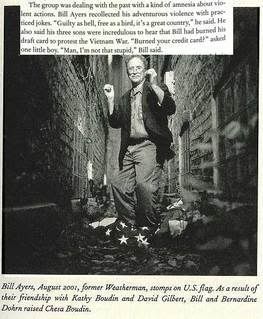
http://i155.photobucket.com/albums/s307/MSimon6808/Ayersflagstomp.jpg
From PajamasMedia.com:
The Op-Ed the New York Times Wouldn’t Run

Posted By Bob Owens

December 23, 2008 @ 12:00 am

On December 5, the New York Times afforded former domestic terrorist Bill Ayers a chance to [1] publish an op-ed, in which he defends himself from various charges made during the 2008 presidential campaign. That Ayers was given such an opportunity by the Times seems extraordinary; Barack Obama’s other mentors, former pastor Jeremiah Wright and Father Michael Pfleger, were subjected to as much public scrutiny as Ayers for their extremist politics and multi-decade associations with the president-elect, and yet it seems only Ayers was presented editorial space in the Times to defend himself. Perhaps even more extraordinary, however, is that the Times allowed Ayers to publish obvious lies about his terrorist past and rejected a rebuttal by the former [2] FBI informant who lived through the history Ayers tried to rewrite.

Ayers claimed in his fantasy that:

I never killed or injured anyone. I did join the civil rights movement in the mid-1960s, and later resisted the draft and was arrested in nonviolent demonstrations. I became a full-time antiwar organizer for Students for a Democratic Society. In 1970, I co-founded the Weather Underground, an organization that was created after an accidental explosion that claimed the lives of three of our comrades in Greenwich Village. The Weather Underground went on to take responsibility for placing several small bombs in empty offices — the ones at the Pentagon and the United States Capitol were the most notorious — as an illegal and unpopular war consumed the nation.

The Weather Underground crossed lines of legality, of propriety, and perhaps even of common sense. Our effectiveness can be — and still is being — debated. We did carry out symbolic acts of extreme vandalism directed at monuments to war and racism, and the attacks on property, never on people, were meant to respect human life and convey outrage and determination to end the Vietnam war.

Peaceful protests had failed to stop the war. So we issued a screaming response. But it was not terrorism; we were not engaged in a campaign to kill and injure people indiscriminately, spreading fear and suffering for political ends.

Ayers’ editorial was poorly written fiction, a fact that perhaps Larry Grathwohl knows better than anyone. Grathwohl was the only informant to successfully penetrate the Underground for the FBI and personally lived through the history Ayers so desperately desires to rewrite.

In hopes of correcting the lies that Ayers put in print, Grathwohl twice submitted an op-ed of his own to the Times to rebut Ayers. The editors rejected Grathwohl’s op-ed, stating in a curt December 12 email:

Dear Mr. Grathwohl,

Because this is a direct response to an op-ed, it should be directed to our letters department.

Please email them at [3] letters@nytimes.com.

Sincerely,

The Op-Ed Staff

Grathwohl’s subsequent submission to the Times was then ignored. The rejected submission is now being run below as a Pajamas Media exclusive.

Ayers would like to claim he participated in non-violent protests. But he omits the fact he helped organize and participated in the 1969 “Days of Rage,” which left innocents and police officers hospitalized and one man permanently crippled, a maiming his fellow Weathermen mocked with the crude lyrics of “Lay Elrod Lay.” One of the participants in the violence noted that the thugs armed themselves with “steel pipes and slingshots, chains, clubs, mace, and rolls of pennies to add weight to a punch.” The participant quoted was Bill Ayers describing the event he helped create in his own book, Fugitive Days.

The Greenwich Village blast Ayers pathologically claims was the catalyst that led to forming the Weather Underground was actually his group’s third botched attempt at mass murder. [4] Ayers personally ordered mass murder attempts at the Detroit Police Benevolent Association and Detroit Police Precinct 13 in February 1970, using bombs comprised of 44 sticks of dynamite. It was only the Weathermen’s incompetence at constructing fuses that kept these blasts from going off and creating dozens of casualties.

Weeks later the Greenwich Village blast occurred when a terrorist cell of the Weather Underground accidentally detonated anti-personnel bombs they were assembling for an attack against soldiers and their dates at a non-commissioned officers dance at nearby Fort Dix that evening. Had the plot succeeded, the planned attack would likely have been the [5] worst terrorist attack on American soil prior to the Oklahoma City bombing.

Bill Ayers would like to use the fog of time to plead his case that he was just another protester against the Vietnam war, a point that the Times is perhaps willing to let him make considering his longtime association with the president-elect they so nakedly support. No amount of inspired fantasy, however, can omit the simple truth that there is only one significant difference between Bill Ayers and Timothy McVeigh.

Competence.

***

“Response to ‘The Real Bill Ayers’”

By Larry Grathwohl

My name is Larry Grathwohl and I infiltrated the Weather Underground for the FBI. I had no idea when my journey began in August 1969 that I would see and experience the degree of violence and hatred of our democracy that existed in the Weather Underground. Bernardine Dorhn, Bill Ayers, and the other people I would meet had as their sole purpose the destruction of the United States. The fact that I ultimately became the only source of information regarding the activities of the Weather Underground and the fact that Bill Ayers now claims their goal was only to bring about the end of the war in Vietnam requires me to respond.

At least Bill admits the Weather Underground “crossed” the line of legality but mitigates this admission by stating that the effectiveness of the “symbolic acts of extreme vandalism” is still being debated. He further states that the selected targets were “property, never people” and that their only purpose was to end the war in Vietnam. Bill is simply not being truthful and is rewriting history to reflect a completely different role for himself and the Weather Underground from what actually took place. “Bring the war home, kill your parents” was the mantra being chanted when the group decided to go underground in December 1969 and there certainly isn’t anything anti-war in that statement. I’m also curious as to who is debating their status. When I think about the Weather Underground my immediate thought is “terrorism and death.”

Billy goes on about how the Weather Underground came into existence because “peaceful protests had failed” and “after an accidental explosion killed three comrades.” The explosion of the townhouse in Greenwich Village was the result of a bomb factory which was preparing bombs containing roofing nails for use at a Fort Dix enlisted club. The inclusion of roofing nails can have but one purpose and that’s to injure or kill people. Prior to this event Bill’s wife, Bernardine Dorhn, placed a bomb of the same design at the Park Police Station in San Francisco and killed Officer McDonnell. Additionally, I was still inside the Weather Underground when the townhouse blew up and the commitment to sabotage and terrorism had already been established and the purpose was the overthrow of the United States government.

Bill implies that the questioning of his activities is dishonest and that at worst he may have made some mistakes in judgment but his motivations were just. Personally, I can think of nothing that would justify the activities of the Weather Underground and am astonished by Bill Ayers’ attempts to corrupt the historical facts by making himself a misunderstood leader of the anti-war movement. Robert Kennedy, possibly the most notable anti-Vietnam war leader of the late 60s, was assassinated by Sirhan Sirhan in 1968. The Weather Underground published Prairie Fire in 1974 and dedicated it to Sirhan Sirhan. Bill Ayers, Bernardine Dorhn, and others signed this dedication but now they would ask us to accept their explanation that all they wanted to accomplish was an end to the war in Vietnam.

I could go on with many other contradictions in the new history Billy is attempting to impose on us. Today we are supposed to believe that Bill is merely an educator with no interests in the political aspects of our society. If this is true then why the picture of him standing on our flag? Why the statement that his only regret is that they (the Weather Underground) hadn’t done enough? What is the meaning of “I now consider myself an anarchist”? I can only conclude that Billy is a confluence of contradictions and revised history meant to confuse us as to what he is really about. Consider “guilty as hell, free as a bird, America is a great country.” Do you think he really means that?

I must conclude by acknowledging that in one respect Bill is probably being absolutely truthful. When he says that “I never killed or injured anyone,” he is most likely being totally honest. Bill, like Charles Manson, never exposed himself to any kind of danger. He always gave orders and then left it to his then-girlfriend, Diane Oughton, and others to implement his plan. If you listen closely you can even hear the similarities in the arguments Manson and Billy use today to justify what they did: the 60s made me do it.

http://www.bruceeisner.com/photos/uncategorized/drewshenemanbushpsychiatristiraq.gif
From The Wall Street Journal:
Another cogent, perceptive analysis by Helprin.

Bush Has Made Us Vulnerable

Two incompetently prosecuted wars
have undermined our deterrent power.

By MARK HELPRIN

In his great Civil War history, "Decision in the West," Albert Castel describes the last Confederate hope of victory. If in 1864 the Confederate armies continue to exact a steep cost from the North, "the majority of Northerners will decide that going on with the war is not worth the financial and human cost and so will replace Lincoln and the Republicans with a Democratic president and Congress committed to stopping hostilities and instituting peace negotiations." He cites the resolution of the Confederate Congress that: "Brave and learned men in the North have spoken out against the usurpations and cruelties daily practiced. The success of these men over the radical and despotic faction which now rules the North may open the way to . . . a cessation of this bloody and unnecessary war." Plus ça change . . . .

The administrations of George W. Bush have virtually assured such a displacement by catastrophically throwing the country off balance, both politically and financially, while breaking the nation's sword in an inconclusive seven-year struggle against a ragtag enemy in two small bankrupt states. Their one great accomplishment -- no subsequent attacks on American soil thus far -- has been offset by the stunningly incompetent prosecution of the war. It could be no other way, with war aims that inexplicably danced up and down the scale, from "ending tyranny in the world," to reforging in a matter of months (with 130,000 troops) the political culture of the Arabs, to establishing a democracy in Iraq, to only reducing violence, to merely holding on in our cantonments until we withdraw.

This confusion has come at the price of transforming the military into a light and hollow semi-gendarmerie focused on irregular warfare and ill-equipped to deter the development and resurgence of the conventional and strategic forces of China and Russia, while begging challenges from rivals or enemies no longer constrained by our former reserves of strength. For seven years we failed to devise effective policy or make intelligent arguments for policies that were worth pursuing. Thus we capriciously forfeited the domestic and international political equilibrium without which alliances break apart and wars are seldom won.

The pity is that the war could have been successful and this equilibrium sustained had we struck immediately, preserving the link with September 11th; had we disciplined our objective to forcing upon regimes that nurture terrorism the choice of routing it out with their ruthless secret services or suffering the destruction of the means to power for which they live; had we husbanded our forces in the highly developed military areas of northern Saudi Arabia after deposing Saddam Hussein, where as a fleet in being they would suffer no casualties and remain at the ready to reach Baghdad, Damascus, or Riyadh in three days; and had we taken strong and effective measures for our domestic protection while striving to stay within constitutional limits and eloquently explaining the necessity -- as has always been the case in war -- for sometimes exceeding them. Today's progressives apologize to the world for America's treatment of terrorists (not a single one of whom has been executed). Franklin Roosevelt, when faced with German saboteurs (who had caused not a single casualty), had them electrocuted and buried in numbered graves next to a sewage plant.

The counterpart to Republican incompetence has been a Democratic opposition warped by sentiment. The deaths of thousands of Americans in attacks upon our embassies, warships, military barracks, civil aviation, capital, and largest city were not a criminal matter but an act of war made possible by governments and legions of enablers in the Arab world. Nothing short of war -- although not the war we have waged -- could have been sufficient in response. The opposition is embarrassed by patriotism and American self-interest, but above all it is blind to the gravity of the matter. Though scattered terrorists allied with militarily insignificant states are not, as some conservatives assert, closely analogous to Nazi Germany, the accessibility of nuclear, biological, and chemical weapons makes the destructive capacity of these antagonists unfortunately similar -- a fact, especially in regard to Iran, that is persistently whistled away by the Left.

An existential threat of such magnitude cannot be averted by imagining that it is the work of one man and will disappear with his death; by mousefully pleasing the rest of the world; by hopefully excluding the tools of war; or by diplomacy without the potential of force, which is like a policeman without a gun, something that doesn't work anymore even in Britain. The Right should have labored to exhaustion to forge a coalition, and the Left should have been willing to proceed without one. The Right should have been more respectful of constitutional protections, and the Left should have joined in making temporary and clearly defined exceptions. In short, the Right should have had the wit to fight, and the Left should have had the will to fight.

Both failed. The country is exhausted, divided, and improperly protected, and will remain so if the new president and administration are merely another face of the same sterile duality. To avoid the costs of a stalled financial system, the two parties -- after an entire day of reflection -- committed to the expenditure of what with its trailing ends will probably be $1.5 trillion in this fiscal year alone.

But the costs of not reacting to China's military expansion, which could lead to its hegemony in the Pacific; or of ignoring a Russian resurgence, which could result in a new Cold War and Russian domination of Europe; or of suffering a nuclear detonation in New York, Washington, or any other major American city, would be so great as to be, apparently, unimaginable to us now. Which is why, perhaps, we have not even begun to think about marshaling the resources, concentration, deliberation, risk, sacrifice, and compromise necessary to avert them. This is the great decision to which the West is completely blind, and for neglect of which it will in the future grieve exceedingly.

Mr. Helprin, a senior fellow at the Claremont Institute, is the author of, among other works, "Winter's Tale" (Harcourt) and "A Soldier of the Great War" (Harcourt).

Monday, December 22, 2008

http://features.csmonitor.com/politics/wp-content/assets/19/668/picture1.jpg
From CommentaryMagazine.com:
In Defense of Warren

Peter Wehner

12.22.2008 - 11:47 AM

Barney Frank is deeply offended by Rick Warren, and he wants to the world to know it. On CNN’s Late Edition yesterday, Representative Frank criticized President-elect Obama for inviting Warren to deliver the invocation at his inauguration. According to Frank,

Mr. Warren compared same-sex couples to incest. I found that deeply offensive and unfair. If [Obama] was inviting the Reverend Warren to participate in a forum and to make a speech, that would be a good thing. But being singled out to give the prayer at the inauguration is a high honor. It has traditionally been given as a mark of great respect. And, yes, I think it was wrong to single him out for this mark of respect.

What has Frank and other gay rights advocates riled up is that Warren backed a California ballot initiative banning same-sex marriage (the measure was approved by voters last month). In the course of defending his stand, Warren has made the point that there are lots of arrangements one could envision consenting adults wanting–from polygamy to incest–that we would not want to label “marriage.” In making that comparison, gay rights advocates have decided to try to turn the Reverend Warren into a reviled figure. Let’s therefore try to examine the argument Warren is making.

The core of this case, which is articulated in William Bennett’s 2001 book The Broken Hearth: Reversing the Moral Collapse of the American Family (full disclosure: I assisted Bennett in writing the book), is that marriage is not an arbitrary social arrangement; it is, rather, based on teleology and the different, complementary nature of men and women. It is also an institution that cannot be understood apart from its cultural, biological, and religious underpinnings. It cannot be redefined by fiat.

Suppose, for example, that a man and three women, all adults, wanted to marry. They insist they love one another and that marriage would strengthen their bond. As consenting adults, they should be allowed to enter any arrangement they desire. Or assume that a man and his 22-year-old daughter decide that they, too, love one another and want to spend the rest of their lives together. They, too, insist that they love each other and that allowing them to marry would represent the best of America: tolerant, respectful of the desires of individuals, and part of the expansion of individual rights that we witnessed during the Civil Rights era. Now ask advocates of same-sex marriage to make an argument against these arrangements.

They will say that marriage isn’t about marrying as many people as you love; it’s about marrying one other person you love. It should therefore be restricted to two people. But why is this? Who are gay-rights advocates to insist that we limit the number of people in marriage to two? Polygamy, after all, has been much more prevalent in history than gay marriage, a movement that was essentially unheard of until a few years ago. But homosexuality is “morally and psychologically” superior to polygamy, others insist. And how do they know? As Charles Krauthammer has pointed out, many Americans believe heterosexuality to be “morally and psychologically” superior to homosexuality, which is why they deny the validity of homosexual marriage.

Same-sex marriage advocates, in dismissing the time-honored definition of marriage and de-linking it from its cultural, religious, and traditional understanding, have lost the ability to draw boundaries against a slew of other arrangements. Once people decide that their own human longings give them license to lay claim to marriage, the definition of the institution is arguably up for grabs. Everyone who wants to redefine marriage will invoke the arguments made by same-sex marriage advocates–from insisting that society should not set up roadblocks to their happiness and their desire to enter into loving, faithful relationships; to arguing that their lives would be incomplete without marriage; to claiming that government is wrong to deny them equal protection.

In the words of Mr. Bennett:

Having just rewritten the central rule of the marriage bond, proponents of same-sex marriage are hardly qualified to dictate to others what constitutes its central meaning, or why it can be felt only between two human beings, and not more than two. What arguments would they invoke? Tradition? Religion? The time-honored definition of the family? These are the very pillars they have already destroyed. No, once marriage has been detached from the natural, complementary teleology of the sexes, it becomes nothing more than what each of us makes of it.

That, I think, is what Rick Warren was getting at, rather than comparing homosexual behavior to incest. Now one may disagree with Warren’s position and believe that gay marriage is simply part of the centuries-long evolution of marriage that has occurred and that it would not harm, and may even marginally help, the institution of marriage. I disagree, but I understand such a case can be made–and, in fact, that case has been made by intelligent and sober advocates for same-sex marriage (like Jonathan Rauch). But to say that the arguments put forth by Warren are “deeply offensive and unfair” is itself, I think, unfair. And the effort to portray Warren as a bigoted and benighted figure is both unfair and wrong.

By all accounts, Rick Warren is a man of enormous integrity who oversees a wonderful, life-saving ministry. He also gives voice to the views of millions and millions of Americans–including presumably Barack Obama, who also opposes same-sex marriage–and Warren does so in a civil manner. Beyond defending the traditional view of heterosexual marriage, Warren has done several other things, including broadening the vision of evangelical social ethics to issues such as AIDS and helping the continent of Africa. He has also shown a generosity of spirit by having Obama speak at his church (and has been criticized from the right for doing so).

President-elect Obama deserves credit for asking Rick Warren to deliver the invocation at his inauguration. It is a symbolic gesture for sure–but symbolism matters, and this reciprocal generosity of spirit is good for the country. It is Barney Frank and his allies who are determined to turn the Obama inauguration into yet one more battlefield in America’s “culture war.”

The outrage directed at Warren is an effort by some to intimidate those who oppose same-sex marriage into silence and de-legitimize their arguments rather than answer them. This effort needs to be resisted, especially by those who claim to care so much about “tolerance” and the free and open exchange of ideas. It would be nice if, from time to time, those who claim to represent modern liberalism would reacquaint themselves with the classical version.