Saturday, November 29, 2008

http://images.huffingtonpost.com/gen/12172/thumbs/s-BUSH-CIA-OBAMA-large.jpg
Socialist Republic
by Patrick J. Buchanan

Posted 11/27/2008 ET

Barack Obama and George W. Bush seem to have come away from their study of the Great Depression with similar conclusions:

To wit: After the Crash of 1929, the Federal Reserve did not move fast enough to save the banks and inject cash into the economy. Second, the New Deal, far from being wastrel deficit spending, was not bold enough. So it was that America wallowed in depression for a decade until the unbridled spending and mammoth deficits of World War II pulled us out.

Bush and Obama seem determined not to make the same mistake.

We are all Keynesians now.

Thus, we have the $700 billion Bush bank bailout, the $700 billion "stimulus package" Obama wants by inauguration to "jolt this economy back into shape" and the $800 billion fund Hank Paulson created to get consumers borrowing and buying again.

These come on top of Bush $455 billion deficit, the $29 billion bailout of Bear Stearns, the $105 billion in pork to grease the $700 billion bailout, the $100 billion to $200 billion to keep Fannie and Freddie afloat, the $140-billion-and-counting for AIG, the $25 billion for the greening of GM, Ford and Chrysler, the $25 billion more to save the Big Three and the $20 billion for CitiGroup.

Now much of this overlaps, and some will be retrieved. But we are still staring at a deficit that could approach $2 trillion.

How would this stack up historically?

A deficit of $1.4 trillion would be 10 percent of gross domestic product, dwarfing the postwar record 6 percent run by Ronald Reagan in the Jimmy Carter recession.

Bewailing the "Reagan deficits" has been a staple of Democratic oratory. This will stop. But the politics of this is not the point, the policy is.

Consider what we are about to do. Bush in 2008 spent 21 percent of GDP. States, counties and cities spent another 12 percent. Thus, one third of GDP is spent by government at all levels. Obama and Co. propose to raise that by another 10 percent of GDP. We may soon be north of 40 percent of gross domestic product controlled and spent by government.

That is Eurosocialism.

And where, exactly, are we going to get the money?

Americans save nothing. We spend more than we earn. Thus the levels of consumer debt, credit card debt, auto debt and mortgage debt. U.S. foreign-exchange reserves amount to a piddling $73 billion.

The only nation with the kind of cash on hand we need now -- if we don't print the money and invite another gigantic bubble -- is China, with its $2 trillion in foreign-exchange reserves.

Will Beijing lend back the dollars it has piled up by selling to us?

China certainly has an incentive to keep Americans spending. For our purchases of Chinese-made goods have often been responsible for 100 percent of China's growth. China does not want to kill the American goose that lays those golden eggs -- until the goose can't lay any more eggs. Then they won't need the goose.

But should China decide to lend us the money, what will Beijing demand in interest rates and assurances that we will not default. After all, the U.S. debt is 70 percent of GDP, our savings rate is near zero, and our merchandise trade deficit is still running at 5 percent to 6 percent of GDP.

Unlike the 1950s, we are today dependent on foreigners for two-thirds of our oil and for much of our manufactured goods -- toys, TVs, radios, cameras, cars, shoes, clothes, bikes, motorcycles -- and for the $700 billion to $800 billion we borrow each year to pay for these imports.

With U.S. homeowners, consumers, companies and banks now going bust, why must the nation borrow trillions more to bail them out? So we can maintain our status and standard of living as the last superpower.

Bush and Obama are competing to shovel out trillions of dollars, so we can return to the good times of yesterday.

But wasn't yesterday the root cause of today? Didn't saving nothing and spending more than we earn, purchasing what we cannot afford in cars, consumer goods and houses, buying far more from abroad than we sell abroad -- didn't that cause this crisis and crash?

A family man in America's condition, awash in debt, spending more than he makes, would cut back consumption, find a second job and get out of debt. Or declare bankruptcy, accept the shame and humiliation, change his wastrel ways and start anew.

Is it different for a nation?

Yet we seem to believe we can borrow and spend our way out of a swamp of unpayable debt into which borrowing and spending have plunged us.

We are headed either for default on our debts and bankruptcy as a nation, or something less honorable: a quiet cheapening of the debts we have incurred by inflating and destroying the dollar, robbing our creditors of what we owe them and robbing our own people of the value of what they have earned. And so it has come to this.

What would the Founding Fathers think of us now?
[The Weekend Interview]
From The Wall Street Journal:
'Our Culture Is Better'

Champion of freedom or anti-Islamic provocateur?
Both.
By JAMES TARANTO

New York

By his own description, Geert Wilders is not a typical Dutch politician. "We are a country of consensus," he tells me on a recent Saturday morning at his midtown Manhattan hotel. "I hate consensus. I like confrontation. I am not a consensus politician. . . . This is something that is really very un-Dutch."
[The Weekend Interview] Zina Saunders

Yet the 45-year-old Mr. Wilders says he is the most famous politician in the Netherlands: "Everybody knows me. . . . There is no other politician -- not even the prime minister -- who is as well-known. . . . People hate me, or they love me. There's nothing in between. There is no gray area."

To his admirers, Mr. Wilders is a champion of Western values on a continent that has lost confidence in them. To his detractors, he is an anti-Islamic provocateur. Both sides have a point.

In March, Mr. Wilders released a short film called "Fitna," a harsh treatment of Islam that begins by interspersing inflammatory Quran passages with newspaper and TV clips depicting threats and acts of violent jihad. The second half of the film, titled "The Netherlands Under the Spell of Islam," warns that Holland's growing Muslim population -- which more than doubled between 1990 and 2004, to 944,000, some 5.8% of the populace -- poses a threat to the country's traditional liberal values. Under the heading, "The Netherlands in the future?!" it shows brutal images from Muslim countries: men being hanged for homosexuality, a beheaded woman, another woman apparently undergoing genital mutilation.

Making such a film, Mr. Wilders knew, was a dangerous act. In November 2004, Theo van Gogh was assassinated on an Amsterdam street in retaliation for directing a film called "Submission" about Islam's treatment of women. The killer, Mohammed Bouyeri, left a letter on van Gogh's body threatening Ayaan Hirsi Ali, the film's writer and narrator.

Ms. Hirsi Ali, born in Somalia, had renounced Islam and been elected to the Dutch Parliament, where she was an ally of Mr. Wilders. Both belonged to the center-right People's Party for Freedom and Democracy, known by the Dutch acronym VVD. Both took a hard line on what they saw as an overly accommodationist policy toward the Netherlands' Muslim minority. They argued that radical imams "should be stripped of their nationality," that their mosques should be closed, and that "we should be strong in defending the rights of women," Mr. Wilders tells me.

This made them dissenters within the VVD. "We got into trouble every week," Mr. Wilders recalls. "We were like children going to their parents if they did something wrong, because every week they hassled us. . . . We really didn't care what anybody said. If the factional leadership said, 'Well, you cannot go to this TV program,' for us it was an incentive to go, not not to go. So we were a little bit of two mavericks, rebels if you like."

Mr. Wilders finally quit the party over its support for opening negotiations to admit Turkey into the European Union. That was in September 2004. "Two months later, Theo van Gogh was killed, and the whole world changed," says Mr. Wilders. He and Ms. Hirsi Ali both went into hiding; he still travels with bodyguards. After a VVD rival threatened to strip Ms. Hirsi Ali's citizenship over misstatements on her 1992 asylum application, she left Parliament and took a fellowship at the American Enterprise Institute in Washington. Mr. Wilders stayed on and formed the Party for Freedom, or PVV. In 2006 it became Parliament's fifth-largest party, with nine seats in the 150-member lower chamber.

Having his own party liberates Mr. Wilders to speak his mind. As he sees it, the West suffers from an excess of toleration for those who do not share its tradition of tolerance. "We believe that -- 'we' means the political elite -- that all cultures are equal," he says. "I believe this is the biggest disease today facing Europe. . . . We should wake up and tell ourselves: You're not a xenophobe, you're not a racist, you're not a crazy guy if you say, 'My culture is better than yours.' A culture based on Christianity, Judaism, humanism is better. Look at how we treat women, look at how we treat apostates, look at how we go with the separation of church and state. I can give you 500 examples why our culture is better."

He acknowledges that "the majority of Muslims in Europe and America are not terrorists or violent people." But he says "it really doesn't matter that much, because if you don't define your own culture as the best, dominant one, and you allow through immigration people from those countries to come in, at the end of the day you will lose your own identity and your own culture, and your society will change. And our freedom will change -- all the freedoms we have will change."

The murder of van Gogh lends credence to this warning, as does the Muhammad cartoon controversy of 2005 in Denmark. As for "Fitna," it has not occasioned a violent response, but its foes have made efforts to suppress it. A Dutch Muslim organization went to court seeking to enjoin its release on the ground that, in Mr. Wilders's words, "it's not in the interest of Dutch security." The plaintiffs also charged Mr. Wilders with blasphemy and inciting hatred. Mr. Wilders thought the argument frivolous, but decided to pre-empt it: "The day before the verdict, I broadcasted ['Fitna'] . . . not because I was not confident in the outcome, but I thought: I'm not taking any chance, I'm doing it. And it was legal, because there was not a verdict yet." The judge held that the national-security claim was moot and ruled in Mr. Wilders's favor on the issues of blasphemy and incitement.

Dutch television stations had balked at broadcasting the film, and satellite companies refused to carry it even for a fee. So Mr. Wilders released it online. The British video site LiveLeak.com soon pulled the film, citing "threats to our staff of a very serious nature," but put it back online a few days later. ("Fitna" is still available on LiveLeak, as well as on other sites such as YouTube and Google Video.)

An organization called The Netherlands Shows Its Colors filed a criminal complaint against Mr. Wilders for "inciting hatred." In June, Dutch prosecutors declined to pursue the charge, saying in a statement: "That comments are hurtful and offensive for a large number of Muslims does not mean that they are punishable." The group is appealing the prosecutors' decision.

In July, a Jordanian prosecutor, acting on a complaint from a pressure group there, charged Mr. Wilders with blasphemy and other crimes. The Netherlands has no extradition treaty with Jordan, but Mr. Wilders worries -- and the head of the group that filed the complaint has boasted -- that the indictment could restrict his ability to travel. Mr. Wilders says he does not visit a foreign country without receiving an assurance that he will not be arrested and extradited.

"The principle is not me -- it's not about Geert Wilders," he says. "If you look at the press and the rest of the political elite in the Netherlands, nobody cares. Nobody gives a damn. This is the worst thing, maybe. . . . A nondemocratic country cannot use the international or domestic legal system to silence you. . . . If this starts, we can get rid of all parliaments, and we should close down every newspaper, and we should shut up and all pray to Mecca five times a day."

It is difficult to fault Mr. Wilders's impassioned defense of free speech. And although the efforts to silence him via legal harassment have proved far from successful, he rightly points out that they could have a chilling effect, deterring others from speaking out.

Mr. Wilders's views on Islam, though, are problematic. Since 9/11, American political leaders have struggled with the question of how to describe the ideology of the enemy without making enemies of the world's billion or so Muslims. The various terms they have tried -- "Islamic extremism," "Islamism," "Islamofascism" -- have fallen short of both clarity and melioration. Melioration is not Mr. Wilders's highest priority, and to him the truth couldn't be clearer: The problem is Islam itself. "I see Islam more as an ideology than as a religion," he explains.

His own view of Islam is a fundamentalist one: "According to the Quran, there are no moderate Muslims. It's not Geert Wilders who's saying that, it's the Quran . . . saying that. It's many imams in the world who decide that. It's the people themselves who speak about it and talk about the terrible things -- the genital mutilation, the honor killings. This is all not Geert Wilders, but those imams themselves who say this is the best way of Islam."

Yet he insists that his antagonism toward Islam reflects no antipathy toward Muslims: "I make a distinction between the ideology . . . and the people. . . . There are people who call themselves Muslims and don't subscribe to the full part of the Quran. And those people, of course, we should invest [in], we should talk to." He says he would end Muslim immigration to the Netherlands but work to assimilate those already there.

His idea of how to do so, however, seems unlikely to win many converts: "You have to give up this stupid, fascist book" -- the Quran. "This is what you have to do. You have to give up that book."

Mr. Wilders is right to call for a vigilant defense of liberal principles. A society has a right, indeed a duty, to require that religious minorities comply with secular rules of civilized behavior. But to demand that they renounce their religious identity and holy books is itself an affront to liberal principles.

Mr. Taranto, a member of The Wall Street Journal's editorial board, writes the Best of the Web Today column for OpinionJournal.com.
http://media.ft.com/cms/944ef5fe-bc64-11dd-9efc-0000779fd18c.jpg
From National Review Online:
It’s Not the Cold War
Updating strategy to fight the ideology.
By Mark Steyn

When terrorists attack, media analysts go into Sherlock Holmes mode, metaphorically prowling the crime scene for footprints, as if the way to solve the mystery is to add up all the clues. The Bombay gunmen seized British and American tourists. Therefore, it must be an attack on Westerners!

Not so, said Newsweek’s Fareed Zakaria. If they’d wanted to do that, they’d have hit the Hilton or the Marriott or some other target-rich chain hotel. The Taj and the Oberoi are both Indian owned, and popular watering holes with wealthy Indians.

Okay, how about this group that’s claimed credit for the attack? The Deccan Mujahideen. As a thousand TV anchors asked on Wednesday night, “What do we know about them?”

Er, well, nothing. Because they didn’t exist until they issued the press release. “Deccan” is the name of the vast plateau that covers most of the triangular peninsula that forms the lower half of the Indian sub-continent. It comes from the Prakrit word “dakkhin, which means “south.” Which means nothing at all. “Deccan Mujahideen” is like calling yourself the “Continental Shelf Liberation Front.”

Okay. So does that mean this operation was linked to al-Qaeda? Well, no. Not if by “linked to” you mean a wholly owned subsidiary coordinating its activities with the corporate head office.

It’s not an either/or scenario, it’s all of the above. Yes, the terrorists targeted locally owned hotels. But they singled out Britons and Americans as hostages. Yes, they attacked prestige city landmarks like the Victoria Terminus, one of the most splendid and historic railway stations in the world. But they also attacked an obscure Jewish community center. The Islamic imperialist project is a totalitarian ideology: It is at war with Hindus, Jews, Americans, Britons, everything that is other.

In the ten months before this week’s atrocity, Muslim terrorists killed over 200 people in India and no-one paid much attention. Just business as usual, alas. In Bombay, the perpetrators were cannier. They launched a multiple indiscriminate assault on soft targets, and then in the confusion began singling out A-list prey: Not just wealthy Western tourists, but local orthodox Jews, and municipal law enforcement. They drew prominent officials to selected sites, and then gunned down the head of the antiterrorism squad and two of his most senior lieutenants. They attacked a hospital, the place you’re supposed to take the victims to, thereby destabilizing the city’s emergency-response system.

And, aside from dozens of corpses, they were rewarded with instant, tangible, economic damage to India: the Bombay Stock Exchange was still closed on Friday, and the England cricket team canceled their tour (a shameful act).

What’s relevant about the Mumbai model is that it would work in just about any second-tier city in any democratic state: Seize multiple soft targets and overwhelm the municipal infrastructure to the point where any emergency plan will simply be swamped by the sheer scale of events. Try it in, say, Mayor Nagin’s New Orleans. All you need is the manpower. Given the numbers of gunmen, clearly there was a significant local component. On the other hand, whether or not Pakistan’s deeply sinister ISI had their fingerprints all over it, it would seem unlikely that there was no external involvement. After all, if you look at every jihad front from the London Tube bombings to the Iraqi insurgency, you’ll find local lads and wily outsiders: That’s pretty much a given.


But we’re in danger of missing the forest for the trees. The forest is the ideology. It’s the ideology that determines whether you can find enough young hotshot guys in the neighborhood willing to strap on a suicide belt or (rather more promising as a long-term career) at least grab an AK and shoot up a hotel lobby. Or, if active terrorists are a bit thin on the ground, whether you can count at least on some degree of broader support on the ground. You’re sitting in some distant foreign capital but you’re minded to pull off a Bombay-style operation in, say, Amsterdam or Manchester or Toronto. Where would you start? Easy. You know the radical mosques, and the other ideological-front organizations. You’ve already made landfall.

It’s missing the point to get into debates about whether this is the “Deccan Mujahideen” or the ISI or al-Qaeda or Lashkar-e-Taiba. That’s a reductive argument. It could be all or none of them. The ideology has been so successfully seeded around the world that nobody needs a memo from corporate HQ to act: There are so many of these subgroups and individuals that they intersect across the planet in a million different ways. It’s not the Cold War, with a small network of deep sleepers being directly controlled by Moscow. There are no membership cards, only an ideology. That’s what has radicalized hitherto moderate Muslim communities from Indonesia to the Central Asian stans to Yorkshire, and coopted what started out as more or less conventional nationalist struggles in the Caucasus and the Balkans into mere tentacles of the global jihad.

Many of us, including the incoming Obama administration, look at this as a law-enforcement matter. Bombay is a crime scene, so let’s surround the perimeter with yellow police tape, send in the forensics squad, and then wait for the DA to file charges. There was a photograph that appeared in many of the British papers, taken by a Reuters man and captioned by the news agency as follows: “A suspected gunman walks outside the premises of the Chhatrapati Shivaji Terminus or Victoria Terminus railway station.” The photo of the “suspected gunman” showed a man holding a gun. We don’t know much about him — he might be Muslim or Episcopalian, he might be an impoverished uneducated victim of western colonialist economic oppression or a former vice-president of Lehman Bros embarking on an exciting midlife career change — but one thing we ought to be able to say for certain is that a man pointing a gun is not a “suspected gunman” but a gunman. “This kind of silly political correctness infects reporters and news services world-wide,” wrote John Hinderaker of Powerline. “They think they’re being scrupulous — the man hasn’t been convicted of being a gunman yet! — when in fact they’re just being foolish. But the irrational conviction that nothing can be known unless it has been determined by a court and jury isn’t just silly, it’s dangerous.”

Just so. This isn’t law enforcement but an ideological assault — and we’re fighting the symptoms not the cause. Islamic imperialists want an Islamic society, not just in Palestine and Kashmir but in the Netherlands and Britain, too. Their chances of getting it will be determined by the ideology’s advance among the general Muslim population, and the general Muslim population’s demographic advance among everybody else.

So Bush is history, and we have a new president who promises to heal the planet, and yet the jihadists don’t seem to have got the Obama message that there are no enemies, just friends we haven’t yet held talks without preconditions with. This isn’t about repudiating the Bush years, or withdrawing from Iraq, or even liquidating Israel. It’s bigger than that. And if you don’t have a strategy for beating back the ideology, you’ll lose.

Whoops, my apologies. I mean “suspected ideology.”
http://media.ft.com/cms/95dc3792-bc64-11dd-9efc-0000779fd18c.jpg
From The Corner at NRO:
Both of the above
Mark Steyn

Andy wrote yesterday about our confused thinking re events in Bombay:

The obsession over whether al Qaeda or its endless jumble of affiliates pulled off the operation is a misguided attempt to mimimize the challenge. The bin Laden network is not unimportant, but it is tapping into something that is much bigger than itself.

We're reluctant to address that "bigger than itself" elephant. All jihad is local: If rockets are fired at Israel, it's a failure to settle the Palestinian question. If an NHS doctor drives a flaming Cherokee into the check-in desk at Glasgow Airport, it must be Tony Blair's foreign policy. The Jerusalem Post's headline writer poses the question:

Homegrown Terror Or International Jihad?

False choice. The answer is: Homegrown terror in the service of international jihad. Clearly, India has had a Muslim problem to one degree or another in the 60 years since partition, but increasingly those locally driven grievances have been absorbed within the global pan-Islamic ideology. What strikes you, as the dust clears in Bombay, is that one assault provided an umbrella for manifestations of almost every strain of Muslim grievance.

There's the local element - the fatal shooting of the city's anti-terror squad, and other prominent officials. There's the crusader element - the targeting of British and American passport holders. There's the Jew-hating element - the Munich massacre nesting within the more general carnage.

And there are the more ironic nuances of jihad: British subjects were to be found not just among the victims but among the perpetrators.

To pose the question as that Jerusalem Post headline is to miss the point. Moreover, the global ideologues correctly see our determination to attribute every attack to purely local phenomena unconnected to any bigger picture as a sign of weakness.

http://graphics8.nytimes.com/images/2008/11/24/us/24obamateam2-600.jpg
From Asia Times Online:
Obama's one-trick wizards
By Spengler

One wants to ask the Wall Street wizards who comprise the talent pool for the incoming administration, "If you so smart, how come you ain't rich no more?"

Manhattan's toniest private schools, harder to get into than Harvard, quietly are looking for full-tuition pupils now that the children of sacked Wall Street bankers are departing for public schools in cheaper suburbs. Harvard University president Drew Faust has warned of budget cuts to come due to "unprecedented losses" to its US$39 billion endowment.

Shares of Citibank, the current firm of Bill Clinton's treasury secretary Robert Rubin, last week traded at less than a tenth of their year-earlier market price and may require yet another federal bailout. [Citigroup will have more than $300 billion of troubled mortgages and other assets guaranteed by the US government under a federal plan to stabilize the lender after its stock fell 60% last week, Bloomberg reported today, November 24. Citigroup also will get a $20 billion cash infusion from the Treasury Department, adding to the $25 billion the bank received last month under the Troubled Asset Relief Program. In return for the cash and guarantees, the government will get $27 billion of preferred shares paying an 8% dividend.]

Rubin, a transition advisor to president-elect Barack Obama, was mentor to Treasury secretary designate Timothy Geithner. Even Goldman Sachs, the thoroughbred trading machine that gave us Treasury Secretary Hank Paulson as well as Rubin, is trading at a fifth of its peak value.

These facts came to mind while reading David Brooks' November 21 New York Times panegyric to Obama's prospective cabinet, which gushes, "Its members are twice as smart as the poor reporters who have to cover them, three times if you include the columnists." Brooks added, "... as much as I want to resent these overeducated Achievatrons ... I find myself tremendously impressed by the Obama transition."

Has Brooks checked the markets? The cleverest people in the United States, the Ivy-pedigreed investment bankers, have fouled their own nests as well as their own net worth, and persuaded the taxpayers to bail them out. If these are the best and the brightest of 2008, America is in very deep trouble.

The one-trick wizards of Wall Street had one idea, which was to ride the trend and pile on as much leverage as credulous investors and crony regulators would allow. It has gone pear-shaped, and those who didn't cash out early along with the cynics are poor. Fortunately for them, Obama will let them play with the budget of the US federal government for the next four years.

Failed financiers run the Obama transition team. It used to be that the heads of great industrial companies got the top Cabinet posts. Now it is the one-trick wizards. After George W Bush fired former Treasury Secretary Paul O'Neill, who had run Alcoa, the last survivor of the species was Vice President Dick Cheney, the former CEO of Halliburton. Obama's bevy of talent comes from finance. American industrialists have become figures of ridicule, like the pathetic chief executive of General Motors, Rick Wagoner, begging for a government loan.

Stocks rallied on November 22 on reports that Obama would give the Treasury post to Geithner, the New York Federal Reserve Bank president and the architect of the biggest bailout in history. He doubled the size of the Federal Reserve's balance sheet to more than $2 trillion, through the purchase of such risky assets as the commercial paper of near-bankrupt American auto companies. That is in addition to the Treasury's $700 billion bailout plan. Investors like the idea of trillion-dollar transfers from public funds to private companies.

Former Treasury secretary Rubin "was an architect of the [Citibank's] strategy," the New York Times reported on November 23. "In 2005, as Citigroup began its effort to expand from within, Mr Rubin peppered his colleagues with questions as they formulated the plan. According to current and former colleagues, he believed that Citigroup was falling behind rivals like Morgan Stanley and Goldman, and he pushed to bulk up the bank's high-growth fixed-income trading, including the [structured credit] business. Former colleagues said Mr Rubin also encouraged [former Citibank CEO Charles] Prince to broaden the bank's appetite for risk, provided that it also upgraded oversight - though the Federal Reserve later would conclude that the bank's oversight remained inadequate."

A case in point is the reported implosion of the Harvard and Yale endowments. For years, these giant funds were held up as proof that superior intelligence was the ticket to excess returns. During the 10 years through 2007, Harvard and Yale produced compound annual returns of 15% and 17.8% respectively, far better than the market, the average endowment or the average hedge funds - only to blow up in 2008 by frightful proportions not yet released.

According to a recent study [1], the "super endowments" sailed past their peers by loading up real estate, commodities, and "private equity", precisely the sectors that underwent necrosis this year. Private equity is the subprime version of corporate finance, acquiring non-public companies with a minimum down payment and the maximum of debt.

David Swenson, the legendary manager of the Yale Endowment, learned one trick: buy on dips in the equity market with all the borrowed money he could get. The alumni network on Wall Street made sure that the university endowments were first in line for the hottest deals. That worked until 2008. We do not know how far the private equity holdings of Harvard and Yale have fallen, but the traded equity price of the Blackstone Group, a leading private equity firm, is a fair gauge. It is down from its $35 initial offering last year to only $4.65 today, a drop of 87%. Commodities, meanwhile, have fallen by half.

For a quarter of a century, the inbred products of the Ivy League puppy mills have known nothing but a rising trend in asset prices. About the origin of this trend, they were incurious. The Reagan administration had encountered a stock market in 1981 trading 50% below its the long-term trend. Reagan restored the equity market to trend by cutting taxes, suppressing inflation and easing some regulations. The private equity sharps were fleas traveling on Reagan's dog. They simply rode the trend with the maximum of leverage.

Now that the stock market has collapsed, the private equity strategies cannot repay their debt, and their returns have evaporated. Note that equity investors spent a decade in the cold, from 1973 to 1983; it may be even worse this time. The maturities on debt issued to finance private equity deals will come due long before the recovery.

Over the long term, we know that the average investment cannot grow faster than the economy, for investments ultimately are valued according to cash flows, and cash flows stem from economic growth. Real American gross domestic product grew by 2% a year on average between 1929 and 2007. Whence came the enormous returns to the Ivy League? Some of them surely came from betting on the right horses, but most came from privileged access to leverage.

One recalls Ferdinand I of Austria (1793-1875), deposed for incompetence after the 1848 Revolution, who apocryphally shot an eagle, and said: "It's got to be an eagle, but it's only got one head!" Ferdinand thought the two-headed bird of his family crest was the norm, just as the pink-shirted, suspender-wearing Ivy Leaguers thought that two-digit returns were the norm for their investments.

The same privileged access to leverage allowed the investment banks to produce return on equity in excess of 20% year in, year out, by selling structured products, as I explained in a recent essay (Lehman and the end of the era of leverage, Asia Times Online, September 16, 2008). For the 10 years through 2007, American homeowners joined the party, with returns in excess of 20% of their home equity (10% home price appreciation more than doubles with leverage).

Investment banks were levered long the leverage, so to speak. The more leverage the world demanded, the more Wall Street could charge for ever-more-arcane methods of packaging leverage, and the higher the returns to leverage providers.

That explains how a Washington political operative like Rahm Emanuel, now Obama's chief of staff, who studied ballet rather than balance sheets, could earn a reported $16.2 million in two-and-a-half years at Wasserstein Perella, the mergers and acquisitions boutique. At the height of the bubble, Bruce Wasserstein's firm sold out to Germany's Dresdner Bank for the fairy-tale sum of $1.6 billion. Even the crumbs from Wasserstein's loaf could make a Chicago politician rich.

Without leverage, the clever folk around Barack Obama are fleas without a dog. None of them invented anything, introduced an important new product, opened a new market, or did anything that reached into the lives of ordinary people. They wore expensive cufflinks, read balance sheets, exercised regularly, sat on philanthropic boards, and assumed that their flea's ride on the Reagan dog would last forever.

All they knew was leverage, and now that the world is de-levering, they are trying to put leverage back into the system. One almost can hear Mortimer Duke, Don Ameche's charcter in Trading Places, shouting, "Now, you listen to me! I want trading reopened right now. Get those brokers back in here! Turn those machines back on!"

Of course, nothing excludes the possibility that Obama's team will come up with something constructive. But there is no reason to expect a drastic change from the crisis response of the same sort of people (starting with Treasury Secretary Paulson) in the Bush administration. They will bail out incompetent, failing firms and drop money from helicopters and call it a stimulus package. And it will turn out no better than it did for the humiliated Republicans.

Note:
[1] http://www.regattaresearch.com/pdf/Investing_Like_
the_Harvard_and_Yale_Endowment_Funds.pdf

Friday, November 28, 2008

http://puffin.creighton.edu/jesuit/andre/images/advent.gif
Icon of Our Lady of the New Advent

From First Things (December 2007):
The End of Advent
by Joseph Bottum

Christmas has devoured Advent, gobbled it up with the turkey giblets and the goblets of seasonal ale. Every secularized holiday, of course, tends to lose the context it had in the liturgical year. Across the nation, even in many churches, Easter has hopped across Lent, Halloween has frightened away All Saints, and New Year’s has drunk up Epiphany.

Still, the disappearance of Advent seems especially disturbing—for it’s injured even the secular Christmas season: opening a hole, from Thanksgiving on, that can be filled only with fiercer, madder, and wilder attempts to anticipate Christmas.

More Christmas trees. More Christmas lights. More tinsel, more tassels, more glitter, more glee—until the glut of candies and carols, ornaments and trimmings, has left almost nothing for Christmas Day. For much of America, Christmas itself arrives nearly as an afterthought: not the fulfillment, but only the end, of the long Yule season that has burned without stop since the stores began their Christmas sales.

Of course, even in the liturgical calendar, the season points ahead to Christmas. Advent genuinely is adventual—a time before, a looking forward—and it lacks meaning without Christmas. But maybe Christmas, in turn, lacks meaning without Advent. All those daily readings from Isaiah, filled with visions of things yet to be, a constant barrage of the future tense: And it shall come to pass . . . And there shall come forth . . . A kind of longing pervades the Old Testament selections read in church over the weeks before Christmas—an anxious, almost sorrowful litany of hope only in what has not yet come. Zephaniah. Judges. Malachi. Numbers. I shall see him, but not now: I shall behold him, but not nigh: There shall come a star out of Jacob, and a scepter shall rise out of Israel.

What Advent is, really, is a discipline: a way of forming anticipation and channeling it toward its goal. There’s a flicker of rose on the third Sunday— Gaudete!, that day’s Mass begins: Rejoice!—but then it’s back to the dark purple that is the mark of the season in liturgical churches. And what those somber vestments symbolize is the deeply penitential design of Advent. Nothing we can do earns us the gift of Christmas, any more than Lent earns us Easter. But a season of contrition and sacrifice prepares us to understand and feel something about just how great the gift is when at last the day itself arrives.

More than any other holiday, Christmas seems to need its setting in the church year, for without it we have a diminishment of language, a diminishment of culture, and a diminishment of imagination. The Jesse trees and the Advent calendars, St. Martin’s Fast and St. Nicholas’ Feast, Gaudete Sunday, the childless crèches, the candle wreaths, the vigil of Christmas Eve: They give a shape to the anticipation of the season. They discipline the ideas and emotions that otherwise would shake themselves to pieces, like a flywheel wobbling wilder and wilder till it finally snaps off its axle.

Maybe that’s what has happened to Christmas. The ideas and the emotions have all broken free and smashed their way across the fields. From Henry Wadsworth Longfellow’s I heard the bells on Christmas Day / Their old, familiar carols play to Irving Berlin’s I’m dreaming of a white Christmas / Just like the ones I used to know, there has been for a long time now something oddly backward looking about Christmas music—some nostalgia that insists on substituting its melancholy for the somber contrition and sorrow of forward-looking Advent.

For a similar reason, the memoir of childhood has become the dominant form of Christmas writing. Often beautiful—from Dylan Thomas’ “A Child’s Christmas in Wales” to Lillian Smith’s Memories of a Large Christmas—those stories nonetheless deploy their golden-hued Christmassy emotions only toward the past: a kind of contrite feeling without the structure of Advent’s contrition, all the regret and sense of absence cast back to what has been and never will be again.

On the other hand, there are plenty of Christmas elements that remain forward looking. In many ways, the season has become little except anticipation—anticipation run amuck, like children so sick with expectation that the reality, when at last it arrives, can never be satisfying. This, too, is something broken off from the liturgical year: another group of adventual feelings without the Advent that gave them form, another set of Christmas ideas set loose to run themselves mad.

Back in the early 1890s, William Dean Howells published a funny little fable called “Christmas Every Day” in one of the most popular venues of the time, St. Nicholas Magazine for Boys and Girls. Once upon a time, the narrator explains as the story begins, “there was a little girl who liked Christmas so much that she wanted it to be Christmas every day in the year.” What’s more, she found a fairy to grant her wish, and she was delighted when Christmas came again on December 26, and December 27, and December 28.

Of course, “after it had gone on about three or four months, the little girl, whenever she came into the room in the morning and saw those great ugly, lumpy stockings dangling at the fireplace, and the disgusting presents around everywhere, used to sit down and burst out crying. In six months she was perfectly exhausted, she couldn’t even cry anymore.” By October, “people didn’t carry presents around nicely anymore. They flung them over the fence or through the window, and, instead of taking great pains to write ‘For dear Papa,’ or ‘Mama’ or ‘Brother,’ or ‘Sister,’ they used to write, ‘Take it, you horrid old thing!’ and then go and bang it against the front door.”

These days, by the time Christmas actually rolls around, it feels as though this is very nearly what we’ve had: Christmas every day, at least since Thanksgiving. Often it starts even earlier. This year the glossy catalogues of Christmas clothing and seasonal bric-a-brac started arriving in September, and there were Christmas-shopping ads on the highway billboard signs before Halloween. The anticipatory elements reach a crescendo by early December, and their constant scream makes the sudden quiet of Christmas Day almost a relief from the Christmas season.

I don’t remember this opposition of Christmas and the Christmas season when I was young. When I was little—ah, the nostalgia of the childhood memoir—I always felt that the days right before Christmas were a time somehow out of time. Christmas Eve, especially, and the arrival of Christmas itself at midnight: The hours moved in ways different from their passage in ordinary time, and the sense of impending completion was somehow like a flavor even to the air we breathed.

I’ve noticed in recent years, however, that the ­feeling comes over me more rarely than it used to, and for shorter bits of time. I have to pursue the sense of wonder, the taste in the air, and cling to it self-consciously. Even for me, the endless roar of untethered Christmas anticipation is close to drowning out the disciplined anticipation of Advent. And when Christmas itself arrives, it has begun to seem a day not all that different from any other. Oh, yes, church and home to a big dinner. Presents for the children. A set of decorations. But nothing special, really.

It is this that Advent, rightly kept, would prevent—the thing, in fact, it is designed to halt. Through all the preparatory readings, through all the genealogical Jesse trees, the somber candles on the wreaths, the vigils, and the hymns, Advent keeps Christmas on Christmas Day: a fulfillment, a perfection, of what had gone before. I shall see him, but not now: I shall behold him, but not nigh.

Joseph Bottum is editor of First Things
http://www.cbc.ca/gfx/images/news/photos/2008/11/26/wide-mumbai-station-cp-RTXA.jpg
From The Corner at NRO:
India
Andy McCarthy

To add for a moment to the sobering observations of VDH and Jonathan Foreman, I took a look this morning at "Renewing American Leadership," then-candidate Barack Obama's essay in the July/August 2007 issue of Foreign Affairs, outlining his anticipated foreign policy vision. Notably, the word "India" appears only three times: one throw-away line in a paragraph about Pakistan, promising to "encourage dialogue between Pakistan and India to work toward resolving their dispute over Kashmir"; and two even more fleeting references — one about India's being one of a handful of emerging powers with whom we need "effective collaboration on pressing global issues," and the other targeting India (as well as the United States and other big "pollute[rs]") for "binding and enforceable commitments to reducing emissions" as part of a "global response to climate change."

It is perhaps unfair to single out Obama. Most of the major candidates published similar essays in the Foreign Affairs series, and there was precious little discussion of India. But I think it's fair to say our new president does not appear to have thought much about it, and may soon come to appreciate that President Bush did think about it, and worked hard to strengthen ties with New Dehli. (Victor aptly predicts a new Democrat appreciation of other Bush national-security measures.)

A feature of this morning's coverage is the standard and increasingly less relevant questions that come up whenever we see global jihadist attacks: (a) Is this an al Qaeda operation? and (b) Are these just home-grown terrorists animated by local issues?

When he guest-hosted Hannity & Colmes last night, Rich had a very edifying couple of segments with Mark Steyn and Richard Miniter. Mark made the excellent point about the reluctance to come to grips with the fact that these attacks on iconic targets, which we're now seeing in Mumbai/Bombay but of course have seen elsewhere, are fueled by an ideology. That's exactly right. The obsession over whether al Qaeda or its endless jumble of affiliates pulled off the operation is a misguided attempt to mimimize the challenge. The bin Laden network is not unimportant, but it is tapping into something that is much bigger than itself.

It's become fashionable for pundits to confine the threat of radical Islam to a relative fringe of disgruntled takfiris and rationalize that if we could only eliminate them all would be well. But that fringe represents only a strain of the virus.

In July 2007, our intelligence community released findings of a National Intelligence Estimate that indicated jihadist ideology had become so extensively propagated in the West that the mediating influence of terrorist organizations like al Qaeda was no longer essential in order for radical cells to spring up and interconnect. Naturally, these local operatives are spurred, in part, by local and regional issues. But, though the mainstream press recoils from this reality, such local issues are fitted to an ideological framework that is global, hegemonic, and more about the ultimate triumph of fundamentalist Islam than, say, a Palestinian state, Kashmir, Danish cartoons, economic inequality, or whatever this week's complaint is.

The jihad, moreover, is about much more than terrorism. Terrorism is one method of extortion, but is far from the only one — though it makes other methods in what Robert Spencer aptly calls the "Stealth Jihad" far more successful.

Now consider India. It has about 140 million Muslims. At a high level of abstraction we may say that's only about 13 percent of the population. But in the real world, it is a critical mass by any estimation. There will be a breathtakingly large number of fundamentalists in any group of that size. The thrumming jihad over Kashmir gives them legitimacy and influence among many factions of Indian Muslims. They are animated by local grievances, but they also see themselves as part of something much bigger and more ambitious, a perception that is only bolstered by the support they get from Pakistani Intelligence — which has probably done more than any entity outside the Muslim Brotherhood and Saudi financing channels to promote the global jihad. [REVISION: I should, of course, have included the Iranian regime with the Muslim Brotherhood and the Saudi financiers — I'm down with a nasty head cold today and not hitting on all cylinders.]

We're noticing India today because of the brazenness of the ongoing attacks. But there have been at least 15 terror strikes by Islamic radicals there in the last three years, and a spate just since July. It's surely not a coincidence that the pace has picked up as India and the United States first agreed to and then finalized the details of a cooperation pact that Congress approved in early October. Jihadists would clearly like to reverse strengthening America-India relations. So would Pakistan (which has long leveraged its ties with jihadists against India) and China.

It will be very important for the Obama administration to continue cultivating India, and to be seen as doing so. Anything less, especially after the events that started yesterday, will embolden radical Islam.

Thursday, November 27, 2008

http://www.calvinwlew.com/images/PrayerAtValleyForge.jpg
From The Wall Street Journal:
'A Day of Thanksgiving'

The national holiday actually began
at a dark hour during our war for independence.
Here's the story.
By IRA STOLL

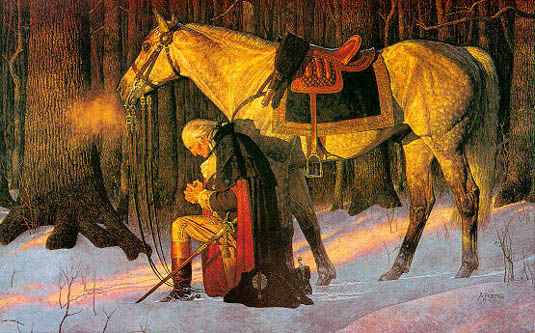
When was the first Thanksgiving? Most of us think of the Pilgrims at Plymouth in 1621. But if the question is about the first national Thanksgiving holiday, the answer is that the tradition began at a lesser-known moment in 1777 in York, Pa.

In July 1776, the American colonists declared independence from Britain. The months that followed were so bleak that there was not much to give thanks for. The Journals of the Continental Congress record no Thanksgiving in that year, only two days of "solemn fasting" and prayer.

For much of 1777, the situation was not much better. British troops controlled New York City. The Americans lost the strategic stronghold of Fort Ticonderoga, in upstate New York, to the British in July. In Delaware, on Sept. 11, troops led by Gen. George Washington lost the Battle of Brandywine, in which 200 Americans were killed, 500 wounded and 400 captured. In Pennsylvania, early in the morning of Sept. 21, another 300 American soldiers were killed or wounded and 100 captured in a British surprise attack that became known as the Paoli Massacre.

Philadelphia, America's largest city, fell on Sept. 26. Congress, which had been meeting there, fled briefly to Lancaster, Pa., and then to York, a hundred miles west of Philadelphia. One delegate to Congress, John Adams of Massachusetts, wrote in his diary, "The prospect is chilling, on every Side: Gloomy, dark, melancholy, and dispiriting."

His cousin, Samuel Adams, gave the other delegates -- their number had dwindled to a mere 20 from the 56 who had signed the Declaration of Independence -- a talk of encouragement. He predicted, "Good tidings will soon arrive. We shall never be abandoned by Heaven while we act worthy of its aid and protection."

He turned out to have been correct, at least about the good tidings. On Oct. 31, a messenger arrived with news of the American victory at the Battle of Saratoga. The American general, Horatio Gates, had accepted the surrender of 5,800 British soldiers, and with them 27 pieces of artillery and thousands of pieces of small arms and ammunition.

Saratoga turned the tide of the war -- news of the victory was decisive in bringing France into a full alliance with America. Congress responded to the event by appointing a committee of three that included Samuel Adams, Richard Henry Lee of Virginia and Daniel Roberdeau of Pennsylvania, to draft a report and resolution. The report, adopted Nov. 1, declared Thursday, Dec. 18, as "a day of Thanksgiving" to God, so that "with one heart and one voice the good people may express the grateful feelings of their hearts, and consecrate themselves to the service of their divine benefactor."

It was the first of many Thanksgivings ordered up by Samuel Adams. Though the holidays were almost always in November or December, the exact dates varied. (Congress didn't fix Thanksgiving on the fourth Thursday in November until 1941.)

In 1778, a Thanksgiving resolution drafted by Adams was approved by Congress on Nov. 3, setting aside Wednesday, Dec. 30, as a day of public thanksgiving and praise, "It having pleased Almighty God through the Course of the present year, to bestow great and manifold Mercies on the People of these United States."

After the Revolution, Adams, who was eventually elected governor of Massachusetts, maintained the practice of declaring these holidays. In October of 1795, the 73-year-old governor proclaimed Thursday, Nov. 19, as "a day of Public Thanksgiving to God," recommending that prayer be offered that God "would graciously be pleased to put an end to all Tyranny and Usurpation, that the People who are under the Yoke of Oppression, may be made free; and that the Nations who are contending for freedom may still be secured by His Almighty Aid."

A year later, Gov. Adams offered a similar Thanksgiving proclamation, declaring Thursday, Dec. 15, 1796, as "a Day of Public Thanksgiving and Praise to Our Divine Benefactor." He recommended "earnest Supplication to God" that "every Nation and Society of Men may be inspired with the knowledge and feeling of their natural and just rights" and "That Tyranny and Usurpation may everywhere come to an end."

These statements were greeted with cynicism and derision by some of Adams's younger political opponents, who saw them as archaic. One of them, Christopher Gore, wrote a friend that it would be an occasion for a real day of thanksgiving when Adams finally retired.

It turned out, though, that the ideas of thanking God for America's blessings -- and of praying for the spread of freedom everywhere -- would long outlast Adams's career. The concepts still meet with skepticism from time to time. But they are reason enough to pause during tomorrow's football game or family feast and raise a glass to the Founding Father who began our Thanksgiving tradition.

Mr. Stoll, formerly the managing editor of the New York Sun, is author of "Samuel Adams: A Life," published this month by Free Press

Wednesday, November 26, 2008

http://www.fantasticfiction.co.uk/images/n53/n265113.jpg
From The Washington Post:
Good review of an outstanding novel.

The Industry of Hope and Grief

A lost child becomes her family's job.

Reviewed by Ron Charles
Sunday, November 23, 2008; BW06

SONGS FOR THE MISSING

By Stewart O'Nan

Viking. 287 pp. $25.95

Stewart O'Nan is a daredevil minimalist, an ardent student of the things people do in between the exciting things other authors write about. In his most recent novel, Last Night of the Lobster, he described the final 10 hours of a Red Lobster restaurant in a Connecticut shopping mall. A fire? A gunman? Legionnaire's disease? No, just budget cuts handed down from the main office. The cooks, waitresses and manager all know what's coming, and so do we. It's a story practically allergic to suspense, but the sensitivity of O'Nan's voice makes it strangely compelling.

Now, 12 months later, his new novel, Songs for the Missing, seems like a sellout. The first chapter sets up a classic thriller premise, strewn with ominous clues: A pretty 18-year-old girl named Kim Larsen leaves her friends at the beach and drives to her part-time job at a gas station. She never arrives. That night her parents notice she hasn't come home. They call her classmates. They call the hospital. They call the police.

We know how this should play out: the accrual of alarming details, mixed with a few false leads; growing suspicion that the devoted father/mother/sister/dog is hiding something; a horrific vision of the crime from the victim's or the murderer's point of view; and finally a shocking revelation. But O'Nan ignores all these conventions in favor of an approach so mundane you can't believe it works, the thriller equivalent of watching blood dry. He's a connoisseur of waiting, and it's his discipline, his refusal to deviate even for a single sentence from the uneventful, dull terror of losing a child, that makes Songs of the Missing so troubling.

Kim's disappearance is at the heart of this novel, but its real concern is with her family members. They have no way of knowing if they're dealing with a simple misunderstanding, an act of teenage rebellion or a capital crime. Even starting the search in earnest seems to Kim's parents like a horrible admission of disaster, but when the initial round of phone calls yields nothing, her father, Ed, feels impelled to do something, get in his car and find her. "They would all laugh at him later, he imagined, Dad freaking out, driving around like a maniac. That was fine with him, as long as she was all right. He didn't expect to see anything." O'Nan follows the trajectory of Ed's panicked thoughts with quiet sympathy: "He'd felt helpless at times in his life, over money troubles most recently, or, more often, the unhappiness of a loved one. This was different. His usually reliable talents of hustle and attention to detail were worthless against the unknown, and he was frightened."

Kim's mother, Fran, is equally afraid, but she reacts differently. As a nurse, "she honored calmness above all, trusting efficiency over emotion." Most of the novel focuses on the mechanics of their search, which Fran pursues with unwavering self-control, an astute study in the way men and women respond to crisis. "The feeling of uselessness nagged" at Ed, but Fran throws herself into these exhausting routines, if only to forestall a descent into madness. "There was a logical order to their panic," Fran thinks. "Every failure led to the next step."

Here once again, O'Nan proves himself the patron saint of labor. These frantic parents have so much to do besides worry: assembling lists of names to contact; canvassing the town with posters; organizing hundreds of volunteers for grid-by-grid searches; staging a "Kare-a-Van for Kim"; ordering buttons, T-shirts and balloons; and trolling through thousands of leads that pour in from witnesses, cranks, psychics and well-wishers. And there are Web sites to monitor and daily blog entries to post -- a whole industry of grieving parents pedaling scraps of hope to each other around the country.

More depressing is O'Nan's clear-eyed portrayal of the media and their double-edged role in these tragedies. "The networks were hungry for missing girl stories," he writes. Fran realizes early that her daughter's disappearance needs to be marketed to get what she wants: maximum exposure as quickly as possible. Even while terrified by thoughts of what might have happened, she must carefully choose the right clothing ("A white blouse would turn into a blob of light" on TV) and train herself to deliver an appropriate appeal. "You don't want to come off as hysterical," a friend advises. "You don't want to be too cool either. . . . It's like advertising." Kim's sister is pushed into the glare of publicity, too: "You're like a celebrity," a well-meaning classmate tells her. Stripped of drama, here is the whole tedious, humiliating, heart-rending work of searching for a loved one.

What holds our attention through all this is O'Nan's careful focus on the minds of shaken family members trapped in a task that consumes their lives and their livelihood. "It was how they told time," O'Nan writes. "They'd picked up the awkward yardstick used by new parents. . . . They counted backwards, snagged on that last day." Forced to go through the motions of hope long after real hope has drained away, they eventually reach that unspeakable place of just wishing it were all over. Ed "no longer looked forward to anything," O'Nan writes. "Pretending to be interested took a constant effort. When he was by himself, he went slack." In scene after scene, these spare descriptions will make you catch your breath. Some are just frozen moments: Fran sitting in her daughter's car in the garage, "both hands on the wheel, as if she was actually going somewhere." Others are masterfully designed sequences: Fran shopping all day for Christmas presents, determined to get her missing daughter just the right thing.

In the end, Kim's family receives neither the resolution they hoped for nor the one they feared. The world that O'Nan captures thwarts our expectations for cathartic tragedy or gleeful celebration, which makes the story even more devastating. This isn't the nightmare of losing your daughter; this is the numbing reality of it. ·

Ron Charles is a senior editor of Book World. He can be reached at charlesr@washpost.com.

TERRORISTS' RESTLESS LEG SYNDROME
by Ann Coulter

November 26, 2008

I thought the rest of the world was going to love us if we elected B. Hussein Obama! Somebody better tell the Indian Muslims.

As everyone but President-elect B. Hussein Obama's base knows, many of the Guantanamo detainees cannot be sent to their home countries, cannot be released and cannot be tried. They need to be held in some form of extra-legal limbo the rest of their lives, sort of like Phil Spector.

And now they're Obama's problem.

If Obama wants his detention of Islamic terrorists to be dramatically different from Bush's Guantanamo, my suggestion is that he cut off -- so to speak -- the expensive prosthetic limb procedures now being granted the detained terrorists.

Far from being sodomized and tortured by U.S. forces -- as Obama's base has wailed for the past seven years -- the innocent scholars and philanthropists being held at Guantanamo have been given expensive, high-tech medical procedures at taxpayer expense. If we're not careful, multitudes of Muslims will be going to fight Americans in Afghanistan just so they can go to Guantanamo and get proper treatment for attention deficit disorder and erectile dysfunction.

After being captured fighting with Taliban forces against Americans in 2001, Abdullah Massoud was sent to Guantanamo, where the one-legged terrorist was fitted with a special prosthetic leg, at a cost of $50,000-$75,000 to the U.S. taxpayer. Under the Americans With Disabilities Act, Massoud would now be able to park his car bomb in a handicapped parking space!

No, you didn't read that wrong, because the VA won't pay for your new glasses. I said $75,000. I would have gone with hanging at sunrise, but what do I know?

Upon his release in March 2004, Massoud hippity-hopped back to Afghanistan and quickly resumed his war against the U.S. Aided by his new artificial leg, just months later, in October 2004, Massoud masterminded the kidnapping of two Chinese engineers in Pakistan working on the Gomal Zam Dam project.

This proved, to me at least, that people with disabilities can do anything they put their minds to. Way to go, you plucky extremist!

Massoud said he had nothing against the Chinese but wanted to embarrass Pakistani President Pervez Musharraf for cooperating with the Americans. You know, the Americans who had just footed -- you should pardon the expression -- a $75,000 bill for his prosthetic leg.

Pakistani forces stormed Massoud's hideout, killing all the kidnappers, including Massoud. Only one of the Chinese engineers was rescued alive.

As a result of the kidnapping, the Chinese pulled all 100 engineers and dam workers out of Pakistan, and work on the dam ceased. This was bad news for the people of Pakistan -- but good news for the endangered Pakistani snail darter!

In none of the news accounts I read of Massoud's return to jihad after his release from Guantanamo is there any mention of the fact that his prosthetic leg was acquired in Guantanamo, courtesy of American taxpayers after he was captured trying to kill Americans on the battlefield in Afghanistan.

News about the prosthetic leg might interfere with stories of the innocent aid workers being held captive at Guantanamo in George Bush's AmeriKKKa.

To the contrary, although Massoud's swashbuckling reputation as a jihadist with a prosthetic leg appears in many news items, where he got that leg is almost purposely hidden -- even lied about.

"Abdullah Massoud ... had earned both sympathy and reverence for his time in Guantanamo Bay. ... Upon his release, he made it home to Waziristan and resumed his war against the U.S. With his long hair, his prosthetic limb and impassioned speeches, he quickly became a charismatic inspiration to Waziristan's youth." -- The New York Times

He's not a one-legged terrorist -- he's a freedom fighter living with a disability. I think we could all learn something about courage from this man.

"He lost his leg in a landmine explosion a few days before the fall of Kabul to the Taliban in September 1996. It didn't dampen his enthusiasm as a fighter and (BEGIN ITALS)he got himself an artificial leg later, says Yusufzai."(END ITALS) -- The Indo-Asian News Service

Where? At COSTCO?

"The 29-year-old Massoud, who lost his left leg in a landmine explosion while fighting alongside the Taliban, often used to ride a horse or camel because his disability made it painful for him to walk long distances in hilly areas." -- BBC Monitoring South Asia

Side-saddle, I'm guessing. And you just know those caves along the Afghan-Pakistan border aren't wheelchair accessible.

"He was educated in Peshawar and was treated in Karachi after his left leg was blown up in a landmine explosion in the Wreshmin Tangi gorge near Kabul in September 1996. He now walks with an artificial leg specifically made for him in Karachi." -- Gulf News (United Arab Emirates)

Karachi? Hey, how do I get into this guy's HMO?

They can't lick leprosy in Karachi, but the Gulf News tells us Massoud got his artificial leg at one of their specialty hospitals.

Anyone who thinks the Guantanamo detainees can be released without consequence doesn't have a leg to stand on.

Tuesday, November 25, 2008

http://lvb.net/media/1/20050717-laffer-curve.gif
From The Daily Beast:
A Warning from Reagan's Economist

by Arthur Laffer

November 24, 2008

Why the proposed $700 billion stimulus plan
could drive the country to economic ruin.


There is no tooth fairy.
Every dollar given to someone comes from someone else.


As you read this, our government is committing enormous sums of money above and beyond normal spending, solely to stimulate the economy and prop up failing companies and markets. These additional sums are huge by any reasonable measure, with estimates as high as $3 trillion in an economy with a GDP of about $15 trillion.

Here’s the bottom line: Instead of making things better, increased spending will only drive our economy further into the ground.

And there is still a lot more spending to come. First it was a $170 billion stimulus package in February of 2008, then material add-ons to both the housing and agricultural bills, followed by Federal Reserve asset swaps with Bear Stearns and a bailout of AIG (which, by the way, isn’t over yet) and then came the debt guarantees of Fannie Mae and Freddie Mac.

Shortly after that, the administration anted up $700 billion in a bailout package, and now Obama, Reid, Pelosi and Bernanke want another stimulus package of $300 billion. Just this week the powers that be are debating bailouts for Michigan’s auto industry. With the slowdown in the economy, tax receipts are now projected to fall sharply. The logic here is totally upside down, and each new measure, far from helping the economy, does enormous damage.

It is true, as the proponents of these stimulus packages argue, that recipients of government checks will spend more than they otherwise would have spent. And, that increased spending will have a multiplier effect increasing spending even further. But this is only part of the story.

The government can only transfer resources; it can’t create resources. There is no tooth fairy. Every dollar given to someone comes from someone else. The government can’t bail some people out of trouble without putting other people into trouble, plus a hefty “toll for the troll.”

In the case of last February’s stimulus package, the government literally borrowed an extra $170 billion and at the same time sent out checks to the transfer recipients totaling $170 billion. The result was a $170 billion increase in the amount of bonds held by the public, accompanied by a $170 billion increase in the current value of future taxes to pay interest and principle on the additional debt.

From the standpoint of accounting, the government is $170 billion further in the red, and taxpayers are liable for an additional $170 billion worth of taxes. Therefore, for every dollar of transfer payment there’s at least an equivalent dollar of future tax liabilities. Those people with the increased tax liabilities will spend less, thereby dis-employing people who had been supplying them with goods they’ll no longer buy. And the reduction in spending of those with higher tax liabilities will lead to a multiplied reduction in total spending equal to and fully offsetting the increase in total spending from the recipients of government checks. There is no stimulus from the stimulus programs!

To see this point more intuitively, imagine what the “stimulus effect” would be if they borrowed the $700 billion from the same people to whom they gave the $700 billion and then promised to raise their taxes by enough in the future to pay off their bonds. Where’s the stimulus in that?

This point is hugely important. For the proponents of increased government spending to argue that their policies will increase output, it is absolutely essential that the increased spending by transfer recipients more than offset any decline in spending by others. If the income effects of fiscal policy net to zero, there is no rationale for these spending policies. And, the income effects of fiscal policy do indeed net to zero.

The diffuse and imprecise nature of just who bares the increased tax liabilities makes the point difficult to understand. We all know who benefits from government programs: mortgage holders, undercapitalized banks, auto companies, low-income earners and the like. But who bears the increased tax burden? That’s a far trickier question, the answer to which I don’t have. But in the aggregate I do know that for every beneficiary of government spending there is someone who has to pay for it. As Milton Friedman so wisely noted, “There ain’t no such thing as a free lunch.”

What I don’t really know is just how far this process can go and just what it will take to stop this vicious cycle. Combine the unintended consequences of a flawed model with a crashing economy in ever more desperate need of beneficial policies, and the results are lethal. The old adage “if you don’t like government problems just wait till you see government solutions” has never been truer.

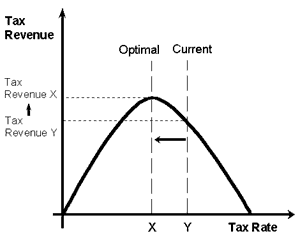
Dr. Laffer is chairman of Laffer Associates and co-author of "The End of Prosperity: How Higher Taxes Will Doom the Economy—If We Let it Happen," recently published by Threshold. He’s best known in economics for the Laffer curve, showing the relation between tax rates and revenue take.

Monday, November 24, 2008

http://uvcarmel.files.wordpress.com/2008/02/sam-falk-the-new-york-times.jpg
From NRO: In commemoration of WFB's birthday today.
Thus may we ever live....

William F. Buckley on Conservatism

Kathryn Jean Lopez

When one declares oneself to be a conservative, one is not, unfortunately, thereupon visited by tongues of fire that leave one omniscient. The acceptance of a series of premises is just the beginning. After that, we need constantly to inform ourselves, to analyze and to think through our premises and their ramifications. We need to ponder, in the light of the evidence, the strengths and the weaknesses, the consistencies and the inconsistencies, the glory and the frailty of our position, week in and week out. Otherwise we will not hold our own in a world where informed dedication, not just dedication, is necessary for survival and growth.

William F. Buckley Jr., Feb 8, 1956, National Review

http://farm1.static.flickr.com/61/205922145_26b349acdd.jpg
From The Corner at NRO:
Too big to bail

Mark Steyn

As a break from the economic gloom over here, here's some economic gloom from over there. The Times in London:

In essence the domestic banks are largely bust. The Government’s £500 billion bailout plan is primarily designed not to keep banks lending to small firms and to homebuyers but to prevent an unimaginable financial calamity...

We should not be worrying about whether this is going to be a thin Christmas for retailers (it is), but whether Britain and the West are about to plunge into a years-long economic Dark Age – complete with mass unemployment and social unrest.

Hey, Happy Thanksgiving! I thought the most interesting line in the piece was this:

It suits ministers, however, to maintain the bogus claim that the bailout is about sustaining bank lending. True, that would be a helpful side-effect, but is not the main purpose. Indeed, a gentle and gradual reduction in the indebtedness of individuals and companies is still needed.

We talk about the "credit crunch" and the calamities associated with the shriveling of credit (as in the Depression). But, in Britain and elsewhere, pre-"bailout" levels of personal indebtedness accumulated on assumptions about home value are unsustainable. In essence, we devalued the currency of credit. Everyone knows Polonius' line from Hamlet - "Neither a borrower nor a lender be" - but forgets what follows: "Borrowing dulls the edge of husbandry." The west's husbandry has a very dull edge right now. And even Polonius' advice is no protection in an age when you can be neither a borrower nor a lender but taxed up the wazoo to pay for the debts and loans of everybody else.

http://www.nypost.com/seven/06052008/photos/new010b.jpg
From The New York Times:
A Pardon to Remember

By GEORGE LARDNER Jr.

Washington

WHEN President Bill Clinton pardoned a billionaire fugitive from justice on his last day in office, even usually loyal Democrats were dismayed. Representative Henry Waxman of California called it “bad precedent” and “an end run around the judicial process.” He said it appeared to set a double standard for the wealthy and powerful.

The billionaire was Marc Rich, a commodities trader, and his pardon is a subject of discussion again because Eric Holder, Mr. Clinton’s deputy attorney general at the time and a key figure in the clemency process, is reported to be Barack Obama’s choice for attorney general. In the years since the Rich pardon, Mr. Holder has said he “never devoted a great deal of time to this matter.” He also told an interviewer that, in hindsight, he wished that the Justice Department had been “more fully informed” about the case. As someone who helped cover the story for The Washington Post, I think the issue is far more complicated and deserves more scrutiny if Mr. Holder is to become our top law-enforcement official.

A little history first. In 1983, Marc Rich was indicted along with his partner, Pincus Green, and their companies on 65 counts of defrauding the I.R.S., mail fraud, tax evasion, racketeering, defrauding the Treasury and trading with the enemy. (The last of these was for an oil deal with Iran while it held American hostages.) On hearing that they were about to be prosecuted, they fled to Switzerland. For the next 17 years, Mr. Rich ducked extradition requests as well as attempts by federal marshals to arrest him in France, England, Finland and elsewhere.

Mr. Rich’s lawyers tried repeatedly to reach a deal with federal prosecutors in New York that would keep him out of jail if he returned. Though his companies pleaded guilty and paid $200 million in fines and other penalties, Mr. Rich insisted that the case against him was weak. The prosecutors offered to drop the racketeering charges and to let Mr. Rich free on bail (without a passport) if he would return. Mr. Rich refused.

The story of how the fugitive came to be pardoned by President Clinton was the subject of a painstaking study by the House Government Reform Committee. While the committee’s report is the subject of some controversy — its Republican chairman, Dan Burton of Indiana, was accused of partisanship — the staff that compiled the documentation was thoroughly professional. All the citations and facts that follow are supported by testimony before the committee or its staff’s documentary evidence.

In 1999, Mr. Rich hired Jack Quinn, who had been Mr. Clinton’s White House counsel from 1995 to 1996, to help him advance his cause. The Rich team was still hoping to strike a deal with federal prosecutors in New York, who were in charge of the case. An e-mail message to Mr. Rich from one of his New York lawyers said that Mr. Quinn felt “he could convince Eric that it made sense to listen to the professors and that he could convince Eric to encourage Mary Jo to do the same.” The “professors” were two tax experts paid more than $96,000 for a study based solely on statements provided them by the Rich legal team; “Mary Jo” was Mary Jo White, the United States attorney in New York.

Mr. Holder was not unsympathetic. He told Mr. Quinn in November of 1999 that he considered the New York prosecutor’s persistent refusal of a meeting “ridiculous” and that “the equities” were on Mr. Rich’s side. Mr. Holder told Mr. Quinn to write a letter to Ms. White with a copy to him, and promised to call her when it arrived. Mr. Holder then called Ms. White personally and, after that conversation, told Mr. Quinn she “didn’t sound like her guard was up.” But New York stood firm.

On Nov. 18, 2000, Mr. Quinn told Mr. Holder that Mr. Rich was going to go for a pardon, a step his team had been contemplating for months. After the conversation, Mr. Quinn told colleagues that Mr. Holder had advised him to “go straight to” the White House and that the “timing is good.” On Dec. 11, just over a month before Mr. Clinton was to leave office, Mr. Quinn delivered the pardon papers to the White House. “The greatest danger lies with the lawyers,” Mr. Quinn wrote in an e-mail message to an aide to Mr. Rich, referring to the prosecutors in New York. “I have worked them hard and I am hopeful that E. Holder will be helpful to us.”

Under the rules governing pardon petitions — rules that were approved by Mr. Holder’s office — the views of United States attorneys “are given considerable weight” because of the “valuable insights” they have. And yet Mr. Holder did not consult Ms. White and her colleagues about the Rich pardon petition; they did not know of it until it had been granted.

Then, on Jan. 19, 2001, Mr. Holder delivered his pardon assessment to the White House, telling Beth Nolan, the White House counsel, that he was “neutral leaning favorable” on the Rich pardon. His decision, he added, was influenced by the support of Ehud Barak, the Israeli prime minister.

The people in the United States attorney’s office in New York weren’t the only ones surprised by Mr. Holder’s decision. Deborah Smolover, his top deputy for pardon cases, did not find out about the pardon for Mr. Rich until the White House called to inform her of it after midnight on Jan. 20. (Mr. Green won a pardon, too.) After the pardon was signed, Mr. Quinn has testified, Mr. Holder called him to commend him on “a very good job.” Mr. Holder also asked Mr. Quinn to consider hiring two former aides, one of whom had already contacted Mr. Quinn on Jan. 2 “at Holder’s suggestion.”

The precedent against pardons for fugitives was set more than 200 years ago by President John Adams. The charge, brought in 1799, was murder on the high seas against a ship’s captain who was clearly trying to put down a mutiny. But the mutineers made it back to the States, ready to testify against the captain, while his supporters were still at sea. The captain was afraid to return. Asked to approve a nolle prosequi (a notice that prosecution won’t be pursued, a procedure then treated as part of the pardon power), the president consulted his cabinet, which concluded that a trial should come first and a pardon, if justified, after that. Clemency, wrote Secretary of War James McHenry, should be exercised only with “great caution and on the fullest information.”

Mr. Holder never came close to meeting that standard. He had the last word at Justice on clemency petitions and he saw to it that he had the only word. He brokered one of the most unjustifiable pardons that an American president has ever granted.

George Lardner Jr., an associate at the Center for the Study of the Presidency, is working on a history of the presidential pardon power.

Sunday, November 23, 2008

http://www.scouters.us/images/r1940.jpg
Excellent article here from The American Thinker:
A Libertarian Defense of Social Conservatism

By Randall Hoven

Social conservatism is taking a beating lately. Not only did it lose in the recent elections, it is being blamed for the Republican losses. If only the religious right would get off the Republican Party's back, the GOP could win like it is supposed to again. I beg to differ.

I'm anything but a social conservative. In nine presidential elections, I voted Libertarian in six. I am a hard core "limited government" conservative/libertarian; I want government out of my pocket-book and out of my bedroom. Concerning my religion, it's none of your business, but I'm somewhere in the lapsed-Catholic-deist-agnostic-atheist spectrum; let's just call it agnostic.

Having said all that, I have no problem with "social conservatives" or the "religious right" and their supposed influence on the Republican party. I base this not on the Bible or historical authority, but on the love of liberty and the evidence of my own eyes.

Who are the true liberty killers?

The most obvious point to me is that it is the do-gooding liberals who are telling us all what we can and can't do. The religious right usually just wants to be left alone, either to home school, pray in public or not get their children vaccinated with who-knows-what. Inasmuch as the "religious right" wants some things outlawed, they have failed miserably for at least the last 50 years. Abortion, sodomy, and pornography are now all Constitutional rights. However, praying in public school is outlawed, based on that same Constitution.

Just think for a moment about the things you are actually forced to do or are prevented from doing. Seat belts. Motorcycle helmets. Bicycle helmets. Smoking. Gun purchase and ownership restrictions. Mandatory vaccines for your children. Car emissions inspections. Campaign ad and contribution restrictions. Saying a prayer at a public school graduation or football game. Trash separation and recycling. Keeping the money you earned. Gas tax. Telephone tax. Income tax. FICA withholding. Fill in this form. Provide ID.

For the most part, the list just cited is post-1960. Neither Pat Robertson nor James Dobson ever forced any of that on us.

How powerful is "social conservatism"?

I can get pornography right at my keyboard, or drive a mile and get all the sex toys I can fit into my car. I can walk to the nearest casino to gamble (but can no longer smoke there). I do need to travel to Nevada for a legal prostitute. If my teenage daughters had wanted abortions, they could have had them free and without even notifying me. (However, had they taken Advil to school, we'd all be in trouble.)

Drugs

There is one thing I can think of that is actually outlawed and that the religious right wants outlawed: illegal drugs. But the criminalization of drugs enjoys broad bipartisan support; it is not exactly an issue owned by the religious right. Last I heard, 70% of those polled wanted to keep drugs outlawed.

But recall that in the Supreme Court decision that ruled against medical marijuana, Gonzales v. Raich, it was the "social conservative" contingent of Rehnquist and Thomas who dissented. Clarence Thomas began his dissent as follows .

Respondents Diane Monson and Angel Raich use marijuana that has never been bought or sold, that has never crossed state lines, and that has had no demonstrable effect on the national market for marijuana. If Congress can regulate this under the Commerce Clause, then it can regulate virtually anything-and the Federal Government is no longer one of limited and enumerated powers.

I'll take that kind of "social conservatism" all I can. It sounds like freedom to me.

It was also the very conservative William Buckley at the very conservative National Review (and who was not alone among conservatives) who said this to the New York Bar Association:

I leave it at this, that it is outrageous to live in a society whose laws tolerate sending young people to life in prison because they grew, or distributed, a dozen ounces of marijuana. I would hope that the good offices of your vital profession would mobilize at least to protest such excesses of wartime zeal, the legal equivalent of a My Lai massacre. And perhaps proceed to recommend the legalization of the sale of most drugs, except to minors.

Abortion

Let's talk about the unavoidable issue: abortion. Who made it a federal issue? The ACLU and then the Supreme Court. Before 1973 it was left to the states; some allowed it, some didn't. Different states could adopt different criteria. Some might allow it under all circumstances. Some other none. Some at 12 or 20 weeks. Some might define "health" of the mother in different terms.

But all that flexibility was halted with Roe v Wade. Since 1973 abortion has been a Constitutional right. Do you know where that right is found in the Constitution? In these words of the 14th Amendment: "[No state shall] deprive any person of life, liberty, or property, without due process of law." Those words, according to our finest Constitutional scholars, mean it's OK to shove scissors through the skull of a baby and suction its brains out, as long as that skull has not yet left the birth canal. I'm sure you see that in those words of the 14th Amendment. Look hard, into the penumbras and emanations - it might take a little imagination.

Regardless of what you think about abortion, to find it in the 14th Amendment is an act of ink-blot reasoning. It might almost be OK, if it meant the court said we have true sovereignty over our own bodies. But the court explicitly said otherwise.

The privacy right involved, therefore, cannot be said to be absolute. In fact, it is not clear to us that the claim asserted by some amici that one has an unlimited right to do with one's body as one pleases bears a close relationship to the right of privacy previously articulated in the Court's decisions. The Court has refused to recognize an unlimited right of this kind in the past... We, therefore, conclude that the right of personal privacy includes the abortion decision, but that this right is not unqualified...

So you do not have the right to do with your body as you please. Neither women nor men own their own bodies. That's what Roe v Wade said. In short, the decision was not "pro-choice". It was pro-abortion, pure and simple. That is the only choice it protected.

If taking abortion out of the hands of the federal government and putting it back into hands of the states, where it is legislated per each state's popular sentiment, let it be. I can stand that kind of "social conservatism." It sounds like federalism and democracy to me.

Guns

Now let's talk about guns. Why is that a "social" issue? We're talking about the Bill of Rights here. You know, where we find the freedom of speech, freedom of the press, religious freedom, freedom from unreasonable searches and seizures, no cruel and unusual punishments or excessive bails, etc. The right to keep and bears arms is No. 2 of 10. This is a right the "religious right" wants to keep, not take away. If you keep your gun in your bedroom, it is the religious right that wants the government to stay out of your bedroom. Who is treading on whose rights here?

Gay Marriage

I am not dead set against gay marriage. I'm mildly against it, but if it comes to an honest vote in my state and passes, I can live with that. But so far, every single time the issue has gone to a popular vote, the people voted it down. The only reason it is legal in two states right now is because of the courts in those states; a mere handful of robed Merlins made the decisions.

I also think it a bit risky to redefine such a fundamental institution that has been defined as between one man and one or more women in every successful civilization I know about, for the last 6,000 years or so. How about we use federalism and the states as laboratories before we dive head-first into opaque water on this one?

God

I must say, even as an agnostic, something is creepy about a government that outlaws Nativity scenes at City Hall, but subsidizes Piss Christ. That tries to disband the Boy Scouts but promotes gay marriage. That disallows even voluntary, student-led prayer at public school, but teaches children how to put on condoms.

What is so funny about Bill Maher's Religulous? What is so bad about Sarah Palin hoping to do God's will or praying for His guidance?

I am not religious myself, but I kind of like the idea that whoever makes and enforces our laws thinks that some invisible being knows his every move and will judge him accordingly in eternity. I would not be offended if the being he prays to is the one who gave the Sermon on the Mount.

I have yet to see the absence of religious devotion replaced with true scientific rationalism. Instead, I see it replaced with Environmentalism, Marxism, New Age "spiritualism" or any of a host of other pseudo-religions. On the other hand, Isaac Newton, for my money the greatest scientist ever and one of our more rational thinkers, wrote way more about the Bible and God than he ever did about calculus, mechanics and optics combined. There is nothing inconsistent between science and religion or reason.

By the way, I know enough about rationalism to know this: anyone who thinks he practices it rigorously has no idea what he's talking about. Bertrand Russell and Alfred North Whitehead are famous for taking a thousand pages to prove, with rigorous logic, that one and one are two (I'll trust them on that). How can anyone with an ounce of humility, or real sense, think he knows the "rational" method of improving the lot of mankind? Lenin and Mao thought they knew, as they sent tens of millions to their graves in the effort.

Mythical Creatures

I'm still searching for the mythical creature that is the "financially conservative, socially liberal" politician. In virtually every case, the pro-abortion or pro-gay marriage politician is the first to vote against a tax cut, the first to vote for more spending and quick to compromise principles on any issue there is.

Using the National Journal's ratings of Senators in 2007 , the correlation coefficient between "economic" scores and "social" scores is 90%. That means they almost always go together; financial conservatives are social conservatives and vice versa. Every Senator scoring above 60 in economic issues, scored above 50 in social ones. Every Senator scoring below 40 in economic issues, scored below 50 in social ones. If there is such an animal as a "financial conservative, social liberal", it does not exist in the US Senate.

Humility and hubris

Finally, there is the concept of small "c" conservative. While we should make some changes in our institutions so that we can evolve, as F.A. Hayek might describe, toward a better society, we should also be careful. Don't change everything at once, for example. Try a few things incrementally and see how they turn out. Maybe we should consider "evidence based" government.

We should be especially careful in tinkering with the most successful society ever to exist on this planet. I would hope I wouldn't have to defend that claim. By 1969 we put man on the moon and brought him back safely. We were the richest and most free country on earth. Immigrants flocked to our shores. We had defeated some of the most despicable regimes in history. Our schools were the envy of the world and our people produced more patents than any other country.

Shouldn't we have some humility about changing the most fundamental institutions that got us to that point? Things like traditional marriage, the nuclear family, schools, private property, the free market and the Bill of Rights? That is not to say we don't change them at all. But let's be careful, incremental and be prepared to change the change. Do not throw out the baby with the bathwater.

It was communism that tried to change everything all at once. Karl Marx described the approach in the Communist Manifesto.

"Abolition of private property. ... Abolition of the family! ... Communism abolishes eternal truths, it abolishes all religion, and all morality ... this cannot be effected except by means of despotic inroads ... In short, the Communists everywhere support every revolutionary movement against the existing social and political order of things."

The Soviets said they would create the "new man." Pol Pot wanted change so drastic he set his revolution in the "year zero." The results were 100 million dead, prison camps, re-education camps and boat people. These new societies, new men, and new calendars did not last.

Liberty

When the day comes that the only thing between me and liberty are some Bible-quoting know-it-alls, I'll reconsider. But right now, there are a lot of things between me and liberty, and the "religious right" is not one of them. In fact, I see them voting for more liberty, not less. If the Republican Party ever decides it really wants to be the party of liberty, rather than the slower-road-to-socialism party, I'll gladly join the religious right there.
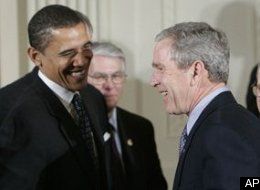
Randall Hoven can be contacted at randall.hoven@gmail.com or via his web site, kulak.worldbreak.com.