Saturday, March 17, 2007

http://www.moonbattery.com/archives/John_Edwards_biker.gif

From First Things:

Deep Thoughts from Senator Edwards

By Stephen Barr

Thursday, March 15, 2007, 10:09 AM

Senator John Edwards has offered us a reflection that gives us a glimpse of his hidden theological depths: “I think that Jesus would be disappointed in our ignoring the plight of those around us who are suffering and our focus on our own selfish short-term needs. I think he would be appalled, actually.”

“WOULD be”? Would be as in “he would be, if he knew about it”? There is a very false note here. A Christian who prays naturally thinks of Christ as ever-present and all-knowing, not as a figure from the past who would doubtless have something interesting to say if he were still alive, or who would have definite opinions of certain matters were they called to his attention. On the other hand, at least Senator Edwards didn’t say that Jesus would be turning over in his grave.

Stephen M. Barr is a theoretical particle physicist at the Bartol Research Institute of the University of Delaware and the author of Modern Physics and Ancient Faith and A Student’s Guide to Natural Science.


From Libertas:
The NPR Liberal Said What?
— Dirty Harry @ 8:15 am

images90.jpg

You hear the words “public radio,” you hear the word “atheist,” and then you hear the NPR atheist begin to talk about Evangelical Christians and that slight twitch in the left eye naturally returns. But then he says this:

Christians are actually, to me, anyway, as a Jew, much more interesting in America. And weirdly, much more misunderstood. Evangelical Christians are the most incompetently portrayed group in America, in TV, in fiction, in the news. When Christians say that the media gets them wrong, Christians are absolutely right. Christian life in this country is really horribly documented, and way more interesting than is done. Generally, in the media, very religious Christians are portrayed as hardheaded doctrinaire knuckleheads. But in fact, from my experience, the most religious Christians I know tend to be incredibly thoughtful, complicated, generous to a fault, very principled and not knuckleheads. Actually, they’re sort of weirdly the opposite of the stereotype, and that includes people from the hardcore fundamentalist faiths.

piaUGHFPI3p94fgv4+86QWF;KQ — Sorry, I grabbed the keyboard crawling up off the floor. That’s a quote from Ira Glass who does both a radio show and a Showtime series called “This American Life” that I will now be checking out. You know, you really don’t know how hungry you are for those words until you hear them.

Thank you, Ira. And thanks to D for the heads up.

http://graphics8.nytimes.com/images/2007/03/08/movies/300span,0.jpg
True Thermopylaes
The story behind Frank Miller's '300.'
by Bill Walsh

03/16/2007 12:00:00 AM


THE BATTLE OF THERMOPYLAE is one of the signal symbolic events in the history of Western civilization. Athens and Jerusalem are the standard shorthands for the West's cultural headwaters, but at Thermopylae, Sparta, that historical mystery of a superpower, played a role for which perhaps she, and only she, was suited.

The story is familiar to anyone with a passing knowledge in military or classical history. Xerxes the Great of Persia set about incorporating Greece into his empire with an army Herodotus estimated at 5 million, half under arms. Leonidas of Sparta, hampered by obscure religious and political considerations, was able to take only 300 hand-picked soldiers as the spearhead of an allied force to meet the Persians at Thermopylae--"the Hot Gates," a narrow pass where the Persian superiority in maneuver and numbers would be negated. The Spartans and their allies held off the Persians until a traitor named Ephialtes of Trachis revealed a secret path around their rear which allowed the Spartans to be encircled and defeated. When Leonidas got word of this, he released his allies, but he and his 300 men, joined by 700 brave Thespians, fought to the death, in willing submission to the Spartan law of no retreat, no surrender.

Their martial prowess, professionalism, sangfroid (see Housman's famous line, "The Spartans on the sea-wet rock sat down and combed their hair."), and absolute sense of honor unto death, were shocking to the Persians and became more than an epic war story: Historians from Herodotus, through Plutarch, and stretching all the way to Victor Davis Hanson some 25 centuries later, have seen in this instance of a tiny force composed of free men dealing horrible destruction to a larger, slave military, the very essence of the conflict between East and West.

Greece was the only location in the classical world in which the flame of liberty burned. A Persian victory would have snuffed out the Greek concept of freedom under the law, imposing a highly centralized god-king system known to past generations as Oriental Despotism. The free Spartans, in this telling, not only fought better as free men fighting for their liberty, but their sacrifice helped preserve the notions and institutions which blossomed into the glorious civilization eventually built on Greek foundations.

FOR THE HEIRS OF THIS SACRIFICE some two millennia on, this story does not sit entirely well. The Spartans, in their way, are as alien to us as the Ancient Egyptians, and due to the fact that they considered it forbidden to transcribe any of their laws, we know considerably less about them than the charmingly literal-minded folk on the Nile, who managed to combine magical thinking and the some of the greatest feats of practical engineering the world has ever seen.

Much of what we do know about the Spartans isn't attractive to modern eyes. Their entire society was geared toward producing and maintaining a professional, standing army, and it did so principally by killing infant boys who seemed weak and brutalizing the surviving children until they were fearless, skillful dealers of death.

Herodotus mentions almost in passing that Leonidas chose his Three Hundred from the ranks of men who already had sons. Left unmentioned is that he did so because he knew none of them would return, himself included--himself especially, given than an oracle had told him that the sacrifice of a king would be needed to preserve Sparta.

Meanwhile, Persia looks a little more reasonable. They were a well-run, tolerant empire. Cyrus had even returned the Jews from exile. What were the Greeks so determined to resist? In fact, there were plenty of Greeks who were ready to sign up with Xerxes, sending symbolic tributes of earth and water. But the democrats of Athens and the militarists of Sparta not only refused, they broke with all diplomatic custom and executed Xerxes' messengers, tossing them into a pit and a well, respectively, with the taunts that they might find their earth and water down below.

SO WHAT were the Greeks fighting for? Power, certainly. Athens and Sparta were Great Powers of the day. (Indeed, it was the not the Three Hundred at Thermopylae but the Athenian navy at Salamis that crucially broke the momentum of the Persian invasion, before the Spartans got their revenge at Plataea.) But in the end, one gets the sense that Herodotus and Hanson are on to something. Leonidas and company might well have recognized the battle cry of Mel Gibson's ludicrously anachronistic, semi-Pictish William Wallace: "They may take our lives, but they'll never take our freedom!"

WHICH BRINGS US to Frank Miller, the comic-book artist best known for his Sin City graphic novels, which Robert Rodriguez made into a well-received 2005 movie. In 1998, Miller penned a comic-book telling of Thermopylae, called 300, which has now also been translated onto film. On the basis of Sin City, Miller's affinity for Thermopylae is not obvious, save for the rivers of blood. Sin City's world was all but devoid of the qualities one sees in the Spartans--self-sacrifice, valor, bravery, honor.

Unlike Sin City, however, 300 can be cleared of the charge of aestheticized nihilism. As his acknowledgments show, Miller was clearly influenced by Victor Davis Hanson's Western Way of War and he puts into the mouths of the Spartans explicit assertions that they fight for their freedom under their law, even if it means death. Miller has also expressed admiration for the Rudolph Maté's 1962 film, The 300 Spartans, which depicted Thermopylae as an adumbration of the Cold War.

Miller's comics present an imaginative, stylized, and somewhat ahistorical version of the great battle. The Spartans are generally running around in loin cloths, heroic classical-nude action figures rather than men at arms in armor; other than Leonidas, they seem to have left their helmets' distinctive crests home in Lacedaemon. The Persians are a bizarre cast of characters, led by a heavily-pierced, African-looking Xerxes with a predilection for self-aggrandizing mystagogy, and employing elephants in battle, à la Hannibal at Lake Trasimene.

That said, Miller's 300 is reasonably faithful to the general outlines of history, although he omits almost the entire broader context and occasionally oversteps the bounds of credibility with his additions. Take, for example, Miller's depiction of Ephialtes of Trachis, the traitor who betrays Greece, as a suicidal, hunchbacked, would-be hoplite rejected for service by Leonidas. Entertaining? Sure, but it sticks out a mile as an invention.

Ultimately, what made 300 work on paper was the combination of Miller's dynamic art (brilliantly colored by Lynn Varley), which alternated between the mimetic and the abstract, and the terse--though often clunky--text which frequently used the Spartans' own Laconic words to tell a hard story of hard men going to the hard task of dying at the hands of their enemies.

AND NOW THERE'S THE MOVIE. Taking the comic as a set of storyboards, director Zack Snyder has crafted a continuum around Miller's still images, using some of the digital-background techniques that made Sin City so visually stunning. The film's advance buzz was very good, with approving (caveated) comments from Hanson and other historians, and even talks of a sequel--however unlikely that might seem given that all the Spartans in 300 end up dead. (And that the Battle of Plataea, at which Greece took its vengeance on the Persian remnant, was included as a too-brief coda.) The film's record-breaking opening weekend, however, would seem to make a sequel of some sort almost a corporate necessity.

Cinematically, the movie and its climactic battles don't approach the standard set by the Battle of Helm's Deep in The Two Towers, arguably the greatest pre-modern (if entirely fictional) battle-narrative sequence ever put on film. Nor does it show the bloody, filthy, squalid reality of hand-to-hand warfare, as Kenneth Branagh's Henry V did with far fewer special effects.

Nor can 300 be said to overcome comic-book movies' usual limitations: over-reliance on superficial, if striking, imagery and insufficient attention to dialogue and characterization. Snyder overuses slow-motion and freeze-frame shots, perhaps genuflecting too reverently towards Miller's drawings. He piles a rhinoceros Pelion atop the already unnecessary elephantine Ossa. Moreover, he adds an entire political-intrigue backstory in Sparta where, among other unlikelihoods, a villain sneeringly dismisses a line of Thomas Jefferson's and Spartan marital mores are held out as similar to our own (they were not). This addition isn't altogether unwelcome, as it provides a bit of counterpoint from the alternating frenzy and slo-mo of Thermopylae, and it allows Lena Headey to turn in the movie's best performance as Queen Gorgo. Gerard Butler's work as Leonidas is also solid, despite the thin script, with the actor's Scottish orneriness well informing the Spartan king's determined resistance to domination.

An unfortunate addition to the film is the literal dehumanization of the Persians. The elite Immortals look as if Mr. Roboto had been sent to ninja camp and cloned--at least until one of them gets his mask ripped off, revealing that he hails not from Persia, but from Mordor or Mos Eisley. A couple of giants are added to the Persian ranks, presumably to provide level bosses for the inevitable video game. On the other hand, Rodrigo Santoro's performance as Xerxes adds weirdness and verve to the comic book's character--and he has the added bonus of actually appearing somewhat Persian, unlike Miller's quasi-Zulu original.

Nevertheless, with its digital scenery, its monstrous villains, its muscular, superheroic Spartans, and its Matrixesque high-speed camerawork, 300 is a genuine spectacle, for good and ill. It creates a lurid phantasmagoria of Thermopylae, a fascinating, bizarre hallucination which concentrates the mind on the Three Hundred's brutal fate--as well as the drama of free men choosing to fight and die to oppose a tyrant's army.

Deficient in narrative and history though it is, this approach captures today's viewers used to visual extravaganzas as well as the worldwide audiences for whom it will be translated. Indeed, in style, 300 strongly resembles the recent Chinese hits The Curse of the Golden Flower and Crouching Tiger, Hidden Dragon, which combined historical settings with mythic, fairy-tale style effects and action.

Unlike those films, however, 300 describes an actual historical event, which invites interpretation and analogy. Predictably, many in Europe and on the Left have tried to make 300 into an allegory for today's Iraq, seeing President Bush as the imperial would-be conqueror thwarted by a smaller foe. Others, particularly in the critics' caste, have cringed at seeing Western warriors portrayed heroically against an alien Other with whom they'd rather sympathize.

These projections are almost entirely inapt. Snyder's film is faithful to Miller's book which was written in 1998 and conceived earlier. If 300 may be called pro-Western, it's ultimately because Herodotus and Plutarch were pro-Western. If the valiant, doomed Spartans seem heroic, it's because, much as it pains us in our anti-heroic age to admit it, heroes have at times walked the earth performing deeds we now find incomprehensible.

IN ITS GLIMPSE INTO THE SOUL of our civilization, Miller & Snyder's 300 resembles Peter Jackson's Lord of the Rings. In that film of J.R.R. Tolkien's epic fable, another outnumbered band of free warriors faces another oceanic host of enemies from the east, bent on slaughter and slaving. Their general rallies their courage with the defiant cry, "Men of the West, I bid you stand!" And stand they do. Tolkien's tale, Herodotus's Histories, and their cinematic adaptations remind us that the West's preeminence, however commonplace and inevitable it appears, is anything but. It is, in fact, staggeringly improbable and breathtakingly contingent on a confluence of incidents and individuals from what are some of the world's most obscure places--from the forests of northern Europe to the Mediterranean's peninsulae to two hills called Sinai and Golgotha.

If 300 has something to say to us, it is not a facile analogy to our own times, but an occasion, however sensational and simple, for considering the meaning of values such as sacrifice, liberty, honor, and valor. These continue to resonate in us, even if they have fallen somewhat out of favor. They have been central to our past, and our acceptance or rejection of them will shape our future.

Either way, we shall likely never see a poet compose a verse as elegiac and haunting as Simonides' epitaph upon the Spartans' burial mound at Thermopylae:

Stranger, go and take word to Sparta
That we here lie, obedient to her law.

Bill Walsh is a writer in Wisconsin. He prefers "lay-o-nee-das" to "lee-o-nigh-duss," but grudgingly accepts the utility of "Xerxes" over "Khshayârsha."

Friday, March 16, 2007

The image “http://images.snapfish.com/33:9856323232%7Ffp46%3Dot%3E232:%3D6%3B%3C%3D878%3DXROQDF%3E2323555897496ot1lsi” cannot be displayed, because it contains errors.
Needed This St. Patrick's Day: Ronald Reagan
By Tom Purcell


FrontPageMagazine.com | March 16, 2007

It was on St. Patrick's Day 1988 when an unexpected visitor arrived at Pat Troy's Irish pub in Alexandria, Va -- President Ronald Reagan.

For 27 years, it's been a favorite watering hole for Washington insiders. Some of Reagan's advance men had been regulars. They secretly arranged the president's visit.

Just before noon, the pub was half-packed when Reagan and his entourage arrived. As news got around, the pub quickly filled to capacity. While Reagan enjoyed a pint of Harp and some corned beef and cabbage, Troy was so busy tending to patrons, he didn't have time to react to his famous patron.

"He had an energy about him that put you instantly at ease," Troy told me. "He made it easy to carry on as though he was just another patron, so that is what I did."

Troy took the stage and led the audience in "The Wild Rover." He directed sections of the audience to compete with each other to see which could sing and clap the loudest.

"You have to clap louder, Mr. President," he said to Reagan, prompting the president, not used to being given orders, to laugh.

Troy next led the audience in "The Unicorn Song." While Troy sang the words, the audience mimicked the animals referenced in the song:

"There were green alligators and long-necked geese, some humpty backed camels and some chimpanzees. Some cats and rats and elephants, but sure as you're born, the loveliest of all was the unicorn."

Reagan turned to watch a group of young women act out the song. His face showed curiosity and delight – he'd never seen this song performed before.

But that was how he was: At the same time he was the world's most powerful man, the man who felled communism and restored American optimism, he was a man of youthful innocence who found immense pleasure in the simplest things.

When Troy finished, he handed the president the microphone. The normally raucous crowd became extraordinarily quiet.

Reagan spoke off the top of his head. He graciously thanked Troy for having him for lunch. He said it was a great surprise. He talked about his father, an Irishman.

"When I was a little boy, my father proudly told me that the Irish built the jails in this country," he said, pausing expertly. "Then they proceeded to fill them."

The crowd laughed heartily.

"You have to understand that for a man in my position, I'm a little leery about ethnic jokes," he said. The crowd roared. "The only ones I can tell are Irish."

He talked about a recent trip to Ireland. He visited Castle Rock, the place where St. Patrick erected the first cross in Ireland.

"A young Irish guide took me to the cemetery and showed me an ancient tombstone there," he said. "The inscription read: 'Remember me as you pass by, for as are you so once was I, and as I am you too will be, so be content to follow me."

As Reagan paused, the crowd eagerly awaited his follow up.

"Then I looked below the inscription, where someone scratched in these words: 'To follow you I am content, I wish I knew which way you went.'"

The crowd roared loud and long, causing the president to deadpan to his advance men: "Why didn't I find this place seven years ago?"

The pub visit was videotaped by Reagan staffers and released to Troy 10 years after Reagan left office. I watched that video and got to see a snapshot of pure, unscripted Ronald Reagan.

It shows how powerfully and eloquently the man was able to engage any audience, large or small, just by being his genuine self. As we begin the process of selecting our next president, we sure could use another fellow like him.

I'll be sure to offer up a toast to the Great Communicator as I celebrate St. Patrick's Day this year:

"To follow you we were content, and grateful for the way we went."

Thursday, March 15, 2007

http://upload.wikimedia.org/wikipedia/en/thumb/c/c1/Dean_smith_1997_sportsman.jpg/250px-Dean_smith_1997_sportsman.jpg
Deja Carolina Blue
By Art Chansky

March 15, 2007

Winston-Salem, N.C. ----- Carolina's placement in the NCAA Tournament is eerily familiar to 10 years ago, when the Tar Heels rolled to the Final Four in Dean Smith's last season on the bench.

The 1997 Tar Heels were also ACC champs, seeded No. 1 in the East Regional and sent here for first- and second-round games on Wake Forest's home floor.

Unlike Roy Williams' current dozen-deep rotation, predominantly six men played that season and managed to avoid foul trouble and injuries most of the way. But that team was saddled with a different kind of pressure, a once-in-a-lifetime burden that represented the more than 100 players that came before them under Smith.

Their coach was about to break the all-time record for major college victories, surpassing the legendary Adolph Rupp for what was once considered an unreachable milestone.

The '97 Tar Heels had struggled early, losing their first three ACC games and nearly a fourth (rallying from nine points down in the last two minutes to beat N.C. State in Chapel Hill).

It looked like Smith wouldn't get there that season, and his former players fretted privately that he might retire short of breaking the record. Then his 36th Tar Heel team put together one of the more amazing streaks in Carolina Basketball history.

They ran the table (8-0) in the second half of the ACC schedule, defeated Virginia, two-time defending ACC champion Wake Forest (with Tim Duncan) and State to sweep the tournament in Greensboro and deliver Smith's lucky 13th ACC championship.

Suddenly, Smith had 875 career coaching wins and was one shy of Rupp's 876.

A buzz perhaps like no other ever in the storied program permeated North Carolina, centering on Winston-Salem. History was in the making and in the air. Tickets were impossible to get if you weren't a Rams Club major donor or willing to scalp your way into Lawrence Joel Coliseum for 10 times face value.

Nervous Carolina actually trailed 16th-seed Fairfield by seven points at halftime before senior Serge Zwikker's 19 points and 13 rebounds led a comeback that buried the Stags. Smith had tied Rupp, the famed Baron of the Bluegrass, and needed one win to break a record that had stood for more than 25 years.


CBS, which generally covered the second round regionally and often jumped around the country, had announced it would show Carolina's 12 Noon Saturday game nationally and in its entirety. The opponent was Colorado and a pretty good guard named Chauncey Billlups.

Of course, the main story line was Smith.

Meanwhile, former Tar Heel players around the country were scrambling to get to - and into - Joel Coliseum. Linda Woods, Smith's administrative assistant, had just so many tickets she could leave for the players who bothered to call, because team allotments to the first two rounds were so small.

Carolina's loyal and connected alumni would not be deterred, however.

Mitch Kupchak, then still assistant general manager of the Lakers, and George Karl, head coach of the Seattle Supersonics, flew red-eyes Friday night after their games on the West Coast. Bobby Jones picked up Kupchak in Charlotte and, after a mandated stop in Lexington for some North Carolina barbecue, they were in their seats by tip-off. Dozens of other players got there and somehow got in, which later flabbergasted Smith.

Of course, there was little doubt about the outcome. Carolina was better than Colorado, playing a virtual home game and now on a mission that no mortal could deny. With Antawn Jamison, Ademola Okulaja and Zwikker combining for 38 rebounds (seven more than the entire Colorado team), the Tar Heels broke open a close game early in the second half and cruised to the record-breaking 73-56 win.

As placards showing the number provided by a local newspaper dotted the crowd, chants of "EIGHT SEVENTY-SEVEN! EIGHT SEVENTY-SEVEN!" rang out. At the buzzer, Zwikker nearly tackled an NCAA official trying to retrieve the game ball so he could give it to Smith. CBS cornered the coach for a national TV interview, but after a few words he slipped through a couple of celebrating players and headed for the locker room.

Emerging a few minutes later for the walk down to the press conference, Smith received the surprise of his life. A throng of his players, plus their families, had somehow wangled their way into the hallway outside the locker rooms.

Caught between elation and emotion, Smith was almost aghast as he walked through the gauntlet of gratitude, gushing "hellos" and "thanks for coming" all the way to the end. He tried to reach out and touch, make eye contact with or say the name of every player he saw, including wives and children he remembered from having presided over the fabled Carolina Basketball Family for four decades.

As he finally reached the TV interview room, Smith was bear-hugged from behind by Michael Hooker, the Chancellor and UNC alumnus whose genuine respect and affection for Smith dated back to his student days in the 1960s.

"Thank you, Michael," Smith said to Hooker, who would be dead two years later from acute lymphoma.

The press conference was one of Smith's last in North Carolina as the Tar Heel coach. He retired the following October, saddening Tar Heel Nation but certainly not surprising the masses that had hung on his every word. The time had come, but at least his players, assistant coaches and managers since 1961 could now say they were part of history.

Smith returned the compliment that March 15, 1997, afternoon and, after he had taken an 11th team to the Final Four and won 879 games, again six months later in the Bowles Room next to the building that bears his name.

"All my players," he said, biting his lip both times, "they are so special."


http://www.bigmagic.com/pages/blackj/monkees.jpg
From RightWingBob.com:

Subversion ...1:52 pm

Dylan was sure having fun on his Theme Time Radio Hour show today, attacking the subject of “TRAINS.” He was having so much fun he decided that next week’s theme will have to be more trains.

Before playing The Monkees doing Last Train to Clarksville Dylan made some interesting remarks. I don’t have the verbatim text at this point, so I’m relying on my memory. He said something to the effect of: “I’ve always felt the first rule of writing a subversive song is not to tell anybody that it’s subversive.” He went on to talk about how Last Train to Clarksville (written by Tommy Boyce and Bobby Hart) was secretly about a Vietnam draftee on his way to the war. That’s what the refrain line, “And I don’t know if I’m ever coming home,” is referring to, according to Bob.

Now, some will predictably rejoice to hear Dylan seemingly make a comment about the Vietnam War, but, in reality, what he was talking about here was songwriting. He was appreciating and highlighting the craft present in what Boyce and Hart were doing — which is the kind of thing he does all the time on his radio show. However, his remark about writing songs that are subversive but which don’t explicitly give away their intent is very interesting indeed, because some of us would argue that Dylan has been doing precisely that, a whole lot of the time. Not by being “anti-establishment” or “anti-war” or any of those old labels that still get thrown around in the media — there would be nothing secret about that (were it even true) because that’s what a lot of people always liked to hear in his songs. That’s what the headlines told you. No, the ways in which a secretive kind of subversion has arguably been present in Dylan’s work include things like: asking questions to which no earthly mind could provide an answer; wielding an awareness of death as an omnipresent background; and writing songs that at first glance appear to be saying one thing but which contain some nagging clauses which undermine that assumption and undermine a listener’s own certainty.

The examples of all those things are too many to start cataloging in this little blog post — and it takes no time listening to Dylan’s songs before they start popping out at you. But the hinted confirmation on his show today that he’s aware of what he’s doing is a tantalizing tidbit indeed. And of-course he is aware of what he’s doing, although that’s not to belittle the role that inscrutable inspiration clearly plays in his work.

Speaking of trains …

People on the platforms
Waiting for the trains
I can hear their hearts a-beatin’
Like pendulums swinging on chains
When you think that you lost everything
You find out you can always lose a little more
I’m just going down the road feeling bad
Trying to get to heaven before they close the door

http://images.scotsman.com/2007/03/14/2007-03-14T002733Z_01_NOOTR_RTRIDSP_2_OUKOE-UK-BUSH-LATINAMERICA-LUNCH.jpg
From Newsday.com:
Bush: Indentured servants welcome
James P. Pinkerton


So George W. Bush has come back from his trip to Latin America with a newfound determination to open up the U.S.-Mexican border. Oops, I mean, he wants "comprehensive immigration reform."

One big hint about his intentions came clear Tuesday afternoon in M–rida, Mexico, when the American president began his joint remarks alongside Mexican President Felipe Calderon by telling his counterpart, "Perhaps the biggest single issue concerning your country is the issue of migration."

Note that last word. The more precise term to describe Mexicans leaving Mexico is "emigration," but instead Bush chose the politically correct "migration."

The whole goal of the open-borders crowd - that powerful combination of Republican-leaning businesses, hungry for cheap labor, and Democratic-leaning politicos, hungry for new voters among the multicultural millions - is to soothe away Americans' natural concern about their country ballooning to, say, 500 million people, with maybe a third of them not speaking English.

So while an "immigrant" is someone from a distant place who might not have sympathy for local traditions, a "migrant" is someone who is just moving around a little.

Indeed, Bush has mastered soothing code words. As he also said to Calderon Tuesday, "My pledge to you and the people of Mexico is they'll be treated with respect and dignity." And then, in the very next breath, he used the "m" word again: "The best way to do that is to pass a migration law."

It was a remarkable moment: a U.S. president pledging, on foreign soil, to adjust American law in a way favorable to foreigners. In the words of NBC News White House correspondent Kelly O'Donnell, speaking to viewers Tuesday night: "We saw something you don't see very often. And that is President Bush made a promise, directly, to the people of another country, pledging to the Mexican public that he'll do everything possible to work for the passage of what he calls 'comprehensive immigration reform.'"

And what's that, exactly? O'Donnell explained, "For him that means a temporary worker program and also a way for illegals already in the U.S. to get citizenship."

There you have it: A "temporary worker" program, also known as a "guest worker" program, followed, of course, by amnesty - although in the years to come, the right-left open-borders alliance will, no doubt, come up with yet another euphemism, such as, maybe, "migratory permanentization."

But "guest workers" and "amnesty" would be disastrous for America. A guest-worker program would create a second class of citizenship, which is little different from indentured servitude, a practice that was long ago prohibited in the United States.

In fact, revealingly, servitude was abolished by the 13th Amendment to the Constitution, ratified in 1865, which also abolished slavery. President Abraham Lincoln put it best when he described free labor as "the just, and generous, and prosperous system, which opens the way for all, gives hope to all, and energy, and progress, and improvement of condition to all."

The Civil War, of course, was a victory for free labor - and a defeat for the idea of a permanent, no-prospects slave class. But the owners of labor-intensive farms and factories didn't abandon their docile-worker dream; they have been looking for clever new ways to guarantee a semi-slave workforce ever since. Hence the U.S.-Mexican "bracero" (unskilled workers) program in the Southwest, which lasted from 1942 to 1964.

Now, in our time, the "solution" has been lax border and labor-law enforcement. But what's the alternative to the United States becoming more like a Third World country? Well, if the border were closed, employers would have to pay more, or else mechanize those jobs.

But it looks as if employers won't have to worry about raising wages or productivity, because more non-free labor is coming their way. The low-wage bosses have Bush in their pocket - though they have to share him with the Democrats and, of course, the Mexicans.

James P. Pinkerton's e-mail address is pinkerto@ix.netcom.com

Wednesday, March 14, 2007

http://www.fromoldbooks.org/pictures-of-old-books/pages/p7110004-geneva-bible-picture/p7110004-geneva-bible-picture-1712x1368.jpg
We live in the land of biblical idiots

Public school courses that promote Bible literacy
can enhance our civic life.

By Stephen Prothero

STEPHEN PROTHERO is chairman of the religion department at Boston University and the author of "Religious Literacy: What Every American Needs to Know -- and Doesn't."

March 14, 2007
ALTHOUGH THE 110th Congress has brought to Capitol Hill 43 Jews, two Buddhists and a Muslim — Rep. Keith Ellison (D-Minn.), who took his oath of office on Thomas Jefferson's Koran — Washington remains a disproportionately Christian town. More than 90% of federal legislators call themselves Christians, making Congress more Christian than the United States itself. The president is an evangelical Protestant. Catholics enjoy a majority on the Supreme Court. Biblical references — from the Jericho Road to the golden rule to the promised land — permeate political speech. Yet U.S. citizens know almost nothing about the Bible. Although most regard it as the word of God, few read it anymore. Even evangelicals from the Bible Belt seem more focused on loving Jesus than on learning what he had to say.

In a religious literacy quiz I have administered to undergraduates for the last two years, students tell me that Moses was blinded on the road to Damascus and that Paul led the Israelites on their exodus out of Egypt. Surveys that are more scientific have found that only one out of three U.S. citizens is able to name the four Gospels, and one out of 10 think that Joan of Arc was Noah's wife. No wonder pollster George Gallup has concluded that the United States is "a nation of biblical illiterates."

Biblical illiteracy is not just a religious problem. It is a civic problem with political consequences. How can citizens participate in biblically inflected debates on abortion, capital punishment or the environment without knowing something about the Bible? Because they lack biblical literacy, Americans are easily swayed by demagogues on the left or the right who claim — often incorrectly — that the Bible says this about war or that about homosexuality.

One solution to this civic problem is to teach Bible classes in public schools. By Bible classes I do not mean classes in which teachers tell students that Jesus loves them or that the Bible is the inerrant word of God, but academic courses that study the Bible's characters and stories as well as the afterlife of the Bible in literature and history. Last week, the Georgia Board of Education gave preliminary approval to two elective Bible courses designed to teach religion rather than preach religion. As long as teachers stick to the curriculum, this is a big step in the right direction.

The most common objection to such courses is that they are unconstitutional. But the Supreme Court has repeatedly given a constitutional stamp of approval to academic courses about religion. In 1963, Justice William Brennan wrote in Abington vs. Schempp that "the holding of the Court today plainly does not foreclose teaching about the Holy Scriptures." And in 1948, Justice Robert Jackson wrote in McCollum vs. Board of Education that "a course in English literature that omitted the Bible … would be pretty barren."

But barren of the Bible is just what our public school curriculums are. According to a study by the Bible Literacy Project, which publishes a Bible textbook for secondary schools, only 8% of U.S. high school students have access to an elective Bible course. As a result, an entire generation of Americans is growing up almost entirely ignorant of the most influential book in world history, unable to understand the 1,300 biblical allusions in Shakespeare, the scriptural oratory of President Lincoln and the Rev. Martin Luther King Jr. or even the prominence of Ezekiel 25:17 (actually a mishmash of this verse and passages from Genesis, Psalms and other books) in the film "Pulp Fiction."

Some have argued against Bible courses in public schools on the theory that they would unconstitutionally "establish" Judeo-Christianity. For Scripture courses to be lawful, this argument goes, teachers must give equal time to all the world's scriptures, treating the Bible as one scripture among many. But the Bible is of sufficient importance in Western civilization to merit its own course. Treating it no differently from, say, the Zend-Avesta of the Zoroastrians or Scientology's Dianetics makes no educational sense.

What makes sense is one Bible course for every public high school student in the U.S. This is not a Christian proposal. It does not serve the political left or the political right. It serves our young people and our public life.
http://allthewrightstuff.mlblogs.com/david_wright_and_the_magi/images/1011arod_blog.jpg
A-Rod needs to shut up and play
Ken Rosenthal / FOXSports.com


Two years ago, I concluded an article about Alex Rodriguez by quoting an American League general manager as saying, "He should let his game do the talking."

Truer words were never spoken.

Rodriguez is talking himself out of New York, talking himself out of adulation, talking himself into a corner from which he will never escape, even if he hits 800 home runs.

I almost felt sorry for him last October after the Yankees were eliminated and manager Joe Torre humiliated him by batting him eighth in the final game against the Tigers.

No more. Never again.

A-Rod should be the anti-Bonds, the darling of baseball fans everywhere. But it's not going to happen as long as he remains his soap-opera self, creating drama when there is none.

Once and for all, he needs to shut up and play.

He was at it again Tuesday, telling WFAN's Mike and the Mad Dog that it's up to Yankees fans to decide whether he will opt out of his contract at the end of the season.

"It's a do-or-die situation," Rodriguez said. "Either New York is going to kick me out of New York this year, say, 'I've had enough of this guy, get him the hell out of here,' ... Or New York is going to say, "Hey, we won a world championship, you had a big year, you were a part of it and we want you back.'"

What is this, an American Idol phone-in? The choice is Rodriguez's and Rodriguez's alone.

No other player is insecure enough to utter such nonsense. No other player would even hint that the public's reaction would influence his choice of teams.

Rodriguez quickly recognized the folly of his words, attempting to backtrack when speaking with Yankees beat reporters Tuesday night.

But his explanation bordered on absurd.

"You heard some of those questions; that was an absolute dogfight for 15 minutes," Rodriguez said. "I was just basically doing the best I can. There were some pretty crazy questions. Fifteen minutes felt like an hour, being under the gun there."

What did Rodriguez expect from Mike and the Mad Dog, an Oprah-style love-in?

He's 31, entering his 14th season, a veteran of thousands of interviews. And now he wants you to believe he can't handle a talk-show fastball.

For Rodriguez, the proper answer to any question about his opt-out clause is, "I'm a Yankee. I want to stay a Yankee. That's it." When he bolts — and trust me, he will bolt — he can just say he changed his mind.

But A-Rod can't stay on message. If he were a politician, he would be a handler's worst nightmare. Surely he gets advice; from his wife; from his agent, Scott Boras; maybe even from teammates. But he's a back-page quote waiting to happen.

A-Rod offended Derek Jeter in a 2001 article in Esquire magazine, permanently damaging their friendship. He boasted about his 6 a.m. workouts and referred to his former Rangers teammates as "24 kids" after getting traded to the Yankees in '04.

Last summer, when asked by Sports Illustrated's Tom Verducci about taking too cerebral an approach to baseball, he said, "I can't help that I'm a bright person. I know that's not a great quote to give, but I can't pretend to play dumb and stupid."

Well, too often he sounds dumb and stupid. A-Rod generally is available to the media. He understands the risks of his cooperation. "If you say the truth, you're a jerk," he once told me. "If you're political, you're a phony." Yet he shows none of the media savvy exhibited by his teammate, Derek Jeter, who is accommodating but as dull as Dick Cheney.

He needs to shut up already.

His game should do the talking.

His talking is obscuring his game.

Ken Rosenthal is a senior baseball writer for FOXSports.com

Tuesday, March 13, 2007

Wynton Marsalis’ latest recording finds him coming out in full swing for a musical take on the twin scourges of drugs and materialism, the evils of gangsta rap, and the crisis of education in America. “From the Plantation to the Penitentiary” will be released Tuesday.
JoAnne Savio

Wynton Marsalis’ latest recording finds him coming out in full swing
for a musical take on the twin scourges of drugs and materialism,
the evils of gangsta rap, and the crisis of education in America.

From The Philadelphia Inquirer:
Jazz messenger


On the record, Wynton Marsalis blows up a storm
over American and black culture. He has his standards.

By Dan DeLuca


In 1985, when Wynton Marsalis was 23, the jazz trumpeter released an LP called Black Codes (From the Underground). The high point of Marsalis' Miles Davis period also marked his debut as a social critic.

The title referred to laws that severely restricted blacks' rights in the post-Civil War South, but also, as Marsalis explained to critic Stanley Crouch, everything from "people who equate ignorance with soulfulness" to "the way they depict women in rock videos."

In 1997, Marsalis won the Pulitzer Prize for Blood on the Fields, an ambitious 3-CD set that explored contemporary racism through the tale of an African man and woman brought to the United States as slaves.

Another 10 years on, the jazz man is once again on his soapbox. On From the Plantation to the Penitentiary, which comes out Tuesday, he speaks out - with lyrics sung by Jennifer Sanon and, on one song, rapped over a second-line swing rhythm by Marsalis himself - about the twin scourges of drugs and materialism, the evils of gangsta rap and the crisis of education in America, and the standing of the United States in the world as a result of the war in Iraq.

In the quarter-century since the son of jazz pianist Ellis Marsalis arrived in New York, Marsalis (who played the Haydn trumpet concerto in E flat major with the New Orleans Philharmonic when he was 14) has risen to be jazz's central polarizing figure.

As creative director of Jazz at Lincoln Center and unquestionably the most identifiable jazz celebrity of his time, Marsalis - who will appear today on This Week with George Stephanopoulos on ABC and on The Daily Show with Jon Stewart on Wednesday - is either cheered for treating jazz with the dignity it deserves or jeered as a rigid conservatism.

Jazz writers trash him even when they're not reviewing him. In a recent Jazz Times magazine - which put Marsalis on its current cover - his brother Delfeayo was slammed thusly: "In the spirit made (in)famous by his brother Wynton, Marsalis sounds most determined to rectify erstwhile radical innovations... and transform them into paradigms of propriety."

Marsalis, whom critic Nat Hentoff once called "the Pope of Jazz," has heard the criticisms many times over, and rejects being labeled a conservative. "That's just people trying to discredit an opinion they don't agree with," he says.

Speaking from his office at Lincoln Center, the 45-year-old trumpeter spoke about the state of the nation and the culture, explained how he and brother Branford are like Jacob and Esau, lamented the middle-age injuries that keep him from using the basketball court he had built at Lincoln Center, and shared how he really feels about hip-hop.

Question: In your notes to "Find Me," on Plantation, you write, "The question is how do you use your time on earth? Will you use it wisely?" You seem like a guy who's worked very hard to make the most of his time.

A: I'm always trying to have a good time, but also to use the time that we have. Because it's here, and then that's it. That's why I've got that song on the album, "Do your thing, do your thing." Because this is your time.

Q: After Branford, you're the second oldest of six. Were you the always the serious brother?

A: No. I clown around constantly. If I'm asked something serious, I'll respond. But I tease people a lot. I've got second brother syndrome.

Q: What's that mean?

A: Did you see that movie Babel? The movie's OK, but the relationship between the two brothers [in Morocco] is really interesting. The second son is really a second son. It's different when there are six of y'all. But the second brother will be the creative kid. You don't have as much pressure, so you have that little spark, you know? The first one has a lot on his mind. My brother Branford and I are like that. Like Jacob and Esau in the Bible.

Q: The title song on From the Plantation to the Penitentiary paints a grim picture. "From the yassuh boss to the ghetto minstrelsy... from the stock in slaves, to the booming prison trade." Do you think that American culture - and black culture - is at a crisis point?

A: Yes. But if you asked me that in 1985, when we recorded Black Codes (From the Underground), I would have said yeah then, too.

I can remember being on the bandstand with my brother [Branford] when I was 15 and he was 16, playing some song like "Shake Your Booty," or "Play That Funky Music." And I said to him, "This is the dumbest [stuff] ever. I don't think it can get any stupider than this!"

He looked at me, and deadpanned: "It can, and it will." He was like: "This [stuff] is nothing. You only think this is dumb. Just wait." I'll never forget how he told me that. Ha!

If you asked anybody who was black in the 1970s that was listening to Stevie Wonder and Marvin Gaye, if there was going to be a type of music coming along that calls people niggers - we would never have believed it. No way. After the Civil Rights movement? C'mon! So what he said was truly prophetic. We saw it happen.

Q: Why do you think it happened?

A: I think there are a myriad of reasons. First, there's a belief in the generation gap. Second is the exploitation of kids. When you're exploiting people, and exploiting their sexuality, you have to find new ways to continue to do that...

The third thing is the traditional American relationship with the minstrel show. Black people acting the fool. Always, there's some money to be made off of that. It's comfortable to the national psyche. And also black people's enjoyment of that - for taking what is serious and reducing it to entertainment, which is the same thing that happened with religious music. And it starts with the whole belief in youth music, and the separation of the 14-year-old from their parents.

Q: And do you see all of those things as bad?

A: It's not a matter of good or bad. It is what it is. If you're making money off of it, it's not bad. If you have a 12-year-old daughter, it's bad. [Marsalis is the father of three sons, age 18, 16, and 11.]

Q: Do you have any use for hip-hop?

A: No.

Q: Do you believe there's good stuff but you're just not interested in it?

A: I believe there are always good things in everything. All prisons are not bad. All drugs are not bad. I'm also not knowledgeable enough about it to make an accurate assessment of the quality of it. I look at it in relation to all of the American music that's available to me, and in terms of the level of musicianship and improvisation... and I don't have that much respect for it. And I feel that from a musical standpoint, it would be very difficult for me to be proven incorrect about that.

Q: And yet, there's a song on From the Plantation called "Where Y'All At?" on which you rap, or at least chant. "You got to speak the language the people are speakin' / Especially when you see the havoc it's wreakin.' "

A: Well, you know, in New Orleans, we was making up rhymes to beef long before there was something called rap. And we used to do all our rhyming to "I-ko, I-ko, un-day, jock-a-mo fee-no ai na-né."

So I didn't have to practice that, if you know what I'm saying. I didn't have to think about having to talk on top of this beat. It's natural... That's fun, but that's very different from being a musician. Being a producer and taking samples and beats and putting them together with rhymes to make a song, there's an art to that. But don't confuse that with being a musician. It does result in an artifact that is music. But that's a totally different skill. There's no way you could program the drums to play the way Ali [Jackson Jr.] is playing on "Where Y'all At?"

Q: What were you feeling when Katrina hit?

A: Man, I can't describe it. [Long pause.] It was a painful thing. Like somebody violated your mama. Very painful. Very painful.

Q: It's been a year and a half. What's your hope for New Orleans?

A: Better leadership.

Q: Locally and nationally?

A: Everywhere. Big problem like that requires leadership. People of the country have shown their willingness to support us. But the leadership is not, has not... it's very disappointing. And there's a painful lack of concern for the people.

Q: Can it ever be like it was?

A: We want it to be better than it was. Who wants it to be like it was?... It's a tragic situation. Eventually people will get around to start fixing things themselves... But it's a shame that this government that we pay so much money to, that they don't serve us when we need them. When it's time for them to serve, they don't serve.

Q: What do you think of the state of jazz, compared to when you came to New York in the late '70s?

A: There's a lot more musicians playing now, I think. We've lost a lot of people: Art Blakey, Betty Carter, Gerry Mulligan, Sarah Vaughan. But there are a lot more musicians trying to play.

Q: So if you arrived in New York today, would there be more opportunity to play?

A: Probably, yeah. There's a little more philosophical clarity than there was then, embracing the whole history of it... Then, there was a question about what jazz is. Is it funk? Is it fusion? I think now a lot of the jazz musicians know the difference between a backbeat and a swing rhythm... Though hip-hop has made it so the majority of people who listen to electronic music have never heard serious musicians play.

In my time, the challenge was trying to get musicians to play jazz. Finding a bass player, finding a drummer. But any kind of artist, coming to New York, you're going to struggle. Playwright, photographer, dancer: you've got to find your place, your integrity, your voice, your sense of what it is you're doing. You have to be uncompromising in your belief in your direction. And that's a hard thing to put on a younger person.

Don J. Easterbrook, a geology professor,
has cited “inaccuracies” in “An Inconvenient Truth.”

From The New York Times: If they're willing to concede this much, there's got to be much more dissent...
From a Rapt Audience, a Call to Cool the Hype

Hollywood has a thing for Al Gore and his three-alarm film on global warming, “An Inconvenient Truth,” which won an Academy Award for best documentary. So do many environmentalists, who praise him as a visionary, and many scientists, who laud him for raising public awareness of climate change.

But part of his scientific audience is uneasy. In talks, articles and blog entries that have appeared since his film and accompanying book came out last year, these scientists argue that some of Mr. Gore’s central points are exaggerated and erroneous. They are alarmed, some say, at what they call his alarmism.

“I don’t want to pick on Al Gore,” Don J. Easterbrook, an emeritus professor of geology at Western Washington University, told hundreds of experts at the annual meeting of the Geological Society of America. “But there are a lot of inaccuracies in the statements we are seeing, and we have to temper that with real data.”

Mr. Gore, in an e-mail exchange about the critics, said his work made “the most important and salient points” about climate change, if not “some nuances and distinctions” scientists might want. “The degree of scientific consensus on global warming has never been stronger,” he said, adding, “I am trying to communicate the essence of it in the lay language that I understand.”

Although Mr. Gore is not a scientist, he does rely heavily on the authority of science in “An Inconvenient Truth,” which is why scientists are sensitive to its details and claims.

Criticisms of Mr. Gore have come not only from conservative groups and prominent skeptics of catastrophic warming, but also from rank-and-file scientists like Dr. Easterbook, who told his peers that he had no political ax to grind. A few see natural variation as more central to global warming than heat-trapping gases. Many appear to occupy a middle ground in the climate debate, seeing human activity as a serious threat but challenging what they call the extremism of both skeptics and zealots.

Kevin Vranes, a climatologist at the Center for Science and Technology Policy Research at the University of Colorado, said he sensed a growing backlash against exaggeration. While praising Mr. Gore for “getting the message out,” Dr. Vranes questioned whether his presentations were “overselling our certainty about knowing the future.”

Typically, the concern is not over the existence of climate change, or the idea that the human production of heat-trapping gases is partly or largely to blame for the globe’s recent warming. The question is whether Mr. Gore has gone beyond the scientific evidence.

“He’s a very polarizing figure in the science community,” said Roger A. Pielke Jr., an environmental scientist who is a colleague of Dr. Vranes at the University of Colorado center. “Very quickly, these discussions turn from the issue to the person, and become a referendum on Mr. Gore.”

“An Inconvenient Truth,” directed by Davis Guggenheim, was released last May and took in more than $46 million, making it one of the top-grossing documentaries ever. The companion book by Mr. Gore quickly became a best seller, reaching No. 1 on the New York Times list.

Mr. Gore depicted a future in which temperatures soar, ice sheets melt, seas rise, hurricanes batter the coasts and people die en masse. “Unless we act boldly,” he wrote, “our world will undergo a string of terrible catastrophes.”

He clearly has supporters among leading scientists, who commend his popularizations and call his science basically sound. In December, he spoke in San Francisco to the American Geophysical Union and got a reception fit for a rock star from thousands of attendees.

“He has credibility in this community,” said Tim Killeen, the group’s president and director of the National Center for Atmospheric Research, a top group studying climate change. “There’s no question he’s read a lot and is able to respond in a very effective way.”

Some backers concede minor inaccuracies but see them as reasonable for a politician. James E. Hansen, an environmental scientist, director of NASA’s Goddard Institute for Space Studies and a top adviser to Mr. Gore, said, “Al does an exceptionally good job of seeing the forest for the trees,” adding that Mr. Gore often did so “better than scientists.”

Still, Dr. Hansen said, the former vice president’s work may hold “imperfections” and “technical flaws.” He pointed to hurricanes, an icon for Mr. Gore, who highlights the devastation of Hurricane Katrina and cites research suggesting that global warming will cause both storm frequency and deadliness to rise. Yet this past Atlantic season produced fewer hurricanes than forecasters predicted (five versus nine), and none that hit the United States.

“We need to be more careful in describing the hurricane story than he is,” Dr. Hansen said of Mr. Gore. “On the other hand,” Dr. Hansen said, “he has the bottom line right: most storms, at least those driven by the latent heat of vaporization, will tend to be stronger, or have the potential to be stronger, in a warmer climate.”

In his e-mail message, Mr. Gore defended his work as fundamentally accurate. “Of course,” he said, “there will always be questions around the edges of the science, and we have to rely upon the scientific community to continue to ask and to challenge and to answer those questions.”

He said “not every single adviser” agreed with him on every point, “but we do agree on the fundamentals” — that warming is real and caused by humans.

Mr. Gore added that he perceived no general backlash among scientists against his work. “I have received a great deal of positive feedback,” he said. “I have also received comments about items that should be changed, and I have updated the book and slideshow to reflect these comments.” He gave no specifics on which points he had revised.

He said that after 30 years of trying to communicate the dangers of global warming, “I think that I’m finally getting a little better at it.”

While reviewers tended to praise the book and movie, vocal skeptics of global warming protested almost immediately. Richard S. Lindzen, a climatologist at the Massachusetts Institute of Technology and a member of the National Academy of Sciences, who has long expressed skepticism about dire climate predictions, accused Mr. Gore in The Wall Street Journal of “shrill alarmism.”

Some of Mr. Gore’s centrist detractors point to a report last month by the Intergovernmental Panel on Climate Change, a United Nations body that studies global warming. The panel went further than ever before in saying that humans were the main cause of the globe’s warming since 1950, part of Mr. Gore’s message that few scientists dispute. But it also portrayed climate change as a slow-motion process.

It estimated that the world’s seas in this century would rise a maximum of 23 inches — down from earlier estimates. Mr. Gore, citing no particular time frame, envisions rises of up to 20 feet and depicts parts of New York, Florida and other heavily populated areas as sinking beneath the waves, implying, at least visually, that inundation is imminent.

Bjorn Lomborg, a statistician and political scientist in Denmark long skeptical of catastrophic global warming, said in a syndicated article that the panel, unlike Mr. Gore, had refrained from scaremongering. “Climate change is a real and serious problem” that calls for careful analysis and sound policy, Dr. Lomborg said. “The cacophony of screaming,” he added, “does not help.”

So too, a report last June by the National Academies seemed to contradict Mr. Gore’s portrayal of recent temperatures as the highest in the past millennium. Instead, the report said, current highs appeared unrivaled since only 1600, the tail end of a temperature rise known as the medieval warm period.

Roy Spencer, a climatologist at the University of Alabama, Huntsville, said on a blog that Mr. Gore’s film did “indeed do a pretty good job of presenting the most dire scenarios.” But the June report, he added, shows “that all we really know is that we are warmer now than we were during the last 400 years.”

Other critics have zeroed in on Mr. Gore’s claim that the energy industry ran a “disinformation campaign” that produced false discord on global warming. The truth, he said, was that virtually all unbiased scientists agreed that humans were the main culprits. But Benny J. Peiser, a social anthropologist in Britain who runs the Cambridge-Conference Network, or CCNet, an Internet newsletter on climate change and natural disasters, challenged the claim of scientific consensus with examples of pointed disagreement.

“Hardly a week goes by,” Dr. Peiser said, “without a new research paper that questions part or even some basics of climate change theory,” including some reports that offer alternatives to human activity for global warming.

Geologists have documented age upon age of climate swings, and some charge Mr. Gore with ignoring such rhythms.

“Nowhere does Mr. Gore tell his audience that all of the phenomena that he describes fall within the natural range of environmental change on our planet,” Robert M. Carter, a marine geologist at James Cook University in Australia, said in a September blog. “Nor does he present any evidence that climate during the 20th century departed discernibly from its historical pattern of constant change.”

In October, Dr. Easterbrook made similar points at the geological society meeting in Philadelphia. He hotly disputed Mr. Gore’s claim that “our civilization has never experienced any environmental shift remotely similar to this” threatened change.

Nonsense, Dr. Easterbrook told the crowded session. He flashed a slide that showed temperature trends for the past 15,000 years. It highlighted 10 large swings, including the medieval warm period. These shifts, he said, were up to “20 times greater than the warming in the past century.”

Getting personal, he mocked Mr. Gore’s assertion that scientists agreed on global warming except those industry had corrupted. “I’ve never been paid a nickel by an oil company,” Dr. Easterbrook told the group. “And I’m not a Republican.”

Biologists, too, have gotten into the act. In January, Paul Reiter, an active skeptic of global warming’s effects and director of the insects and infectious diseases unit of the Pasteur Institute in Paris, faulted Mr. Gore for his portrayal of global warming as spreading malaria.

“For 12 years, my colleagues and I have protested against the unsubstantiated claims,” Dr. Reiter wrote in The International Herald Tribune. “We have done the studies and challenged the alarmists, but they continue to ignore the facts.”

Michael Oppenheimer, a professor of geosciences and international affairs at Princeton who advised Mr. Gore on the book and movie, said that reasonable scientists disagreed on the malaria issue and other points that the critics had raised. In general, he said, Mr. Gore had distinguished himself for integrity.

“On balance, he did quite well — a credible and entertaining job on a difficult subject,” Dr. Oppenheimer said. “For that, he deserves a lot of credit. If you rake him over the coals, you’re going to find people who disagree. But in terms of the big picture, he got it right.”

http://www.bluechipreview.com/MEXICAN_ENGLISH_NO.gif
President opens border to Mexican trucks and drivers
By Phyllis Schlafly

Monday, March 12, 2007

Our federal and state highways and bridges are among America's great assets; they enable us to drive freely and safely all over the country, and they belong to all of us, paid for by our taxes. But they are expensive assets; they require maintenance, repair and expansion due to rising population and traffic.

Anyone who does much driving on our highways in ordinary sedans knows how crowded with big trucks the highways already are. President George W. Bush's latest concession to Mexico is to allow Mexican trucks for the first time to have open access to all our highways, roads and bridges.

It is painful to note that the Bush administration is less protective of U.S. interests than the late, unlamented administration of former president Bill Clinton. To his credit, Clinton kept Mexican trucks off U.S. highways except for a 25-mile commercial zone immediately north of the border.

U.S. Transportation Secretary Mary E. Peters went to El Paso, Texas, to announce that for the first time, starting in April, 100 Mexican trucking companies will be allowed to make deliveries anywhere in the United States, and she put no limit on the number of trucks the 100 companies can operate. This is a major step toward Bush's vision of a North American community.

To find out why the Bush administration ignores the comfort and safety of ordinary U.S. drivers, just follow the money. Big corporations are eager to have their made-in-Mexico-by-cheap-labor products delivered in the United States by Mexican drivers, who are paid 33 to 40 percent less than U.S. truckers.

Bush will never face the voters again, but other Republicans will pay the price for his coziness toward Mexico and his elitist disregard for American workers. Even the Wall Street Journal, an enthusiastic supporter of the movement of goods, services and people, legal or illegal, across the U.S.-Mexico border, admits that rising public opinion against the importation of cheap labor "helped propel Democrats to take back Congress in November."

The jobs issue will be even bigger in 2008, and the cost to Republicans even more damaging.

The problem is not only the increased wear and tear on American highways that U.S. taxpayers will subsidize, and not even the crowding of the roads that will make driving less pleasant for us all, but it's worry about safety. That concern is real, even if you don't buy Teamsters President Jim Hoffa's statement, "They are playing a game of Russian roulette on American's highways." Homeland Security Secretary Michael Chertoff assures us he is "committed to retaining a high level of security and safety standards under this program." But we are entitled to disbelieve his promise; Michael Chertoff is impudently repudiating Congress's Secure Fence Act and the president's much photographed pre-election signing of the Act.

Del Rio, Texas, Mayor Efrain Valdez boasted on Feb. 22 that "Secretary Chertoff stated publicly after the meeting (with Texas border mayors) that Texas doesn't need a fence."

Maybe Chertoff will give us "virtual" safety standards like the "virtual fence" he sometimes talks about. At the present time, only about 2 percent of trucks coming across the border are inspected, so drug dealers consider it a cost of doing business that a few of their illegal loads will be caught.

U.S. truck drivers must meet strict requirements that include enforcement of hours, regular physicals, age limits, and drug and alcohol tests. We have no way of telling how many hours Mexican truck drivers have been on the road before they reach our border inspectors.

Mexico has no limits on how many hours a driver can drive a truck, and no credible drug testing of drivers. The Mexican trucking industry, with few exceptions, has never successfully been monitored, much less supervised. National Transportation Safety Board member Deborah A.P. Hersman doubts that we have the personnel to take on the additional work of sending inspectors to Mexico. She says we already lack enough inspectors to conduct safety reviews of at-risk domestic carriers.

Over the last several years, there have been many fatal accidents caused by cars and trucks driven by Mexicans, legal and illegal. The most tragic and costly truck accident in Midwest history, resulting in the incineration of Rev. Scott Willis' six children in 1994, was caused by a Mexican truck driver's inability to comprehend warnings in the English language.

Secretary Peters claims Mexican drivers will be able to understand English, but we are entitled to doubt Bush's enforcement of the English-language regulation. Mexican drivers unfamiliar with our roads and signage, plus language incompatibility, are a danger to all driving Americans.

Phyllis Schlafly is a national leader of the pro-family movement, a nationally syndicated columnist and author of Feminist Fantasies.

Monday, March 12, 2007

From Babeslovebaseball.com:

Under The Bleachers


A Roger Clemens interview

Sooze: Roger --

Roger Clemens: Please. Call me Rocket.

Sooze: Rocket. I gotta tell ya, I'm not a big fan. I think you're pretty much full of crap.

Rocket: I think I'm awesome, but let's just agree to disagree.

Lizzy: Let's start with the burning question that everyone wants an answer to. Where will you play this season?

Rocket: Ya know, everybody kind of perceives me as being angry. It's not anger, it's motivation.

Sooze: That's very insightful. Do you think you'll motivate your way to New York this season? Or will you keep that intensity in Houston?

Rocket: I am intense, no question about it. Every time I toe the rubber, it's no different for me than if it was in the World Series.

Lizzy: Your son, Koby, is in the Astros minor league system. When he makes it up to the majors, do you think you'll still be playing at this level?

Rocket: You know how hard I work during my off days? My only day off is the day I pitch.

Sooze: That's pretty hard.

Rocket: Yeah. Told you I was awesome.

Sooze: I thought we agreed you'd be honest with us... but you keep saying that you're "awesome".

Rocket: Can you pitch at the major league level, young lady? I don't see a World Series ring on that finger. (shoves nearby cameraman)

Lizzy: That was uncalled for, Roger. Besides, that's Randy Johnson's move. And Kenny Rogers'.

Rocket: He called me fat.

Disgruntled Cameraman: Yeah well, the truth hurts, Rain Man!

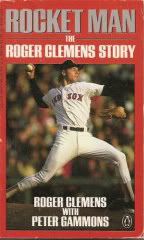
Rocket: That's Rocket Man, as the title of my autobiography clearly states. (hands a signed copy to Lizzy)

Lizzy: Sweet... So, are you ever going to retire, or what?

Rocket: Yeah, probably until June or so. Then we'll see what happens. For now, I'm thinking about starting up my own blog. I'm gonna call it "What's In Rocket's Pocket".

Sooze: Interesting.

Rocket: Go ahead, ask me what's in my pocket.

Sooze: No, that's okay.

Rocket: Really. Ask me. C'mon.

Lizzy: (sighs) What's in your pocket?

Rocket: (pulls hand out of pocket to flip the bird)

Sooze: Very nice.

Rocket: (falls over in a fit of laughter)

Lizzy: Hmm. Speaking of things that are hilarious, I understand your wife, Debbie, has made quite the name for herself with her Bedazzling website. Lots of butterflies, creepy music and plastic rhinestones for denim hats and jean jackets.

Rocket: Yeah, those things are AMAZING! I wanted her to bedazzle my glove, but she said my teammates would just make fun of me.

Sooze: Probably.

Rocket: She bedazzles my name onto the front of my underwear, instead. Bling, Bling.

Sooze: Thanks, Rocket. That's probably more than enough info. See you in New York this summer.

Rocket: Yep, see you there. I mean... we'll see where I end up. If I decide to pitch. Blah blah family blah blah priorities blah blah bedazzling.

[Roger Clemens Bio] | [debbieclemens.com]
The image “http://msnbcmedia4.msn.com/j/msnbc/Components/Photos/070307/070307_300movie_hmed_1p.hlarge.jpg” cannot be displayed, because it contains errors.
From National Review:
300 Shocker
Hollywood takes a detour to reality.

By David Kahane

Okay, this is weird.

Since about, oh, September 12, 2001, every writer, producer, director, and suit in this town has known one thing to be true: Don’t make fun of our so-called “enemies.”

Don’t stereotype them as bad guys. Don’t mock their beliefs. Don’t even mention their names. And for heaven’s sake, don’t make them mad.

Instead, try to understand them. Celebrate their diversity. And realize that, in a world (as the voice on the trailer intones) in which black is really white, up is really down, an attack is really self-defense and self-defense is really a provocation, we ourselves are actually the enemy.

This made things really easy. Out went any script that ascribed anything but the purest of motives to Arabs, Iranians, and Muslims. Back came everybody’s favorite villains: ex- and neo-Nazis (I haven’t met any, but I hear they’re everywhere) and crazed Christian fundamentalists, lurking out there in flyover country, itching to pull the triggers to establish a theocracy in a country we all know perfectly well was founded by unarmed vegetarian multicultural atheists.

Not even Jim Cameron could get a picture like 1994’s True Lies — in which the current governor of California slaughters hundreds of Arab terrorists single-handedly — made anymore, and he’s the King of the World. Instead, we got things like Kingdom of Heaven, in which the Christian ruler of Jerusalem becomes a hero by surrendering the Holy Land to the noble Saladin.

So now along comes a bunch of schmucks nobody’s ever heard of — graphic novelist Frank Miller, director Zack Snyder, and a couple of other writers — to pull in $70 million over the weekend with a movie about a handful of brave warriors who stand up against the limitless central-Asian hordes, iron men vs. effeminate oriental voluptuaries, and patriots against robotic slaves. How was this picture allowed to be made?

I’m talking, of course, about 300, a gory retelling of the Spartans’ defense at Thermopylae, which has got the whole town buzzing, and not just about its first-weekend grosses. Is it an ode to Riefensthalian fascist militarism? A thinly veiled attack on the Bush administration‘s insane war-mongering? Or is it something else?

Help me out here, because I’m having trouble wrapping my mind around a few things: When, early in the film, a sneering Persian emissary insults King Leonidas’s hot wife, threatens the kingdom, and rages about “blasphemy,” the king kicks him down a bottomless well. And yet nobody in Sparta asks, “Why do they hate us?” and seeks to find common ground with the Persians on their doorstep. Why not?

The Spartans mock the god-king Xerxes (whose traveling throne resembles a particularly louche Brazilian gay-pride carnival float), mow down his armored “immortal” holy warriors clad is nothing but red cloaks, loincloths, and sandals, and generally give their last full measure to defend Greek civilization against superstition and tyranny. Where are the liberal Spartan voices raised in protest against this blatant homophobia, xenophobia, and racism?

The only way this bunch of refugees from a Village People show can whup our heroes is by dangling some dubious hookers in front of a horny hunchback who makes Quasimodo look like Tom Cruise, and by bribing a corrupt legislator to tie up reinforcements with various legalistic maneuvers. When the queen finally kills the councilor, the others call him a “traitor.” Isn’t that both blaming the victim and questioning his patriotism?

You’d think 300 was a metaphor for something…

I heard the other day that one of the creators of this film is… yes, a closet conservative. And now he, whoever he is, is a rich closet conservative.

As screenwriter-god Bill Goldman says, it’s all about the next job. So that noise you hear this morning is the wind created by hundreds of writers from Playa del Rey to Santa Barbara, sticking their fingers in the air to see if the wind’s suddenly shifted, wondering if they can shelve their metrosexual Syriana and Babel knockoffs and conjure up some good old-fashioned “men of the West” material.

Because the dirty little secret is, we used to write these movies all the time. Impossible odds. Quixotic causes. Death before surrender. Real all-American stuff, in which our heroes stood up for God and country and defending Princess Leia and getting back home to see their wives and children, with their shields or on them.

And the dirtier little secret is: We loved writing them. Even a blacklisted commie like Carl Foreman came up with High Noon, in which a lone Gary Cooper defends a town full of ungrateful, carping yellowbellies and then throws away his badge in disgust at their cowardice. Sure, John Wayne hated it at the time, but today the Duke would be doing handstands to get his teeth into a part like that.

But then came psychiatrists and psychologists and Ritalin and global warming and racism and sexism and homophobia and the enlightened among us said the hell with John Wayne and Gary Cooper. Hollywood became one big Agatha Christie novel in the last chapter — you know, the one where the survivors of the homicidal maniac gather in the drawing room and realize: The killer must be one of us!

And then came September 11th and that was that. But now, I’m beginning to wonder.

Beginning to wonder if a $70-million opening weekend for a picture that was tracking at $40 million will get somebody’s attention. Beginning to wonder if a movie that has no stars, the look and feel of a video game, and the moral code of the U.S.M.C. might have something to say, even to audiences in New York and L.A.

But most of all, I’m beginning to wonder what it feels like to be the good guy.

— David Kahane is a nom de cyber for a writer in Hollywood. “David Kahane” is borrowed from a screenwriter character in The Player.

http://cagle.msnbc.com/news/BondsSteroids/images/lester.gif
Don't Make Bonds A Guilty Pleasure
By Thomas Boswell

Monday, March 12, 2007; E01

Barry Bonds wants to overshadow this entire baseball season and harm the sport he has grown to hate and wants to hurt.

Our task is not to let him. As he hunts Hank Aaron, those who care about the game should view his tainted chase clearly, both morally and historically, then gradually ignore him and ultimately marginalize him.

Bonds may have no shame, but that doesn't mean we should have no judgment.

If he hits No. 756 and few honor it as a record, then is it one? Let's find out.

Sensing this mood, Bud Selig now says he may merely phone Bonds long distance, rather than have a celebration of a new Home Run King. Perhaps the commissioner can reduce the sport's response to a brief handwritten note: "Congratulations*."

A year ago, there was hope that Bonds would simply fade away, worn down by age, injury and, perhaps, baseball's history of undeserved good luck. "I don't even want to play next year," Bonds said last year during spring training. "Baseball is a fun sport. But I'm not having fun. I've never cared about records anyway, so what difference does it make."

Now the tune has changed utterly. Disgusted with appearing weak and, in his mind, appeasing his enemies, Bonds has embraced the dark side. "I'm playing until I'm 100," he now says. "You guys get used to me."

On his Internet site, the man who doesn't care about records has a huge "Home Run Counter" with the big number set at "734." Everything else is in small type. Passing Aaron is everything to him now. No matter how long it takes. "I'll drag it out. I'll let you guys wait. You know me," Bonds said in spring training. "The anticipation, the hype -- I'll let you guys talk it up."

If it's humanly or perhaps chemically possible, he's going to make it.

On Friday, Bonds belted his first spring homer, then hit another Saturday.

"I thought I hit it straight up in the air," said Bonds. "I said, 'Darn it.' Then I saw the guys running back."

This is Bonds's sly way of telling us that, at 42, his power is back.

When he hits the ball "straight up," it still clears the fence. When he hits it squarely, cue the canoes. Proudly, Bonds points out that from last Aug. 21 to Sept. 23, he slugged .800, with 10 homers, 25 RBI, 19 walks and only 8 strikeouts in a 26-game span. Quietly, almost unnoticed, the old Bonds returned. Now, in Arizona, it looks like he's b-a-a-a-c-k, like a nightmare, needing just 22 homers to pass Aaron's pristine record.

Told no player at 42 had ever hit more than 18 homers, Bonds retorted, "I'm capable of more than that."

That's his promise and his threat. If Bonds has his way, baseball will have to swallow him all season. He's not hiding. Instead, he's beating the drum. Why not? He's had a change of heart. Last season, on his brief reality TV show ("Bonds on Bonds" on ESPN, the shame-lite network), Bonds's eyes filled with tears as he said: "If it makes them happy to go out of their way to try to destroy me, go right ahead. You can't hurt me any more than you've already hurt me."

Now, on his Web site, he says, "I'm happy, very happy." What about the weight of multiple steroid, tax and perjury probes, investigations and commissions? "It doesn't weigh on me at all, at all," Bonds repeated. "Let 'em investigate. They've been doing it this long." But doesn't he have concerns?

"None," he said defiantly.

If Bonds's current defiant stance seems to have more depth than his whiny demeanor last spring, then there's probably a simple reason. Bonds is echoing one of our oldest and most emotionally complex archetypes -- the fallen angel, the proud, ambitious transgressor who is hurled from heaven.

Who knew a left fielder could stumble into such classic material?

"Better to reign in hell than serve in heaven," Milton's Satan decided in "Paradise Lost." "To be weak is miserable. . . . My sentence is for open war, which, if not victory, is yet revenge."

Many have agreed with the poet William Blake that Milton drew such a sympathetic portrait of Satan that he was "of the Devil's party without knowing it." There may be a similarly perverse temptation in our antihero culture to shrug and give Bonds a free pass into baseball history. So many sluggers have used performance-enhancing drugs in the last 20 years that it's almost impossible for fans to remember which star confessed (Jose Canseco), who got caught (Rafael Palmeiro), who is merely suspected (Mark McGwire and Sammy Sosa) and who, like Bonds, has had an entire book written about his cheating ("Game of Shadows"), which is underpinned in part by leaked grand jury testimony.

When we get confused in complex cases, we tend to throw up our hands and err on the side of leniency. This is devilishly easy. But in Bonds's case, we should not fall into the trap -- because it isn't necessary. Let the courts decide whether Bonds broke any laws, including perjury before a grand jury and tax evasion. And let baseball decided, with the aide of its Mitchell commission or other investigations, whether there is enough evidence of steroid use to deny Bonds the homer record.

For baseball fans, the question is simpler. We aren't sending anybody to jail, taking away his salary, preventing him from playing or even deciding whether his records deserve an asterisk or a complete erasure. We just have to decide what we think. The court of public opinion has weight.

And in this decision process, one extremely important event took place recently.

Last month, Troy Ellerman, one of Victor Conte's lawyers in the BALCO case, pleaded guilty to leaking the grand jury information that was used by the San Francisco Chronicle reporters who also wrote "Game of Shadows." He faces two years in prison and a $250,000 fine. He had his own motives for leaking. Apparently, he thought it might cause a mistrial of his client.

What matters to fans, however, is that there is now no doubt that crucial reporting in the Chronicle and "Shadows" was, in fact, based on direct knowledge of grand jury testimony by and about Bonds. For me, this removes the last scintilla of reasonable doubt.

On Bonds's Web site, he's asked in a recent interview whether baseball should have a celebration this year of the 60th anniversary of Jackie Robinson integrating baseball. "I hope baseball celebrates it," Bonds said. "The important thing is that we, as a league, need to celebrate what's right."

Yes, indeed, we should "celebrate what's right." Just as we should ignore or refuse to celebrate what is not right.

Sympathy for the devil is more than a song title. Everybody deserves understanding as well as judgment. But when it comes to the homer record, there is a clear line in the dirt. Aaron earned it properly. Bonds didn't.

In this one instance, numbers on a page in a statistics book don't change a deeper truth. Hank Aaron is baseball's home run champion. Barry Bonds will never be.