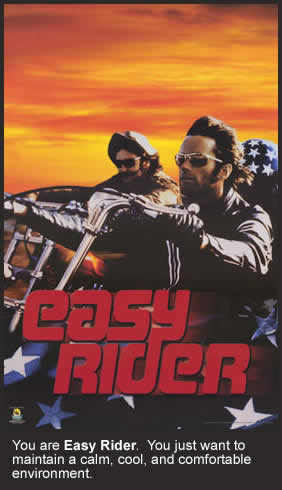
What Classic Movie am I?
Hmmmm.
Tuesday, December 30, 2003



A couple of good posts here taken from Blogs4God:
"Whenever I meet a Buddhist leader, I meet a holy man. Whenever I meet a Christian leader, I meet a manager."
This is Dan Kimball quoting Os Guinness who is quoting a Japanese businessman.
12 Steps for the Recovering Pharisee (Like Me)
1. We admit that our single most unmitigated pleasure is to judge other people.
2. Have come to believe that our means of obtaining greatness is to make everyone lower than ourselves in our own mind.
3. Realize that we detest mercy being given to those who, unlike us, haven't worked for it and don't deserve it.
4. Have decided that we don't want to get what we deserve after all, and we don't want anyone else to either.
5. Will cease all attempts to apply teaching and rebuke to anyone but ourselves.
6. Are ready to have God remove all these defects of attitude and character.
7. Embrace the belief that we are, and will always be, experts at sinning.
8. Are looking closely at the lives of famous men and women of the Bible who turned out to be ordinary sinners like us.
9. Are seeking through prayer and meditation to make a conscious effort to consider others better than ourselves.
10. Embrace the state of astonishment as a permanent and glorious reality.
11. Choose to rid ourselves of any attitude that is not bathed in gratitude.
12. Having had a spiritual awakening as the result of these steps, we will try to carry this message to others who think that Christians are better than everyone else.
"Whenever I meet a Buddhist leader, I meet a holy man. Whenever I meet a Christian leader, I meet a manager."
This is Dan Kimball quoting Os Guinness who is quoting a Japanese businessman.
12 Steps for the Recovering Pharisee (Like Me)
1. We admit that our single most unmitigated pleasure is to judge other people.
2. Have come to believe that our means of obtaining greatness is to make everyone lower than ourselves in our own mind.
3. Realize that we detest mercy being given to those who, unlike us, haven't worked for it and don't deserve it.
4. Have decided that we don't want to get what we deserve after all, and we don't want anyone else to either.
5. Will cease all attempts to apply teaching and rebuke to anyone but ourselves.
6. Are ready to have God remove all these defects of attitude and character.
7. Embrace the belief that we are, and will always be, experts at sinning.
8. Are looking closely at the lives of famous men and women of the Bible who turned out to be ordinary sinners like us.
9. Are seeking through prayer and meditation to make a conscious effort to consider others better than ourselves.
10. Embrace the state of astonishment as a permanent and glorious reality.
11. Choose to rid ourselves of any attitude that is not bathed in gratitude.
12. Having had a spiritual awakening as the result of these steps, we will try to carry this message to others who think that Christians are better than everyone else.
The Best Albums of 2003
There wasn't one album that towered over the rest for me the way The Rising did in 2002. Through CDRs of Springsteen's 2003 tour, his live music dominated my listening for the last year. Leaving the magic of audience recordings aside, these were the albums that gave me the most pleasure and/or nourishment for the year gone by.
1) Fleetwood Mac -Say You Will
2) Vince Gill -Next Big Thing
3) Drive By Truckers -Decoration Day
4) Brooks & Dunn -Red Dirt Road
5) Daryl Hall -Can't Stop Dreaming
6) Ronald Isley/Burt Bacharach -Here I Am
7) Michael McDonald -Motown
8) The Thorns
9) Various Artists -Gotta Serve Somebody:The Gospel Songs of Bob
Dylan
10) Warren Zevon -The Wind
Honorable Mention
In no particular order:
Various Artists -Light of Day:A Tribute to Bruce Springsteen
Steely Dan -Everything Must Go
The Jayhawks -Rainy Day Music
Joss Stone -The Soul Sessions
Jesse Malin -The Fine Art of Self Destruction
Pernice Brothers -Yours, Mine, & Ours
There wasn't one album that towered over the rest for me the way The Rising did in 2002. Through CDRs of Springsteen's 2003 tour, his live music dominated my listening for the last year. Leaving the magic of audience recordings aside, these were the albums that gave me the most pleasure and/or nourishment for the year gone by.
1) Fleetwood Mac -Say You Will
2) Vince Gill -Next Big Thing
3) Drive By Truckers -Decoration Day
4) Brooks & Dunn -Red Dirt Road
5) Daryl Hall -Can't Stop Dreaming
6) Ronald Isley/Burt Bacharach -Here I Am
7) Michael McDonald -Motown
8) The Thorns
9) Various Artists -Gotta Serve Somebody:The Gospel Songs of Bob
Dylan
10) Warren Zevon -The Wind
Honorable Mention
In no particular order:
Various Artists -Light of Day:A Tribute to Bruce Springsteen
Steely Dan -Everything Must Go
The Jayhawks -Rainy Day Music
Joss Stone -The Soul Sessions
Jesse Malin -The Fine Art of Self Destruction
Pernice Brothers -Yours, Mine, & Ours
Sunday, December 28, 2003
Another slightly contrariarian view of ROTK from a National Review guest columnist.
Give the Hobbit a Break
The Lifetime-ization of Tolkien.
By Gina R. Dalfonzo
EDITOR’S NOTE: This article contains spoilers about The Return of the King. Proceed at your own risk.
Poor Frodo Baggins. He just can’t catch a break.
It’s not bad enough that many literary critics and readers of J. R. R. Tolkien’s The Lord of the Rings are always elevating one supporting character or another to the position of hero, completely overlooking the gentle, unassuming hobbit at the heart of the story, the one who has to carry an evil, burdensome, corrupting ring to be destroyed. To add insult to injury, whenever a dramatic adaptation is made of The Lord of the Rings, the adapters can’t seem to resist the urge to tamper with the character.
It happened years ago with the BBC’s prestigious radio dramatization. Ian Holm — who, by the way, plays Bilbo Baggins in the current film adaptations — gave a strong performance as Frodo, at least at the beginning. But by the time they got to the halfway point, whether at the behest of the writer or the director, he was as snappish as if he’d somehow picked up a bad case of PMS along with the ring.
Now, much the same thing has happened again with Peter Jackson’s movie adaptations. Though I’ve enjoyed these three films, I have a bone to pick with the director and his team, a weakness that many other viewers have observed as well. Let me put it this way: Jackson never errs in the direction of making any character nobler. So while watching the second movie in the series, The Two Towers, I started to worry about what they were doing with Frodo, one of my favorite literary characters. I hadn’t a fault to find with Elijah Wood’s performance; he’s been consistently good throughout the films (and, it now turns out, extraordinarily good in the latest installment, The Return of the King. Wood communicates so effectively with his eyes in certain scenes that I’m inclined to think he made an extensive study of Jimmy Stewart’s famous wheelchair-bound performance in Rear Window). Again, it was the adapters who just couldn’t keep their hands off the character. Though the ring Frodo carries is notorious for driving people crazy, it seemed to me he was going crazy too early and too often.
So I wasn’t surprised when, in The Return of the King, Jackson and company added a scene that completely deviated from the book. Here Frodo’s mind is so addled by the ring that he believes the lies of Gollum, his monstrous, corrupt guide, about Sam, his faithful servant and friend, and sends Sam home. Jackson has said that his intent was to punch up the “psychological drama” of the story, a phrase ominously reminiscent of a Lifetime Channel movie. And the scene is dramatic, all right. But it not only weakens the portrayal of one of the strongest, most trusting friendships in literature; it also diminishes Frodo’s character. It’s no wonder that many viewers are thinking of Sam — who follows Frodo at a distance and (as in the book) eventually saves his life — as the real hero of the piece.
The need for psychological drama may also be the reason why Jackson repeatedly stresses the possibility that Frodo might become as possessed by the malevolent ring as Gollum is, whereas Tolkien only provided the occasional intriguing hint in that direction. The story goes that Jackson even shot a scene where Faramir, the young captain who helps Frodo (and whose own sterling character undergoes some shoddy treatment in The Two Towers), has a vision of Frodo turning into a Gollum-like creature. In the end, Jackson left the scene out for fear of confusing the audience, but it hints at another reason for the liberties he took with the story: It may be that he finds evil more fascinating than good.
If this is the case, he’s hardly alone. Our culture is sadly unused to fully realized portrayals of good characters. So was Tolkien’s, in fact; when he created his hobbit hero, literary anti-heroes were very much in vogue (which may help explain why his own books were so popular). As he put it, “Goodness is . . . bereft of its proper beauty.” Now we’ve gone so far down that road that, for the most part, we seem to have run out of the resources we need to portray a really heroic hero. We find our heroes much more palatable — or so the entertainment industry assumes, anyway — with a few major flaws thrown in, perhaps to make us more comfortable with our own.
So in the movies, though we still get a brave and good-hearted Frodo, we get less of a sense, for instance, of exactly why Sam is so devoted to his master and friend and why he looks up to him. Tolkien, on the other hand, had no trouble at all explaining it, in passages like this: “It had always been a notion of [Sam’s] that the kindness of dear Mr. Frodo was of such a high degree that it must imply a fair measure of blindness. Of course, he also firmly held the incompatible belief that Mr. Frodo was the wisest person in the world.”
Tolkien’s original Frodo, though he starts out a bit naïve, is a morally rich, exceptionally mature character. As he struggles against the ring’s control, he actually grows in wisdom and moral stature, reflecting what Tolkien called in a letter the theme of “the ennoblement (or sanctification) of the humble.” And though he is not always able to be as steadfast as Sam, the often overlooked truth is that Sam doesn’t have to fight the same battle Frodo does. Which is why I’ve always thought that honoring Sam over Frodo — honorable and faithful though Sam is — is a bit like honoring Simon of Cyrene over Christ.
The comparison isn’t such a wild exaggeration as it may appear. The truth is that Frodo has many of the characteristics of a Christ figure, chiefly a willingness to sacrifice himself, to forgive others, and to bear an awful burden for the sake of others. And that hardly means a lack of drama. When the ring takes control of Frodo one final, terrible time at the climax of the story, it is in such sharp contrast to what we’ve come to expect from him — especially without our having been subjected to the kind of foreshadowing so dear to Peter Jackson’s heart — that we fully grasp the horror of the situation. As Baylor University professor Ralph C. Wood puts it in his new book The Gospel According to Tolkien, “Tolkien demonstrates that the mightiest evil can summon forth the very highest good in a character like Frodo, even as it defeats him.” Moreover, as the scene plays out, we grasp three truths that are fully in line with Tolkien’s deeply Christian imagination: that moral strength can carry us farther than we could have imagined possible; that even the greatest human moral strength cannot stand against the strongest evil (a Christ figure is not Christ, as Tolkien would have been well aware); and that there is a Power in the world greater than we can understand, great enough to save us when we can’t save ourselves.
Tolkien emphasized qualities in his hero — an iron will, unfathomable courage, humility, selflessness, and wisdom — that help to make these points. Jackson and his writers, though they did include all these qualities in some degree, chose to deemphasize them for the sake of their modern conception of “psychological drama.” Their movies, moving and powerful as they undoubtedly are, are nevertheless the poorer for it.
— Gina R. Dalfonzo is a writer for BreakPoint and a graduate student in English at George Mason University.
Give the Hobbit a Break
The Lifetime-ization of Tolkien.
By Gina R. Dalfonzo
EDITOR’S NOTE: This article contains spoilers about The Return of the King. Proceed at your own risk.
Poor Frodo Baggins. He just can’t catch a break.
It’s not bad enough that many literary critics and readers of J. R. R. Tolkien’s The Lord of the Rings are always elevating one supporting character or another to the position of hero, completely overlooking the gentle, unassuming hobbit at the heart of the story, the one who has to carry an evil, burdensome, corrupting ring to be destroyed. To add insult to injury, whenever a dramatic adaptation is made of The Lord of the Rings, the adapters can’t seem to resist the urge to tamper with the character.
It happened years ago with the BBC’s prestigious radio dramatization. Ian Holm — who, by the way, plays Bilbo Baggins in the current film adaptations — gave a strong performance as Frodo, at least at the beginning. But by the time they got to the halfway point, whether at the behest of the writer or the director, he was as snappish as if he’d somehow picked up a bad case of PMS along with the ring.
Now, much the same thing has happened again with Peter Jackson’s movie adaptations. Though I’ve enjoyed these three films, I have a bone to pick with the director and his team, a weakness that many other viewers have observed as well. Let me put it this way: Jackson never errs in the direction of making any character nobler. So while watching the second movie in the series, The Two Towers, I started to worry about what they were doing with Frodo, one of my favorite literary characters. I hadn’t a fault to find with Elijah Wood’s performance; he’s been consistently good throughout the films (and, it now turns out, extraordinarily good in the latest installment, The Return of the King. Wood communicates so effectively with his eyes in certain scenes that I’m inclined to think he made an extensive study of Jimmy Stewart’s famous wheelchair-bound performance in Rear Window). Again, it was the adapters who just couldn’t keep their hands off the character. Though the ring Frodo carries is notorious for driving people crazy, it seemed to me he was going crazy too early and too often.
So I wasn’t surprised when, in The Return of the King, Jackson and company added a scene that completely deviated from the book. Here Frodo’s mind is so addled by the ring that he believes the lies of Gollum, his monstrous, corrupt guide, about Sam, his faithful servant and friend, and sends Sam home. Jackson has said that his intent was to punch up the “psychological drama” of the story, a phrase ominously reminiscent of a Lifetime Channel movie. And the scene is dramatic, all right. But it not only weakens the portrayal of one of the strongest, most trusting friendships in literature; it also diminishes Frodo’s character. It’s no wonder that many viewers are thinking of Sam — who follows Frodo at a distance and (as in the book) eventually saves his life — as the real hero of the piece.
The need for psychological drama may also be the reason why Jackson repeatedly stresses the possibility that Frodo might become as possessed by the malevolent ring as Gollum is, whereas Tolkien only provided the occasional intriguing hint in that direction. The story goes that Jackson even shot a scene where Faramir, the young captain who helps Frodo (and whose own sterling character undergoes some shoddy treatment in The Two Towers), has a vision of Frodo turning into a Gollum-like creature. In the end, Jackson left the scene out for fear of confusing the audience, but it hints at another reason for the liberties he took with the story: It may be that he finds evil more fascinating than good.
If this is the case, he’s hardly alone. Our culture is sadly unused to fully realized portrayals of good characters. So was Tolkien’s, in fact; when he created his hobbit hero, literary anti-heroes were very much in vogue (which may help explain why his own books were so popular). As he put it, “Goodness is . . . bereft of its proper beauty.” Now we’ve gone so far down that road that, for the most part, we seem to have run out of the resources we need to portray a really heroic hero. We find our heroes much more palatable — or so the entertainment industry assumes, anyway — with a few major flaws thrown in, perhaps to make us more comfortable with our own.
So in the movies, though we still get a brave and good-hearted Frodo, we get less of a sense, for instance, of exactly why Sam is so devoted to his master and friend and why he looks up to him. Tolkien, on the other hand, had no trouble at all explaining it, in passages like this: “It had always been a notion of [Sam’s] that the kindness of dear Mr. Frodo was of such a high degree that it must imply a fair measure of blindness. Of course, he also firmly held the incompatible belief that Mr. Frodo was the wisest person in the world.”
Tolkien’s original Frodo, though he starts out a bit naïve, is a morally rich, exceptionally mature character. As he struggles against the ring’s control, he actually grows in wisdom and moral stature, reflecting what Tolkien called in a letter the theme of “the ennoblement (or sanctification) of the humble.” And though he is not always able to be as steadfast as Sam, the often overlooked truth is that Sam doesn’t have to fight the same battle Frodo does. Which is why I’ve always thought that honoring Sam over Frodo — honorable and faithful though Sam is — is a bit like honoring Simon of Cyrene over Christ.
The comparison isn’t such a wild exaggeration as it may appear. The truth is that Frodo has many of the characteristics of a Christ figure, chiefly a willingness to sacrifice himself, to forgive others, and to bear an awful burden for the sake of others. And that hardly means a lack of drama. When the ring takes control of Frodo one final, terrible time at the climax of the story, it is in such sharp contrast to what we’ve come to expect from him — especially without our having been subjected to the kind of foreshadowing so dear to Peter Jackson’s heart — that we fully grasp the horror of the situation. As Baylor University professor Ralph C. Wood puts it in his new book The Gospel According to Tolkien, “Tolkien demonstrates that the mightiest evil can summon forth the very highest good in a character like Frodo, even as it defeats him.” Moreover, as the scene plays out, we grasp three truths that are fully in line with Tolkien’s deeply Christian imagination: that moral strength can carry us farther than we could have imagined possible; that even the greatest human moral strength cannot stand against the strongest evil (a Christ figure is not Christ, as Tolkien would have been well aware); and that there is a Power in the world greater than we can understand, great enough to save us when we can’t save ourselves.
Tolkien emphasized qualities in his hero — an iron will, unfathomable courage, humility, selflessness, and wisdom — that help to make these points. Jackson and his writers, though they did include all these qualities in some degree, chose to deemphasize them for the sake of their modern conception of “psychological drama.” Their movies, moving and powerful as they undoubtedly are, are nevertheless the poorer for it.
— Gina R. Dalfonzo is a writer for BreakPoint and a graduate student in English at George Mason University.
From the fine folks at The corner, the National Review blog:
ADVENTURES IN LIBERAL RELIGION [Rod Dreher]
The Rt. Rev. John Bryson Chane, the Episcopal Bishop of the nation's capital and Dean of National Cathedral, delivered a real lulu of a Christmas sermon this year. Excerpt:
And what was God thinking... when the Angel Gabriel was sent by God to reveal the Law to Moses? And what was God thinking... when the Angel Gabriel was sent by God to reveal the sacred Quran to the prophet Muhammad? And what was God thinking... when the Angel Gabriel was sent by God to reveal the birth of Jesus Christ, the Son of God?
It will come as news to many Christians that an Anglican bishop believes that the Islamic revelation was true, not false, as Christianity teaches implicitly. Nevertheless, a Michigan lawyer friend suggests that Bp. Chane has opened up a new and exciting area for exploring ecumenism/syncretism. Now, the Episcopalians of Washington can have a gay wedding in the church, and push a wall over on the two grooms at the reception.
ADVENTURES IN LIBERAL RELIGION [Rod Dreher]
The Rt. Rev. John Bryson Chane, the Episcopal Bishop of the nation's capital and Dean of National Cathedral, delivered a real lulu of a Christmas sermon this year. Excerpt:
And what was God thinking... when the Angel Gabriel was sent by God to reveal the Law to Moses? And what was God thinking... when the Angel Gabriel was sent by God to reveal the sacred Quran to the prophet Muhammad? And what was God thinking... when the Angel Gabriel was sent by God to reveal the birth of Jesus Christ, the Son of God?
It will come as news to many Christians that an Anglican bishop believes that the Islamic revelation was true, not false, as Christianity teaches implicitly. Nevertheless, a Michigan lawyer friend suggests that Bp. Chane has opened up a new and exciting area for exploring ecumenism/syncretism. Now, the Episcopalians of Washington can have a gay wedding in the church, and push a wall over on the two grooms at the reception.
An unexpectedly fine post on Christmas from Washington Post political columnist E.J. Dionne.
God, as We Hadn't Seen Him
By E. J. Dionne Jr.
Thursday, December 25, 2003
My 6-year-old rummages around in our Christmas boxes looking for the figures to place in the Nativity scene. "Where is Joseph?" she asks urgently. Joseph eventually turns up, and she happily places him where he belongs, near the baby Jesus.
But 6-year-olds are among our best theologians because they ask the difficult questions. We were driving together a few days later, and she wanted to know how Jesus could be the Son of God when His father was Joseph.
My daughter's curiosity is delightful -- and humbling. I am no theologian and know that my answers to her were thoroughly inadequate. So, therefore, are my answers to myself.
Christmas is like that, a season of joy and affirmation that can also prompt intense questioning about the nature of the event being celebrated. It is a matter that cannot be settled by going to the videotape.
The core claim of Christianity, that God sent His Son to redeem the world, is one of the most liberating concepts in human history. It revolutionized the idea of who God is -- a distant, all-powerful ruler transformed into a fellow pilgrim working in solidarity with His creation.
This, I think, explains why the Nativity scene has inspired creativity in art, music and poetry across all cultures in which Christianity has found a home. The immediate attraction of the moment is obvious enough -- the joy of new birth, the young couple forced to experience this joy in a stable surrounded by farm animals. "Why lies He in such mean estate?" asks the hymn.
But that points to the Nativity's larger appeal. It depicts a vulnerable God, a helpless child, the "little Lord Jesus asleep on the hay." The Christmas hymns are eloquent in explaining the historical moment. "Born to raise the sons of Earth," "God and sinners reconciled" -- this is about a universal quest for liberation from human frailty and failure.
Understanding Christmas in this way explains the power of Christianity in the face of all its difficulties. So many Christian testimonies speak of a God who chooses to identify with suffering human beings.
I recently ran across this passage from the great German theologian Jurgen Moltmann. It suggests that for all his formidable intellectual power, his attraction to Christianity was, finally, personal. "In 1945," he wrote, "I was imprisoned in a wretched prisoner of war camp in Belgium. The German Reich had collapsed. German civilization had been destroyed through Auschwitz. My hometown Hamburg lay in ruins; and in my own self things looked no different. I felt abandoned by God and human beings, and the hopes of my youth died. . . .
"In this situation, an American chaplain put a Bible into my hands and I began to read it. . . . I was drawn to the story of the passion, and when I came to Jesus' death cry, I knew: this is the one who understands you and is beside you when everyone else abandons you. 'My God, why have you forsaken me?' . . . I began to understand the suffering, assailed and God-forsaken Jesus because I felt he understood me. And I began to understand that this Jesus is the divine Brother in our distress."
Now the skeptic can ask whether this reaction says anything at all about Jesus and the divine. Is it instead a commentary on a human being seeking, well, tidings of comfort and joy in a very hard circumstance? In his masterpiece of nearly 40 years ago, "Belief and Unbelief," the Catholic writer Michael Novak asked how the believer "can assure himself that he is not talking about nothing at all, in a void peopled by his own imaginings." At another point, Novak asks: "How does one know that one's belief is truly in God, not merely in some habitual emotion or pattern of response?"
For many, of course, "habitual emotion" is another way of describing an experience of the divine that is no less authentic for being a habit.
As I said earlier, I am no theologian. I am, however, drawn to those theologians who themselves struggle with what we know and what we don't. "If God is God," wrote the Christian writer Jacques Ellul, "he obviously cannot be totally known or circumscribed or put into a human formula. There is always something more to know and understand and receive."
My hunch is that if God is God, the Christmas story offers an insight that is more than a human invention. The idea that the divine would choose to embrace His creation reflects a yearning, but also a realistic hope. It's why they call it good news.
God, as We Hadn't Seen Him
By E. J. Dionne Jr.
Thursday, December 25, 2003
My 6-year-old rummages around in our Christmas boxes looking for the figures to place in the Nativity scene. "Where is Joseph?" she asks urgently. Joseph eventually turns up, and she happily places him where he belongs, near the baby Jesus.
But 6-year-olds are among our best theologians because they ask the difficult questions. We were driving together a few days later, and she wanted to know how Jesus could be the Son of God when His father was Joseph.
My daughter's curiosity is delightful -- and humbling. I am no theologian and know that my answers to her were thoroughly inadequate. So, therefore, are my answers to myself.
Christmas is like that, a season of joy and affirmation that can also prompt intense questioning about the nature of the event being celebrated. It is a matter that cannot be settled by going to the videotape.
The core claim of Christianity, that God sent His Son to redeem the world, is one of the most liberating concepts in human history. It revolutionized the idea of who God is -- a distant, all-powerful ruler transformed into a fellow pilgrim working in solidarity with His creation.
This, I think, explains why the Nativity scene has inspired creativity in art, music and poetry across all cultures in which Christianity has found a home. The immediate attraction of the moment is obvious enough -- the joy of new birth, the young couple forced to experience this joy in a stable surrounded by farm animals. "Why lies He in such mean estate?" asks the hymn.
But that points to the Nativity's larger appeal. It depicts a vulnerable God, a helpless child, the "little Lord Jesus asleep on the hay." The Christmas hymns are eloquent in explaining the historical moment. "Born to raise the sons of Earth," "God and sinners reconciled" -- this is about a universal quest for liberation from human frailty and failure.
Understanding Christmas in this way explains the power of Christianity in the face of all its difficulties. So many Christian testimonies speak of a God who chooses to identify with suffering human beings.
I recently ran across this passage from the great German theologian Jurgen Moltmann. It suggests that for all his formidable intellectual power, his attraction to Christianity was, finally, personal. "In 1945," he wrote, "I was imprisoned in a wretched prisoner of war camp in Belgium. The German Reich had collapsed. German civilization had been destroyed through Auschwitz. My hometown Hamburg lay in ruins; and in my own self things looked no different. I felt abandoned by God and human beings, and the hopes of my youth died. . . .
"In this situation, an American chaplain put a Bible into my hands and I began to read it. . . . I was drawn to the story of the passion, and when I came to Jesus' death cry, I knew: this is the one who understands you and is beside you when everyone else abandons you. 'My God, why have you forsaken me?' . . . I began to understand the suffering, assailed and God-forsaken Jesus because I felt he understood me. And I began to understand that this Jesus is the divine Brother in our distress."
Now the skeptic can ask whether this reaction says anything at all about Jesus and the divine. Is it instead a commentary on a human being seeking, well, tidings of comfort and joy in a very hard circumstance? In his masterpiece of nearly 40 years ago, "Belief and Unbelief," the Catholic writer Michael Novak asked how the believer "can assure himself that he is not talking about nothing at all, in a void peopled by his own imaginings." At another point, Novak asks: "How does one know that one's belief is truly in God, not merely in some habitual emotion or pattern of response?"
For many, of course, "habitual emotion" is another way of describing an experience of the divine that is no less authentic for being a habit.
As I said earlier, I am no theologian. I am, however, drawn to those theologians who themselves struggle with what we know and what we don't. "If God is God," wrote the Christian writer Jacques Ellul, "he obviously cannot be totally known or circumscribed or put into a human formula. There is always something more to know and understand and receive."
My hunch is that if God is God, the Christmas story offers an insight that is more than a human invention. The idea that the divine would choose to embrace His creation reflects a yearning, but also a realistic hope. It's why they call it good news.
Saturday, December 27, 2003
Very good post here from Adam Yoshida's blog:
Dean for America
I was rewatching the Aaron Sorkin-penned The American President a few nights ago. Despite its liberal leanings, I must admit that I’ve always had a soft spot for it. In any case, I enjoy it more because it doesn’t actually show anything that happened after President Sheppard (played by Michael Douglas) makes his little speech at the end in which he, among other things, vows to, “go door to door,” and, “get the guns.” Frankly, I suspect that any President making a speech such as that (in the same speech he also advocates the burning of the American flag, calls on his likely opponent to join the ACLU, and calls for a 20% reduction in all Fossil Fuel emissions) would probably be either impeached or assassinated in short order. In any case, I like to imagine the likely pasting that President Sheppard would receive the following November from the ‘Evil Republican™’ Senator running against him.
The interesting thing about the ending of The American President (and, for that matter, those of other recent American political films) is the insight it provides into how liberals think. Consider it for a moment. What fictional political films have been produced in recent years? Rod Lurie’s The Contender, Chris Rock’s Head of State, and Warren Beatty’s Bulworth (there’s also Primary Colors, but I’m going to ignore that, as it was largely based on actual events). What is the theme of each of these films? To put it simply: the American people are all actually liberals, and the only thing preventing them from expressing their liberalism is the stubborn (and inexplicable) refusal of Democratic candidates to place themselves in the Michael Moore/Dennis Kucinich wing of the Democratic Party.
If Bill Clinton was the candidate of the actual people in Hollywood then Governor Dr. Howard Brush Dean III is the candidate of the images that Hollywood created. One thing that has gone almost totally unremarked upon (an internet search finds a reference by myself and exactly two other stories that even mention it) is that Dean’s campaign slogan, “Dean for America” is obviously cribbed from a 2001 episode of the Aaron Sorkin-penned The West Wing, in which we find out that the campaign slogan of the fictional President Jed Bartlet was “Bartlet for America” (in fact, it’s the title of the episode).
Now I realize that most people would dismiss this as insignificant. I disagree: it says a lot about who Howard Dean wants to be and how his followers see him. This is one of the reasons why the Dean campaign has proved so resilient to bad news: the Deaniacs are operating on the false premise that, if only Americans knew what liberals really believe, they would elect them by overwhelming majorities when, in fact, the truth is much closer to how Ann Coulter has put it in the past: if the American people knew the truth about what liberals believe, they’d probably boil them in oil.
The Deaniacs think that the only reason that other Presidential candidates haven’t gone into the South and told them to stop voting on, “race, God, guns, and gays,” is that they’re cowards when, in fact, the reason is that most Democratic candidates have common sense, something that Governor Dr. Howard Brush Dean III, for all of his fancy name, seems to lack.
Dean followers might claim that they’ll vote for “anyone but Bush” in the end, but I don’t really believe them. The Dean campaign has taken on the lustre of a crusade: they ain’t going to be stopping until either they win, or are smashed utterly.
What I think that the entire ‘Dean/Bartlet for America’ thing reveals best is this: the Dean campaign isn’t really about Howard Dean.
Dean is a vessel for their dreams. Dean is President Bartlet, or President Sheppard, or any of the other liberal Presidents that they’ve seen on screen. They hold a vision, shared by many of the less insightful people on the left, that America is a nation of basically liberal people who are continually tricked by ‘fundamentalist preachers’, the NRA and Evil™ Corporations. Because of this, they believe that all that is required is for someone to come along (like Chris Rock’s character in Head of State) and shout left-wing dogma at them from a national stage.
Frankly, I’m hoping that Dean gets the Democratic nomination, most of all because I’m looking forward to reading Democratic Underground that night. Given the way that they reacted over there after the 2002 Mid-Terms and the California Recall, I suspect that half of them will be posting their suicide notes and letting fly from their windows about ten minutes after the election is called for Bush.
posted by Adam at 9:45 PM
Dean for America
I was rewatching the Aaron Sorkin-penned The American President a few nights ago. Despite its liberal leanings, I must admit that I’ve always had a soft spot for it. In any case, I enjoy it more because it doesn’t actually show anything that happened after President Sheppard (played by Michael Douglas) makes his little speech at the end in which he, among other things, vows to, “go door to door,” and, “get the guns.” Frankly, I suspect that any President making a speech such as that (in the same speech he also advocates the burning of the American flag, calls on his likely opponent to join the ACLU, and calls for a 20% reduction in all Fossil Fuel emissions) would probably be either impeached or assassinated in short order. In any case, I like to imagine the likely pasting that President Sheppard would receive the following November from the ‘Evil Republican™’ Senator running against him.
The interesting thing about the ending of The American President (and, for that matter, those of other recent American political films) is the insight it provides into how liberals think. Consider it for a moment. What fictional political films have been produced in recent years? Rod Lurie’s The Contender, Chris Rock’s Head of State, and Warren Beatty’s Bulworth (there’s also Primary Colors, but I’m going to ignore that, as it was largely based on actual events). What is the theme of each of these films? To put it simply: the American people are all actually liberals, and the only thing preventing them from expressing their liberalism is the stubborn (and inexplicable) refusal of Democratic candidates to place themselves in the Michael Moore/Dennis Kucinich wing of the Democratic Party.
If Bill Clinton was the candidate of the actual people in Hollywood then Governor Dr. Howard Brush Dean III is the candidate of the images that Hollywood created. One thing that has gone almost totally unremarked upon (an internet search finds a reference by myself and exactly two other stories that even mention it) is that Dean’s campaign slogan, “Dean for America” is obviously cribbed from a 2001 episode of the Aaron Sorkin-penned The West Wing, in which we find out that the campaign slogan of the fictional President Jed Bartlet was “Bartlet for America” (in fact, it’s the title of the episode).
Now I realize that most people would dismiss this as insignificant. I disagree: it says a lot about who Howard Dean wants to be and how his followers see him. This is one of the reasons why the Dean campaign has proved so resilient to bad news: the Deaniacs are operating on the false premise that, if only Americans knew what liberals really believe, they would elect them by overwhelming majorities when, in fact, the truth is much closer to how Ann Coulter has put it in the past: if the American people knew the truth about what liberals believe, they’d probably boil them in oil.
The Deaniacs think that the only reason that other Presidential candidates haven’t gone into the South and told them to stop voting on, “race, God, guns, and gays,” is that they’re cowards when, in fact, the reason is that most Democratic candidates have common sense, something that Governor Dr. Howard Brush Dean III, for all of his fancy name, seems to lack.
Dean followers might claim that they’ll vote for “anyone but Bush” in the end, but I don’t really believe them. The Dean campaign has taken on the lustre of a crusade: they ain’t going to be stopping until either they win, or are smashed utterly.
What I think that the entire ‘Dean/Bartlet for America’ thing reveals best is this: the Dean campaign isn’t really about Howard Dean.
Dean is a vessel for their dreams. Dean is President Bartlet, or President Sheppard, or any of the other liberal Presidents that they’ve seen on screen. They hold a vision, shared by many of the less insightful people on the left, that America is a nation of basically liberal people who are continually tricked by ‘fundamentalist preachers’, the NRA and Evil™ Corporations. Because of this, they believe that all that is required is for someone to come along (like Chris Rock’s character in Head of State) and shout left-wing dogma at them from a national stage.
Frankly, I’m hoping that Dean gets the Democratic nomination, most of all because I’m looking forward to reading Democratic Underground that night. Given the way that they reacted over there after the 2002 Mid-Terms and the California Recall, I suspect that half of them will be posting their suicide notes and letting fly from their windows about ten minutes after the election is called for Bush.
posted by Adam at 9:45 PM
Thursday, December 25, 2003
A fine, if somewhat contrarian, review of the last installment of LOTR. The writer makes his points cogently, and well.
The Lure of the Obvious in Peter Jackson's The Return of the King
The film adaptations of a 1,200 page novel required making significant changes to the story. But at what cost?
By Ralph C. Wood
Because movie-adaptations of books become new works of art in their own right, they cannot be measured too strictly against their originals. Even so, we must ask whether a film retains the spirit if not the letter. The first two Peter Jackson film-renderings of The Lord of the Rings missed the moral and religious depths of Tolkien's epic fantasy, but still managed to capture the excitement of the plot and the grandeur of the scene. Yet the second movie began a trend that Jackson has unfortunately retained in the third—an obsession with outward violence. His version of The Return of the King converts the awful subtlety and complexity of evil into something so obvious as to be unserious.
This ethical and artistic failure becomes most evident in the third movie's depiction of Gollum, the wretched hobbit who, having possessed the Ruling Ring for five hundred years, has been virtually devoured by it. In The Two Towers Jackson revealed Gollum to be a conflicted soul even in his consuming greed. And here he powerfully depicts Gollum's original Cain-like murder in seizing the Ring. But Jackson soon removes our sympathy with the conflicted Gollum—and thus our complicity in his crimes—by turning him into a pathetically comic and merely devious figure. Jackson even allows Gollum to create a bizarre alienation between the utterly loyal servant Sam Gamgee and his heroic master Frodo Baggins. But instead of being emotionally wrought with concern that these two dearest of friends should suddenly be divided, I found myself sniggering at this outrageous violation of Tolkien's great book.
So is Denethor the steward of Gondor turned into a caricature of himself, a snarling and drooling oaf rather than a noble pessimist who has good cause for lamenting the loss of past glories that will never return. Tolkien clearly intends Denethor to be a man of our own time in his forlorn despair over the decline of his culture. Yet Jackson robs Denethor even of the logic of his death—his suicidal refusal to accept half-measures and partial triumphs. Instead, Gandalf's horse knocks Denethor onto the pyre he has built for his son Faramir! Set aflame by its fires, the maddened steward hurtles off a cliff. A scene that Tolkien intended to disclose the horror of hopelessness becomes yet another unintentionally comic display of flamboyant technical effects.
At the end of his arduous Quest, Frodo comes at last to cast the Ring back into the melting volcanic fires whence it was originally forged. Tolkien reveals that, even this most heroic of hobbits is finally overwhelmed by the coercive power evil. In his utmost act of resistance against the Dark Lord, Frodo is made into a virtual puppet of Sauron—defiantly refusing to destroy the Ring, thrusting it onto his own finger instead. After Gollum manages to seize the invisible Frodo and to bite the Ring from his hand, he then topples into the molten lava while dancing his jig of false joy. Thus does evil finally destroy itself, Tolkien teaches, while ruining much good in the process.
Rather than giving us this tragically defeated Frodo, Jackson transforms him into a thumping soap opera success. When Jackson's Frodo spies Gollum dancing victoriously with the Ring, he wrestles the wretched creature to the ground, until finally they tumble over the volcanic brink. But of course Frodo clings valiantly to a ledge as Gollum plummets into the river of fire. Nothing of Tolkien's profound sense of providence remains, nothing of his conviction that it was first Bilbo's and then Frodo's forgiveness of Gollum which enabled the final victory over evil. "But for [Gollum]," Frodo somberly confesses in the novel but not in the movie, "I could not have destroyed the Ring. The Quest would have been in vain, even at the bitter end. So let us forgive him!" The all-permeating presence of pity—the mercy that refuses eager condemnation—is the religious leit-motif of Tolkien's book. Yet it is totally absent from this final Lord of the Rings film.
Throughout the movie, Jackson portrays evil as ugly and monstrous, never as subtle and alluring. Tolkien's novel demonstrates, by contrast, that our virtues tempt us even more than our vices. This is the subtle attraction of evil, not the obvious blandishments of ordinary sins. Gandalf's pity, Galadriel's beauty, Boromir's bravery, Saruman's desire for order—these are the good things which, if linked with absolute coercive power, become utterly evil, as in Saruman's case. Yet here we neither see nor hear anything of Saruman, the once-exalted wizard who has utterly ruined himself by seeking alliance with Sauron.
Neither are we shown the terrible social and political price that evil exacts. In the absence of the Company during their year-long Quest, Tolkien reveals that the Shire has been invaded and inveigled by Saruman and his henchmen. They have turned it into a grim industrialized and bureaucratized state devoid of all joy and delight. "This is worse than Mordor!" Sam Gamgee confesses in an exceedingly dark declaration. Refusing such moral and spiritual realism, Jackson has the eight remaining Walkers return to a Shire just as pristine and idyllic as they had left it.
Jackson's The Return of the King does manage to convey the majesty and solemnity of Aragorn's crowning as the true King of Gondor, but then film immediately undercuts the dignity of the event by having Aragorn give his future queen, the elven-maiden Arwen, a prolonged Hollywood kiss. Yet the battle scenes are magnificent. The winged Nazgûl with their deafening shrieks are truly terrorizing, and the giant oliphaunts—with their deadly swaggering tusks and their huge wooden towers manned by dozens of archers—remain fearsome even in their fall. Jackson also succeeds in having Aragorn resuscitate the Sleeping Dead, who are then able to atone for their earlier betrayals by fighting valiantly against the forces of Sauron. Yet these digitally-realized triumphs are examples of what Aristotle called spectacle—an excitation of the visual senses that should enhance moral and religious insight, not obliterate it.
Yet Jackson is to be praised for the wrenching melancholy of the otherwise playful Pippin as he is made to sing a Shire song in strange and dreadful land. Jackson also catches the bitter-sweet quality of the novel's end, where Tolkien shows that true victories over evil are won not for the sake of the valiant but for the little people—the unheralded and the defenseless. So drastically have the hobbits been altered by their grueling Quest that Sam and Merry and Pippin will never be able to resume the care-free lives that they once lived. Jackson also captures the poignancy of Gandalf and Frodo's final parting for Valinor, the elven-realm where they will find peace and rest from their long labors.
The lesson to be learned from this seriously-flawed adaptation of The Return of the King is that the movies—like the Frank Peretti novels and the Left Behind books—often tempt us with their quick and obvious solutions to evils that require great subtlety to discern and even greater patience to remedy. The Lord of the Rings abjures such deadly allurements by its very length, some 1200 pages. The reading of it requires a disciplined act of devotion and discrimination. So do all of the other good things in life, although this movie, alas, does not.
The Lure of the Obvious in Peter Jackson's The Return of the King
The film adaptations of a 1,200 page novel required making significant changes to the story. But at what cost?
By Ralph C. Wood
Because movie-adaptations of books become new works of art in their own right, they cannot be measured too strictly against their originals. Even so, we must ask whether a film retains the spirit if not the letter. The first two Peter Jackson film-renderings of The Lord of the Rings missed the moral and religious depths of Tolkien's epic fantasy, but still managed to capture the excitement of the plot and the grandeur of the scene. Yet the second movie began a trend that Jackson has unfortunately retained in the third—an obsession with outward violence. His version of The Return of the King converts the awful subtlety and complexity of evil into something so obvious as to be unserious.
This ethical and artistic failure becomes most evident in the third movie's depiction of Gollum, the wretched hobbit who, having possessed the Ruling Ring for five hundred years, has been virtually devoured by it. In The Two Towers Jackson revealed Gollum to be a conflicted soul even in his consuming greed. And here he powerfully depicts Gollum's original Cain-like murder in seizing the Ring. But Jackson soon removes our sympathy with the conflicted Gollum—and thus our complicity in his crimes—by turning him into a pathetically comic and merely devious figure. Jackson even allows Gollum to create a bizarre alienation between the utterly loyal servant Sam Gamgee and his heroic master Frodo Baggins. But instead of being emotionally wrought with concern that these two dearest of friends should suddenly be divided, I found myself sniggering at this outrageous violation of Tolkien's great book.
So is Denethor the steward of Gondor turned into a caricature of himself, a snarling and drooling oaf rather than a noble pessimist who has good cause for lamenting the loss of past glories that will never return. Tolkien clearly intends Denethor to be a man of our own time in his forlorn despair over the decline of his culture. Yet Jackson robs Denethor even of the logic of his death—his suicidal refusal to accept half-measures and partial triumphs. Instead, Gandalf's horse knocks Denethor onto the pyre he has built for his son Faramir! Set aflame by its fires, the maddened steward hurtles off a cliff. A scene that Tolkien intended to disclose the horror of hopelessness becomes yet another unintentionally comic display of flamboyant technical effects.
At the end of his arduous Quest, Frodo comes at last to cast the Ring back into the melting volcanic fires whence it was originally forged. Tolkien reveals that, even this most heroic of hobbits is finally overwhelmed by the coercive power evil. In his utmost act of resistance against the Dark Lord, Frodo is made into a virtual puppet of Sauron—defiantly refusing to destroy the Ring, thrusting it onto his own finger instead. After Gollum manages to seize the invisible Frodo and to bite the Ring from his hand, he then topples into the molten lava while dancing his jig of false joy. Thus does evil finally destroy itself, Tolkien teaches, while ruining much good in the process.
Rather than giving us this tragically defeated Frodo, Jackson transforms him into a thumping soap opera success. When Jackson's Frodo spies Gollum dancing victoriously with the Ring, he wrestles the wretched creature to the ground, until finally they tumble over the volcanic brink. But of course Frodo clings valiantly to a ledge as Gollum plummets into the river of fire. Nothing of Tolkien's profound sense of providence remains, nothing of his conviction that it was first Bilbo's and then Frodo's forgiveness of Gollum which enabled the final victory over evil. "But for [Gollum]," Frodo somberly confesses in the novel but not in the movie, "I could not have destroyed the Ring. The Quest would have been in vain, even at the bitter end. So let us forgive him!" The all-permeating presence of pity—the mercy that refuses eager condemnation—is the religious leit-motif of Tolkien's book. Yet it is totally absent from this final Lord of the Rings film.
Throughout the movie, Jackson portrays evil as ugly and monstrous, never as subtle and alluring. Tolkien's novel demonstrates, by contrast, that our virtues tempt us even more than our vices. This is the subtle attraction of evil, not the obvious blandishments of ordinary sins. Gandalf's pity, Galadriel's beauty, Boromir's bravery, Saruman's desire for order—these are the good things which, if linked with absolute coercive power, become utterly evil, as in Saruman's case. Yet here we neither see nor hear anything of Saruman, the once-exalted wizard who has utterly ruined himself by seeking alliance with Sauron.
Neither are we shown the terrible social and political price that evil exacts. In the absence of the Company during their year-long Quest, Tolkien reveals that the Shire has been invaded and inveigled by Saruman and his henchmen. They have turned it into a grim industrialized and bureaucratized state devoid of all joy and delight. "This is worse than Mordor!" Sam Gamgee confesses in an exceedingly dark declaration. Refusing such moral and spiritual realism, Jackson has the eight remaining Walkers return to a Shire just as pristine and idyllic as they had left it.
Jackson's The Return of the King does manage to convey the majesty and solemnity of Aragorn's crowning as the true King of Gondor, but then film immediately undercuts the dignity of the event by having Aragorn give his future queen, the elven-maiden Arwen, a prolonged Hollywood kiss. Yet the battle scenes are magnificent. The winged Nazgûl with their deafening shrieks are truly terrorizing, and the giant oliphaunts—with their deadly swaggering tusks and their huge wooden towers manned by dozens of archers—remain fearsome even in their fall. Jackson also succeeds in having Aragorn resuscitate the Sleeping Dead, who are then able to atone for their earlier betrayals by fighting valiantly against the forces of Sauron. Yet these digitally-realized triumphs are examples of what Aristotle called spectacle—an excitation of the visual senses that should enhance moral and religious insight, not obliterate it.
Yet Jackson is to be praised for the wrenching melancholy of the otherwise playful Pippin as he is made to sing a Shire song in strange and dreadful land. Jackson also catches the bitter-sweet quality of the novel's end, where Tolkien shows that true victories over evil are won not for the sake of the valiant but for the little people—the unheralded and the defenseless. So drastically have the hobbits been altered by their grueling Quest that Sam and Merry and Pippin will never be able to resume the care-free lives that they once lived. Jackson also captures the poignancy of Gandalf and Frodo's final parting for Valinor, the elven-realm where they will find peace and rest from their long labors.
The lesson to be learned from this seriously-flawed adaptation of The Return of the King is that the movies—like the Frank Peretti novels and the Left Behind books—often tempt us with their quick and obvious solutions to evils that require great subtlety to discern and even greater patience to remedy. The Lord of the Rings abjures such deadly allurements by its very length, some 1200 pages. The reading of it requires a disciplined act of devotion and discrimination. So do all of the other good things in life, although this movie, alas, does not.
Wednesday, December 24, 2003
This is a pretty cool story about a person who becomes more impressive as the years go by.
Letterman Visits U.S. Soldiers in Baghdad
JASON KEYSER
Associated Press
BAGHDAD, Iraq - With shouts of "Dave, Dave!" U.S. soldiers greeted the American late night TV show host David Letterman as he visited troops in central Baghdad on Christmas Eve.
Letterman, the host of CBS' "Late Show," chatted with wounded and sick soldiers in the military's main combat hospital and met soldiers at one of Saddam Hussein's ransacked palaces that now serves as part of the U.S.-led coalition's headquarters.
Soldiers said the visit was an important boost over the holiday spent far from home.
Arriving at the hospital, Letterman emerged from a car wearing dark sunglasses, smoking a cigarette, holding a cup of coffee and casually taking a phone call.
Snapping a picture, 1st Lt. Michael Gerstmyer, 24, from Baltimore, Maryland, said he was surprised at how relaxed the TV star appeared in a battle zone.
"He acts like he's been here for years," Gerstmyer said.
Last Christmas, Letterman visited troops in Afghanistan.
Letterman - who brought along his comedy sidekick Biff Henderson and the show's musician, Paul Schaffer - toured the hospital and stopped at the bed of Pfc. Jacob Dominique, 20, of Archbold, Ohio. "We took his appendix," a nurse said.
Letterman's reply - "I saw it downstairs in the gift shop" - won a roomful of laughs.
In a routine that Letterman is famous for on the show, he read out a "top 10" list written especially for the soldiers: the top 10 signs you've been in Iraq too long.
"No. 9: you've heard a crazy rumor that Arnold Schwarzenegger is the governor of California," Letterman said.
Number two was, "Camel: it tastes like chicken."
Number one was aimed at the soldiers running the hospital: "And the No. 1 sign you've been in Iraq too long: Dave's heard about our outstanding health care and came to us for his hemorrhoids," Letterman said to loud applause.
Letterman Visits U.S. Soldiers in Baghdad
JASON KEYSER
Associated Press
BAGHDAD, Iraq - With shouts of "Dave, Dave!" U.S. soldiers greeted the American late night TV show host David Letterman as he visited troops in central Baghdad on Christmas Eve.
Letterman, the host of CBS' "Late Show," chatted with wounded and sick soldiers in the military's main combat hospital and met soldiers at one of Saddam Hussein's ransacked palaces that now serves as part of the U.S.-led coalition's headquarters.
Soldiers said the visit was an important boost over the holiday spent far from home.
Arriving at the hospital, Letterman emerged from a car wearing dark sunglasses, smoking a cigarette, holding a cup of coffee and casually taking a phone call.
Snapping a picture, 1st Lt. Michael Gerstmyer, 24, from Baltimore, Maryland, said he was surprised at how relaxed the TV star appeared in a battle zone.
"He acts like he's been here for years," Gerstmyer said.
Last Christmas, Letterman visited troops in Afghanistan.
Letterman - who brought along his comedy sidekick Biff Henderson and the show's musician, Paul Schaffer - toured the hospital and stopped at the bed of Pfc. Jacob Dominique, 20, of Archbold, Ohio. "We took his appendix," a nurse said.
Letterman's reply - "I saw it downstairs in the gift shop" - won a roomful of laughs.
In a routine that Letterman is famous for on the show, he read out a "top 10" list written especially for the soldiers: the top 10 signs you've been in Iraq too long.
"No. 9: you've heard a crazy rumor that Arnold Schwarzenegger is the governor of California," Letterman said.
Number two was, "Camel: it tastes like chicken."
Number one was aimed at the soldiers running the hospital: "And the No. 1 sign you've been in Iraq too long: Dave's heard about our outstanding health care and came to us for his hemorrhoids," Letterman said to loud applause.
Saturday, December 20, 2003
January 19, 2004 issue
Copyright © 2003 The American Conservative
How the Left Stole Christmas
Merry Birth of Guru Gobind Singh Day!
By Tom Piatak
“I am sure I have always thought of Christmas time, when it has come round—apart from the veneration due to its sacred name and origin, if anything can be apart from that—as a good time: a kind, forgiving, charitable, pleasant time: the only time I know of, in the long calendar of the year, when men and women seem by one consent to open their shut up hearts freely, and to think of people below them as if they really were fellow passengers to the grave, and not another race of creatures bound on other journeys.�
These words of Scrooge’s nephew describe Christmas in the America of my youth. Christmas was a special and wonderful time of year, marked by kindness and good cheer, with its myriad celebrations all viewed as ultimately stemming from the birth of the One who, in Dickens’ words, “made lame beggars walk and blind men see.�
Today’s consensus is different. In last year’s made-for-cable movie “Christmas Rush,� one character wishes another “Merry Christmas,� only to be told, “Gee, that is politically incorrect.� And so it is. In one generation—I was born in 1964—Christmas has gone from being a widespread and joyous public celebration to the holiday that dare not speak its name. We now have “holiday trees,� “holiday cards,� “holiday parties,� “holiday songs,� and even, in one particularly egregious advertisement, a “child’s first holiday.� Simply put, there is now raging a “War Against Christmas,� in author Peter Brimelow’s trenchant phrase.
A hallmark of this war is an aggressive multiculturalism that has elevated a variety of formerly obscure or even non-existent festivals into faux-Christmases, principally Hanukkah, Kwanzaa, and now Ramadan, but also Diwali, Bodhi Day, the Birth of Guru Gobind Singh, Dongji, and Chinese New Year. The reason for the elevation of these holidays is their proximity to Christmas, not their cultural significance or intrinsic worth. Indeed, Kwanzaa was invented in 1966, Hanukkah is traditionally a minor holiday (with no basis in the canonical Hebrew Bible), and Ramadan was virtually unknown in America until a few short years ago. Despite their recent provenance—at least as pseudo-Christmases—these holidays are now treated as coequals of Christmas, with public figures sure to pepper any of the increasingly rare mentions of Christmas with references to at least some of these others.
The desire to efface Christmas that lies behind the elevation of Hanukkah, Kwanzaa, and all the rest is illustrated by recent developments in the New York City public schools. The Thomas More Law Center is now suing the school system, which bans Nativity scenes but regularly display menorahs and Muslim crescents. Nor are the schools trying to rectify this now that their hostility to Christianity has been put in the spotlight. Instead, they are vigorously defending the ban, claiming that the “suggestion that a crèche is a historically accurate representation of an event with secular significance is wholly disingenuous.� The birth of the most important figure in history carries no weight in New York City, nor does the fact that the birth was first depicted in a crèche by another seminal historical figure, an itinerant friar from Assisi named Francis. It does not take a belief in the divinity of Christ or the sanctity of Francis to recognize their tremendous impact on the history and culture of the West. Apparently, though, the multiculturalists are eager to promote every culture but our own.
That the war against Christmas is part of a broader war against Western culture is shown by last year’s winner of VDARE.com’s invaluable War Against Christmas competition. The Columbus, Ohio, schools banned a performance of Handel’s Messiah, which for the previous nine years had been the highlight of the year at a specialized school for the arts. The performance would have violated the district’s religious-music policy, which came into being as the result of an ACLU lawsuit. According to the Columbus Dispatch, the policy stipulated that the proportion of religious music performed in concert be no more than 30 percent and that the performance of religious music be “based on sound curricular reasons� and not “manifest a preference for religion or particular religious beliefs.� The educational bureaucrats who devised the policy, trying to be helpful, suggested the students perform “Frosty the Snowman� or “Jingle Bells� instead of Handel. Their ignorance and philistinism is appalling, though characteristic of those waging the War Against Christmas. After hearing Messiah performed in London, Haydn was moved to exclaim, “Handel is the master of us all!� and to write his own great oratorio, The Creation. But, in today’s climate of “sensitivity� and “tolerance,� beauty and artistic merit are scarcely a sufficient warrant for exposing delicate ears to the name of Christ.
The transformation of Christmas to “holiday� and the attendant impoverishment of our culture was brought about to accommodate not the small minority of Americans who do not celebrate Christmas but the far smaller minority—comprising those of all faiths and of none—who resent the overwhelming majority who do celebrate Christmas. In my experience, most non-Christians do not resent Christmas and generally enjoy some aspects of its celebration. This sentiment was well expressed by Philadelphia Inquirer editor Jane Eisner’s thoughtful and generous essay of December 2002, in which she explained why, as a Jew, she was bothered by the suppression of Christmas and “[t]he conflation of Christmas, Hanukkah, and now Kwanzaa … into one big, fat indistinguishable holiday.�
But the transformation of Christmas into “holiday� would not have occurred without a dedicated, active minority who resented and despised it. An upcoming film on the art-house circuit, called “The Hebrew Hammer,� a spoof of blaxploitation films, features the film’s eponymous hero and his sidekick, the head of the Kwanzaa Liberation Front, battling the film’s villains, the sons of Santa Claus and Tiny Tim. Among the villains’ acts of treachery: distributing videos of “It’s A Wonderful Life,� one of the greatest of all American movies and the favorite picture of both Frank Capra and Jimmy Stewart. Judging from the film’s Web site, it appears that “The Hebrew Hammer� at least has the potential to be funny. But the reasons for its making are not. As the film’s director, Jonathan Kesselman, told the LA Jewish Journal, “I asked myself, ‘What as a Jew really pisses me off?’ It hit me when I was walking around a mall in December: I hate Christmastime.�
This Christmas, though, you won’t have to go to an art house to see a film inspired by disdain for Christmas. Disney is observing the holiday by releasing (through its Miramax subsidiary) another alleged comedy, “Bad Santa.� This movie’s Santa figure is shown being a drunk and having sex, is heard by other characters having anal sex, and repeatedly swears in front of children. According to the Chicago Tribune’s John Kass, Disney is promoting this charming film with advertisements on TV featuring “a veiled reference to oral sex and an unmistakable reference to feminine hygiene� at times—such as during Sunday afternoon football games—when it would be reasonable to expect children to watch them. As Kass archly observes, “About the only thing that Santa is forbidden to do these days is mention the real reason that gifts are given in late December.�
The whole point of “Bad Santa� is to mock and demean Christmas. The film’s boosters say as much. George Thomas, of the Akron Beacon Journal, wrote in early November, “The trailer shows this as an anti-holiday film and it could be the much needed antidote to that good-will-to-man feeling that permeates the season.� It goes without saying that the great Walt Disney would never have made such a film, but neither would any of the other major studios in Hollywood’s golden age. They were busy instead making such delightful films as “It’s a Wonderful Life,� “The Bells of St. Mary’s� (the film playing in Bedford Falls as George Bailey runs down its snowy streets on Christmas Eve), “The Bishop’s Wife,� and “Miracle on 34th Street.� The journey from “Miracle on 34th Street� to “Bad Santa� is downhill all the way.
Kesselman has the same right to “hate Christmastime� as the rest of us do to love it, but it makes no sense to transform our culture and jettison beloved and popular traditions to appease such hatred. The malcontents and misfits who have litigated and complained to prevent such horrors as children learning how to sing “Silent Night� should not be allowed to set our course. What is needed, instead, is true tolerance, a recognition that the point of celebrating a holiday is just that—celebration—and the intent of those doing the celebrating is not to demean those who don’t. As Jane Eisner wrote, “Somehow we have to learn to coexist without calling in lawyers and initiating merger talks. We have to recognize the strength and distinctiveness of each celebration, and not force equality by pretending ‘I Had a Little Dreidel’ is on par with the heavenly melodies of Christmas carols.�
I first began thinking about this while driving to my parents’ in Michigan several years ago to celebrate Christmas. Even though I was driving on Dec. 23, I could not find Christmas music on any American radio station. Then I came across CBC 2, which was carrying nothing but Christmas music and whose announcers were regularly wishing their listeners a Merry Christmas. Their programming featured both familiar Christmas music and some gems in the seemingly inexhaustible treasury of beautiful Christmas music I had not heard before: Anne Sofie von Otter singing lovely Swedish carols, Charpentier’s beautiful Mass for Midnight, with its generous borrowing from French carols, and Praetorius’s stunning Mass for Christmas Morning. The sheer beauty of the music brought home what we are in danger of losing. And that the proudly tolerant Canadians were playing such music led me to wonder why we are, instead, sanitizing our culture of any reference to Christmas.
Rather than strip the altars, we used to try to add to all the beauty surrounding Christmas, the work done earlier by Giotto, Bach, Dickens, Charpentier, Praetorius, and the village priest and organist who collaborated to give us “Silent Night.� Although not quite on this level, Hollywood’s classic Christmas films have stood the test of time and are still being watched and enjoyed nearly 60 years after they were made. More recently, carols such as “The Little Drummer Boy� and cartoons such as “A Charlie Brown Christmas� have enchanted us, and they still do, nearly 40 years later. We no longer make such contributions, as the focus of the Christmas season is no longer the positive one of celebrating a shared tradition but the negative one of pretending that tradition does not exist, so as not to offend those who do not share it.
The result of sanitizing Christmas is now within sight: an undistinguished, uninspiring public celebration, devoid of religious or cultural significance or indeed of beauty, with nothing left but multiculturalist pap and tawdry commercialism. I do not believe that grim fate is inevitable. But that future will indeed be ours if we remain so unnerved by the thought of giving offense to those looking for a reason to be offended that we are afraid to celebrate our own culture, tradition, and religion.
____________________________________
Tom Piatak writes from Cleveland, Ohio.
January 19, 2004 issue
Copyright © 2003 The American Conservative
Copyright © 2003 The American Conservative
How the Left Stole Christmas
Merry Birth of Guru Gobind Singh Day!
By Tom Piatak
“I am sure I have always thought of Christmas time, when it has come round—apart from the veneration due to its sacred name and origin, if anything can be apart from that—as a good time: a kind, forgiving, charitable, pleasant time: the only time I know of, in the long calendar of the year, when men and women seem by one consent to open their shut up hearts freely, and to think of people below them as if they really were fellow passengers to the grave, and not another race of creatures bound on other journeys.�
These words of Scrooge’s nephew describe Christmas in the America of my youth. Christmas was a special and wonderful time of year, marked by kindness and good cheer, with its myriad celebrations all viewed as ultimately stemming from the birth of the One who, in Dickens’ words, “made lame beggars walk and blind men see.�
Today’s consensus is different. In last year’s made-for-cable movie “Christmas Rush,� one character wishes another “Merry Christmas,� only to be told, “Gee, that is politically incorrect.� And so it is. In one generation—I was born in 1964—Christmas has gone from being a widespread and joyous public celebration to the holiday that dare not speak its name. We now have “holiday trees,� “holiday cards,� “holiday parties,� “holiday songs,� and even, in one particularly egregious advertisement, a “child’s first holiday.� Simply put, there is now raging a “War Against Christmas,� in author Peter Brimelow’s trenchant phrase.
A hallmark of this war is an aggressive multiculturalism that has elevated a variety of formerly obscure or even non-existent festivals into faux-Christmases, principally Hanukkah, Kwanzaa, and now Ramadan, but also Diwali, Bodhi Day, the Birth of Guru Gobind Singh, Dongji, and Chinese New Year. The reason for the elevation of these holidays is their proximity to Christmas, not their cultural significance or intrinsic worth. Indeed, Kwanzaa was invented in 1966, Hanukkah is traditionally a minor holiday (with no basis in the canonical Hebrew Bible), and Ramadan was virtually unknown in America until a few short years ago. Despite their recent provenance—at least as pseudo-Christmases—these holidays are now treated as coequals of Christmas, with public figures sure to pepper any of the increasingly rare mentions of Christmas with references to at least some of these others.
The desire to efface Christmas that lies behind the elevation of Hanukkah, Kwanzaa, and all the rest is illustrated by recent developments in the New York City public schools. The Thomas More Law Center is now suing the school system, which bans Nativity scenes but regularly display menorahs and Muslim crescents. Nor are the schools trying to rectify this now that their hostility to Christianity has been put in the spotlight. Instead, they are vigorously defending the ban, claiming that the “suggestion that a crèche is a historically accurate representation of an event with secular significance is wholly disingenuous.� The birth of the most important figure in history carries no weight in New York City, nor does the fact that the birth was first depicted in a crèche by another seminal historical figure, an itinerant friar from Assisi named Francis. It does not take a belief in the divinity of Christ or the sanctity of Francis to recognize their tremendous impact on the history and culture of the West. Apparently, though, the multiculturalists are eager to promote every culture but our own.
That the war against Christmas is part of a broader war against Western culture is shown by last year’s winner of VDARE.com’s invaluable War Against Christmas competition. The Columbus, Ohio, schools banned a performance of Handel’s Messiah, which for the previous nine years had been the highlight of the year at a specialized school for the arts. The performance would have violated the district’s religious-music policy, which came into being as the result of an ACLU lawsuit. According to the Columbus Dispatch, the policy stipulated that the proportion of religious music performed in concert be no more than 30 percent and that the performance of religious music be “based on sound curricular reasons� and not “manifest a preference for religion or particular religious beliefs.� The educational bureaucrats who devised the policy, trying to be helpful, suggested the students perform “Frosty the Snowman� or “Jingle Bells� instead of Handel. Their ignorance and philistinism is appalling, though characteristic of those waging the War Against Christmas. After hearing Messiah performed in London, Haydn was moved to exclaim, “Handel is the master of us all!� and to write his own great oratorio, The Creation. But, in today’s climate of “sensitivity� and “tolerance,� beauty and artistic merit are scarcely a sufficient warrant for exposing delicate ears to the name of Christ.
The transformation of Christmas to “holiday� and the attendant impoverishment of our culture was brought about to accommodate not the small minority of Americans who do not celebrate Christmas but the far smaller minority—comprising those of all faiths and of none—who resent the overwhelming majority who do celebrate Christmas. In my experience, most non-Christians do not resent Christmas and generally enjoy some aspects of its celebration. This sentiment was well expressed by Philadelphia Inquirer editor Jane Eisner’s thoughtful and generous essay of December 2002, in which she explained why, as a Jew, she was bothered by the suppression of Christmas and “[t]he conflation of Christmas, Hanukkah, and now Kwanzaa … into one big, fat indistinguishable holiday.�
But the transformation of Christmas into “holiday� would not have occurred without a dedicated, active minority who resented and despised it. An upcoming film on the art-house circuit, called “The Hebrew Hammer,� a spoof of blaxploitation films, features the film’s eponymous hero and his sidekick, the head of the Kwanzaa Liberation Front, battling the film’s villains, the sons of Santa Claus and Tiny Tim. Among the villains’ acts of treachery: distributing videos of “It’s A Wonderful Life,� one of the greatest of all American movies and the favorite picture of both Frank Capra and Jimmy Stewart. Judging from the film’s Web site, it appears that “The Hebrew Hammer� at least has the potential to be funny. But the reasons for its making are not. As the film’s director, Jonathan Kesselman, told the LA Jewish Journal, “I asked myself, ‘What as a Jew really pisses me off?’ It hit me when I was walking around a mall in December: I hate Christmastime.�
This Christmas, though, you won’t have to go to an art house to see a film inspired by disdain for Christmas. Disney is observing the holiday by releasing (through its Miramax subsidiary) another alleged comedy, “Bad Santa.� This movie’s Santa figure is shown being a drunk and having sex, is heard by other characters having anal sex, and repeatedly swears in front of children. According to the Chicago Tribune’s John Kass, Disney is promoting this charming film with advertisements on TV featuring “a veiled reference to oral sex and an unmistakable reference to feminine hygiene� at times—such as during Sunday afternoon football games—when it would be reasonable to expect children to watch them. As Kass archly observes, “About the only thing that Santa is forbidden to do these days is mention the real reason that gifts are given in late December.�
The whole point of “Bad Santa� is to mock and demean Christmas. The film’s boosters say as much. George Thomas, of the Akron Beacon Journal, wrote in early November, “The trailer shows this as an anti-holiday film and it could be the much needed antidote to that good-will-to-man feeling that permeates the season.� It goes without saying that the great Walt Disney would never have made such a film, but neither would any of the other major studios in Hollywood’s golden age. They were busy instead making such delightful films as “It’s a Wonderful Life,� “The Bells of St. Mary’s� (the film playing in Bedford Falls as George Bailey runs down its snowy streets on Christmas Eve), “The Bishop’s Wife,� and “Miracle on 34th Street.� The journey from “Miracle on 34th Street� to “Bad Santa� is downhill all the way.
Kesselman has the same right to “hate Christmastime� as the rest of us do to love it, but it makes no sense to transform our culture and jettison beloved and popular traditions to appease such hatred. The malcontents and misfits who have litigated and complained to prevent such horrors as children learning how to sing “Silent Night� should not be allowed to set our course. What is needed, instead, is true tolerance, a recognition that the point of celebrating a holiday is just that—celebration—and the intent of those doing the celebrating is not to demean those who don’t. As Jane Eisner wrote, “Somehow we have to learn to coexist without calling in lawyers and initiating merger talks. We have to recognize the strength and distinctiveness of each celebration, and not force equality by pretending ‘I Had a Little Dreidel’ is on par with the heavenly melodies of Christmas carols.�
I first began thinking about this while driving to my parents’ in Michigan several years ago to celebrate Christmas. Even though I was driving on Dec. 23, I could not find Christmas music on any American radio station. Then I came across CBC 2, which was carrying nothing but Christmas music and whose announcers were regularly wishing their listeners a Merry Christmas. Their programming featured both familiar Christmas music and some gems in the seemingly inexhaustible treasury of beautiful Christmas music I had not heard before: Anne Sofie von Otter singing lovely Swedish carols, Charpentier’s beautiful Mass for Midnight, with its generous borrowing from French carols, and Praetorius’s stunning Mass for Christmas Morning. The sheer beauty of the music brought home what we are in danger of losing. And that the proudly tolerant Canadians were playing such music led me to wonder why we are, instead, sanitizing our culture of any reference to Christmas.
Rather than strip the altars, we used to try to add to all the beauty surrounding Christmas, the work done earlier by Giotto, Bach, Dickens, Charpentier, Praetorius, and the village priest and organist who collaborated to give us “Silent Night.� Although not quite on this level, Hollywood’s classic Christmas films have stood the test of time and are still being watched and enjoyed nearly 60 years after they were made. More recently, carols such as “The Little Drummer Boy� and cartoons such as “A Charlie Brown Christmas� have enchanted us, and they still do, nearly 40 years later. We no longer make such contributions, as the focus of the Christmas season is no longer the positive one of celebrating a shared tradition but the negative one of pretending that tradition does not exist, so as not to offend those who do not share it.
The result of sanitizing Christmas is now within sight: an undistinguished, uninspiring public celebration, devoid of religious or cultural significance or indeed of beauty, with nothing left but multiculturalist pap and tawdry commercialism. I do not believe that grim fate is inevitable. But that future will indeed be ours if we remain so unnerved by the thought of giving offense to those looking for a reason to be offended that we are afraid to celebrate our own culture, tradition, and religion.
____________________________________
Tom Piatak writes from Cleveland, Ohio.
January 19, 2004 issue
Copyright © 2003 The American Conservative
Thursday, December 18, 2003
From the Toronto Star:
Middle Earth is God's country
Lord Of The Rings `cultus' often ignores Tolkien's devout Catholic faith
KATHY SHAIDLE
SPECIAL TO THE STAR
We know what J.R.R. Tolkien thought of his most over-the-top admirers: head-bangers and hippies with their FRODO LIVES buttons; Italian neo-Fascists huddled at "Camp Hobbit;" proto-Trekkies in velvet capes.
The Lord Of The Rings author famously dismissed this disparate lot as "my deplorable cultus."
But what do his millions of fans, eccentric or not, know about the guiding force in Tolkien's own life: the Catholic faith that informed everything he wrote?
True: the hobbits of Tolkien's Middle Earth don't mention Jesus or Mary, heaven or hell. Even director Peter Jackson, who's brought the trilogy to the big screen, is convinced the books are "a celebration of pagan virtues:" tribalism, revenge and blind loyalty — The Sopranos with elves.
Yet the author himself was unequivocal: "The Lord Of The Rings is of course a fundamentally religious and Catholic work."
A religious outsider in Protestant England, "Tolkien was a deeply devout and highly conservative Catholic," says medievalist Sandra Meisel, a Lord Of The Rings fan since the book's U.S. release in 1965. In fact, "he worried that he might have done something unorthodox" — even blasphemous — "in the making of his fictional universe."
After his mother's death, young Tolkien was raised by his legal guardian — a Catholic priest whom he assisted at morning masses before school. But Tolkien was no ordinary altar boy. He was learning Latin, French and German by the age of 7. Before long, he was inventing imaginary languages, and stories to go with them.
Not surprisingly, the grown-up Tolkien became a philologist at Oxford University, teaching the history of language and literature, and cultivating his interest for Anglo-Saxon and Norse mythology.
Tolkien also went to Mass nearly every day (sometimes at dawn), to confession almost as often, and was instrumental in the conversion of atheist and fellow Oxford don C.S. Lewis. The pair decided to try spreading the Gospel through fantasy fiction, but their approaches differed.
Lewis finished first, writing a Christian allegory for children, The Chronicles Of Narnia. His Aslan the Lion is such an obvious stand-in for Jesus that one critic called the stories, "Sunday school in drag."
Tolkien disliked such heavy-handed symbolism, too. He yearned to create art, not propaganda. In an influential essay, Tolkien theorized about fantasy's paradoxical power; because the best "fairy stories" transport us into a vivid "other" world, Tolkien wrote, they help us see our own world — God's world — more clearly. Such fables cast absolute Good and Evil, Right and Wrong, into high relief. And so Tolkien created Middle Earth, "that we might see Christianity reflected in it more clearly, if indirectly."
His theories and his passions — mythology, linguistics and religion — came together when The Lord Of The Rings was published in 1954. The first two elements are evident on every page, but as Tolkien commented, "The religious element is absorbed into the story and the symbolism."
Recent books like Ralph Wood's The Gospel According To Tolkien and Bradley Birzer's J.R.R. Tolkien's Sanctifying Myth are trying to snatch The Lord Of The Rings from the clutches of New Age fandom and clueless back-to-the-land white supremacists (one anti-Jewish, anti-Christian Web site bemoans the choice of a "kike actor" to play Frodo on film).
These authors point to the Hobbits' beloved Shire as a model of Catholic social teaching: a wholesome place characterized by generosity, plentiful children — and a healthy appreciation for earthy creature comforts.
They also detect echoes of communion wafers in the lembas, the mystical waybread that sustains the Hobbits on their journey. The Elf "star queen" Elbereth is clearly a Virgin Mary figure, whom Frodo and Sam evoke in the trilogy's only outright prayer.
Most tellingly: The Fellowship embarks on its mission on Dec. 25 (Christmas). It ends exactly three months later, on March 25 (the date of the Fall of Man, the Annunciation, and the Crucifixion in the old English calendar).
Tolkien biographer Joseph Pearce sees distinctly Christian themes in The Lord Of The Rings: "self-sacrifice, the exaltation of the humble, the power of humility versus the destructive and self-negating futility of pride."
But Tolkien sometimes found himself at odds with members of Mother Church.
Toronto broadcaster and author Michael Coren (J.R.R. Tolkien: The Man Who Created The Lord Of The Rings) says that in the 1960s, the author "expressed displeasure at Vatican II" and its sweeping reforms of Catholic life and liturgy. Tolkien, who'd had his hero Aragorn declare that "good and ill have not changed since yesteryear" felt that "suddenly the Truth had changed. And he found it vulgar."
Much earlier, in the 1930s, says Coren, "there was a flirtation with the far right, with fascism, among some English Catholic writers and intellectuals" like Evelyn Waugh. "They thought it was all quite witty."
Tolkien was disgusted. In 1938, he denounced the Nazis' "wholly pernicious and unscientific race-doctrine." That same year, a German publisher asked for permission to publish Tolkien's first book, The Hobbit — and wondered, in passing, if Tolkien "had Aryan blood."
It was altogether the wrong question. Tolkien's classic reply dripped with uncharacteristic sarcasm:
"I regret that I am not clear as to what you intend by `arisch.' I am not of Aryan extraction: that is Indo-Iranian; as far as I am aware none of my ancestors spoke Hindustani, Persian, Gypsy, or any related dialects. But if I am to understand that you are enquiring whether I am of Jewish origin, I can only reply that I regret that I appear to have no ancestors of that gifted people."
Speaking of fascists: mention of fellow biographer Joseph Pearce elicits a laugh from Michael Coren. The two British-born writers first crossed paths, after a fashion, many years ago. In his former life, Pearce was a youth leader in the notorious ultra-right-wing National Front. Coren often saw Pearce at anti-racist demonstrations in London — they were on opposite sides. "We used to throw bottles at him," Coren recalls.
Pearce later served prison time for inciting racial hatred at such demonstrations. His jailhouse conversion to Christianity was inspired in part, he now says, by reading The Lord Of The Rings.
It's tempting to think that Tolkien, that unlikely evangelist, would have traded all the Elvish-speaking Gandalf impersonators on Earth for a few more readers like Joseph Pearce.
------------------------------------------------------------------------
Kathy Shaidle surveys religion and popular culture at the weblog RelapsedCatholic.com
Middle Earth is God's country
Lord Of The Rings `cultus' often ignores Tolkien's devout Catholic faith
KATHY SHAIDLE
SPECIAL TO THE STAR
We know what J.R.R. Tolkien thought of his most over-the-top admirers: head-bangers and hippies with their FRODO LIVES buttons; Italian neo-Fascists huddled at "Camp Hobbit;" proto-Trekkies in velvet capes.
The Lord Of The Rings author famously dismissed this disparate lot as "my deplorable cultus."
But what do his millions of fans, eccentric or not, know about the guiding force in Tolkien's own life: the Catholic faith that informed everything he wrote?
True: the hobbits of Tolkien's Middle Earth don't mention Jesus or Mary, heaven or hell. Even director Peter Jackson, who's brought the trilogy to the big screen, is convinced the books are "a celebration of pagan virtues:" tribalism, revenge and blind loyalty — The Sopranos with elves.
Yet the author himself was unequivocal: "The Lord Of The Rings is of course a fundamentally religious and Catholic work."
A religious outsider in Protestant England, "Tolkien was a deeply devout and highly conservative Catholic," says medievalist Sandra Meisel, a Lord Of The Rings fan since the book's U.S. release in 1965. In fact, "he worried that he might have done something unorthodox" — even blasphemous — "in the making of his fictional universe."
After his mother's death, young Tolkien was raised by his legal guardian — a Catholic priest whom he assisted at morning masses before school. But Tolkien was no ordinary altar boy. He was learning Latin, French and German by the age of 7. Before long, he was inventing imaginary languages, and stories to go with them.
Not surprisingly, the grown-up Tolkien became a philologist at Oxford University, teaching the history of language and literature, and cultivating his interest for Anglo-Saxon and Norse mythology.
Tolkien also went to Mass nearly every day (sometimes at dawn), to confession almost as often, and was instrumental in the conversion of atheist and fellow Oxford don C.S. Lewis. The pair decided to try spreading the Gospel through fantasy fiction, but their approaches differed.
Lewis finished first, writing a Christian allegory for children, The Chronicles Of Narnia. His Aslan the Lion is such an obvious stand-in for Jesus that one critic called the stories, "Sunday school in drag."
Tolkien disliked such heavy-handed symbolism, too. He yearned to create art, not propaganda. In an influential essay, Tolkien theorized about fantasy's paradoxical power; because the best "fairy stories" transport us into a vivid "other" world, Tolkien wrote, they help us see our own world — God's world — more clearly. Such fables cast absolute Good and Evil, Right and Wrong, into high relief. And so Tolkien created Middle Earth, "that we might see Christianity reflected in it more clearly, if indirectly."
His theories and his passions — mythology, linguistics and religion — came together when The Lord Of The Rings was published in 1954. The first two elements are evident on every page, but as Tolkien commented, "The religious element is absorbed into the story and the symbolism."
Recent books like Ralph Wood's The Gospel According To Tolkien and Bradley Birzer's J.R.R. Tolkien's Sanctifying Myth are trying to snatch The Lord Of The Rings from the clutches of New Age fandom and clueless back-to-the-land white supremacists (one anti-Jewish, anti-Christian Web site bemoans the choice of a "kike actor" to play Frodo on film).
These authors point to the Hobbits' beloved Shire as a model of Catholic social teaching: a wholesome place characterized by generosity, plentiful children — and a healthy appreciation for earthy creature comforts.
They also detect echoes of communion wafers in the lembas, the mystical waybread that sustains the Hobbits on their journey. The Elf "star queen" Elbereth is clearly a Virgin Mary figure, whom Frodo and Sam evoke in the trilogy's only outright prayer.
Most tellingly: The Fellowship embarks on its mission on Dec. 25 (Christmas). It ends exactly three months later, on March 25 (the date of the Fall of Man, the Annunciation, and the Crucifixion in the old English calendar).
Tolkien biographer Joseph Pearce sees distinctly Christian themes in The Lord Of The Rings: "self-sacrifice, the exaltation of the humble, the power of humility versus the destructive and self-negating futility of pride."
But Tolkien sometimes found himself at odds with members of Mother Church.
Toronto broadcaster and author Michael Coren (J.R.R. Tolkien: The Man Who Created The Lord Of The Rings) says that in the 1960s, the author "expressed displeasure at Vatican II" and its sweeping reforms of Catholic life and liturgy. Tolkien, who'd had his hero Aragorn declare that "good and ill have not changed since yesteryear" felt that "suddenly the Truth had changed. And he found it vulgar."
Much earlier, in the 1930s, says Coren, "there was a flirtation with the far right, with fascism, among some English Catholic writers and intellectuals" like Evelyn Waugh. "They thought it was all quite witty."
Tolkien was disgusted. In 1938, he denounced the Nazis' "wholly pernicious and unscientific race-doctrine." That same year, a German publisher asked for permission to publish Tolkien's first book, The Hobbit — and wondered, in passing, if Tolkien "had Aryan blood."
It was altogether the wrong question. Tolkien's classic reply dripped with uncharacteristic sarcasm:
"I regret that I am not clear as to what you intend by `arisch.' I am not of Aryan extraction: that is Indo-Iranian; as far as I am aware none of my ancestors spoke Hindustani, Persian, Gypsy, or any related dialects. But if I am to understand that you are enquiring whether I am of Jewish origin, I can only reply that I regret that I appear to have no ancestors of that gifted people."
Speaking of fascists: mention of fellow biographer Joseph Pearce elicits a laugh from Michael Coren. The two British-born writers first crossed paths, after a fashion, many years ago. In his former life, Pearce was a youth leader in the notorious ultra-right-wing National Front. Coren often saw Pearce at anti-racist demonstrations in London — they were on opposite sides. "We used to throw bottles at him," Coren recalls.
Pearce later served prison time for inciting racial hatred at such demonstrations. His jailhouse conversion to Christianity was inspired in part, he now says, by reading The Lord Of The Rings.
It's tempting to think that Tolkien, that unlikely evangelist, would have traded all the Elvish-speaking Gandalf impersonators on Earth for a few more readers like Joseph Pearce.
------------------------------------------------------------------------
Kathy Shaidle surveys religion and popular culture at the weblog RelapsedCatholic.com
Don't know how I missed posting this yesterday. Brilliant, simply brilliant.
The Bike-Path Left:
Saddam? Osama? Whatever, dude!
BY MARK STEYN
Wednesday, December 17, 2003 12:01 a.m.
Like Susan Lucci at the Emmys, Howard Dean is getting better at putting a brave face on things. When Saddam Hussein fell from power, the Vermonter said churlishly, "I suppose that's a good thing." When Uday and Qusay bit the dust, the governor announced that "the ends do not justify the means." But on Sunday, Dr. Dean was doing his best to be fulsome, if you can be fulsome with clenched teeth. Nonetheless, he congratulated "our extraordinary military on an extraordinary victory and an extraordinary success." They gave Miss Lucci the Emmy eventually, and maybe by Labor Day next year, when the good doctor is thanking Don Rumsfeld for the souvenir vial of Osama's DNA he FedExed over, the voters will be feeling sorry enough to give Howard the prize, too. But this weekend that pileup of "extraordinaries" made the governor seem, well, ordinary.
It's odd that when something big happens, as on Sunday, the Democratic candidates seem irrelevant to the story, like asking a lacrosse expert what he thinks of the Super Bowl. They get interviewed and they trot out their lame clichés, about the need to "internationalize" Iraq, by which they mean not Tony Blair, John Howard, the Poles and Italians, but Kofi Annan, The Hague, the French, the Guinean foreign minister, all the folks who proved unwilling and unable to deal with Iraq before the liberation and who have given no indication of being likely to do any better after. The Democrats' indestructible retreat to this dreary line gives them the air of a gormless twit in a drawing-room comedy coming in through the French windows every 10 minutes and saying, "Anyone for tennis?" You can't help feeling that, on the big questions roiling around America's national security, the Dems don't really have speaking parts: if this was Broadway, they'd have been written out in New Haven.
There was a revealing moment on MSNBC the other night. Chris Matthews asked Dr. Dean whether Osama bin Laden should be tried in an American court or at The Hague. "I don't think it makes a lot of difference," said the governor airily. Mr. Matthews pressed once more. "It doesn't make a lot of difference to me," he said again. Some of us think what's left of Osama is already hard enough to scrape off the cave floor and put in a matchbox, never mind fly to the Netherlands. But, just for the sake of argument, his bloodiest crime was committed on American soil; American courts, unlike the international ones, would have the option of the death penalty. But Gov. Dean couldn't have been less interested. So how about Saddam? The Hague "suits me fine," he said, the very model of ennui. Saddam? Osama? Whatever, dude.
So what does get the Dean juices going? A few days later, the governor was on CNN and Judy Woodruff asked him about his admission that he'd left the Episcopal Church and become a Congregationalist because "I had a big fight with a local Episcopal church over the bike path." I hasten to add that, in contrast to current Anglican controversies over gay marriage in British Columbia and gay bishops in New Hampshire, this does not appear to have been a gay bike path: its orientation was not an issue; it would seem to be a rare example of a non-gay controversy in the Anglican Communion. But nevertheless it provoked Howard into "a big fight." "I was fighting to have public access to the waterfront, and we were fighting very hard in the citizens group," he told Judy Woodruff. Fighting, fighting, fighting.
And that's our pugnacious little Democrat. On Osama bin Laden, he's Mister Insouciant. But he gets mad about bike paths. Destroy the World Trade Center and he's languid and laconic and blasé. Obstruct plans to convert the ravaged site into a memorial bike path and he'll hunt you down wherever you are.
Howard Dean catapulted himself from Vermont obscurity to national fame very ingeniously. His campaign was tonally brilliant. He was an angry peacenik, an aggressive defeatist, he got in-your-face about getting out of Iraq. The problem with pacifism as a political position is that it's too easy to seem wimpy, wussy, nancy-boyish, pantywaisty, milksopping, etc. In that sense, his fellow Democrat, Dennis Kucinich, has a pacifist mien: I'm not saying he's a pantywaist or milksop, but he comes over as a goofy nebbish, as the Zionist neocons would say. The main impact he's made on the Granite State electorate seems to be his lack of a girlfriend, which has prompted a New Hampshire Web site to try and find a date for him. Somehow one is not surprised to hear this. By contrast, when Howard Dean, shortish and stocky, comes out in his rolled-up shirtsleeves, he looks like Bruce Banner just before he turns into the Incredible Hulk, as if his head's about to explode out of his shirt collar. Republicans are from Mars, Democrats are from Venus, but Dr. Dean is Venusian in a very Martian way. He's full of anger.
But only for peripheral issues. Ask him serious questions about the president's key responsibilities--national security and foreign policy--and the passion drains away as it did with Chris Matthews. David Brooks, visiting Burlington in 1997 in search of what eventually became his thesis "Bobos in Paradise," concluded that the quintessential latté burg was "relatively apolitical." He's a smart guy but he was wrong. All the stuff he took as evidence of the lack of politics--pedestrianization, independent bookstores--is the politics. Because all the big ideas failed, culminating in 1989 in Eastern Europe with the comprehensive failure of the biggest idea of all, the left retreated to all the small ideas: in a phrase, bike paths. That's what Bill Clinton meant when he said the era of big government was over; instead, he'd be ushering in the era of lots and lots of itsy bits of small government that, when you tote 'em up, works out even more expensive than the era of big government. That's what Howard Dean represents--the passion of the Bike-Path Left.
Vermonters marked the end of the Dean era by electing a Republican governor and a Republican House. Even Vermont isn't as liberal as liberals assume. What's liberal is the idea of Vermont as it's understood across America: a bucolic playground of quaint dairy farms punctuated by the occasional boutique business that's managed to wiggle through the Dean approval process. A lot of those dairy barns are empty and belong to weekending flatlanders, the rest are adorned with angry "Take Back Vermont" signs, and the quintessential Green Mountain boutique business, Ben and Jerry's, wound up selling out to the European multinational Unilever. But these dreary details are irrelevant. To Democratic primary voters across the land, Vermont is a shining, rigorously zoned, mandatory-recycling city on a hill. And the only way up the hill is by the bike path.
Unlike Howlin' Howard and the Burlington Episcopalians, I'm agnostic on the merits of bike paths. But earlier this year, when the antiwar types held "Bridges to Peace" demonstrations on the spans across the Connecticut River between New Hampshire and Vermont, I couldn't help noticing they were very much a bike-path crowd. It was February and 20 below, so they didn't have their bikes with them, but they did have snowshoes and cross-country skis, for the activities that would occupy the rest of their weekends once they'd got a little light demonstrating out of the way. But, under their snowsuits, they were, metaphorically, wearing cycling shorts. They loved the '90s because you never heard a thing about macho stuff like war: it was all micro-politics, new regulations for this, new entitlements for that--education, environment, "social justice." For hard-core Democrats, the whole war thing is an unwelcome intrusion on what large numbers of people had assumed to be a permanent post-Martian politics. When you're at a Dean get-together, you realize they're not angry about the war, so much as having to talk about the war.
A little over an hour north of that Burlington bike path is Montreal, the visits to which (for kids' hockey fixtures and his appearances on a Canadian TV show) Dr. Dean cites, seriously, as his main foreign-policy experience. Montreal is home to North America's largest Iraqi émigré community and on Sunday night the streets were full of honking horns celebrating Saddam's downfall. You don't have to go far to see the world beyond the good doctor's bike-path parochialism, but it's farther than most Dems are willing to go.
Last weekend was confirmation, if you needed it, that this is not a time for micro-politics. Many independents and a critical sliver of Democrats understand that, and, in a time of war, they're not prepared to stick with the bike-path left. When you put the pedal to the full metal jacket, it's no contest.
Mr. Steyn is a columnist for London's Daily Telegraph and Spectator.
The Bike-Path Left:
Saddam? Osama? Whatever, dude!
BY MARK STEYN
Wednesday, December 17, 2003 12:01 a.m.
Like Susan Lucci at the Emmys, Howard Dean is getting better at putting a brave face on things. When Saddam Hussein fell from power, the Vermonter said churlishly, "I suppose that's a good thing." When Uday and Qusay bit the dust, the governor announced that "the ends do not justify the means." But on Sunday, Dr. Dean was doing his best to be fulsome, if you can be fulsome with clenched teeth. Nonetheless, he congratulated "our extraordinary military on an extraordinary victory and an extraordinary success." They gave Miss Lucci the Emmy eventually, and maybe by Labor Day next year, when the good doctor is thanking Don Rumsfeld for the souvenir vial of Osama's DNA he FedExed over, the voters will be feeling sorry enough to give Howard the prize, too. But this weekend that pileup of "extraordinaries" made the governor seem, well, ordinary.
It's odd that when something big happens, as on Sunday, the Democratic candidates seem irrelevant to the story, like asking a lacrosse expert what he thinks of the Super Bowl. They get interviewed and they trot out their lame clichés, about the need to "internationalize" Iraq, by which they mean not Tony Blair, John Howard, the Poles and Italians, but Kofi Annan, The Hague, the French, the Guinean foreign minister, all the folks who proved unwilling and unable to deal with Iraq before the liberation and who have given no indication of being likely to do any better after. The Democrats' indestructible retreat to this dreary line gives them the air of a gormless twit in a drawing-room comedy coming in through the French windows every 10 minutes and saying, "Anyone for tennis?" You can't help feeling that, on the big questions roiling around America's national security, the Dems don't really have speaking parts: if this was Broadway, they'd have been written out in New Haven.
There was a revealing moment on MSNBC the other night. Chris Matthews asked Dr. Dean whether Osama bin Laden should be tried in an American court or at The Hague. "I don't think it makes a lot of difference," said the governor airily. Mr. Matthews pressed once more. "It doesn't make a lot of difference to me," he said again. Some of us think what's left of Osama is already hard enough to scrape off the cave floor and put in a matchbox, never mind fly to the Netherlands. But, just for the sake of argument, his bloodiest crime was committed on American soil; American courts, unlike the international ones, would have the option of the death penalty. But Gov. Dean couldn't have been less interested. So how about Saddam? The Hague "suits me fine," he said, the very model of ennui. Saddam? Osama? Whatever, dude.
So what does get the Dean juices going? A few days later, the governor was on CNN and Judy Woodruff asked him about his admission that he'd left the Episcopal Church and become a Congregationalist because "I had a big fight with a local Episcopal church over the bike path." I hasten to add that, in contrast to current Anglican controversies over gay marriage in British Columbia and gay bishops in New Hampshire, this does not appear to have been a gay bike path: its orientation was not an issue; it would seem to be a rare example of a non-gay controversy in the Anglican Communion. But nevertheless it provoked Howard into "a big fight." "I was fighting to have public access to the waterfront, and we were fighting very hard in the citizens group," he told Judy Woodruff. Fighting, fighting, fighting.
And that's our pugnacious little Democrat. On Osama bin Laden, he's Mister Insouciant. But he gets mad about bike paths. Destroy the World Trade Center and he's languid and laconic and blasé. Obstruct plans to convert the ravaged site into a memorial bike path and he'll hunt you down wherever you are.
Howard Dean catapulted himself from Vermont obscurity to national fame very ingeniously. His campaign was tonally brilliant. He was an angry peacenik, an aggressive defeatist, he got in-your-face about getting out of Iraq. The problem with pacifism as a political position is that it's too easy to seem wimpy, wussy, nancy-boyish, pantywaisty, milksopping, etc. In that sense, his fellow Democrat, Dennis Kucinich, has a pacifist mien: I'm not saying he's a pantywaist or milksop, but he comes over as a goofy nebbish, as the Zionist neocons would say. The main impact he's made on the Granite State electorate seems to be his lack of a girlfriend, which has prompted a New Hampshire Web site to try and find a date for him. Somehow one is not surprised to hear this. By contrast, when Howard Dean, shortish and stocky, comes out in his rolled-up shirtsleeves, he looks like Bruce Banner just before he turns into the Incredible Hulk, as if his head's about to explode out of his shirt collar. Republicans are from Mars, Democrats are from Venus, but Dr. Dean is Venusian in a very Martian way. He's full of anger.
But only for peripheral issues. Ask him serious questions about the president's key responsibilities--national security and foreign policy--and the passion drains away as it did with Chris Matthews. David Brooks, visiting Burlington in 1997 in search of what eventually became his thesis "Bobos in Paradise," concluded that the quintessential latté burg was "relatively apolitical." He's a smart guy but he was wrong. All the stuff he took as evidence of the lack of politics--pedestrianization, independent bookstores--is the politics. Because all the big ideas failed, culminating in 1989 in Eastern Europe with the comprehensive failure of the biggest idea of all, the left retreated to all the small ideas: in a phrase, bike paths. That's what Bill Clinton meant when he said the era of big government was over; instead, he'd be ushering in the era of lots and lots of itsy bits of small government that, when you tote 'em up, works out even more expensive than the era of big government. That's what Howard Dean represents--the passion of the Bike-Path Left.
Vermonters marked the end of the Dean era by electing a Republican governor and a Republican House. Even Vermont isn't as liberal as liberals assume. What's liberal is the idea of Vermont as it's understood across America: a bucolic playground of quaint dairy farms punctuated by the occasional boutique business that's managed to wiggle through the Dean approval process. A lot of those dairy barns are empty and belong to weekending flatlanders, the rest are adorned with angry "Take Back Vermont" signs, and the quintessential Green Mountain boutique business, Ben and Jerry's, wound up selling out to the European multinational Unilever. But these dreary details are irrelevant. To Democratic primary voters across the land, Vermont is a shining, rigorously zoned, mandatory-recycling city on a hill. And the only way up the hill is by the bike path.
Unlike Howlin' Howard and the Burlington Episcopalians, I'm agnostic on the merits of bike paths. But earlier this year, when the antiwar types held "Bridges to Peace" demonstrations on the spans across the Connecticut River between New Hampshire and Vermont, I couldn't help noticing they were very much a bike-path crowd. It was February and 20 below, so they didn't have their bikes with them, but they did have snowshoes and cross-country skis, for the activities that would occupy the rest of their weekends once they'd got a little light demonstrating out of the way. But, under their snowsuits, they were, metaphorically, wearing cycling shorts. They loved the '90s because you never heard a thing about macho stuff like war: it was all micro-politics, new regulations for this, new entitlements for that--education, environment, "social justice." For hard-core Democrats, the whole war thing is an unwelcome intrusion on what large numbers of people had assumed to be a permanent post-Martian politics. When you're at a Dean get-together, you realize they're not angry about the war, so much as having to talk about the war.
A little over an hour north of that Burlington bike path is Montreal, the visits to which (for kids' hockey fixtures and his appearances on a Canadian TV show) Dr. Dean cites, seriously, as his main foreign-policy experience. Montreal is home to North America's largest Iraqi émigré community and on Sunday night the streets were full of honking horns celebrating Saddam's downfall. You don't have to go far to see the world beyond the good doctor's bike-path parochialism, but it's farther than most Dems are willing to go.
Last weekend was confirmation, if you needed it, that this is not a time for micro-politics. Many independents and a critical sliver of Democrats understand that, and, in a time of war, they're not prepared to stick with the bike-path left. When you put the pedal to the full metal jacket, it's no contest.
Mr. Steyn is a columnist for London's Daily Telegraph and Spectator.
Tuesday, December 16, 2003
The Good Fight
'Return of the King' Completes Tolkien's Epic Fantasy of Evil Vanquished
By Stephen Hunter
Washington Post Staff Writer
Tuesday, December 16, 2003; Page C01
It may help if you know an orc from a Ringwraith or Aragorn from Gimli or Gandalf from Maiar. Yeah, and while you're at it, you might learn how the politics of the Second Age differ from the politics of the Third Age, and how Smeagol degenerated into Gollum but at key moments his essential Smeagolism bursts through, and why it is that Elrond reminds you of "The Matrix." All that is fine.
But here's basically enough to get you through "The Lord of the Rings: The Return of the King": There's us and there's them. They want what we have. We're not about to give it to them.
What we have is called civilization, and to defend it we will fight a war to end all wars, except for the war after that, and the next one, too. But anyway: "Return of the King," like many epic fantasies, decodes into straight combat stuff. We fight a big fight over here to keep from being overrun; meanwhile, our commandos try and sneak in and deliver a death blow over there. Okay, so instead of wearing camouflage tunics and carrying M-4s, our special forces ops have big hairy bare feet and dress like extras in "H.M.S. Pinafore."
But it's the same as it ever was, and when it's over everybody comes home to celebrate except that there's too much fatigue, melancholy, shame, loss and residual fear for the great feelings to last for long. And so it ends with as much rue as glee, and some old soldiers fade away. And there's that sense that maybe, as terrible as they were, those were the best years of our lives.
Of course, on this side of the trenches, not all our allies are, strictly speaking, human. We're in Middle-earth, after all, not on Earth. Our side includes dwarves, hobbits, elves and wizards, and everybody looks as though they just stepped out of a Maxfield Parrish painting. Hey, it's Tolkien. What did you expect?
J.R.R. Tolkien, famously, was a World War I veteran. He saw men die in the thousands in the mud of the Somme (where he fought); to my knowledge, he never wrote about it directly, and he never became one of the strident, bitter antiwar novelists of the 1920s; he didn't publish his first novel until 1937, and it was called not "Goodbye to All That" or "A Farewell to Arms" but "The Hobbit." Possibly he believed too fervently in metaphysical systems to consign the slaughter he'd witnessed to existential nothingness, and then, later, the slaughter he experienced vicariously as a citizen of Britain during the war it fought 20 years later. It had to mean something, and one way of looking at "Lord of the Rings" is to imagine the old combat-scorched don using words as therapy for the pain of those war memories.
So in his great books and in Peter Jackson's great movie versions, there's a kind of subsumed memory of the Great War underneath it all. You see it on the battlefields, such as the one at Pelennor Fields, the climactic engagement here. It's an endless field of ruin, desolate and despairing, blown with smoke and dust. It's the Somme -- where 20,000 young English boys ran into emplaced German machine gun fire -- as distilled through some sort of fantastic imagination and reconstrued in fairy tale form. But still: It's the Somme. Grim-faced men doing their duty against overwhelming odds, not particularly happy about it, wishing deeply to be somewhere else, but willing to follow the dictates of duty, which means death.
And the battle turns, so it works out, on something that every Great War vet must have thought about at moments of crisis on the battlefield. Suppose, he must have thought, all the men who died here, suppose suddenly now, in the day when Heaven was falling, the hour when Earth's foundations fled, suppose we were helped by our own dead, who would rise and carry the day. Men who've seen a lot of death would necessarily think that; and so it is that Aragorn arrives with the Army of the Dead, and turns the tide against the dark hordes from Mordor.
You don't have to love hobbits (I don't) to love this, but nevertheless it's true that the one thing Jackson does brilliantly is capture the exhilaration, fatigue, heroism and despair of war. He looks at it as something not ennobling but exhausting, more ordeal than crusade but -- completely necessary.
So this film is mostly war. It builds, skillfully, toward that big kill-off at Pelennor Fields, which it re-creates with almost unbearable intensity. You may want to laugh, of course: There are flying lizards and really big elephants, and guys without faces under their armored visors and even a fleet of eagles that comes to the rescue at a key point. Yet you cannot laugh because the battle is so intense and the stakes so high, and Frodo and Sam and Gollum are getting so close to Mount Doom.
Underneath everything -- all the quasi-mythic names, all the Christian symbolism, all the Arthurian idylls, all the beasties and races and shires and dells, all the sentimentalizations of the English countryside and the memories of the battlefields of the Great War -- "The Lord of the Rings" in general and "The Return of the King" in specific is a species of drop-dead melodramatic plotting. Tolkien and his representative on Earth, Jackson, really know how to get a tale roaring down the tracks.
Yet paradoxically, this final installment seems somehow less densely plotted than the other two, possibly because some of the main characters are now dead, and some of the subplots (like the two other hobbits in the story, Merry and Pippin) are folded into the battle story. Basically, we're down to two stories, cutting between them at precisely dramatic moments for maximum tension.
In one, men and elves and dwarves deal with the invasion from Mordor, as the Mordorian army swarms toward Minas Tirith, imagined as a great Escheresque structure in the mountains overlooking the plains of Pelennor. There, political realities must be faced, as various men, dwarves and elves decide whether to join in the crusade, various fathers and sons quarrel and leader-in-waiting Aragorn (Viggo Mortensen, still in need of a bottle of Breck) deals with his own apprehensions about his legacy of kingliness.
Meanwhile, that smaller unit of hobbit-commandos -- this is Frodo (the ultra-alarmed Elijah Wood) and the ever more heroic Sam (Sean Astin) -- have bonded with the sincerely insane Gollum (who originally found the ring when he was a hobbit, as the first few minutes show us) and are creeping ever closer to Mount Doom to throw the damned thing, which only Frodo can hold without being corrupted, into the volcano's fiery maw.
If there are flaws in the film, they seem to be flaws inherited directly from Tolkien's original conception, rather than newly minted movie flaws. One is that Sauron, the Lord of the Rings himself, the Dark Lord, Gorthaur, Annatar, the Black Hand, He, Lord of the Dark Tower, the Nameless One (he sure has a lot o' names for a Nameless One), isn't personified. In "The Two Towers," he was fronted by Saruman (played by eternal dark lord Christopher Lee) and that was helpful, for it gave you someone to hate.
In this version, Sauron has taken the form of the Lidless Eye, and he looks like something off a secret Masonic document, an eye bathed in fire and floating in space. Like the many effects in the film it's impressive, but it's static. We want a villain whose ritual death will delight us. (On the other hand, when someone takes out one of the Ringwraiths by driving a sword through his face, I liked that a lot!) Watching what is essentially a structure tip into the flames lacks dramatic impact.
A second annoyance is the occurrence so soon of a battle after the big one at Pelennor Fields. In the actual book, there were nine battles in 26 days, but Jackson rearranges or consolidates. Still, it feels like not enough or too much. Aragorn leads troops to the Black Gates, that is, to actually assault Mordor proper, as a diversion from Frodo's mission. It feels anticlimactic and somewhat hastily arrived at.
Then, finally, there are the endings, all six of them. I suppose if you're essentially making one 558-minute movie you're entitled to six endings. And for the members of the cult, each of those endings ties up a storyline and will produce unbelievable poignancy. For us outsiders, it seems like too much of a good thing. You keep awaiting the wondrous magical elven words "The" and "End" to bring the enchantment to a finish. Instead your mind's eye produces "But Wait: There's Still More Stuff!"
But all those are minor rants: The big fact is that "The Return of the King" puts you there at Waterloo, or Thermopylae or the Bulge, any desperate place where men ran low on blood and iron and ammo, but not on courage.
'Return of the King' Completes Tolkien's Epic Fantasy of Evil Vanquished
By Stephen Hunter
Washington Post Staff Writer
Tuesday, December 16, 2003; Page C01
It may help if you know an orc from a Ringwraith or Aragorn from Gimli or Gandalf from Maiar. Yeah, and while you're at it, you might learn how the politics of the Second Age differ from the politics of the Third Age, and how Smeagol degenerated into Gollum but at key moments his essential Smeagolism bursts through, and why it is that Elrond reminds you of "The Matrix." All that is fine.
But here's basically enough to get you through "The Lord of the Rings: The Return of the King": There's us and there's them. They want what we have. We're not about to give it to them.
What we have is called civilization, and to defend it we will fight a war to end all wars, except for the war after that, and the next one, too. But anyway: "Return of the King," like many epic fantasies, decodes into straight combat stuff. We fight a big fight over here to keep from being overrun; meanwhile, our commandos try and sneak in and deliver a death blow over there. Okay, so instead of wearing camouflage tunics and carrying M-4s, our special forces ops have big hairy bare feet and dress like extras in "H.M.S. Pinafore."
But it's the same as it ever was, and when it's over everybody comes home to celebrate except that there's too much fatigue, melancholy, shame, loss and residual fear for the great feelings to last for long. And so it ends with as much rue as glee, and some old soldiers fade away. And there's that sense that maybe, as terrible as they were, those were the best years of our lives.
Of course, on this side of the trenches, not all our allies are, strictly speaking, human. We're in Middle-earth, after all, not on Earth. Our side includes dwarves, hobbits, elves and wizards, and everybody looks as though they just stepped out of a Maxfield Parrish painting. Hey, it's Tolkien. What did you expect?
J.R.R. Tolkien, famously, was a World War I veteran. He saw men die in the thousands in the mud of the Somme (where he fought); to my knowledge, he never wrote about it directly, and he never became one of the strident, bitter antiwar novelists of the 1920s; he didn't publish his first novel until 1937, and it was called not "Goodbye to All That" or "A Farewell to Arms" but "The Hobbit." Possibly he believed too fervently in metaphysical systems to consign the slaughter he'd witnessed to existential nothingness, and then, later, the slaughter he experienced vicariously as a citizen of Britain during the war it fought 20 years later. It had to mean something, and one way of looking at "Lord of the Rings" is to imagine the old combat-scorched don using words as therapy for the pain of those war memories.
So in his great books and in Peter Jackson's great movie versions, there's a kind of subsumed memory of the Great War underneath it all. You see it on the battlefields, such as the one at Pelennor Fields, the climactic engagement here. It's an endless field of ruin, desolate and despairing, blown with smoke and dust. It's the Somme -- where 20,000 young English boys ran into emplaced German machine gun fire -- as distilled through some sort of fantastic imagination and reconstrued in fairy tale form. But still: It's the Somme. Grim-faced men doing their duty against overwhelming odds, not particularly happy about it, wishing deeply to be somewhere else, but willing to follow the dictates of duty, which means death.
And the battle turns, so it works out, on something that every Great War vet must have thought about at moments of crisis on the battlefield. Suppose, he must have thought, all the men who died here, suppose suddenly now, in the day when Heaven was falling, the hour when Earth's foundations fled, suppose we were helped by our own dead, who would rise and carry the day. Men who've seen a lot of death would necessarily think that; and so it is that Aragorn arrives with the Army of the Dead, and turns the tide against the dark hordes from Mordor.
You don't have to love hobbits (I don't) to love this, but nevertheless it's true that the one thing Jackson does brilliantly is capture the exhilaration, fatigue, heroism and despair of war. He looks at it as something not ennobling but exhausting, more ordeal than crusade but -- completely necessary.
So this film is mostly war. It builds, skillfully, toward that big kill-off at Pelennor Fields, which it re-creates with almost unbearable intensity. You may want to laugh, of course: There are flying lizards and really big elephants, and guys without faces under their armored visors and even a fleet of eagles that comes to the rescue at a key point. Yet you cannot laugh because the battle is so intense and the stakes so high, and Frodo and Sam and Gollum are getting so close to Mount Doom.
Underneath everything -- all the quasi-mythic names, all the Christian symbolism, all the Arthurian idylls, all the beasties and races and shires and dells, all the sentimentalizations of the English countryside and the memories of the battlefields of the Great War -- "The Lord of the Rings" in general and "The Return of the King" in specific is a species of drop-dead melodramatic plotting. Tolkien and his representative on Earth, Jackson, really know how to get a tale roaring down the tracks.
Yet paradoxically, this final installment seems somehow less densely plotted than the other two, possibly because some of the main characters are now dead, and some of the subplots (like the two other hobbits in the story, Merry and Pippin) are folded into the battle story. Basically, we're down to two stories, cutting between them at precisely dramatic moments for maximum tension.
In one, men and elves and dwarves deal with the invasion from Mordor, as the Mordorian army swarms toward Minas Tirith, imagined as a great Escheresque structure in the mountains overlooking the plains of Pelennor. There, political realities must be faced, as various men, dwarves and elves decide whether to join in the crusade, various fathers and sons quarrel and leader-in-waiting Aragorn (Viggo Mortensen, still in need of a bottle of Breck) deals with his own apprehensions about his legacy of kingliness.
Meanwhile, that smaller unit of hobbit-commandos -- this is Frodo (the ultra-alarmed Elijah Wood) and the ever more heroic Sam (Sean Astin) -- have bonded with the sincerely insane Gollum (who originally found the ring when he was a hobbit, as the first few minutes show us) and are creeping ever closer to Mount Doom to throw the damned thing, which only Frodo can hold without being corrupted, into the volcano's fiery maw.
If there are flaws in the film, they seem to be flaws inherited directly from Tolkien's original conception, rather than newly minted movie flaws. One is that Sauron, the Lord of the Rings himself, the Dark Lord, Gorthaur, Annatar, the Black Hand, He, Lord of the Dark Tower, the Nameless One (he sure has a lot o' names for a Nameless One), isn't personified. In "The Two Towers," he was fronted by Saruman (played by eternal dark lord Christopher Lee) and that was helpful, for it gave you someone to hate.
In this version, Sauron has taken the form of the Lidless Eye, and he looks like something off a secret Masonic document, an eye bathed in fire and floating in space. Like the many effects in the film it's impressive, but it's static. We want a villain whose ritual death will delight us. (On the other hand, when someone takes out one of the Ringwraiths by driving a sword through his face, I liked that a lot!) Watching what is essentially a structure tip into the flames lacks dramatic impact.
A second annoyance is the occurrence so soon of a battle after the big one at Pelennor Fields. In the actual book, there were nine battles in 26 days, but Jackson rearranges or consolidates. Still, it feels like not enough or too much. Aragorn leads troops to the Black Gates, that is, to actually assault Mordor proper, as a diversion from Frodo's mission. It feels anticlimactic and somewhat hastily arrived at.
Then, finally, there are the endings, all six of them. I suppose if you're essentially making one 558-minute movie you're entitled to six endings. And for the members of the cult, each of those endings ties up a storyline and will produce unbelievable poignancy. For us outsiders, it seems like too much of a good thing. You keep awaiting the wondrous magical elven words "The" and "End" to bring the enchantment to a finish. Instead your mind's eye produces "But Wait: There's Still More Stuff!"
But all those are minor rants: The big fact is that "The Return of the King" puts you there at Waterloo, or Thermopylae or the Bulge, any desperate place where men ran low on blood and iron and ammo, but not on courage.
Taking on left wing debunkers of WMDs in Iraq over at Right Wing News.
What About The Weapons Of Mass Destruction?
by John Hawkins
Yesterday, I was talking a friend of mind today about Saddam Hussein and she said in part,
FOH: ...I just don't agree with being lied to in order to take (Saddam) out.
John Hawkins: What lie do you think you were told?
FOH: That we were in imminent danger of being destroyed by weapons of mass destruction.
My friend isn't very political, but some left-winger apparently got to her and convinced her that Bush was lying about WMD. While her belief is erroneous, it's understandable that some people might buy into the idea that "Bush lied about WMD" because they're not political junkies who remember every detail of the build-up to the war. That's why it's so important for conservatives to remind people of what really happened even as the left tries to rewrite history.
To begin with, this argument that Bush kept emphasizing that we were in "imminent danger" can be quickly and easily disposed of. That's because the whole concept behind making preemptive strikes runs counter to the idea of waiting until a threat is "imminent". As Bush said in his 2003 State of the Union speech,
"Some have said we must not act until the threat is imminent. Since when have terrorists and tyrants announced their intentions, politely putting us on notice before they strike? If this threat is permitted to fully and suddenly emerge, all actions, all words, and all recriminations would come too late. Trusting in the sanity and restraint of Saddam Hussein is not a strategy, and it is not an option. (Applause.)"
Secondly, while Bush certainly made it very clear that he believed that Saddam had weapons of mass destruction, that was not the sole reason Bush gave for invading Iraq. To the contrary, Bush hit several themes consistently in the year before the invasion of Iraq including WMD, Saddam's violation of 17 United Nations resolutions (which did not deal with WMD alone), Hussein's mistreatment of his people, & his cooperation with terrorists. To prove that I'm not just blowing smoke, let me go back to Bush's widely covered Sept 12, 2002 speech to the United Nations General Assembly. In that speech which made front page news all around the world, Bush explained what Saddam needed to do to avoid war. If the anti-war critics are right and Bush predicated his whole case on Saddam Hussein having weapons of mass destruction, it would be logical to think that Bush simply told Saddam to get rid of his WMD. But to the contrary, Bush said the following,
"If the Iraqi regime wishes peace, it will immediately and unconditionally forswear, disclose, and remove or destroy all weapons of mass destruction, long-range missiles, and all related material.
If the Iraqi regime wishes peace, it will immediately end all support for terrorism and act to suppress it, as all states are required to do by U.N. Security Council resolutions.
If the Iraqi regime wishes peace, it will cease persecution of its civilian population, including Shi'a, Sunnis, Kurds, Turkomans, and others, again as required by Security Council resolutions.
If the Iraqi regime wishes peace, it will release or account for all Gulf War personnel whose fate is still unknown. It will return the remains of any who are deceased, return stolen property, accept liability for losses resulting from the invasion of Kuwait, and fully cooperate with international efforts to resolve these issues, as required by Security Council resolutions.
If the Iraqi regime wishes peace, it will immediately end all illicit trade outside the oil-for-food program. It will accept U.N. administration of funds from that program, to ensure that the money is used fairly and promptly for the benefit of the Iraqi people."
Ok, so we've now shown that Bush wasn't claiming the threat was "imminent" and that Bush's case against Iraq wasn't built exclusively on showing that Saddam had WMD. Even if that's so, we haven't found the WMD yet. Doesn't that mean Bush "lied"?
No, it doesn't. What you have to understand is almost EVERYBODY in the know thought Saddam had WMD. For example, just listen to what "Rep. Jane Harman, D-Calif., ranking member of the House intelligence Committee" had to say about this subject,
"Some are suggesting, certainly, that (Saddam) destroyed the weapons after 1998 or maybe even sooner. It's just counterintuitive that he would have done that. His would have been the greatest intelligence hoax of all time, fooling every intelligence agency, three presidents, five secretaries of defense and the entire world into thinking he still had the weapons."
Furthermore, Harman wasn't the only Democrat who felt that way. There are many examples I could cite, but here's one from the current golden girl of the Democratic Party, Hillary Clinton, making virtually the same case to the American people that Bush did on weapons on mass destruction,
"In the four years since the inspectors left, intelligence reports show that Saddam Hussein has worked to rebuild his chemical and biological weapons stock, his missile delivery capability, and his nuclear program. He has also given aid, comfort, and sanctuary to terrorists, including Al Qaeda members, though there is apparently no evidence of his involvement in the terrible events of September 11, 2001. It is clear, however, that if left unchecked, Saddam Hussein will continue to increase his capacity to wage biological and chemical warfare, and will keep trying to develop nuclear weapons. Should he succeed in that endeavor, he could alter the political and security landscape of the Middle East, which as we know all too well affects American security." -- Hillary Clinton, October 10, 2002
Since Bush's position on whether Saddam had WMD was indistinguishable from that of most of the VIPs in the Democratic Party, no intellectually honest person can claim that "Bush lied about WMD" unless he also believes that the majority of the US government on both sides of the aisle, along with intelligence agencies and leaders from many other nations, also lied about Hussein's WMD.
At worst, those who are knowledgable about the situation and who aren't blind partisans can say that Bush's allegation that Saddam had weapons of mass destruction was in error. But to be truthful, we can't even definitively say that's the case yet. I tell you that because there are a variety of theories about what happened to the weapons of mass destruction. Some people believe that the WMD have been; shipped to Lebanon or Syria, destroyed at some point, hidden and not yet found, carried away in the looting, given to terrorists, not built for years by scientists afraid to tell Saddam the truth, or some combination thereof. At this point, it's difficult to rule any of those possibilities out. But as David Kay pointed out in his interim report, Saddam at the very least intended to procure WMD,
"Saddam, at least as judged by those scientists and other insiders who worked in his military-industrial programs, had not given up his aspirations and intentions to continue to acquire weapons of mass destruction. Even those senior officials we have interviewed who claim no direct knowledge of any on-going prohibited activities readily acknowledge that Saddam intended to resume these programs whenever the external restrictions were removed. Several of these officials acknowledge receiving inquiries since 2000 from Saddam or his sons about how long it would take to either restart CW production or make available chemical weapons."
So we know beyond a shadow of a doubt that Hussein once had and used weapons of mass destruction. Moreover, at the time of the invasion, Saddam either had WMD or planned to acquire them. So all this quibbling over WMD is in a very important sense, irrelevant. Worst case scenario, it's like we stopped a serial killer before he could kill again as opposed to actually catching him with a body in the basement. In any case, sensible people who are concerned about what an anti-American tyrant like Saddam might have done with his WMD should be happy that the "Butcher of Baghdad" is now permanently out of business.
What About The Weapons Of Mass Destruction?
by John Hawkins
Yesterday, I was talking a friend of mind today about Saddam Hussein and she said in part,
FOH: ...I just don't agree with being lied to in order to take (Saddam) out.
John Hawkins: What lie do you think you were told?
FOH: That we were in imminent danger of being destroyed by weapons of mass destruction.
My friend isn't very political, but some left-winger apparently got to her and convinced her that Bush was lying about WMD. While her belief is erroneous, it's understandable that some people might buy into the idea that "Bush lied about WMD" because they're not political junkies who remember every detail of the build-up to the war. That's why it's so important for conservatives to remind people of what really happened even as the left tries to rewrite history.
To begin with, this argument that Bush kept emphasizing that we were in "imminent danger" can be quickly and easily disposed of. That's because the whole concept behind making preemptive strikes runs counter to the idea of waiting until a threat is "imminent". As Bush said in his 2003 State of the Union speech,
"Some have said we must not act until the threat is imminent. Since when have terrorists and tyrants announced their intentions, politely putting us on notice before they strike? If this threat is permitted to fully and suddenly emerge, all actions, all words, and all recriminations would come too late. Trusting in the sanity and restraint of Saddam Hussein is not a strategy, and it is not an option. (Applause.)"
Secondly, while Bush certainly made it very clear that he believed that Saddam had weapons of mass destruction, that was not the sole reason Bush gave for invading Iraq. To the contrary, Bush hit several themes consistently in the year before the invasion of Iraq including WMD, Saddam's violation of 17 United Nations resolutions (which did not deal with WMD alone), Hussein's mistreatment of his people, & his cooperation with terrorists. To prove that I'm not just blowing smoke, let me go back to Bush's widely covered Sept 12, 2002 speech to the United Nations General Assembly. In that speech which made front page news all around the world, Bush explained what Saddam needed to do to avoid war. If the anti-war critics are right and Bush predicated his whole case on Saddam Hussein having weapons of mass destruction, it would be logical to think that Bush simply told Saddam to get rid of his WMD. But to the contrary, Bush said the following,
"If the Iraqi regime wishes peace, it will immediately and unconditionally forswear, disclose, and remove or destroy all weapons of mass destruction, long-range missiles, and all related material.
If the Iraqi regime wishes peace, it will immediately end all support for terrorism and act to suppress it, as all states are required to do by U.N. Security Council resolutions.
If the Iraqi regime wishes peace, it will cease persecution of its civilian population, including Shi'a, Sunnis, Kurds, Turkomans, and others, again as required by Security Council resolutions.
If the Iraqi regime wishes peace, it will release or account for all Gulf War personnel whose fate is still unknown. It will return the remains of any who are deceased, return stolen property, accept liability for losses resulting from the invasion of Kuwait, and fully cooperate with international efforts to resolve these issues, as required by Security Council resolutions.
If the Iraqi regime wishes peace, it will immediately end all illicit trade outside the oil-for-food program. It will accept U.N. administration of funds from that program, to ensure that the money is used fairly and promptly for the benefit of the Iraqi people."
Ok, so we've now shown that Bush wasn't claiming the threat was "imminent" and that Bush's case against Iraq wasn't built exclusively on showing that Saddam had WMD. Even if that's so, we haven't found the WMD yet. Doesn't that mean Bush "lied"?
No, it doesn't. What you have to understand is almost EVERYBODY in the know thought Saddam had WMD. For example, just listen to what "Rep. Jane Harman, D-Calif., ranking member of the House intelligence Committee" had to say about this subject,
"Some are suggesting, certainly, that (Saddam) destroyed the weapons after 1998 or maybe even sooner. It's just counterintuitive that he would have done that. His would have been the greatest intelligence hoax of all time, fooling every intelligence agency, three presidents, five secretaries of defense and the entire world into thinking he still had the weapons."
Furthermore, Harman wasn't the only Democrat who felt that way. There are many examples I could cite, but here's one from the current golden girl of the Democratic Party, Hillary Clinton, making virtually the same case to the American people that Bush did on weapons on mass destruction,
"In the four years since the inspectors left, intelligence reports show that Saddam Hussein has worked to rebuild his chemical and biological weapons stock, his missile delivery capability, and his nuclear program. He has also given aid, comfort, and sanctuary to terrorists, including Al Qaeda members, though there is apparently no evidence of his involvement in the terrible events of September 11, 2001. It is clear, however, that if left unchecked, Saddam Hussein will continue to increase his capacity to wage biological and chemical warfare, and will keep trying to develop nuclear weapons. Should he succeed in that endeavor, he could alter the political and security landscape of the Middle East, which as we know all too well affects American security." -- Hillary Clinton, October 10, 2002
Since Bush's position on whether Saddam had WMD was indistinguishable from that of most of the VIPs in the Democratic Party, no intellectually honest person can claim that "Bush lied about WMD" unless he also believes that the majority of the US government on both sides of the aisle, along with intelligence agencies and leaders from many other nations, also lied about Hussein's WMD.
At worst, those who are knowledgable about the situation and who aren't blind partisans can say that Bush's allegation that Saddam had weapons of mass destruction was in error. But to be truthful, we can't even definitively say that's the case yet. I tell you that because there are a variety of theories about what happened to the weapons of mass destruction. Some people believe that the WMD have been; shipped to Lebanon or Syria, destroyed at some point, hidden and not yet found, carried away in the looting, given to terrorists, not built for years by scientists afraid to tell Saddam the truth, or some combination thereof. At this point, it's difficult to rule any of those possibilities out. But as David Kay pointed out in his interim report, Saddam at the very least intended to procure WMD,
"Saddam, at least as judged by those scientists and other insiders who worked in his military-industrial programs, had not given up his aspirations and intentions to continue to acquire weapons of mass destruction. Even those senior officials we have interviewed who claim no direct knowledge of any on-going prohibited activities readily acknowledge that Saddam intended to resume these programs whenever the external restrictions were removed. Several of these officials acknowledge receiving inquiries since 2000 from Saddam or his sons about how long it would take to either restart CW production or make available chemical weapons."
So we know beyond a shadow of a doubt that Hussein once had and used weapons of mass destruction. Moreover, at the time of the invasion, Saddam either had WMD or planned to acquire them. So all this quibbling over WMD is in a very important sense, irrelevant. Worst case scenario, it's like we stopped a serial killer before he could kill again as opposed to actually catching him with a body in the basement. In any case, sensible people who are concerned about what an anti-American tyrant like Saddam might have done with his WMD should be happy that the "Butcher of Baghdad" is now permanently out of business.
Monday, December 15, 2003
Terrorist behind September 11 strike was trained by Saddam
By Con Coughlin
(Filed: 14/12/2003)
Iraq's coalition government claims that it has uncovered documentary proof that Mohammed Atta, the al-Qaeda mastermind of the September 11 attacks against the US, was trained in Baghdad by Abu Nidal, the notorious Palestinian terrorist.
Details of Atta's visit to the Iraqi capital in the summer of 2001, just weeks before he launched the most devastating terrorist attack in US history, are contained in a top secret memo written to Saddam Hussein, the then Iraqi president, by Tahir Jalil Habbush al-Tikriti, the former head of the Iraqi Intelligence Service.
The handwritten memo, a copy of which has been obtained exclusively by the Telegraph, is dated July 1, 2001 and provides a short resume of a three-day "work programme" Atta had undertaken at Abu Nidal's base in Baghdad.
In the memo, Habbush reports that Atta "displayed extraordinary effort" and demonstrated his ability to lead the team that would be "responsible for attacking the targets that we have agreed to destroy".
The second part of the memo, which is headed "Niger Shipment", contains a report about an unspecified shipment - believed to be uranium - that it says has been transported to Iraq via Libya and Syria.
Although Iraqi officials refused to disclose how and where they had obtained the document, Dr Ayad Allawi, a member of Iraq's ruling seven-man Presidential Committee, said the document was genuine.
"We are uncovering evidence all the time of Saddam's involvement with al-Qaeda," he said. "But this is the most compelling piece of evidence that we have found so far. It shows that not only did Saddam have contacts with al-Qaeda, he had contact with those responsible for the September 11 attacks."
Although Atta is believed to have been resident in Florida in the summer of 2001, he is known to have used more than a dozen aliases, and intelligence experts believe he could easily have slipped out of the US to visit Iraq.
Abu Nidal, who was responsible for the failed assassination of the Israeli ambassador to London in 1982, was based in Baghdad for more than two decades.
By Con Coughlin
(Filed: 14/12/2003)
Iraq's coalition government claims that it has uncovered documentary proof that Mohammed Atta, the al-Qaeda mastermind of the September 11 attacks against the US, was trained in Baghdad by Abu Nidal, the notorious Palestinian terrorist.
Details of Atta's visit to the Iraqi capital in the summer of 2001, just weeks before he launched the most devastating terrorist attack in US history, are contained in a top secret memo written to Saddam Hussein, the then Iraqi president, by Tahir Jalil Habbush al-Tikriti, the former head of the Iraqi Intelligence Service.
The handwritten memo, a copy of which has been obtained exclusively by the Telegraph, is dated July 1, 2001 and provides a short resume of a three-day "work programme" Atta had undertaken at Abu Nidal's base in Baghdad.
In the memo, Habbush reports that Atta "displayed extraordinary effort" and demonstrated his ability to lead the team that would be "responsible for attacking the targets that we have agreed to destroy".
The second part of the memo, which is headed "Niger Shipment", contains a report about an unspecified shipment - believed to be uranium - that it says has been transported to Iraq via Libya and Syria.
Although Iraqi officials refused to disclose how and where they had obtained the document, Dr Ayad Allawi, a member of Iraq's ruling seven-man Presidential Committee, said the document was genuine.
"We are uncovering evidence all the time of Saddam's involvement with al-Qaeda," he said. "But this is the most compelling piece of evidence that we have found so far. It shows that not only did Saddam have contacts with al-Qaeda, he had contact with those responsible for the September 11 attacks."
Although Atta is believed to have been resident in Florida in the summer of 2001, he is known to have used more than a dozen aliases, and intelligence experts believe he could easily have slipped out of the US to visit Iraq.
Abu Nidal, who was responsible for the failed assassination of the Israeli ambassador to London in 1982, was based in Baghdad for more than two decades.
From The World magazine: An article on LOTR with movie principals, with reference to Tolkien's worldview.
'Baptized imagination'
The creative men and women behind the Lord of the Rings trilogy didn't always accept or understand Tolkien's themes, but his worldview still comes through powerfully in the films. The result is a profoundly Christian vision for the postmodern world
By Andrew Coffin
SURROUNDED BY TOWERING palms, the Four Seasons Hotel Los Angeles sits just blocks from Beverly Hills' famous Rodeo Drive, shopping Mecca for the rich and famous (or those who think they are or who hope to be). Within a short walk is the large building that houses Larry Flynt Publishing, headquarters of Hustler magazine; Mr. Flynt's elegant black Rolls Royce is frequently parked in front of the hotel during the lunch hour, just as it was on a sun-soaked afternoon earlier this month.
A guest at this posh, quintessentially California hotel shouldn't be surprised to find himself rubbing shoulders with actor Robert Duvall in the dimly lit, tastefully appointed lobby bar or brushing against rapper LL Cool J at the concierge desk. The Beverly Hills Four Seasons is perhaps one of the last places on earth one would expect to find a doorway into a fantasy world of another sort: J.R.R. Tolkien's Middle Earth.
And yet this turned out recently to be the case, as WORLD sat down with the creative forces (both in front of the camera and behind it) responsible for this month's The Return of the King, the final installment in director Peter Jackson's film trilogy of Tolkien's Lord of the Rings tales.
The film, which arrives in theaters on Dec. 17, is the crowning triumph of a series that seems to have only improved with each installment. It is epic not just in the scale of its battles, in the scope of its story, or in the sheer magnitude of its sets, but also in its tightly knit narrative that includes moments of startling intimacy.
Director Jackson, writers Philippa Boyens and Fran Walsh, and gutsy producers at New Line who gave this mammoth project a green light deserve credit for committing this beloved tale to film in such a powerful, and ultimately faithful, manner. But in talking to Mr. Jackson and others involved in the project, it's clear that these films say more about the strength of the source material-the power of Tolkien's myth-than anything else. Nearly half a century after the books were first published, the history of Middle Earth still has the ability to capture imaginations, and, perhaps more significantly, communicate fundamental Christian truths.
That Tolkien's faith (he was a committed Roman Catholic) deeply influenced his writing is without question. The author himself said that The Lord of the Rings "is a fundamentally religious and Catholic work; unconsciously so at first, but consciously in the revision." Many of the writers, actors, and other creative talent behind the films don't seem to accept or understand this worldview; yet it consistently made its way into the trilogy.
Whatever the personal convictions of the film's collaborators, not only will audiences find here virtues like valor, fealty, honor, and self-sacrifice, but also Tolkien's more explicitly Christian concepts of absolute truth, good and evil, and the sure hand of Providence.
The striking thing about sitting in a cramped hotel room at the Four Seasons with the filmmakers and a dozen other members of the press was that such topics were even on the table. Tolkien's ideas were questioned, misunderstood, and distorted-but they were discussed with both respect and lively interest.
The fragmented process of filmmaking often keeps those involved, especially the actors, from being fully engaged in the larger story. But nearly everyone involved in this project was invested in Tolkien's myth. "I think in playing a hobbit, I was at the very center of his ideology and his perspective of what was good and what was wrong with the world," Elijah Wood, who plays Frodo, told WORLD. "I think those themes that are very important in the story to Tolkien ... became very important to me. I think I agreed with them before, but I think even more so after."
By all accounts, the tone of the production was set at the top. Special-effects designer Richard Taylor noted that it was his job "to pursue [Peter Jackson's] vision over and above Tolkien's vision," but from the start, Mr. Jackson was committed to preserving the essence of Tolkien's vision.
"We made a real decision at the beginning that we weren't going to introduce any new themes of our own into The Lord of the Rings," he said. "We were just going to make a film based upon what clearly Tolkien was passionate about." Both Mr. Jackson and other cast members referred to the paperback copies of the trilogy used during filming as their "bible."
But the filmmakers' didn't always seem to agree with the themes in the "bible" that they were faithfully translating. Mr. Jackson himself isn't sure that he buys all of Tolkien's ideas. "I don't know whether evil exists," he said. "You see stuff happening around the world, and you believe it truly does ... I think evil exists within people. I don't know whether it exists as a force outside of humanity."
Writers Philippa Boyens and Fran Walsh made similar comments on the DVD commentary track for the second film in the series, The Two Towers, addressing the question of what these films were really "about." "It's about our need to feel that there are universal values of good. Whether or not that's true in the real world, who can say?" suggested Ms. Walsh.
When asked to expand on these ideas further, she told WORLD, "I think that stories do offer the comfort that we live in a moral universe, whether or not [we actually do]-as I said, who can say?-because the world here seems to be quite an amoral place and not founded on a great sort of underlying decency. Sometimes you have to question that." Not quite what Tolkien would say, but perhaps not too far off either: Ms. Walsh's doubts about humanity's goodness could begin to sound an awful lot like an awareness of original sin.
Some of the actors involved were a little less clear on Tolkien's key themes. Tolkien's concern for the stewardship of creation in the tales-which some take to be equivalent to modern environmentalism-was a recurring topic of discussion; many of the actors seemed to most easily identify with this aspect of Tolkien's work. When asked specifically about how he was influenced by Tolkien's worldview, Billy Boyd, who plays the hobbit Pippin, answered, "I think mainly, especially in his environmental messages that he was trying to follow through, that's what we definitely agree with."
Other actors brought more of their own presuppositions to the project. Answering a similar question, Ian McKellan, the renowned British actor who plays Gandalf, observed, "I would note that Hobbiton is a community without a church. There is no pope; there is no archbishop; there is no set of beliefs, no credo. I think what is appealing to human beings is to look inside yourself and look to your friends. Everybody brings their strengths."
On the other hand, John Rhys-Davies, who plays Gimli the dwarf, seemed to reveal a deeper understanding of at least some of Tolkien's themes. He related the Middle Earth myth to the rise of Islam in the modern world: "I think that Tolkien says that some generations will be challenged and if they do not rise to meet that challenge they will lose their civilization. That does have a real resonance with me.... What is unconscionable is that too many of your fellow journalists do not understand how precarious Western civilization is.... The abolition of slavery comes from Western democracy. True Democracy comes from our Greco-Judeo-Christian-Western experience. If we lose these things, then this is a catastrophe for the world.
"And if it just means replacement of one genetic stock with another genetic stock, I don't think that matters too much. But if it involves the replacement of Western civilization with different cultural values then it's something we really ought to discuss because ... I am for dead white male culture! If Tolkien's got a message, it's that sometimes you've got to stand up and fight for what you believe in."
One could argue that Tolkien's myth puts his ideas at a safe enough distance from real life as to be palatable to those who don't share his faith. The orderliness and hope found in his concept of providence, for instance, can prompt a sort of wistful admiration.
Ms. Walsh acknowledged that Tolkien "took from his own profound Christian beliefs" and that the filmmakers "attempted, as much as you can in film, [to] base them in the story. Certainly the values in them give you a sense of hope that [life] isn't chaos, and it isn't up a tree, and isn't without a point in the end. I love storytelling for those reasons; because so many things fall away as we charge forward in this new century-there's so much cynicism and such a lack of ritual and a kind of bleak belief system governing things. I like stories for that, because they still offer it."
Tolkien's myth is a forceful answer to such yearning. C.S. Lewis, Tolkien's great friend and admirer, spoke of a "baptized imagination" as one important step in his journey toward Christianity, allowing him to begin to accept the potential for truth in the One Myth.
Tolkien, through his books and now through these films, has given the postmodern world a profoundly Christian vision. It's a powerful picture, even if that world doesn't always have the proper terms to describe it.
'Baptized imagination'
The creative men and women behind the Lord of the Rings trilogy didn't always accept or understand Tolkien's themes, but his worldview still comes through powerfully in the films. The result is a profoundly Christian vision for the postmodern world
By Andrew Coffin
SURROUNDED BY TOWERING palms, the Four Seasons Hotel Los Angeles sits just blocks from Beverly Hills' famous Rodeo Drive, shopping Mecca for the rich and famous (or those who think they are or who hope to be). Within a short walk is the large building that houses Larry Flynt Publishing, headquarters of Hustler magazine; Mr. Flynt's elegant black Rolls Royce is frequently parked in front of the hotel during the lunch hour, just as it was on a sun-soaked afternoon earlier this month.
A guest at this posh, quintessentially California hotel shouldn't be surprised to find himself rubbing shoulders with actor Robert Duvall in the dimly lit, tastefully appointed lobby bar or brushing against rapper LL Cool J at the concierge desk. The Beverly Hills Four Seasons is perhaps one of the last places on earth one would expect to find a doorway into a fantasy world of another sort: J.R.R. Tolkien's Middle Earth.
And yet this turned out recently to be the case, as WORLD sat down with the creative forces (both in front of the camera and behind it) responsible for this month's The Return of the King, the final installment in director Peter Jackson's film trilogy of Tolkien's Lord of the Rings tales.
The film, which arrives in theaters on Dec. 17, is the crowning triumph of a series that seems to have only improved with each installment. It is epic not just in the scale of its battles, in the scope of its story, or in the sheer magnitude of its sets, but also in its tightly knit narrative that includes moments of startling intimacy.
Director Jackson, writers Philippa Boyens and Fran Walsh, and gutsy producers at New Line who gave this mammoth project a green light deserve credit for committing this beloved tale to film in such a powerful, and ultimately faithful, manner. But in talking to Mr. Jackson and others involved in the project, it's clear that these films say more about the strength of the source material-the power of Tolkien's myth-than anything else. Nearly half a century after the books were first published, the history of Middle Earth still has the ability to capture imaginations, and, perhaps more significantly, communicate fundamental Christian truths.
That Tolkien's faith (he was a committed Roman Catholic) deeply influenced his writing is without question. The author himself said that The Lord of the Rings "is a fundamentally religious and Catholic work; unconsciously so at first, but consciously in the revision." Many of the writers, actors, and other creative talent behind the films don't seem to accept or understand this worldview; yet it consistently made its way into the trilogy.
Whatever the personal convictions of the film's collaborators, not only will audiences find here virtues like valor, fealty, honor, and self-sacrifice, but also Tolkien's more explicitly Christian concepts of absolute truth, good and evil, and the sure hand of Providence.
The striking thing about sitting in a cramped hotel room at the Four Seasons with the filmmakers and a dozen other members of the press was that such topics were even on the table. Tolkien's ideas were questioned, misunderstood, and distorted-but they were discussed with both respect and lively interest.
The fragmented process of filmmaking often keeps those involved, especially the actors, from being fully engaged in the larger story. But nearly everyone involved in this project was invested in Tolkien's myth. "I think in playing a hobbit, I was at the very center of his ideology and his perspective of what was good and what was wrong with the world," Elijah Wood, who plays Frodo, told WORLD. "I think those themes that are very important in the story to Tolkien ... became very important to me. I think I agreed with them before, but I think even more so after."
By all accounts, the tone of the production was set at the top. Special-effects designer Richard Taylor noted that it was his job "to pursue [Peter Jackson's] vision over and above Tolkien's vision," but from the start, Mr. Jackson was committed to preserving the essence of Tolkien's vision.
"We made a real decision at the beginning that we weren't going to introduce any new themes of our own into The Lord of the Rings," he said. "We were just going to make a film based upon what clearly Tolkien was passionate about." Both Mr. Jackson and other cast members referred to the paperback copies of the trilogy used during filming as their "bible."
But the filmmakers' didn't always seem to agree with the themes in the "bible" that they were faithfully translating. Mr. Jackson himself isn't sure that he buys all of Tolkien's ideas. "I don't know whether evil exists," he said. "You see stuff happening around the world, and you believe it truly does ... I think evil exists within people. I don't know whether it exists as a force outside of humanity."
Writers Philippa Boyens and Fran Walsh made similar comments on the DVD commentary track for the second film in the series, The Two Towers, addressing the question of what these films were really "about." "It's about our need to feel that there are universal values of good. Whether or not that's true in the real world, who can say?" suggested Ms. Walsh.
When asked to expand on these ideas further, she told WORLD, "I think that stories do offer the comfort that we live in a moral universe, whether or not [we actually do]-as I said, who can say?-because the world here seems to be quite an amoral place and not founded on a great sort of underlying decency. Sometimes you have to question that." Not quite what Tolkien would say, but perhaps not too far off either: Ms. Walsh's doubts about humanity's goodness could begin to sound an awful lot like an awareness of original sin.
Some of the actors involved were a little less clear on Tolkien's key themes. Tolkien's concern for the stewardship of creation in the tales-which some take to be equivalent to modern environmentalism-was a recurring topic of discussion; many of the actors seemed to most easily identify with this aspect of Tolkien's work. When asked specifically about how he was influenced by Tolkien's worldview, Billy Boyd, who plays the hobbit Pippin, answered, "I think mainly, especially in his environmental messages that he was trying to follow through, that's what we definitely agree with."
Other actors brought more of their own presuppositions to the project. Answering a similar question, Ian McKellan, the renowned British actor who plays Gandalf, observed, "I would note that Hobbiton is a community without a church. There is no pope; there is no archbishop; there is no set of beliefs, no credo. I think what is appealing to human beings is to look inside yourself and look to your friends. Everybody brings their strengths."
On the other hand, John Rhys-Davies, who plays Gimli the dwarf, seemed to reveal a deeper understanding of at least some of Tolkien's themes. He related the Middle Earth myth to the rise of Islam in the modern world: "I think that Tolkien says that some generations will be challenged and if they do not rise to meet that challenge they will lose their civilization. That does have a real resonance with me.... What is unconscionable is that too many of your fellow journalists do not understand how precarious Western civilization is.... The abolition of slavery comes from Western democracy. True Democracy comes from our Greco-Judeo-Christian-Western experience. If we lose these things, then this is a catastrophe for the world.
"And if it just means replacement of one genetic stock with another genetic stock, I don't think that matters too much. But if it involves the replacement of Western civilization with different cultural values then it's something we really ought to discuss because ... I am for dead white male culture! If Tolkien's got a message, it's that sometimes you've got to stand up and fight for what you believe in."
One could argue that Tolkien's myth puts his ideas at a safe enough distance from real life as to be palatable to those who don't share his faith. The orderliness and hope found in his concept of providence, for instance, can prompt a sort of wistful admiration.
Ms. Walsh acknowledged that Tolkien "took from his own profound Christian beliefs" and that the filmmakers "attempted, as much as you can in film, [to] base them in the story. Certainly the values in them give you a sense of hope that [life] isn't chaos, and it isn't up a tree, and isn't without a point in the end. I love storytelling for those reasons; because so many things fall away as we charge forward in this new century-there's so much cynicism and such a lack of ritual and a kind of bleak belief system governing things. I like stories for that, because they still offer it."
Tolkien's myth is a forceful answer to such yearning. C.S. Lewis, Tolkien's great friend and admirer, spoke of a "baptized imagination" as one important step in his journey toward Christianity, allowing him to begin to accept the potential for truth in the One Myth.
Tolkien, through his books and now through these films, has given the postmodern world a profoundly Christian vision. It's a powerful picture, even if that world doesn't always have the proper terms to describe it.
Sunday, December 14, 2003
A brilliant review of the moral obtuseness of Chomsky and the Left.
By the left... about turn
There's a simple argument behind the convoluted prose of Noam Chomsky's Hegemony or Survival, but the reality of Iraq shatters his looking-glass world, says Nick Cohen
Nick Cohen
Sunday December 14, 2003
The Observer
Hegemony or Survival: America's Quest for Global Dominance
by Noam Chomsky
Hamish Hamilton £16.99, pp278
Whatever other crimes it committed or covered up in the twentieth century, the Left could be relied upon to fight fascism. A regime that launched genocidal extermination campaigns against impure minorities would be recognised for what it was and denounced.
Not the least of the casualties of the Iraq war is the death of anti-fascism. Patriots could oppose Bush and Blair by saying that it wasn't in Britain's interests to follow America. Liberals could put the UN first and insist that the United States proved its claims that Iraq had weapons of mass destruction before the court of world opinion. Adherents to both perspectives were free to tell fascism's victims, 'We're sorry to leave you under a tyranny and realise that many more of you will die, but that's your problem.'
The Left, which has been formally committed to the Enlightenment ideal of universal freedom for two centuries, couldn't bring itself to be as honest. Instead millions abandoned their comrades in Iraq and engaged in mass evasion. If you think that it was asking too much to expect it to listen to people in Iraq when they said there was no other way of ending 35 years of oppression, consider the sequel. Years after the war, the Kurdish survivors of genocide and groups from communists through to conventional democrats had the right to expect fraternal support against the insurgency by the remnants of the Baath Party. They are being met with indifference or active hostility because they have committed the unforgivable sin of cooperating with the Americans. For the first time in its history the Left has nothing to say to the victims of fascism.
Defeat explains much of the betrayal. The past 20 years have witnessed the collapse of communism, the triumph of US capitalism and the recognition of the awkward fact that many Third World revolutions are powered by a religious fundamentalism so strange the traditional Left can't look it in the eye. The result of the corruption of defeat is an opposition to whatever America does; a looking-glass politics where hypocrisies of power are matched by equal hypocrisies in the opposite direction.
The contortions are almost funny. In the Eighties, when the US and Europe were the de facto allies of Saddam, the Left wept rivers for his Kurdish and Arab victims. The concern dimmed when Saddam spoilt everything by invading Kuwait and turning himself into America's enemy. In the Nineties, the tyrant of Iraq was no longer responsible for conditions in the tyranny of Iraq. Its suffering was the fault of UN sanctions. By the spring of this year, evasion had reached outright denial as the reflection in the looking glass completed its about turn and opposed the only means of overthrowing Saddam.
Noam Chomsky is the master of looking-glass politics. His writing exemplifies the ability of the Western Left to criticise everything from the West - except itself. He is immensely popular; but his popularity is mystifying on the first reading. His work is dense and filled with non sequiturs (here he seeks to use the Cuban missile crisis to explain the Iraq war, which is a little like using the first Moon landing to explain the dotcom boom). He claims to confront the comfortable with uncomfortable facts they don't want to face. Yet his audience is primarily a comfortable Western audience.
The appeal lies in the simple argument that underlies the convoluted prose. Capitalism, particularly American capitalism, is responsible for the world's problems, it runs. Resistance, however perverted, is inevitable. If the resistance is barbaric the barbarism is the fault of capitalism.
Most of the time, the argument is hidden because, although it can stand up in a many circumstances, it is an absurd universal claim. But every now and again, the veil lifts and the professor is explicit. 'Recognition that control of opinion is the foundation of government, from the most despotic to the most free, goes back at least to Hume,' he writes. 'But a qualification should be added. It is far more important in the most free societies, where obedience cannot be maintained by the lash.'
Got that? Not that propaganda is more subtle in the United States than, say, China, or harder to detect in Britain than say, North Korea, but 'more important'. To the far Left, accustomed to decades of defeat, Chomsky's account of the brainwashing of the dumb masses provides an excuse for failure. For others he presents a curiously ethno-centric and soothing view of the world.
The lesson of 11 September is that no constraints of morality or conscience would stop al-Qaeda exploding a nuclear weapon. If however, it is all our fault, as Chomsky says, perhaps we can avert catastrophe by being nicer and better people. Perhaps we can, but Chomsky is as reluctant to admit that al Qaeda is an autonomous movement as he is to admit the existence of the democratic and socialist opposition to Saddam Hussein.
He wasn't always so coy. In his younger and better days he condemned the dishonesty of intellectuals who went along with America's crimes in Indochina and South America. It would be heartening if he could apply the same standards to himself. Just before the war, Jose Ramos-Horta, one of the leaders of the struggle for independence of East Timor, looked on the anti-war protesters and asked: 'Why did I not see one single banner or hear one speech calling for the end of human rights abuses in Iraq, the removal of the dictator and freedom for the Iraqis and the Kurdish people?'
Perhaps Professor Chomsky would like to carry on his campaign against hypocrisy by answering him.
Guardian Unlimited © Guardian Newspapers Limited 2003
By the left... about turn
There's a simple argument behind the convoluted prose of Noam Chomsky's Hegemony or Survival, but the reality of Iraq shatters his looking-glass world, says Nick Cohen
Nick Cohen
Sunday December 14, 2003
The Observer
Hegemony or Survival: America's Quest for Global Dominance
by Noam Chomsky
Hamish Hamilton £16.99, pp278
Whatever other crimes it committed or covered up in the twentieth century, the Left could be relied upon to fight fascism. A regime that launched genocidal extermination campaigns against impure minorities would be recognised for what it was and denounced.
Not the least of the casualties of the Iraq war is the death of anti-fascism. Patriots could oppose Bush and Blair by saying that it wasn't in Britain's interests to follow America. Liberals could put the UN first and insist that the United States proved its claims that Iraq had weapons of mass destruction before the court of world opinion. Adherents to both perspectives were free to tell fascism's victims, 'We're sorry to leave you under a tyranny and realise that many more of you will die, but that's your problem.'
The Left, which has been formally committed to the Enlightenment ideal of universal freedom for two centuries, couldn't bring itself to be as honest. Instead millions abandoned their comrades in Iraq and engaged in mass evasion. If you think that it was asking too much to expect it to listen to people in Iraq when they said there was no other way of ending 35 years of oppression, consider the sequel. Years after the war, the Kurdish survivors of genocide and groups from communists through to conventional democrats had the right to expect fraternal support against the insurgency by the remnants of the Baath Party. They are being met with indifference or active hostility because they have committed the unforgivable sin of cooperating with the Americans. For the first time in its history the Left has nothing to say to the victims of fascism.
Defeat explains much of the betrayal. The past 20 years have witnessed the collapse of communism, the triumph of US capitalism and the recognition of the awkward fact that many Third World revolutions are powered by a religious fundamentalism so strange the traditional Left can't look it in the eye. The result of the corruption of defeat is an opposition to whatever America does; a looking-glass politics where hypocrisies of power are matched by equal hypocrisies in the opposite direction.
The contortions are almost funny. In the Eighties, when the US and Europe were the de facto allies of Saddam, the Left wept rivers for his Kurdish and Arab victims. The concern dimmed when Saddam spoilt everything by invading Kuwait and turning himself into America's enemy. In the Nineties, the tyrant of Iraq was no longer responsible for conditions in the tyranny of Iraq. Its suffering was the fault of UN sanctions. By the spring of this year, evasion had reached outright denial as the reflection in the looking glass completed its about turn and opposed the only means of overthrowing Saddam.
Noam Chomsky is the master of looking-glass politics. His writing exemplifies the ability of the Western Left to criticise everything from the West - except itself. He is immensely popular; but his popularity is mystifying on the first reading. His work is dense and filled with non sequiturs (here he seeks to use the Cuban missile crisis to explain the Iraq war, which is a little like using the first Moon landing to explain the dotcom boom). He claims to confront the comfortable with uncomfortable facts they don't want to face. Yet his audience is primarily a comfortable Western audience.
The appeal lies in the simple argument that underlies the convoluted prose. Capitalism, particularly American capitalism, is responsible for the world's problems, it runs. Resistance, however perverted, is inevitable. If the resistance is barbaric the barbarism is the fault of capitalism.
Most of the time, the argument is hidden because, although it can stand up in a many circumstances, it is an absurd universal claim. But every now and again, the veil lifts and the professor is explicit. 'Recognition that control of opinion is the foundation of government, from the most despotic to the most free, goes back at least to Hume,' he writes. 'But a qualification should be added. It is far more important in the most free societies, where obedience cannot be maintained by the lash.'
Got that? Not that propaganda is more subtle in the United States than, say, China, or harder to detect in Britain than say, North Korea, but 'more important'. To the far Left, accustomed to decades of defeat, Chomsky's account of the brainwashing of the dumb masses provides an excuse for failure. For others he presents a curiously ethno-centric and soothing view of the world.
The lesson of 11 September is that no constraints of morality or conscience would stop al-Qaeda exploding a nuclear weapon. If however, it is all our fault, as Chomsky says, perhaps we can avert catastrophe by being nicer and better people. Perhaps we can, but Chomsky is as reluctant to admit that al Qaeda is an autonomous movement as he is to admit the existence of the democratic and socialist opposition to Saddam Hussein.
He wasn't always so coy. In his younger and better days he condemned the dishonesty of intellectuals who went along with America's crimes in Indochina and South America. It would be heartening if he could apply the same standards to himself. Just before the war, Jose Ramos-Horta, one of the leaders of the struggle for independence of East Timor, looked on the anti-war protesters and asked: 'Why did I not see one single banner or hear one speech calling for the end of human rights abuses in Iraq, the removal of the dictator and freedom for the Iraqis and the Kurdish people?'
Perhaps Professor Chomsky would like to carry on his campaign against hypocrisy by answering him.
Guardian Unlimited © Guardian Newspapers Limited 2003
Saturday, December 13, 2003
The Quiet Revolutionary
By Richard Miniter
12/12/2003
One of the extraordinary things about Robert L. Bartley, who for thirty years was the editor of the Wall Street Journal's editorial pages, is that he had legions of admirers -- few of whom could pick his face out of a crowd.
Bartley did not become influential or famous through any conventional means. He rarely appeared on television. He gave relatively few speeches. He was not a regular on the talk radio circuit or a star in the blogosphere. Nor was he vaulted to popular attention by public-relations men, publicity stunts or fawning articles in the nation's press. He did it the old fashioned way: He developed an intense following simply through the power of his ideas.
And the ideas that Bartley championed -- which he summarized as "free men and free markets" -- were hardly popular at the time. In the dark days of the 1970s even "conservative" Republican President Richard M. Nixon proclaimed "We're all Keynesians now."
The Modern Editorial Page
And what ideas! Bartley had ideas about journalism, economics and politics -- and he had the guts to give them a go. Bartley essentially invented the idea of the modern editorial page. Before 1972, when Bartley became editor, most papers ran unsigned editorials, letters, a few syndicated columnists and that's it. As for those unsigned editorials -- the official voices of the newspaper -- they were full of opinion and humor, perhaps, but no reporting, no new facts. Bartley wanted editorial writers to find facts, preferably new or overlooked ones. How else can you persuade someone? That meant making phone calls and going places. It meant hard work. The idea of a reported editorial (known internally as a "rando," short for Review AND Outlook) was a signature Bartley innovation and it gave the editorials of the Wall Street Journal a unique authority and a new power. Believe it or not, no one had done this before.
And while the New York Times invented the "op-ed" in the Nixon era, Bartley's response was the "editorial page feature." These were bylined articles that might have looked like op-eds, but did not read like them. These features were rarely written by professional columnists -- those paid opinion-slingers -- but by outsiders who had developed an expertise and gathered the facts to present interesting and important arguments. This made the Journal's features a must-read. Again, no one had done this before either.
In these two small but significant ways, Bartley changed the journalism trade. The taciturn Midwesterner had gotten America to give facts and ideas pride of place over rhetoric and wordplay. If this were all that Bartley had accomplished, it would be worthy enough monument.
But, as it happened, Bartley was just getting started.
In the parlance of the Wall Street Journal editorial page, there is a category of editorial feature known as "dull but worthy." In the early 1970s, Bartley began identifying dull but worthy ideas. The ideas were "dull" only in the sense that few commentators were willing to study economics (let alone question the Keynesian consensus). But Bartley, along with his first hire, Jude Wanniski, was willing to listen and learn. And, importantly, he wasn't afraid of math.
From Michael One to the Reagan Revolution
Meeting at a little known restaurant in lower Manhattan called Michael One, Bartley met a growing number of young or dissenting economists. One was a Columbia University economics professor, Robert Mundell. (Mr. Mundell would later be the "father of the euro" -- Europe's new single currency -- and win the Nobel Prize in economics.) In the early 1970s, Mundell was a relative nobody with a career that was going nowhere. But he had brilliant insights. One of his mantras was "the only economy is the world economy." That meant that while U.S. policy could simultaneously penalize petroleum production and subsidize oil consumption through price controls, such policies would ultimately fail because the world market would set the prevailing price. Another element of Mundell's insight about the single global economy was that protectionist barriers would simply punish the nations that taxed themselves to subsidize domestic producers; meanwhile the world market would keep functioning according to a global price mechanism, regardless of how many billions France or Indonesia spent subsidizing or protecting home-grown favorites. While this sounds obvious to us now, it was an heretical thought in the 1970s, when economists believed that somehow competition stopped at national borders or that goods that could be substituted for each other did not actually compete with each other. That meant that the U.S. economy was headed in the wrong direction, retreating behind protectionist walls, subsidizing failing industries like Chrysler, and regulating to death successful ones like IBM. And Bartley wasn't afraid to say it.
Inflation was another big problem in the 1970s. For the first time since the American civil war, Americans were suffering from inflation north of five percent, were seeing the value of their wages and savings disappear, creditors lent less because inflation eroded the value of the money to be paid back. Unions demanded double-digit wage increases to stay a step ahead of inflation. At the time, the conventional wisdom was that inflation was simply an increase in price, and if prices could somehow be restrained, inflation would just go away like a bad dream. But Bartley and the economists who became his friends soon began to take on an older, more subtle explanation of inflation -- that it was a function of the money supply. Therefore, money-supply measures (such as M1, M2, M3) could accurately predict, using well-established formulas, future inflation rates. Treating inflation as a problem of excess printing of money meant that the solution to inflation was not what the chattering class recommended (wage and price controls, "excess profits" taxes, and other baleful measures) but the opposite. A freer economy to stimulate growth and higher interest rates to mop up the excess capital. Bartley repeatedly laid out the intellectual case for his position in the pages of the Wall Street Journal. Some in business and journalism and academia listened and understood. But many more scoffed. They thought that Bartley had fallen for the old-time free market religion and that modern men, who knew better, realized that his solutions were dangerous and destructive.
But, in 1981, a reader and a some-time correspondent of Bartley's was sworn in as president of the United States. Ronald Reagan adopted the ideas advocated by Bartley and the world knows the result -- the longest peace-time expansion of the United States economy in its history up to that point. Reagan arrested inflation and no U.S. president has dared to let it out on parole. Bartley deserves some of the credit for that.
At those long dinners at Michael One, Bartley would listen and cross-examine to see the value in what later became known as the supply-side. He published many editorial features by Art Laffer, Richard Rahn, Jude Wanniski, Bruce Bartlett and other supply-siders who argued that tax cuts would spur economic growth and boost government revenue. Bartley was always careful not to say that the "tax cuts would pay for themselves," only that government revenue would increase. And history has consistently shown that income-tax cuts have boosted government revenues. Bartley and the Journal deserve a large dollop of credit for putting and keeping tax cuts on the top of the national agenda for the past two decades.
One of the enduring myths about Bartley (and the Wall Street Journal editorial page in general) is that it somehow favors "big business." Bartley never did. If you'd ask him, he would say that he favored free enterprise and he was savvy enough to know that, more often than not, big business is quite happy to collude with big government and big labor against free competition and the little guy. Bartley had the vision to know and the tenacity to say that the future is almost always with open competition and the emerging entrepreneur -- not today's industrial behemoths. Capitalism is not for the rich and if it were, capitalism would not long survive. It has few true friends among the trustfund set. Capitalism's true constituency is among the strivers and the punters, the guys with little money and big ideas, the guys willing to bet their house on a tiny invention in their garage, the women willing to save money in a shoebox for years to take a chance on a new idea. These entrepreneurs willing to roll the dice, take the risks and accept the consequences; they like the revolutionary nature of capitalism and its switchback sense of fortune. And, in America, there are millions of these people. Many read the Journal's editorial page.
Legions of Admirers
Which brings us back to Bartley's legions of admirers, his many fans who would gladly invite him to dinner but couldn't pick out his face on the street. Many had never seen his face or heard his voice or even saw his name in print. But they knew him, liked him and admired him because he was willing to champion these unfashionable ideas, ideas that just happened to be right, that just happened to save America from stagflation, unemployment, humiliation and hopelessness. And these were ideas they shared. Maybe they didn't know all of the academic curlicues or mathematical complexity that supported Bartley's supply-side ideas, but they liked Bartley for showing them the respect to make a serious intellectual case for those neglected ideas.
For many years, I was one of Bartley's admirers. I read the Wall Street Journal editorial page in grade school, high school, college and beyond. I'd never seen Bartley's face. I'd never heard his high-pitched voice nor sat through his sudden silences. But he was a hero to me and it was his example of what journalists could do that led me into journalism.
I wasn't alone. On the day that Bartley died, I received e-mails and phone calls from journalists in America and Europe. Here's what Chicago-based journalist Gene Koprowski wrote to me: "His writing and editing were an inspiration to me since college. Not many conservatives in journalism school. ... I can remember being an undergrad, and reading the WSJ edit page in the college newspaper newsroom and being quite the curiosity. This was 1985 or 1986. I learned how to write -- really write -- from that edit page."
A few years ago, I had the pleasure of meeting Bartley and getting to know him when he hired me as an editorial writer and sent me to Brussels. As it turned out, I was one of the last people Bob ever hired. I can't say that I knew Bartley very well on a personal level. I had had maybe a half-dozen conversations with him. None was particularly deep. Once when I was describing a Saigon hotel, Bartley came up behind me and asked if they still served cocktails on the verandah. It turned out that he had been there in the 1970s. And while others can write about their long and close friendship with Bartley, I think the thing to remember about him was not that he was a good man, a religious man, a pioneering journalist, although all of those things are true. The thing to remember is his ideas and his willingness to take risks for them. That's Bartley's true legacy.
There's a convention at the Wall Street Journal editorial page to refer to every man, save the vilest dictators and terrorists, as "Mr.," but after they are dead, to simply refer to them by their last name. Reflecting on the vast reach of Bartley's ideas, it saddened me to pick up the editorial page and, for the first time, to see Bartley's name without the "Mr." I know there were millions of others who felt the same way.
Mr. Miniter is the author of "Losing bin Laden: How Bill Clinton's Failures Unleashed Global Terror," (Regnery, 2003). He was Wall Street Journal editorial page writer in Europe and a columnist for the editorial page's OpinionJournal.com. His last article for TCS was on the Iraq-Al Qaeda connections.
By Richard Miniter
12/12/2003
One of the extraordinary things about Robert L. Bartley, who for thirty years was the editor of the Wall Street Journal's editorial pages, is that he had legions of admirers -- few of whom could pick his face out of a crowd.
Bartley did not become influential or famous through any conventional means. He rarely appeared on television. He gave relatively few speeches. He was not a regular on the talk radio circuit or a star in the blogosphere. Nor was he vaulted to popular attention by public-relations men, publicity stunts or fawning articles in the nation's press. He did it the old fashioned way: He developed an intense following simply through the power of his ideas.
And the ideas that Bartley championed -- which he summarized as "free men and free markets" -- were hardly popular at the time. In the dark days of the 1970s even "conservative" Republican President Richard M. Nixon proclaimed "We're all Keynesians now."
The Modern Editorial Page
And what ideas! Bartley had ideas about journalism, economics and politics -- and he had the guts to give them a go. Bartley essentially invented the idea of the modern editorial page. Before 1972, when Bartley became editor, most papers ran unsigned editorials, letters, a few syndicated columnists and that's it. As for those unsigned editorials -- the official voices of the newspaper -- they were full of opinion and humor, perhaps, but no reporting, no new facts. Bartley wanted editorial writers to find facts, preferably new or overlooked ones. How else can you persuade someone? That meant making phone calls and going places. It meant hard work. The idea of a reported editorial (known internally as a "rando," short for Review AND Outlook) was a signature Bartley innovation and it gave the editorials of the Wall Street Journal a unique authority and a new power. Believe it or not, no one had done this before.
And while the New York Times invented the "op-ed" in the Nixon era, Bartley's response was the "editorial page feature." These were bylined articles that might have looked like op-eds, but did not read like them. These features were rarely written by professional columnists -- those paid opinion-slingers -- but by outsiders who had developed an expertise and gathered the facts to present interesting and important arguments. This made the Journal's features a must-read. Again, no one had done this before either.
In these two small but significant ways, Bartley changed the journalism trade. The taciturn Midwesterner had gotten America to give facts and ideas pride of place over rhetoric and wordplay. If this were all that Bartley had accomplished, it would be worthy enough monument.
But, as it happened, Bartley was just getting started.
In the parlance of the Wall Street Journal editorial page, there is a category of editorial feature known as "dull but worthy." In the early 1970s, Bartley began identifying dull but worthy ideas. The ideas were "dull" only in the sense that few commentators were willing to study economics (let alone question the Keynesian consensus). But Bartley, along with his first hire, Jude Wanniski, was willing to listen and learn. And, importantly, he wasn't afraid of math.
From Michael One to the Reagan Revolution
Meeting at a little known restaurant in lower Manhattan called Michael One, Bartley met a growing number of young or dissenting economists. One was a Columbia University economics professor, Robert Mundell. (Mr. Mundell would later be the "father of the euro" -- Europe's new single currency -- and win the Nobel Prize in economics.) In the early 1970s, Mundell was a relative nobody with a career that was going nowhere. But he had brilliant insights. One of his mantras was "the only economy is the world economy." That meant that while U.S. policy could simultaneously penalize petroleum production and subsidize oil consumption through price controls, such policies would ultimately fail because the world market would set the prevailing price. Another element of Mundell's insight about the single global economy was that protectionist barriers would simply punish the nations that taxed themselves to subsidize domestic producers; meanwhile the world market would keep functioning according to a global price mechanism, regardless of how many billions France or Indonesia spent subsidizing or protecting home-grown favorites. While this sounds obvious to us now, it was an heretical thought in the 1970s, when economists believed that somehow competition stopped at national borders or that goods that could be substituted for each other did not actually compete with each other. That meant that the U.S. economy was headed in the wrong direction, retreating behind protectionist walls, subsidizing failing industries like Chrysler, and regulating to death successful ones like IBM. And Bartley wasn't afraid to say it.
Inflation was another big problem in the 1970s. For the first time since the American civil war, Americans were suffering from inflation north of five percent, were seeing the value of their wages and savings disappear, creditors lent less because inflation eroded the value of the money to be paid back. Unions demanded double-digit wage increases to stay a step ahead of inflation. At the time, the conventional wisdom was that inflation was simply an increase in price, and if prices could somehow be restrained, inflation would just go away like a bad dream. But Bartley and the economists who became his friends soon began to take on an older, more subtle explanation of inflation -- that it was a function of the money supply. Therefore, money-supply measures (such as M1, M2, M3) could accurately predict, using well-established formulas, future inflation rates. Treating inflation as a problem of excess printing of money meant that the solution to inflation was not what the chattering class recommended (wage and price controls, "excess profits" taxes, and other baleful measures) but the opposite. A freer economy to stimulate growth and higher interest rates to mop up the excess capital. Bartley repeatedly laid out the intellectual case for his position in the pages of the Wall Street Journal. Some in business and journalism and academia listened and understood. But many more scoffed. They thought that Bartley had fallen for the old-time free market religion and that modern men, who knew better, realized that his solutions were dangerous and destructive.
But, in 1981, a reader and a some-time correspondent of Bartley's was sworn in as president of the United States. Ronald Reagan adopted the ideas advocated by Bartley and the world knows the result -- the longest peace-time expansion of the United States economy in its history up to that point. Reagan arrested inflation and no U.S. president has dared to let it out on parole. Bartley deserves some of the credit for that.
At those long dinners at Michael One, Bartley would listen and cross-examine to see the value in what later became known as the supply-side. He published many editorial features by Art Laffer, Richard Rahn, Jude Wanniski, Bruce Bartlett and other supply-siders who argued that tax cuts would spur economic growth and boost government revenue. Bartley was always careful not to say that the "tax cuts would pay for themselves," only that government revenue would increase. And history has consistently shown that income-tax cuts have boosted government revenues. Bartley and the Journal deserve a large dollop of credit for putting and keeping tax cuts on the top of the national agenda for the past two decades.
One of the enduring myths about Bartley (and the Wall Street Journal editorial page in general) is that it somehow favors "big business." Bartley never did. If you'd ask him, he would say that he favored free enterprise and he was savvy enough to know that, more often than not, big business is quite happy to collude with big government and big labor against free competition and the little guy. Bartley had the vision to know and the tenacity to say that the future is almost always with open competition and the emerging entrepreneur -- not today's industrial behemoths. Capitalism is not for the rich and if it were, capitalism would not long survive. It has few true friends among the trustfund set. Capitalism's true constituency is among the strivers and the punters, the guys with little money and big ideas, the guys willing to bet their house on a tiny invention in their garage, the women willing to save money in a shoebox for years to take a chance on a new idea. These entrepreneurs willing to roll the dice, take the risks and accept the consequences; they like the revolutionary nature of capitalism and its switchback sense of fortune. And, in America, there are millions of these people. Many read the Journal's editorial page.
Legions of Admirers
Which brings us back to Bartley's legions of admirers, his many fans who would gladly invite him to dinner but couldn't pick out his face on the street. Many had never seen his face or heard his voice or even saw his name in print. But they knew him, liked him and admired him because he was willing to champion these unfashionable ideas, ideas that just happened to be right, that just happened to save America from stagflation, unemployment, humiliation and hopelessness. And these were ideas they shared. Maybe they didn't know all of the academic curlicues or mathematical complexity that supported Bartley's supply-side ideas, but they liked Bartley for showing them the respect to make a serious intellectual case for those neglected ideas.
For many years, I was one of Bartley's admirers. I read the Wall Street Journal editorial page in grade school, high school, college and beyond. I'd never seen Bartley's face. I'd never heard his high-pitched voice nor sat through his sudden silences. But he was a hero to me and it was his example of what journalists could do that led me into journalism.
I wasn't alone. On the day that Bartley died, I received e-mails and phone calls from journalists in America and Europe. Here's what Chicago-based journalist Gene Koprowski wrote to me: "His writing and editing were an inspiration to me since college. Not many conservatives in journalism school. ... I can remember being an undergrad, and reading the WSJ edit page in the college newspaper newsroom and being quite the curiosity. This was 1985 or 1986. I learned how to write -- really write -- from that edit page."
A few years ago, I had the pleasure of meeting Bartley and getting to know him when he hired me as an editorial writer and sent me to Brussels. As it turned out, I was one of the last people Bob ever hired. I can't say that I knew Bartley very well on a personal level. I had had maybe a half-dozen conversations with him. None was particularly deep. Once when I was describing a Saigon hotel, Bartley came up behind me and asked if they still served cocktails on the verandah. It turned out that he had been there in the 1970s. And while others can write about their long and close friendship with Bartley, I think the thing to remember about him was not that he was a good man, a religious man, a pioneering journalist, although all of those things are true. The thing to remember is his ideas and his willingness to take risks for them. That's Bartley's true legacy.
There's a convention at the Wall Street Journal editorial page to refer to every man, save the vilest dictators and terrorists, as "Mr.," but after they are dead, to simply refer to them by their last name. Reflecting on the vast reach of Bartley's ideas, it saddened me to pick up the editorial page and, for the first time, to see Bartley's name without the "Mr." I know there were millions of others who felt the same way.
Mr. Miniter is the author of "Losing bin Laden: How Bill Clinton's Failures Unleashed Global Terror," (Regnery, 2003). He was Wall Street Journal editorial page writer in Europe and a columnist for the editorial page's OpinionJournal.com. His last article for TCS was on the Iraq-Al Qaeda connections.
Subscribe to:
Posts (Atom)


