Saturday, November 22, 2008


From Backstreets.com:

"WORKING" SINGLE -- HEAR IT NOW!
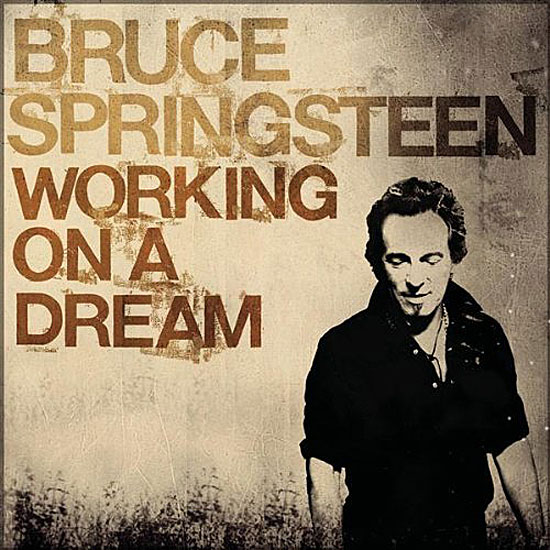
"Working on a Dream," the title track from Springsteen's forthcoming album, is going to radio today and Monday -- that's the single art above. Go to Q1043.com now to stream the song on demand.
- November 21, 2008

Friday, November 21, 2008

http://www.thetorquereport.com/detroit_3-thumb.jpg
Who Killed Detroit?
by Patrick J. Buchanan

Posted 11/21/2008 ET

Who killed the U.S. auto industry?

To hear the media tell it, arrogant corporate chiefs failed to foresee the demand for small, fuel-efficient cars and made gas-guzzling road-hog SUVs no one wanted, while the clever, far-sighted Japanese, Germans and Koreans prepared and built for the future.

I dissent. What killed Detroit was Washington, the government of the United States, politicians, journalists and muckrakers who have long harbored a deep animus against the manufacturing class that ran the smokestack industries that won World War II.

As far back as the 1950s, an intellectual elite that produces mostly methane had its knives out for the auto industry of which Ike's treasury secretary, ex-GM chief Charles Wilson, had boasted, "What's good for America is good for General Motors, and vice versa."

"Engine Charlie" was relentlessly mocked, even in Al Capp's L'il Abner cartoon strip, where a bloviating "General Bullmoose" had as his motto, "What's good for Bullmoose is good for America!"

How did Big Government do in the U.S. auto industry?

Washington imposed a minimum wage higher than the average wage in war-devastated Germany and Japan. The Feds ordered that U.S. plants be made the healthiest and safest worksites in the world, creating OSHA to see to it. It enacted civil rights laws to ensure the labor force reflected our diversity. Environmental laws came next, to ensure U.S. factories became the most pollution-free on earth.

It then clamped fuel efficiency standards on the entire U.S. car fleet.

Next, Washington imposed a corporate tax rate of 35 percent, raking off another 15 percent of autoworkers' wages in Social Security payroll taxes

State governments imposed income and sales taxes, and local governments property taxes to subsidize services and schools.

The United Auto Workers struck repeatedly to win the highest wages and most generous benefits on earth -- vacations, holidays, work breaks, health care, pensions -- for workers and their families, and retirees.

Now there is nothing wrong with making U.S. plants the cleanest and safest on earth or having U.S. autoworkers the highest-paid wage earners.

That is the dream, what we all wanted for America.

And under the 14th Amendment, GM, Ford and Chrysler had to obey the same U.S. laws and pay at the same tax rates. Outside the United States, however, there was and is no equality of standards or taxes.

Thus when America was thrust into the Global Economy, GM and Ford had to compete with cars made overseas in factories in postwar Japan and Germany, then Korea, where health and safety standards were much lower, wages were a fraction of those paid U.S. workers, and taxes were and are often forgiven on exports to the United States.

All three nations built "export-driven" economies.

The Beetle and early Japanese imports were made in factories where wages were far beneath U.S. wages and working conditions would have gotten U.S. auto executives sent to prison.

The competition was manifestly unfair, like forcing Secretariat to carry 100 pounds in his saddlebags in the Derby.

Japan, China and South Korea do not believe in free trade as we understand it. To us, they are our "trading partners." To them, the relationship is not like that of Evans & Novak or Fred Astaire and Ginger Rogers. It is not even like the Redskins and Cowboys. For the Cowboys only want to defeat the Redskins. They do not want to put their franchise out of business and end the competition -- as the Japanese did to our TV industry by dumping Sonys here until they killed it.

While we think the Global Economy is about what is best for the consumer, they think about what is best for the nation.

Like Alexander Hamilton, they understand that manufacturing is the key to national power. And they manipulate currencies, grant tax rebates to their exporters and thieve our technology to win. Last year, as trade expert Bill Hawkins writes, South Korea exported 700,000 cars to us, while importing 5,000 cars from us.

That's Asia's idea of free trade.

How has this Global Economy profited or prospered America?

In the 1950s, we made all our own toys, clothes, shoes, bikes, furniture, motorcycles, cars, cameras, telephones, TVs, etc. You name it. We made it.

Are we better off now that these things are made by foreigners? Are we better off now that we have ceased to be self-sufficient? Are we better off now that the real wages of our workers and median income of our families no longer grow as they once did? Are we better off now that manufacturing, for the first time in U.S. history, employs fewer workers than government?

We no longer build commercial ships. We have but one airplane company, and it outsources. China produces our computers. And if GM goes Chapter 11, America will soon be out of the auto business.

Our politicians and pundits may not understand what is going on. Historians will have no problem explaining the decline and fall of the Americans.
http://www.obamaformessiah.com/wp-content/uploads/2008/07/obama-messiah.jpg
Genius, Thy Name Is Obama
by Ann Coulter

Posted 11/19/2008 ET

With Time magazine comparing Obama to Jesus, I guess we should be relieved that, this week, liberals are only comparing him to Abraham Lincoln.

The one thing every liberal on TV seems to know about Lincoln is that he put rivals in his cabinet, as subtly indicated in the title to historian and plagiarist Doris Kearns Goodwin's book: "Team of Rivals: The Political Genius of Abraham Lincoln." Like Lincoln, Goodwin is always open to contributions from her rivals, although Lincoln was better at crediting their words.

And hasn't Obama talked to former rival Hillary about becoming his secretary of state? Hasn't he had a sit-down with Sen. John McCain? Did I imagine this, or is he even now brokering peace talks between Joy Behar and Elisabeth Hasselbeck?

Ergo: Obama is a genius.

Indeed, historians have just named Obama the best president-elect ever.

I don't recall the media swooning when President George W. Bush reached out to rivals, such as Sen. Teddy Kennedy, who was asked to co-write Bush's education bill. In fact, the way I remember it, Bush is liberals' most hated president ever (only because they can't remember George Washington or they'd hate him, too).

And yet no modern president has ever done more to bridge partisan divides and show respect to his opponents than George W. Bush. I do not say this with admiration; it is simply a fact.

Throughout the year and again in his convention speech during the 2000 presidential campaign, Gov. Bush bragged that he had "no stake in the bitter arguments of the last few years. I want to change the tone of Washington to one of civility and respect."

(As a side note: Bush would never have been elected president if not for the "bitter arguments of the last few years," in which Republicans exposed and impeached Bill Clinton, which then killed Al Gore's presidential ambitions. So you're welcome.)

But the point is: Bush was massively chummy with his enemies -- Democrats, communists and the Congressional Black Caucus. So chummy that even they began to wonder if he was a little daft.

In his first few weeks in office, Bush met with more than 150 members of Congress, half of them Democrats -- including five events with America's leading liberal menace, Sen. Teddy Kennedy.

Bush's very first social event at the White House was movie night with the Kennedy family to watch "Thirteen Days," a falsely heroic portrayal of JFK's disastrous handling of the Cuban Missile Crisis. This suggests to me that Obama's first social move as president will have to be to invite Lindsey Graham over to a screening of "Larry the Cable Guy Saves Christmas."

Naturally, Bush also had primary rival John McCain and his wife, Cindy, over to dinner at the White House.

Bush was the first president in memory to attend the congressional retreats of the opposing party. After two weeks in office, a Wall Street Journal column noted that Bush's charm offensive was "disorienting the local Hatfields and McCoys." (Again: You're welcome.)

Bush even made a special point to meet with the Congressional Black Caucus upon taking office, which -- given their feelings toward Bush -- would be the equivalent of Obama holding a special meet-and-greet session with the upper management of the Ku Klux Klan.

Bush invited the Democratic black mayor of the District of Columbia to the White House, attended a majority black District church service and appointed the first black secretary of state.

And that was all before Feb. 1, 2001. (By the end of his presidency, he would have appointed the first two black secretaries of state.)

Though it was small potatoes after all that palling around with Teddy Kennedy, this is the same George W. Bush who had Muslim "spiritual leaders" to the White House a week after 9/11.

Bush also famously said of then-Russian president, former KGB agent Vladimir Putin, that he looked him in the eye and "was able to get a sense of his soul."

(This made Bush's critics almost as apoplectic as if he had said, "I looked into Putin's eyes and, frankly, I just don't trust the guy." No matter what Bush did, liberals were incensed.)

As president, Bush scuttled the playing of "Hail to the Chief" in his honor and repeatedly reminded his staff to act humbly.

This is as opposed to Obama, who I believe is the first president-elect in history to have his own "Office of the President-elect" seal commissioned.

Like I always say, even if you don't like the current president-elect, you should still have some respect for the office of the presidency-elect.

Thursday, November 20, 2008

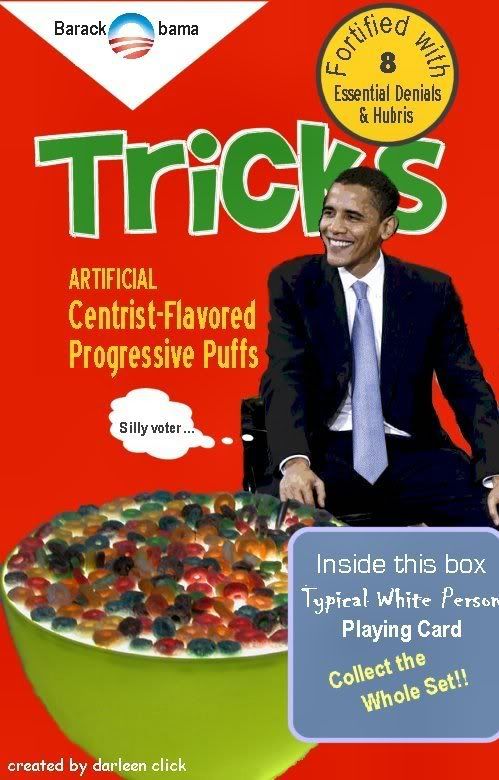
http://i243.photobucket.com/albums/ff182/darleenclick/blog%20images/obama_trix.jpg
From National Review Online:
Confirming Fears
By the Editors

That didn’t take long.

As we observed throughout the campaign, Barack Obama gave indications that his election would mean a return to the September 10 mentality, a national-security outlook marked prominently by its lack of seriousness about the terrorist threat. In choosing Eric Holder to be his attorney general, President-Elect Obama has taken a step toward confirming those misgivings.

Holder was the Clinton administration’s last deputy attorney general, succeeding Jamie Gorelick in 1997 under Janet Reno. That appointment marked the final elevation in a series of Clinton-era promotions that punctuate his résumé. Holder’s rise, like Obama’s own, is of symbolic significance, as he now has been nominated to be the nation’s first black attorney general. Symbolism, however, cannot camouflage the fact that Holder is a conventional, check-the-boxes creature of the Left.

He is convinced justice in America needs to be “established” rather than enforced; he’s excited about hate crimes and enthusiastic about the constitutionally dubious Violence Against Women Act; he’s a supporter of affirmative action and a practitioner of the statistical voodoo that makes it possible to burden police departments with accusations of racial profiling and the states with charges of racially skewed death-penalty enforcement; he’s more likely to be animated by a touchy-feely Reno-esque agenda than traditional enforcement against crimes; he’s in favor of ending the detentions of enemy combatants at Guantanamo Bay and favors income redistribution to address the supposed root causes of crime.

In any other time, Holder would simply be an uninspired choice. But these are not ordinary times — we face a serious, persistent threat from Islamist terrorists. At the same time, Democrats have expressed outrage over both the alleged politicization of the Justice Department and the reckless disregard of its storied traditions. For these times, it is difficult to imagine a worse choice for AG than Eric Holder.

Much has been made, and appropriately so, of Holder’s untoward performance in the final corrupt act of the Clinton administration: the pardons issued in the departing president’s final hours. Of these, most notorious is the case of Marc Rich, an unrepentant fugitive wanted on extensive fraud, racketeering, and trading-with-the-enemy charges — but granted a pardon nonetheless thanks to the intercession of his ex-wife, a generous donor to Clinton’s library and legal-defense fund.

Holder’s role was aptly described as “unconscionable” by a congressional committee. He steered Rich’s allies to retain the influential former White House counsel Jack Quinn (Holder later conceded he hoped Quinn would help him become attorney general in a Gore administration); he helped Quinn directly lobby Clinton, doing an end-run around the standard pardon process (including DOJ’s pardon attorney); and he kept the deliberations hidden from the district U.S. attorney and investigative agencies prosecuting Rich so they couldn’t learn about the pardon application and register their objections.

There’s more. In 1999, over the objections of the FBI, the Bureau of Prisons, and prosecuting attorneys, Holder supported Clinton’s commutation of the sentences of 16 FALN conspirators. These pardons — of terrorists who even Holder has conceded had not expressed any remorse — were issued in the months after al-Qaeda’s 1998 U.S. embassy bombings, when the Clinton administration was pretending to be the scourge of terrorism. The commutations were nakedly political, obviously designed by Clinton to assist his wife’s impending Senate campaign by appealing to New York’s substantial Puerto Rican vote.

Equally noxious were the stealthy pardons of Susan Rosenberg and Linda Evans — Weather Underground terrorists associated with Obama’s friends Bill Ayers and Bernadine Dohrn — issued on the same day as the Rich pardon. Rosenberg and Evans had been serving decades-long sentences for bombings targeting American government facilities. With Holder again helping to circumvent the pardon process and to evade objections from prosecutors, the terrorists’ jail terms were commuted just weeks after the bombing of the U.S.S. Cole.

Under Holder’s stewardship, moreover, the Justice Department chose, in the Dickerson case, to oppose its own prosecutors and seek reversal of the conviction of a bank robber whose voluntary confession had been elicited without Miranda warnings. Taking the Justice Department's signal, the Supreme Court overruled the lower courts and vacated the conviction, upending 30 years of precedent which had held that Miranda was not part of the core Fifth Amendment guarantee. Thanks to this ruling, rendered in the comfort of pre-9/11 complacence, terrorists tried in civilian courts — which is where Obama and Holder want them to be tried — will enjoy a powerful argument against the admission of critical confession evidence.

To be blunt, Holder is a terrible selection. If there’s any Obama cabinet nomination that Republicans feel moved to oppose, this should be it.

Wednesday, November 19, 2008

http://www.buckfush.com/images/George_Bush_Treasurer_Hank_Paulson.jpg
From TownHall.com:
Hank Paulson, Naked Emperor
Michelle Malkin

Friday, November 14, 2008

Treasury Secretary Hank Paulson finally confirmed what lonely bailout opponents tried to tell the American public all along: The man doesn't know what the hell he's doing.

Paulson held a bazooka to taxpayers' heads. He groveled on his knees in front of Democratic House Speaker Nancy Pelosi. He lured leaders from both political parties into linking arms in a panicked Chicken Little line dance for the beleaguered mortgage industry. Paulson demanded an unprecedented $700 billion Troubled Asset Relief Program for the good of the country. For the health of the housing market. For the survival of the economy. No time for deliberation. No time to review the failures of such interventionist approaches around the world. Now, now, now!

And now? The pulled-out-of-the-posterior "$700 billion" price tag has ballooned into the trillions. The "mortgage industry rescue" has expanded to banks, insurance companies, automakers, credit card companies and possibly the entire national volume of consumer lending. Oh, and that vaunted "TARP" component, Paulson admitted this week, is nothing but a four-letter word that rhymes with TRAP.

In September, Paulson offered his lofty pledge: "The ultimate taxpayer protection will be the stability this troubled asset relief program provides to our financial system, even as it will involve a significant investment of taxpayer dollars. I am convinced that this bold approach will cost American families far less than the alternative -- a continuing series of financial institution failures and frozen credit markets unable to fund economic expansion."

Two months later, Paulson's conviction melted faster than microwaved butter. "Our assessment at this time is that this is not the most effective way to use TARP funds," he sheepishly told the nation Wednesday.

Hey, who died and put Emily "Never Mind" Litella in charge of the economy?

Paulson explained at his non-mea culpa press conference that he knew when the bailout was signed that it wasn't going to work as sold: "It was clear to me by the time the bill was signed on October 3 that we needed to act quickly and forcefully, and that purchasing troubled assets -- our initial focus -- would take time to implement and would not be sufficient given the severity of the problem."

Now he tells us? Would have been nice if he had made this clear -- quickly, forcefully and publicly -- to the Beltway stooges who were pulling the TARP over our eyes. So much for Paulson's earnest transparency commitments on the Hill.

Members of Congress who let themselves be bullied into switching their votes on the bailout should be experiencing the biggest case of buyers' remorse in U.S. history. They fell for what Nobel Prize-winning economist F.A. Hayek called "the fatal conceit" -- the disastrous idea that a federal bureaucrat has the knowledge to do a better job than the private market in organizing and directing an economy. They gave unchecked power to a single government official without a clue.

Wielding his enormous authority, Paulson is desperately throwing our money at banks in a futile attempt to convince them to lend. Instead, those banks are either hoarding the cash or acquiring more assets. In other words: Paulson is helping the banks that were "too big to fail" grow even bigger with taxpayer backing. Swell.

The White House says: "We'll just trust our treasury secretary to implement the program." President Bush insists "government's role will be limited and temporary." Meanwhile, Democratic Rep. Barney Frank is shrugging off the lack of bailout disclosure by both the Federal Reserve and Treasury. But as I reminded readers before this latest bait-and-switch admission, Hank Paulson is not to be trusted. I repeat:

This is the man who proclaimed the subprime crisis "largely contained" in April 2007; "near the bottom" in May 2007; and "largely contained" again in August 2007. This is the man who pledged that he had "no interest in bailing out lenders or property speculators" in October 2007 and couldn't "think of any situation where the backdrop of the global economy was as healthy as it is today."

This is the man who patted himself on the back for refusing to "put taxpayer money on the line" to rescue Lehman Brothers on Sept. 15 -- and then turned around the next day and engineered the $85 billion taxpayer-funded bailout of AIG. This is the man who vowed he had "no plans to insert money" into Fannie Mae and Freddie Mac -- and then turned around and committed $200 billion in capital and credit lines to those corrupt, bloated, crumbling institutions.

This is the man who declared that "the worst is likely to be behind us" in May 2008.

Emperor Paulson's bipartisan courtiers in Congress berated anyone who dared challenge his wisdom. Minority Leader John Boehner sniffed: "This is no time for ideological purity." Well, ideological pollution begat this mess. It's time for a fiscal-conservative counterinsurgency to disrobe and disarm the charlatans before they do more harm.

Tuesday, November 18, 2008

http://o.aolcdn.com/photo-hub/news_gallery/5/6/567381/1218049073774.JPEG
As GM Goes, So Goes the GOP
by Patrick J. Buchanan

11/18/2008

Understandably, Republicans are seething.

When Hank Paulson demanded $700 billion to haul away the trash in the dumpsters of JPMorgan Chase and Goldman Sachs -- assuring us we could hold a garage sale of the junk -- they rebelled. They acted as the nation, by 100 to one, demanded. They killed the Wall Street bailout.

The Dow quickly sank another 1,000 points, and, charged with criminal irresponsibility by the elites, the GOP buckled, reversed itself, rescued the bailout -- and was wiped out on Nov. 4.

Now we hear from Paulson that the $700 billion Congress voted will not, after all, be used to buy up all that rotten paper on the books of the big banks. Some banks are using the cash to buy other banks.

So Republicans are right to be enraged. They are victims of the biggest bait-and-switch in political history. But they are now about to do something terminally stupid. With GM, Ford and Chrysler teetering on the brink, they are turning a cold stone face to Detroit and are about to follow the counsel of that quintessential Bushite Dick Darman, who said of our computer chip industry, "If our guys can't hack it, let 'em go."

America responded -- by letting George H.W. Bush and Darman go.

Are Republicans aware of what they are about to do?

When workers, execs, engineers, dealers, salesmen and suppliers are all factored in, the Big Three employ 3 million people who contribute $21 billion a year to Social Security and Medicare, and $25 billion in federal income taxes. Add in all the businesses that depend on the auto industry, and we are talking about one-tenth of the U.S. labor force.

As columnist Tom Piatak of Chronicles and Takimag.com writes, 850,000 retirees, and their families, depend for pensions and health care on the Big Three. If they go under, the burden falls on us.

And to let the auto industry die is to write America out of much of the economic future of the planet.

In a good year, like 2005, Americans buy more than 17 million new cars, and West Europeans as many. Tens of millions in Eastern Europe, Russia, China, India and Southeast Asia are now moving into the middle class each year. These folks will all need or want one or two family cars. If we let the U.S. auto industry die, that immense and burgeoning market will be lost forever to America, and ceded to Asia.

"Who cares?" comes the free-traders' reply. Japanese and Koreans are setting up factories here. They can pick up the slack.

But that means Americans will work for and depend on foreign companies for a necessity of our national life as vital as the imported oil and gas on which our cars and trucks operate. All the profits of the mighty automobile industry in America will be sent abroad.

Before Republicans follow this free-trade fanaticism to their final interment, they might study the results of a poll by Peter Hart:

-- Seventy-eight percent of Americans believe the U.S. auto industry is highly or extremely important. Three percent think we can do without it.

-- Ninety percent of Americans believe the death of the U.S. auto industry would do great damage to our economic future.

-- By 55 percent to 30 percent, Americans favor federal loans to save it. And by 64 percent to 25 percent Americans back President-elect Obama's resolve not to let the U.S. auto industry go under.

If the GOP blocks these loans, and the industry dies, the party can forget about Ohio, Michigan and the industrial Midwest. For the Reagan Democrats will never come home again. Nor should they.

By the choices we make, we define ourselves and reveal what we truly care about. Thus, consider:

We bail out the New York and D.C. governments of Abe Beame and Marion Barry. We bail out a corrupt Mexico. We bail out public schools that have failed us for 40 years.

We bail out with International Monetary Fund and World Bank loans and foreign aid worthless Third World regimes.

We bail out Wall Street plutocrats and big banks.

But the most magnificent industry, the auto industry that was the pride of America and envy of the world, we surrender to predator-traders from Asia and Europe, lest we violate the tenets of some 19th-century ideological scribblers that the old Republicans considered the apogee of British stupidity.

Nancy Pelosi is talking about tying loans to a restructuring of the industry. But Congress is not competent to do that.

What needs to be restructured is the U.S. tax-and-trade regime.

Dump globalism. Instruct Japan, Canada, Korea, Germany and China that if they wish to sell cars here, they will assemble them here and produce the parts here. And we shall have the same free access to and same share of their auto market as they have of ours.

To accomplish this, use the same import quotas and tariffs Ronald Reagan used to save the steel industry and Harley-Davidson.

Reciprocal trade. Even Democrats like FDR used to practice it.

Monday, November 17, 2008

https://www.andrew.cmu.edu/user/pcombe/Obama-Wan-1280.jpg
From Pittsburgh Tribune-Review:
Where's Obama's 'mandate'?

By Ralph R. Reiland


Monday, November 17, 2008

Now that the facts are in, it's clear that the pro-Obama mainstream media continued to get it wrong right through election night.

Watching CNN's Wolf Blitzer add up the numbers on that night, you'd get the idea that a massive turnout of dramatically energized and newly liberal voters had produced an Obama landslide.

In fact, despite the pictures of four-hour lines at the polls, American University's Center for the Study of the American Electorate reports that voter turnout in this year's election was the same in percentage terms as it was four years ago --- or at most had risen by less than 1 percent.

"Between 60.7 percent and 61.7 percent of the 208.3 million eligible voters cast ballots this year, compared with 60.6 percent of those eligible in 2004," reports Curtis Gans, the director of the university's center.

In both years, in short, some 40 percent of those eligible to vote didn't show up at the polls, with Republicans, in particular, taking a none-of-the-above stance this year and staying home.

"A downturn in the number and percentage of Republican voters going to the polls seemed to be the primary explanation for the lower than predicted turnout," states the American University report. "Compared to 2004, Republican turnout declined by 1.3 percentage points to 28.7 percent."

Jennifer Marsico, a writer/researcher with the AEI-Brookings Election Reform Project, explains the impact of those Republican nonvoters: "Mr. Obama got about 40,000 fewer votes in Ohio than John Kerry got four years ago. Obama carried the state where Kerry did not because Republicans stayed home."

And the reported Obama "landslide," as compared with George W. Bush allegedly just squeaking into the White House? Obama received 52 percent of the popular vote, 1 point more than Bush's 51 percent re-election win over John Kerry in 2004.

Similarly, there appears to be virtually no change among the nation's voters this year in their center-right ideological self-identification, according to exit polls conducted by the Edison/Mitofsky National Election Pool. This year, 34 percent called themselves conservative, unchanged from the 2004 election; 22 percent were liberal, up 1 point from 2004's 21 percent; and 44 percent called themselves moderate, down 1 point from 45 percent in 2004.

With party preference by race, there was also no major change this year. In 2000, according to CNN's exit polling, Al Gore got 41 percent of the white vote. In 2004, likewise, John Kerry got 41 percent of the white vote. This year, Barack Obama received an estimated 44 percent of the white vote.

The last Democrat candidate for president to win a majority of the white vote was Lyndon Johnson in 1964, following the Kennedy assassination.

Conversely, the black vote goes overwhelmingly and more lopsidedly to Democrat presidential candidates, with Gore, Kerry and Obama, respectively, getting 95 percent, 93 percent and 95 percent of the black vote, according to CBS News.

And so, what's the change? Not much. What's the mandate? Nothing.

With no ideological realignment, there's no call from the public for turning America into a European welfare state or beating our swords into plowshares; no go-ahead for Obama to push America's coal plants into bankruptcy or to put a lid on the expansion of nuclear power and oil drilling by way of excessive regulatory hurdles; no public demand for federal agents to pick up the guns or shut down talk radio; no call for the expansion of government or the redistribution of wealth; no public call to put federal bureaucrats in charge of the health-care decisions of patients and physicians; and no call for the nation to buckle under to the union bosses and enact a card-check bill that would effectively deprive workers of private-ballot votes in unionization drives.

On the card-check legislation, a proposed payback to organized labor for their more than $100 million in spending in support of Obama and Democrat congressional candidates, Obama should ask himself why the level of unionization in the nation's private sector has collapsed to 7 percent and how General Motors -- even after its upcoming multibillion-dollar bailout -- can be expected to compete against Toyota when their labor costs, respectively, are $73 per hour and $48 per hour.

What the public wants from Washington is better management, not jerks to the Left and continued payoffs to political contributors.

Ralph R. Reiland can be reached at rrreiland@aol.com
http://www.aolcdn.com/red_galleries/bruce-springsteen-dropout-400a062207.jpg
From Backstreets.com: The snippet played at halftime of the football game sounded good, the NFL sound effects notwithstanding, and it's nice to see Bruce continuing to indulge his pop instincts.
WORKING ON A DREAM

SET FOR JANUARY 27 RELEASE
It's official: Bruce Springsteen's new album is set for January 27 release on Columbia Records. Working on a Dream was recorded with the E Street Band and features twelve new Springsteen compositions plus two bonus tracks. It is the fourth collaboration between Springsteen and Brendan O'Brien, who produced and mixed the album.

Track list:
1. Outlaw Pete
2. My Lucky Day
3. Working On a Dream
4. Queen of the Supermarket
5. What Love Can Do
6. This Life
7. Good Eye
8. Tomorrow Never Knows
9. Life Itself
10. Kingdom of Days
11. Surprise, Surprise
12. The Last Carnival

Bonus tracks:
The Wrestler
A Night with the Jersey Devil

Springsteen said, "Towards the end of recording Magic, excited by the return to pop production sounds, I continued writing. When my friend producer Brendan O'Brien heard the new songs, he said, 'Let's keep going.' Over the course of the next year, that's just what we did, recording with the E Street Band during the breaks on last year's tour. I hope Working on a Dream has caught the energy of the band fresh off the road from some of the most exciting shows we've ever done. All the songs were written quickly, we usually used one of our first few takes, and we all had a blast making this one from beginning to end."

Working on a Dream is Bruce Springsteen's twenty-fourth album and was recorded and mixed at Southern Tracks in Atlanta, GA with additional recording in New York City, Los Angeles, and New Jersey. [press release from www.shorefire.com]

The album drops just five days before Bruce and the E Street Band play the halftime show at Super Bowl XLIII. A preview of the album's title track came last night on NBC's Sunday Night Football, a 90-second edit of the song over halftime highlights.

http://icanhazbailout.com/wp-content/uploads/2008/04/bushoover.jpg
From The New York Times:
George W. Hoover?

By WILLIAM KRISTOL

Last week, assembled at Miami’s InterContinental Hotel for a meeting of the Republican Governors Association, the governors seemed cheerful. The G.O.P. had lost only one statehouse on Election Day. The prospects for a Republican pickup in Virginia in 2009 were decent, and good candidates were plotting runs in states like California, Pennsylvania and Ohio in 2010.

There was even a sense of liberation in the air. For the last 14 years, there has been either a Republican Congress or a Republican White House, or sometimes both. Now the Republican governors are free of those heavy taps on the shoulder from their “betters” in Washington. So for these governors, this seems a moment of opportunity, in which their policies, their examples and their successes can help shape the future of the G.O.P.

The governors will be important. But there was an almost-never-mentioned elephant in the Versailles Ballroom (yes, that’s its name) full of Republicans: George W. Bush. For the hard fact is this: The worst financial crisis in almost 80 years has happened on his watch. The Bush administration will leave behind probably the most severe recession in at least a quarter-century. Fairly or unfairly, this will be viewed as George Bush’s economic meltdown.

If Republicans and conservatives don’t come to grips with what’s happened — and can’t develop an economic agenda moving forward that seems to incorporate lessons learned from what’s happened — then they could be back, politically, in 1933.

From 1933 to 1980, Republicans repeatedly failed to convince the country they were no longer the party of Herbert Hoover — the party, as it was perceived, of economic incompetence, austerity and recession (if not depression).

Only two Republicans won presidential elections in that half-century, Dwight D. Eisenhower and Richard M. Nixon. Both were able to take the White House only because we were mired down in difficult wars, in Korea and Vietnam. And Ike and Nixon were unable — they didn’t really try — to change the generally liberal course of domestic and economic policy. The G.O.P.’s fate on Capitol Hill was worse. The party controlled Congress for only 4 of those 47 years.

That’s what happens when a depression begins on your watch and when you can’t offer a coherent explanation of how and why it occurred and what you are going to do differently. That’s what happens when instead of having such an explanation, you spend decades in quarrels between pragmatic but unimaginative moderates who seek to be better tax collectors for the liberal welfare state, and principled but fanciful conservatives who hope for a wholesale rejection of that welfare state. And the fact that there were many successful Republican governors in those years didn’t much change the party’s status nationally.

Then there was a real moment of economic rethinking in the 1970s. Supply-side economics challenged demand-side Keynesians and austerity-minded conservatives by putting growth, entrepreneurship and incentives at the center of economic policy. Supply-side economics gave Ronald Reagan’s G.O.P. a new and different economic agenda in 1980, and Republicans were able to become a governing party.

Republicans and conservatives today face a similar challenge to that of 1976. A hawkish foreign policy, social conservatism and middle-American populism aren’t the problems. Those elements, as embodied on the Republican ticket by John McCain and Sarah Palin, produced a respectable 46 percent of the national vote — in the midst of an economic meltdown, with the Bush administration flailing and House Republicans rebelling and the Republican ticket lacking any coherent economic message.

I don’t pretend to know just what has to be done. But I suspect that free-marketers need to be less doctrinaire and less simple-mindedly utility-maximizing, and that they should depend less on abstract econometric models. I think they’ll have to take much more seriously the task of thinking through what are the right rules of the road for both the private and public sectors. They’ll have to figure out what institutional barriers and what monetary, fiscal and legal guardrails are needed for the accountability, transparency and responsibility that allow free markets to work.

And I don’t see why conservatives ought to defend a system that permits securitizing mortgages (or car loans) in a way that seems to make the lenders almost unaccountable for the risk while spreading it, toxically, everywhere else. I don’t see why a commitment to free markets requires permitting banks or bank-like institutions to leverage their assets at 30 to 1. There’s nothing conservative about letting free markets degenerate into something close to Karl Marx’s vision of an atomizing, irresponsible and self-devouring capitalism.

If conservatives do some difficult re-thinking in the field of political economy, they can come back. If they don’t — well, there were a lot of admirable conservative thinkers and writers, professors and novelists, from 1933 to 1980. But conservatives didn’t govern.

Sunday, November 16, 2008

http://images.quickblogcast.com/35238-32833/ObamaToast.jpg
From National Review Online:
Obama Lexicon
Neologisms for the age of hope and change.
By Mark Hemingway

Everyone scoffed at the idea that a man named Hussein was running for president. While Barack Obama has an unusual name by any historical or conventionally American aesthetic standards, it has turned out to be an asset. By the time his successful campaign had ended, his supporters in the media and elsewhere had embraced its distinctiveness and lexical malleability fully and completely.

First there was Obamamania. And the media declared it good. Now that the senator from Illinois is our president-elect, we have to ask the question: What comes after Obamamania? And we don’t mean what does he stand for. That would require responsible, objective journalism.

No, the real question is: What other neologisms await the American public in the upcoming Obama administration?

The Associated Press has already produced a helpful glossary of terms including Obamaphoria, Obamalujah, Obamalicious, Barackstar and Bamelot. No doubt Ambrose Bierce is doing about 75 rpms in his grave. Your humble correspondent’s favorite selection from the Associated Press was the following:

OBAMASCOPE: Media scrutiny of the new leader. (Example: “One hundred days after Barack Obama took office, newspaper editors put the president’s economic plan under the Obamascope.”)

This is coming from the same news organization that wrote two days after Obama was elected, “Even after nearly two years in the spotlight, little is understood about the 47-year-old first-term senator’s approach to leadership. His resume: community organizer, eight years as state legislator, and less than four as U.S. senator. . . . Personally, he’s a bit of an enigma, too.”

It’s a tough business climate for news organizations, and so when the AP — which has always been a wire service — wrote of media scrutiny of Obama, we were pleased to discover that they had diversified into the realm of joke writing. [Q: What do you see when you look through the Obamascope? A: Whatever you want to see!]

Still, even though the media is cranking out Obama-related neologisms at roughly the same rate their industry is shedding jobs, there’s still something undeniably awkward about the practice.

For instance, what is an Obama follower? (We need something broader than the current “producer for MSNBC.”) So, in the interests of helping you, dear reader, we are going to offer the best terms for those swept up by Obamamania. Obama-philes? Too dirty. Obamanauts? They’re spacey. Obama-ists? Sounds like something from PCU.

All too awkward. Let’s move on. What are we going to call a President Obama’s opponents?

Anti-Obama-ite: Not bad. No doubt, these beknighted individuals will be the source for the unfortunate “Yo’, Obama” jokes that will hammer the Administration for all four years.

What about adjectives?

Obamean? Messes up the spelling.

Barackean? Cumbersome.

Barackite? Weren’t they smote in the Old Testament with the jawbone of an ass or something?

The media persists in contorting the president-elect’s name to suit their purposes, so it should come as no surprise that Obama’s opponents have begun to develop a lexicon of their own. Here are a few entries:

Obamedia — Interchangeable with MSM.

O-basm: The climactic paragraph or statement in the standard media coverage. (Some might vote for The Big O.)


Obasequious — The standard journalistic position when covering Obama.

Obama Sesame — The gaping yaw of discretion shown by Obama after high-level meetings with sitting presidents.

Obamaganda — Styrofoam columns, fake presidential seal, even placards of imaginary “Offices” of the President Elect and the other narcissistic accoutrements that seem to pop up around Obama wherever he goes.

Obamomatopoeia — The sound of mindlessly repeating phrases such as “Yes We Can” and words like “hope” and “change” until they are sounds that bear no relation to the words they approximate.

O-blah-ma — The white noise of rhetorical overkill that accompanies one of his speeches. He’s promising to make the oceans recede, and yet all anyone can hear is a voice not unlike the adults in Peanuts holiday specials saying “O-blah-ma, O-blah-ma.”

Finally, we seem to be forgetting to ask what Barack Obama really stands for. What are the policies behind his slogans and speechifying? The media has seized on Obamanomics.

That’s one term we definitely can’t use. Simply too unwieldy. Obamanomics doesn’t work for the hippest, youngest, freshest candidate and his economic theories. We suggest sticking with “socialist.” Other appropriate policy terms may include:

Between Barack and a hard place — the precise location of America’s foreign policy interests for the next four to eight years.

Obamahol — The candidate’s proposed alternative energy source. It has enough energy density to replace hydrocarbons, deliver 5 million green-collar jobs and save the U.S. auto industry. The exact formula is a closely guarded secret, but it’s believed to be comprised primarily of tofu, recycled “Jimmy Carter in ‘80” bumper stickers and unicorn flatulence.

Barackalypse — The state of the world if his policies are enacted.

Now to put these terms to use. We recommend trying your hand at the following lesson.

Exercise: Use at least eight of these new terms in a well-formed paragraph.

Sample solution: “His inauguration speech was vintage o-blah-ma, and that ginormous statue behind him on the podium as he was being sworn in — the one of Abraham Lincoln and Martin Luther King Jr. holding hands — was the most egregious piece of obamaganda we’ve seen yet. However, the obamedia is so obasequious I’m sure Olbermann’s “special” comment on MSNBC this evening will be a hellbroth of obasms and obamomatopoeia. I can’t wait to see what these jokers have to say when he follows through on his new plan to pull us out of Iraq in three months and Al-Qaeda has us between Barack and a hard place. In the meantime, I’m hoarding all the dried meat and canned food I can get my hands on so I can ride out the coming Barackalypse.”

Mark Hemingway is an NRO staff reporter. The author wishes to acknowledge his collaborator on this piece, a former government official who wishes to remain anonymous.


Mark Hemingway is a writer in Washington, D.C.
http://i51.photobucket.com/albums/f367/Torquemada1/libertysmall.jpg
From Forbes:
The Loss Of Individual Liberty
Peter Robinson

11.14.08, 12:01 AM ET

Over dinner with Milton Friedman several years before he died, I offered the great man a compliment. He refused it.

I had just re-read God and Man at Yale, the 1951 book in which William F. Buckley Jr., denounced the leftist attitudes he had encountered among the Yale faculty and administration as an undergraduate. Buckley singled out the department of economics as the most collectivist department on the campus. "Today," I said, "nobody would call the economics department at a major university 'collectivist.'"

Academia as a whole may have continued its long, sorry wobble to the left, I continued, but the economics profession had proved an exception, moving the other way. Departments of economics across the country now grasped the importance of free markets. "Mises, Hayek, Stigler and you," I told Friedman. "You've transformed the intellectual climate. You've won."

Friedman shook his head. "We may have won the intellectual battle," he replied, "but in practical politics, it's difficult to see that we've had any effect at all."

Government spending had continued to grow, he explained. After a pause during the Reagan years, regulations had once again proliferated. For a moment, Friedman grew silent. Then he looked at me.

"The challenge for my generation," he said, "was to provide an intellectual defense of liberty. The challenge for your generation is to keep it."

To tell you the truth, I doubted it. Only a couple of years earlier, Republicans had captured control of the White House and both houses of Congress for the first time since 1928. It might take them a while, I thought, but they'd get the problems in under control. Everything would be just fine.

That was then.

This is now:

Item: Since my dinner with Milton Friedman, a Republican president and Republicans in Congress--I repeat, Republicans--enacted a prescription drug benefit that represents the biggest expansion of the welfare state since the Great Society. They also indulged in a massive increase in discretionary domestic spending and passed the biggest farm bill in history, a massive transfer of resources to the 2% of the population still engaged in agriculture.

Item: In the campaign that just concluded, the GOP--again, I repeat, the GOP--nominated a man whose proudest legislative achievement was a campaign finance reform, the McCain-Feingold bill, that represented a direct assault on freedom of speech.

Item: During the campaign, the Republican nominee--again, the Republican--told voters that the federal government should "give you a mortgage you can afford" while attacking businesspeople as "greedy."

Item: Next week, the Democrats who now run Congress will ask the House and Senate to enact emergency aid to the auto industry, apparently with George W. Bush's approval. Where will they get the money, estimated to total to some $25 billion? From the $700 billion bailout that these same leaders promised just a few weeks ago would be devoted entirely to the banking industry.

Whereas a bailout for the financial system made a certain amount of sense--if the banking system had failed, the entire economy would have suffered--what sense can it make to bail out GM or Ford? Even if both companies ceased production altogether, Americans would simply purchase a somewhat different mix of automobiles, shifting, for example, from Fords manufactured in Michigan to Toyotas manufactured in Kentucky or Mississippi. Did the nation shudder when Studebaker went under? Did our economy suffer a mortal blow with the demise of American Motors?

Item: Democratic president-elect Barack Obama has proposed federalizing health insurance, a first step toward the "universal health care" he has long advocated. The federal government, in other words, now intends the nationalization of health care, an industry that accounts for 17% of our gross domestic product.

Item: The president-elect has also proposed refundable tax credits that represent direct cash grants from the federal government. As Daniel Henninger has noted, the Obama plan would "place some 48% of Americans ... out of the income tax system."

This would fundamentally alter the nature of citizenship itself. Almost half of all Americans would, in effect, have been made the recipients of a vast new entitlement. As that proportion grows, the nation would approach a tipping point.

All that the nation's founders understood two centuries ago about the imperative of limited government, all that we learned from the long struggle between collectivism and free markets during our own time--all this could soon simply evanesce.

We are being asked to unlearn what we know, to surrender the virtues that can only be acquired in conditions of freedom, and to become a lesser people than we are. The land of the free and the home of the brave could soon be transformed into the land of the dependent and the home of the infantilized.

I may not have seen it at the time, but Milton Friedman was right. The challenge for this generation is to keep our liberty. And the challenge is now upon us.

Peter Robinson, a research fellow at the Hoover Institution and contributor to RobinsonandLong.com, writes a weekly column for Forbes.com.