Saturday, September 08, 2007

LIBERTAS Review: 3:10 To Yuma
By Dirty Harry

08_300dpi.jpg

Peter Fonda plays a bad-ass bounty hunter. … … … What? You’re still here? Beyond Peter Fonda plays a bad-ass bounty hunter — what do you need to know? Okay, how does this sound? Peter Fonda plays a bad-ass bounty hunter in a western directed by The Mighty James Mangold and starring Christian Bale and Russell Crowe. … … … More? You want more? Just go already. It’s a great film. It doesn’t star meterosexuals and there’s shoot-outs and horses and Peter Fonda playing a bad-ass bounty hunter. … … …

Fine.

3:10 To Yuma is a remake of a near-classic 1957 western of the same name that starred The Great Glenn Ford and The Great Van Heflin. It’s the story of Dan Evans, a desperate man whose only hope to save his Arizona ranch is the money offered to transport Ben Wade, a charming but vicious killer, to the town of Constantine and put him on the 3:10 prison train bound for Yuma. As his violent gang closes in to spring him, Wade launches a psychological war against his captors but zeroes in on Evans hoping his stubborn principles can be eroded by his desperation.

02_300dpi.jpg

I love the original film, but this one’s better. The plotting’s smarter, the character’s more complicated, and the emotions richer. It takes everything that made the original special and explores it more thoroughly through added subplots and deeper characterizations. How it holds up on repeat viewings will decide whether it’s a contemporary classic like Unforgiven, Lonesome Dove, and Dances With Wolves, or just a solid western in the Tombstone, Open Range category. Regardless, it is very entertaining and brilliantly acted.

As the desperate Dan Evans, Christian Bale is the heart and soul of the film. Crippled in the Civil War and broken in spirit by the loss of his wife and eldest son’s respect, Bale doesn’t let an ounce of sentimentality or pathos drip from his character. Instead he plays Evans as a man with remarkable grit whose life has been plagued by bad luck and an endless series of humiliations. After he accepts the job of transporting Wade, his wife (Gretchen Mol), who doesn’t have faith he’s man enough to do it, tries to talk him out of it. “No one will think less of you,” she argues. “No one can think less of me,” he replies. And so he sets off to redeem himself to those he loves and save his ranch.

01_72dpi.jpg

Crowe is equally good as the smooth confident Ben Wade, a man with his own code of honor that sometimes requires terrible acts of brutality. Both the writers and Crowe do an excellent job of making this character just as easy to loathe as to like.

Like the original, the life-blood of the story is the relationship between Evans and Wade. In a world filled with vicious killers on one side of the law and greedy bankers on the other there is no honor. But in each other they recognize that the other has a code even if it puts them at cross purposes, and a grudging respect develops. As Wade’s gang gathers and Evan’s help chickens out, the tension comes from wondering which man will bend to the other. Who will give in and change codes?

09_300dpi.jpg

Mangold’s 3:10 spends a lot more time on the trail to Constantine than the original did. The second act is padded by about thirty extra minutes but it’s a plus allowing for more action and a more expansive look at the West. There’s also an added subplot with Evan’s son that made me groan at first, but it ended up being a major benefit to the story and especially to the climax.

It’s a competently shot film and in keeping with the desert setting the colors are washed out and subdued. The action’s very well choreographed and easy to follow and the score’s unobtrusive and fits well in the genre. It’s also not an excessively violent film. Gun blasts and blood, but nothing you haven’t seen on television.

07_300dpi.jpg

Don’t be surprised, if like the original, the remake’s climax divides audiences. It does keep faith with the original’s ending, but retells it on a different level. I loved it and bought it completely. 3:10 To Yuma is about honor. It’s about living by a code. The mettle of a man isn’t defined by his code as much as how faithfully he sticks to it — especially when the going gets rough. Within this context, the climax made complete sense. Some excellent writers brought it together with finesse and heart. I still can’t get it out of my head.

We keep hearing how the western is dead and yet John Wayne remains one of our most popular stars nearly thirty-years after his death and his films have endlessly repeated on cable television since it was invented. What killed this genre was political correctness; the uncontrollable urge to constantly apologize for America’s sins, real or imagined. What makes those older westerns forever popular is their sense of freedom and adventure in an untamed land still filled with endless promise and danger. The genre isn’t dead, it just stopped being fun.

09_300dpi.jpg

Thankfully, 3:10 manages to avoid such nonsense by smartly remaining the simple contained story that makes the original so endurable. It’s also worth mentioning that the film offers a number of respectful Christian moments, a very positive message about the relationships between fathers and sons, and Peter Fonda as a bad-ass bounty hunter.

stars_3-5.gif

The image “http://www.goasu.com/autoimage/th300_pWQwDPs.jpg” cannot be displayed, because it contains errors.
From The Biblical Recorder online:
Moore Mountaineers
by Norman Jameson


With sports writers the nation over calling Appalachian State University's 34-32 win over Michigan Sept. 1 the biggest upset in the football history, you need to know that App State coach, Jerry Moore, is a committed Christian and member of Mount Vernon Baptist Church in Boone.

The Mountaineers are two-time defending national champion in their division, the Football Championship Subdivision (FCS, formerly known as 1-AA). But on the national scene, in the Big 10 arenas where football is a $50 million annual business, the FCS is considered junior varsity. Michigan was nationally ranked No. 5 in their division, the Football Bowl Subdivision, formerly known as 1-A, and is the NCAA's winningest program.

There is no suitable analogy here. David had more believers when he faced Goliath than App State had going into Michigan's "Big House" in front of 109,000 expectant fans. There were eight times as many people in the stands as the population of Boone.

Moore's pastor Allan Blume was bragging about the coach's faith commitment long before the season began. If Appalachian never won another game the impact Moore has on players' lives will make more headlines in heaven than even the ink his team's resounding defeat of storied Michigan garnered.

Moore has been head coach at ASU for 18 seasons and is the winningest coach in Southern Conference history. He has twice earned American Football Coaches' Association (AFCA) FCS Coach of the Year.

In a Baptist Press story last spring Moore said he entered his adult years not knowing whether or not he was a Christian. He played football at Baylor, worked at Southern Methodist and Nebraska before his first head coaching job came in 1979 at North Texas. He was head coach at Texas Tech from 1981 to 1985.

He got fired from Texas Tech after losing four games by a total of six points and was devastated. He drove to Dallas to work for a mortgage company and on the way listened to some Christian tapes someone left on his car seat. He was struck by what he heard, and outlined all the tapes in that Charles Stanley series. He and his family eventually attended Stanley's church in Atlanta, and for the first time, his faith became genuine.

Today he starts every morning reading Psalms and Proverbs passages with his morning coffee. He has taped pictures of his relatives and friends throughout a "Words of Wisdom" book so he can remember to pray for them.

He has given "Words of Wisdom" to hundreds of his players over the years and he can easily recite one of his favorite quotes that he inscribes in each copy before he hands it to them: "Let the first moments of the day when the heart is fresh be given to God. Never see the face of man till you have seen the King."

Roy Williams' Basketball Hall of Fame Acceptance Speech


"I am ecstatic to be here to say the least. Thank you Coach Smith and Coach Brown for being here with me and I truly appreciate your words as well as those from Billy Cunningham. I asked these three people to speak as a way of honoring Coach Smith. Coach, you now have three pupils in the Hall of Fame as coaches. ...

"Thank you to the Hall of Fame and the Honors Committee for selecting me ...

"More than anyone who has ever stood before you, I am the luckiest guy alive. Lou Gehrig said it and made it famous, but I feel it. Abe Lemons once said of me at a roast, 'Roy is well known in unknown places.' And he was right, but because of a lot of help from others, I stand before you now.

"The hardest part's going to be this first part to talk about my family. At one point I had a mom, a dad and a sister, and now I have none. I may stand here alone, but they are with me. My mom was my hero and she would be so proud. I guarantee you she is watching right now. My dad and I struggled, but before he died we came together and I am so glad of that. My sister never got the lucky breaks I did, but she loved the ground I walked on. Her children are with me here tonight.

"My wife, Wanda, the greatest of all time raising children and making our family. I wanted her to be the mother of my children, but I got a bonus because she's the best partner I could ever have. Scott and Kimberly, now you are my heroes. I love you, I adore you and I hope you feel that love every time you see me or hear me or hear my name. Scott also has a perfect mate in Katie and you two are so good together. Scott and Kimmy, as I've gotten older I worry more and more that I did not do enough or wasn't there enough. I apologize, but no one loves their children more than I do.

"My high school coach, Buddy Baldwin, was the most influential male in my life. Coach gave me confidence and made me feel I could do anything and I could be somebody. I know I would not be here today were it not for him. I wanted to be like Buddy Baldwin.

"Coach Smith, this truly is hard to put into words. You were and are my mentor, my teacher and my friend. 95 percent of what I do came from you. You, Coach Guthridge, and Eddie Fogler, Larry Brown, Greg Popovich and Oliver Purnell with the Olympics, shared with me your knowledge and that's the greatest gift one can get. I'll never be as good as you, but I hope all of you feel proud of how hard I tried.

"Chancellor Gene Budig and Dr. Bob Frederick, my athletic director at Kansas, took a tremendous chance by hiring me. Kansas wanted a name coach -- a successful and proven coach -- and I was not a household name even in my own house. But Bob had a belief and gave me a chance, even when his wife said, 'You're not going to hire that no-name guy from North Carolina.' I can never repay you, but thanks very much.

"I can say with more conviction than anyone that I've had the best coaching staff for 20 years. Jerry Green was my first hire at Kansas, I trusted him with everything -- he was my security blanket and my comic belief, but I know I could not have succeeded without you. All of my assistants have been successful, and they have been phenomenal to me. Kevin Stallings, Mark Turgeon, Matt Doherty, Neil Dougherty, Ben Miller and the group I have now -- Joe Holladay, in his 15th year with me, Steve Robinson, 13th, and two former players in Jerod Haase and C.B. McGrath for seven years each. I love having former players with me and I hope all four of you know how much I care.

"I would also like to say I'm honored to go into the Hall of Fame with this great class. Van [Chancellor], I've known a while, Phil I've followed greatly, two international coaches I've admired a great deal, Marvin Rudolph who was a referee so we've got to love those guys too because somebody's got to do that job. And the Texas Western-UTEP bunch, I'll only tell you my wife and I watched 'Glory Road' Saturday night for the second time and it's been a thrill being with you. And as I said today, Coach Haskins must have been a heck of a coach to see a bunch of ragamuffins like you and win a national championships. You talk to each one and they'll tell you they're the star, but what you did for basketball and what you did for the culture of basketball is something I treasure greatly.

"Lastly, but most importantly, the wonderful players I've had. Great ability, but even greater character. Great players, but even greater teammates. Winners, competitors, people that enjoy other people's successes as well as their own.

"From Adonis Jordan, who is here tonight - my first recruit - to Marvin Williams and Tyler Hansbrough the last few years. From my first team with Milt Newton, Mark Randall and Kevin Pritchard, to today's team with Ty Lawson and Marcus Ginyard.

"Paul Pierce, Raef LaFrentz and Jacque Vaughn, the leaders of great teams that I feel I failed because I didn't get you to the Final Four. Jacque, the best student-athlete I've ever known, winning the NBA championship this year with the Spurs brought tears to my eyes. It didn't make me forget not getting you to the Final Four, but it gave me a great smile to see you in that celebration.

"Kirk Hinrich and Nick Collison, both here tonight with your dads, high school coaches -- boy do I love that part -- you two, and Drew Gooden, gave me the belief I could recruit the right way with the right kids and be the coach I wanted to be when I was so down in recruiting. The 2005 national champions -- with Sean May, Raymond Felton, Marvin Williams, Wes Miller -- those are moments that will never leave me.

"Greg Gurley, Patrick Riche, Ryan Robertson, T.J. Pugh, Rex Walters -- also a great competitor who will be a great coach in his own right -- Steve Woodberry and Wayne Simien (my last year at Kansas, a youngster that I left and the fact that he came back tonight was so, so special to me). Clyde Lovellette, a great player from Kansas that is in the Hall of Fame, tells me he came back tonight because of me -- you cannot have any better feelings than that.

"I truly appreciate you 21 who are here tonight, being here to represent the 117 players that I've been able to coach as a head coach and the many more I coached on the JV team at North Carolina and for five years the basketball team at Owen High School. I've been the luckiest guy alive.

"My family at home, my family on the court -- no one has been more fortunate than me. I love you, and I thank you; this is the greatest honor to look out and see those people -- players and coaches and these two gentleman here -- who

Friday, September 07, 2007

http://www.wheaton.edu/learnres/ARCSC/collects/sc03/LENGLE.JPG
From The Corner: A wonderful appreciation...
Madeleine L'Engle at Home
John Podhoretz

You know her as the author of A Wrinkle in Time — possibly the best and most memorable young person's novel written in the United States since World War II. If you're lucky, you read or sampled a dozen or more of the 60-odd books she wrote for children and adults before passing away on Thursday at the age of 88.

Madeleine L'Engle was our neighbor growing up. She lived on the 9th floor at 924 West End Avenue in apartment 95; we lived on the 6th floor in apartment 65. There was one elevator for this line of apartments and therefore everybody in them came to know each other quite well, especially since the elevator had a habit of breaking down and trapping a few of us in it for 20 minutes at a time.

As a young boy, I knew her as the kind-faced and friendly woman with the two fluffy big nice dogs (in contrast to the constantly barking and lunging German Shepherds who lived on 12 and scared the bejeezus out of me and everybody else). Then, when I was 9 or 10, I read A Wrinkle in Time and my sister Naomi told me offhandedly that she was its author.

I wrote her the first fan letter of my life and, heart pounding, rode the elevator to 9 and slipped it under her door. Within hours a package was left at our door with an inscribed copy of its recently published sequel, A Wind at the Door, a box of baked chocolate chip cookies, and a response that was so appreciative I could hardly believe it, it was so gracious and thoughtful. I had grown up with writers whose friends were all writers and one thing I had learned even at that ludicrously tender age is that saying anything to any author about his or her work is to enter into an emotional minefield.

Madeleine had sold more copies of her work than any of my parents' friends, and probably had received more fan mail than any of them, but her letter had a tone of delight to it that not only suggested she understood how to write to a child, but also that she had about her an almost supernatural grace — suitable to someone who was a very serious churchgoing Episcopalian and the author of several novels for adults about the difficulties and joys of faith. I was particularly taken with The Love Letters, in which a young woman finds herself absorbed in the story of St. Teresa of Avila.

These were books I read the old-fashioned way — by finding them haphazardly at public libraries around New York over the years of my boyhood and adolescence. I would have 15 second discussions of them with her in the elevator as we traveled down or up. I was slightly abashed to be speaking so gushingly, and I think she sensed that and always made it seem as though I had made her day or her week.

Her late husband, Hugh Franklin, was as lovely as she — a working actor on soap operas and in theater around New York who would leave tickets at the box office for me whenever he was performing. This, needless to say, is not something most actor neighbors in New York would do.

My parents moved out of 924 West End Avenue in 1979, and I never saw Madeleine after that. But I still read her — she wrote a moving account of her marriage in a book called Two Part Invention that she published after Hugh's death in 1986. And I still knew she was around, still serving as the writer in residence at the Cathedral of St. John the Divine on 111th and Amsterdam — a New York landmark that appeared in several of her books set in our Upper West Side neighborhood.

So for those who were moved and affected by A Wrinkle in Time, or the Austins books, or her trilogy of memoirs about faith, I just wanted you to know that their author was a wonderful neighbor, a wonderful person, and a model of social and personal grace. I was profoundly lucky to have had the chance to spend time with her in an elevator that kept breaking down.
http://content.answers.com/main/content/wp/en/d/de/Wrinkle_In_Time_Cover.jpg
From The New York Times:
Madeleine L’Engle, Children’s Writer, Is Dead

By DOUGLAS MARTIN

Madeleine L’Engle, who in writing more than 60 books, including childhood fables, religious meditations and science fiction, weaved emotional tapestries transcending genre and generation, died Thursday in Connecticut. She was 88.

Her death, of natural causes, was announced today by her publisher, Farrar, Straus and Giroux.

Ms. L’Engle (pronounced LENG-el) was best known for her children’s classic, “A Wrinkle in Time,” which won the John Newbery Award as the best children’s book of 1963. By 2004, it had sold more than 6 million copies, was in its 67th printing and was still selling 15,000 copies a year.

Her works — poetry, plays, autobiography and books on prayer — were deeply, quixotically personal. But it was in her vivid children’s characters that readers most clearly glimpsed her passionate search for the questions that mattered most. She sometimes spoke of her writing as if she were taking dictation from her subconscious.

“Of course I’m Meg,” Ms. L’Engle said about the beloved protagonist of “A Wrinkle in Time.”

The “St. James Guide to Children’s Writers” called Ms. L’Engle “one of the truly important writers of juvenile fiction in recent decades.” Such accolades did not come from pulling punches: “Wrinkle” is one of the most banned books because of its treatment of the deity.

“It was a dark and stormy night,” it begins, repeating the line of a 19th- century novelist Edward George Bulwer-Lytton, and presaging the immortal sentence that Snoopy, the inspiration-challenged beagle of the Peanuts cartoon, would type again and again. After the opening, “Wrinkle,” quite literally, takes off. Meg Murray, with help from her psychic baby brother, uses time travel and extrasensory perception to rescue her father, a gifted scientist, from a planet controlled by the Dark Thing. She does so through the power of love.

The book used concepts that Ms. L’Engle said she had plucked from Einstein’s theory of relativity and Planck’s quantum theory, almost flaunting her frequent assertion that children’s literature is literature too difficult for adults to understand. She also characterized the book as her refutation of ideas of German theologians.

In the “Dictionary of Literary Biography,” Marygail G. Parker notes “a peculiar splendor” in Ms. L’Engle’s oeuvre, and some of that splendor is sheer literary range. “Wrinkle” is part of her series of children’s books, which includes “A Wind in the Door,” “A Swiftly Tilting Planet,” “Many Waters” and “An Acceptable Time.” The series combines elements of science fiction with insights into love and moral purpose that pervade Ms. L’Engle’s writing.

Ms. L’Engle’s other famous series of books concerned another family. The first installment, “Meet the Austins,” which appeared in 1960, portrayed an affectionate family whose members displayed enough warts to make them interesting. (Perhaps not enough for The Times Literary Supplement in London, though; it called the Austins “too good to be real.”)

By the fourth of the five Austin books, “A Ring of Endless Light,” any hint of Pollyanna was gone. Named a Newbery Honor Book in 1981, it told of a 16-year-old girl’s first experience with death. Telepathic communication with dolphins eventually helps the girl, Vicky, achieve a new understanding of things.

“The cosmic battle between light and darkness, good and evil, love and indifference, personified in the mythic fantasies of the ‘Wrinkle in Time’ series, here is waged compellingly in its rightful place: within ourselves,” Carol Van Strum wrote in The Washington Post in 1980.

Madeleine L’Engle Camp was born in Manhattan on the snowy night of Nov. 29, 1918. The only child of Madeleine Hall Barnett and Charles Wadsworth Camp, she was named for her great-grandmother, who was also named Madeleine L’Engle.

Young Madeleine’s mother came from Jacksonville, Fla., society and was a fine pianist; her father was a World War I veteran who worked as a foreign correspondent and later as drama and music critic for The New York Sun. He also knocked out potboiler novels.

The family lived on the Upper East Side of Manhattan; her parents had artistic friends, Madeleine an English nanny. She felt unpopular at school. She recalled that an elementary school teacher – Miss Pepper or Miss Salt, she couldn’t remember which — treated her as if she were stupid.

She had written her first story at 5 and retreated into writing. When she won a poetry contest in the fifth grade, her teacher accused her of plagiarizing. Her mother intervened to prove her innocence, lugging a stack of her stories from home.

When she was 12, she was sent to a boarding school in Switzerland, Chatelard, and at 15 to Ashley Hall, a boarding school in Charleston, S.C. She graduated from Smith College with honors in English. (She took no science, often a surprise to readers impressed with her science fiction.)

Returning to New York, Ms. L’Engle began to get small acting parts. She wrote her first novel, “The Small Rain,” in 1945 and had several plays she wrote produced.

She met the actor Hugh Franklin when both were appearing in a production of Chekhov’s “The Cherry Orchard.” They married in 1946, and their daughter Josephine was born the next year. In 1951, when Ms. L’Engle became pregnant again, they moved to the small town of Goshen, Conn., where they bought and ran a general store. Their son, Bion, was born in 1952, and in 1956 they adopted another daughter, Maria.

Mr. Franklin died in 1986 and Bion in 1999. Ms. L’Engle is survived by her daughters, Josephine F. Jones and Maria Rooney; five grandchildren; and five great-grandchildren.

Ms. L’Engle’s writing career was going so badly in her 30s that she claimed she almost quit writing at 40. But then “Meet the Austins” was published in 1960, and she was already deeply into “Wrinkle.” The inspiration came to her during a 10-week family camping trip.

That was just the start. She once described herself as a French peasant cook who drops a carrot in one pot, a piece of potato in another and an onion and a piece of meat in another.

“At dinnertime, you look and see which pot smells best and pull it forward,” she was quoted as saying in a 2001 book, “Madeleine L’Engle (Herself): Reflections on a Writing Life,” compiled by Carole F. Chase.

“The same is true with writing,” she continued. “There are several pots on my backburners.”

Her deeper thoughts on writing were deliciously mysterious. She believed that experience and knowledge are subservient to the subconscious and perhaps larger, spiritual influences.

“I think that fantasy must possess the author and simply use him,” she said in an interview with Horn Book magazine in 1983. “I know that is true of ‘A Wrinkle in Time.’ I cannot possibly tell you how I came to write it. It was simply a book I had to write. I had no choice.

“It was only after it was written that I realized what some of it meant.”

What turned out to be her masterpiece was rejected by 26 publishers. Editors at Farrar, Straus and Giroux loved it enough to publish it, but told her that she should not be disappointed if it failed.

The family moved back to New York, where Hugh Franklin won fame as Dr. Charles Tyler on the popular soap opera “All My Children.” For more than three decades, starting in 1966, Ms. L’Engle served as librarian and writer-in-residence at the Cathedral Church of St. John the Divine. One or two of her dogs often accompanied her to the cathedral library.

Much of her later work was autobiographical, although sometimes a bit idealized; she often said that her real truths were in her fiction. Indeed, she discussed her made-up stories the way a newspaper reporter might discuss his latest article about a crime.

When her son, then 10, protested the death of Joshua in “The Arms of the Starfish” (1965), she insisted that she could not change the tale, which was still unpublished at the time.

“I didn’t want Joshua to die, either,” Ms. L’Engle said in 1987 in a speech accepting the Margaret Edwards Award from the American Library Association for lifetime achievement in writing young adult literature, one of scores of awards she received.

“But that’s what happened. If I tried to change it, I’d be deviating from the truth of the story.”

Her characters continued living their lives even if she hadn’t mentioned them for decades. She had gotten word that Polly O’Keefe, who appeared in three books of the “Time Fantasy” series, was in medical school, she said a few months before the library speech.

A woman wrote her to say that she herself was a first-year medical student at Yale and that she would love to have Polly in her class. Ms. L’Engle said fine, and the student went to the registrar’s office to sign up Polly as an “official” Yale medical student.

“Why does anybody tell a story?” Ms. L’Engle once asked, even though she knew the answer.

“It does indeed have something to do with faith,” she said, “faith that the universe has meaning, that our little human lives are not irrelevant, that what we choose or say or do matters, matters cosmically.”

Thursday, September 06, 2007

http://www1.whdh.com/images/news_articles/389x205/070411_duke_players.jpg
From Opinion Journal:
The Massacre of Innocence

A stunning new book shows how elite culture
made the Duke rape hoax possible.


BY ABIGAIL THERNSTROM
Thursday, September 6, 2007 12:01 a.m.

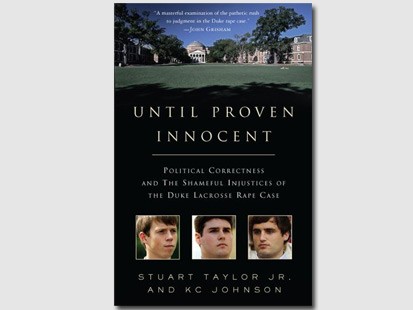
Privileged, rowdy white jocks at an elite, Southern college, a poor, young black stripper, and an alleged rape: It was a juicy, made-for-the-media story of race, class and sex, and it was told and retold for months with a ferocious, moralistic intensity. Reporters and pundits ripped into Duke University, the white race and the young lacrosse players at the center of the episode, and the local justice system quickly handed up indictments. But as Stuart Taylor Jr. and KC Johnson show in "Until Proven Innocent"--and as the facts themselves would show when they finally came to light--it was a false story, a toxic controversy built on lies and bad faith.

There was plenty of wrongdoing, of course, but it had very little to do with Duke's lacrosse players. It was perpetrated instead by a rogue district attorney determined to win re-election in a racially divided, town-gown city; ideologically driven reporters and their pseudo-expert sources; censorious faculty members driven by the imperatives of political correctness; a craven university president; and black community leaders seemingly ready to believe any charge of black victimization.

"Until Proven Innocent" is a stunning book. It recounts the Duke lacrosse case in fascinating detail and offers, along the way, a damning portrait of the institutions--legal, educational and journalistic--that do so much to shape contemporary American culture. Messrs. Taylor and Johnson make it clear that the Duke affair--the rabid prosecution, the skewed commentary, the distorted media storyline--was not some odd, outlier incident but the product of an elite culture's most treasured assumptions about American life, not least about America's supposed racial divide.

A bit of college-age stupidity triggered the sequence of events. The co-captains of the Duke lacrosse team held a house party in Durham, N.C., on March 13, 2006, and hired two strippers from an escort service for the occasion. The women who showed up--Crystal Mangum and Kim Roberts--happened to be black.

It turned out that Ms. Mangum--although the public would not learn of such details until very late in the life-span of the scandal--had a serious alcohol and narcotics problem. She had been diagnosed as bipolar and had spent a week in the state mental hospital the previous summer. Having arrived at the party late, she did not start dancing until midnight. Time-stamped photos show that her performance lasted only four minutes. By 12:30 she had passed out, as she often did--it was later discovered--at the Durham night club where she worked as an "exotic dancer." The other dancer, Ms. Roberts, eventually drove her to a grocery store and asked for help, and the security guard there called the police, who assumed that Ms. Mangum was "passed-out drunk."

In the custody of police, Ms. Mangum said nothing about a rape. (Ms. Roberts called the rape charge a "crock" when she first heard of it, until District Attorney Michael Nifong bribed her to say otherwise by reducing a bondsman's fee--from an earlier conviction--by roughly $2,000.) Ms. Mangum, fearing recommitment to a mental hospital, landed on rape as the explanation for her incoherent and generally woeful condition when she was prompted by a nurse-advocate at a mental-health processing facility. There was no medical evidence to substantiate the charge.

In a series of interviews with prosecutors, Ms. Mangum drew wildly different and implausible pictures of the alleged rape. DNA tests from swabs taken the night of the incident revealed that she had had recent sexual contact with as many as four men, none of whom were Duke lacrosse players. Defense lawyers discovered this damning detail only after combing through more than 1,800 pages of documents released by the district attorney months after the testing was done. The DNA cover-up was only one of the procedural travesties that eventually cost Mr. Nifong his job and law license and (last week) earned him a one-day jail sentence.

In two photo-identification lineups, Ms. Mangum couldn't identify anyone as her rapist. On a third try--before which Mr. Nifong announced to her that all the photos that she was about to see were of Duke lacrosse players--she suddenly fingered three: David Evans, Collin Finnerty and Reade Seligmann. It was apparently of no consequence to Mr. Nifong that the lineup violated basic departmental rules and that none of the men she identified bore the slightest resemblance to the descriptions she had given police.

Time-stamped photos--at the party and at an ATM--along with cellphone and taxi records showed indisputably that Mr. Seligmann could not have participated in the 30-minute, three-orifice gang rape and vicious beating of which Ms. Mangum accused the three players. Messrs. Evans and Finnerty did not have such air-tight alibis, but each cooperated fully with the police, even offering to take lie-detector tests, and there was not a shred of evidence against them. The district attorney branded the defendants as "hooligans," but others--like Messrs. Taylor and Johnson here--described them in glowing terms, as earnest, hard-working students.

The state attorney general--after an agonizing yearlong investigation, culminating in Mr. Nifong's removal from the case--determined in April 2007 that Messrs. Evans, Finnerty and Seligmann were innocent of all charges. Nothing--absolutely nothing--had happened at the party. The players' innocence had been apparent to their own attorneys from the outset. It should have been apparent to Mr. Nifong, too, given all the exculpatory details he knew. But he was desperate to win a close primary election and needed black votes, so he proceeded with an unjustified prosecution and publicly vilified innocent young men.

In this fundamental injustice, he was aided and abetted by others in Durham. Richard Brodhead, the president of Duke, condemned the lacrosse players as if they had already been found guilty, demanded the resignation of their coach and studiously ignored the mounting evidence that Ms. Mangum's charge was false. He was clearly terrified of the racial and gender activists on his own faculty. Houston Baker, a noted professor of English, called the lacrosse players "white, violent, drunken men veritably given license to rape," men who could "claim innocence . . . safe under the cover of silent whiteness." Protesters on campus and in the city itself waved "castrate" banners, put up "wanted" posters and threatened the physical safety of the lacrosse players.

The vitriolic rhetoric of the faculty and Durham's "progressive" community--including the local chapter of the NAACP--helped to intensify the scandal and stoke the media fires. The New York Times' coverage was particularly egregious, as Messrs. Taylor and Johnson vividly show. It ran dozens of prominent stories and "analysis" articles trying to plumb the pathologies of the lacrosse players and of a campus culture that allowed swaggering white males to prey on poor, defenseless young black women. As one shrewd Times alumnus later wrote: "You couldn't invent a story so precisely tuned to the outrage frequency of the modern, metropolitan, bien pensant journalist." Such Nifong allies--unlike the district attorney himself--paid no price for their shocking indifference to the truth.

Ms. Thernstrom is a senior fellow at the Manhattan Institute and the recipient of a 2007 Bradley Award. You can buy "Until Proven Innocent" form the OpinionJournal bookstore.

http://cultura.blogosfere.it/images/pavarotti-luciano-photo-xl-luciano-pavarotti-6232782.jpg
From Guardian Unlimited:
Luciano Pavarotti

Operatic superstar blessed with a voice of pure gold
whose career was a triumph of marketing

Tom Sutcliffe


Thursday September 6, 2007

The Italian tenor in full cry is what we mean when we say opera, which remains, in that sense, a man's world. The names of Caruso, Gigli, Pavarotti are code for operatic achievement, while the legendary divas they partnered only register with opera fans. Modern recording technology ensures that the spell-binding heroic expressiveness of great tenors can work its magic anywhere. Historic voices are for all time. Since the mechanisation of memory, we need no longer rely on the pallid words of critics or historians.

Luciano Pavarotti, who has died aged 71 of pancreatic cancer, grew up in the 1940s listening to the previous golden generation of tenor stars on record and radio. So the presence of the past underpinned his own recorded achievement as a singer. His family were enthusiastically musical and, aged four, he was apparently standing on the kitchen table singing the Duke of Mantua's La donna é mobile from Rigoletto as a party trick. He modelled himself on what he heard, and used recordings to take account of the competition, dead or alive, throughout his career.

Nature equipped him with one of the most individual, unmistakable and beautiful voices there has been. In his 50s, thanks to records and the increasing refinement of public address systems in the enormous, sometimes open-air concert venues where he performed, he became probably the richest opera singer in the history of music.

But his thriving career, in fact, coincided with the steady decline of Italian opera. The Pavarotti phenomenon was a triumph of marketing. His name was given to a men's perfume. His first wife, Adua Veroni (with whom he had three daughters, Lorenza, Cristina and Giuliana in the 1960s), launched Stage Door Opera Management in 1987, which became a leading Italian agency - though she confessed to "never being very fond of opera".

Pavarotti made his debut at the Teatro Municipale, Reggio Emilia, in northern Italy, on April 29 1961, in the part of Rodolfo in La Bohème, conducted by Francesco Molinari Pradelli. He became a superstar 11 years later, on February 17 1972, when he sang Tonio in Donizetti's delightful La Fille du Régiment at the New York Met. "I had to sing nine high Cs in a row before I won the public's attention," he said later.

After this Met triumph, Herbert Breslin took over his public relations and turned him into a television celebrity. A huge white handkerchief became his characteristic recital prop. Pavarotti and his warm knowing grin were soon familiar at every level of society. He was on the cover of Newsweek and Time magazines, and there were Pavarotti masterclasses on US television. He launched the Pavarotti Philadelphia international voice competition. His ease and potential on television was first demonstrated in 1963 to an audience of 15 million people on ITV's Sunday Night at the London Palladium, when he was standing in for Giuseppe di Stefano at Covent Garden. It was a role he frequently returned to at the Royal Opera House.

The operatic tenor is very much a 19th- and 20th-century phenomenon. The taste for Verdi and verismo that Pavarotti's remarkable gift helped sustain may not last forever. Until Bellini and Donizetti came along (some of whose high-lying bel canto tenor roles helped to reinforce Pavarotti's early fame), the opera world was dominated by castrati. These were adult males singing soprano in such heroic roles as Julius Caesar or Alexander the Great, whose parents had (usually) collaborated with the Roman Catholic church in their castration, and who, in a few cases, garnered pop star-like fortunes. Even in the age of Verdi, however, there were no hysterical Italian fans rioting about tenors. But by the late 20th century the phenomenon of the three tenors, Pavarotti, Placido Domingo and José Carreras, helped opera compete a trifle longer with football as a vehicle of Italian social mobility.

Seldom in the history of opera would three such stars of the same voice have been seen together on stage, even for an impresario's gala. Carreras's illness clinched the gimmick. Each of the three earned so much money for a third less effort that the temptation was irresistible. If serious money can still be made singing songs a century old, perhaps opera cannot be written off yet - though Puccini, the last universally popular opera composer, died in 1926.

Pavarotti's voice will cast a shadow for years to come on new aspirants. Yet on stage he took no role composed later than 1926. That was not his fault. The flood of Italian music faltered and stopped. A few of the classless Italian and Neapolitan gems that served him as encores in recitals - like Volare and Un amore così grande - were postwar. But those thousands who filled his pockets and flocked to rain-sodden fields and unlovely arenas to hear him amplified through loudspeakers would not have been interested in songs from postwar operas - if there had been any popular Italian operas from the 1950s onwards, which there were not. His lavish and beautifully lyrical tenor needed appealing melodies.

Has any tenor ever used the text with more immaculate musical expressiveness? Verdi, Bellini, Donizetti and Puccini showed him off at his eloquent (and, as he aged, increasingly robust) best. He sang a little Richard Strauss - the Italian tenor in Der Rosenkavalier was perfect typecasting. He was sublime as both son and father in Mozart's Idomeneo, at different stages of his career. He learned a few extra parts until he turned 60 (Verdi's Don Carlo, Giordano's Andrea Chenier). But his repertoire was almost entirely a manageable range of roles that he had sung throughout his career.

Not for Pavarotti, therefore, the adventures of Domingo, equally successful and almost contemporary, who could study Tchaikovsky and Wagner minutely and turn out not quite idiomatic Russian and German. Pavarotti stuck to the tradition represented by well-recorded earlier giants like Caruso, Martinelli, Bjoerling, Bergonzi and Corelli - who, in turn, had stuck mainly to the Italian rep. He could apply his extraordinary ear, and polish and adjust his detailed approach so that the result was newly minted and fresh as a musical experience. He was an inspired perfectionist when it came to the fundamentals of his art: the ideal moulding of poetry to a heavenly line of music.

Let there be no mistake, Pavarotti really was a triumphantly fabulous artist. He never distorted the true colour and purity of the vowels that he was singing. His words were always limpidly clear, expressively registered and dramatic. Fans of Domingo would suggest that their man could act, whereas Pavarotti only sang. But acting is not something you do, it is something you are. Pavarotti acted not by demonstrating or showing off the characteristics of the part, but by defining its inward emotional essence in how he uttered the music and the text.

It was absolutely part of the authentic operatic tradition that he was never fluent at reading music. According to the Daily Telegraph's Rome correspondent in 1997, Pavarotti relied "on his ear and his own rudimentary form of annotation to learn a musical work". In the Corriere della Sera, he admitted he was not a musician: "I don't go in too deep. The musical score is one thing and the singing part is another. If you have the music in your head, and you sing it with your body, you'll be all right." He learned his songs by becoming familiar with the words, which he would print out in a notebook alongside signs showing the melody rising or falling. So much for the old operatic debate about whether words or music come first.

Pavarotti could make the music and words adhere to each other completely naturally. Both were in a sense laid on to his large frame in a way that made their delivery second nature. This wonderful quality of acting out the meaning, including the dramatic meaning, through the words as musically realised was fundamental to his genius as a performer. The natural beauty of the sound he commanded was, in the end, more significant than the fact that he could sing top notes far more effortlessly than the hard-working and supremely competent Domingo (who could never sing as high comfortably anyway).

Pavarotti was born in Modena, northern Italy. His father, Fernando, was a baker with a vast record collection who sang tenor in his spare time in the Corale Rossini, a local chorus; his mother worked in a tobacco factory. The boy was often looked after by his grandmother. It was a close family; even much later, Pavarotti cancelled performances at Covent Garden because of his father's illness. In fact, both his parents lived on into the 21st century. The young Luciano joined the Corale Rossini and sang alongside his father in his mid-teens. In 1955, aged 19, he was with them at the International Eisteddfod in Llangollen, where they won top prize. He attended a teachers' training college to become a PE teacher. But when he qualified, the family took a vote on allowing him to study singing, and agreed to his wish, no doubt partly because it was fulfilling his father's own dream.

He took lessons in Modena from the tenor Arrigo Pola before moving on to Ettore Campogalliani in Mantua, an experienced repetiteur and voice coach who absolutely understood the way in which Italian tenor singing ideally handles the passagio. This is the name for the part of the voice above top G where the tenor has to turn the vocal sound so that its natural resonance can glow and vibrate without forcing and without overstressing the weight of breath support behind the lyrical vibrato. The consistently elegant, expressively refulgent way that Pavarotti sang through the passagio was the secret of the remarkable longevity of his voice as an instrument.

But the truth is he was a natural - born into an ideal situation, where there was ample sensitivity and musical intelligence around him about his chosen art. Of course, such an impeccable technique could not be acquired through lessons. The beautiful and natural sound that Pavarotti started out with simply needed to be polished and strengthened.

In 1961, still only 25, Pavarotti won the Achille Peri competition, and married Adua Veroni after an engagement of eight years. The reward for winning the competition was to make his debut in Reggio Emilia. Over the next 30 months, he sang at provincial opera houses in Italy, the Netherlands, Austria and Ireland. He was Rodolfo, the Duke in Rigoletto, Alfredo in La Traviata, Edgardo in Lucia di Lammermoor and Pinkerton in Madama Butterfly. In Dublin, he was spotted by a Covent Garden talent scout and engaged as understudy to di Stefano for the role of Rodolfo.

In fact, Pavarotti did the whole run of performances - except for one sung by di Stefano. His Royal Opera House debut, on September 21 1963, was heard by the Guardian's Philip Hope-Wallace: Pavarotti "made a good impression ... he seemed modest, sang with musicianly feeling and uses a pretty, clear, lyrical voice to some effect". His Scala Milan debut (in the same role, conducted by Herbert von Karajan) was still two years away. Then the pace of his career quickened. He sang Edgardo in Lucia in Amsterdam; in July 1964, he was Idamante at Glyndebourne (opposite Richard Lewis's Idomeneo for 12 performances), later declaring, "What I learned there was to sing piano" - from Jani Strasser, the legendary head of music, who taught him the role.

At 28, Pavarotti's style was impeccable, the ease and beauty with which the text was realised were utterly irresistible, the perfection of support and focus at the top were a model. Listening today to the recording of that August's Prom performance (it is still available on CD), the contrast with Richard Lewis's muddy Anglo-Italian demonstrates exactly what was going to make Pavarotti a world-beater. The conductor John Pritchard recorded Idomeneo again 19 years later in Vienna, with Pavarotti in the title role.

In February 1965 he made his US debut in Miami, as Edgardo to Joan Sutherland's Lucia, conducted by her husband Richard Bonynge, a team with whom he would make a large number of important recordings. He returned to Covent Garden with Sutherland for La Sonnambula (as Elvino), and toured Australia with the Sutherland-Williamson company in L'Elisir d'Amore (Nemorino became a signature role for him), Traviata, Lucia and Sonnambula. In 1966 Abbado conducted him in I Capuleti e i Montecchi at La Scala. He had performed the Duke in Rigoletto with Tullio Serafin at the Teatro Massimo in Palermo during the earliest stages of his career, and now he repeated the role with Gianandrea Gavazzeni. Later, in 1969, at La Scala, he also sang Des Grieux in Massenet's Manon (in Italian).

But what mattered most in 1966 was his legendary appearance with Sutherland at Covent Garden in La Fille du Régiment in June. The point was that he sang the high Cs in full voice, though Donizetti had expected them to be sung in head voice. Full voice means without any adjustment towards falsetto or even modified falsetto, the sound when the soft palette is pressed down. Head voice would have meant not going into the passagio and sustaining that sort of modified shout, which is how tenors make their top notes exciting. But Pavarotti had a relaxed natural vibrato right through, so there was no need for him to mix in any kind of lightness or lack of body at the very top: his singing was all of a piece. This ability was a sort of piratical feat, and Decca (Pavarotti's recording company) used the title King of the High Cs on a record he made. The success and fame of this achievement for a time helpfully focused his work on the bel canto repertoire in which Bonynge and Sutherland were contemporary pioneers, with roles like Arturo in Bellini's I Puritani and Fernando in Donizetti's La Favorita.

Considering the length of his career, and the flair with which he recognised work that was right for his gifts, the fact that Pavarotti stayed with a particular corner of the repertoire at such an important developmental stage may well have strengthened further his extraordinary technique. A period devoted to lighter, more lyrical roles was the foundation for a carefully calculated expansion of his repertoire. Roles he later undertook included Riccardo in Un Ballo in Maschera, Ernani, Rodolfo in Luisa Miller, Manrico in Il Trovatore, Cavaradossi in Tosca, Calaf in Turandot (which gave him his World Cup aria, Nessun Dorma), Idomeneo and Enzo in La Gioconda. After the success of his high Cs at the Met and the engagement of Breslin, he started to extend the number and scale of recitals that he undertook, starting with one in Liberty, Missouri, in February 1973.

Pavarotti performed in so many provincial centres all over the world that his recognisability, popularity and fame registered everywhere. Sales of his records were enormous, even if recitals reduced his availability for work in important opera houses. The range of roles he sang regularly or frequently on stage was much more limited than his recorded legacy suggests. Recitals and, eventually, epic amplified solo performances in arenas accommodating thousands of listeners, were a major factor in his working career.

Photographs from the 1960s show that Pavarotti was not thin - though he was a handsome, if usually unaristocratic, figure on stage. By the early 1970s, he was significantly overweight. But his father, too, cut a bulky shape, which was clearly in the genes. Reporters interviewing Pavarotti always referred to this. When asked his weight, he would reply, "Less than before," and when challenged what exactly that was would respond, "More than now". He wrote his autobiography, My Own Story (1981), and took part in a movie, Yes, Giorgio (1982).

After 1983, with Breslin's encouragement, he teamed up with Tibor Rudas, the promoter of Frank Sinatra and Neil Diamond concerts. He sang to 7,500 people in a heated tent in Atlantic City. The fee for similar occasions would be $100,000 and a percentage of the ticket sales. In 1984, he sang to 20,000 at Madison Square Garden, New York.

During the 1980s, he sang only half as many opera performances each year as Domingo, and the latter's repertoire of roles was twice as large. But Pavarotti made enormous amounts of money, in part by turning himself into a painter, which had long been a hobby. A print of one of his paintings fetched $2,500, though he was sued by the author of a how-to-draw book, who claimed he had copied her examples.

Ventures that were not artistic successes included directing opera (a Favorita at La Fenice in Venice, after which he explained, "It was not much fun. I was too nervous.") and singing the title role in Otello in Chicago with Georg Solti conducting. The performances and public rehearsals, in Chicago and later Carnegie Hall, were recorded and edited on to a CD but the result was unimpressive. His Radames, in Aida at Covent Garden in the 1980s, was also unconvincing, with his enormous frame covered up in a tent-like frock.

His involvement with various younger singers, some of whom had won prizes at his competition, only occasionally led them towards successful careers. Some of these proteges were very close to him, as were some of his secretaries. He had sung at almost every opera house of note, during a longer than 40-year career. Finally, though, the voice was not quite living up to expectations.

His first marriage came to an end when, in his 60s, he took up with his former personal assistant Nicoletta Mantovani, a woman 35 years his junior - their wedding, in 2003, was celebrated with a banquet for 600 guests, including Sting, Bono and Donatella Versace. They had a daughter, Alice.

He began to cancel performances that looked as if they should have been final appearances, and announced that he would retire on his 70th birthday in 2005. His schedule of 40 mainly concert performances in 2003 was rumoured to earn him $35m. He did 34 Three Tenors concerts around the world between 1990 and 2003. But his medical condition began to interfere with his plans, and after starting a farewell world tour in 2005 he discovered he had pancreatic cancer.

An operation was declared successful and Pavarotti announced he would return to the stage in 2007 after convalescing. This summer he had been working on a recording of sacred songs to be released in 2008, and teaching a select group of students. His last performance of a staged opera was at the Met on March 14 2004. In February 2006 he opened the Winter Olympics in Turin, singing Nessun Dorma transposed to a more suitable pitch for a tenor of his years.

Pavarotti's kind of astounding international celebrity made it difficult to stop. According to Decca, he was the most popular artist in the history of the classical recording industry. Perhaps, he was even more famous than Caruso. He was probably the last great lyric tenor in a noble line: his kind of music - by Puccini, Verdi and other Italian operatic greats - is increasingly distant from contemporary taste. When he was born, Mascagni and Giordano were still alive and writing: they have had no Italian operatic heirs. Pavarotti possessed a voice of pure gold that matured in strength and depth of colour as he aged, without losing its innate ravishing beauty, precision and expressiveness. He was a unique phenomenon.

· Luciano Pavarotti, tenor, born October 12 1935; died September 6 2007
http://www.hollywoodtoday.net/wp-content/uploads/2007/09/pavarotti-with-bono.jpg
From U2.com: an appreciation by Bono.
Luciano Pavarotti 1935 - 2007

“Some can sing opera, Luciano Pavarotti was an opera.

No one could inhabit those acrobatic melodies and words like him. He lived the songs, his opera was a great mash of joy and sadness; surreal and earthy at the same time; a great volcano of a man who sang fire but spilled over with a love of life in all its complexity, a great and generous friend.

Great, great fun, The Pavlova we used to call him. An emotional arm twister if he wanted you to do something for him he was impossible to turn down. A great flatterer.

When he wanted U2 to write him a song he rang our housekeeper, Theresa, continually so we talked about little else in our house.

When he wanted U2 to play his festival in Modena, he turned up in Dublin unannounced with a film crew, and door-stopped the band. His life and talent was large but his sense of service to the weak and vulnerable was larger.

We wrote Miss Sarajevo for him. He had worked on the humanitarian crisis that was the war in Bosnia. We travelled together on a UN air force flight to Mostar... all of us earnest in hard hats, just about strapped into this industrial aircraft with the big man handing out parmigiano from Reggio Emilia, “the best cheese in the world" he kept saying… deadpan… to make us laugh.

In Pesaro, in his summer house, he lived an almost bohemian life with a recording studio set up in an out house - but did all his vocals in his bedroom... there was a hammock hung between two marine pines for a siesta. He liked to eat, sleep and then warm up his vocals though I remember more eating than warming up. When we first recorded with him I left a stone heavier than I arrived.

Intellectually curious, couldn’t stick to his own generation - loved new ideas, new people, new song forms.

A sexy man whose life lit up again when he fell in love with Nicoletta and as he watched Alice play in the yard. He loved all his daughters so much.
The sadness of losing his only boy his only silence.

I spoke to him last week... the voice that was louder than any rock band was a whisper. Still he communicated his love. Full of love.

That's what people don't understand about Luciano Pavarotti. Even when the voice was dimmed in power, his interpretive skills left him a giant among a few tall men.”

Bono
Duvall loves smell of napalm,
likes Giuliani for president

Robert Duvall made famous the role of a gung-ho
air cavalry commander in "Apocalypse Now."

By Brian C. Mooney, Globe Staff

Hollywood endorsements are a dime a dozen, but former New York Mayor Rudy Giuliani has bagged one that seems particularly suited to fit his hard-edged campaign for president.

Academy Award-winning actor Robert Duvall has starred in vivid roles as grizzled cowboys, a mad preacher, an overbearing Marine pilot, and consiglieri to a Mafia don. The most memorable, however, may be Lt. Col. Bill Kilgore, the wild surf-loving air cavalry commander in "Apocalypse Now," Francis Ford Coppola's 1979 masterpiece set in the Vietnam War.

"Rudy has consistently proven he's ready to confront tough challenges," Duvall said in a statement issued today by the Giuliani campaign. "I don't normally get involved in politics, but I think the stakes are too high this election."

He and his wife, Luciana, will host a fundraiser for Giuliani later this month at their home in Virginia, the campaign said.

"As a fan and an admirer of Mr. Duvall's work for some time, I am honored to have Robert and his wife Luciana's support and help on our campaign," Giuliani said in the campaign press release.

Maybe Giuliani, who loves to imitate Marlon Brando's rendering of Vito Corleone, the don in another Coppola classic, "The Godfather," will add some memorable Duvall lines to his repertoire on the stump.

The most famous from "Apocalypse Now:" "You smell that? Do you smell that? Napalm, son. Nothing else in the world smells like that. I love the smell of napalm in the morning."
From Richmond Style Weekly:
The brazen Clinton ops are back in full swing.
Kathleen Willey Reports Stolen Manuscript,
Suspects “Clinton Operative”
by Jason Roop


Kathleen Willey had planned to spend the Labor Day weekend proofing pages of her forthcoming book, “Target: In the Crosshairs of Bill and Hillary Clinton.”

Instead, she says, someone broke into her Powhatan County home Friday, Aug. 31, and stole a copy of her unpublished 230-page manuscript. Her publishers are “aghast,” she says.

“I think it’s a Clinton operative,” Willey says. “It sounds like Watergate. It’s amateurish, but I know they’re not amateurs.”

Style Weekly reported in its Sources Say column Sept. 5 that World Ahead press planned to publish Willey’s book Nov. 20.

The book -- likely to get special attention considering Hillary Clinton’s presidential campaign -- details Willey’s allegations that then-President Bill Clinton groped her during a private Oval Office visit in 1993.

The story swept the Richmonder, a political activist and former fan of Clinton, into a national scandal that included Paula Jones and eventually Monica Lewinsky. Willey maintains that she and her family received threats from the Clinton camp and that a stranger approached her while jogging and instructed her to lie in her Jones disposition. She says the book details the intimidations she endured.

Of the weekend break-in, Willey says she was sleeping upstairs in her two-story house with the windows open Friday night (Aug. 31). She vaguely recalls her dogs barking, she says, but they quieted down and she went back to sleep.

“I realized the next morning that my purse was gone,” Willey says. She called the police and canceled her credit cards. Then, she says, she found her purse in the woods. The credit cards were there, but the cash was gone.

A spokeswoman with the Powhatan Sheriff’s Office confirms that a deputy responded to a report of breaking and entering Sept. 1 in the block where Willey resides on New Timber Way, and that a purse was reported stolen.

What really has Willey reeling is that she discovered one of her two book manuscripts missing from the desk in her first-floor study. She says someone had also gotten onto her laptop computer, broken her car antenna and did something that caused her DirecTV service to malfunction.

“I think they were looking for one thing and they made it try to look like a petty burglary,” she says. “It’s scary stuff to realize somebody was in your house. I’m still scared.”

Wednesday, September 05, 2007

ahmedmohamedyousefmegahed.jpg
Mohamed and Megahed: Smiling Terrorists Had Lots of Pipe Bombs, Bullets
CRUISING WHILE REPUBLICAN
by Ann Coulter

September 5, 2007

If you've just returned from your Labor Day vacation and are scanning the headlines from last week's newspapers -- don't panic! America is not threatened by a category 5 hurricane named "Larry Craig."

Despite the 9/11-level coverage, Larry Craig is merely accused of "cruising while Republican." There is nothing liberals love more than gay-baiting, which they disguise as an attack on "hypocrisy."

Chris Matthews opened his "Hardball" program on Aug. 28 by saying Larry Craig had been "exposed as both a sexual deviant and a world-class hypocrite."

Normally, using the word "deviant" in reference to any form of sodomy would be a linguistic crime worse than calling someone a "nappy headed ho." Luckily, Craig is a Republican.

As a backup precaution, Matthews has worked to ensure that there is virtually no audience for "Hardball." I shudder to think of the damage such a remark might have done if uttered about a non-Republican on a TV show with actual viewers.

The New York Times ran 15 articles on Craig's guilty plea to "disorderly conduct" in a bathroom. The Washington Post ran 20 articles on Craig. MSNBC covered it like it was the first moon landing -- Three small taps for a man, one giant leap for public gay sex!

In other news last week, two Egyptian engineering students, Ahmed Abdellatif Sherif Mohamed and Youssef Samir Megahed, were indicted in Tampa on charges of carrying pipe bombs across states lines. They were caught with the bombs in their car near a Navy base.

But back to the real news of the week: CNN's Dana Bash reported that the Larry Craig story was "everywhere and it is not going to let up."

If liberals were any happier, they'd be gay.

Just as liberals were reaching a fever-pitch of pretend shock and dismay at Larry Craig, it was announced that Craig was resigning. And there went MSNBC's fall program schedule.

Indignant that Craig had short-circuited their gleeful gay-baiting, liberals quickly switched to a new set of talking points. In the blink of an eye, they went from calling Craig a "deviant" to attacking Republicans for not insisting that Craig stay.

Liberals said the only reason Republicans were not blanketing the airwaves defending Craig -- maybe running him for president -- was because of Republican "homophobia." After howling with rage all week about gay Republicans, to turn around and call Republicans homophobes on Friday was nothing if not audacious.

But last Friday -- or, for short, "the day the two bomb-carrying Egyptian students were indicted and the mainstream media was too busy jeering at Larry Craig to notice" -- The New York Times editorialized:

"Underlying the (Republicans') hurry to disown the senator, of course, is the party's brutal agenda of trumpeting the gay-marriage issue. To the extent Sen. Craig, a stalwart in the family values caucus, might morph into a blatant hypocrite before the voters' eyes, he reflects on the party's record in demonizing homosexuality. The rush to cast him out betrays the party's intolerance, which is on display for the public in all of its ugliness."

Liberals don't even know what they mean by "hypocrite" anymore. It's just a word they throw out in a moment of womanly pique, like "extremist" -- or, come to think of it, "gay." How is Craig a "hypocrite," much less a "blatant hypocrite"?

Assuming the worst about Craig, the Senate has not held a vote on outlawing homosexual impulses. It voted on gay marriage. Craig not only opposes gay marriage, he's in a heterosexual marriage with kids. Talk about walking the walk!

Did Craig propose marriage to the undercover cop? If not, I'm not seeing the "hypocrisy."

And why is it "homophobic" for Senate Republicans to look askance at sex in public bathrooms? Is the Times claiming that sodomy in public bathrooms is the essence of being gay? I thought gays just wanted to get married to one another and settle down in the suburbs so they could visit each other in the hospital.

Liberals have no idea what they think about homosexuality, which is why their arguments are completely contradictory. They gay-bait Republicans with abandon -- and then turn around and complain about homophobia.

They call Larry Craig a "deviant" based on accusations that he attempted to solicit sex in a public bathroom -– and then ferociously attack efforts to prevent people from having sex in public bathrooms.

They say people are born gay -- and then they say it's the celibacy requirement that turns Catholic priests gay.

They tell us gays want nothing more than to get married -- and then say it's homophobic to oppose homosexual sex in public bathrooms.

Unlike liberals, the "family values caucus" that the Times loathes has only one position on homosexuality: Whatever your impulses are, don't engage in homosexual sex. In fact, don't have any sex at all unless it is between a husband and wife.

The Idaho Statesman spent eight months investigating a rumor that Craig was gay. They interviewed 300 people, going back to his college days. They walked around Union Station in Washington, D.C., with a picture of Craig, asking people if they had seen him loitering around the men's bathrooms.

And they produced nothing.

All they had was the original anonymous charge of sodomy in a bathroom at Union Station that started the eight-month investigation in the first place -- and his plea to "disorderly conduct" after an ambiguous encounter in a bathroom in Minneapolis. Even his enemies said they had never seen any inappropriate conduct by Craig.

If the charges against Craig are true -- and that is certainly in doubt -- he's a sinner (and barely that, according to The Idaho Statesman), but he is among the least hypocritical people in America.
http://www.peterwerbe.com/bush_burns_constitution.jpg
Buenas Noches, America
by Patrick J. Buchanan


“Mexico does not end at its borders. . . . Where there is a Mexican, there is Mexico.”

That astonishing claim, by Mexican President Felipe Calderon, in his state of the nation address at the National Palace Sunday, brought his audience wildly cheering to its feet.

Were the United States a serious nation, Calderon’s claim that Mexico extends into the United States would have produced an instant demand from the U.S. ambassador for clarification. Failing to receive it, he would have packed his bags, and the United States would be on the verge of severing diplomatic relations.

In an earlier time, U.S. troops would be rolling to the border.

For this is not the first time an arrogant Mexican ruler has made a claim to extra-territorial rights inside the United States and, indeed, to U.S. territory. Mexico’s presidents have gotten into a habit of suborning treason against the United States

In 1995, President Ernesto Zedillo told a Dallas audience of U.S. citizens of Mexican descent, “You are Mexicans, Mexicans who live north of the border.” I.e., you owe loyalty to Mexico, not Uncle Sam.

In 1997, Zedillo brought a Chicago gathering of La Raza to its feet by exclaiming, “I have proudly affirmed that the Mexican nation extends beyond the territory enclosed by its borders.”

In 1998, Mexico changed its constitution to restore citizenship to Mexican-Americans who have taken an oath of allegiance to the United States and renounced loyalty to any other country.

Purpose: loosen their ties of loyalty to the United States, re-knit their ties of loyalty to Mexico, and persuade Mexican-Americans to vote Mexico’s interests in the U.S.A. Put Mexico first, even if you have taken an oath of allegiance to the United States.

In June 2004, President Vicente Fox took the Zedillo road to the Mexican-American community in Chicago. There, he, too, declared: “We are Mexicans that live in our territories, and we are Mexicans that live in other territories. In reality, there are 120 million that live together and are working together to construct a nation.”

President Fox was saying that the construction of his nation is taking place—inside our nation. Is that not sedition?

In 2005, the head of the Institute of Mexicans Abroad, Carlos Gutierrez, asserted, “The Mexican nation goes beyond the borders that contain Mexico.”

What these Mexicans politicians are saying is that Mexico extends into the United States, and the first loyalty of all men and women of Mexican ancestry is, no matter where they live, to Mexico.

Mexico’s rulers believe in a nation of history, blood and soil that pre-existed, and supersedes, any pledge of allegiance any Mexican may make to another country, especially to the United States.

Is George W. Bush vaguely aware of any of this?

At the Quebec summit, Bush mocked the idea of a merger of a North American Union as a fantasy of conspiracy theorists. “It’s quite comical actually, to realize the difference between reality and what some people on TV are talking about.”

Calderon laughed it off, too. “I’d be happy with one foot in Mexicali and one in Tijuana.” But in his state of the nation, Felipe is talking about one foot in Mexico and one in Los Angeles.

Is Bush oblivious to what his friend Vicente Fox laid down in Madrid in 2002 as the long-term strategy of Mexico?

“Eventually, our long-range objective is to establish with the United States … an ensemble of connections and institutions similar to those created by the European Union, with the goal of attending to future themes as important as … the freedom of movement of capital, goods, services and persons. The new framework we wish to construct is inspired in the example of the European Union.”

Fox is talking about the erasure of borders.

Whether Bush is aware of this really makes no difference. For the real issue is not what the Mexican regime has in mind, but whether we can stop it, or whether we have passed a point of no return.

Today, already, there are 45 million Hispanics in the United States, perhaps half from Mexico, and 37 million immigrants.

Now, Steve Camarota of the Center for Immigration Studies projects—using official Census Bureau figures of 1.25 million legal and illegal immigrants entering and staying in the United States every year—a U.S. population of 468 million by 2060.

We will add as many people—167 million—in the next half-century as the entire population of the United States when JFK was elected.

Some 105 million of these folks will be immigrants and their children. That 105 million is equal to the entire population of Mexico, whence most of these folks will be coming.

No wonder Mexican presidents are coming out of the closet about what is up. They know the gringos can’t stop it, for they have the American establishment on their side.

Buenas noches, America
http://hs.riverdale.k12.or.us/maverick/files/immigration_protest.jpg
From The Washington Post: Facts the poverty pimp John Edwards chooses to ignore.
Linking Immigration and Poverty
By Robert Samuelson


The government last week released its annual statistical report on poverty and household income. As usual, we -- meaning the public, the press and politicians -- missed a big part of the story. It is this: The stubborn persistence of poverty, at least as measured by the government, is increasingly a problem associated with immigration. As more poor Hispanics enter the country, poverty goes up. This is not complicated; but it is widely ignored.

The standard story is that poverty is stuck; superficially, the statistics support that. The poverty rate measures the share of Americans below the official poverty line, which in 2006 was $20,614 for a four-person household. Last year, the poverty rate was 12.3 percent, down slightly from 12.6 percent in 2005 but higher than the 11.3 percent in 2000, the recent low. It was also higher than the 11.8 percent average for the 1970s. So the conventional wisdom seems amply corroborated.

It isn't. Look again at the numbers. In 2006, there were 36.5 million people in poverty. That's the figure that translates into the 12.3 percent poverty rate. In 1990, the population was smaller, and there were 33.6 million people in poverty, a rate of 13.5 percent. The increase from 1990 to 2006 was 2.9 million people (36.5 million minus 33.6 million). Hispanics accounted for all of the gain.

Consider. From 1990 to 2006, the number of poor Hispanics increased 3.2 million, from 6 million to 9.2 million. Meanwhile, the number of non-Hispanic whites in poverty fell from 16.6 million (poverty rate: 8.8 percent) in 1990 to 16 million (8.2 percent) in 2006. Among blacks, there was a decline from 9.8 million in 1990 (poverty rate: 31.9 percent) to 9 million (24.3 percent) in 2006. White and black poverty has risen somewhat since 2000, but is down over longer periods.

Only an act of willful denial can separate immigration and poverty. The increase among Hispanics must be concentrated among immigrants, legal and illegal, as well as their American-born children. Yet, this story goes largely untold. Government officials didn't say much about immigration when briefing on the poverty and income reports. The American Enterprise Institute, a conservative-leaning think tank, and the Center on Budget and Policy Priorities, a liberal advocacy group for the poor, both held briefings. Immigration was a common no-show.

Why is it important to get this story straight?

One reason is truthfulness. It's usually held that we've made little, if any, progress against poverty. That's simply untrue. Among non-Hispanic whites, the poverty rate may now be approaching some irreducible minimum: people whose personal habits, poor skills, family relations or bad luck condemn them to a marginal existence. Among blacks, the poverty rate remains abysmally high, but it has dropped sharply since the 1980s. Moreover, taking into account federal benefits (food stamps, the earned income tax credit) that aren't counted as cash income would further reduce reported poverty.

We shouldn't think that our massive efforts to mitigate poverty have had no effect. Immigration hides our grudging progress.

A second reason is that immigration affects government policy. By default, our present policy is to import poor people. This imposes strains on local schools, public services and health care. From 2000 to 2006, 41 percent of the increase in people without health insurance occurred among Hispanics. Paradoxically, many Hispanics are advancing quite rapidly. But assimilation -- which should be our goal -- will be frustrated if we keep adding to the pool of poor. Newcomers will compete with earlier arrivals. In my view, though some economists disagree, competition from low-skilled Hispanics also hurts low-skilled blacks.

We need an immigration policy that makes sense. My oft-stated belief is that legal immigration should favor the high-skilled over the low-skilled. They will assimilate quickest and most aid the economy. As for present illegal immigrants, we should give most of them legal status, both as a matter of practicality and fairness. Many have been here for years and have American children. At the same time, we should clamp down on new illegal immigration through tougher border controls and employer sanctions.

Whatever one's views, any sensible debate requires accurate information. There's the rub. Among many analysts, journalists and politicians, it's politically or psychologically discomforting to discuss these issues candidly. Robert Greenstein, head of the Center on Budget and Policy Priorities, says his group focuses on short-term trends, where immigration's role isn't so apparent. Conveniently, that avoids antagonizing some of the center's supporters.

Journalists are also leery of making the connection. Fifty-four reporters signed up for the center's briefing last week. With one exception (me), none asked about immigration's effect on poverty or incomes. But the evidence is hiding in plain sight, and the facts won't vanish just because we ignore them.

(c) 2007, The Washington Post Writers Group

Tuesday, September 04, 2007

Until PRoven Innocent
"Until Proven Innocent" chronicles the Duke University lacrosse players
struggle to vindicate themselves following a rape accusation
From Newsweek:
Was Duke Rape Case 'Academic McCarthyism'?
'Until Proven Innocent' is harshly critical
of the city and campus response to the Duke University rape case.


By Evan Thomas

Sept. 10, 2007 issue - On March 28, 2006, the four co-captains of the Duke lacrosse team accused of gang-raping an exotic dancer met with university president Richard Brodhead. One of the captains, David Evans, emotionally protested that the team was innocent and apologized for the misbegotten stripper party. "Brodhead's eyes filled with tears," write Stuart Taylor Jr. and KC Johnson in their new book on the case, "Until Proven Innocent" (420 pages. Thomas Dunne Books. $26.95). Brodhead "said that the captains should think of how difficult it had been for him." The misbehavior of the players, said Duke's president, "had put him in a terrible position." Listening to Brodhead, Robert Ekstrand, a lawyer representing the captains and many of their teammates, "felt his blood starting to boil," write Taylor and Johnson. "Here, he thought, is a comfortable university president wallowing in self-pity in front of four students who are in grave danger of being falsely indicted on charges of gang rape, punishable by decades in prison."

It is possible to feel sympathy for Brodhead (who in an interview with Taylor denied he was tearful or self-pitying at the meeting). The president of a modern, elite university must be careful not to cross his politically correct faculty. Brodhead had already lost face with some professors (who dislike the admissions break given to athletes) by appearing to kowtow before Duke's iconic basketball coach, Mike Krzyzewski, to stop him from jumping to the pros. Brodhead had to worry about potential riots if he were seen as an apologist for the lacrosse players. They were white and the alleged victim was black; Duke is seen as a bastion of white privilege in its racially mixed hometown of Durham, N.C.

Still, as unforgivingly portrayed in "Until Proven Innocent," Brodhead appears weak-kneed. In their vivid, at times chilling account, the authors are contemptuous of prosecutor Mike Nifong, whom the North Carolina legal establishment disbarred for his by now well-documented misconduct. (Nifong's lawyer, David Freedman, says "there are a number of people who testified at the state bar proceeding that [Nifong] was a very caring career prosecutor.") But their most biting scorn is aimed at the "academic McCarthyism" that they say has infected top-rated American universities like Duke.

A much-beloved dean at Yale before Duke hired him away in 2004, Brodhead is shy and sensitive, dryly witty and poetic, the authors write. Nifong, the Durham D.A. (who was held in criminal contempt of court last week for lying to a judge while pursuing the case and sentenced to a day in jail), is depicted as a bully and blowhard. What the two men had in common was an almost willful disregard for the facts. Brodhead took a high-road stance: Duke could not take sides in a criminal matter. But, according to the authors, he rebuffed the offers of the players' families and lawyers to show him evidence. (The authors write, however, that Brodhead stressed the presumption of innocence in his public statements.)

Nifong never discussed the case with the accuser, the stripper who cried rape and whom he described as "my victim." Nifong knew he was on thin ice. According to police testimony, after hearing the holes in the evidence on March 27, he declared, "You know, we're f---ed." That was just before he told reporters the woman had been brutally raped and the team was a bunch of hooligans who were stonewalling. (Freedman says the comment was made in reference to the fact that there had been no immediate search warrant issued on the house where the party occurred.)

By and large, the press did not let the facts get in the way of a good race-class-sex-violence morality play. Thanks in part to the reporting and guidance of Taylor, a NEWSWEEK contributing editor, NEWSWEEK was the first major publication to pick apart the prosecution's case, in an article on June 29, 2006. But the magazine also put mug shots of two of the wrongly charged players on its cover on May 1 and, in the cover story I wrote, clucked at doting parents who do not want to see that their sons could turn into "thugs." Taylor and Johnson show that the players were crude and drank too much, but that they had no prior record of racism or sexual violence.

The authors make the Duke faculty look at once ridiculous and craven. For months, not one of the university's nearly 500-member faculty of arts and sciences stood up to question the rush to judgment against the lacrosse team. So much for the ideal of the liberal-arts university where scholars debate openly and seek the truth. ("This book provides one interpretation," says Duke spokesman John Burness.) The only group that shows any common sense in "Until Proven Innocent" is the student body. Aside from a few noisy activists who assumed the players were guilty, Duke undergrads mostly overlooked the political correctness of their professors.

With Roya Wolverson

Monday, September 03, 2007

The image “http://www.fantagraphics.com/blog/uploaded_images/hitchensMillionaire-740055.jpg” cannot be displayed, because it contains errors.
From Claremont.org: The most thorough evisceration so far
of Hitchens' book length anti-God rant.

Lord Have Mercy

A review of God is Not Great:
How Religion Poisons Everything, by Christopher Hitchens

By Ross Douthat


Posted July 9, 2007

This article appeared in the Summer 2007 issue of the Claremont Review of Books.


Every talented writer is entitled to be a bore on at least one subject, but where religion is concerned Christopher Hitchens abuses the privilege. For years now, he has supplemented his prolific punditry and criticism with a stream of anti-theistic diatribes, and now these rivers of vituperation have pooled into a single volume, an omnium gatherum of God-bashing (although he insists on using the lower-case "g" throughout) that exceeds most of its predecessors in the felicity of its prose, but matches them in the tedium of its arguments. "I have been writing this book all my life," Hitchens declares in the conclusion to God is Not Great: How Religion Poisons Everything, "and intend to keep on writing it." One hopes that someone near and dear to him will have the courage to firmly suggest that he stop.

The book has been written with two main purposes in mind: to show that all religions are false, and to prove that their effects are near-universally pernicious. In each case, Hitchens's argument proceeds principally by anecdote, and at his best he is as convincing as that particular style allows, which is to say not terribly. He succeeds in demonstrating that many faiths are frauds and many prophets have been fakers, that believers commit all sorts of terrible crimes and that Buddhists are no more pacific than Southern Baptists, and that the Bible is neither a work of academic history nor a biology textbook. Then again, I was convinced of these points already, and hoped that Hitchens would pick a fight on more contested territory, such as the origin and nature of spiritual experience, which seems a more likely source for man's persistent religiosity than, say, the fear of thunderstorms or the stubborn refusal to crack open The Origin of Species. But like most apologists for atheism, he evinces little interest in the topic of religion as it is actually lived, preferring to stick to the safer ground of putting the godly in the dock and cataloguing their crimes against humanity.

In this vein, he is exhaustive but largely unpersuasive. I remain unconvinced, for instance, that religious practice has no significant effect on moral character, though all I have to support my intuition is a heap of academic studies suggesting that churchgoing boosts marital happiness, private generosity, and various other indicators of a life well lived, while Hitchens has the devastating rebuttal that Robert Ingersoll, the noted freethinker, was a better husband and father than the Catholic Evelyn Waugh. Similarly, I'm unpersuaded that the Catholic Church's stance on birth control has been a major factor in the spread of AIDS around the world, though again I'm merely relying on statistics—African infection rates, for instance, are highest in heavily Protestant countries; most studies suggest that serious religious practice correlates with lower rates of risky sexual behavior, even among people already infected with HIV—while Hitchens has the irrefutable power of anecdote on his side, specifically a few dumb statements about condoms from Third World churchmen.

I'm also unconvinced that male circumcision is quite the species of totalitarianism that God Is Not Great makes it out to be, though I am perhaps suffering from what Hitchens, in his Marxist phase, would have described as "false consciousness." Nor do I believe that the doctrine of hell has wrecked quite so many millions of childhoods as he claims (though he does have citations from James Joyce and Mary McCarthy on his side); or that religion has likewise ruined the act of coitus (a difficult thing to do, one might hazard) for untold numbers of believers; or that the difference between the Spanish Inquisition and the U.S. military chaplaincy is a matter of degree and not of kind. Although Hitchens may be entirely correct that an atheist need "never again confront the impressive faith of an Aquinas or a Maimonides," because faith of "the sort that can stand up at least for a while in a confrontation with reason" no longer exists, I wish he had risked the confrontation, instead of writing an entire book about religion that includes exactly two quotations from religious intellectuals born since 1800, both taken from the same C.S. Lewis pamphlet.

* * *

It might be argued that the brevity of the book and the amount of ground it covers should excuse the less-than-rigorous fashion in which it advances its more controversial arguments. But the demands of brevity should clarify and hone, whereas Hitchens manages to be both short and sloppy. To dispense with both the Old and New Testament in 25 pages is a difficult task, but if he was limited by considerations of length he might have found better evidence for the fraudulence of the Christian witness than, say, the less-than-earthshattering revelation that non-canonical gospels circulated in the centuries after Christ; or the news that the well-known passage in the Gospel of John dealing with the woman taken in adultery was not part of the original Johannine text; or the self-evidently specious observation that the New Testament authors "cannot agree on anything of importance." Hitchens might also have better disguised the fact that he seems to have consulted no New Testament authorities more distinguished than the latest publications from Elaine Pagels, the doyenne of the "lost gospels" industry, and Bart Ehrman, the ex-fundamentalist who abandoned Christianity once it became clear to him that there might have been actual human beings involved in the composition of its sacred texts.

Perhaps one should be grateful when Hitchens cites any authority at all, since his artful prose is forever rushing on to the insult and skipping the argument, and sometimes the facts as well. He claims that Mel Gibson's The Passion of the Christ stars a "lead actor who was apparently born in Iceland or Minnesota," a jibe calculated to amuse anyone who's never set eyes on Jim Caviezel, the lead actor in question, who looks exactly like the dark-haired, dark-skinned Italian-Slovak-Irish mongrel he is. Of the Gospels themselves, Hitchens notes that "the book on which all four may possibly have been based, known speculatively to scholars as ‘Q,' has been lost forever, which seems distinctly careless on the part of the god who is claimed to have ‘inspired' it"—a good line that reveals at best a passing acquaintance with biblical scholarship, since the hypothetical Q is only envisioned as a source for Matthew and Luke, not Mark and certainly not John.

* * *

Every book has its errors, of course, but few are quite so tendentious in their interpretation of the facts they manage to get right. Like an overzealous Christian searching pagan texts for anything that could be construed as foreshadowing Christ's coming, Hitchens scours the record of man's inhumanities to man for any hint that they might have been motivated by piety, prophecy, or dogma. No atrocity has been committed and no tyranny established, if you believe his theocentric history of violence, that did not have religion at its root somehow.

This would seem a rather difficult case to make, since a cursory reading of history suggests that loyalty to one's kin, one's tribe, and one's nation—not to mention sundry political ideologies—has sparked at least as much violence as any theological controversy. But fortunately for Hitchens's polemic, religion is so woven into human affairs that nearly every war contains some religious element for his monomania to batten on. And perhaps some readers will even be persuaded by, for instance, his peculiar suggestion that the Hutu-on-Tutsi carnage in Rwanda had less to do with ethnic grievances and the pernicious legacy of Victorian Europe's racial theories than with some minor Marian visionaries, whose prophecies, which included dire and all-too-accurate predictions of imminent mass murder, were briefly co-opted by Hutu thugs.

More likely, though, the reader will come away unpersuaded of anything save the self-evident truth of the matter, which is that human beings, being a clannish and quarrelsome lot, tend to find all sorts of things to fight over, and that nearly every aspect of human affairs can serve as a powerful spur to actions both heroic and deplorable. So religion produces both Torquemada and Dorothy Day; philosophy spurs Socrates to die for truth and Heidegger to prostitute himself for Hitler; science cures polio and speeds our missiles on their way; the bonds of family provide the foundation for innumerable happy childhoods, but also for the Wars of the Roses. None of this is to excuse the crimes of religious believers; it's merely to suggest that the line between good and evil runs through every aspect of human affairs, and denouncing belief in God for poisoning the world is as absurd as denouncing "democracy" because it has empowered tyrants from Hitler down to Hugo Chavez, or "equality" because its partisans have included the Jacobins, the Khmer Rouge, and the KGB.

Of this last objection, at least, Hitchens seems well aware, and he devotes an entire chapter to arguing strenuously that both the Nazis and the Communists were effectively religious and effectively theocratic, their secular experiments poisoned by religion. But with this move he begins sawing off the very branch he occupies, since if faith tends to infect even secular politics, then what separates Hitchens from his religious enemies?

* * *

The absence of ideology, he would doubtless claim, and the commitment to skepticism and humanism, "free thought" and above all Science. But Science is not a moral teacher, and Hitchens is nothing if not a moralist, passionately invested in such notions as universal human rights, the wastefulness of violence, the particular inviolability of children, and so forth. Where he finds these principles, I am uncertain, but then he seems to be perplexed as well, given how quickly his attempt to apply evolutionary theory to the thorny problem of abortion collapses into unfortunate-sounding appeals to "creative destruction" and "the pitilessness of nature."

This detour into Social Darwinism is mercifully brief, and for the most part Hitchens hews faithfully to Thomas Jefferson's famous attempt to carve all the miracles out of the Gospels and leave the ethical teaching intact. I do not mean to give offense in calling Hitchens a quasi-Christian moralist, but in his better moments that is what he plainly is—a true believer in the branch of the Enlightenment tradition that is epistemologically materialist but otherwise takes its cues from Christianity. The trouble is that this two-step contains a certain contradiction, which is why liberalism has tended to lurch in one direction or another ever since—toward a spineless relativism on the one hand or a scientistic utopianism on the other, with New Testament morality the first thing to be jettisoned in either case.

* * *

Hitchens's own temptations lie in the latter direction. Though he casts himself as a chastened ex-Marxist, he slips all too easily into a boasting utopianism. There is the dream of near-immortality, thanks to "stupendous advances in medicine and life extension, derived from work on our elementary stem cells." There is the usual atheistic claptrap about how the "undreamed of vistas inside our own evolving cortex, in the farthest reaches of the known universe, and in the proteins and acids which constitute our nature" are a suitable replacement for the inspiration and consolation associated with religion. And inevitably, there is the fantasy of a sexual utopia, since "the divorce between the sexual life and fear, the sexual life and disease, and the sexual life and tyranny, can now at last be attempted, on the sole condition that we banish all religions from the discourse." (This last bit is the kind of nonsense that only an intellectual could believe—that religion, rather than biology and human nature, is responsible for making sex physically and emotionally perilous, or linking promiscuity with disease, or intertwining the personal and the political.)

At one point, summoning his readers to the salons and barricades of a new Age of Reason, Hitchens adds the caveat that "only the most naive utopian can believe that this new humane civilization will develop, like some dream of ‘progress,' in a straight line." This sounds admirably humble, until you read the next sentence—"we have to first transcend our prehistory, and escape the gnarled hands which reach out to drag us back to the catacombs and the reeking altars"—and realize that the only people standing between us and this "new humane civilization" are the unenlightened types who don't agree with Christopher Hitchens about the ultimate purpose of human affairs.

We've heard this kind of talk before—transcending the past, building a new humane civilization, escaping the outworn moralities and metaphysics of yore—and its results have tended to be unhappy for those unfortunate enough to be identified with the "prehistory" that needs to be transcended. Perhaps a more modest utopianism will be less pernicious than its predecessors; perhaps Hitchens really means it when he protests, in between the insults, that he only dislikes religion because it won't leave him well enough alone. But there's nothing, either in recent history or in the pages of this smug, incurious book, to give one any confidence of that.