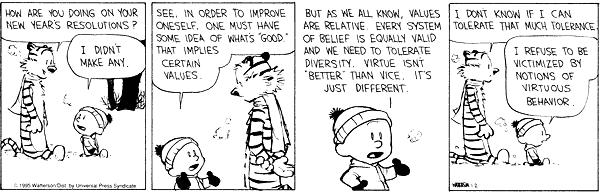
Saturday, April 21, 2007

http://davefaq.com/Opinions/Relativism/1995-01-02.Relativism_Resolutions.gif
From The American Thinker:
Was Cho taught to hate?

By James Lewis

Yes, I know. Tens of thousands of ordinary college students are lonely, full of rage, lost and frustrated. A few percent are psychotically disturbed, and some of them can kill. Our big factory colleges are alienating. Take millions of adolescents, and at any time there are bound to be quite a few confused and seething souls walking loose. Just visit downtown in any American or European city, and you can see all the lost and disturbed living in their private hells. And no, that doesn't excuse executing thirty-two innocents.

Still, I wonder --- was Cho taught to hate? Whatever he learned in his classes --- did it enable him to rage at his host country, to hate the students he envied so murderously? Was he subtly encouraged to aggrandize himself by destroying others? Was his pathology enabled by the PC university? Or to ask the question differently --- was Cho ever taught to respect others, to admire the good things about his host country, and to discipline himself to build a positive life?

And that answer is readily available on the websites of Cho's English Department at Virginia Tech. This is a wonder world of PC weirdness. English studies at VT are a post-modern Disney World in which nihilism, moral and sexual boundary breaking, and fantasies of Marxist revolutionary violence are celebrated. They show up in a lot of faculty writing. Not by all the faculty, but probably by more than half.

Just check out their websites.

I wonder if Cho took the senior seminar by Professor Knapp, on "The self-justifying criminal in literature." Because he certainly learned to be a self-justifying criminal. Or whether he sat in courses with Nikki Giovanni, using her famous self-glorifying book, "The Prosaic Soul of Nikki Giovanni (2003)". Maybe he read Professor Bernice Hausman's "Changing Sex: Transsexualism, technology, and the idea of gender" --- just the thing for a disoriented young male suffering from massive culture shock on the hypersexual American campus. And even more gender-bending from Professor Paul Heilker, who wrote "Textual Androgyny, the Rhetoric of the Essay, and the Politics of Identity in Composition (or The Struggle to Be a Girly-Man in a World of Gladiator Pumpitude)." Or the Lesbian love stories of Professor Matthew Vollmer. Yup, that's just what this student needs. These trophy "art works" are all advertised on the English Department faculty websites.

Or maybe Cho was assigned Professor Lisa Norris' prize-winning book, Toy Guns, featured on her web site. The book reviewers wrote
"All ten stories in this disturbing collection revolve around Americans' passionate devotion to guns, gun-toting, sexually-tinged violence, and the womanly pursuit of power and dignity." [....]

"In each wrenching story, we see an America out of control, in love with war...."
I don't know any Americans who are in love with war, but that is the picture Cho got from his teachers. Having spent the last 14 years as a resident alien in the school system, he could know nothing else.

And then there is the big Marxist website from Professor Brizee, all in fiery red against pitch black, showing old, mass-murder-inspiring Karl flanked by two raised fists. It celebrates revolutionary violence and hate for capitalist America (which is paying for Cho's education). "Critical Social Theory" --- the euphemism for PoMo (Post Modern) Marxism --- is a big part of English teaching at VT. The Marxist page links prominently to the British Socialist Worker's Party, which is currently leading the charge for Islamic fascism through such creatures as George Galloway.

And, talking about Islamist ideas, there is Professor Carter-Tod, who wrote a report about "Treatment of Arab American, Muslums and Seiks (sic) Post 911," for the US Civil Rights Commission. The racial grievance industry is alive and growing at VT.

Post-modernism, with its hatred for reason, is another big theme at the VT English Department. Professor James Collier boasts about his book, Philosophy, Rhetoric and the End of Knowledge: A New Beginning for Science and Technology Studies, But "the end of knowledge" is the beginning of ignorance.

And of course there is the "diversity" crowd, diversity being a very well-funded program at ole' guilt-tripping VT. There's Professor Carlos Evia, who describes himself as "...soy director de la Comisión de Igualdad y Diversidad en Virginia Tech." Or in English, "I am also chair of the Virginia Tech Commission on Equal Opportunity and Diversity." There's "research" in "Feminist science fiction" and "The comic strip" from Professor Susan C. Allender-Hagedorn. Scratching racial and gender wounds until they bleed is a big preoccupation at VT. What's a kid from South Korea to think?

The question I have is: Are university faculty doing their jobs? At one time college teachers were understood to have a parental role. Take a look at the hiring and promotion criteria for English at VT, and you see what their current values are. Acting in loco parentis, with the care, protectiveness, and alertness for trouble among young people is the last thing on their minds. They are there to do "research," to act like fake revolutionaries, and to stir up young people to go out and revolt against society. Well, somebody just did.

I'm sorry but VT English doesn't look like a place that gives lost and angry adolescents the essential boundaries for civilized behavior. In fact, in this perversely disorienting PoMo world, the very words "civilized behavior" are ridiculed --- at least until somebody starts to shoot students, and then it's too late. A young culture-shocked adolescent can expect no firm guidance here. But we know that already.

What's the English Department's official frontpage reaction to the murder of thirty-two students just a few days ago? Here it is.

"We do not understand this tragedy 


We know we did nothing to deserve it

But neither does a child in Africa 


Dying of AIDS

Neither does the baby elephant watching his community 


Be devastated for ivory 


... Neither does the Mexican child looking 


For fresh water

... Neither does the Appalachian infant killed 


By a boulder 


Dislodged

Because the land was destabilized"
In other words: We didn't do nuthin.' It ain't our fault. It's greedy capitalism's fault. We don't teach civilized behavior, the value of reason, the cultural foundations of Western thought. We teach adolescent rage, because that's how we make a living. We do narcissistic "research" in Marxist analysis of American brutal capitalism. We're good people. See how much we care about AIDS in Africa. Don't blame us. We ain't responsible.

James Lewis blogs at www.dangeroustimes.wordpress.com
http://www.suspense-movies.com/images/film1/Sturges3.jpg
Gun control isn't the answer
Why one reaction to Virginia Tech
shouldn't be tightening firearm laws.
By James Q. Wilson


JAMES Q. WILSON teaches public policy at Pepperdine University and previously taught at UCLA and Harvard University. He is the author of several books, including "Thinking About Crime."

April 20, 2007

THE TRAGEDY at Virginia Tech may tell us something about how a young man could be driven to commit terrible actions, but it does not teach us very much about gun control.

So far, not many prominent Americans have tried to use the college rampage as an argument for gun control. One reason is that we are in the midst of a presidential race in which leading Democratic candidates are aware that endorsing gun control can cost them votes.

This concern has not prevented the New York Times from editorializing in favor of "stronger controls over the lethal weapons that cause such wasteful carnage." Nor has it stopped the European press from beating up on us unmercifully.

Leading British, French, German, Italian and Spanish newspapers have blamed the United States for listening to Charlton Heston and the National Rifle Assn. Many of their claims are a little strange. At least two papers said we should ban semiautomatic assault weapons (even though the killer did not use one); another said that buying a machine gun is easier than getting a driver's license (even though no one can legally buy a machine gun); a third wrote that gun violence is becoming more common (when in fact the U.S. homicide rate has fallen dramatically over the last dozen years).

Let's take a deep breath and think about what we know about gun violence and gun control.

First: There is no doubt that the existence of some 260 million guns (of which perhaps 60 million are handguns) increases the death rate in this country. We do not have drive-by poisonings or drive-by knifings, but we do have drive-by shootings. Easy access to guns makes deadly violence more common in drug deals, gang fights and street corner brawls.

However, there is no way to extinguish this supply of guns. It would be constitutionally suspect and politically impossible to confiscate hundreds of millions of weapons. You can declare a place gun-free, as Virginia Tech had done, and guns will still be brought there.

If we want to guess by how much the U.S. murder rate would fall if civilians had no guns, we should begin by realizing — as criminologists Franklin Zimring and Gordon Hawkins have shown — that the non-gun homicide rate in this country is three times higher than the non-gun homicide rate in England. For historical and cultural reasons, Americans are a more violent people than the English, even when they can't use a gun. This fact sets a floor below which the murder rate won't be reduced even if, by some constitutional or political miracle, we became gun-free.

There are federally required background checks on purchasing weapons; many states (including Virginia) limit gun purchases to one a month, and juveniles may not buy them at all. But even if there were even tougher limits, access to guns would remain relatively easy. Not the least because, as is true today, many would be stolen and others would be obtained through straw purchases made by a willing confederate. It is virtually impossible to use new background check or waiting-period laws to prevent dangerous people from getting guns. Those that they cannot buy, they will steal or borrow.

It's also important to note that guns play an important role in selfdefense. Estimates differ as to how common this is, but the numbers are not trivial. Somewhere between 100,000 and more than 2 million cases of self-defense occur every year.

There are many compelling cases. In one Mississippi high school, an armed administrator apprehended a school shooter. In a Pennsylvania high school, an armed merchant prevented further deaths. Would an armed teacher have prevented some of the deaths at Virginia Tech? We cannot know, but it is not unlikely.

AS FOR THE European disdain for our criminal culture, many of those countries should not spend too much time congratulating themselves. In 2000, the rate at which people were robbed or assaulted was higher in England, Scotland, Finland, Poland, Denmark and Sweden than it was in the United States. The assault rate in England was twice that in the United States. In the decade since England banned all private possession of handguns, the BBC reported that the number of gun crimes has gone up sharply.

Some of the worst examples of mass gun violence have also occurred in Europe. In recent years, 17 students and teachers were killed by a shooter in one incident at a German public school; 14 legislators were shot to death in Switzerland, and eight city council members were shot to death near Paris.

The main lesson that should emerge from the Virginia Tech killings is that we need to work harder to identify and cope with dangerously unstable personalities.

It is a problem for Europeans as well as Americans, one for which there are no easy solutions — such as passing more gun control laws.

Friday, April 20, 2007

http://www.mikevasas.com/blog/uploaded_images/monkees-795789.jpg
He's a believer
Peter Tork defends the Monkees' viability for Rock Hall of Fame

BY JOSEPH DIONISIO

joseph.dionisio@newsday.com

April 18, 2007

'So you better get ready," shouts the theme to the Monkees' 1960s TV series, "we may be comin' to your town!" Unless, of course, your town is Cleveland.

Peter Tork - whose band Shoe Suede Blues visits East Setauket and Patchogue this week - says the Monkees merit consideration for the Rock and Roll Hall of Fame, but one man opposes their induction.

"The only person ... holding a grudge is Jann Wenner of Rolling Stone," says the former Monkee. The magazine editor "has never written a gracious word. He personally has the veto power to keep us out."

How does the band - whose Emmy-winning show aped the Beatles' film "A Hard Day's Night" - rank against other inductees? Neither the Animals, the Rascals, the Lovin' Spoonful, the Dells, Del Shannon, Frankie Lymon nor Black Sabbath have more Top 20 singles than the Monkees' 10. Ratings aside, classics such as "Pleasant Valley Sunday" have aged better than the likes of Shannon, whose "Hat's Off to Larry" seems laughable as Hall justification.

Bands as disparate as the Sex Pistols ("Steppin' Stone"), Run-D.M.C. ("Mary, Mary") and The Church ("Porpoise Song") have covered Monkees' songs. Even Radiohead's "Go To Sleep" eerily channels Micky Dolenz's vocals.

"I'm convinced that Micky is one of the great singers of our time," Tork says. "He's always been something of a genius."

One notable fan is Michael Stipe, who reportedly vowed to bar R.E.M. from the Hall until the Monkees got in. Stipe declined comment, but in 1994 he did tell Rolling Stone that "The Monkees ... meant a lot more to me" than the Beatles. R.E.M. was finally inducted last month.

Wenner - who didn't reply to an interview request - allegedly denounces Tork, Dolenz, Davy Jones and Mike Nesmith for not playing their own instruments on the band's first albums.

In this "American Idol" era, when acts are "manufactured" like toasters, fewer critics crucify the Monkees for being a TV show that spawned a band. So have they faced an unfair standard? Were they, in fact, a "real" group?

"I've not heard the slightest murmur about the Monkees being fake," Tork, 65, says from his Connecticut home. "Everybody's forgotten it, except Wenner. He's been vicious."

One Rolling Stone reporter, Tork says, wrote a glowing story crystallizing their merits. But before publication, Tork adds, "The writer said, 'Jann took my article, gutted it and rewrote it to [bury] you.'"

Backed by producer Don Kirshner's songwriting stable - Carole King, Gerry Goffin, Neil Diamond, Neil Sedaka, Tommy Boyce and Bobby Hart - the band unleashed four straight No. 1 albums and three chart-toppers. They eventually penned their own catchy pop, albeit with less chart success.

"George Harrison used to say he wished his best songs were as good as the worst of Lennon-McCartney," Tork says. "So, we used to hope our best songs were as good as the worst of the Brill Building."

Tork's fame, however, is more about musicianship than songwriting. So said Jimi Hendrix, who called him the most talented Monkee. The guitarist opened several Monkees' gigs, including a '67 show at Forest Hills' West Side Tennis Club. Was his compliment accurate?

"I'm not sure it's quite true," says Tork, who plays guitar, banjo, piano and bass. "I'm far and away the best-trained musician, but I'm in awe of all three [Monkees]. Jimi meant that I was the most [receptive] to his kind of music."

Tork's new album - Shoe Suede Blues' "Cambria Hotel" (sold at cdbaby.com) - stars guitarist Richard Mikuls, bassist Arnold Jacks and drummer Jeff Olson. The band's name doesn't reflect Elvis, so much as a less fractious era in radio.

Besides a bluesy "Last Train to Clarksville," its hidden gem is an Indian violin-laced "For Pete's Sake," aka the show's closing theme. The album has medicinal value, Tork suggests.

"People listen to dance music like taking aspirin: to shut down the pain," he says. "But the blues puts you back together. Like penicillin, it's therapeutic. If I can bring a microscopic bit of that feeling ... my career's in good shape.

The Monkees today:

DAVY JONES, 61 ... the lone British Monkee


His fame led David Bowie (originally David Jones) to change his name ... Tony nominee for "Oliver!" in '60s ... he and Dolenz had little musical training before the series' NBC debut on Sept. 12, 1966.

MIKE NESMITH, 64 ... aka Wool Hat

He wrote Linda Ronstadt's "Different Drum" ... video pioneer who paved the way for creation of MTV ... his mom, Bette Nesmith, invented Liquid Paper in the '50s Skipped most Monkee reunions, and keeps little contact.

MICKY DOLENZ, 62

Earned TV success as child star (1956's "Circus Boy"), director ("Boy Meets World")... auditioned as Fonzie on "Happy Days" and Riddler in '95's "Batman," but voiced Two-Face in a Bat 'toon ... son of actor George Dolenz … former DJ at WCBS/101.1 FM.

Copyright 2007 Newsday Inc.

Thursday, April 19, 2007

http://www.givingto.vt.edu/images/vigil-big.jpg

This is the single best piece yet written about the Virginia Tech killings and cultural grief-mongering.

Sense and Sensibility
by Thomas Fleming

The shootings at Virginia Tech have aroused, once again, a national discussion, not only of campus security and gun control, but of the more fundamental questions of who we think we are as American and who we would like to be. The debate, as much as the killings, gives testimony (though not “eloquent testimony”) to our degeneracy. We should find the grandiloquent statements of public officials particularly disturbing.

The president of the university, fumbling for the right cliché, described this as a tragedy of monumental proportions. Setting aside the misleading metaphorical use of “monumental,” it would be interesting to learn what he thought he was saying other than “This is really bad.” These incidents are inevitably called tragedies, but that is precisely what they are not. In a tragedy like Oedipus or Macbeth, a basically great man, trusting in his own abilities, deludes himself into making self-destructive decisions. Flaws in his character lead him first to arrogance and then down the path of folly and ruin. Tragedies make sense of the human world, while these pointless murders seem to reveal a world that makes no sense. In calling them tragedies, we are essentially saying that human existence is pointless.

This is not just a “semantic point.” It is all too true that most Americans are like most people everywhere in all periods of history: They speak without thinking. But unreflective peasants relied on proverbs and clichés that were deeply rooted in historical experience. Our clichés and mental tics are almost always bits of propaganda invented by liberals ignorant of human nature and human history. In our mythology, children are smarter than adults, racial minorities smarter than whites, women stronger and braver than men. We believe that we really do care about people killing each other in Nigeria, even though we do nothing about the murders taking place on the other side of town, and we insist on calling every pointless misfortune a tragedy. We can only talk this way because we have tossed away our moral compasses.

The President of the United States arrived in Blacksburg with his wife, saying their hearts were “full of sorrow.” I know we have come to expect this sort of talk from politicians, but it cannot be true. The President knew none of these people and had no particular connection to the university. If he had such sorrow in his heart every time a baby was aborted or a drunk driver wiped out a family, he could not get through the day. If shaking your head and saying, those poor kids, constitutes a heart full of sorrow, then I suppose my heart is just as filled as the President’s, but I have managed to eat a good dinner every day, do my job, joke with friends, and rejoice in the birth of a grandchild. When Simon Cowell rolled his eyes in impatience over an American Idol contestant who tried to manipulate the audience by expressing his heartfelt condolences, he was given the Don Imus treatment. I am not a fan of Mr. Cowell or the nauseating music he promotes, but his manifest disgust revealed a residual sense of shame I should have thought he had jettisoned long ago.

Do we make these phony condolences because we are hypocrites or because we do not know what sorrow is? When my mother died, my father went into shock and did not wish to live. Other family members were in a daze. We ate little and could only talk of one subject. That is sorrow. The more we feign sorrow for strangers, the less capable we are of sorrow and compassion for the people we know and for whom we are responsible. The late 18th century was also filled with gross sentimentalism (read Henry MacKenzie’s gushy The Man of Feeling or Voltaire’s stupid and vindictive comments on the Lisbon earthquake). The best antidote is still Jane Austen, especially Sense and Sensibility. Confronted with this phenomenon in its earliest stages, Austen (like Dr. Johnson) recognized it as pernicious cant.

George Bush is President of a country where more than 40 people are murdered on an average day. If the statistics I have seen are accurate, illegal aliens alone account for about a dozen, and they kill a dozen more in drunk driving accidents. Yet, faced with this problem, all the President can talk about is amnesty and guest worker programs. In Iraq, as a direct result of decisions made by George Bush, many more people are murdered every day—perhaps 60-70,000 civilians since we launched our invasion. If he has a heart, it should be brimful of sorrow for his victims, American and Iraqi, in a war that he must have known he could not win. If he entertained dreams of victory, he should not have been elected, and if he still entertains them, he should be removed from office.

It was within hours of the shooting that the professional counselors began arriving, as predictably as ambulance-chasing lawyers at an accident scene. As a people we are grown so dependent on “professionals” we cannot even mourn the death of a friend with grief counselors or, as I heard on NPR, “grievance counselors.” (Someone should start a blog to record the constant gaffes in usage, syntax, and pronunciation on NPR. I would do it here, but the errors of Renee Montaigne alone would probably exhaust our band width.)

Man cannot live without the ceremonials of religion, and since Virginia is still, nominally at least, part of the Christian South, some people turned to their pastors and their churches. More commonly, it seems from the accounts of journalists, VT students and Blacksburg residents showed solidarity by taking part in mass rallies where they wore the school colors and chanted the school’s football cheers. There is nothing wrong per se with any of this, but it strikes me as odd to see mass murders commemorated by pep rallies. What a strange people we have become. I am happy to learn I am not the only crank. Scott Richert sent me a link to Relapsed Catholic Blog on which one “Kathy” declares:

“Please don’t indulge in godless modern paganism and set up homely, self-indulgent makeshift memorials with cheap flowers and teddy bears. Don’t hold hands and sing bad pop songs.

Go to church. That’s what it’s for. For centuries, people smarter than you and with more finely honed aesthetics worked on rituals that actually do what they’re supposed to do.

Those people who hung around outside the Palace after Princess Diana’s death looked like fools and you will too if you cave to the lure of cheap grace and post-modern superficiality. Those British mourners displayed as much cringe-inducing, pan- generational learned helplessness as Katrina survivors, but their laziness and ignorance was spiritual.

Worse, you will still feel as empty as you did before, maybe more so, and wonder why.

Don’t make America look stupid and shallow to the whole world by Disneyfying your grief.”

Every mass killing is a boost for the gun control movement. In this case, I have to wonder why Virginia allows aliens to purchase firearms. Contrary to the libertarian propaganda being spewed out, gun ownership is not a universal human right; it is a civil right guaranteed by our Constitution. We should pass a federal law stipulating that no alien, unless his security requires it, can legally acquire a gun. Punishment should be expulsion from the US.

There is little doubt that armed young men used to be able to defend themselves. I am not at all sure of what contemporary college students would do with a gun. When I was a college student, a large number of the young men in my dormitory had a gun or guns in the room. I do not know exactly how many. Guns, like alcohol and women, were forbidden, but I do not recall anyone being suspended for infraction of any of these rules. If Cho Seung-Hui had invaded my dorm, he would not have lasted more than a few minutes.

If college professors were not such feebes and foulballs, I would propose arming them. On the other hand, why do we trust such people to form the minds of our children if we cannot trust them to carry guns? Some of us are old enough to remember when a famous classics professor was fired from the University of Illinois for taking a gun to class. Revilo P. Oliver was a founder of the John Birch Society and the only distinguished man the Birchers have ever had in their leadership. After receiving many death threats, he decided to carry a gun. As I recall, the AAUP took up his case and got him reinstated. Those were the days.

In principle I believe, as I have always believed, that an armed citizenry is the only solid basis for political liberty. However, the more I see of my fellow citizens in action, the more I am beginning to see the point of gun control. Few of them seem to have any part of the old American character, and still fewer have any understanding of republican government. Most of us, left and right alike, are consumers and subjects, but not citizens. Would free-minded conservative citizens have allowed their minds to be controlled by the neoconservatives at the Wall Street Journal, much less have voted twice for George W. Bush? Half of them still think Saddam used his weapons of mass destruction to attack the US on September 11.

Americans today are not free nor do they wish to be free. Judging by the average American’s boorish behavior in public, in shopping malls and behind the wheel of their cars, they should not be allowed to own pellet guns, much less a semi-automatic pistol. If we had an effective authoritarian government with a responsible constabulary that kept the hooligans in order, I might be willing to surrender my weapons. Since that day seems a long way off, it is better to be armed.

In the past few days, I have been asked what people can do to protect themselves against random violence. The simple answer is “I do not know.” In high schools and universities, much of the fault lies with boards and administrators, who have almost entirely abrogated their responsibility to act in loco parentis. Coed dorms, open campuses, toleration of drugs, promotion of athletics, and a refusal to maintain a vigilant scrutiny over the students has turned once safe havens into cesspools of violence and vice. Cho had been caught stalking two different coeds and taken in for counseling. The parents of the victims have a right to know why he was still in school.

Naturally, educators always claim that schools only reflect society, but throughout the past 100 years, educationists have claimed they are transforming society by changing the minds of students. None of the changes in school life is an accident; all of them could be reversed. But the administrators would rather promote their leftist agenda than protect the young people who have been entrusted to their care. And, when a conscientious teacher actually does warn the counselors and police about Cho’s violent propensities, she is rebuffed on some theory that students have rights.

So my first piece of advice is never to trust the institutions. Most of them are so big as to be unmanageable. Schools like VT, with student populations that number in the tens of thousands, are anonymous jungles. In a school of 500, Cho would either have learned to fit in or have attracted such hostile attention as to force him out. My second point is to be very careful about whom you associate with. In the old days, young women did not keep company with people her family did not know. It sounds old-fashioned, but one way or the other we have to reproduce some of the old gossipy community spirit that snooped on neighbors and kept tabs on oddballs.

The truth is that very few people in the American middling and upper classes are likely to be the victims of random violence. More important than protection from drive-by shooting or classroom killers is protection from the lethal sentimentality that has infected public discourse. Shun the counselors and avoid the neopagan ceremonials that are occasions for wallowing in unhappiness. And, whether you believe or not, seek solace in the Church, which has been treating the effects of sin and misery for 2000 years.

Comments sent in will be posted in a section on the Cultural Revolutions blog, which will be open to civil and relevant comments.

A Culture of Passivity
"Protecting" our "children" at Virginia Tech.

By Mark Steyn

I haven’t weighed in yet on Virginia Tech — mainly because, in a saner world, it would not be the kind of incident one needed to have a partisan opinion on. But I was giving a couple of speeches in Minnesota yesterday and I was asked about it and found myself more and more disturbed by the tone of the coverage. I’m not sure I’m ready to go the full Derb but I think he’s closer to the reality of the situation than most. On Monday night, Geraldo was all over Fox News saying we have to accept that, in this horrible world we live in, our “children” need to be “protected.”

Point one: They’re not “children.” The students at Virginia Tech were grown women and — if you’ll forgive the expression — men. They would be regarded as adults by any other society in the history of our planet. Granted, we live in a selectively infantilized culture where twentysomethings are “children” if they’re serving in the Third Infantry Division in Ramadi but grown-ups making rational choices if they drop to the broadloom in President Clinton’s Oval Office. Nonetheless, it’s deeply damaging to portray fit fully formed adults as children who need to be protected. We should be raising them to understand that there will be moments in life when you need to protect yourself — and, in a “horrible” world, there may come moments when you have to choose between protecting yourself or others. It is a poor reflection on us that, in those first critical seconds where one has to make a decision, only an elderly Holocaust survivor, Professor Librescu, understood instinctively the obligation to act.

Point two: The cost of a “protected” society of eternal “children” is too high. Every December 6th, my own unmanned Dominion lowers its flags to half-mast and tries to saddle Canadian manhood in general with the blame for the “Montreal massacre,” the 14 female students of the Ecole Polytechnique murdered by Marc Lepine (born Gamil Gharbi, the son of an Algerian Muslim wife-beater, though you’d never know that from the press coverage). As I wrote up north a few years ago:

Yet the defining image of contemporary Canadian maleness is not M Lepine/Gharbi but the professors and the men in that classroom, who, ordered to leave by the lone gunman, meekly did so, and abandoned their female classmates to their fate — an act of abdication that would have been unthinkable in almost any other culture throughout human history. The “men” stood outside in the corridor and, even as they heard the first shots, they did nothing. And, when it was over and Gharbi walked out of the room and past them, they still did nothing. Whatever its other defects, Canadian manhood does not suffer from an excess of testosterone.

I have always believed America is different. Certainly on September 11th we understood. The only good news of the day came from the passengers who didn’t meekly follow the obsolescent 1970s hijack procedures but who used their wits and acted as free-born individuals. And a few months later as Richard Reid bent down and tried to light his shoe in that critical split-second even the French guys leapt up and pounded the bejasus out of him.

We do our children a disservice to raise them to entrust all to officialdom’s security blanket. Geraldo-like “protection” is a delusion: when something goes awry — whether on a September morning flight out of Logan or on a peaceful college campus — the state won’t be there to protect you. You’ll be the fellow on the scene who has to make the decision. As my distinguished compatriot Kathy Shaidle says:

When we say “we don’t know what we’d do under the same circumstances”, we make cowardice the default position.

I’d prefer to say that the default position is a terrible enervating passivity. Murderous misfit loners are mercifully rare. But this awful corrosive passivity is far more pervasive, and, unlike the psycho killer, is an existential threat to a functioning society.

— Mark Steyn, a National Review columnist, is author of America Alone.

Wednesday, April 18, 2007

http://archive.seacoastonline.com/2003news/5_17.jpg
A Post-Imus Republic Of Virtue
By Tony Blankley

The Imus affair was not about Don Imus; it was -- and more importantly, is -- about the motives of those who brought him down. And we should be familiar with those motives, because they recur throughout history. They were well articulated in a once famous speech:

"Since virtue (good citizenship) and equality are the soul of the republic ... it follows that the first rule of your political conduct must be to relate all of your measures to the maintenance of equality and to the development of virtue.

"... What is our goal? The enforcement of the constitution for the benefit of the people. Who will our enemies be? The vicious and the rich. What means will they employ? Slander and hypocrisy ... The people must therefore be enlightened. But what are the obstacles to the enlightenment of the people? Mercenary writers who daily mislead them with impudent falsehoods. What conclusions may be drawn from this? These writers must be proscribed as the most dangerous enemies of the people. Right-minded literature must be scattered about in profusion.

"... If the driving force of popular government in peacetime is virtue, that of popular government during a revolution is both virtue and terror: virtue, without terror is destructive; terror without which virtue is impotent. Terror is only justice that is prompt, severe, and inflexible; it is thus an emanation of virtue; it is less a distinct principle than a consequence of the general principle of democracy applied to the most pressing needs of the patrie."

These are excerpts from the speech "Republic of Virtue," by Maximilien Robespierre in 1794, which justified and accelerated the Reign of Terror into its culmination, "La Grande Terreur" (The Great Terror) -- the blood bath from which the French Revolution never fully recovered.

Do I exaggerate? Of course. Last week, the mob didn't cut off Imus's head, merely his microphone. But it is by studying repression of ideas in its extreme, unambiguous form that we may understand clearly its earlier, partly obscured symptoms and motives.

For me, the repressive mentality was brought home last week while participating in a National Public Radio interview on the Imus affair. A "respected" liberal journalist and I were exchanging views when she said (to closely paraphrase): As long as we got Imus off the air, I don't much care how we did it.

In other words, the ends justify the means. If Imus's words are destructive, the people shouldn't hear them. Just shut him up any way you can. Of course, the acceptance of the proposition that "bad" words or ideas should be suppressed is itself, a priori, a rejection of the principle of free speech.

But note, we need to distinguish between constitutional free speech and a culture conducive to free speech. Neither Imus, nor any of us, have a right to be published or broadcast. Constitutionally, we only have a right to stand on a street corner or otherwise self-publish our ideas and words.

But a culture that cheers on collective efforts at suppression of heresy, dissent or other unpopular words is every bit as chilling as one merely enforced by law. And there is usually a political agenda (often hidden) behind such public exhortations to suppression: Crassly silence one's political opponent in the name of public virtue. Or, as in the case of Imus, use his suppression as a chilling threat to others -- who are one's true political enemies.

Imus used a nasty phrase, reasonably believed by many to have been hateful. His transgression was merely a convenient moment to launch an intimidating suppression campaign against other "hate speech."

But we all know that "hate speech" is in the ear of the listener. In Europe, citizens can be -- and have been -- criminally prosecuted for calling elements of Islam violence-prone. The great crusading journalist Oriana Fallaci was forced to live out her last cancer-ridden days in exile to avoid paying the penal price for her honest (and accurate) expressions on that topic.

Dissent is often filled with hate -- at objects well worthy of such hatred. But whether the hatred is justified or not, once we have accepted the proposition that hateful speech should not be free, we have lost the battle. The right to speak offensively is at the heart of freedom of expression. One needs no rights to say that puppies are cute, or that it's nice to be nice.

And it is worth noting who has been defending Imus's rights. Although he is a liberal and gave his microphone over to mostly liberal journalists, it was conservatives (and out of the mainstream lefties like Rosie O'Donnell and Bill Maher) who defended his right. Because we are the ones who value and need both a law and culture of free expression.

The liberal journalists were mostly hiding under their desks last week, because their ability to be published and broadcast is dependent, not on freedom of expression, but on friends in high media places (the executive suites of CBS. NBC, ABC, NY Times, Newsweek, Time, etc.)

If one has friends in the palace, one doesn't need justice -- but one must be careful not to displease one's friends. It is the common people, the outcasts who need justice.

While the executives in the liberal media elite no more represent the views of Americans than Louis XVI represented the sentiments of the French people, they do represent current media power -- and they are weak and easily scared by activists such as Sharpton and others who brandish the charge of "hate speech" at commentators who don't support their political agenda.

Imus may be an imperfect martyr, but the malign forces that brought him down must be opposed ferociously.

Monday, April 16, 2007

07.04.10.OffColor-X.gif


The Imus Lynch Party
By Patrick J. Buchanan

In the end, it was not about Imus. It was about us.

Are we really a better country because, after he was publicly whipped for 10 days as the worst kind of racist, with whom no decent person could associate, he was thrown off the air?

Cards on the table.

This writer works for MSNBC, has been on the Imus show scores of times, watches Imus every morning, and likes the show, the music and the guys: the I-Man, Bernie, Charles and Tom Bowman.

And Imus is among the best interviewers in our business. Not only does he read and follow the news closely, he listens and probes as well as any interviewer in America. Because he is a comic, people mistake how good a questioner he is.

Is "Imus in the Morning" outrageous? Over the top at times? Are things said every week, if not every day, where you say, "He's going too far"? Yeah. But outrageousness is part of the show, whether the skits are of "Teddy Kennedy," "Reverend Falwell," "Mayor Nagin" or "The Cardinal."

And when Imus called the Rutgers women's basketball team "tattooed ... nappy-headed ho's," he went over the top. The women deserved an apology. There was no cause, no call to use those terms. As Ann Coulter said, they were not fair game.

But Imus did apologize, again and again and again.

And lest we forget, these are athletes in their prime, the same age as young women in Iraq. They are not 5-year-old girls, and they are capable of brushing off an ignorant comment by a talk-show host who does not know them, or anything about them.

Who, after all, believed the slur was true? No one.

Compare, if you will, what was done to them—a single nasty insult—to the savage slanders for weeks on end of the Duke lacrosse team and the three players accused by a lying stripper of having gang-raped her at a frat party.

Duke faculty and talking heads took that occasion to vent their venom toward all white "jocks" on college campuses. Where are the demands for apologies from the talk-show hosts, guests, Duke faculty members and smear artists, all of whom bought into the lies about those Duke kids—because the lies comported with their hateful view of America?

And hate is what this is all about.

While the remarks of Imus and Bernie about the Rutgers women were indefensible, they were more unthinking and stupid than vicious and malicious. But malice is the right word to describe the howls for their show to be canceled and them to be driven from the airwaves—by phonies who endlessly prattle about the First Amendment.

The hypocrisy here was too thick to cut with a chainsaw.

What was the term the I-Man used? It was "ho's," slang for whores, a term employed ad infinitum et ad nauseam by rap and hip-hop "artists." It is a term out of the African-American community. Yet, if any of a hundred rap singers has lost his contract or been driven from the airwaves for using it, maybe someone can tell me about it.

If the word "ho's" is a filthy insult to decent black women, and it is, why are hip-hop artists and rap singers who use it incessantly not pariahs in the black community? Why would black politicians hobnob with them? Why are there no boycotts of the advertisers of the radio stations that play their degrading music?

Answer: The issue here is not the word Imus used. The issue is who Imus is—a white man, who used a term about black women only black folks are permitted to use with impunity and immunity.

Whatever Imus' sins, no one deserves to have Al Sharpton—hero of the Tawana Brawley hoax, resolute defender of the fake rape charge against half a dozen innocent guys, which ruined lives—sit in moral judgment upon them.

"It is our feeling that this is only the beginning. We must have a broad discussion on what is permitted and not permitted in terms of the airwaves," says Sharpton. It says something about America that someone with Al's track record can claim the role of national censor.

Who is next? And why do we take it?

I did a bad thing, but I am not a bad person, says Imus. Indeed, whoever used his microphone to do more good for more people—be they the cancer kids of Imus Ranch, the families of Iraq war dead now more justly compensated because of the I-Man or the cause of a cure for autism?

"We know no spectacle so ridiculous as the British public in one of its periodic fits of morality," said Lord Macaulay. Unfortunately, Macaulay never saw the likes of the Revs. Sharpton and Jackson.

Imus threw himself on the mercy of the court of elite opinion—and that court, pandering to the mob, lynched him. Yet, for all his sins, he was a better man than the lot of them rejoicing at the foot of the cottonwood tree.

Patrick J. Buchanan needs no introduction to VDARE.COM readers; his book State of Emergency: The Third World Invasion and Conquest of America, can be ordered from Amazon.com.

http://www.actioninengland.gb.com/Denmark/halal.jpg


From Captain's Quarters:

The End Result Of Multiculturalism

Katherine Kersten follows up today on her column last week regarding the installation of foot-washing basins for Muslims at Minneapolis Community Technical College. Kersten digs deeper into the process by which MCTC will modify its facilities to accommodate the requirements of a specific religion, and discovers the less-than-tolerant agenda of the group advising them (via Power Line):

But I also discovered something more important for colleges seeking guidance on "accommodations": Projects like MCTC's are likely to be the first step in a long process.

The task force's eventual objectives on American campuses include the following, according to the website: permanent Muslim prayer spaces, ritual washing facilities, separate food and housing for Muslim students, separate hours at athletic facilities for Muslim women, paid imams or religious counselors, and campus observance of Muslim holidays. The task force is already hailing "pioneering" successes. At Syracuse University in New York, for example, "Eid al Fitr is now an official university holiday," says an article featured on the website. "The entire university campus shuts down to mark the end of Ramadan." At Henry Ford Community College in Dearborn, Mich., "halal" food -- ritually slaughtered and permissible under Islamic law -- is marked by green stickers in the cafeteria and "staff are well-trained in handling practices."

At Georgetown University, Muslim women can live apart in housing that enables them to "sleep in an Islamic setting," as the website puts it. According to a student at the time the policy was adopted, the university housing office initially opposed the idea, on grounds that all freshman should have the experience of "living in dorms and dealing with different kinds of people." That might sound appealing, Muslim students told a reporter in an article featured on the website. But in their view, the reporter wrote, "learning to live with 'different kinds of people' " actually "causes more harm than good" for Muslims, because it requires them to live in an environment that "distracts them from their desire to become better Muslims, and even draw[s] weaker Muslims away from Islam."

In other words, what we will get from this process of multiculturalism is precisely the kind of "separate but equal" facilities struck down by the Supreme Court in Brown v Board of Education in 1954. These Muslim activists want to create a separate society within the United States for Muslims, and they want the US to provide them the facilities with which to create it. Separate dorms, separate cafeterias, Muslim-only physical-education classes -- they want a separate Muslim college at MCTC and everywhere else. It's self-initiated apartheid.

Forty years ago and more, we had segregationists insisting that different peoples could not live within the same area without dividing lines. They used the same excuses as multiculturalists do today, too; each culture feels more secure when they can exclude others. We heard it from white supremacists and from black separatists -- and we proved them wrong. We made sure that people knew America stood for peaceful integration and not for Balkanization, even for what seemed to be good reasons to some.

Now we have Muslims who want to reopen the argument in order to create a closed society for themselves within the US. We have no problem with Muslims who integrate into our society and become Americans in deed as well as in name. If Muslims want to open their own universities to ensure the proper exercise of their religion, well, that works too. But if Muslims want us to recreate the French banlieus and an homage to Jim Crow so they can get even more insular than they already are here in the US, then we need to put our foot down -- washed or unwashed -- and say, "Enough!"

We do not need religious apartheid at MCTC or any other public university or facility. If devout Muslims do not want to integrate into American society, then they need to find another place to live. Period.

Posted by Ed Morrissey

Sunday, April 15, 2007

http://www.atlantajewish.com/graphics/subpages/content/032006/kinky-inside.jpg
From The New York Daily News:
COWARDS KICK AWAY ANOTHER PIECE OF AMERICA'S SOUL
By KINKY FRIEDMAN


April 15, 2007 -- Author, musician and former Texas gubernatorial candidate Kinky Friedman has been friends with Don Imus since 1975, when they met on stage at The Bottom Line.

I MET Imus on the gangplank of Noah's Ark. He was then and remains today a truth-seeking missile with the best bull-meter in the business.

Far from being a bully, he was a spiritual chop-buster never afraid to go after the big guys with nothing but the slingshot of ragged integrity. I watched him over the years as he struggled with his demons and conquered them. This was not surprising to me.

Imus came from the Great Southwest, where the men are men and the emus are nervous. And he did it all with something that seems, indeed, to be a rather scarce commodity these days. A sense of humor.

There's no excusing Imus' recent ridiculous remark, but there's something not kosher in America when one guy gets a Grammy and one gets fired for the same line.

The Matt Lauers and Al Rokers of this world live by the cue-card and die by the cue-card; Imus is a rare bird, indeed - he works without a net. When you work without a net as long as Imus has, sometimes you make mistakes.

Wavy Gravy says he salutes mistakes. They're what makes us human, he claims. And humanity beyond doubt, is what appears to be missing from this equation. If we've lost the ability to laugh at ourselves, to laugh at each other, to laugh together, then the PC world has succeeded in diminishing us all.

Political correctness, a term first used by Joseph Stalin, has trivialized, sanitized and homogenized America, transforming us into a nation of chain establishments and chain people.

Take heart, Imus. You're merely joining a long and legendary laundry list of individuals who were summarily sacrificed in the name of society's sanctimonious soul: Socrates, Jesus, Galileo, Joan of Arc, Mozart and Mark Twain, who was decried as a racist until the day he died for using the N-word rather prolifically in "Huckleberry Finn."

Speaking of which, there will always be plenty of Al Sharptons and Jesse Jacksons around. There will be plenty of cowardly executives, plenty of fair-weather friends, and plenty of Jehovah's Bystanders, people who believe in God but just don't want to get involved. In this crowd, it could be argued that we need a Don Imus just to wake us up once in a while.

There probably isn't a single one of Imus' vocal critics who come anywhere close to matching his record of philanthropy or good acts on this earth.

Judge a man by the size of his enemies, my father used to say. A man who, year after year, has raised countless millions of dollars and has fought hand-to-hand to combat against childhood cancer, autism, and SIDS - well, you've got a rodeo clown who not only rescues the cowboy, but saves the children as well.

I believe New York will miss its crazy cowboy and America will miss the voice of a free-thinking independent-minded, rugged individualist. I believe MSNBC will lose many viewers and CBS radio many listeners.

Too bad for them. That's what happens when you get rid of the only guy you've got who knows how to ride, shoot straight and tell the truth.
