Friday, April 04, 2008

From The Wall Street Journal:
Obama and King

By JUAN WILLIAMS

April 4, 2008

Martin Luther King Jr. died at age 39; today, the 40th anniversary of his death, is the first time he has been gone longer than he lived.

Figures such as Jesse Jackson and Al Sharpton have tried to claim his place on the American stage. But at most they have achieved fame and wealth. What separated King from any would-be successor was his moral authority. He towered above the high walls of racial suspicion by speaking truth to all sides.

[Obama and King]
Corbis
Martin Luther King, Jr. during the march
on Washington.

Now comes Barack Obama, a black man and a plausible national leader, who appeals across racial lines. But to his black and white supporters, Mr. Obama increasingly represents different things.

The initial base of support for Mr. Obama's presidential campaign came from young whites – who saw in him the ability to take the nation to a place where, to quote from King's "I Have A Dream" speech, "we shall be able to transform the jangling discords of our nation into a beautiful symphony of brotherhood."

Black voters rallied to Mr. Obama after whites in Iowa and New Hampshire showed they were willing to vote for him. Mr. Obama spoke directly to charges that he was not "black enough," that he was not a child of the civil rights movement because he grew up in Hawaii and has an Ivy League education, that he is too young, it is not his time, and even that his campaign is too risky because white racists might kill him.

Mr. Obama, his wife Michelle and supporters such as Oprah Winfrey make the case to black voters that he is the fruit of the struggles of King and others. They argue that this generation of black Americans does not have to wait for their turn to reach for the ultimate political power of the presidency.

Mr. Obama has carried a message of pride and self-sufficiency to black voters nationwide, who have rewarded him with support reaching 80% and higher. His candidacy has become, as the headline on Ebony magazine put it, a matter of having a black man as president "In Our Lifetime."

Among his white supporters, race is coincidental, not central, to his political identity. Mr. Obama is to them the candidate who personifies the promise of equal opportunity for all. But as black support has become central to his victories, this idealistic view has been increasingly at war with the portrayal, crafted by the senator to win black support, of him as the black candidate. The terrible tension between these racially distinct views now surrounds and threatens his campaign.

So far, Mr. Obama has been content to let black people have their vision of him while white people hold to a separate, segregated reality. He is a politician and, unlike King, his goal is winning votes, not changing hearts. Still, it is a key break from the King tradition to sell different messages to different audiences based on race, and to fail to challenge racial divisions in the nation.

Mr. Obama's major speech on race last month was forced from him only after a political crisis erupted: It became widely known that he'd sat for 20 years in the pews of a church where Rev. Jeremiah Wright lashed out at white people. The minister cursed America as worthy of damnation, made lewd suggestions about the nature of President Clinton's relationship with black voters, and embraced the paranoid idea that the white government was spreading AIDS among black people.

[Barack Obama]

Here is where the racial tension at the heart of Mr. Obama's campaign flared into view. He either shared these beliefs or, lacking good judgment, decided it politically expedient for an ambitious young black politician trying to prove his solidarity with all things black, to be associated with these rants. His judgment and leadership on the critical issue of race is in question.

While speaking to black people, King never condescended to offer Rev. Wright-style diatribes or conspiracy theories. He did not paint black people as victims. To the contrary, he spoke about black people as American patriots who believed in the democratic ideals of the country, in nonviolence and the Judeo-Christian ethic, even as they overcame slavery, discrimination and disadvantage. King challenged white America to do the same, to live up to their ideals and create racial unity. He challenged white Christians, asking them how they could treat their fellow black Christians as anything but brothers in Christ.

When King spoke about the racist past, he gloried in black people beating the odds to win equal rights by arming "ourselves with dignity and self-respect." He expressed regret that some black leaders reveled in grievance, malice and self-indulgent anger in place of a focus on strong families, education and love of God. Even in the days before Congress passed civil rights laws, King spoke to black Americans about the pride that comes from "assuming primary responsibility" for achieving "first class citizenship."

Last March in Selma, Ala., Mr. Obama appeared on the verge of breaking away from the merchants of black grievance and victimization. At a commemoration of the 1965 Selma-to-Montgomery march for voting rights, he spoke in a King-like voice. He focused on traditions of black sacrifice, idealism and the need for taking personal responsibility for building strong black families and communities. He said black people should never "deny that its gotten better," even as the movement goes on to improve schools and provide good health care for all Americans. He then challenged black America, by saying that "government alone can't solve all those problems . . . it is not enough just to ask what the government can do for us -- it's important for us to ask what we can do for ourselves."

Mr. Obama added that better education for black students begins with black parents visiting their children's teachers, as well as turning off the television so children can focus on homework. He expressed alarm over the lack of appreciation for education in the black community: "I don't know who taught them that reading and writing and conjugating your verbs were something white. We've got to get over that mentality." King, he added later, believed that black America has to first "transform ourselves in order to transform the world."

But as his campaign made headway with black voters, Mr. Obama no longer spoke about the responsibility and the power of black America to appeal to the conscience and highest ideals of the nation. He no longer asks black people to let go of the grievance culture to transcend racial arguments and transform the world.

He has stopped all mention of government's inability to create strong black families, while the black community accepts a 70% out-of-wedlock birth rate. Half of black and Hispanic children drop out of high school, but he no longer touches on the need for parents to convey a love of learning to their children. There is no mention in his speeches of the history of expensive but ineffective government programs that encourage dependency. He fails to point out the failures of too many poverty programs, given the 25% poverty rate in black America.

And he chooses not to confront the poisonous "thug life" culture in rap music that glorifies drug use and crime.

Instead the senator, in a full political pander, is busy excusing Rev. Wright's racial attacks as the right of the Rev.-Wright generation of black Americans to define the nation's future by their past. He stretches compassion to the breaking point by equating his white grandmother's private concerns about black men on the street with Rev. Wright's public stirring of racial division.

And he wasted time in his Philadelphia speech on race by saying he can't "disown" Rev. Wright any more than he could "disown the black community." No one has asked him to disown Rev. Wright. Only in a later appearance on "The View" television show did he say that he would have left the church if Rev. Wright had not retired and not acknowledged his offensive language.

As the nation tries to recall the meaning of Martin Luther King today, Mr. Obama's campaign has become a mirror reflecting where we are on race 40 years after the assassination. Mr. Obama's success has moved forward the story of American race relations; King would have been thrilled with his political triumphs.

But when Barack Obama, arguably the best of this generation of black or white leaders, finds it easy to sit in Rev. Wright's pews and nod along with wacky and bitterly divisive racial rhetoric, it does call his judgment into question. And it reveals a continuing crisis in racial leadership.

What would Jesus do? There is no question he would have left that church.

Mr. Williams is a political analyst for National Public Radio and Fox News.

Thursday, April 03, 2008

The image “http://cagle.com/news/ObamaObama/images3/nease.jpg” cannot be displayed, because it contains errors.
OBAMA'S DIMESTORE 'MEIN KAMPF'
by Ann Coulter

April 2, 2008

If characters from "The Hills" were to emote about race, I imagine it would sound like B. Hussein Obama's autobiography, "Dreams From My Father."

Has anybody read this book? Inasmuch as the book reveals Obama to be a flabbergasting lunatic, I gather the answer is no. Obama is about to be our next president: You might want to take a peek. If only people had read "Mein Kampf" ...

Nearly every page -- save the ones dedicated to cataloguing the mundane details of his life -- is bristling with anger at some imputed racist incident. The last time I heard this much race-baiting invective I was ... in my usual front-row pew, as I am every Sunday morning, at Trinity United Church of Christ in Chicago.

Obama tells a story about taking two white friends from the high school basketball team to a "black party." Despite their deep-seated, unconscious hatred of blacks, the friends readily accepted. At the party, they managed not to scream the N-word, but instead "made some small talk, took a couple of the girls out on the dance floor."

But with his racial hair-trigger, Obama sensed the whites were not comfortable because "they kept smiling a lot." And then, in an incident reminiscent of the darkest days of the Jim Crow South ... they asked to leave after spending only about an hour at the party! It was practically an etiquette lynching!

So either they hated black people with the hot, hot hate of a thousand suns, or they were athletes who had come to a party late, after a Saturday night basketball game.

In the car on the way home, one of the friends empathizes with Obama, saying: "You know, man, that really taught me something. I mean, I can see how it must be tough for you and Ray sometimes, at school parties ... being the only black guys and all."

And thus Obama felt the cruel lash of racism! He actually writes that his response to his friend's perfectly lovely remark was: "A part of me wanted to punch him right there."

Listen, I don't want anybody telling Obama about Bill Clinton's "I feel your pain" line.

Wanting to punch his white friend in the stomach was the introductory anecdote to a full-page psychotic rant about living by "the white man's rules." (One rule he missed was: "Never punch out your empathetic white friend after dragging him to a crappy all-black party.")

Obama's gaseous disquisition on the "white man's rules" leads to this charming crescendo: "Should you refuse this defeat and lash out at your captors, they would have a name for that, too, a name that could cage you just as good. Paranoid. Militant. Violent. Nigger."

For those of you in the "When is Obama gonna play the 'N-word' card?" pool, the winner is ... Page 85! Congratulations!

When his mother expresses concern about Obama's high school friend being busted for drugs, Obama says he patted his mother's hand and told her not to worry.

This, too, prompted Obama to share with his readers a life lesson on how to handle white people: "It was usually an effective tactic, another one of those tricks I had learned: People were satisfied so long as you were courteous and smiled and made no sudden moves. They were more than satisfied, they were relieved -- such a pleasant surprise to find a well-mannered young black man who didn't seem angry all the time."

First of all, I note that this technique seems to be the basis of Obama's entire presidential campaign. But moreover -- he was talking about his own mother! As Obama says: "Any distinction between good and bad whites held negligible meaning." Say, do you think a white person who said that about blacks would be a leading presidential candidate?

The man is stark bonkersville.

He says the reason black people keep to themselves is that it's "easier than spending all your time mad or trying to guess whatever it was that white folks were thinking about you."

Here's a little inside scoop about white people: We're not thinking about you. Especially WASPs. We think everybody is inferior, and we are perfectly charming about it.

In college, Obama explains to a girl why he was reading Joseph Conrad's 1902 classic, "Heart of Darkness": "I read the book to help me understand just what it is that makes white people so afraid. Their demons. The way ideas get twisted around. I helps me understand how people learn to hate."

By contrast, Malcolm X's autobiography "spoke" to Obama. One line in particular "stayed with me," he says. "He spoke of a wish he'd once had, the wish that the white blood that ran through him, there by an act of violence, might somehow be expunged."

Forget Rev. Jeremiah Wright -- Wright is Booker T. Washington compared to this guy.

Wednesday, April 02, 2008

http://www.playersautographs.com/Derek_Jeter/Derek_Jeter_autographs_pictures_2.JPG
From Newsday.com:
Jeter has earned monument at new Yankee Stadium
Mark Herrmann

11:15 PM EDT, April 1, 2008

At this stage of his career, which is to say his prime, there is only one question left about Derek Jeter: monument or plaque?

A person couldn't help getting in a historical mood, what with the Yankees playing their final Opening Day (at night) in the original (albeit remodeled) Yankee Stadium. So it was only natural to wonder how the captain and symbol of this era will be remembered once they move Monument Park to the glittering new (yet traditional) Yankee Stadium next door.

Jeter couldn't escape history's tap on the shoulder. He was asked about the impending move on Monday, before the originally scheduled Opening Day was rained out. He had agreed to appear at a rare pregame news conference because what he thinks matters. At 33, he is too young to be an elder statesman, but he has been around long enough to be the face and heart and soul of the most famous team on Earth.

Let's put it this way. He has come a long way from being the skinny kid who referred to the manager as Mr. Torre. For all the respect the shortstop has earned, people on the team ought to be calling him "Mr. Jeter."

For the record, he believes the Yankees legacy will make the transition just fine.

"It's just what, 100 yards away? That's not too far for the ghosts to go," he said.

Fact is, he is the one who will carry the torch on behalf of Babe Ruth, Lou Gehrig, Joe DiMaggio, Mickey Mantle, Yogi Berra, Thurman Munson and Reggie Jackson. And that brings us back to the question of where Jeter eventually will wind up in the relocated Monument Park.

Years from now, when he spends all his days happily settled in that new home he is building in Florida, the Yankees are going to honor him. Fans are going to remember nights like Tuesday night, when they gave him a huge ovation as he ran to the first-base line when his name was introduced. They will give him an even bigger ovation that day, as the club retires his No. 2 -- and rewards him with either a plaque, like the ones Berra, Whitey Ford, Jackson, Phil Rizzuto and others have; or a monument, like Ruth, Gehrig, Miller Huggins, DiMaggio and Mantle have.

The case for a plaque is that, so far he isn't a jaw-dropping slugger, league batting champion, record setter or even a one-time Most Valuable Player. Is he a bigger deal than Yogi and Whitey?

The case for a monument so far is about a hundred-fold, such as he is one of the great clutch players ever, has four rings, is very likely to reach 3,000 hits, has three Gold Gloves and breezily handles the responsibility of being an icon on the most pressurized team in the non-stop information age.

I vote for the monument.

He has simply done too much unforgettable stuff to deny him getting his career etched in granite. The home run that broke the Mets' back, the backhanded relay flip that doomed the Athletics, the face-busting rush into the seats for that foul ball against the Red Sox.

Joe Girardi, a teammate when Jeter was a rookie and his manager now, has seen Jeter evolve. He pointed out that it hasn't been all that much of an evolution. True, the photos from 1996 made current teammates say he looked like flagpole-thin pitcher Edwar Ramirez. "He's filled out a little bit," Girardi said, adding, "his attitude is the same. I think it's always youthful enthusiasm."

There also is the Jeter that most people don't see. At 3:40 Tuesday afternoon, before the Yankees' 3-2 win over the Blue Jays, neophyte first baseman Shelley Duncan was taking ground balls and practicing throws to second. Only one other infielder was out there, serving as a target, encourager, teacher. It was Jeter. He even helped pick up the practice baseballs and put them in the bag.

"It wasn't the first time," Duncan said. "Aside from Derek being made into some sort of character, when you're actually working with him, he's amazing. He's an amazing teammate."

Sounds like an epigram to me. Cast it in bronze, save it for the millions who will visit the new Yankee Stadium next door.

With all due respect to those fancy digs he is planning in Florida, the new ballpark in the Bronx will be the true House that Jeter Built.

Tuesday, April 01, 2008

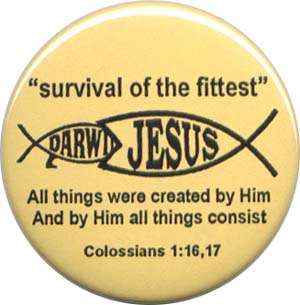
The image “http://www.av1611.org/buttons/images/darwin_jesus.jpg” cannot be displayed, because it contains errors.
From the Los Angeles Times:
Evolution of religious bigotry
The cowardice and intolerance of slapping
a Darwin fish on your car bumper.

Jonah Goldberg

April 1, 2008

I just watched "Fitna," a 17-minute film by Geert Wilders, head of the Dutch Freedom Party, which takes a hard-line stance against Muslim immigration.

Released on the Internet on Thursday, "Fitna" juxtaposes verses from the Koran with images and speeches from the world of jihad. Heads cut off, bodies blown apart, gays executed, toddlers taught to denounce Jews as "apes and pigs," imams calling for global domination, protesters holding up signs reading "God Bless Hitler" and "Freedom go to Hell" -- these are just some of the powerful images from "Fitna," an Arabic word that means "ordeal."

Predictably, various Muslim governments have condemned the film. Half the Jordanian parliament voted to sever ties with the Netherlands. Egypt's grand imam threatened "severe" consequences if the Dutch government didn't ban the film.

Meanwhile, European and U.N. leaders are going through the usual motions of theatrical hand-wringing, heaping all of their anger on Wilders for sowing "hatred."

Me? I keep thinking about Jesus fish.

During a 1991 visit to Istanbul, a buddy and I found ourselves in a small restaurant drinking, dancing and singing with a bunch of middle-class Turkish businessmen, mostly shop owners. It was a hilariously joyful evening, even though they spoke nearly no English and we spoke considerably less Turkish.

At the end of the night, after imbibing unquantifiable quantities of raki, an ouzo-like Turkish liquor, one of the men came up to me and gave me a worn-out business card. On the back, he'd scribbled an image. It was little more than a curlicue, but he seemed intent on showing it to me (and nobody else). It was, I realized, a Jesus fish.

It was an eye-opening moment for me, though obviously trivial compared with the experiences of others. Here in this cosmopolitan and self-styled European city, this fellow felt the need to surreptitiously clue me in that he was a Christian just like me (or so he thought).

Traditionally, the fish pictogram conjures the miracle of the loaves and fishes as well as the Greek word IXOYE, which not only means fish but serves as an acronym, in Greek, for "Jesus Christ the Son of God [Is] Savior." Christians persecuted by the Romans used to draw the Jesus fish in the dirt with a stick or a finger as a way to tip off fellow Christians that they weren't alone.

In America, the easiest place to find this ancient symbol is on the back of cars. Recently, however, it seems as if Jesus fish have become outnumbered by Darwin fish. No doubt you've seen these too. The fish symbol is "updated" with little feet coming off the bottom, and "IXOYE" or "Jesus" is replaced with either "Darwin" or "Evolve."

I find Darwin fish offensive. First, there's the smugness. The undeniable message: Those Jesus fish people are less evolved, less sophisticated than we Darwin fishers.

The hypocrisy is even more glaring. Darwin fish are often stuck next to bumper stickers promoting tolerance or admonishing random motorists that "hate is not a family value." But the whole point of the Darwin fish is intolerance; similar mockery of a cherished symbol would rightly be condemned as bigoted if aimed at blacks or women or, yes, Muslims.

As Christopher Caldwell once observed in the Weekly Standard, Darwin fish flout the agreed-on etiquette of identity politics. "Namely: It's acceptable to assert identity and abhorrent to attack it. A plaque with 'Shalom' written inside a Star of David would hardly attract notice; a plaque with 'Usury' written inside the same symbol would be an outrage."

But the most annoying aspect of the Darwin fish is the false bravado it represents. It's a courageous pose without consequence. Like so much other Christian-baiting in American popular culture, sporting your Darwin fish is a way to speak truth to power on the cheap.

Whatever the faults of "Fitna," it ain't no Darwin fish.

Geert Wilders' film could very, very easily get him killed. (He's already guarded around the clock.) It essentially picks up the work of Dutch filmmaker Theo van Gogh, who was murdered in 2004 by a jihadi for criticizing Islam.

"Fitna" is certainly provocative, yet it has good reason to provoke. A cancer of violence, bigotry and cruelty is metastasizing within the Islamic world.

It's fine for Muslim moderates to say they aren't part of the cancer; and that some have, in response to the film, is a positive sign. But more often, diagnosing or even observing this cancer -- in film, book or cartoon -- is dubbed "intolerant" while calls for violence, censorship and even murder are treated as understandable, if regrettable, expressions of well-deserved anger.

It's not that secular progressives support Muslim religious fanatics, but they reserve their passion and scorn for religious Christians who are neither fanatical nor inclined to use violence.

The Darwin fish ostensibly symbolizes the superiority of progressive-minded science over backward-looking faith. I think this is a false juxtaposition, but I would have a lot more respect for the folks who believe it if they aimed their brave contempt for religion at those who might behead them for it.

Monday, March 31, 2008

The image “http://www.alexberenson.com/ghost-war-jacket-246.jpg” cannot be displayed, because it contains errors.
From The New York Times: Good review of the latest Berenson novel.
The China Card

By ROBERT D. KAPLAN

THE GHOST WAR
By Alex Berenson.
383 pp. G. P. Putnam’s Sons. $24.95.

While the United States remains focused on the Middle East, China quietly and relentlessly creeps forward as a national security challenge. Its economic rise is being followed by its military rise. In 2006, a Chinese Song-class attack submarine, equipped with Russian-made wake-homing torpedoes, stalked the U.S.S. Kitty Hawk carrier strike group in the Pacific. The sub surfaced within firing range before being detected only five miles from the carrier itself.

In 2007, the Chinese destroyed one of their aging weather satellites with a missile — effectively ending decades of debate over whether space would be militarized.

In “The Ghost War,” the New York Times reporter Alex Berenson has fashioned a smart, economically written spy novel that imagines a future clash with the Chinese. As such, it’s a novel for policy wonks, with a very sophisticated vision of how a conflict with China could come about, akin to the kind of war-gaming scenarios that occupy Washington strategists. Here, a power struggle between the military and civilian wings of the Chinese leadership and the accidental ramming of a Chinese trawler by an American destroyer ignite an unwelcome conflict. Adding to the complexity is a new alliance between China and Iran, a secret one between China and the Taliban, the attempted defection of a North Korean spy to the West and the usual moles on each side.

The plot moves quickly, in tight, essayistic paragraphs that show Berenson’s command of such disparate worlds as the United States Navy and Chinese migrant workers. I once spent a month aboard a destroyer in the Pacific and can attest to the accuracy of the author’s portrayal of one. His description of a semi-starving Chinese laborer who starts a riot, and whose only memory of home and his dead parents is a baseball hat that a policeman grabs from him, is vivid and moving. Elsewhere, Berenson offers an intriguing account of a meeting of the Chinese leadership in a banquet hall that’s “drab” on the outside, but on the inside “seemed to have been transported directly from Versailles.” Here, China’s small band of rulers guzzle down a half-case of 1992 Château Lafitte at 10,000 yuan, or $1,300, a bottle.

“Li sipped his wine,” Berenson writes. “His father Hu had worked at a tire factory until his heart gave out on his 52nd birthday. Hu hadn’t made 10,000 yuan in his entire life.” Li Ping, the head of the People’s Liberation Army, is Berenson’s most studied character: an abstemious military man who would rather be drinking freshly squeezed orange juice than expensive wine, who exercises constantly, and who wants China’s new wealth to be more evenly distributed among its poor, especially during a short-term economic slowdown. Li’s purity fuses with his political extremism. He concocts a plot to draw China into a limited war with the United States, in order to oust the more personally decadent and free-market-oriented members of the Standing Committee.

The conflict feeds Chinese nationalism and resentment after the trawler is accidentally rammed — “Hegemonists apologize! No more American war crimes!” the crowds in Beijing cry. When the crisis gets out of control, China’s military modernization allows for a submarine-launched torpedo to elude the Navy’s electronic defenses and hit the errant destroyer. As Berenson explains, “Until a few years before, China’s armed forces had relied on leaky ships, rusting submarines and fighter jets whose design dated from the Korean War.” That was all changing, Berenson continues, now that Chinese students in engineering and software at America’s top universities were returning home to China; some were going to work for their country’s navy, which was now concentrating on undersea warfare, rather than going head-to-head with the United States to develop carriers and other surface warships.

In reality, when it comes to asymmetrical warfare, there are two ends of the spectrum: the roadside bombs of the Iraqi insurgency represent the crude, low-tech end, and the Chinese, with their focus on submarines, ballistic missiles and space weaponry, are poised to demonstrate the subtle, high-tech end. The object is not a war with America, but rather the ability to deny the United States Navy complete access to coastal Asia. But even this would not be enough to start a limited war. As the novel suggests, China’s military development will merely create the conditions for a conflict; the conflict itself could arise only through power plays that lead to accidents and miscalculations.

Berenson is also geopolitically savvy, and maps out how a single crisis can ripple across several regions. In a fluid, global world, it makes sense that a conflict beginning in Asia soon takes on a Middle East angle, too, owing to trade and military links between eastern and western Asia.

Like many novels of this genre, “The Ghost War” is too mechanical in its plot and lacks the baroque character development for which John le Carré is famous. The protagonist, a Central Intelligence Agency officer named John Wells, is a two-dimensional variation of derring-do types common to other spy books. (Much more successful is Berenson’s study of the American mole, Keith Robinson, whose family tragedy leads him in stages to betray his country.) Moreover, the lavish descriptions of military technicalities can sometimes be distracting from the plot and the characters themselves. But Berenson is not trying to be le Carré. Rather, he displays a reporter’s fine awareness of headlines over the horizon.

Robert D. Kaplan is a national correspondent for The Atlantic and a senior fellow at the Center for a New American Security.

The image “http://www.lifesitenews.com/ldn/images/2008b/magdiallambaptism.jpg” cannot be displayed, because it contains errors.
From The Asia Times:
The mustard seed in global strategy

By Spengler

A self-described revolution in world affairs has begun in the heart of one man. He is the Italian journalist and author Magdi Cristiano Allam, whom Pope Benedict XVI baptized during the Easter Vigil at St Peter's. Allam's renunciation of Islam as a religion of violence and his embrace of Christianity denotes the point at which the so-called global "war on terror" becomes a divergence of two irreconcilable modes of life: the Western way of faith supported by reason, against the Muslim world of fatalism and submission.

As Magdi Allam recounted , on his road to conversion the challenge that Pope Benedict XVI offered to Islam in his September 2006 address at Regensburg was "undoubtedly the most extraordinary and important encounter in my decision to convert". Osama bin Laden recently accused Benedict of plotting a new crusade against Islam, and instead finds something far more threatening: faith the size of a mustard seed that can move mountains. Before Benedict's election, I summarized his position as "I have a mustard seed and I'm not afraid to use it." Now the mustard seed has earned pride of place in global affairs.

Magdi Allam tells us that he has found the true God and forsaken an Islam that he regards as inherently violent. Magdi Allam has a powerful voice as deputy editor of Italy's newspaper of record, Corriere della Sera, and a bestselling author. For years he was the exemplar of "moderate Islam" in Europe, and now he has decided that Islam cannot be "moderate".

Since September 2001, the would-be wizards of Western strategy have tried to conjure an "Islamic reformation", or a "moderate Islam", or "Islamic democracy". None of this matters now, for as Magdi Allam tells us, the matter on the agenda is not to persuade Muslims to act like liberal Westerners, but instead to convince them to cease to be Muslims. The use of the world "revolution" is Magdi Allam's:
His Holiness has sent an explicit and revolutionary message to a Church that until now has been too prudent in the conversion of Muslims, abstaining from proselytizing in majority Muslim countries and keeping quiet about the reality of converts in Christian countries. Out of fear. The fear of not being able to protect converts in the face of their being condemned to death for apostasy and fear of reprisals against Christians living in Islamic countries. Well, today Benedict XVI, with his witness, tells us that we must overcome fear and not be afraid to affirm the truth of Jesus even with Muslims.
There is no deference to mutual respect and multi-culturalism. Magdi Allam forsook Islam because he considers it to be "inherently evil". As he wrote to his editor at the Corriere della Sera:
My conversion to Catholicism is the touching down of a gradual and profound interior meditation from which I could not pull myself away, given that for five years I have been confined to a life under guard, with permanent surveillance at home and a police escort for my every movement, because of death threats and death sentences from Islamic extremists and terrorists, both those in and outside of Italy ...

I asked myself how it was possible that those who, like me, sincerely and boldly called for a "moderate Islam", assuming the responsibility of exposing themselves in the first person in denouncing Islamic extremism and terrorism, ended up being sentenced to death in the name of Islam on the basis of the Koran. I was forced to see that, beyond the contingency of the phenomenon of Islamic extremism and terrorism that has appeared on a global level, the root of evil is inherent in an Islam that is physiologically violent and historically conflictive [emphasis added].
Far more important than denouncing the evils of Islam, though, is Magdi Allam's embrace of what he calls the God of faith and reason:
The miracle of the Resurrection of Christ has reverberated through my soul, liberating it from the darkness of a tendency where hate and intolerance in before the "other", condemning it uncritically as an "enemy", and ascending to love and respect for one's "neighbor", who is always and in any case a person; thus my mind has been released from the obscurantism of an ideology which legitimates lying and dissimulation, the violent death that leads to homicide and suicide, blind submission and tyranny - permitting me to adhere to the authentic religion of Truth, of Life, and freedom. Upon my first Easter as a Christian I have not only discovered Jesus, but I have discovered for the first time the true and only God, which is the God of Faith and Reason ...
Magdi Allam presents an existential threat to Muslim life, whereas other prominent dissidents, for example Ayaan Hirsi Ali, offer only an annoyance. Much as I admire Hirsi Ali, she will persuade few Muslims to reconsider their religion. She came to the world's attention in 2004 after a Muslim terrorist murdered Theo van Gogh, with whom she had produced a brief film protesting the treatment of women under Islam. As an outspoken critic of Islam, Hirsi Ali has lived under constant threat, and I have deplored the failure of Western governments to accord her adequate protection.

Yet the spiritual emptiness of a libertine and cynic like Theo van Gogh can only repel Muslims. Muslims suffer from a stultifying spiritual emptiness, depicted most poignantly by the Syrian Arab poet Adonis (see Are the Arabs already extinct?, Asia Times Online, May 8, 2007). Muslim traditional society cannot withstand the depredations of globalized culture, and radical Islam arises from a despairing nostalgia for the disappearing past. Why would Muslims trade the spiritual vacuum of Islam for the spiritual sewer of Dutch hedonism? The souls of Muslims are in agony. The blandishments of the decadent West offer them nothing but shame and deracination. Magdi Allam agrees with his former co-religionists in repudiating the degraded culture of the modern West, and offers them something quite different: a religion founded upon love.

Only a few months ago it seemed fanciful to hail Benedict XVI as the leader of the West. I wrote late last year (The inside story of the Western mind, Asia Times Online, November 6, 2007):
The West is not fighting individual criminals, as the left insists; it is not fighting a Soviet-style state, as the Iraqi disaster makes clear; nor is it fighting a political movement. It is fighting a religion, specifically a religion that arose in enraged reaction to the West. None of the political leaders of the West, and few of the West's opinion leaders, comprehends this. We are left with the anomaly that the only effective leader of the West is a man wholly averse to war, a pope who took his name from the Benedict who interceded for peace during World War I. Benedict XVI, alone among the leaders of the Christian world, challenges Islam as a religion, as he did in his September 2006 Regensburg address.
One does not fight a religion with guns (at least not only with guns) but with love, although sometimes it is sadly necessary to love one's enemies only after they are dead. The Church has lacked both the will to evangelize Muslims as well as the missionaries to undertake the task. Benedict XVI, the former Joseph Cardinal Ratzinger, has thought about the conversion of the Muslims for years, as I reported just before his election in 2005 (The crescent and the conclave, Asia Times Online, April 19, 2005). Where will the Pope find the sandals on the ground in this new religious war? From the ranks of the Muslims themselves, evidently. Magdi Allam is just one convert, but he has a big voice. If the Church fights for the safety of converts, they will emerge from the nooks and crannies of Muslim communities in Europe.

The Pope also has in reserve the European youth movement "Communione e Liberazione", which he has nurtured for decades. Forty-thousand members turned out in 2005 when the then Cardinal Ratzinger addressed a memorial service in Milan for the movement's founder. European Christianity may be reduced to a few coals glowing in the ashes, but it is not dead, only marginalized. If the Catholic youth of Europe are offered a great task - to evangelize the Muslims whose restlessness threatens to push Europe into social chaos - many of them may heed the call.

As I wrote in 2005, "Now that everyone is talking about Europe's demographic death, it is time to point out that there exists a way out: convert European Muslims to Christianity." Today's Europeans stem from the melting-pot of the barbarian invasions that replaced the vanishing population of the Roman Empire. The genius of the Catholic Church was to absorb them. If Benedict XVI can convert this new wave of invaders from North Africa and the Middle East, history will place him on a par with his great namesake, the founder of the monastic order the bears his name.

As Magdi Allam enjoins his new Church:
For my part, I say that it is time to put an end to the abuse and the violence of Muslims who do not respect the freedom of religious choice. In Italy there are thousands of converts to Islam who live their new faith in peace. But there are also thousands of Muslim converts to Christianity who are forced to hide their faith out of fear of being assassinated by Islamic extremists who lurk among us. By one of those "fortuitous events" that evoke the discreet hand of the Lord, the first article that I wrote for the Corriere on September 3, 2003, was entitled "The new Catacombs of Islamic Converts". It was an investigation of recent Muslim converts to Christianity in Italy who decry their profound spiritual and human solitude in the face of absconding state institutions that do not protect them and the silence of the Church itself. Well, I hope that the Pope's historical gesture and my testimony will lead to the conviction that the moment has come to leave the darkness of the catacombs and to publicly declare their desire to be fully themselves.
What the outcome will be of the evangelization of Muslims lies beyond all speculation: that is a matter of every soul's relationship to God. But the global agenda has changed, not through the machinations of statesmen or the word-mincing of public intellectuals, but through the soul of a single man. Benedict's Regensburg challenge to Islam now demarcates the encounter between the West and the Muslim world, and nothing will be the same.

(Copyright 2008 Asia Times Online Ltd. All rights reserved. Please contact us about sales, syndication and republishing.)

Sunday, March 30, 2008

http://www.internetwritingjournal.com/pics/faithfulspy.gif
From The New York Times:
Hardcover review of the current #1 paperback fiction bestseller:
May 9, 2006
Books of The Times | 'The Faithful Spy'
Thriller Fights to Keep Up With Headlines
By CELIA McGEE

"Nam. Nam. Nam. Nam. Nam. Nam." The single syllable ricochets like a stray sharp rock through Alex Berenson's "Faithful Spy," connecting fighters and bureaucrats, revolutionaries and black-marketeers, the peaceful and the violent. Though much of the action is conducted by misguided Americans in a hopelessly escalating war, we aren't in Indochina anymore. The word means yes in Arabic, and there is global terror afoot in the novel, with precious few equipped to keep annihilation from our own shores.

The kind of spy thriller Mr. Berenson has set out to deliver has to contend nowadays with a world's worth of violent events flashing from battlefield and bomb site to television or computer screen at the blink of a satellite signal. Where does that leave the war novel? The fiction of international intrigue?

For Mr. Berenson, a reporter for The New York Times who covered Iraq for three months in 2003, it goes beyond ripping his story from the headlines to imagining, and in some instances eerily predicting, scenarios tied to his central premise: that a Central Intelligence Agency operative infiltrated Al Qaeda several years before 9/11. John Wells, his man undercover, is making it his mission to help lasso the storm of catastrophe, madness, secrets and betrayal that continue in its aftermath.

Lest this seem a prescription for more derring-do than reflection, Mr. Berenson gives himself plenty of opportunity to ruminate — on politics, poverty, Islam, trust, courage and festering bureaucratic rivalries — by cramming his book full of people who think, plot and (sometimes too conveniently) experience the emotions he needs to move his story along. They appear and disappear in great numbers, ready-made for the movie for which "The Faithful Spy" has already been optioned.

But there is a sadness to the swiftness with which he draws his portraits of players caught here, there and everywhere in a global web of interdependent blame. He brings characters to life to have them killed, maimed, left for worse than dead. A business reporter, Mr. Berenson has run the numbers on the current state of world affairs, and the results do not look good.

Wells has dedicated his recent career to trying to get those numbers to add up to an understanding of Osama bin Laden's terror network so the C.I.A. and company can destroy it. In his guise of Muslim convert and American turncoat, he has even met the elusive leader "with cunning narrow eyes." Despite Wells's infinite training, fearless intelligence and the lethal instincts of the Montana high school football champ he once was, he has failed to assassinate "the Sheikh."

More than that, he has spent years having to convince one skeptical Qaeda comrade after the next that he is for real, braving the cold, the privations and the prejudices of tribal existence in Afghanistan and the North-West Frontier. He has sacrificed his family back home — a wife and a young child, his aging, beloved parents — to the cause.

Mr. Berenson gives Wells — or Jalal, as he's known in his jihadi incarnation— a Muslim Lebanese grandmother to make his increasing belief in Islam credible, and a pretty C.I.A. handler, Jennifer Exley, who has also forfeited everything for an ungrateful agency, to doubt and love him simultaneously. When Wells gets wind of a plot against the United States far graver than the World Trade Center attacks, he has to expedite his return to the States to avert it. He comes down from his alien mountains and into post-9/11 American culture like Rip van Winkle in a turban.

The anxiety for Exley and her suspicious, bungling colleagues in the so-called intelligence community is that Wells has become their Kurtz, that he has "gone over" all the way into a heart of darkness. Wells seems not always to know his loyalties for sure, either. It doesn't help that, in their drive to destroy the Western modernity they have tasted but cannot afford to provide to their swelling populations, the ruthless masterminds he tries to thwart make up in smarts for what they lack in scruples.

When it's not fatal, Mr. Berenson sees the darkly comic in such cross-pollinations of hostile civilizations. "Jihadis couldn't resist machine pistols," Wells observes, "they had seen too many action movies." But the action can shift equally to Iraq, and to skittish American soldiers at large in a hopelessly impoverished land, with no resolution in sight.

Simply, everything and everyone have changed. Wells "regretted not having been a spy during the cold war," Mr. Berenson writes at one point. "Back then the game had possessed a certain formal elegance. Neither side really expected the other to blow up the world, and proxy soldiers in Africa and Central America fought the nastiest battles."

Now his Americans step over every conceivable line drawn by the Constitution in scenes of torture and coercion, while their enemies delight in doing the innocent harm. A new language is spoken, couched in hypotheticals and unfamiliar signs, and a new math has had to be devised to calculate the outcome of hijackings, biological assaults and technological cruelty in the service of fundamentalist religion.

If Mr. Berenson remains as much reporter as novelist at this point — a newspaper editor would tell him he had overstuffed his lead, and that he often tended to impart information that was all too well known — he still has an ingenious narrative to show for it. Uncertain times call for tough examinations, and "The Faithful Spy" doesn't back away.

Celia McGee is an arts writer and book critic in New York.

Tata Nano photo by B. Balaji: flickr

Global warming skepticism from the left:
Global Warming: the Climate of Fear

Although the world’s climate is on a warming trend, there is zero evidence that the rise in carbon dioxide levels has anthropogenic origins. For daring to say this I have been treated as if I have committed intellectual blasphemy.

In magazine articles and essays I have described in fairly considerable detail, with input from the scientist Martin Hertzberg, that you can account for the current warming by a number of well-known factors having to do with the elliptical course of the Earth in its relationship to the sun, the axis of the Earth in the current period, and possibly the influence of solar flares. There have been similar warming cycles in the past, such as the Medieval Warming Period, when the warming levels were considerably higher than they are now.

Yet from left to right, the warming that is occurring today is taken as man-made, and many have made this opinion the central plank of their political campaigns. For reasons I find very hard to fathom, the environmental left movement has bought very heavily into the fantasy about anthropogenic global warming and the fantasy that humans can prevent or turn back the warming cycle.

This turn to climate catastrophism is tied into the decline of the left, and the decline of the left’s optimistic vision of altering the economic nature of things through a political program. The left has bought into environmental catastrophism because it thinks that if it can persuade the world that there is indeed a catastrophe, then somehow the emergency response will lead to positive developments in terms of social and environmental justice.

This is a fantasy. In truth, environmental catastrophism will, in fact, play into the hands of the sinister-as-always corporate interests. The nuclear industry is benefiting immeasurably from the current catastrophism. Last year, for example, the U.S. Nuclear Regulatory Commission sped up its licensing process, and there is an imminent wave of new nuclear plant building. Many in the nuclear industry see an opportunity to recover from the adverse publicity of Chernobyl in the story about carbon dioxide causing climate change.

More generally, climate catastrophism is leading to a re-emphasis of the power of the advanced industrial world, through its various trade mechanisms, to penalize Third World countries. For example, India has just produced an extremely cheap car, the Tata Nano, which will enable its poorer citizens to get about without having to load their entire family onto a bicycle. Greens have already attacked the car, and it won’t take long for the World Trade Organization and the advanced powers to start punishing India with a lot of missionary-style nonsense about its carbon emissions and so on.

World Trade Organization photo: flickr

The politics of climate change also have potential impacts on farmers. Third World farmers who don’t use seed strains or agricultural procedures sanctioned by the international ag corporations, major multilateral institutions, and banks controlled by the Western powers, will be sabotaged by attacks on their “excessive carbon footprint.”

Here in the West, the so-called “war on global warming” is reminiscent of medieval madness. You can now buy indulgences to offset your carbon guilt. If you fly, you give an extra 10 quid to British Airways; B.A. hands it on to some non-profit carbon-offsetting company, which sticks the money in its pocket and goes off for lunch.

But what is truly sinister about environmental catastrophism is that it diverts attention from hundreds and hundreds of serious environmental concerns that can be dealt with – starting, perhaps, with the nitrous oxide emissions from power plants. Here in California, if you drive upstate you can see the pollution from Los Angeles all up the Central Valley, a lot of it caused, ironically, by the sulfuric acid droplets from catalytic converters! The problem is that 20 or 30 years ago, the politicians didn’t want to take on the power companies, so they fixed their sights on penalizing motorists, who are less able to fight back.

Emissions from power plants could be dealt with now. You don’t need to have a world program called “Kyoto” to fix something like that. The Kyoto Accord must be one of the most reactionary political manifestos in the history of the world; it represents a horrible privileging of the advanced industrial powers over developing nations.

The marriage of environmental catastrophism and corporate interests is best captured in the figure of Al Gore. As a politician, he came to public light as a shill for two immense power schemes in the state of Tennessee: the Tennessee Valley Authority and the Oak Ridge Nuclear Laboratory. Gore is not, as he claims, a non-partisan green; he is influenced very much by his background. His arguments, many of which are based on grotesque science and shrill predictions, seem to me to be part of a political and corporate outlook.

In today’s political climate, it has become fairly dangerous for a young scientist or professor to step up and say: “This is all nonsense.” It is increasingly difficult to challenge the global warming consensus, on either a scientific or a political level. Academies can be incredibly cowardly institutions, and if one of their employees were to question the discussion of climate change he or she would be pulled to one side and told: “You’re threatening our funding and reputation – do you really want to do that?” I don’t think that we should underestimate the impact that kind of informal pressure can have on people’s willingness to think thoroughly and speak openly.

One way critics are silenced is by accusing them of ignoring “peer-reviewed science.” Yet oftentimes, peer reviews are nonsense. As anyone who has ever put his nose inside a university will know, peer review is usually a mode of excluding the unexpected, the unpredictable, and the unrespectable, and forming a mutually back-scratching circle. Through the process of peer review, of certain papers nodded through by experts and others given a red cross, the controllers of the major scientific journals can include what they like and exclude what they don’t like. Peer review is frequently a way of controlling debate, even curtailing it.

Since I started writing essays challenging the global warming consensus and seeking to put forward critical alternative arguments, I have felt like the object of a witch-hunt. One individual who was once on the board of the Sierra Club has suggested I should be criminally prosecuted. A series of articles on climate change issues I wrote for The Nation elicited a level of hysterical outrage and affront that I found astounding – and I have a fairly thick skin, having been in the business of making unpopular arguments for many years.

There was a shocking intensity to their self-righteous fury, as if I had transgressed a moral as well as an intellectual boundary and committed blasphemy. I sometimes think to myself, “Boy, I’m glad I didn’t live in the 1450s,” because I would be out in the main square with a pile of wood around my ankles.

This experience has given me an understanding of what it must have been like in darker periods to be accused of being a blasphemer, of the summary and unpleasant consequences that can bring. There is an element of witch-hunting in climate catastrophism. That is clear in the use of the word “denier” to label those who question claims about anthropogenic climate change. “Climate change denier” is, of course, meant to evoke the figure of the Holocaust denier.

In my forthcoming book, A Short History of Fear, I explore the link between fear-mongering and climate catastrophism. For example, alarmism about a population explosion is being revisited through the climate issue. Population alarmism goes back as far as Malthus, of course; and in the environmental movement there has always been a very sinister strain of Malthusianism. This is particularly the case in the U.S. where there has never been as great a socialist challenge as there was in Europe. I suspect, however, that even in Europe, what remains of socialism has itself turned into a degraded Malthusian outlook. It seems clear to me that climate catastrophism represents a new form of the politics of fear.

I think people have had enough of peer-reviewed science and experts telling them what they can and cannot think about climate change. Climate catastrophism, the impact it is having on people’s lives and on debate, can only really be challenged through rigorous open discussion and through a “battle of ideas,” as the conference I spoke at in London last year described it. I hope my book is a salvo in that battle.

Alexander Cockburn is a columnist for The Nation and a co-editor of the political newsletter CounterPunch.
http://www.cybercountry.com/PageMill_Images/ryanbingham1007.jpg
From the Los Angeles Times
THE OUTSIDERS
For Ryan Bingham, the rawness is real

Ryan Bingham has no formal musical training.
His chords are often mismatched and his lyrics melancholy.
But his songs are heartfelt and genuine,
and that's what makes him stand out.

By Scott Gold
Los Angeles Times Staff Writer

March 30, 2008

HOUSTON — THERE are nights when Ryan Bingham sounds just like what he is, and there's no shame in that.

He sounds like a kid. Twenty-six years old, on paper, but a kid, really, who can write a pretty song about truck stops and pawnshops but was still carrying around a chord book not all that long ago. A musician so raw that some prospective band members have thrown up their hands and bailed on him because his songs, all mismatched chords and misplaced bridges, don't make sense to people who know what they're doing.

Then there are nights like this.

It's a blustery, mischief-making night in Houston. Bingham is playing Fitzgerald's, a beer joint that ran out of letters for the marquee, so it says RYA BGAM on the side of the building. The graffiti over the toilet says "JESUS VOTES REPUBLICAN," and the ratty wooden floor in front of the stage rises and falls like a fat man's belly when the crowd gets going. It's his kind of place, and it's packed.

Most in the audience are there to see Joe Ely, or at least they think they are.

Ely is virtual nobility in the West Texas songwriting kingdom, which has produced, over the years, a startlingly deep bench of talent -- Buddy Holly, Waylon Jennings, Terry Allen, Jimmie Dale Gilmore. Backstage, Ely suggests, graciously, that the show is a "co-bill," that it's coincidence that Bingham is going on first.

The truth is, Bingham’s got less than an hour out there. It’s all he needs. His belly full of pork chops and Lone Star beers, Bingham rips through a dizzying set of 13 songs, with elements of roadhouse rock, beach music, mariachi, new country and old.

By the time he's done, his voice is so throaty he sounds like a dying man's last wish. When he puts down his guitar and strides offstage, people in the front row are banging their fists on the stage and chanting "Bing-ham! Bing-ham!" and it's so absurdly over the top you'd think they've been healed at an old-timey revival.

Bingham seems a little taken aback himself. Backstage, he stands in a corner, drops his cowboy hat between the toes of his boots and bends over with his hands on his knees. Sweat drips from his nose, and he says nothing until he notices a visitor.

"Hey, man," he drawls. "You havin' a good night?"

Rough beginnings

JUST about everybody who hears Bingham for the first time assumes it's all a put-on, that no one his age could have this many miles and hardships behind him.

He hasn't received much press, despite the release last fall of his first major-label album, "Mescalito." Some of the attention has been laced with skepticism; one alternative publication said he had fallen victim to "absurd self-mythologizing."

That's what Ely figured too, after someone handed him a Bingham tape a few years back. It seemed a little silly for a then-24-year-old to be singing about "being a desperado in West Texas for so long," about being "lost on them back roads so many times I've gone blind."

But Ely, like most who have come across Bingham, learned quickly not to underestimate him. The more Bingham unspools, the more it becomes clear he is authentically wayworn and wounded, that his life has, as his songs contend, hurtled between cursed and charmed.

“That’s a rough-and-tumble world out there in West Texas,” said Ely, who grew up in Amarillo and Lubbock. "It's not a very easy place, even if things are going good. There comes a time when you might either wind up in the pen or you can pick up your guitar and sing your way out. That's what Ryan did. I could relate to it."

He was born just across the New Mexico border, in the boom-and-bust oil town Hobbs. His grandfather was a cattle rancher and owned 72 square miles, each more stark than the last, between Hobbs and Carlsbad.

Bingham's family lost the ranch amid a money dispute and would soon see more bust than boom. His father became a roughneck, an old-fashioned oil field worker who chased his work, first to Bakersfield, Calif., then to Texas -- to Midland, Odessa, Laredo. They never stayed anywhere long; Bingham eventually stopped unpacking, then reduced his belongings to a cardboard box that he carried from town to town.

His parents, he said, "were not mean people. They just couldn't get it together." Trouble came in heaps: "Fights. Pills. Alcohol." One day, he came home and slumped on the couch. The TV wasn't working but something underneath the set caught his eye. It was a mirror topped with a pile of cocaine.

"I thought: 'Well, no wonder the electricity got turned off again,' " he said.

Before his 17th birthday, he dropped out of school, where he'd grown tired of being the new kid in a small town, and left home for good.

"It just wasn't working out," he said quietly.

He was befriended by a group of Mexican boys who introduced him to jackpot bullrides. His uncle had ridden bulls professionally and had imparted a few tricks of the trade, including the ability to sense how close he could get to the edge before he had to jump free of an animal.

Until then, Bingham had ridden only smaller steers in the bull-riding equivalent of Little League. Now he was graduating to the real thing, bulls that could easily weigh more than 2,000 pounds -- "beasts," Bingham said with a smile, "who will stalk you down."

In the next few years, he would ride hundreds of bulls in Mexico and Texas. He broke both legs, one wrist and the big toe on his right foot three times. He broke his right hand at least once just hanging onto the rope, leaving him with a permanent growth on the back of his hand.

One night in Weatherford, Texas, a menacing black angus named Spanky reared his head violently and crushed Bingham in the face, leaving his top lip hanging from his face and knocking out most of his upper teeth, now replaced with fakes.

Bingham's friends -- particularly his prom date, as he had put himself back in high school and the dance was just a few days after the incident -- nearly fainted when they saw his face. He got a kick out of the whole thing.

"It gave me a purpose -- something," Bingham said. "Something to drive for."

Music as refuge

STILL, he was often homeless, working odd jobs -- shoeing horses, pouring concrete -- and sleeping on friend's couches and in the bed of his truck. His only constant companion was a guitar he could barely play.

His mother, who died recently, had given it to him for his 16th birthday. It was a little classical guitar with gut strings. Bingham knew one song, taught to him by a crackhead who lived next door at a seedy apartment complex in Laredo. It was a mariachi-style folk song called "La Malaguena:"

"Que bonitos ojos tienes. . . . Ellos me quieren mirar."

"What pretty eyes you have. . . . They want to look at me."

Bored, Bingham got himself a chord book. Untrained, he could not pick up the keys or the chord progressions of other people's songs. So, unlike most musicians, the first songs he learned to play -- other than "La Malaguena" -- were his own. (That's why he plays few cover songs in concert, other than the occasional Freddie King number.)

About seven years ago, while living in a trailer outside Fort Worth, he sat on the couch one day and began to play. Out came "Southside of Heaven," the song that is perhaps best known today within his small but fervent following.

The song was born of anger and abandonment and solitude -- the very authenticity that those who don't know better have called into question. It was uncommonly revealing and personal: "Money can't buy my soul, 'cause it comes from a hard-earned place. . . . Losing faith in my family has driven me out of my damn mind."

"I couldn't sing. I couldn't play guitar," he said. "But that day, it damn near made me cry."

Bingham, still riding bulls, recorded some of his songs in a friend's garage and began hawking recordings while playing on tailgates before rodeos. Soon, he was booking himself at roadhouses and beer halls, wherever the rodeo circuit took him. He developed a small local following; a couple of his songs even made it on the radio.

Then came a fateful night five years ago, when he mistakenly booked a rodeo in Brownwood and a bar in Dallas -- almost 200 miles apart. The choice, he said, was evident.

"I was lost. Broke. Playing guitar was my way out," he said. "When I wrote these songs, I was just venting. . . . And then when I played and people liked it? And wanted to pay me money to do it? Well. . . . " He threw his head back and laughed.

Bingham dived into his music, studying his guitar, playing small clubs across the West, busking for tips and recording several versions of his songs. He scraped together enough money to record a fairly polished album in Nashville -- a little too polished, though a small label began to distribute it in 2006. Bingham hated the recording. So did his band.

"It didn't sound like Ryan," said Matthew Smith, his drummer. "It sounded like what somebody thought Ryan should sound like."

Some breaks

BUT the stars were about to align.

Around then, Bingham had been invited to play in Marfa, Texas, at a large anniversary party thrown every few years by musician Terry Allen and his wife, Jo Harvey. Allen had invited Bingham after catching his act at a local club.

It was no ordinary party; it was more like a Cabinet meeting of the West Texas songwriters. Among those in attendance: Ely, Guy Clark, Butch Hancock, Gilmore and Robert Earl Keen. David Byrne of the Talking Heads, who'd begun collaborating with Ely, was there too. Everybody had a guitar, and they played until almost 8 the next morning. Bingham kept pace, and more; it was all the Cabinet needed to see.

"It's a pretty serious lineup, and he just kept right up," Ely said. "That night, we accepted him into the Texas Songwriters Ne'er-Do-Wells -- an exclusive club."

Ely, Allen and others took Bingham under their wing, letting him sleep in their guest rooms when he was in town and lobbying for him in the industry. Lost Highway Records, a Universal Music subsidiary, came calling for Bingham a few months later. The first thing Bingham did was buy a new van for his band; the old one had conked out as they had driven into Nashville to sign the contract.

At about the same time, Marc Ford, an elite guitarist best known for his work with the Black Crowes, and Ben Harper, walked late one night into the King King, a Hollywood Boulevard club. Bingham was on stage.

"I was floored," Ford said. "I believed every single word that he said."

When Bingham walked off stage, Ford was waiting. He effectively demanded to take over Bingham's recording. Bingham agreed at once, and together they took up residence at the Compound, a recording studio in Long Beach whose sound is gaining an increasing reputation among Southern California musicians.

To that point, Bingham's recordings were "Nashvilled out," Ford said. "By trying to make it better for radio, they were taking something away from it," he said.

Ford stripped them down as if they were rebuilding an old house. They eliminated many of the fancy trappings, such as a pedal steel guitar part that had been added on "Southside of Heaven." A machine had been used to automatically put Bingham's voice in tune; Ford did away with it, recognizing that it eroded the raw, untutored sound that had struck him that night at the King King.

"It needed to be bones -- its natural state," Ford said.

The result was "Mescalito," Bingham's first album for Lost Highway. Bingham, Ford and the band -- also including guitarist-mandolinist Corby Schaub and bassist Elijah Ford, Marc Ford's son -- are back at the Compound today; they will remain there for the next 10 days or so recording Bingham's next album.

They're a loose, tight-knit group; they spend much of their time smoking cigarettes, drinking beer and telling Texas tales -- about how they're going to have to rename themselves "The Dirty Underwear Gang" if they don't get off the road soon, about the time a roadie stole a chicken from some backwoods beer hall.

None of it masks the sense of possibility that follows them around these days. Bingham is a practical man; he knows that he will probably either make it or not in the next couple of years. At the same time, he figures that it took him this long to convince the skeptics that he's real. There's no sense in doing anything different now.

"If it's not the best record in the world, well, then that's as good as we are right now," he said. "It's not going to be anything that it's not. That's the way it should be. Always."

scott.gold@latimes.com


From TarHeelBlue.com:
Getting Theirs

March 30, 2008

CHARLOTTE--Over the past three years, we've seen this particular group of Tar Heels do almost everything. They've won big games and lost big games. Won championships and lost championships. Cut down the nets and sometimes even left the nets hanging. We've seen them grow up, from the young team hanging with an Illinois squad bent on revenge to the wise group that suddenly understands what a one-and-done tournament means.

"We don't get a do-over," Marcus Ginyard told his teammates late in the second half as Louisville made a run. "We don't get a second chance. We learned that the hard way last year."

We've seen all that. But Saturday night, we saw something we might not have seen before. We saw Ty Lawson sprint past Kenny Smith. Late in the game, I could've sworn I saw Tyler Hansbrough post up Brad Daugherty.

These are the ghosts that you see every day when you play basketball for the University of North Carolina. You see them in the rafters. You see them dotting the walls of the locker room in color photographs. Your coach mentions them regularly.

Always, there is the past. Always, there was someone who did it better or a team that won more or a player who worked harder.

Dean Smith taught us not to compare them, to simply enjoy each team for what makes it unique. But sometimes, what makes a team unique is how they relate to some of those teams from the past.

In the wake of Carolina's 83-73 win over Louisville in the East Region final, now this can be said: we are watching one of the best Tar Heel basketball teams of all time.


There has been almost a century of Tar Heel hoops. Already, this team has won more than any team before them--they set a school record for victories and are still adding on. The total currently stands at 36.

They may eventually score more than any team before them. They have a player, Tyler Hansbrough, who is better than almost any player who came before him.

But they are still looking for their place. Remember two weeks ago, when they won the ACC Tournament in this same building. The so-called celebration was muted, more a feeling of obligation than celebration. Fine, we'll cut down the nets. Fine, we'll wear the t-shirts.

After the Tar Heels disposed of a game Cardinal team but before they scaled the ladder to cut down the nets, Roy Williams gathered his players around him. "Enjoy this," he said. "Enjoy this time on the court. But there's still work to do in San Antonio."

"I don't know if this team has enjoyed anything all year," Deon Thompson said. "We won back-to-back ACC championships. We won the most games of any team at Carolina. But we've never sat back and enjoyed it. We're glad we're a part of the great history at Carolina. But we still want a national championship."

Thompson is right. And to be honest, I'm not sure if we've enjoyed watching them the way we should. Ten years from now...five years from now...heck, even a year from now we'll be remembering them as one of the best of our lifetimes. But all year long, there's been something to worry about. Who's hurt? Who's healthy? Why are they beating on Tyler? Can we get that number-one seed in Charlotte?

And here we sit, 36-2 and one of four teams that the entire nation will focus on over the next week. Is that worth, perhaps, a day of sheer bliss before worrying about the next hurdle?

Carolina Basketball goes national this week. America will get reacquainted with our Hall of Fame coach. The nation will get to know Hansbrough, who in the glow of the win said, "I'm just trying to keep it classy," when asked why he didn't want to jump on the scorer's table or hurl the ball to the roof of the Charlotte Bobcats Arena when time expired. For the next seven days, as the sports world focuses on San Antonio, casual fans will once again get a glimpse of the Carolina Way that we take for granted. Suits on the road. Help a teammate. Keep it classy. If that doesn't make you proud, then take a word of advice from Williams and enjoy it for just a minute.

There, that's better.

Now, being part of that thing called Carolina Basketball means understanding where you fit among those who came before you. In the summer, former players return for pickup games. The trash talk flows, but there is only one ultimate final word.

"The guys who come back from that '05 team, if you say anything to them, they just point at their title banner," Wayne Ellington said. "There's nothing you can say to that. That's why you come to North Carolina, to win championships."

One of those guys, of course, is Quentin Thomas, who will try to become the first Tar Heel with two national titles. Three other champions were in the stands on Saturday--David Noel, Wes Miller, and Sean May.

As the current team snipped the net, Williams called the alums down to the front row of the stands. He hugged each of them and they each whispered, "Congratulations, Coach."

Noel had his '05 title ring around his right index finger. He looked out at the court, where Ellington and Hansbrough and Lawson were looking at him. The current players motioned for the trio to come out on the court, to be a part of the celebration.

That would have been a great moment. Past and present, together on the court. Fans would have loved it. Pictures would have been snapped. Those are three of my all-time favorites, and maybe yours too.

But they didn't belong on the court at that moment. It wouldn't have been true Carolina, which all involved understood. This moment, right now, was about 2008.

"Nah," said Noel, waving at the current incarnation of his team to go relish their moment. "We've already got ours."

Now it's time to go get theirs.

Adam Lucas is the publisher of Tar Heel Monthly. He is also the author or co-author of four books on Carolina basketball.

The image “http://i.a.cnn.net/si/2007/writers/luke_winn/03/21/scouting.unc/t1_hansbrough_si.jpg” cannot be displayed, because it contains errors.
From Sporting News.com:
Hansbrough saves Heels from another collapse

Chris Littmann

March 30, 2008

CHARLOTTE -- Tyler Hansbrough's final basket against Louisville is the only play you need to see if you missed North Carolina's Elite Eight win over Louisville.

He pumped once and watched Earl Clark fly by. Then Hansbrough settled and fired a jumper as he fell to the ground with David Padgett in pursuit. By the time his backside hit the ground, the ball was ripping the net.

That is a how a player of the year gets it done when a Final Four trip is on the line.

"The reason he made that shot is because he's made it hundreds of times already," North Carolina coach Roy Williams said. "It's like that television commercial when the young man shoots extra shots before every practice, every off day."

All night long, it was Hansbrough, who finished with 28 points and 13 rebounds in the Heels' 83-73 win, getting the best of a stable of Louisville thoroughbreds down low. And most importantly, when the Cardinals stormed back from a 12-point second-half deficit, it was Psycho T saving the Heels from a second consecutive Elite Eight collapse.

"(Georgetown) was in the back of, I'd say, a lot of our minds," Hansbrough said. "There was that point when they went on that run, and I think the difference this year is that we handled that run better and stayed poised."

When Louisville's Edgar Sosa trimmed the lead to four with 14:18 remaining, Hansbrough came to the rescue, slamming home Danny Green's missed shot. When Louisville tied the game at 59-59 -- the closest the closest the Cardinals were since leading 5-4 in the opening minutes -- Hansbrough put together back-to-back baskets to restore a four-point lead.

Padgett said he had never before faced an opponent who plays as hard as Hansbrough. And Hansbrough's undying intensity led Louisville coach Rick Pitino to bring up the names of stars like Michael Jordan and Charles Barkley.

"Certainly, he doesn't have all of those skills of those superstars," Pitino said. "But, just like shooting, rebounding, playing defense and passing are skills, working hard is an acquired skill."

Hansbrough's poise at crunch time exemplifies how cool these Heels are under pressure. When the game was tied with 10:21 remaining, it was the first real challenge North Carolina had seen in the entire tournament.

How much did it affect the team? After the game, Marcus Ginyard said he didn't realize the score was ever tied. Williams said the same thing. North Carolina is a team playing with focus and a purpose, led by Hansbrough's every-possession effort.

After the game, Hansbrough -- who seemed oddly reserved for a guy who high-stepped and fist-pumped his way down the Charlotte Bobcats Arena floor in the ACC Tournament -- mentioned something Ginyard told him on the way to the postgame news conference.

He noted North Carolina achieved something big by earning a trip to San Antonio, but they can do something even bigger next week.

Chris Littmann is an associate editor for Sporting News. E-mail him at clittmann@sportingnews.com

From ESPN.com:
No surprise the hardest working player
in college hoops was the hero


CHARLOTTE, N.C. -- North Carolina coach Roy Williams was walking back to the locker room and still he couldn't get over the work ethic of Tyler Hansbrough.

Tyler Hansbrough
Tyler Hansbrough scored a game-high 28 points.
"He spent two-and-a-half hours in the gym on our off day last Monday taking shots," said Williams, shaking his head in disbelief at how Hansbrough continues to amaze him.

What did you expect? Of course Hansbrough would be in the gym working on his craft on an off day. Who did you expect would take over the Elite Eight game against Louisville other than Hansbrough? "I mean, he deserves every accolade and all the success he gets," said Louisville senior forward David Padgett after the No. 3 seeded Cardinals fell to top-seeded North Carolina 83-73 in a powder-blue dominated Charlotte Bobcats Arena on Saturday night that sent the Tar Heels to the Final Four next week in San Antonio. "I've never played against somebody who plays that hard, and the kid is just absolutely determined to be a great basketball player. And big-time players make big-time plays and he made two big-time plays at the end of the game." Of course he did. So, when Louisville mounted a comeback in the second half from 12-down to tie the game at 59-59, who broke the tie? Hansbrough. "He's an All-American and it showed tonight," said Louisville senior forward Juan Palacios. "The thing he did was make difficult shots, and that's what great players do. He took charge of the game when it looked like his team might be in trouble."

I've never played against somebody who plays that hard, and the kid is just absolutely determined to be a great basketball player. And big-time players make big-time plays and he made two big-time plays at the end of the game.

--Louisville senior forward David Padgett

Who stretched the lead multiple times with pull-up jumpers, including two end-of shot-clock square-up shots just inside the 3-point line pushing the lead to seven and then nine points in the final two minutes? Who do you think? "Tyler Hansbrough made two shots that you prayed they were going to take and it shows you what an All-American he is to make those shots because they were both challenging -- I was following the flight of the ball; he couldn't even see the basket," Louisville coach Rick Pitino said. "First time I've seen him up close and some pro team is going to be very lucky. I haven't seen a guy play every possession like that in a long time. I've never seen it actually."

Who scored 20 of the Tar Heels' 39 points in the second half and seven in a row when the game was tied? Come on, don't even ask. "Tyler is a big-time player obviously so you've got to find a way to give a player like that the ball to give him the opportunity to make those big-time shots like that," said fellow UNC junior Marcus Ginyard. "It says even more about Tyler, the fact that he's ready and the opportunity presents itself, he's there, and he's got the guts to knock the shot down." The jumpers he hit Saturday, that helped him pour in 28 points on 12 of 17 shooting (and 13 boards), weren't the same kind of shot as his loose-ball rebound, quick mid-range jumper with 0.8 seconds left to beat Virginia Tech in the ACC semifinals in this same building on March 15. Did that shot mean more to Hansbrough than the jumpers he hit Saturday night? Ah, no.
Tyler Hansbrough
Tyler Hansbrough finds himself heading to the Final Four in San Antonio.
"I would say the jumpers tonight, definitely," said Hansbrough.

"That was a shot he had to shoot," said his exhilarated father, Gene Hansbrough, of the baseline jumper to beat Virginia Tech. "How about he beat [Louisville] with jump shots? That's the first time I've seen him beat anyone with a jump shot [in the flow of the offense]. I know he can hit the jump shot. I've seen him work on it all the time. He just squared up and shot it, just like he does a million times in practice. I'm glad he took it. I'm glad it went in." What did you expect? "Well, to be honest with you, I kinda felt like they were going in when they left," Gene Hansbrough said. "I was confident."

Of course, he was. Tyler Hansbrough showed more emotion after hitting the game-winning shot against the Hokies by running wildly up court. Saturday, he was much more reserved in his celebration. He had the ball at the end of the game and instead of hurling it to the rafters, he just eventually handed the ball off to someone working the game. When he took his turn to cut a strand of the net, he walked up the ladder, trimmed the net and then politely waved to the crowd. He wasn't dancing with Danny Green down below, nor was he hooting or hollering while running toward the locker room.

"This was just like winning a mini-tournament," Hansbrough said on his way to the locker room after being on the postgame news conference podium. Earlier at the news conference he said, "I feel like we want to accomplish more. Marcus [Ginyard] said something to me as we were walking in here, 'it feels like we did something big, but we can also do something bigger.'"

A year ago, Hansbrough was crushed when the Tar Heels fell short in the Elite Eight to Georgetown. He was determined to get back to this spot and beyond. He didn't want to become the hardest working player, the national player of the year, the one everyone fawns over with good reason -- who never made the Final Four.

"I know it means a lot to get there and a great honor," said Gene Hansbrough. "He's worked so hard to get there. But he wants to win the championship. That has been his dream ever since he was a little kid." Of course, what else would you expect from Tyler Hansbrough.

Andy Katz is a senior writer at ESPN.com.