Saturday, December 27, 2008

http://media2.tbo.com/mediamanager/2008/dec/24/2383_gulfsanta.orig-max-640x640.jpg
The pedophile Santa of global capitalism
Mark Steyn

I was at the mall two days before Christmas, and it was strangely quiet. So quiet that, sadly, I was able to hear every word of Kelly Clarkson bellowing over the sound system "My Grown-Up Christmas List." Don't get me wrong – I love seasonal songs. "Winter Wonderland" – I dig it. "Rudolph" – man, he's cool, albeit not as literally as Frosty. But "Grown-Up Christmas List" is one of those overwrought ballads of melismatic bombast made for the "American Idol" crowd. It's all about how the singer now eschews asking Santa for materialist goodies – beribboned trinkets and gaudy novelties – in favor of selfless grown-up stuff like world peace.

Which is an odd sentiment to hear at a shopping mall.

But it seems to have done the trick. "Retail Sales Plummet," read the Christmas headline in The Wall Street Journal. "Sales plunged across most categories on shrinking consumer spending."

Hey, that's great news, isn't it? After all, everyone knows Americans consume too much. What was it that then Sen. Obama said on the subject? "We can't just keep driving our SUVs, eating whatever we want, keeping our homes at 72 degrees at all times regardless of whether we live in the tundra or the desert and keep consuming 25 percent of the world's resources with just 4 percent of the world's population, and expect the rest of the world to say, 'You just go ahead, we'll be fine.'"

And boy, we took the great man's words to heart. SUV sales have nose-dived, and 72 is no longer your home's thermostat setting but its current value expressed as a percentage of what you paid for it. If I understand then Sen. Obama's logic, in a just world Americans would be 4 percent of the population and consume 4 percent of the world's resources. And in these past few months we've made an excellent start toward that blessed utopia: Americans are driving smaller cars, buying smaller homes, giving smaller Christmas presents.

And yet, strangely, President-elect Barack Obama doesn't seem terribly happy about the Obamafication of the U.S. economy. He's proposing some 5.7 bazillion dollar "stimulus" package or whatever it is now to "stimulate" it back into its bad old ways.

And how does the rest of the world, of whose tender sensibilities then-Sen. Obama was so mindful, feel about the collapse of American consumer excess? They're aghast, they're terrified, they're on a one-way express elevator down the abyss with no hope of putting on the brakes unless the global economy can restore aggregate demand.

What does all that mumbo-jumbo about "aggregate demand" mean? Well, that's a fancy term for you – yes, you, Joe Lardbutt, the bloated, disgusting embodiment of American excess, driving around in your Chevy Behemoth, getting two blocks to the gallon as you shear the roof off the drive-thru lane to pick up your $7.93 decaf gingersnap-mocha-pepperoni-zebra mussel frappuccino, which makes for a wonderful thirst-quencher after you've been working up a sweat watching the plasma TV in your rec room with the thermostat set to 87. The message from the European political class couldn't be more straightforward: If you crass, vulgar Americans don't ramp up the demand, we're kaput. Unless you get back to previous levels of planet-devastating consumption, the planet is screwed.

"Much of the load will fall on the U.S.," wrote Martin Wolf in The Financial Times, "largely because the Europeans, Japanese and even the Chinese are too inert, too complacent, or too weak." The European Union has 500 million people, compared with America's 300 million. Britain, France, Germany, Italy and Spain are advanced economies whose combined population adds up to that of the United States. Many EU members have enjoyed for decades the enlightened progressive policies that Americans won't be getting until Jan. 20. Why then are they so "inert" that their economic fortunes depend on the despised, moronic Yanks?

Ah, well. To return to Kelly Clarkson – and Barbra Streisand and Michael Buble and Amy Grant – the striking thing about their "Grown-Up Christmas List" is how childish it is. The vocalist tells Santa that what she wants for Christmas is:

"No more lives torn apart,

That wars would never start…"

Whether wars start depends on the intended target's ability to deter. As to "lives torn apart," that, too, is a matter of being on the receiving end. If you're in an African dictatorship, your life can be torn apart. If you're in a society that values individual liberty, you'll at least get a shot at tearing your own life apart – you'll make bad choices, marry a ne'er-do-well, blow your savings, lose your job – but these are ultimately within your power to correct. The passivity of the lyric – the "lives" that get "torn apart" is very revealing. A state in which lives aren't torn apart will be, by definition, totalitarian: As in "The Stepford Wives" or "The Invasion Of The Body Snatchers," we'll all be wandering around in glassy-eyed conformity. "Lives" will no longer be "torn apart" because they're no longer lives, but simply the husks of a centrally controlled tyranny.

To liveis messy but liberating: free societies enable the citizenry to fulfill their potential – to innovate, to create, to accumulate – while recognizing that some of their number will fail. But to attempt to insulate free peoples from moral hazard is debilitating and ultimately fatal. To Martin Wolf's list of a Europe "too inert, too complacent, too weak," we might add "too old": Healthy societies recharge their batteries by the aged and wealthy lending their savings to the young and eager. But Germany is a population of prosperous seniors with no grandchildren to lend to. Japan is a society of great invention with insufficient youth to provide a domestic market. That's why if you're Sony or IKEA or any other great global brand, you want access to America for your product. That's why economic recovery will be driven by the U.S., and not by euro-Japanese entities long marinated in Obamanomics.

One final thought on "My Grown-Up Christmas List". The first two lines always give me a chuckle:

"Do you remember me?

I sat upon your knee…"

When was the last time you saw a child sit upon a Santa's knee? Rod Liddle in the British Spectator reports that at a top London department store Santa sits at one end of the bench while a large "X" directs the moppet to a place down the other end, well out of arm's reach. For even Santa Claus is just another pedophile in waiting. Naughty or nice? Who really knows? Best not to take any chances. That's another way societies seize up – by obsessing on phantom threats rather than real ones.

Are free peoples now merely vulnerable infants in need of protection from the pedophile Santa of global capitalism? This is the issue that will determine the future: Euro-style state-directed protectionist sclerosis versus individual liberty in all its messiness. I know what I want on my "Grown-Up Christmas List."

Wednesday, December 24, 2008

http://www.operationlettertosanta.com/Christmas%20images/Wallpapers/tree-forest.jpg
From Opinion Journal:
A Christmas Tale -- 1919

By HANS VON SPAKOVSKY

It's easy to complain in the midst of a stressful holiday season. But my family has a unique remedy: We remember one special Christmas in 1919 that gave us the freedom and liberty we enjoy today. This will be the 89th anniversary of the year my father celebrated Christmas Eve deep in the snow-laden woods of Russia as he fled the Communist takeover of his homeland.

When I tell people that my father was an officer in the White Army who fought the Bolsheviks in the Russian civil war, they usually look at me with disbelief, because I am only 49. But he married and started a family later in life, after he lived through both world wars.

He had been an officer in the Russian Army in World War I; after the Bolshevik putsch he ended up fighting against them in the far north of Russia. In 1919 he was close to the Arctic Circle in the port city of Arkhangelsk, where at the beginning of the year, six feet of snow fell and the temperature was regularly 30 degrees below zero.

The Allies -- the English, Americans and French -- had put military forces in Russia, including in Murmansk and Arkhangelsk, in 1918. When they withdrew in September 1919, the White Army forces faced dire peril: Their source of supplies, including arms, was gone. Many regular soldiers deserted en masse to the Bolsheviks.

As the situation deteriorated, my father and his unit were surrounded. They fought until very few supplies remained. By December, their commander told them that they would soon be unable to continue to fight and that the Bolsheviks had promised that surrendering White forces would be freed and sent home.

But my father knew that the communists shot the officers they captured. The only way he could escape was through the frozen White Sea on the lone icebreaker in the port, which was not large enough to evacuate everyone. Only a small number of high-ranking White Russian officers eventually fled that way.

One woman and 16 men, including my father, decided they would try to get out another way. In the middle of a very snowy night, they skied through the Bolshevik lines toward Finland. As my father later told his five children, it was an arduous and long journey. They had so little food that at one point they were reduced to eating the beeswax candles they carried with them.

They soon ceased to count the days. Time became amorphous as they traveled through the chilling cold of an Arctic winter in the darkness of the deep woods. Their singular goal was to avoid Bolshevik patrols.

On one of those timeless, dark days, my father said, the woman in their group reminded the men of something they had all lost track of -- tomorrow would be Christmas Eve.

The next day they skied 'til the beams of the sun turned the treetops golden and the shadows in the forest became longer and longer. They stopped in a small glade for the night, and my father cut down a small fir. They placed some of their remaining candles on its branches and adorned it with blue ribbons cut from a blouse the woman had carried in her knapsack.

With the dark veil of night covering them, they lit the candles and their small pine became a Christmas tree. The scene seemed almost mystical to my father -- 17 human beings sitting in the glow of a makeshift Christmas tree in the thicket of a primeval forest. They forgot about the frost of the northern wintry night, their exhaustion, and their anxiety about the future.

No more hatred remained in their hearts, my father told us -- only love for God and men alike, friends and enemies. They said a prayer, sang some Christmas hymns, and then sat silently, thinking about what they had lost and were leaving behind, including their families. (My father never saw his mother or his father again.) The candles burned out, and it became dark again around them.

The next day they resumed their journey. Once Christmas had passed, and they did not encounter any Bolshevik patrols, my father felt they had been saved. Two weeks later, they arrived safely in Finland. They had skied hundreds of kilometers through the wilderness in the dead of winter.

My father died in 1988, just short of his 93rd birthday. There is a lot more to his story -- great drama, more danger, and adventures that he always said were better to recall as memories than to have lived through. He eventually immigrated to the United States with my mother, whom he met in 1946 in a refugee camp in occupied Germany.

So this Christmas, besides opening presents and singing carols, my family will observe one other tradition. We will drink a toast and give thanks to a man who fled a murderous, cruel dictatorship and gave us a gift more precious than anything else: the chance to grow up in freedom and to enjoy the liberty that is our birthright as Americans. Merry Christmas!

Mr. von Spakovsky is a visiting legal scholar at The Heritage Foundation and a former commissioner of the Federal Election Commission. He is a proud first-generation American.

http://www.weirdrepublic.com/episode77.jpg
MY TRIUMPH OVER KWANZAA!
by Ann Coulter
December 24, 2008

Is it just me, or does Kwanzaa seem to come earlier and earlier each year?

This year, I believe my triumph over this synthetic holiday is nearly complete. The only mentions of Kwanzaa I've seen are humorous ones. Most important, for the first time in eight years, President George Bush appears not to have issued "Kwanzaa greetings" to honor this phony non-Christian holiday that is younger than I am.

It is a fact that Kwanzaa was invented in 1966 by a black radical FBI stooge, Ron Karenga, aka Dr. Maulana Karenga. Karenga was a founder of United Slaves, a violent nationalist rival to the Black Panthers and a dupe of the FBI.

In what was probably ultimately a foolish gamble, during the madness of the '60s the FBI encouraged the most extreme black nationalist organizations in order to discredit and split the left. The more preposterous the organization, the better. Using that criterion, Karenga's United Slaves was perfect. In the annals of the American '60s, Karenga was the Father Gapon, stooge of the czarist police.

Despite modern perceptions that blend all the black activists of the '60s, the Black Panthers did not hate whites. They did not seek armed revolution. Those were the precepts of Karenga's United Slaves. United Slaves were proto-fascists, walking around in dashikis, gunning down Black Panthers and adopting invented "African" names. (That was a big help to the black community: How many boys named "Jamal" currently sit on death row?)

Whether Karenga was a willing dupe, or just a dupe, remains unclear. Curiously, in a 1995 interview with Ethnic NewsWatch, Karenga matter-of-factly explained that the forces out to get O.J. Simpson for the "framed" murder of two whites included: "the FBI, the CIA, the State Department, Interpol, the Chicago Police Department" and so on. Karenga should know about FBI infiltration. (He further noted that the evidence against O.J. "was not strong enough to prohibit or eliminate unreasonable doubt" -- an interesting standard of proof.)

In the category of the-gentleman-doth-protest-too-much, back in the '70s, Karenga was quick to criticize rumors that black radicals were government-supported. When Nigerian newspapers claimed that some American black radicals were CIA operatives, Karenga publicly denounced the idea, saying, "Africans must stop generalizing about the loyalties and motives of Afro-Americans, including the widespread suspicion of black Americans being CIA agents."

Now we know that the FBI fueled the bloody rivalry between the Panthers and United Slaves. In one barbarous outburst, Karenga's United Slaves shot to death Black Panthers Al "Bunchy" Carter and Deputy Minister John Huggins on the UCLA campus. Karenga himself served time, a useful stepping-stone for his current position as a black studies professor at California State University at Long Beach.

(Sing to "Jingle Bells")
Kwanzaa bells, dashikis sell
Whitey has to pay;
Burning, shooting, oh what fun
On this made-up holiday!

Kwanzaa itself is a nutty blend of schmaltzy '60s rhetoric, black racism and Marxism. Indeed, the seven "principles" of Kwanzaa praise collectivism in every possible arena of life -- economics, work, personality, even litter removal. ("Kuumba: Everyone should strive to improve the community and make it more beautiful.") It takes a village to raise a police snitch.

When Karenga was asked to distinguish Kawaida, the philosophy underlying Kwanzaa, from "classical Marxism," he essentially explained that under Kawaida, we also hate whites. While taking the "best of early Chinese and Cuban socialism" -- which one assumes would exclude the forced abortions, imprisonment of homosexuals and forced labor -- Kawaida practitioners believe one's racial identity "determines life conditions, life chances and self-understanding." There's an inclusive philosophy for you.

Coincidentally, the seven principles of Kwanzaa are the very same seven principles of the Symbionese Liberation Army, another charming invention of the Worst Generation. In 1974, Patricia Hearst, kidnap victim-cum-SLA revolutionary, posed next to the banner of her alleged captors, a seven-headed cobra. Each snake head stood for one of the SLA's revolutionary principles: Umoja, Kujichagulia, Ujima, Ujamaa, Nia, Kuumba and Imani — the exact same seven "principles" of Kwanzaa.

Kwanzaa was the result of a '60s psychosis grafted onto the black community. Liberals have become so mesmerized by multicultural nonsense that they have forgotten the real history of Kwanzaa and Karenga's United Slaves -- the violence, the Marxism, the insanity. Most absurdly, for leftists anyway, is that they have forgotten the FBI's tacit encouragement of this murderous black nationalist cult founded by the father of Kwanzaa.

This is a holiday for white liberals -- the kind of holiday Bill Ayers and Bernardine Dohrn probably celebrate. Meanwhile, most blacks celebrate Christmas.

Kwanzaa liberates no one; Christianity liberates everyone, proclaiming that we are all equal before God. "There is neither Jew nor Greek, slave nor free, male nor female, for you are all one in Christ Jesus" (Galatians 3:28). Not surprisingly, it was practitioners of that faith who were at the forefront of the abolitionist and civil rights movements.

Next year this time, we'll find out if our new "Halfrican" president is really black or just another white liberal. If he's black enough to say the "brothers should pull up their pants," surely Obama can just say no to Kwanzaa.

Tuesday, December 23, 2008

[Commentary]
Martin Kozlowski
From Opinion Journal:
Conservative Snobs Are Wrong About Palin

I know Maggie Thatcher.
The two women have a lot in common.

By JOHN O'SULLIVAN

Being listed in fourth place for Time magazine's "Person of the Year," as Sarah Palin was for 2008, sounds a little like being awarded the Order of Purity (Fourth Class). But it testifies to something important.

Though regularly pronounced sick, dying, dead, cremated and scattered at sea, Mrs. Palin is still amazingly around. She has survived more media assassination attempts than Fidel Castro has survived real ones (Cuban official figure: 638). In her case, one particular method of assassination is especially popular -- namely, the desperate assertion that, in addition to her other handicaps, she is "no Margaret Thatcher."

Very few express this view in a calm or considered manner. Some employ profanity. Most claim to be conservative admirers of Mrs. Thatcher. Others admit they had always disliked the former British prime minister until someone compared her to "Sarracuda" -- at which point they suddenly realized Mrs. Thatcher must have been absolutely brilliant (at least by comparison).

Inevitably, Lloyd Bentsen's famous put-down of Dan Quayle in the 1988 vice-presidential debate is resurrected, such as by Paul Waugh (in the London Evening Standard) and Marie Cocco (in the Washington Post): "Newsflash! Governor, You're No Maggie Thatcher," sneered Mr. Waugh. Added Ms. Coco, "now we know Sarah Palin is no Margaret Thatcher -- and no Dan Quayle either!"

Jolly, rib-tickling stuff. But, as it happens, I know Margaret Thatcher. Margaret Thatcher is a friend of mine. And as a matter of fact, Margaret Thatcher and Sarah Palin have a great deal in common.

They are far from identical; they rose in different political systems requiring different skills. As a parliamentarian, Mrs. Thatcher needed forensic and debating skills which her training in Oxford politics and as a tax lawyer gave her. Mrs. Palin is a good speaker, but she needs to hone her debating tactics if she is to match those of the Iron Lady.

On the other hand, Mrs. Palin rose in state politics to jobs requiring executive ability. Her successful conduct of the negotiations with Canada, Canadian provinces and American states over the Alaska pipeline was a larger executive task than anything handled by Mrs. Thatcher until she entered the Cabinet and, arguably, until she became prime minister.

Mrs. Thatcher's most senior position until then had been education secretary in the government of Edward Heath where, as she conceded in her memoirs, she lacked real executive power. Her political influence within that government was so small that it took 17 months for her to get an interview with him. Even then, a considerate civil servant assured Heath that others would be present to make the meeting less "boring." Her main political legacy from that job was the vitriolic slogan, "Margaret Thatcher, Milk-Snatcher," thrown at her by the left because of a budgetary decision she had opposed to charge some children for school meals and milk. It was the single most famous thing about her when she defeated Heath for the Tory leadership in 1975.

At this point she became almost as "controversial" as Sarah Palin. Heath, for example, made it plain privately that he would not serve under her. And Sir Ian Gilmour, an intellectual leader of the Tory "wets," privately dismissed her as a "Daily Telegraph woman." There is no precise equivalent in American English, but "narrow, repressed suburbanite" catches the sense.

Mrs. Thatcher attracted such abuse for two reasons. First, she was seen by the chattering classes as representing a blend of provincial conservative values and market economics -- Middle England as it has come to be called -- against their own metropolitan liberalism. They thought this blend was an economic dead-end in a modern complex society and a political retreat into futile nostalgia. Of course, they failed to notice that their modern complex society was splintering under their statist burdens even as they denounced her extremism.

Second, Margaret Thatcher was not yet Margaret Thatcher. She had not won the 1979 election, recovered the Falklands, reformed trade union law, defeated the miners, and helped destroy Soviet communism peacefully.

Things like that change your mind about a girl. But they also take time, during which she had to turn her instinctive beliefs into intellectually coherent policies against opposition inside and outside her own party. Like Mrs. Palin this year, Mrs. Thatcher knew there were serious gaps in her knowledge, especially of foreign affairs. She recruited experts who shared her general outlook (such as Robert Conquest and Hugh Thomas) to tutor her on these things. Even so she often seemed very alone in the Tory high command.

As a parliamentary sketch writer for the Daily Telegraph (and a not very repressed suburbanite), I watched Mrs. Thatcher's progress as opposition leader. She had been a good performer in less exalted positions. But initially she faltered. Against the smooth, condescending Prime Minister James Callaghan in particular she had a hard time. In contrast to his chuckling baritone she sounded shrill when she attacked. But she lowered her tone (vocally not morally), took lessons in presentation from (among others) Laurence Olivier, and prepared diligently for every debate and Question Time.

I can still recall her breakthrough performance in a July 1977 debate on the Labour government's collapsing economy. She dominated the House of Commons so wittily that the next day the Daily Mail's acerbic correspondent, Andrew Alexander, began his report: "If Mrs. Thatcher were a racehorse, she would have been tested for drugs yesterday." She was now on the way to becoming the world-historical figure who today is the gold standard of conservative statesmanship.

Mrs. Palin has a long way to go to match this. Circumstances may never give her the chance to do so. Even if she gets that chance, she may lack Mrs. Thatcher's depths of courage, firmness and stamina -- we only ever know such things in retrospect.

But she has plenty of time, probably eight years, to analyze America's problems, recruit her own expert advice, and develop conservative solutions to them. She has obvious intelligence, drive, serious moral character, and a Reaganesque likability. Her likely Republican rivals such as Bobby Jindal and Mitt Romney, not to mention Barack Obama, have most of these same qualities too. But she shares with Mrs. Thatcher a very rare charisma. As Ronnie Millar, the latter's speechwriter and a successful playwright, used to say in theatrical tones: She may be depressed, ill-dressed and having a bad hair day, but when the curtain rises, out onto the stage she steps looking like a billion dollars. That's the mark of a star, dear boy. They rise to the big occasions.

Mrs. Palin had four big occasions in the late, doomed Republican campaign: her introduction by John McCain in Ohio, her speech at the GOP convention, her vice-presidential debate with Sen. Joe Biden, and her appearance on Saturday Night Live. With minimal preparation, she rose to all four of them. That's the mark of a star.

If conservative intellectuals, Republican operatives and McCain "handlers" can't see it, then so much the worse for them.

Mr. O'Sullivan is executive editor of Radio Free Europe-Radio Liberty in Prague, and a former special adviser to Prime Minister Margaret Thatcher. His book, "The President, the Pope, and the Prime Minister" (Regnery), has just been published in paperback.

http://cache.daylife.com/imageserve/05KtgjGg05gWY/610x.jpg
From Roger's Rules at PajamasMedia.com:
Who caused the global economic crisis?
(Hint: it wasn’t George W. Bush)

Posted By Roger Kimball

December 22, 2008

“Toutes choses sont dites déjà, mais comme personne n’écoute, il faut toujours recommencer.”
–André Gide

I sometimes wonder if The New York Times is secretly in league with the country’s dentists. All the teeth grinding our former paper of record occasions must be good for those in the business of capping and crowning teeth. Consider, to take only the most recent example that comes to hand, the long piece in yesterday’s business section about who or what caused the current economic crisis.

I’ll tell you in a moment who really caused it, but let’s play a game. Your mission, should you choose to accept it, is to guess whom the Times would nominate as the prime mover and scapegoat-in-chief in the global financial dégringolade we’ve been living through. Ready? You have 10 seconds to come up with the answer. . . .

OK. Time’s up. Those of you who said “Ronald Reagan” or “Margaret Thatcher” get honorable mention, but you’re still playing last week’s game. No, it should be obvious to all comers that the only possible answer to any question involving political or economic failure is George W. Bush.

That’s right, folks. It was all George’s fault. Well, if you are Times reader (which is not the same thing as someone who happens to read the Times), you already knew that. Everything is Bush’s fault.

In the great contest to determine the worst Times story ever, many, so many, are called, but few are chosen. To make it to the zenith of awfulness, a Times story must not only be factually distressed, it must also achieve that tone of absolute smugness that perfectly reflects and soothingly reinforces the self-righteous sensitivities of its readership. I wrote about one example last January when the Times, in its best more-in-sorrow-than-in-anger pulpit strains ran a story about the high homicide rates of veterans returning from Iraq. Oh dear. The brutality of war. The awfulness of Iraq. George Bush. It all added up to a psychic catastrophe. Across the US, towns and cities would need to brace themselves for homicidal rampages as returning Vets went berserk.

Alas for the story, it turned out the the homicide rate among Vets was far lower than that of the general population, a titdbit that the Times neglected to mention. At the time, I asked “[1] Why does anyone believe The New York Times about anything, ever?“, a question no one has yet answered to my satisfaction.

But one of the things that made that story about the Killer Vets so perfect a Times story was its tone. Pseudo concern underwritten by smug knowingness. That’s the recipe. Yesterday’s story about how the global economic crisis is all Bush’s fault comes from the same kitchen. It’s an exercise in histrionics, partly. The Times presents the story as it it were staging a Stephen King movie: Title: “The Reckoning.” Episode one: “[2] White House Philosophy Stoked Mortgage Bonfire.” Starring George W. Bush as the incarnation of evil. The story opens with a large picture of the President smiling in front of sign reading in huge letters “A Home of Your Own.” For those slow on the uptake, there is also this epigraph:

“We can put light where there’s darkness, and hope where there’s despondency in this country. And part of it is working together as a nation to encourage folks to own their own home.”

– President Bush, Oct. 15, 2002

The Times allows that “there are plenty of culprits” and mentions “lenders who peddled easy credit, consumers who took on mortgages they could not afford and Wall Street chieftains who loaded up on mortgage-backed securities without regard to the risk.” But–and here comes the gravamen of the piece–”But the story of how we got here is partly one of Mr. Bush’s own making, according to . . .” Well, according to the cheery-picked people the Times assembled in this preposterous, factually-challenged indictment of the the President.

A few months ago in this space, I asked “Who caused ‘the biggest financial crisis since the Great Depression?‘” The answer, in brief, is the utopian policies of left-wing Democrats who required banks to lend money to people who could not–or would not–pay it back.

Let’s go through it again, step by step:

The Root Cause

* According to Senator Chris Dodd (D. CT) the “root cause” of the problem is “the housing foreclosure crisis.”

Not 100% accurate, perhaps–it’s really a credit crisis–but close enough for government work, especially from someone who has just happens to chair the Senate Banking Committee and who, completely coincidentally, has been such a [3] conspicuous beneficiary of preferential mortgages and who, also coincidentally, leads the list of those who have received campaign contributions from Fannie Mae and Freddie Mac. (Guess who comes in [4] 2nd and 3rd?)

* But what caused the housing crisis to which Senator Dodd alludes? The housing “bubble.”

* And what caused the housing bubble? “Sub-prime,” i.e., risky, mortgages; that is, mortgages made to people who, in the normal course of things would have to pay a premium in order to obtain a mortgage (if they could obtain one at all) because

a) they had bad or non-existent credit

b) their income was insufficient or

c) both.

Packaging the American Dream

A home of your own. It’s part of the American dream. Work hard, save up for a down payment, pay your bills on time and, presto, you, too, can buy a home.

For decades the government has done things to help Americans to realize the dream, e.g., graciously allowing citizens to keep some of their own money to help pay for the interest on a mortgage (the official term for this is a “tax deduction,” but I prefer my locution since it emphasizes the fact that it is YOUR MONEY we are talking about).

But what about people who do not work hard (if they work at all)? What about people who have not saved up for a down payment? What about people who do not pay their bills on time (if they pay them at all)? Why shouldn’t they get to live the American dream?

That was the question that led to (drum roll, please)

“The Community Reinvestment Act” (see [5] here for more).

* The original Community Reinvestment Act was signed into law in 1977 by Jimmy Carter. Its purpose, in a nutshell, was to require banks to provide credit to “under-served populations,” i.e., those with poor credit.

The buzz word was “[6] affordable mortgages,” e.g., mortgages with low teaser-rates, which required the borrower to put no money down, which required the borrower to pay only the interest for a set number of years, etc.

* In 1995, Bill Clinton’s administration made various changes to the CRA, increasing “access to mortgage credit for inner city and distressed rural communities,” i.e., it provided for the [7] securitization, i.e. public underwriting, of what everyone now calls “sub-prime mortgages.”

Bottom line? It forced banks to issue something on the order of $1.5 trillion in sub-prime mortgages.

$1.5 trillion, i.e., one and a half thousand billion dollars in sub-prime,i.e., risky, mortgages, in order to push this latest example of social engineering.

But wait: how did it force banks to do this? Easy. Introduce a federal requirement that banks make the loans or face penalties. As Howard Husock, writing in City Journal way back in 2000 [8] observed: “Bank examiners would use federal home-loan data, broken down by neighborhood, income group, and race, to rate banks on performance. There would be no more A’s for effort. Only results—specific loans, specific levels of service—would count.” Way back in 1994, for example, Barack Obama sued Citibank on behalf of a client who [9] charged that the bank “systematically denied mortgages to African-American applicants and others from minority neighborhoods.”

* In 1997, Bear Stearns –- O firm of blessed memory –- was the first to get onto the sub-prime gravy train.

* [10] Fannie Mae & Freddy Mac — were there near the beginning, too.

Anatomy of a bubble

Step 1. The intoxication: “My house is worth millions!” From 1995 - 2005, the number of sub-prime mortgages skyrocket. So did the house prices.

Step 2. The hangover: “Oh my God, my house isn’t selling. What went wrong?”

Why didn’t someone try to stop it?

[11] Someone did: “The Bush administration today recommended the most significant regulatory overhaul in the housing finance industry since the savings and loan crisis a decade ago,” The New York Times, September 11, 2003.

But someone intervened to stymie the Bush administration. Who? The New York Times reports:

Supporters of the companies said efforts to regulate the lenders tightly under those agencies might diminish their ability to finance loans for lower-income families. . . . “These two entities — Fannie Mae and Freddie Mac — are not facing any kind of financial crisis,” said Representative Barney Frank of Massachusetts, the ranking Democrat on the Financial Services Committee. “The more people exaggerate these problems, the more pressure there is on these companies, the less we will see in terms of affordable housing.”

Why didn’t someone else ring the alarm?

Someone else did. In 2005, [12] John McCain co-sponsored the “[13] Federal Housing Enterprise Regulatory Reform Act,” which among other things provided for more oversight of Freddie & Fannie. The bill didn’t pass. Guess who blocked it?

The bill was reintroduced in 2007. But again, no luck. Fannie Mae and Freddie Mac had friends in the Senate:

* Chris Dodd, a [14] recipient of “sweetheart” loans from a Freddie and Fannie backed company.

* The junior senator from Illinois, i.e., Barack Obama, who turned to Jim Johnson, [15] former head (1991-1998) of Fannie Mae, to help advise him on whom to pick for the vice-presidential slot on his ticket. From 1985 to 1990, incidentally, Johnson was managing director of Lehman Brothers. Remember them?

* You might also want to check out one of Barack Obama’s other advisors: Franklin Raines, former CEO of Freddie Mac: see [16] here , for example, or [17] here, or [18] here. (And thanks again to this [19] great video for the outline I précis above.)

The dog that didn’t bark.

Perhaps the most amazing thing about the Times’s little drama that casts George Bush as the protagonist of our economic tragedy is not what’s in it but what isn’t. You will search in vain for the name “Barney Frank” or the phrase “Community Reinvestment Act.” But telling the story of our economic crisis with out those elements is like staging Macbeth without Macbeth or the witches.

There is a great refusal in operation here, a refusal to face up to facts. Thomas Sowell touched on this in a typically percipient [20] column a few months ago when he wondered, not without exasperation, whether facts still mattered in our political life. The current economic crisis seems to have benefitted Democrats. But how could that be? Sowell reminds us of some forgotten facts:

Fact Number One: It was liberal Democrats, led by Senator Christopher Dodd and Congressman Barney Frank, who for years –- including the present year -– denied that Fannie Mae and Freddie Mac were taking big risks that could lead to a financial crisis.

It was Senator Dodd, Congressman Frank and other liberal Democrats who for years refused requests from the Bush administration to set up an agency to regulate Fannie Mae and Freddie Mac.

It was liberal Democrats, again led by Dodd and Frank, who for years pushed for Fannie Mae and Freddie Mac to go even further in promoting subprime mortgage loans, which are at the heart of today’s financial crisis.

Alan Greenspan warned them four years ago. So did the Chairman of the Council of Economic Advisers to the President. So did Bush’s Secretary of the Treasury, five years ago.

Yet, today, what are we hearing? That it was the Bush administration “right-wing ideology” of “de-regulation” that set the stage for the financial crisis. Do facts matter?

None of this is new. But Gide was right: although everything has already been said, no one was listening, so it is always necessary to start over again. Go into your local bank. Look around. Somewhere you’ll see posted on the wall a notice advising customers that the bank’s lending practices follow the dictates of the Community Reinvestment Act and that federal bureaucrats regularly stop by to make sure the bank is abiding by its ruinous stipulations. When will it stop?

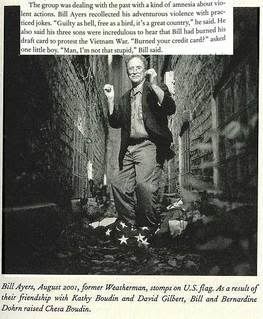
http://i155.photobucket.com/albums/s307/MSimon6808/Ayersflagstomp.jpg
From PajamasMedia.com:
The Op-Ed the New York Times Wouldn’t Run

Posted By Bob Owens

December 23, 2008 @ 12:00 am

On December 5, the New York Times afforded former domestic terrorist Bill Ayers a chance to [1] publish an op-ed, in which he defends himself from various charges made during the 2008 presidential campaign. That Ayers was given such an opportunity by the Times seems extraordinary; Barack Obama’s other mentors, former pastor Jeremiah Wright and Father Michael Pfleger, were subjected to as much public scrutiny as Ayers for their extremist politics and multi-decade associations with the president-elect, and yet it seems only Ayers was presented editorial space in the Times to defend himself. Perhaps even more extraordinary, however, is that the Times allowed Ayers to publish obvious lies about his terrorist past and rejected a rebuttal by the former [2] FBI informant who lived through the history Ayers tried to rewrite.

Ayers claimed in his fantasy that:

I never killed or injured anyone. I did join the civil rights movement in the mid-1960s, and later resisted the draft and was arrested in nonviolent demonstrations. I became a full-time antiwar organizer for Students for a Democratic Society. In 1970, I co-founded the Weather Underground, an organization that was created after an accidental explosion that claimed the lives of three of our comrades in Greenwich Village. The Weather Underground went on to take responsibility for placing several small bombs in empty offices — the ones at the Pentagon and the United States Capitol were the most notorious — as an illegal and unpopular war consumed the nation.

The Weather Underground crossed lines of legality, of propriety, and perhaps even of common sense. Our effectiveness can be — and still is being — debated. We did carry out symbolic acts of extreme vandalism directed at monuments to war and racism, and the attacks on property, never on people, were meant to respect human life and convey outrage and determination to end the Vietnam war.

Peaceful protests had failed to stop the war. So we issued a screaming response. But it was not terrorism; we were not engaged in a campaign to kill and injure people indiscriminately, spreading fear and suffering for political ends.

Ayers’ editorial was poorly written fiction, a fact that perhaps Larry Grathwohl knows better than anyone. Grathwohl was the only informant to successfully penetrate the Underground for the FBI and personally lived through the history Ayers so desperately desires to rewrite.

In hopes of correcting the lies that Ayers put in print, Grathwohl twice submitted an op-ed of his own to the Times to rebut Ayers. The editors rejected Grathwohl’s op-ed, stating in a curt December 12 email:

Dear Mr. Grathwohl,

Because this is a direct response to an op-ed, it should be directed to our letters department.

Please email them at [3] letters@nytimes.com.

Sincerely,

The Op-Ed Staff

Grathwohl’s subsequent submission to the Times was then ignored. The rejected submission is now being run below as a Pajamas Media exclusive.

Ayers would like to claim he participated in non-violent protests. But he omits the fact he helped organize and participated in the 1969 “Days of Rage,” which left innocents and police officers hospitalized and one man permanently crippled, a maiming his fellow Weathermen mocked with the crude lyrics of “Lay Elrod Lay.” One of the participants in the violence noted that the thugs armed themselves with “steel pipes and slingshots, chains, clubs, mace, and rolls of pennies to add weight to a punch.” The participant quoted was Bill Ayers describing the event he helped create in his own book, Fugitive Days.

The Greenwich Village blast Ayers pathologically claims was the catalyst that led to forming the Weather Underground was actually his group’s third botched attempt at mass murder. [4] Ayers personally ordered mass murder attempts at the Detroit Police Benevolent Association and Detroit Police Precinct 13 in February 1970, using bombs comprised of 44 sticks of dynamite. It was only the Weathermen’s incompetence at constructing fuses that kept these blasts from going off and creating dozens of casualties.

Weeks later the Greenwich Village blast occurred when a terrorist cell of the Weather Underground accidentally detonated anti-personnel bombs they were assembling for an attack against soldiers and their dates at a non-commissioned officers dance at nearby Fort Dix that evening. Had the plot succeeded, the planned attack would likely have been the [5] worst terrorist attack on American soil prior to the Oklahoma City bombing.

Bill Ayers would like to use the fog of time to plead his case that he was just another protester against the Vietnam war, a point that the Times is perhaps willing to let him make considering his longtime association with the president-elect they so nakedly support. No amount of inspired fantasy, however, can omit the simple truth that there is only one significant difference between Bill Ayers and Timothy McVeigh.

Competence.

***

“Response to ‘The Real Bill Ayers’”

By Larry Grathwohl

My name is Larry Grathwohl and I infiltrated the Weather Underground for the FBI. I had no idea when my journey began in August 1969 that I would see and experience the degree of violence and hatred of our democracy that existed in the Weather Underground. Bernardine Dorhn, Bill Ayers, and the other people I would meet had as their sole purpose the destruction of the United States. The fact that I ultimately became the only source of information regarding the activities of the Weather Underground and the fact that Bill Ayers now claims their goal was only to bring about the end of the war in Vietnam requires me to respond.

At least Bill admits the Weather Underground “crossed” the line of legality but mitigates this admission by stating that the effectiveness of the “symbolic acts of extreme vandalism” is still being debated. He further states that the selected targets were “property, never people” and that their only purpose was to end the war in Vietnam. Bill is simply not being truthful and is rewriting history to reflect a completely different role for himself and the Weather Underground from what actually took place. “Bring the war home, kill your parents” was the mantra being chanted when the group decided to go underground in December 1969 and there certainly isn’t anything anti-war in that statement. I’m also curious as to who is debating their status. When I think about the Weather Underground my immediate thought is “terrorism and death.”

Billy goes on about how the Weather Underground came into existence because “peaceful protests had failed” and “after an accidental explosion killed three comrades.” The explosion of the townhouse in Greenwich Village was the result of a bomb factory which was preparing bombs containing roofing nails for use at a Fort Dix enlisted club. The inclusion of roofing nails can have but one purpose and that’s to injure or kill people. Prior to this event Bill’s wife, Bernardine Dorhn, placed a bomb of the same design at the Park Police Station in San Francisco and killed Officer McDonnell. Additionally, I was still inside the Weather Underground when the townhouse blew up and the commitment to sabotage and terrorism had already been established and the purpose was the overthrow of the United States government.

Bill implies that the questioning of his activities is dishonest and that at worst he may have made some mistakes in judgment but his motivations were just. Personally, I can think of nothing that would justify the activities of the Weather Underground and am astonished by Bill Ayers’ attempts to corrupt the historical facts by making himself a misunderstood leader of the anti-war movement. Robert Kennedy, possibly the most notable anti-Vietnam war leader of the late 60s, was assassinated by Sirhan Sirhan in 1968. The Weather Underground published Prairie Fire in 1974 and dedicated it to Sirhan Sirhan. Bill Ayers, Bernardine Dorhn, and others signed this dedication but now they would ask us to accept their explanation that all they wanted to accomplish was an end to the war in Vietnam.

I could go on with many other contradictions in the new history Billy is attempting to impose on us. Today we are supposed to believe that Bill is merely an educator with no interests in the political aspects of our society. If this is true then why the picture of him standing on our flag? Why the statement that his only regret is that they (the Weather Underground) hadn’t done enough? What is the meaning of “I now consider myself an anarchist”? I can only conclude that Billy is a confluence of contradictions and revised history meant to confuse us as to what he is really about. Consider “guilty as hell, free as a bird, America is a great country.” Do you think he really means that?

I must conclude by acknowledging that in one respect Bill is probably being absolutely truthful. When he says that “I never killed or injured anyone,” he is most likely being totally honest. Bill, like Charles Manson, never exposed himself to any kind of danger. He always gave orders and then left it to his then-girlfriend, Diane Oughton, and others to implement his plan. If you listen closely you can even hear the similarities in the arguments Manson and Billy use today to justify what they did: the 60s made me do it.

http://www.bruceeisner.com/photos/uncategorized/drewshenemanbushpsychiatristiraq.gif
From The Wall Street Journal:
Another cogent, perceptive analysis by Helprin.

Bush Has Made Us Vulnerable

Two incompetently prosecuted wars
have undermined our deterrent power.

By MARK HELPRIN

In his great Civil War history, "Decision in the West," Albert Castel describes the last Confederate hope of victory. If in 1864 the Confederate armies continue to exact a steep cost from the North, "the majority of Northerners will decide that going on with the war is not worth the financial and human cost and so will replace Lincoln and the Republicans with a Democratic president and Congress committed to stopping hostilities and instituting peace negotiations." He cites the resolution of the Confederate Congress that: "Brave and learned men in the North have spoken out against the usurpations and cruelties daily practiced. The success of these men over the radical and despotic faction which now rules the North may open the way to . . . a cessation of this bloody and unnecessary war." Plus ça change . . . .

The administrations of George W. Bush have virtually assured such a displacement by catastrophically throwing the country off balance, both politically and financially, while breaking the nation's sword in an inconclusive seven-year struggle against a ragtag enemy in two small bankrupt states. Their one great accomplishment -- no subsequent attacks on American soil thus far -- has been offset by the stunningly incompetent prosecution of the war. It could be no other way, with war aims that inexplicably danced up and down the scale, from "ending tyranny in the world," to reforging in a matter of months (with 130,000 troops) the political culture of the Arabs, to establishing a democracy in Iraq, to only reducing violence, to merely holding on in our cantonments until we withdraw.

This confusion has come at the price of transforming the military into a light and hollow semi-gendarmerie focused on irregular warfare and ill-equipped to deter the development and resurgence of the conventional and strategic forces of China and Russia, while begging challenges from rivals or enemies no longer constrained by our former reserves of strength. For seven years we failed to devise effective policy or make intelligent arguments for policies that were worth pursuing. Thus we capriciously forfeited the domestic and international political equilibrium without which alliances break apart and wars are seldom won.

The pity is that the war could have been successful and this equilibrium sustained had we struck immediately, preserving the link with September 11th; had we disciplined our objective to forcing upon regimes that nurture terrorism the choice of routing it out with their ruthless secret services or suffering the destruction of the means to power for which they live; had we husbanded our forces in the highly developed military areas of northern Saudi Arabia after deposing Saddam Hussein, where as a fleet in being they would suffer no casualties and remain at the ready to reach Baghdad, Damascus, or Riyadh in three days; and had we taken strong and effective measures for our domestic protection while striving to stay within constitutional limits and eloquently explaining the necessity -- as has always been the case in war -- for sometimes exceeding them. Today's progressives apologize to the world for America's treatment of terrorists (not a single one of whom has been executed). Franklin Roosevelt, when faced with German saboteurs (who had caused not a single casualty), had them electrocuted and buried in numbered graves next to a sewage plant.

The counterpart to Republican incompetence has been a Democratic opposition warped by sentiment. The deaths of thousands of Americans in attacks upon our embassies, warships, military barracks, civil aviation, capital, and largest city were not a criminal matter but an act of war made possible by governments and legions of enablers in the Arab world. Nothing short of war -- although not the war we have waged -- could have been sufficient in response. The opposition is embarrassed by patriotism and American self-interest, but above all it is blind to the gravity of the matter. Though scattered terrorists allied with militarily insignificant states are not, as some conservatives assert, closely analogous to Nazi Germany, the accessibility of nuclear, biological, and chemical weapons makes the destructive capacity of these antagonists unfortunately similar -- a fact, especially in regard to Iran, that is persistently whistled away by the Left.

An existential threat of such magnitude cannot be averted by imagining that it is the work of one man and will disappear with his death; by mousefully pleasing the rest of the world; by hopefully excluding the tools of war; or by diplomacy without the potential of force, which is like a policeman without a gun, something that doesn't work anymore even in Britain. The Right should have labored to exhaustion to forge a coalition, and the Left should have been willing to proceed without one. The Right should have been more respectful of constitutional protections, and the Left should have joined in making temporary and clearly defined exceptions. In short, the Right should have had the wit to fight, and the Left should have had the will to fight.

Both failed. The country is exhausted, divided, and improperly protected, and will remain so if the new president and administration are merely another face of the same sterile duality. To avoid the costs of a stalled financial system, the two parties -- after an entire day of reflection -- committed to the expenditure of what with its trailing ends will probably be $1.5 trillion in this fiscal year alone.

But the costs of not reacting to China's military expansion, which could lead to its hegemony in the Pacific; or of ignoring a Russian resurgence, which could result in a new Cold War and Russian domination of Europe; or of suffering a nuclear detonation in New York, Washington, or any other major American city, would be so great as to be, apparently, unimaginable to us now. Which is why, perhaps, we have not even begun to think about marshaling the resources, concentration, deliberation, risk, sacrifice, and compromise necessary to avert them. This is the great decision to which the West is completely blind, and for neglect of which it will in the future grieve exceedingly.

Mr. Helprin, a senior fellow at the Claremont Institute, is the author of, among other works, "Winter's Tale" (Harcourt) and "A Soldier of the Great War" (Harcourt).

Monday, December 22, 2008

http://features.csmonitor.com/politics/wp-content/assets/19/668/picture1.jpg
From CommentaryMagazine.com:
In Defense of Warren

Peter Wehner

12.22.2008 - 11:47 AM

Barney Frank is deeply offended by Rick Warren, and he wants to the world to know it. On CNN’s Late Edition yesterday, Representative Frank criticized President-elect Obama for inviting Warren to deliver the invocation at his inauguration. According to Frank,

Mr. Warren compared same-sex couples to incest. I found that deeply offensive and unfair. If [Obama] was inviting the Reverend Warren to participate in a forum and to make a speech, that would be a good thing. But being singled out to give the prayer at the inauguration is a high honor. It has traditionally been given as a mark of great respect. And, yes, I think it was wrong to single him out for this mark of respect.

What has Frank and other gay rights advocates riled up is that Warren backed a California ballot initiative banning same-sex marriage (the measure was approved by voters last month). In the course of defending his stand, Warren has made the point that there are lots of arrangements one could envision consenting adults wanting–from polygamy to incest–that we would not want to label “marriage.” In making that comparison, gay rights advocates have decided to try to turn the Reverend Warren into a reviled figure. Let’s therefore try to examine the argument Warren is making.

The core of this case, which is articulated in William Bennett’s 2001 book The Broken Hearth: Reversing the Moral Collapse of the American Family (full disclosure: I assisted Bennett in writing the book), is that marriage is not an arbitrary social arrangement; it is, rather, based on teleology and the different, complementary nature of men and women. It is also an institution that cannot be understood apart from its cultural, biological, and religious underpinnings. It cannot be redefined by fiat.

Suppose, for example, that a man and three women, all adults, wanted to marry. They insist they love one another and that marriage would strengthen their bond. As consenting adults, they should be allowed to enter any arrangement they desire. Or assume that a man and his 22-year-old daughter decide that they, too, love one another and want to spend the rest of their lives together. They, too, insist that they love each other and that allowing them to marry would represent the best of America: tolerant, respectful of the desires of individuals, and part of the expansion of individual rights that we witnessed during the Civil Rights era. Now ask advocates of same-sex marriage to make an argument against these arrangements.

They will say that marriage isn’t about marrying as many people as you love; it’s about marrying one other person you love. It should therefore be restricted to two people. But why is this? Who are gay-rights advocates to insist that we limit the number of people in marriage to two? Polygamy, after all, has been much more prevalent in history than gay marriage, a movement that was essentially unheard of until a few years ago. But homosexuality is “morally and psychologically” superior to polygamy, others insist. And how do they know? As Charles Krauthammer has pointed out, many Americans believe heterosexuality to be “morally and psychologically” superior to homosexuality, which is why they deny the validity of homosexual marriage.

Same-sex marriage advocates, in dismissing the time-honored definition of marriage and de-linking it from its cultural, religious, and traditional understanding, have lost the ability to draw boundaries against a slew of other arrangements. Once people decide that their own human longings give them license to lay claim to marriage, the definition of the institution is arguably up for grabs. Everyone who wants to redefine marriage will invoke the arguments made by same-sex marriage advocates–from insisting that society should not set up roadblocks to their happiness and their desire to enter into loving, faithful relationships; to arguing that their lives would be incomplete without marriage; to claiming that government is wrong to deny them equal protection.

In the words of Mr. Bennett:

Having just rewritten the central rule of the marriage bond, proponents of same-sex marriage are hardly qualified to dictate to others what constitutes its central meaning, or why it can be felt only between two human beings, and not more than two. What arguments would they invoke? Tradition? Religion? The time-honored definition of the family? These are the very pillars they have already destroyed. No, once marriage has been detached from the natural, complementary teleology of the sexes, it becomes nothing more than what each of us makes of it.

That, I think, is what Rick Warren was getting at, rather than comparing homosexual behavior to incest. Now one may disagree with Warren’s position and believe that gay marriage is simply part of the centuries-long evolution of marriage that has occurred and that it would not harm, and may even marginally help, the institution of marriage. I disagree, but I understand such a case can be made–and, in fact, that case has been made by intelligent and sober advocates for same-sex marriage (like Jonathan Rauch). But to say that the arguments put forth by Warren are “deeply offensive and unfair” is itself, I think, unfair. And the effort to portray Warren as a bigoted and benighted figure is both unfair and wrong.

By all accounts, Rick Warren is a man of enormous integrity who oversees a wonderful, life-saving ministry. He also gives voice to the views of millions and millions of Americans–including presumably Barack Obama, who also opposes same-sex marriage–and Warren does so in a civil manner. Beyond defending the traditional view of heterosexual marriage, Warren has done several other things, including broadening the vision of evangelical social ethics to issues such as AIDS and helping the continent of Africa. He has also shown a generosity of spirit by having Obama speak at his church (and has been criticized from the right for doing so).

President-elect Obama deserves credit for asking Rick Warren to deliver the invocation at his inauguration. It is a symbolic gesture for sure–but symbolism matters, and this reciprocal generosity of spirit is good for the country. It is Barney Frank and his allies who are determined to turn the Obama inauguration into yet one more battlefield in America’s “culture war.”

The outrage directed at Warren is an effort by some to intimidate those who oppose same-sex marriage into silence and de-legitimize their arguments rather than answer them. This effort needs to be resisted, especially by those who claim to care so much about “tolerance” and the free and open exchange of ideas. It would be nice if, from time to time, those who claim to represent modern liberalism would reacquaint themselves with the classical version.
http://www.northstarcompass.org/nsc0310/robeson.jpg
Pictured: Paul Robeson in the Soviet Union
From World Net Daily:
Why Are We Naming Schools For Paul Robeson?

By Jack Cashill

Not too long ago, I was pulled over by a traffic cop here in Kansas City. “I have absolutely no idea why you stopped me,” I told him.

The officer informed me that I had been speeding in a school zone. “Where is the school?” I asked. He pointed to a building that I had known only as a Jewish community center.

Apparently, the school district had bought the center and, with little ado, had renamed it the “ Paul Robeson Middle School.” Had I not been ticketed, I would not have known.

As I learned, Kansas City is not unique in its affection for Mr. Robeson. Public school districts in New Jersey, New York, Pennsylvania, California, and elsewhere have named schools for a man the Chicago School District describes as a “great human being.”

In 1998, on the occasion of the Paul Robeson centennial, Chicago and other districts devised lesson plans to help instructors in grades 1-12 system-wide “ take up the teaching of Paul Robeson.”

Chicago educators found this corrective necessary because the presumably racist publishing companies “left [Robeson] out of the history books,” this despite the fact that Robeson was “an athlete, a lawyer, a linguist, a singer, an actor and activist for human and civil rights.”

If genuinely curious, Chicago teachers can learn something of Robeson’s forgotten history in Tim Tzouliadis’s stunning new book, “The Foresaken.” The Greek-born British author does not slight Robeson at all.

The reader first meets the former All American football player in 1934. Robeson has come to Moscow on an extended stay to entertain and is greeted by his fellow Americans as “a hero of the progressive cause.”

In the depths of the Depression, more than two thousand Americans had moved to the Soviet Union. Although many of them were political activists, most were working class Joes who had been lured by the promise of steady work.

When Robeson arrived among them, the Americans were the toast of the Soviet Union. They had formed social clubs and baseball leagues and published their own newspaper.

Little did the Americans, the “Foresaken” of Tzouliadis’s title, suspect that within five years they would be toast. Thanks to the Pulitzer Prize-winning suppression of The New York Times’ Walter Duranty, the Americans had emigrated to the Soviet unaware of the genocidal terror famine that Stalin had just orchestrated.

In 1934 one could understand Robeson’s enthusiasms as well. He had suffered a goodly share of the everyday indignities that befell blacks in America at the time and was likely as ignorant as his fellow Americans of Stalin’s capacity for evil.

By 1937, when Robeson returned to Russia for a lengthy concert tour, he had no such excuse. Stalin had already unleashed his famously paranoid “Terror” against all suspected intriguers, the entire American community among them.

Robeson pretended not to notice. “Here was one who was wise and good,” said Robeson of Stalin after the tour, “the world and especially the socialist world was fortunate indeed to have his daily guidance. I lifted my son Pauli to wave to this world leader.”

Pauli, then ten, could see what his father refused to: the parents of his school chums were being arrested and assassinated. In his memoirs, Pauli lamented how his father had turned his back even on his closest friends.

When a fellow black American appealed to Robeson to help him escape to Ethopia, he was rudely rebuffed by Robeson’s entourage and later by his wife, Eslanda.

“Suppose [Robeson] were to help you leave,” Eslanda told the man, “and then when you arrived in Ethiopia, you decided to turn anti-Soviet. We would find ourselves in trouble with the authorities here.”

By 1949, almost all in the American community had been incarcerated or liquidated in the Terror along with several million Russians and other foreign nationals. That did not stop Robeson from returning to the Soviet Union to entertain.

While there, he had asked to meet with two Russian Jews he had met and befriended at an anti-fascist rally in New York during the war. He was told they were both away “on holiday.”

When Robeson persisted, the Soviets suddenly found the poet Yitzhak Pfeffer, who had apparently been vacationing in Moscow’s notorious Lubyanka prison.

As Pfeffer explained in sign language when he met Robeson in his bugged hotel room, their other mutual friend had already been murdered. “They’re going to kill us,” Pfeffer quietly wrote on a piece of paper. “When you return to America, you must speak out and save us.”

The “us” was the Soviet Union’s Jewish community. Stalin had already begun his “anti-cosmopolitan” campaign. True to form, Robeson rejected the rumors of mass arrest and publicly denied reports of a purge against Soviet Jews.

Three years later, Pfeffer and 14 other leading Jewish intellectuals were taken to the basement of the Lubyanka and shot one by one for their work on the ant-fascist committee that brought them to New York to meet Robeson.

By the time Stalin died in 1953, no sentient adult could have failed to understand the depths of his depravity, none, of course, but the winner of the 1952 Stalin Peace Prize, Paul Robeson.

“Yes, through his deep humanity, by his wise understanding, he leaves a rich and monumental heritage,” Robeson eulogized his beloved Uncle Joe. “He leaves tens of millions all over the earth bowed in heart-aching grief.”

Stalin also left tens of millions buried under that same earth. That educators continue to ignore Stalin’s infamy, and honor Robeson useful idiocy, tells us just about all we need to know about the public school establishment.

http://assets.espn.go.com/photo/2008/0617/face_of_program04.jpg
From The Washington Post:
Baugh: The Texan
Who Gave Birth to Redskins Fanaticism

By Thomas Boswell

Thursday, December 18, 2008; 1:24 PM

Sammy Baugh, a man whose face is almost completely forgotten but whose legend is still vivid generations after he retired, is the single star that created the Redskins brand.

When 90,000 people gather in FedEx Field on Sunday to see Washington play the Eagles, please think of Baugh, who died yesterday at 94, as the founder, the inspiration and the symbol of everything that is burgundy-and-gold.

The five world championship games, and two world titles, in '37 and '42, to which he led the Redskins began the NFL epidemic in Washington. Baugh is the root, everything else is branch, or more recently perhaps, twig.

For the current Redskins, who think they get the most out of themselves, this is perhaps all they need to know about Slingin' Sammy and what was meant by the word "work" in the 1930s when he emerged: Baugh would not leave practice until he had completed 100 passes in a row. Now the Redskins nag "stars" to come to practice at all.

My father arrived in Washington in Baugh's rookie season and caught the Redskins fever. To me, he embodied the local mania, the way one star athlete and the teams he led can define the habits of a family for decades. My dad cared for no other sport, yet was a Redskins fan 57 seasons. I never heard him curse except when he hit his thumb with a hammer or a Redskins quarterback, some Jurgensen or Rypien, someone not named Baugh, threw an interception.

Whenever anybody tells me that Vince Lombardi's one-year arrival in 1969 or George Allen's one Super Bowl team or Joe Gibbs's dynasty gave birth to this city's Redskins fanaticism, I know better. The late Shirley Povich didn't have to tell me (though he did). It was Baugh. He brought not just victories but thrills and ignited Washington with a passion even the worst Redskins periods can barely diminish.

In my father's house, all Redskins quarterbacks had a place of respect, yet none were ever compared to Baugh -- this unseen but vividly imagined man who wore No. 33, averaged 49 yards a punt for years, passed more accurately than any human and once intercepted more than a pass-a-game for a full season.

To this day Baugh remains, even in Washington, that purest of legends, the player who exists only in the retelling of his deeds from parents to children. How many have even seen him in the flesh? Compared to Baugh, Joe DiMaggio was a publicity hound. Better, perhaps, that he retired quietly to his 7,600-acre ranch in Texas, to his five children, 11 grandchildren and 12 great grandchildren, and almost never showed up back here in his "second home" to take bows.

Still, Baugh's enormous stature, as the last living member of the NFL's first Hall of Fame class, contrasts with his near invisibility in a celebrity age. Every decade or so, reporters would seek him out for an update-on-Sam story. They always found him a gentleman, a fellow with an anecdote punctuated by a single "hell" or "damn" and a delicious demonstration of restraint.

In my basement, I have 20 sports pictures. My friends recognize Michael Jordan, Muhammad Ali and the rest. But one face is a complete mystery to everyone. The black-and-white photo is of a football bench with four players in uniform intently watching the action. Behind them is a packed grandstand. Sitting on the bench among the players, dressed in a classy camel's hair coat, wearing a string tie and an elegant white cowboy hat, sits a man with a lean chiseled face and a big cigar in the center of his mouth.

"Who's that?" I ask. There's never even a guess. "He's the greatest football player of the first half of the 20th century," I hint. Silence. "He's the greatest Redskin ever."

Oh, Sammy Baugh! They all say instantly. Everybody still knows the man who did not invent but unleashed the potential of the forward pass, transforming the National Football League.

Yet few, at least these days, understand how completely Baugh modernized the NFL, turning the forward pass from an ugly oblong oddity into the soaring signature of the sport. What Babe Ruth's home runs did for baseball in the early 1920s, Baugh's bombs did for the NFL in the late '30s. Ruth was more Bunyanesque, more outside the parameters of previous imagination. But Baugh wasn't too far behind.

In 1936, the season before Baugh arrived, the average NFL team scored 11.9 points a game and completed 5.6 passes. The NFL completion percentage: 36.5. The entire sport threw only 67 scoring passes to 216 interceptions. A team passed out of third-down necessity or for trickery.

Then came Baugh.

Into this thudding world, where someone named Arnie Herber held such passing records as there were, the 6-foot-2 Texan, who could throw from all angles and drolly asked "which eye" he should hit his receivers in, was a revelation.

As a rookie, starting only five games, he broke the NFL completion record with 81. By 1940, he was accomplishing the inconceivable, completing 62.7 percent of his passes.

For accuracy, Baugh was two generations ahead of his time. His career completion percentage of 56.5, much of it done with a round-ended ball that Eli Manning might have trouble forcing into a spiral, is comparable to Sonny Jurgensen's career mark of 57.1. And it's better than individual seasons, within the last 10 years, of such Redskins starters as Trent Green, Tony Banks, Shane Matthews, Patrick Ramsey, Mark Brunell and, as a rookie, Jason Campbell.

Before Baugh came, only one man ever passed for 1,000 yards in a season. By 1947, Baugh completed 210 passes for 2,938 yards -- both then records by miles. If Ruth quadrupled the prevailing view of how many home runs were possible in a season, then Baugh tripled the notion of how much yardage a team could gain through the air. Just as important, others followed or imitated him, especially Sid Luckman in 1942 and Otto Graham in 1946.

The range of Baugh's skill is almost incomprehensible now. His career punting average was more than 45 yards, but from 1940 through 1942 it was almost 50 yards (49.5). Yes, they liked to quick kick then. But 50 yards is still 50 yards.

In 1940, he intercepted 11 passes in just 10 games. How good is that? No NFL player has intercepted 11 passes since 1981 and the last man to have more than an interception per game was Night Train Lane in 1952.

Those who saw Baugh in his prime have dwindled to a precious few. We must take the word, across time, of relatives and elders, as well as a few old newsreels where his passes look long, sweet and straight over the shoulder.

We may not know his face when we see it in a photo: ears and nose prominent, cheeks slightly sunken, deep lines in his face before 40 and a middle-distance gaze in his dark eyes as focused as any hawk.

But, as long as people know the Redskins, they will know Sammy Baugh. He's the Texan who branded them.

Sunday, December 21, 2008


From The Boston Globe:
'God bless all of you . . . on the good Earth'

By Jeff Jacoby

Globe Columnist / December 21, 2008

IT HAD BEEN a wretched and demoralizing year.

In April, Martin Luther King had been murdered in Memphis; in Los Angeles two months later, Bobby Kennedy was struck down. The fighting in Vietnam ground bloodily on, pushing the American death toll past 30,000 and fueling massive antiwar demonstrations at home. The United States was humiliated when North Korea captured the USS Pueblo and imprisoned its crew for 11 months. Racial tensions worsened, as segregationist George Wallace launched a third-party campaign for president. Outside the Democratic convention in Chicago, TV cameras broadcast appalling scenes of chaos and police brutality. "Seldom," Time magazine observed, "had the nation been confronted with such a congeries of doubts and discontents."

But in its final days, the annus horribilis of 1968 was unexpectedly redeemed by a dazzling display of intrepidity and ambition and nerve: Apollo 8's flight around the moon - the first human voyage to another world.

Afterward, the decision to send Apollo 8 to the moon would be called the greatest gamble in the history of the space program. The mission had originally been scheduled to test the new lunar landing vehicle while orbiting the Earth; the first moon-orbit mission wasn't planned until 1969. But the lunar lander wasn't ready. And the CIA was reporting that the Soviets were on the verge of upstaging the United States by sending a manned Soyuz spacecraft around the moon.

So NASA decided not to wait. Apollo 8 would go all the way to the moon. It was a gutsy, dangerous decision, and not just because flying without a lunar lander meant that Apollo 8's crew - Commander Frank Borman, James Lovell, and Bill Anders - would be stranded without a lifeboat if anything went wrong. Houston still didn't have the software Apollo would need to navigate to the moon. And the huge Saturn V rocket required to launch a spacecraft beyond the Earth's gravity was still being perfected, and had never been used on a manned flight. By today's standards, the risks were unthinkable. Apollo's program director, Chris Kraft, figured the odds of getting the crew home safely were no better than 50-50.

Yet in the end, it was a triumph. Apollo 8 lifted off on the morning of Dec. 21. The massive rocket, as tall as a 35-story building and burning 20 tons of fuel per second, performed flawlessly. Two years earlier, Pete Conrad and Dick Gordon had flown Gemini 11 to a record-breaking 850 miles above the Earth. Now Borman, Lovell, and Anders were on their way to beating that record by more than 230,000 miles.

They reached their target on Dec. 24, easing into orbit around the moon just 69 hours after leaving home. As an Earthbound audience of hundreds of millions tuned in, the astronauts of Apollo 8 - the first humans to view the lunar surface up close - described what they were seeing.

"The moon is essentially gray, no color," Lovell reported, according to a transcript. "Looks like plaster of Paris, or sort of a grayish deep sand." Borman described it as "vast, lonely, forbidding," a "great expanse of nothing that looks rather like clouds and clouds of pumice stone."

But it was only when they turned their camera away from the moon and back to the heavens that the full emotional impact of their achievement began to sink in.

"Oh, my God," Anders gasped. "Look at that picture over there!"

"What is it?" asked Borman.

"The Earth coming up. Wow, is that pretty."

Rising above the horizon, over a bleak lunar surface, was the world they had come from, a delicate marble of blue and white, floating alone in the darkness, home to everyone and everything they or anyone had ever known - "the most beautiful, heart-catching sight of my life," Borman later said, "one that sent a torrent of nostalgia, of sheer homesickness, surging through me." It was like a glimpse of Creation - like seeing the Earth as God might see it.

For their Christmas Eve broadcast from lunar orbit, NASA had instructed the astronauts simply: "Say something appropriate." And so, as half a billion people watched and listened 40 years ago this week, they did. Anders began:

In the beginning, God created the heaven and the earth; and the earth was without form and void, and darkness was upon the face of the deep; and the spirit of God moved upon the face of the waters. And God said, 'Let there be light,' and there was light.

Lovell took up the reading after Anders, and then Borman brought the broadcast to an end.

And God called the dry land Earth, and the gathering-together of the waters called He seas. And God saw that it was good.

"And from the crew of Apollo 8," Borman finished, "we close with, Good night, good luck, a Merry Christmas, and God bless all of you - all of you on the good Earth."

Jeff Jacoby can be reached at jacoby@globe.com.