Saturday, May 31, 2008

http://farm2.static.flickr.com/1163/1289920278_f301439bac.jpg?v=0
From Chronicles.org:
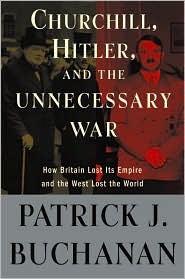
Churchill, Hitler, and the Unnecessary War:

How Britain Lost Its Empire and the West Lost the World,
by Patrick J. Buchanan.
New York: Crown. 544 pp. $25.95

Reviewed by Thomas Fleming

A Review published in The Wanderer . Since this is my unedited text, any errors are the fault of the author and not of The Wanderer. Check out their website at http://thewandererpress.com/.

In his latest book, Patrick J. Buchanan has confronted one of the dominant historical myths of the 20th century, the myth of “the last good war” and the heroic British Prime Minister who not only rallied his nation to victory but, unlike Franklin Roosevelt, refused to be taken in by the schemes of Joseph Stalin. In describing this consensus of history teachers, editorialists, and History Channel watchers as a myth, I do not mean to say that it is entirely or even predominantly untrue. Myths usually include more than a little truth, but myth-makers whittle and polish the rough edges of reality in order to produce a fable that can be easily learned and repeated. Inevitably, reality is further distorted with every retelling until we are left with a simplistic morality play in which virtuous Yankees defeat wicked Confederates, or high-minded cowboys and frontiersman defend their women from murderous thieving redskins—though this latter example, like so many American myths, has been turned upside down, converting the thieving redskins into peace-living Native Americans, whose superior civilization was destroyed by greedy and violent capitalist exploiters.

According to the myth of the World Wars, the United States entered World War I to stop two evil and militaristic German Empires from conquering and subjugating the peace-loving peoples of Europe. The noble Woodrow Wilson, at the end of the war, proclaimed the lofty principles of world peace and self-determination that were invoked to destroy the Prussian war machine and break up the Austro-Hungarian Empire into happy little states inhabited by contented peasants. Ignored in the blissful recitations of the myth are several inconvenient facts: Neither Slovak nor Croat peasants were especially content to be included in states run, respectively, by Czechs and Serbs; the Prussian war machine was no more a threat to world peace than the war machines created by their enemies; and many European and American statesmen viewed the Versailles Treaty as the direct cause both of the rise of Hitler and the second World War. Equally ignored is the Wilson administration’s shaky legal basis for entering into a conflict that appeared to concern the United States very little and in which both sides were guilty of violations of international law.

In this wonderful book, which should be read by all Americans who love their country, Patrick Buchanan has launched a devastating attack on the myth. Because the author makes no assumptions about the historical literacy of the United States, people who have not recently boned up on the history of 20th Century can use this volume as a refresher course that narrates the big events and portrays the leading figures. Buchanan makes the period come alive, as he highlights the ambiguous character of many eminent statesmen of the 20th century. The central figure, of course, is the brilliant and mercurial Winston Churchill, who changed sides so often that hardly anyone trusted him. Rejoining the Conservative Party in 1924, which he had abandoned for the Liberals 20 years earlier, Churchill quipped, “Anyone can rat, but it takes a certain ingenuity to re-rat.” Churchill was nothing if not ingenious.

Buchanan is quite right to emphasize the political influence of Churchill’s family—he was directly descended from John Churchill, the first Duke of Marlborough–but he might well have devoted a few pages to pointing out that Marlborough was a glory-seeking general and statesman, who betrayed the king who had relied on him and spent much of his career jockeying for power. Winston, who wrote a massive biography of his famous ancestor, modeled his own career on Marlborough’s.

The Churchills tended toward melancholy and dissipation: Winston’s father Randolph was like his son an unreliable maverick, whose irregular habits may have caused the illness (probably syphilis) that took his life at an early age. Winston’s son Randolph is best remembered as the binge-drinking companion we meet in Evelyn Waugh’s diaries. It is remarkable that Winston, who suffered from his family’s predilection for alcoholism, accomplished as much as he did.

Unlike many revisionist historians, Buchanan does not demonize Winston Churchill or deny his excellent qualities: the keen intelligence that early on discerned the Soviet menace, the battlefield valor that would be translated into the moral courage to take unpopular positions, and the political astuteness that enabled him to hold the reins of power throughout most of the War.

He does, however, draw up a formidable set of charges against him: recklessness as the First Lord of the Admiralty who clamored for war with the German empires, folly in arguing for military retrenchments in the dangerous period between the two wars and in urging capitulation to U.S. demands to put and end to the alliance with Japan, an action that served to justify the Japanese attack on Britain’s far-eastern passions, arrogance in securing sanctions that gave Mussolini, by now fearful of Hitler, no choice but to cement his alliance with Germany, obtuseness in writing the entirely unnecessary blank check to Poland, guaranteeing her security and making the Second World War inevitable and giving international legitimacy to Stalin, and finally, his stubborn intransigence toward Nazi Germany that prevented any possibility of a negotiated settlement that would have eliminated or reduced the slaughter of the war and possibly saved the lives of millions of European Jews. When these charges are added to Churchill’s apparent inability to understand Stalin’s plans to take over Eastern Europe, they make a serious indictment of an allegedly great statesman’s career.

The net result of Churchill’s blundering and blindness was the loss of the British colonial empire, the enslavement of Eastern Europe, and a Cold War the weighed heavily on American taxpayers for four decades. Churchill does not bear the burden alone. It goes without saying that equally grave mistakes were made by colleagues like Anthony Eden and by Franklin Roosevelt and his successive cabinets, but the debunking of Churchill’s infallibility is an important step toward recovering a sane and balanced view of the world wars.

Buchanan has made a strong case for the prosecution, though he may not have quite secured a conviction. It is not easy to evaluate Hitler’s motives, and, while he might have been content to have left Britain alone, it is in the nature of ideological empires to expand. One emergency after another is required to justify the assumption of so much power, and the wealth brought by conquest is the fuel that permits the total state to continue functioning. Mussolini may have allowed himself to be driven into the Fuhrer’s arms, but he had his own imperial ambitions that would have sooner or later dragged Italy into imperial adventures the Italian army was not prepared to sustain.

Sober or drunk, Churchill made more than his share of mistakes, and while his admirers have painted altogether too flattering a picture of their hero, one should beware of trusting too much to the judgment of his sometimes envious rivals. David Lloyd-George and Stanley Baldwin had good reason to be suspicious of Winston, but neither Lloyd-George’s hysterical bellicosity nor Baldwin’s pacifism, in retrospect, evince much deeper wisdom or patriotism than Churchill’s own ad hoc approach to foreign affairs, as helter-skelter as his policies sometimes seems. In his diary Count Ciano, who was Mussolini’s son-in-law and foreign secretary, compared the Duce with Churchill, and envied the British their possession of a prudent diplomat who (unlike his own boss) did not make a fool of himself in his public performances.

Mr. Buchanan’s title would suggest that the scope of his book is limited to what historian John Lukacs has called “the duel” between Churchill and Hitler. In fact, half of the book is devoted to events that took place before the outbreak of the war and nearly one fourth to the origins of World War I, the conduct of the war, and its aftermath. While this broader canvas permits the author to paint his anti-myth with broader strokes, it means that he cannot go into the documentary details that would render his arguments more persuasive to careful readers of history. On the other hand, by beginning his tale in the early 20th century (apart from a few broad references to earlier decades), he is unable to set the Great War in its proper context, which certainly includes France’s burning desire to get revenge for her defeat in the Franco-Prussian War.

These are minor quibbles. Buchanan is not an historian but a journalist and polemicist, using an historical backdrop for contemporary political debate. He states his aim directly, even bluntly in the introduction:

“There has risen among America’s elite a Churchill cult. Its acolytes hold that Churchill was not only a peerless war leader but statesman of unparalleled vision whose life and legend should be the model for every statesman, To this cult, defiance anywhere of U.S. hegemony, resistance anywhere to U.S. power becomes another 1938. Every adversary is “a new Hitler,” every proposal to avert war “another Munich.” Slobodan Milosevic, a party apparatchik who had presided over the disintegration of Yugoslavia—losing Slovenia, Croatia, Macedonia, and Bosnia—becomes the Hitler of the Balkans for holding Serbia’s cradle province of Kosovo. Saddam Hussein, whose army was routed in 100 hours in 1991 and who had not shot down a U.S. plane in forty thousand sorties, becomes “an Arab Hitler” abut to roll up the Persian Gulf and threaten mankind with ‘weapons of mass destruction.’”

So, to undermine the neoconservative campaign for U.S. global hegemony, Buchanan has set out to destroy the myth of the “necessary war” that justifies our latter-day imperialism. It is a bold thesis, one that needs stating, and it would be churlish, probably, to point out that when Slovenia seceded from Yugoslavia in June of 1991 and Croatia in September, the President of the Federal Executive Council was a Bosnian Croat Ante Markovic, not Milosevic, who was then only Prime Minister of Serbia. And, while Sadddam’s war machine may not have amounted to much in the second Gulf War, he had provoked the Iran-Iraq War in which he used chemical weapons that killed vast number of Iranian civilians. If Saddam represented no direct threat to the United States, he was, nonetheless, a violent dictator who threatened not only Iran but also Israel.

I cite these two examples, especially the former, to give some idea of the difficulty of writing historical essays without a very firm grasp of the evidence. If there is a serious flaw in Buchanan’s book, it is the heavy reliance on secondary sources—recent biographies and history books—and the neglect of primary sources, even when they are easily available in published form. An egregious omission is Warren Kimball’s edition of the Churchill/Roosevelt correspondence, but the correspondence and papers of most of the major statesmen he discusses are accessible. These are minor matters, perhaps, and they should not distract us from Buchanan’s accomplishment.

In examining the career of Winston Churchill, Patrick Buchanan has made a highly valuable contribution to American political debate. In praising and recommending the book, I should be less than candid if I did not acknowledge my friendship with the author and my profound agreement with his overall point-of-view. When Christian conservatives seek to understand the revolution that has devastated the world of their fathers, they cannot do better than to turn to Pat’s spirited defense of old republican principles and his relentless attack on the sacred cows who have too long monopolized the pastures of the American conservative mind.

Friday, May 30, 2008

From Libertas:

RIP: Harvey Korman 1927 - 2008

Posted by Dirty Harry

carol_burnett.jpg

This won’t do anything to burnish my already suspect “hip” credentials but when The Mighty Harvey Korman comes to this mind it’s not about Blazing Saddles. People much cooler than I reference that iconic comedy whenever the chance arises — more power to them – and the death of Hedley Lamarr is yet another opportunity to do so, but when I think of Korman it’s about those five-years of Saturday nights.

Every Saturday night from 1972 to 1977 The Carol Burnett Show aired at 9pm on CBS, and it was the last of its kind: a clean, insult and irony-free zone. You turned on the television, sat down with your family, and for a full-hour you were not only likely to laugh as hard as you had all week, but you were safe. No one took the easy road to a laugh. No one went for the shock, crotch, or insult. And to be that funny, entertaining, and enduring without those crutches takes the kind of talent we don’t see much of anymore.

carol_burnett_show_2.jpg

You can only begin to understand just how special Harvey Korman was by making a list in your head of present-day performers who wouldn’t survive without the crutch of vulgarity and insults. You keep naming names while I move on.

The Carol Burnett Show aired from 1967 to 1979. Korman was there in the beginning but left in ‘77 hoping to find success outside of sketch comedy. The show was never the same without him. Korman, Carol Burnett, and Tim Conway, had a chemistry that was lightening in a bottle. Even Dick Van Dyke who was brought in to replace Korman couldn’t replace Korman.

Blazing Saddles is fine; a little over-worshiped but arguably brilliant at times, and naturally Korman’s quite good in it. But consider what this country went through during the twelve-years The Carol Burnett Show aired and only then you can begin to understand what a gift that show was.

Today, the too-cool-for-school kids dismiss that kind of comedy as “corn.” I think they’re just afraid to try.

The image “http://lordcrimson.files.wordpress.com/2007/10/fear.jpg” cannot be displayed, because it contains errors.
Moving Toward Energy Rationing
By Charles Krauthammer

WASHINGTON -- I'm not a global warming believer. I'm not a global warming denier. I'm a global warming agnostic who believes instinctively that it can't be very good to pump lots of CO2 into the atmosphere, but is equally convinced that those who presume to know exactly where that leads are talking through their hats.

Predictions of catastrophe depend on models. Models depend on assumptions about complex planetary systems -- from ocean currents to cloud formation -- that no one fully understands. Which is why the models are inherently flawed and forever changing. The doomsday scenarios posit a cascade of events, each with a certain probability. The multiple improbability of their simultaneous occurrence renders all such predictions entirely speculative.

Yet on the basis of this speculation, environmental activists, attended by compliant scientists and opportunistic politicians, are advocating radical economic and social regulation. "The largest threat to freedom, democracy, the market economy and prosperity," warns Czech President Vaclav Klaus, "is no longer socialism. It is, instead, the ambitious, arrogant, unscrupulous ideology of environmentalism."

If you doubt the arrogance, you haven't seen that Newsweek cover story that declared the global warming debate over. Consider: If Newton's laws of motion could, after 200 years of unfailing experimental and experiential confirmation, be overthrown, it requires religious fervor to believe that global warming -- infinitely more untested, complex and speculative -- is a closed issue.

But declaring it closed has its rewards. It not only dismisses skeptics as the running dogs of reaction, i.e., of Exxon, Cheney and now Klaus. By fiat, it also hugely re-empowers the intellectual left.

For a century, an ambitious, arrogant, unscrupulous knowledge class -- social planners, scientists, intellectuals, experts and their left-wing political allies -- arrogated to themselves the right to rule either in the name of the oppressed working class (communism) or, in its more benign form, by virtue of their superior expertise in achieving the highest social progress by means of state planning (socialism).

Two decades ago, however, socialism and communism died rudely, then were buried forever by the empirical demonstration of the superiority of market capitalism everywhere from Thatcher's England to Deng's China, where just the partial abolition of socialism lifted more people out of poverty more rapidly than ever in human history.

Just as the ash heap of history beckoned, the intellectual left was handed the ultimate salvation: environmentalism. Now the experts will regulate your life not in the name of the proletariat or Fabian socialism but -- even better -- in the name of Earth itself.

Environmentalists are Gaia's priests, instructing us in her proper service and casting out those who refuse to genuflect. (See Newsweek above.) And having proclaimed the ultimate commandment -- carbon chastity -- they are preparing the supporting canonical legislation that will tell you how much you can travel, what kind of light you will read by, and at what temperature you may set your bedroom thermostat.

Just Monday, a British parliamentary committee proposed that every citizen be required to carry a carbon card that must be presented, under penalty of law, when buying gasoline, taking an airplane or using electricity. The card contains your yearly carbon ration to be drawn down with every purchase, every trip, every swipe.

There's no greater social power than the power to ration. And, other than rationing food, there is no greater instrument of social control than rationing energy, the currency of just about everything one does and uses in an advanced society.

So what does the global warming agnostic propose as an alternative? First, more research -- untainted and reliable -- to determine (a) whether the carbon footprint of man is or is not lost among the massive natural forces (from sunspot activity to ocean currents) that affect climate, and (b) if the human effect is indeed significant, whether the planetary climate system has the homeostatic mechanisms (like the feedback loops in the human body, for example) with which to compensate.

Second, reduce our carbon footprint in the interim by doing the doable, rather than the economically ruinous and socially destructive. The most obvious step is a major move to nuclear power, which to the atmosphere is the cleanest of the clean.

But your would-be masters have foreseen this contingency. The Church of the Environment promulgates secondary dogmas as well. One of these is a strict nuclear taboo.

Rather convenient, is it not? Take this major coal-substituting fix off the table and we will be rationing all the more. Guess who does the rationing?
The image “http://media.economist.com/images/20080419/D1608US0.jpg” cannot be displayed, because it contains errors.
The Obama Gaffe Machine
By JOHN FUND

May 30, 2008

For months, Barack Obama has had the image of an incandescent, golden-tongued Wundercandidate. That image may be fraying now.

As smart and credentialed as he is, Sen. Obama is often an indifferent speaker without a teleprompter. He has large gaps in his knowledge base, and is just as likely to dig in and embrace a policy misstatement as abandon it. ABC reporter Jake Tapper calls him "a one-man gaffe machine."

Take the Auschwitz flub, where Mr. Obama erroneously claimed last weekend in New Mexico that his uncle helped liberate the Nazi concentration camp. Reporters noted Mr. Obama's revised claim, that it was his great uncle who helped liberate Buchenwald. They largely downplayed the error. Yet in another, earlier gaffe back in 2002, Mr. Obama claimed his grandfather knew U.S. troops who liberated Auschwitz and Treblinka – even though only Russian troops entered those concentration camps.

That hardly disqualifies Mr. Obama from being president. But you can bet that if Hillary Clinton had done the same thing it would have been the focus of much more attention, especially after her Bosnia sniper-fire fib. That's because gaffes are often blown up or downplayed based on whether or not they further a story line the media has attached to a politician.

When John McCain claimed, while on a trip to Iraq in March, that Sunni (as opposed to Shiite) militants in Iraq are being supported by Iran, coverage of the alleged blunder tracked Democratic attacks on his age and stamina. (In fact, Iran may well be supplying both Sunni and Shiite militants.) Dan Quayle, tagged with a reputation as a dumb blond male, never lived down his misspelling of "potatoe."

Mr. Obama, a former editor of the Harvard Law Review, has largely been given a pass for his gaffes. Many are trivial, such as his suggestion this month that America has 57 states, and his bizarre statement in a Memorial Day speech in New Mexico that America's "fallen heroes" were present and listening to him in the audience.

Some gaffes involve mangling his family history. Last year in Selma, Ala., for example, he said that his birth was inspired by events there which took place four years after he was born. While this gaffe can be chalked up to fatigue or cloudy memory, others are more substantive – such as his denial last April that it was his handwriting on a questionnaire in which, as a state senate candidate, he favored a ban on handguns. His campaign now contends that, even if it was his handwriting, this doesn't prove he read the full questionnaire.

Mr. Obama told a Portland, Ore., crowd this month that Iran doesn't "pose a serious threat to us," saying that "tiny countries" with small defense budgets aren't much to worry about. But Iran has almost one-fourth the population of the U.S. and is well on its way to developing nuclear weapons. The next day Mr. Obama had to reverse himself and declare he had "made it clear for years that the threat from Iran is grave."

Last week in Orlando, Fla., he said he would meet with Venezuelan dictator Hugo Chávez to discuss, among other issues, Chávez's support of the Marxist FARC guerrillas in Colombia. The next day, in Miami, he insisted any country supporting the FARC should suffer "regional isolation." Obama advisers were left explaining how this circle could be squared.

In a debate last July, Mr. Obama pledged to meet, without precondition, the leaders of Iran, North Korea, Syria and Cuba. He called President Bush's refusal to meet with them "ridiculous" and a "disgrace."

Heavily criticized, Mr. Obama dug in rather than backtrack. He's claimed, in defense of his position, that John F. Kennedy's 1961 summit with Soviet leader Nikita Khrushchev in Vienna was a crucial meeting that led to the end of the Cold War.

Not quite. Kennedy himself admitted he was unprepared for Khrushchev's bullying. "He beat the hell out of me," Kennedy confided to advisers. The Soviet leader reported to his Politburo that the American president was weak. Two months later, the Berlin Wall was erected and stood for 28 years.

Reporters may now give Mr. Obama's many gaffes more notice. But don't count on them correcting an implicit bias in writing about such faux pas.

Over the years, reporters have tagged a long list of conservative public figures, from Barry Goldwater to Ronald Reagan to George W. Bush, as dim and uninformed. The reputation of some of these men has improved over time. But can anyone name a leading liberal figure who has developed a similar media reputation, even though the likes of Al Gore, Harry Reid and Nancy Pelosi have committed substantial gaffes at times? No reporter I've talked to has come up with a solid example.

It's clear some gaffes are considered more newsworthy than others. But it would behoove the media to check their premises when deciding just how much attention to pay to them. The best guideline might be: Show some restraint and judgment, but report them all.

Mr. Fund is a columnist for WSJ.com.

Thursday, May 29, 2008

In this Friday, March 3, 2000 file photo, cast members of the famed "Carol Burnett Show", from left,
Carol Burnett, Tim Conway, Harvey Korman and Vicki Lawrence pose for a photo before attending
a discussion of the fshow at the Director's Guild Theater in the Hollywood section of Los Angeles.

Harvey Korman dies 4 months after aneurysm
By BOB THOMAS

LOS ANGELES (AP) — Harvey Korman, the tall, versatile comedian who won four Emmys for his outrageously funny contributions to "The Carol Burnett Show" and played a conniving politician to hilarious effect in "Blazing Saddles," died Thursday. He was 81.

Korman died at UCLA Medical Center after suffering complications from the rupture of an abdominal aortic aneurysm four months ago, his family said. He had undergone several major operations.

"He was a brilliant comedian and a brilliant father," daughter Kate Korman said in a telephone interview with The Associated Press. "He had a very good sense of humor in real life. "

A natural second banana, Korman gained attention on "The Danny Kaye Show," appearing in skits with the star. He joined the show in its second season in 1964 and continued until it was canceled in 1967. That same year he became a cast member in the first season of "The Carol Burnett Show."

His most memorable film role was as the outlandish Hedley Lamarr (who was endlessly exasperated when people called him Hedy) in Mel Brooks' 1974 Western satire, "Blazing Saddles."

"A world without Harvey Korman — it's a more serious world," Brooks told the AP on Thursday. "It was very dangerous for me to work with him because if our eyes met we'd crash to floor in comic ecstasy. It was comedy heaven to make Harvey Korman laugh."

On television, Burnett and Korman developed into the perfect pair with their burlesques of classic movies such as "Gone With the Wind" and soap operas like "As the World Turns" (their version was called "As the Stomach Turns").

Another recurring skit featured them as "Ed and Eunice," a staid married couple who were constantly at odds with the wife's mother (a young Vickie Lawrence in a gray wig). In "Old Folks at Home," they were a combative married couple bedeviled by Lawrence as Burnett's troublesome young sister.

Korman revealed the secret to the long-running show's success in a 2005 interview: "We were an ensemble, and Carol had the most incredible attitude. I've never worked with a star of that magnitude who was willing to give so much away."

Burnett was devastated by Korman's death, said her assistant, Angie Horejsi.

"She loved Harvey very much," Horejsi said.

After 10 successful seasons, Korman left Burnett's show in 1977 for his own series. Dick Van Dyke took his place, but the chemistry was lacking and the Burnett show was canceled two years later. "The Harvey Korman Show" also failed, as did other series starring the actor.

"It takes a certain type of person to be a television star," he said in that 2005 interview. "I didn't have whatever that is. I come across as kind of snobbish and maybe a little too bright. ... Give me something bizarre to play or put me in a dress and I'm fine."

Brooks tapped Korman's kinetic comic chops often, including roles in "High Anxiety," "The History of the World Part I" and "Dracula: Dead and Loving It."

"I gave him tongue twisters because I knew he was the only one who could wrap his mouth around them," Brooks said. "Harvey was such a good solid actor that he could have done Shakespearean drama just as well and easily as he did comedy."

Brooks described Korman as a "dazzling" comic talent.

"You could get rock-solid comedy out of him. He could lift the material. He always made it real, always made it work, always believed in characters he was doing," he said.

Korman's other films included two "Pink Panther" moves, "Trail of the Pink Panther" in 1982 and "Curse of the Pink Panther" in 1983; "Gypsy," "Huckleberry Finn" (as the King), "Herbie Goes Bananas" and "Bud and Lou" (as legendary straightman Bud Abbott to Buddy Hackett's Lou Costello).

In television, Korman guest-starred in dozens of series including "The Donna Reed Show," "Dr. Kildare," "Perry Mason," "The Wild Wild West," "The Muppet Show," "The Love Boat" and "Burke's Law."

Korman and "Carol Burnett" co-star Tim Conway continued working together into their '70s, touring the country with their show "Tim Conway and Harvey Korman: Together Again." They did 120 shows a year, sometimes as many as six or eight in a weekend.

Korman had an operation in late January on a non-cancerous brain tumor and pulled through "with flying colors," Kate Korman said. Less than a day after coming home, he was re-admitted because of the ruptured aneurysm and was given a few hours to live. But he survived for another four months.

"He fought until the very end. He didn't want to die. He fought for months and months," said Kate Korman.

Harvey Herschel Korman was born Feb. 15, 1927, in Chicago. He left college for service in the U.S. Navy, resuming his studies afterward at the Goodman School of Drama at the Chicago Art Institute. After four years, he decided to try New York.

"For the next 13 years I tried to get on Broadway, on off-Broadway, under or beside Broadway," he told a reporter in 1971.

He had no luck and had to support himself as a restaurant cashier. Finally, in desperation, he and a friend formed a nightclub comedy act.

"We were fired our first night in a club, between the first and second shows," he recalled.

After returning to Chicago, Korman decided to try Hollywood, reasoning that "at least I'd feel warm and comfortable while I failed."

For three years he sold cars and worked as a doorman at a movie theater. Then he landed the job with Kaye.

In 1960 Korman married Donna Elhart and they had two children, Maria and Christopher. They divorced in 1977. Two more children, Katherine and Laura, were born of his 1982 marriage to Deborah Fritz.

In addition to his daughter Kate, he is survived by his wife and the three other children.

http://dallassouthblog.com/wp-content/uploads/2007/05/farr%20and%20pfle.jpg
From The Wall Street Journal:
Meanwhile, Back at Trinity United

By JAMES TARANTO

May 29, 2008

Blogger Armando Llorens of the pro-Clinton site TalkLeft.com has an eye-opening video from the Trinity United Church of Christ, which remains Barack Obama's church. The video was uploaded to YouTube this past Sunday, though it is unclear if it was shot then or earlier. But to judge by the subject matter, it is quite recent.

The video features Father Michael Pfleger, with an introduction by the Rev. Otis Moss, Jeremiah Wright's successor at Trinity United. As we noted last month, the Democratic presidential front-runner described Moss as a "wonderful young pastor" after Obama renounced Wright.

Blogress Michelle Malkin has transcribed the video, in which Pfleger, described by Moss as "a friend of Trinity . . . a brother beloved . . . a preacher par excellence . . . a prophetic, powerful pulpiteer . . . our friend . . . our brother," delivers a hateful rant against Hillary Clinton:

When Hillary was crying [gesturing tears, uproarious laughter from audience]--and people said that was put-on--I really don't believe it was put-on.
I really believe that she just always thought "This is mine" [laughter, hoots]. "I'm Bill's wife. I'm white. And this is mine. And I jus' gotta get up. And step into the plate." And then out of nowhere came, "Hey, I'm Barack Obama." And she said: "Oh, damn! Where did you come from!?!?!" [Crowd going nuts, Pfleger screaming]. "I'm white! I'm entitled! There's a black man stealing my show." [Sobs.] She wasn't the only one crying! There was a whole lotta white people cryin'!

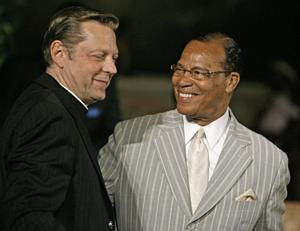
Who is Michael Pfleger? As we noted last month, he is a strong supporter of Louis Farrakhan and has been described as a "spiritual adviser" to Obama. He also publicly threatened the life of a Chicago businessman and, according to one report, "is known for climbing ladders to deface liquor billboards."

In his Trinity United oration, Pfleger asserted that white people have a moral obligation to surrender their assets, which, he suggested, properly belong to blacks (the video clip begins in midsentence):

--honest enough to address the one who says, "Well, don't hold me responsible [gesticulating] for what my ancestors did." But you have enjoyed the benefits of what your ancestors did and unless you are ready to give up the benefits [voice rising], throw away your 401 fund, throw away your trust fund, throw away all the money you put into the company you walked into because yo' daddy and yo' granddaddy and yo' greatgranddaddy--[screaming at the top of his lungs]--unless you're willing to give up the benefits, then you must be responsible for what was done in your generation 'cuz you are the beneficiary of this insurance policy!

Pfleger is white. Many Illinois taxpayers are black. The New York Times reported earlier this month that the latter have been forced to subsidize the former, through the good offices of one state Sen. Barack Obama:

Mr. Obama more eagerly met the demands for spending earmarks for churches and community groups in his district, said State Senator Donne E. Trotter, then the ranking Democrat on the Senate Appropriations Committee. "I know this firsthand, because the community groups in his district stopped coming to me," Mr. Trotter said.
Typical of Mr. Obama's earmarks was a $100,000 grant for a youth center at a Catholic church run by the Rev. Michael Pfleger, a controversial priest who was one of the few South Side clergymen to back Mr. Obama against [Rep. Bobby] Rush.
Father Pfleger has long worked with South Side political leaders to reduce crime and improve the community. But he has drawn fire from some quarters for defending the Nation of Islam leader Louis Farrakhan and inviting him to speak at his church. Father Pfleger, who did not return calls for comment, is one of the religious leaders whose "faith testimonials" Mr. Obama has posted on his presidential campaign Web site.

We searched the Obama Web site in vain for Pfleger's endorsement. It appears the campaign has suppressed it, although a copy appears on the Michelle Malkin page linked above.

Llorens, the TalkLeft blogger who posted the video, says twice in his short post that "this has nothing to do with Barack Obama." It seems to us Llorens is quite wrong about this, although possibly he is being ironic. For one thing, it raises serious questions about Obama's moral judgment that he not only attends but sends his two young daughters to a church whose pulpit regularly features such hatred.

It also renders doubtful one of the most frequent arguments for an Obama presidency: that he would diminish anti-American sentiment around the world through his conciliatory mien and tough diplomacy. His response to the political crisis over his spiritual advisers has been vacillatory, not conciliatory: first he stood by them, then he distanced himself from them. Now he pretends they don't exist--which differs from the putative Bush administration approach to Mahmoud Ahmadinejad & Co. how exactly?

Obama does not appear to have succeeded in diminishing anti-American sentiment in his own church, from religious leaders who fervently support him. The danger is that he would show similar weakness on the world stage, and that America's enemies would find such weakness provocative rather than meliorative.

Wednesday, May 28, 2008

http://www.hollywood-elsewhere.com/images/column/101507/chejungle.jpg
Che on the Silver Screen
By Humberto Fontova
FrontPageMagazine.com

5/28/2008

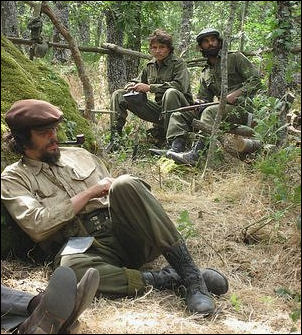
Oscar-winning director Steven Soderbergh unveiled his four-and-a-half-hour Che Guevara Biopic at the Cannes Film Festival last Thursday. One reviewer described the movie as “maniacally anticipated” - and Variety hailed it as Cannes' “most-anticipated” film.

But based on reviews thus far, it looks like Soderbergh blew it. After suffering what some critics described as the film's “butt-numbing” duration, Variety's Todd McCarthy branded the movie “defiantly nondramatic” and “a commercial impossibility.”

New York Magazine calls it, “something of a fiasco.” Everyone seemed bored if not actually catatonic while viewing the film. Time's Richard Corliss described Benicio Del Toro in the starring role as “seemingly sedated.” Bloomberg News wrote of the “viewers' bleary eyes.”

These reviewers, as usual, miss the point and bash the director unfairly. Director Stephen Soderbergh said flat out that the purpose of his movie was “to give you a sense of what it was like to hang out with [Che Guevara].”

Well? What did the reviewers expect? As usual, they know very little about the film's subject. In fact, Soderbergh has accomplished his goal with bells on. As exhibit one, I submit a sample of Che Guevara's sparkling conversation:

"The past makes itself felt not only in the individual consciousness – in which the residue of an education systematically oriented toward isolating the individual still weighs heavily – but also through the very character of this transition period in which commodity relations still persist, although this is still a subjective aspiration, not yet systematized."

Splash some cold water on your face and stick with me for just a little more:

"It is still necessary to deepen his conscious participation, individual and collective, in all the mechanisms of management and production, and to link this to the idea of the need for technical and ideological education, so that we see how closely interdependent these processes are and how their advancement is parallel.”

These passages come straight from the Che diaries that form the basis of the film's script. "I have no home, no woman, no parents, no brothers and no friends," wrote Guevara. "My friends are friends only so long as they think as I do politically."

To everyone familiar with the real Che Guevara it's abundantly clear that Soderbergh directed masterfully. He was not giving us Jerry Lee Lewis or John Belushi. No honest and educated reviewer can deny him massive kudus for so expertly transmitting this insufferable personality and presence to a soon snoring audience.

Soderbergh and Benicio Del Toro, who stars as Che and shares production credits, actually had an intriguing and immensely amusing theme if only they'd known how to plumb it. Soderbergh hails Guevara as "one of the most fascinating lives in the last century." Almost all who actually interacted with Ernesto Guevara (and are now free to express their views without fear of firing squads or torture chambers) know that the The Big Question regarding Ernesto, the most genuinely fascinating aspect of his life, is: how did such a dreadful bore, sadist and and epic idiot attain such iconic status?

The answer is that this psychotic and thoroughly unimposing vagrant named Ernesto Guevara had the magnificent fortune of linking up with modern history's top press agent, Fidel Castro, who for going on half a century now, has had the mainstream media anxiously scurrying to his every beck and call.

Had Ernesto Guevara De La Serna y Lynch not linked up with Raul and Fidel Castro in Mexico city that fateful summer of 1955--had he not linked up with a Cuban exile named Nico Lopez in Guatemala the year before who later introduced him to Raul and Fidel Castro in Mexico city-- everything points to Ernesto continuing his life of a traveling hobo, panhandling, mooching off women, staying in flophouses and scribbling unreadable poetry.

While making their film, Soderbergh and Del Toro repeatedly visited Havana to coo and peck away as anxiously as Herbert Matthews, Dan Rather or Barbara Walters while the regime tossed out its crumbs. Though rarely meeting with the Maximum Leader himself, the filmmakers, on top of relying on Che's diaries (edited by Fidel Castro) for the script, also obtained recollections from Che's widow and many of his former underling executioners. These all currently serve as ministers in a totalitarian regime. “We wanted to show the real character” boasts Soderbergh.

"I met him (Fidel Castro) for about five minutes," Del Toro said. "He knew about the project and he said to me that he was very happy that we had spent so much time researching the subject.”

“I'm here in Cuba's hills thirsting for blood,” Che wrote his abandoned wife in 1957. “Dear Papa, today I discovered I really like killing,” he wrote shortly afterwards. Alas, this killing very rarely involved combat, it come from the close-range murder of bound and blindfolded men and boys.

“When you saw the beaming look on Che's face as the victims were tied to the stake and blasted apart,” said a former political prisoner to this writer, “you knew there was something seriously, seriously wrong with Che Guevara.” In fact the one genuine accomplishment in Che Guevara's life was the mass-murder of defenseless men and boys. Under his own gun dozens died. Under his orders thousands crumpled. At everything else Che Guevara failed abysmally, even comically. Yet Soderbergh and Del Toro skip over these fascinating quotes and Che's one genuine accomplishment as a revolutionary.

He's lauded as the century's most celebrated guerrilla fighter but he never fought in a querrilla war. “The Guerrilla war in Cuba was notable for the marked lack of military skills or offensive spirit in the soldiers of either side," writes military historian Arthur Campbell, in his authoritative, Guerrillas: A History and Analysis. "The Fidelistas were completely lacking in the basic military arts or in any experience of fighting.”

"In all essentials Castro's battle for Cuba was a public relations campaign, fought in New York and Washington," writes British historian Hugh Thomas.

Yet Soderbergh and Del Toro, obsessively wary of lapsing into the slightest historical inaccuracy, relied on the Castro regime as primary source -- and came up with a shoot-'em up war movie! -- albeit an apparently boring one.

He's lauded as a rebel and free-spirit yet he denounced the very "spirit of rebellion" as "reprehensible!" -- and he boasted that under his watch "individualism must disappear!" This was no idle boast either. Che Guevara co-founded a regime that jailed more of its subjects than Stalin's and murdered more people in its first three years than Hitler's in its first six. In 1959, with the help of KGB agents, the man celebrated by the beautiful people at Cannes helped found, train and indoctrinate Cuba's secret police. "Always interrogate your prisoners at night," Che ordered his goons. "A man's resistance is always lower at night." Today the world's largest Che mural adorns Cuba's Ministry of the Interior, the headquarters for Cuba's STASI and KGB trained secret police.

Too bad Soderbergh and Del Toro didn't interview the former CIA officers who revealed to this writer how Fidel Castro himself, via the Bolivian Communist party, constantly fed the CIA info on Che's whereabouts in Bolivia. Including Fidel Castro's directive to the Bolivian Communists regarding Che and his merry band might have also added drama. “Not even an aspirin,” instructed Cuba's Maximum Leader to his Bolivian comrades, meaning that Bolivia's Communists were not to assist Che in any way—“not even with an aspirin,” if Che complained of a headache.

Alas, utterly starstruck by their subject and slavishly compliant to Fidel Castro's script and casting calls, all these fascinating plots and subplots flew right over Soderbergh and Del Toro's heads.

Humberto Fontova is the author of Exposing the Real Che Guevara and the Useful Idiots Who Idolize Him. Visit www.hfontova.com

Tuesday, May 27, 2008

http://images.barnesandnoble.com/images/26610000/26610547.JPG
From Human Events:
How the West Lost the World

by Patrick J. Buchanan

Europe, the Mother Continent of Western Man, is today aging and dying, unable to sustain the birth rates needed to keep her alive, or to resist conquest by an immigrant invasion from the Third World.

What happened to the nations that only a century ago ruled the world?

In "Churchill, Hitler and 'The Unnecessary War': How Britain Lost Its Empire and the West Lost the World," published today, this writer will argue that it was colossal blunders of British statesmen, Winston Churchill foremost among them, that turned two European wars into world wars that may yet prove the mortal wounds of the West.

The first blunder was a secret decision of the inner Cabinet in 1906 to send a British army across the Channel to fight in any Franco-German War. Had the Kaiser known the British Empire would fight for France, he would have moved more decisively than he did to halt the plunge to war in July 1914.

Had Britain not declared war on Aug. 4 and brought in Japan, Italy and the United States, the war would have ended far sooner. Leninism and Stalinism would never have triumphed in Russia, and Hitler would never have come to power in Germany.

The second blunder was the vengeful Treaty of Versailles that added a million square miles to the British Empire while putting millions of Germans under Czech and Polish rule in violation of the terms of the armistice and Woodrow Wilson's 14 Points.

A third was the British decision to capitulate to U.S. demands in 1921 and throw over a faithful Japanese ally of 20 years. Tokyo took its revenge, 20 years later, by inflicting the greatest defeat in British history, the surrender of Singapore and an army of 80,000 to a Japanese army half that size.

A fourth British blunder, which Neville Chamberlain called the "very midsummer of madness," was the 1935 decision to sanction Italy for a colonial war in Ethiopia. London destroyed the Stresa Front of Britain, France and Italy that Mussolini had forged to contain Germany, and drove Mussolini straight into the arms of a Nazi dictator he loathed.

In 1936, France sounded out the British to determine if they would support a drive to push German troops out of the Rhineland that Hitler had occupied in violation of Versailles. The British refused. And Churchill congratulated France for taking the matter up with the League of Nations, and said the ideal solution would be a voluntary Nazi withdrawal from the Rhineland to show the world that Hitler respected the sanctity of treaties.

Munich, 70 years ago this September, was a disaster. But it was a direct, if not inevitable, consequence of a Versailles treaty that had consigned 3.5 million Sudeten Germans to Czech rule against their will and in violation of the principle of self-determination.

But the fatal blunder was not Munich.

It was the decision of March 31, 1939, to hand a war guarantee to a neo-fascist regime of Polish colonels who had joined Hitler in the rape of Czechoslovakia.

Britain gave Warsaw a blank check to take her to war over a town, Danzig, the British themselves thought should be restored to Germany. Result: a Hitler-Stalin Pact and a six-year war that left scores of millions dead, Europe in ruins, the British empire bankrupt and breaking, 10 European nations under the barbaric rule of Joseph Stalin and half a century of Cold War. Had there been no war guarantee to Poland, there might have been no war, no Nazi invasion of Western Europe and no Holocaust.

Churchill was the indispensable war leader who held on until Hitler committed his fatal blunders, invading Russia and declaring war on America. He was also the man most responsible for Britain's fall from mistress of the greatest empire since Rome to an island dependency of the United States.

About the character of the Bolshevik regime in 1919 and Nazi regime in 1933, Churchill had been right. About British rearmament, he had been right. But Churchill was also often disastrously wrong.

He led the West down a moral incline to its own barbarism by imposing a starvation blockade on Germany in 1914 and launching air terror against open cities in 1940. These policies brought death to hundreds of thousands of women and children.

He was behind the greatest British military blunders in two wars: the Dardanelles disaster of 1915 and the Norwegian fiasco of 1940 that brought down Chamberlain and vaulted Churchill to power.

While excoriating Chamberlain for appeasing Hitler, Churchill's own appeasement of Stalin lasted longer and was even more egregious and costly, ensuring that the causes for which Britain sacrificed the empire -- the freedom of Poland and preventing a hostile power from dominating Europe -- were lost.

Churchill was, however, surely right when he told FDR in their first meeting after Pearl Harbor that they should call the war they were now in "The Unnecessary War."

He was a Great Man -- at the cost of his country's greatness.
http://therealrevo.com/blog/wp-content/uploads/2008/04/marxists.jpg
From National Review Online:
Obama, the Closer
An eloquent clean cut black man
is the perfect front man for the radical Left.
By Kyle-Anne Shiver

Is Barack the one we have been waiting for? Or is it the other way around? Are we the people we have been waiting for? Barack Obama is giving voice and space to an awakening beyond his wildest expectations, a social force that may lead him far beyond his modest policy agenda.

— Tom Hayden, endorsing the Obama Movement

For a Boomer like me, following the threads of the Obama movement is like a flashback from a bad 60s drug trip — an old, unwelcome nightmare.

Whether it’s Billy Ayers or Bernadine Dohrn, Tom Hayden or Jane Fonda, or any of the other lesser-knowns, 60s Marxist radicals are lining up behind Obama.

Obama’s young worshippers think they see something altogether new, a unique persona, seemingly magically transported to this moment in history to help them finally be the ones to net the elusive butterfly of socialism’s never-realized promise.

The kids think they see something new. But do they?

Sixties’ radicals see their as yet unfulfilled yearning for socialist utopia in a well-groomed, glittery, establishment-approved package.

The college kids today, flocking to Obama rallies, don’t look much like we did, with our tie-dyed shirts and frayed bellbottoms, our waist-length hair or wild Afros. And they seem to see Obama as the antithesis of 60s’ madness, with a been-there-done-that-want-something-new kind of thirst, a quest for which youth has always been known.

Obama is clean-cut. He talks unity, not subversion. He promises equal outcomes without resorting to violence to get them. He endorses marriage and fidelity for himself, without condeming other lifestyle choices. He speaks in highbrow English, rather than the 60s revolutionary slogans:

Kill the Pigs
Smash Monogamy
Violence is as American as cherry pie
If America don’t come around, we’re gonna burn it down

Obama’s followers make high-tech videos, mindlessly chanting, “Yes, we can” instead of making bombs to blow up government buildings, or holding up armored trucks and killing police officers.

This new generation seems to have the opportunity to do now with mere votes what their predecessors tried and failed to do through violence. We can finally seal the deal on the real revolution — democratically. Obama, the Closer, is at hand.

Evidenced by his list of supporters, from Ayers Dohrn, Hayden and Fonda, to the New Black Panthers, the New SDS, the New Winter Soldiers, et al., the radical Left has anointed Obama as the One. Every aging, anti-war, anti-capitalist group and their new offshoots are flocking around Obama like moths to a flame.

He is the One they’ve been waiting for. Biding their time during the dark, dreary days of Reagan, throughout the self-absorbed Boomer years, into the Yuppie sellout decade, and on through the compromising Clinton years, they’ve waited and planned and hoped.

To these rabid Marxist radicals, Obama is the One, because he’s probably their last chance to see socialism triumph on our own soil. They have grasped the reality of their own mortality.

And this could be very bad news for America. Who, in his right mind, really wants anything these radicals were peddling?

The Revolutionary (and Generational) Vanguard
An odd fact often gets lost in 60s mythology: the key Marxist radicals of those days were not themselves Baby Boomers.

Billy Ayers and Bernadine Dohrn, of Weatherman infamy, were both born during WWII, barely missing the Boomer cut-off of 1946. Tom Hayden of the Chicago Seven, later a far-left California politician who was married briefly to Hanoi Jane Fonda, was born in 1939. Every single one of the Chicago Seven, in fact, known for their Days of Rage at the Chicago Democratic Convention of 1968, were pre-Boomers.

The leaders of all the Marxist student groups of the 60s were either Red Diaper Babies or upper-crust white kids born during or shortly before WWII. For them, the time was ripe for revolution in America, brought on by the convergence of post-war prosperity (they were spoiled rotten), a new war on foreign soil (Vietnam) and forced conscription (the draft). And the white radicals were able to latch on to MLK’s nonviolent successes in the civil rights movement, as opportunistic hangers-on.

In truth, the genuine Marxist revolutionaries of that era mightily disdain the Boomers for our mostly short-lived flirtation with their ways, means, and mantras. They thought that we were the ones they had been waiting for; but we copped out.

In fact, we grew up — and remembered how great America is. They still haven’t. And they hate us for it.

Boomer Hillary
Even though both Bill and Hillary Clinton were radicals of a sort — protesting against the Vietnam War (Bill was a draft dodger), and supporting far-left causes at the time (the Black Panthers, SDS, George McGovern, etc.) — neither of them is technically of the same generation as the real radical leaders, the ones who are now flocking to Obama. Hillary and Bill are both Boomers, as is George W. Bush.

Although Hillary calls herself a modern “Progressive,” and continues to have close alliances with many former radicals, the true Marxists prefer Obama. They are the authentic “Progressives,” progressing the Marxist cause in America, without regard for the will of the citizenry.

Hillary is, undoubtedly, of the same mindset, but she has lived at least nine political lives, and more clearly understands the folly of seeking ideological perfection without regard to practical results over the long term. She also has, as we have seen over and over again, a personal survival instinct so strong that it keeps her from falling on her (and our) sword for the revolution.

The authentic do-or-die-trying arch-radicals see Hillary as a pragmatic compromiser, like Bill. The pair are not nearly as committed to the Revolution as they have become to Clinton power, the Clinton legacy, and the Clinton bank accounts. These Marxist revolutionaries reject politicians who stand up for America against foreign enemies; Hillary’s threats against Iran are the equivalent of blasphemy to them. Anything pragmatic is blashemy to them.

Obama’s appeasement seems a perfect fit with their own worldwide-revolutionary instincts.

These Marxist rabble-rousers, who refuse to grow up, or die, have long considered nearly all of us real Boomers to be sellouts. While most of the pre-Boomers remained Yippie revolutionaries, most Boomers became Yuppies instead. Or far, far worse, Republicans.

Jerry Rubin and Abbie Hoffman, both Chicago Seven defendants, were co-founders of the Yippies, the socialist Youth International Party, most known for its anti-establishment street theater and other public antics, as well as their symbolic flag: a bright-red star on a black field, with a dark-green marijuana leaf superimposed.

When Rubin went to work for corporate America in the mid-80s, he debated Hoffman on the merits of his decision to sell out to the man, and distilled the difference between Yippies and Yuppies thus: “if the acronym IRA makes you think of the Irish Republican Army, you're a yippie. But if you think that IRA stands for Individual Retirement Account, then you're a yuppie.”

In radical Marxist eyes, Hillary and Bill Clinton are definitely Yuppies. And to these folks, revolution is a religion like Islam. There are no honorable conversions. Period.

Judged politically mainstream sell-outs, the Clintons are now unacceptable standard-bearers of the Marxist revolution — an important behind-the-scenes factor in the Democrat primary race that the mainstream liberal media is loath to admit. Bill and Hillary may still have many of the same old radical goals, but any compromise with reality is too much for the pre-Boomer radicals to stomach.

Who’s afraid of washed-up SIXTIES’ radicals?
A couple of reminders on the political creed of Bernadine Dohrn — former Weatherman underground leader, now married to Billy Ayers, and very chummy with Barack Obama — seem in order here.

The best thing that we can be doing for ourselves, as well as for the Panthers and the Revolutionary Black Liberation Struggle, is to build a f**king white revolutionary movement.
— Bernadine Dohrn, May 21, 1970

That Barack Obama’s meteoric rise in American politics should have Chicago as its political home base was perhaps not quite as fortuitous and coincidental as it once appeared.

The first alliances Obama made in Chicago were with fellow travelers of socialist Saul Alinsky and leaders of the ongoing “Black Liberation” Struggle, Jeremiah Wright and Louis Farrakhan. And before Obama made even his first attempt to dip into Chicago’s political cesspool, he was introduced to and properly coronated by Ayers and Dohrn. Then came one “magical” success after another, until now the ultimate prize in American politics is stunningly within reach, in little more than a decade since Obama’s initial political grooming.

I’m going to read a declaration of a state of War. This is the first communication from the Weatherman Underground. All over the world, people fighting Amerikan imperialism look to Amerika’s youth to use our strategic position behind enemy lines to join forces in the destruction of the empire. . . . Within the next fourteen days we will attack a symbol or institution of Amerikan injustice.
— Bernadine Dohrn, circa 1970

Bernadine missed the Days of Rage at the Democrat Convention in 1968, because she was in Yugoslavia, meeting with communists from the National Liberation Front, getting advice on how to assist the worldwide revolution here in America. By far the communist radical with the sexiest image, Bernadine was also on the front lines of the “Smash Monogamy” campaign, which was designed to destroy the bedrock of American society by sneaking the revolution through the bedroom door, thereby crushing Americans’ “bourgeois hang-ups” and making them more amenable to groupthink.

And then, too, Bernadine and Ayers were busy helping their comrades to shed their “white skin privilege,” so they could identify with the core of the revolution’s oppressed, the Black Panthers. It seems more than fitting to these old Marxists, I’m quite certain, that they have found a black man to anoint, since they always believed that the revolution would succeed in America on the tails of black liberation.

Some have surmised that the considerable political influence of Ayers’ father within the Daley machine and Chicago’s halls of “justice” is the reason that both Ayers and Dohrn paid only the barest penalties for their numerous crimes against the United States. As Ayers loves to make a habit of gloating, he is “guilty as hell and free as a bird.”

Obviously, without a viable contemporary standard-bearer, these crusty old radicals would be no real threat to America, except at their university podiums, in their dreary textbooks, and in a sprinkling of local public offices.

But an eloquent, clean-cut, moderate-sounding black man is the perfect instrument for these radicals to promote their revolutionary program. Anyone who remembers the mayhem they caused and the citizens they killed in many a city and town across America, should be experiencing quite a lot of deja-vu angst right now, with Obama’s star rising, especially in the east and west.

Can Obama Seal the Deal?
Whether Obama proves to be The One, whom the 60s radicals have anointed to seal the deal on their long-awaited Marxist revolution, lies mostly now in the hands of Democratic National Committee, the party’s superdelegates, and — eventually, if he receives the nomination from the fractious Dems — the American electorate.

The 60s are long gone, but the era’s legacy lives on in the Democrat Party. As Peter Collier and David Horowitz summarized in their book, Destructive Generation:

The decade ended with a big bang that made society into a collection of splinter groups, special interest organizations and newly minted “minorities,” whose only common belief was that America was guilty and untrustworthy. This is perhaps the enduring legacy of the Sixties.

Even if the Democrats manage to avoid a big-bang ending to this nominating process (the rules for which were largely engineered by the 60s radicals themselves) remains to be seen. The Party may yet split on more traditional lines, between those who still love America and those who clearly don’t.

But the biggest sell Obama will have to make in November, if he is the nominee, is that he’s not just the handpicked new face of a very old, and thoroughly discredited ideology.

Even a young guy like Barack can’t revive the dead horse of socialism. Or can he?

— Kyle-Anne Shiver is a frequent contributor to American Thinker
Sydney Pollack, Film Director, Dies at 73


From The New York Times:
Sydney Pollack, Film Director, Is Dead at 73

By MICHAEL CIEPLY

LOS ANGELES — Sydney Pollack, a Hollywood mainstay as director, producer and sometime actor whose star-laden movies like “The Way We Were,” “Tootsie” and “Out of Africa” were among the most successful of the 1970s and ’80s, died Monday at home here. He was 73.

The cause was cancer, said the publicist Leslee Dart, who spoke for his family.

Mr. Pollack’s career defined an era in which big stars (Robert Redford, Barbra Streisand, Warren Beatty) and the filmmakers who knew how to wrangle them (Barry Levinson, Mike Nichols) retooled the Hollywood system. Savvy operators, they played studio against studio, staking their fortunes on pictures that served commerce without wholly abandoning art.

Hollywood honored Mr. Pollack in return. His movies received multiple Academy Award nominations, and as a director he won an Oscar for his work on the 1985 film “Out of Africa” as well as nominations for directing “They Shoot Horses, Don’t They?” (1969) and “Tootsie” (1982).

“Michael Clayton,” of which Mr. Pollack was a producer and a member of the cast, was nominated for a best picture Oscar earlier this year. He delivered a trademark performance as an old-bull lawyer who demands dark deeds from a subordinate, played by George Clooney. (“This is news? This case has reeked from Day 1!” snaps Mr. Pollack’s Marty Bach.) Most recently, Mr. Pollack portrayed the father of Patrick Dempsey’s character in “Made of Honor.”

Mr. Pollack became a prolific producer of independent films in the latter part of his career. With a partner, the filmmaker Anthony Minghella, he ran Mirage Enterprises, a production company whose films included Mr. Minghella’s “Cold Mountain” and the documentary “Sketches of Frank Gehry,” released in 2006, the last film directed by Mr. Pollack.

Mr. Minghella died in March, at the age of 54, of complications from surgery for tonsil cancer.

Apart from the Gehry documentary, Mr. Pollack never directed a movie without stars. His first feature, “The Slender Thread,” released by Paramount Pictures in 1965, starred Sidney Poitier and Anne Bancroft. In his next 19 films — every one a romance or drama but for the single comedy, “Tootsie” — Mr. Pollack worked with Burt Lancaster, Natalie Wood, Jane Fonda, Robert Mitchum, Al Pacino, Dustin Hoffman, Meryl Streep, Tom Cruise, Harrison Ford, Nicole Kidman, Ms. Streisand and others. A frequent collaborator was Robert Redford.

“Sydney’s and my relationship both professionally and personally covers 40 years,” Mr. Redford said in an e-mailed statement. “It’s too personal to express in a sound bite.”

Sydney Irwin Pollack was born on July 1, 1934, in Lafayette, Ind., and reared in South Bend. By Mr. Pollack’s own account, in the book “World Film Directors,” his father, David, a pharmacist, and his mother, the former Rebecca Miller, were first-generation Russian-Americans who had met at Purdue University.

Mr. Pollack developed a love of drama at South Bend High School and, instead of going to college, went to New York and enrolled at the Neighborhood Playhouse School of the Theater. He studied there for two years under Sanford Meisner, who was in charge of its acting department, and remained for five more as Mr. Meisner’s assistant, teaching acting but also appearing onstage and in television.

Curly-haired and almost 6 feet 2 inches tall, Mr. Pollack had a notable role in a 1959 “Playhouse 90” telecast of “For Whom the Bell Tolls,” an adaptation of the Hemingway novel directed by John Frankenheimer. Earlier, Mr. Pollack had appeared on Broadway with Zero Mostel in “A Stone for Danny Fisher” and with Katharine Cornell in “The Dark Is Light Enough.” But he said later that he probably could not have built a career as a leading man.

Instead, Mr. Pollack took the advice of Burt Lancaster, whom he had met while working with Mr. Frankenheimer, and turned to directing. Mr. Lancaster steered him to the entertainment mogul Lew Wasserman, and through him Mr. Pollack landed a directing assignment on the television series “Shotgun Slade.”

After a faltering start, he hit his stride on episodes of “Ben Casey,” “Naked City,” “The Fugitive” and other shows. In 1966 he won an Emmy for directing an episode of “Bob Hope Presents the Chrysler Theater.”

From the time he made his first full-length feature, “The Slender Thread,” about a social work student coaxing a woman out of suicide on a help line, Mr. Pollack had a hit-and-miss relationship with the critics. Writing in The New York Times, A. H. Weiler deplored that film’s “sudsy waves of bathos.” Mr. Pollack himself later pronounced it “dreadful.”

But from the beginning of his movie career, he was also perceived as belonging to a generation whose work broke with the immediate past. In 1965, Charles Champlin, writing in The Los Angeles Times, compared Mr. Pollack to the director Elliot Silverstein, whose western spoof, “Cat Ballou,” had been released earlier that year, and Stuart Rosenberg, soon to be famous for “Cool Hand Luke” (1967). Mr. Champlin cited all three as artists who had used television rather than B movies to learn their craft.

Self-critical and never quite at ease with Hollywood, Mr. Pollack voiced a constant yearning for creative prerogatives more common on the stage. Yet he dived into the fray. In 1970, “They Shoot Horses, Don’t They?,” his bleak fable of love and death among marathon dancers in the Great Depression, based on a Horace McCoy novel, received nine Oscar nominations, including the one for directing. (Gig Young won the best supporting actor award for his performance.)

Two years later, Mr. Pollack made the mountain-man saga “Jeremiah Johnson,” one of three closely spaced pictures in which he directed Mr. Redford.

The second of those, “The Way We Were,” about ill-fated lovers who meet up later in life, also starred Ms. Streisand and was a huge hit despite critical hostility.

The next, “Three Days of the Condor,” another hit, about a bookish C.I.A. worker thrust into a mystery, did somewhat better with the critics. “Tense and involving,” said Roger Ebert in The Chicago Sun-Times.

With “Absence of Malice” in 1981, Mr. Pollack entered the realm of public debate. The film’s story of a newspaper reporter (Sally Field) who is fed a false story by federal officials trying to squeeze information from a businessman (Paul Newman) was widely viewed as a corrective to the adulation of investigative reporters that followed Alan J. Pakula’s hit movie “All the President’s Men,” with its portrayal of the Watergate scandal.

But only with “Tootsie,” in 1982, did Mr. Pollack become a fully realized Hollywood player. By then he was represented by Michael S. Ovitz and the rapidly expanding Creative Artists Agency. So was his leading man, Dustin Hoffman.

As the film — a comedy about a struggling actor who disguises himself as a woman to get a coveted television part — was being shot for Columbia Pictures, Mr. Pollack and Mr. Hoffman became embroiled in a semi-public feud, with Mr. Ovitz running shuttle diplomacy between them.

Mr. Hoffman, who had initiated the project, argued for a more broadly comic approach. But Mr. Pollack — who played Mr. Hoffman’s agent in the film — was drawn to the seemingly doomed romance between the cross-dressing Hoffman character and the actress played by Jessica Lange.

If Mr. Pollack did not prevail on all points, he tipped the film in his own direction. Meanwhile, the movie came in behind schedule, over budget and surrounded by bad buzz.

Yet “Tootsie” was also a winner. It took in more than $177 million domestically and received 10 Oscar nominations, including for best picture. (Ms. Lange took home the film’s only Oscar, for best supporting actress.)

Backed by Mr. Ovitz, Mr. Pollack expanded his reach in the wake of success. Over the next several years, he worked closely with both TriStar Pictures, where he was creative consultant, and Universal, where Mirage, his production company, set up shop in 1986.

Mr. Pollack reached perhaps his pinnacle with “Out of Africa.” The film, based on the memoirs of Isak Dinesen, paired Ms. Streep and Mr. Redford in a drama that reworked one of the director’s favorite themes, that of star-crossed lovers. It captured Oscars for best picture and best director.

Still, Mr. Pollack remained uneasy about his cinematic skills. “I was never what I would call a great shooter or visual stylist,” he told an interviewer for American Cinematographer last year. And he developed a reputation for caution when it came to directing assignments. Time after time, he expressed interest in directing projects, only to back away. At one point he was to make “Rain Man,” a Dustin Hoffman picture ultimately directed by Mr. Levinson; at another, an adaptation of “The Night Manager” by John le Carré.

That wariness was undoubtedly fed by his experience with “Havana,” a 1990 film that was to be his last with Mr. Redford. It seemed to please no one, though Mr. Pollack defended it. “To tell you the truth, if I knew what was wrong, I’d have fixed it,” Mr. Pollack told The Los Angeles Times in 1993.

“The Firm,” with Tom Cruise, was a hit that year. But “Sabrina” (1995) and “Random Hearts” (1999), both with Harrison Ford, and “The Interpreter” (2005), with Nicole Kidman and Sean Penn, fell short, as Hollywood and its primary audience increasingly eschewed stars for fantasy and special effects.

Mr. Pollack never stopped acting; in a recent episode of “Entourage,” the HBO series about Hollywood, he played himself.

Among Mr. Pollack’s survivors are two daughters, Rebecca Pollack and Rachel Pollack, and his wife, Claire Griswold. The couple married in 1958, while Mr. Pollack was serving a two-year hitch in the Army. Their only son, Steven, died at age 34 in a 1993 plane crash in Santa Monica, Calif.

In his later years, Mr. Pollack appeared to relish his role as elder statesman. At various times he was executive director of the Actors Studio West, chairman of American Cinematheque and an advocate for artists’ rights.

He increasingly sounded wistful notes about the disappearance of the Hollywood he knew in his prime. “The middle ground is now gone,” Mr. Pollack said in the fall 1998 issue of New Perspectives Quarterly. He added, with a nod to a fellow filmmaker: “It is not impossible to make mainstream films which are really good. Costa-Gavras once said that accidents can happen.”

By Sydney Pollack

A selected filmography:
“The Slender Thread” (1965)
“This Property Is Condemned” (1966)
“The Scalphunters” (1968)
“The Swimmer” (1968) (uncredited)
“Castle Keep” (1969)
“They Shoot Horses, Don’t They?” (1969)
“Jeremiah Johnson” (1972)
“The Way We Were” (1973)
“The Yakuza” (1974)
“Three Days of the Condor” (1975)
“Bobby Deerfield” (1977)
“The Electric Horseman” (1979)
“Absence of Malice” (1981)
“Tootsie” (1982)
“Out of Africa” (1985)
“Havana” (1990)
“The Firm” (1993)
“Sabrina” (1995)
“Random Hearts” (1999)
“The Interpreter” (2005)
“Sketches of Frank Gehry” (2005)

The image “http://blueherald.com/uploads/Batocchio/RW_Cartoons/11_11_06/Varvel_11_11_06.jpg” cannot be displayed, because it contains errors.
From The Wall Street Journal:
Republicans Are in Denial

By TOM COBURN

May 27, 2008

As congressional Republicans contemplate the prospect of an electoral disaster this November, much is being written about the supposed soul-searching in the Republican Party. A more accurate description of our state is paralysis and denial.

Many Republicans are waiting for a consultant or party elder to come down from the mountain and, in Moses-like fashion, deliver an agenda and talking points on stone tablets. But the burning bush, so to speak, is delivering a blindingly simple message: Behave like Republicans.

Unfortunately, too many in our party are not yet ready to return to the path of limited government. Instead, we are being told our message must be deficient because, after all, we should be winning in certain areas just by being Republicans. Yet being a Republican isn't good enough anymore. Voters are tired of buying a GOP package and finding a big-government liberal agenda inside. What we need is not new advertising, but truth in advertising.

Becoming Republicans again will require us to come to grips with what has ailed our party – namely, the triumph of big-government Republicanism and failed experiments like the K Street Project and "compassionate conservatism." If the goal of the K Street Project was to earmark and fund raise our way to a filibuster-proof "governing" majority, the goal of "compassionate conservatism" was to spend our way to a governing majority.

The fruit of these efforts is not the hoped-for Republican governing majority, but the real prospect of a filibuster-proof Democrat majority in 2009. While the K Street Project decimated our brand as the party of reform and limited government, compassionate conservatism convinced the American people to elect the party that was truly skilled at activist government: the Democrats.

Compassionate conservatism's starting point had merit. The essential argument that Republicans should orient policy around how our ideas will affect the poor, the widow, the orphan, the forgotten and the "other" is indisputable – particularly for those who claim, as I do, to submit to an authority higher than government. Yet conservatives are conservatives because our policies promote deliverance from poverty rather than dependence on government.

Compassionate conservatism's next step – its implicit claim that charity or compassion translates into a particular style of activist government involving massive spending increases and entitlement expansion – was its undoing. Common sense and the Scriptures show that true giving and compassion require sacrifice by the giver. This is why Jesus told the rich young ruler to sell his possessions, not his neighbor's possessions. Spending other people's money is not compassionate.

Regaining our brand as the party of fiscal discipline will require us to rejoin Americans in the real world of budget choices and priorities, and to leave behind the fantasyland of borrowing without limits. Instead of adopting earmarks, each Republican can adopt examples of government waste, largess and fraud, and restart the permanent campaign against big government.

Republicans can tear up the "emergency spending" credit card and refuse to accept any new spending whatsoever, including for the wars in Iraq and Afghanistan, until Congress does its job of eliminating wasteful spending. The federal budget contains a vast unexplored area of offsets. My office alone has identified $300 billion in annual waste. Borrowing from the next generation when we haven't done our job of oversight is unconscionable.

Regaining our brand is not about "messaging." It's about action. It's about courage. It's about priorities. Most of all, it's about being willing to give up our political careers so our grandkids don't have to grow up in a debtor's prison, or a world in which other nations can tell a weakened and bankrupt America where we can and can't defend liberty, pursue terrorists, or show compassion.

John McCain, for all his faults, is the one Republican candidate who can lead us through our wilderness. Mr. McCain is not running on a messianic platform or as a great healer of dysfunctional Republicans who refuse to help themselves. His humility is one of his great strengths. In his heart, he's a soldier who sees one more hill to charge, one more mission to complete.

Mr. Coburn is a Republican U.S. senator from Oklahoma.

Monday, May 26, 2008

http://havanajournal.com/images/uploads/sydney-pollack-havana.jpg
From the Los Angeles Times:
Sydney Pollack, 73;
Oscar-winning director and producer
By Dennis McLellan

6:08 PM PDT, May 26, 2008

Sydney Pollack, the Academy Award-winning director of "Out of Africa" who achieved acclaim making popular, mainstream movies with A-list stars, including "The Way We Were" and "Tootsie," died Monday. He was 73.Pollack, who also was a producer and actor, died of cancer at his home in Pacific Palisades, according to Leslee Dart, his publicist and friend.

"Sydney Pollack has made some of the most influential and best-remembered films of the last three decades," film scholar Jeanine Basinger told The Times recently.

In looking at Pollack's films, she said, "what you see is how he kept in step with the times. He doesn't get locked into one decade and left there. He had a very sharp political sensibility and a keen sense of what the issues of his world were, and he advanced and changed as the times advanced and changed."

After launching his show-business career as an actor and acting teacher in New York City in the 1950s, Pollack moved west in the early '60s and began directing episodic television before turning to films.

Beginning with "The Slender Thread," a 1965 drama starring Sidney Poitier and Anne Bancroft, Pollack was credited with directing 20 films, including "They Shoot Horses, Don't They?," a 1969 drama about Depression-era marathon dancers starring Jane Fonda that earned Pollack an Oscar nomination for best director.

Known for what New York Times film critic Janet Maslin once described as "his broadly commercial instincts and penchant for all-star casts," Pollack directed seven movies with Robert Redford, beginning with "This Property Is Condemned" (with Natalie Wood) in 1966.

The Pollack-Redford collaboration also produced "The Way We Were" (with Barbra Streisand), "Jeremiah Johnson," "Three Days of the Condor" (with Faye Dunaway), "The Electric Horseman" (with Fonda), "Out of Africa" (with Meryl Streep) and "Havana."

As a filmmaker, Pollack had a reputation for being a painstaking craftsman -- "relentless and meticulous," screenwriter and friend Robert Towne once said.

"His films have a lyrical quality like great music, and the timing is impeccable," cinematographer Owen Roizman, who shot five films directed by Pollack, including "Tootsie" and "Havana," said in 2005 when it was announced that Pollack would receive the 2006 American Society of Cinematographers Board of Governors Award for his contributions to advancing the art of filmmaking.

"He is never satisfied. . . . His passion is contagious. It inspires everyone around him to dig a little deeper," Roizman said.

Film critic and historian Leonard Maltin said "the hallmark" of Pollack's career "has been intelligence, both in his approach and his selection of subject matter."

"Good, bad or in between, his films at the very least respected their audience," Maltin told The Times. "And, of course, he worked with grade-A collaborators on both sides of the camera -- the best screenwriters, the best actors -- and it shows."

"Out of Africa," the 1985 drama based on Danish author Isak Dinesen's experiences in Kenya during the early part of the 20th century and her romance with English big-game hunter-adventurer Denys Finch Hatton, earned Pollack two Academy Awards: as director and as producer of the film, which won the best picture Oscar.

Pollack also received a best director Oscar nomination -- and a New York Film Critics Circle Award -- for "Tootsie," the 1982 comedy starring Dustin Hoffman as Michael Dorsey, an unemployed New York actor who revives his career by transforming himself into a "woman" -- actress Dorothy Michaels -- who lands a role in a TV soap opera and then finds himself falling in love with an actress on the show, played by Jessica Lange. In the process of masquerading as a woman, Dorsey becomes a better man.

The making of the film was marked by creative dissension between Pollack and Hoffman -- and unexpected difficulties.

"It's like working with the mechanical shark in 'Jaws,' " Pollack told the New York Times in 1982. "Dustin's breasts fall down. The high heels hurt his feet. The makeup causes pimples, and the heat makes his beard show through after a couple of hours. It's a three-and-a-half-hour makeup job, and then the makeup only has a life of four or five hours. We didn't anticipate that."

Pollack spoke of his preference for working with big stars in an interview with New York Times in 1982.

"Stars are like thoroughbreds," he said. "Yes, it's a little more dangerous with them. They are more temperamental. You have to be careful because you can be thrown. But when they do what they do best -- whatever it is that's made them a star -- it's really exciting."

Sometimes, he added, "if you have a career like mine, which is so identified with Hollywood, with big studios and stars, you wonder if maybe you shouldn't go off and do what the world thinks of as more personal films with lesser-known people. But I think I've fooled everybody. I've made personal films all along. I just made them in another form."

Pressed by Hoffman to play his actor-character's exasperated agent in "Tootsie," Pollack finally consented to take on his first big-screen acting role since the 1962 film "War Hunt," during which he met Redford, who also was making his film debut.

"Dustin really kept after me to do the part," Pollack told the New York Times in another interview in 1982. "At one point, he even sent me flowers and signed the note, 'Love Dorothy.' The acting itself was fun. It would be a great vacation to act in a movie if I weren't directing it. But to do it while you're directing interferes with your concentration."

As an actor, Pollack later appeared in a number of films, including Woody Allen's "Husbands and Wives," Robert Altman's "The Player," Stanley Kubrick's "Eyes Wide Shut" and the recent Oscar-nominated Tony Gilroy film "Michael Clayton." Pollack also turned up in guest roles on TV series such as "Frasier," "Will & Grace" and "The Sopranos."

"I don't care much about acting," he told the South Bend Tribune in 2002. "It's more about watching other directors work."

Basinger, head of the film studies department at Wesleyan University in Middletown, Conn., and the author of numerous books on film, said Pollack "was a fabulous actor, and he understood actors and got the best out of them" as a director.

"Here's a man who could have himself been a movie star of a certain type had he so chosen because he really is that good an actor," she said, adding that Pollack, who spoke to film students at Wesleyan several times, also "cared about education" and was a "natural-born teacher."

Pollack's experience as an actor and acting teacher helped earn him a reputation as an "actor's director."

"He talks in a language that actors can understand," Ed Harris, who played an FBI agent in Pollack's 1993 dramatic thriller "The Firm," starring Tom Cruise, told USA Today at the time. "He won't just say 'speed up' or 'slow down'; he'll talk to you about the situation."

Fonda, who earned an Oscar nomination for her leading role in "They Shoot Horses, Don't They?," has said the darkly dramatic film was "a turning point for me, both professionally and personally."

With Pollack's guidance, she said, "I probed deeper into the character and into myself than I had before, and I gained confidence as an actor," she wrote in her autobiography, "My Life So Far."

In a 1993 interview with the Los Angeles Times, Pollack said he liked to talk to his actors at length.

"When I start a scene I say, 'Let's not make this a movie.' It's my way of wanting it first to be realistic. You're not doing it to be observed. You're doing it alone. I tell actors, 'Watch "Candid Camera," then flick the channel to something else, then turn back. You'll see how phony the acting looks because real reaction so often means doing nothing.' It's always simple. The tendency with actors is to think that if you're doing more, you're doing more."

The son of a pharmacist, Pollack was born July 1, 1934, in Lafayette, Ind., and later moved with his family to South Bend.

"I think of it with great sadness," he said of his experiences in South Bend in a 1993 interview with the New York Times. "It was a real cultural desert. There weren't many Jews like us, and it was real anti-Semitic."

His parents divorced while he was growing up, and his mother, who "had emotional problems and became an alcoholic," died when Pollack was 16. Although his father envisioned him becoming a dentist, Pollack left home after graduating from high school and moved to New York to become an actor. After studying with Sanford Meisner at the Neighborhood Playhouse School of the Theatre, Pollack became Meisner's assistant.

Pollack, whose career was interrupted by Army service from 1957 to 1959, had a small role in the 1955 Broadway comedy "The Dark Is Light Enough" and later appeared on "Playhouse 90" and "The United States Steel Hour," as well as series such as "The Twilight Zone" and "Have Gun Will Travel."

As an actor, however, he viewed teaching as his meal ticket.

"I knew I wasn't going to be any great shakes as an actor -- the way I looked I would play the soda jerk or the friend of a friend," he told the New York Times in 1993. "I taught. That's how I made my living."

Pollack's work as an actor on director John Frankenheimer's two-part adaptation of Ernest Hemingway's "For Whom the Bell Tolls" on "Playhouse 90," led Frankenheimer to ask him to work as a dialogue coach for two children in his "Playhouse 90" production of "Turn of the Screw."

That, in turn, led Pollack to do similar work in Hollywood on Frankenheimer's 1961 film "The Young Savages," starring Burt Lancaster.

"Lancaster told me to come to his office one day and said, 'You should be a director,' and I said that I didn't know anything about directing, so he introduced me to Lew Wasserman [then chairman of MCA, owner of Universal Pictures]," Pollack told the New York Times.

Over the next several years, Pollack directed episodes of TV shows such as "The Fugitive," "The Defenders," "Kraft Suspense Theatre" and "The Alfred Hitchcock Hour."

In 1966, he won an Emmy award for his direction of "The Game," an episode of "Bob Hope Presents the Chrysler Theatre." He also received Emmy nominations as the director of another segment of "Bob Hope Presents the Chrysler Theatre" and an episode of "Ben Casey."

Pollack's other films as a director are "The Scalphunters" (with Lancaster), "Castle Keep," "The Yakuza," "Bobby Deerfield," "Absence of Malice," "The Firm," "Sabrina," "Random Hearts" and "The Interpreter."

His most recent film was a departure: "Sketches of Frank Gehry," a feature-length documentary released in this country in 2006 about his friend, the renowned architect whose work includes the Guggenheim Museum in Bilbao, Spain and Walt Disney Concert Hall in Los Angeles.

Variety critic Todd McCarthy called Pollack's portrait of the architectural giant, shot in part with Pollack's own hand-held camera, "a rich tour of [Gehry's] artistic world and the journey that brought him to where he is today."

Pollack also had had more than 40 credits as a producer or executive producer on films such as "Presumed Innocent," "The Fabulous Baker Boys," "The Talented Mr. Ripley," "Cold Mountain" and "Michael Clayton."

Pollack, who co-founded Mirage Productions in 1985, was a founding member of the Sundance Institute, chairman emeritus of the American Cinematheque, a founding member of the Film Foundation, and a member of the board of directors for the Motion Picture and Television Fund.

He met his wife, Claire, when he was teaching and she was studying at the Neighborhood Playhouse. They were married in 1958 and had three children, Rebecca, Rachel and Steven. Steven died in a plane crash in 1993. He is also survived by six grandchildren and a brother Bernie, a Hollywood costume designer.

Services will be private.