Saturday, January 10, 2009

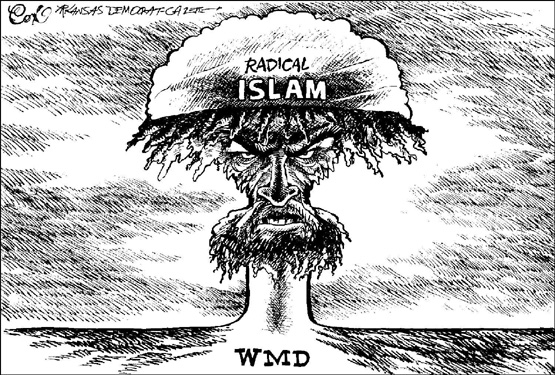
http://www.jewishworldreview.com/op-art/radical_islam2.jpg
From Pajamas Media:
Government Policies Stifle Talk of Islam

By David J. Rusin

January 9, 2009

When President Roosevelt addressed Congress after Pearl Harbor, he cited Japan [1] fifteen times in a speech of five hundred words. When President Bush did the same after 9/11, he uttered “Islam” or “Muslim” more sparingly — just [2] eleven times in a speech of three thousand words. And when Senators Obama and McCain spoke at the [3] respective [4] conventions and [5] debates, asking to be entrusted with America’s security, not a single reference to Islam could be found.

“Language shapes the way we think, and determines what we can think about,” [6] noted linguist Benjamin Lee Whorf. Based on the language used by Western governments, one must conclude that they do not want anybody thinking about the fundamental role that Islam plays in the conflict with Muslim radicals. If this self-imposed straitjacket hinders discussion of a foe that wishes to subjugate the world under Sharia law, then we have little chance of knowing him. And as Sun Tzu [7] observed, only by knowing the enemy can he be defeated.

The seeds of this silence were planted even while rescue teams picked through the smoldering wreckage of Ground Zero. Given the intensity of those weeks, it is no surprise that words and actions would set the tone for years to come. More often than not, however, the wrong words were spoken, the wrong actions were undertaken, and the wrong tone was set. Three events in particular stand out.

First, there was the aforementioned September 20, 2001, [2] speech to Congress. By reiterating the “war on terror” phraseology that he had [8] introduced on the day of the attacks, Bush defined the conflict in terms of a tactic (terrorism) rather than a strategic enemy (radical Islam). Moreover, of the references to Muslims and their faith, many sought to convince Americans that there was but a tenuous link between Islam and 9/11. His claim that “the terrorists practice a fringe form of Islamic extremism that has been rejected by Muslim scholars and the vast majority of Muslim clerics” remains an egregious example of happy talk displacing reality.

The second sign arrived days later when Operation Infinite Justice became Operation Enduring Freedom. Connecting the change to fallout from Bush’s hastily retracted “[9] crusade” remark, the BBC [10] reported that Defense Secretary Donald Rumsfeld “said the administration had quickly reconsidered the original name because, in the Islamic faith, such finality is considered something provided only by God.” While the initial title of the military response to 9/11 was [11] less than inspiring, its modification foreshadowed how Muslim sensibilities, both real and imagined, would wield veto power over language at the highest of levels.

The third domino fell when Italian Prime Minister Silvio Berlusconi voiced an undeniable truth. “We must be aware of the superiority of our civilization,” he [12] stated on September 26, 2001, “a system that has guaranteed well-being, respect for human rights, and — in contrast with Islamic countries — respect for religious and political rights, a system that has as its value understanding of diversity and tolerance.” Criticism rained down on him for daring to assert that nations which uphold basic freedoms are preferable to those which do not. Soon an emasculated Berlusconi was [13] testifying to his “deep respect” for the “great” religion of Islam — and a promising opportunity to define the ideological parameters of the war had been lost.

Seven years on, those seeds — watered by Western leaders’ intermittent praise of the “[14] religion of peace and love” — have matured into a thicket of [15] government policies and “suggestions” designed to remove Islam from official discourse.

British Home Secretary Jacqui Smith has come to epitomize this newspeak, [16] declaring in January 2008 that terrorism would henceforth be known as “anti-Islamic activity,” since “there is nothing Islamic about the wish to terrorize” — jihadists’ claims to the contrary. The Home Office soon confirmed that phrases like “Islamic extremism” had been jettisoned due to fears that they inflame Muslims. Previously the Foreign Office had [17] asked ministers to stop alluding to the “war on terror” for the same reason. Yet if terrorism is “anti-Islamic activity,” would not the “war on terror” be pro-Islamic?

To keep everybody on message — and away from Islam — Smith’s Home Office assembled a [18] phrasebook that, according to the Guardian, “tells civil servants not to use terms such as ‘Islamist extremism’ or ‘jihadi-fundamentalist,’ but instead to refer to violent extremism and criminal murderers or thugs.” The European Union has instituted [19] similar guidelines, instructing government spokesmen to utilize “non-offensive” phrases when making statements and to avoid “jihad” or “Islamic.”

The language police have infiltrated key U.S. agencies as well. “Terminology to Define the Terrorists: Recommendations from American Muslims,” a January 2008 Department of Homeland Security [20] paper, begins by professing that the government’s words “must accurately identify the nature of the challenges that face our generation.” But then it proceeds to do just the opposite, urging “caution in using terms such as ‘jihadist,’ ‘Islamic terrorist,’ ‘Islamist,’ and ‘holy warrior,’” based on the assumption that such words help legitimize radicals and offend moderates. By the way, “moderate Muslim” is out too. DHS has [21] refused to reveal which “influential Muslim Americans” — “moderate” or otherwise — were consulted for the project.

The National Counterterrorism Center soon developed a follow-up [22] document, “Words That Work and Words That Don’t: A Guide for Counterterrorism Communication,” advising on how to “describe terrorists who invoke Islamic theology.” Bullet points such as “Don’t Invoke Islam” and “Don’t Harp on Muslim Identity” make it clear that religion is to be swept under the rug. The recommendations have been [23] adopted by the State Department and Secretary of State Condoleezza Rice has led by example, eliminating references to jihad from her public comments.

It is not just words intended for mass consumption that have been suppressed. The case of Major Stephen Coughlin demonstrates how political correctness threatens to disarm policymakers behind closed doors. In early 2008, Coughlin, an expert on jihad warfare, was [24] released from his post with the Joint Staff after feuding with a Muslim official who, as Bill Gertz [25] reported, had wanted him “to take a softer line on Islam and Islamic law elements that promote extremism.” Central to the dispute was Coughlin’s weighty [26] thesis, “To Our Great Detriment”: Ignoring What Extremists Say About Jihad, which contends that “we do not understand the Islamic components” of the present conflict — a situation that many inside and outside of government work to perpetuate.

There are, however, hints that a backlash is brewing. A recent [27] study by the Inspectorate of Constabulary and Audit Commission finds that the ambiguous terminology favored by the British Home Office is hampering efforts to fight domestic radicalization. “Switching language … causes confusion,” one local council head bemoans in the document. Another suggests that the guidelines have led people to say nothing because they are “worried about saying the wrong thing” and being called “racist.” Instead, many officials [28] express “a preference for plain speaking so that issues could be dealt with openly rather than being avoided or disguised as something else.”

In addition, a U.S. Central Command “red team” has [29] produced “Freedom of Speech in Jihad Analysis: Debunking the Myth of Offensive Words,” a [30] report that questions policies aimed at downplaying connections between Islam and terrorism. “While there is concern that we not label all Muslims as Islamist terrorists,” it argues, “it is proper to address certain aspects of violence as uniquely Islamic. … The fact is our enemies cite the sources of Islam as the foundation of their global jihad. We are left with the responsibility of portraying our enemies in an honest and accurate fashion.”

President-elect Obama would be wise to build on this momentum. First, he should order a top-down review of the language that government agencies employ to describe Islamists and the war they wage on the West. Second, in a nod to critics of the Homeland Security document, he should pledge greater transparency with regard to the individuals and organizations invited to help shape the lexicon.

Confucius [31] warned that “if language is not correct, then what is said is not what is meant; if what is said is not what is meant, then what must be done remains undone.” There is much that remains undone in the struggle against Islamism, both violent and nonviolent. The West cannot afford to compound these challenges by labeling them imprecisely.

Research for this article was conducted under the auspices of [32] Islamist Watch, a project of the [33] Middle East Forum.

@ 12:07 am In . Column2 04, . Positioning, Elections 2008, Free Speech, Glenn and Helen Show, Homeland Security, Middle, Politics, Religion, US News | 46 Comments

Friday, January 09, 2009

http://farm1.static.flickr.com/177/484049734_a7ffb06b9a.jpg?v=0
From The Times:
As an atheist, I truly believe Africa needs God
Missionaries, not aid money,
are the solution to Africa's biggest problem -
the crushing passivity of the people's mindset
Matthew Parris

December 27, 2008

Before Christmas I returned, after 45 years, to the country that as a boy I knew as Nyasaland. Today it's Malawi, and The Times Christmas Appeal includes a small British charity working there. Pump Aid helps rural communities to install a simple pump, letting people keep their village wells sealed and clean. I went to see this work.

It inspired me, renewing my flagging faith in development charities. But travelling in Malawi refreshed another belief, too: one I've been trying to banish all my life, but an observation I've been unable to avoid since my African childhood. It confounds my ideological beliefs, stubbornly refuses to fit my world view, and has embarrassed my growing belief that there is no God.

Now a confirmed atheist, I've become convinced of the enormous contribution that Christian evangelism makes in Africa: sharply distinct from the work of secular NGOs, government projects and international aid efforts. These alone will not do. Education and training alone will not do. In Africa Christianity changes people's hearts. It brings a spiritual transformation. The rebirth is real. The change is good.

I used to avoid this truth by applauding - as you can - the practical work of mission churches in Africa. It's a pity, I would say, that salvation is part of the package, but Christians black and white, working in Africa, do heal the sick, do teach people to read and write; and only the severest kind of secularist could see a mission hospital or school and say the world would be better without it. I would allow that if faith was needed to motivate missionaries to help, then, fine: but what counted was the help, not the faith.

But this doesn't fit the facts. Faith does more than support the missionary; it is also transferred to his flock. This is the effect that matters so immensely, and which I cannot help observing.

First, then, the observation. We had friends who were missionaries, and as a child I stayed often with them; I also stayed, alone with my little brother, in a traditional rural African village. In the city we had working for us Africans who had converted and were strong believers. The Christians were always different. Far from having cowed or confined its converts, their faith appeared to have liberated and relaxed them. There was a liveliness, a curiosity, an engagement with the world - a directness in their dealings with others - that seemed to be missing in traditional African life. They stood tall.

At 24, travelling by land across the continent reinforced this impression. From Algiers to Niger, Nigeria, Cameroon and the Central African Republic, then right through the Congo to Rwanda, Tanzania and Kenya, four student friends and I drove our old Land Rover to Nairobi.

We slept under the stars, so it was important as we reached the more populated and lawless parts of the sub-Sahara that every day we find somewhere safe by nightfall. Often near a mission.

Whenever we entered a territory worked by missionaries, we had to acknowledge that something changed in the faces of the people we passed and spoke to: something in their eyes, the way they approached you direct, man-to-man, without looking down or away. They had not become more deferential towards strangers - in some ways less so - but more open.

This time in Malawi it was the same. I met no missionaries. You do not encounter missionaries in the lobbies of expensive hotels discussing development strategy documents, as you do with the big NGOs. But instead I noticed that a handful of the most impressive African members of the Pump Aid team (largely from Zimbabwe) were, privately, strong Christians. “Privately” because the charity is entirely secular and I never heard any of its team so much as mention religion while working in the villages. But I picked up the Christian references in our conversations. One, I saw, was studying a devotional textbook in the car. One, on Sunday, went off to church at dawn for a two-hour service.

It would suit me to believe that their honesty, diligence and optimism in their work was unconnected with personal faith. Their work was secular, but surely affected by what they were. What they were was, in turn, influenced by a conception of man's place in the Universe that Christianity had taught.

There's long been a fashion among Western academic sociologists for placing tribal value systems within a ring fence, beyond critiques founded in our own culture: “theirs” and therefore best for “them”; authentic and of intrinsically equal worth to ours.

I don't follow this. I observe that tribal belief is no more peaceable than ours; and that it suppresses individuality. People think collectively; first in terms of the community, extended family and tribe. This rural-traditional mindset feeds into the “big man” and gangster politics of the African city: the exaggerated respect for a swaggering leader, and the (literal) inability to understand the whole idea of loyal opposition.

Anxiety - fear of evil spirits, of ancestors, of nature and the wild, of a tribal hierarchy, of quite everyday things - strikes deep into the whole structure of rural African thought. Every man has his place and, call it fear or respect, a great weight grinds down the individual spirit, stunting curiosity. People won't take the initiative, won't take things into their own hands or on their own shoulders.

How can I, as someone with a foot in both camps, explain? When the philosophical tourist moves from one world view to another he finds - at the very moment of passing into the new - that he loses the language to describe the landscape to the old. But let me try an example: the answer given by Sir Edmund Hillary to the question: Why climb the mountain? “Because it's there,” he said.

To the rural African mind, this is an explanation of why one would not climb the mountain. It's... well, there. Just there. Why interfere? Nothing to be done about it, or with it. Hillary's further explanation - that nobody else had climbed it - would stand as a second reason for passivity.

Christianity, post-Reformation and post-Luther, with its teaching of a direct, personal, two-way link between the individual and God, unmediated by the collective, and unsubordinate to any other human being, smashes straight through the philosphical/spiritual framework I've just described. It offers something to hold on to to those anxious to cast off a crushing tribal groupthink. That is why and how it liberates.

Those who want Africa to walk tall amid 21st-century global competition must not kid themselves that providing the material means or even the knowhow that accompanies what we call development will make the change. A whole belief system must first be supplanted.

And I'm afraid it has to be supplanted by another. Removing Christian evangelism from the African equation may leave the continent at the mercy of a malign fusion of Nike, the witch doctor, the mobile phone and the machete.

Thursday, January 08, 2009

http://www.lifesitenews.com/ldn/images/2007/Prayer%20Breakfast/Neuhaus1f.jpg
From The Boston Globe:
The Rev. Richard John Neuhaus dies at 72

Posted by Michael Paulson

January 8, 2009 12:22 PM

The Rev. Richard John Neuhaus (right), one of the leading conservative voices in contemporary American Catholicism, died this morning at 72. Here is the announcement from Joseph Bottum, the editor of the journal Neuhaus founded, First Things:

"Fr. Richard John Neuhaus slipped away today, January 8, shortly before 10 o’clock, at the age of seventy-two. He never recovered from the weakness that sent him to the hospital the day after Christmas, caused by a series of side effects from the cancer he was suffering. He lost consciousness Tuesday evening after a collapse in his heart rate, and the next day, in the company of friends, he died.

My tears are not for him—for he knew, all his life, that his Redeemer lives, and he has now been gathered by the Lord in whom he trusted.

I weep, rather for all the rest of us. As a priest, as a writer, as a public leader in so many struggles, and as a friend, no one can take his place. The fabric of life has been torn by his death, and it will not be repaired, for those of us who knew him, until that time when everything is mended and all our tears are wiped away.

Funeral arrangements are still being planned; information about the funeral will be made public shortly. Please accept our thanks for all your prayers and good wishes."

Father Neuhaus was a Lutheran minister who converted to Catholicism in 1990. He is probably best known for his 1984 book, "The Naked Public Square: Religion and Democracy in America.'' He was a frequent commentator in the media about the Catholic church; I interviewed him on multiple occasions over the years, and he was always thoughtful, sharp, and forceful. He had been battling cancer for some time.

The world of Catholic and religion news bloggers, which has been anticipating Neuhaus's death for some time, is offering a variety of tributes today:

•Gary Stern, the religion writer at the Journal News in Westchester County, NY, writes: "Let’s be honest: Most people never heard of Neuhaus. He wasn’t really a public figure, in the modern celebrity sense. But among those who care about Catholic thought, the larger realm of Christian thought, the political school of thinking that’s become known as neo-conservativism, and the role of religion in the public square, he was really an intellectual giant."

• Jeffrey Weiss, a religion reporter at the Dallas Morning News, comments on Father Neuhaus's ubiquity, writing, "There can scarcely be a religion reporter who has worked over the past several decades who hasn't had occasion to talk to the Rev. Richard John Neuhaus once or thrice. He was smart, quotable and available -- an irresistible combination."

•Domenico Bettinelli, Jr., a staffer for the Archdiocese of Boston who blogs about Catholicism from the right, writes, "As a sometime Catholic journalist myself, Fr. Neuhaus was one of those I strived to emulate, but I did so only poorly. His erudition, wit, and communication skill far surpassed that of the rest of us. We have lost a great priest, writer, and public leader, but hopefully we have gained an advocate in heaven."

• Michael Sean Winters, who blogs about Catholicism from the left for America magazine, also praises Neuhaus, saying, "I remember the first time Father Neuhaus attacked me in print: I felt on top of the world. For a left-of-center person like me, being attacked by Father Neuhaus was a badge of honor. To gain the notice of someone with whom you disagree is much more flattering than to gain the praise of a mentor or an acolyte. Neuhaus’s career, beginning as a leftie Lutheran and ending as a conservative Catholic (he passed Gary Wills going in the opposite direction some time in the early 1970s), made him a hero among his newly found ideological soulmates on the right: We Catholics love a convert. But, even those of us who stayed on the left developed an admiration for Neuhaus’s facility with the language, the self-evident sincerity of his convictions, and the sheer prolificness of his pen. He seemed to be always writing and whether you agreed with him or not, his writings were always worth the read, always provocative and always written with flair. I never made Father Neuhaus’s acquaintance personally but a mutual friend once told me that if we were to break bread together we would soon be downing scotch and laughing with greater intensity than we had ever argued. I suspect that is right and look forward to a tumbler of single malt with him in the hereafter."

First Things has posted an essay on death that Father Neuhaus penned in 2000, so Father Neuhaus, never short of an opinion, gets the final word on his own demise:

"We are born to die. Not that death is the purpose of our being born, but we are born toward death, and in each of our lives the work of dying is already underway. The work of dying well is, in largest part, the work of living well. Most of us are at ease in discussing what makes for a good life, but we typically become tongue-tied and nervous when the discussion turns to a good death. As children of a culture radically, even religiously, devoted to youth and health, many find it incomprehensible, indeed offensive, that the word “good” should in any way be associated with death. Death, it is thought, is an unmitigated evil, the very antithesis of all that is good.

Death is to be warded off by exercise, by healthy habits, by medical advances. What cannot be halted can be delayed, and what cannot forever be delayed can be denied. But all our progress and all our protest notwithstanding, the mortality rate holds steady at 100 percent.

Death is the most everyday of everyday things. It is not simply that thousands of people die every day, that thousands will die this day, although that too is true. Death is the warp and woof of existence in the ordinary, the quotidian, the way things are. It is the horizon against which we get up in the morning and go to bed at night, and the next morning we awake to find the horizon has drawn closer. From the twelfth-century Enchiridion Leonis comes the nighttime prayer of children of all ages: 'Now I lay me down to sleep, I pray thee Lord my soul to keep; if I should die before I wake, I pray thee Lord my soul to take.' Every going to sleep is a little death, a rehearsal for the real thing."

http://www.catholiceducation.org/images/authos/neuhaus2.JPG
From National Review Online:
Death on a Thursday Morning
Fr. Richard John Neuhaus, R.I.P.

By the Editors

Richard John Neuhaus, who died earlier today in New York, was the most influential Catholic and Christian theologian and writer in America during the second half of the 20th century. His influence can be compared to that of Archbishop Fulton Sheen, with one important distinction: Fulton Sheen exercised his sway over the public directly, through his radio and television sermons. Father Neuhaus did so less directly, through his books and articles, through his editorship of two important magazines devoted to religion and politics, through his friendship with Pope John Paul II, and through his impact on other theologians both in the Catholic Church and in other Christian congregations. Partly for those reasons, however, Neuhaus’s influence is likely to be the deeper, longer-lasting and more extensive one.

Neuhaus began his adult life as a Canadian, a left-winger, and a Lutheran. He never lost his love for his country of birth — he spent six weeks of every year vacationing, reading, and reflecting in the Quebec countryside — his respect for a liberalism shaped by charity, or his admiration for the Lutheran tradition. He became nonetheless an American, a conservative, and a Catholic. And from these three conversions he forged for himself a distinctive religious identity that was conservative and generous, traditional and open, charitable and — yes — combative.

Neuhaus was a superb, natural controversialist. His two regular columns in the magazine he founded and edited, First Things, commented on the overlapping topics of religion, culture, and politics both in long, thoughtful articles and in short, brilliant squibs. Both profound and witty, they were required reading for morally serious people. His wit was a vehicle for important truths, and some of his epigrams have entered the language.

Thus: “For the New York Times the only good Catholic is a bad Catholic.”

Or: “Whenever orthodoxy becomes optional, it will sooner or later be proscribed.”

Neuhaus never shrank from what he considered a necessary fight — even one with friends — when the issue was important enough. He abandoned his original allies on the Left over Roe v. Wade. On the same issue he later devoted a special issue of First Things to an attack on judicial supremacy that questioned whether an American political regime that tolerated mass abortions was a legitimate one. That formulation divided the Right and led to the Left inventing the term “theocons” to demonize him and the Christian conservatives. To the end of his life Neuhaus continued to fight passionately for the thousands of innocents we kill annually.

But fighting and controversy, though necessary to the propagation of religious truth in our age, were secondary themes in Neuhaus’s life. His achievements were essentially creative. He was a natural organizer who did not stop at reshaping his own religious identity. Along with Michael Novak, George Weigel, and others, he established First Things and made it the focus for an intellectually respectable resistance to the theological liberalism of the 1960s in Judaism and all Christian denominations. That achieved, he worked successfully to bring together Catholics and evangelicals — traditionally not the friendliest of fellow-Christians — in a new, unified political constituency for “Life” issues and other concerns of traditional believers. He reshaped that old-time religion.

Without Richard John Neuhaus, the Christian conservatives in America would have been politically much weaker and intellectually far less formidable.

Much more could be written about his influence on Christianity in America and worldwide. But we at National Review also knew Richard as a valued colleague — our religion editor for many years — and a dear friend. Most of us have enjoyed dinners with him that would begin with a strong Beefeater martini and end with equally strong draughts of laughter. Some of us sought his pastoral advice and benefited from his wisdom. That he was just a few streets away in New York was itself a source of consolation.

We feel sorrow at his passing, but mainly for ourselves. He has gone to the Savior he served so well and faithfully. R.I.P.
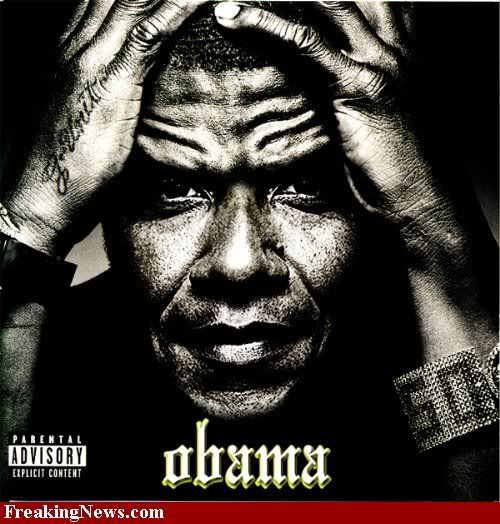
http://img.photobucket.com/albums/v637/Rokketmania/Black-Obama--36308.jpg
From chicagotribune.com:
Obama serves Reid taste of Chicago Way
John Kass

January 8, 2009

So the Chicago Way hauled off and slapped the U.S. Senate in the face—one of those backhands with the knuckles to unsuspecting lips—and guess who blinked?

It wasn't Chicago.

It was the Senate.

Get used to it, America. And it won't be the last time either.

Roland "Tombstone" Burris, the amiable Illinois Democratic political hack who is being called eminently qualified by the national Democrats—perhaps because he's from Illinois and he hasn't been indicted—has almost reached his goal of being addressed as "Yes, sir, Senator."

Now Tombstone has President-elect Barack Obama behind him, muscling Democratic Majority Leader Harry Reid in a phone call earlier in the week. So much for transcending the old politics.

Only a week ago, Obama, Reid and other Democratic leaders were adamant that they'd block any Senate appointment made by tainted Illinois Gov. Rod "Dead Meat" Blagojevich, who has been charged with trying to sell Obama's seat to the highest bidder.

Their statements back then were stern and inflexible, invoking the honor of the Senate and how they'd never let an allegedly corrupt governor put his greasy paws on their august dignity. Those statements weren't bland. They were so tough they had hair on them. More hair than Blagojevich, even.

But today's news is that Obama, often treated by the national media as the gentle Mr. Tumnus of American politics, got privately hardball with Reid over the Tombstone issue.

According a story in the Tribune by Rick Pearson and Mike Dorning, Obama didn't want the Chicago Way on parade in Washington, less than two weeks before his inauguration, when he formally becomes the agent of the change we can believe in.

Obama is perfectly within his rights to try to wriggle out of an embarrassing political situation, and what could be more embarrassing for him than to have Illinois political corruption constantly on the news in Washington?

People might start asking questions, wondering how Obama could come out of a city run by the wrought-iron fists of the Daley machine but smell like the neck of a baby after a bath.

I'm still wondering.

Yet Obama was tricky, not mentioning his phone call to Reid when talking to reporters Wednesday. He said Tombstone was the Senate's business, not his business.

"This is a Senate matter. But I know Roland Burris, obviously; he's from my home state. I think he's a fine public servant," Obama said, pulling a 180 on his earlier no-Burris position. "If he gets seated, then I'm going to work with Roland Burris, just like I work with all the other senators."

At least Obama had the good grace not to wag his index finger at reporters and bite his lower lip before announcing, "I did not have phone contact with that senator, Harry Reid, never, ever."

That's because he wasn't asked about Reid.

Obama almost wasn't asked anything about Burris on Wednesday. One reporter barely tossed it up at the end, after others asked him about the war in the Gaza Strip (Obama still can't comment about Gaza because he's not yet president) and the economy (though he's not president, you can't stop the guy from commenting on that one).

What Obama forgot to mention is that he ordered the Tombstone issue settled because it became his problem. So he told Reid to cave.

In political terms, Reid rolled up his sleeves, put on his favorite "Kiss the Chef" apron, got his fingers dusty with flour and baked himself a big humble pie. He scarfed it down in front of reporters Wednesday, without a fork, all but licking his fingers, that pie was so sweet and tasty. Mmm-mmm.

"For me, who had never met the man, it was very enlightening," oozed Reid, heaping praise on Burris after meeting him for the first time. "He is very engaging, an extremely nice man and he presents himself very well."

Reid was joined by another oozer, perhaps the most accomplished public oozer in the Senate, Dick Durbin of Illinois.

"I've known Roland Burris for 36 years in Illinois politics. We have always been friends," said Durbin, who a few days ago was calling the Burris appointment "an act of political defiance" that "will lead nowhere."

Then they agreed that Tombstone would probably get to join their club, and they also agreed that race had nothing to do with it, even though they are Democrats and Blagojevich played the race card as adroitly as Al Sharpton eating soul food with Caroline Kennedy in Harlem.

Sure, they're white guys and Burris is African-American, but race had nothing to do with it. It was just procedure and technicalities, they said.

"People ask a lot of times why we have to do various things procedurally here in the Senate," Reid told reporters. "It's because we're the Senate: That's how we operate."

Correction. That's how you used to operate. You're from Nevada, but Obama comes from Chicago.

It's sure got to be difficult to eat a big hunk of humble pie when your lips are stinging, but here's some advice, Senators.

Have another slice. There's plenty more.

jskass@tribune.com

http://www.enterstageright.com/archive/articles/0503/042803neuhausrichardjohn.jpg
Fr. Richard John Neuhaus
May 14, 1936 – January 8, 2009

A pair of moving tributes from The Corner:

A Tribute to Father Neuhaus [Peter Wehner]

The death of Father Neuhaus is a terrible blow. Not for him, who is now united with his Savior and his Redeemer, in whom Father Neuhaus placed all of his trust and all of his hope; but for us, who have lost one of America's leading public intellectuals, a man of profound wisdom and learning, and a great champion for the unborn. It was Father Neuhaus, along with his dear, long-time friend George Weigel and just a handful of others like Michael Novak, who not only championed the pro-life cause for so many years, but who gave the rest of us both the grounding and the vocabulary to speak on this issue.

They made the pro-life cause the cause of those seeking justice and protection for the weakest and most vulnerable members of the human community.

Father Neuhaus was author of one of the most important, debate-changing books in the history of modern conservatism: The Naked Public Square: Religion and Democracy in America (published in 1984). He penned many other books, before and after, and they were unfailingly intelligent, well-argued, elegantly written, and often moving. He was editor in chief of First Things and author of its very popular column "The Public Square," Neuhaus's monthly survey of religion, culture, and public life. And he was a central figure in finding common ground among Catholics and evangelicals. Father Neuhaus's influence was quiet, profound, and virtually without boundaries. A former, very influential member of Congress wrote me just yesterday, saying, "When I first ran for Congress I read everything I could from him to formulate my thinking on social policy."

Beyond his influence in our national life, Father Neuhaus was a wonderful and delightful man. Many knew him better than I, but what I did know of him led me to conclude he was an exceptional man. When I would travel to New York City while serving in the White House, I would make it a point to drop in to see Father Neuhaus, to benefit from his wisdom, to gain perspective, and to experience the joy of his company. I helped arrange to have him come to the White House, so others, including the President, might as well. Over the years he was always very kind and supportive of me. And I would always delight in receiving e-mails from him, often in response to something I had written, many times offering an insight which I wish I had thought of, and sometimes offering a gentle corrective.

I accepted every one of them.

Richard John Neuhaus was many things, and people will dilate on them in this space and in other places in the coming hours and days. But he was, above everything else, a man of faith who loved his church and loved his Lord. He served Him honorably and well all the days of his life.

In The Imitation of Christ, Thomas a Kempis wrote,

How greatly I long for the dawning of this day, and the end of all worldly things. On the Saints this day already shines, resplendent with everlasting glory; but to us who are pilgrims on earth it appears but dim and distant. The citizens of Heaven now taste the joys of this day. Having excluded all worldly things from his heart and life, he will be worthy to take his place in the choir of Angels.

A few hours ago, Richard John Neuhaus went from being a pilgrim to becoming a citizen of Heaven, taking his place in the choir of Angels.

He is at peace; and they are now blessed to receive him.


Neuhaus [Ramesh Ponnuru]

Although he would probably not have taken this description as a compliment, Fr. Neuhaus's "The Public Square" feature in First Things was an extraordinary journalistic accomplishment. Every month he read everything from Lutheran newsletters to the New York Review of Books and added comments of his own that rarely failed to enlighten, entertain, or, frequently, both.

The Naked Public Square is probably his most influential work, but the one I value most highly is Death on a Friday Afternoon. On hearing the news of his death, I looked up this passage:

When I come before the judgment throne, I will plead the promise of God in the shed blood of Jesus Christ. I will not plead any work that I have done, although I will thank God that he has enabled me to do some good. I will plead no merits other than the merits of Christ, knowing that the merits of Mary and the saints are all from him; and for their company, their example, and their prayers throughout my earthly life I will give everlasting thanks. I will not plead that I had faith, for sometimes I was unsure of my faith, and in any event that would be to turn faith into a meritorious work of my own. I will not plead that I held the correct understanding of "justification by faith alone," although I will thank God that he led me to know ever more fully the great truth that much misunderstood formulation was intended to protect. Whatever little growth in holiness I have experienced, whatever strength I have received from the company of the saints, whatever understanding I have attained of God and his ways—these and all other gifts I have received I will bring gratefully to the throne. But in seeking entry to that heavenly kingdom, I will, with Dysmas, look to Christ and Christ alone.

Then I hope to hear him say, "Today you will be with me in paradise," as I hope with all my being—because, although looking to him alone, I am not alone—he will say to all.

R.I.P.

Wednesday, January 07, 2009

http://a362.ac-images.myspacecdn.com/00841/16/35/841645361_l.jpg
From Pajamas Media:
Sonny Corleone in Gaza
Posted By Robert Stacy McCain

January 5, 2009

“If you touch my sister again, I’ll kill you,” Sonny Corleone says after delivering a [1] memorable beating to Carlo in The Godfather.

Sonny Corleone was on my mind Sunday morning after seeing a [2] New York Times story about the rise of “dating abuse” among teenagers. In Rhode Island, schools are required to begin teaching in seventh grade about the dangers of such abuse, but my inner traditionalist wonders, whatever happened to brothers like Sonny?

My inner traditionalist also wonders why liberal Jews like Glenn Greenwald invariably disparage Israeli efforts to defend themselves against terrorism. Greenwald [3] excoriated Michael Goldfarb of the Weekly Standard for an “excessive tribalistic identification” after [4] Goldfarb pondered the ruthlessness with which the Israeli Air Force targeted [5] Hamas leader Nizar Ghayan.

Greenwald is hardly alone among liberals in denouncing the Gaza campaign — Israel’s response to Hamas rocket and mortar attacks — as “disproportionate.” Yet what would a “proportionate” response look like? The denunciations would be no less vehement if Israel emulated Hamas and started lobbing shells haphazardly at Gaza on a tit-for-tat basis.

Random “proportionate” attacks, however, would do nothing in terms of dismantling the Hamas terrorist infrastructure, which is the [6] avowed mission of Israel’s Gaza campaign. By going into Gaza in Sonny Corleone fashion, Israel aims to ensure that the Hamas attacks — as cowardly as Carlo’s battering of Sonny’s sister Connie — are permanently ended.

Of course, Hamas being Hamas, they will never stop trying to kill Jews. Fans of The Godfather will recall that Carlo, being Carlo, chose a coward’s revenge by betraying Sonny to rival mobsters, so that at last Michael Corleone assigned Clemenza to deal decisively with Carlo.

If this analogy can be stretched a bit more, then, where does Glenn Greenwald fit? He’s [7] Connie pleading frantically on behalf of her abusive husband: “It was my fault! … I started a fight with him. … Sonny, please don’t do anything. Please don’t do anything.” This is what the [8] Blame Israel First crowd always says whenever Israel responds to repeated attacks by striking back against the terrorists. Always the demand is that Israel should make concessions, always condemnation is reserved for Israel’s defenders who are, Greenwald assures us, “guilty of insufficiently weighing the deaths of Palestinian innocents.”

Innocent Israelis — like [9] Shiri Negari, killed with 18 others in a 2002 suicide attack — are curiously invisible in the Greenwaldian discourse, as if in some metaphysical sense no Israeli could ever be truly innocent. No, in the eyes of the Blame Israel Firsters, all the bloodshed in the Promised Land ultimately is on the hands of the Jews. They have internalized the Hamas narrative of “Zionist imperialism,” in which the Jews deserve whatever evil befalls them, just as Connie believed she deserved to be beaten by Carlo.

Like flashback sequences in The Godfather II, arguments over the Middle East have a way of devolving into historical trips backward in a time machine. Back to the Oslo Accords in 1993, back to the Yom Kippur War in 1973 and the Six-Day War in 1967, back to the founding of Israel in 1948, back to the Balfour Declaration in 1917, back through the history of the Ottoman Empire and so on until finally one is confronted with Isaac and Ishmael. The conflict is so ancient that any talk of peace immediately calls to mind the words of the prophet [10] Jeremiah denouncing those who say, “Peace, peace; when there is no peace.”

Hamas has never advocated peace, and has sabotaged every effort to broker a peace between Israel and the Palestinians. Indeed, Hamas reportedly responded to the Israeli attack on Gaza by [11] rounding up their Fatah rivals and other suspected “collaborators,” Fatah having been guilty of complicity in peace talks with Israel.

Insofar as Hamas has any coherent political philosophy, that philosophy can be summed up in two words: Kill Jews. And anyone — Arab or Jew, Muslim or infidel — who opposes that genocidal objective must sooner or later become an enemy of Hamas. The only real question is how far Hamas should be allowed to pursue its objective before Israel responds, and how far Israel can go before it goes too far.

“How many missiles is Israel to suffer before it is warranted to defend its territory and its people?” [12] R. Emmett Tyrrell wondered last week. “It is tragic that Palestinian civilians are dying, but Hamas locates its military installations and administrative facilities in civilian areas precisely to dissuade Israel from attacking Hamas as it insouciantly bombards Israel, its soldiers, and more frequently its civilians.”

Hunkered down amid their human shields, Hamas leaders seem determined to fight to the last Palestinian civilian. Nazir Ghayan, whose death provoked Michael Goldfarb’s ruminations on “ruthlessness,” had already sent his own son to die in a suicide attack, and appears to have intentionally kept his own family at hand so they could all die together in an Israeli airstrike.

Given the persistent fanaticism of the Hamas death cult, what are we to make of those who, like [13] Newsweek columnist Aaron David Miller, proclaim that the solution is for Barack Obama to “get tough” with Israel? Perhaps they’re Tessio, who exposes himself as a traitor by proposing a meeting with Barzini. Or maybe they’re just weak and stupid like Fredo.

We can’t fast-forward to find out how the saga ends. For now, we can only watch as Hamas learns the timeless lesson: Don’t mess with Sonny Corleone’s sister.

From Rollingstone.com:
The E Street Band Keep Rolling in '09
Inside the making of Springsteen's
new 'Working on a Dream'


DAVID FRICKE

Just after Bruce Springsteen wrapped up recording 2007's Magic, the E Street Band headed back to the studio to shoot a video — but Springsteen had bigger plans for the group. "Bruce said, 'I've got a new group of songs, and everyone's gonna be in one place,' " recalls Magic producer Brendan O'Brien. "He said, 'Let's get together while we're there and get them done.'"

Those songs — and others cut in New York and L.A. during breaks from the Magic tour — became Springsteen's 16th studio album, Working on a Dream, due January 27th. "I hope Working on a Dream has caught the energy of the band fresh off the road from some of the most exciting shows we've ever done," Springsteen said in a statement announcing the new album. "A lot of stuff was done on the fly," O'Brien confirms. "We would hear things and go, 'That would sound great, let's try that.' There wasn't a lot of dwelling."

But Working on a Dream is also an intricately arranged album, combining the dense whirl of E Street stage shows with orchestral and vocal flourishes that recall classic recordings by Roy Orbison and the Byrds. "My Lucky Day," one of the first songs cut for the album, is a burst of garage-guitar clatter with huge Sixties-pop vocal harmonies, and the dark, psychedelic swirl of "Life Itself" includes a backward guitar break by Nils Lofgren. "What Love Can Do" and "Surprise, Surprise" are both pop stomps loaded with Beatlesque guitar jangle, and "This Life" is draped in 1966-Beach Boys vocal harmonies. Ironically, "Tomorrow Never Knows" is not the Beatles' Revolver song but a Springsteen original outfitted with fiddle, strings and pedal steel guitar à la Bob Dylan's Nashville Skyline.

"Bruce was into this material being more orchestral, not just capturing a live feel," O'Brien says, "and that takes different sounds, orchestrations and vocal presentations." No song captures that ambition better than the eight-minute opening track, "Outlaw Pete," a gunfighter saga with changing time signatures, a driving Steven Van Zandt guitar riff and dramatic interjections of tubular bell, marxophone (an antique keyboard instrument that sounds like a hammer dulcimer) and Springsteen's "Thunder Road"-style harmonica. The combined effect is like a Pete Seeger ballad scored by Sergio Leone. "It is a beast of music," O'Brien concedes. "We actually cut it in pieces, one step at a time. In Bruce's mind, it was 'Let's make every moment as interesting as we can.'"

Sessions continued through this fall when, during mixing, Springsteen brought in the moving finale, "The Last Carnival," a tribute to E Street keyboard player Danny Federici, who played on a few songs on the album before his death last April. (Federici's son, Jason, plays accordion on "The Last Carnival," which is followed by a bonus track, Springsteen's Golden Globe-nominated title song for The Wrestler.)

Springsteen and the E Street Band will tour behind the new album, following their Super Bowl halftime set on February 1st. A source says the tour will not be "a total marathon," probably 50 to 60 shows divided between the U.S. and Europe. One idea under consideration is a miniset each night devoted to a full performance of one of Springsteen's classic albums — "a way of addressing the past," the source says.

In the meantime, Springsteen has songs left over that could be the start of another album. "But you have to remember," O'Brien says, "when Bruce calls, it's not 'Oh, I gotta crank up for an album.' It's 'Hey, man, I've got some songs. What are you doing? Let's record.' Sometimes it's hard to tell when one record stops and another one starts."

[From Issue 1070 — January 22, 2009]
http://seattletimes.nwsource.com/ABPub/2008/07/25/2008073175.jpg
From Human Events:
This Is the Downer We've Been Waiting For!

After NBC canceled me "for life" on Monday -- until seven or eight hours later when the ban was splashed across the top of The Drudge Report, forcing a red-faced NBC to withdraw the ban -- an NBC insider told The Drudge Report: "We are just not interested in anyone so highly critical of President-elect Obama, right now," explaining that "it's such a downer. It's just not the time, and it's not what our audience wants, either."

In point of fact, I'm not particularly critical of Obama in my new book. I'm critical of the media for behaving like a protection racket for Obama rather than the constitutionally protected guardians of our liberty that they claim to be. So I think what the NBC insider meant to say is that NBC is not interested in anyone so highly critical of NBC right now. It's such a downer, it's just not the time, and it's not what their audience wants right now, either.

In fact, I think my book is the downer America has been waiting for! So herewith, I present an excerpt from the smash new book out this week, Guilty: Liberal Victims and Their Assault on America:

When the Obama family materialized, the media was seized by a mass psychosis that hadn't been witnessed since Beatlemania. OK! magazine raved that the Obamas "are such an all-American family that they almost make the Brady Bunch look dysfunctional." Yes, who can forget the madcap episode when the Bradys' wacky preacher tells them the government created AIDS to kill blacks!

Still gushing, OK! magazine's crack journalists reported: "Mom goes to bake sales, dad balances the checkbook, and the girls love Harry Potter" -- and then the whole family goes to a racist huckster who shouts, "God damn America!"

Months before network anchors were interrogating vice presidential candidate Sarah Palin on the intricacies of foreign policy, here is how NBC's Brian Williams mercilessly grilled presidential candidate Barack Obama: "What was it like for you last night, the part we couldn't see, the flight to St. Paul with your wife, knowing what was awaiting?"

Twisting the knife he had just plunged into Obama, Williams followed up with what has come to be known as a "gotcha" question: "And you had to be thinking of your mother and your father." Sarah Palin was memorizing the last six kings of Swaziland for her media interviews, but Obama only needed to say something nice about his parents to be considered presidential material.

The media's fawning over Obama knew no bounds, and yet, in the midst of the most incredible media conspiracy to turn this jug-eared clodhopper into some combination of Winston Churchill and a young Elvis, you were being a bore if you mentioned the liberal media. Oh surely we've exploded that old chestnut. ... Look! Look, Obama just lit up another Marlboro! Geez, does smoking make you look cool, or what! Yeah, Obama!.

The claim that there's no such thing as a left wing press is a patent lie said to enrage conservatives. Newspapers read like the press under Kim Jong Il, which, outside of a police state, looks foolish. The prose is straight out of The Daily Worker, full of triumphal rhetoric with implicit exclamation points. Still, their chanted slogans fill your brain, like one of those bad songs you can't stop humming.

There is no other explanation for the embarrassing paeans to Obama's "eloquence." His speeches were a run-on string of embarrassing, sophomoric Hallmark card bromides. It seemed only a matter of time before Obama would slip and tell a crowd what a special Dad it had always been to him.

The major theme of Obama's campaign was the audacity of his running for president. He titled his keynote address at the 2004 Democratic National Convention, "The Audacity of Hope" -- named after a sermon given by his spiritual mentor Jeremiah Wright, whom we were not allowed to mention without being accused of playing dirty tricks. (Rejected speech titles from sermons by Rev. Wright included "God Damn America!," "The U.S. of K.K.A." and "The Racist United States of America.")

What is so audacious about announcing that you're running for president? Every U.S. Senator has run for president or is currently thinking about running for president. Dennis Kucinich ran for president. Lyndon LaRouche used to run for president constantly.

But the media were giddy over their latest crush. Even when Obama broke a pledge and rejected public financing for his campaign -- an issue more dear to The New York Times than even gay marriage -- the Times led the article on Obama's broken pledge with his excuse. "Citing the specter of attacks from independent groups on the right," the Times article began, "Sen. Barack Obama announced Thursday that he would opt out of the public financing system for the general election."

So he had to break his pledge because he was a victim of the Republican Attack Machine.

When Obama broke his word and voted for the Foreign Intelligence Surveillance Act bill (FISA), the Times' editorial began: We are shocked and dismayed by Sen. Obama's vote on ... oh, who are we kidding? We can't stay mad at this guy! Isn't he just adorable? Couldn't you just eat him up with a spoon? Is he looking at me? Ohmigod, I think he's looking at me!!!! Couldn't you just die?

It has ever been thus.

Ann Coulter is Legal Affairs Correspondent for HUMAN EVENTS and author of "High Crimes and Misdemeanors," "Slander," ""How to Talk to a Liberal (If You Must)," "Godless," and most recently, "If Democrats Had Any Brains, They'd Be Republicans."
http://www.novatownhall.com/blog/graphics/neuhaus_ncpb_sm.jpg
From The Corner at NRO:
On Fr. Neuhaus

Kathryn Jean Lopez

His friends and family are keeping vigil and he was administered last rites shortly after midnight. Fr. George Rutler, who gave him the Catholic Sacrament, says that “he is not expected to live long” and suggests “that it is appropriate that prayers be offered for a holy death.”

Fr. Neuhaus has come close to this moment before and been back. If it’s his time: Go in peace. He's a man who has loved and served His Lord. When he leaves this world, his vast intellectual and spiritual body of work will have a long life here.

Speaking of his archives: Fr. Neuhaus might agree with his brother priest on the appropriate prayer for him. Fr. Neuhaus might say, if he could right now, what he's already written:

We are born to die. Not that death is the purpose of our being born, but we are born toward death, and in each of our lives the work of dying is already underway. The work of dying well is, in largest part, the work of living well. Most of us are at ease in discussing what makes for a good life, but we typically become tongue-tied and nervous when the discussion turns to a good death. As children of a culture radically, even religiously, devoted to youth and health, many find it incomprehensible, indeed offensive, that the word "good" should in any way be associated with death. Death, it is thought, is an unmitigated evil, the very antithesis of all that is good.

Death is to be warded off by exercise, by healthy habits, by medical advances. What cannot be halted can be delayed, and what cannot forever be delayed can be denied. But all our progress and all our protest notwithstanding, the mortality rate holds steady at 100 percent.

Death is the most everyday of everyday things. It is not simply that thousands of people die every day, that thousands will die this day, although that too is true. Death is the warp and woof of existence in the ordinary, the quotidian, the way things are. It is the horizon against which we get up in the morning and go to bed at night, and the next morning we awake to find the horizon has drawn closer. From the twelfth-century Enchiridion Leonis comes the nighttime prayer of children of all ages: "Now I lay me down to sleep, I pray thee Lord my soul to keep; if I should die before I wake, I pray thee Lord my soul to take." Every going to sleep is a little death, a rehearsal for the real thing.

01/07 02:29 PM
Glasvegas - how they thundered to greatness in '08
Conjuring uplifiting rock from brutal realism: Glasvegas

From telegraph.co.uk:
Glasvegas: how they thundered to greatness
Glasvegas combine singalong populism
and soulful artistry on their self-titled debut album.

By Neil McCormick

In a student hall in Nottingham, a crowd sing along to the refrain of Go Square Go, a song about a violent confrontation at the school gates. It's delivered by singer James Allan in a thick Scots accent, while his black-garbed gang of rockers produce a maelstrom of distorted sound.

For all its lairiness, somewhere at the heart of the reverb-heavy drums and overdriven guitars lurks a painfully sensitive observation of bullying and fear. It is a song for our times and just one example of the complex mixture of singalong populism and soulful artistry that make Glasvegas one of the best new groups of 2008.

On their self-titled debut album, Glasvegas conjure uplifting rock from a kind of brutal social realism. Allan sings about knife crime, social workers, depression, jealousy and parental failure in a language that is at once gritty and poetic, while lifting the spirits with old-fashioned melodies and a big, dramatic wall of sound. It is as if Oasis had been imbued with the spirit of the Smiths and produced by Phil Spector.

Backstage, after the performance, I meet Allan. Despite flashes of bravado, he is a thoughtful, self-questioning character. "Do you know what I like?" he says as we discuss Glasvegas's music. "When all the sounds merge together and it gets quite furious. You get it with a lot of classical music. You almost can't pick out every tiny sound because everything is blended, and you have to use your imagination more.

"Sometimes, jangly rock bands can seems flat, like a white sheet of paper. The thing I like about Phil Spector records, you'd almost fall into it, your imagination would float downstream and slip into the milky way, because its got a depth. Ebb Tide, the Righteous Brothers – when it gets furious it's so heavy metal, and when it gets tranquil you just float away. It's the same if you listen to Tchaikovsky."

Allan actually uses Beethoven's Moonlight Sonata to declaim spoken lyrics to Stabbed, the grim monologue of a victim about to be attacked. "All we had when we started was two guitars, but I wanted to make it sound orchestral. I always felt classical music would have worked just as well as the backdrop to the words."

Classical music, he says however, was not a significant part of his life: "I might have heard it in a shop." Allan and the other band members grew up on rough Glasgow estates. "I was really bad at school – rubbish at reading, quite slow, restless."

Football was the sole focus of his youth, but, in examining what brought him to this point, he recognises a sensitivity to chords and melodies, recalling the ghostly sounds of Roy Orbison heard through his mother's bedroom wall.

Phil Spector's 1963 Christmas album made such a big impression that Glasvegas have recorded their own Christmas mini-album, A Snowflake Fell (And It Felt Like a Kiss).

When he hears Spector, he says, he can "almost taste the selection box. That's what Christmas meant to me – sweeties and a new football strip."

His own offering is likely to conjure up rather different associations, from an ethereal Silent Night recorded with a Transylvanian choir to a brutal ballad of domestic loneliness entitled F--- You, It's Over.

Despite what you might assume from such prosaic language, there is something poetic in Allan's lyrical directness. There is no hiding place, no artifice, but he conjures up voices and characters with the ear of a playwright.

"You've gotta have a toughness to say there's a purpose to this. I never sat down to write the songs. It came through being a really extreme daydreamer. I was unemployed for years; I could go days without seeing or speaking to anybody. But having that time for your imagination, it can drag you through some blackness and gutter, but also can go through blue skies and angels.

"When certain thoughts come to me, I try to take it, the sound and the colours, without watering it down, without compromising any of it."

The song that brought Glasvegas to the world's attention is Daddy's Gone, which has the musical form of a girl-group, doo-wop ballad while spilling out a tale of parental abandonment. It's a strange and touching thing to see a crowd of young people, arms aloft, singing the heartbreaking coda: "Forget your dad, he's gone."

"I remember going to a friend's house when I was younger," says Allan, "and I walked in and his mum and dad were sitting on the couch together, and I thought that was so strange. They were just sitting holding hands: it was like aliens or something.

"I'm not saying, 'Oh, I've had it bad' because it was common in the east end of Glasgow. Growing up, I have seen people who would probably be quite regretful about the past. It forces you to think. I would like to get to an age where there was tranquillity and blue skies. I don't want the blackness when I'm 50. I've seen enough of that in my life."

Tuesday, January 06, 2009

http://www.inelegant.it/glasvegas.jpg
From NME: A fall release in the UK, out today in the US, Glasvegas' self-titled debut lives up to all the praise it garnered at home. An amazing, transcendent recording melding chiming U2/Big Country guitar riffs, a Spector-like wash of production, early Springsteen's doomed romanticism melded to Orbisonesque vocalizing (the spirit, if not the purity of tone) with heavy Scottish brogue. Simply outstanding.
Glasvegas
By Emily Mackay

9 out of 10

Sept. 5, 2008

First, a question: what is the point of rock’n’roll? There are as many answers as there are people to ask, but surely one essential tenet is that great rock affirms life. Which brings us to ‘Stabbed’, one of the most unsettling moments on Glasvegas’ astounding debut. In it, James Allan recounts a flight from a tooled-up gang in a half-dead monotone, muttering, “No cavalry could ever save me/I’m gonna get stabbed”, over reverb-ghostly piano. How many people are hunched knit-browed over notebooks right now, trying to write songs about ‘broken Britain and knife culture and that’? Well, they’ve all been rendered pointless by this, which knowingly echoes The Shangri-Las’ ‘Past, Present And Future’ in its borrowing of Beethoven’s ‘Moonlight Sonata’. A piece written by the world’s most famous composer while he was slowly going deaf, appropriated by a bunch of rough-edged dreamgirls to make a teenage melodrama of crushed hearts, reappropriated by a 20-something Glaswegian for a topical-yet-timeless evocation of terror that, in its humanisation of a social problem, somehow offers hope. That, my friends, is pop music at work.

And that’s nowhere near the best song on the album. From the off, ‘Flowers & Football Tops’ grabs you by the throat: huge space and reverb lend power to spare instrumentation, stock “wooah wooah”s and “baby”s twisted to fit the raw and real pain of a mother deprived of her son by violence. Then there’s ‘Go Square Go’, the artery-pumping surge of guitar perfectly conjuring the adrenaline rush of an imminent childhood kicking. ‘Perfect’ is a word that keeps springing to mind, yet one of Glasvegas’ great strengths is that they’re forged from imperfection. Rather than seek out the tightest drummer on the Glasgow scene and the most seasoned guitarist, James Allan chose a girl he met in a shop and his cousin.

As a result, they have the do-or-die gang mentality of all great bands. That knack of using the near-to-hand and commonplace to fashion a watertight aesthetic also feeds into Allan’s lyrics. At first, his repeated use of nursery-rhyme motifs jars, but on further listening you realise each is tightly woven into its context. Most heartbreakingly so in ‘Flowers & Football Tops’, where the refrain from ‘You Are My Sunshine’ lingers, subtly wrenching, on the “sun” syllable. ‘It’s My Own Cheating Heart That Makes Me Cry’, meanwhile, deftly threads in a lyric from fellow working-class romantics Oasis as the narrator goes about his conquests. “It’s all about going out and getting pissed with eagle eyes/And sincerity bottom on my list/What’s the story morning glory?/I feel so low and worthless”, howls Allan, before the torrential finale cleanses his self-disgust. But unlike Oasis, Glasvegas are a social band: they sing about their city’s troubles, tour prisons and dedicate their first award to the murdered local teen who inspired ‘Flowers…’.

Their most socially aware songs, ‘Geraldine’ and ‘Daddy’s Gone’, remain as astounding as at first listen. The former rips through a classic indie-rock template to the raw guts underneath by the sheer force of Allan’s retching-up-his-soul delivery and its genius subject matter: who else could write a song about a social worker and make it sound like your soul ascending to heaven? ‘Daddy’s Gone’ similarly still stuns with its frank but never mawkish sense of abandonment. That Allan keeps it out of the melodramatic mire it could be (at risk of a hack-lynching, compare it with Lennon’s ‘Mother’) is to his credit.

What makes the album so sonically perfect is the contrast between the grandeur of Rich Costey’s big New York production, the simplicity of the songs and the immediacy of their Dion & The Belmonts-via-Dalmarnock inflections. Of course, they’re hardly the first to take doo-wop and girl-group sounds and add a bit of noise and echo. What sets them apart from bands ploughing similar furrows (like The Raveonettes) is their resistance to stylised retro references in favour of something much more human.

So believe it: this is the real thing, no-one’s crying wolf, not even Alan McGee. There’s not enough hype in the world for Glasvegas. They are an important, amazing, real band that won’t let you down. Not because they play real instruments and sing real songs about real people (they’d be just as genuine if they wrote noise collages about interstellar seahorses on MacBooks); they’re real because they put their entire hearts and souls and brains into it. And that is rock’n’roll.
http://media.bonnint.net/wp-stl/ichannel/0/0/68.jpg
http://www.orangeandbluehue.com/wp-content/uploads/2007/11/Tebow21.jpg
From OrlandoSentinel.com:
For the mainstream media, an amazing article, especially
the pro-life reference toward the end.
When talking about Tebow,
we should be talking about God

David Whitley

12:19 AM EST
January 6, 2009

MIAMI

Tim Tebow could have made Monday easier if he'd worn his game face. The one with eye-black patches and white lettering.

"Phil 4:13"

That's not a dig at Phil Fulmer's weight. It's Philippians 4:13, "I can do all things through Christ who strengthens me."

The stick-on patches started framing Tebow's nose this season. The response has been predictable.

Many think the Biblical advertising is great. Others feel religion and sports should not mix.

"Why must he rub it in my face?" they ask.

It's a pivotal question if you want to understand Tebow, though an army of professional questioners failed to pursue it Monday. It was BCS Media Day, when every Sooner and Gator was bused to Dolphin Stadium.

The stars sat for an hour of the media trying to get inside their heads. Florida drew the second session, so the sun was getting high and hot as Tebow took his seat.

"Good morning," he said, squinting out at a dozen TV cameras and about 40 reporters.

The queries ranged from Tebow's superstitions to his NFL chances to his Heisman letdown to his affinity for Frank Sinatra. Tebow merrily fielded 164 questions in an hour, and maybe five dealt with the biggest influence in his life.

"My faith," he said.

The reporters were only reflecting society. Religion makes some people uncomfortable, and athletes spouting it makes them downright irritable.

We roll our eyes when they thank God after a game. Sam Bradford is also a card-carrying Christian. What if he shows up Thursday with "John 3:16" on his face? Would God have to go to a sudden-death verse-off to pick a winner?

About the 152nd question, Tebow tried to explain. He doesn't believe God gives a hoot who wins. Philippians 4:13 just inspires Tebow to perform better. That means being humble in victory and gracious in defeat.

Tebow said the verse has inspired him countless times in and out of games. We may not believe that, we may think it's all just a psychological crutch.

That doesn't matter.

Tebow believes it helps him, therefore it does. Therefore you'd think it would be the kind people wanting to know all about Tebow would have asked about.

Think again.

He mentioned his first speaking engagement. He was 15 and shaking as he stood up in front of 10,000 high-school students and talked about his faith.

The story ended there.

Tebow's face lit up when he was asked about going to prisons and speaking to inmates.

"It's definitely changed me and what I feel about my purpose," he said.

But what about Oklahoma's trash-talking?

If an athlete said he was heavily influenced by Star Trek we'd all be asking about his love of William Shatner. But when one says he's inspired by the Apostle Paul, pens stop moving and tapes stop recording.

If Tebow really wanted to make things uncomfortable, he'd bring up how doctors advised his mother to get an abortion in 1987. She'd contracted dysentery in the Philippines, and the drugs she needed could have harmed the fetus.

She refused, and the former fetus was answering questions Monday.

"Who's more superstitious, you or Coach Meyer?"

"What about the scenery in Gainesville?"

"Are you a good comedian?"

"Talk about your love of Frank Sinatra."

They weren't dumb questions. Heck, I wanted to find out more about Tebow's affection for the Chairman of the Board.

But even Sinatra doesn't make Tim Tebow tick. If you really want to know what does, you'll have to watch Thursday night.

The answer will be written all over his face.

David Whitley can be reached at dwhitley@orlandosentinel.com.

Monday, January 05, 2009

http://d.yimg.com/us.yimg.com/p/ap/20090104/capt.ade902af8a54488ea9763864cba9aebf.mideast_israel_palestinians_jrl801.jpg?x=400&y=249&q=85&sig=myG17IaWJCv9zU6izpge_w--
Gaza has its version of rocket scientists
By Mark Steyn

So how was your holiday season? Over in Gaza, whether or not they're putting the Christ back in Christmas, they're certainly putting the crucifixion back in Easter. According to the London-based Arabic newspaper al Hayat, on Dec. 23 Hamas legislators voted to introduce Sharia — Islamic law — to the Palestinian territories, including crucifixion. So next time you're visiting what my childhood books still quaintly called "the Holy Land" the re-enactments might be especially lifelike.


The following day, Christmas Eve, Samuel Huntington died at his home at Martha's Vineyard. A decade and a half ago, in his most famous book "The Clash Of Civilizations," professor Huntington argued that Western elites' view of man as homo economicus was reductive and misleading — that cultural identity is a more profound behavioral indicator than lazy assumptions about the universal appeal of Western-style economic liberty and the benefits it brings.


Very few of us want to believe this thesis.


"The great majority of Palestinian people," Condi Rice, the secretary of state, said to commentator Cal Thomas a couple of years back in a report that first appeared on JWR, "they just want a better life. This is an educated population. I mean, they have a kind of culture of education and a culture of civil society. I just don't believe mothers want their children to grow up to be suicide bombers. I think the mothers want their children to grow up to go to university. And if you can create the right conditions, that's what people are going to do."


Thomas asked a sharp follow-up: "Do you think this or do you know this?"


"Well, I think I know it," said Secretary Rice.


"You think you know it?"


"I think I know it."


I think she knows she doesn't know it. But in the modern world there is no diplomatic vocabulary for the kind of cultural fault line represented by the Israeli/Palestinian dispute, so even a smart thinker like Dr. Rice can only frame it as an issue of economic and educational opportunity. Of course, there are plenty of Palestinians like the ones the secretary of state described: You meet them living as doctors and lawyers in Los Angeles and Montreal and Geneva � but not, on the whole, in Gaza.


In Gaza, they don't vote for Hamas because they want access to university education. Or, if they do, it's to get Junior into the Saudi-funded, Hamas-run Islamic University of Gaza, where majoring in rocket science involves making one and firing it at the Zionist Entity. In 2007, as part of their attempt to recover Gaza from Hamas, Fatah seized 1,000 Qassam rockets at the university, as well as seven Iranian military trainers.


At a certain unspoken level, we understand that the Huntington thesis is right, and the Rice view is wishful thinking. After all, when French President Sarkozy and other European critics bemoan Israel's "disproportionate" response, what really are they saying? That they expect better from the despised Jews than from Hamas. That they regard Israel as a Western society bound by civilized norms, whereas any old barbarism issuing forth from Gaza is to be excused on grounds of "desperation."


Hence, this slightly surreal headline from The New York Times: "Israel Rejects Cease-Fire, But Offers Gaza Aid." For whatever that's worth. Wafa Samir Ibrahim al-Biss, a young Palestinian woman who received considerate and exemplary treatment at an Israeli hospital in Beersheba, returned to that same hospital packed with explosives in order to blow herself up and kill the doctors and nurses who restored her to health. Well, what do you expect? It's "desperation" born of "poverty" and "occupation."


If it was, it would be easy to fix. But what if it's not? What if it's about something more primal than land borders and economic aid?


A couple of days after Hamas voted to restore crucifixion to the Holy Land, their patron in Tehran (and their primary source of "aid") put in an appearance on British TV. As multicultural "balance" to Her Majesty The Queen's traditional Christmas message, the TV network Channel 4 invited President Ahmadinejad to give an alternative Yuletide address on the grounds that it was a valuable public service to let viewers hear him "speak for himself, which people in the West don't often get the chance to see."


In fact, as JWR contributor Caroline Glick pointed out in The Jerusalem Post, the great man "speaks for himself" all the time — when he's at the United Nations, calling on all countries to submit to Islam; when he's presiding over his international conference of Holocaust deniers; when he's calling for Israel to be "wiped off the map" — or (in his more "moderate" moments) relocated to a couple of provinces of Germany and Austria. Caroline Glick forbore to mention that, according to President Ahmadinejad's chief adviser, Hassan Abbassi, his geopolitical strategy is based on the premise that "Britain is the mother of all evils" — the evils being America, Australia, Israel, the Gulf states, Canada and New Zealand, all the malign progeny of the British Empire. "We have established a department that will take care of England," Mr. Abbassi said in 2005. "England's demise is on our agenda."


So when Britain's Channel 4 says that we don't get the chance to see these fellows speak for themselves, it would be more accurate to say that they speak for themselves incessantly but the louder they speak the more we put our hands over our ears and go "Nya nya, can't hear you." We do this in part because, if you're as invested as most Western elites are in the idea that all anyone wants is to go to university, get a steady job and settle down in a nice house in the suburbs, a statement such as "England's demise is on our agenda" becomes almost literally untranslatable. When President Ahmadinejad threatens to wipe Israel off the face of the map, we deplore him as a genocidal fantasist. But maybe he's a genocidal realist, and we're the fantasists.


The civilizational clashes of professor Huntington's book are not inevitable. Culture is not immutable. But changing culture is tough and thankless and something the West no longer has the stomach for. Unfortunately, the Saudis do, and so do the Iranians. And not just in Gaza but elsewhere the trend is away from "moderation" and toward something fiercer and ever more implacable.


To be fair to President Ahmadinejad's hosts at Channel 4, the "department that will take care of England" probably doesn't get the lion's share of the funding in Tehran. On the other hand, when Hashemi Rafsanjani describes the Zionist Entity as "the most hideous occurrence in history," which the Muslim world "will vomit out from its midst" with "a single atomic bomb," that sounds rather more specific, if not teetering alarmingly on the "disproportionate." Unlike its international critics in North America and Europe, Israel has no margin for error.

Sunday, January 04, 2009

Southern Cal quarterback Mark Sanchez, left, celebrated with wide receiver Damian Williams after the Trojans' win over Penn State in a lackluster Rose Bowl matchup.
Southern Cal quarterback Mark Sanchez, left, celebrated with wide receiver
Damian Williams after the Trojans' win over Penn State in a lackluster
Rose Bowl matchup. (By Mark J. Terrill -- Associated Press)
From The Washington Post:
Old Habit Was Kicked on New Year's Day
By Michael Wilbon

Saturday, January 3, 2009

SCOTTSDALE, Ariz.

I'd never taken a long walk on New Year's Day, never been bargain hunting on New Year's Day, never been to a beach on New Year's Day.

I've never been to church, never been to a restaurant, never been to a friend's house. Never, not once in 39 years of single life, did I ever have a date on New Year's Day. Never, not once in 11 years of married life, have I ever taken my wife to dinner on New Year's Day.

One thing and only one thing has mattered for every single New Year's Day of my entire life: bowl games. Didn't matter who was playing; I watched bowl games. Almost everybody I knew has watched bowl games. Started at noon, maybe 11 a.m., ended at midnight or thereabout. Either I watched on TV or covered them for this newspaper for a total of, oh, 42, 43 years, something like that.

Until Thursday.

Sometime around 2 p.m. on New Year's Day 2009, after watching the first two periods of the NHL's Winter Classic outdoors at Chicago's Wrigley Field, I announced that I was leaving the house to take a drive. My wife, astounded, said: "You've never left the house on New Year's Day in the whole time I've known you. Is there something wrong with you?"

Well, yeah, something was seriously wrong. The bowl games, for the first time in my life, didn't matter. The people who run college football had succeeded, finally, in killing New Year's Day. Instead of college playoff games commanding our attention, we were left with a bunch of BCS exhibitions that meant absolutely nothing. I didn't know what games were being played at what times, nor in several cases, what day. Not until I sat down and started typing these words did I know that the Fiesta Bowl, played right here in Arizona where I'm spending the first week of this new year, will be played Monday. I'm now guessing -- seriously, this is a total guess -- the Sugar Bowl was to be played last night. The Cotton Bowl, I'm told, has been moved out of the early New Year's Day slot to the day after.

Why? The Cotton Bowl hasn't been a game of consequence for years.

ad_icon

The Orange Bowl, the only game played in prime time on New Year's Day, featured two teams not ranked in the top 10. The Rose Bowl, as we all suspected going in, was a total non-contest. It's fine for Penn State to play Southern California; it just should have been a 1 vs. 8 quarterfinal game in the national college football playoff. As is, the "Granddaddy of Them All" amounted to an exhibition, too. I watched 20 minutes, max.

Initially, I figured it was just me, but it wasn't. Every guy I called who traditionally has his butt bolted to the sofa in front of the TV for a dozen hours on New Year's Day had essentially the same story. They watched a little, then checked out, found other stuff to do. Or they watched the NHL game at Wrigley. Or the bowl game was on in the background while they answered e-mail. Seems the folks entrusted to oversee college football have so worried themselves into a tizzy over the sacredness of the regular season they've now let the postseason go straight to Hades.

And with no NFL games, with no NBA games, New Year's Day as a sporting tradition has gone south as well. The Orange Bowl couldn't hold me for 10 minutes. And while it's a function of the economy more than what's happening with college football, it was impossible not to repeatedly notice, with every camera shot of the stands, how empty Dolphin Stadium was. Then again, Virginia Tech-Cincinnati is hardly one of those matchups that forces people to run to the nearest ticket broker.

Because there's no playoff and only a BCS championship game Jan. 8, the implicit message is that nothing leading up to that matters, not even New Year's Day games. We're told by the BCS that Oklahoma and Florida are the two best teams in the country, so why watch USC if it has no chance? Why watch Alabama play Utah (another perfect No. 1 vs. No. 8 playoff matchup) if the Crimson Tide has no chance to finish No. 1?

New Year's Day 2009 was such an enormous disappointment that I'm now hoping President-elect Barack Obama wasn't teasing when he said he might just throw his weight around to pressure the powers-that-be into staging a playoff.

As it was, we had one fairly lousy game in the Orange Bowl on Thursday night, unopposed. No Sugar Bowl to click over to check on. I called one of my best friends -- J.A. Adande, who writes for ESPN.com -- to ask him when the Fiesta Bowl would be played. "It's not tomorrow?" he asked. No. When told it will be played Monday, he howled. When I filed this column, I had no idea of the teams in the Fiesta Bowl, an event I've covered five or six times, and excitedly.

This is the big problem for the bowl people, whether or not they ever want to acknowledge it: Sports, for me, are vocation and avocation. Same for Adande. And if we don't know who's playing and when, it's not a good thing for the bowls.

Those of you who like the BCS system are probably asking why playoff proponents think these bowl games matter less now than they did 25 years ago. Fair question. But the answer is easy. We're a culture now that expects, at the end of any competitive process, to have a winner declared in the arena. "American Idol" and "Dancing With the Stars" even get that. Arguing it out isn't good enough anymore in sports. We don't want to be told Florida and/or Oklahoma are better than USC; we expect the Gators and/or Sooners to prove it.

So, by the way, do the Gators and Sooners.

Used to be, I actually climbed in bed relatively early on New Year's Eve because I got up early to be ready for the very first bowl game. I knew it was a long day and I'd need my energy. Now, at least I know I can stay out as late as I want on New Year's Eve because the lousy state of affairs in college football has made New Year's Day the perfect time to catch up on my sleep.