Saturday, August 09, 2008

http://www.tridentmediagroup.com/empire%20of%20lies.jpg
From The Washington Post:
Why Are We Whispering?

By Andrew Klavan

Saturday, August 9, 2008

At a recent writers conference in Southern California, one of my colleagues on a screenwriters panel told the crowd of about 50 people that she hoped Barack Obama would win the presidency. A number of people applauded. When it was my turn to speak, I politely said that I disagreed with her politics and moved on to other topics. There was no applause for me, but several writers approached me afterward. Each dropped his voice to a whisper and, looking around to make sure no one would overhear, said, "Thank you for saying that."

Which raises a question for all conservatives in the arts: Why are we whispering?

It's true throughout Hollywood certainly. In filmland business meetings, the executives, producers and talent feel free to wax on about how stupid President Bush is, how evil American foreign policy is, even what awful human beings conservatives are. Hollywood rightists, meanwhile, are reduced to holding secret gatherings to confess their beliefs in sympathetic company.

The results of having a bold artistic left and a cowering artistic right are clear on both the big and small screens. It's not just the movies attacking the war on terrorism or rehashing Joe McCarthy's peccadilloes or sanctifying murderous communist thugs such as Che Guevara. Those are mere vanity projects bravely speaking leftism to leftists. Far more pervasive, and damaging to our society, are the off-hand leftist assumptions that underlie a vast majority of mainstream TV shows and films: American might is sinister, soldiers are criminalized by war, Christians are intolerant and hypocritical, housewives are desperate, corporations are evil, the environment is in mortal danger from wicked man and, in general, something is terribly wrong with mainstream society that only the wisdom of radical types can cure.

It's true that conservative values are sometimes hidden away in the fantasy worlds of films such as "The Lord of the Rings," "The Chronicles of Narnia" or "Spider-Man 3." But that only raises the question again: Why are conservatives whispering when the left is shouting?

There are practical answers, to be sure. Personally and professionally, the creative left rejects right-wingers with small-minded savagery. There may not be a blacklist in Hollywood, but there is a graylist that makes it far more difficult for conservatives to get hired and instigate projects. When good films that openly defy the left-wing party line do get made -- "The Passion of the Christ," "Not Without My Daughter," "Tears of the Sun" -- they are often excoriated by powerful lefty critics in reviews that frequently include personal attacks on the filmmakers and stars. (It's not just movies, either. My latest novel was deemed the work of a "right-wing crackpot" by the Associated Press.) Who can blame artists for not wanting to step out of the foxhole a second time?

But I believe there is a deeper, more troubling reason for conservative reticence. The left has somehow succeeded in convincing the rest of us that there is virtue in a culture of lies, that some truths should not be spoken and that if you speak them you are guilty of racism or sexism or some other kind of bigotry. Right-wingers may disagree philosophically with this sort of political correctness, but I think they may have incorporated some of its twisted values psychologically and walk in fear of seeming "offensive" or "insensitive."

Thus they sign on to a creative mind-set in which the depiction of reality is considered immoral and distortion becomes an act of political virtue. The threat of Islamo-fascism must never be shown without drawing some moral equivalence with the West (see: "The Kingdom" and "Iron Man"). It must never be suggested that men might be better at some tasks on average or that many women might prefer homemaking to business. Sexual promiscuity and illegitimacy are romantic or funny (à la "Juno") and not contributing factors to poverty, depression and suicide rates (à la life). And so on.

Whenever I raise these issues in public, someone says, "Well, Hollywood's all about money. They just make what sells." That sounds like cynical wisdom, but it's only half true. Artists want love, praise and respect, which money represents but which can also be found in reviews, awards and good publicity, almost all of which encourage leftist distortions and teach us to respond to plain speaking with outrage.

Conservative artists can't battle this state of affairs with silence or secrecy. They must create -- with courage, openness and honesty. These are the tools of both conservatism and art. With them, we can take the culture back.

Andrew Klavan's most recent novel is "Empire of Lies."

http://i14.photobucket.com/albums/a334/redsoxgrl295/DominiqueMoceanu.jpg
From The New York Times:
Creep Show

By BUZZ BISSINGER

And so the Olympics are upon us ....

May God help us.

Since I have already gone on record with a Times Op-Ed article in April saying the games should be banned entirely because of their incontrovertible history of corruption and politicizing, I know I shouldn’t watch. But given my abiding interest in the bizarre spectacle that I call SportsWorld, I won’t be able to entirely ignore the endless soap operas.

I will pay close attention to the Beijing pollution index, waiting for that inevitable moment when the Chinese, with their very serious paranoia and their obsessive drive to create a perfect summer Olympiad, not only ban all cars, factory work, construction and outdoor breathing in the city, but simply move the entire population of 17.4 million temporarily to Queens. I will watch eagerly to see the amount of blue sky that actually appears over the next 16 days, because the Chinese have promised good weather, and I have full confidence in the Chinese since pretty much everything I own at this point is either made by the Chinese or will be in the near future.

I will keep an eye on the medals table, curious to see how the Russians perform now that several of their finest athletes have been suspended for failing drug tests. I will watch women’s beach volleyball, not because it’s a sport, but because skimpily-clad leggy women rolling in sand does put me in a state of excitement right up there with mud wrestling (no doubt the next sanctioned Olympic sport given NBC’s need for strong television ratings and the correct calculus that soft-core porn under the guise of sport does have its benefits). I will watch the short-distance races to see if I can determine by naked eye alone who is cheating, because history tells us that somebody inevitably will be.

But most of all I will watch the enormously popular women’s gymnastics competition. The performances are incredible and fearless, but it isn’t the athleticism that draws me in. In fact I can’t think of any competition in the Olympics, or all of SportsWorld, more creepy and disturbing: these largely shapeless girls in their leotards and flaxen-waxen hair and bouncy-wouncy ponytails. “They look like girls from the neck up,” I was told by Joan Ryan, whose 1995 book, “Little Girls in Pretty Boxes,” blew a sky-high lid off the sadomasochistic training regimens that young female gymnasts were being subjected to. She continued: “From the neck down they look like prepubescent boys.”

During the Olympics, when a female gymnast finishes an event and hugs her coach, often a man three times her age, I cringe at what I believe is the unsavory stench of the sport in general — children under the wing of men who based on lengthy documentation have proven to be abusive, relentless, intolerant, humiliating and, in some instances, accused of sexual misconduct. “These girls will do anything for these guys,” Ms. Ryan told me. “They have such control over them.”

For the mothers and young daughters who watch in droves, Olympic female gymnasts represent the little princess fantasy, perfect pixies in those perfect ponytails. For the men who watch, they may say they do so because of the pure sport of it. But for some the voyeuristic fantasy is part of the mix as well, these older-men-little-girl relationships that remind me for some reason of the Louis Malle film “Pretty Baby” and Brooke Shield’s role as a coquettish 12-year-old prostitute in New Orleans in the early 1900’s.

How young are these girls? Jeré Longman and Juliet Macur of The Times recently reported that China has two gymnastics participants in the Games who may be 14, although in order to qualify, girls must have been born in 1992 or earlier. In other words, basically 16. Not that 16 is particularly old of course. It is still young, too young perhaps to compete in the Olympics where female bodies are still being formed not just physically but psychologically. But that’s the way it is in women’s gymnastics — in your prime in your teens until such nettlesome realities as puberty and weight gain often render you washed-up and useless. As for the coaches, the vast majority of them only care about one thing no matter how many soft and sweet hugs they give to their little princesses after an event.

Just listen to Jennifer Sey, a former national champion at 16 in 1986 whose payback to the sport before she had the sense to quit was a broken femur, a torn hamstring, several broken ankles, stress fractures in her shins and wrists and floating bone chips in one of those torn-up ankles that ultimately required surgery. There was also the obsession with keeping thin, tacitly aided and abetted by her coaches according to Sey, that led to anorexia, bulimia, a diet that consisted largely of laxatives and once caused her to soil herself in public, and the inability to menstruate until she turned 20 and had given up the sport.

“They’re coaches and their only interest is in having a winning athlete,” Sey told me. Which doesn’t make them different from coaches the world over: no matter how many bromides they weave about character-building and lifelong lessons in discipline and the rest of the blah blah blah, winning is the only thing they care about and will ever care about, the higher the level the more maniacal the attitude.

But as Sey points out, there is one major difference between women’s gymnastics and other sports — the age-level that is required to achieve the dream of making the Olympics. For a young girl who has promise, rigorous training often begins at the age of six or seven, the cycle of a regimen that quickly builds itself to as much as seven hours of practice a day. “These aren’t grown children,” says Ms. Sey, now 39 years old and the mother of two sons and a vice president of marketing for Levi Strauss & Co. “These are children.”

That age factor, combined with the inherent physical dangers of female gymnastics, is also what causes Joan Ryan, who spent 13 years as a newspaper sports columnist in San Francisco, to call it “the must brutal sport I’ve ever covered.”

Ms. Sey has not performed competitively since the 1980s, but the effects of what she went through still linger. It wasn’t until she became pregnant at 30 that she believes she began to maintain a healthy attitude toward food, still remembering the coach who got on a loudspeaker and berated a fellow teammate for gaining a pound. To this day her hips still pop and her ankles still swell and her hands still stiffen to the extent that it is difficult to hold a cup of coffee in the morning.

But she also believes that things have changed. Girls at the elite level are not as bone-thin as they once were, in part she says, because the sport has become more difficult and demanding and therefore requires added power and muscle. Because of the age requirement that was introduced into the Olympics in 1997, girls are also obviously not as young as they once were: two members of this year’s American team are 20 and the average age is roughly seventeen and a half.

Based on various medical studies, however, the sport still has a high rate of physical injury. But don’t expect to see the dark side portrayed during NBC’s broadcast of the games in Beijing. The sport is carefully marketed on television as an aesthetic female fantasy — girls performing death-defying feats without so much as a single blemish of what they have gone through. “ But the six members of the Olympic team are the ones who have made it. What you never see, says Ms. Ryan, are “all the bodies that were broken and discarded to get to those six. There are hundreds and hundreds of bodies strewn along their path.”

Julissa Gomez, a Texan who made the national team in the mid-‘80’s, ultimately died in 1991 from complications of paralysis after misstep on a springboard caused her to collide at full speed into the vaulting apparatus. Christy Henrich, world-class artistic gymnast, was told by a judge when she was 15 that she was too heavy to compete at an Olympic level (she was 4 feet 11 inches and 90 pounds at the time); after that, she simply withered away, weighing less than 50 pounds when she died in 1994 at the age of 22.

According to a study by Merrilee Zetaruk of the Pan Am Sports Medical Center in Canada based on data collected largely from the 1990s, the number of injuries in competitive women’s gymnastics were as high as 200 per 100 gymnasts per year. There’s a whole litany of injuries — skin rips on the palm from holding rings, terrible stress on the wrist in which the force was 2.37 times the weight of the body for a back handspring; spine stress fractures that affected as much as 11 percent of the female competitive population.

Dr. Zetaruk cited the phenomenon of the “female athletic triad,” which in sports marked by a need for a lean body has led to serious disorders in eating, disruptions in menstrual cycle and osteoporosis. She also found that the prevalence of dangerous weight control by competitive female gymnasts, whether through use of laxatives, diuretics, excessive exercise or diet pills, was as high as 74 percent, in sharp contrast to 47 percent in female distance track athletes and 21 percent in female volleyball athletes.

There is also the dirty little secret of sexual misconduct. Nobody knows how prevalent it is. But Sey said the prevailing attitude was basically one of “see no evil, speak no evil,” entirely understandable when you have young girls in the power thrall of dominant male coaches.

But there have been suspicious incidents. In 2004 in England, a top gymnastics coach named Joseph Mills was sentenced to seven years in prison after he admitted to four acts of “indecency” with girls ranging in age from eight to 14 and was described by a judge of being guilty of a “disgraceful” abuse of his position. Last December, a popular gymnastics coach named Steve Infante was charged with molesting two female gymnasts when they were in their teens. He pleaded not guilty.

But it all adds up to a sport that is far removed from any ideal of what it should be, much less the Olympic one. Former United States Olympian Dominique Moceanu, who at the age of 14 was part of the 1996 team that won the overall Olympic gold, called for the ouster of Marta Karolyi, the coordinator of the women’s Olympic team, in a recent appearance on the HBO show “Real Sports.”

Moceanu told me she feels the training methods of Marta Karyoli and her legendary husband, Bela, are obsolete, outdated and center on intimidation. As a result, injuries are often ignored; Moceanu suffered a lower-leg stress fracture right before the Olympics in 1996 and says Marta Karolyi initially scoffed even though she collapsed twice one day while trying to train. But seeing as Marta Karolyi has helped produce 13 gold medals for the United States at world championships since 2001, don’t count on any changes, in particular if the women’s team finds itself drenched in gold in Beijing.

“Why is winning the only thing that matters?” asks Sey. “There must be some national crisis of self-esteem for us to push so hard for these medals. Otherwise why would you need it?”

Because that’s SportsWorld. Which is also why upon further review, I’ll stick with the Beijing pollution index and the blue sky index and not watch women’s gymnastics. I will no doubt miss out on some of the best performances of the entire games. But that’s the trade-off when you’re just not a fan of child abuse.

Friday, August 08, 2008

http://lh6.ggpht.com/_6MxDMklvRt4/R85FOjUd8xI/AAAAAAAABWQ/7mLR06E6tFk/Training%2520pg%2520crying1.jpg
From StarTribune.com:
So, who was the winner? Certainly not Brat Favre
By MARK CRAIG, Star Tribune

August 8, 2008

GREEN BAY, WIS. - The Green Bay Packers handled a difficult situation beautifully. Brett Favre handled it like a thin-skinned child and ultimately lost because he pouted his way out of Green Bay and then couldn't whine his way to Minnesota, the NFC North or even the NFC.

Had Favre been as clear-minded and mature as Packers General Manager Ted Thompson, he'd be on Clarke Hinkle Field today, competing with Aaron Rodgers for the Packers' starting quarterback job, which he would have won. Instead, he's a 38-year-old New York Jet who's late to camp, unfamiliar with the AFC East and trying to learn a new offense for the first time in 17 years.

Yes, both sides made missteps in communication from the time Favre retired in March until his true desire to play this season became evident. But when he showed up in Green Bay on Sunday, the Packers were willing to put the animosity aside. Favre was not.

"We would have let Brett compete for his position," coach Mike McCarthy said Thursday. "I talked to Brett about that, and he felt that was clearly the best way to go. He had no problem competing."

But Favre had a major problem with Thompson and the organization. He agreed with McCarthy's conclusion that Favre no longer had the mind-set to play for the Packers because of things that were said back and forth during the offseason.

Favre was particularly upset the Packers refused to believe his desire to play again was legitimate, even though Favre is a chronic retirement waffler and didn't ask the league to be reinstated until last week. Also, Favre said far more to damage the relationship than the Packers did, including an interview in which he said he said he couldn't trust Thompson in part because he wouldn't follow his advice and hire Steve Mariucci and sign Randy Moss.

In seven hours of conversations Monday and Tuesday -- six with McCarthy and one with Thompson -- Favre said he could not get past the personal differences. Favre even admitted that to his media relations department, otherwise known as ESPN.

Favre, however, underestimated the strength of Thompson's will to keep him off the Vikings' roster. Complaining to ESPN's Chris Mortensen on Tuesday morning about the Packers' treatment of him -- and doing it right before the second round of talks with McCarthy -- was a blatant attempt to make the Packers mad enough to release him.

Thompson never wavered. He not only kept Favre out of Minnesota, he also steered him away from Tampa Bay, the only other interested trading partner outside the NFC North. Favre preferred Tampa Bay over the Jets because he's familiar with coach Jon Gruden, knows the offense and, oh yeah, the Bucs play the Packers at home in Week 4.

"Ted has been a true professional through this whole process," said Mark Murphy, Packers president and CEO. "In my view, he has no ego. ... I thought it was really masterful the way Ted handled this situation, particularly the trade. ... And Mike has been solid as a rock."

Thompson managed to get a conditional fourth-round draft pick in 2009. According to the NFL Network, it becomes a third-round pick if Favre plays 50 percent of the snaps this season; a second-round pick if he plays 70 percent and the Jets make the playoffs; and a first-round pick if he plays 80 percent and the Jets make it to the Super Bowl.

Also, to protect the organization, Thompson insisted on a "poison pill" clause that said the Jets would owe the Packers three first-round draft picks if they trade Favre to the Vikings. A beautiful move to protect the team from giving the Vikings a much better quarterback than any they currently have.

"Contrary to reports, I like Brett a lot," Thompson said. "I'm wishing him well. I think all football fans want to see him do well. And we pray he will."

Thompson took the high road and at least got something of value in return for an old quarterback who walked away in March, waffled for weeks and didn't want to play for him in August. Favre took the low road and lost miserably in his bid to wear a purple jersey into Lambeau Field on Sept. 8.
http://www.cnd.org/HYPLAN/yawei/june4th/bj10.jpg
From Pajamas Media:
The Tiananmen Massacre Map
By Claudia Rosett

This is one the official guides to the Olympics won’t be handing out, but it is vital to understanding the true context of the spectacle we are about to witness in Beijing. Created and circulated by people who have kept faith with the Chinese democracy movement:

The Tiananmen Massacre Map

showing street locations in Beijing where on June 4, 1989, 150 of the demonstrators were killed, or the hospitals where their bodies were taken. As the text accompanying the map explains, the total number killed “remains unknown although estimates range from several hundred to several thousand.” The information for this map was gathered by a group called the Tiananmen Mothers, started by Ding Zilin, a mother of one of the victims.

Nineteen years have passed, but as one of the eye-witnesses in the Beijing streets and in Tiananmen Square itself to that night of June 3-4, 1989, I look at this map and in memory can still hear the first cracks of the bullets, feel the treads of armored personnel carriers shaking the pavement, and see the people looking grimly at the advancing rows of helmets, silhouetted against the burning roadblocks. They were clutching bricks and bottles against the guns of their own country’s army. I remember a young man I saw closeup, shot in the chest, one of seven with bullet wounds I saw carried to a makeshift medical tent at the north end of Tiananmen Square during the final hours — and wonder if any of them are named in this document. I remember the demonstrators sitting in the spring breeze, shortly before dawn, on the steps of the monument to China’s Revolutionary Heroes, surrounded on three sides by tens of thousands of soldiers in the final standoff in Tiananmen Square — and facing off against the huge portrait of Mao, the white Goddess of Liberty statue that stood in Tiananmen for less than a week before China’s rulers knocked it down.

Here’s the account I filed that June 4th, recording what I had witnessed, and trying to answer my editor’s question, what does it mean? “The Party Pulls the Trigger.”

In that 1989 article, in the closing paragraph, I tried to set down something that still applies today; not least as visitors to Beijing survey the massive security efforts, not all of which are intended strictly to protect the Olympics:

“No doubt when the Chinese government has finished dealing with its people, the tidy square will be presented again as a suitable site for tourists, visiting dignitaries and the Chinese public to come honor the heroes of China’s glorious revolution. It will be important then to remember the heroes of 1989, the people who cried out so many times these past six weeks, ‘Tell the world what we want. Tell the truth about China.’ “

On this massacre map, one of the important truths that stands out if you look at the ages of some of those who died that night, is that the Tiananmen uprising was not solely a student movement. Some of the people who in their passion for liberty tried to face down the guns of their own government were in their 30s, 40s, 50s and 60s. Nor were they all killed in Tiananmen Square. From what I saw, my best estimate is that more were shot or crushed to death in the surrounding streets, trying to stop the advancing troops from reaching Tiananmen — which had become a symbol of the desire for freedom and justice.

Now come the 2008 Olympics, and while wishing the athletes well, I have little to add to what I wrote in early 2001, when Beijing was competing with Osaka, Istanbul, Paris and Toronto to host these games.

“…Trying to imagine the Olympic torch lit in Beijing, I keep remembering another torch, put there not at the behest of the communist regime, but by the protesters who nearly 12 years ago rose up by the millions to defy China’s tyranny. It was the torch held in both hands by the Chinese Goddess of Democracy — patterned after our Statue of Liberty — that for almost a week stood in Tiananmen Square, until it was destroyed by government troops on June 4, 1989.

When that symbolic flame of freedom can be safely lit again in China, it will be fitting to award Beijing the Olympic Games. Until then, the Olympics can better keep faith with human dignity — especially that of the Chinese people — by going somewhere else.”

Wednesday, August 06, 2008

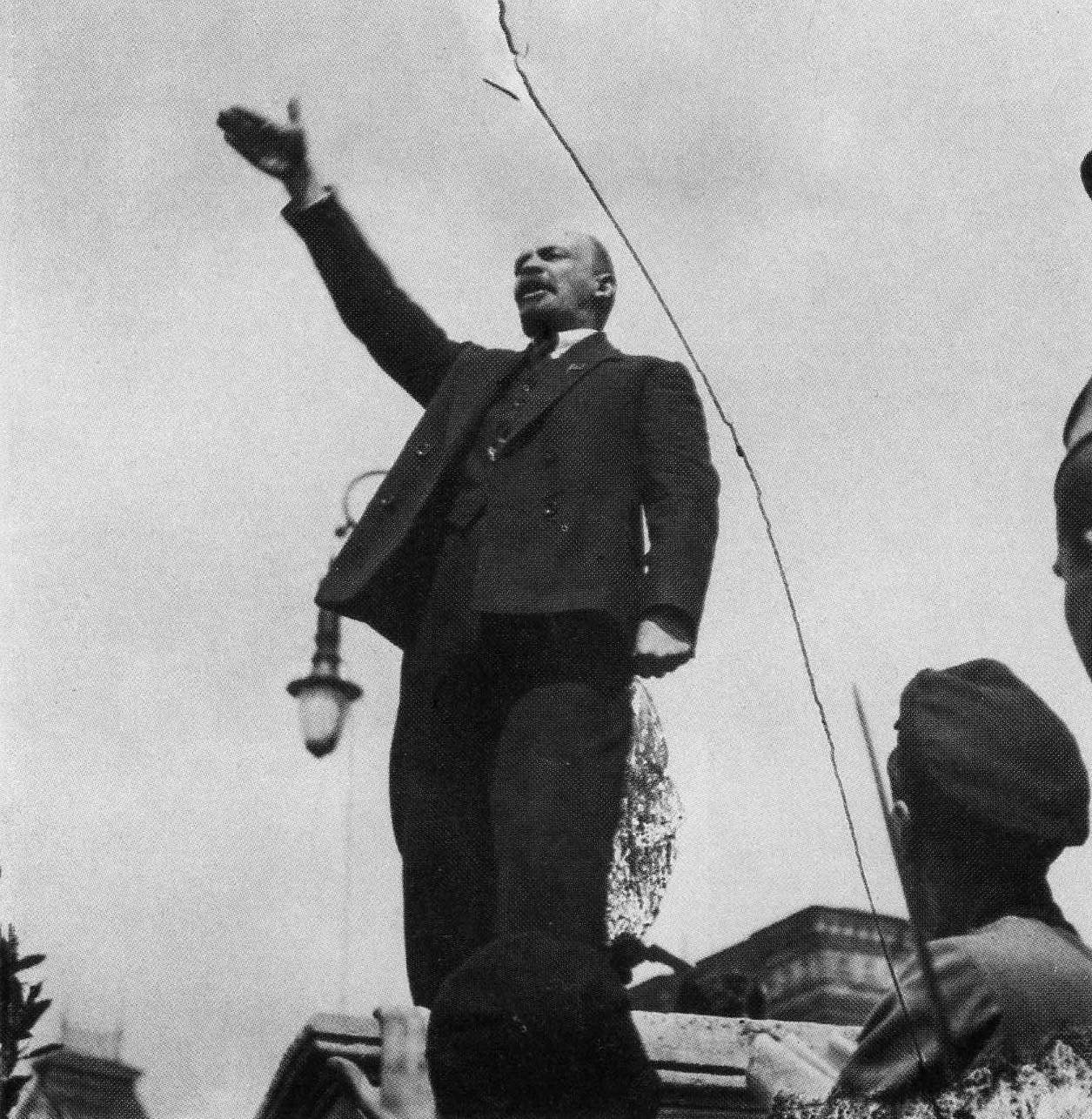
http://upload.wikimedia.org/wikipedia/commons/6/68/Lenin.WWI.JPG
From TownHall.com:
Comrade Lenin: Alive and Well
Daniel Silva

Wednesday, July 09, 2008

The New Russia may have finally embraced free-market capitalism, but Vladimir Lenin, founder of Soviet communism and one of the great murderers of the twentieth century, still casts a long shadow across the Russian landscape. Indeed, when I journeyed to Russia with my family last summer to research my forthcoming novel, Moscow Rules, it seemed Lenin was our constant companion. His statue still looms over the gates of the city that once bore his name, with its arm heroically extended as if poor Vladimir were forever trying to hail a cab. Streets still bear his name, as do squares, schools, parks, and sports clubs. And he still snoozes peacefully in his little rose-colored mausoleum at the edge of Red Square, a waxen figure in a bottle, well-dressed and neatly groomed.

One cannot enter a tourist bazaar without stumbling across all manner of Lenin paraphernalia, including ubiquitous metallic busts of the great man that peer inscrutably from dusty shelves. Sometimes, the head of his accomplice and successor, Joseph Stalin, stands next to him. In one market on the outskirts of Moscow, I saw a fine little statuette of Lenin seated in a chair, clearly thinking deep thoughts. I wondered what weighty matter was he pondering at the moment the artist conceived this iconic image. The annihilation of a village that would not bend to his will? The murder of a rival? Or perhaps he was thinking about killing a few meddlesome shopkeepers who didn’t quite see the wisdom in submitting themselves to “the dictatorship of the proletariat.”

Imagine if the scene were Berlin instead of Moscow. Imagine if, near Brandenburg Gate, there stood a hundred-foot-tall statue of Adolph Hitler with his arm raised in a Nazi salute. Imagine if one could buy a bronze-plated bust of Hitler in a flea market in the Tiergarten. Imagine if one could window shop in the Hilter-Strasse or take lunch at an outdoor café in the Hitler-Platz. Or if one could view Hitler’s body—or his ashes, perhaps—in a sacred tomb at the edge of the Alexanderplatz. Editorial pages, interest groups, and political leaders throughout the civilized world would surely howl with indignation and anger. And rightly so.

Fortunately, the idea of a giant Hitler statue standing in the heart of Berlin is laughable. So why is this not the case in modern Russia? Why are there no howls of righteous indignation from Western shapers of opinion over the display and sale of symbols of a murderous, totalitarian system? And why don’t the leaders of the New Russia remove the statues of Lenin, change the names of the streets and squares that still bear his name, and give his poor old carcass a proper burial?

The silence in many quarters of the West is, sadly, easy to understand. During the Cold War, many of the opinion leaders in Western Europe—the academics, the essayists and novelists, the campaigners for peace and human rights—were too often willing to overlook the Soviet Union’s inexhaustible list of crimes against humanity because they were adherents of Marxist-Leninist bilge themselves. Lenin was to be forgiven his sins because, in their eyes, his cause was just. As for Stalin, yes, he was a monster, but he was also a hero, the man who single-handedly fought Nazi Germany to a stalemate until the American and British could join the fight. Many conveniently overlook the fact that, by agreeing to the infamous Non-Aggression Pact with Hitler in 1939, Stalin was the one who made the Second World War possible in the first place.

The answer to the second part of the question is, in my opinion, far more perilous for Russia’s newly free neighbors and the West. Vladimir Putin, the man now running Russia, is a child of the system Lenin and Stalin created. A former KGB officer and Party member, he surely studied their writings, as a seminarian studies the sacred texts. Moreover, an estimated seventy-five percent of the senior members of his regime also came from the KGB and its successor services. Putin and his cabal surely cannot permit a full and honest exploration of the crimes of the Soviet state, because to do so would discredit the system and the organization—i.e., the KGB—that produced them.

Edward Lucas, a reporter for the Economist, argues in a persuasive new book, The New Cold War, that Putin and his cronies are engaged in a carefully orchestrated effort to “sanitize” the more repulsive elements of Soviet history while honoring its achievements, which is to say, its military might and its empire. In 2005, Putin made his feelings abundantly clear when, in his state of the nation speech, he referred to the collapse of the Soviet Union as “the greatest geopolitical catastrophe of the twentieth century.” And he even managed to say it with a straight face.

Let us return to Germany for a moment. Let us imagine that Chancellor Angela Merkel was a former officer of the SS rather than a former professor of physical chemistry. And let us imagine she went before her parliament and people and proclaimed the collapse of Nazi-occupied Europe the greatest geopolitical catastrophe of the twentieth century. Such a remark would have produced a furious response from the German press, the German political opposition, and the German people. Germany’s neighbors would have twitched with anxiety. Ambassadors would have been recalled. Editorial writers would have wondered whether the Nazi beast was reawakening.

And imagine, too, that the SS and the Gestapo, under new, benign-sounding names, were still responsible for internal German security. And that they still worked from their old headquarters buildings. That scenario, as preposterous as it sounds, is exactly the situation in Russia today. The FSB, Russia’s Federal Security Service, occupies the KGB’s old headquarters building in Lubyanka Square. Many Russians don’t even bother to call the FSB by its new name. They still refer to it as the KGB.

While researching Moscow Rules, my family and I were invited to visit FSB headquarters. A former KGB colonel with an amiable face and glittering eyes gave us a private tour of the building. It ended in a small, private KGB museum, where we spent several hours, carefully reviewing the organization’s remarkable history. It was a surprisingly honest place, though distinctly lacking in any evidence that the Soviet Union had ever tried to spy on the United States. A particularly telling moment occurred when we paused to examine a photo album of all the KGB’s leaders. There was Vladimir Putin, proudly displayed with all the great murderers and oppressors of the past. Our guide flipped through the pages, giving us highly abbreviated biographies of each chief. “He was shot,” he said of one. “He was shot,” he said of the next. “He was shot, too.” Flipping to the next page, he paused and smiled. “Ah, this one was different,” he said. “He was poisoned.”

The overall message of the museum was unmistakable: the course of Soviet history would have proceeded much differently if the KGB had been running the regime instead of serving has its guardian. Now, nearly two decades after the fall of the Soviet Union, the KGB has finally gotten its wish. Putin and his cabal want their empire back, and they want to be a great power again. And they are using Russia’s newfound oil wealth to achieve those goals. As for taking an honest look into the Russian past, there isn’t time for that. Nor is there any appetite. Lenin once said: “There are no morals in politics; there is only expedience.” Vladimir Putin would surely agree. Perhaps that is why Lenin the murderer still stands at the gates of the city that once bore his name. And why Lenin the murderer still sleeps peacefully in Red Square.
Olympic gold medalist Joey Cheek raised awareness over China's dealings with Sudan.
Olympic gold medalist Joey Cheek raised
awareness over China's dealings with Sudan.

From The Washington Post:
Speak Up, and Get Shut Down
By Sally Jenkins


Wednesday, August 6, 2008

BEIJING

The slow strangling death of the Olympics at the hands of the Chinese officials continues. Their Olympic motto of "One World, One Dream" is beginning to take on an ominous tone, what with the gagging of athletes, and the censorship of the press, and the basic all-around stamping out of Olympic spirit. The only vision of the world that's permitted is their own, judging by the fact that gold medalist Joey Cheek was denied admittance to these Summer Games for the following offense: He spoke.

Darfur. That's the word that so alarmed Chinese officials that they revoked Cheek's visa, a day before he was to fly to Beijing. We'll see how quickly the Chinese surveillance blocks the word from the Internet, or whether the cops show up and invite me to the departure lounge at the airport for writing it. The Olympics are supposed to be apolitical, Chinese officials continually bray; they will not allow any signs, or protests. And now it seems they've issued another edict: no humanitarians.

These Olympics might have been China's chance to present a new face to the world. Instead, the main impression one has so far is of the immense egotism of the Chinese state, which issues a stream of absurdities and can't bear to be contradicted. It's an impression that overwhelms everything: the sweet welcomes of the Chinese volunteers, the magnificent topiary and the effusions of flowers, and the titanic architecture of the capital.

The Olympics are supposed to be generally apolitical, yes, but the Olympic charter was never meant to be anti-humane. Cheek is no political figure, and he's not even a particularly controversial activist. Following his retirement from speedskating, he co-founded Team Darfur, an organization that aims to publicize the plight of children in the troubled region. The organization basically is a membership of athletes who are committed to drawing attention to and raising aid for victims of the war-torn region in Sudan. Cheek put his money where his mouth was, to the deep admiration of his fellow Olympians, when he donated his $40,000 bonus from the U.S. Olympic Committee to Right to Play, an organization founded to use sports as a platform to help needy children in Sudan.

Cheek has been exceptionally careful to frame his organization as more of a charitable and humanitarian endeavor rather than a political one, and unlike the most passionate Darfur advocates, he never has advocated a boycott of the 2008 Games. He's not a firebrand, he's just a do-gooder -- and an intelligent, committed one at that.

But when his visa was suddenly revoked Tuesday -- without a reason -- Cheek spoke out boldly. "The denial of my visa is a part of a systemic effort by the Chinese government to coerce and threaten athletes who are speaking out on behalf of the innocent people of Darfur," he said.

Cheek is just one athlete from Team Darfur who has been denied a visa. Synchronized swimmer Kendra Zanotto, a 2004 bronze medalist, planned to attend the Beijing Games as a freelance journalist, but was denied a visa. Most disturbing, a number of athletes from other countries who belong to Team Darfur have quietly called to drop out of the group in the run-up to these Games, because they were pressured by their Olympic committees to disassociate from the group.

The Chinese government has continually called for the world to suspend its judgments of its international policies -- from its support for the Sudanese regime to its crackdown on Tibetan monks -- during the Games. And yet it's the Chinese state that continually throws us all into a political cauldron with actions like this one. All we have to go on in forming impressions of China is the behavior of its government. "I believe we must assess a governing power not by what it says it is, or by what it intends, but by what it does," Harold Pinter once wrote. "It can call itself what it likes."

Ironically, the more the Chinese government tries to control speech at these Games, the more it flexes its power and enforces silence, the weaker it seems. "Censorship reflects a society's lack of confidence in itself," U.S. Supreme Court Justice Potter Stewart said. When a government bans the presence of a gentle-voiced man like Joey Cheek, you wonder what it's really afraid of.

Tuesday, August 05, 2008

http://media3.washingtonpost.com/wp-dyn/content/photo/2008/08/04/PH2008080401378.jpg
From The American Spectator:
The West Should Heed Solzhenitsyn

By Quin Hillyer

Published 8/5/2008
12:08:28 AM


Aleksandr Solzhenitsyn's first great novel started with these words: "Reveille was sounded...."

Yes, reveille was sounded for One Day in the Life of Ivan Denisovich the same way it was sounded for every other one of the "three thousand six hundred fifty three days like this in his sentence." But rather than being routine, the reveille that Solzhenitsyn sounded for the Western world was extraordinary and singular in its import and its effectiveness. Solzhenitsyn, who died on Sunday at 89, told the story from inside the gulag that the great British historian Robert Conquest had told from outside: how brutal it was, how senseless, and how it was meant to dehumanize. As Solzhenitsyn said in his famous 1978 commencement address at Harvard, "socialism of any type and shade leads to a total destruction of the human spirit and to a leveling of mankind into death."

It was for his witness to the evils of socialism/communism that American conservatives treasured the great Russian writer. Nobody wrote against the Evil Empire with more courage or more moral force. Nobody spoke more boldly. And nobody other than Ronald Reagan did more to scold American elites for their cowardly kowtowing to the communist menace. It was instructive that when Solzhenitsyn finally made it to the United States, President Gerald Ford and Secretary of State Henry Kissinger refused to give him an audience at the White house -- something about "detente" and "realpolitik," more correctly known as sniveling flapdoodle -- but Reagan wrote columns welcoming the great Russian and North Carolina's Jesse Helms welcomed him to the Senate. It was American conservatives who recognized moral imperatives, while the supposedly sensible centrists were mired in cynicism.

In his Harvard address, Solzhenitsyn condemned the Ford approach (without referring to Ford by name) by describing it as the attitude that "the world situation should stay as it is at any cost, there should be no changes." But, he warned in the very next sentence, "This debilitating dream of a status quo is the symptom of a society which has come to the end of its development."

Here, though, is where not just the conservative appreciation for Solzhenitsyn but also the more general Western appreciation of him became more difficult to sustain. Oh, sure, conservatives were thrilled that Solzhenitsyn railed against the communists. And even European "social Democrats" ended up very glad that he blew the whistle on the Soviets who menaced them. But anti-communism was only part of the Russian Nobel laureate's message. As harsh as he was in denouncing the gulag, he was almost as harsh in denouncing not just the diplomatic weakness (up until then) of the West but also its moral decrepitude. Again in the Harvard speech, here's what he said:
"It is time, in the West, to defend not so much human rights as human obligations. Destructive and irresponsible freedom has been granted boundless space. Society appears to have little defense against the abyss of human decadence, such as, for example, misuse of liberty for moral violence against young people, motion pictures full of pornography, crime and horror. It is considered to be part of freedom and theoretically counter-balanced by the young people's right not to look or not to accept. Life organized legalistically has thus shown its inability to defend itself against the corrosion of evil."

Somewhere between the age of Churchill and today we lost the idea that freedom obliges us, all of us, to expend "blood, toil, tears and sweat." Somewhere between the rationing of World War II and the Age of the Shopping Mall we forgot that a 5.7 percent unemployment rate after eight rocky months is a phenomenal achievement rather than a crisis. And somewhere along the way we forgot that while every one of 4,000 American deaths in a foreign land is a tragedy, they are collectively the mark of a nation that protects its soldiers amazingly well while freeing the world from a dangerous megalomaniac. Solzhenitsyn himself probably saw, personally, at least as many of his compatriots killed in any one of several bad weeks while fighting on the front lines against the invading Nazi death machine.

Thirty years before Phil Gramm complained that we have become a nation of whiners, Solzhenitsyn said much the same thing. One can almost hear him sneer as he noted to the Harvard grads that "the center of your democracy and of your culture is left without electric power for a few hours only, and all of a sudden crowds of American citizens start looting and creating havoc. The smooth surface film must be very thin, then, the social system quite unstable and unhealthy." One wonders what he made of the looting after Hurricane Katrina, and of the political buck-passing that accompanied the botched responses thereto.

And way back 30 years ago, Solzhenitsyn also offered criticisms of the press that sound eerily prescient today:
"Thus we may see terrorists heroized, or secret matters, pertaining to one's nation's defense, publicly revealed, or we may witness shameless intrusion on the privacy of well-known people under the slogan: 'everyone is entitled to know everything.' But this is a false slogan, characteristic of a false era: people also have the right not to know, and it is a much more valuable one. The right not to have their divine souls stuffed with gossip, nonsense, vain talk. A person who works and leads a meaningful life does not need this excessive burdening flow of information."

Solzhenitsyn clearly was no fan of consumerist American modernity. He said that it in its own way it was as dehumanizing -- or, perhaps more accurately, as de-spiritualizing -- as almost anything the gulag could engender. Yet in all of his complaining, in all of his cultural criticism of both the Free World and the communist one, this great Russian thinker's underlying message remained redemptive. As truly awful, by ordinary standards, as Ivan Denisovich's day in the labor camp had been, Ivan went to sleep thinking that "nothing had spoiled the day and it had been almost happy." After all, "he'd had a lot of luck today. They hadn't put him in the cooler....He'd finagled an extra bowl of mush at noon....And he'd gotten over that sickness."

With God's help, human beings have a remarkable capacity to find hope in the thinnest gruel. We have the capacity, he believed, to get over our sickness.

Likewise, Solzhenitsyn concluded his address at Harvard with these words:
"If the world has not come to its end, it has approached a major turn in history, equal in importance to the turn from the Middle Ages to the Renaissance. It will exact from us a spiritual upsurge, we shall have to rise to a new height of vision, to a new level of life where our physical nature will not be cursed as in the Middle Ages, but, even more importantly, our spiritual being will not be trampled upon as in the Modern era. This ascension will be similar to climbing onto the next anthropologic stage. No one on earth has any other way left but -- upward."

Upward, indeed. One imagines that such is the direction Solzhenitsyn himself has finally and eternally traveled.


Quin Hillyer is an associate editor at the Washington Examiner and a senior editor for The American Spectator. He can be reached at qhillyer@gmail.com.

http://www.wormbook.addr.com/055112.jpg
From The Washington Post:
Stronger Than the Gulag
By Anne Applebaum

Tuesday, August 5, 2008

Although more than three decades have passed since the winter of 1974, when unbound, hand-typed samizdat versions of Alexander Solzhenitsyn's "The Gulag Archipelago" began circulating in what used to be the Soviet Union, the emotions they stirred remain today. Usually, readers were given only 24 hours to finish the lengthy manuscript -- the first-ever historical account of the Soviet concentration camp system -- before it had to be passed on to the next person. That meant spending an entire day and night absorbed in Solzhenitsyn's sometimes eloquent, sometimes angry prose, not an experience anyone was likely to forget.

People in that first generation of readers remember who gave them the book, who else knew about it, to whom they passed it. They remember the stories that affected them most -- tales of small children in the camps, or of informers, or of camp guards. They remember what the book felt like -- the blurry, mimeographed text; the dog-eared paper; the dim glow of the lamp switched on late at night -- and with whom they discussed it.

In part, his Soviet readers responded so strongly because Solzhenitsyn -- who died Sunday at age 89 -- was simultaneously very famous and strictly taboo. Twelve years earlier, the Soviet regime had serendipitously allowed him to publish, officially, the first fictional account of Stalin's concentration camps, "One Day in the Life of Ivan Denisovich." It was also the last: Too honest for the leaders at the time, the book, a publishing sensation, was quickly banned along with its author, whose later works would be "published" illegally -- or abroad.

It didn't matter: Even Solzhenitsyn's expulsion from Russia in 1974 only increased his notoriety, as well as the impact of "The Gulag Archipelago." Though it was based on "reports, memoirs and letters by 227 witnesses," the book was not quite a straight history -- obviously, Solzhenitsyn did not have access to then-secret archives -- but, rather, an interpretation of history. Partly polemical, partly autobiographical, both emotional and judgmental, it aimed to show that, contrary to what many believed, the mass arrests and concentration camps were not an incidental phenomenon but an essential part of the Soviet system -- and had been from the very beginning.

Not all of this was new: Credible witnesses had reported on the growth of the Gulag and the spread of terror since the Russian Revolution. But what Solzhenitsyn produced was simply more thorough, more monumental and more detailed than anything that had preceded it. His account could not be dismissed as a single man's experience. No one who dealt with the Soviet Union, diplomatically or intellectually, could ignore it. So threatening was the book to certain branches of the European left that Jean-Paul Sartre himself described Solzhenitsyn as a "dangerous element." Its publication certainly contributed to the recognition of "human rights" as a legitimate element of international debate and foreign policy.

In later years, Solzhenitsyn lost some of his stature, thanks partly to Soviet propaganda that portrayed him as a crank and an extremist but thanks also to his own failure to embrace liberal democracy. He never really liked the West, never really took to free markets or pop culture. When the Soviet Union finally collapsed in 1991, he went back to Russia, where he was first welcomed, then forgotten. In a Russia that is no longer interested in examining its history, he came to seem outdated, a spokesman from an irrelevant past. Even his nationalism, now a popular cause, had something crusty and old-fashioned about it: His vision of a more spiritual society, of Russia as an alternative to the consumerist West, doesn't hold much appeal for the super-charged, super-wealthy, oil-fueled Russian elite of today. His apparent endorsement of former president Vladimir Putin seemed more like an old man's foible than a serious change of heart.

In the week of his death, though, what stands out is not who Solzhenitsyn was but what he wrote. It is very easy, in a world where news is instant and photographs travel as quickly as they are taken, to forget how powerful, still, are written words. And Solzhenitsyn was, in the end, a writer: A man who gathered facts, sorted through them, tested them against his own experience, composed them into paragraphs and chapters. It was not his personality but his language that forced people to think more deeply about their values, their assumptions, their societies. It was not his television appearances that affected history but his words.

His manuscripts were read and pondered in silence, and the thought he put into them provoked his readers to think, too. In the end, his books mattered not because he was famous or notorious but because millions of Soviet citizens recognized themselves in his work: They read his books because they already knew that they were true.

applebaumletters@washpost.com
http://www.americanthinker.com/blog/obama1%20compressed.jpg
Mr. Obama, Welcome to the NFL!
By Patrick Buchanan

Barack Obama just had the worst week since his beloved pastor, Jeremiah Wright, decided to expatiate on black liberation theology at the National Press Club.

Coming off his royal progress through the Near and Middle East, Berlin, Paris and London, Barack had surged to a nine-point lead in the Gallup tracking poll. By Friday, he was back to a dead heat with a 72-year-old opponent with none of his natural skills, in a year when grocers are pulling Republican brands off the shelves.

For all its gracelessness, the McCain campaign, given openings by Barack, stepped in and put Muhammad Ali on the canvas.

The first opening was the clumsiness with which Barack dealt with a planned visit to wounded U.S. troops in Landshul, Germany.

While the first half of his foreign trip, to Afghanistan and Iraq, was official, the European tour was campaign related. Yet, it was on this leg that a visit to wounded U.S. soldiers had been scheduled. As campaigning in a military hospital is prohibited, the visit was canceled.

But, instead of going ahead and visiting the troops alone, without aides, press or cameras, Barack bailed out and flew on to Paris.

This left the McCain folks an opening to paint Obama as a cold-hearted opportunist avid to visit a military hospital only if he could bring in press and cameras to record his compassion.

Enraged Obama aides savagely accused McCain of running a dishonorable campaign. This reflex reaction, and the ugly brawl that ensued, made some Americans think less of Obama, but many more forget what a success his foreign trip had been.

Came then the Paris-Britney ad. This opens with shots of the wayward blondes, then of Barack, presuming to equate the three as vacuous, insubstantial and aimless. Purpose: Disparage Barack's rock-star popularity and turn it into something laughable.

While the ad seemed both defensive and non-credible, too much of a stretch to be believed -- even Republicans derided it as "childish" -- it apparently acted as something of a matador's cape snapped in front of an already tormented Obama.

Stung, Barack retorted: "What they're going to try is make you scared of me. You know, he's not patriotic enough. He's got a funny name. You know, he doesn't look like all those other presidents on those dollar bills you know. He's risky."

Barack was accusing the McCain campaign of implying he is risky because he is black.

This was the opening Rick Davis of McCain's campaign needed to deliver a vicious uppercut to Obama's jaw, charging him with "playing the race card ... from the bottom of the deck." Added Davis, this was "divisive, negative, shameful and wrong." McCain, sadly, agreed.

With that, both benches cleared.

Saturday, Bob Herbert of The New York Times charged McCain and the Republican Party with producing ads that are "slimy ... foul, poisonous ... designed to exploit the hostility, anxiety and resentment of the many white Americans who are still freakishly hung up on the idea of black men rising above their station and becoming sexually involved with white women."

Sunday, Gene Robinson of The Washington Post accused McCain of "running a desperate, ugly campaign."

The Britney-Paris ad calling Obama "the biggest celebrity in the world" was an attempt to "turn Obama's popularity into a flaw."

Now, undeniably, McCain's ad was designed to minimize and mock Obama's popularity as a modern form of Beatlemania.

But what is wrong with that?

On the weekend, the McCain folks released another ad. Called "The One," it features Barack's grandiose pronouncements about who he is, what he means to mankind and the marvelous miracles that await our messiah's arrival -- and twins him with Moses (Charlton Heston) parting the Red Sea in "The Ten Commandments."

The effectiveness of the ad is that people laugh with it, and so doing, laugh at the perceived pretentiousness of Barack Obama.

In a week, Barack, an object of media homage on his trip abroad, has become an object of mockery in much of Middle America. Though his media allies may howl racism, most Americans tend more and more to dismiss this. That card has been played so often it's dog-eared.

And Barack's raising the race issue anew seems suicidal. When one is winning the black vote 94 to 1, does it make sense to keep pushing into the face of the 87 percent of Americans who are Asian, Hispanic and Caucasian that the next president will definitely not be one of you?

When JFK's polls showed him sweeping 80 percent of Catholics, he did not whistle-stop through the Bible Belt, billing himself as our "first Roman Catholic president." He sent Lyndon and Lady Bird on a Dixie special to talk about JFK's war record and rake Richard Nixon.

Thus did he become our first Catholic president. If Barack wishes to be our first black president, he will tell his friends to stop bellowing and braying every day about it.

Copyright 2008, Creators Syndicate Inc.

Monday, August 04, 2008


Soccer Hall of Famer Mia Hamm fights back tears as she introduces
her former coach Anson Dorrance during Sunday-s Induction Ceremony in Oneonta.
From The Oneonta Daily Star:
Bond between Dorrance, Hamm strong as ever
By Sarah Weber

ONEONTA _ Mia Hamm just had to ask.

"What took you guys so long?" Hamm asked as she flashed a smile to open the presentation of her former U.S. National and North Carolina women's soccer coach, Anson Dorrance.

Hamm wasn't talking to Builder selection Dorrance or Veterans pick Hugo Perez, who were inducted into the National Soccer Hall of Fame on Sunday. Instead, she threw the light-hearted jab in the general direction of the Oneonta shrine.

In other words, why did it take the Soccer Hall so long to elect Dorrance?

Good question.

Dorrance will begin his 30th season as the Tar Heels' head coach this fall. His resume includes 18 NCAA championships at North Carolina and a FIFA World Cup title in 1991.

Four of those college championships came with Hamm in a Tar Heels uniform, the last in 1993. She also led the 1991 World Cup team to victory.

Hamm fought back tears as she set up Dorrance for his induction speech, further illustrating a special bond the two have shared for the past 22 years.

Their relationship started well before Hamm became a household name, before the college and international championships, before the Gatorade commercials with M.J., before her marriage to baseball star Nomar Garciaparra, and before she helped draw a record Induction Ceremony crowd estimated at 5,000 as a member of the Class of 2007.

Dorrance, who presented Hamm last year, caught his first glimpse of the future Hall of Famer when she was age 14. One year later, she became the youngest player to make the U.S. National women's soccer roster.

"He created an environment that nurtured strengths and appreciated differences," said Hamm, who completed high school a year early and enrolled at UNC at age 16. "Because of Anson, there's an entire generation of strong, confident, intelligent, unique, competitive and independent women."

Dorrance contributed to the development of Hamm's independence, becoming her legal guardian while she attended UNC as her family moved to Rome.

Ever since, their lives have been intertwined, professionally and personally.

"He's just an amazing person and a wonderful friend," Hamm said of Dorrance. "He inspires people to be better than they were the day before."

Dorrance spoke highly of Hamm, a 36-year-old mother of 17-month-old twin girls who lives in Los Angeles with her husband, Dodgers infielder Garciaparra.

"I knew Mia Hamm when she was 14," Dorrance said at the podium. "I have loved seeing this special, young girl grow up to be this special woman."

He appeared touched by Hamm's introductory speech, saying afterward, "What she shared was just so poignant, articulate and just heart-wrenching."

Hamm said she felt the weight of responsibility for her speech as she tried to "adequately represent the voices of all the lives (Dorrance) touched."

After the ceremony, Hamm revealed that of all the accolades Dorrance's former players and friends bestowed upon him, loyalty was the most common trait cherished by those who are closest to him.

"It's not just a soccer factory," she said of North Carolina. "That's something that people kept talking about when I spoke to them.

"If you were the leading scorer, or one of the last ones off the bench, you knew what your value was to the team, and you embraced it, because he made sure that he expressed to you how important you were," she continued. "That really had an impact on all of us."
The image “http://www.russiablog.org/SolzhenitsynTIMEMagazine.jpg” cannot be displayed, because it contains errors.
Solzhenitsyn: The Harvard Address

Text of Address by

Alexander Solzhenitsyn
at Harvard Class Day Afternoon Exercises

Thursday, June 8, 1978

I am sincerely happy to be here with you on this occasion and to become personally acquainted with this old and most prestigious University. My congratulations and very best wishes to all of today's graduates.

Harvard's motto is "Veritas." Many of you have already found out and others will find out in the course of their lives that truth eludes us if we do not concentrate with total attention on its pursuit. And even while it eludes us, the illusion still lingers of knowing it and leads to many misunderstandings. Also, truth is seldom pleasant; it is almost invariably bitter. There is some bitterness in my speech today, too. But I want to stress that it comes not from an adversary but from a friend.

Three years ago in the United States I said certain things which at that time appeared unacceptable. Today, however, many people agree with what I then said...


A World Split Apart
by Alexander Solzhenitsyn

The split in today's world is perceptible even to a hasty glance. Any of our contemporaries readily identifies two world powers, each of them already capable of entirely destroying the other. However, understanding of the split often is limited to this political conception, to the illusion that danger may be abolished through successful diplomatic negotiations or by achieving a balance of armed forces. The truth is that the split is a much profounder and a more alienating one, that the rifts are more than one can see at first glance. This deep manifold split bears the danger of manifold disaster for all of us, in accordance with the ancient truth that a Kingdom -- in this case, our Earth -- divided against itself cannot stand.

Contemporary Worlds

There is the concept of the Third World: thus, we already have three worlds. Undoubtedly, however, the number is even greater; we are just too far away to see. Any ancient deeply rooted autonomous culture, especially if it is spread on a wide part of the earth's surface, constitutes an autonomous world, full of riddles and surprises to Western thinking. As a minimum, we must include in this category China, India, the Muslim world and Africa, if indeed we accept the approximation of viewing the latter two as compact units. For one thousand years Russia has belonged to such a category, although Western thinking systematically committed the mistake of denying its autonomous character and therefore never understood it, just as today the West does not understand Russia in communist captivity. It may be that in the past years Japan has increasingly become a distant part of the West, I am no judge here; but as to Israel, for instance, it seems to me that it stands apart from the Western world in that its state system is fundamentally linked to religion.

How short a time ago, relatively, the small new European world was easily seizing colonies everywhere, not only without anticipating any real resistance, but also usually despising any possible values in the conquered peoples' approach to life. On the face of it, it was an overwhelming success, there were no geographic frontiers to it. Western society expanded in a triumph of human independence and power. And all of a sudden in the twentieth century came the discovery of its fragility and friability. We now see that the conquests proved to be short lived and precarious, and this in turn points to defects in the Western view of the world which led to these conquests. Relations with the former colonial world now have turned into their opposite and the Western world often goes to extremes of obsequiousness, but it is difficult yet to estimate the total size of the bill which former colonial countries will present to the West, and it is difficult to predict whether the surrender not only of its last colonies, but of everything it owns will be sufficient for the West to foot the bill.

Convergence

But the blindness of superiority continues in spite of all and upholds the belief that vast regions everywhere on our planet should develop and mature to the level of present day Western systems which in theory are the best and in practice the most attractive. There is this belief that all those other worlds are only being temporarily prevented by wicked governments or by heavy crises or by their own barbarity or incomprehension from taking the way of Western pluralistic democracy and from adopting the Western way of life. Countries are judged on the merit of their progress in this direction. However, it is a conception which developed out of Western incomprehension of the essence of other worlds, out of the mistake of measuring them all with a Western yardstick. The real picture of our planet's development is quite different.

Anguish about our divided world gave birth to the theory of convergence between leading Western countries and the Soviet Union. It is a soothing theory which overlooks the fact that these worlds are not at all developing into similarity; neither one can be transformed into the other without the use of violence. Besides, convergence inevitably means acceptance of the other side's defects, too, and this is hardly desirable.

If I were today addressing an audience in my country, examining the overall pattern of the world's rifts I would have concentrated on the East's calamities. But since my forced exile in the West has now lasted four years and since my audience is a Western one, I think it may be of greater interest to concentrate on certain aspects of the West in our days, such as I see them.

A Decline in Courage [. . .]

may be the most striking feature which an outside observer notices in the West in our days. The Western world has lost its civil courage, both as a whole and separately, in each country, each government, each political party and of course in the United Nations. Such a decline in courage is particularly noticeable among the ruling groups and the intellectual elite, causing an impression of loss of courage by the entire society. Of course there are many courageous individuals but they have no determining influence on public life. Political and intellectual bureaucrats show depression, passivity and perplexity in their actions and in their statements and even more so in theoretical reflections to explain how realistic, reasonable as well as intellectually and even morally warranted it is to base state policies on weakness and cowardice. And decline in courage is ironically emphasized by occasional explosions of anger and inflexibility on the part of the same bureaucrats when dealing with weak governments and weak countries, not supported by anyone, or with currents which cannot offer any resistance. But they get tongue-tied and paralyzed when they deal with powerful governments and threatening forces, with aggressors and international terrorists.

Should one point out that from ancient times decline in courage has been considered the beginning of the end?

Well-Being

When the modern Western States were created, the following principle was proclaimed: governments are meant to serve man, and man lives to be free to pursue happiness. (See, for example, the American Declaration). Now at last during past decades technical and social progress has permitted the realization of such aspirations: the welfare state. Every citizen has been granted the desired freedom and material goods in such quantity and of such quality as to guarantee in theory the achievement of happiness, in the morally inferior sense which has come into being during those same decades. In the process, however, one psychological detail has been overlooked: the constant desire to have still more things and a still better life and the struggle to obtain them imprints many Western faces with worry and even depression, though it is customary to conceal such feelings. Active and tense competition permeates all human thoughts without opening a way to free spiritual development. The individual's independence from many types of state pressure has been guaranteed; the majority of people have been granted well-being to an extent their fathers and grandfathers could not even dream about; it has become possible to raise young people according to these ideals, leading them to physical splendor, happiness, possession of material goods, money and leisure, to an almost unlimited freedom of enjoyment. So who should now renounce all this, why and for what should one risk one's precious life in defense of common values, and particularly in such nebulous cases when the security of one's nation must be defended in a distant country?

Even biology knows that habitual extreme safety and well-being are not advantageous for a living organism. Today, well-being in the life of Western society has begun to reveal its pernicious mask.

Legalistic Life

Western society has given itself the organization best suited to its purposes, based, I would say, on the letter of the law. The limits of human rights and righteousness are determined by a system of laws; such limits are very broad. People in the West have acquired considerable skill in using, interpreting and manipulating law, even though laws tend to be too complicated for an average person to understand without the help of an expert. Any conflict is solved according to the letter of the law and this is considered to be the supreme solution. If one is right from a legal point of view, nothing more is required, nobody may mention that one could still not be entirely right, and urge self-restraint, a willingness to renounce such legal rights, sacrifice and selfless risk: it would sound simply absurd. One almost never sees voluntary self-restraint. Everybody operates at the extreme limit of those legal frames. An oil company is legally blameless when it purchases an invention of a new type of energy in order to prevent its use. A food product manufacturer is legally blameless when he poisons his produce to make it last longer: after all, people are free not to buy it.

I have spent all my life under a communist regime and I will tell you that a society without any objective legal scale is a terrible one indeed. But a society with no other scale but the legal one is not quite worthy of man either. A society which is based on the letter of the law and never reaches any higher is taking very scarce advantage of the high level of human possibilities. The letter of the law is too cold and formal to have a beneficial influence on society. Whenever the tissue of life is woven of legalistic relations, there is an atmosphere of moral mediocrity, paralyzing man's noblest impulses.

And it will be simply impossible to stand through the trials of this threatening century with only the support of a legalistic structure.

The Direction of Freedom

In today's Western society, the inequality has been revealed of freedom for good deeds and freedom for evil deeds. A statesman who wants to achieve something important and highly constructive for his country has to move cautiously and even timidly; there are thousands of hasty and irresponsible critics around him, parliament and the press keep rebuffing him. As he moves ahead, he has to prove that every single step of his is well-founded and absolutely flawless. Actually an outstanding and particularly gifted person who has unusual and unexpected initiatives in mind hardly gets a chance to assert himself; from the very beginning, dozens of traps will be set out for him. Thus mediocrity triumphs with the excuse of restrictions imposed by democracy.

It is feasible and easy everywhere to undermine administrative power and, in fact, it has been drastically weakened in all Western countries. The defense of individual rights has reached such extremes as to make society as a whole defenseless against certain individuals. It is time, in the West, to defend not so much human rights as human obligations.

Destructive and irresponsible freedom has been granted boundless space. Society appears to have little defense against the abyss of human decadence, such as, for example, misuse of liberty for moral violence against young people, motion pictures full of pornography, crime and horror. It is considered to be part of freedom and theoretically counter-balanced by the young people's right not to look or not to accept. Life organized legalistically has thus shown its inability to defend itself against the corrosion of evil.

And what shall we say about the dark realm of criminality as such? Legal frames (especially in the United States) are broad enough to encourage not only individual freedom but also certain individual crimes. The culprit can go unpunished or obtain undeserved leniency with the support of thousands of public defenders. When a government starts an earnest fight against terrorism, public opinion immediately accuses it of violating the terrorists' civil rights. There are many such cases.

Such a tilt of freedom in the direction of evil has come about gradually but it was evidently born primarily out of a humanistic and benevolent concept according to which there is no evil inherent to human nature; the world belongs to mankind and all the defects of life are caused by wrong social systems which must be corrected. Strangely enough, though the best social conditions have been achieved in the West, there still is criminality and there even is considerably more of it than in the pauper and lawless Soviet society. (There is a huge number of prisoners in our camps which are termed criminals, but most of them never committed any crime; they merely tried to defend themselves against a lawless state resorting to means outside of a legal framework).

The Direction of the Press

The press too, of course, enjoys the widest freedom. (I shall be using the word press to include all media). But what sort of use does it make of this freedom?

Here again, the main concern is not to infringe the letter of the law. There is no moral responsibility for deformation or disproportion. What sort of responsibility does a journalist have to his readers, or to history? If they have misled public opinion or the government by inaccurate information or wrong conclusions, do we know of any cases of public recognition and rectification of such mistakes by the same journalist or the same newspaper? No, it does not happen, because it would damage sales. A nation may be the victim of such a mistake, but the journalist always gets away with it. One may safely assume that he will start writing the opposite with renewed self-assurance.

Because instant and credible information has to be given, it becomes necessary to resort to guesswork, rumors and suppositions to fill in the voids, and none of them will ever be rectified, they will stay on in the readers' memory. How many hasty, immature, superficial and misleading judgments are expressed every day, confusing readers, without any verification. The press can both simulate public opinion and miseducate it. Thus we may see terrorists heroized, or secret matters, pertaining to one's nation's defense, publicly revealed, or we may witness shameless intrusion on the privacy of well-known people under the slogan: "everyone is entitled to know everything." But this is a false slogan, characteristic of a false era: people also have the right not to know, and it is a much more valuable one. The right not to have their divine souls stuffed with gossip, nonsense, vain talk. A person who works and leads a meaningful life does not need this excessive burdening flow of information.

Hastiness and superficiality are the psychic disease of the 20th century and more than anywhere else this disease is reflected in the press. In-depth analysis of a problem is anathema to the press. It stops at sensational formulas.

Such as it is, however, the press has become the greatest power within the Western countries, more powerful than the legislature, the executive and the judiciary. One would then like to ask: by what law has it been elected and to whom is it responsible? In the communist East a journalist is frankly appointed as a state official. But who has granted Western journalists their power, for how long a time and with what prerogatives?

There is yet another surprise for someone coming from the East where the press is rigorously unified: one gradually discovers a common trend of preferences within the Western press as a whole. It is a fashion; there are generally accepted patterns of judgment and there may be common corporate interests, the sum effect being not competition but unification. Enormous freedom exists for the press, but not for the readership because newspapers mostly give enough stress and emphasis to those opinions which do not too openly contradict their own and the general trend.

A Fashion in Thinking

Without any censorship, in the West fashionable trends of thought and ideas are carefully separated from those which are not fashionable; nothing is forbidden, but what is not fashionable will hardly ever find its way into periodicals or books or be heard in colleges. Legally your researchers are free, but they are conditioned by the fashion of the day. There is no open violence such as in the East; however, a selection dictated by fashion and the need to match mass standards frequently prevent independent-minded people from giving their contribution to public life. There is a dangerous tendency to form a herd, shutting off successful development. I have received letters in America from highly intelligent persons, maybe a teacher in a faraway small college who could do much for the renewal and salvation of his country, but his country cannot hear him because the media are not interested in him. This gives birth to strong mass prejudices, blindness, which is most dangerous in our dynamic era. There is, for instance, a self-deluding interpretation of the contemporary world situation. It works as a sort of petrified armor around people's minds. Human voices from 17 countries of Eastern Europe and Eastern Asia cannot pierce it. It will only be broken by the pitiless crowbar of events.

I have mentioned a few trends of Western life which surprise and shock a new arrival to this world. The purpose and scope of this speech will not allow me to continue such a review, to look into the influence of these Western characteristics on important aspects on [the] nation's life, such as elementary education, advanced education in [?...]

Socialism

It is almost universally recognized that the West shows all the world a way to successful economic development, even though in the past years it has been strongly disturbed by chaotic inflation. However, many people living in the West are dissatisfied with their own society. They despise it or accuse it of not being up to the level of maturity attained by mankind. A number of such critics turn to socialism, which is a false and dangerous current.

I hope that no one present will suspect me of offering my personal criticism of the Western system to present socialism as an alternative. Having experienced applied socialism in a country where the alternative has been realized, I certainly will not speak for it. The well-known Soviet mathematician Shafarevich, a member of the Soviet Academy of Science, has written a brilliant book under the title Socialism; it is a profound analysis showing that socialism of any type and shade leads to a total destruction of the human spirit and to a leveling of mankind into death. Shafarevich's book was published in France almost two years ago and so far no one has been found to refute it. It will shortly be published in English in the United States.

Not a Model

But should someone ask me whether I would indicate the West such as it is today as a model to my country, frankly I would have to answer negatively. No, I could not recommend your society in its present state as an ideal for the transformation of ours. Through intense suffering our country has now achieved a spiritual development of such intensity that the Western system in its present state of spiritual exhaustion does not look attractive. Even those characteristics of your life which I have just mentioned are extremely saddening.

A fact which cannot be disputed is the weakening of human beings in the West while in the East they are becoming firmer and stronger. Six decades for our people and three decades for the people of Eastern Europe; during that time we have been through a spiritual training far in advance of Western experience. Life's complexity and mortal weight have produced stronger, deeper and more interesting characters than those produced by standardized Western well-being. Therefore if our society were to be transformed into yours, it would mean an improvement in certain aspects, but also a change for the worse on some particularly significant scores. It is true, no doubt, that a society cannot remain in an abyss of lawlessness, as is the case in our country. But it is also demeaning for it to elect such mechanical legalistic smoothness as you have. After the suffering of decades of violence and oppression, the human soul longs for things higher, warmer and purer than those offered by today's mass living habits, introduced by the revolting invasion of publicity, by TV stupor and by intolerable music.

All this is visible to observers from all the worlds of our planet. The Western way of life is less and less likely to become the leading model.

There are meaningful warnings that history gives a threatened or perishing society. Such are, for instance, the decadence of art, or a lack of great statesmen. There are open and evident warnings, too. The center of your democracy and of your culture is left without electric power for a few hours only, and all of a sudden crowds of American citizens start looting and creating havoc. The smooth surface film must be very thin, then, the social system quite unstable and unhealthy.

But the fight for our planet, physical and spiritual, a fight of cosmic proportions, is not a vague matter of the future; it has already started. The forces of Evil have begun their decisive offensive, you can feel their pressure, and yet your screens and publications are full of prescribed smiles and raised glasses. What is the joy about?

Shortsightedness

Very well known representatives of your society, such as George Kennan, say: we cannot apply moral criteria to politics. Thus we mix good and evil, right and wrong and make space for the absolute triumph of absolute Evil in the world. On the contrary, only moral criteria can help the West against communism's well planned world strategy. There are no other criteria. Practical or occasional considerations of any kind will inevitably be swept away by strategy. After a certain level of the problem has been reached, legalistic thinking induces paralysis; it prevents one from seeing the size and meaning of events.

In spite of the abundance of information, or maybe because of it, the West has difficulties in understanding reality such as it is. There have been naive predictions by some American experts who believed that Angola would become the Soviet Union's Vietnam or that Cuban expeditions in Africa would best be stopped by special U.S. courtesy to Cuba. Kennan's advice to his own country -- to begin unilateral disarmament -- belongs to the same category. If you only knew how the youngest of the Moscow Old Square [1] officials laugh at your political wizards! As to Fidel Castro, he frankly scorns the United States, sending his troops to distant adventures from his country right next to yours.

However, the most cruel mistake occurred with the failure to understand the Vietnam war. Some people sincerely wanted all wars to stop just as soon as possible; others believed that there should be room for national, or communist, self-determination in Vietnam, or in Cambodia, as we see today with particular clarity. But members of the U.S. anti-war movement wound up being involved in the betrayal of Far Eastern nations, in a genocide and in the suffering today imposed on 30 million people there. Do those convinced pacifists hear the moans coming from there? Do they understand their responsibility today? Or do they prefer not to hear? The American Intelligentsia lost its [nerve] and as a consequence thereof danger has come much closer to the United States. But there is no awareness of this. Your shortsighted politicians who signed the hasty Vietnam capitulation seemingly gave America a carefree breathing pause; however, a hundredfold Vietnam now looms over you. That small Vietnam had been a warning and an occasion to mobilize the nation's courage. But if a full-fledged America suffered a real defeat from a small communist half-country, how can the West hope to stand firm in the future?

I have had occasion already to say that in the 20th century democracy has not won any major war without help and protection from a powerful continental ally whose philosophy and ideology it did not question. In World War II against Hitler, instead of winning that war with its own forces, which would certainly have been sufficient, Western democracy grew and cultivated another enemy who would prove worse and more powerful yet, as Hitler never had so many resources and so many people, nor did he offer any attractive ideas, or have such a large number of supporters in the West -- a potential fifth column -- as the Soviet Union. At present, some Western voices already have spoken of obtaining protection from a third power against aggression in the next world conflict, if there is one; in this case the shield would be China. But I would not wish such an outcome to any country in the world. First of all, it is again a doomed alliance with Evil; also, it would grant the United States a respite, but when at a later date China with its billion people would turn around armed with American weapons, America itself would fall prey to a genocide similar to the one perpetrated in Cambodia in our days.

Loss of Willpower

And yet -- no weapons, no matter how powerful, can help the West until it overcomes its loss of willpower. In a state of psychological weakness, weapons become a burden for the capitulating side. To defend oneself, one must also be ready to die; there is little such readiness in a society raised in the cult of material well-being. Nothing is left, then, but concessions, attempts to gain time and betrayal. Thus at the shameful Belgrade conference free Western diplomats in their weakness surrendered the line where enslaved members of Helsinki Watchgroups are sacrificing their lives.

Western thinking has become conservative: the world situation should stay as it is at any cost, there should be no changes. This debilitating dream of a status quo is the symptom of a society which has come to the end of its development. But one must be blind in order not to see that oceans no longer belong to the West, while land under its domination keeps shrinking. The two so-called world wars (they were by far not on a world scale, not yet) have meant internal self-destruction of the small, progressive West which has thus prepared its own end. The next war (which does not have to be an atomic one and I do not believe it will) may well bury Western civilization forever.

Facing such a danger, with such historical values in your past, at such a high level of realization of freedom and apparently of devotion to freedom, how is it possible to lose to such an extent the will to defend oneself?

Humanism and Its Consequences

How has this unfavorable relation of forces come about? How did the West decline from its triumphal march to its present sickness? Have there been fatal turns and losses of direction in its development? It does not seem so. The West kept advancing socially in accordance with its proclaimed intentions, with the help of brilliant technological progress. And all of a sudden it found itself in its present state of weakness.

This means that the mistake must be at the root, at the very basis of human thinking in the past centuries. I refer to the prevailing Western view of the world which was first born during the Renaissance and found its political expression from the period of the Enlightenment. It became the basis for government and social science and could be defined as rationalistic humanism or humanistic autonomy: the proclaimed and enforced autonomy of man from any higher force above him. It could also be called anthropocentricity, with man seen as the center of everything that exists.

The turn introduced by the Renaissance evidently was inevitable historically. The Middle Ages had come to a natural end by exhaustion, becoming an intolerable despotic repression of man's physical nature in favor of the spiritual one. Then, however, we turned our backs upon the Spirit and embraced all that is material with excessive and unwarranted zeal. This new way of thinking, which had imposed on us its guidance, did not admit the existence of intrinsic evil in man nor did it see any higher task than the attainment of happiness on earth. It based modern Western civilization on the dangerous trend to worship man and his material needs. Everything beyond physical well-being and accumulation of material goods, all other human requirements and characteristics of a subtler and higher nature, were left outside the area of attention of state and social systems, as if human life did not have any superior sense. That provided access for evil, of which in our days there is a free and constant flow. Merely freedom does not in the least solve all the problems of human life and it even adds a number of new ones.

However, in early democracies, as in American democracy at the time of its birth, all individual human rights were granted because man is God's creature. That is, freedom was given to the individual conditionally, in the assumption of his constant religious responsibility. Such was the heritage of the preceding thousand years. Two hundred or even fifty years ago, it would have seemed quite impossible, in America, that an individual could be granted boundless freedom simply for the satisfaction of his instincts or whims. Subsequently, however, all such limitations were discarded everywhere in the West; a total liberation occurred from the moral heritage of Christian centuries with their great reserves of mercy and sacrifice. State systems were becoming increasingly and totally materialistic. The West ended up by truly enforcing human rights, sometimes even excessively, but man's sense of responsibility to God and society grew dimmer and dimmer. In the past decades, the legalistically selfish aspect of Western approach and thinking has reached its final dimension and the world wound up in a harsh spiritual crisis and a political impasse. All the glorified technological achievements of Progress, including the conquest of outer space, do not redeem the Twentieth century's moral poverty which no one could imagine even as late as in the Nineteenth Century.

An Unexpected Kinship

As humanism in its development became more and more materialistic, it made itself increasingly accessible to speculation and manipulation at first by socialism and then by communism. So that Karl Marx was able to say in 1844 that "communism is naturalized humanism."

This statement turned out not to be entirely senseless. One does see the same stones in the foundations of a despiritualized humanism and of any type of socialism: endless materialism; freedom from religion and religious responsibility, which under communist regimes reach the stage of anti-religious dictatorship; concentration on social structures with a seemingly scientific approach. (This is typical of the Enlightenment in the Eighteenth Century and of Marxism). Not by coincidence all of communism's meaningless pledges and oaths are about Man, with a capital M, and his earthly happiness. At first glance it seems an ugly parallel: common traits in the thinking and way of life of today's West and today's East? But such is the logic of materialistic development.

The interrelationship is such, too, that the current of materialism which is most to the left always ends up by being stronger, more attractive and victorious, because it is more consistent. Humanism without its Christian heritage cannot resist such competition. We watch this process in the past centuries and especially in the past decades, on a world scale as the situation becomes increasingly dramatic. Liberalism was inevitably displaced by radicalism, radicalism had to surrender to socialism and socialism could never resist communism. The communist regime in the East could stand and grow due to the enthusiastic support from an enormous number of Western intellectuals who felt a kinship and refused to see communism's crimes. When they no longer could do so, they tried to justify them. In our Eastern countries, communism has suffered a complete ideological defeat; it is zero and less than zero. But Western intellectuals still look at it with interest and with empathy, and this is precisely what makes it so immensely difficult for the West to withstand the East.

Before the Turn

I am not examining here the case of a world war disaster and the changes which it would produce in society. As long as we wake up every morning under a peaceful sun, we have to lead an everyday life. There is a disaster, however, which has already been under way for quite some time. I am referring to the calamity of a despiritualized and irreligious humanistic consciousness.

To such consciousness, man is the touchstone in judging and evaluating everything on earth. Imperfect man, who is never free of pride, self-interest, envy, vanity, and dozens of other defects. We are now experiencing the consequences of mistakes which had not been noticed at the beginning of the journey. On the way from the Renaissance to our days we have enriched our experience, but we have lost the concept of a Supreme Complete Entity which used to restrain our passions and our irresponsibility. We have placed too much hope in political and social reforms, only to find out that we were being deprived of our most precious possession: our spiritual life. In the East, it is destroyed by the dealings and machinations of the ruling party. In the West, commercial interests tend to suffocate it. This is the real crisis. The split in the world is less terrible than the similarity of the disease plaguing its main sections.

If humanism were right in declaring that man is born to be happy, he would not be born to die. Since his body is doomed to die, his task on earth evidently must be of a more spiritual nature. It cannot unrestrained enjoyment of everyday life. It cannot be the search for the best ways to obtain material goods and then cheerfully get the most out of them. It has to be the fulfillment of a permanent, earnest duty so that one's life journey may become an experience of moral growth, so that one may leave life a better human being than one started it. It is imperative to review the table of widespread human values. Its present incorrectness is astounding. It is not possible that assessment of the President's performance be reduced to the question of how much money one makes or of unlimited availability of gasoline. Only voluntary, inspired self-restraint can raise man above the world stream of materialism.

It would be retrogression to attach oneself today to the ossified formulas of the Enlightenment. Social dogmatism leaves us completely helpless in front of the trials of our times.

Even if we are spared destruction by war, our lives will have to change if we want to save life from self-destruction. We cannot avoid revising the fundamental definitions of human life and human society. Is it true that man is above everything? Is there no Superior Spirit above him? Is it right that man's life and society's activities have to be determined by material expansion in the first place? Is it permissible to promote such expansion to the detriment of our spiritual integrity?

If the world has not come to its end, it has approached a major turn in history, equal in importance to the turn from the Middle Ages to the Renaissance. It will exact from us a spiritual upsurge, we shall have to rise to a new height of vision, to a new level of life where our physical nature will not be cursed as in the Middle Ages, but, even more importantly, our spiritual being will not be trampled upon as in the Modern era.

This ascension will be similar to climbing onto the next anthropologic stage. No one on earth has any other way left but -- upward.


Notes

[1] The Old Square in Moscow (Staraya Ploshchad') is the place where the [headquarters] of the Central Committee of the CPSU are located; it is the real name of what in the West is conventionally referred to as "the Kremlin."