Saturday, July 26, 2008

The image “http://i265.photobucket.com/albums/ii236/kuahsotosegar/bat/batman_dark_knight.jpg” cannot be displayed, because it contains errors.
From Opinion Journal:
What Bush and Batman Have in Common

By ANDREW KLAVAN

July 25, 2008; Page A15

A cry for help goes out from a city beleaguered by violence and fear: A beam of light flashed into the night sky, the dark symbol of a bat projected onto the surface of the racing clouds . . .

Oh, wait a minute. That's not a bat, actually. In fact, when you trace the outline with your finger, it looks kind of like . . . a "W."

[What Bush and Batman Have in Common]
Warner Bros. Pictures

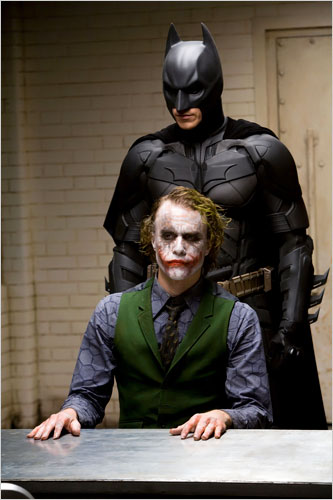
There seems to me no question that the Batman film "The Dark Knight," currently breaking every box office record in history, is at some level a paean of praise to the fortitude and moral courage that has been shown by George W. Bush in this time of terror and war. Like W, Batman is vilified and despised for confronting terrorists in the only terms they understand. Like W, Batman sometimes has to push the boundaries of civil rights to deal with an emergency, certain that he will re-establish those boundaries when the emergency is past.

And like W, Batman understands that there is no moral equivalence between a free society -- in which people sometimes make the wrong choices -- and a criminal sect bent on destruction. The former must be cherished even in its moments of folly; the latter must be hounded to the gates of Hell.

"The Dark Knight," then, is a conservative movie about the war on terror. And like another such film, last year's "300," "The Dark Knight" is making a fortune depicting the values and necessities that the Bush administration cannot seem to articulate for beans.

Conversely, time after time, left-wing films about the war on terror -- films like "In The Valley of Elah," "Rendition" and "Redacted" -- which preach moral equivalence and advocate surrender, that disrespect the military and their mission, that seem unable to distinguish the difference between America and Islamo-fascism, have bombed more spectacularly than Operation Shock and Awe.

Why is it then that left-wingers feel free to make their films direct and realistic, whereas Hollywood conservatives have to put on a mask in order to speak what they know to be the truth? Why is it, indeed, that the conservative values that power our defense -- values like morality, faith, self-sacrifice and the nobility of fighting for the right -- only appear in fantasy or comic-inspired films like "300," "Lord of the Rings," "Narnia," "Spiderman 3" and now "The Dark Knight"?

The moment filmmakers take on the problem of Islamic terrorism in realistic films, suddenly those values vanish. The good guys become indistinguishable from the bad guys, and we end up denigrating the very heroes who defend us. Why should this be?

The answers to these questions seem to me to be embedded in the story of "The Dark Knight" itself: Doing what's right is hard, and speaking the truth is dangerous. Many have been abhorred for it, some killed, one crucified.

Leftists frequently complain that right-wing morality is simplistic. Morality is relative, they say; nuanced, complex. They're wrong, of course, even on their own terms.

Left and right, all Americans know that freedom is better than slavery, that love is better than hate, kindness better than cruelty, tolerance better than bigotry. We don't always know how we know these things, and yet mysteriously we know them nonetheless.

The true complexity arises when we must defend these values in a world that does not universally embrace them -- when we reach the place where we must be intolerant in order to defend tolerance, or unkind in order to defend kindness, or hateful in order to defend what we love.

When heroes arise who take those difficult duties on themselves, it is tempting for the rest of us to turn our backs on them, to vilify them in order to protect our own appearance of righteousness. We prosecute and execrate the violent soldier or the cruel interrogator in order to parade ourselves as paragons of the peaceful values they preserve. As Gary Oldman's Commissioner Gordon says of the hated and hunted Batman, "He has to run away -- because we have to chase him."

That's real moral complexity. And when our artistic community is ready to show that sometimes men must kill in order to preserve life; that sometimes they must violate their values in order to maintain those values; and that while movie stars may strut in the bright light of our adulation for pretending to be heroes, true heroes often must slink in the shadows, slump-shouldered and despised -- then and only then will we be able to pay President Bush his due and make good and true films about the war on terror.

Perhaps that's when Hollywood conservatives will be able to take off their masks and speak plainly in the light of day.

Mr. Klavan has won two Edgar Awards from the Mystery Writers of America. His new novel, "Empire of Lies" (An Otto Penzler Book, Harcourt), is about an ordinary man confronting the war on terror.

From The Weekly Standard:
Sweet Nothings
A close reading of The Speech.
by Andrew Ferguson

08/04/2008

Anyone who wants to understand Barack Obama would do well to stay away from the radio and the TV. Obama is a theatrical presence. That's what it means to be "charismatic": To an unnerving degree his appeal relies on sight and sound rather than sense. Better, in my opinion, to stick to the printed word. On paper (or the computer screen) his words can be thought about and chewed over. You can understand him at your own pace, undistracted by that rich baritone, the regal bearing, the excellent drape of his Burberry suits.

The printed word has its problems too, of course. You really need to be on your toes if you're going to get anything out of a newspaper's election coverage. You've got to tune your ear to euphemism and translate as you go. So last Friday, having missed the television broadcasts of Obama's speech in Berlin the day before, I read the Washington Post with a cocked ear, and when I saw that the speech was described as "broadly thematic" and "sober and serious" I knew exactly what it meant: a boring speech full of blah blah blah.

And so it was. In the Post as elsewhere, as much coverage was devoted to the speech's setting--the sprawling crowds and the dramatic backdrop and the tingling sense of anticipation--as to the speech itself. The paper didn't even bother to print verbatim excerpts, as it usually does with a big-time address. The occasion had been taken as an invitation to deliver a summary of Obama's view of America's role in the world. When his handlers decided to schedule a speech in Berlin, they teed up comparisons with the portentous speeches that Presidents Kennedy and Reagan had delivered there.

Instead, in the heart of Europe, before 200,000 breathless admirers, Obama pulled himself up to his full height, lifted his chin, unlimbered those eloquent hands, and said nothing at all.

Obama's "nothing" is sometimes interesting anyway; there are pointers in the vacuousness, as I saw when I read the full text on his campaign's website. He began the speech, as he often does, with a summary of his own life history, which elided into a history of the Cold War--mixing the two together, with his customary grandiosity. The history was nicely written up but not news. And the lesson he drew from it was, to be kind, idiosyncratic: The West's victory in the Cold War, he said, proved that "there is no challenge too great for a world that stands as one."

This will come as a surprise to anyone who lived through the Cold War or has even read about it. The thing about wars, even cold ones, is that the world doesn't stand as one; that's why there's a war. And in the Cold War the Soviet side was as united as the West; more so, probably. Left out of Obama's history was any mention of the ferocious demonstrations against the United States in the streets of Paris and West Berlin during the 1960s and 1980s, when American presidents were routinely depicted as priapic cowboys and psychopaths. Probably a fair number of the older members of Obama's audience had been hoisting those banners themselves 25 years ago.

So if "standing as one" didn't win the Cold War, what did? Obama didn't stop to answer, since his own reading of history seems to deny the premise of the question. Instead he hustled on to the present moment. Now, he said, "we are called upon again." To do what? Presumably to stand as one all over again, in the face of "new promise and new peril." Included in the latter are terrorism, global warming, and nuclear proliferation. But those perils aren't the worst of it. "The greatest danger of all is to allow new walls to divide us from one another."

The sentence is the heart of the speech and an instance of Obama's big weakness--his preference for the rhetorical flourish over a realistic account of things as they are. Most politicians share the weakness, and the preference has proved wildly attractive to Obama's supporters. But think it through: "New walls to divide us" is just a metaphor, a trope. A trope can't be the "greatest danger of all." A terrorist setting off a nuclear bomb in London--that's a danger. A revolution in Islamabad--that's a danger. A figure of speech is just a figure of speech.

And what will Obama have us do to avoid those nonmetaphorical dangers? He declined to get specific, aside from urging us to "answer the call." Floating along on a cloud of metaphor and generality allows Obama to do what he wants to do, in the Berlin speech and elsewhere. As a public figure he means to rise above any hint of conflict, and to suggest that problems and dangers dissolve when we "come together." And coming together, "standing as one," is simply the logical outcome of every participant's correctly understanding his best interest. What could be more reasonable?

It doesn't matter that human affairs never work out this way, no more in domestic politics than in foreign policy. The assumption that they do is what lends so many of Obama's utterances their greeting-card simplicity and appeal. The effect is almost soporific: "America cannot turn inward," he says. Check. "Now is the time to build new bridges." All set to go. "We must defeat terror." True dat. "Every nation in Europe must have the chance to choose its own tomorrow free from the shadows of yesterday." Roger. "We must help answer the call for a new dawn in the Middle East." Go ahead: Argue.

To pump a little vigor into his limp sentiments, Obama attached them to a hypnotic refrain. "This is the moment," he said in Berlin, repeatedly. But where's the urgency come from? What's the rush? In the long train of platitudes he suggested no discrete, definable policy that needed to be adopted urgently, beyond his call to unity, which isn't a policy but an aspiration. You get the idea that the urgency doesn't arise from an assessment of reality but from a rhetorical need. He's got to keep the folks on their toes somehow.

Obama couldn't come to Berlin and deliver a speech full of portent, as Reagan and Kennedy did before him, and as his publicists suggested he might. For all the talk about this being our time and us being the people, Obama shows no sign of really believing we live in portentous times. This is surely part of his appeal. It's not surprising that when he came to Berlin and said nothing at all, none of his admirers seemed disappointed. After eight years of overheated history, nothing comes as a relief.

Andrew Ferguson is a senior editor at THE WEEKLY STANDARD.


Illustration from NoMaas.org.

From Newsday.com:
An enthusiastic thumbs-up on Yankees trade
By Ken Davidoff

BOSTON

The Yankees made a heck of a trade Friday night, and the Red Sox and Rays should be concerned.

"Phenomenal," Alex Rodriguez said, in admiration, of the impending arrivals of Damaso Marte and Xavier Nady; they're both expected at Fenway Park on Sunday.

That said, neither Boston nor Tampa Bay should concede quite yet. Both rivals, historic and brand new, have put together strong, deep organizations that can withstand the deal.

No, the real beauty of this transaction is that, even when the Yankees fall short of the playoffs this season, it can still be viewed positively. Really, it's the next step in Brian Cashman's Master Plan.

Cashman, since gaining full power in 2005, has operated by two simple mantras: 1) build up a stockpile of young talent; and 2) prioritize roster flexibility.

The deal of Phil Coke, George Kontos, Ross Ohlendorf and Jose Tabata to Pittsburgh, in return for the lefthanded reliever and righty-hitting outfielder they desired, perfectly blended the tangential strategies.

Cashman finally felt comfortable enough with his quantity of prospects to deal from it. And to still feel content, afterward, with the quality and depth of the farm system.

And the two guys coming, in addition to providing their obvious talent, do anything but clog up roster flexibility. To the contrary, they enhance it.

Nady, as long as he performs capably over the next two months, should be the Yankees' starting rightfielder in 2009, allowing the club to bid farewell to Bobby Abreu. Whereas Abreu will be a free agent and should receive multiyear offers from elsewhere, Nady (making $3.35 million this season) will be arbitration-eligible - the Yankees never mind the dollars, only the years - then a free agent after next year.

As for Marte, if the Yankees absolutely love him, they can exercise a $6-million team option for next year. That's pretty rich for a lefty specialist, so if they set him free, then they'll pick up a couple of high 2009 draft picks. Under Cashman's rule, the Yankees have been far less hesitant to overspend in June (on the amateurs) than in November (for veteran free agents).

Pirates GM Neal Huntington drove a hard bargain for quite a while on his guys, then he relented. Did he do so too much? It appears so, to this space. But one official from an American League club, citing his affection for Tabata and Coke, thought that the Yankees gave up too much.

Tabata was the biggest name, the jewel of the Yankees' farm system two years ago, when he competed in the Futures Game at 17. But his stock had dropped precipitously, thanks to a series of disciplinary issues. He's too young to write off altogether, yet certainly flawed enough to give up for value.

We all saw Ohlendorf; nice kid, decent stuff. Perhaps someday he'll put it all together. Either way, the Yankees have plenty of more guys like Ohlendorf.

As for the other two kids, both Coke, 26, and Kontos, 23, put up good numbers at Double-A Trenton this season. Yet like Ohlendorf, these guys ranked nowhere near the top of the Yankees' stash.

Predictably, the trade drew raves in the Yankees' clubhouse.

"You've got two players in their primes," A-Rod said after the Yankees' 1-0 victory over the Red Sox. "Marte is a guy with A-plus stuff and an A-plus makeup. 'X' has New York experience [with the Mets in 2006]. It was a great move."

"I think it's great for our team," Johnny Damon agreed.

Damon, Abreu and Barry Bonds are those who have reason to frown. Nady figures to see plenty of time in leftfield - he'll probably spell Abreu in right, too - relegating Damon to more of a role at DH. Abreu, as mentioned, essentially received his walking papers upon the completion of this season.

With Nady here, we can officially cease the Bonds speculation. He was never a good fit, no matter what Hank Steinbrenner thought.

Nady and Marte are superb fits, in a plan that's working very well. It was a great night for the Yankees, and not only because Joba Chamberlain outpitched Josh Beckett.

Copyright © 2008, Newsday Inc.
Yankees starter Joba Chamberlain delivers a pitch in the first inning of last night's game against Boston. He pitched seven shutout innings as the Bombers beat the Red sox 1-0.
From The New York Post:
Great game and trade last night, great outcome today...
START TO FINISH, THIS WAS CLASSIC
By MIKE VACCARO

July 26, 2008 --

BOSTON - There was only one way for this beauty of a baseball game to end, of course. The tying run had to be on base. There had to be two outs in the ninth inning, with the MVP of the All-Star Game digging in to face the greatest closer in the history of the sport.

Some nights demand the full regal treatment. Those nights also deserve an appropriate conclusion. And so it was that Mariano Rivera zipped a 95-mph cutter toward the outside corner, and J.D. Drew stood and stared at it, and home plate umpire Marty Foster lifted his right arm and tied it all up in a bow.

Yankees 1, Red Sox 0.

"That," Joe Girardi said after he'd breathed his final sigh of relief, "was one whale of a game, wasn't it?"

It was that. It was even more than that. It was a grizzled ace of the present named Josh Beckett bringing C-plus stuff to Fenway Park and nearly getting away with it, tip-toeing in and out of trouble for seven innings, somehow scattering nine hits, burned only by a Jason Giambi bleeder that nudged in the only run.

It was a fuzzy-cheeked ace of the future named Joba Chamberlain accepting that one-run lead after nearly getting cold-cocked by the Boston bats an inning earlier, then grinding his way through seven innings of his own, retiring the last 10 hitters to face him, extending by another game a brewing feud with Kevin Youkilis which is either a relentless quirk of fate or a conflagration waiting to happen.

And at last, naturally, there was the great Rivera, summoned with one out in the eighth, re-proving one more time why he is the best ever born at his job, striking out three, retiring five of the six he faced, kicking the plug out on the crazed crowd of 37,744, dragging the Yankees another game closer to the Red Sox.

"We're not in a position where we can afford to take any games off," Derek Jeter said. "This one just felt like a team effort from the very beginning."

It felt that way because it was that way, starting with back-to-back fielding gems in the second, when Melky Cabrera made one of the best catches you'll ever see robbing Drew of what would surely have been a run-scoring double, Robinson Cano following that with a breathtaking start to a 4-6-3 that rescued Chamberlain from the only real trouble he'd see all night.

Unless you count the kind that generally visits whenever he's on the mound and Kevin Youkilis is at the plate. A year ago, a high hard one too close to Youkilis' melon earned him a suspension, and earlier this month a slider behind Youkilis' legs drew a chorus of hard stares and harder feelings.

Last night, leading off the home seventh, ahead in the count 2-and-0, Youkilis got an up-close look at another heater, one that missed drilling his helmet only because his bat got in the way. Chamberlain recovered to strike him out, Youkilis screaming "Horse [bleep]!" all the way back to the bench.

"He has great command," Terry Francona said of Joba, "until Youk gets in there."

"It was at his head!" an incredulous Beckett muttered.

The Yankees pled innocence, naturally, Girardi insisting it was "coincidence," Joba defiantly proclaiming "If you think I'm going to throw at him leading off an inning with a one-run lead, that's just crazy."

It's always dangerous to wrap yourself too closely around one game in July, even if the presence of the Yankees and the Red Sox makes such hyperbole mandatory. But this one begs you to praise it and to re-watch it when it inevitably winds up a Yankee Classic on YES. There is still so much season left to play, and there are still the Rays, refusing to be pulled offstage by the vaudeville cane.

But you aren't human - or, at the least, you aren't a baseball fan - if this game didn't make you salivate over what could be across the next two months. And beyond.

michael.vaccarro@nypost.com

Friday, July 25, 2008

http://www.americanthinker.com/Obama's%20new%20messianic%20parade.JPG
From The Times (UK):
He ventured forth to bring light to the world
The anointed one's pilgrimage to the Holy Land is a miracle
in action - and a blessing to all his faithful followers

By Gerard Baker

July 25, 2008

And it came to pass, in the eighth year of the reign of the evil Bush the Younger (The Ignorant), when the whole land from the Arabian desert to the shores of the Great Lakes had been laid barren, that a Child appeared in the wilderness.

The Child was blessed in looks and intellect. Scion of a simple family, offspring of a miraculous union, grandson of a typical white person and an African peasant. And yea, as he grew, the Child walked in the path of righteousness, with only the occasional detour into the odd weed and a little blow.

When he was twelve years old, they found him in the temple in the City of Chicago, arguing the finer points of community organisation with the Prophet Jeremiah and the Elders. And the Elders were astonished at what they heard and said among themselves: “Verily, who is this Child that he opens our hearts and minds to the audacity of hope?”

In the great Battles of Caucus and Primary he smote the conniving Hillary, wife of the deposed King Bill the Priapic and their barbarian hordes of Working Class Whites.

And so it was, in the fullness of time, before the harvest month of the appointed year, the Child ventured forth - for the first time - to bring the light unto all the world.

He travelled fleet of foot and light of camel, with a small retinue that consisted only of his loyal disciples from the tribe of the Media. He ventured first to the land of the Hindu Kush, where the

Taleban had harboured the viper of al-Qaeda in their bosom, raining terror on all the world.

And the Child spake and the tribes of Nato immediately loosed the Caveats that had previously bound them. And in the great battle that ensued the forces of the light were triumphant. For as long as the Child stood with his arms raised aloft, the enemy suffered great blows and the threat of terror was no more.

From there he went forth to Mesopotamia where he was received by the great ruler al-Maliki, and al-Maliki spake unto him and blessed his Sixteen Month Troop Withdrawal Plan even as the imperial warrior Petraeus tried to destroy it.

And lo, in Mesopotamia, a miracle occurred. Even though the Great Surge of Armour that the evil Bush had ordered had been a terrible mistake, a waste of vital military resources and doomed to end in disaster, the Child's very presence suddenly brought forth a great victory for the forces of the light.

And the Persians, who saw all this and were greatly fearful, longed to speak with the Child and saw that the Child was the bringer of peace. At the mention of his name they quickly laid aside their intrigues and beat their uranium swords into civil nuclear energy ploughshares.

From there the Child went up to the city of Jerusalem, and entered through the gate seated on an ass. The crowds of network anchors who had followed him from afar cheered “Hosanna” and waved great palm fronds and strewed them at his feet.

In Jerusalem and in surrounding Palestine, the Child spake to the Hebrews and the Arabs, as the Scripture had foretold. And in an instant, the lion lay down with the lamb, and the Israelites and Ishmaelites ended their long enmity and lived for ever after in peace.

As word spread throughout the land about the Child's wondrous works, peoples from all over flocked to hear him; Hittites and Abbasids; Obamacons and McCainiacs; Cameroonians and Blairites.

And they told of strange and wondrous things that greeted the news of the Child's journey. Around the world, global temperatures began to decline, and the ocean levels fell and the great warming was over.

The Great Prophet Algore of Nobel and Oscar, who many had believed was the anointed one, smiled and told his followers that the Child was the one generations had been waiting for.

And there were other wonderful signs. In the city of the Street at the Wall, spreads on interbank interest rates dropped like manna from Heaven and rates on credit default swaps fell to the ground as dead birds from the almond tree, and the people who had lived in foreclosure were able to borrow again.

Black gold gushed from the ground at prices well below $140 per barrel. In hospitals across the land the sick were cured even though they were uninsured. And all because the Child had pronounced it.

And this is the testimony of one who speaks the truth and bears witness to the truth so that you might believe. And he knows it is the truth for he saw it all on CNN and the BBC and in the pages of The New York Times.

Then the Child ventured forth from Israel and Palestine and stepped onto the shores of the Old Continent. In the land of Queen Angela of Merkel, vast multitudes gathered to hear his voice, and he preached to them at length.

But when he had finished speaking his disciples told him the crowd was hungry, for they had had nothing to eat all the hours they had waited for him.

And so the Child told his disciples to fetch some food but all they had was five loaves and a couple of frankfurters. So he took the bread and the frankfurters and blessed them and told his disciples to feed the multitudes. And when all had eaten their fill, the scraps filled twelve baskets.

Thence he travelled west to Mount Sarkozy. Even the beauteous Princess Carla of the tribe of the Bruni was struck by awe and she was great in love with the Child, but he was tempted not.

On the Seventh Day he walked across the Channel of the Angles to the ancient land of the hooligans. There he was welcomed with open arms by the once great prophet Blair and his successor, Gordon the Leper, and his successor, David the Golden One.

And suddenly, with the men appeared the archangel Gabriel and the whole host of the heavenly choir, ranks of cherubim and seraphim, all praising God and singing: “Yes, We Can.”
The image “http://host.trivialbeing.org/up/tdk-mar10-nyt-batman-joker.jpg” cannot be displayed, because it contains errors.
From First Things.com: Excellent analysis of the film...
Christopher Nolan’s Achievement: The Dark Knight
By Thomas S. Hibbs

Tuesday, July 22, 2008, 6:12 AM

With the record-setting release of The Dark Knight, his sequel to Batman Begins, Christopher Nolan, whose previous films include Memento, Insomnia, and The Prestige, stakes his claim to be our most inventive and most philosophical filmmaker. He has certainly surpassed M. Night Shyamalan, whose latest release The Happening was his third straight disappointing film. Both Nolan and Shyamalan focus on dark tales of human quest in which characters, set out to solve a crime or set things right in the face of seemingly insuperable evil, are beset with doubts, and tempted by despair, or—what is worse—by the temptation to become the evil they are fighting against. Whereas Shyamalan has descended into unintentional self-parody in his last few films, Nolan’s filmmaking and storytelling skills are on the rise.

Nolan first gained his notoriety with Memento, his remarkable indie neo-noir film starring Guy Pearce as a man trying to solve his wife’s murder while suffering from short-term memory lapses. Shot in short segments, to mirror the amount of time Pearce’s memory could remain intact, and in reverse chronological order, the film raised all sorts of interesting questions about personal identity, knowledge of the past and the significance of human choices. The examination of moral issues was even more at the forefront of Nolan’s next film, Insomnia, starring Al Pacino as a compromised cop, whose insomnia reflects his uneasiness with the state of his own soul. Pursuing a wily suspect (Robin Williams), Pacino’s character is forced to reckon with questions about what differentiates him from the criminal. Consciously making use of classic noir thematic and stylistic elements, Nolan specializes in the dramatic portrayal of quests for which there is no possibility of a traditional happy ending or a complete recovery of what has been lost. The best that can be hoped is, as Pacino’s character puts it, that we “not lose our way.”

A similar premise undergirds Nolan’s retelling of the Batman myth, starring Christian Bale as Bruce Wayne. Batman Begins invests the backstory of Bruce Wayne’s embrace of the Batman persona with philosophical depth. Scarred and formed by witnessing his parents murder and the impotence of the legal justice system, Wayne crafts a “symbol” to intimidate evildoers. Batman’s quest to restore justice in Gotham is often hard to distinguish from the pursuit of raw vengeance. Thus, Batman himself is always in danger of becoming what he fights against; as Alfred (Michael Caine) warns him in the first film, “don’t get lost inside the monster.”

Ambitious to make a sequel that would rival in quality the second films in The Godfather and Star Wars trilogies, Nolan focuses in The Dark Knight on the “idea of escalation,” the way Batman’s dramatic persona, with its violent heroism, calls forth a greater, more creative response from the criminal element. It would be hard to imagine a more compelling embodiment of the escalation of evil in Gotham than what Nolan and actor Heath Ledger have created in the character of The Joker, whose insouciant embrace of chaos eclipses the malevolence of Hannibal Lecter from Silence of the Lambs and John Doe from Se7en. What makes Nolan’s latest film such a success is not, however, Ledger’s compelling presentation of evil, on which critics have focused their attention, but the way in which he uses that character to bring out the depth and complex goodness of the other characters in the film, including Batman. The title of the film is not The Joker but The Dark Knight.

Still, Ledger’s performance as The Joker is a chilling and memorable one, superseding all other villains in superhero genre. To account for The Joker, Nolan adverts to no childhood trauma or scientific experiment gone awry. All such explanation is beside the point. At one point, The Joker asks one of his victims whether he wants to hear the story of how he got his scars. He proceeds to explain that his father was a “drunken fiend,” who fought with his mother, one night to the point of cutting her with a knife. Having done so, he turned on his stupefied son and, putting the knife to his mouth, asked, “Why so serious?” Then, in a subsequent scene, The Joker tells quite a different story about the source of his scars. The point is clear—there is no “reason” for the Joker’s love of chaos. As Nolan commented, The Joker has “no arc, no development”; he is an “absolute.” As he sets fire to a huge pile of money, The Joker chastises the astounded criminals in his midst for their petty love of money. When Bruce Wayne tells Alfred that criminals are “not complicated” and that they just need to find out “what this one wants,” Alfred responds, “some men just want to watch the world burn.” There is no ultimate purpose to his mayhem; he delights in it for its own sake, as is evident in one particularly chilling scene in which Batman tries to beat him into revealing his plans. As The Joker cackles with glee at the pain, he taunts Batman, “you have nothing to frighten me with.”

Beyond good and evil, The Joker is off the human scale. In preparation for the role, Ledger studied the voices of ventriloquist dummies aiming for a chilling effect in which the voice itself sounds “disembodied.” Ledger and Nolan looked at Francis Bacon paintings to try to capture the look of “human decay and corruption.” As in William Peter Blatty’s definitive depiction of demonic evil in The Exorcist, so too here—the demon’s target is us, to make us believe that we are “bestial, ugly, and not worthy of redemption.”

If there were a purpose, it would be akin to that pursued by Mr. Glass (Samuel Jackson) in Shyamalan’s Unbreakable, whose amoral destruction has as its goal the discovery of someone at the other end of the spectrum, his complement. As The Joker says to Batman, “Why would I want to kill you? What would I do without you? You complete me.” So he taunts Batman, “You’re just like me—a freak.”

The Joker espouses a nihilist philosophy concerning the arbitrariness of the code of morality in civilized society; it is but a thin veneer, a construct intended for our consolation. If you tear away at the surface, “civilized people will eat each other.” As The Joker puts it, “madness is like gravity; all it takes is a little push.” In a wonderfully comic take on a Nietzschean sentiment, he sums up his beliefs: “Whatever does not kill you makes you stranger.” His character also illustrates the parasitic status of evil and nihilism. A thoroughgoing nihilist could not muster the energy to destroy or create. As The Joker puts it at one point, he’s like the dog chasing a car; he has no idea what he would do if he caught it.

The Joker’s attempt to bring down the entire system of civilization has the scope and feel of terrorism; in fact, the film features many genuinely terrifying scenes. Here Nolan shares Shyamalan’s sense that true suspense and fear require restraint in the direct depiction of gore and the development of characters with whom the audience is sympathetic. In addition to Batman, there are a number of other admirable characters in The Dark Knight. In a film brimming with terrific performances, three stand out: Lieutenant and then Commissioner Gordon (Gary Oldman), the assistant D.A. Rachel (Maggie Gyllenhaal, replacing Katie Holmes from Batman Begins), and especially the fearless crime fighting D.A. Harvey Dent (Aaron Eckhart), whose tragic undoing at the hands of The Joker is the “arc” upon which the plot pivots. These three illustrate the costs of defending the innocent and fighting against evil, the costs borne by those who would be decent in an indecent world. If in certain prominent instances in this film, the hopes of the audience for these characters are dashed, the film does not succumb to The Joker’s vision. It is not nihilistic; it is instead about the lingering and seemingly ineradicable longing for justice and goodness that pervades the film. As Batman put it in the original film, “Gotham is not beyond redemption.”

Dark quests for redemption, whether religious or secular, abound in contemporary culture. As Nolan’s films indicate, these quest films owe a great debt to classic film noir. Classic noir takes aim at some of the treasured assumptions and promises of modernity. In noir, the modern world, embodied in an urban setting, is hardly the world of light, happiness, and peace that utopian thinkers of the Enlightenment foretold. Modernity is about human beings exercising control over nature and thus taking control of their destinies; in our modern technological project, knowledge and power are one. The postmodern turn in noir is about the loss of control, the absence of intelligibility, and the threat of powerlessness. But the quest has something pre-modern about it—a sense of human limitations, of the dependence of human beings on one another and on events not in their control. In this world, the outcome of the quest is tenuous and uncertain.

The title of the Nolan’s latest Batman film calls to mind medieval chivalry in a postmodern key. The dark knight embraces extraordinary tasks and fights against enormous odds; his quest is to restore what has been corrupted and to recover what has been lost. In so doing, he takes upon himself a suffering and loneliness that isolate him from his fellow citizens and inevitably court their misunderstanding and scorn. He is a dark knight, in part, because the world he inhabits is nearly void of hope and virtue, and, in part, because some of the darkness resides within him, in his internal conflicts between the good he aspires to restore and the means he deploys to fend off evil. Of the many filmmakers designing dark tales of quests for redemption, Christopher Nolan is currently making a serious claim to being the master craftsman.

Thomas S. Hibbs is Distinguished Professor of Ethics and dean of the honors college at Baylor University. His books include Virtue’s Splendor and, most recently, Arts of Darkness: American Noir and the Quest for Redemption.

Thursday, July 24, 2008

http://www.pastemagazine.com/blogs/images/uploads/2007/06/TheHoldSteady2_low.jpg
From Salon:
Soundtrack for the great American road trip

The Hold Steady are a New York indie rock band for people who hate New York indie rock bands, and their new album chronicles the country's dark underbelly.

By Michaelangelo Matos

Jul. 14, 2008 | Indie rock is full of annoying voices. Hell, indie rock was founded on annoying voices, from the low, talky Lou Reed of the Velvet Underground, to the grating likes of the New York Dolls' David Johansen and the Sex Pistols' Johnny Rotten, all the way down to Coldplay's whiny Chris Martin and the screechier works of Conor Oberst (aka Bright Eyes).

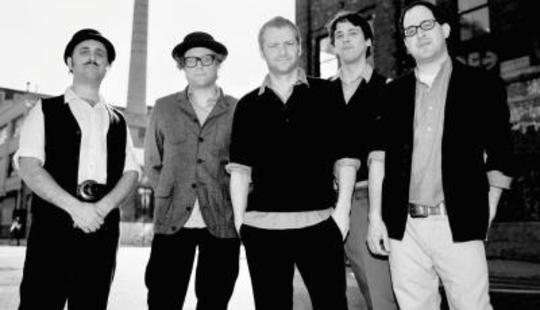
But standing out even in this company is Craig Finn, the lead singer, lyricist and rhythm guitarist in Brooklyn, N.Y., five-piece the Hold Steady. That's partly because Finn's voice is both nasal and chesty, a whiny bellow that at times seems like it isn't aiming for any notes in particular. (Matador Records co-founder Gerard Cosloy once memorably described Finn and his group as "later-period Soul Asylum fronted by Charles Nelson Reilly.") Still, you can hear on the Hold Steady's new "Stay Positive" that Finn's voice has mellowed with age (he's now 37) and singing lessons. If anything, though, Finn's lyrics -- hyper-detailed, highly allusive, fictional stories about teenage runaways, low-level criminals, copious substance abuse, and the more amusingly desperate edges of the rock lifestyle -- are enhanced by his nasal bark.

The Hold Steady identify as an indie band primarily because they're on Vagrant Records (and before that, the Brooklyn label Frenchkiss). But what they play is closer to '70s AOR -- souped-up and punk-inclusive, but still defined by Tad Kubler's splashy, muscular guitar leads and Franz Nicolay's oft-romantic keyboards; bassist Galen Polivka and drummer Bobby Drake form a tough, nimble rhythm section. Bruce Springsteen's E Street Band is the Hold Steady's most obvious and direct predecessor (and Bruce loves 'em back), but others, like Cheap Trick and Boston, are also in clear sonic evidence. And if the Hold Steady evoke the great mid-American summer road trip, Finn's voice and lyrics expose its dark underbelly.

Finn's music has long offered a kind of trade-off: Stick around even if you think you can't stand his glottal bark, because eventually you will be sucked all the way in. Finn has repeatedly told interviewers his favorite fan correspondence is e-mail from dudes around 40 who lost interest in new music a decade or more ago but plan to get stupid drunk and shout along with every word the next time the Hold Steady come to town.

People hear their lives in this band, just the way Finn heard his in his favorite groups growing up. Finn told me in a 2003 interview, "In hardcore circles, there's a T-shirt that says 'Straightedge Till Death.' And there's another one that says 'Straightedge Till Prom,' because most of the people in hardcore are still underage. So I think of [what I write] as post-prom straightedge songs." Finn's musical roots in hardcore are especially pronounced on "Stay Positive," the Hold Steady's latest album -- especially the title track and the album's opener, "Constructive Summer," in which Finn raises "a toast to Saint Joe Strummer." Alternately spieling like an inspired scoutmaster and the one-time 16-year-old in a basement keeping the hardcore faith, Finn declares, "Let this be my annual reminder/ That we could all be something bigger ... We are our only saviors/ We're gonna build something this summer."

If you go back to Finn and Kubler's previous band, the Minneapolis quartet Lifter Puller, you can start to see what Finn is building. This earlier band was essentially the Hold Steady in embryo, though there are many differences: Kubler played bass, not guitar, and Lifter Puller's sound was wiry art-punk, heavy on needling keyboards, rather than widescreen rock. The band was the hub of a thriving arts and music community in late-'90s Minneapolis, scene kings that no one cared about outside the scene. Part of their appeal was the way Finn portrayed his hometown: Most of Lifter Puller's songs were set there and turned a mostly humdrum city into one crawling with vice, mischief, drugs and action -- a squalid, alluring, David Lynchian vision lurking beneath the bland surfaces. Finn's narrators were the excitable guys insisting they knew where the real action was, and he frequently played their haplessness for laughs. "Fiestas + Fiascos," Lifter Puller's 2000 swan song, includes one character yelping, "Woke up in the grass with the assless chaps!"

When the band dissolved in late 2000, Finn and Kubler both made their way to Brooklyn; the Hold Steady began playing in early 2003. Originally a quartet, the Hold Steady deliberately stayed away from the new wave keyboards, brisk tempos, condensed structures and lack of choruses that had characterized Lifter Puller. On "The Hold Steady Almost Killed Me," the band's 2004 debut, Finn still set many of his songs in the Twin Cities, but he sounded more amused than bug-eyed, sloshing alongside the ridiculous characters and lost dingbats he was now chronicling, while Kubler set out to re-create the guitar leads from his melted classic-rock car tapes -- right enough to catch their essence, wrong enough not to get sued.

Having watched his prior group become a posthumous cult favorite thanks to the Internet, Finn was trying to make something happen. His timing was flawless. When the Hold Steady first appeared, indie rock was the hottest thing going in New York, with the Strokes, Yeah Yeah Yeahs, Interpol and a dozen other bands stirring up excitement even among jaded locals. It was an exciting time for live music in New York; the scene was also very arty and trendy, and as a recently transplanted Midwesterner, those fashiony trappings made Finn bristle. Like a lot of Midwesterners who move east (I speak from experience), Finn began sticking to his traditionalist guns in a way he hadn't at home -- partly ironically, partly out of defensiveness. Take this lyric from "Hostile, Mass.," on "Almost Killed Me": "He said, 'My name's Corey and I'm really into hardcore/ People call me 'Hard Corey.'" Sure, cute -- but then Finn throws in the twist: "Don't you hate these clever people and these clever-people parties?" The Strokes spoke to the nonchalantly chic; the Hold Steady spoke for the ex-pats waiting to finish doing their city time and head back to their hometowns. They became the New York rock band for people who hated New York rock bands.

If in Lifter Puller Finn had his tongue at least slightly in cheek when singing about subcultures, in the Hold Steady he began to openly value community -- which in turn attracted an audience that was looking for something recognizable with which to connect. Finn's lyrics were still furiously paced, but with Kubler frequently taking solos you could let the details sink in. And the storytelling style itself was relaxing as well: less brash trash talk, more character study. 2005's "Separation Sunday" brought to center stage yet another obsession that had occasionally bobbed up in Finn's work before: Catholic guilt. That album is a loosely plotted suite about a lapsed Catholic girl, Holly (short for Hallelujah), who goes on a sex-drugs-resurrection road trip. "Boys and Girls in America," from 2006, was baldly romantic and occasionally just wet, with acoustic instruments increasingly prominent. But its discrete songs and Finn's more melodic approach help put them over to a larger audience -- the kind you get from constant touring. It's hard to think of the Hold Steady as a New York band now: They've become festival-happy road dogs who frequently sport beards.

"Stay Positive" is a natural progression -- backward and forward. Nothing rhythmically fancy goes on in Hold Steady songs, but their beat hurtles, and Kubler and Nicolay both have a gift for instrumental fills that complement the onslaught of words. While there are a lot of new touches, particularly the brazenly plastic synthesizers of "Navy Sheets" and a handsome array of acoustic instruments on several songs, most of the time they just play basic rock. But they do it well enough that it can feel like you haven't heard its like in years. No new ground is broken; none needs be.

Still, for all of the vigor of the up-tempo rock songs that dominate, "Stay Positive" is clearly the work of a bunch of guys who are nearing 40 and thinking about what that means. The harder edges of the music seem not so much hemmed in as blurry from use. But musically the Hold Steady are starting to look back too, beyond the hardcore references. The "Navy Sheets" synth line is a clear hat-tip to the Lifter Puller sound. You can always tell a band is "maturing" when the cellos come out, but here the banjo (played by J. Mascis of Dinosaur Jr. on "Both Crosses"), squeezebox ("Lord, I'm Discouraged") and harpsichord ("One for the Cutters") add new shades to the well-established sound.

The main thing, though, is the way Finn connects back to his earlier work. He's repeated lines from, or referring to, older songs as a matter of course, but on "Stay Positive," there's a sense of finality when he brings up old characters again. Maybe that's Finn's voice, more casually weary than ever, but it's also logical. That's why this album's center feels less like its explicitly punk roots than magisterial ballads like "Lord, I'm Discouraged" and "Both Crosses." Both songs wrestle with Catholicism again, and Finn begins another song, "Yeah Sapphire," "If I cross myself when I come would you maybe receive me?" (Bet that works great with the ladies.)

What connects everything is that for all the drugged-out messes he chronicles, Finn is about as far from a nihilist as rock has. What he'll never expunge from the church is the same thing he can never forget from all those basement shows as a kid: the sense that you can make yourself more powerful by giving in to the collective. He isn't trying to be anybody's savior. He just wants to spread the word.

http://nymag.com/images/2/daily/entertainment/08/05/05_holdsteady_lg.jpg
From The Houston Chronicle:
Music jibes with album's title
The Hold Steady
Stay Positive

By ANDREW DANSBY

Small-town discontent, middle-age regrets, a desire to do better and some sort of salvation through rock 'n' roll: Constructive Summer, the very Springsteenlike opening song on the Hold Steady's Stay Positive, could've been called ``Radio Somewhere.''

As is often the case with this blustery bar band, it rides a muscle-car riff as though the streets are empty. Behind the wheel is one of those drunken poet types, Craig Finn, who blurts more than he sings.

``Me and my friends are like/the drums on Lust for Life/We pound it out on floor toms/Our psalms are sing-along song./This whole town is lifeless/Been that way our whole lives/just work at the mill until you die.''

It's all earnest to a T (``Raise a toast to Saint Joe Strummer ...''), which is refreshing in an age when bands often need some sort of stylistic device to find their way out of the mud.

The Hold Steady have fleshed out their sound some this time out. Various keyboards peek through more prominently (check out the Cars-y line on Navy Sheets), horns jump from nowhere, a banjo finds its way into the mix. But these are mere embellishments. Those drawn in by the band's breakthrough Boys and Girls in America won't feel tricked.

Finn's still musing about most of the same stuff: drinking, music, girls and class warfare. They often intersect, sometimes humorously. ``We didn't go back to her place,'' he sings on Sequestered in Memphis. ``We went to some place where she cat-sits.''

It's followed by the deadly serious One for the Cutters, a musical short story that plays out a little like The Outsiders with a lost rich girl, a knife, a lie and a life that followed an unexpected path.

Not surprisingly, the title track is the centerpiece. It's also a sort of mission statement and an anthemic look ahead. There's zero pretense to the song. Finn sometimes plays narrator, but here he's almost reviewing himself.

``Most kids give me credit for being down with it,'' he sings, an admission of the band's indie cred. Then he pays it forward by looking backward, name-checking two deserving but underappreciated hard-core acts: ``The Youth of Today and the early 7 Seconds/Taught me some of life's most valuable lessons.''

And then he does something bold. There's none of that hoping he'll die before he gets old. Finn's in his mid-30s. He's too old for those careless declarations.

``Because the kids at the shows they'll have kids of their own,'' he sings. ``And the sing-along songs will be our scriptures. We gotta stay positive!''

And there's his answer to Springsteen's ``Is there anybody alive out there?''

Finn has the same passionate true-believer sincerity that drew people to Springsteen and Paul Westerberg. He lacks the strained, soulful vocal quality that helps those two sell a song. But his blunt delivery, while initially jarring, is different, and that matters. Amid the open fanboy references, there's still a touch of mystery to many of his songs, lest they come across as screeds or valentines. And the presentation -- a plain-singing guy in a hard-driving bar band -- feels honest. And positive.

andrew.dansby@chron.com

From MLive.com:
Top 10 lyrics from the new The Hold Steady album

Posted by Bill Chapin

July 18, 2008 12:43PM

Will you folks indulge me in just one more plug for The Hold Steady? I already gushed about them once this week, but that was before I finally listened to the Brooklyn (as in the New York City borough) band's new album, "Stay Positive." Yes, It has been available online for many weeks now, but so help me, it's just not the same for me as popping a shiny little disc into a tray or slot.

Besides, I find you can't really enjoy a The Hold Steady album to its fullest until you've listened to it with the lyrics in front of you so you can pour over all the symbolism, dense storytelling, recurring themes and running gags. Singer and lyricist Craig Finn's songs read like literature, like beat poetry. Maybe that's why this band hasn't quite broken through to mainstream popularity. The classic rock riffs are enjoyable on the surface, but the music only achieves brilliance if the listener is willing to put some effort into it ... and that's just not what most people are looking for in their music, unfortunately.

Like all The Hold Steady's albums, this one is basically about young folks behaving badly (booze, sex, fights). Finn's usual tricks are on display, too. He hints at some cataclysmic event that deeply affected all the characters without spelling out exactly what happened. He talks about religion like it's a drug and rock 'n' roll like it's a religion. He quotes catch phrases from previous songs. I thought that last trick might start to annoy me after four albums, but at this point when he mentions "clever kids," it's like a visit from an old friend. Even the title "Stay Positive" is a reference to the very first song off the band's very first album, "Positive Jam."

It's not all a retread, though. Unlike the others, this album is all about getting caught. The authorities are on to what the boys and girls in America have been up to, and they're asking questions. There are also some new musical tricks — banjos and singing saws, among other things.

These are my Top 10 lyrical snippets from "Stay Positive." They may not make total sense out of context from the rest of the songs, but they should give you an idea of what the band's all about ... if you're willing to put some effort into it.

  1. "Summer, grant us all the power to drink on top of water towers."
  2. "In bar-light, she looked all right; in daylight, she looked desperate; that's alright, I was desperate, too; I'm getting pretty sick of this interview."
  3. "Now we're trying to match their mouths to the screams."
  4. "Can't you hear her? She's that sweet missing songbird when the choir sings on Sundays."
  5. "Sacramento, it swung at us first."
  6. "Hey, Judas, I know you've made a grave mistake; hey, Peter, you've been pretty sweet since Easter break."
  7. "She saw the footage right before it got cut; and she saw the bodies and she saw the blood; she saw the angel put a sword in his side; and, baby, that's how we got canonized."
  8. "We were kids in the crowd; now we're dogs in this war; we were wasps with new wings; now we're bugs in the jar."
  9. "Don't mention Tampa, they'll just know all the rest." *
  10. "We're the projectors; we're hosting the screening; we're dust in the spotlights; we're just kinda floating."

* This is my favorite in-joke on the album. It's a nod to the final song on the band's first album, which references Ybor City, an old-town section of Tampa, Fla.


From StarTribune.com:
Hold Steady: The World's Biggest Bar Band
By CHRIS RIEMENSCHNEIDER

July 19, 2008

Tad Kubler says it happened backstage at England's mammoth Glastonbury Festival last summer, when 177,000 attendees were introduced to the Hold Steady.

"We walked off-stage and the crowd noise was amazing," he recalled.

That's when the Hold Steady guitarist realized his Twin Cities-rooted, New York-based group was no longer just a bar band.

"It was our first European festival, and we just stood backstage looking at each other through the noise. It was one of those moments when you realize there's no going back."

The Hold Steady spent the rest of 2007 touring the world, playing gigs in such far-flung locales as Slane Castle in Ireland (where it opened for the Stones) and Zagreb, Croatia (with the Stooges). So much for that whole just-on-weekends thing.

This international success explains why the Hold Steady's fourth album, "Stay Positive," took two years to make -- and what, exactly, there is for the band to stay so positive about.

Both Kubler and singer/guitarist Craig Finn talked positively by phone from their apartments in Brooklyn on July 3. Two days later, they headed back overseas for some U.K. dates crammed in before their long U.S. tour, which brings them back to First Avenue on Tuesday.

"Our third record was the first to get released overseas," Finn said. "And it kind of blew up pretty quick. Our amount of touring essentially doubled."

They also nearly doubled their record sales, which -- with 122,000 U.S. copies sold from their first three albums -- weren't all that impressive compared with the mouth-frothing critical accolades the group has amassed since its 2002 debut, "The Hold Steady Almost Killed Me." Still, 122,000 isn't bad for a classic-rock-riffing, low-frills band formed in 2000 by some frumpy-looking, 30-something, semiretired musicians just for kicks (and to spoil the dance-punk movement).

Touring without warring

One measure of success for Finn was seeing his band stand up to the rigors of the road, and maybe even thrive on them.

"It showed us that we really like being together," he said. "A lot of bands get in trouble when they start touring a lot. We might have an advantage because we're a little older and have some kind of perspective and treat each other with respect."

"Also, we've all had day jobs," he said. (Finn still worked in an office as recently as 2006.) "We definitely know what we're missing by doing this."

Being closer to middle age than to drinking age is a defining theme of "Stay Positive."

On previous albums, it seemed as if the Hold Steady couldn't write a song without at least one reference to booze, drugs or sexual hookups. But the members -- who didn't necessarily live their songs, anyway -- strayed heavily from the partying lifestyle last year to endure the heavy touring, Kubler said.

"We realized we weren't sprinting across the finish line, we were on a marathon," he said.

Said Finn, "I'm 36. I can't party like I'm 26 anymore."

What's more, at least a couple of people close to the band endured serious addiction problems in recent years. When Finn, Kubler and keyboardist Franz Nicolay started writing songs on the road -- a first for the band, and done out of sheer necessity -- those low-down songs about high-living didn't seem so fun anymore.

"Most of us know someone who's taken the party beyond the part where it's any kind of celebration," Finn said.

"A lot of this record is about my idea of the attempt to age gracefully and trying to hold onto some kind of youthful exuberance as you grow older. It gets harder and harder to have fun when you accumulate more responsibilities -- and more problems."

Why so glum?

Addiction is a clear subject in one of the album's standout cuts, "Lord, I'm Discouraged," a title Finn lifted from blues pioneer Charley Patton. Finn sings, "She keeps coming up with excuses and half-truths. ... She keeps insisting the sutures and bruises are none of my business/ She says that she's sick, but she won't get specific."

Yeah, no fun.

Despite its cheery title and the band's continued prosperity, "Stay Positive" is actually the band's darkest record to date. As Finn noted, "Anytime you say, 'Stay positive,' it's usually in dark times."

Even some of the record's more up-tempo rockers are bleak in tone, such as the grimy "Navy Sheets" -- featuring backup vocals by the Drive-by Truckers' Patterson Hood -- and the epic closer "Slapped Actress." The latter was inspired by John Cassavetes' 1978 movie "Opening Night," in which Gena Rowlands plays an actress past her prime.

"The movie's a metaphor for Cassavetes' own life," Finn said. "He lived his whole life trying to make this true, raw art, but in the end his self-destructive behavior did him in."

Sounds like a metaphor for a lot more than Cassavetes.

Trouble town

"Stay Positive" is not all gloom, though. The album's first single, "Sequestered in Memphis," is another rowdy, chant-filled rocker that's classic Hold Steady.

"I had to call a lawyer friend of mine to make sure I had the correct terminology of 'subpoenaed' and 'sequestered,'" Finn said, admitting the song's eventful story line is purely fictitious. "We spent a couple nights in Memphis on the last tour, and it seemed like a town you could get in trouble in -- that's the only story behind it."

A common Hold Steady shtick, the band also has fun paying tribute to some of its blue-collar rock influences. There are shout-outs to Joe Strummer ("He might've been our only decent teacher") and even to positive-minded punk band 7Seconds. The song "Joke About Jamaica" is based entirely on Led Zeppelin's catalog and the correct pronunciation of the song "Dy'er Mak'er" (if you have to ask ...).

All too fittingly, "Jamaica" features an amusing guitar solo enhanced by another '70s rock fixture, the TalkBox, the weird, vocal-tube-through-guitar-amp device that Peter Frampton made famous with "Show Me the Way"

"I saw the voice box when I came in the studio one day and I thought, 'Uh oh. It's coming down!'" Finn recalled. "Definitely Tad's most ridiculous solo to date."

The classic-rock references are there, but one thing that "Stay Positive" noticeably lacks is Finn's usual name-checking of Twin Cities streets and locations. (Both Finn and drummer Bobby Drake grew up in the Twin Cities. Bassist Galen Polivka also lived here, as did Kubler, who played with Finn in the cult-loved late-'90s punk band Lifter Puller.)

Except for a nod to St. Paul in "Your Sapphire," the lyrics on "Stay Positive" are Minnesota-free, compared to the dozen-plus local references on previous albums.

"I didn't even realize it till we were done writing," Finn said. "I guess it has to do with me being out of Minneapolis for eight years, but probably also to being in more places on tour, having other cities pop up in my head. I hadn't really even traveled abroad before last year."

The Twin Cities are hardly in the band's rearview mirror, though. Finn took time out in the interview to rave about this season's Twins team. Both he and Kubler expressed genuine excitement about returning to First Ave, which the band skipped last year to play the bigger State Theatre. (Not surprisingly, Tuesday's show sold out weeks ago.)

"I've played in all kinds of clubs all over the world now," Finn said. "I still don't think there's one that compares to First Ave."

At least they're still a bar band at heart.

Chris Riemenschneider • 612-673-4658
http://www.spinner.com/media/2006/09/the-hold-steady-400.jpg
From Northwest Herald:
The Hold Steady
“Stay Positive”

By BRYAN WAWZENEK

3-1/2 stars

“Stay Positive” is The Hold Steady’s “Darkness on the Edge of Town.”

The comparisons go beyond the fact that frontman Craig Finn has always worn his love for Bruce Springsteen on the sleeve of his Minnesota Twins jersey. And the similarities don’t end with that saxophone on “Sequestered in Memphis.”

As with Bruce and “Darkness,” The Hold Steady are following a celebratory commercial breakthrough with a record that mostly trades moods for tunes. The guitars aren’t as sharp and the crescendos aren’t as grand, mostly because there’s nothing to be too sunny about.

Sure, 2006’s “Boys and Girls in America” contained a lot of drugs and trouble for the kids in Finn’s memory. But now we’re into addiction (“Lord, I’m Discouraged”) and violence (“One For the Cutters”) and even the cops are getting involved (“Memphis”). The “scene” is getting ugly. It’s getting druggy. It’s dying. The boys and girls either are growing up or getting old fast (“Joke About Jamaica”).

The music has changed, taking a turn for the muted. The ominous “One For the Cutters” opens with a tingling harpsichord. The religious imagery of “Both Crosses” is paired with a foggy, prickly accompaniment that recalls The Hold Steady’s acoustic EP, “Live at Fingerprints.”

Tad Kubler doesn’t get to play guitar hero too much on “Stay Positive,” but he proves he can chug a power riff with the best of them on the crunch groove of “Navy Sheets” (an otherwise ho-hum effort). “Koob” is still great, but keyboardist Franz Nicolay has become the band’s new MVP, holding things steady with tumbling piano and blazing organ parts.

Everything fans love about Finn’s writing – forever the star attraction – remains. He references Iggy Pop’s “Lust for Life,” a Dillinger Four song and “Saint Joe Strummer” on kickoff track “Constructive Summer” (about the townies who drink on the water tower). Catholic themes abound elsewhere (especially “Both Crosses”). He tosses in tour stops (Aberdeen, Cheyenne, St. Paul) as eagerly as he references his past tracks. Finn’s song catalog is like Kevin Smith’s View Askewniverse.

The title track dredges up a tune from each of The Hold Steady’s three previous albums, as Finn stops being the punk and becomes the godfather. Finn shrugs off being recognized on the street and then begins to pontificate to the kids. “There’s gonna come a time when the scene’ll seem less sunny,” he sings in his gruff, “talked all night at the bar” voice. He flashes back to “Massive Nights,” “Separation Sunday” and “Positive Jam” before paying an honest tribute to scenesters past and present: “We couldn’t have even done this, if it wasn’t for you.”

Presto, Finn becomes an adult for the rest of the record, realizing he can’t make a troubled girlfriend love him (“Magazines”) and mourning a woman who’s still trying to live out her glory days as the boys get younger and the bands get louder (“Joke About Jamaica,” perhaps the best song here).

The band washes it all down in a steady-charging melange of the album’s themes: Religion, maturity, violence, performance, belonging to a group, being part of something. Where Springsteen sang of a promised land, on “Slapped Actress,” Finn can only promise do-it-yourself empowerment. “We make our own movies,” he talk-sings, name-checking John Cassavetes and guaranteeing pain.

But he tries real hard to stay positive.
http://stereogum.com/img/pe_hold_steady-stay_positive.jpg
From The Times (UK) Online:
The Big CD - Hold Steady: Stay Positive
By John Mulvey

If you spent some time at a festival last summer, you may well have been exposed to the invigorating spectacle of the Hold Steady. These rowdy thirtysomethings were not the most fashionable group to come out of Brooklyn in 2007, but they were certainly the most ubiquitous. Here were five men who had waited nearly two decades for their chance, and who were determined to make the most of it at an age when most of their bar-band peers were finally contemplating getting proper jobs.

This late-flowering success is, in part, the subject matter of Stay Positive, the fourth Hold Steady album. A snatch of the band's music might suggest they were a good-time bunch in thrall to Bruce Springsteen, Elvis Costello and some old American punk bands. And if you are looking for boozy songs on which men of a certain age “raise a toast to St Joe Strummer”, then Stay Positive will work just fine.

But the album also triumphs on more complex levels. Craig Finn, the Hold Steady's frontman, has always tried to squash a Great American Novel - usually about drugs, Catholicism and wayward Minneapolis adolescents - into each of his albums. Behind the glorious, fist-punching tunes, Stay Positive is his most ambitious yet. This time there are allusions to John Cassavetes films, a couple of unsolved murders and some messy elisions between religion and sex, as well as a sense that Finn and his protagonists may be getting a little old for their hedonistic lifestyles. Artfully, he manages to continue the narrative arc of the previous Hold Steady albums while addressing a pressing new question: how do you retain your dignity and integrity when you are nearly 40 and almost famous?

The answer, it seems, is to make the album of your life. Stay Positive is exhilarating and endlessly provocative. It has songs such as Constructive Summer and Slapped Actress, which will become rumbustious singalong anthems. And, at the end of Yeah Sapphire, it has a lyric that pinpoints how, given faith, this ruggedly orthodox band can reveal themselves to have extraordinary hidden depths: “I was a sceptic at first,” bellows Finn, ecstatically. “But these miracles work.”
craig finn
From Drowned In Sound:
The Hold Steady: Q&A with Craig Finn
by Dom Passantino

Artists: The Hold Steady

Topics forgotten to broach during this interview with Craig Finn, frontman of Brooklyn-based bar-rock revivalists The Hold Steady: Daniel Radcliffe says you’re his favourite band; those beards you grew in the build-up to release of new album Stay Positive were pretty suspect; and that guy that looks like a Romanian taxi driver from 1963 – what’s his deal? We did, however, find out that “being healthy is a big part of The Hold Steady”.


DiS: There’s a clear change of sound on Stay Positive, everything is a little less ‘indie produced’ and a little more ‘anthemic produced’... was that something you deliberately set out to do?
Craig Finn: Well, every time we make a record, we make it a little more musical. The more you play, and we’ve played hundreds of dates these past few years, the more musical you get, whether you’re using different instruments, getting tighter, being able to sing better on my part... right now, we’re a better band than we’ve ever been, just from playing all these dates.

DiS: The album has lyrical progression as well. Although it’s still classic Hold Steady territory, the characters that make Stay Positive up are a lot more honest than the cast on Separation Sunday and Boys and Girls In America.
CF: What the album talks about a lot is facing your responsibilities as you get older. The people on the album are reaching an older age, while trying to maintain youthful ideals. It’s pretty sobering.

DiS: Is reaching an older age while trying to maintain youthful ideals something you can relate to?
CF: Yeah man... I mean, I’m 36 years old and making a living off of rock ‘n’ roll, I’m always trying to make sense of it.

DiS: So how much of what the characters are saying on this album are what you yourself is saying? You’re a guy who paints some pretty large landscapes on your songs... I hate to use the word ‘literary’ but it kind of applies?
CF: Well, I’m trying to tell a story that is what I am actually saying, but there’re different viewpoints, different ways of telling the story and looking at it... These characters aren’t real people, but they’re based on people I’ve been around all my life, especially when younger.

DiS: So which song on the album is closest to your actual viewpoint then?
CF: To me, the title track is the most real. That’s actually me talking about myself, you know... “There’s a lot of old friends that are getting back in touch / And it’s a pretty good feeling, yeah, it feels pretty good”. One of the things we started to deal with on Boys and Girls In America, and it’s continuing into this album, is the idea of becoming a public figure. I know we’re not household names, but it’s still something I struggle with. It does make life a lot more interesting, just not in a positive way always.

DiS: Examples?
CF: Well, there’re times you don’t want to be recognised. If I’m in a bar and fighting with my girlfriend, I don’t want the person sitting next to me to know who I am.

DiS: On a similar tip, this album, like a lot of your back catalogue, takes place in the bar, but you’ve said that people always assume that The Hold Steady drink a lot more than they actually do?
CF: What’s happened is that because of the touring we do, we’ve had to clean ourselves up. I want to keep my voice, and we need to keep our energy up for going on stage. Being healthy has become a big part of The Hold Steady. People assume that because you’re a songwriter you’re the guy in your songs. When we recorded our first album, yeah, there was a lot of drinking, but now we’re trying to keep ourselves in better shape.

DiS: Four albums in five years, plus near-constant touring... for guys that grew up Catholic you sure do have a Protestant work ethic...
CF: It’s gotten to the point where, for me, it’s much harder to sit at home and do nothing than it us to go out and tour or record an album. If I sit at home, I have problems. The touring is all by design, people are consuming music a hell of a lot quicker these days, and we’re just trying to give people the opportunity to see us as much as they can.

DiS: Do you think that you’re a throwback to a touring era then, before bands were launched with MySpace and viral marketing and YouTube campaigns?
CF: We’re a little older than most bands. We’re from an era where this kind of touring, this kind of release schedule, was commonplace. If you look at guys like Husker Du, they did an album a year, and toured constantly. Those are the bands who we, as an organisation, want to be.
http://www.nydailynews.com/img/2008/07/15/alg_nantz.jpg
From WRAL.com:
Changed voices may be malady or melody

By Barry Jacobs

We will soon see if ear plugs should give way to a barf bag, or if it's just time to trade the familiar for the new.

At first blush TV has taken another step toward schtick over substance with the announcement that Billy Packer has retired from analyzing college basketball games.

Packer will no longer appear as a commentator on ACC telecasts, a role he first undertook in 1972 – “David Thompson’s freshman year,” as he dates it. Nor will Packer, the former Wake Forest player and assistant coach, broadcast prominent regular season games or the NCAA tournament for CBS.

He said the decision was made last spring, although when asked point blank in February Packer denied the change was afoot. ”I didn’t mean to lie,” he said by way of apology. Instead, Packer explained he preferred to avoid any farewell tour or promotional accent that would detract from the games he covered. “I hate all that stuff,” he said.

Good luck, then, because the plainspoken Packer will be succeeded by Clark Kellogg, who calls a basketball “the orange,” praises those who display “spurtability,” and spews other painfully-contrived expressions.

The transition on a national stage, after Packer worked for CBS for 27 years, signifies a more pronounced shift than merely changing voices.

Kellogg at 47 is of a different generation than Packer, 68, his viewpoint more contemporary. Packer, a point guard, first arrived at Wake Forest during the late 1950s. Kellogg played power forward from 1979-82 at Ohio State, the school that in 1962 eliminated a Demon Deacon squad quarterbacked by Packer in Wake’s only Final Four appearance.

Kellogg also represents change in that he's an African-American given a place of prominence at the broadcaster’s mike covering a game dominated by black athletes. The media, and sports in general, still have a long way to go to achieve a diversity that reflects their audience.

And Kellogg’s ascendance a year after six of eight CBS color commentators during the NCAAs hailed from the ACC – Jay Bilas (Duke), Dan Bonner (Virginia), Len Elmore (Maryland), Mike Gminski (Duke), Packer (Wake Forest), and Jim Sparnarkel (Duke) -- adds a strong Big Ten flavor to the mix. His frame of reference is apt to be Bob Knight or Gene Keady rather than Dean Smith or Vic Bubas.

At best, this will take some adjustment for ACC fans. Then again, having heard Packer’s presentations for a third of a century, many may be more inclined to celebrate than ruminate.

ACC adherents often argued that Packer went out of his way to denigrate ACC squads, either individually or collectively. That ear-of-the-beholder impression, and the sense of wounded pride it sparked, was far from unique. In a perverse way, it was part of Packer’s charm. “Billy was an equal-opportunity critic,” said CBS studio commentator Seth Davis, also a writer for Sports Illustrated. “You ask any fan base, they thought he was biased against their school.”

Packer did frequently sound like a curmudgeon. His second-guessing of officials’ calls could grow tedious. He was always prepared and saw the game with a coach’s eye, but was relentlessly critical once he seized upon a theme, and candid to the point of brutality. Packer’s comment during the first half of UNC’s Final Four blowout by Kansas that the game was “over” still irks Carolina fans.

Yet, the more important point is that Packer’s comment was astute, and he was not afraid to utter it. That streak of independence, grounded in experience, is precious in a medium too often given to conformity and cosmetics, dominated by ever-louder voices, and driven by the bottom line before the story line.

“If I had to use one word to describe Billy it would be provocative, in the literal sense of the word: He liked to provoke people,” said John Maddrey, North Carolina’s Assistant Solicitor General and for 26 years a statistician on ACC telecasts alongside Packer and others. “Whether you agreed with him or disagreed with him, he had a set of personal guidelines and he was consistent with them.”

Packer, a land developer and entrepreneur, said he hoped to launch by mid-September an unspecified new “project” related to college basketball, a venture he’s been working on for years. “I won’t broadcast any more basketball games,” he vowed. “I fulfilled my contract, and I’m not retiring.”

Now just another full-time listener, Packer said he enjoyed either announcers such as his old NBC partner, Al McGuire, whose florid act was natural and unforced, or commentators able to impart analytical insights, less a McGuire strength. “To be honest with you, I like to listen to people I can learn something from,” Packer said. Citing a pair of NBA voices, he added, “A Doug Collins or a Hubie Brown can teach me something about the game.”

Soon, we’ll see what Packer and the rest of us can learn from Kellogg, whose patter may overshadow his skill, if Davis, a Duke product, is to be believed.

Davis worked for years alongside Kellogg in the CBS studio at tournament time. “You can say that he has a lot of schtick to him, but he’s anything but unoriginal,” Davis insisted. “I think he’s creative and insightful…He doesn’t overtalk the game, and he’s very well prepared. He genuinely has affection for the English language.”

Sometimes it doesn’t hurt to keep an open mind. Maybe this is one of those times. But here’s hoping someone convinces Kellogg to quit loving the language to death, to dispense with the premeditated cleverness and the awkward verbal branding, and just get on with telling us about the game we tuned in to see.

Wednesday, July 23, 2008

http://i52.photobucket.com/albums/g29/shannonm_01/ImmigrationPasswordVoteDemocratGlen.gif
Where the Ducks Are

"You go hunting where the ducks are," said Barry Goldwater.

The successor to Barry's Senate seat apparently believes that ducks come from Mexico and speak Spanish. For in July alone, John McCain made three separate appearances before Hispanic groups.

Last week, he spoke to La Raza (The Race), where rival Barack Obama said, "The Latino community holds the election in its hands."

McCain would appear to agree. But are he and the GOP letting go of the bird in the hand to grab two in the bush, which may not even be there?

Consider. Though Hispanics are 14.5 percent of the U.S. population, they will likely constitute only 7 percent to 8 percent of the electorate in 2008.

Why? A vast share are illegal or recent immigrants who cannot vote. Hispanic citizens also register and vote in low percentages. And they are concentrated in New York, Illinois and California, which are out of reach for McCain, and Texas, where McCain will win handily.

Some 14 percent of the vote in crucial Florida is Hispanic, but Cubans are overrepresented there, and Cubans do not vote like La Razans.

A mid-July Quinnipiac University poll showed Obama leading McCain among black voters 94 to 1. Yet, McCain appeared last week at the NAACP convention.

Now, as GOP nominee, McCain is entitled to court any voters. But why has he decided to court the hardest of hard-core Democrats, rather than the Democrats he can win?

Who are they? Though the GOP seems deaf to the message, the primaries of 2008 fairly screamed out the answer.

Hillary lost 90 percent of the black vote in April and May but routed Obama in Ohio and Pennsylvania by 10 points, and in Kentucky and West Virginia by 35 and 41. With almost no African-American votes, in states where the Hispanic vote is tiny, Hillary crushed the nominee of the Democratic Party who is McCain's opponent this fall.

The Democrats who will decide the outcome in November are white folks living in Ohio, Michigan, Pennsylvania and Wisconsin. More numerous than African-Americans and Hispanics combined, they have often voted Republican and, as they showed in the primaries, are wary of Barack, his associations and his attitudes.

McCain may not recognize that this is where the election can be won, but Obama recognizes this is where the election can be lost. This is why he has scuttled rightward so fast his liberal base is in shock.

He has severed ties to Trinity United, defenestrated the Rev. Wright, come out for the death penalty for child rapists, supported the Second Amendment right to keep a handgun in the home, put the flag pin back on and denounced MoveOn.org for the "General Betray Us" ad.

If Obama believes his vulnerability is with Hillary's Democrats, why is McCain doing the La Raza-NAACP tour? Why is he not going for the Democrats who carried Hillary to victory after victory?

How can they be won? The answers lie in the successful referenda of the past two decades.

On the California ballot this year is a proposition that declares, in repudiation of the state's Supreme Court, that marriage is between a man and a woman only, and California shall recognize no other.

More than 61 percent of Californians in 2000 voted for a similar law. In 2004, 13 states, including Ohio, enacted -- by landslides ranging from 57 percent of the vote to 85 percent in Mississippi -- ballot propositions that restricted marriage to men and women.

Barack opposes the California proposition. Why do McCain and the Republicans not exploit this?

On illegal immigration, it is hard anywhere to find a referendum that has called for a cut-off in social welfare benefits that did not pass. That includes Proposition 200 in McCain's own state of Arizona in 2004, which carried with 56 percent, including 47 percent of Hispanics, over McCain's opposition and that of the entire GOP congressional delegation.

Ward Connerly of the American Civil Rights Institute has never lost a referendum. In California in 1996, Washington and Michigan after that, his initiatives, which outlaw affirmative action -- i.e., any state discrimination against or favoritism toward anyone based on race, gender, ethnicity or sexual preference -- usually triumph handily.

Connerly is fighting the good fight again this year. Why is McCain, why are the national Republicans, not campaigning with him? For the primary victims of affirmative action are the working- and middle-class white Democrats who will decide the election.

Campaigning in Ohio, Barack and Hillary discovered NAFTA is toxic. Both denounced it. McCain, however, embraced it and told Michigan voters, "The jobs are not coming back."

Then he went to Canada and Mexico to assure those folks that NAFTA is sacred writ.

Among the issues on which Republicans can find common ground with Democrats are language, borders, culture, affirmative action, re-industrializing the nation and retention of our sovereignty.

Neither La Raza nor the NAACP is likely to be of much help with this agenda.


The Smithereens to Release
"B-Sides The Beatles" on September 2, 2008

New Album Is the Highly Anticipated Follow Up
to 2007's "Meet The Smithereens"


NEW YORK, NY--(Marketwire - July 23, 2008) - KOCH Records is happy to announce the release of "B-Sides The Beatles," The Smithereens' highly anticipated follow up to their critically acclaimed 2007 release, "Meet The Smithereens." The album will be released on September 2, 2008.

It's no secret that The Smithereens grew up listening to The Beatles. Their album "Meet The Smithereens" paid homage to the group's landmark Capitol debut album by lovingly re-recording "Meet The Beatles" in its entirety. This time The Smithereens dug through their treasure of early Beatles singles and selected a dozen of Beatles B-sides.

The last two years have been an incredibly prolific time for The Smithereens.

"B-Sides The Beatles" is, amazingly, after a ten-year absence from the recording studio, the SEVENTH full-length Smithereens CD released within the past two years. The band also released their first best-selling Beatles Tribute smash hit "Meet The Smithereens!," "The Smithereens Live In Concert," "Christmas With The Smithereens," and "7th Inning Stretch" (the Soundtrack Recording from Smithereens' singer Pat DiNizio's ESPN-TV Baseball/Rock and Roll Special "7th Inning Stretch"), all on KOCH. In addition, frontman Pat DiNizio released two recent solo CDs, the pop standards collection "This is Pat DiNizio" and the rocking "Pat DiNizio," both released in late 2007.

When asked about "B-Sides The Beatles," Smithereens Co-Producer Kurt Reil said, "The project started while we were making demos in preparation for the next new original Smithereens album. As the band warmed up on obscure Beatles B-sides they used to play in clubs, we soon realized there was some unfinished Beatles business for The Smithereens, especially in light of the success of 'Meet The Smithereens,' and the idea for a follow up was born."

The Smithereens have enlisted legendary illustrator Jack Davis, one of the most beloved and talented artists to be associated with Mad magazine, to create the cover of this album. His work for Mad dated back to its inception as an EC comic in the '50s. Davis' work has also been featured in TV Guide, Creem, Playboy, Time, Ebony, myriad book covers, movie posters, advertising campaigns, greeting cards, bubble-gum trading cards and on scores of record albums. Now The Smithereens join a distinguished fraternity of artists that includes the likes of Homer & Jethro, Spike Jones, Johnny Cash and The Cowsills, all of whom can boast long-players adorned by the art of Jack Davis.

The album includes some very special surprises for dedicated Beatles fanatics. For "B-Sides The Beatles," Andy White, who in 1962 played drums on The Beatles' original version of "P.S. I Love You," reprises his role as surrogate stickman for The Smithereens in 2008. The September 11, 1962 session that produced "Love Me Do" and its B-side "P.S. I Love You" featured session drummer White, with the newly recruited Ringo Starr relegated to tambourine and maracas duties. Upon release in America, the A-side shot to #1, and the B-side made the top-10 as well.

"B-Sides The Beatles" also includes fantastic in-depth liner notes by Beatles author/historian Bruce Spizer, as well as "Beatle" Tommy Frangione (Joe Johnson's Beatle Brunch), and the Smithereens' own Dennis Diken.

At the time Beatlemania exploded, the dominant format was the 45 RPM single -- an unbreakable vinyl disc that spun on a turntable at 45 revolutions per minute. One paid anywhere from 69 cents to a buck for these records, and although they were called singles, each disc contained two songs, one on each side.

The Smithereens' respectful treatment of these B-sides from 1964 and early 1965 re-enforces what we knew all along -- The Beatles B-sides were better than most of the A-sides released by other artists.

The Smithereens drive home this point by keeping the arrangement the same while remaining true to their New Jersey bar band roots. You know you are listening to great Beatles songs, but at the same time, you know it's The Smithereens who are performing them.

THE SMITHEREENS "B-SIDES THE BEATLES":
1. Thank You Girl 7. P.S. I Love You
2. There's A Place 8. Happy Just To Dance With You
3. I'll Get You 9. If I Fell
4. You Can't Do That 10. Slow Down
5. Ask Me Why 11. I Don't Want to Spoil The Party
6. Cry For a Shadow 12. Some Other Guy
Public Enemy
From TimesOnline:
John McWhorter:
the most unpopular black man in America?

Political rappers recycle clichés about ‘the ghetto’ and fail black aspirations,
says John McWhorter, but is the American academic overlooking the rise of the bling thing?


If Barack Obama is the most admired black man in America right now, it may be no exaggeration to say that John McWhorter is a candidate for the unpopularity prize. Which is an odd thing to say about a courteous academic from the arcane realm of linguistics. Yet by venturing onto the mean streets of hiphop with a dispassionate critique of a multimillion-dollar industry, he risks becoming a target of drive-by shootings by enraged academics, book reviewers and bloggers.

McWhorter is not all that surprised that critics have given him a pummelling. He lets out a sigh of resignation: “By its very nature, this book cannot be received fairly. It’s difficult for people to separate feelings from thought. Tempers are going to have to cool.”

So, what is the incendiary message of his book? Interestingly enough, McWhorter doesn’t align himself with that beleaguered minority of sceptics who see rap as a cultural dead end, a bloated, bragging perversion of the American Dream. He may be in his forties, he may be a devotee of musical theatre (Cole Porter is one of his deities, and he met his wife at a sing-along cabaret bar), yet McWhorter admires the best that rap has to offer. He likes the Roots; he occasionally listens to Snoop Dogg while cooking dinner.

All of which makes him sound like your average right-on professor. McWhorter’s animus is reserved for those pundits and intellectuals who see in hiphop the makings of a social revolution, guided by rappers whose outspoken commentaries on race, poverty and violence have made them, in the famous words of Public Enemy’s Chuck D, “Black America’s CNN”.

Nothing could be further from the truth, McWhorter argues. Far from being truth-tellers, he says, so-called “conscious” rappers recycle endless clichés and conspiracy theories about inner-city blight, the drugs trade and Aids. Instead of generating a desire to change the system, rappers and their acolytes in the media and academia simply encourage a sense of passivity. “Insisting that things are still so simple that black people need to get together and rise in fury against an evil oppressor makes for entertaining hiphop,” he writes. “It sounds good uttered fiercely and set to a driving beat. But this way of parsing things does not correspond to what black America really needs today, as opposed to what it needed 50 years ago.”

Naturally, hiphop’s defenders have been quick to respond. In the harshest riposte to appear so far, the LA Times’s reviewer dismissed McWhorter as “smug and beleaguered”, insisting that he had got the politics all wrong: “The idea that hiphop in 2008 is ‘antiestablishment’ and ‘by definition about protest’ is equally perplexing, given that so much of hiphop has embraced the trappings of materialism in recent years. McWhorter glosses over a complex reality in which rappers are record-label CEOs and corporate pitch men, small-business owners and schoolteachers.”

The author is unrepentant. One of the most common responses to the book, he says, is that his thesis misses the point because hiphop is now more about bling than social protest. He disagrees, arguing that big-selling stars such as Kanye West routinely recycle political slogans. In any case, McWhorter’s argument is more with the intellectuals who praise hiphop than with the performers who make the records.

“One reason I wrote this book is that I worry that there are bookshelves groaning with titles by bright people with PhDs saying how important conscious hiphop is. They get urgent attention. There’s nothing wrong with that, but they present only a partial picture. They’re mistaking volume for substance. Most people on the street realise that conscious hiphop doesn’t play much of a political role, but the intellectuals don’t. They think it’s still in the vanguard.”

The controversy adds a refreshing twist to a debate that has long been simmering within the African-American community. Bill Cosby, for instance, has declared war on rappers who, in his eyes, make a killing from degradation and violence. The trumpeter Wynton Marsalis is even more damning. “I call it ghetto minstrelsy,” he has said. “Old-school minstrels used to say they were ‘real darkies from the real plantation’. Hiphop substitutes the plantation for the streets. Now you have to say you’re from the streets, you shot some brothers, you went to jail. Rap has become a safari for people who get their thrills from watching African-American people debase themselves, men dressing in gold, calling themselves stupid names such as Ludacris and 50 Cent, spending money on expensive fluff, using language such as ‘bitch’ and ‘ho’ and ‘nigger’.”

Brave words. The problem with Marsalis’s assessment, however, is that the kind of retro-jazz he has championed in the past two decades is, bluntly, an overreverential facsimile of the music of 40 or 50 years ago. Although his restless campaigning on behalf of jazz has paid dividends in the creation of a splendid new performing base at the Lincoln Center, in New York, it is still not entirely clear whether the venue will ever amount to more than a museum for the well-heeled Manhattan middle class, black and white.

McWhorter’s comparatively measured approach may strike more of a chord with black listeners, although the fact that he is a senior fellow at the conservative Manhattan Institute means many people not familiar with his previous forays into politics (including the excellent polemic Losing the Race) will automatically write him off as a Republican hack. In fact, he is a centrist, and is supporting Obama in the presidential contest. (His Bloggingheads video dialogues with another independent-minded black intellectual, Glenn Loury, have been one of the most fascinating new media phenomena of this election year.)

In his previous books, McWhorter has bravely categorised the worst excesses of hiphop as a manifestation of “therapeutic alienation” - by which he means that they pander to a corrosive sense of victimisation. America, he insists, has moved far beyond the poisonous racial climate of the pre-civil-rights era. More controversially still, he believes racism is no longer the prime barrier to black progress. “Self-sabotage” is what concerns him most. Unlike Cosby, however, he hesitates before drawing a direct connection between rap’s most unsavoury manifestations and general levels of street violence. It is, he says, a stale argument, and one reason he thinks his book will annoy right-wingers almost as much as liberals.

What about the casual abuse of women embedded in so many rap lyrics? Again, McWhorter is cautious, perhaps excessively so. On the one hand, he has no problem reiterating his view that hiphop has produced “the most misogynistic music” in human history. On the other, he has yet to be convinced that the lyrics actually encourage violence. It is an exceedingly tricky balancing act.

McWhorter is much less shy about proclaiming his belief in an old-fashioned hierarchy of artistic values. Much as he enjoys the best examples of rap, he hesitates before placing most of them on the same level as the best black music of the 1960s and 1970s. Stevie Wonder’s socially charged album of 1973, Innervisions, remains one of his measures of R&B excellence.

A quarter of a century ago, McWhorter was intrigued by the advent of Grandmaster Flash, the pioneer rapper. Then disillusionment set in, as the next wave of practitioners slipped into bombast. Years later, he began listening seriously again, if only to try to connect with the all-pervasive music that was, for better or worse, shaping the tastes of the next generation in America and beyond.

At the pinnacle of McWhorter’s pantheon sit Brahms, Duke Ellington and Billy Strayhorn. In the end, he reaches for a gourmet analogy: “It’s like duck à l’orange and hot dog. Now, I love hot dogs, but sausage only takes you so far. To me, hiphop is like that. It’s great, but it’s not going to rise to the level of Porgy and Bess.”

All About the Beat: Why Hiphop Can’t Save Black America is published by Gotham Books