Thursday, March 29, 2007

http://www.audiobooksonline.com/shopsite/media/Dreams_from_My_Father_A_Story_of_Race_and_Inheritance_Barack_Obama_abridged_compact_discs.jpg
From VDare.com:
Winter Kills: Obama Exposed As Race Racketeer

By Steve Sailer

You can blame winter for the slow erosion of Senator Barack Obama's image.

As I've been noting going back to my January VDARE.com article on Obama, much of what you hear about the fashionable Presidential candidate ranges from wishful thinking to sheer ignorance to outright distortion.

More recently, I wrote in The American Conservative one of the first detailed analyses of Obama's 1995 autobiography, Dreams from My Father that takes seriously his absolutely accurate subtitle: A Story of Race and Inheritance. Rather than being the racial healer of media legend, Obama has,—according to his own account—conducted a lifelong love affair with racial resentment and self-pity. [Obama’s Identity Crisis, March 26, 2007]

The response from liberals like David Brock and Matthew Yglesias was that it was not the politician who is running for President of the United States whose personality should be examined, but the journalist's who dares question Obama.

Baloney. Obama's vague, feel good, bring-us-together campaign as the half black-half white candidate who will enable America to" transcend" race is absolutely dependent on continued journalistic negligence regarding what Obama has actually written about race.

We elected a pig in a poke as President in 2000 and are paying the price today. But with George W. Bush, we at least had the excuse for not making the effort to understand him that he turns out to be not very interesting to understand—he's Peter Sellers' Chauncey Gardiner from Being There with a mean streak.

Obama, on the other hand, is a more intriguing individual, a man of parts, a fine writer and speaker. We don't have the excuse of boredom for not putting in the work to understand the passionately ethnocentric candidate's race obsession.

While few in the media appear to have read Obama's bestselling memoir all the way through, his press coverage has gotten less rapturous in recent weeks.

Why? Winter.

To flee it, numerous big city reporters have convinced their editors to send them on expense-account junkets to Obama's old tropical haunts in Hawaii and Indonesia. The articles they wrote to justify their trips have begun to undermine Obama's carefully crafted façade.

The next credibility problem for Obama's persona: Chicago is a great place to visit once the snow stops falling. As spring arrives, more investigative reporters will head to the Windy City to find out more about Obama's spiritual adviser, the Rev. Jeremiah T. Wright Jr., who was one of the organizers of Nation of Islam leader Louis Farrakhan's 1994 Million Man March.

In Sunday's Chicago Tribune, Kirsten Scharnberg and Kim Barker report from Honolulu and Jakarta, where Obama spent his first 18 years:

"More than 40 interviews with former classmates, teachers, friends and neighbors in his childhood homes of Hawaii and Indonesia, as well as a review of public records, show … several of his oft-recited stories may not have happened in the way he has recounted them, sometimes making him look better in the retelling, and sometimes skipping over some of the most painful, private moments of his life."[ The Not So Simple Story of Barack Obama's Youth, March 25, 2007]

Obama described Indonesia in the late 1960s as idyllic for a small mixed-race boy, while Hawaii in the 1970s was a nightmare of racism.

The Tribune reporters found the opposite was closer to the truth.

They interviewed Southeast Asians from his Jakarta neighborhoods:

"All say he was teased more than any other kid in the neighborhood--primarily because he was so different in appearance." He was frequently attacked by three Indonesian kids at once, and one time they threw him in a swamp. "Luckily he could swim."

Conversely, Obama's account of his supposedly oppressed and angry 5th-12th grade years (at Honolulu's most prestigious prep school) make Hawaii sound like Alabama in the 1950s—rather than a state where whites didn't hold any of the top three elective posts at the time. However, the Tribune correspondents note,

"Much time is devoted in Obama's book to exploring his outsider status at Punahou. But any struggles he was experiencing were obscured by the fact that he had a racially diverse group of friends--many of whom often would crowd into his grandparents' apartment, near Punahou, after school let out."

Obama exploits his typical reader's ignorance of Hawaii's very different racial rules. For instance:

"Obama described having long, heated conversations about racism with another black student, 'Ray,' who once railed: 'Tell me we wouldn't be treated different if we was white. Or Japanese. Or Hawaiian.' The real Ray, located by the Tribune, is actually half black and half Japanese. And according to a close friend from high school, that young man was perceived and treated as one of Punahou's many mixed-race students."

In his Honolulu classmates' recollections, the young Obama wasn't the lonely, alienated victim depicted in his book. Instead, he was much as he is now: a naturally gifted politician with a knack for making himself popular. CBS reported:

"Most classmates and teachers recall an easygoing, slightly chunky young man, with the same infectious smile he sports today. Yet many say they have trouble reconciling their nearly 30-year-old memories with Obama's more recent descriptions of himself as a brooding and sometimes angry adolescent…"

I particularly like how Obama rationalized his preppie drug use as "something that could push questions of who I was out of my mind . . ." His classmates, in contrast, in these articles seemed to find his explanation puzzlingly gratuitous. Many of them smoked dope on the beach, too, but they didn't need a racial identity crisis caused by the white power structure to justify their getting high. It was, like, Hawaii in the 1970s, you know? Maui Wowie, dude!

While Dreams from My Father may not be the most accurate of autobiographies ( Random House should have encouraged him to write an autobiographical novel, for which his talents are more suited), it should not be dismissed. Artistically, it is a minor masterpiece, although of a rather depressing sort.

While Obama's aptitude as a prose stylist doesn't necessarily mean he'd make a competent Chief Executive, it might be refreshing to have a President who was at least good at something.

One reason few have finished Obama's autobiography, even though it has been on the bestseller list for over a year, is because of the stubborn relentlessness with which he refused to recount any incidents in his life just because they were entertaining or educational or edifying. It's clearly not ghostwritten—any professional hack would have made it less forbiddingly literary, more reader-friendly.

The aesthetic (as opposed to factual) integrity of Dreams is extraordinary. The discipline with which Obama stuck to his one and only theme—his racial identity, his "Story of Race and Inheritance"—for 442 pages is rare among autobiographies…fortunately for readers. Despite my professional interest in his topic, I had trouble finishing his book because it is so lacking in anecdotes.

In contrast, in the extremely unlikely event that I ever wrote my autobiography, I would make sure to put in, say, a funny story about the time I sat around in a bar drinking with Margaret Thatcher. I wouldn't include the anecdote because it was a crucial to understanding the development of my personality, but because any sane reader would be more interested in hearing about a historic figure like Mrs. Thatcher than about me.

But Obama's solipsistic self-obsession won't allow his readers the cheap thrills of his even trying to appeal to their interests rather than his own.

Why has Obama tied his fate to the Rev. Jeremiah Wright, a tactless race man who is the living opposite of the myth Obama is trying to project about himself?

It's not exactly a secret that Obama, like George W. Bush, has Daddy Issues. The great curse of our current President's life is that his father was an all-around pretty good guy whose biggest failure was not winning a second term as President. The President's awareness that he is palpably inferior to his dad has transformed the younger Bush from a mere mediocrity into a twisted mediocrity.

In contrast, Obama entitled his autobiography Dreams from My Father after the man he worshipped from afar because he had abandoned little Barack Jr. at age 2. When Obama went to Kenya to in the late 1980s to learn more about his late father, the brilliant scholar and national leader turned out to be an egomaniacal alcoholic impoverished bigamist. One might surmise that Obama's father's abandonment of him and this disappointment of his fantasies about his heritage have left a hole in his soul that he hopes to fill by becoming President of the United States.

This may seem like a rather elaborate form of therapy. But such motivations are hardly uncommon among politicians, including some great ones. Sir Winston Churchill, for example, was spurred on by the bitter knowledge that his father, Lord Randolph Churchill, had risen to be Chancellor of the Exchequer and Leader of the House of Commons by the age of 37, only to see his career collapse in the most humiliatingly public way, slowly going mad ( reputedly from syphilis) on the floor of the House of Commons.

Just as Obama spent only one month as a boy with his father, who died in a drunken car crash in Kenya in 1982, Churchill bitterly regretted that his father had seen fit to hold merely a few substantial conversations with him.

Less obvious are the Mommy Issues that provoked both Churchill and Obama into excessively idolizing their unworthy fathers.

Sir Winston's mother, Jennie, was an adventuress more interested in men than the little boy she dumped at boarding school when he was seven.

While not as irresponsible as his Kenyan father, Obama's white mother twice dumped the lad upon her parents in Hawaii so that she could do whatever it was that was so important for her to do in Indonesia. In both episodes, in a sort of Sophie's Choice, she left Obama and took his younger half-sister with her. In his 2004 preface to the reissue of his memoirs, Obama, in effect, apologizes to his late mother for his cool-hearted treatment of her in his autobiography.

The closest Obama has come to finding a surrogate for the father he desperately missed is his pastor, the Rev. Jeremiah T. Wright Jr., longtime leader of the Trinity United Christian Church on 95th Street on the South Side of Chicago. The title of Obama's second book, the current bestseller The Audacity of Hope is lifted from one of Wright's sermons

That Obama is a "devout Christian" is a big part of his political appeal. But Wright's black church, which Obama joined in the mid-1980s, turns out to be almost as racialist and political in its own way as the Boers' old Dutch Reformed Church was in apartheid South Africa.

Obama now realizes he has to keep the Rev. Wright covered up, which is why the day before his nationally televised campaign kickoff in Springfield, Illinois, Obama rescinded his invitation to Wright to give the invocation. Wright, however, is a loose cannon. He explained to the New York Times why he was "disinvited":

"When [Obama's] enemies find out that in 1984 I went to Tripoli [in Libya]" to visit Col. Muammar el-Qaddafi, Mr. Wright recalled, "with [Black Muslim leader Louis] Farrakhan, a lot of his Jewish support will dry up quicker than a snowball in hell." [March 6, 2007 Disinvitation by Obama Is Criticized By Jodi Kantor]

Indeed.

Obama's "spiritual mentor" just won't shut up because the man of God is also a man of wrath. The New York Times article about his disinviting had largely disappeared down the memory hole. But then the Rev. Wright released a long, angry letter denouncing the Times for, well, for quoting him correctly.

None of this is to say that Obama shouldn't be President. That's up to the voters to decide. What the public needs, however, are the facts about the candidates.

Unfortunately, honest inquiries into race are not the mainstream media's strong suit.

That's what VDARE.com is, among much else, for!

[Steve Sailer [email him] is founder of the Human Biodiversity Institute and movie critic for The American Conservative. His website www.iSteve.com features his daily blog.]

http://www.whitehouse.gov/news/releases/2006/05/images/20060516-4_p051606pm-0531-1-515h.jpg
The Tony Snow I Know
By Cal Thomas

Wednesday, March 28, 2007

Nobody dislikes Tony Snow. By acclamation, people who know him say the White House press secretary is the most decent, kind and encouraging human being they have ever met. Speaking from personal experience, I can testify not only to his inner warmth and outer kindness, but also to the goodness of his wife, Jill, and their three children.

The return of Snow's colon cancer comes only days after Elizabeth Edwards announced the return of her breast cancer. Snow was quick in his warm comments about the wife of the presidential candidate, which came just days before the discovery that cancer had moved to his liver. He can identify with Elizabeth Edwards.

At a Jan. 31 dinner for media people in conjunction with the National Prayer Breakfast in Washington, Snow revealed his soul to the 100-plus hardened journalists and others in a hotel banquet room. He told us, "In many ways, having cancer was the very best thing that ever happened to me, other than marrying my wife."

He said the death of his mother from colon cancer produced a "shadow that follows you." He said he wasn't afraid of dying, but is afraid of leaving his wife and kids. These are human emotions with which everyone can identify, whether or not they have had to deal with a potentially fatal disease.

Snow spoke about the importance of "faith and attitude. You have to make a choice about whether you want to live." Speaking of a friend who had cancer in several parts of her body, he said faith and attitude are not decisive in whether you will live, "but they certainly are a great help, because those who give up, or give in to self-pity about how awful things are, a lot of times they don't make it."

He said the disease caused him to ask where he would go with faith: "For a lot of us as kids, having faith is like sitting on Santa's lap; you pray because you want things and you want outcomes. But instead when you're faced with death, you don't really die, you get to go to a cooler place with maybe a sterner teacher. It's not that big a leap and you're going to see a lot of friends there." Now there's a sermon!

So, how do you approach God, he wondered? Do you ask for favors, or do you do something that is very hard in the modern era, "which is learn how to give yourself to God, to surrender. It's not just saying ŒGod, it's in your hands,' but understanding whatever may come afterwards is a matter of not trying to get God to do stuff for you, except maybe to mow down some of the barriers that separate you from God, because for all of us, our vanities get in the way."

Snow says his deepening faith didn't happen overnight. It began with realizing "how many people loved me." He said a lot of life is figuring out you're not in charge and figuring out who is. He started to pray, he said, and began to sense a growing presence of God in his life. He said after his first cancer surgery many people sent him letters that included Bible verses. Among his favorites was Psalm 91:2-3: "I will say of the Lord, ŒHe is my refuge and my fortress, my God in whom I trust. Surely he will save you from the fowler's snare and from the deadly pestilence.'"

After his first cancer surgery, Snow said he had to stay in bed and he began reading the Bible more, "learning to pray" and to ask God to "draw me closer, please, (which) develops a hunger that is also a form of joy."

He said colleagues frequently ask him what he will do after the White House? He says he might have had an answer before, but now he has no clue. "I put everything in God's hands."

President Bush asked the country to pray for Tony. It was the right request. Knowing Tony Snow, he would also ask for prayers for his wife and children and, oh yes, for Elizabeth Edwards and her husband. One thing Tony is not is stingy in his love for God and for others. He is an authentic Christian in faith and in works.

The image “http://www.cbsnews.com/images/2004/01/07/image592025x.jpg” cannot be displayed, because it contains errors.
Still more evidence of Bush incompetence:
Ken Allard: Army nears a breaking point

San Antonio Express-News

First in a three-part series on the U.S. Army

Having lived in Washington for almost 20 years before becoming a transplanted Texan, being back in D.C. last week felt downright weird. Some things obviously hadn't changed.

The Redskins were about to trade another less-than-successful safety for whom they paid too much to begin with. Meanwhile, the Washington Post reported that a well-known lobbying firm had just earned its owner more than $11 million, the legislative process sometimes resembling thoroughbred racing or high-stakes poker.

What had changed dramatically, however, was the issue prompting my trip: the U.S. Army and its readiness for battle.

The short version of my findings: The Army is no longer at the tipping point but at the breaking point.

Some argue that it already is broken, but the reality resembles certain West Texas towns like Noodle and Munday. Strictly speaking, they are not located at the end of the world, but you can see that point clearly, and the local bus will take you out there for a quarter.

It is much the same in today's breaking-point Army, where institutional meltdown is in sight. The Army (created in 1775, an act of faith that necessarily preceded independence) is too small for its missions abroad and at home. Recent stories like the deplorable conditions at Walter Reed have only increased the growing sense of urgency.

Just last week, for example, the New York Times nonchalantly reported the shocking fact that almost 3,200 soldiers deserted last year. The response by an Army spokesman: Because desertions remain "below postwar levels and retention remains high, the force is healthy."

Wanna bet? Those glib words are contradicted by a high-ranking insider who, because he is still in a position to know, must remain nameless.

He characterizes the Army as "an unready force" which — five years after 9-11 — has been stretched beyond the breaking point.

The math runs like this: The Army must provide 33 brigades — each consisting of about 3,500 soldiers — to meet requirements from Iraq and Afghanistan to Korea and Germany. With the surge in Iraq requiring an additional 20,000 troops, the cupboard is rapidly running bare.

With half its 43 active-duty brigades already deployed overseas, the Army can only meet those commitments by dipping into the Reserves — and each of those brigades already has been mobilized and sent overseas at least once. The effect, according to the military insider: "We face two risks in Iraq: Al-Qaida and breaking the volunteer Army."

The result of this force-to-mission mismatch is that we now have a "just-in-time Army," double-timing hard to stay a step ahead of its deployments.

Ever mindful that slick-sounding bafflegab is the mother's milk of congressional hearings, Pentagon personnel weenies came up with the "dwell-time-to-deployment ratio" — to put the best possible face on an absurdity.

The current ratio is 1-to-1, meaning that you're either on a one-year deployment — or at home for a year getting ready for the next one. "But the real bad news is that 'dwell time' is going down to .7," my source said, so our soldiers may soon meet themselves coming home while heading back out the door.

Sheer statistical nonsense, of course, but its effects are quite real. With soldiers facing back-to-back deployments, it is small wonder that divorce rates in the volunteer Army are climbing or that some must make hard choices between family and continued service.

Tough, realistic Army training — a defining feature and secret weapon for two decades — is also coming under enormous pressure as time, money and people are siphoned off just to meet the frantic pace of current operational commitments.

Yet the Times also reported last week that even in the elite 82nd Airborne Division, "the so-called ready brigade is no longer so ready" to fight. Its soldiers are untrained, and its equipment is elsewhere. Nor is this an isolated problem, according to my source: "Forty percent of our equipment is either in Iraq or is being rebuilt."

After consuming the peace dividend, you start gobbling up the seed corn. So it is in today's just-in-time Army, just in time for our upcoming war with Iran.


Retired Col. Ken Allard is an executive-in-residence at UTSA and author of "Warheads: Cable News and the Fog of War." E-mail him at WARHEADS6@aol.com.

Wednesday, March 28, 2007

The image “http://image.listen.com/img/356x237/9/0/2/6/506209_356x237.jpg” cannot be displayed, because it contains errors.
Warren Zevon Remembered
With Reissues, Compilation And Book

By: ChartAttack.com Staff

Singer/songwriter Warren Zevon died of lung cancer four years ago, but you'll be seeing a lot more of him in the coming weeks.

Rhino will reissue Zevon's Excitable Boy, Stand In The Fire and Envoy albums on March 27. The live Stand In The Fire has been unavailable for years after it was first released in 1981, and Envoy has never been issued on CD. The albums have been 24-bit digitally remastered and each one will come with four previously unreleased bonus tracks.

Danny Goldberg's new Ammal Records label will release the two-disc Preludes — Rare And Unreleased Recordings on May 1. Following Zevon's death, his son Jordan Zevon found 126 unreleased out-takes and demo recordings, and the new collection features the best of the pre-1976 material. The 16-song disc will be paired with another CD featuring 40 minutes of music interspersed with an interview between Zevon and Austin, Texas radio station KGSR-FM's Jody Denberg.

Zevon's wife, Crystal Zevon, has put together a book titled I'll Sleep When I'm Dead: The Dirty Life And Times Of Warren Zevon that features contributions from family members and friends, including Jackson Browne, Mitch Albom, David Crosby and Lindsey Buckingham. It will be published by Harper Collins on May 1.

Here are the songs on the first disc of Preludes — Rare And Unreleased Recordings:

  • "Empty Hearted Town"
  • "Steady Rain"
  • "Join Me In L.A."
  • "Hasten Down The Wind"
  • "Werewolves Of London"
  • "Tule's Blues"
  • "The French Inhaler"
  • "Going All The Way"
  • "Poor Poor Pitiful Me"
  • "Studebaker"
  • "Accidentally Like A Martyr"
  • "Carmelita"
  • "I Used To Ride So High"
  • "Stop Rainin' Lord"
  • "The Rosarita Beach Cafe"
  • "Desperados Under The Eaves"

Tuesday, March 27, 2007

http://www.salem-news.com/spimg/march262007/10148081.jpg
From The Sporting News:
Carolina a different shade of blue today
By David Stein


March 26, 2007

Perspective.

I think Jason Ray found out Monday morning that Heaven really does have a Carolina Blue sky. I think Jason Ray found a place Monday morning where UNC beats Duke every night and Duke fans see the Blue Devils beating the Tar Heels every night. I think Jason Ray will be Carolina's mascot in a much better place.

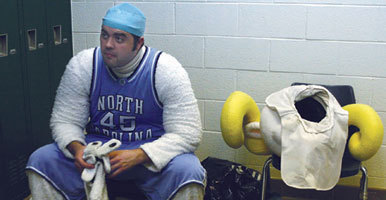
On Monday, Jason died from injuries he received when he was hit by an SUV on Friday near his hotel in Newark. In addition to being Ramses the Carolina mascot, Jason was about to graduate with a business degree having minored also in religion. Along with the azaleas and magnolias of Chapel Hill, his world was going to blossom in May.

He didn't get to see his team lose its game against Georgetown. He didn't get to see his team shoot so poorly in the last half. He didn't get to see all of the second guessing and blame being laid on this person or that. I'm glad. I'm glad he didn't have to see that. It truly doesn't matter. I hope that there isn't a player, a coach or Tar Heels fan anywhere who wouldn't give up a chance at the title just to have Jason back. Anyone who is flapping their mouth today about "why Carolina lost..." should keep that in perspective.

Soon, there may be a scholarship announced in Jason's name and there may be a plaque at the arena in his memory, and someday, hopefully way into the future, Dean Smith will greet him with a suitcase. He'll pull out a mascot costume, and he'll smile and say, "Come on, son... We've got a game today."

Perspective.
http://img389.imageshack.us/img389/368/allhatnocattle2et.jpg
Interventions Without End?
By Patrick J. Buchanan


"Whatever happens in Iraq, retreat from the world is not an option," wrote Financial Times columnist Philip Stephens last weekend.

Why not? Because a world map highlighting those regions where the West's vital resources are located would exactly overlap a map highlighting those regions where state power is crumbling, disease and poverty are pandemic and violence rules.

"The implication of this is obvious," says Stephens.

"We can proudly declare ourselves isolationists, resolve to eschew 'imperialist adventures,' decry liberal interventionists such as Britain's Tony Blair and damn the neoconservatives around U.S. President George W. Bush. But, one way or another, the West cannot avoid getting involved. On this, moral impulse and hard-headed interests are as one."

We are fated to intervene forever. "The reality of interdependence of a world shrunk by globalization cannot be wished away." [ The west cannot hide from the disordered world beyond]

Put me down as not so sure. For if America is defeated in Iraq, as we were in Southeast Asia, who will ever again intervene in the Middle East?

As Stephens writes, Europe's "eternal role" seems to be that of the "concerned bystander" to disasters anywhere. And, revisiting the 20th century, the United States did not declare war on the Kaiser's ally Turkey in 1917, despite the Armenian massacres. Nor did we did confront Stalin over genocide in the Ukraine. FDR recognized Stalin's regime as it perpetrated that holocaust. Nor did we intervene to halt Mao's slaughter and starvation of millions of Chinese.

America looked on during Pol Pot's genocide. Clinton stood aside in Rwanda. No one is calling for the 82nd Airborne to be dropped into Darfur.

No matter, says Stephens, the West cannot abide the emerging new world disorder. But, again, that begs the question: Who is going to intervene?

If Iraq and Afghanistan, despite the U.S. investment in blood and treasure, end in defeats, who does Stephens think is going to send troops to rescue imperiled "liberal democratic values"?

In his second inaugural, President Bush declared that America's national goal is now to "support the growth of democratic movements and institutions in every nation and culture, with the ultimate goal of ending tyranny in our world."

Are Americans still willing to support that utopian mission with blood and billions of dollars?

In a Gallup poll this year that posed the question, "Should the United States try to change a dictatorship to a democracy when it can, or should the United States stay out of other countries' affairs?"— by near five to one Americans said, "Stay out." Fifteen percent said "yes" to the Bush commitment. Sixty-nine percent said to stay out of the internal affairs of other countries.

Columnist David Broder cites a Penn, Schoen poll conducted Jan. 30 to Feb. 4. By 58 percent to 36 percent, respondents said, "It is a dangerous illusion to believe America is superior to other nations; we should not be attempting to reshape other nations in light of our values."

"By an even greater proportion -- almost three to one," adds Broder, "they say the main goal of American foreign policy should be to protect the security of the United States and its allies, rather than the promotion of freedom and democracy."

By 70 percent to 27 percent, Americans agreed, "Sometimes it's better to leave a dictator in charge of a hostile country, if he is contained, rather than risk chaos that we can't control if he is brought down."

By 58 percent to 38 percent, American agreed with the statement that "if negotiating with countries that support terrorism like Iran and Syria will help protect our security interests, the U.S. should consider negotiating with them."

"Practicality trumps idealism at every turn," writes Broder.

"Idealism"? That is true only if one buys the proposition that refusing to talk to enemies and fighting unnecessary wars is idealism rather than folly. FDR and Truman talked to Stalin, Ike invited the Butcher of Budapest to Camp David, Nixon went to Beijing to talk to Mao, Reagan accepted Gorbachev's invitation to Reykjavik during the Soviet war in Afghanistan. Were all these men devoid of idealism?

Stephens believes the successors to Bush and Blair will find they have no option but to intervene to prevent the new world disorder.

Perhaps. But given the rage and revulsion Americans feel at having been stampeded into Iraq and pinioned in Baghdad, unable to stop the bleeding but unwilling to walk away in defeat, the American appetite for intervention has probably been sated for a long, long time.

U.S. global hegemony is history. Like every nation, America must now choose -- between what is vital and worth fighting for, and what may be "idealistic," but is not worth a war.

Not long ago, America produced 96 percent of all she consumed and was the most self-sufficient republic in history. With statesmanship and sacrifice, we can become so again. With leaders like we once had, we can chuck the empire. For what good has it done us?

Patrick J. Buchanan needs no introduction to VDARE.COM readers; his book State of Emergency: The Third World Invasion and Conquest of America, can be ordered from Amazon.com.

Monday, March 26, 2007

http://www.coxandforkum.com/archives/05.07.20.RealSuicideBomb-X.gif
Musharraf caught in a sticky wicket
BY MARK STEYN


March 25, 2007

The other day Pakistan's Gen. Pervez Musharraf took time off from his hectic schedule of trying to survive assassination attempts to pay tribute to someone who, alas, had been less successful at dodging the attentions of his killers: A week ago, during the cricket World Cup, Bob Woolmer, the coach of the Pakistani national cricket team, was murdered in the Pegasus Hotel in Kingston, Jamaica, in what Mark Shields (not the American TV pundit but the veteran Scotland Yard man leading the police investigation) called “extraordinary and evil circumstances."

"This nation will always remember him for the joys he brought into the lives of millions of Pakistanis," said Musharraf, awarding Bob Woolmer posthumously the Sitarae-Imtiaz, or Star of Excellence. "The cricketing world and Pakistan, in particular, will find it extremely difficult to fill the void Bob's death has left behind."

Unless you're one of America's many cricket fans — pause for sound of crickets chirping — you probably didn't even notice this news. When Anna Nicole meets an untimely end in the Caribbean, there's 24/7 coverage. But in Pakistan, the West Indies, Britain and many other places, Woolmer's death is Anna Nicole multiplied a gazillionfold. I was talking to a prominent London journalist in Chicago the other day when his cell phone rang and he was told to hop on a plane to Kingston and get cracking on the murder.

"Whodunnit?" I asked.

"Russian Mafia," he said, already halfway down the corridor.

"Russian Mafia?" I echoed in disbelief. "That's not cricket."

But apparently it is. Whether or not any actual Russians are involved, rumors of a "match-fixing mafia" are running rampant around Jamaica. Just before the coach's murder, the Pakistani cricket team had lost to Ireland, which is a bit like the New York Yankees losing to my gran'ma. Lord Condon, the head of the International Cricket Council's Anti-Corruption Unit, is said to be en route to the island.

Anyway, I thought of this strange death as I followed the rest of the week's news from Pakistan. Musharraf has had a good innings but stands at an ever lonelier wicket: He suspended the chief justice the other day; the biggest parliamentary faction, the Muslim League, has turned against him; so have the country's three warring intelligence agencies; and in the badlands up by the Afghan border more and more villages are being annexed by the Taliban, which the general doesn't mind terribly much but his friends in the White House do. In the Washington Post, Ahmed Rashid called for the general's retirement and "free and fair elections," which sounds very nice but would deliver Islam's only fully functioning nuclear state into the same kind of weak and corrupt administration as Musharraf's predecessor and be shortly followed by the inevitable coup, or worse.

If you had to draw one of those organizational charts of the world's problems, Pakistan would be at the center of them. We speak of the northwestern tribal lands as some of the most remote places on Earth. But, in fact, when they wanted to, the Saudis had no problem getting to them, spreading a ton of walkingaround money, and utterly transforming those villages: In Waziristan, you'll find goatherds with GPS systems and a quarter-million dollars in U.S. currency, which is a lot for a goatherd. From the North-West Frontier Province, the Saudi money and Wahhabist ideology seeped through the country, into the mosques of the cities, radicalizing a generation of young Muslim men. From there it moved on to new outposts of the jihad, to Indonesia, Thailand and beyond. The flight routes from Pakistan to the United Kingdom are now the most important ideological conduit for radical Islam. The July 7 London bombers were British subjects of Pakistani origin. Last week, two more were arrested in connection with the Tube bombings at Manchester Airport as they prepared to board a plane to Karachi.

Meanwhile, flying back from Karachi and Islamabad to Heathrow and Manchester are cousins — lots and lots of them. Roger Ballard, in a very detailed study of Punjabi marriage, writes that "brothers and sisters now expect to be given right of first refusal in offers of marriage for each others' children." In his research of the Mirpur district in Pakistan, he estimates that at least half and maybe up to two-thirds of those living in Britain of Mirpuri descent marry first cousins. This is a critical tool of reverse-assimilation: Instead of being diluted over the generations, tribal identity is reinforced; in effect, Pakistani tribal lands are now being established in parts of northern England — and, like Musharraf, the authorities have mostly concluded that these communities are so impenetrable and insular that it's best to keep at a safe distance.

Which brings us back to the cricket World Cup, and a freakish murder after a bizarre Ireland victory and stories about a "match-fixing mafia." The civilized world sometimes forgets how thin the veneer of that civilization is: Many venerable, respectable institutions can be hollowed out from within by predators and opportunists. Outwardly, nothing much has changed. But underneath all kinds of other forces are at play, and, by the time you notice, it requires enormous will to reverse it. Pakistan was never the most placid and stable polity but it's now riddled from top to toe, its worst pathologies amplified by Arab cash and ideology and the nuclear equivalent of a desktop-publishing boom: Mysterious Sino-Pakistani technological transfers have recently been noticed through Kashmir.

Pakistan exports the fruit of its radical madrassahs in ideology and personnel to Britain and beyond. The mother country, like an elderly spinster, doesn't like to think ill of those nice young men in Manchester and Leeds and Oldham. We're all inclined to be deferential to multiculturalism these days: When imams get turfed off a flight in Minneapolis, it's easiest to tut-tut and demand sensitivity training for the cabin crew, so that next time round, no matter what they do, we'll know to look the other way. The Quebec government, which mandates verifiable picture ID in order to vote, has just waived the requirement for Muslims: Show up at the polls in a burqa or niqab and no one will be so insensitive as to insist on checking whether your face matches that on the driver's license. And so it goes: creeping sharia, day by day, further insulating communities already prone to self-segregation, but nothing too big or startling to ruffle the scene. In Britain, the authorities can tell you (roughly) the number of jihadist cells and the support they command in the Muslim community. But doing anything about it is far more problematic. Wouldn't be cricket, old boy.

© Mark Steyn 2007
The image “http://www.nypost.com/seven/03252007/photos/oped023.jpg” cannot be displayed, because it contains errors.
From The New York Post:

WHERE AL'S WRONG
By BJORN LOMBORG


March 25, 2007 -- AL GORE and the many people he has inspired on the global-warming issue have good will and great intentions. However, he has gotten carried away and come to show only worst-case scenarios. This is unlikely to form the basis for a sound policy judgment. Indeed, if we follow Gore's recommendations, we will likely end up choosing very bad policies - ones that fail to solve the problem, yet are so expensive that they divert resources from areas where we can save many more lives, at far less cost.

In short, Gore's prescriptions would in effect present an obstacle to saving millions of lives.

The best science does indicate that global warming is real and man-made - and Gore deserves applause for making global warming cool again. But statements about the strong, ominous and immediate consequences of warming are often wildly exaggerated. This is also strong Gore territory - and here he deserves a severe reprimand.

We need a stronger focus on smart solutions rather than excessive if well-intentioned efforts. And we also need to put global warming in perspective: Climate change is not the only issue on the global agenda, and actually one of the issues where we can do the least good first.

That said, the warming debate presents an opportunity for America to reclaim its leadership, both enacting sensible global warming policies and smartly addressing the many other ills of the world.

Warming Is Real

Global warming is indeed real, as has been pointed out several times by the U.N. Climate Panel (the so-called IPCC). Over the coming century, temperatures will likely increase about 5ºF. The total cost of global warming is anything but trivial, about $15 trillion. Yet it is only about one-half of 1 percent of the total net worth of the 21st century, about $3,000 trillion.

Yes, the media often carry far more dire descriptions of warming's consequences. Gore, for example: "We have just 10 years to avert a major catastrophe that could send our entire planet into a tail-spin of epic destruction involving extreme weather, floods, droughts, epidemics and killer heat waves beyond anything we have ever experienced." A fine phrase for such talk is "climate porn": This kind of language makes any sensible policy dialogue about our global choices impossible.

It is also simply wrong. Consider two outstanding examples of Gore's claims - heat deaths and sea-level rise.

Heat Deaths & Cold Deaths

W E often hear about global warming causing more heat deaths - but very little about cold deaths. It is true that, for example, the temperature rise from global warming will probably cause 2,000 more heat deaths in the United Kingdom by 2080. Yet studies indicate that the same temperature increase will also decrease cold deaths - 20,000 fewer U.K. cold deaths by 2080. Mentioning 2,000 more deaths, but not the 20,000 fewer cold deaths that go with them, is no basis for sound policy.

For the United States, the net lower death count from global warming in 2050 is estimated at 174,000 per year.

Rising Seas

LIKEWISE with sea-level rise. The 2007 U.N. report on the issue esti mated that sea levels will rise a little over a foot during the rest of the century. This is not a trivial amount - but it is also not outside historical experience. Since 1850, we have experienced a sea level rise of about one foot, yet this has clearly not caused major disruptions.

Ask a very old person about the most important issues that took place in the 20th century. She will likely mention two world wars, the Cold War, the internal combustion engine and perhaps the IT revolution. But it is very unlikely that she will add: Oh, and sea levels rose.

Sea-level rise is a problem, but not a catastrophe. No, this is not what we hear from advocates of immediate action on global warming. Gore makes their point most forcefully. In a very moving part of his film, for example, he shows us large parts of Florida, including all of Miami, inundated by 20 feet of water. He goes on to show us equally strong clips of San Francisco Bay being flooded, the Netherlands being wiped off the map, Beijing and then Shanghai being submerged, Bangladesh be made uninhabitable for 60 million people - and even how New York City and its World Trade Center Memorial will be deluged.

How can one of today's strongest voices on climate change say something so dramatically different from the best science? Well, technically, Gore isn't contradicting the U.N.'s estimates. He simply says: "If Greenland melted or broke up and slipped into the sea - or if half of Greenland and half of Antarctica melted or broke up and slipped into the sea, sea levels worldwide would increase by between 18 and 20 feet."

The problem is that neither "if" is based on science. Gore is simply positing a hypothetical - and then showing us in graphic and gory detail what would happen. Many of Gore's defenders claim acquittal on this technicality, but of course the film clearly suggests immediate inundation.

Smarter Policies


THE current raft of policies that are ei ther enacted or suggested to combat warming are costly but have virtually no effect.

Take the Kyoto Protocol. As the nearby chart shows, Kyoto - even if it had been successfully adopted by all signatories (including the United States), and fully adhered to throughout the century - would have postponed warming by just five years, at a cost of $180 billion a year.

This does not mean we should do nothing at all about climate change. It means we need to be much smarter. We need to abandon expensive and inefficient strategies like Kyoto and search for new opportunities.

Of course, in an ideal world we would deal with warming at once, and with all the world's woes. We should win the war against hunger, end conflicts, stop communicable diseases, provide clean drinking, step up education and halt climate change. But we have to face reality.

There are many world problems - like HIV, malnutrition, trade barriers, malaria, lack of clean drinking water - where we can do immense amounts of good. It seem obvious to me that we should focus our attention and our big expenditures there first.

That does not mean we shouldn't start thinking about how we can cheaply tackle climate change in the long run. The big problem about cutting carbon emissions Kyoto-style is that it costs a lot now, and does very little for the future. Yet what matters is not whether we cut a little now, but whether we eventually cut a lot. Maybe we should try going a different way.

My proposal for tackling global warming in the long run is that all nations commit themselves to spending just 0.05 percent of gross domestic product on R&D of non-carbon-emitting energy technologies. This approach would cost about $25 billion per year - seven times cheaper than Kyoto and many more times cheaper than a Kyoto II. It would involve all nations, with richer nations naturally paying the larger share. It would let each country focus on its own future vision of energy needs - whether that means concentrating on renewable sources, nuclear energy, fusion, carbon storage, conservation or searching for new and more exotic opportunities.

Such a massive global research effort would also have potentially huge innovation spin-offs (a bit like NASA's moon mission also brought us computers and Velcro). And most importantly, it will likely have a much greater impact on the long-term climate.

Other Vital Issues


THE Copenhagen Consensus process asked some of the world's leading economists - including four Nobel Laureates - where we can do the most good for the world. The answer was focusing on amazing opportunities such as fighting HIV/AIDS, malnutrition and malaria and advancing free trade. They also told us that early and strong climate action would be a bad place to start.

Climate change is a century-long, expensive issue. So we have to ask the hard question of whether we can do better by focusing on other issues first - helping real people improve their lives and resilience such that they can better deal with the world, climate change or no climate change.

In the current global-warming fury, we easily get so caught up with cutting greenhouse gasses that we forget there are other and better ways to do good. With everyone screaming, we're unlikely to make good judgments. We owe it to the future to do better.

Bjorn Lomborg is head of the Copenhagen Consensus Center, adjunct professor at Copenhagen Business School and author of the best-selling "The Skeptical Environmentalist." His new book on climate change, "Cool It" will be out in September
http://mypetjawa.mu.nu/archives/taliban_beating_woman.jpg

From Chronicles.org:

Europe Shariatized:
Wife-Beating Legitimized by German Court
By Srdja Trifkovic

The husband routinely beat his 26-year-old German-born wife, mother of their two young children, and threatened to kill her when the court ordered him to move out of their apartment in Hamburg. The police were called repeatedly to intervene. The wife wanted a quick divorce—without waiting a year after separation, as mandated by German law—arguing that that the abuse and death threats she suffered easily fulfilled the “hardship” criteria required for an accelerated decree absolute. The judge—a woman by the name of Christa Datz-Winter—refused, however, arguing that the Kuran allows the husband to beat his wife and that the couple’s Moroccan origin must be taken into account in the case.


They both come from a cultural milieu, Her Honor wrote, in which it is common for husbands to beat their wives—and the Kuran sanctions such treatment. “The [husband’s] exercise of the right to castigate does not fulfill the hardship criteria as defined by Paragraph 1565” of German federal law, the judge’s letter said. [emphasis added] The judge further suggested that the wife’s Western lifestyle would give her husband grounds to claim his honor had been compromised.

The reports in German and English do not state this, but Turkish papers have reported that the judge made specific reference to Sura 4, which contains the infamous Verse 34:

Men have the authority over women because God has made the one superior to the other, and because they spend their wealth to maintain them. Good women are obedient. They guard their unseen parts because God has guarded them. As for those from whom you fear disobedience, admonish them and send them to beds apart and beat them.

The wife’s lawyer, Barbara Becker-Rojczyk, could not believe her eyes: a German judge was invoking Kuran in a German legal case to assert the husband’s “right to castigate” his wife. The meaning was clear: “the husband can beat his wife,” Becker-Rojczyk commented. She decided to go public with the case last Tuesday because the judge was still on the bench, two months after the controversial verdict was handed down. The judge was subsequently removed from the case, but not from the bench.

A spokesman for the court, Bernhard Olp, said the judge did not intend to suggest that violence in a marriage is acceptable, or that the Kuran supersedes German law. “The ruling is not justifiable, but the judge herself cannot explain it at this moment,” he said. But according to Spiegel Online this was not the first time that German courts have used “cultural background” to inform their verdicts. Christa Stolle of the women’s rights organization Terre des Femmes said that in cases of marital violence there have been a number of cases where the perpetrator’s culture of origin has been considered as a mitigating circumstance.

Of some 25 million Muslims in Western Europe, the majority already consider themselves autonomous, a community justifiably opposed to the decadent host society of infidels. They already demand the adoption of sharia within segregated Muslim communities, which but one step that leads to the imposition of sharia on the society as a whole. Swedish courts are already introducing sharia principles into civil cases. An Iranian-born man divorcing his Iranian-born wife was ordered by the high court in the city of Halmestad to pay Mahr, Islamic dowry ordained by the Kuran as part of the Islamic marriage contract.

As our magazine readers may recall, Europe’s elite class is ready for further surrenders. Dutch Justice Minister Piet Hein Donner—a Christian Democrat—sees the demand for sharia as perfectly legitimate, and argues that it could be introduced “by democratic means.” Muslims have a right to follow the commands of their religion, he says, even if the exercise of that right included some “dissenting rules of behavior”:

It is a sure certainty for me: if two thirds of all Netherlanders tomorrow would want to introduce sharia, then this possibility must exist. Could you block this legally? It would also be a scandal to say “this isn’t allowed”! The majority counts. That is the essence of democracy.

The same “essence” was reiterated in similar terms last July by Jens Orback, the Swedish Integration [sic] Minister, who declared in a radio debate on Channel P1, “We must be open and tolerant towards Islam and Muslims because when we become a minority, they will be so towards us.”

To all forward-looking Europeans it must be a welcome sign that continental courts are catching up with the leader in sharia compliance, Great Britain. A key tenet of sharia is that non-Muslims cannot try Muslims. Peter Beaumont, QC, senior circuit judge at London’s Central Criminal Court, the Old Bailey, accepts the commandment not only in civil, but also in criminal cases. He banned Jews and Hindus—and anyone married to one—from serving on the jury in the trial of Abdullah el-Faisal, accused of soliciting the murder of “unbelievers.” “For obvious reasons,” he said, “members of the jury of the Jewish or Hindu faith should reveal themselves, even if they are married to Jewish or Hindu women, because they are not fit to arbitrate in this case.” One can only speculate what the reaction would be if equally “obvious reasons” were invoked in an attempt to exclude Muslims from a trial of an alleged “Islamophobe.”

Here at home, The New York Times had a bone to pick with the German judge mainly because of her suggestion that Islam justified violence against women. It stated matter-of-factly, “While the verse cited by Judge Datz-Winter does say husbands may beat their wives for being disobedient—an interpretation embraced by fundamentalists— mainstream Muslims have long rejected wife-beating as a medieval relic.”

In reality “mainstream Muslims” do nothing of the sort. New York Times’ claim notwithstanding, the original sources for “true” Islam—the Kuran and Hadith—provide ample and detailed evidence on Islamic theory and the sources of Shari’a practice that remains in force all over the Islamic world today. According to orthodox Islamic tradition, the verse invoked by the German judge (4:34) was revealed in connection with a woman who complained to Mohammad that her husband had hit her on the face, which was still bruised. At first he told her to get even with him, but then added, “Wait until I think about it.” The revelation duly followed, after which he said: “We wanted one thing but Allah wanted another, and what Allah wanted is best.” Qatari Sheikh Walid bin Hadi explains that every man is his own judge when using violence: “The Prophet said: Do not ask a husband why he beats his wife.” The scholars at the most respected institution of Islamic learning, Cairo’s Azhar University, further explain:

If admonishing and sexual desertion fail to bring forth results and the woman is of a cold and stubborn type, the Qur’an bestows on man the right to straighten her out by way of punishment and beating, provided he does not break her bones nor shed blood. Many a wife belongs to this querulous type and requires this sort of punishment to bring her to her senses!

Physical violence against one’s wife, far from being Haram, remains divinely ordained and practically advised in modern Islam. “Take in thine hand a branch and smite therewith and break not thine oath,” the Kuran commands. Muslim propagators in the West “explain” that the Islamic teaching and practice is in line with the latest achievements of clinical psychology: it is not only correct, but positively beneficial to them because “women’s rebelliousness (nushuz) is a medical condition” based either on her masochistic delight in being beaten and tortured, or sadistic desire to hurt and dominate her husband. Either way,

Such a woman has no remedy except removing her spikes and destroying her weapon by which she dominates. This weapon of the woman is her femininity. But the other woman who delights in submission and being beaten, then beating is her remedy. So the Qur’anic command: ‘banish them to their couches, and beat them’ agrees with the latest psychological findings in understanding the rebellious woman. This is one of the scientific miracles of the Qur’an, because it sums up volumes of the science of psychology about rebellious women.

According to Allah’s commandment to men (Kuran 2:223), “Your wives are as a soil to be cultivated unto you; so approach your tilth when or how ye will.” Therefore “the righteous women are devoutly obedient.” Those that are not inhabit the nether regions of hell. Muhammad has stated that most of those who enter hell are women, not men. Contemporary Azhar scholars of Egypt agree: “Oh, assembly of women, give charity, even from your jewelry, for you (comprise) the majority of the inhabitants of hell in the day of resurrection.” In the same spirit, courts in Muslim countries, to mention a particularly egregious legal practice, routinely sentence raped women to death for “adultery,” usually by stoning, because they follow the sharia that mandates this punishment.

To the outright divine command of every wife’s obedience to her husband, Muhammad has added a few comments of his own. When asked who among women is the best, he replied: “She who gives pleasure to him (husband) when he looks, obeys him when he bids, and who does not oppose him regarding herself and her riches fearing his displeasure.” Even in basic necessities the needs of the husband take precedence: “You shall give her food when you have taken your food, you shall clothe her when you have clothed yourself, you shall not slap her on the face, nor revile (her), nor leave (her) alone, except within the house.” The husband’s sexual needs have to be satisfied immediately: “When a man calls his wife to his bed, and she does not respond, the One Who is in the heaven is displeased with her until he is pleased with her.”

Such treatment of women might be expected to make Islam abhorrent within the cultural milieu epitomized by the equal-rights obsessed European Union and the neofeminist New York Times, but this has not happened. There is a reason for this. It is the refusal of Islam to accept the wife as her husband’s closest and inseparable loving partner and companion. Islam therefore challenges Christian marriage in principle and in practice. Muslim teaching on marriage and the family, though “conservative” about “patriarchy,” denies the traditional Christian concept of matrimony. Islam is therefore an “objective” ally of postmodernity, a few beatings here and a few rapes there notwithstanding.

“I can only say, Good night, Germany,” says Ronald Pofalla, general secretary of Germany’s ruling Christian Democratic Union, of Frau Datz-Winter’s ruling. Unless the madness is checked it will be good night to us all well before this century is over.


"There is a violent streak within Islam. We need to be able to discuss and…
counter these arguments so that we don’t have any more Mohammad Sadique Khans."

Hassan Butt
From 60 Minutes:
The Network
Reported by Bob Simon


March 25, 2007(CBS)

British police this week arrested three British Muslims in connection with the 2005 bombings on the London subway system in which 52 people were killed.

The world was shocked when the four suicide bombers blew themselves up that morning, especially when it turned out that they were British citizens. The four had been recruited to what is called the "Network," a web of radical Islamic organizations loosely affiliated to al Qaeda which has turned Britain into the western world’s richest breeding grounds for terrorists. How did this happen?

60 Minutes correspondent Bob Simon met someone who knows. And for the first time he spoke about what it was like to be inside that network for ten years. His name is Hassan Butt. He’s only 26 years old, but some of the people he recruited were a lot younger than that.


Hassan Butt admits he sent a 17-year-old boy from England to Pakistan to be involved in terrorist training.

Butt was only 16 when he was recruited by the network. Like thousands of other young British Muslims, he became exposed to some of the most radical Imams in Britain – Imams who supported attacks on westerners all over the world and believed that they had a tacit agreement with the British authorities.

They could preach hatred, they could recruit followers, they could raise funds, and they could even call for Jihad – Holy war – as long as they didn’t call for attacks on British soil. London became such a safe haven for Muslim militants that it came to be known as "Londonistan."

"Do you think this was an unspoken deal with the establishment? That, do whatever you want here as long as you don't blow us up?" Simon asks Butt.

"Absolutely. I believe that sincerely," Butt tells Simon. "That was an unspoken deal. And as a result of that, what tended to happen is the British government lost count of how many people were going abroad getting trained and coming back and going into operational mode as sleeper cells."

If there was such a deal, it was shattered in July 2005, when the four suicide bombers blew themselves up on the London subway; three of the terrorists were born in Britain of Pakistani parents.

"The four men who blew themselves up all came from good families, good homes, good educations. How do you explain what they did?" Simon asks.

"I mean, for me, they did it simply because they were convinced that they were doing something in the name of God, in the name of Islam. And they honestly believed they would obtain paradise from doing the activities that they carried out, the terrorist attacks that they carried out," Butt explains.

Ringleader Mohammad Siddique Kahn made a video of his last will. Hassan Butt had met him but insists they never discussed specific operations. Khan told him he first became attracted to radical Islam because the tradition he grew up with was forcing him into an arranged marriage. The radical Imams were offering him a way out.

"A lot of guys I know, actually, have become radicalized, or initially took the first steps towards learning more about Islam and their way of life as a result of them being tried to being forced to marry someone they don't want to marry," Butt tells Simon.

And Butt says the radical preachers are in favor of men marrying whomever they went, as long as their wives are practicing Muslims.

"So this is a very effective and an important proselytizing technique?" Simon asks.

"Absolutely. Yeah. Absolutely," Butt says.

But that’s just the start of the recruiting process – it’s bringing them into the tent. Hassan Butt would follow up with young men in his gym in Manchester, England, and in neighborhood pool halls. He says he personally recruited between 50 and 75 people to receive training in Pakistan; thousands more were being recruited elsewhere in Britain.

"We’d talk about the suffering of the Muslims all over the world," Butt tells Simon. "We were very well-versed in the Koran, in the verses of the Koran, in the sayings of the Prophet and show that how it was permissible for people to go around killing innocent men, women and children."

"You would explain to them why it's permissible to kill innocent men, women and children?" Simon asks.

"Well, a better way to put it is, we would take away the innocence from the person so they were no longer innocent men, women and children," Butt explains.

"So, men, women and children would become non-innocents?" Simon asks.

"Become non-innocent and hence, combatants and allowed to be targeted," Butt says.

Asked at what point he would say to a recruit it was time to head to Pakistan, Butt tells Simon, "Never. I would never say that, ever. It's not me forcing them. I mean, the network never, never pushes people in that way. We believe that if the person is convinced, has the conviction themself to come up to you and say they wanna go training, then they are the type of person who will most likely take that one step further and will be the reliable foot soldiers for you."

And a reliable foot soldier is all Hassan Butt wanted to be when he decided to move to Pakistan at age 20. Behind the scenes he was helping young British Muslims get to Afghanistan to fight alongside the Taliban.

British Muslims had flocked to Pakistan for military training. But as the Taliban retreated, many of them wanted to take the fight back home.

In 2002, Butt warned BBC Radio in an interview from Pakistan that British Muslims fighting in Afghanistan would return home and take military action within Britain and that he was in favor of this.

Asked if, at the time, he really believed that British Muslims would attack their own country, Butt says, "Yeah. Absolutely. These were people that I was meeting and these were people who decided to return back to Britain to become, you know, sleeper cells."

"Sleeper cells that stayed asleep for a little while?" Simon asks.

"Yeah," says Butt.

Butt told Simon that he began associating with militants who had been involved in terrorist attacks in Pakistan in which people had lost their lives. So when he was tipped off that the Pakistani authorities were about to arrest him, he flew back to Britain where he was arrested, questioned for five days and released without charge.

He became one of the network’s star fundraisers. Over the next couple of years, he says he raised $300,000.

His biggest contributors? "Doctors. People who were businessmen. Professional people basically who wanted to donate substantial amounts of money," Butt tells Simon.

Butt says he openly told them he was raising funds for Jihad.

And he says he didn’t just solicit from the professional classes: he also targeted criminals, drug dealers who were told that their activities would be cleansed for a percentage of their earnings.

What kind of percentage?

"Twenty percent," says Butt.

The drug dealers were told the 20 percent would legitimize them in Islamic eyes and that the rest of their income was, in Butt's words, "purified."

"As long as the drugs weren't being sold to other Muslims. They were being sold to non-Muslims. In fact, we saw it as a tactic of war to keep, you know, one of the people that I sat with said, 'Well, let's keep poisoning the non-Muslim community in the West. Let's feed their addiction,'" Butt adds.

This was a tactic Butt discussed with the drug dealers and he says it made them feel better for the work they were doing.

How did the funds get from the U.K. to Pakistan? Butt tells Simon they used the Hawala system.

Asked to explain how the trust-based system works, Butt explains, "We'd contact someone here, we'd give them the money. They'd make a phone call to Pakistan, saying this amount of money is being deposited with us. Someone by this name, by this name and this age will come and collect this amount of money from you in Pakistan. They, obviously, would take a fee, which would pay, no paperwork. No trail."

There is no paper trail and Butt says it always works.

Butt says affiliates of al Qaeda received the funds, and used them for terrorist activities. He adds he did not know the specific operations that were funded by the money.

Why is he revealing all this? Because, he told Simon, the London bombings changed him. He began asking questions of his handlers, theological questions. He wanted to know whether the bombings could ever be justified in Islam. He waited and waited for answers. Months later, he was summoned by his handlers to a meeting in the Middle East. But he wasn’t given answers, only new orders.

"They were trying to force me into Iraq to fight basically," Butt says.

"So, to summarize, you're asking, basically, why should we be killing innocent people?" Simon asks.

"That's correct," Butt replies.

"And the answer you eventually received is go to Iraq and perhaps carry out a suicide mission?" Simon asks.

"Go to Iraq to basically – the actual word that they used was that I needed 'reprogramming.' And Iraq would give me the opportunity to basically be reprogrammed for what I needed I mean. I was quite shocked at the analogy," Butt says. "To think that will, firstly, I'm neither a computer nor a robot. And I don't know on your say so, I do on God's say so. And if you can't justify to me or prove to me that this is what God wants, then I'm gonna have to go my separate ways."

Asked if he was frightened, Butt tells Simon, "Shocked more than frightened. But, yes, it definitely, I was intimidated at that point."

Butt says it was after that meeting that he began answering his questions, himself.

"What I've come to realize is that killing for the sake of killing, and killing in the name of Islam for the sake of killing, is completely and utterly prohibited. And there's a big disease, a big problem and a cancer in the Muslim world. And it's a very dangerous cancer, and it needs to be dealt with," he says.

How? "And I really believe, if Muslims can pluck up their courage to ask questions, regardless of the consequences, then I do see that there is still hope, you know, to solve, to cure this cancer," Butt says.

Hassan Butt made his about face public last January at Cambridge University, at the debating union. For the first time he revealed that he had left the network and announced his strategy to confront radical Muslims.

"The position of moderate Muslims is that Islam has nothing to do with terrorism. Do you buy that?" Simon asks.

"No, absolutely not. By completely being in denial about it's like an alcoholic basically. Unless an alcoholic acknowledges that he has a problem with alcohol, he's never gonna be able to go forward," Butt argues. "And as long as we, as Muslims, do not acknowledge that there is a violent streak in Islam, unless we acknowledge that, then we are gonna always lose the battle to the militants, by being in complete denial about it."


Butt’s private life is a shambles right now. His family has called him a traitor to Islam and his former friends from the network have threatened his life. He’s writing a book about his transformation and his challenge to Muslims.

He says he wants to make right what he calls the bad work he did before – bad work that may have included more direct involvement in terrorism than fund raising and recruitment.

Asked if he considered the work he used to do bad, Butt says, "Yeah, absolutely, not just bad work. I mean, bad is an understatement. It's evil, wicked work."

What's the most evil, wicked thing he did?

"It's not something that I want to talk about on camera," he tells Simon.

Asked if he loses sleep over his past deeds, Hassan says, "Yeah."

How does he atone for them?

"Well, hopefully, by the work that I intend to now start," Butt says. "Whatever it costs, I'm willing to make sure I see this through to the end."


Hassan Butt may have left the Network, but if he did hear about the planning of any terrorist operations, he told us, he would inform the authorities. Barring that, he has no plans to turn in his former colleagues to the police. That, he says, would jeopardize his efforts to prevent young Muslims from being radicalized.


102 Steps
Adam Lucas on the loss to Georgetown.


EAST RUTHERFORD, N.J.--This hallway is much too long.

And this hallway is much too short.

This hallway is a back corridor of the Meadowlands in New Jersey, which opened in 1981 but seems much older. NCAA Tournament postgames work this way: the head coach and two players answer questions at the podium in front of the assembled media. Some media never leave the podium area. Others make the walk down the hall to the locker room to get quotes from players not called to the podium.

After Sunday's loss--really, "loss" doesn't do it justice, does it?--you stop at the podium area first. Mostly, in truth, just to have a place to sit. You sat at courtside for as long as you could, watching Roy Hibbert grin and Jeff Green point to the "Georgetown" on the front of his jersey and every Hoya wearing dark blue get a hug from John Thompson Sr.

It is hard to believe. With what seemed like just moments left in the second half, you looked at the clock and it still said 7 minutes and 51 seconds remained. Was this clock ever moving? It was going...so...slow. So close to the Final Four but not wanting to think about it but you couldn't help letting it creep into your brain and then you shooed it away before anyone could notice.

Then the clock rushed. It cascaded. It snowballed. Then shots weren't falling and three-pointers were being jacked up and a 10-point lead was gone, just like that. Some will say Carolina couldn't stop Georgetown in overtime. That's not true. Carolina couldn't stop them beginning at tipoff. The Hoyas shot 59.4% in the first half, 55.6% in the second half, and 57.1% in overtime.

Ugh.

Which brings us to this hallway. You can only sit in the podium area for so long without wondering what's happening in the locker room. People pay thousands of dollars for the privilege of getting one sneak peek into the Tar Heel locker room. And right now, there's nowhere less appealing.

The NCAA brings the same blue carpet to every tournament venue. It was the same in Winston-Salem and the same in East Rutherford and it'll be the same in Atlanta, not that you care enough to watch and find out.

Right now, you're staring down at that carpet and pondering a long walk to the locker room. This is the exact definition of "trudging." Just get in there, get the feel of the room, and get out. Don't linger. Keep your head down between here and there. No eye contact. Maybe it'll be deserted back here.

Thirty-eight steps later, here comes Joe Holladay. He's got a Midwestern sense of humor that is delightful. Right now, there are very few people you want to see less. It is nothing against him. It's just that, well, right now there is not much to say. Any suggestions? "Good game, Coach," doesn't seem appropriate. "Sorry" doesn't either. The answer to, "How are you doing?" is obvious.

So you look up, give a little shake of your head, and pat him on the back. He doesn't say anything. There is nothing to say.

Eighteen steps later, here is the Georgetown band. They are hollering and high-fiving.

Twenty steps later, C.B. McGrath and Jerod Haase are standing against a wall. College roommates, fast friends, their wives even gave birth within a couple months of each other. It is almost impossible to be in a room with them and not hear words bouncing off the walls, the rapid-fire easy chatter of best friends.

They're not saying anything now. They're just standing there, looking down at this blue carpet.

Five steps later, you go around a corner and come upon some very tall individuals. It's every single Georgetown player, and they're laughing and hopping to their locker room. Hibbert has a piece of net stuck behind his ear. They're wearing championship t-shirts. Somewhere, there is a box of Carolina championship t-shirts. Probably, someone moved them closer to the court with 6 minutes left. That way they'd be closer to the court for the celebration. Now we'll never see them.

The Georgetown band spots the players and merriment ensues. It is festive. It is joyous. And it sounds exactly like fingernails on a chalkboard.

Twenty-one more steps, and you're in the locker room. This is, without question, a losing locker room. Some years there is a chance to prepare. You know it's coming. This year, it felt like things were just falling into place. It still felt that way less than an hour ago.

Now there are hotel room keys tossed on the floor. Dewey Burke is in full uniform, just sitting there. It's quiet, strangely quiet considering how many individuals are crammed into this space. Players answer questions in hushed tones, and there is none of the usual back-and-forth between players as they get dressed.

Something is out of place: it's the jerseys. Usually, they're tossed in the laundry to be washed for the next game. Now there is no next game. So Danny Green's familiar number-14, still blindingly white, is hung on a peg behind him. Surry Wood's is folded neatly on top of his travel bag. It's hard to explain why this is so jarring. It's the official confirmation that there's nothing left in this season. These jerseys won't be needed again.

That's the most striking sight. To Green's left, in another part of the room, is the most striking sound. It sounds like this: sniff clickclickclickclick.

It's Tyler Hansbrough, and he's trying not to cry but the tears are coming. This is like chum in the water for photographers, who press their lenses right up to his face to get the shot. One photographer goes high, the other crouches down and shoots the sitting Hansbrough from below. For effect, you know. My words aren't good enough to explain how uncomfortable this should be, intruding on a moment like this. These particular individuals--not photographers as a whole, but these individuals--don't seem bothered by it.

There are a total of 102 steps between the podium area and the locker room. That sounds like it's a lot, but it's not enough.

People wonder why Roy Williams cries at the end of almost every season. Looking around this room, it's completely obvious. This room is broken. Every single team except one ends the season this way. At this particular moment, the BCS sounds like a good idea in college basketball...except that you know how good it feels to be that one team that ends the season with a win. That's what keeps you playing. That's what keeps you dreaming. That's what will get most of these players back in the gym later this week.

Like Wayne Ellington. He knows the magnitude of the shot he missed at the end of regulation. He's taken it thousands of times in his driveway and thousands of times in practice. Even took it a handful of times at the end of high school games.

"Most of them went in," he says, and he shrugs a little.

This one didn't. Now he has to figure out what to do next.

"I want to get some rest, but I want to get back in the gym," he says. "You're so upset that you want to work on things. It depends on how I feel physically, but I'm ready to get back to it."

It took 102 steps to get here.

The first step of 2008 is on the other side of the locker room door.

Adam Lucas's third book on Carolina basketball, The Best Game Ever, chronicles the 1957 national championship season and is available now. His previous books include Going Home Again, focusing on Roy Williams's return to Carolina, and Led By Their Dreams, a collaboration with Steve Kirschner and Matt Bowers on the 2005 championship team.