Saturday, February 10, 2007

The image “http://www.indianahistory.org/lhs/images/Lincoln%20myth.jpg” cannot be displayed, because it contains errors.

From Chronicles.org:

The Lincoln Fable, Part 1

Alas! it is delusion all;
The future cheats us from afar,
Nor can we be what we recall,
Nor dare we think on what we are.

—Lord Byron

“The words of his mouth were smoother than butter, but war was in his heart: his words were softer than oil, yet were they drawn swords.”

—Psalm 56:21

In our time M.E. Bradford was the pioneer who blazed a new trail into the wilderness of the Lincoln legacy where lurk so many of the evil demons of our public life. Several years ago, when I began to explore the dark and bloody ground on my own, I used the label “The Lincoln Myth” to describe the yawning gap between Lincoln the historical person and the Lincoln icon that is the commanding symbol of America.


I knew that “myth” was not quite the correct term, but I was consciously setting up a counter to the fashionable history-mongering then and now underway in regard to the so-called “Myth of the Lost Cause.” According to Establishment historians, everything favorable that Southerners (or anybody) believe about the Confederates—their courage, skill, dedication, sacrifice, principle—amounts to nothing but a deceitful “Lost Cause Myth” that was invented after the fact by Southerners to put a pretty face on their evil deeds and disastrous failure. This now mainstream characterization of the central event of American history is an ideological reassertion of the old Radical Republican stance, with a bit of Marxism thrown in, masquerading as expert knowledge. Among its many flaws, it abuses the term “myth,” misappropriating an intellectual-sounding word as a substitute for falsehood.

Properly considered, a myth is neither true nor false—it is art. It is a story rising out of the collective unconscious to give a meaningful pattern to a people’s history and nourish their identity. Some myths that we know come from remote times and other peoples—the siege of Troy, Romulus and Remus. Some are idealized versions of more recent but poorly known history—King Arthur, Joan of Arc, Robin Hood. It never occurs to scholars who prattle about the Lost Cause Myth that they are as human as the people they libel and that they may be labouring under a few “myths” of their own. In 2002 I suggested to the purveyors of the Lost Cause myth as historical explanation, that before they dismissed the whole Southern case as dishonest or deluded mythology, they ought to

research a little into the extravagant glorification of the Union cause that dominated American discourse for decades after the war and involved, among other things, the virtual (and blasphemous) deification of Lincoln. That mythology persists powerfully to this day. It is at least as unfactual as the “Lost Cause” and the source of far more evil consequences. A little admiration for Lee and the boys in grey by their descendants and others is harmless in comparison with a self-righteous stamping-out-the-grapes-of-wrath mentality.

I now see that the Lincoln story qualifies as fable rather than myth. My Webster’s Collegiate has as its first definition of fable: “a fictitious narrative or statement.” A myth is a product of the folk, while a fable usually has a known author or authors and time of creation. A myth contains a kind of poetic meaning even if it is not literally accurate. By this reckoning, the Lincoln story is a fable. We know when and how it was created and we know that it is essentially fictitious. The interesting question to be asked, is why was the fable created and what purpose does its false story serve?

For most countries, the iconic national person is a figure of heroic action fighting for his people—Joan of Arc, William Tell, Frederick the Great, Simon Bolivar, Garibaldi. This was the role filled by Washington for earlier Americans—Washington the brave and virtuous leader on horseback or the incorruptible Roman lawgiver. What are we to make of a people who replace that Washington as their commanding national symbol with a corporate attorney in an armchair? Nobody has ever been able to make to make Lincoln into a soldier. Even his brief active militia service is treated mainly as a source of humorous stories. They have a little better luck with Lincoln the Lawgiver, by highly inventive interpretations of the Emancipation Proclamation and the Gettysburg Address, which uses powerful prose to sanctify a deceitful history and a barbarous war of conquest.

One postwar Southern commentator remarked that “the dead Lincoln was worshiped because the living one had no admirers.” It is true that the living Lincoln was not highly valued by those on his side. It was the circumstance of his assassination that forwarded the creation of the fable. Stanton emerged from Lincoln’s death chamber to proclaim “Now he belongs to the ages.” For the previous four years Stanton had freely referred to Lincoln as “the Gorilla” and considered him a third-rate man unequal to his duties, who had to be managed into moving in the right direction. (Somewhat like how Dick Cheney must view George W. Bush.)

So one aspect of the proliferating Lincoln fable was the cynical use far into the future of the fable of a martyred leader of supreme virtue for emotional ammunition to keep the Republican party in power. Another aspect of the fable is far more troublesome—the creation of Lincoln the Christ figure. It can be and has been thoroughly documented that this icon was created in post-assassination sermons. As a historian two generations back put it: “That the Lord had sent Lincoln to earth as his mysterious representative, to die for his people, was a belief that rose from many Easter sermons and grew with time to blend into the faith that the humble backwoodsman had been by some miracle the savior of the Union.” The literature that created the Lincoln/Christ is vast and stomach-turningly blasphemous. And, of course, it is never asked just what made saving the Union such a divine cause.

The Lincoln thus imagined and propagated was a fictitious narrative which has long been proclaimed to contain the true account of American history and the essential meaning of America. The fable gained its purchase in the midst of war, revolution, assassination, violent and vengeful self-righteousness, and most important and worst of all—religious disintegration. Lincoln the Christ figure was thrust into the vacuum created by the erosion of belief that had been steadily undermining Northern Protestantism in the previous decades. Out of public anxiety and near hysteria was created the religion of Americanism: America The Father, Lincoln The Son, and Democracy The Holy Spirit.

To this day and to the immense peril of our souls and bodies, many of our fellow citizens are incapable of distinguishing between God and “America” or comprehending that one who occupies the throne of Lincoln and uses the hallowed terms that Lincoln used can be capable of wrong.

The Lincoln Fable, Part II

There are a couple of curious aspects of the Lincoln story that are worth mentioning here. The two men who knew Lincoln best, Herndon, his longtime law partner, and Lamon, his confidential agent during the war, both ridiculed the Lincoln fable that was being created in their time. To them Lincoln was no saint; he was the tough, cunning politician who carried off the difficult feat of consolidating the Republican coup d’etat. Another curious thing is that Lincoln’s son destroyed vast quantities of his father’s papers, which were never seen by anyone except the two adoring secretaries/biographers Nicolay and Hay. One must wonder why. You would think that every scrap of paper associated with such an important and revered figure would be cherished. That is normally the case. If you had a slip of paper with an authentic Lincoln signature on it, you could put it on the market today for $5,000 to start.


Known facts about Lincoln, both as a public and as a private man, contradict or seriously undermine the fable at every point. What I have to say does not include any amazing discoveries or brilliant insights. It is simply information that has long been known. Establishment historians either deny the obvious or are, as Professor Thomas DiLorenzo has pointed out, fabulously creative in finding excuses. James G. Randall, once known as the leading Lincoln scholar, admitted that, yes, Lincoln was something of a dictator. But that was all right because he was only dictatorial when he had to be, and the power could not have been in safer hands. Lincoln is not a question of evidence and reason; he is a question of Faith. To question the Faith is like flushing the Koran in front of a Muslim.

Lincoln never looked like a handsome young Henry Fonda or Raymond Massey even at his best. His face was partly deformed, he had a degenerative disease, and his arms and legs, as everybody noticed, were too long for his trunk, almost to the point of grotesqueness, which is why Stanton called him “the Gorilla.” Besides, he had been kicked in the head by a horse or a mule and ever after had frequent doddering blackouts, though usually lasting only a few seconds.

Despite ten thousand Mother’s Day sermons about the tender and loving son, Lincoln callously walked away from his natal family and never looked back. At times his wife drove him from the house in a rage, and she ended up in an insane asylum suffering mental and physical deterioration that have been described as resembling advanced syphilis. On the record, Lincoln was no poster boy for son, husband, or father. According to the fable Lincoln suffered greatly from the tragic early death of his first love. There is no evidence whatsoever for the Ann Rutledge story. However, we do know that Lincoln cold-bloodedly jilted one lady when he found another of higher status. Even then, he stood up the new fiance at the altar the first time.

The fable presents us with a pious, praying, saintly Ole Abe, a rail-splitter of humble birth, rather resembling a well-known Carpenter of similar background, and who also was martyred on Good Friday and wafted to Heaven by flights of angels. So far as we know the real Lincoln was an agnostic who was a prolific retailer of dirty stories and who cynically made his political speeches sound like the King James Bible. One of the few evidences of belief he showed was in the Second Inaugural when he blamed the war on God, for whom Humble Abe Lincoln was but an innocent instrument.

Then, there is Honest Abe, the poor boy who made good through earnest effort and integrity. He was born in a log cabin. Big deal. Most people were born in log cabins in those days and many very successful men were self-educated. Lincoln’s rival Stephen Douglas was born in a log cabin in Vermont and walked all the way to Illinois. He became a successful lawyer without the prestigious sponsorship of well-connected Southern families that Lincoln enjoyed. But a public that fell for “Horatio Alger” was ripe for a log cabin spiel. Lincoln was not the country lawyer who defended the poor widow whose cow had been killed by the railroad. He was the attorney for the railroad and a rich man. That his career was somehow in defense of the “common man” is concocted political propaganda endlessly repeated as a fact. His success as a lawyer was based on a mastery of cunning tactics with juries, not on deep and noble learning.

Then there is the young prairie idealist whose integrity and potential greatness was sensed by the people, who propelled him forward into leadership despite his humility. In fact, according to Herndon, ambition—a relentless, almost pathological ambition—was the dominant trait of Lincoln’s character. No one was ever elected to the Presidency before or since who was more unknown and with less real popular support. After all, 60 per cent of “the people” voted against him. He rose by mastering all the mechanics of politics—packing and manipulating conventions, secretly buying up newspapers, meeting vital issues with elegant sounding but ambiguous positions. Idealist? David Davis, whom Lincoln appointed to the Supreme Court, said that Lincoln was “the most secretive man I ever knew,” an observation supported by others. What we have here is not an idealist but a self-taught and very talented Machiavellian.

In fact, Lincoln calculated and dissimulated even more than is normal for ambitious politicians. One of the reasons we have trouble understanding how bad it was is that he permanently debased the standards of public discourse so that we now take for granted things that were egregious innovations in his day. Lincoln admitted he named his chief rivals in the party to his cabinet so he could keep his eye on them. This is now regarded as clever and amusing. Washington and Jefferson would have regarded it as corrupt and dishonourable. Lincoln drove even his admirers and supporters mad with his habit of never answering a question, but instead proffering a humorous story. This again is now regarded as cute and clever. Can you imagine Washington, Jefferson, Jackson, or Jefferson Davis conducting his public duties this way?

Lincoln fits quite well the personality type that has been described as the Crackpot Realist. A crackpot realist is one who believes that everyone is just as cynical and self-serving as he is, and in knowing that and being clever, he can manipulate others to his advantage. That well describes Lincoln’s legal career and his relationship to the voters. Lincoln in Illinois: I have neither the intention nor the power to interfere with slavery. I would not know what to do if I had the power. Lincoln in New York: A house divided against itself cannot stand. It must become all one thing or all the other. What exactly is your position on the slavery controversy, Mr. Lincoln? Well, that reminds me of the story about the farmer and the pig . . . Lincoln was not against slavery; he was just in favor of reducing Southern political power so that the South could not block politicians and capitalists from looting the Treasury and defend itself from exploitation or interference.

I think Lincoln’s crackpot realism caught up with him in the secession crisis. He really thought, and his party certainly preached to the Northern public, that Southerners were not serious about secession. He thought they were merely using maneuver and rhetoric for advantage, which was his own method and his only conception of politics. He did not understand that Southern leaders came from an older world in which a man said what he meant and meant what he said. Lincoln believed that firmness and perhaps a little show of force would bring the South to accept what he regarded as realism and after awhile buckle under to the fait accompli. Refusing any sort of negotiation, he maneuvered for an excuse for force. When he got Fort Sumter he called for troops. The call for troops immediately more than doubled the population and resources of the Confederacy, put the border states into bloody play, and guaranteed a loing and horrible war. One must conclude that this great wise and all-seeing statesman either wanted the war or else he made the most terrible miscalculation in American history.

(to be continued)

http://z.about.com/d/politicalhumor/1/7/b/6/edwards_breckgirls.jpg

From politico.com:

Edwards Blogger Flap Discomforts Religious Left

By: Ben Smith
February 10, 2007 12:27 PM EST


As the flap over alleged anti-Catholic writings by two John Edwards campaign bloggers devolves into a shouting match between conservative religious voices and liberal bloggers, some members of the "religious left" say they feel – again – shoved to the margins of the Democratic Party.

"We're completely invisible to this debate," said Eduardo Penalver, a Cornell University law professor who writes for the liberal Catholic journal Commonweal. He said he was dissatisfied with the Edwards campaign's response. "As a constituency, the Christian left isn't taken all that seriously," Penalver said.

Democrats -- and Edwards in particular -- have embraced the language of faith and the imperative of competing with Republicans for the support of religious voters. His wife, Elizabeth Edwards, even sits on the board of the leading organization of the religious left, Call to Renewal. But in private conversations and careful public statements today, religious Democrats said they felt sidelined by Edwards' decision to stand by his aides.

"We have gone so far to rebuild that coalition [between Democrats and religious Christians] and something like this sets it back," said Brian O'Dwyer, a New York lawyer and Irish-American leader who chairs the National Democratic Ethnic Leadership Council, a Democratic Party group. O'Dwyer said Edwards should have fired the bloggers. "It's not only wrong morally – it's stupid politically."

O'Dwyer e-mailed a statement to reporters saying: "Senator Edwards is condoning bigotry by keeping the two bloggers on his staff. Playing to the cheap seats with anti-Catholic bigotry has no place in the Democratic Party."

In a comment that several Catholic Democrats told The Politico they found particularly offensive, Edwards aide Amanda Marcotte asked, in a posting to her personal blog, "What if Mary had taken Plan B after the Lord filled her with his hot, white, sticky Holy Spirit?"

The other Edwards blogger, Melissa McEwan, has come under fire for referring to Christian conservatives as “Christofascists” in her personal blog.

Thursday, the campaign issued a statement from Edwards saying that he had been personally offended by the remarks and that the bloggers "have both assured me that it was never their intention to malign anyone's faith, and I take them at their word."

The campaign also sent out semi-apologetic statements from each blogger saying she was sorry if anyone was offended.

And so religious liberals find themselves in a quandary. They have no interest in associating with the likes of William Donohue, the Catholic League president who is closely aligned with the GOP and led the charge against Edwards' aides. Donohue said Thursday he would take out newspaper advertisements attacking Edwards as anti-Catholic. But religious liberals also think Edwards' aides merit more than a slap on the wrist.

“I thought his explanation was not satisfying," said Cornell's Penalver. "It's obvious that they did mean to give offense."

"You imagine a similar kind of comment directed at the Jewish community or at the gay community – something at this level of intentional offensiveness -- and I have a hard time believing it gets resolved in the same way," he said.

The Catholic Alliance, which stresses that fighting poverty and social injustice are Catholic values, sent out a careful public statement Thursday afternoon,

"We accept Senator Edwards' assurances that he too was offended by comments made by recently-hired staffers and that religious intolerance has no place in his campaign," the group's executive director, Alexia Kelley, said in the statement.

But in a mark of how religious Democrats are fighting a war on two fronts, Kelley also took a passing shot at Donohue in an interview.

She said she hoped that Donohue would hew to the Catholic value of forgiveness in forgiving the bloggers – as Donohue had notoriously forgiven Mel Gibson.

The image “http://www.theage.com.au/ffximage/2006/11/23/noel_narrowweb__300x387,0.jpg” cannot be displayed, because it contains errors.

Not an attack on Bono's efforts at all, but at his constant drumbeat. All in all, pretty good points...
Noel Gallagher Attacks U2's Bono Humanitarian Efforts

Maira Oliveira - All Headline News Reporter

February 8, 2007 7:36 a.m. EST

London, England (BANG) - Noel Gallagher recently told Bono to "shut
the f**k up" about Africa. However, it seems like Noel should be the
one to shut his trap and quit moaning and griping.

The Oasis guitarist is sick of the U2 frontman campaigning to end
Third World debt in the continent, and insists Bono's fans don't want
to be constantly lectured by their idol.

Noel told Britain's Daily Telegraph newspaper, "With U2 it's like play
'One', shut the f**k up about Africa. People don't want to hear about
it all the time."

The outspoken songwriter has also blasted Radiohead frontman Thom
Yorke for brow-beating his fans with his political beliefs. He has
urged him to ditch his serious attitude to music and write a "proper"
rock song.

He said: "Thom Yorke sat at a piano singing, 'This is f***ed up', for
half-an-hour. We all know that, Mr. Yorke. Who wants to sing the news?
No matter how much you sit there twiddling, going, 'We're all doomed',
at the end of the day people will always want to hear him play
'Creep.' Get over it."

Noel - who along with brother Liam and the rest of the band will
collect the prestigious Outstanding Contribution To Music award at
next week's BRITs - has no intention to stop writing hit songs.

The rocker - whose band has scored an incredible eight U.K. number
singles, including "Lyla" and "Don't Look Back In Anger" - added,
"Somehow I don't ever see myself on stage playing a mouth organ to 150
people on a Wednesday. Every time I write a song, I envisage them in
football stadiums with loads of people going f***ing mental - that's
Oasis."
http://atlasshrugs2000.typepad.com/atlas_shrugs/images/feminist_buttons20030920.jpg

Harvard’s Faustian Bargain
America’s oldest university selects a dreadful president.

By Heather Mac Donald
9 February 2007

The feminist takeover of Harvard is imminent. The Harvard Crimson reported yesterday that the university is about to name as its new president Drew Gilpin Faust, dean of the Radcliffe Institute for Advanced Study. Harvard’s Corporation, which is likely to recommend Faust to the university’s Board of Overseers for confirmation, could not have more clearly repudiated Lawrence Summers’s all-too-brief reign of meritocracy and academic honesty, or more openly signaled that Harvard will now be the leader in politically correct victimology.

Faust runs one of the most powerful incubators of feminist complaint and nonsensical academic theory in the country. You can count on the Radcliffe Institute’s fellows and invited lecturers to proclaim the “constructed” nature of knowledge, gender, and race, and to decry endemic American sexism and racism. Typical guest speakers include left-wing journalists Susan Faludi and Barbara Ehrenreich. At Radcliffe, Faludi argued that 9/11 had triggered yet another “backlash against feminism,” while Ehrenreich lectured on “Weird Science: Challenging Sexist Ideology Since the 1970s.” It is received truth among Radcliffe Institute lecturers that obstacles throughout American society block women’s progress. Radcliffe speaker Rebecca Walker, for example, has created the “I Spy Sexism” initiative, which asks young women between the ages of 15 and 30 to keep logs of the “sexism, racism, and homophobia” that they see as they walk down the street or go to a movie.

With typical feminist hypocrisy, Faust has managed to wield massive power even as she rues female powerlessness. She headed the Task Force on Women Faculty, created after the firestorm over Summers’s recklessly honest speculations about women in science, that strengthened the feminist hold on faculty hiring and promotions. The Task Force won a $50 million commitment to increase faculty “diversity efforts” at Harvard, notwithstanding that for decades the university has tied itself in knots trying to increase female and black faculty representation. Faust’s Task Force also muscled into existence a remarkable new bureaucratic sinecure: the Senior Vice Provost for Diversity and Faculty Development. This new official sits with the president, the provost, and the deans of faculties, in order to push “diversity” quotas in every corner of the university’s academic operations. Naturally, Harvard gave the new position to one of Faust’s two co-chairs on the Task Force: Evelyn Hammonds, a professor of the history of science, and of African and African-American studies, who specializes in discerning bias against minority women in science and medicine. (Please do not question how Hammonds’s unobstructed rise through the most elite American universities comports with her thesis of pervasive discrimination against black women.)

Should the Board of Overseers confirm Faust, the Senior Vice Provost for Diversity that she created will be even more redundant than before. Expect a constant push for ever greater female and minority representation throughout the university, backed up by academic “research” showing widespread discrimination against those favored beneficiaries—research unclouded by the fact that women now run many of the nation’s most prestigious universities. Unbiased inquiry into why certain groups may not enjoy proportional representation in scientific and technical fields, of the sort that Summers engaged in to his demise, will be even more proscribed. This triumph of feminist ideology is a tragedy not just for Harvard, but for the American academic world, which will undoubtedly follow Harvard’s lead in elevating feminist politics to premier intellectual standing.

http://image.guardian.co.uk/sys-images/Guardian/Pix/gallery/2001/11/20/Beatles016.jpg

From NewsBusters.com

43rd Anniversary of The Beatles

First Appearance on Ed Sullivan

Posted by Noel Sheppard on February 9, 2007 - 23:07.

My first vivid memory as a child is watching JFK’s funeral on television. The next one occurred less than three months later when the Beatles appeared on “The Ed Sullivan Show.”

Of course, I wasn’t alone that night. It is estimated that 73 million Americans watched the show that evening, exactly 43 years ago, representing 45 percent of the population at that time.

Pretty astounding.

Any way, without further ado, here is the video of that amazing night (h/t Hot Air). I hope it puts a tear in your eye, and as big a smile on your face as it does me. Watching this, I feel four years old again, without a care in the world, and nothing but a limitless future ahead of me.

How 'bout you?

*****Update: For a little trivia, February 9, 1964 was not the first time the Beatles appeared on American television. Jack Parr had shown a clip of them a few weeks before. Video here.

*****Update II: From the following week on Ed Sullivan I believe. Video here.

*****Update III: The Beatles' first concert in America was days later in Washington, D.C. Videos here, here and here.

Friday, February 09, 2007

http://tn3-1.deviantart.com/fs8/300W/i/2005/287/9/6/I_see_dumb_people_o_O_by_cool_slayer.jpg
The Race to the Bottom In the race to the bottom for votes to win office, or to preserve themselves in office, it would be difficult to out-run Republicans as they pander to the Hispanic vote by refusing to control our southern border against an invasion by millions of illegal aliens. Democrats are trying and they may soon pass Republicans in their cynical pursuit of political power.

At the Democrats' "winter meeting" (they used to call it a "retreat," before that word conjured up negative implications about the war), a clergyman was asked to deliver the invocation. He was Husham Al-Husainy of the Karbalaa Islamic Education Center, a Shi'ite mosque in Dearborn, Mich.

According to a transcript published on the Website HotAir.com, Al-Husainy offered a prayer with anti-American and anti-Israel undertones: "We thank you God, to send us your messages through our father Abraham and Moses and Jesus and Mohammed. Through you, God, we unite. So guide us to the right path. The path of the people you bless, not the path of the people you doom. Help us God to liberate and fill this earth with justice and peace and love and equality. And help us to stop the war and violence, and oppression and occupation…"

To the untrained ear and uninformed mind, the first part sounds kind of ecumenical, a type of universalism and religious correctness, in which everybody's biblical or Koranic figures get equal billing, so as not to offend. But Muslims see all of these religious leaders as Muslim prophets. Their view is that Abraham, Moses and Jesus taught Islam and that the Jews and Christians perverted the Islamic faith and, according to some, deserve death for doing so.

Al-Husainy was engaging in something more dangerous than prayer. He proclaimed religious superiority and triumphalism. Surely Democrats do not subscribe to his not-so-subtle religious doublespeak, which places the United States and Israel among the people God "dooms." Neither do most Democrats believe that all of Israel is occupied and that "oppression and occupation" applies to the Jews who live there and must be evicted. So why invite a clergyman who leads them in such a prayer? It isn't that his background is unknown.

As blogger Debbie Schlussel has written, Al-Husainy led "almost daily protests" last summer "of thousands of Hezbollah supporters on the streets of Dearborn and Detroit, swarming with swastikas and anti-Semitic, anti-American signs. Later, I watched him … at an anti-Semitic rally of 3,000 Hezbollah supporters at Dearborn's Bint Jebail Cultural Center. He was among several who delivered hate-filled, anti-American rhetoric. I watched him cheer others on when they called for the hastened destruction of the Jews and when they said Americans are 'diseased.'"

On the Website "Jihad Watch" (a good place to keep up with what the Islamofascists are planning for us), Robert Spencer writes, "…the West is facing a concerted effort by Islamic jihadists, the motives and goals of whom are largely ignored by the Western media, to destroy the West and bring it forcibly into the Islamic world - and to commit violence to that end even while their overall goal remains out of reach."

A clergyman who advocated white supremacy and the inferiority of all other faiths would never have been invited to offer the invocation at a DNC gathering. Yet Democrats got the equivalent of such a person in Al-Husainy.

Democrats have been trying to get back in the religion game since Republicans cornered most of the Evangelical Christian vote in the last several election cycles, but choosing Husham Al-Husainy as their instrument to put them in closer touch - if not with God, than with Muslim voters - is more outrageous and shameful than Sen. Joseph Biden's remarks about Barack Obama, and far more dangerous.

The Muslim vote went largely to Democrats in last year's election. In Virginia, Democrat James Webb received 92 percent of the Muslim vote, compared to Republican George Allen's 8 percent, according to the Muslim American Society and the Virginia Muslim Political Action Committee. Was inviting Al-Husainy to pray for the destruction of America and Israel payback to the Muslim community? If so, the price is too high and the potential consequences are too great.

Has politics come to this, that some politicians would sell out their own and other free countries for a voting bloc that contains elements committed to our destruction (Democrats), or pander to illegal immigrants who break our laws and then get Social Security checks (Republicans)? Have politicians no shame?

http://media.movieweb.com/galleries/3772/posters/poster1_large.jpg

From Christianity Today:

Pan's Labyrinth
Review by Jeffrey Overstreet

"You're too old to be filling your head with such nonsense."

So says Carmen (Ariadna Gil), whose 12-year old daughter Ofelia (Ivana Baquero) is reading a fairy tale storybook in the car, early in Guillermo Del Toro's film Pan's Labyrinth.

Are fairy tales just a waste of time? Should children be allowed to read such stuff? And what about adults? Should we bother with movies about magic and enchantment—like Pan's Labyrinth? Or is it all just childish madness and reckless escapism?

Clearly, Del Toro believes that fairy tales have something to say to grownups. Otherwise, he would not have crafted an R-rated story about make-believe monsters. Don't take your kids to this bloody, nightmarish tale. It's disturbing and often terrifying.

But it's also heartfelt and deeply meaningful. By contrasting the conflict of good and evil in the real world with the dramas that take place in fantasy land, Del Toro reminds us that children's stories—especially those dark and twisted fables from the Grimm Brothers and Hans Christian Andersen—can give us rewarding perspectives on troubling realities. Sometimes, grownups need fairy tales as badly as children do.

Ivana Baquero as the imaginative Ofelia

It's easy to see what's sending Ofelia off to wonderland. Her pregnant mother is moving them into the Spanish countryside so they can live under the protection of the unborn baby's father, Vidal (Sergi López), a monstrous captain in Spain's civil guard. But Vidal doesn't have much care for his family, outside of his desire for a son. He's more intent on crushing a force of rebels who are resisting the government's oppression. While the Spanish Civil War fades and World War II intensifies, Ofelia's world seems to be spiraling out of control.

As J.R.R. Tolkien once told C.S. Lewis, those who are most hostile to the idea of escape tend to be jailers. Ofelia wants to be—no, needs to be—elsewhere, and her parents are in no mood to help her.

Like Chihiro at the beginning of Spirited Away, Ofelia discovers a gateway to wonderland just beyond a stone guardian who stands in the trees near the village where Vidal is stationed. Then, a curious creature with wings guides her into the most intriguing labyrinth we've seen on the big screen since, well, Labyrinth, twenty years ago.

And when Ofelia meets the host of this mysterious maze, he's even more otherworldly than David Bowie, who ruled the netherworld of Jim Henson's 1986 film. He's a faun with massive horns and a menacing stride. Thanks to the title, some moviegoers will worry that he is a representation of the "Horned God" born of Greek mythology who goes by the name of Pan. But no, this isn't a figure meant to represent male sexuality. The English-language title of the film was chosen for marketing purposes—it "sounded better" than the proper translation of the Spanish title, The Labyrinth of the Faun.

Doug Jones plays The Faun

The faun (played with a spooky beastliness by Hellboy's Doug Jones) is not a gentle Yoda, but he's not the Devil either. Instead, this unpredictable creature manifests the untrustworthy aspects of the natural world. "I am the mountain, the woods, the earth," he explains. "I'm a faun." Don't worry, this isn't a pantheistic story. The faun doesn't demand worship, although he clearly enjoys his power. He prefers to bless, punish, and issue unreasonable demands.

And so he informs Ofelia that she is, in fact, an ancient princess who has forgotten her true home—news that would undoubtedly delight an imaginative girl. In order to find that home, Ofelia must complete three tasks (of course). She must confront a giant toad. She must steal a dagger from the chambers of the Pale Man (a ghastly devil played, again, by Doug Jones). And then, she must employ the dagger per the faun's instructions to break the enemy's power.

Back in "the real world," Vidal is beginning to realize that he may have a traitor in his camp. And so he begins a campaign of interrogation and torture to root out those who sympathize with the rebels. All suspects are presumed guilty until proven innocent—and either way, he's likely to kill them.

A slave to his superiors, Vidal is an automaton of evil, a man who has silenced his conscience. He represents the opposite of Ofelia, whose decisions reflect a healthy conscience. His choices are not choices at all, but merely blind obedience. "To obey without questions," says a defiant rebel to Vidal, "that's something only people like you can do."

Jones also plays the Pale Man

What is Ofelia's secret? It is her capacity for believing in the "nonsense" of storytelling. Again and again, the films of 2006—Stranger than Fiction, Flags of Our Fathers, The Fountain, The Science of Sleep—have illustrated this. Story can help us endure chaos and suffering. Narrative gives us a framework for our lives in which we are able to apprehend meaning. Even Todd Field's Little Children suggests we'll understand our world better if we consider it through the lens of "grim" fairy tales.

Ofelia finds no comfort or help from religion, for the clergy in Vidal's company are clearly corrupt. She turns instead to another source of understanding—the light of imagination. And there, we see that the greatest power in her world is not fascism, nor a faun, but love itself.

The story comes to vivid life in shadowy worlds—both realistic and fantastic—that merge seamlessly through Eugenio Cabellero's production design, captured by Guillermo Navarro's expert cinematography. Enhanced by a lush, resonant score that recalls Howard Shore's themes for The Lord of the Rings, Del Toro's wonderland is populated by some of the most lifelike fantasy creatures ever created. There is a wondrous quality to the faun and his netherworld neighbors, who resemble figures from Arthur Rackham's storybook illustrations.

The cast members refuse to let their make-believe co-stars steal the spotlight. Ivana Baquero is unnervingly convincing as a child caught in a traumatic situation. Maribel Verdú (Y Tu Mama Tambien) is affecting as Mercedes, the housekeeper who watches over Ofelia. Sergi Lopez, who has portrayed unforgettable villains in With a Friend Like Harry and Dirty Pretty Things, is rather one-dimensionally wicked here; but as he represents the hard-heartedness of a brutal regime, he's not meant to be a complicated character.

Del Toro, working his magic

Del Toro directs this tale with the confidence of a master storyteller. Pan's Labyrinth further develops a unique blend of fantasy and history that he introduced in his extraordinary 2001 film, The Devil's Backbone. It succeeds because of Del Toro's uncompromising dedication to his vision. When financiers lost their courage and bailed, Del Toro gave up his salary in order to finish it. As a result, he's given us one of the best fantasy films ever made.

But Pan's Labyrinth is more than just a fantasy. It's an important film about the power of childlike faith to guide us through a darkening world.

Thus, it's disappointing that Del Toro's film writes off the church with one broad stroke, casting the Christian clergyman as hand-in-hand with the devil. It's true that many evils have been committed in the name of Christ, and the Spanish Civil War raises questions about the relationship of the Catholic church and a fascist regime.

In an article in Sight and Sound, Del Toro said that the Pale Man, a devil who has a face without eyes, represents the evil committed by "faceless institutions" like the church. (He also describes himself as a "lapsed Catholic," and tells us that he turned down an offer to direct The Chronicles of Narnia: The Lion, the Witch and the Wardrobe because he "wasn't interested in the lion resurrecting.") But it seems rather extreme to equate Christians and Nazis. And it's a shame that Del Toro can't make a distinction between the message of Christ and the distortion of that message by corrupt and misguided churchmen.

Still, whether he knows it or not, Del Toro has given us a story resonant with echoes of Christianity. Consider the fairy tale about the rose of redemption, which was abandoned by those who feared the rose's thorns. Consider the suggestion that those who become too focused on their own suffering will forget their true heritage and home. Consider the reminder that innocent blood has been shed for the salvation of the world.

This film would probably have delighted Tolkien and Lewis, who believed that fairy tales—even dark and troubling myths like this one—serve to help us explore spiritual mysteries and apprehend the reality of grace as it glimmers through a glass, or in this case a screen, darkly. Pan's Labyrinth is a parable so profound it's like the gospel masquerading in a mysterious disguise.


Pan's Labyrinth

Pan's Labyrinth
4 Stars

Rated R
(for graphic violence and some language)

Genre:Fantasy, History

Theater release:
December 29, 2006
by Picturehouse

Directed by: Guillermo Del Toro

Runtime: 119 minutes

Cast:
Ariadna Gil (Carmen); Sergi López (Vidal); Ivana Baquero (Ofelia); Doug Jones (The Faun); Maribel Verdú (Mercedes); Dr. Ferreiro (Alex Angulo)
http://www.ultimateyankees.com/Derek%20Jeter%20Auto%20Photo%20with%20Bat.jpg
From New York Daily News:

JETER MOOD SWING

BY ANTHONY McCARRON
DAILY NEWS SPORTS WRITER


Wednesday, February 7th, 2007

TAMPA - Even on a European vacation last fall, Derek Jeter couldn't get away from the Yankees' postseason loss to Detroit.

A few days after the upstart Tigers put away the Yanks, cementing another disappointing October in the Bronx, Jeter was at a restaurant with a friend during one stop on his six-day, six-city holiday - he couldn't quite remember the city, London, perhaps - when a Tigers fan reminded him that the Yankees lost a series they had controlled.

"You'd think you could escape it in Europe, you know?" Jeter said yesterday while taking a break from a pre-spring training workout on a clear, sunny morning at the Yankees' minor-league complex here. "You get it all the time here, but Europe?"

In fact, the sting of the most recent Bomber setback is only starting to fade for Jeter, the Yankee captain who grew used to winning every year early in his career. The Yankees are now ring-less since 2000.

Jeter resumed baseball activities three weeks ago for the first time since the end of the season. It's a way to put the disappointment in the past.

"It takes a long time to get over it. That's what people don't realize," Jeter said as several Yankee prospects took batting practice nearby. "It's a whole year you've played. The worst phrase in all of sports is saying, 'Ah, get them next year.' Well, next year is another 12 months. It's not like you're going to have the opportunity to play forever.

"Every year that goes by is one less year on your career, so it takes awhile to get over it. But that's what makes spring training so fun. Everyone starts over."

Yankees' pitchers and catchers report for camp Tuesday and will have their first workout a week from today. Position players such as Jeter will report Feb. 18. But like most of his teammates, Jeter is already working. He took about a month off after last season to "heal up, rest my body. Then I get going again, mostly conditioning, until mid-January."

This week, Jeter has been laughing easily around the batting cage with Jorge Posada and Miguel Cairo, two of the few major leaguers who come to the complex for daily workouts. He exchanged hellos with Japanese pitcher Kei Igawa, who threw for the first time Tuesday.

"That's how you get your new beginning," Jeter said, referring to his return to baseball routine.

Right after the Tigers closed out the series, Jeter admitted, he wondered what might have been. The Yankees had won the opener and were leading, 3-1, going into the fifth inning at the Stadium in Game 2, with Mike Mussina on the mound. But they lost that afternoon and dropped both games in Detroit.

"You think about that for a long time, but I'm not thinking about it now," Jeter said. "You're only focused on 2007 now."

Jeter is excited about the new season, especially with Andy Pettitte returning to the Bronx. "I was disappointed when he left in the first place, but you understand it because he wanted to be close to his family," Jeter said. "I'm glad he got the opportunity to come back. With Pettitte, you know what you're going to get. He's not always going to be successful, but you know he's not going to be overwhelmed by New York, by any situation.

"He's been here when we've won, when we've lost. Good times, bad times. He knows how to deal with the media. On the field, you just hope he stays healthy. If he does, he's going to be fine."

He added that the season would seem "weird" without Bernie Williams, who may or may not be in spring training with the Yanks. "He was always older than me, so he was a mainstay before I even got here," Jeter said. "I watched Bernie play when I was in high school, before I even got drafted. I don't know what the situation is; I haven't talked to Bernie lately. But you hope he'd come back. It would be strange without him.

"I have not spoken to him about whether he would play somewhere else, but I can't picture it."

But plenty has already changed for Jeter and the Yankees, as that Tigers fan was happy to remind him.

"You've got to want to win. You've got to enjoy competing. That's the only thing you need to stay motivated," Jeter said. "We won before, and any time you have, you realize how special it is and what a good feeling it is and that it's the complete opposite when you lose.

"You want to get back to that winning feeling, so motivation has never been a problem for me. When you start to lose that motivation to compete, that's when it's time to go home."

Thursday, February 08, 2007


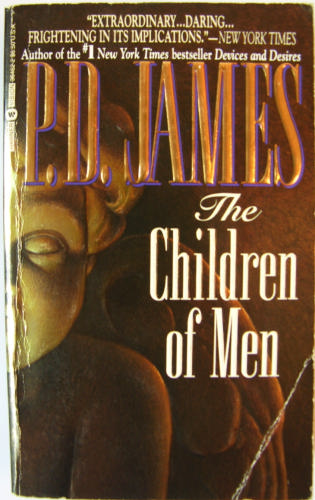
Children of Men': Opportunity lost
By CHARLES COLSON


Published: January 25, 2007

Twelve years ago, I spoke about a novel by P. D. James titled The Children of Men. I said then, "P. D. James ... seems to be warning us that we might just destroy ourselves from within-if we continue to embrace a culture of death." It was a great book.

I wish I could say as much for the new movie version of Children of Men. Its story and themes are so completely different, it's just like somebody set out to make a movie of Adam Smith's famous The Wealth of Nations, the conservative book, and wound up making instead Karl Marx's Das Kapital.

The premise is the same between P. D. James's book and this movie: For no clear reason, infertility strikes the entire world. The story is set among what appears to be the last human generation, until one woman inexplicably finds herself pregnant and has to flee to protect her child.

But there all similarities end. James's insightful tale-a "Christian fable," as she called it-has been transformed into something unrecognizable. The Christian faith that was central has all but vanished. Many once-Christian characters now talk in a mixture of obscenities and Buddhist chants.

But that's not the half of it. Infertility, the blight on humanity, is little more than a side issue. Director Alfonso CuarÓn and his screenwriting team have hijacked the story to score political points, making it mostly about crackdowns on illegal immigration and terrorism. (It couldn't have been easy to take potshots at the Bush administration in a movie set in Britain in 2027, but somehow Cuarón manages it.) Even when the miracle child is born, the warring factions of the population take one quick break to honor her before getting back to wiping each other out.

Why would the adapters of this story do such a thing? Well, as I said, they wanted to make their own political statement. But it goes deeper than that. Listen to what James wrote in her wonderful novel:

"Pornography and sexual violence ... had increased and become more explicit, but less and less in the West we made love and bred children. It seemed at the time a welcome development in a world grossly polluted by over-population. ... We thought we knew the reasons, that the fall [in fertility rates] was deliberate, a result of more liberal attitudes to birth control and abortion, the postponement of pregnancy. ... But as I remember it, no one suggested that the [actual] fertility of the human race was dramatically changing."

Now, how many in Hollywood want to make a movie about how sexual hedonism and the devaluing of human life could play a role in our own destruction? Much more palatable to make the story into just another swipe at conservatives.

The film has earned critical praise, but to me it represents an opportunity lost and a perversion. It has become just another chance for the entertainment industry to proclaim, "It's the rest of the world that's the problem; any way we want to live is just fine." Poignantly and ironically, that's the exact attitude that P. D. James portrayed as leading to the end of umanity.

Here's my advice: Obviously, skip the movie, and instead, read The Children of Men. The worldview behind the work makes a world of difference.

Copyright (c) 2007 Prison Fellowship. Used with permission.


Wes Miller scored just four points against Duke,
but he had an enormous impact on the game.

Senior Moments:

By Adam Lucas

Feb. 8, 2007

Wes Miller is having a moment.

An hour after Carolina had dispatched Duke 79-73 at Cameron Indoor Stadium, Wes Miller was lugging his travel bag to the Tar Heel bus. To get there, he had to walk across Coach K Court.

He was intercepted by his family and girlfriend. They hugged and they high-fived, not necessarily in that order.

Photographer extraordinaire John Lyon happened to walk by, and he snapped a photo of the happy Millers. Their toes were just touching the center jump circle with the royal blue "D." Their arms were around each other. And they were smiling--broadly.

The moment made you want to run down to Miller and make sure he soaked it in for just a second longer. For the next 50 years, he'll look at that picture and remember the night he closed out his Cameron Indoor Stadium career with a victory. Can you imagine what that would feel like?

He almost didn't get that feeling. Down 50-41 with 14 minutes to play, it's OK to admit that you didn't believe. All day, this game had been looming with a curious sense of excitement and dread.

Excitement, because it was Duke. Because Carolina won in Durham last year when no one believed it was possible and because this was a chance for a 2-game winning streak in the rivalry and because it was an opportunity to deepen Duke's misery by sending them to a three-game losing streak overall. And because you looked at these two teams on paper, compared the stats and the rosters and the results, and you thought, "We can't lose to them." And you smiled, because you were confident.

But not confident enough to jinx anything, of course.

Dread, because, well, it was Duke. They are tough and they are gritty and they make everything difficult. They play good defense and they dive for loose balls and they slow the tempo. And you looked at all the close games they had played and the imposing specter of Cameron Indoor Stadium, and you thought, "We can't lose to them." And you grimaced, because you were nervous.


But not nervous enough to be scared of those dastardly Dukies, of course.

But at 50-41, it was time to stop being nervous and start shouting. It was time for these Tar Heels to decide if they were content to be a very talented group of basketball players that won some games or if they wanted to be a winning basketball team.

"It was time," Bobby Frasor said, "to get down and dirty."

Exactly. This is the lineup Roy Williams deployed: Frasor, Tyler Hansbrough, Marcus Ginyard, Reyshawn Terry, and Miller. That is perhaps the slowest, shortest, least athletic lineup Carolina has available.

It also was the most effective.

Understand that this season has been difficult for Miller. He is a good shooter who for some reason is shooting 28.8% from the 3-point line. That is not how the storybook senior season is supposed to go.

About three weeks ago, he made a commitment to himself: no matter what was happening with his shot, when he got into the game he was going to play the type of vigorous defense that turns games around. He was going to move his feet, clap his hands, and be an all-around pest.

That is what he wanted to do to Greg Paulus.

"I wanted to bother him," Miller said. "I didn't want him to feel like he could make a pass without thinking twice about it. I didn't want anything to be easy for him."

To that point, Paulus was 4-for-9 with 13 points.

He would hit just one of his last eight field goal attempts.

The storyline will be that Paulus was fatigued. Does anyone ever think to ask how he got that way? The answer is simple--defense. Intense, game-changing defense.

This is why we keep watching sports. Because on a court with remarkable raw talent, with future NBA Draft picks battling at almost every position and even holding down a few spots on the bench, it was the (allegedly) 5-foot-11 Miller who changed the game.

"They were playing such hard defense," said Ty Lawson, who watched from the bench and then returned refreshed later in the half. "We needed everyone to play defense the way Wes, Bobby, and Marcus were playing defense. They took Duke's guards out of the game." Lawson would be the beneficiary of that defense. By the time he returned to the game, the gap had tightened and the Carolina spark was reignited.

Eventually, the Tar Heels would push the lead to 75-70 with 11 seconds left. Hansbrough was on the free throw line for two shots, and he converted them both. They were the shots that basically sealed Duke's fate, and they led to a Carolina timeout.

As he walked to the Tar Heel huddle, Miller almost let a smile cross his face. Instead, he settled for just pumping his fists, shouting, "Yeah!"

"It was such an indescribable feeling," he would say moments later. "There are no words to describe what it's like to come into this hostile environment and win. It's one of the greatest thing about being a college basketball player. This was my last time at Duke, and I went out with two wins. It feels..."

His words trailed off, like he wasn't sure he could do his feelings justice.

"Amazing. It feels amazing."

So maybe it was wrong. Maybe Wes Miller wasn't having just one moment.

Maybe he just had a whole night of them.

Adam Lucas's third book on Carolina basketball, The Best Game Ever, chronicles the 1957 national championship season and is available now. His previous books include Going Home Again, focusing on Roy Williams's return to Carolina, and Led By Their Dreams, a collaboration with Steve Kirschner and Matt Bowers on the 2005 championship team.

Wednesday, February 07, 2007


Highly rated prospect Marvin Austin
picks North Carolina


By Christopher Lawlor, USA TODAY


Nattily dressed in a black pin-striped suit with his dreadlocks in a ponytail and carrying an attaché, USA TODAY's Defensive Player of the Year from Ballou High made his first important decision.

"I'm a Tar Heel," he told a national television audience announcing he'd signed a binding national letter-of-intent to play football at the University of North Carolina.

Austin's decision to attend North Carolina boosted the Tar Heels to third among Atlantic Coast Conference schools, according to CSTV's recruiting analyst Tom Lemming.

"You have no idea the importance of this signing," Lemming said. "Marvin gives (North) Carolina instant credibility in recruiting circles, boding well for its future."

When North Carolina finished 3-9 last season, coach John Bunting was fired and former Cleveland Browns head coach Butch Davis was hired.

"When I visited there (in December), even their defensive linemen said 'we need you to help us get better,'" said Austin, a 6-3, 300-pound lineman. "I see this as a new beginning for me and North Carolina.

"Football is easy for me, I'm naturally blessed physically and mentally, but academics and socially it was the right choice," he said.

When Austin weighed his college options — he also considered Florida State, Tennessee and Maryland — proximity to home, academics, social and assistant coach John Blake, who was hired away from Nebraska in December.

Austin instantly connected with Blake "spiritually."

"He quoted Bible verses, spoke about how to invest money and knew I'd learn a lot about life and football. We have a father-son relationship," Austin said.

Ballou, located in a hardscrabble neighborhood, was Austin's second high school in four years. Last summer, he transferred from Coolidge following coach Moses Ware, who was hired at Ballou after being an assistant at Coolidge. Austin's addition to an existing solid core of returning players helped Ballou capture its first District of Columbia public school championship in November, beating Dunbar 34-33.

Ware said, "Marvin did his homework on schools, he did a thorough job. He checked everything from graduation rates to how he'd fit socially at a school."

Signing day also signaled a victory for Ballou as 10 of its 14 seniors will play in college. Austin's teammate Lamar Milstead, a 6-5, 275-pound offensive lineman became his ACC rival Wednesday when he signed with Virginia.

"Marvin's the great teammate always boosting up others," he said. "But now we'll line up against each other. I'll be ready."
http://img.slate.com/media/1/123125/2098815/2134319/2134320/060117_int_BauerEX.jpg
In Defense of '24'
An Arab-American defends the real-life Bauers.

BY EMILIO KARIM DABUL
Wednesday, February 7, 2007 12:01 a.m. EST

I am an Arab-American as well as a fan of "24." The two things are not mutually exclusive, despite what the Council on American Islamic Relations (CAIR) and other such groups have to say about this season's opening episodes possibly increasing anti-Muslim and anti-Arab prejudice in American society.

Most of the terrorists represented in "24" through the years have been Arab Muslims. Why? Well, probably because most terrorists today are, in fact, Arab Muslims. As a descendant of Syrian Muslims, I am very well aware that the majority of Muslims world-wide are peaceful, hard working, and law abiding. That still does not change the fact that the greatest terrorist threat to the U.S. today comes not from the ETA, the IRA, etc., but from one group: Islamic terrorists.

And this is what makes "24" a compelling drama every week. Instead of pretending Islamic terrorists don't exist, the show presents frighteningly real worst-case scenarios perpetrated by Osama bin Laden's followers. So CAIR thinks it's over the top for the terrorists in "24" to blow up Los Angeles with a nuke? Please, if bin Laden and his crew had nukes, most of us would be way too dead to argue over such points.

There is a dangerous trend in the U.S. today that involves skirting the truth at the risk of offending any individual or group. When Bill Cosby talks to African-Americans about self-respect and responsibility, and says publicly what many have been saying privately for years, he's branded a "reactionary," "misinformed," "judgmental," and so on. When "24" confronts America's worst fears about al Qaeda--whose goal remains to kill as many Americans as possible whenever possible--the show is said to be guilty of fueling anti-Muslim and anti-Arab prejudice.

Well, here's the hard, cold truth: When Islamic terrorists stop being a threat to America's survival, viewers will lose interest in "24," because it will have lost its relevancy. Until such time, I will continue to watch "24"--because, believe it or not, the idea that there are Jack Bauers out there in real life risking their lives to save ours does mean something to me.

And as for "24" causing a possible backlash against Muslims and Arab-Americans, where's the evidence of that? The show is now in its sixth season and there hasn't been one recorded incident of any viewer ever slurring or attacking any Muslim or Arab-American because of something that happened on the show. More to the point, in the latest episode President Palmer stated, "The American Muslim community is the greatest line of defense against these terrorists." He advocates strengthening ties with Islamic leaders across the U.S., and is opposed to measures that would in any way infringe upon the constitutional rights of Arab Americans.

That said, I would certainly welcome more characters in movies, TV programs and novels who reflect the overall Arab-American experience. Truth is, most of us don't have bomb-making skills or a desire to become human missiles. And there are Muslim and Arab-American CTU heroes out there, as well as doctors, superdads, women scientists, etc. But just as it took Saul Bellow to give literary voice to the Jewish-American experience, we need our own storytellers to weave the pastiche of tales that make up Arab-American life.

In the meantime, the next time a journalist decides to report on Arab-American concerns about shows like "24," maybe he could actually talk to someone other than CAIR and the Muslim Public Affairs Council, and seek out Arab-Americans with a different point of view. We actually do exist.

And maybe that same reporter could take a closer look at CAIR. Ask CAIR about the Holy Land Foundation and its support of Hamas. Ask it about the 1993 World Trade Center bombing and the CAIR board member who was named as an unindicted co-conspirator in that case--yet still sits on CAIR's board. Look a little closer, and maybe you'll find that CAIR has good reason to get nervous about shows like "24."

Because terrorists and their supporters continue to hide among us in plain sight, we need Jack Bauer, now more than ever.

Mr. Dabul is a free-lance writer and the author of "Deadline," a novel about modern terrorism.

http://www.moonbattery.com/archives/GOREZILLA.jpg
Bad Research, Worse Reporting on Global Warming
By Dennis Byrne


February 07, 2007

In trying to prove that the Bush administration is throttling research into global warming, the Union of Concerned Scientists rolled out some breathtakingly bad science.

The group unveiled a supposedly scientific survey of more than 1,600 federal climate scientists as evidence that the administration was engaged in "wide-ranging political interference in research related to global warming."

"The new evidence shows that political interference in climate science is no longer a series of isolated incidents but a system-wide epidemic," Dr. Francesca Grifo, Director of the UCS Scientific Integrity Program, said in a press release. "Tailoring scientific fact for political purposes has become a problem across many federal science agencies."

Grifo obviously doesn't' appreciate the irony when he trots out a poll that is so flawed that it is manifest evidence of exaggeration, incompetence or dishonesty on his group's part.

You don't have to be a social scientist to understand that the survey was deceptive, for example, when it lumped into the same category scientists who said they actually experienced the alleged tampering and scientists who simply "perceived" that it happened to someone else. For example, the group's press release said "Forty-three percent of respondents reported they had perceived or personally experienced changes or edits during review of their work that changed the meaning of their scientific findings." But turn to the study's appendix, and you'll find that only 15 percent of the respondents said that they had actually experienced such interference.

Other examples abound: 43 percent perceived or experienced "fear of retaliation for openly expressing concerns about climate change outside my agency." Actually, only 14 percent personally harbored such a fear; the other 29 percent apparently thought they saw it in others. Notice, the question didn't ask how many actually experienced retaliation, instead of just fearing it.

When the survey finally got around to asking how many scientists actually received "requests by officials for scientists to provide incomplete, inaccurate, or misleading information to the public," only 12 scientists (4 percent of respondents) did. Let's see, 12 out of the 1,630 scientists who received the survey amounts an underwhelming 0.7 percent. Hardly the kind of statistic that supports the claim of a "wide-spread epidemic" of interference.

Explaining the problem in more detail was the Statistical Assessment Service (STATS), a non-partisan a watchdog at George Mason University that tries to correct misinformation in the media springing from bad science, politics or ignorance.

STATS said that by lumping together scientists who actually experienced interference with those who only perceived it, the survey "creates a statistical phenomenon that artificially inflates the impression of a hostile work environment. Consider an agency that contains 10 scientists. One tells the other nine that he has encountered interference. When they are surveyed, all ten report that they have 'perceived in others and/or personally experienced' interference. So one act of interference is counted as ten acts that are 'perceived' or 'experienced'; ten percent of the scientists have been interfered with, but 100 percent report 'perceiving in others and' or personally' experiencing interference. If the agency contains 100 scientists, the interference experienced by one becomes 'perceived' interference by the other 99, and so forth."

The survey's "most obvious problem" STATS said, was the low response rate of 17 percent. "This means we don't know the views and experiences of the other 83 percent...Any professional survey researcher...will tell you that a 17 percent response rate is inadequate to draw conclusions about the group being surveyed, in the absence of other information demonstrating that the sample is representative." STATS quotes Harris Poll chairman Humphrey Taylor as saying a small response rate is more damaging than a small sample, noting that many peer-reviewed academic journals will not accept papers relying on samples smaller than 50 percent.

The survey also may be infected with a "selection bias," meaning that "the scientists who took the time and effort to fill out and return the questionnaire might be precisely those most upset about perceived interference."

STATS also refers to "a great deal of social science evidence" that such perceptions often are wrong. "The tendency to believe that others will be influenced by forces to which we ourselves are immune (e.g., by misleading advertising or partisan rhetoric) is so common that sociologists have a name for it--the 'third person effect.'"

"Finally," STATS said, "the researchers assume that all these responses refer to officials' efforts to alter certain kinds of findings about global warming. But that is not specified in the questionnaire." For example, a scientist could find a change in working conditions without it having anything to do with global warming.

The original research was bad enough, but the reporting of it was horrendous. No telling where NBC's Andrea Mitchell got the figure that "nearly half [the scientists] were pressured to eliminate the words' climate change' or 'global warming,' but it clearly wasn't from the survey, which said no such thing. Not to be outdone in the patently wrong department, the New York Times reported that 60 percent of the scientists "personally experienced" interference. ABC's Jake Tapper said, "scientists say their work on global warming has been watered down and twisted by the White House..." even though such hyperbole is not a conclusion warranted by the survey.

Naturally, editorial writers, egged on by faulty science and faulty reporting, raised the usual alarms, such as the Minneapolis Star Tribune's "Bush's blatant abuse of climate scientists."

One explanation for such appalling journalism is the industry's willingness to be spoon-fed by the likes of Rep. Henry Waxman (D-Calif.), who gladly sanctified the bad science by giving it a platform on his Committee on Oversight and Government Reform. "It appears there may have been an orchestrated campaign to mislead the public about climate change," Waxman said.

And if anything makes Bush look bad, some in the media will show up. Like NBC's Brian Williams, for example, who intoned on his nightly newscast: "The question in Washington was this: did the Bush administration...try to cook the books on the topic of global warming?"

Of course, scientists ought not be pressured or made to change their research to suit a political or ideological agenda. I wouldn't be surprised if someone, somewhere down the line tried, but I also don't buy the whining by some scientists about how delays in the "release of websites, press releases, reports, or other science-based materials" demonstrated some sort of conspiracy to shut them up. What do they think, that they're not working in a government bureaucracy?

I'm not surprised, but I can't excuse, how the Union of Concerned Scientists, the inexhaustibly liberal and self-appointed guardians of scientific purity, can try to corrupt science for its own ends. But I never can get over how so many of my media colleagues allow themselves to be so easily manipulated by junk science.

Dennis Byrne, a Chicago writer, is a former Russell Sage Fellow in Social Science Writing at the University of Wisconsin at Madison. http://dennisbyrne.blogspot.com

Tuesday, February 06, 2007

http://files.blog-city.com/files/O05/150158/p/f/ronald_reagan_1.jpg
From Newsday.com:

As time goes by, Reagan looks like a giant
James P. Pinkerton


February 6, 2007

As with any historical figure, Ronald Reagan's reputation has been riding both the up escalator and the down escalator.

But it's interesting today, on what would have been the 40th president's 96th birthday, to note that Reagan is being increasingly praised by onetime enemies and increasingly criticized by ostensible friends - who at least call themselves conservatives.

For most of Reagan's life and career, the liberal/media establishment contented itself with phrases such as "right-wing cowboy" and "amiable dunce" to describe the Gipper.

But now, the judgment is changing. For example, Peggy Noonan, writing in The Wall Street Journal, quoted Leslie Stahl as admiring Reagan's "gallantry." Stahl, who covered Reagan for CBS News, certainly rarely had anything nice to say about him when he was in office. But in the nearly two decades since, even many liberals have admitted that Reagan's leadership succeeded in the Cold War against the Soviet Union and in the economic war against inflation and economic "malaise."

And now comes an approving book from John Patrick Diggins, well-known historian of the left, "Ronald Reagan: Fate, Freedom and the Making of History," which argues that Reagan "deserves to be regarded as one of our three or four greatest presidents."

Diggins lauds Reagan for ending the nuclear arms race and moving America away from welfare-state dependency, but then he takes his praise in a direction many traditional Reaganites might not agree with: "Far from being a conservative, Reagan was the great liberating spirit of modern American history, a political romantic impatient with the status quo."

The author is on to something. Reagan, after all, declared many times on the stump that Americans "have the power to begin the world over again" - not exactly a conservative thought. In fact, Reagan was a New Dealer back in the '30s and '40s; as he often said, he didn't leave the Democratic Party, the Democratic Party left him. So Diggins' book will make some conservatives uncomfortable - precisely because the author has articulated an additional facet of Reagan's persona.

But that's the way it goes with the great actors of history. On the occasion of Abraham Lincoln's death in 1865, Secretary of War Edwin Stanton declared, "Now he belongs to the ages." Stanton might have said, "Now he belongs to the historians" - who have been writing about Lincoln ever since. And so it goes, as well, for Reagan, who died in 2004.

Interestingly, many "friends" of Reagan have turned into ex-friends. One such is the prominent neoconservative Norman Podhoretz. As early as 1983, he accused Reagan of "appeasement by any other name" - this being the same year that Reagan announced the Strategic Defense Initiative.

But the neocons have their specific reason for disliking Reagan: They accuse him of being weak in the Middle East. The clearest statement of this view has come from Secretary of State Condoleezza Rice, who said back in 2003, "The terrorists declared war on America ... many years before Sept. 11, 2001." She cited, among other incidents, "the attack on the Marine barracks in Lebanon in 1983, the hijacking of the Achille Lauro in 1985, the bombing of Pan Am 103 in 1988" - all of which occurred during the Reagan presidency. Yet, Rice continued, until the George W. Bush administration, "the terrorists faced no sustained, systematic and global response."

These days, of course, the wisdom of the Bush administration's "response" to terrorism - specifically, the Iraq war - is under, shall we say, close scrutiny. And so maybe Reagan's response doesn't look so bad in comparison. Nobody thinks of his Marine mission to Lebanon as a success, but at least the Gipper knew when to cut his losses.

So happy birthday, Mr. President. You've gone up to that Great Ranch in the Sky, leaving liberals to like you more and some conservatives to like you less. But this onetime staffer of yours - and forever an admirer - sees you as the gold standard for presidents.

Copyright 2007 AP
Busch Series championship driver, Sam Ard, drives short trips to the store for his wife and when he goes his dog "Putt Putt" is always with him, Thursday, Jan. 11, 2007, in Pamplico, S.C. Unlike veterans of other sports, Sam Ard has no pension to fall back on. (AP Photo/Mary Ann Chastain)

Without Pension, NASCAR Stars Forgotten
By JENNA FRYER


PAMPLICO, S.C. — The living room of Sam Ard's brown doublewide trailer speaks to his short but successful NASCAR career. Trophies surround the fireplace and crowd its mantel. Plaques and pictures dot the living room walls. What's not there speaks to Ard's life after NASCAR, the two championship rings and a handful of grandfather clocks from Martinsville Speedway that he sold because "we was running short on cash." Unlike veterans of other sports, Ard has no pension to fall back on.

As the booming stock-car series built by men such as Sam Ard heads to Daytona International Speedway this week to kick off its 59th season, NASCAR remains the only major-league sport without a pension plan.

"You can drive for NASCAR, but when it's over, it's over. You get nothing," Ard said. "When you fall out of racing or something happens to you, it seems like NASCAR just forgets about you. It's your friends and the people around the race track who have to remember you and keep you going."

Other leagues have pensions. Today's 10-year veterans in baseball will receive a six-figure annual payout beginning at age 62. Even middle-of-the-road professional golfers can pile up millions under the PGA Tour's deferred-compensation plan, which puts money away for players based on performance.

An NFL player with six seasons between 1998 and 2003 will get about $2,500 a month beginning at age 55, and the NBA has a similar plan. The NHL contributes about $45,000 per year to retirement accounts for veterans. The ATP and WTA tours make annual contributions averaging between $7,500 and $9,500 to retirement accounts for each tennis player.

NASCAR's policy always has been that its drivers are "independent contractors" who bear full responsibility for their finances, health care, retirement and life insurance.

Few in NASCAR are arguing for a fund to help today's drivers, who make millions from team contracts and even more from race purses and merchandise sales. Jeff Gordon, the sport's all-time money leader, has won a record $82,366,716 through 14 full seasons and isn't sure what the responsibility should be.

"We don't want to make NASCAR go broke like some other companies out there with pension plans have done," said the four-time Nextel Cup champion. "We all need to be responsible for our actions."

But if NASCAR wants to compete with other major sports, Gordon said drivers are going to ask for similar benefits.

"We are now competing with the NFL, basketball, the NHL," Gordon said. "And so, should we be compared to them on every level? And when it comes to this subject, there is no comparison. I mean, I don't even think we are on the board."

Old-timers have lobbied for years for some sort of fund to help repay the men, like Ard, who contributed to the sport and now are struggling to make ends meet.

"It would almost cost nothing," said Jack Ingram, the 1985 Busch champion. "It wouldn't be many people that's not wealthy that contributed a lot to this sport, but they're ... destitute. (Ard's) a NASCAR champion; he's living in a trailer house. It shouldn't be that way."

Ard, two-time Busch Series champion, has Alzheimer's. Jo, his wife of 46 years, has a degenerative eye disease that's slowly stealing her sight.

Between Social Security, Sam's veterans benefits and what Jo picks up cleaning houses, the Ards bring in roughly $1,600 a month. After the mortgage payment of $426.96, car insurance on Ard's 1993 Ford Ranger, utilities, phone and cable, there's only about $123 left.

They don't advertise their problems or complain. Even so, individual members of the NASCAR community have stepped up to help.

From the desk near the fireplace Jo Ard pulls out a letter from Dale Earnhardt Jr. and Kevin Harvick that circulated through the NASCAR community late last year and recently was forwarded to her. She's a proud woman, so showing it to a stranger isn't easy.

"To All:

"Many of you may not be aware that one of NASCAR's pioneers and champion, Sam Ard, is in very poor health and dire straits. ... If it wasn't for men like Sam, none of us would be able to enjoy the lifestyle we live today. We all do charity work and give back to the community, this time it's one of our own."

If Jo Ard had her way, the letter wouldn't exist, and she and her beloved "Sammy" wouldn't need handouts.

Although some inside NASCAR - specifically president Mike Helton and spokesman Jim Hunter - have given financial assistance on a case-by-case basis, they aren't prepared to fund a pension.

"I think the biggest detriment to a pension plan, aside from the fact that they are not NASCAR employees, is trying to decide who would pay for it and what the eligibility factors would be," Hunter said. "How many years would you go back? To 1948? Or would you start in the 50s? Or the 60s? Or the 70s? There's a lot of issues that would need to be figured out."

Tony Stewart, a two-time Cup champion who routinely dips into his own pocket to quietly support the old-timers, believes NASCAR could do more to help.

"I'm not going to say they have the responsibility, but it'd sure be nice," Stewart said.

Part of the problem is there's no way to gauge how many drivers are in need, or who would be eligible if a plan existed.

The independent-contractor model isn't unique to NASCAR and is followed in almost every form of motorsports. Unlike crew members who work for teams that provide full benefits and 401(k)s, drivers are on their own.

"Those are the rules going in, and we all know it," said two-time Daytona 500 winner Michael Waltrip. "I don't think you can find any driver that, if you put a NASCAR ride in front of him, would say, 'Wait, this doesn't come with a pension plan? No retirement fund? No insurance? No thanks. I'm not interested.'

"No driver in their right mind would walk away."

That includes Ard.

Like so many drivers from NASCAR's early days, Ard didn't get rich racing. His three seasons netted $378,765, and Ard got only 25 percent of it. He also was responsible for paying his crew and their food and lodging expenses on the road.

"Them boys don't know what it's all about," Ard said. "Shoot, I used to build my cars, haul 'em to the race track, race 'em, then haul 'em back home. Now all they do is show up and sit in a hauler until it's time to get in the car, then they go out on the race track and make a boatload of money along the way.

"I'd like to go racing again like that."

Ard hasn't raced since suffering severe head trauma in a 1984 accident at North Carolina Speedway. He had to learn how to walk and talk and feed himself, and did much of his therapy on an old sawdust pile near the woods behind his house.

"That's where I learned how to walk again, I'd run up and down that sawdust pile because if I fell, it didn't hurt," he said. "I about wore that sawdust pile out."

Before the accident, Ard seemingly had the perfect life. A job as a Ford mechanic and a four-year Air Force stint gave him the financial security to quit the 9-to-5 grind and focus strictly on racing.

In his early 40s, he had enough money put away for all four children to attend college and had the talent for a successful NASCAR career.

It ended the moment he hit the wall at Rockingham.

Race car drivers had a hard time getting insurance back then, and car owner Howard Thomas wasn't on the hook for anything. NASCAR covered all of Ard's medical bills, but he never again had a consistent income.

First, the Ards used the college funds to pay everyday living expenses. Then they went into debt.

Ard tried to run his own race team, but with so-so results.

"I hear people all the time say Sammy wasn't right, he didn't know what he was doing," Jo Ard said. "Of course he wasn't right. He had major head trauma; his brain was broken. He was never going to be right again."

Now Ard spends most of his days sitting in the recliner next to the front window of his trailer. He watches NASCAR - Dale Jr. is his favorite - and spends a lot of time with his beloved dog, Putt-Putt, a fiercely protective mix of boxer and pit bull.

Although Ard can remember details from his career - like beating the late Dale Earnhardt to the finish at Charlotte Motor Speedway while Earnhardt Jr. was at the track celebrating his 9th birthday - Jo can't send him to the grocery store without an explicit list. Even then, she has to cross her fingers and hope he hasn't forgotten where he put the list.

With a short Busch career and only one Cup start, Sam Ard never was considered one of NASCAR's superstars.

But his three seasons as a full-time racer were stellar. He finished second in the 1982 Busch standings and then won consecutive championships in 1983 and 1984. He earned his first title by winning 10 races - a record that stands today.

Harvick furiously chased Ard's record last season. He fell one win short, but brought attention to Ard's plight in the process.

After the Ards wrote NASCAR asking for $24,000 to help pay off their trailer, NASCAR and Richmond International Raceway held an auction that raised $36,000 before taxes ate up a chunk of the money.

But Harvick, who has never met Ard but knows about his legacy because his wife, DeLana, grew up rooting for him, couldn't shake the need to do more. So he got together with Earnhardt Jr. to raise money from other drivers. Neither told Ard they were responsible - even after anonymously dropping "a good amount" of money into the Sam Ard Care Fund.

"You look at a lot of these guys who have raced and made our sport what it is today, and they don't have anything," Harvick said. "We are reaping the benefits from their aches and pains, the things that they did several years ago, and it's really not fair to leave them hanging. It just kind of rubs me the wrong way."

A lot of drivers feel a responsibility to the men who came before them and would welcome a system to honor and aid them.

"Jack Ingram, Sam Ard, Bobby Allison - those guys created an excitement about our sport that has made it wonderful, and I think we have to be careful as a generation to make sure we don't forget that," said Jeff Burton. "One of the things that I think should fall on the shoulders of all the current drivers is that we need to leave the sport better than it was when we got here. Because they damn sure did."